Monthly Archives: July 2022
Review: Final Fantasy 7 Remake
I completed Final Fantasy 7 Remake (FF7R) over the weekend. Astute readers will recall that this is a full two months since I originally purchased it. Considering how giddy I was when I started, you might wonder why it took that long to play through… approximately 25 hours of game. The reason? What I wrote about in my final paragraph of the first impression post:
Anyway, not going to let a little thing like a combat system interrupt my JRPG nostalgerbation. I am going to assume it gets better, or that I can change things around enough to make it so, or that it will not diminish the rest of the experience. Which would be quite the feat considering how much I am enjoying myself already just walking around.
Let’s just say the game devs indeed achieved that ignoble feat.
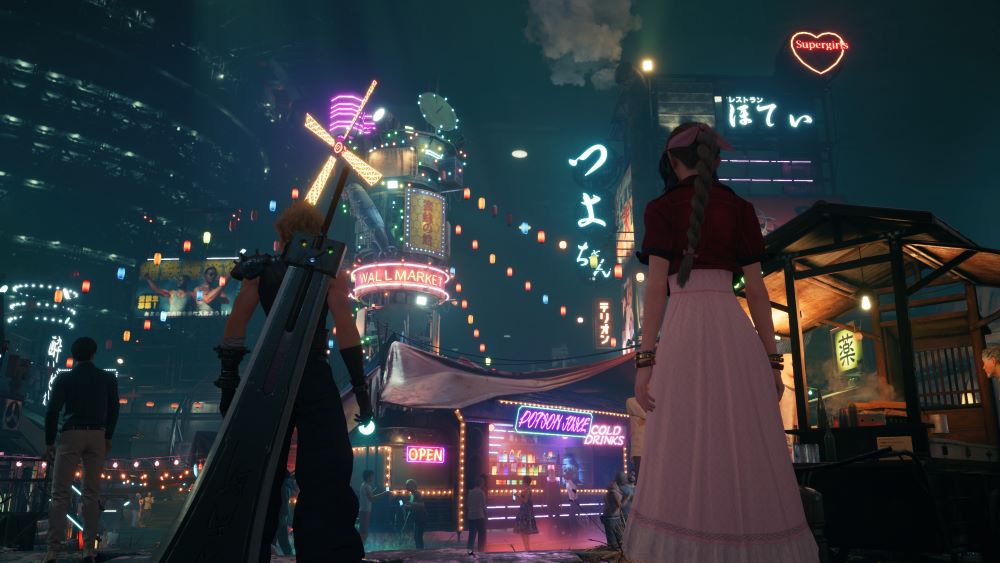
Before I get started, it is important to know that I love that this game exists. The original FF7 was groundbreaking in a lot of ways, including ushering in the era of mainstream RPGs, and seeing Cloud and Aerith and Midgard again is a goddamn magical experience to me. Looking at screenshots from the original game today makes you question whether your memories from 25 years ago are suspect. But watching the gang walk around the Sector 7 slums or the Shinra tower? The graphics on my screen right now in FF7R are what my mind saw back then, like some kind of reverse déjà vu.
I say this for two reasons. The first is to establish my inherent bias. The second is because if you are also a fan of the original game, I would suspect that you will feel similarly.
If you are not a fan of the original or never played it… well, it’s hard to recommend FF7R at all.
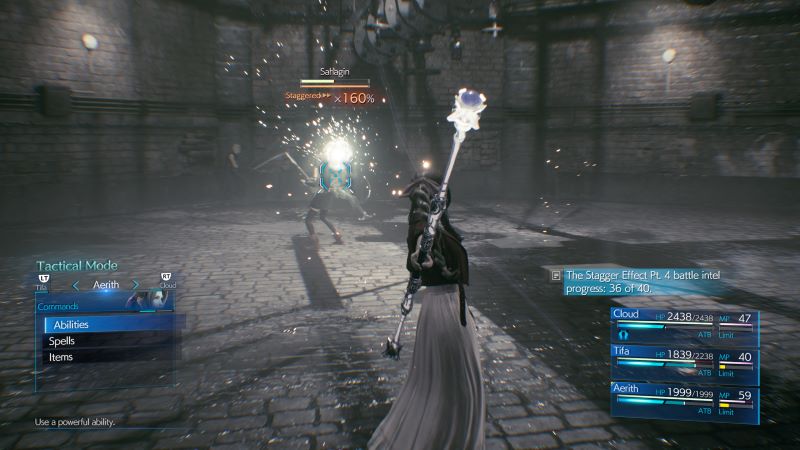
The short version is that the combat system is hot garbage. I thought I had been doing things wrong somehow, but nope, it’s really that bad. And by “bad” I mean unintuitive and punishing to a frustrating degree. I played the whole game on Normal difficulty, so perhaps things are better on Easy.
During combat you control one character (of up to three) and can run around, Dodge Roll, Guard, perform light/heavy attacks by pressing/holding X, and have a character-specific move with Y. You also have an ATB gauge with two segments that slowly fills over time, and fills more quickly when you attack or Guard against attacks. Once you have at least one ATB segment filled, you can cast a Spell, use an Ability, or use an Item. You also have Limit Breaks and the ability to use Summon materia on “bigger” fights. Sound good so far?
There are a few problems that pop up right away. For one, Dodge Roll is a completely useless noob trap – it convers no invincibility-frames and doesn’t move you faster than just running. Secondly, the ATB setup rewards momentum and punishes falling behind. For example, if you take a lot of damage, the only way to heal is… to melee more mobs until you can cast Cure or use an Item. Blocking will reduce damage and technically you can run around in circles to buy time, but in both cases you are praying to survive long enough to spend your one ATB action to heal. Your other party members have their own ATB gauges and could bail you out – you can either switch to them directly or remotely command them to use an action – but their ATB accumulates much slower than the active character.
Here’s the kicker though: your ATB actions can fail. The first time it happened, I couldn’t believe it. Cloud used his Braver ability to spin around in the air and bring his sword down on… empty pavement. The enemy had walked away, not even on purpose. All abilities have to specifically target a character, so this isn’t like I accidentally pressed the wrong button on my way up to melee range. There is no range-finder indication to suggest your attack will succeed or fail, so you just sort of hope for the best. Oh, and magic works the same way. Spells like Lightning hit instantly, but Blizzard has a sort of delay where an ice crystal spawns and then explodes – if the enemy has better places to be, nothing happens. Normally these differences would result in spells dealing more or less damage based on ease of use, but that’s not the case either.
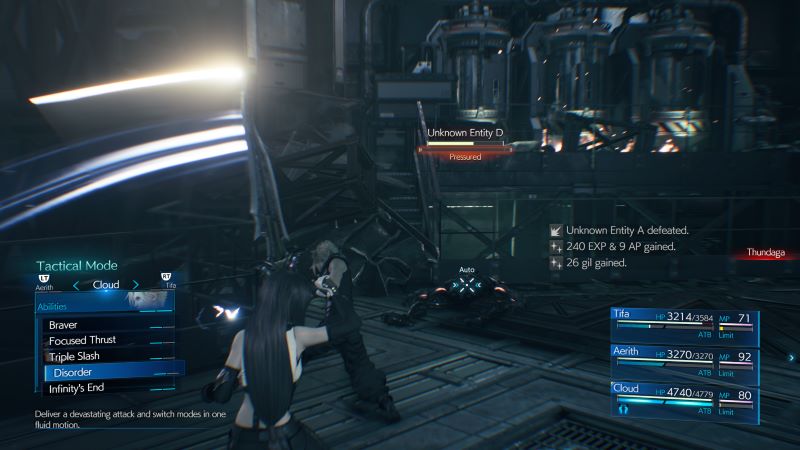
By the way, surprise! Your characters can be interrupted. If you’re casting Cure, perhaps on yourself because you’re about to die, but get hit by whatever, the spell fails (!!), you lose the ATB charge (!!?), and even the MP used to cast it (!!?!?!). Technically enemies can also be interrupted in this way, but guess what, that typically requires you to be using ATB actions… which will probably be interrupted by whatever the enemy was doing in the first place.
I’m spending a lot of time on this because it really drags down the game. Simply put, combat isn’t fun, and only gets worse over time when you face enemies who are resistant to everything but particular elemental attacks. Dungeons are big, and while there aren’t random encounters per se, you already know there are dozens of fights you have to slog through. It got to the point where I would just Save & Quit right in the middle of a dungeon and play a different game entirely for the next week. Which of course makes it more difficult to get back into the game knowing you got this shit cake waiting for you.
What really galls me about this is how the devs split the baby. I could imagine an actual action-based combat system where Dodge Rolling was used to avoid attacks, you had to aim special moves, and interrupting was an important (explained!) mechanic. Instead, we have this pseudo-action nonsense.
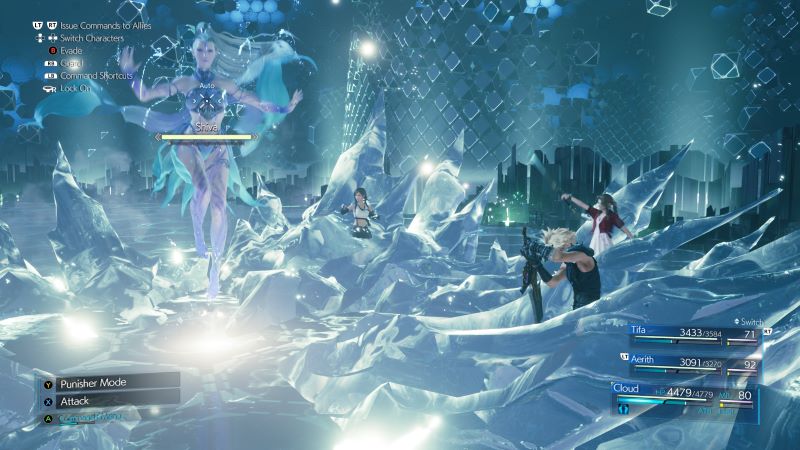
[Fake Edit] As noted, I played the entire game on Normal. There is a “Normal (Classic)” mode available (along with Easy/Easy Classic) that I tried out for a few minutes after beating the game. Classic basically means your characters will attack, defend, and run around on their own with the player basically waiting around for ATB charges and deciding what Ability or Spell to use. While I would be curious how the AI handles some of the tougher boss fights, this did seem to be a viable option for those who don’t want to spend a lot of time mashing X. However, I can confirm that your characters can still be interrupted mid-action, Abilities can still miss when the target walks away during the animation, etc.
Everything outside of combat though? Great. Fantastic, even
I’m not going to talk about the story or anything, as I appreciated the fact that I somehow avoided spoilers for years. Suffice it to say, the Remake part of the title is not a misnomer, even if the main story beats are similar. Characters are expressive and interesting. I have heard some people complain about the voice actors, but aside from Barret (a faithfully recreated caricature) and Wedge, everyone else is perfectly fine or even great. Graphics are phenomenal, and Midgard really comes to life in a big way. Managing materia is just as fun as it was 25 years ago, even though your selection is somewhat limited.
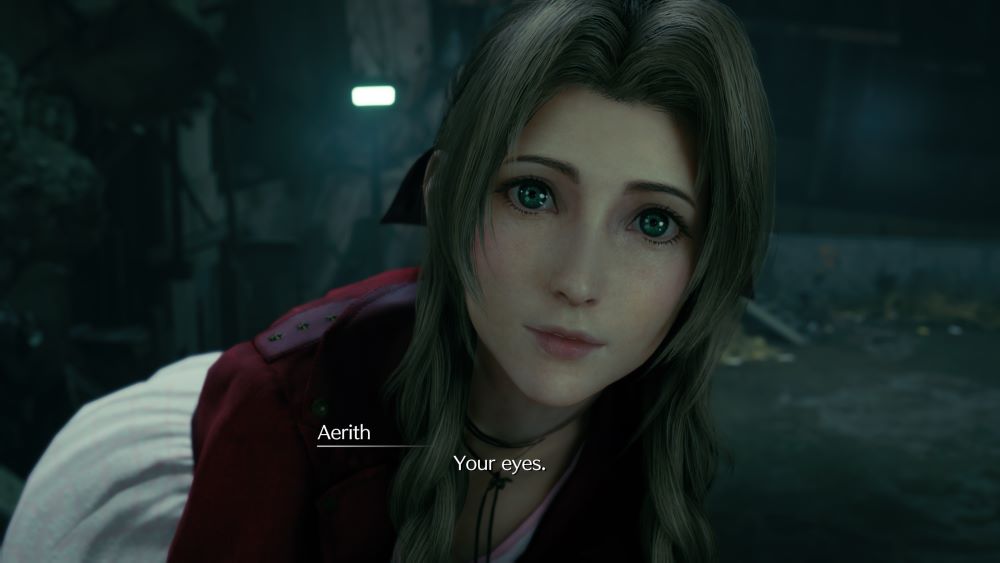
Ultimately, I am glad that Final Fantasy 7 Remake exists. That it does is a validation of decades-long adoration on my part. It’s just a goddamn shame that the combat system is so bad. Not bad enough to prevent progression, but enough to dissuade me from recommending this game to people not already invested in the experience. This will hopefully change as the next two titles come out and the plot comes closer to fruition. At which point I would likely recommend just buying the Ultima(te) edition that has all the games at once.
Impressions: Gordian Quest
Ever wonder what would happen if designers just added all the things to a game? Wonder no more.
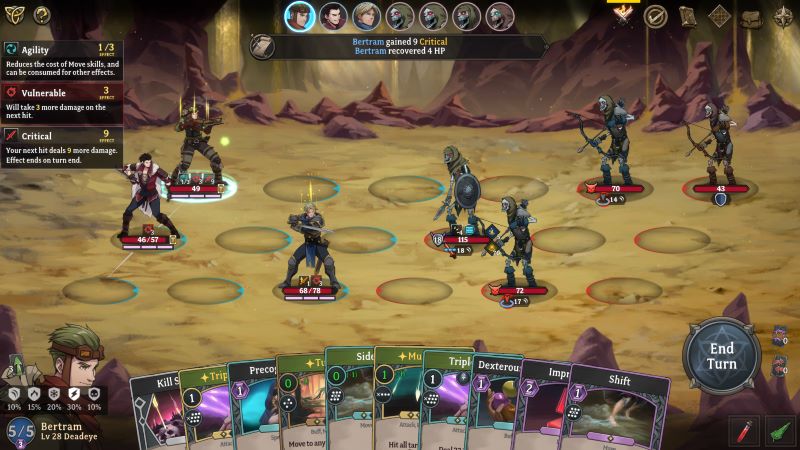
Gordian Quest is a sorta-roguelike tactical turn-based deck-building card game, with a full story campaign along with the more “traditional” roguelike modes. You control up to three characters with their own individual themed decks and battle enemies on a grid. Characters can also equip items that boost their stats or even add special cards into their decks. Those stats are important for the scaling of cards and also because there are D&D-esque skill checks occasionally. Also also, characters gain XP and level up, allowing them to place talent points on a customizable, randomized grid and expand in multiple directions. Have I mentioned there are 10 characters to choose from and each character has three distinct themes of cards that can be mixed and matched? And that items have rarity levels and randomized stats, with Legendary versions possibly opening new synergies? Oh, and items have rune slots too, which can be slotted with additional stats or special effects?
Like I said, the designers really went nuts with this one.
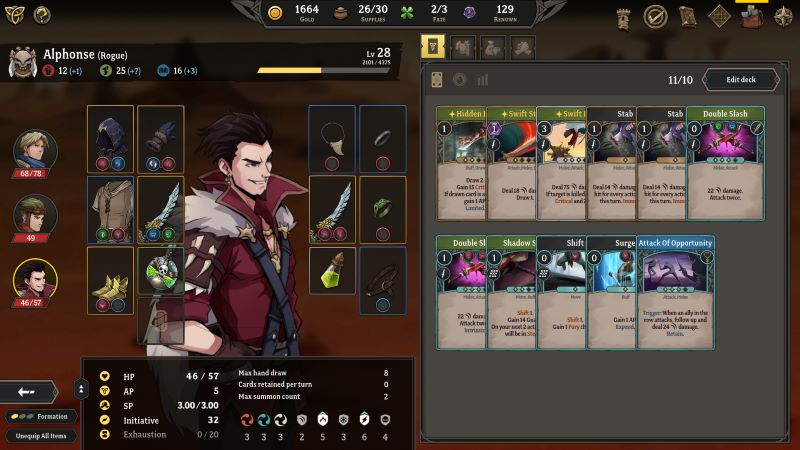
In reality, the game is mostly more coherent than I am implying. If you played Banners of Ruin, this game is basically that with some D&D and Card Hunter and FFX Sphere-Grid sprinkled in. Nothing stands out as being completely unnecessary while you’re playing, but just thinking about it now… goddamn is there a lot.
Is it fun? Yes. For a while.
Unfortunately, I basically broke the game before I finished Act 1 (of 4). Two of my characters are an archer and a rogue, with either one of them being capable of solo-murdering the entire enemy team on the first turn. If for some reason there is a straggler, the other one mops up. My third dude never actually gets to play cards at all, but if he did, he also is fairly stacked in the murder department. I had hoped that perhaps things would change once I hit Act 2 – maybe enemies would have a bunch more HP or have more Initiative to go first – but thus far that has not been the case. The only time enemies even get a turn is when they are bosses with literally 10-20x as many HP as normal, and even then they only ever get that one turn before getting melted.

The double-unfortunate thing is that breaking the game in this way was not particularly difficult. Part of that is undoubtedly due to my overall experience with deck-building games wherein winning strategies are roughly the same: prioritize increasing your per-turn draw, and keeping as few cards in your deck as possible. The other part though largely stems from what I imagine was a designer attempt at keeping things “balanced.” For example, the available talents are… boring. Even the ones all the way at the bottom of the tree. So I basically ignore all the Tier 3 talents and just pick the ones that grant +1 draw per turn and similar.
This “balance” extends to the three themes per character as well. My archer has Sharpshooter, Trapper, and Sentry schools of cards. Sharpshooter is all about damage. Trapper is about setting traps on enemy cells and cards that move enemies around (thereby forcing traps to trigger). Sentry is about setting up turrets on your side of the battlefield, boosting said turrets, and then letting them damage the enemy. You would be forgiven for assuming that Trapper and Sentry cards deal more overall damage, considering that that would make sense given the fact that they require setup. But… that’s not the case. Sharpshooter cards deal the same or more damage with no setup. And since 99% of the Trapper and Sentry cards are useless by themselves, you engineer your way to only choosing Sharpshooter cards when offered a choice, thereby increasing the average power level of your damage cards in a runaway feedback loop.

There is a bard character that is all about building up melody combos and essentially buffing the entire party so that they don’t need to worry about defense on their own turns. There is a warlock character that focuses on Bleed effects and debuffs. There is a golemancer that presumably mances golems. I haven’t even bothered trying those characters out because what’s the point? They would never get a turn. There are so many buffs, debuffs, tactical decisions, etc, that are entirely irrelevant in ways it seems impossible to make relevant without massive nerfs and a complete overhaul.
Sigh. Could this be solved by just avoiding the Archer and Rogue? Sorta. Although the Warrior and Cleric characters also have some gnarly damage cards/combos too. Could all this be addressed in a future patch? Maybe. If this was still Early Access, I would not be as concerned. Given that this is a full 1.0 release though, something tells me that they aren’t going to radically alter the way the card schools are entirely set up. And it is not as though higher difficulties can “solve” the issue either – cranking enemy HP higher and player damage lower is only going to make the currently non-viable (in comparison) strategies even more non-viable.
I suppose I will see if anything changes between now and the final boss. Assuming that I bring myself to slog through the rest of the game, like a Conquest victory in Civilization that was a forgone conclusion fifty turns ago.
Up until this point? Pretty fun though.
 In An Age
Out of this RimWorld
Jul 21
Posted by Azuriel
After hitting a lull in Final Fantasy 7 Remake motivation, I did the most logical thing possible with a $1800 prebuilt PC: reinstalled RimWorld. Admittedly, it had been a while.
While there has been two expansions released, the core experience has largely remained intact. I think the biggest thing that threw me for a loop was needing to build a wooden pen for animals. Previously, you could just “paint” an Allow zone for animals in an area, and herd them elsewhere by moving the zone. Probably a bit too abstract, sure, but it’s not as though the rest of the game is super intuitive.
The other aspect of the game that returned quickly was the demotivating sense of inevitability. And I don’t just mean those unfortunate events where the dice don’t land your way and your best sniper gets shot in the eye by a tribal with an arrow from 50m away. I mean when you hit Spacer tech and you’re starting down the charged barrel of endgame Civilization Conquest next-turning for the next dozen hours. Don’t get me wrong, there is nothing certain about Randy RNG beyond your tears… but, also, kinda yeah there is. There is a point where all you’re doing is pulling the handle, and seeing if you’ve successfully installed a bionic spine into colonist #6, or if everyone gets muscle parasites an hour before a mechanoid cluster lands inside your base.
I’m currently on the fence regarding whether I believe the expansions would help. The prevailing wisdom is that the Royalty DLC adds a lot of new content, while Ideology adds more roleplay elements. Either or both could possibly help with that inevitable feeling. I certainly have no desire to caravan across the planet and/or DIY a spaceship – I did both years ago and that was enough.
But… we’ll see. It was a craving for a survival experience that led me to reinstalling in the first place, and RimWorld isn’t that. It’s adjacent, in a way. But once you’ve had your fill, that’s that.
Posted in Commentary
1 Comment
Tags: DLC, Ennui, Inevitable, Next Turn, RimWorld