Author Archives: Azuriel
Review: Journey [PS3]
Game: Journey [PS3]
Recommended price: $20
Metacritic Score: 92
Completion Time: 2-3 hours
Buy If You Like: World peace, Justice, Art, Sand simulators
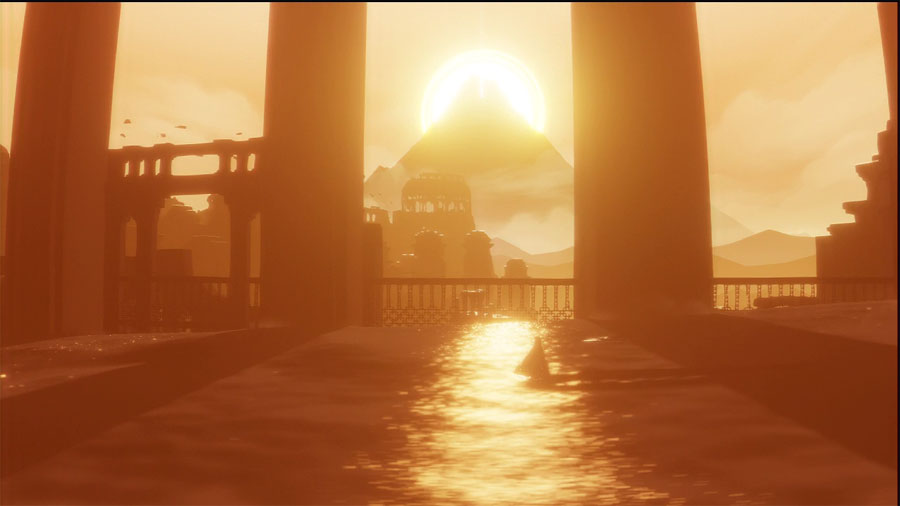
Seriously, play this game.
I do not even know where to begin with describing Journey. Perhaps the beginning? That always seems to work for most people.
Journey starts out as (and continues to be) the most impressive sand-simulator I have ever seen. Sliding down the first sand dune instantly transported me back into childhood, or at least as far as Super Mario 64. But Journey is not a platformer; it is an emotion, an experience. One that only gets more and more compelling as the minutes pass.
Describing your mechanical actions as you play the game almost feels like missing the point, but to not mention them would miss the point. Nearly every single thing about Journey is perfectly crafted. You move around with the left analog stick, and can pan the camera by either tilting the PS3 controller or using the right analog stick. In the opening desert-scape, you get some extra fabric added to your avatar’s scarf, which allows you to jump and glide for a few seconds. The only other button used is “O,” which lets out a little “energy chirp” or longer blast if held down.
That is it. There is no UI, no hearts, no power meter (aside from the scarf), nothing to distract you beyond the immensity and immediacy of the moment.
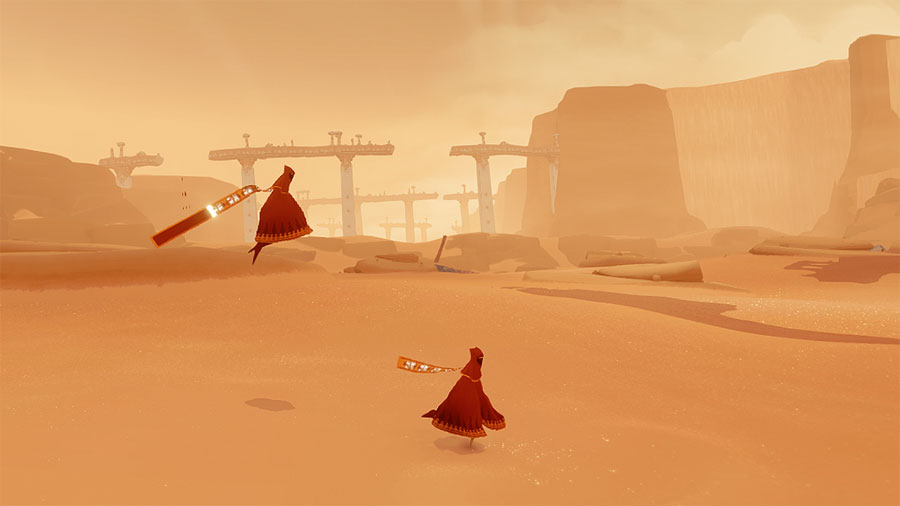
I felt more connected here than in most MMOs.
After the tutorial “level,” gamers connected to the internet will encounter perhaps the most sublimely executed feature in videogames: another human being. That sounds facetious, until you realize how often games treat other players as competitors, enemies, or judgmental peers desperately trying to foster virtual respect. Your fellow traveler in Journey is exactly that, no more, no less. Except… it is much, much more than that.
Remember when I mentioned the player’s scarf controlling the ability to jump? While there are items scattered around the landscape that add length to said scarf to further increase one’s hang-time, the ability to jump is always limited to how much of a “charge” the scarf has. One can only replenish this charge at certain locations along the map.
Unless, that is, there is another player around. Merely being in close proximity to a player with charge remaining on their scarf, will cause your scarf to recharge to full as they entwine. This is not a draining of power, but rather a creation, a resonance. Similarly, the sort of “energy chirp” players can do will also charge your partner’s scarf if they are in range.
I am spending so much time talking about this because the way Journey fits together as a whole led me to one of the most intimate experiences I have had in videogaming – all without voice, text, or even names. I felt connected to this stranger, as we slid down sand highways and soared above the dunes while alternating our energy chirps. I had a suspicion that my anonymous partner had played this game before, but he or she seemed tolerant of my exploratory inclinations. If they wanted to direct my attention towards something or indicate that we should give up on trying to get that tricky scarf-extension orb, a series of chirps was enough. Of course, as we traveled, I would occasionally chirp to keep up his/her power level, and after a while I think he/she realized what my seemingly random chirping accomplished (and then returned the favor).
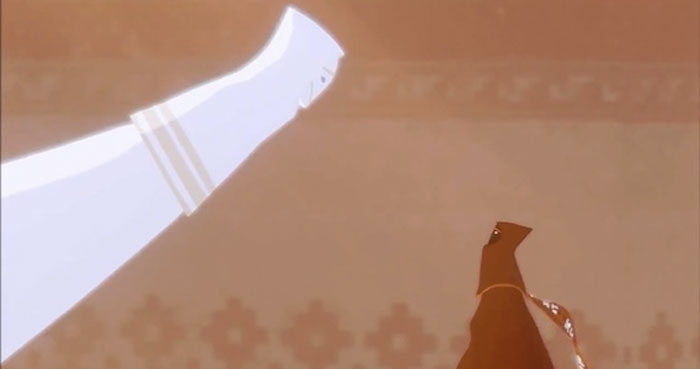
There’s more than just desert, but seriously, I don’t want to lessen the experience.
I am not going to talk any more about the rest of the game and the environments explored, both to avoid “spoilers” and because the game itself is only 2-3 hours long. But suffice it to say, it’s brilliant. Absolutely, devastatingly, goddamn brilliant. And I haven’t even talked about the music, which is universally praised and adored. And have I mentioned the visuals? I believe I have, but they too are striking and sublime – there were a few moments during Journey at which I seriously considered buying a $150 video capture device solely to take screenshots of this one game.
Sometimes I struggle with these shorter, more artistic games insofar as how much they are really worth. A game like LIMBO can be amazing (and it is), but spending $15 on something you finish in a single sitting? Perhaps I should have waited for a sale there. But with Journey I do feel it is enough of a novel experience to be worth skipping one night out at the movies to play. Not to mention it comes with two other games, although I have not yet played them. Possibly all combined they could make a full MSRP ($30) worth it. Even if it is just Journey though, anything more than a 25% sale means this bundle will be worth it on the strength of Journey alone.
…”Journey alone.” Whatever you do, don’t Journey alone. Christ, I want to play again.
Virtual Realms: Height of Cynicism
Alright, maybe Virtual Realms were the unannounced feature of 5.4. Or the tutorial zone, aka Proving Grounds. But, no, probably Virtual Realms:
New Feature: Virtual Realms
- Virtual Realms are sets of realms that are fused together, and will behave exactly as if they were one cohesive realm. Players on the same Virtual Realm will be able to join guilds, access a single Auction House, join arena teams and raids, as well run dungeons or group up to complete quests.
- Players belonging to the same Virtual Realm will have a (#) symbol next to their name.
I guess they finally solved that otherwise insurmountable naming problem, amirite?
Anyway, there are two (other) reasons this announcement is the height of cynicism:
1) Server Merges by any other name.
I get it, you get it, we all get it. Actually saying “server merges” is a sign of the apocalypse and bad PR besides. Grouping several low-pop servers together “virtually” is putting lipstick on the pig of 1.3+ million subscriber losses in the last quarter. At some point though, it’s just sad. You aren’t fooling anyone with that ridiculous comb-over. Just shave your head and get it over with.
2) Aren’t you glad you just spent $12.50+ server transferring?
I read the comments on my earlier post, regarding how things “usually go on sale before they are obsoleted.” For as jaded and dour as I can be under normal circumstances, I generally have some minimum level of faith in humanity. Obvious displays of naked greed are actions that can still genuinely surprise me, even if I distrust the “altruism” of corporations as a rule.
But, Jesus Christ, did Blizzard just take a huge shit on their playerbase.
There was a running joke in the PlanetSide 2 community regarding something similar: Item of the Day. Usually, the deals are 50% off the Station Cash (i.e. RMT) price of some garbage item or another, including items that are way cheaper to purchase with Certs. Every now and then though, some recently-released gun or something will pop up, prompting a lot of sales. People always joked that whenever something good snuck its way into the rotation, that meant it was getting nerfed by next week. And the shitty thing? It usually did.
The assumption got so pervasive and accurate that Higby, one of the PlanetSide 2 devs, actually stepped in and rolled back a planned nerf to one of the vehicle weapons that had just went on sale. He assured the community that these sales are planned out 30 days in advance, that the sale/nerf cycle was just coincidence, but who can you really believe when it comes to capitalistic incentives?
That question is not so rhetorical anymore. It was not an accident that Blizzard put server transfers on sale for the first time in their 8+ year history a mere week before announcing (free) server merges. Maybe they see some distinction insofar as players can choose where they go versus leaving it up to random chance. It’s still absolute bullshit though, because how many people would have bought a server transfer if the sale was this week, or next week? QED.
I mean, this is a new low that even EA hasn’t achieved, not for lack of trying.
My Mod/DLC Dilemma
I started playing Torchlight 2 a few weeks ago, and I am having some issues. Now, I did not like the original game all that much, but picking up the sequel for $5 during one of those crazy Steam sales seemed safe enough. And so far, I am not experiencing the same acute symptoms of frustration as in the first game. Except… now I kinda am.
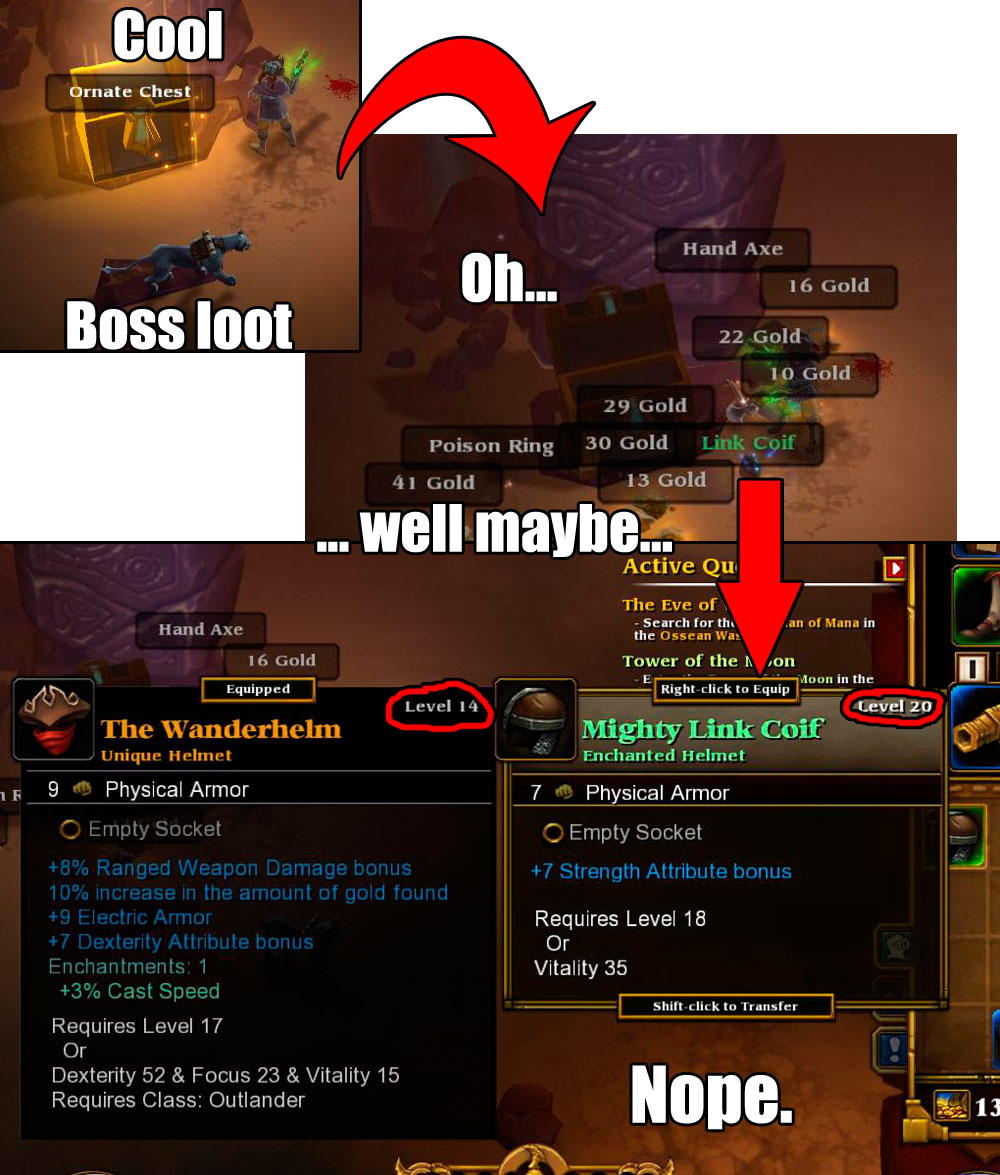
My biggest gripe with the original game was that the loot system was broken. Specifically, there was no real sense of gear progression in a hack-n-slash Diablo-clone genre that is based entirely on gear progression – I used the same “legendary” level 3 necklace all the way into the endgame, never finding an upgrade. While I have not ran into this problem as much in Torchlight 2, the contours of the issue remain in place. For example, I ran into this gearing decision the other day:

We’re back to getting Best-in-Slot at level 3, I guess.
Maybe “higher level = better” is too simplistic a progression design, but… is it really?
The more pressing concern in Torchlight 2 though, is how a lot of things that should be rewarding are really not. Each main area map has a Locked Golden Chest which contains, as you might imagine, a lot of loot. The key to this chest can drop randomly from any mob on that particular map, or from a specific fairy mob 100% of the time.
Compelling design, right? It would be, if these chests dropped something more than vendor trash.
Random loot is random, but after spending more time than strictly necessary opening these chests up and walking away with nothing of any value, I am finding myself souring on game in general. Indeed, even the extra-large treasure chests at the end of boss encounters reveals greys and greens more often than not. Why should I be fighting bosses when smashing pottery is clearly the more profitable activity?
Par for the course.
In Torchlight 2’s case though, there is a “solution”: mods. In fact, the #1 highest-rated mod in the Steam Workshop is one that tweaks Golden Chests (and boss chests) to always drop a Unique item. That’s not as broken as it sounds – items are still random, scaled to your level, and sometimes class-specifc – and does a lot to fix what I otherwise consider a problem. There are mods for all sorts of things, in fact, including Skill tweaks, doubling the amount of gold drops, Respec potions (base game only allows reshuffling of last 3 Skills), improving game textures, increasing view distance, and even additional whole classes. Indeed, one of the big selling points of Torchlight 2 was its modability in comparison to Diablo 3.
Thing is, I don’t like using mods on my initial play-through of a game. Hell, I usually don’t even like loading in DLC that affects the core game, even when I’m playing the Game of the Year version that bundles it all together.
My situation is a bit unique (and self-inflicted) insofar as I fancy myself a game reviewer. But even before this website, I preferred going in vanilla and raw. Not all my friends had the extra spending money for the expansions and whatnot, so telling them Diablo 2 was better with Lords of Chaos installed really just means “the base game is deficient.” Well, perhaps not deficient in D2’s case, but you understand my meaning.
Good game design is supposed to be good out of the box. If developers are stumbling around for the first several months from release, that stumbling needs to remain part of the overall narrative. I failed to mention in my Fallout: New Vegas review that the game was literally unplayable for the first two weeks without downloading a crack that fixed the DirectX issues; it’s an important detail to know for when the next Fallout game is released, lest it too require Day 0 patching from players to fix what the devs rushed to production.
I suppose some of this harkens back to that debate over whether MMOs (etc) are toys vs games. There is no wrong way to play with a toy, no real rules to govern your interaction with them. In this sense, mods are sort of like adding salt to your meal – some chefs might see that as an insult, but perhaps your individual taste skews more salty than the others sharing the meal. Ergo, developers letting mods fix any subjective “problem” only makes sense. Keep the vanilla pure, and let players add the chocolate and sprinkles as they wish.
Personally though, I am much more interested in the game portion of things, or more specifically: experiences. Show me the genius of your rulesets, the compelling nature of your narratives, the excellence of your craft. Anyone can imagine a stick into a lightsaber, just as anyone can turn a crappy game good with tweaks. I am interested in what you can do, Mr(s) Game Man Person, not mod developer XYZ. I want to be excited that you are releasing another game, not that the modding community has another opportunity to fix a deficient product. And besides, only one of those two parties is getting paid. Hint: it’s not the person/people improving the game.
It may not be entirely rational, but there it is. Odds are that I will keep trucking along in vanilla Torchlight 2 so that I can give an accurate report on its (so far) many failings. It is worth noting that while you can import your vanilla save into the “game + mods” version of the game, you cannot thereafter go back – neither your character nor your gear will appear under the default game any more. While that probably has little meaning beyond the people interested in Steam achievements, it sort of highlights how even the developers believe a segregation between the two ought to exist.
In which case, I shall play their game and complain about it, rather than fix things myself.
Unannounced WoW Feature Announced
Coming in 5.4: Flexible Raid sizes.
While it’s impossible to fit every player into a neat, tidy archetype, we recognize that we could be providing a better experience to one broad category of raider: social groups comprised predominantly of friends and family, and smaller guilds that do their best to include as many members in their Raid outings possible. […]
To fill this void, we’re in the process of developing a new Flexible Raid system, which includes a new difficulty that sits between Raid Finder and Normal difficulty, while still allowing friends, family, or pick-up groups to play together. This difficulty will be available for premade groups of 10–25 players, including any number in between. That means whether you have 11, 14, or 23 friends available for a Raid, they’ll all be able to participate.
The Flexible Raid system is designed so that the challenge level will scale depending on how many players you have in the Raid. So if you switch between 14 players one week and 22 the next, the difficulty will adjust automatically.
Technically, this isn’t confirmed as the “unannounced new feature,” but I have a hard time believing that there could be something else to top this game-changer.
…or does this change much at all?
I mean, yes, I have little doubt that this will improve the quality of life for a lot of friends & family guilds out there. Back in Wrath, my guild constantly had the inevitably poisonous problem of having 11-12 people show up on raid nights, and having to pick who sits out. Something like this feature would have made the issue moot, as we could grab everyone who showed up and did something fun as a guild. Even better, the difficulty is supposed to be pegged between LFR and Normal, which would perhaps mean taking that charming guildie who improves the general social atmosphere – albeit at a DPS loss – is no longer such a vexing decision.
On the other hand, this would do nothing to guilds like mine that were unable to field even a full 10m by the end. Maybe this could have incentivised our (failed) raiding partnership with a sister guild, but I don’t find that particularly likely.
…
You know what though? My mind is actually racing about this feature. Part of the reason why our raiding partnership failed was because the people we were bringing weren’t quite matching up to the skill level the content required. With this feature, if your guild found 10m Normal raids too difficult, you could down-shift to Flexible and still bring 10 people.
On top of that, this could be a massive coup for the Trade chat pugs of the world. I am sure there will still be stubborn raid leaders out there spamming “LF6M 25m” for hours, but as long as they had the basic roles covered, they could have everyone zone in with just the 19 they had. And on top of that, there is the news that Flexible mode has its own, separate lockout. That is huge. Go raid with your hardcore guild on Thursday, and then kick back with your friends/family on Friday, all while still getting (off-spec, perhaps) gear.
In another life, I might have been more concerned with how popular the feature would be, given the ilevel rewards would be lower than Normal mode. But looking at how LFR turned out, it is pretty clear that that sort of nonsense rarely matters except in the minds of a few. In fact, I’d almost be more worried that Flexible mode will further erode the entire raiding model, doing to 10m what LFR did to 25m.
In any event, it looks like we’re seeing the fruits of those minds diverted from the Titan project already. Now if only they could focus their efforts on, say, actual server merges instead of this 50% off highway robbery bullshit, I might actually reach for the resubscribe button again.
Well, probably not this expansion, but they are damn closer than they were yesterday.
WoW Finally Has Server/Faction Sale
In a move that I have been suggesting literally forever, Blizzard is slashing all character services by 50%… for one week.
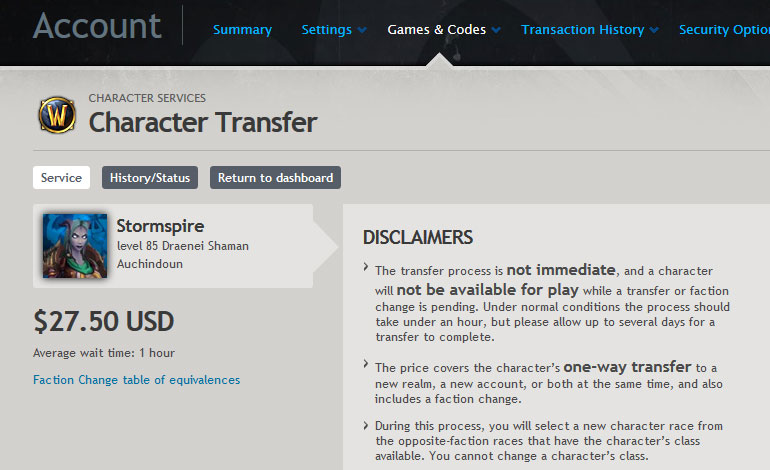
Still has a 50,000g transfer cap, unfortunately.
The prices break down as follows:
- Server Transfer = $12.50
- Faction Transfer = $15.00
- Server + Faction Transfer = $27.50
- Name/Appearance Change = $7.50
- Race Change = $12.50
If there is not a clearer sign that Blizzard believes WoW still exists as luxury entertainment on a level all to its own, I don’t know what it is. Well, you know, beyond the fact that as absurd as these prices appear to be, given the proper distance from the game, they are normally 50% higher.
I mean… Christ. Is this the same MMO that lost 1.3 million subscribers last quarter? That’s a rhetorical question because of course it is. Otherwise Blizzard would have no cause to not still charge people $25/$55 to move off dead realms Blizzard kills with extreme negligence.
In other news, I just bought EVE Online for $4.98 on Steam. You know, for a rainy day.
Hope Springs Eternal
(This is followup to my In Defense of Used Games post.)
I believe that eventually we will see the resell of game licenses. Given how our present trajectory is clearly in favor of restrictive limited licenses, games-as-services, and exclusive accounts everywhere, from whence does this optimism spring? Basically, it springs from what I imagine to be an inevitable reconciliation between what is legal and what consumers see as reasonable and/or how they play games in the real world.
I am going to divide this model into roughly two parts: the Practical and the Legal.
The Practical Disconnect
There is an incredible disconnect between what companies write in their ToS/EULAs and how people actually use the products in question. In fact, even the question of what amounts to game piracy is not as clear-cut as you might think. If you download the Tomb Raider reboot off of Pirate Bay, that is clearly piracy, sure. But suppose you let your little brother play the copy that you legally purchased. Is that piracy? Instead of it being a family member, suppose you let a friend come over and play it. Is that (still) piracy? What if you let a complete stranger play your copy of the game?
Now suppose this copy of Tomb Raider in question was purchased on Steam. Does that change anything at the family/friend/stranger level? It does:
“When you complete Steam’s registration process, you create a Steam account (“Account”). Your Account may also include billing information you provide to Valve for the purchase of Subscriptions. You are solely responsible for all activity on your Account and for the security of your computer system. You may not reveal, share or otherwise allow others to use your password or Account. You agree that you are personally responsible for the use of your password and Account and for all of the communication and activity on Steam that results from use of your login name and password. You may not sell or charge others for the right to use your Account, or otherwise transfer your Account, nor may you sell, charge others for the right to use, or transfer any Subscriptions other than if and as expressly permitted by this Agreement (including any Subscription Terms or Rules of Use).”
In our all-digital future, everything is tied to accounts. Ostensively, account-sharing is a bannable offense. In fact, if Valve suspects you shared or sold a given Steam account, it will ban all accounts in your possession, even if nothing untoward was happening in the others. And yet the problem with account-sharing is that it shouldn’t actually be any company’s business who is sitting in the chair, behind the keyboard/controller. I mean, it is technically their business – because they say it is – but it shouldn’t be.
I am not playing WoW right now, despite having multiple level-capped characters and a large sum of gold doing no good to anyone. If I resubscribed and started playing again, Blizzard would be happy. If I resubscribed and let a friend play my character, Blizzard would still be happy… up until the moment they realized what I was doing. But provided we did not alternate log-ins from multiple IP addresses or whatever, there is really no way for Blizzard to tell the difference between us. And yet that is “illegal.” Why? Because presumably the threat of account closure is supposed to induce the friend to purchase their own account/expansions/etc and work their way from scratch.
If letting friends and family members play your games does not count as piracy, neither should letting them log onto your account(s). Indeed, the only way the company would be able to ascertain a difference between users is with intrusive biometric privacy measures like… an always-on IR camera powerful enough to measure your heart rate via body heat to ensure only the True Owner ™ utilizes the account. Otherwise, these measures simply fail unless you attempt to log in from two places simultaneously. These companies are writing rules and contractual terms they have no means of enforcing outside the most heinous of nightmare scenarios. Or, I guess the Honor System.
Perhaps you do believe that your little brother playing your copy of Tomb Raider counts as piracy. In which case I have two questions: 1) why haven’t you turned yourself in, and 2) how far does that really go? Is it piracy for him to watch you play? Or is the crime committed only when he touches the controller? What if it is a strategy game in which he tells you what moves to make, and you simply act as his inputs? Still probably worth a $150,000 fine, wouldn’t you agree?
If companies could go this far, they would. That is the copyright endgame: the limitation of the experience to a single, paying mind. Thankfully, they lack the ability to dictate what happens in the privacy of our homes. Except, you know, for all the times that they can.
The Legal Aspect
In his rebuttal to me, Tobold linked an article in regards to US courts ruling against First Sale doctrine applying to digital goods. The article includes the following passage:
“Notably, the ReDigi case turned in large part on the same phrase at issue in Kirtsaeng—whether the copies at issue were “lawfully made” under [the Copyright Act]. In ReDigi, the court held they were not. “The first sale doctrine does not protect ReDigi’s distribution of Capitol’s copyrighted works,” Sullivan held, because the files at issue are “unlawful reproductions” and therefore not “lawfully made.” And, also like Kirtsaeng, the court said the proper venue to decide the core issue—whether buyers of digital products can resell them—is Congress.
“ReDigi effectively requests that the Court amend the [the Copyright Act] to achieve ReDigi’s broader policy goals—goals that happen to advance ReDigi’s economic interests,” Sullivan observed, adding that “amendment of the Copyright Act in line with ReDigi’s proposal is a legislative prerogative that courts are unauthorized and ill-suited to attempt.”
If you haven’t been following the ReDigi case, you really should take a look. Spoiler alert though: ReDigi lost back in April, but is appealing.
The hinge of the case was that even though ReDigi’s process involved removing the music file from the original computer, technically ReDigi was still “creating” a copy on their own servers by virtue of the transfer process. That was the entire hang-up, or more accurately, the technicality. Even Google tried to get involved in the case by coming to the defense of ReDigi, arguing a judgment against ReDigi “would put the entire cloud computing industry, worth an estimated 41 billion dollars, at risk.”
Incidentally, as pointed out in the concluding paragraphs of the same article:
To make his point, Sullivan stressed that the first sale doctrine does still protect the ability to resell digital music—you can still sell your “computer hard disk, iPod, or other memory device” onto which the file was originally downloaded, he wrote. While conceding that practice might prove to be “onerous,” he suggested there may also be reasons why such “physical limitations” are desirable. “It is left to Congress, and not this Court,” he concluded “to deem them outmoded.”
In other words, you can resell your digital music, as long as you originally downloaded them onto, I dunno, say a $6 MicroSD card. Or a $2-$5 USB stick (which are 1gb in size… Jesus, time flies). Preferably we could cut the bullshit and just print the CD/DVDs ourselves, but I imagine there is no direct-to-CD argument that can be made, else they would have made it.
The salient point here is that the current system is, at best, untenable. As more and more aspects of our lives migrate more fully into the digital realm, Congress will revisit this subject again. Honestly, they really should not have to – it would be better for everyone involved if companies came to this voluntarily. Hell, I have been shitting on the Xbox One pretty often, but Microsoft is apparently putting in a “used digital game” framework, in some murky form or another. It would be the height of irony if Microsoft ended up starting a revolution in the same way that Steam made digital games mainstream. Both Apple and Amazon have patented second-hand digital marketplaces, by the way, but have yet to actually do anything with them.
Some people get the impression that I am anti-IP, or that I am antagonistic to copyright. That is not really the case, although I do believe “life of author + 70 years” is absurd welfare for corporate rent-seekers rather than to the actual benefit of society, e.g. the entire original purpose of copyright. I mean, are there really artists out there that would look at something like Life + 5 years and go “fuck it, I’m not going to bother”? Give me a break.
Anyway, what I desire is for the designers to partner with consumers, for all of us to cooperate for the common good. I don’t like GameStop any more than game designers do – they really are just parasitic middleman – but only one of those two parties actually make efforts to improve consumer surplus, even if it’s just by accident. And if there was any enduring message that came out of the wild internet heyday, it is that you Can’t Stop the Signal. Revenue models are going to have to change, whether you like it or not. If game designers want a piece of the the new paradigm, they have every opportunity to get aboard the train.
In Defense of Used Games
I have talked about used games before. I am going to talk about them again, as a rebuttal against this video from Total Biscuit regarding how he justifies his belief that used games are bad.
Before I start, there is one fundamental truth that needs to be acknowledged: a used game sale is a new game sale at a lower price-point. No one is seeking out used games because they are used, they are sought because they are less expensive. Incidentally, this same principal applies if someone is able to re-sell a game they bought, as the ability to recoup part of the cost means the original purchase becomes less expensive.
Without further ado, let me examine each of TB’s arguments against used games:
1) Used Game Sales support shady/pushy retailers
Or, the GAME (in UK) and GameStop Are Bad argument.
It is absolutely true that retailers who specialize in used game sales push used games sales over new ones; the original sale is a recouping of an investment for the store, whereas each additional resell is nearly pure profit. I am not interested in defending the practices of GameStop (etc) though, primarily because it is irrelevant and red herring besides. No matter how much you swing the “games as licenses” argument, the fact remains that used game sales are legal in the United States and presumably elsewhere – GAME and GameStop would have been sued into the ground otherwise. The shadiness of any organization does not reflect on the product they provide. You can picket Wal-mart for all sorts of legitimate reasons, but that does not make cheap groceries immoral.
I have gone into a GameStop all of twice in my life, whereas I frequented a mom-and-pop used game shop next to the local theater for the better part of a decade. I went there because their used games were cheaper, and you received more store credit (or cash) than GameStop provided, all in a no-pressure sale environment. Ergo, any argument that uses the removal of used games as a vehicle to attack a retailer you don’t like is simply ridiculous. GameStop’s practices have nothing to do with the “question” of used games, as there are alternative stores which do not behave in similar fashion.
2) Used games do not depreciate
This honestly reminds me of the “you wouldn’t download a car” PSA. Even if we take this claim on face value… so what? Is the argument supposed to be that used game sales would have been fine if the AI started glitching out on its own five years from now?
To be charitable, I am going to assume instead that people are referring to how physical depreciation of goods naturally differentiates two otherwise identical products, potentially justifying the premium on the unused version. In which case, I’d argue that something similar already occurs even in purely digital products.
Videogames are not released in a vacuum – they are always a product of their times. While the actual data bits do not decay, the value and meaning of them in the mind of a player certainly can. There are whole classes of videogames that I literally cannot bring myself to play anymore, because the graphics are too primitive, or the resolution too low, and so on. Innovation in mechanics or design can render older titles feeling stilted or slow, even though nothing in the original game itself has changed. Some games hold up better than others, of course, and many older games are arguably better than new titles. But on a certain base level, videogames do depreciate, if not literally then culturally.
If you do not find this counter-argument particularly compelling, that’s fine, but allow me to make two final observations. First, no one expects a game to remain $59.99 two, three, four years after release. If games do not depreciate in value, why do you think we see the companies themselves reduce the price? Second, how much do you think your unopened City of Heroes or Battlefield 2 box will go for these days?
3) Music and Film industries are less harmed by secondary sales
TB’s point here is a roundabout justification for how videogames are a special case when it comes to secondary sales, despite music and movies also being digital goods without depreciation. Buying used movies is less harmful to studios, he argues, because a particular film can make the bulk of its money in the theater, followed by Pay-Per-View, DVD sales, rentals, and finally syndication on TV networks. Similarly, music artists get the bulk of their profits from concert tickets, in addition to (small) payments from streaming services and finally the default CD sales. In other words, music and movies have multiple revenue streams whereas videogames have just the one.
To which I must ask: whose fault is that?
As a consumer, you are not responsible for a company’s business model. It is perfectly fine to want the developers to be paid for their work, or to wish the company continued success. But presuming some sort of moral imperative on the part of the consumer is not only impossible, it’s also intellectually dishonest. You and I have no control over how a game company is run, how much they pay their staff, what business terms they ink, or how they run their company. Nobody asked EA to spend $300+ million on SWTOR. Nobody told Curt Schilling to run 38 Studios into the ground. Literally nobody wanted THQ to make the tablet that bankrupted the studio.
What is worse though is the implicit moral superiority that is derived for buying “legit.” If game companies and their designers deserve to be paid, and we have some moral obligation to do so, doesn’t that mean they deserve ALL the money? I cannot even begin to imagine the mental gymnastics Total Biscuit had to perform when he denigrated used games and celebrated Steam sales in the same breath. When you buy a game for 75% off, that is you robbing the game company of 75% of the money they deserve. Not even deserve, really, considering by many metrics they are entitled to much, much more than the purchase price given the total amount of enjoyment derived.
That sounds absurd, and it is, but that is my point; you cannot make the moral imperative argument and only go halfway. A company either deserves $59.99 or they don’t. Alternatively, you are not responsible for their business models at all, and are fully justified in maximizing your consumer surplus, e.g. by waiting for sales, buying used, etc. It is noble to wish these designers success, at least when such nobility is followed-up with busting out your checkbook. Otherwise, it is so many empty words.
4) Once used games are removed, games will be cheaper
No, seriously, Total Biscuit actually said this, presumably with a straight face.
Why in god’s name would anyone rationally assume that the removal of competition (in the form of secondary sales) would force or even encourage game prices to decrease? Everyone keeps pointing to Steam with its effects on PC gaming, as if Steam weren’t the exception that proved the rule. Everyone acknowledges that used games on the PC haven’t existed for quite some time, but no one seems to follow-up that thought with what should have been an obvious question to ask: were there big discounts on PC games back before Steam?
Good lord, no! You were at the complete mercy of retailers who almost never marked anything down from MSRP. And why would they? You literally could not buy these games anywhere else. If you found a good deal, it was likely because nobody was buying that game and the store wanted to liquidate their stock. Outside of fire sales, there was/is always going to be resistance from retailers over discounting a game’s price because there is a minimum cost involved with pressing a DVD, shipping it across the country, unloading it in the back, and paying people to sort and shelve it.
Incidentally, this is another reason why I don’t think future console games will be cheaper: there will still be hard copies sold. Do you think retailers would let Microsoft sell Halo 6 for $40 online and $59.99 in stores? Of course, there is a pseudo-analog that exists right now between PC vs digital download games, with things wildly alternating for no apparent reason. For example, it’s somehow $20 cheaper Amazon to ship me DVD of Bioshock Infinite than it is to download a copy of it. Or maybe that does make sense, insofar as what I explained earlier about retailers trying to liquidate stock.
If you legitimately believe Xbox One games are going to be cheaper, let me ask you two things. First, what kind of deals have you seen on XBLA titles? Similar in size, scope, and frequency to Steam sales? Microsoft has already dabbled in digital games for which no secondary sales exist, so their pricing behavior now may reflect any potential behavior in the future. Second, what kind of deals have you seen on Origin in the last, I dunno, two years? There have been a few recently, but very rarely more than 50%, and they are not nearly on a scale as Steam. That is a publisher who has as near a 100% profit margin on every digital sale as possible, and even they are not willing to compete on price with retailers who sell game codes on EA’s own platform!
The point here is that Steam is the exception that proves the rule. I bought Tomb Raider on the PC for $20 a mere three months – three months – after its $49.99 release. Granted, it was via Green Man Gaming, but it activated on Steam. Do you honestly believe that the only difference between our present console MSRP reality and a hypothetical all-digital future is the mere possibility of resell? That companies would be fine with a $30 markdown for a limited time a few months after release? Maybe. Maybe we don’t see similar sales because GameStop (etc) would buy a few pallets of discs at $20/each to sell at $40 after the sale is over. Then again, I could have done that exact same thing via GMG and just sold the activation codes. Actually… that’s not a bad idea…
Simply put, this argument requires a striking amount of faith in game publishers to work. Consumers are being asked to cede an enormous amount of implicit value, not just in resell value, but also in control over how they play these games (tied to accounts, phone home every 24 hours, no borrowing, etc). We are asked to cede these values all in the hopes that companies like Microsoft will not simply keep charging $59.99 out of… well, out of the goodness of their hearts. That is not enough for me. There is certainly every economic incentive to keep things running business-as-usual, after all.
5) Used games cost the companies money in terms of support/servers.
It is true that game companies “must” provide support to even non-paying (i.e. used game) customers in a way that movie and music companies do not. However, there are two things wrong with the argument TB is presenting. First, it sort of assumes that the game was not worth playing for very long in the first place. Total Biscuit’s example was how a company would need to provide support to a gamer for two months, and then a new player who bought the copy from the first guy for another two months, and a third person, and so on. The difference between that scenario and one guy who plays continuously for 6+ months is… what?
Total Biscuit’s second point about non-payers in multiplayer (presumably driving up bandwidth costs or whatever) caused me to facepalm IRL. Maybe he has never heard about why the Free-2-Play model works, or more importantly how it works? Someone playing the latest Call of Duty secondhand is providing content to “legitimate” players in a way that a no-longer-playing gamer by definition is not. I mean, that’s the premise of the argument, right? That the first dude sold his game, and is now an empty seat in a lobby somewhere. You do not even need to have the full F2P development plan set up to appreciate the fact that an extra body is making your multiplayer experience that much more worthwhile when it otherwise could/would have been nobody.
Summation
As I pointed out in the beginning, let me point out again: used game sales are new game sales at a lower price point. Nothing is stopping companies from lowering the prices for their games and otherwise being more competitive with used games. You might think that used game prices would simply adjust to compensate, and maybe they would, but that is an argument against selling at anything less than full MSRP, ever. Which is clearly ridiculous.
In any case, time marches on. Even though I see this forceful transition into all-digital games as a net-negative for gamers (and it is), I am obviously not against digital platforms themselves. I am just a bit miffed that the transition is being accelerated by Microsoft (etc) before the question on the transferability of licenses is fully settled, at least in US law. Believe me, the day will come when we shall be able to buy a Steam game (license) and then sell it to someone else after we are done.
At which point I’m sure the suits will pine for the days when it was at least possible for someone to lose their disc.
Edit: Removed incorrect “et tal” usage. Thanks, Tobold.
Darkwood
It is kinda true what they say about donating to Kickstarter and the like: you can’t stop at just one.
I’m stopping at two.
Meet Darkwood, a top-down survival-horror roguelike with crafting elements. It is also open-world and procedurally-generated, but I’m kinda tired of typing out that phrase. Could we maybe come up with an acronym or something? “Pro-gen” or maybe start using Minecraft as an adjective. Anyway, Darkwood is actually over on Indiegogo instead of Kickstarter, and as of two days ago it passed its $40,000 goal, by virtue of my $10 gamble no doubt.
Take a look at the video:
What caught my eye – aside from the fact you never really get a good look at the monster(s) you are fighting, or how you can’t see the light shining behind you – is when the dude laid down a bear trap, put meat on it, soaked it in gasoline, and then set a gas trail on fire to burn the trapped monster. That… is pretty clever. Plus, I’m a big fan of looting. Not the sort of mechanical action of inherent to every game ever, but the whole ransacking of an abandoned house in search of random post-apocalypse survival tools. I always find that sort of thing both compelling and mentally soothing at the same time.
Please announce Fallout 4 at E3. Please announce Fallout 4 at E3. Please announce Fallout 4 at E3.
Anyway, it’s $10 to secure your infinitely reproducible digital copy on Indiegogo. The projected release date is “mid-2014,” which is admittedly a bummer. Even if you’d rather wait for my inevitable review, do go ahead and pop open your Steam client and vote for the game on Green Light. The more of these indie games that get onto Steam, the more likely you can pick them up for 75% off later. Win-win.
Constants and Titanic Variables
In the off-chance you haven’t already read thirteen hundred blogs talking about it, VentureBeat broke the news about Blizzard’s new MMO “Titan” being sent back to the drawing board. Depending on how you slice it, that is between 2-7 years of game development being flushed, with 70 of 100 developers being redistributed to other games while the core 30 presumably get called to the carpet.
First thoughts? Well, maybe now Ghostcrawler will have enough staff on hand so that patches can have both raid and dungeon content instead of these unquestionably artificial “dilemmas.” ¿Por qué no los dos?
The normally sanguine Syp thinks Blizzard should scrap Titan altogether due to the risk:
Blizzard cares deeply about its reputation and position as an industry leader. That’s another obstacle, because any stumble, no matter how small, will be taken and used as a weapon against it by capricious gamers. For example, while Diablo III has sold quite well and boasts a healthy population of players, the error 37 and auction house debacles have damaged the game’s reputation while slapping some egg on the face of the studio. Blizzard has had to learn humility over the past couple of years, and it is odd and unnerving to see this formerly arrogant company stuttering out apologies.
His point about holding Blizzard to higher standards is absolutely true, and the Diablo 3 point is especially apt.
Indeed, I am starting to think this Titan decision makes more sense coming from the other direction. What if it was not so much that Titan’s design was terrible or out-dated (having ostensively been drafted pre-mobile, pre-F2P), but rather it was not good enough to justify the loss of 70 top-quality developers for years?
One of the more frustrating realities of game design from the consumer perspective is that current success pays for future projects instead of being reinvested. While it isn’t that big a deal when it comes to single-player games, it’s huge when it comes to MMOs. Just think about the following:
We first reported on Titan back in 2011. Blizzard chief operating officer Paul Sams told us in an interview that “we have taken some of our most experienced developers and put them on [Titan]. We believe we have a dream team. These are the people who made World of Warcraft a success. We are going to blow people’s minds.” [emphasis added]
They had the very designers that crafted WoW into the 8+ million subscription engine it was back in 2004 tied to an unreleased (and now scrapped) game for the last X years. People joked about Ghostcrawler being a part of the B Team for a long time, of course, although I honestly do not have much against the guy. But regardless of where you fall on the WoW line, really think about that alternate universe where the original team was never split. What kind of game would WoW have been? What could we be playing today? Would it still be shedding over a million subs in a quarter?
So that’s my wild, out-of-my-ass idle speculation of the day: the old version of Titan might have been perfectly serviceable, but not crazy-good enough to justify keeping 70 people tied up when the rest of the boat(s) are taking on water. This is Activision Blizzard, after all, home of the billion dollar franchises. The Blizzard half cannot simply expect investors to be patient with Call of Duty and Skylanders propping up an ailing WoW to buy time for a Titan-ic (har har) gamble.
In spite of its age, WoW could be doing just fine as a money-printing machine. It just needs more and better things. And more agile developers. And server merges. Hopefully this transfusion of developers will be enough juice to keep the engine pumping.
 In An Age
Beach and the PS4
Jun 12
Posted by Azuriel
So, I have been and will continue to be on vacation at the beach with family until the end of the week. The internet service down here is absolutely abysmal – we’re talking 5 Mbps shared across 40 rooms – which is why I have not been on top of the comments and general news. I suppose that might sound bad, caring about frivolous internet things while at the beach. But honestly, if I knew it was going to be vacation back to 1994, I might have passed. Also, the ocean seems saltier this year and there was a fly in my soup.
That said, how ’bout that PS4 news?
If you have not been keeping abreast of the latest developments, Sony basically “won” the show. You can read Liore’s coverage of the event or even similar things in this CNN article. Bottom line?
It wasn’t all good news – a Playstation Plus membership is required for all multiplayer, just like Xbox Live today – but it was a fantastic PR coup for Sony to have been quiet all this time before launching into these consumer-friendly revelations.
A couple Apologists skeptics from around the web have tried to paint Sony with the Xbox One brush over the used games quote though:
“Aha!” the Apologists cried. “Same thing as Xbox!”
Not really. In fact, not at all. The key point here is that Sony’s strategy is unchanged from the current generation. Remember Online Passes? Those were 3rd party attempts at mitigating secondary game sales, all of which happened in this generation. If EA suddenly changes their mind vis-a-vis reintroducing Online Passes, Sony isn’t going to stop them, but at least it isn’t turned on by default as it is in the Xbox One scenario. As Destructoid put it:
Or you can go with the Game Front article for even further clarification:
Basically: #PS4Life
Not that I’m going to buy one anytime soon – I just bought a PS3 last Christmas. But it’s nice to know that whenever I do hop aboard the next console generation, I will have the opportunity to catch up on all the games I’ve missed by hitting up Amazon or some local place and not be paying full MSRP out the ass for 2+ year old games.
Posted in Commentary
4 Comments
Tags: E3, Microsoft, PS3, PS4, Sony, Used Games, Xbox One