Category Archives: Commentary
The Limits of Procedure
In a recent post, Tobold says:
After Everquest Next announced dynamic spawns with an ecosystem, destructible environment, and open world player housing, several people dismissed these claims as unrealistic with the argument that Ultima Online tried that and failed: Players kill mobs faster than they can reproduce, gather resources so fast that whole forests are turned into deserts, and build houses everywhere until no more flat surface is left. While that history is correct, the conclusion isn’t. As a counter-example look at Star Wars Galaxies, where open world housing clearly worked a lot better than in Ultima Online. So what is the difference, and how can a virtual world with a stable ecosystem be created without players destroying everything? The answer is simply in the size of the world, and the scale of the ecosystem.
Two paragraphs later though, he sort of undermines his own argument a bit (emphasis mine):
The Ultima Online ecosystem failed due to its small size and technical limitations of the time. But a procedurally generated world can be much bigger, even infinite. People don’t run out of world to modify in Minecraft. And if the world is big enough, you can put in enough mobs so that players can’t possibly make them extinct.
Er… if players cannot possibly make the mobs extinct, what’s the point in having an “ecosystem” in the first place?
But, never mind that. What I really wanted to talk about is the Minecraft bit. Because sometimes I get the feeling that “procedurally-generated” as a concept is being elevated as some paragon virtue of game design – a silver-bullet to boredom – when it is really nothing of the sort.
A procedurally-generated game solves exactly one problem: metagaming. That is not quite the correct word I want to use though, as you can still technically metagame a procedurally-generated world in several ways. Namely, by knowing its procedures. For example, no matter what Minecraft world is created (mods aside), diamond only spawns in layer 19 and below. Indeed, there is a whole bunch of Minecraft constants to consider (accurate circa 2010 anyway). All the Minecraft map being procedurally-generated does is prevent you from following a guide telling you to move North a hundred steps and then walk East to find a nice batch of Iron Ore near the surface. Avoiding those scenarios is certainly useful, and it’s always fun running into the truly bizarre and whimsical creations of the RNG gods.
The problem arises in treating the procedurally-generated whatever as “endless content,” when it is really not anything of the sort. As I talked about before, your knowledge of a game’s systems really only ever increases as you play; novelty has diminishing returns within the same game. Each Minecraft world generated may be completely different, but you are going to be doing the same sort of things each time: punch wood, make tools, make structure, dig for ore, etc. Different starting locations and details can spice up the gameplay for a time, but your “build order” is unlikely to change much no matter where you are.
Procedurally-generated content definitely has a place in gaming, usually in the context of roguelikes, but it will not solve any of EQN or any other MMO’s problems. Not that its application in MMOs made much sense in the first place – one of the defining characteristics of an MMO is a persistent world, which is incongruent with procedural generation. Even if it was just one world of infinite size (expanding at the edges), the amount of space surrounding objects of player interest would remain finite. And that’s assuming players would be willing to trudge out very far from their starting location in the first place.
No, just adding more space isn’t going to solve the issue. If anyone claims that an MMO’s world cannot be too big, simply point them at any given low-pop server of any game anywhere.
Bioshock Infinite DLC Cometh
I am not entirely sure how I feel about the news that Bioshock Infinite will be getting three DLC packs in the near future. Actually, I do: a distinct lack of fucks given.
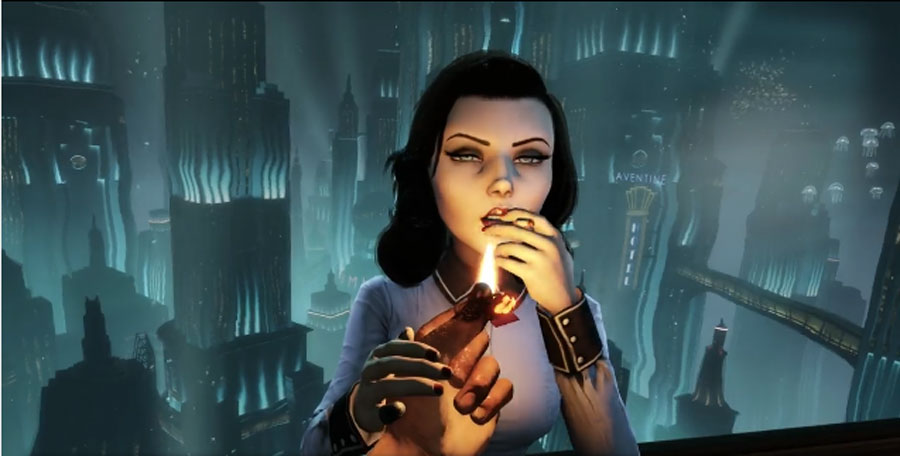
Can this be considered fan service?
The first DLC is a story-less horde mode that will subject you to more of the banal combat system. The second and third are portions of a presumably expanded narrative, although who can really tell what is going on in a time-traveling alternate-dimension throw-everything-at-the-wall plot? But, hey! We’re going to see a pre-destruction Rapture! You know, a throwback to the games that were actually good.
To be fair, Bioshock Infinite did do some things right. The visuals were gorgeous, Elizabeth made the game feel more human, Columbia had brilliant imagery, the music was fantastic, and so on. It is just that Kotaku’s recent interview with Ken Levine boiled my residual bile concerning the plot back up into white-hot incandescent rage. I was fine all the way up until the final paragraph:
“I walked away from BioShock Infinite actually very, very satisfied mostly because of the debate that people were having, not just about what happens in the game, but about what the meaning of it was. That we gave something for people to argue about. We trusted the gamers enough to say, ‘You know what? There’s some room here for you.’ If people walk away frustrated that we didn’t explain everything to them, it probably wasn’t a game for them.”
That noise you just heard is the sound of an aneurysm.

No, Levine, you do not get to fucking say that. As I pointed out months ago, the plot of Infinite is complete garbage. The “room” left for gamers is for them to refuse to apply critical reasoning to their experience, thereby passively constructing a better ending which doesn’t exist inside the actual game.
I can get behind a narrative that explores the descent of a man’s soul to the point that he believes unmaking his existence would be better for everyone involved. We can all probably emphasize with that, regretting having done things or failing to do so. That was not Bioshock Infinite’s plot. The real plot was this:
Finally, let me kind of wrap all these various ingredients up into one complete shit sandwich. What exactly is the message being conveyed here in Bioshock Infinite? What is the theme, the moral of the story?
At the beginning, I almost felt like Booker was trying to make up for his sins, to seek forgiveness and redemption, to put things right. But what is Booker’s actual crime that he is repenting? To stop a person he never turned out to be from entrapping the person he is into a crime a third version must now stop? Booker choosing to be drowned seems a noble sacrifice until you realize what exactly he is undoing: choices he never made. Or, even worse, stopping a man (Comstock) he had no choice into becoming. There is never any “good Comstock” because apparently being bad is a constant. Fate. Predestination.
What is the message here about personal responsibility, free will, and choice? You have none because Constants and Variables. And suddenly, infinite universes means you are implicitly responsible to consequences [of actions] that you never chose and never happened in your own universe. Do you remember when you donated to charity instead of setting a baby on fire? Well, you should feel real bad anyway because the not-you baby-arsonist is running amok and it’s up to you to stop yourself like you already did by not setting the baby on fire in the first place. GUYZ, DEEPEST PLOT EVAR.
There is no route from Infinite’s plot to a good story. None. The “grand redemption” is paying for mistakes you explicitly did not commit in this universe. Even in my most charitable reading of the game – that Booker acknowledges the potential darkness in his soul – leads to the same asinine moral conclusions. Because Booker can choose evil, and did so in an alternate universe, it’s better to kill all possible versions of himself before he can make that potential choice. O… kay? All of us have darkness inside; quite literally who we are is determined by how we manage that darkness. Simply choosing to have it never happen in the first place is an easy, childish fantasy.
And don’t get me started on how moral responsibility can possibly exist in a deterministic universe.
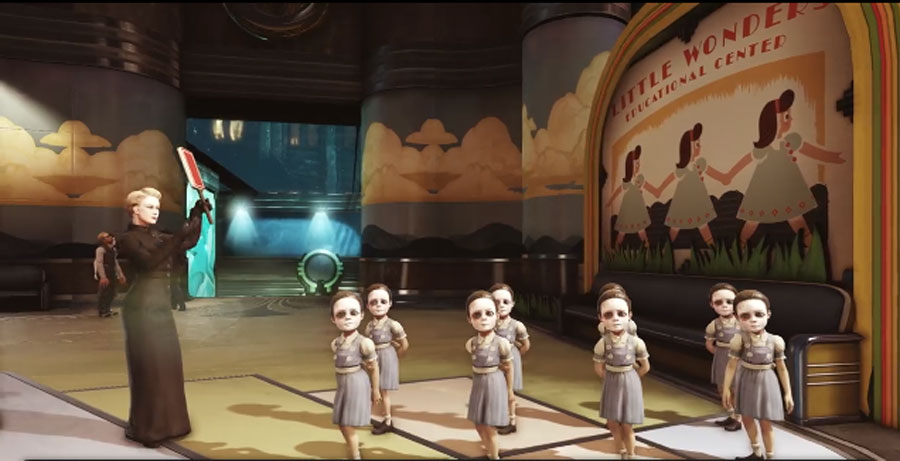
Remember to feel guilty for killing them in an alternate universe you weren’t a part of.
But you know what? This is not even about Infinite anymore. This is about the hubris of an artist to paint his/her deficiencies as strengths, thereby negating any difference between good or bad works. It is me telling you that if you do not find this argument convincing, it is your fault. “If you don’t like this thing I made, it must not have been for you, and thus you’re an idiot for having bought it.” That’s not how this shit works! And besides, Levine, you already told us everything relevant in the game proper: namely, that you’re the next M. Night Shamalanananon. A couple of great works, followed by a more crappy one, and all of a sudden (spoiler alert) the trees are killing everyone.
The tragedy in all this is that we already know who ultimately wins the historical narrative. It has been four months since the debacle started, and all the comment sections in the DLC posts are filled with those gushing over the “deep” ending. And why not? Those who were disgusted as I am have long since stopped caring, or are embarrassed to silence that they still do, leaving the uncouth Philistines to drown in their Confirmation Bias echo chambers. And that is how this whole thing will play out: a great game with a good plot that sold millions of copies. Just like 50 Shades of Grey, Diablo 3, and EA’s Sim City.
Constant and variables, amirite? Christ, how depressing.
In Defense of Nostalgia
“That’s just the nostalgia talking.”
After reading Liore’s post about starting to play Final Fantasy 7 for the first time (from the latest Steam sale), I started thinking about nostalgia. After all, I still consider FF7 in my top three favorite videogames of all time. I have undoubtedly played other games for longer – and it’s likely that I’ve played “better” games since then – but a component of what I describe as “favorite” includes impact on my life.
Nostalgia is always used as a pejorative in videogame discussions, a way of dismissing the assertion that X is better than Y, or that X is still good at all. Hell, I have probably used the term in the same manner. But it seems clear to me now that the “charge” of nostalgia is a bit too sweeping. Sure, sometimes you think something is (still) good simply because you liked it when you were younger. But sometimes you do just so happen to experience a revolution or cultural event as a child. Was the moon landing “just nostalgia talking”? Was MLK’s speeches “just nostalgia talking?”
The cultural impact of FF7 in gaming specifically cannot be overstated. It has sold 10 million copies as of 2010, which might not sound impressive for a game that came out in 1998, but keep in mind that that still makes it the best-selling Final Fantasy title of all time. It pretty much popularized the (J)RPG genre in the United States, and arguably sold the original PlayStation by itself. The graphics, which admittedly don’t hold up well at all today, were revolutionary at the time. And the music? The end of Disc 1? One-Winged Angel? There is a reason why so many people cosplay as FF7 characters and not, say, characters from FF6 or FF4 or FF9.
But let’s assume that is just nostalgia talking. Well… when does nostalgia not talk? Is everything from the past suspect? Do things only get better over time? Are all the good things in gaming just conveniently occurring right now? (Hint: Many MMO bloggers are saying no.) I am not entirely sure that a hyper-focus on the present is any less ridiculous than a longing for the past.
I will be the first to admit I have criticized someone for having “rose-colored glasses” in regards to wistfully looking back to, say, TBC WoW game design. And I do actually still stand by those criticisms: there is nothing about TBC that I don’t honestly and truly believe Wrath improved (with the exception of Kara, maybe). But… I dunno. I’m not sure anymore that I can legitimately claim “that’s just nostalgia talking” in one instance and not levy the same damnation on a game like FF7. Vanilla WoW or even TBC WoW were just as groundbreaking at the time, in their contexts, as FF7 or anything else. Cataclysm? Much less so.
Nostalgia remains a tricky subject though. Can something be both legitimately revolutionary and not hold up to today’s scrutiny? Probably. Like… Pong, maybe. And surely there are others too, although the first thing that came to mind, Super Mario Bros, actually holds up IMO. Secret of Mana? The music alone buoys the game. And, again, I’m not entirely sure why a game “not holding up” is necessarily a deficiency of the game anyway. A timeless classic in other mediums remains amazing by definition, but it is not as though we continuously invent new ways of reading books or watching movies. Meanwhile, there are millions of different iterations on combat systems or simple object interaction. Holding games to the same standards of books and other mediums seems like an unfair comparison in that regard.
And really, who cares if it is “just nostalgia”? Regardless of whether FF7 holds up, it had a significant impact on my (gaming) life if nothing else. I created save files in front of every CG cutscene and showed my friends when they came for sleep-overs. Remember the Mako Junon Cannon firing? I was showing them that one and my friend David quipped “Is that the gun?” when the camera was panning to the side turrets. I paused a beat and then said “No, that’s the gun” as the Cannon came on-screen. That IRL moment couldn’t get more cinematic if we tried.
As I mentioned at the top, I have undoubtedly played other games for longer amounts of time, and probably have played objectively better games too. Nevertheless, I’m not entirely sure whether my favorite games of all time list have really changed. To be honest, I haven’t thought about it all that much. Bastion was good enough to dislodge some SNES game, surely, but which one? Hell, can I even get myself to play my supposedly favorite games again? And if I can’t, should that even mean anything?
I dunno. I also purchased FF7 during the latest Steam sale, and am looking forward to playing it again with no mods (besides the music one that makes it sound like the PS1 original). Will it hold up? Will my opinion on it change? We’ll see. Maybe not soon, but eventually. And then perhaps I should give Xenogears and Final Fantasy Tactics another try too, seeing as they hold spots #1 and #3 respectfully.
There Can Be Only One
With an odd sense of inevitability, I beat Don’t Starve’s Adventure Mode Sunday night.
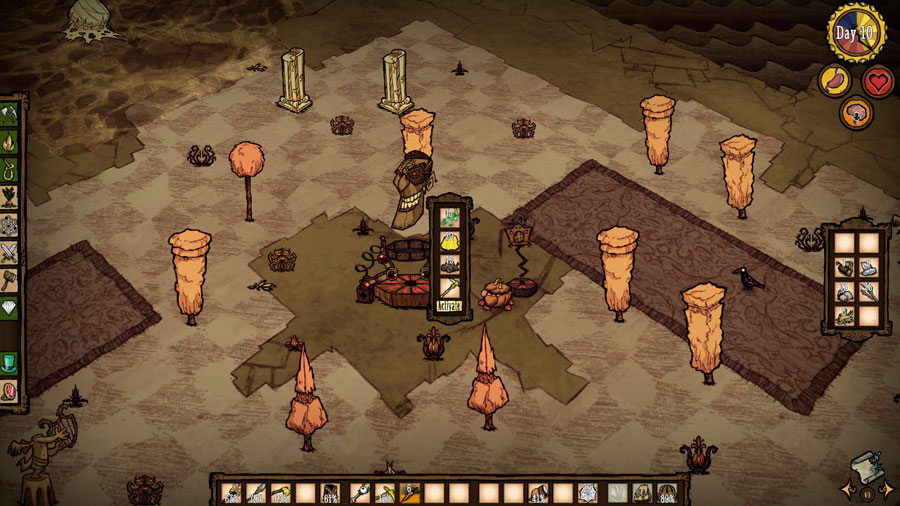
This is what they call “overkill.”
In one sense, my victory was all but assured the moment I zoned into the first world as WX-78. As I may have mentioned, each of the various alternate characters have different pros and cons. The default Wilson has no negative qualities, and has the benefit of growing a beard; if left unshaven, the beard acts as insulation against the cold, while shaved beard hair can be used to craft a Meat Effigy (placeable respawn structure). Wickerbottom has higher penalties for eating spoiled food and can’t sleep, in exchange for the highest Sanity pool, the ability to craft spell books, and can use a lower-level research structure to build higher-tier items. Meanwhile, WX-78 has the lowest starting stats and takes damage in the rain, but can eat spoiled food with no penalty and can eat gears to regain health/hunger/sanity while also increasing said stats by 20 each (to a certain maximum).
With the exception A Cold Reception – where it rains constantly – victory was more or less assured with WX-78 due to the gear bonus alone. While the locations of the Things you are hunting are random, the set pieces in which they are located are all the same. Thus, you know there will always be at least four mechanical enemies at the “exit” to a given world and they will drop two gears each. Gears stack up to 40 in a single inventory slot, do no spoil, and as mentioned earlier they provide a huge boost to all three meters.
In fact, it turns out that I wasted a significant amount of time cooking food throughout most of the worlds given that one gear snack would have been enough to sustain me for an entire day – I waltzed into the final world with 40 gears and left 4 days later. Compare that to my best Wilson run, where I was constantly in dire need of sustenance in a world where plants don’t grow and rabbits need to be dug out of the ground. Indeed, my death in that last level was due to stopping to dig up mushrooms to boost my health/sanity, which was completely unnecessary with WX-78’s gears.
Do I feel satisfied? Well… more or less. I definitely feel like a switch has been flipped off in my mind, allowing me to move on (for real this time). The difference in implicit difficulty sort of made it feel like I had godmode on, although I suppose I should not discount the fact that I had 50+ hours of experience and knew what to expect going in. Another part of it though? I think that I expected to have beaten it that last time with Wilson. The roguelike aspect of having to redo the whole thing generated more hours /played, but not necessarily more enjoyment.
Just shy of 60 hours.
In any case, there is actually more to do. The most recent update fleshed out the Cave system even more, which acts as its own mini-Adventure mode insofar as dying in a cave simply respawns you outside the entrance. I could also seek to, you know, actually survive in Survival Mode – the farthest I got was about day 40. Or… I could move on.
I’m going to try the latter and see if it sticks this time.
Console Counselor Councilor
Okay, I am contractually obligated to divulge that I sit on a THRONE OF LIES.
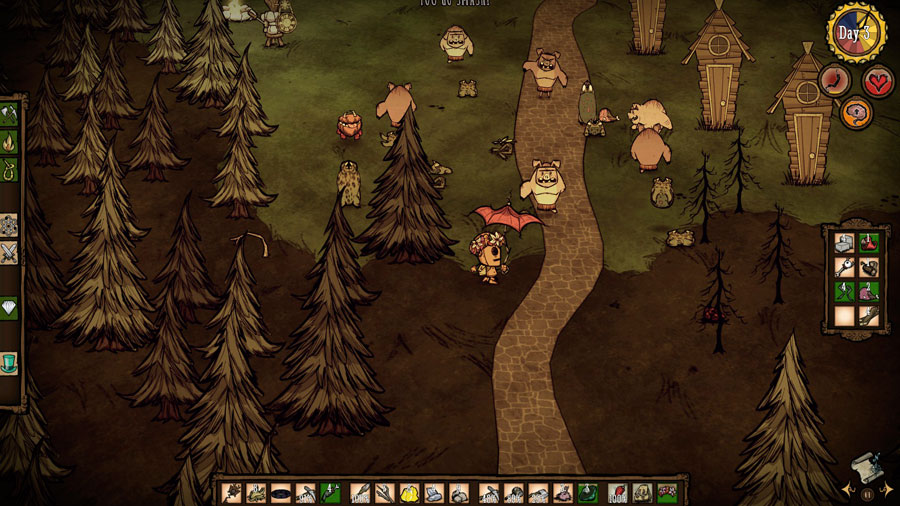
I may or may not have orchestrated this slaughter.
To be fair (to myself), I already mentioned how I was was getting bored with Don’t Starve’s Adventure Mode, in part, due to not being able to change characters. When I created a new Save with a new character in an attempt to start Adventure Mode with them, I was stymied by the requirement of trudging across the map trying to locate Maxwell’s Door. So what changed?
As befits my new (?) seating arrangement: cheating. Specifically, I enabled console commands. And with my new god-like powers, I… just teleported to Maxwell’s Door. Problem solved.
Now, it should be noted that I still feel a bit wary. Cheating is, well, cheating. I don’t actually care what other people think about the act per se, but I wonder if this will diminish the accomplishment of actually beating Adventure Mode. Technically, I haven’t actually cheated in Adventure Mode – just getting there. And considering I was at the end of my enjoyment with the game proper, any entertainment gleaned at this point is entertainment that would not have existed otherwise.
On the plus side, the character I chose, WX-78, is a robot that starts with lower stats in exchange for the ability to eat Gears to both replenish Health/Hunger/Sanity and increase their maximum stats. And he also takes damage when it rains. So, of course, my very first world is A Cold Reception, aka Waterworld, aka the world where it rains (frogs) for approximately 14 hours every day.
Nice try, Maxwell, but I’m still coming for you like a hungry ghost.
Familiarity Breeds Contempt
I think I’m done with Don’t Starve. For real this time.
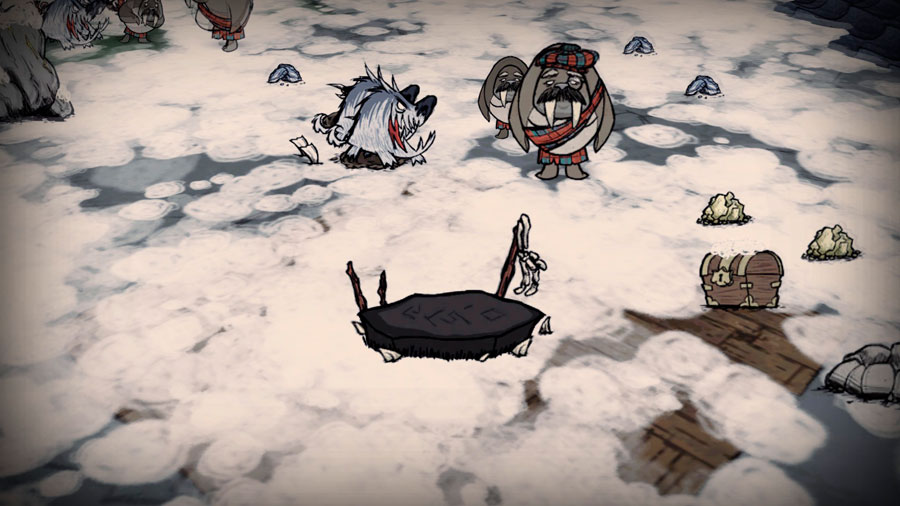
Oh, hey, that’s cool. Just spawn a fucking hunting party right at my resurrection stone.
Thrush’s comment from yesterday sort of gave shape to the amorphous feeling in my mind:
I hate doing things twice. If I go for a walk I go in a loop because I don’t want to see the same scenery twice (weird I know). […] I just can’t get into the roguelike genre for this reason. Once I’ve done 2 hours of work, I don’t want to start from scratch again.
That’s what I was getting at yesterday, even though I couldn’t nail the words down. While my displeasure at what amounts to recycled content is not quite as “extreme” – I have/had plenty of alts in WoW – each subsequent Don’t Starve Adventure Mode attempt generated more bile than the last. It is not about the dying; each death was a novel experience I learned from and won’t happen again. It is not even about the lost progress, really. No, what really pushed me over the edge was the rote, mechanical early game.
Wake up, grab Diving Rod, and then spend the next hour of game time picking shit up off the ground, desperately trying to find a piece of gold ore to build a Science Machine to unlock basic items like the Spear, backpack, and Crock Pot. Subsequent worlds in Adventure Mode are almost always different though, because you retain knowledge of past schematics and are able to bring in four items (and stacks thereof) from before. You might not be able to bring a backpack with you, but you’ll be able to whip one right up after gathering some grass and sticks.
If it’s your first world… well, better start praying for gold.
So, basically, I’m fine with permadeath and roguelikes if they don’t ask you to do the same shit in the same sequence with no possible variation every goddamn time. Or if they do, at least minimize the time spent in what amounts to an unskippable tutorial.
I did start a new Survival Mode map with a different character in the hopes that a new set of pros/cons would liven things up a bit. Then I realized that even a custom map with abundant food and no enemies would require hours (!) of otherwise meaningless exploration trying to find Maxwell’s Door before I could even start again. While I appreciate the commitment to the game’s harsh internal logic, I no longer have time for this shit. By which I mean I’m bored.
Time to play something else.
Roguehate
Do you know the worst part about a roguelike? You can’t even rage-quit! “Oh, I just died? Well… fine! I’ll just delete my saves and… oh.”
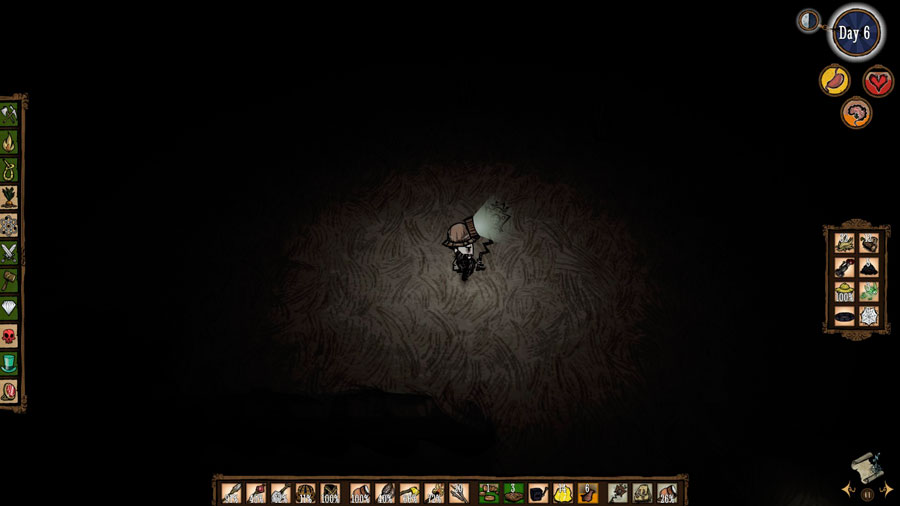
Last known photo of my Adventure Mode hero.
The roguelike genre is one I had avoided for years, rebuffed by the mere word “permadeath.” Is that supposed to be an appealing characteristic? It’s like, I don’t need to know anything more about scrotum piercing to understand, at a fundamental level, that it’s just not for me. And so I happily carried on in my non-permadeath gaming, leaving behind the empty husks of my peers who had just lost their 60+ hour Diablo 2 Hardcore characters.
The Binding of Isaac changed all that for me. And then FTL cemented it. I don’t seek out roguelikes, but it is an exotic flavor I am willing to sample now and again.
The problem I am having though, is with all these roguelikes that choose to, well, bend the (unwritten) rules. For me, it started with Dungeons of Dredmor. After dying a few times getting a feel for the game, I went full optimize-the-fun-out-of-the-game mode. Explored every floor, room by room, while collecting and refining every resource. It was pretty clear that I had vaulted over the difficulty curve and would be coasting my way to the very end. That’s the point of permadeath though, right? To encourage conservative play?
Regardless of the answer to that question, the fact remains that I was on hour 22 of my roguelike save. To me, that is starting to border on obscene. I feel like the roguelike structure works perfectly for games that can conceivably be won within a few hours or a single (marathon) session. Anything longer is simply suspect – what useful purpose does permadeath serve then? I have 52 hours /played on FTL and 27 hours on Binding of Isaac, both of which can be finished within 2-3 hours. Permadeath in this scenario, and procedurally-generated encounters generally, thus increase the play-time of an otherwise short game. But if you are already spending 20+ hours on a single life only to die in some asinine way… well, what’s the point of trying again?
If you can’t tell, I’m writing this post because I’m pissed at dying in Don’t Starve. I made it all the way to the final world in Adventure Mode, which I could not even start until I found the doorway on Day 30+ in Survival Mode. You have no idea how close to the end I was. I had collected all four Things and was on my way to the Wooden Thing to assemble them. The last world is exceedingly harsh though, and my sanity was leaking out at a precipitous rate (it didn’t help that I was traversing a swamp). I stopped to pick a Blue Mushroom in the hopes of regaining just enough sanity to push me over the finish line.
Alas, a tentacle I couldn’t even see spawned and spanked me twice. Dead. I resurrected at my Meat Effigy in total darkness, and was one-shot a few seconds later. Dead again. Spawned back at the Adventure Door portal, and would have to go through everything all over again.
…except I don’t think I am. I have 35 hours into Don’t Starve, and was relishing the thought of being “done” with the game once Adventure Mode was beaten. “Done” in the sense of achieving sufficient mental satisfaction to allow me to move on to another game. Now? I just feel so goddamn empty. Dying to the last boss in Binding of Isaac feels terrible, but you are only really out an hour or so. Same with FTL. With Don’t Starve, I just saw 7-10 hours of my life evaporate into the ether. While that is technically how all leisurely pursuits end, I don’t usually end a gaming session feeling, well, like an empty husk.
It’s not really Don’t Starve’s fault – if the game were easier, even a tiny bit, it wouldn’t be the same game on a fundamental level. I like that a harsh game like this exists, as it pushes you into uncomfortable scenarios in which inaction is punished. I just don’t know if I want to be playing “long-form” roguelikes like this anymore. Permadeath is fine in the proper contexts, and said context is always in short games, IMO. Putting roguelike qualities into a game that simultaneously demands X amount of investment just strikes me as cruel and unusual. Some people like that sort of thing, sure. But I doubt that the end reward for our valiant efforts will be sweet enough to cover the acrid, bitter bile that is seeing so many hours go up in smoke.
Fake Edit: I tried again anyway. Died a few times, tried some more. Got the insanely difficult “forever winter” stage as my first level, but persisted anyway. Somehow made it even farther. Got to the 4th stage, and was feeling pretty good about myself. Run into a field of killer bees looking for a Thing, and died. Now at 48 hours /played. FML.
Optional Difficulty
I am finding myself with conflicting opinions on optional difficulty.
On the one hand, options are good. The distribution of peoples’ skill levels is a gradient, and not usually well-served by binary distinctions. We can easily imagine someone not being challenged at Normal difficulty, but perhaps overwhelmed when the switch is flipped to Hard – doubling monster HP and the like is overkill when all the person needed was +50%.
On the other hand… I might have become a bit corrupted by years of extrinsic MMO rewards.
You see, I just finished playing A Valley Without Wind, which I found to be fairly easy overall. The game actually features one of the most generously granular difficulty options I have ever seen though: it features 5+ different difficulty settings in three independent categories. At any time, you can boost the platforming difficulty up a few notches while lowering the actual fighting bits, or raising the “city-building” aspect to maximum while all but removing everything else.
Despite feeling like the game was a bit easy, I did not change the difficulty at all. “Why would I? It’s not like I get any better items or anything.” Oh. Oh my.
To be fair (to myself), this attitude changes depending on the game. I played on the highest difficulty in Magic 2013, for example, and couldn’t imagine playing on anything lower. X-COM was completed on Normal Ironman, as I imagined that at least Ironman was the “intended” difficulty. And actually, that is my usual metric: what did the designers intend to be the “real” difficulty? “Whatever is appropriate to you” is not a real answer to the question, as most times the difficulty is “Base +/- 100%.” I want to know what the Base is, and judge from there.
Now, it is also possible this is a specific game issue, e.g. I just don’t care all that much about AVWW. I had no problem with turning on Hardcore mode in my second playthrough of Fallout: New Vegas, for example, and actually felt like it made the game more interesting/fun when you couldn’t carry around 1000+ rounds of every ammunition type. Conversely, I did not see how mobs having more HP in AVWW was going to improve the gaming experience at all – left-clicking a few more times while you continue kiting isn’t really more fun.
In any event, this scenario has given me a somewhat greater appreciation for the “forced” difficulty games out there… at least the ones that fall within my natural ability, of course. While I still believe it is better overall to tune a game to cover a wide range of personal abilities, I hate having to arbitrarily decide what is an appropriate challenge to me. I don’t want easy games, but I don’t necessarily want a more tedious experience either (i.e. everything takes longer to kill + you’re more likely to die). Just give me a challenging game and let me figure out how to beat it on my own, without tempting me to cheese it with metagaming.


Endless Loop of Nonplaying
Aug 30
Posted by Azuriel
The final Season Pass DLC – Tiny Tina’s Assault on Dragon Keep – has been out for Borderlands 2 for a while now. I have not even finished Sir Hammerlock’s Big Game Hunt yet, having gotten bored with what the BL2 gameplay devolves into in Ultimate Vault Hunter Mode difficulty (I started playing Sir Hammerlock after the UVHM was released).
Actually, that is not entirely true. What happened is I’m stuck in an endless loop of nonplaying.
See, one of the big changes in UVHM difficulty is that you pretty much have to own some form of gun that features Slag damage (a Slagged enemy received extra non-Slag damage). Since Slag wasn’t required in the prior difficulty, I never really bothered to pick a gun with it up. And since I never saw a point in farming the final boss back when True Vault Hunter Mode difficulty and level 50 was the highest you could go, my normal level 50 weaponry is pretty weak. This was one of the contributing factors to my boredom with the Hammerlock DLC insofar as the enemies took forever to kill on UVHM and yet none of the weapons I was receiving were technically any more powerful. Lack of character progression = lack of interest.
And yet… where is the off-ramp to this endless loop? Completing the Hammerlock DLC isn’t required to start up the next one, but I’m not likely to start it in UVHM difficulty due to the weapon issue. But I’m already level 51, one past the prior cap, from my progress in Hammerlock. So not only will my Dragon Keep adventure start at a reduced difficulty, I also won’t receive any actual gun upgrades throughout it. But I can’t play UVHM without better guns. Which I can’t get without farming the last boss in story mode, or perhaps farming another of the other DLCs. But I don’t want to farm content that I have technically seen multiple times already, and certainly not to acquire guns that will likely be better than what I’ll see in the DLC I need to have them for.
This is, like, a Catch .2206.
Technically, I have shit-ton of Golden Keys from nearly six months of not using any; these will open a chest with high-grade, level-appropriate weapons of a random nature. Also technically, I could use a Save Game editor and just give myself appropriate weapons. In fact, I was considering the Editor because I’m tired of Zer0’s gameplay but don’t want to have to beat the game twice, again, just to get back to where I already am. But I kinda feel like using the Editor would remove any meaning to loot drops much as the AH did in Diablo 3.
So what typically happens is that I’ll be in the mood for some FPS game, think about Borderlands 2, try and navigate the thought process behind what I need to do to play it, and then… go play something else. Because, Christ, I just wanted to shoot things, not map out the plot of Primer.
Posted in Commentary
1 Comment
Tags: Borderlands 2, DLC, Endless Loop, Primer, Ultimate Vault Hunter Mode