Category Archives: Commentary
Beach and the PS4
So, I have been and will continue to be on vacation at the beach with family until the end of the week. The internet service down here is absolutely abysmal – we’re talking 5 Mbps shared across 40 rooms – which is why I have not been on top of the comments and general news. I suppose that might sound bad, caring about frivolous internet things while at the beach. But honestly, if I knew it was going to be vacation back to 1994, I might have passed. Also, the ocean seems saltier this year and there was a fly in my soup.
That said, how ’bout that PS4 news?
If you have not been keeping abreast of the latest developments, Sony basically “won” the show. You can read Liore’s coverage of the event or even similar things in this CNN article. Bottom line?
- No new restrictions on used game sales.
- No internet connection required.
- $399 vs Xbox One’s $499
It wasn’t all good news – a Playstation Plus membership is required for all multiplayer, just like Xbox Live today – but it was a fantastic PR coup for Sony to have been quiet all this time before launching into these consumer-friendly revelations.
A couple Apologists skeptics from around the web have tried to paint Sony with the Xbox One brush over the used games quote though:
“The DRM decision is going to have to be in the hands of the third parties. That’s not something that we’re going to dictate or mandate or control or implement.”
“Aha!” the Apologists cried. “Same thing as Xbox!”
Not really. In fact, not at all. The key point here is that Sony’s strategy is unchanged from the current generation. Remember Online Passes? Those were 3rd party attempts at mitigating secondary game sales, all of which happened in this generation. If EA suddenly changes their mind vis-a-vis reintroducing Online Passes, Sony isn’t going to stop them, but at least it isn’t turned on by default as it is in the Xbox One scenario. As Destructoid put it:
The major difference between PS4 and Xbox One, of course, is that Sony hasn’t made it easier for corporations to control the behavior of their customers, because the PS4 doesn’t tie your copies to your accounts, or initiate checks to scrub traded game data off your system. Basically, Microsoft designed the Xbox One to make it as easy as flipping a switch to eradicate any possibility of sharing your games, while Sony is maintaining its policy of this current generation.
Or you can go with the Game Front article for even further clarification:
“The Online Pass program for PlayStation first-party games will not continue on PlayStation 4. Similar to PS3, we will not dictate the online used game strategy (the ability to play used games online) of its publishing partners. As announced last night, PS4 will not have any gating restrictions for used disc-based games. When a gamer buys a PS4 disc they have right to use that copy of the game, so they can trade-in the game at retail, sell it to another person, lend it to a friend, or keep it forever.”
This is good news for gamers, indeed. In a nutshell, you can buy a used single-player game for the PS4 and play it all you want. If you want to go online with it, you may have to deal with some sort of publisher-determined DRM, be it an Online Pass or whatever.
Basically: #PS4Life
Not that I’m going to buy one anytime soon – I just bought a PS3 last Christmas. But it’s nice to know that whenever I do hop aboard the next console generation, I will have the opportunity to catch up on all the games I’ve missed by hitting up Amazon or some local place and not be paying full MSRP out the ass for 2+ year old games.
My Mod/DLC Dilemma
I started playing Torchlight 2 a few weeks ago, and I am having some issues. Now, I did not like the original game all that much, but picking up the sequel for $5 during one of those crazy Steam sales seemed safe enough. And so far, I am not experiencing the same acute symptoms of frustration as in the first game. Except… now I kinda am.
My biggest gripe with the original game was that the loot system was broken. Specifically, there was no real sense of gear progression in a hack-n-slash Diablo-clone genre that is based entirely on gear progression – I used the same “legendary” level 3 necklace all the way into the endgame, never finding an upgrade. While I have not ran into this problem as much in Torchlight 2, the contours of the issue remain in place. For example, I ran into this gearing decision the other day:

We’re back to getting Best-in-Slot at level 3, I guess.
Maybe “higher level = better” is too simplistic a progression design, but… is it really?
The more pressing concern in Torchlight 2 though, is how a lot of things that should be rewarding are really not. Each main area map has a Locked Golden Chest which contains, as you might imagine, a lot of loot. The key to this chest can drop randomly from any mob on that particular map, or from a specific fairy mob 100% of the time.
Compelling design, right? It would be, if these chests dropped something more than vendor trash.
Random loot is random, but after spending more time than strictly necessary opening these chests up and walking away with nothing of any value, I am finding myself souring on game in general. Indeed, even the extra-large treasure chests at the end of boss encounters reveals greys and greens more often than not. Why should I be fighting bosses when smashing pottery is clearly the more profitable activity?
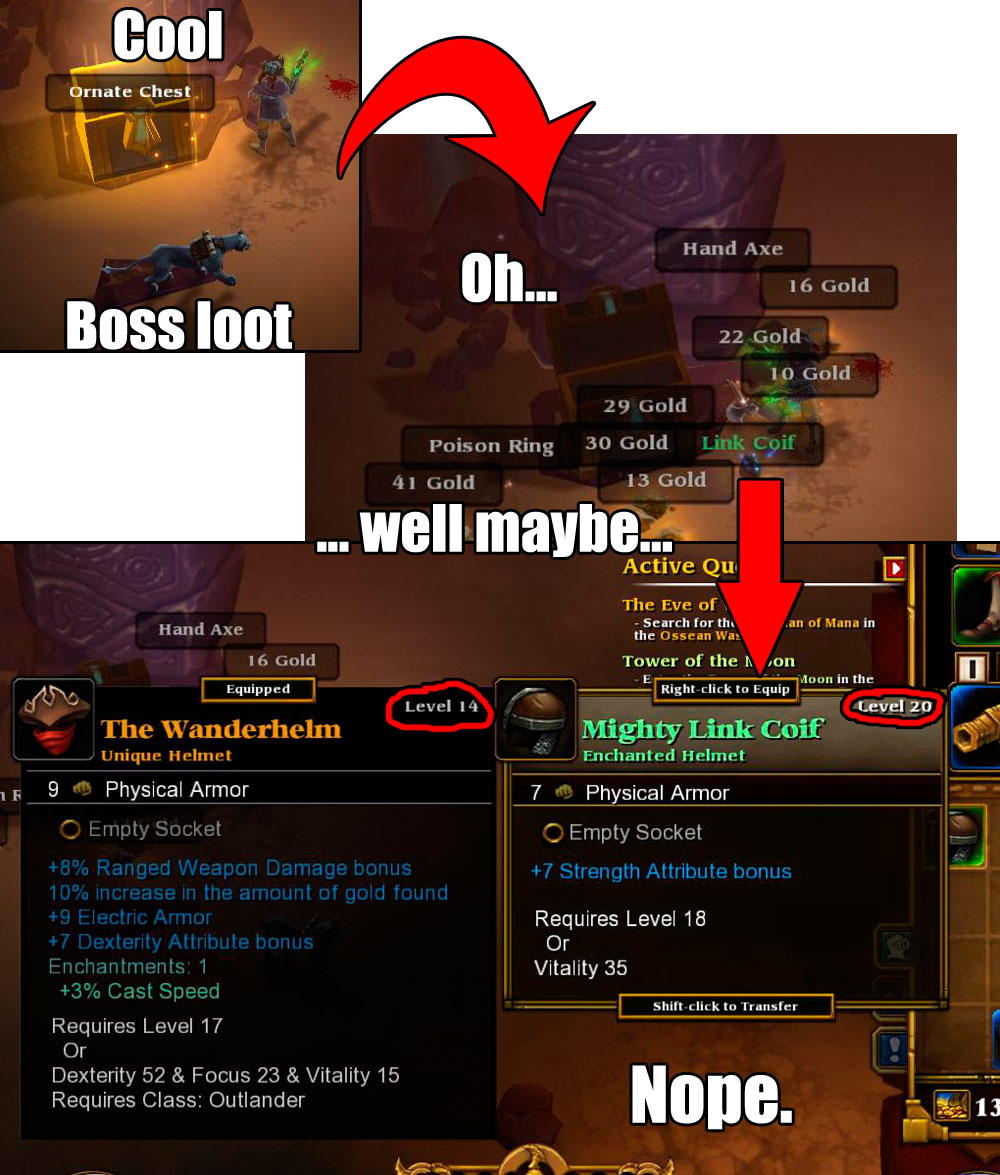
Par for the course.
In Torchlight 2’s case though, there is a “solution”: mods. In fact, the #1 highest-rated mod in the Steam Workshop is one that tweaks Golden Chests (and boss chests) to always drop a Unique item. That’s not as broken as it sounds – items are still random, scaled to your level, and sometimes class-specifc – and does a lot to fix what I otherwise consider a problem. There are mods for all sorts of things, in fact, including Skill tweaks, doubling the amount of gold drops, Respec potions (base game only allows reshuffling of last 3 Skills), improving game textures, increasing view distance, and even additional whole classes. Indeed, one of the big selling points of Torchlight 2 was its modability in comparison to Diablo 3.
Thing is, I don’t like using mods on my initial play-through of a game. Hell, I usually don’t even like loading in DLC that affects the core game, even when I’m playing the Game of the Year version that bundles it all together.
My situation is a bit unique (and self-inflicted) insofar as I fancy myself a game reviewer. But even before this website, I preferred going in vanilla and raw. Not all my friends had the extra spending money for the expansions and whatnot, so telling them Diablo 2 was better with Lords of Chaos installed really just means “the base game is deficient.” Well, perhaps not deficient in D2’s case, but you understand my meaning.
Good game design is supposed to be good out of the box. If developers are stumbling around for the first several months from release, that stumbling needs to remain part of the overall narrative. I failed to mention in my Fallout: New Vegas review that the game was literally unplayable for the first two weeks without downloading a crack that fixed the DirectX issues; it’s an important detail to know for when the next Fallout game is released, lest it too require Day 0 patching from players to fix what the devs rushed to production.
I suppose some of this harkens back to that debate over whether MMOs (etc) are toys vs games. There is no wrong way to play with a toy, no real rules to govern your interaction with them. In this sense, mods are sort of like adding salt to your meal – some chefs might see that as an insult, but perhaps your individual taste skews more salty than the others sharing the meal. Ergo, developers letting mods fix any subjective “problem” only makes sense. Keep the vanilla pure, and let players add the chocolate and sprinkles as they wish.
Personally though, I am much more interested in the game portion of things, or more specifically: experiences. Show me the genius of your rulesets, the compelling nature of your narratives, the excellence of your craft. Anyone can imagine a stick into a lightsaber, just as anyone can turn a crappy game good with tweaks. I am interested in what you can do, Mr(s) Game Man Person, not mod developer XYZ. I want to be excited that you are releasing another game, not that the modding community has another opportunity to fix a deficient product. And besides, only one of those two parties is getting paid. Hint: it’s not the person/people improving the game.
It may not be entirely rational, but there it is. Odds are that I will keep trucking along in vanilla Torchlight 2 so that I can give an accurate report on its (so far) many failings. It is worth noting that while you can import your vanilla save into the “game + mods” version of the game, you cannot thereafter go back – neither your character nor your gear will appear under the default game any more. While that probably has little meaning beyond the people interested in Steam achievements, it sort of highlights how even the developers believe a segregation between the two ought to exist.
In which case, I shall play their game and complain about it, rather than fix things myself.
Keeping An Eye On
I am not usually someone who risks getting my hopes up for games that aren’t even in beta, but I have the occasional moments of weakness. Here are a few of the games I am keeping an eye on:
Sir, You Are Being Hunted.
Basically an indie procedurally-generated, open-world survival game where you are being hunted by British robots. Yes, really. As much as I like the premise though, this is the sort of game that is going to live and die on the player perception of how/if the robots “cheat.” Were you really engaging in risky behavior, or does the AI just sort of auto-spot you within 30 meters? Maybe it is fun either way, who knows. The game is supposedly going to be released in July 2013, aka two months from now, so we’ll see how it shakes out soon enough.
Dying Light

First-person free-running zombie survival game from Techland, aka makers of Dead Island. Whatever your opinion is on zombies it’s wrong, a lot of Mirror’s Edge comparisons are being thrown around, which automatically makes it potentially more awesome. Some of the news sites are looking at this as a potential disaster given that its from the makers of Dead Island, but as you know, I enjoyed the original quite a bit. More of that in more open environments, please.
Incidentally, I have not picked up Dead Island: Riptide yet (with it’s 63 Metacritic score), but supposedly that game was made by a different team than the original. One bitten, twice zombie… or something. In any case, I wasn’t bitten. Dying Light appears to be a “hopeful” 2014 release.
Hex
The last time I talked about Hex, they were fast approaching their $300,000 Kickstarter goal. As of the time of this writing, they are sitting a $1.3 million, or more than 400% funded. The average backer spent just shy of $160. Me? I only paid $85.
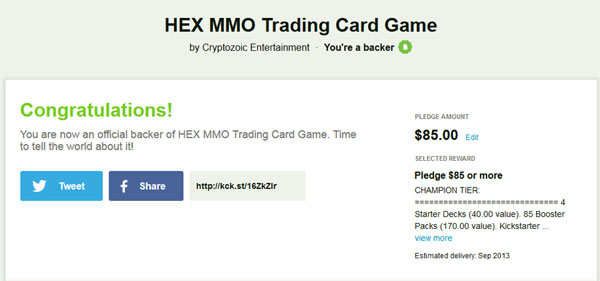
My concerns about how TCGs naturally (and insidiously) combine both P2W and gamble boxes hasn’t really changed. What has changed is where exactly I place Cryptozoic on my internal Nefarious Scale, which ranges from indie all the way up to EA.
Cryptozoic is here to make money, no doubt, but their communication and outright concessions throughout the 18 Kickstarter updates has been downright refreshing. For example, their $250 Pro Player tier granted 1 free booster draft for life, which sold out in a week or less. Meanwhile, the other $250 tiers had bonuses tied to the PvE portion of the game, which is less of a value even if you planned to only play PvE (you can use PvP cards in PvE but not vice versa).
Solution? Every $250 tier now grants a free booster draft per week for 1 year.
Now, that could be construed as cynical marketing given that the Pro Player tier was sold out but the other $250 tiers were not – what better way to convince late-comers to boost their pledges than virtually increase the most popular tier? And, of course, it costs nothing to make all manners of promises in a Kickstarter campaign. At this point though, I want to believe. Just look at this:
960K – Keep DefenseBecome the master of your own domain! Every Lord of Entrath must defend their Keep, so we’re turning it into a game. Players will be able to set up a series of decks to defend their Keep, which will be played by our powerful AI (so you don’t need to even be online!). There will be rewards and prizes for those who are victorious in both defense and offense.
“Prizes” probably won’t be booster packs, so I’m not getting my hopes up about that part. But put that aside for a moment: this is asynchronous player-generated content to the max. Can you see it in your mind? Browsing your collection, building decks that you think will be useful in assaulting these keeps. And then turning around and brainstorming decks to stymie and frustrate the worms that dare defy the sanctity of your realm? Shit, I would do this all day long for free! Er… well, I guess I’m quite literally paying Cryptozoic to create content for other people, but that’s okay too.
In any case, this is quite literally the first Kickstarter I have ever pledged towards, and jumping right in at $85 given my mercilessly frugal gaming habits is pretty crazy. Dropping $10 for a beta invite probably should have sufficed. But, well, sometimes you have to put on your Press™ Pants and go full gonzo. At least, that’s what I’m telling myself. The Hex beta starts in September 2013.
Please don’t be bad. Please don’t be bad. Please don’t be bad.
Xbox One11!one1!
The Xbox One reveal reminded me, forcibly, that Microsoft is the company behind the console. I mean, obviously, right? But between Windows 7 and Bill Gates building better condoms, I temporarily forgot about Games for Windows Live, Windows 8, and all the markedly cynical shit the Redmond company pulls as it endeavors to further erode all consumer surplus and out-EA EA.
Remember the always-online brouhaha? Well, the new Xbox doesn’t require an always-online internet connection. Except when you play a game for the first time. Or if the game company feels like pulling a Maxis and “off-loading computations to the cloud.” And just kidding, your Xbox needs an internet connection to phone home once every 24 hours or it presumably bricks itself until you do.
So how often does it check your connection? “Depends on the experience,” Harrison said.
“For single-player games that don’t require connectivity to Xbox Live, you should be able to play those without interruption should your Internet connection go down. Blu-ray movies and other downloaded entertainment should be accessible when your Internet connection may be interrupted. But the device is fundamentally designed to be expanded and extended by the Internet as many devices are today.”
Oh, how nice of them that your Blu-ray movies “should” be accessible when your internet connection is interrupted.
In return for all of these restrictions, you get to opportunity to… pay full MSRP for all your games! There are no used games for Xbox One, there are simply game disks which will prompt you to pay a “fee” of the full price of the game to play it. Remember when we thought EA eliminating the Online Pass was a gesture of contrition and good will? Surprise! It was cynical bullshit because Microsoft is handling the Online Passes now and adding them to 100% of all future Xbox games.
A lot of the Xbox Apologists have pointed at Steam in making their arguments that things are not so bad. In fact, there is talk that you may be able to sell your used games game licenses to other people on the Xbox Marketplace, in a sort of virtual GameStop setup. Okay… details? If it is true, and assuming you can set your own price, and assuming there isn’t exorbitant fees, then great! We just had to give up renting games, letting your friend borrow your games, and in the case of Steam comparisons, getting 50% discounts on brand new games released just three months ago.
I am not an Xbox customer; I neither bought any of the prior consoles nor plan to purchase this new one. But this sort of shit will affect every one of us. We already see DLC for our PC games delayed because of “Xbox exclusives.” Ports of future Microsoft games could be pulled from Steam just like EA pulled theirs, ostensively so we can have the privilege of paying more money for no conceivable consumer gain. What we see today is what we can expect more of tomorrow – not just from companies like Microsoft, but from everyone who thinks they can get away with it.
And that sucks.
Hex Followup
Is it just me, or does the word “followup” just look weird after a while?
…anyway. Here are some relevant Q&A straight from the forums regarding the now-funded Hex:
Q: Any chance this might be headed to IOS as well?
A: Our immediate launch plans are PC and Mac, but the tech has built from the ground up for mobile.
Q: I would also like to know about the card rotation plan. Will there be standard and unlimited formats, or will all cards be legal to play forever?
A: Right now we’re planned for a 2 block format, as well as an everything format. That is the current plan. We might revisit it after 2 years of data.
Q: The estimated delivery sep 2013 is that for the full game or the beta stages ?
A: September is the estimated delivery for the beta, which will have all of the PvP content and some of the PvE content.
Q: Will the game require a big internet connection? I’m currently working 6 month a year in a inuit village with Satellite internet connection and wireless modems and I get a 5000 ping in online games like Path of Exile here. Wondering if the game will be playable in those condition (Drop out, Lags, ect).
A: The internet overhead of the game is very, very low. The amount of data that goes back and forth to the server is minimal, and we have a 3 minute reconnect timer, that if you lose connection during a game, you have 3 minutes to log back in and you will be automatically rejoined to that game. Any single player experience just uses save states, so you can actually rejoin almost any time after disconnecting.
Okay… hold up a sec. “Working 6 months a year in a inuit village”? You know what, nevermind.
Q: Weird question i know, but any plans of a post beta wipe, getting packs and such back?
A: We will not do a post-beta wipe. Once we give you something, we won’t take it away in even the most seemingly kind way (eg, by refunding packs.) If you open a super rare awesome card it’s yours until you decide to trade it.
Q: So there is currently no other way to get cards for PVP except through initial pledge and buying $2 each?
A: The only way to get PvP packs is through the KS rewards, at $2 each, or as rewards for playing in drafts/constructed tournaments. We will also have an auction house, and I’d expect that PvP commons can be easily picked up off there at budget prices.
So it’s official: you cannot earn booster packs in PvE content. In other words, the only way anyone is playing Limited/Draft formats is for them to have bought, traded for, or won boosters themselves. Based on other questions, it appears the first set is 350 PvP cards that only come from boosters, and 300 PvE cards that are only earned in PvE and cannot be used in normal PvP games (but there might be “anything goes” formats for fun). Now, it is likely you will be able to sell a particularly nice rare you got in a Draft (that you otherwise lost) to help purchase boosters to try your luck again, but otherwise these games are going to cost you $6 a pop for less than an hour of play.
By the way, the stretch goal for $540,000?
540K – Add Primal Packs
Primal Packs are “god packs” that will drop for lucky players when buying HEX booster packs. It is not a separate item in the HEX Store. Every card in this booster is a Rare or Legendary! In addition, each Primal Pack will contain a Legendary Treasure Chest that will hold some truly incredible items, which you can open or trade in the Auction House. Speaking of which, should you be lucky enough to get one of Primal Packs, they are tradable and can be given or put in the Auction House for others just like any other pack. To maintain balance in a tournament setting, you cannot get a Primal Pack during a draft.
“Yo dawg, I heard you like gamble boxes. So we put gamble boxes in your gamble boxes […]”
If it sounds like I am being unduly harsh, it’s simply because I know the effect these sort of games have on me. Drafting is addicting: you get to see 24 boosters being opened, passed around, and picked apart, plus the 30 minutes of frantic deck-building, plus the very-real pressure of best-out-of-three duels with the prize being enough boosters to join another draft for free. That’s a sex, drugs, and rock & roll combo of endorphins right there.
But you’re going to pay. A lot. Unless you’re good, I suppose, in which case the poor players will be subsidizing your gameplay.
Just screwing around in 1v1 Standard duels is fun and all, but you won’t be getting any new cards; there is no progression without pay. Then again, I suppose that is what the whole PvE side of the game will be about. Will it be enough? You cannot use your PvE cards in PvP. Then again, PvE cards do not “expire” and yet there will be additional PvE sets in the future, presumably along with additional monsters/dungeons/raids, so… yeah. Maybe Cryptozoic will be able to shore up the one weakness Magic Online has.
I suppose we’ll see in September, once the Beta is released.
Hex
In the event that you didn’t read last Friday’s Penny Arcade, they talked about the Cryptozoic Kickstarter for a “MMO-TCG” called Hex. Basically, Hex is Magic Online meets WoW TCG meets cards that can get socketed gems, equip gear, gain XP, earn achievements that expand artwork and upgrade cards to foil versions. Also, there will be PvE, apparently including dungeons and raids. And all of this is Free to Play.
Of course, just like with Hearthstone, calling a TCG “F2P” is criminally misleading.
I have some concerns with Hex. First, while I am frankly excited about the unique opportunities involved with an all-digital TCG – cards that buff your creatures do so for the rest of the match, you can put tokens on cards that get shuffled into your library, and all sorts of crazy nonsense that physical card games couldn’t pull off – this game skews so heavily towards Magic Online that I’m surprised Wizards of the Coast hasn’t issued a takedown notice.
Seriously, look at this video:
I’m not talking about Apple’s “rounded corners” copyright bullshit, I’m talking about Grand Theft Mechanics. Creatures have summoning sickness, there is First Strike, Haste, seven cards in the opening hand, 20 life per player, four copy limit on individual cards, 60 cards per deck, land cards, instants, discrete turn phases (Draw phase, main phase, declaring attackers/blockers/combat damage, end step), and even the goddamn Stack.
That’s not even really my concern here though. My concern is what occurs about 200 times in the bottom right corner of that video: spamming of the Pass Priority button.
This is alpha footage, things can change, etc etc etc… but not really. Magic is an incredibly nuanced card game with thousands of pages of technical rules that few follow to the letter in non-tournament settings; friends usually don’t ask each other if there is any response to their Draw Phase, unless one of them was packing a relevant card in their deck. My initial few weeks with Magic Online was a brilliant experience because the game reminded you of all the sort of routine Upkeep triggers and the like that can bog down/derail completely a physical game when you forget one. Trouble is, Magic Online is going to ask you every damn time because it has to. You can manually change your settings to ignore certain steps if you want, but again, Magic is an incredibly complex beast – if you aren’t careful about when you cast a spell or use an ability, you can snatch defeat from the jaws of victory in an (cough) instant.
So that’s concern number one: the Pass Priority button is going to simultaneously be annoying as hell and be the reason you lost a perfectly winnable match. It’s also incredibly high-brow for as much as Hex is being marketed as “easy to get into.” I was a tad disappointed at first when I watched the Hearthstone duels and realized that there would be no “in response I play X!” back and forth. But seeing Hex and being reminded about how cerebral Magic can get… I think the Blizzard folks are on the right track, at least for a casual audience.
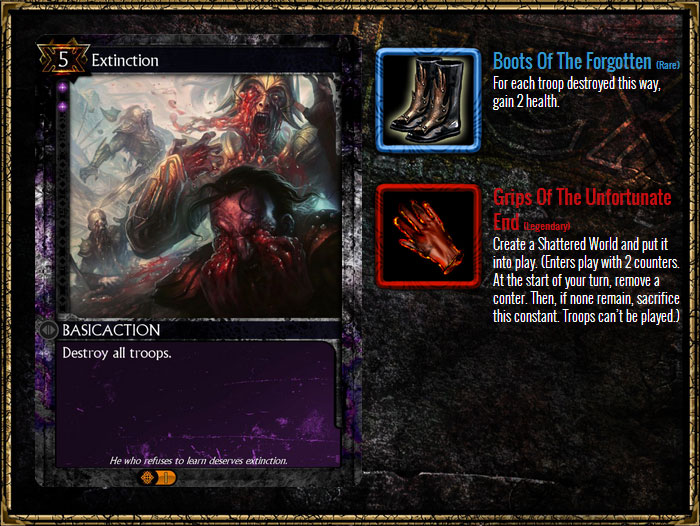
Calling it now: this will sell for at least $60. Each.
Concern number two? You’re going to spend probably $100-$200 a month playing this F2P game.
Look at this paragraph from the official website regarding the above card Extinction:
Every last troop in sight bites the dust. This card will be a crucial staple of many control decks in any tournament format for a long time to come. In other words, in addition to being awesome, these will be quite valuable to all types of players. If you’re dungeon crawling instead of tournament crawling, you can even keep troops off the board for another two turns while you finish your master plan, with the all-powerful equipment Grips of the Unfortunate!
Translation: everyone will be paying out of the ass for this “crucial staple” of a card.
Even if you don’t see yourself competing in the sort of obvious P2W Constructed deck format (or presumably high-end PvE raiding), you will still probably be spending many times the average monthly subscription if you are remotely interested in the game. It is all right there in the Kickstarter page:
For experienced TCG players, we have designed the card set around Booster Draft and Limited play. We have engineered the card sets to launch three times a year, like a standard TCG.
In Magic Online, a Booster Draft = eight players buy three booster packs apiece. Open pack, take one card, pass remaining to the left, repeat. Build deck. Limited = buy six booster packs, open them, build deck. Booster packs in Hex will cost $2 for 15 random cards, which is half of what WotC charges. Magic Online rewards the winners of these mini-tournaments with extra booster packs, such that those coming in 1st and 2nd place can generally leave with a profit of a few packs; I assume Hex will reward similarly. Everyone keeps the cards they play with, so you don’t leave empty-handed if you lose, but… well. Suffice it to say, I finally overcame my game subscription aversion when I realized I spent $24 in the course of a one hour in Magic Online. Suddenly, a mere $15/month seemed like a total steal. Cue WoW purchase.
Frankly, Booster Drafts and Limited are the best Magic tournament formats to play in because there is no Pay 2 Win pressure – everyone starts with the same random chance to get good/bad cards, and skill plays an exceedingly strong role thereafter. But, again, in Hex you are looking at dropping $6-$12 to participate in “content” that evaporates after an hour, if you’re lucky. This is to say nothing about the fact that new sets will come out three times a year, which means most of your cards will be unplayable in Standard settings (which is the big set and its two smaller components in Magic). You can still play older cards in Magic, but only in Extended formats where most people are still packing the overpowered cards of 5 years ago, not the leftover garbage from your Limited games that just became old news.

My deck-building sense is tingling. Or that could be the withdrawal.
If you haven’t noticed, I am extrapolating a lot about Hex from how Magic Online worked, but Cryptozoic has already stolen so much shit I feel safe that they will keep the theme going here. Perhaps Hex will feel a little different since it will have a PvE aspect, where some of your “outdated” cards might find a long-term home. Perhaps you could even earn boosters from said PvE – that would at least make the F2P claim less of a bald-faced lie. But make no mistake here: Hex, like any TCG (digital or no), will contain the two worst components of consumer-gouging videogame design: Pay 2 Win and gamble boxes.
And goddamn it if I’m still reacting like an ex-junkie, credit card in shaking hand.
Ouch. WoW down another 1.3 million
As reported by MMO-Champion, the subscriber total was 8.3 million at the end of the quarter, a loss of 1.3 million subs since Q4 (which had its own 400k loss). For those keeping track at home, Blizzard had 9.1 million subs back on August 3rd, 2012, during an eight-month lull of zero content at the end of Cataclysm, i.e. pre-Mists of Pandaria. That is a net loss of 800k this expansion – with a 1.5 million sub rollercoaster in the middle – and the lowest subscriber count WoW has had since 2007.
By the way, RIP to MMOData.net, which has not made an update in nearly nine months now. How can we pontificate without graphs? Sigh.
I went and signed up to listen to the investor report as there was not a transcript available, wondering where MMO-Champ got the rest of those bullet points. Plus, you know, Press™:
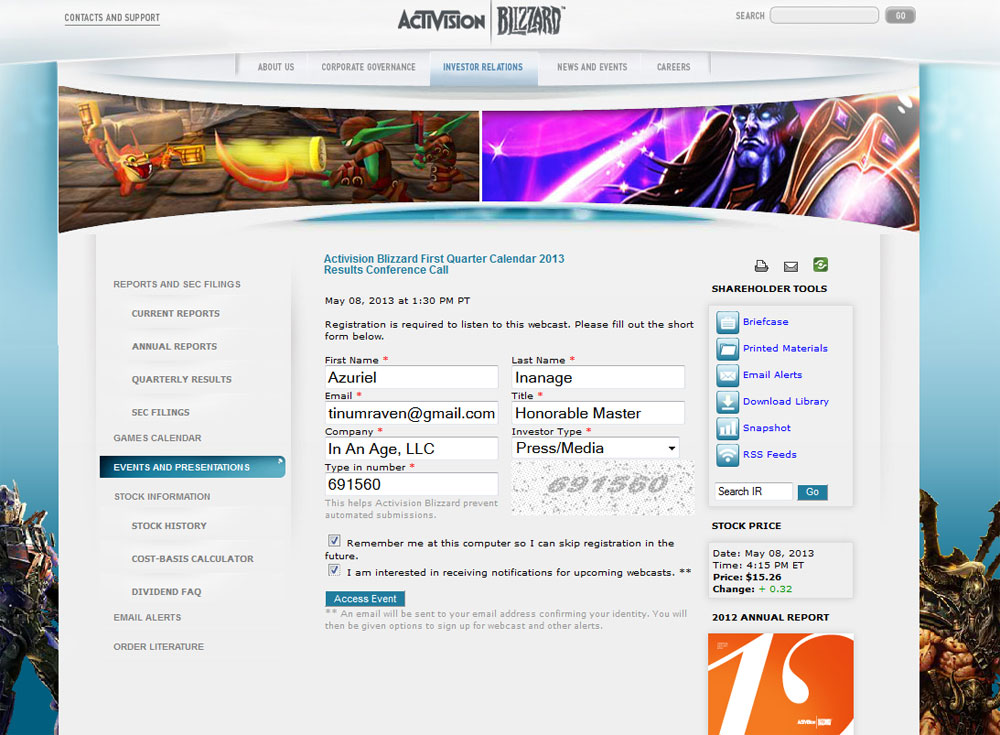
Nothing could go wrong with this.
To save yourself 38 minutes, just trust me when I confirm MMO-Champ got all the relevant information.
What did interest me though was hearing how ultra-conservative Activision Blizzard is. I mean, that sort of thing isn’t a particular trade secret, but when Bobby Kotick explained that the company wasn’t interested in the mobile sphere because the Top 10 titles change every year, I cocked an eyebrow. Call of Duty and WoW still have a lot of viable milking years ahead of them, but this is the same company that gushed about their $1 billion Skylanders franchise that didn’t even exist two years ago. If CoD: Ghost ends up pulling a Warfighter along with the further expected losses (their words) in WoW subs, you can almost imagine a scenario in which they conserve themselves right off a cliff by the end of this year.
But, alas, the money machines continue unabated.
Finally, I sort of chuckled at this part of the WoW presentation:
- There has been less engagement by casual players.
Well… yeah. What did they imagine would happen when you release one of the most alt-unfriendly expansion in the history of the game? And then proceed to put everything behind a triple-gate of dailies and rep, all but remove leveling dungeons (only to put them back), and then essentially stop all production of 5m dungeons for the rest of the expansion? Oh, and don’t get me started on the continued embarrassment of no-pop servers languishing.
At this point, all I’m really interested in is Hearthstone (as hopefully a cheaper Magic: Online) and maybe Bungie’s new game; Titan has been too much of a cocktease for too long to even get a rise out of me anymore. Otherwise Activision-Blizzard might join the ranks of EA as a big-budget publisher who only produces one title that I am remotely interested in, with all the “risky” indie ventures soaking up the money I leave on the table.
And as Doone points out, that’s probably the best thing for everyone involved.


Xbox One Eighty
Jun 20
Posted by Azuriel
I take no credit for either the title nor the picture:
Sort of like SimCity’s “cloud computing.”
If you had not already felt the Earth’s sudden wobble from the magnitude of Microsoft’s about-face, allow me the pleasure of informing you: the Xbox One no longer has its ridiculous DRM. Namely:
One of the “casualties” of this Lance Armstrong-level backpedaling is that you can’t have that whole “10-person family sharing” plan or the ability to “take your games anywhere by logging in.” Often lost amongst the Apologist tears though was the simple fact that logging on from a friend’s Xbox One basically meant you would have had to wait for a 10+ GB download before playing anyway. And what were the odds that more than one member of the family could play the same game at the same time? In other words, you are not any worse off than the present system of just taking the disc with you.
Plus, you know, used games.
On a semi-related bit of interesting news, apparently Valve snuck some interesting code into the Steam software: shared libraries, e.g. lending digital games. Obviously nothing is formally implemented yet, but the premise seems to be that once you lend a game to a friend, they can play it until you log on to play it yourself (which then bumps them off). Which is… pretty remarkably clever if you think about it. Valve could just as easily went the other way, where you couldn’t play until your friend “gave it back,” which would probably discourage people from using the feature at all. Assuming there is no transaction fee or anything, I would feel comfortable giving one or two of my Steam buddies access to everything.
Regardless of which way the shared library plays out – if it plays out at all – today was a huge win for consumers everywhere. I am not quite ready to declare victory yet, but the future sure is looking considerably brighter than it was, oh, two weeks ago, eh?
Posted in Commentary
1 Comment
Tags: About-Face, Consumers, Digital Gaming, Microsoft, Rights, Steam, Used Games, Valve, Xbox One