Category Archives: Commentary
Boxed In
I have been having more fun with boxes than strictly necessary in DE: HR.
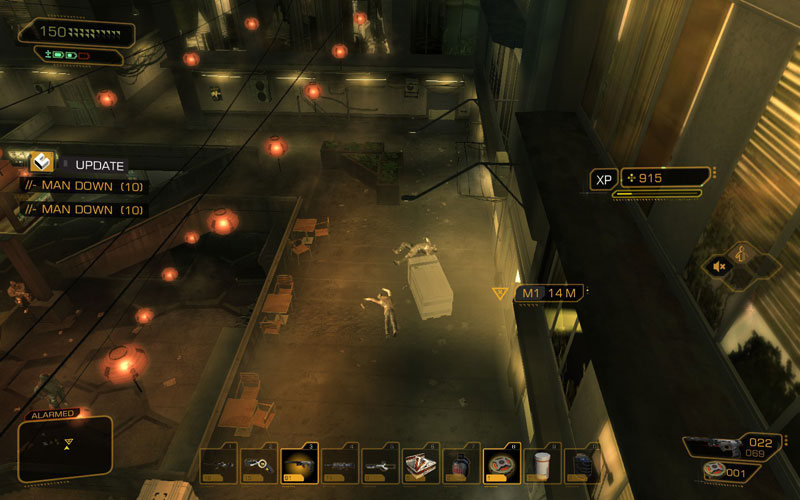
Two birds, one industrial crate.
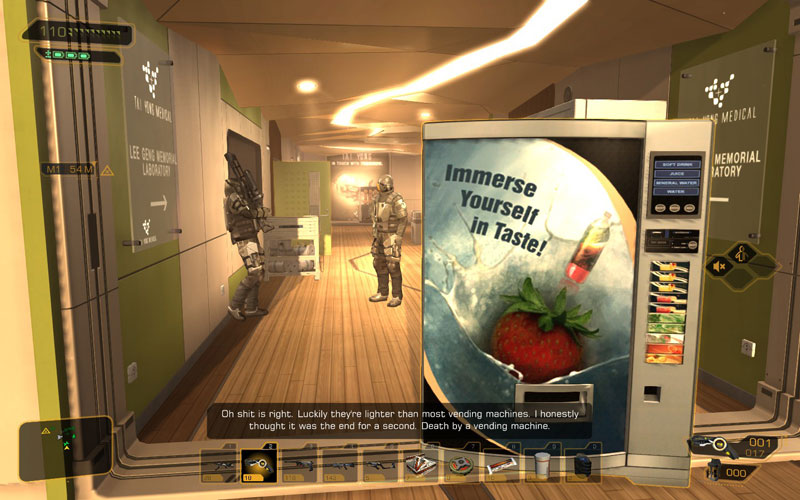
Things Not to Say to A Guy Randomly Carrying Around a Vending Machine #467
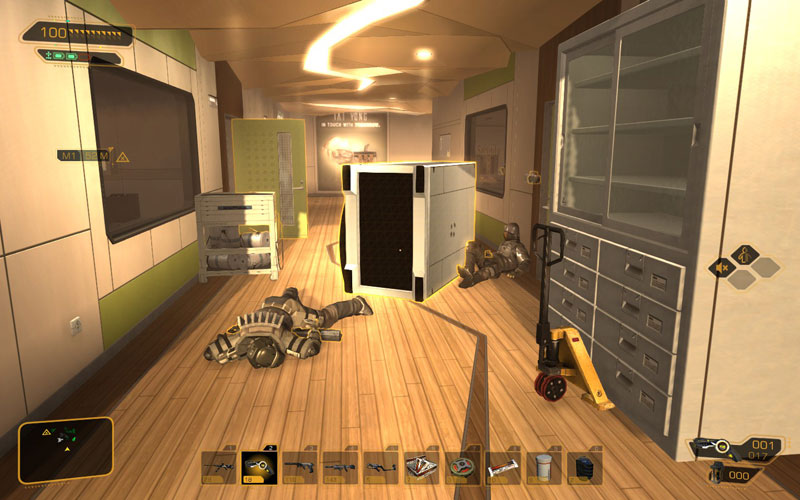
With that kind of setup, I was surprised by the lack of an achievement.
What has been less fun are the frequent Crash-To-Desktop (C2D). By “frequent,” I mean between every 5 to 50 minutes with a trend towards the former. It boggles my mind that legitimate pieces of software are able to be released in this sort of broken state. Googling results in the same, unhelpful article posted a hundred different places. The Steam forums basically tells you to turn off DirectX11 (it’s off), and then tells you that it’s not really a Steam issue anyway. The Edios website tells you to, no joke, create a non-administrative user account in Windows, then play the game from there (tried it, didn’t work). Oh, and by the way, technically it’s not an Edios problem, but a Square-Enix problem. And there is no useful support forum for Square-Enix.
Finally, there was always the “turn everything down” proposed solution. I have yet to try this “solution,” mainly because A) I didn’t purchase a goddamn $1200 computer to play games on settings my laptop could have done, and B) the C2Ds, while supremely annoying, do not make the game unplayable.
I would like to believe that, ultimately, reviews should reflect the game as it should be, or is for the majority of players, reflected through the prism of of the reviewer’s worldview. For example, it would be asinine to complain about DE: HR’s graphics looking terrible in 640×480 resolution with the lowest settings. Similarlly, should a game be “punished” if it launched with bugs that later players never experience?
On the other hand, this situation frustrates me so much precisely because I love everything else going on. If it was a terrible game, like say Frozen Synapse, I would have dropped it like a rock (something I typically do not do). I want to be able to say that I’m never buying another game from Edios/Square-Enix based on their shitty QA process, but just like with Bethesda, I can’t say that either. If they released another Deus Ex, I’d be on that like white on rice microfiber weave carbon nanotubes on a super-conducting ceramic polymer.
When In Doubt, Update Drivers
As I mentioned in the last post, I was extremely nervous about my computer “investment” considering the choppy performance in Deus Ex: Human Revolution thus far. When I re-downloaded Fraps, I finally saw the full scope of the depravity: ~15 fps standing still in the outdoor environments, single digits walking around. Keep in mind, that was with the lowest texture settings, AA set to one notch above “none,” and a 1440×900 resolution. As is often the case in these things, Google was fairly useless other than letting me know that people with lesser machines were miraculously getting better performance.
Then, in my darkest… half-hour, I fell back on my most basic of training: when in doubt, update drivers.
The Nvidia driver update did not actually solve anything. But in the process of updating it, I noticed a Virtu Control Panel button in the System Tray. Screwing around with the settings there did nothing. That was when I chose the “check for updates button,” navigating to their website for the latest driver. Which said:
New games added
- Battlefield 3
- Shogun2
- Crysis 2
- DiRT3
- Deus EX Human Revolution
From what I gather, the Virtu program basically creates a virtual GPU that combines the power of your processors + your normal graphics card. Or, in my case, prevent my computer from using the goddamn graphics card. No, seriously. Once the driver was updated, I loaded up Deus Ex and had a maximum settings, 105 fps orgasm. We’re talking Perpetual Motion Machine lubricant smooth. This feels like an entirely different game than I was playing for the last 15 hours. I almost feel like starting the game over entirely.
So, when in doubt, update drivers. Including the drivers for shit you didn’t even know was installed on the machine.
Deus Ex: Cardboard Box Revolution
Been playing DE: HR for about 11 hours now, and I have come to some early conclusions.
- Many of the design incentives are all screwed up.
It is one thing for your reward scheme to be rote enough that a player can earn XP for knocking out a guard, and then earn even more XP for killing the unconscious guard. Or that there are obviously invisible XP triggers in the duct-work, that encourage players to actually wander around up there long after there was a need to. Those are fine, whatever.
Where I begin to draw the line is the differences between hacking a computer and using the known passcode for the same computer. It is not just the XP that you get for doing the former: the hacking bit is actually fun and rewards its own loot. Not getting the hacking loot might be considered an acceptable “cost” for someone who never bothers to upgrade those skills, sure. But the game design in regards to hackers doesn’t make sense on two levels. 1) Using the passcode prevents you from playing the fun minigame, and 2) it makes no goddamn sense that you couldn’t unlock those secret files with full administrative access to the computer. If I can find secret files while hacking, why can’t I find secret files when I enter the password?
Of course, many people have commented on the above inconsistencies months ago. While I haven’t gone around killing the guards I knock unconscious or running around in the duct-work unnecessarily for the XP, I find the hacking bit to be especially jarring. That could be a sign of my atrophied “simulation is important” organ lurching back to life, but I prefer to think of it as the principal of the thing. If I’m a hacker-type and get your password, I should automatically get all the goodies on your computer. It’s only fair.
- I’m getting nervous about my computer investment.
Perhaps its unrealistic expectations, but I honestly thought I’d boot up the game and play on the highest settings at 60+ FPS. That… is not the case. I turned some settings down, usually the ones with the acronyms that they don’t bother explaining, and am at a point where everything still looks good and plays smoothly. Considering Kotaku pointed out a deal today on a laptop with a i5-2430M, GeForce GT 555M for $695.20… I’m concerned I may not have got $500 more oomph for my money. Ultimately, it will come down to how BF3 plays, since that was my primary impetus for the purchase.
- Did this game begin as a cardboard box simulator?
Seriously, you cannot walk 15 feet in-game without half a dozen cardboard boxes being highlighted in helpful yellow. At first I was confused about all this seemingly pointless interactivity. But that was before I got to the basement of the police station…
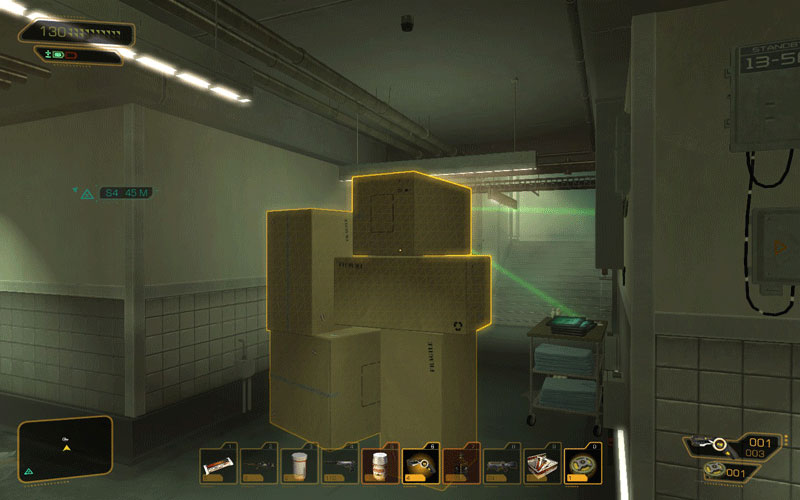
Nothing out of the ordinary here, Mr. Camera.
Directly behind me was a keycard reader I was hacking; behind the boxes is an oscillating video camera with its helpful green beams. In a break from FPS tradition (Bioshock, et tal), hacking in DE:HR forces you to stand up and do so in real time. After some close calls with attempting to disable the camera with my stun gun and hack my way through the door while getting all the goodies, I came upon the more… practical solution.
32GB At A Time
The new computer has arrived.
Remember that photo from the 5 Stages of PC Shopping? Yeah, that basically showed up.
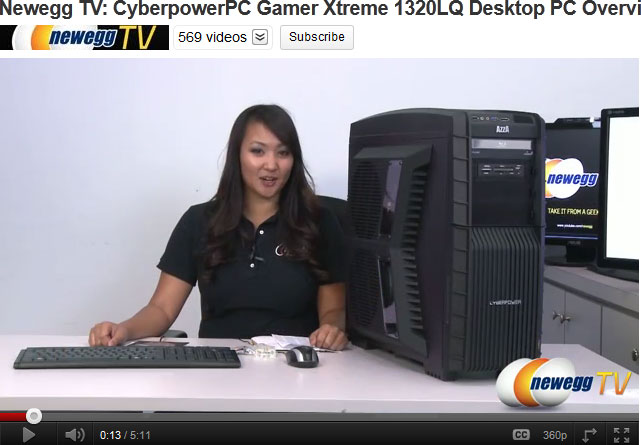
Asian (unfortunately) not included.
Although I have technically had this rig – and it physically qualifies as a “rig” – for a day and a half, I have not actually played any games on it. As it turns out, somewhere inbetween the last time I bought a new computer and this one, I have accumulated a lot of shit that does not like being moved around. iTunes, for instance, was an adventure; you can’t just copy the iTunes folder over and be done with it. It’s fickle. So fickle, in fact, that I ended up having to change the way iTunes was stored on my laptop (moving everything to D:/), then renaming my hard drive on the new machine from E:/ to D:/ (for some reason the Blu-Ray drive was D:/), copying it all onto a 32GB thumb drive I bought today for this express purpose, and then finally shifting it to the new machine.
The whole operation felt like a Kidney transplant, complete with a fear of rejection by the host. And now that I looked it up on Wikipedia, it took around the same amount of time. My Steam transplant, by comparison, was more akin to a vasectomy: just a little snip-snip, followed by recovery.
Hopefully I will be back up and running at full steam (oh ho ho) by the weekend at the latest. Although I had half a mind to chase the Skyrim bandwagon before it completely faded from view, Deus Ex: HR was technically here first in the “I wish my computer could play this” category. And screw being topical anyway (when you are already so far behind the curve)!
Spared Expense
If you have not seen it yet, the 4.3 Patch trailer is one of the worst trailers Blizzard has ever made. Why? No voice over. I was originally sympathetic to the argument that “Hey, they’re just patch trailers.” But after watching this week’s episode of Legendary, I was inspired to see if Youtube had a collection of the old ones. As it turns out, they do.
- Patch 1.11 – Shadow of the Necropolis
- Patch 2.1 – The Black Temple
- Patch 2.3 – The Gods of Zul’Aman “We gonna bury you here.”
- Patch 2.4 – Fury of the Sunwell
- Patch 3.1 – Secrets of Ulduar “May this death-god… take you all.”
- Patch 3.2 – Call of the Crusade (phoning it in)
- Patch 3.3 – Fall of the Lich King
- Patch 4.1 – Rise of the Zandalari “Da Horde is my people.”
- Patch 4.2 – Rage of the Firelands
- Patch 4.3 – Hour of Twilight
To be clear, not all of them are good. Most of them seemed way cooler at the time. But out of all of them, the only other patch trailer with no voice over was 3.2, Call of the Crusade. As in the most phoned-in raiding content patch in the history of the game. Is that really the comparison Blizzard should be going for, nearly two million subscribers down, with the LAST patch of an expansion and ultimate show-down with Deathwing, aka “I am the Cataclysm?”
It becomes even worse when you consider this fan-made revision:
This is what the fan says in the Youtube description:
After seeing the slightly disappointing 4.3 trailer from Blizzard I had a thought that it was simply lacking voiceovers, so I downloaded their trailer and voiceovers from the Dragon Soul raid and played around with it in iMovie for about an hour and this is the result.
Do note I have almost no video editing experience.
You know that tingling sensation, accompanied by your nipples getting hard? That’s (probably) due to proper voice work. And the goddamn height of Blizzard’s absurdity in this is that these voice clips already exist in the game files. It is not as though they can even hide behind the “expense” of getting Metzen to read the inactive ingredients label on a bottle of shampoo over Skype, or whatever passes as content creation in Blizzard offices these days. They had all the pieces already, but chose NOT to spend the one extra hour making a presentably badass trailer for the ultimate, world-destroying boss. Instead, they chose to dust off the 3.2 trailer generator, and cut & paste new video while changing the text in the “delayed left-to-right lens flare” field.
If Titan does not end up being the best videogame in the history of the medium, I hope to god that we see a VH1 Behind the Scenes special, five years down the road, detailing the descent into drugs and madness that was the dev team during this time period. I would rather know that they were booting black tar heroin than to accept that a team of gamer designers sat around a table and approved garbage like the original trailer. I would rather them say “let the casuals eat cake” and return to TBC 2.0, than to know they said “good enough” while rubber-stamping an inferior product. Design directions, even if I disagree with them, at least indicate a modicum of seriousness. This shit… if they stop caring, why should I? Or anyone?
The little things matter.
Factionally Imbalanced
I typically feel assuaged when reading the Dev Watercoolers, because they represent both that players have a legitimate grievance, and that the designers are on the case. With the latest Dev Watercooler entitled Faction Favoritism though, not only am I appalled by the lack of understanding, but I am beginning to lose faith in Blizzard’s ability to craft narratives worth experiencing.
So when it comes to the game’s ongoing story developments, it’s no surprise that Alliance and Horde fans are “keeping score.” Maps and charts of territory gained and lost started showing up around the time the Cataclysm shook the world to its foundations. Southshore plagued? Taurajo burned? Oh no they didn’t!
Implicit amidst most of the grumbling from either side is the assumption that Blizzard should be fairly treating both factions. Then there’s the more explicit assumption: if one faction is losing ground, then Blizzard must be biased.
Are we?
What is this I don’t even

Dave “Fargo” Kosak painfully goes on to talk about how it is precisely because of unfairness that “Hero Factories” get built. In the process of the explanation, it fully dawned on me how much Blizzard has no goddamn idea what the problem even is.
The Widening Narrative Gap
Claims about faction favoritism have never been (or should not have ever been) about the lack of tit-for-tat in territory gains/losses. Perfectly even exchanges are formulaic, boring, and have no place in stories worth experiencing. For Blizzard to address the fact that Horde gained more territory than Alliance in Cataclysm – or even to try and justify it with events that took place in the RTS games – is to miss the point entirely.
The fundamental issue vis-a-vis Horde bias is that Horde have the lion’s share of inter-faction narrative drama. Sylvannas is pulling a Lich King, the Tauren are reeling from the inadvertent loss of their beloved leader in a duel, there is deep divisions amongst the trolls, the orcs are going xenophobic, and the goblin starting experience cements the fact that your own faction leader betrayed you for profit. Meanwhile… what? Malfurion woke up, Audiun grew up, Gnomergan is still irradiated, Magni turned to diamond, and Prophet Velan has neither made any prophecies nor repaired the Naaru ship since it crash landed “two months ago.”
If the two factions represented two different creative writing papers for English 101, which would receive the higher grade? Where is the conflict between gnomes, dwarves, elves, humans, and draenei? Why aren’t the Night Elves complaining about humans cutting down trees to fuel war machines? Or Draenei starting to distrust the growing number of Alliance warlocks? Perhaps the new dwarven council decides it would be better to go isolationist, especially after a particularly disastrous gnome experiment caves-in part of Ironforge?
Bottom line: the Horde interaction is multifaceted with many conflicting goals and desires among the groups. Alliance interaction is one-dimensional, for basically no reason. Horde has Wheel of Time meets Dune whereas Alliance has goddamn Jack and Jill meets See Spot Run.
And so when Fargo says:
In the midst of this crisis, the Alliance is going to need to pull together like never before. At the BlizzCon lore panel we promised that key Alliance characters are going to get more time in the spotlight throughout Mists and the subsequent patches, and I wanted to reiterate that here. They’re going to come out of this stronger than ever, but the road ahead won’t be easy.
…I die a little on the inside. Alliance “pulling together” presumes a division that doesn’t exist, leaving the implication that Alliance will simply see some territory gains and some more Jaina/Varian screen-time. Wrathgate was the closest the Alliance has ever come in actually being angry with each other, and it was simply between Varian and Jaina, the latter of which has never been presented as even being part of the Alliance in any meaningful way.
All the while Horde will continue getting all the interesting narrative, what with Garrosh’s overreach, the growing problem with Silvannis’ blatant disregard for the use of plague and desecration of the dead, and the brilliantly implicit tension from the widening gulf between the Horde that Tauren and the Trolls pledged to so many years ago and the monster it has become. If Baine Bloodhoof doesn’t liken Garrosh’s militaristic Horde with the violent centaurs that Thrall helped Cairen defeat so many years prior, Blizzard will have left the ripest, low-hanging fruit in the history of narrative fiction to wither on the tree.
I wish I could say I have faith in Blizzard’s ability to do a narrative course correction. And I would… if I thought they understood why the present heading was wrong in the first place. Instead, the best any Alliance player can hope out of the lore team is summed up in the Alliance battlecry:
We’ll Keep Trying!
Re: PC Shopping
Thanks everyone who commented earlier about the 5 Stages of PC Shopping, as I have officially broke the cycle. Le specs:
- i5-2500K Processor (4x 3.30GHz/6MB L3 Cache)
- 8 GB [4 GB X2] DDR3-1600
- NVIDIA GeForce GTX 560 Ti – 1GB – EVGA Superclocked – Core: 900MHz
- 64 GB ADATA S596 Turbo SSD (for Windows, games)
- 500 GB HARD DRIVE — 16M Cache, 7200 RPM, 6.0Gb/s (for data)
The rig came to $1260 when the $75 (!) shipping was added in, all via iBuyPower.com. If you’re interested, their Black Friday sale has morphed into a Weekend Sale that will undoubtedly segue into a Cyber Monday sale, so you probably have some time.
I suppose the “cycle” is not permanently broken until I start buying and assembling the computer myself, but given I haven’t had a computer tower in years I figure I’ll be more comfortable next time around. When I priced the components individually on Newegg, it came to ~$818 before shipping and without certain features like liquid cooling and such. I paid a premium, but it’s an okay premium. For now.
In unrelated, albeit possibly interesting news, I will be playing the SWTOR beta starting in the afternoon.
Great Timing
When I originally saw the MMO-Champion post about free SWTOR beta keys, I was excited. And, hey, I actually got a key! Oh… what? It’s a key to enter the drawing for a chance at downloading and playing a 20+ gig client for more than a day 1.5 weeks from now? Wow. I am still trying to imagine a scenario in which downloading a 20 gig game to play for 24 hours or less is not a thinly-veiled “fuck you.” I do not suffer under bandwidth caps, but there is absolutely a cap on my attention span and tolerance for bullshit.
That was a week ago. Last night at 3:23 am, I get the email talking about how I was magically selected for the upcoming weekend beta. I quickly click the link in the email, because apparently the speed at which you click determines the duration of the cock-tease. Fantastic, there is an error. Apparently SWTOR wants everyone who registered before a certain date to reset their passwords. I press the password reset button and wait for the email. And wait. And wait. It arrives at 4:29 am, having taken the equivalent of Pony Express speeds through the Internet tubes, about fifteen minutes after I went to sleep.
Today, I finally reset the password, and attempt to log on to redeem my weekend beta code.
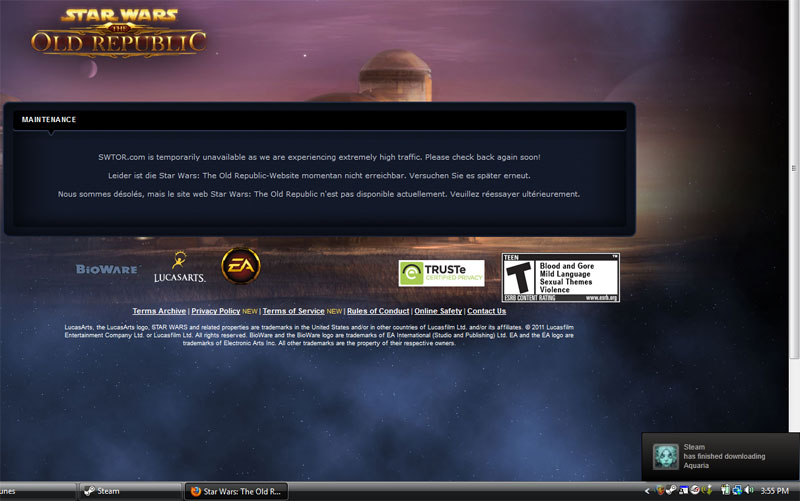
Couldn't they spend, say, $5 million of that $300 million making a goddamn website that works?
Gee whiz, guys. With how concerned EA/Bioware is with a smooth launch, one would assume their goddamn website would be able to handle the traffic generated by the miserly metering of beta codes a week ago.
But you know what? I’m over it. If you notice down at the lower right of the screenshot, there is a Steam notification that Aquaira finished downloading. Aquaria and Crayon Physics Delux and Darwinia and other indie titles for $3.53 care of the latest Humble Bundle that went up today. Not to mention the next Indie Royale bundle will be going up on Friday, along with the inevitable Steam sales over Thanksgiving.
When I quit WoW, I was somewhat concerned about what I would do with all the time freed up by no longer doing daily quests, running heroics, playing the AH and so on. After all, when you averaged the ~7700 hours out it was in the neighborhood of 5 hours a day (albeit most of that encompassed when I was unemployed). What I discovered is that time gets filled up no matter what I do – there is never a time when I am bored for lack of games to play, blogs to read, or things to do. And so I am wondering if I will even have the time or inclination to fit in mediocre MMO gameplay propped up by social strings and glue anymore. Having friends is great; making friends is an awkward pain in the ass.
And unless/until SWTOR starts impressing me a lot more than it currently is, I may stick to the vastly cheaper, and amusingly better quality indie gameplay.


Game of Dethrones
Jan 4
Posted by Azuriel
Rohan’s recent post The Guild as a Nexus of Contracts is an excellent read on the subject of Blizzard’s automatic “GM Dethrone” ability that was added in patch 4.3, and the concept of guild ownership overall. And it reminded me of the hidden depths of my rage towards this policy.
I joined the guild Invictus back when Azuriel was a level 30 draenei paladin tanking Scarlet Monastery for the first time, around a month before the release of Patch 2.2. The original GMs were a husband-wife couple who, a few months after I joined, inexplicably left total ownership of Invictus to the suave, smarmy smartass that
wasis myself. There was a period of time in that initial confusion when I contemplated, quite literally, /gkicking everyone and running away with the entire contents of the guild bank.Listening to the better angels of my nature, as The Abe would say, I relinquished my power to the rightful heir to the throne, Soleste, whom shepherded us through most of the remaining bits of Burning Crusade content. In the months leading up to Wrath though, when the leveling guild-turned-10m progression guild was grinding down due to cliquish drama and apathy, I found myself once again bearing the weight of the crown.
And I am here to say: Invictus is mine.
Or at least was, until Blizzard felt good money should be thrown after bad in terms of Guild Leveling, which has probably killed more guilds than it saved in the aggregate.
I get it. Guild perks and reputation and auto-sustaining levels of guild-funded repairs gives the average member more of a stake in the guild as a whole. But it’s also bullshit. The guild will “belong to everyone” when people can vote for GM, vote for guild bank permissions, vote for bans from g-chat, veto /gkicks, decide on how loot distribution will work, spend three hours on Vent trying to prevent a drama-fueled implosions, purchase guild bank tabs, decide on guild names, tabards, and transfers.
Blizzard is not rolling out the goddamn Magna Carta here – you still can and will be /gkicked by a GM for no reason, with no appeal, at his or her complete mercy. Ownership is, to me, the ability to destroy something. And while guilds can no longer be disbanded, the membership can still be destroyed via kicking, prohibiting g-chat, removing privileges, and so on.
So what the hell is this half-measure? For every guild that is “saved” by First-Come, First-Serve succession, how many random alts of alts suddenly come into possession of a guild bank full of goods? How much residual goodwill is lost from the knowledge that everything you have worked so hard towards for years is not there waiting for you, should you return? Invictus was the sum of its members, yes. But it was also my blood, my tears, my gold, my time that formed the mortar of that structure. If I am to lose it, I want to be the one to watch it burn.
It makes no logical sense, of course. Bear the burden of leadership long enough though, bear the responsibility, and tell me it doesn’t make emotional sense.
Posted in Commentary, WoW
16 Comments
Tags: Dethrone, Guild Master, Invictus