Category Archives: Impressions
Impressions: The Long Dark
I first played The Long Dark ages ago back when it was in Early Access. It was back then, and still is today, a survival game of another kind: a true Player versus Environment. Your primary foe is hunger, thirst, and a cold Canadian wilderness hostile to your continued existence.

Welcome to the middle of nowhere. Population: You.
Having played it for a dozen or more hours now, I can safely say that I am pining for some zombies.
When I said your primary opponent is the environment, I meant it. Outside of the story mode (broken down into Episodes), there are no NPCs. Fauna consists of rabbits, deer, wolves, and bears. I have heard there might be moose involved, and I guess you can technically fish up, er, fish. But that’s really it. While you can eventually craft a bow or loot a rifle, this is not an action survival game by any means.
Given the above, the fundamental gameplay tension is food and warmth. The Canadian tundra is cold, the windchill is colder, and blizzards are colder still. Keeping warm is a challenge, and just finding shelter is not necessarily good enough. That’s when The Long Dark’s thumbscrews come out.
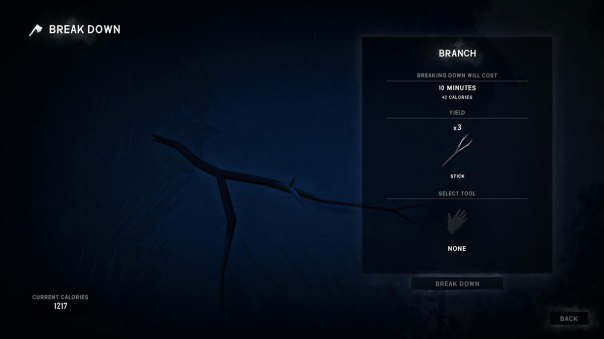
Don’t do this by hand. Or in a Blizzard. Or, really, ever.
See, picking up sticks is easy. Come across a branch that can be broken down into sticks? That’s going to take 10 minutes by hand. Which the game fast-forwards through, but your warmth meter is depleting rapidly all the while (depending on weather and your gear), and now you’re at risk for hypothermia. And those three sticks you got from breaking said branch? That’s maybe 22 minutes of heat in the campfire, which might not be long enough to regain the Warmth you lost breaking the branch outside, nevermind the other firestarting materials. Oh, and it took 42 calories.
The Long Dark takes counting calories to a whole new level. Sleeping takes 75 calories per hour. Breaking down a crate for wood for a fire takes ~62 calories. Walking around for an hour takes 270 calories. Harvesting meat from an animal, so you can cook it to regain calories, takes X calories. Hopefully less than the amount it took you to kill said animal, but not always.
What ends up happening is that you never really feel safe, anywhere. Sure, finding a sufficiently warm shelter is nice. But necessity will drive you from that place eventually. Water is abundant, but needs fire to be produced. Which needs fuel to be collected. Which needs calories to burned. Which needs food to be scavenged or hunted. Which needs you to be outside, in the cold, taking risks.
Being naturally driven from your comfort zone in a quest for survival is brilliant game design. But it is also dissatisfying. Instead of feeling like I have agency, I instead feel despondent. In 7 Days to Die, I forage for supplies so that I can construct defenses capable of outlasting next week’s Blood Moon. In The Long Dark, I forage supplies so I can… stave off the inevitable for another 24 hours. Technically they might be the same in principle, but one feels a hell of a lot better than the other.
Having said all that, I am currently working through Episode 2 of the Story mode and having a plot to follow makes things a bit better. Plus, the locations where the story NPCs live have a fire going 24/7, which makes things considerably easier. Not having the ability to unlock schematics and such as one does in the regular Sandbox version can be a bit stifling (e.g. not being able to craft a bow), but the overall experience is quite good, if a bit linear and directed.
Impression: Slay the Spire
Slay the Spire is basically a deck-building roguelike in the vein of Hearthstone’s Dungeon Run with a splash of Dominion. While still in Early Access, damn near everything about the game was compelling enough to grab my attention for 20+ hours immediately after purchasing.

Not a good hand at the moment.
The basic gameplay cadence is to pick one of two classes, and then complete encounters on your way up the Spire. At the start, you have 10 cards in your deck, and three energy to spend each turn. After each turn, cards you played (and any you didn’t) go to the discard pile and you draw 5 more cards. When you run out of cards, the discard pile is shuffled into a new draw pile, repeat ad infinitum.
Your beginning deck is basically filled with 1-energy Attack (deal 6 damage) and Defend (gain 5 block) cards. As you defeat enemies, you get a choice of one of three cards to add to your deck. Some of these are strict upgrades to your basic cards (Deal 5 damage AND gain 5 block), but many of them are completely different mechanically (discard your entire hand, draw that many cards). Adding these new cards to your deck makes it more powerful, but just as with Dominion, a deck with 30+ cards is not as powerful as a deck with 15 cards – you are simply less likely to get the combo pieces you need when you need them.
This is where the brilliance of Slay the Spire comes in. For one thing, it allows you to forgo getting new cards if you wish. Additionally, in shops and certain non-combat encounters, you can choose to remove cards from your deck. This is good both for thinning the lower-impact cards from your deck, and also removing Curse cards (usually just a dead draw) you might have inadvertently picked up. In addition to cards, you can also get one-use potions, and gain Relics, which are typically passive abilities that augment your run in some way.
All of this is on top of a robust buff/debuff system, a dozen or so different enemy types with their own behaviors, a bunch of bosses/elite encounters, some non-combat events, Shops that let you purchase new cards, one-use potions with nice effects, and so on and so forth.
Oh, and have I mentioned that the two available classes have different card pools?
Since purchasing the game last week, I have beaten the final encounter a couple of times with both classes, using (by necessity) several different methods based on which relics I managed to pick up. For example, one relic gives you 3 Block each time you discard a card. Suddenly, Calculated Gamble (Discard your hand, draw that many cards, costs zero) becomes the best defense card in the game, while simultaneously moving you closer to a your win condition cards. Other games required playing and fetching the same two cards as many times as possible. Still other games saw me die to the first elite encounter I faced, three moves into a run.
Roguelikes sometimes dislike rogues, know what I’m sayin’?
In any case, if you were looking for something less RNG than Hearthstone’s Dungeon Run, or enjoy deckbuilding in general, I highly recommend Slay the Spire. It is in Early Access, so technically it could get better or worse, but they would have to essentially gut the entire game at this point to make it not worth the $13 (on sale) I already paid. Buy it, or keep it on your radar once it releases for real.
Space Ninja Janitor
Warframe was going so great. All the way up until I wall-ran into the payslope and slid back down on my space ninja ass.
The problem I currently have is that all of the blueprints I have available require materials I do not have enough of. In my specific case, it’s Plastids. While mobs do drop some resources, your primary source of most everything are breaking containers and opening lockers. This is essentially the equivalent of breaking clay pots in Diablo. But hey, it’s a looter shooter, right? No big deal.
Let me tell you, there is nothing more disillusioning than a space ninja terminator walking around at normal speed breaking open containers and opening lockers.
Warframe is about leaping through the air and slamming into the ground, knocking your foes aside. Warframe is about drawing an energy sword from the void and instantly slicing five enemies in half. Warframe is about dodging attacks and taking down tough bosses and then escaping as an infinite amount of enemies try to block your path.
I was not expecting Warframe to be a JRPG in which you perform the equivalent of pressing X on everything to discover hidden Elixirs.
Alas, this is a F2P game with cash money solutions to the problems it arbitrarily introduces for that express purpose. I can buy 300 Plastids from “the Market” for 30 Platinum, and $20 will get me 370 Platinum. So… $1.67ish? Warframe will periodically give you 50% and even 75% off Platinum purchases for 48 hours coupons, so technically the price can be a bit lower than that. At a certain point, it absolutely makes more sense to pay to skip the parts of the game which require you to not play as a space ninja terminator. Both money and time are fungible, after all.
…then I remember that these designers do this shit on purpose.
For now, I will ignore my empty crafting queue and continue progressing through the story missions as best I can. There is technically a “resource extractor” that I can purchase with in-game currency that will presumably collect things like Plastids while I am away. It also apparently takes damage and could blow up if I do not retrieve it fast enough, e.g. leave it running for longer than a day. Because of course it does.
If I end up burning out from having to use the same weapons and classes I am stuck with, well, that’s the designers’ fault. I’m 25 hours into the game and am still hunting down the final blueprint that will allow me to “craft” a new class. Once that occurs, I’ll reevaluate and see where things stand. Considering that I only have two Warframe class slots by default, and have to pay Platinum to open more, things might get a bit cramped.
Warframe of Mind
A while ago, I mentioned Warframe only in passing as a slick F2P loot grinder featuring space ninjas. Since that time, I gave it another shot to hook me, and hook me it did. It has now become my “I don’t know what I feel like doing” and “I only have 30 minutes to play” game.
I am still early on, but the general gameplay loop is finally big enough for me to slip through. The missing components were blueprints. As you might imagine, blueprints are necessary to construct new things like guns and other weapons, but also entirely new Warframes (e.g. classes). Once you have a blueprint, it will let you know how many of what resources you need to construct it – which might include components that themselves require blueprints – along with the Credits necessary to get started.
Credits in particular are a concern, as they are used for blueprints and upgrading the mods you get. In the beginning, I was spending pretty freely, for lack of anything else to spend them on (since I had no blueprints). Now? I’m pretty broke. While you can continue the story to unlock missions with greater Credit rewards, enemy levels continue to increase, which means you need to spend Credits upgrading your mods to have a chance, and so on. At some point, you have to grind/farm.
(Or, you know, pay real cash money, but nevermind.)
Luckily, Warframe doesn’t make things too painful. Every 20-30 minutes, there will be an alert on a specific map that grants bonus cash and occasionally a mod or blueprint as an extra reward. I have also discovered a few player-controlled areas which give generous Credit bonuses. Fundamentally, grinding isn’t too painful in Warframe because the moment-to-moment gameplay is fast and exciting. The minute that changes, the whole edifice will collapse in on itself, but until then there are plenty of “excuses” to jump/leap/bound/wall-run around maps like a goddamn space ninja terminator.
Ironically, something like Guild Wars 2 would normally have been my go-to game for incremental progress, but the expansion zones needing so much “Mastery XP” means that if an Event Train starts, you need to stay on-board lest you miss a significant chunk of progress. So, ultimately, the more serious I treat GW2, the more fun of a release Warframe becomes.
Heart of Thorns: Impressions
Having (painfully) unlocked mounts in my prior session, I felt ready to unlock Gliders in this one. Once again, I limbered up the Elementalist, and got ready to trek into the jungle.
…if only I could figure out how.
I think one of the most enduring legacies of WoW that no one gives much thought about are the seamless transitions between zones. Guild Wars 2 has big and beautiful zones… inside very defined silos. Mountains and invisible walls grid everything so that the only way to get to A is through the single zone gate B. Assuming you can find said gate.
So, I teleported to the zone next to the expansion content, mounted up, and road my way down the perimeter. Then, 15 minutes later, I looked up where the fuck the portal was supposed to be. Ah, that little brown smudge on the map.
After a cool cinematic, I started working on the directed quests. They referenced a bunch of stuff I never did – apparently I killed some dragons, like you do – but it was easy enough to follow. After a bit of follow-up, I was dumped into the jungle and told to unlock Gliders to progress further.
It’s been several days since that moment, but I still have a look of incredulity all but permanently affixed to my face. Nothing was explained how to unlock Gliders, just that I needed to. No map markers, no quests, no “Hearts,” no dialog, nothing. Hell, even doing searches in Google and Reddit turned up next to nothing. What, exactly, were the devs wanting me to do?
In case you ever follow my footsteps, here it is: to unlock Gliders in Guild Wars 2: Hearth of Thorns, you must mindlessly grind XP in the expansion zone. That’s it. There are no Hearts in the beginning section, so you must rely on Events you don’t know about or Champion trains filled with mobs that will one-shot you without warning. There is a Day/Night cycle in the jungle that ensures a steady stream of Event-ish things to do, but again, you have to complete enough of them to fill your entire XP (i.e. Mastery) bar before you can unlock Gliders and get on with the rest of the story.
It’s tough to imagine a dumber way to design an expansion, but there is still time to surprise me.
Anyway, my dilemma remains. For sure, I do not want to continue doing anything on my Elementalist. Perhaps either of the two Elite Specializations might make the class more fun to play, but that requires gaining 100% of all your standard abilities, e.g. grinding out additional Hero Points. I’m pretty sure that also means hitting up all the Hero Point challenges in all of the default maps, but who knows. That means I’m either going to continue progressing through the vanilla GW2 story on my Necro, or boosting the Necro to 80 and doing the same thing. Not sure if there would be an advantage to the boosting immediately – I’ll have to research if the XP at the cap turns into Mastery XP or whatever.
I dunno. I’m going to have to look at Thief and Mesmer again, as those would be good candidates for my free level 80 boosts. There is also the Revenant, of which I have only looked at in the PvP lobby. Having permanent Swiftness seems cool, but is less relevant now that I have a mount. The Necro is good, and mostly feels good to play, but I’m concerned about the fact that it seems to hold no relevance in group play basically anywhere. Chronomancers, Druids, and Warriors or bust, is what I’m reading.
I suppose it’s no different than any other MMO: the struggle is always finding that class that is both useful and fun to play. And how do you do that, if not playing for hours and hours and potentially burning yourself out with an unfun or non-useful class in the meantime?
Holiday Updates
I got in some quality gaming time in the past few days.
Far Cry 4
As mentioned in previous post, I was having some issues getting into (or really, staying into) Far Cry 4 despite it being better than what else I was playing. I originally attributed this to the breakpoints within the game, but as others deduced in the comments, it might have been from other tertiary concerns as well. After thinking about it, I agree it was not so much the game itself. Part of my “obligation” in playing Far Cry 4 was that it was taking up a lot of hard drive space, and I thus felt like I needed to finish it and make room for something else I had wanted to try.
After the insight, I went back to Far Cry 4 and enjoyed the experience more as I coasted into and past the endgame. I feel like Far Cry 3 is the better narrative experience overall, but Far Cry 4 plays much better and is a much more cohesive as a whole. Being able to get mobility options like the Wingsuit early on really opens the game world up, without being overpowered.
The Talos Principle
In a word: Amazing.
Portal 1/2 are better games overall, but The Talos Principle is the first puzzle game in quite a while to engender a sort of mild existential crisis. And that’s really what puzzle games are for, right?
Inevitably, everyone always seems to point out the most superficial philosophical questions when it comes to games like this – “Can robots be people?” “Are people just robots?” – and then just stop there. The Talos Principle should invite more salient questions though, and did for me. The game’s setting is one in which mankind is slowly dying, and you can read (and listen via audio logs) to how various individuals react to that inevitability. Some fight on to the bitter end, some leave to spend their last days with family, others do a LAN party, and another pair enjoy one final sunset and then commit mutual suicide. Milton, the AI “serpent,” will question your grasp of the meaning of life over the course of the game, and how it can be ascertained, often deconstructing arguments in ways that would lead some people I know IRL into tears.
That is what The Talos Principle should be noted for, not because the player-character is an android. If anything, whether the player’s android avatar is truly conscious in the same way people are is the least interesting question posed.
Anyway, I highly recommend it if you intrigued by philosophy or pathos or puzzles. It gots all three.
Warframe
According to the Search bar, I have apparently never talked about Warframe before. I played it once last year for about two hours, and then dropped it. I was interested in taking a second look primarily because my Amazon Prime account gave me Twitch Prime, which in turn gives free goodies every month, including what I thought was a free “warframe” but ended up being cosmetics. I think.
Warframe is a third-person over-the-shoulder looter shooter. Think “Diablo meets space ninjas” with a generous helping of impenetrable nonsense. It is also about the slickest F2P experience out in gaming right now.
The general idea is that you are a space ninja and need to space-grind ninja-resources across the solar system. Maps are surprisingly well-crafted, although you will be seeing them quite a bit, as each one serves several different gameplay types – sometimes you need to kill X mobs, sometimes you need to do a sort of King of the Hill node capture, etc. As you finish missions and kill bosses and collect loot, you unlock the ability to craft different warframes (aka classes), which come with different movement abilities, attacks, and so on.
I doubt I stick with Warframe for much longer than what I have already played. While it is a lot of visceral fun being able to jump around the map as a space ninja doing cool space ninja things, there doesn’t really ever feel like much of a narrative “point.” When I completed the first story section, for example, the next required me to reactive a Solar Relay to access missions on Venus. The activation though, required a laundry list of different, metagame-related things, like obtaining 20 mods, equipping four of them, etc. While that is a good way to ensure I am playing the game properly, it also meant I had to play several maps for the express purpose of trying to obtain randomly-dropped mods. Each map probably lasts 10 minutes or less, so it’s not a huge ask, but it still didn’t sit well with me.
Guild Wars 2
Even though I had not been playing playing GW2 for quite some time, I kept it installed on my PC and had been logging in once a day in order to accumulate the free goodies ArenaNet gives you. The currency is nice, but the real prize for me were basically the Tomes of Knowledge, which are free levels. The idea was that once I ended up purchasing one or both of the expansions, I’d have the opportunity to actually experience the content on a class of my choosing, rather than having to stick with the Elementalist, which is the only level-80 class I have.
Well, I picked up Heart of Thorns this past weekend for $15. So I’m playing GW2 again.
It’s funny though, the sort of things that go through my mind when playing MMOs like this. For one thing, I really enjoy the Necromancer, and that is the class I wanted to experience more of the game with. Since she was level 45, I could have skipped near the cap with my 34 Tomes. But wait a minute, I could also get an easy 10 levels via leveling up crafting, right? Gotta save those Tomes for when they are more valuable. Probably like never. But, whatever, I have level 400 Cooking now.
As I cycled through my characters just to re-familiarize myself with things, I also noticed that at least three of my characters received a 5-year anniversary present pack. Which, incidentally, meant I got three level-50 boosts. I had already leveled the Necro into level 55 by that point, but it will be good for later alts.
Anyway, I will be playing GW2 some more now. Seeing people running around on mounts really makes me want to pick up Path of Flames, just to make leveling alts easier, but I’m going to hold off for now. Will my GW2 experience be another passing fancy (again)? Will not jumping in with both (expansion) feet cause the game to be another passing fancy? Stay tuned.
Impressions: No Man’s Sky
Before its release in August 2016, the hype train for No Man’s Sky was insane. Something like 17 trillion different planets in a vibrant galaxy full of procedurally-generated lifeforms. Do anything, go anywhere! Reality hit people hard, including me, even though I did not buy the game at release.
I did buy the game a week or so ago though, and I can say that after a year of actually substantive updates, No Man’s Sky is almost ready for its debut. Mostly.
The first hour or so of gameplay is not that great, and can be worse depending on the randomly generated planet you start on. The vast majority of planets have hostile weather that necessitates the constant recharging of suit protections, driving you to seek shelter in your ship or a cave or farming Zinc from plants. Your ship needs Plutonium to lift off the ground each time, and your Life Support systems can only be charged with Thamium9. And you have to juggle all of these competing element requirements with a micro-inventory that gets worse before it gets better.
That’s really the summary for the game: No Man’s Sky gets worse before it gets better. Mostly.
After getting a few upgrades here and there, especially getting a better ship, the game opens up tremendously. You still need all the survival elements, but you have the space and cash to stockpile a few stacks. Then there is the forward momentum that comes from the primary quests, assuming you did not choose to free-roam. Things progress quite nicely, especially after unlocking your base and assorted goodies like Exocraft, e.g. vehicles.
Here’s the thing though: the core gameplay loop is incredibly tiny. On each non-lifeless planet, there will always be the following: Life Pods, Habitable Buildings, Trade Posts, Crashed Ships, Monoliths. All of them will look the same, although there are a few different types. All of them will be randomly scattered around, but the scattering itself will be very uniform across the entire surface of the world. By all measures you can actually fully upgrade your Exosuit before leaving the original planet you spawned on (assuming you somehow got the cash).
Planets are literally the size of real planets, but everything you could really ever need on any individual one of them will exist within 10km of wherever you land. Each star system has a Space Station, and each Space Station is set up exactly the same way. You can accept “missions” from an NPC there, and these missions are essentially Radiant Quests ala Skyrim. Kill X number of Y, collect Z resource, kill some space pirates, deliver this item, etc. As you increase your reputation, more lucrative quests unlock, which feature harder to find Z resources, or tougher pirates.
Some of the gameplay elements remain half-baked. Early on, you will find many rocks that contain Deuterium, which you are unable to mine. After unlocking Exocraft, e.g. vehicles, you can finally mine them. I was pretty excited… up until the moment I realized Deuterium is only used for Exocraft upgrades. Once you install the ones you want, the element has no purpose anywhere else in the game. The same applies to another element that comes from “raiding” (read: blowing up) protected silos. Why would you ever mine Deuterium or raid the other element again? It not being used for anything other than the thing it was needed for seems comically short-sighted.
It’s not obvious at first, but No Man’s Sky is more of a game about economics than anything else. Each plant or creature you scan gives you Units. Some elements exist only to be mined and sold as vendor trash. Completing missions gives you Units, and unlock better missions that grant more Units. Some of the base-building requires specific elements, but for the most part its Iron which is everywhere. Pretty much the biggest reason to have a base at all is so your can start a Farm, which lets you “grow” special elements. That you then turn into unusable-but-very-sellable items. So you can eventually buy a Freighter for 186 million Units… to have more inventory space. For Units.
I’m at over 50 hours at this point, and I have no idea why I still find this fun, but I do.
The key, I think, is to temper your expectations. This is not Minecraft in space. This is not 3D Starbound/Terraria. I’m not even sure if it’s all that good for Explorers, given that procedurally-generated terrain/plants/creatures generally all look the same after a while. That said, I do find the Primary quests to be interesting, and I very much enjoy the ability to just fly around and do whatever. Want to stop what you’re doing and warp to a different star system? You can. Want to just make a bee-line to the center of the galaxy? Go do that. Want to make the perfect farm so you can mass-produce Circuit Boards and sell them for 1 million Units apiece? Yeah, I’m on it.
No Man’s Sky has gotten a lot of updates since release, and it seems as though more might still be on the way. I ended up buying my copy for $20, and at that price I feel like I got my money’s worth already. In a few months, it might even be cheaper with more content and better gameplay loops. We’ll have to see.
Impressions: BlizzCon Day 1
Well, now. I didn’t really see this coming.
The biggest news of the day, based on Reddit traffic, was clearly Blizzard’s teasing of WoW Classic. As in, they are actually making a vanilla server. Everything is still in development, so it’s technically possible that it won’t actually happen, but that would be pretty embarrassing given that they spent time on stage and even created a video about it. Important details such as cost and which patch stage they will be basing it on are still unknown – based on “server” language though, it’s possible it will just be, well, a server option in your normal WoW subscription.
Some people will undoubtedly be overjoyed. None will probably play a paladin.
In other news, the next expansion in WoW Prime will be… err…

Uhh…
Now, I’m sure there be a lot of people excited for WarCraft to get back to “roots” as a Red vs Blue RTS trope, but this is literally the most generic title and expansion theme they could have done. Sequel Escalation can be difficult to manage when there is no formal end planned – there are only a few more tricks Blizzard can pull once the Burning Legion itself is extinguished – but… this? “Battle for Azeroth” is something you write on a whiteboard with an underline, to denote that a series of actual title ideas will follow. Is this what people felt like almost exactly six years ago when Mists of Pandaria was revealed?
Looking at the MMO-Champ coverage, about the most interesting set of bullet points were:
World PVP
- The PvP vs PvE server division is going away, replaced by an individual toggle. You can choose if you want to opt in to PvP or not when you are in town. Players that feel trapped on PvP servers have a way out. This opens up the game to changing and improving the world PvP ruleset.
- New content like bounty hunting or assassination quests will become an option.
- There will be bonuses to experience, reputation and other things when you are questing with PvP mode enabled to offset the inefficiency.
This is almost a complete game-changer for me. And probably anyone else trapped on an imbalanced PvP server. My primary server at this point is actually heavily skewed to the Alliance, but that just makes the Horde I do encounter especially surly while leveling. Or, you know, when faceless Cross-Realm hit-squads phase into your area. Now that problem is permanently solved.
It also, rather cleverly, creates world PvP hotzones with the carrot of increased Reputation (etc) gains. You could argue that these Reputation-farming zones would already be hot in a normal, always-on PvP server, and you would be correct. But now everyone there would be consensually engaging in (or preparing for) PvP, likely putting up more of a sport of it. And since the change in flagging requires one to be inside a town, you avoid opportunistic ganking, and presumably accidental flagging in the same design. Win-win.
There will be more to talk about in the coming days, I’m sure, but those are my first impressions.
Star Cards
You may have heard a lot of people talking about how bad the Star Cards are in Star Wars Battlefront 2 (SWBF2), but there appears to be a dearth of information on what the cards actually do. Well, I took some screenshots, and will transcribe a lot of them here before.
Among the four classes, the following two abilities are in all of them:
- Brawler: Melee kill regens 50/65/75/100 HP
- Resourceful: All abilities recharge 10%/15%/20%/28% faster.
I did not experience much melee action in my limited time in the beta, so I’m not entirely sure if there is a special damage bonus for attacking from behind, ala the kill sequences from the Battlefield series. Somehow, I doubt it. Resourceful though, is a particularly impressive bonus. I don’t know the default cooldown for most abilities, but assuming 30 seconds, that results in the cooldown being 27/25.5/24/21.6 seconds. Not that this is a WoW raid or anything, but over the course of 5 minutes that means you can press the button almost 14 times instead of 10.
The other noteworthy Star Cards:
Officer
- Officer Presence: Reduce HP Regen Delay by 20%/25%/30%/40%
Heavy
- Defender: Gain 4/6/7/9 score for each hit you take
I was not able to test Defender, but this seems just a bit insane. Is there an internal cooldown? Otherwise, I can imagine some people rolling out Heavies and soaking up some long-distance fire for a few minutes before suddenly coming back as a Hero and murdering people. For reference, you typically get zero points for dealing damage until and unless the target dies.
Assault
- Assault Training: Gain 20/26/30/40 HP on kill
- Vanguard Refresh: Refreshes your abilities on kill 25/23/21/18
The Assault class in general felt extremely weak in the beta, even though it technically has more HP than the Specialist. Getting up to 40 HP on a kill would go a long way in fixing that. Additionally, Vanguard Refresh is just a straight-up upgrade to the default Vanguard ability, which sees you put away the blaster for a shotgun and quicker movement. Not sure what the bonus does exactly though.
Specialist
- Stealth: Remain hidden when firing, and deal 65/75/100/150 extra melee damage.
- Infiltration: Scrambler: Marks enemies for allies and scrambles scanners in 10/11/12/14 range.
- Trip Mine: (replaces Thermal Binoculars) Laser Tripmine with a 30/26/22/16 cooldown.
The Specialist is really quite absurd all-around, even before the Star Cards IMO. Yeah, they will die to a Heavy in a reasonably fair fight. However, the E ability gives you an infinite-clip burst-firing gun, makes you invisible to radar, shows everyone else on your radar, and causes you to speed around the map. Have I mentioned that getting a kill resets the timer too? Adding the Infiltration: Scrambler to that and/or the Trip Mine is just bonkers.
The biggest Star Card offender from a blogging perspective is Boba Fett. Here are his upgrades:
Boba Fett
- Acute Concussion: Concussion lasts 1/1.5/2/4 seconds longer
- Quick Refill: Jetpack refills 20/25/35/40% faster.
- Fuel Efficiency: Jetpack burns 15/18/21/25% slower.
- Death from Above: during Rocket Barrage, take 50/60/75/100% less damage
- Intense Barrage: Rocket Barrage fires 30/40/50/70% faster (more rockets)
As you can see, Death from Above in particular goes from 50% damage reduction while using a very visible ability to complete immunity. Intense Barrage adds more missiles to said attack for free. Or you can combine the two Jetpack cards together to get a much larger Jetpack uptime.
The characters aren’t the only problem either. Here are three cards from Starfighter:
- Bomber has 5/10/20/40% more HP
- Fighter deals 2/4/7/10% more damage with primary fire
- Fighter takes 50/100/150/200% longer to lock onto with missiles.
If you are in a fairly even dogfight, but your opponent has 40% more HP or they deal 10% more damage, or you have to wait 200% longer than normal to get a lock-on… well, that’s not really a fair fight anymore.
Things can always change, of course. I don’t think that the Star Card system itself is going to change, but there will probably be tweaks to the exact percentages. And entirely new options/cards.
That actually might be where most of the concern should be centered. Because as we all know, the payment structure of games inform their ongoing development, which means the designers have incentives to create more powerful Star Cards later on. When they are undoubtedly added into the game “for free,” the average player might be able to craft the first two tiers with regular currency, but whales and competitive gamers alike will have it maxed out as soon as the servers are up.
 In An Age
Slay the Spire: Quick Strategy
Feb 27
Posted by Azuriel
I have beaten Slay the Spire two times as the Ironclad and three times as the Silent. All of the runs were quite different insofar as specific cards and interactions go, but the overall strategy was basically the same for each one:
Avoid Losing Health
This probably sounds like I’m trolling, but I am quite serious.
Not losing HP anytime soon.
As with many games, HP is a resource in Slay the Spire. However, regaining HP comes at a much higher cost in this game. At each Campsite, you can regain 30% of your max HP, or you can upgrade a card. While sometimes necessary, each time you heal at a Campsite instead of Upgrading a card, you are forgoing dozens, if not hundreds of opportunities of using said upgraded card over the rest of the run. Even if you end up grabbing a specific card or Relic that heals you somehow, that is typically at the expense of a different selection that might have helped you in a different way. Much better to simply not need to heal at all.
So here are my tips in avoiding losing health.
Understanding and Loving Block
Blocking often feels bad, especially when it isn’t enough to absorb an entire attack. Instead of being one turn closer to ending the fight, you instead do nothing and take 2 damage, right?
Fist full of Curses, but Block still set me free.
Well, imagine instead that there was a 1-mana card that said “Gain 5 HP.” Would you play it? Yeah, you would probably play it as much as you could. Guess what. That’s what Block does any time it absorbs damage. There will be times when you will save more HP by burning down an enemy than blocking half the damage, but you also have to look beyond the current battle. If you save 10 damage now by burning down the enemy quickly, but lose 30 HP three fights from now, you have ultimately made a poor trade.
Now, there will be times where you have a fist full of Block cards while your opponent is doing nothing but buffing themselves. Those times will suck, and it’s possible you’ll take more damage overall later. However, consider the opposite case where you have a fist full of attack cards and a pile of damage coming back your way. The latter is much more dangerous than the former.
Combat is for the Fortunate
If you do not have a reliable means of avoiding damage via deck/Relic combos, you should not be taking unnecessary risks in combat. Or getting in combat at all. This means picking a route that bypasses as many regular and Elite encounters as possible. Yeah, combat gives you a chance to add cards to your deck, and Elites giving a Relic is cool, but you can also get cards and Relics in those “?” encounters, typically without losing HP. Do those instead.
This sort of route is ideal.
The biggest exception to the general rule is everything on the 1st floor. Since you are just starting a run, it behooves you to take as many risks as possible now, when failure does not sting as much, rather than later when you could lose hours of progress.
Relics Will Carry You
Your overall run will, in a large part, be dictated by the Relics you acquire. Nab the one that gives you 3 Block every time you discard a card? You should probably start picking everything that lets you discard cards. The beginning of a run is more free-form as a result, but you generally can’t go wrong with a fast cycle deck. Just make sure you pick up some Answer cards along the way.
Answer the Encounter Questions
Slay the Spire is currently in Early Access so this can change, but generally the “questions” that an encounter will pose and the subsequent answers are:
Exhibit A
Generally, you are going to want to have at least one card that applies Weaken no matter what. Several bosses have one uber-attack that will deal more than 40 damage at a time, so that one Weaken card will end up being the equivalent of “Gain 15+ block.” Would you draft a card that said “Deal 9 damage, gain 15 Block”? Of course you would.
Beyond that… well, it depends on the character you chose and the relics provided. Playing as the Silent means you have specific access to some very nice cycling cards, and can pick up cards that apply Poison. Tons of Block + Poison = eventual win. With Ironclad, you are generally more reliant on attacking, but don’t forgo Block cards on your way to stack Vulnerability (+50% damage). I had the most success with Ironclad when I kept a lean deck and upgraded the 0-cost card that buffed my Strength for the turn.
Accumulate Advantage
Some of the cards and relics you pick up during a run have an impact beyond any individual combat. For example, the Feed card gives you an increased max HP when it deals a killing blow, and the Alchemize card grants you a Potion. There are also relics that heal you when you cast a Power, or perhaps grant you a special action when you reach a campsite.
This may seem like another duh moment, but… do those things.
Specifically, engineer scenarios in which you can take advantage of them all the time. If you get a Feed/Alchemize card, start drafting card draw or extra block so that you can stall combat long enough to capitalize on them. If you get a bonus action at campsites, make sure you are not wasting the opportunity by having to heal up. You should avoid having to heal at campsites anyway (so you can upgrade cards instead), but that goes twice as much when one of your precious relic opportunities is consumed by something that is useless otherwise.
Posted in Commentary, Impressions
Comments Off on Slay the Spire: Quick Strategy
Tags: Quick & Dirty Guide, Roguelike, Slay the Spire, Strategy