Category Archives: Impressions
[Cyberpunk 2077] The Other 40 Hours
I have a very dim view of the designers behind Cyberpunk, but as Nogamara pointed out, I do have 40 hours and counting in the game thus far. So, what gives?
As it turns out, Cyberpunk 2077 is a lot of fun in the moment-to-moment gameplay.
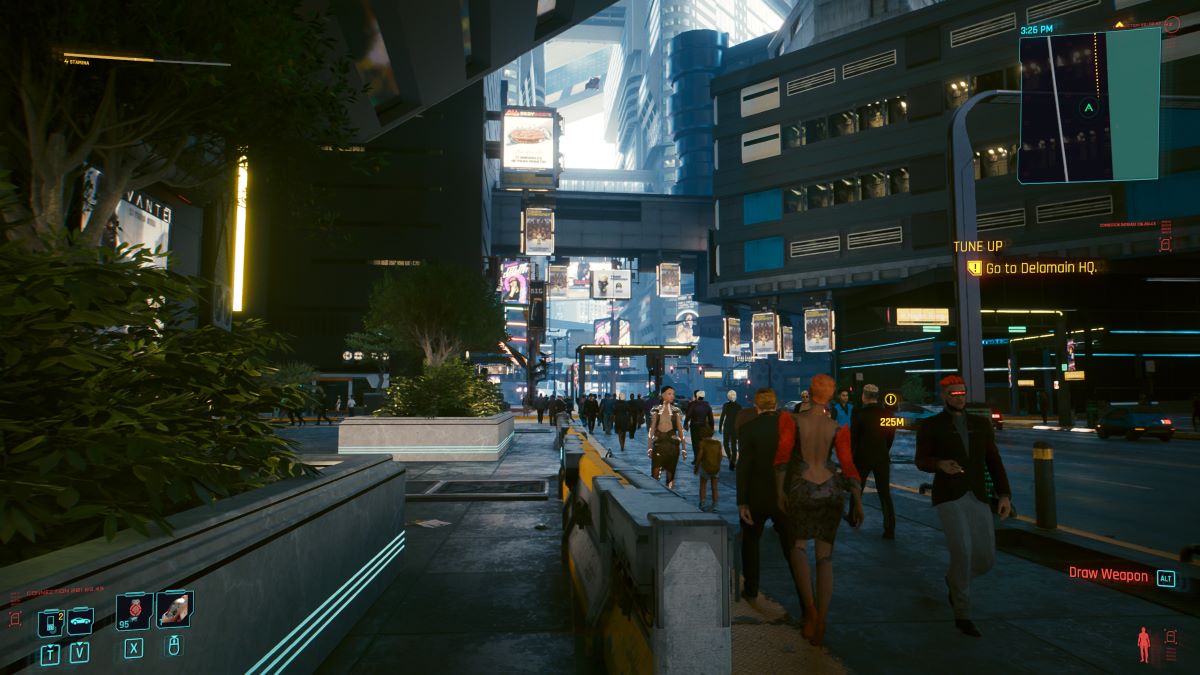
My prebuilt beast of a PC is running Cyberpunk pretty much on max settings (1440p) with 60-80 fps, and… damn. Night City looks incredible. Aside from the absurd number of loading screens when booting up the game, I notice nary a slowdown or hiccup as I speed around the streets looking for trouble to get into. In this regard, it is pretty much like GTA 5 mixed with Skyrim: a pleasure to just get around and get into trouble.
In the beginning, I was playing the game like I always default to with first-person games: sneaky archer. Cyberpunk does support this to a point, but only just so – Dishonored this is not. To clarify, you can indeed stealth through pretty much all the missions, taking special care to perform silent takedowns, pick up Quickhacks that will blind or distract enemies, hide bodies from patrols, add silencers to your weapons, and so on. There’s just… no particular reason to. Stealth is not extrinsically rewarded, locations are huge with dozens and dozens of mooks to plow through, and pretty much every other aspect of the game leads you towards more direct confrontations. Indeed, if you end up picking fights with higher-level “skull” enemies, you are no longer able to perform takedowns on them.
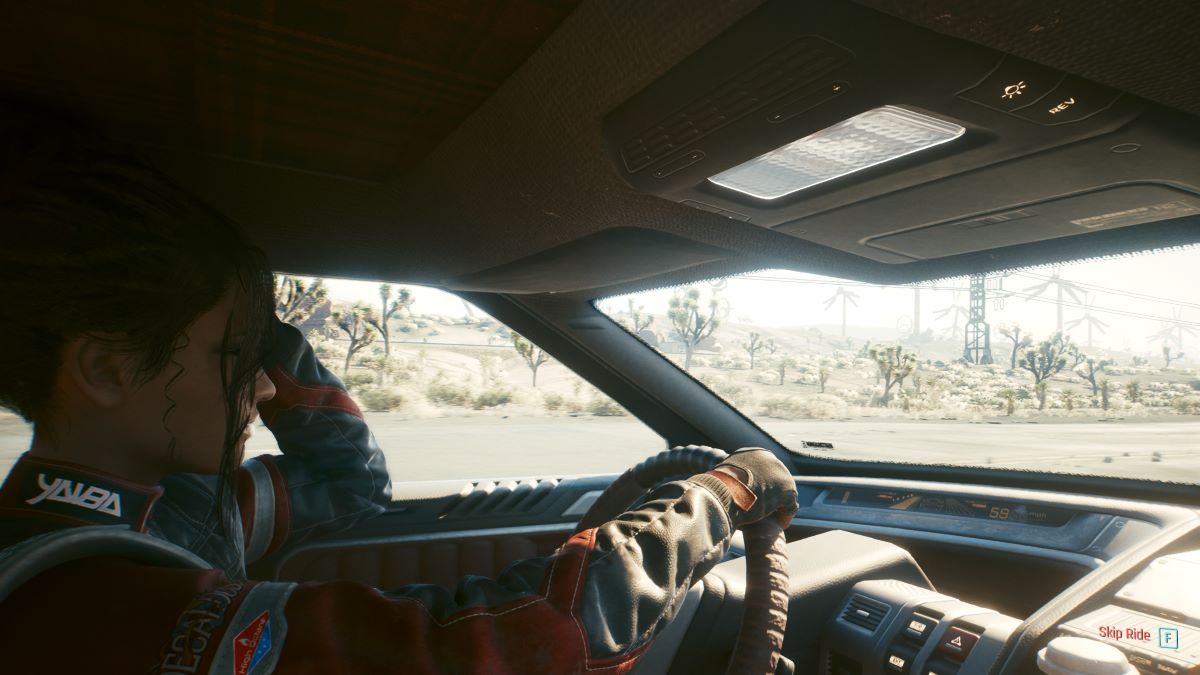
Having said that, the game gets a bit weird once you stop pulling punches and start pulling grenades. As it turns out, grenades are rather good at solving a lot of problems, like gang assaults in progress, enemies hiding behind cover, and basically anything you toss them at. While these have been my preferred method problem-solving, bullets work just as well. By the midgame, there aren’t a lot of things that are especially difficult. Granted, I am playing on Normal difficulty, but I’m not certain whether increasing the number of headshots necessary to defeat foes would do much to make things more engaging.
From a story perspective, Cyberpunk has been serviceable to good. There are a lot of weird side gigs and cross-references that sort of make the setting feel more Outer Worlds goofy than Deus Ex. For example, there are direct Office references, Portal cake jokes, and so on. The main story segments are more reserved and philosophical… ish. While I’m not done with the game yet, the whole Keanu Reeves rock star terrorist angle feels bizarre. Is he supposed to seem cool? Was he a rock star turned partisan, or was he always a commando and did concerts as a front? I’m not sure the answer even matters.
Indeed, I was presented with a few “choices” between unlikeable major factions and I just chose to destroy the one that insulted/betrayed me more recently. I’m fine with games introducing decision-points that have no bearing on anything other than roleplaying, but guys, would it kill you to offer a bit more context? What’s my motivation here? Hard to hate The Man if none of your interactions up to this point have dealt with The Man in a meaningful way. For all the implied Corpo oppression, it doesn’t affect the player in any way. Yeah, there’s poverty and gangs everywhere, but that’s window dressing and content, respectively. I would have liked to have seen a variation of the Wanted meter where instead of cops, you start getting hunted by Corpo mercs depending on the side jobs you take.
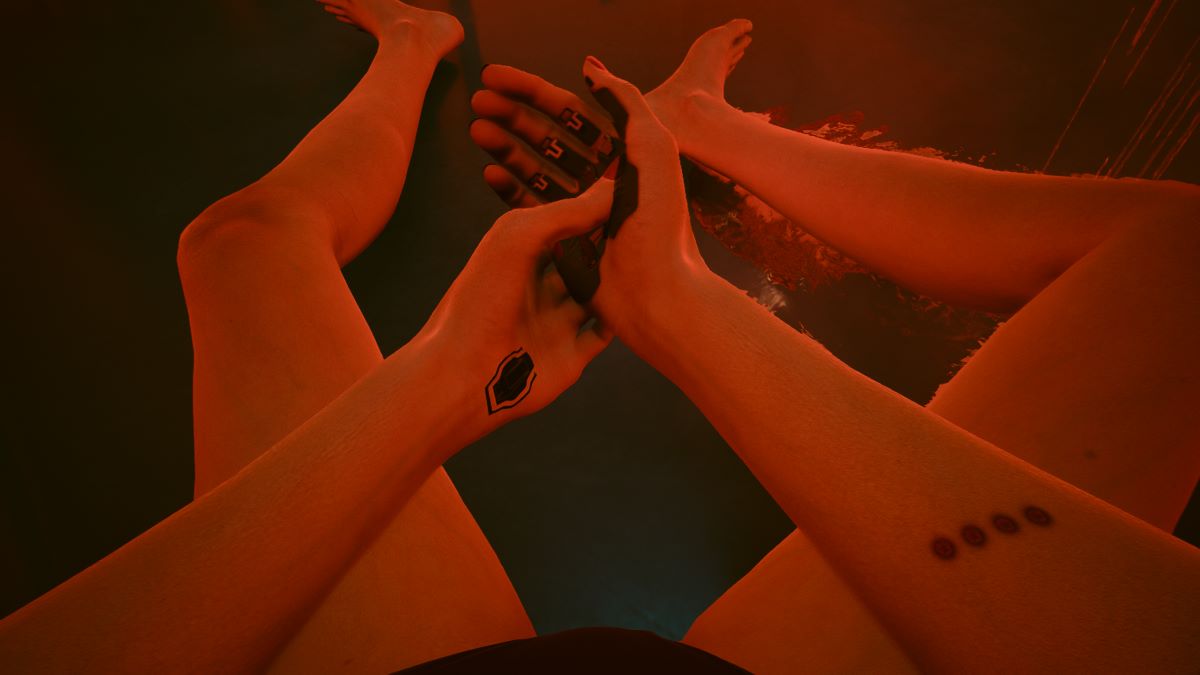
In any case, those are my positive impressions. It’s fun to run around and shoot people in the face. The commitment to first-person perspective – including little things like being able to see your feet, seeing when you get cyberware installed on your hands, etc. – is refreshing and welcome. I seek out opportunities to fight and infiltrate buildings and cause mayhem. I love cyberpunk as a genre.
However. I am currently sitting on 1 unspent Attribute and 7 unspent Skill points. Nothing in the talent trees get my juices flowing, and I have nothing to look forward to, nothing to build towards. Shit, I just found out one of the capstone Technical Ability Skills I had within reach – the one that makes Tech weapons ignore all enemy armor – doesn’t actually work. As in, enemies don’t have armor to ignore. What kind of literal fucking clown show is this? Apparently I was also supposed to be getting free Quickhacks for my hacking efforts (and spent Attribute points) but some bug that’s been around since 1.0 prevents it. Neat. This game would arguably be better off with zero Attributes or Skills systems at all. Not even “everyone has everything all the time,” but literally no one having any enhancements.
After all, there are always grenades.
Having said all that… there is a greater than zero chance I segue right into a second playthrough with a male V focused on “studying the blade” at max difficulty. Quickhacks have been cute, but I’ve been eyeing time dilation katana shenanigans ever since I saw the requisite cyberware on vendors. Viable? Probably not. But it is just crazy enough to possibly be fun.
[Cyberpunk 2077] Terrible Design
Cyberpunk 2077 has undergone a ton of changes since its disastrous launch. I was not keeping track of everything they fixed and tweaked, but suffice it to say, there was a lot. Some of which was immediately indicative of… well, idiot designers. That may sound harsh but let me give you an example: there is an early talent (Dagger Dealer) that allows you to throw your equipped knives. What was missing from the launch of the game until literally February of this year was any way to retrieve your thrown knives. Some designer thought this talent up and some programmer put it into a game where there are legendary knives, and no one thought that maybe losing them forever was a bad idea? Again, this was fixed in version 1.5 which I am currently playing. But the fact that it was even a thing outside of alpha is mind-boggling.
What I am coming to understand is that Dagger Dealer is a symptom of deeper issues.
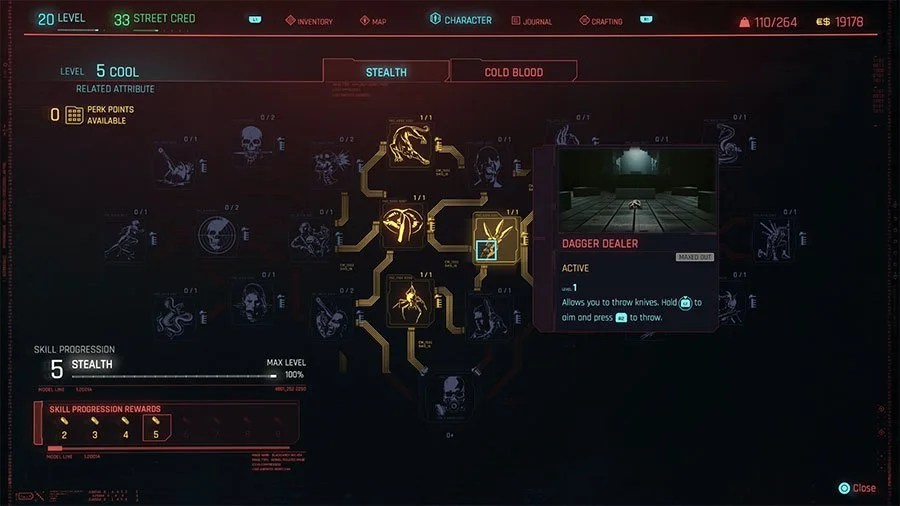
The overall leveling system is just a mess. You gain XP and gain character levels, which grant you Perk points and occasionally Attribute points. The latter are very important because they determine the maximum level of perk you can select within that Attribute. Additionally, each Attribute has multiple Skill Trees associated with it. So for example, the Reflexes Attribute contains the Assault, Blades, and Handguns trees, each of which contain 17-20 Perks that can have multiple tiers.
BUT WAIT, THERE’S MORE! Each Skill tree has its own XP meter that increases by utilizing that specific Skill in various ways. The more you use Handguns, the more Handgun XP you generate, and eventually you work your way down the reward track up to the limit of the Attribute. The rewards are usually little enhancements (Recoil reduction on Handguns, etc) but sometimes they are Perk points which you can actually assign anywhere. While that could lead to some interesting decisions wherein you start farming Blade XP to generate extra Perk points to put into Handguns or whatever, the emphasis should not deviate from the word “farm.” Because that is what it takes.
All of that may sound complicated, but none of it is particularly interesting.
I could live with all the overcomplicated shenanigans, but what I cannot stand is a Talent/Perk/Skill system with so few synergies. It is like the designers didn’t even try. I scoured the various trees and the closest thing to interesting that popped up was a Reflexes 8 Perk in the Blades tree called Stuck Pig that increases Bleed duration by 3/6/9 seconds. That is notable not because it’s actually any good, but because there is no “inflicted by a Blade” qualifier to it. Some things other than Blades inflict Bleed, so that would be an interesting choice and/or build to work towards if Bleeds were your thing. If instead you put any Perk points into Handguns, well, all of them turn off the moment you equip anything else.
And, Jesus Christ, don’t get me started on the crafting system. Because I’m going to anyway.
Crafting is governed by the Technical Ability Attribute and subsequent perks in the Crafting Skill tree. The most important ones are those Perks that unlock the crafting of Rare (5), Epic (12), and Legendary (18) items. In many games, there is always a tension between player crafting and found loot: A) if crafting is better, why search for loot, vs B) if loot is better, why engage with crafting at all. Cyberpunk kicks this up a notch with Iconic gear – these are weapons/armor with unique effects that you can continually upgrade… provided you dump a bunch of Attribute points into Technical Ability. If you don’t, those Iconic items might be good for a mission or two before trash drops start dealing more damage.

Aside from that, crafting largely sucks. You need to purchase weapon/armor “specs” from vendors to unlock the ability to craft that item in that specific tier. Just because you can craft a Rare sniper rifle does not mean you can craft the Epic version of the same sniper rifle, even if you unlocked Epic crafting via Perks. Also, the spec for that Sniper Rifle costs 75,000 credits which is just about what it costs to just purchase the Legendary version of that Sniper Rifle from the same vendor. At a certain point you can farm practically infinite amounts of credits via crafting anyway (purchase components, craft X gun, sell to vendor, cycle vendors), but the point is that the system as a whole makes no fucking sense. What was the harm with a more reasonable weapon spec cost? Woohoo, I get a “cheap” Epic Sniper Rifle by dumping Attribute and Perk Points into a tree that does not otherwise enhance my ability to deal damage with said Sniper Rifle. Christ, I bet that I would deal more damage with a trash-tier Sniper Rifle and those points spent in Reflexes instead.
By the way, Cyberpunk does feature a Respec button. The hilarious thing – in a comedy of errors sort of way – is that it only refunds Perk points, not Attribute points. Thus even though I am 40 hours deep into the game and realize how terrible Crafting has been for me, none of it matters because I can’t shuffle many of those points elsewhere because I’m limited based on Attributes, not Perks. I guess there is an argument that people would game the system by switching to a full Crafting build, upgrade all their shit, get infinite money, and then swap back to a weapon-specific build, but come on.
Know what else is disappointing? The cyberware parts of Cyberpunk. The game is predicated on body enhancements and everyone certainly looks the part. But the thing you find out after browsing a few Ripperdocs is that all the enhancements are… just random buffs locked behind Attribute gates. Sometimes you will find a common-tier upgrade not locked behind such a gate, but the vast majority are tied to your character’s Body or Reflexes Attribute, which means a Technical Ability/Intelligence character (cough) doesn’t have much to gain by cyberware. Which is really fucking bizarre, right? Compare that to how Deus Ex handles things – augments grant gameplay-changing abilities and are otherwise a big deal. In Cyberpunk, they are non-choices.
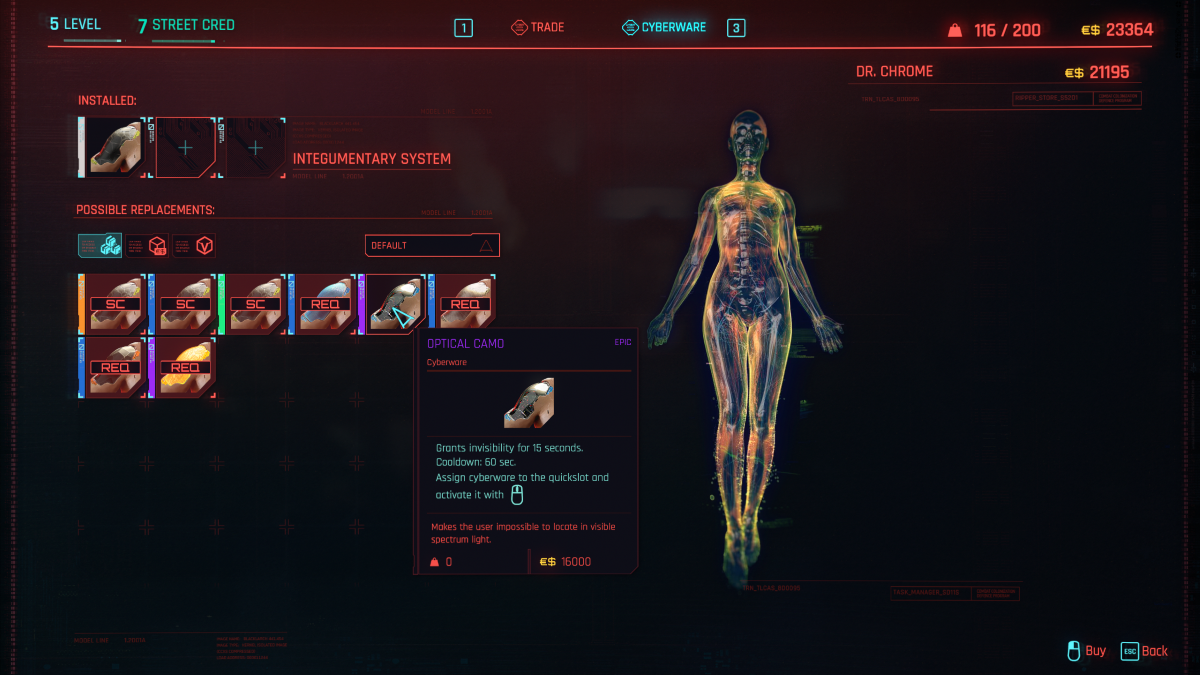
Ultimately, that is the biggest disappointment of all: everything in Cyberpunk (outside of dialog) feels like a non-choice. Can you “choose” to build your character around using Shotguns and Katanas for roleplaying purposes? Sure. Place your Attribute and Perk points in the corresponding slots. But none of that is interesting. And to me, there is no such thing as an uninteresting choice – there are choices and mere decisions. You decide to use Shotguns, and everything else follows. Notwithstanding the banality of having to decide on a specific weapon to use in the first place, there is no room for synergy choices within Skill trees or trying different strategies once Attribute points have been committed.
I am not certain this part of Cyberpunk 2077 is fixable. Being able to Respec Attribute points would help, or perhaps granting more Attribute points overall. Perks would have be radically reworked to introduce synergies though, and I’m not certain designers who had to wait a year and half to noodle on how to fix throwing knives is up to the task.
Impression: Necromunda: Hired Gun
In a word: jank. But the good kind. Mostly.
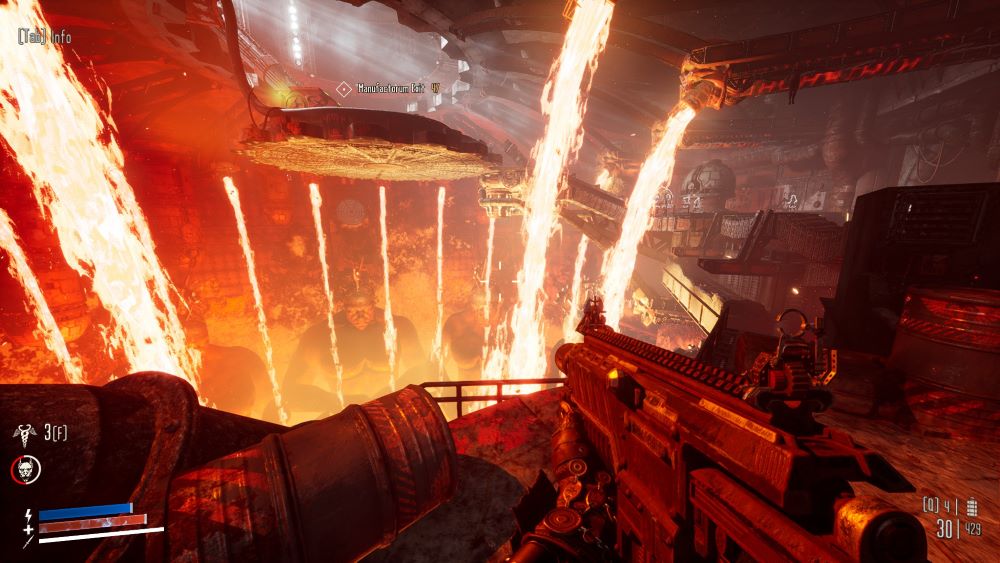
Necromunda: Hired Gun (N:HC) is a run-n-gun, arena-based looter-shooter set in the Warhammer 40k universe. You play as a cybernetically-enhanced mercenary taking contract-killing jobs deep in the bowels of the eponymous Imperium hive world. And you also have a dog. And that dog can be cybernetically-enhanced.
The gameplay is… well, jank. Cool jank, but jank nonetheless. After about the first mission, your character unlocks a bevy of amazing movement capabilities. These abilities include double-jumps, wall running, power slides, and even a grappling hook. However, these maneuvers become downright required mechanically – several of the player upgrades include 50%+ dodge chance while wall running, for example, or even that your guns become more accurate and have aim-assist… while wall running. That said, the movement is not as tight as, say, Titanfall: when you power slide off a catwalk, your character instantly drops to the lower level in a sudden abandonment of physics.
Despite this focus on movement, the maps are not all that set up for you to take much advantage of these maneuvers, up to and including many instant-death zones for you to fall into. Sure, that makes the environments feel more real and dangerous. On the other hand… jank.
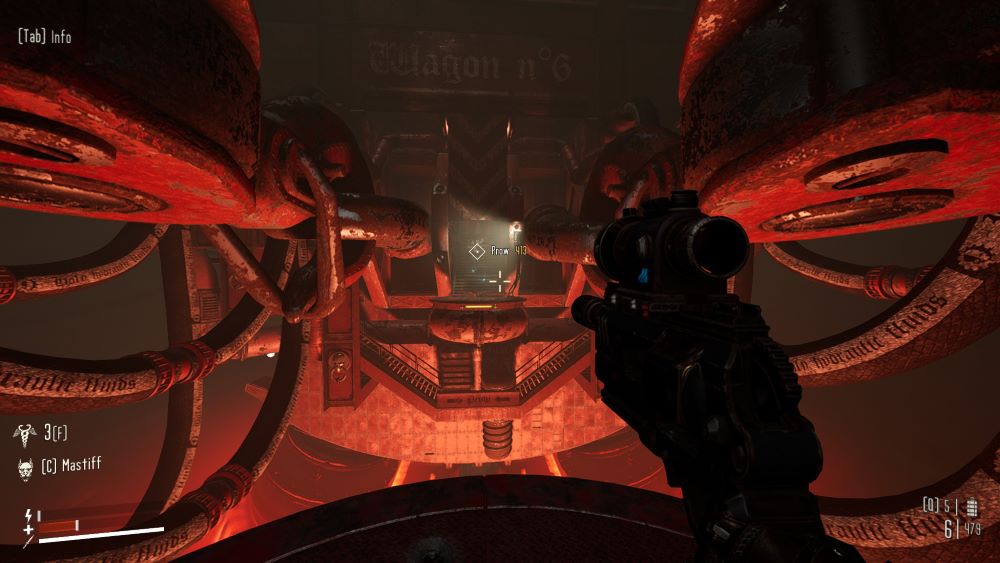
The gunplay is also not really that tight. There are several classic Warhammer 40k weapons available, but several of them are downright awful. Enemies have near-perfect aim and you will be taking constant damage, so the entire gunplay element requires you to be in close range to take advantage of DOOM-esque self-healing by rapid enemy takedowns. This makes longer-ranged engagements (and the corresponding guns) functionally impossible. So you end up being laser-focused on close-quarter weapons like shotguns and the like.
As mentioned previously, this is also a looter-shooter. You will acquire a lot of incrementally more powerful guns that you can customize with various mods and relics. You can also farm cash with side missions to assist with upgrading your cybernetics and special powers. For as many powers you have available, I did find it quite odd how limited you end up being with accessing them via hotkeys (there is 1 total). You can pause time to select from the full menu but that breaks the game flow a bit.
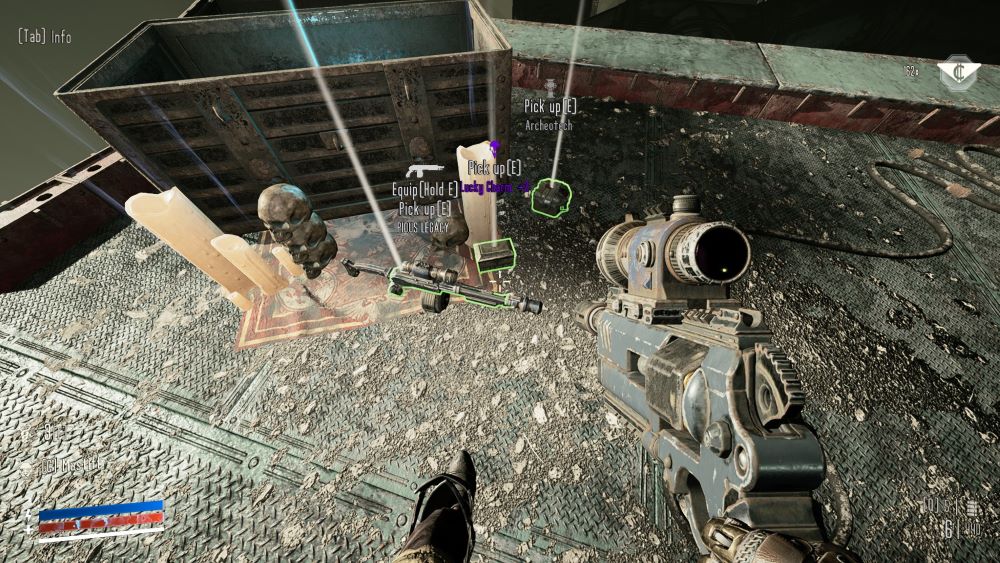
To be honest, the weird feeling of the world and overall game design snapped into place once I read the the developers of this game were the same as EyE: Divine Cybermancy from a decade ago. I don’t expect anyone to have ever played that but it was basically a radiant-quest Deus Ex meets Warhammer 40k meets… developer dreams exceeding their grasp. It wasn’t a great game, but it had a lot of ideas and they did their best to execute on them. Same thing here.
Ultimately, I do find Necromunda: Hired Gun serviceable in the “shoot people in the face” department. Boot it up, play a mission or two, and put it down. My copy came from a recent Humble Bundle that got discounted down to $6 instead of $12. If yours didn’t, well… maybe it’ll come to Game Pass.
Impressions: Gordian Quest
Ever wonder what would happen if designers just added all the things to a game? Wonder no more.
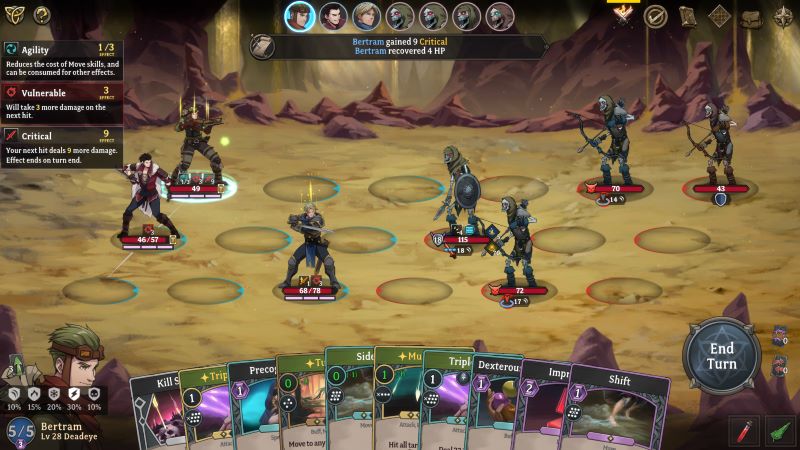
Gordian Quest is a sorta-roguelike tactical turn-based deck-building card game, with a full story campaign along with the more “traditional” roguelike modes. You control up to three characters with their own individual themed decks and battle enemies on a grid. Characters can also equip items that boost their stats or even add special cards into their decks. Those stats are important for the scaling of cards and also because there are D&D-esque skill checks occasionally. Also also, characters gain XP and level up, allowing them to place talent points on a customizable, randomized grid and expand in multiple directions. Have I mentioned there are 10 characters to choose from and each character has three distinct themes of cards that can be mixed and matched? And that items have rarity levels and randomized stats, with Legendary versions possibly opening new synergies? Oh, and items have rune slots too, which can be slotted with additional stats or special effects?
Like I said, the designers really went nuts with this one.
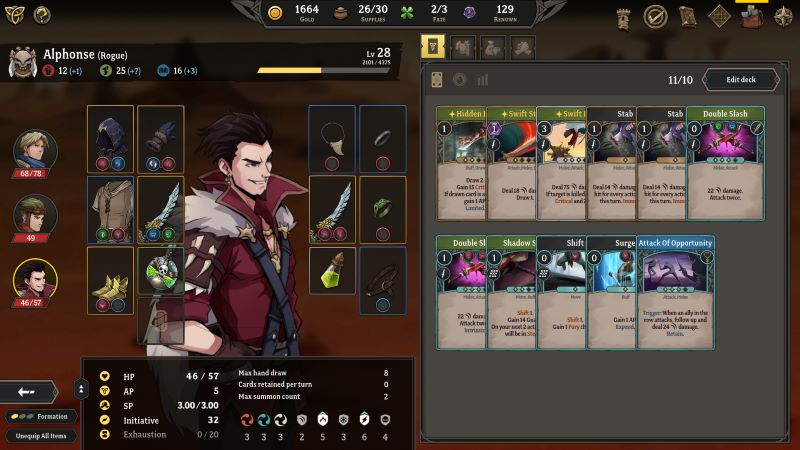
In reality, the game is mostly more coherent than I am implying. If you played Banners of Ruin, this game is basically that with some D&D and Card Hunter and FFX Sphere-Grid sprinkled in. Nothing stands out as being completely unnecessary while you’re playing, but just thinking about it now… goddamn is there a lot.
Is it fun? Yes. For a while.
Unfortunately, I basically broke the game before I finished Act 1 (of 4). Two of my characters are an archer and a rogue, with either one of them being capable of solo-murdering the entire enemy team on the first turn. If for some reason there is a straggler, the other one mops up. My third dude never actually gets to play cards at all, but if he did, he also is fairly stacked in the murder department. I had hoped that perhaps things would change once I hit Act 2 – maybe enemies would have a bunch more HP or have more Initiative to go first – but thus far that has not been the case. The only time enemies even get a turn is when they are bosses with literally 10-20x as many HP as normal, and even then they only ever get that one turn before getting melted.

The double-unfortunate thing is that breaking the game in this way was not particularly difficult. Part of that is undoubtedly due to my overall experience with deck-building games wherein winning strategies are roughly the same: prioritize increasing your per-turn draw, and keeping as few cards in your deck as possible. The other part though largely stems from what I imagine was a designer attempt at keeping things “balanced.” For example, the available talents are… boring. Even the ones all the way at the bottom of the tree. So I basically ignore all the Tier 3 talents and just pick the ones that grant +1 draw per turn and similar.
This “balance” extends to the three themes per character as well. My archer has Sharpshooter, Trapper, and Sentry schools of cards. Sharpshooter is all about damage. Trapper is about setting traps on enemy cells and cards that move enemies around (thereby forcing traps to trigger). Sentry is about setting up turrets on your side of the battlefield, boosting said turrets, and then letting them damage the enemy. You would be forgiven for assuming that Trapper and Sentry cards deal more overall damage, considering that that would make sense given the fact that they require setup. But… that’s not the case. Sharpshooter cards deal the same or more damage with no setup. And since 99% of the Trapper and Sentry cards are useless by themselves, you engineer your way to only choosing Sharpshooter cards when offered a choice, thereby increasing the average power level of your damage cards in a runaway feedback loop.

There is a bard character that is all about building up melody combos and essentially buffing the entire party so that they don’t need to worry about defense on their own turns. There is a warlock character that focuses on Bleed effects and debuffs. There is a golemancer that presumably mances golems. I haven’t even bothered trying those characters out because what’s the point? They would never get a turn. There are so many buffs, debuffs, tactical decisions, etc, that are entirely irrelevant in ways it seems impossible to make relevant without massive nerfs and a complete overhaul.
Sigh. Could this be solved by just avoiding the Archer and Rogue? Sorta. Although the Warrior and Cleric characters also have some gnarly damage cards/combos too. Could all this be addressed in a future patch? Maybe. If this was still Early Access, I would not be as concerned. Given that this is a full 1.0 release though, something tells me that they aren’t going to radically alter the way the card schools are entirely set up. And it is not as though higher difficulties can “solve” the issue either – cranking enemy HP higher and player damage lower is only going to make the currently non-viable (in comparison) strategies even more non-viable.
I suppose I will see if anything changes between now and the final boss. Assuming that I bring myself to slog through the rest of the game, like a Conquest victory in Civilization that was a forgone conclusion fifty turns ago.
Up until this point? Pretty fun though.
In Other News…
…this happened yesterday in FF7R:

Not quite playing as much FF7R as I probably should for how much amusement I get each time I do.
If there is a particular reason, it’s this: FF7R is not a survival crafting nor a roguelike deck-building game. Those are apparently the only ones capable of consuming my entire life in one go anymore. Everything else has to be… “intentionally” done. Or perhaps there is indeed something critical to be said about the lengths between exposition in FF7R, filled such as it is with vast expanses of empty, dungeon space.
Which reinforces the size of Midgar, mind you, just perhaps too well. Or conveniently well. Hmm.
Second Impressions: FF7R
I didn’t think it was possible, but I like Final Fantasy 7 Remake even more.
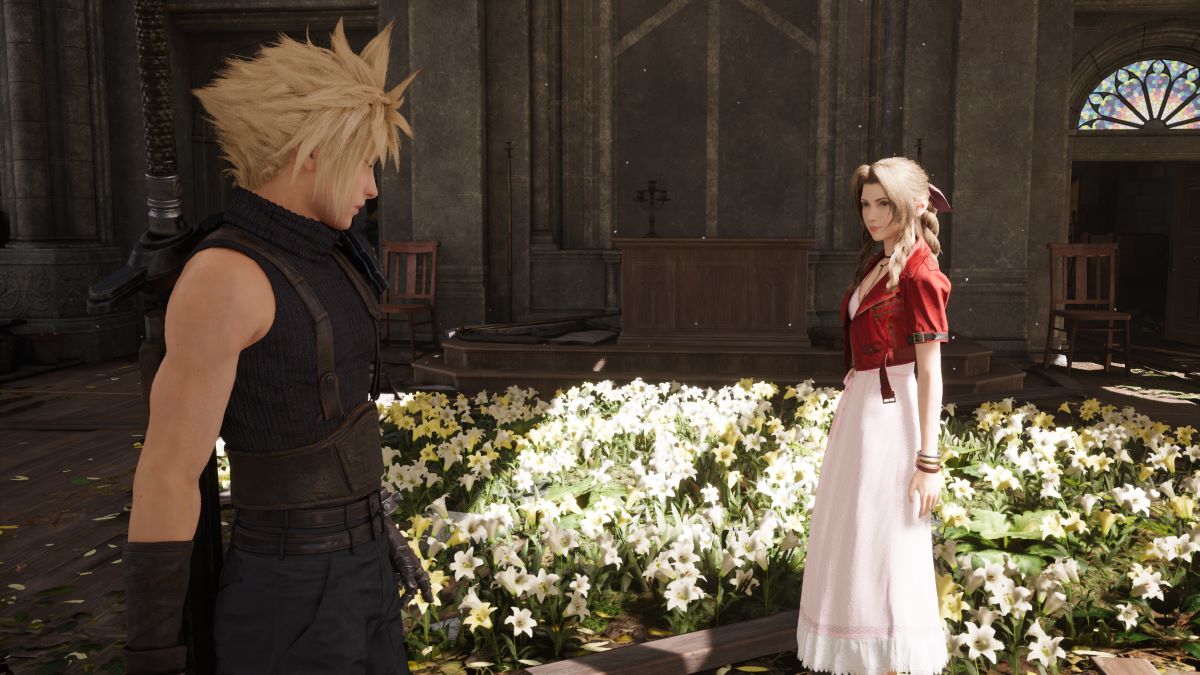
One aspect that I didn’t like initially has really grown on me: uninterrupted dialog. Basically, there are no RPG-esques pauses whenever someone is talking. Conversations just flow with zero button inputs. It was initially kind of frustrating, because some of the banter is hilarious and it goes by too quick for me to take a screenshot (I always have subtitles up in games precisely for screenshot purposes).
But do you know what it all reminds me of? Mass Effect.
Over ten (!?) years ago now, I was writing about how the winks in Mass Effect were blowing my mind. There is a lot more than winks going on in FF7R, but that’s not really the point. The point is that these are genuinely interesting characters with personalities and mannerisms. They wink, nod, pose, strut, and otherwise behave in consistent ways. Some of those mannerisms are very anime-ish, but hey, Japan. At least these land miles better than in FF14.
Anyway, I just got to the point where I party up with Aerith and I’ve been smiling the whole goddamn time. I’ve always historically been Team Tifa, even before Disc 1, but Aerith is the biggest dork in the Remake and I love it. Just the little things like Cloud saying “The wererats pray on the weak” and Aerith replying “Well, you better be careful then.” Typing this out seems so dumb but there’s just this whole vibe going on in the game, and I’m feeling it.
Oh, and there’s this moment when Cloud and Aerith reach a pipe and have to slide down to get to the next area. Aerith goes first… and says “Wheee!” with her hands raised in the air as she goes down.
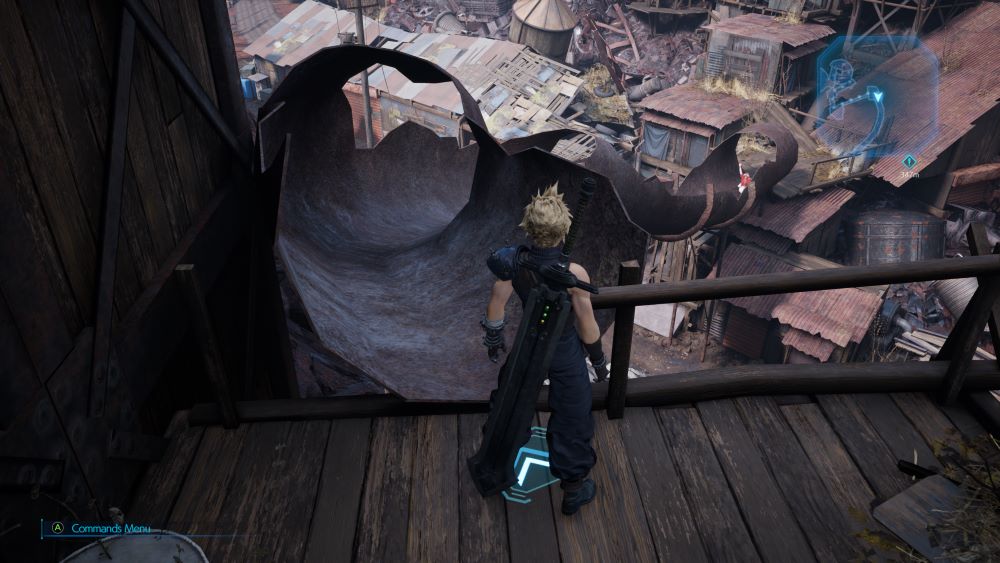
Guys. Guys. Again, feel super-dumb typing it out. But when was the last time you played a game where you were able to vicariously feel the joy and care of the designers through the screen? Whoever scripted that moment loved their job. It didn’t have to exist. It was over in literally two seconds – I couldn’t even hit the screenshot key fast enough – and it has no bearing on anything other than to flavor the experience and convey that which is Aerith.
It made me smile. When was the last time a game did that for you?
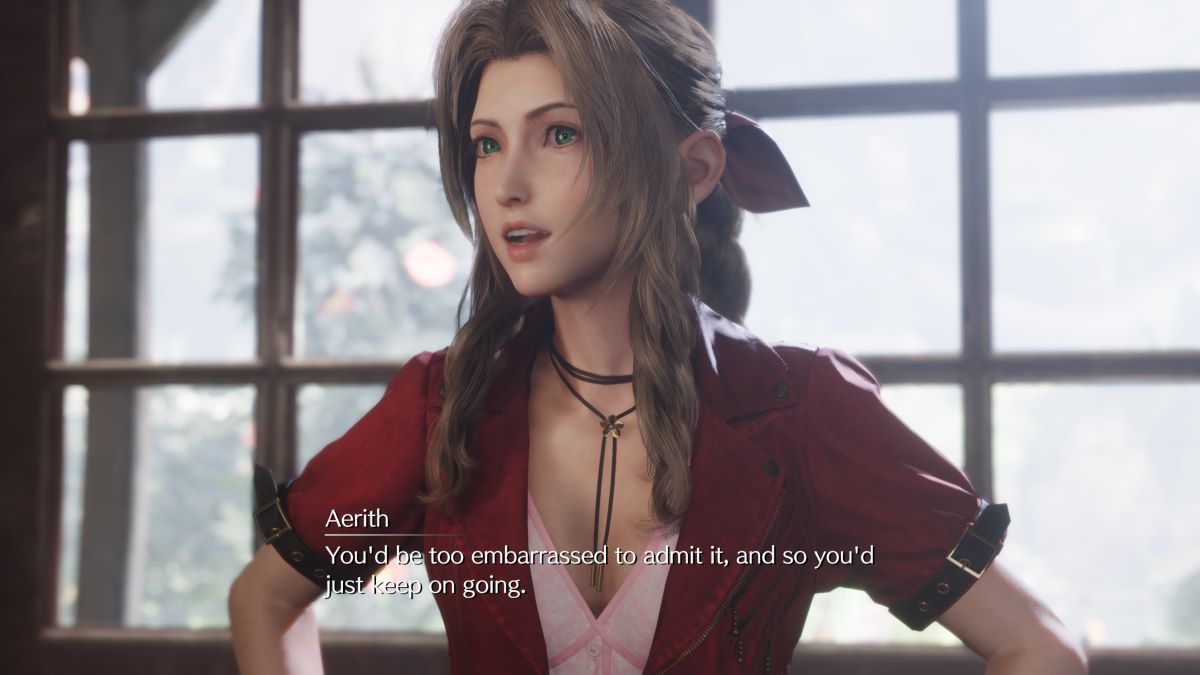
In closing, let me reiterate the disclaimer that the original Final Fantasy 7 has been in my top 5 game list for 25 (!?!) years. So FF7R is basically intravenous nostalgia from the word GO. Will you appreciate the “personalities and mannerisms” of these characters in the same way I do? Probably not. In a vacuum, they might just be cliché.
Nevertheless, these devs have taken a formative experience of my childhood and brought it to life in a way that has exceeded all my wildest expectations. A breath I never knew I was holding has been released as a cathartic sigh, blowing away my whole jaded gamer schtick. For the time being, at least.
So there it is. Hopefully the rest of the game holds up, but it doesn’t even matter. I’m happy right now.
First Impressions: FF7R
Oh, man. OH. MAN.
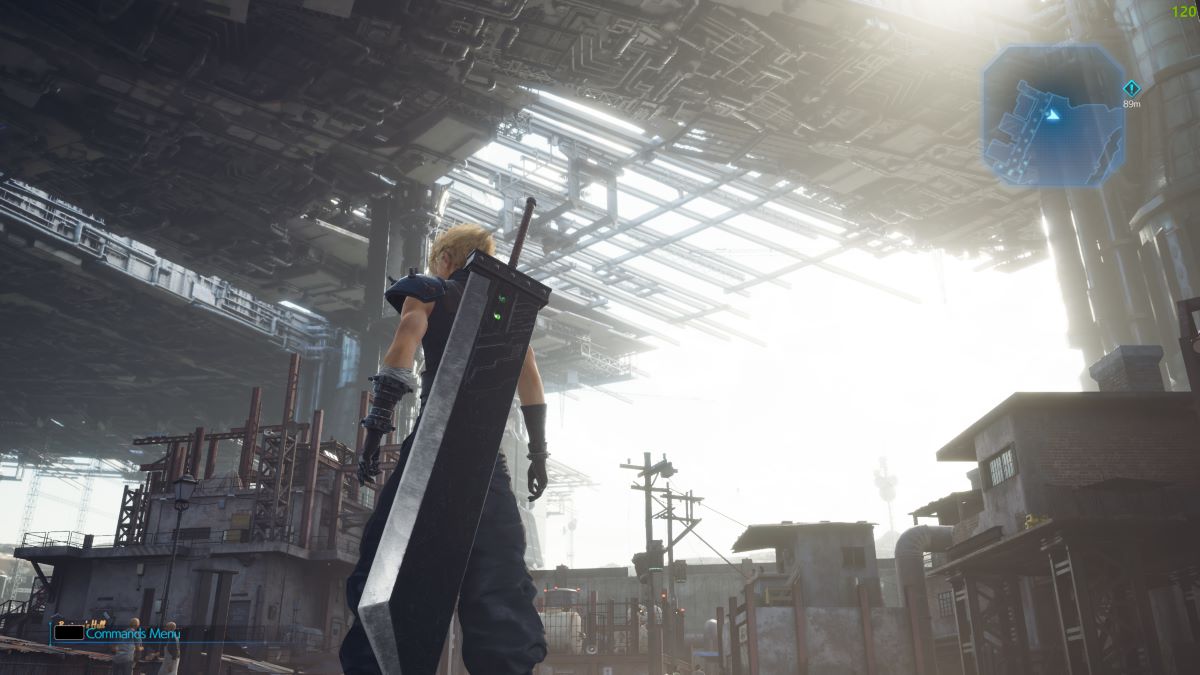
I know the game is a remake and the devs have had decades of modern game design experience to leverage… but, guys. I’m home. I haven’t been this giddy and excited since… I don’t even remember. Every single part of game so far is like finally finding someone who shares the same passion as you and catching up for hours. Walking around Sector 7 Slums and looking up (looking up!) just pulls the FF7 memories of my high school imagination straight out of my head and serves them right back in high definition.
And it really reinforces, to me, how groundbreaking FF7 originally was. For you see, FF7 was not my first Final Fantasy game – that was actually FF6. So this is not a “always remember your first love” situation. This instead is a recognition of how novel the pseudo-sci-fi setting was, the mind-blowing scale of Midgar, and that first time you leave the city and see it as just another town on the world map. Blew my fucking mind. That experience is right up there with first leaving the Vault in Fallout 3.
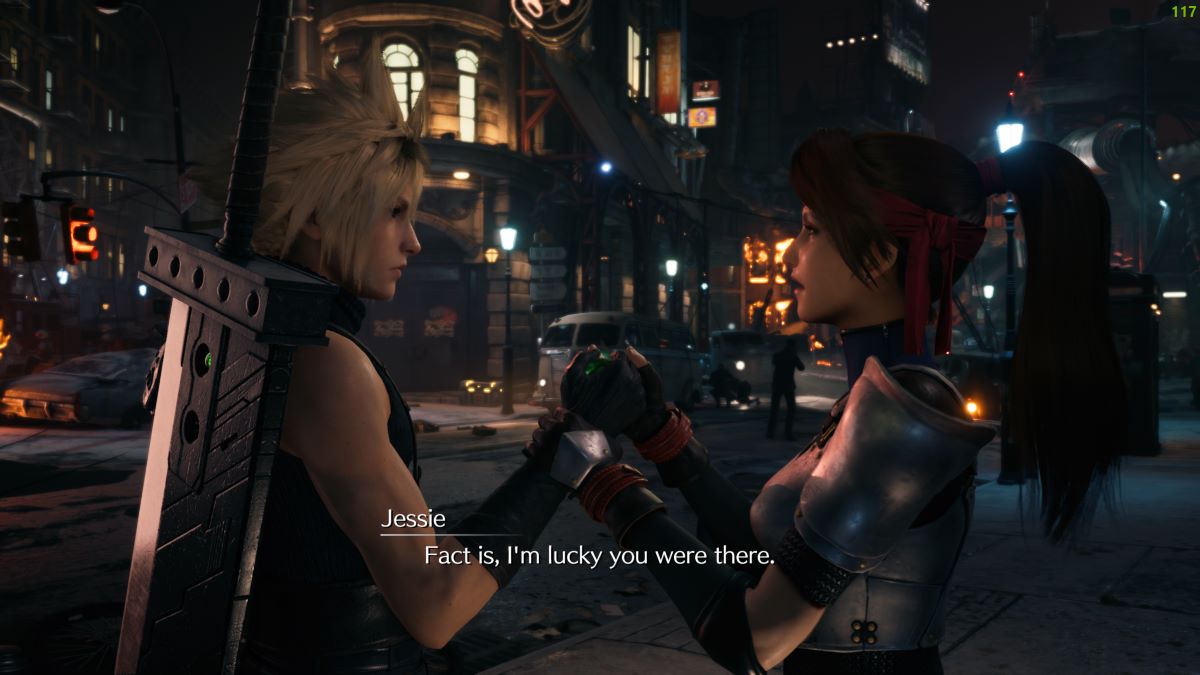
There are some other things I like. An extremely flirty Jessie. The random NPCs commenting on Cloud. The aftereffects of the reactor explosion. The extra cutscene on what really caused the reactor explosion. The well-stitched narrative in which I felt it difficult to stop playing. Not that I was going to stop playing until I reached Tifa for the first time. Tifa.
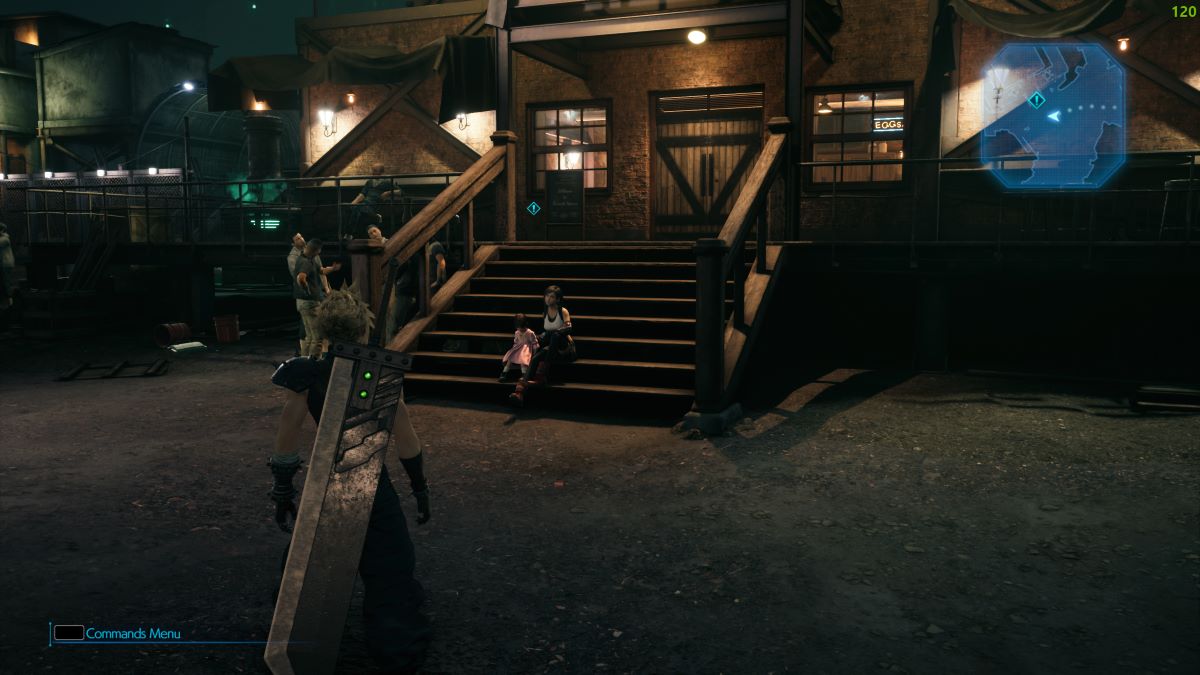
The one negative so far, and it’s kind of important: the combat system.
Basically I’m not quite sure what’s going on yet. Like obviously I’m reading the tutorial prompts and successfully navigating the fights. But it seems like I’m taking a lot of damage and I don’t know if that is expected, or if I’m supposed to not, or what. It’s “action gamey” but not in the same way as, say, Nier Automata. Controlling Barret feels even worse as none of his attacks feel particularly satisfying. Hold X to rapid-fire for some amount of time, or press Y to… speed up the charging of a special attack. But that attack can be stopped by random terrain if you aren’t careful.
Anyway, not going to let a little thing like a combat system interrupt my JRPG nostalgerbation. I am going to assume it gets better, or that I can change things around enough to make it so, or that it will not diminish the rest of the experience. Which would be quite the feat considering how much I am enjoying myself already just walking around.
Impressions: Banners of Ruin
Banners of Ruin is an incredibly slick deckbuilding roguelike that has consumed my life for the past week. While it shares some conventions with other games in the genre, it has a fairly unique mix of them that result in a number surprising interactions. Also, everyone is an anthropomorphized animal.
Before moving on though, let me say this: the visuals and especially the music are phenomenal. The combination sucks you right into the setting, and I found myself humming along with the battle music pretty much the entire time it’s playing. Just like with Tainted Grail before it, I will be tracking down this soundtrack, if it exists.
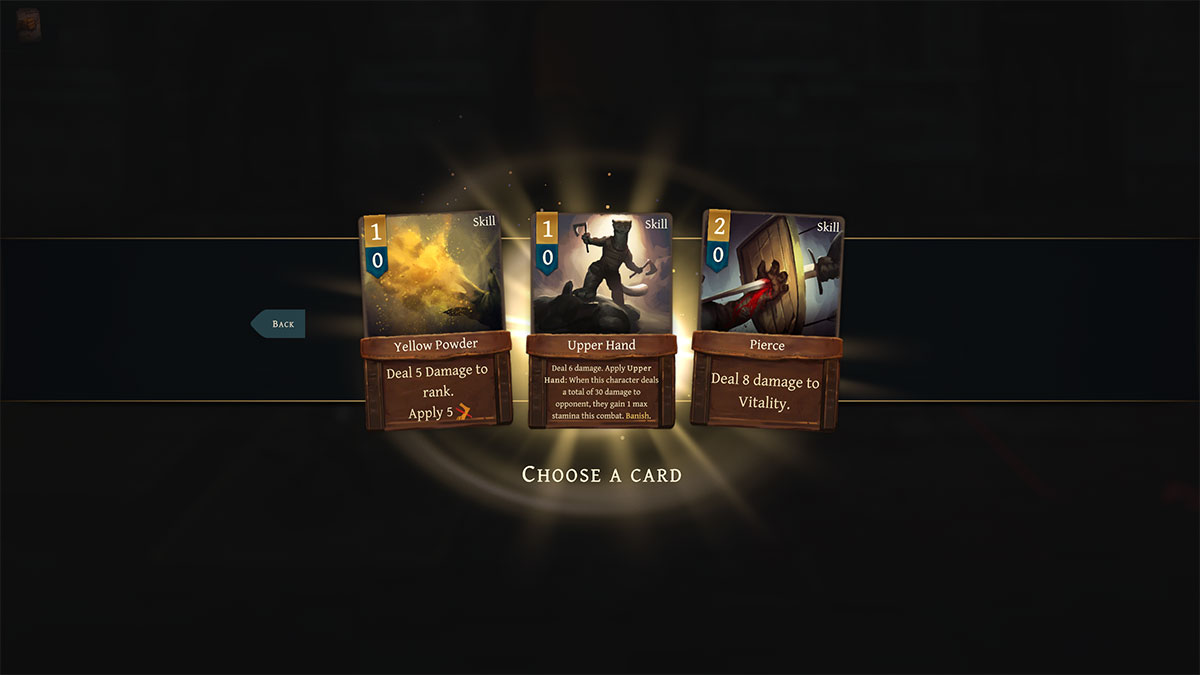
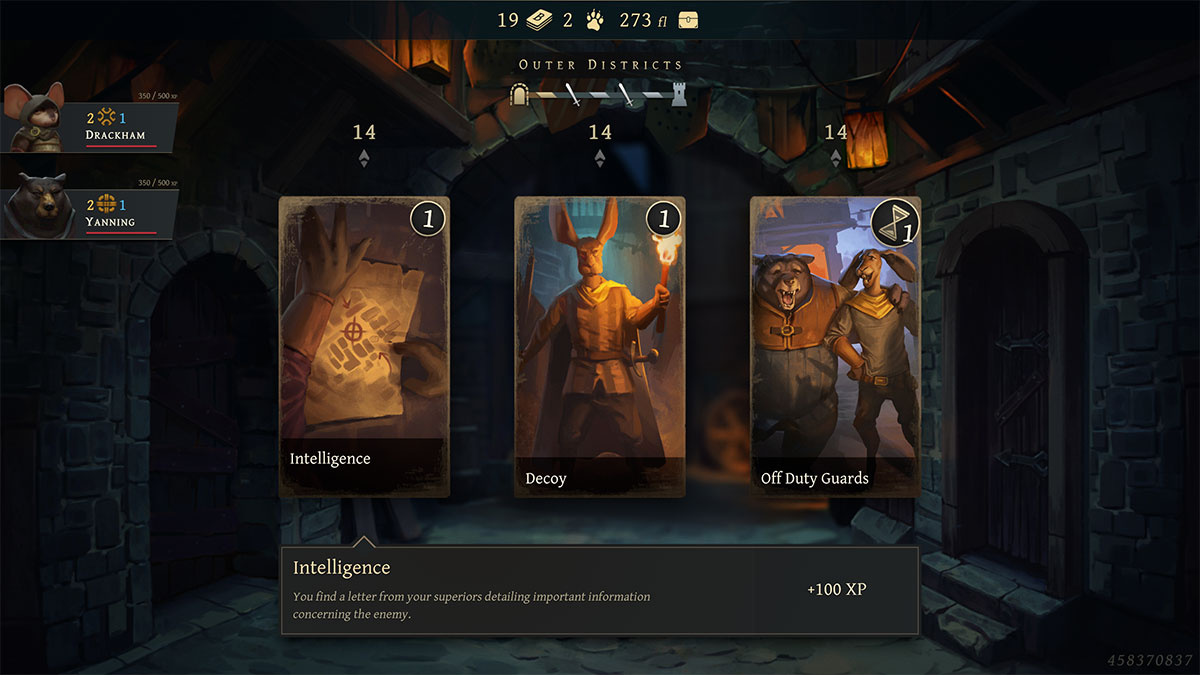
The central premise of the game is that you are a member of a suddenly-deposed House, and you are trying to escape the city with your life. As you navigate the city, you must choose from one of three “path” cards which can lead to combat, shops, or events. These choices are mutually exclusive, and you don’t have a particular notion of what offerings you will get next time. After a specific number of choices, you will encounter the boss fight of the area and then move on, if successful.
Combat is highly tactical. You start with two characters that can be arranged however you like (ahead of time) on a 2×3 grid; enemies are will be placed in their own 2×3 formation facing opposite. While you are free to play cards every turn, your foes will only act one rank at a time, e.g. the front three positions on Turn 1, then the back three positions on Turn 2, etc, unless there are no enemies in a specific rank.
Positioning matters. Enemies will typically attack a specific horizontal lane. Place one character in front of another, and that front character is likely to eat all of the incoming attacks. However, if three enemies are targeting a character with nobody behind them and then that character moves to a different spot, all three attacks will be negated. And remember when I said that enemies take turns attacking based on which rank they’re in? If they are set to attack you this turn from the front rank and you move them (via a card like Kick) to the back rank… then they don’t attack that turn. Next turn, if you then draw into cards that can move them back to the front, you can skip their turn again.
The tactical nature of the game extends out into deckbuilding and character progression too. Each character has two weapons slots and an armor slot. Equipping a bow will add a Bow card into your deck; equipping two daggers adds two dagger cards instead; a shield will add a shield card, and so on. Armor is more passive insofar as it affects your starting armor only, although there are special armors that have more interesting effects. As characters level up, they can unlock a choice of three Talent cards which are then added to the deck, but only that character can play the card. Same with the weapon cards, actually. Level ups also unlock a choice of passive abilities. Oh, and each race has a racial ability that can be activated any time, as long as you have a secondary resource (Will) available.
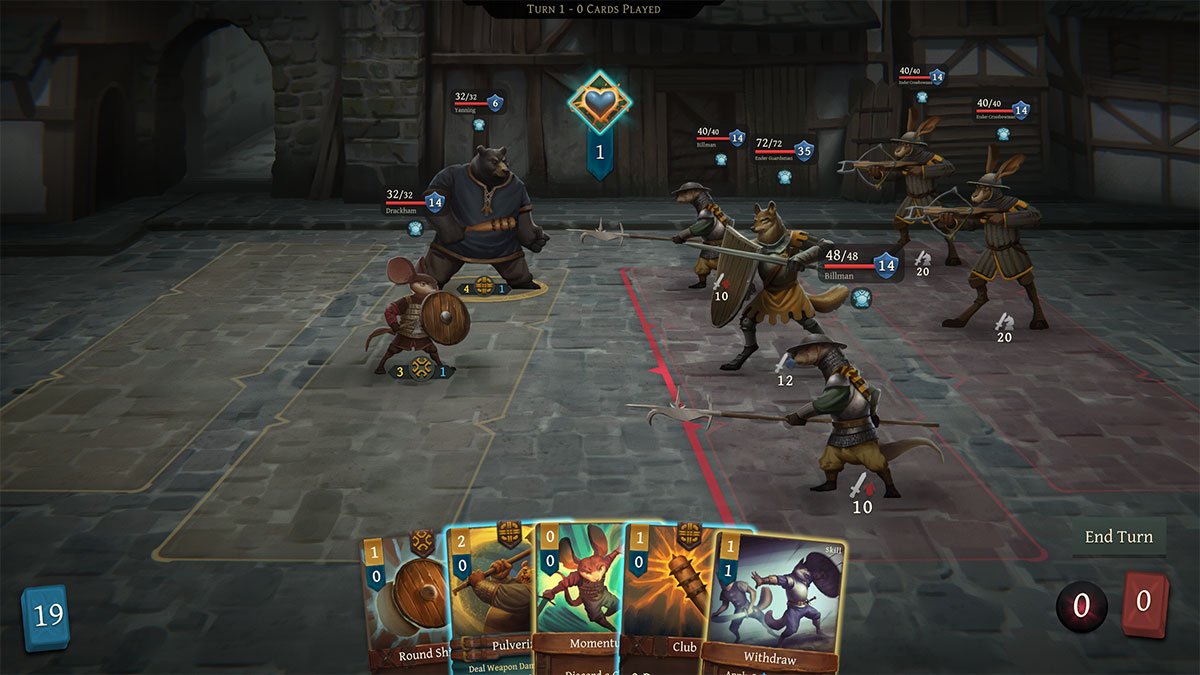
What all this combines into is an interesting gumbo of choices, tactics, and deckbuilding strategy.
…until you get to the endgame.
There is a final Final Boss that become accessible after performing a series of steps along the campaign. However, the fight itself is so oppressive and ridiculous that it leads to really just a single strategy to overcome it. Once I understood this, and realized the same strategy works for the rest of the game too, every subsequent run started to feel the same. It doesn’t help that while there is a great variety in character races and Talent cards and passives, the number of defined weapons/armors and enemies in general is much more limited. Indeed, I think all of the bosses are the same each time too.
The potentially good news is that the game appears to still be in active development – there was a major release in November 2021, which added new “hallway” scenarios, some optional difficulty modifiers (aka Ascension ranks), mini-bosses and so on. That is not enough to elevate the endgame to a Slay the Spire level, IMO, but A) not everything needs infinite replay value, and B) maybe a future patch or DLC will spice things up.
Overall, I am very satisfied with my (discounted) purchase of Banners of Ruin. As someone who plays a lot of games in this genre, I definitely appreciated the slick presentation and the novel mix of elements. The sort of defined challenges I complained about earlier might be more of a positive to others who dislike a lot of randomness. Or maybe we can just be happy playing a game for ~30 hours and be done.
Impression: Roguebook
Out of all of the deck-building games I have played, Roguebook is the one that has come closest to scratching the Slay the Spire itch. And yet it is also different enough that it’s possible that someone who didn’t like Slay the Spire might enjoy Roguebook.
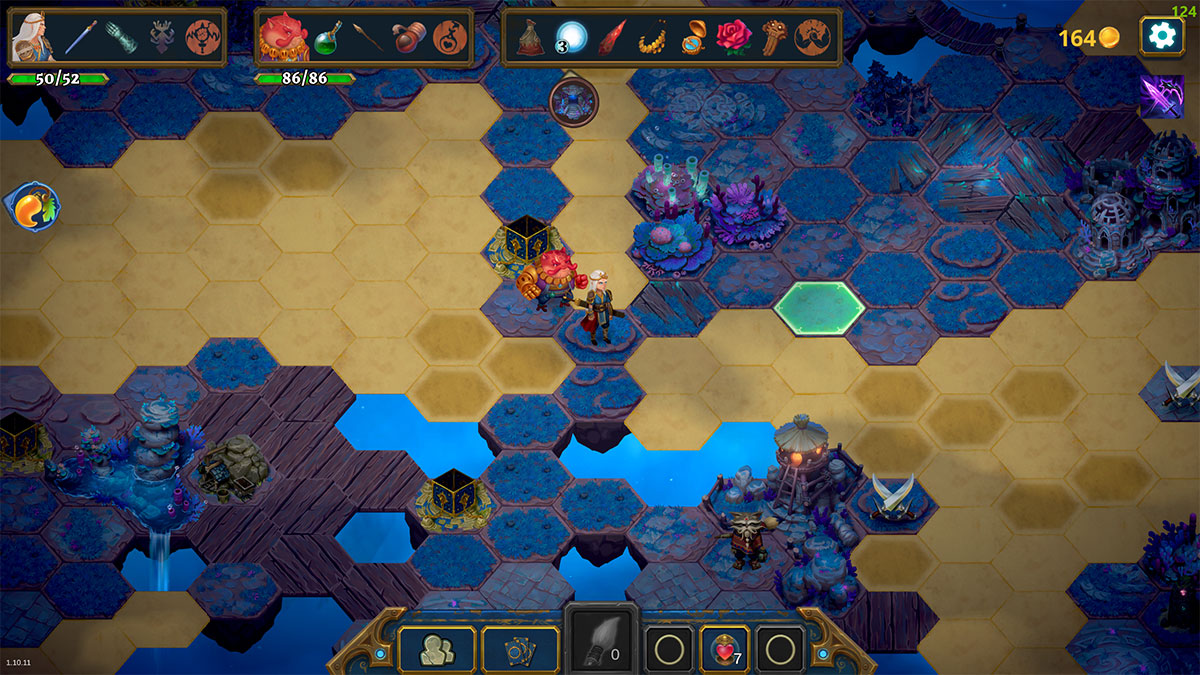
There are a lot of interesting design decisions going on in Roguebook. The basic premise is that you have been sucked into (presumably) the titular book, and you must battle your way past many foes and bosses on your way out. However the aesthetic is one of “blank pages,” where you use bottles of ink and paintbrushes to uncover blank tiles in order to explore and otherwise navigate towards the exit. By default, there is a very straight path to each level’s boss, but you are unlikely to survive without exploring more of the board and getting stronger. Regular fights give ink bottles to uncover straight-line paths, and elite battles give AoE paintbrushes. Gold can be found on the map, and there are a number of other structures that allow you to purchase new cards, get additional treasures, and there’s always a shop available to do likewise.
Make no mistake: exploration is extremely RNG-driven. While there are sometimes pre-revealed tiles you can head towards, the difference between uncovering an empty tile and one that lets you transform a basic card into a rare one with gems attached can be massive. You do eventually start earning progression currency that will allow you to improve future runs – thereby making exploration and combat easier overall – but things can be swingy in the beginning.
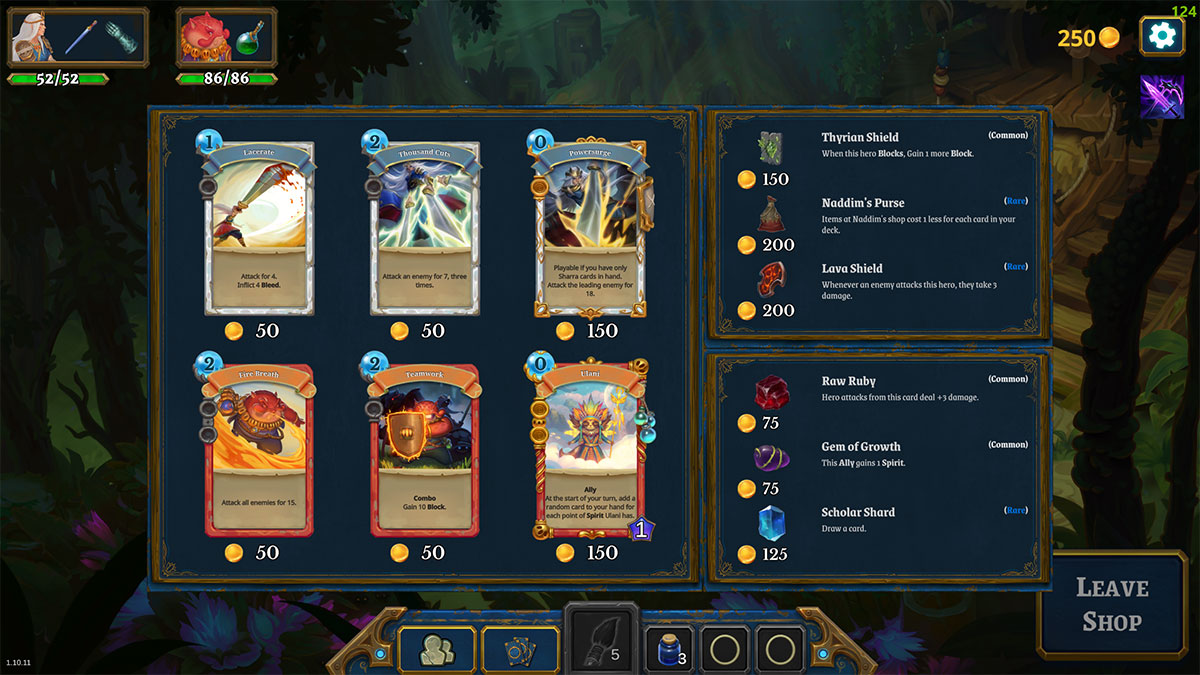
Speaking of gems, cards have gem slots ala Monster Train. Some gems are standard sort of “+3 damage” options, but some of the rarer varieties can do goofy things like giving you a free copy of the card, shuffling it back on top of your library, and similar. Artifacts can also be earned/purchased, which give passive (and sometimes active!) abilities.
Combat is fairly standard Slay the Spire with cards costing resources to play, drawing new cards each turn, etc… except there are two heroes. Playing a Defend card (or a few others) will cause that hero to go to the front, with any incoming damage hitting just that person. Losing one hero is not Game Over – you can recover by casting 5 special cards, but you get saddled with two spoiler cards in your deck until that level’s boss is defeated. Each hero has their own exclusive card pools and there are four heroes total, and you can choose the pair at the beginning of each run.
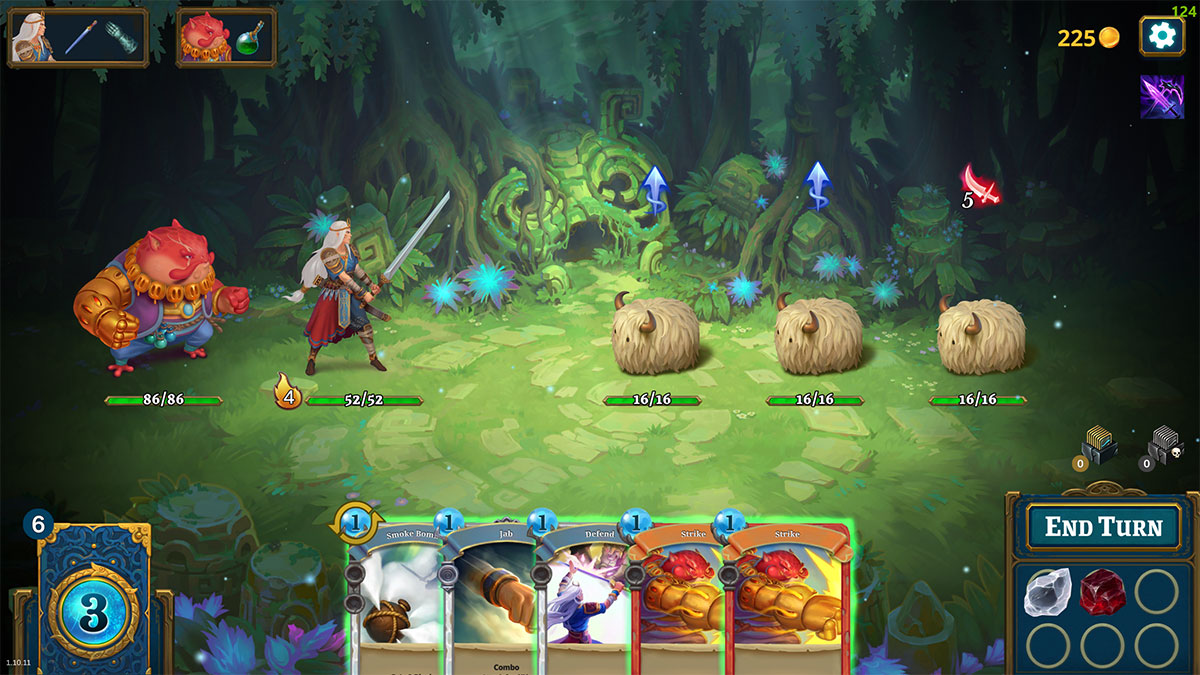
One twist I appreciated was the introductions of talents based on deck size. Basically every X number of cards you add to your deck, unlocks a randomized selection of three talents based on the heroes you’re running. All too often in this genre, the optimal strategy is to keep your deck size as small as possible, so it was fun to see the designers address it with talents. While some of them can be misses, a few can radically alter your entire gameplan.
For example, one character might get “Gain 1 Power each time a card is Dissolved,” which by itself is whatever. But if you paired that character with another that is frequently offered cards that generate 0-cost Throwing Daggers that, you guessed it, dissolve when played, and then combine that with an attack the original character has that deals 1×8 damage… yeah. Does that get your juices flowing?
Overall, Roguebook is a fun game that nevertheless feels a tad easier than Slay the Spire. I have played over 40 hours thus far, unlocking almost all of the Ascension-esque effects. I would say that about 80% of that time has been with the same pair of characters chasing the same strong synergies each game, only deviating if my luck was terrible. In other words, I don’t feel it has the same depth has Slay the Spire, but none of that matters much if you aren’t looking for something to entertain you for 200+ hours. Roguebook is entertaining enough and possibly more approachable at that.
Impressions: Chimeraland
After reading a half-dozen posts over at Inventory Full, I decided to see what the hell Chimeraland was all about.
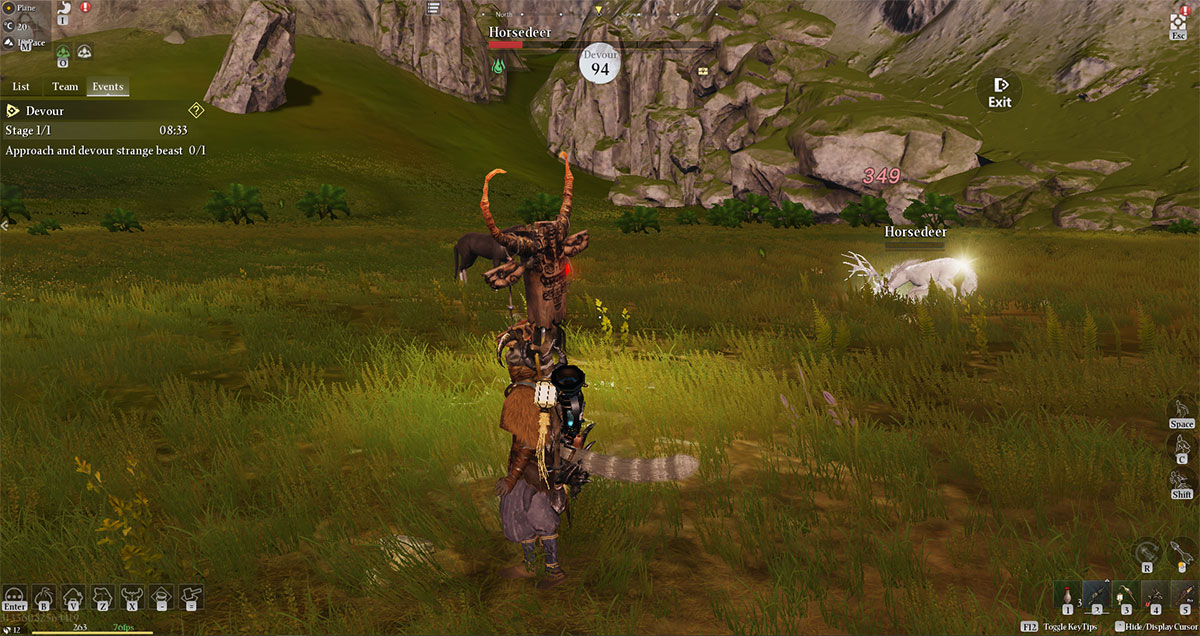
After a few hours of playing… yeah, maybe I’m missing something, but this feels like some poor mobile port Asian jank.
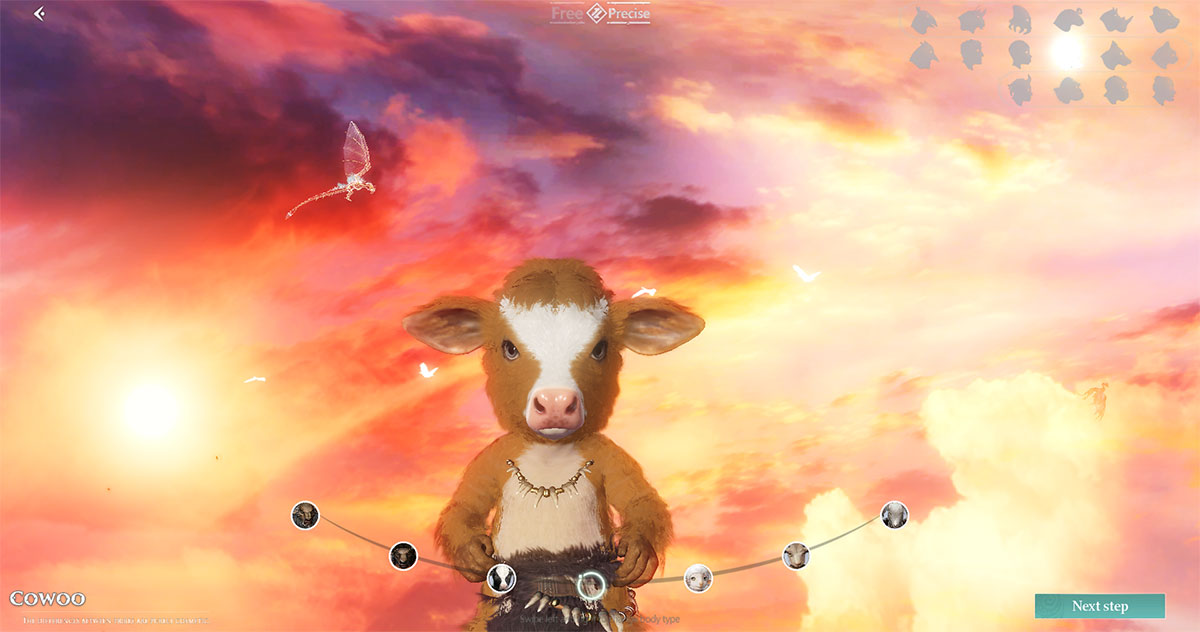
The character creation process is pretty outrageous, if you’re into that. I think someone mentioned that there are 18 different species you can choose from, but on top of that you can use the age slider to play as literal children. Not just human children, but cow and sheep children. And that’s just the start! There are ridiculous sliders that let you change your ears and cheekbones into non-Euclidean shapes. Some serious Mario 64 title screen vibes.
All you need to know about the PC version of this game is that Full Screen is not yet implemented. I was today years old when I found out that “Full Screen” was a game setting that had to be built and not, you know, something that is a default state of being. The game is filled to the brim with UX jank like this. For example, not having any apparent way to increase turning speed. Or having the camera default to action-cam style, but having dozens of buttons that need clicked with the mouse. Finally realized that you need to press the [`] button to get a mouse cursor active, which is fine, but any attempt to unselect something puts you right back into action-cam mode.
The translation runs the gamut from poor to nonexistent. Hard to fault them on this front, considering that there are zero US/EU servers – the game prominently displays “SEA” on the launcher.
In principle, Chimeraland is doing some interesting things in the MMO space. The ability to build a house anywhere you please. Being able to capture and either ride or bring into battle any creature in the game world. Light survival elements. Seeing all your weapons on your back at once is cool.

Chimeraland is also objectively worse than any game that already does any one of these things. Hell, the whole time I was playing I kept asking myself why I wasn’t just playing ARK. Or Fallout 76. Or Guild Wars 2. While I was pondering, some players decided to fight a “grand” enemy outside my house. I joined in a bit, then kept eating ranged AoEs because the dash-move wouldn’t activate, and finally died. I respawned and got back in the mix, then the creature died, and… nothing. No idea whether I gained XP for that, or should have had a chance at loot, or whether my dying removed that chance. Felt like a big waste of time.
Which, incidentally, describes the rest of my game experience with Chimeraland.
 In An Age