Category Archives: Philosophy
Character Customization Through Talents
I was really going to leave the talent discussion alone, it being “old news” by now and my having already presented my case. But I keep coming across what seems historical revisionism of sorts when it came to early WoW talents and the number of actually legitimate customization options available. Take, for instance, this passage over at The Babbling Gamer:
[…] When I first played WoW back in 2005, it’s biggest selling point for me was the talent system. It allowed far more character customization than most MMOs out at the time. I tried all sorts of things. I tinkered. I had fun. The Burning Crusade felt like a solid improvement on it. I played with lots of sub-optimal specs, trying to find the one that was the most fun. I don’t min/max for effectivity, I min/max for enjoyability. I don’t care if spec A does 10% more damage while spamming one spell over and over than my spec B complex rotation of silly abilities and half-working synergies. I don’t care that I hardly ever use that heal I spent talent points to get and could be doing more damage without. […]
After some digging around Google, I actually found a website that has functioning TBC v2.01 talent calculators. Booting up the Retribution tree and seeing Crusader Strike as the 41-point talent really takes me back… to a time where I apparently enjoyed auto-attacking my balls with a hammer. And 61 talent points to spend! Those will sure come handy… in filling out all these 5-point talent sinks. You see, leveling up and getting a new talent point is fun. Putting said talent point into Rank 3 Conviction (+1% crit rate, 5 ranks) is at no point whatsoever fun.
So with that in mind, I decided to look at the various class trees and basically remove every talent that did NOT change your gameplay in any possible way. Here are some of the results:
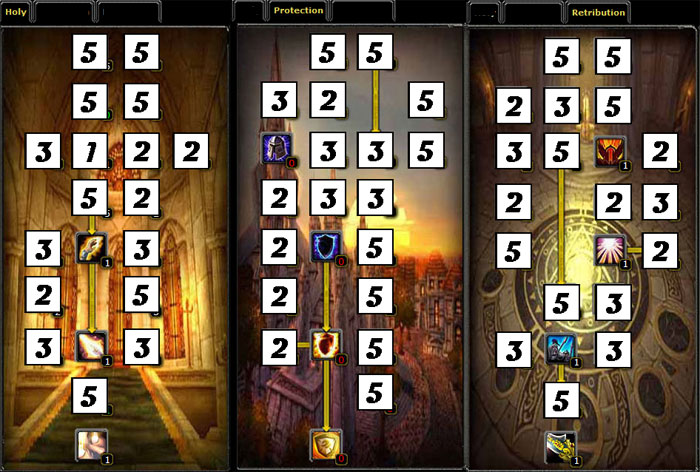
TBC paladin talent tree.
How about the mage?
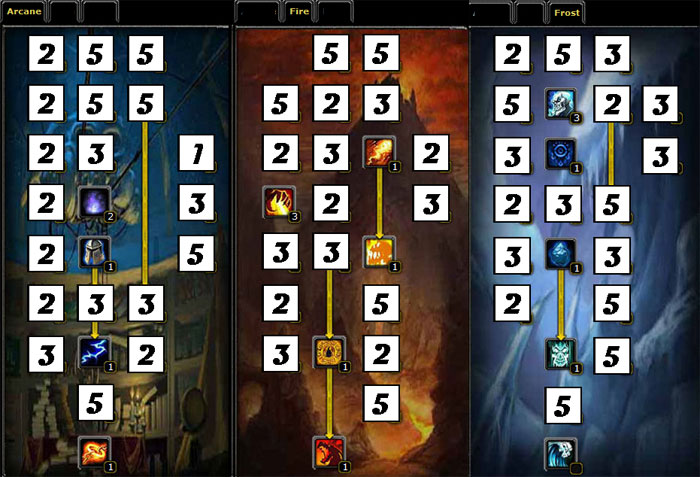
TBC mage talent trees.
The rubric I used to determine whether a talent changed your gameplay was pretty simple:
- The talent added a button to your hotbar; or
- The talent changed the way you used a button already on your hotbar.
The paladin case was fairly straight-forward: cooldowns, buffs, and abilities only. Then again, paladins have a lot of bleed-over utility that eventually resulted in the “one-man army” effect of Retribution in early Wrath.
The mage tree was a little less straight-forward. For example, I left Improved Counterspell up because it changed Counterspell from a button you only should push at a certain moment (when the target is casting), to a button that could be cast strategically (to deny spellcasting at certain moments). I left Improved Scorch open because the talent makes you actually include Scorch in your rotation to keep up a vital (raid) debuff, changing your gameplay. Likewise, I left Frostbite open even though it simply gives some of your spells a 15% chance to Freeze (root) your target, because that interrupts your normal spell rotation; instead of just chain-casting Frostbolt, when Frostbite procs you’re encouraged to do a Shatter combo of firing an Ice Lance with a Frostbolt in the air. You may or may not have noticed, but Shatter itself I left covered as a talent sink – even if Shatter did not exist, the damage/time limit of a Frostbite proc would still encourage the Frostbolt/Ice Lance combo. Shatter simply increases the potential damage, just like the overwhelming majority of all the talents in TBC trees.
A question arises though: is choosing between damage talents not a choice? Well… yes and no. The easy answer is the one from the Extra Credits video, which is to say that a choice between +10% Frostbolt damage vs +10% Ice Lance damage is NOT a choice, but a calculation. A problem arose, however, when I considered these two talents from Fallout: New Vegas:
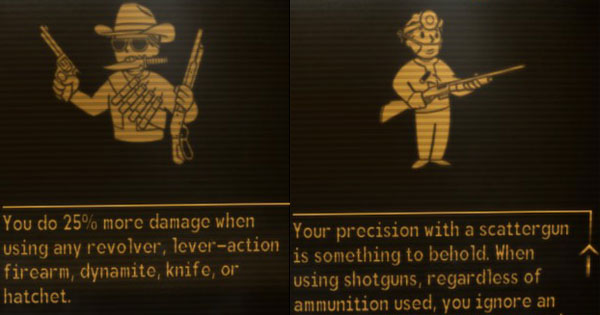
Cowboy + Shotgun Surgeon
Granted, Fallout: New Vegas does not have a talent tree per se; it has a perk system. Every two levels you must choose a perk from an ever-expanding list however, so I consider that roughly analogous. So… is the Cowboy perk a choice or is it a calculation? I just agreed that choosing between +10% damage to two different spells is a calculation, and the Cowboy perk essentially gives me +25% damage to a small number of weapons. And yet I am inclined to say it is a legitimate choice. Why? I consider these sort of talents to be stylistic and/or identity choices. In a game with no formal classes, picking the Cowboy perk is the closest thing you can come to differing “specs” in Fallout. A Gatling laser handles a lot differently than a sniper rifle that handles a lot differently than a revolver. Likewise, an Arcane mage plays differently than a Fire mage that plays differently than a Frost mage.
So, going back to the Babbling Gamer quote, we can zero in on this part:
I don’t care if spec A does 10% more damage while spamming one spell over and over than my spec B complex rotation of silly abilities and half-working synergies.
What Warsyde has done is essentially used the old talent system to create an entirely new spec. Maybe create an Arcane mage that takes Ignite and casts Fireball instead of Arcane Blast with a little PoM-Pyro action in the wings? Warsyde did not actually mention any specific spec, but a Google searched turned up this gem of a EJ mage theorycraft thread started 10/16/06, talking about an Arcane/Frost hybrid mage grabbing both Spell Power (+50% crit damage) and Ice Shards (+100% crit damage with Frost spells). That sort of thing definitely would have got my juices flowing at the possibilities. So, yes, choices!
And yet… and yet… maybe not.
See, there was never any question that picking a specialization was a choice. And while the number of talents points available in TBC and the various positions in the trees allowed for the creation of “new” specs like the hybrid Arc/Fire or Arc/Frost mage, what were those hybrid specs really? A fire mage with PoM and Arcane Power, and a Frost mage with absurdly large Frostbolt crits, respectively. You were still basically a Fire mage or Frost mage with different activated abilities. And guess what Fire mages?
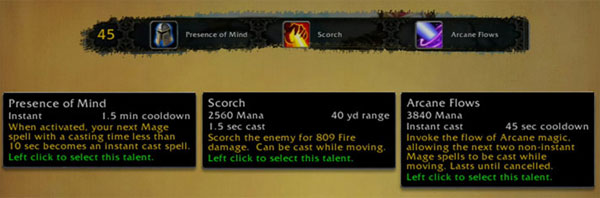
ka-POW!
You can have your PoM-Pyro back.¹
In conclusion, the older WoW talent systems allowed space for unsupported hybrid specs to exist, but in actuality these hybrids were almost always simply normal specs using 1-2 different abilities; an outcome basically indistinguishable from the proposed plan in MoP. The rest of the talent choices, and arguably many of the hybridization ones, simply came down to calculations – Arc/Frost was created simply to abuse +crit damage talents, for example. The only real thing we are losing is the ability to gain a number every other level, and sink that number down into a hole.
And while Warsyde can choose between spamming one spell vs a complex rotation of silly abilities with vague (calculated!) synergy, so can a 0/0/0 mage. How complicated one’s rotation should be is definitely a choice, but not one you make with talents.
¹ Yes, I am aware of Hot Streak procs and their simulated PoM-Pyro-ness. It’s just not the same.
Fixing MMOs: The Social Solutions
Last time, I talked about the problem surrounding traditional MMO social structures, or the lack thereof. Today, let’s come up with some solutions.
Increase Mobility
One of the most radical ideas (or so I thought) turned out to be top suggestion from multiple people in the comments of the prior post: reduce or eliminate the tyranny of the server. I believed this to be radical because on the surface of things, de-emphazing servers necessarily destroys server communities; something that LFD is almost universally recognized as accomplishing, right? Yes… and no. The problem is Blizzard only went halfway. If a friend plays on Maeiv and I am on Auchindoun, why can’t we play together? RealID is making baby-steps in this direction, but the hemorrhaging community does not have time for that baby to grow up into a paramedic and stop the bleeding.
Here are some methods that could work:
- Free, unlimited character transfers, aka the nuclear option.
Not particularly practical (Blizzard would lose a lot of money besides), but it is technically an option. It may encourage mass migration, give shelter to ninja-looters and the like, and other such social upheavals. Ultimately though, it may be better than to simply allow people to fade into account cancellation when they feel trapped in a server “community” they no longer enjoy (and don’t feel like gambling $25 escaping).
- Free, limited character transfers.
Say, 1 character move a month with the option of purchasing more if desired. This would prevent mass exoduses, while still allowing friends to follow each other around in a measured way. It would also allow someone to “test the waters” of a server in a more meaningful way than making a level 1 toon and observing Trade chat.
- Eliminate named, permanent servers entirely.
Essentially, set up the servers like an ice-cube tray and as each server fills up, it spills over into the next server, and divide it all into game regions. One huge benefit of this would be to allow there to always be a steady population of people leveling in every zone for group questing, etc.
Example: if I went to Borean Tundra right now, there may be 1 person questing there on Auchindoun, and maybe 5 on Maeiv, and 50 on Tichondrius. Under this methodology, there would be 56, up until an arbitrary cut-off. And if the cut-off is 100, I would have it start transferring people to a second zone instance at around ~70 so the 101st guy isn’t off by himself. The key would be to make it subtle, with no load-screen or anything. With phasing technology it should not be a problem.
Of course, if you find you enjoy spending time with someone, how will you ever find them again if there are no specific servers? This brings me to my next overarching social solution:
Introduce an informal ranking system in LFD (and elsewhere).
This suggestion needs its own entire section. Ranking people in the LFD system is frequently suggested on the forums, but the point of my ranking system is different, and it isn’t even technically a “ranking.” On the forums, people believe that being helpful/geared/experienced should be rewarded with faster queues and being grouped with similarly good people. That is actually self-defeating. It is in the community’s best holistic interest for there to be 1 experienced/helpful player in every group – letting all the cream rise to the top simply makes the bottom groups congeal into a hardened lump of terribleness. I believe players need to know what they can aspire towards before they understand what social behavior the designers want to encourage.
So, essentially, my informal ranking system would be the equivalent to a Facebook Like or Google +1. This feature is something that a player will have to initiate themselves (there is no post-dungeon survey), possibly through right-clicking a player’s portrait. What the +1 does is make it more likely that they are grouped with that person in LFD, and/or otherwise present on that player’s server (under a fluid server dynamic) in the future.
That’s it. There are no rewards for having the most Likes, nor any visible indication of how many you have. Giving this +1 to someone does not notify them, nor does it add them to a Friends List (although it will let you easily do so on your own). I briefly imagined something like a title or special effect to occur if you get 100+ Likes or whatever, but it is important that there be no incentive to game the system. It’s not a democracy, it’s not a popularity contest; it is a more generalized form of self-selection.
More Show & Tell
Under the traditional MMO social model, you are frequently limited to appearance, actions, and incidental text to communicate your personality. “Err… but Az,” I hear you say, “isn’t that basically everything?” No, sir or madam! In an MMO, your appearance is limited to the gear you happen to be wearing (or a costume, if you are lucky); your actions are entirely limited to the location and time in which they are performed (typically dungeons or raids); and incidental text just happens to be whatever you have said in a particular channel, on a particular topic, at a particular time.
While you can certainly develop impressions of a stranger, especially if you encounter them in an unique or extreme circumstance, kinship generally requires time precisely because it’s difficult to give an accurate representation of one’s character in a single sitting. Traditionally, the “solution” was enforced grouping and the pre-LFD dungeon situation in which placing voluntary strangers in close proximity for long durations was supposed to spontaneously generate communities. This “worked,” just like placing soiled rags in the the 17th century lab’s corner “worked” at spontaneously generated rats.
Repetition is required for communities – people are more asocial in LFD precisely because you aren’t going to see anyone again (unless you have a ranking system, of course). We can, however, condense the process via Show & Tell. What this means in a general sense is instead of blooming into a flower in front of others over time, you do hours and hours of blooming beforehand and invite others into your garden. Some MMO methods include:
- Player Housing
Blizzard has strongly resisted the demand for player housing because they are afraid of players sequestering themselves away in instanced communities. Which, of course, makes sense in the 17th century spontaneous generation sort of way. How can players envy each other if they aren’t AFK outside banks and auction houses on the Flavor of the Patch mount?
But that’s just it: players generally have a preternatural desire to express themselves any way they can. Player housing would not be about having somewhere to chill out waiting for a LFD queue, or even arranging your trophies and armor sets in aesthetically pleasing ways. It would be about designing and decorating a virtual space for others to look at. You already know the meaning behind that piece of gear that’s been sitting in your bank for the last four years. Other people don’t know, and deep down I believe it is a common human desire for said object or achievement to be recognized and acknowledged as something meaningful.
Player housing is something that can easily be half-assed and end up making the game worse, yes. It will take development time and resources to make work right. If I cannot put that Light of Elune potion I’ve held onto since level ~20, four years ago, under a glass with a little plaque explanation, then I would consider player housing a failure, for example. But if you ever walked into a house with something like prominently displayed, you would see a facet of my personality that you likely never would have unless the topic somehow came up.
- Character/Guild Bios
To an extent, Blizzard already has this in the crippled form of the Guild Finder. Which, incidentally, you cannot even use unless you happen to be guildless.
The idea behind the Bio screen is to have a sort of poor-man’s player housing without the instancing. A simple whiteboard allowing curious passerby the ability to see what you are all about. Beyond the obvious player ramifications on RP servers, I also imagine it as a way to perhaps allow you to highlight which of your in-game achievements are your favorite, or other demonstrations of skill, perseverance, or luck. Or, hell, as a way of passively advertising your WoW blog. Unsavory characters may use it to transmit keyloggers and such, but it really is not so different than what happens in text form already. And besides, Bios would require you to be actively inspecting/looking someone up, rather than getting it forced upon you Trade Chat style.
Conclusion
This is running pretty long already, and about to be buried in BlizzCon news besides. The sort of bottom line here is that most MMOs are woefully stuck in the Dark Ages, and need to catch up to the emerging trends and zeitgeist of the day – specifically in the realm of social tools. For as much as I despise Facebook and “social media” in general (for their nefarious ways), it is worlds easier being able to locate and interact with new people from multiple locations with similar interests as yourself, while flexing your Show & Tell muscles all the while.
The sort of subscriber revolt going on in Cataclysm had many causes, but I strongly believe the #1 reason had nothing particular to do with LFD or difficulty or boring grinds per se, but with the sort of cascade effect that happens when the underlying social structure has been weakened by those (and other) things. In other words, I think LFD and hard heroics and boring grinds can be fine as long as you have the social tools to keep people together in the midst of it. A return to the vanilla/TBC model without a LFD would have been equally disastrous IMO, unless social tools were added too.
If you have critiques or alternative ideas, let me know in the comments below.
Things That Used to Work, Vol. 2
…but don’t anymore.
As with Vol. 1, these listings reflect a personal (d)evolution of sensibilities based on some recent titles I completed.
Stats Games with Invisible Stats/Debuffs
Why It Used to Work: No one knew what they were doing, technical limitations.
Why It Doesn’t Work Anymore: I am much more conscious of questionable game design.
As I mentioned before, many of these categories stemmed from a recent completion of The Witcher, but there have been other games like Dragon Age: Origins that fit into this category. [Edit: for clarification purposes, a “stats game” is one which determines outcomes via visible or invisible dice rolls. God of War and Devil May Cry are not stats games, even if they technically have stats like HP and upgraded items and such. Even Counter-Strike has HP and damage modifiers to weapons (headshots are 3x damage for example), but it is also not a stats game. A headshot in a stats game would deal 3d6+10 damage with a Fortitude save DC 20 for half, assuming you overcame the 7% miss modifier.]
The underlying issue at hand is twofold. The first is when you have a stats game built around stats you cannot see or measure. In The Witcher, the talent trees as filled with “straight-forward” items like Damage +20% in Tier 2, followed by Damage +25% in Tier 3. Are these bonuses additive? Multiplicative? Do they simply replace each other? What is my baseline amount of damage anyway? There is no formal character sheet, so there is no real way to know. Bonus damage is attractive to me as a player, but without the number-crunching followup, it is more cock tease than substance.
The other issue is when a game pretends – or, worse, implements! – debuffs (that) actually matter without giving you a very effective way of understanding them in-game. The Witcher contains debuffs like Pain, Poison, Bleeding, Blinding, Incineration, and the like along with talents that raise your resistance against said debuffs and increasing your chances of inflicting them. Good luck figuring out when they are actually applied though, as the game designers felt that character animations alone should clue you in. Something which is pretty bizarre considering a fair number of talents increase your damage while the enemy is afflicted with a certain debuff. Spending resources debuffing an enemy so as to deal more damage overall than simply bludgeoning them over and over is the first road on the way to strategic depth; the road less traveled, unfortunately enough.
A topical side note comes from scrusi from Procrastination Amplification, who talks about how hiding the numbers can lead to excitement coming from the other direction. I absolutely agree. The point I am making here though is that a game designer cannot have it both ways. By all means, hide the numbers to build excitement… just don’t sneak in Damage +20% and other numbers to get nerd senses tingling without the follow-through.
Amnesia
Why It Used to Work: Built a sense of mystery, allowed naratives to start in medias res instead of always beginning in small villages, gives options for players to reprogram established characters.
Why It Doesn’t Work Anymore: It is almost always nothing more than a meta-narrative crutch.
Amnesia is so cliche a plot element that merely saying it is cliche is itself a cliche. I get why game designers do it, I really do. As mentioned, not having to start every story with a main character at age 17 in a small village is a big draw; not every game can pull off a Fallout 3-style beginning. Amnesia also lets you bypass a large portion of potentially boring but still slightly relevant backstory.
The thing is: none of that has anything to do with actually including amnesia into the narrative itself. Did Geralt having amnesia within the game affect the game in any real way? Not at all. The designers justified it – coming back from the dead! – but it served no other purpose than letting the player choose things Geralt as a historical character with an established narrative might not have done. And that is just damn lazy.
Obviously The Witcher is not alone in this. When I think back to FF7 with Cloud’s amnesia, all I realize is how much that particular plot-point is ostensibly designed to surprise the player, rather than make any real sense. Yes, it is justified in-game – Mako! PTSD! Experiments! – but in almost every single case I can imagine the story being so much more poignant with Cloud knowing the entire time. ¹ And that is what rubs me the wrong way about taking the easy way out via amnesia: all the missed opportunity for legitimate angst.
Nevermind how the amnesia itself rarely becomes more than a sub-plot. I was more okay with the amnesia of Planescape: Torment, for example, because it was not just a plot device, it was the entire plot.
Waiting for Groups
Why It Used to Work: You had to, It Builds Character.™
Why It Doesn’t Work Anymore: Looking For Dungeon, indie games, Steam.
Way back in February, in a post about LFD and difficulty, I just sort of asserted that the WoW LFD genie is out of the bottle and never going back in. I do not think that anyone actually disagrees with that assertion, even those that actively wish LFD was rolled back or limited to specific servers. The thing is, in a real way, I believe the very concept of waiting for groups at all has been irrevocably spoiled for me.
And… I think I’m fine with that.
I played World of Warcraft for ~7700 hours over the course of four years. I started in TBC, not Wrath, nevermind how LFD did not exist until patch 3.3, i.e. Icecrown. In the course of debating Nils on the issue of LFD’s effects on WoW’s social fabric, I keep finding myself examining why it is that so many people say that they went from sociable Friends List-using fellows to asocial LFD dwellers “overnight.” Battlegrounds had this functionality years before you even could form groups for competitive PvP (outside of world PvP of course). Surely battlegrounds are being utilized by more people than heroics are, yes? What made 5m dungeons so pivotal to the community aspect of the MMO?
While thinking on that question, I tried to imagine myself back in a time when what I could do was dictated entirely on the whims of strangers. And I thought: why bother with that? Loaded up on my Steam account right now is Assassin’s Creed: Brotherhood, Audiosurf, Frozen Synapse, Machinarium, Metro 2033, Recettear: An Item Shop’s Tale, Shining in the Darkness, the two Shadowgrounds games, SpaceChem, VVVVVV, and Dawn of War 2: Retribution. Those are simply the ones installed at the moment², not the 16 unplayed games like Mass Effect 1&2, The Witcher 2, and so on.
It sort of boggles my mind now that I would literally sit in Shattrath for hours trying to fill up a group for heroic Magister’s Terrace, back in the day.
Perhaps LFD did ruin things. Perhaps more people do run heroics than BGs. Perhaps the PvE community’s social fabric was hanging by a thread that was ultimately (and ironically) cut on December 8th, 2009. Academic retrospectives aside, I do not feel there is any going back for me, to blithely waiting for groups in any game ever again. I sat through some 40+ minute DPS queues right up towards the end of my Cataclysm run, either Alt-Tabbed or completing dailies, sure. But the way I look at things now, the content at the other end of those forty minutes of waiting better be damn impressive to justify not simply playing something else.
So if nothing else, the one thing LFD did do is disabuse me of the notion that waiting is required. In a world of $5 indie games and Steam deals, it really isn’t anymore.
¹ Keep in mind that I say this as someone who considers FF7 to be his #2 favorite game of all time.
² And I’m only really playing Shadowgrounds and AC: Brotherhood at the moment. The others are simply there for convenience’s sake.
Things That Used to Work, Vol. 1
…but don’t work anymore.
Many of the items on this list were inspired by my recent completion of The Witcher, although my (d)evolved sensibilities have been been growing this way for the past several years. Let’s get started:
Multiple Endings
Why It Used to Work: Replayability, simulates your decisions as being meaningful.
Why It Doesn’t Work Anymore: I am not likely to play ANY game more than once anymore (few people even finish the first time), and if I do, it will only be because the underlying gameplay was fun – in which case a different possible ending is at most a cherry to the already-frosted cake. Also, this could just be a personal thing, but whenever I am working on a game with multiple endings, my choices actually feel less meaningful rather than more, for two reasons.
The first reason is that nagging feeling whenever I reach a path-branching decision that one of the two options will be more fun than the other, and I will be stuck with the less-fun one. In The Witcher, it was choosing between Order, the nonhumans, or the neutral path. In Fallout: New Vegas, it was choosing between NCR, Caesar’s Legion, or your own way. The tenor and tone of each faction has their own charm, and in setting up a mutually exclusive decision, I am made responsible for picking the shittier option.
Even if I do replay the game, I am double-screwed. If the 2nd path ended up being better, I feel gypped that I didn’t pick it the first time. If the 2nd path ends up being worse, I am stuck playing a shittier game.
The second reason my choices actually feel less meaningful is that they typically are. No matter what side you pick in The Witcher, the final hours of the game are the same (same location, differently textured enemies). No matter what side you pick in Fallout: New Vegas, you are still battling on Hoover Dam. Different dialog from different NPCs is meaningfully different (enough that I feel like I’m losing something by not experiencing it), sure, but a lot of times it feels like Mad Lib storylines where they just switch around the Proper Nouns in the plot blanks. The last RPG I played with actual, game-changing decisions was Tactics Ogre way back on the PS1.
No Quest Hubs
Why It Used to Work: No one had really thought of it, Kaplan talks about how “the Christmas Tree effect” can leads to poor pacing and less engagement in any individual quest, it is more of a metagame issue.
Why It Doesn’t Work Anymore: I hate revisiting areas I know haven’t changed in any meaningful way. The Witcher does have a Notice Board which acts like a Fetch Quest Hub of sorts, but when I talk about Quest Hubs I mean the principle of being able to completely “finish” a particular zone at your own pace and move on. If a quest sends me to the fields to kill something, return to the city, then sends me back out into the fields to kill something else, my immediate reaction is “Time Sink!”
The term “boomerang quest” is an example of this principle, but it is slightly more than that. If I had to sum it up in a single way, it would perhaps be “inefficient questing.” Don’t send me on quests to kill the cave spiders, then a follow-up to kill the poison cave spiders deeper in, culminating in a quest to kill the spider queen in the deepest parts of the cave, without giving me all three quests first. Let me multitask! Whatever Wal-Mart has done wrong in crowding out smaller businesses and being jank-central, being able to make one trip and pick up milk, light bulbs, and spark plugs in a single trip is of immense value, lower prices notwithstanding.
Blind Choices (and/or Rewards)
Why It Used to Work: Puts a focus on the decision itself, more immersive/less metagame, perhaps enhances replayability through obfuscation.
Why It Doesn’t Work Anymore: Thank you, great hero! Please choose your reward:
- A book about vampires.
- Your very own hut.
- Wreath of immortelles.
Err… what? Perhaps I am simply too far down the metagame hole at this point, but how can anyone consider a choice with unknown consequences as meaningful? I mean, fine, all decisions and choices we make technically have unforseen consequences. But these game designers are literally giving you nonsense to choose between on top of said unforseen consequences. I don’t consider the choice between door #1 and door #2 to be meaningful at all – I may as well flip a coin or roll a die for as much thinking as it requires.
The above is an actual choice that The Witcher presents you with, and it is not the first nonsese choice. I picked the wreath de immortalies due to the time-honored tradition of game designers making the most useless-seeming items the most radically powerful. Plus, I figured that my own hut wouldn’t be very important to gameplay if I could choose not to have one, and I was likely leaving the area soon besides. Turns out the wreath let me complete an upcoming story quest faster than normal. Woo… hoo?
It is not as though I want WoW-like quest rewards, because there isn’t really any choice there either: something is an upgrade or it isn’t (and you probably can’t wear the other options anyway). When I think about meaningful choices, I remember back to the original Deus Ex when you’d come across upgrades like the cloaking device. Thermal or Electromagnetic? That was a meaningful decision because it shaped your gameplay in a way that had no “wrong” answers. I liked sniping people, and since I couldn’t snipe robots, easily sneaking past them (and cameras) was way more useful. There were plenty of humans/robots in the later stages so it could have gone either way. I wanted both and yet I was almost as fine with just one.
That, my friends, is a good choice to present to players. And they didn’t hide it behind a door or questionable language. You knew exactly what each did, and more importantly, you trusted the designers to present a scenario in which either would be equally useful.
Butchered
If you want to read a 4,079 word essay on the decline of WoW from the standpoint of two members of the sub-10% of raiders, you cannot go wrong with Failure, Challenge, and the Decline of WoW. If, instead, you were looking for a well-written, relevant essay on WoW’s “decline” exploring actual issues, don’t bother reading it at all. Stede in particular eviscerates the entire argument in a single comment.
What interested me about the essay is how so completely it falls into that utterly bizarre MMO difficulty trap – the sort of notion that MMOs should be social engineering experiments to create a generation of better gamers. The part that struck me the most was when they were talking about The Butcher from the original Diablo:
The best piece of low-level content ever created by Blizzard is found not in current WoW, nor even in old WoW, but 15 years ago in Diablo. The Butcher.
Every NPC in town warns you about The Butcher before your first trip into the dungeon. In case you didn’t bother talking to them, just outside the dungeon entrance you find the previous adventurer who tried to delve in, bloody and dying. Before killing your first mob, a villain is set up. The first half hour of dungeon crawling goes by uneventfully. But somewhere on the second level down, starting to get a little comfortable with your level 4 character, you come upon a small square room completely covered with blood. Maybe you remember the warning, maybe you didn’t, but in either case, it’s your first time playing and you want to know what’s in there, so you open the door. And you get Butchered.
This experience is hard to convey in text to people who’ve never played Diablo. Ask anyone who has if they remember their first time being killed by him. It’s sudden, surprising, and scary. It’s probably your first character death. He does a huge amount of damage, stuns you, and holds you in melee range. He has a loud yell the moment you open the door, an elaborate bloody apron, and a ridiculously-sized cleaver. You’re mostly likely dead before you take in everything that’s happening. And for some reason, it’s the one moment that makes everyone’s eyes briefly glass over in nostalgia.
Having played the original Diablo, I had the same experience of being mercilessly slaughtered by The Butcher. The essay goes on from this point to talk about Hogger, trying to tie both the experiences together while lamenting that Cataclysm and WoW in general has lost this dangerous feeling. The ironic part of these examples is that each were precisely designed to not be difficult. The Butcher was not supposed to be a difficult encounter, it was supposed to kill you. As the author(s) note, you probably had not died yet at this point in Diablo, so it behooves the game designers to set up unwinnable scenario to demonstrate what will happen when you overextend in the game proper. Same exact deal with Hogger: his purpose was demonstrate the difference between non-elite and Elite mobs. You were supposed to die. Neither were difficult in any meaningful sense of the term, and both simply encouraged you to grind mobs until you outleveled them as content.
The original Hogger.
Even Nils has recently demonstrated that the early game is designed to still kill you, Hogger or no Hogger. What gets confused by these challenge-seekers is that leveling was never designed to be challenging. The “kill you” moments or outdoor Elites that could be defeated through skillful actions were not designed to challenge your skill, they were to organically demonstrate how death and resurrection worked without resorting to instant-kill mechanics. And yet people lament the removal of the outdoor Elites near dungeons as if they were designed to spice up gameplay instead of marking territory out-of-bounds for solo players.
It is fine to desire content tailored to your skill level, as those authors so obviously want. But it always strikes me as bizarrely pompous to place said desire on a pedestal as if gamers becoming better at games is some kind of righteous calling, a form of high art compared to the Jersey Shore-ness of current WoW leveling. First, they were wrong about the purpose of early difficulty. But secondly, and more importantly, a high-difficulty paradigm actively destroys the social aspect of MMOs. If I want to experience hard raiding content but the friends that I made leveling up do not, I must abandon them. Read the comments from that article. For every “exclusive content through difficulty” proponent, there are at least two more people grateful that they can finally raid with their friends (until Firelands anyway).
In any event, the other half of the article talks about loot structures in MMOs, which is another post entirely. Suffice it to say, I disagree with them on that point as well.
Evil Genius of F2P
Saw this last week:
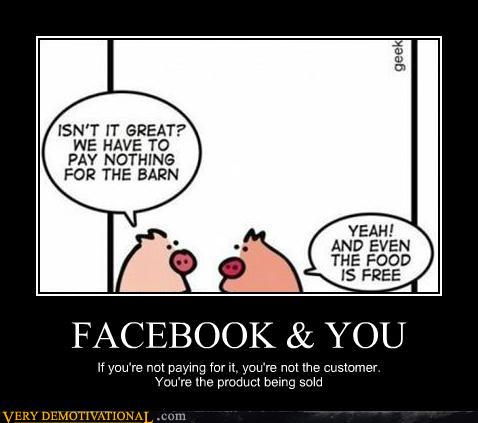
Unfortunately, Tobold actually already linked to this Demotivational poster before I could finish this post, thereby costing me street cred.
It is a fairly common statistic (if unofficial) that less than 10% of F2P gamers actually ever spend money in the cash shop. Most of the resulting commentary has focused on how this ~10% subsidizes the other 90%. This is not actually the case. The evil genius of F2P games is how the non-paying gamers subsidize the paying ones by simply being there. If you are playing LotRO “for free,” what you are actually doing is giving paying customers a reason to actually pay money.
Think about it. If 90% of F2P gamers don’t pay, then the game would presumably have only a tenth as many players if it were not F2P. Hell, the entire point of LotRO going F2P was how they would have shut down the servers otherwise. It did not matter that there were already paying customers; the problem was there was not enough paying customers. When the F2P switch is flipped, you suddenly get a huge influx of “freeloaders” who have a very compelling reason to buy items that make them stand out from each other. Meanwhile the already paying customers are happy because now they have the ability to keep paying for a game they enjoy, and a whole bunch of new people to do it with.
Facebook and Google aren’t doing you a favor by providing “free” social media services. As the Demotivational mentions, you are a product – in this case private demographic information, music tastes, favorite shows, etc, all freely updated by you on your own time – to be sold. You may “get” some bit of value out of these services (else you presumably would not use them) but Facebook/Google/F2P MMO developers are obviously getting a lot more from the bargain. F2P and social media is honestly the biggest marketing coup since fashion apparal designers realized that people would actually give them money for the privledge of wearing advertisements, e.g. shirts with the company logo on them.
They Owe Us
There has been a rather interesting conversation going on in the comment section of my Class Warfare post. Essentially, the question is: do game companies owe their early fans anything? According to Doone, the answer is a clear yes.
Just think that each time any gamer says “this game isn’t made for you anymore” they’re making this very case; that game is no longer for the ones who got that developer where they were. […]
Do these companies owe their customers anything? In my opinion …you’re damn right they do. They owe them loyalty, nothing more and nothing less. That doesn’t mean they’ll cater to every whim and idea of their fan base, but that perhaps their games should never “not be for” the audience that brought them success.
I find this argument fascinating for a number of reasons.
1) It legitimizes the “It’s my $15/month” argument.
The only difference between the “It’s my $15/month” argument and the one being presented here, is one of seniority. In effect, you have been paying your $15/month longer than anyone else, therefore you are entitled to catering. No, it’s worse than catering, it’s shackling. Because:
2) Trading value for value enslaves the producer of value.
If you bought Rock n’ Roll Racing or Lost Vikings, Blizzard owes you. Your dollars bought more than a game, they bought a seat at the design table because Blizzard would not exist if it were not for your patronage. In the same way, Apple owes you for buying an iPod, Wal-Mart owes you for your groceries, and the company of your first job owns you to the point that you should never not be working towards their eternal success.
Facetiousness aside, I am more sympathetic to the situations in which a company like Blizzard says one thing and then eventually does another. I remember rather distinctly when they said you would never be able to change factions, and never be able to transfer from a PvE server to a PvP one, for example. If your WoW subscription was predicated on such “constants,” then you have a legitimate grievance of fraud, in my eyes.
That being said, I thoroughly reject the notion of some kind of implied contractual relationship between the producer of a good and the buyer thereof. Someone who bought Lost Vikings was not “investing” in (future) Blizzard, they were trading value for value. In other words, you paid cash for a piece of entertainment. Transaction complete. This is different from actual investors who pay cash now on the hope of a future return.
3) Entitlement vs Indebtedness.
When I pointed out that claiming game companies owe customers a debt of loyalty sounds an awful like entitlement, Doone said:
@Azuriel: There’s a pretty big difference between entitlement and indebtedness.
Is there? Is entitlement not a presumption of indebtedness that does not exist? I suppose that is what we are arguing, whether a debt exists in the first place.
But I have to ask: why would Blizzard (etc) be indebted to us and not the other way around? Doone talked about the (lucrative) communities that form around these games, the sort of bonus value that send accountants and CFOs into orgasmic comas – the Elitist Jerks, the Thottbots, the Wowheads, the Tankspots, etc. All of these things undoubtedly improve Blizzard’s bottom line. And yet, would these communities exist if not for Blizzard’s game(s)? Are we not indebted to Blizzard and other game companies for having created something worth, say, blogging about? How is an early payment a discharge of our debt, and the beginning of an eternal one for them… instead of the other way around?
For what it is worth, I understand the argument about it not (usually) making financial sense to alienate your “base.” Brand loyalty is worth several times is weight in gold, after all. But just like that old cliche, “If you love something, let it go.” Are we entitled to more than a game we used to love? Is the having of it not enough?
Who is really in whom’s debt?
Choosing to Miss the Point
The unofficial blogging theme of the week is Choice, and while I was not going to comment on it, the sheer force of a thousand bloggers missing the point simultaneously slowed the rotation of the Earth enough to make it necessary. So allow me to clear up a few things.
1) You cannot have “meaningful” narrative choice in MMOs. Nor would you want them.
In case you need a reminder, we are talking about Massively Multiplayer Online games here. Assuming “meaningful” choices existed, who is going to be making them? You? Or the ten thousand other players on your server? You cannot all be making meaningful choices pretty much by definition. Remember the Siege of Undercity? No you don’t. The Siege was completed by Arthasdklol hours before you logged on. If you solve the Arthasdklol situation by instancing everything out, at what point does A) the choices cease to remain meaningful, and B) the game ceases to be an MMO?
The lack of “meaningful” (narrative) choices in MMOs is not a bug, it’s an essential feature.
“What about MMOs like EVE?” I hear you cry. Obviously Sandbox content is a bit different than designer-created narrative content. But it is important to not get too pedantic with pitting player-generated stories against a coherent narrative, the latter of which is what everyone is talking about when they speak about choices anyway. If the headlined EVE scams and interstellar drama is put on a pedestal, why is WoW intra-guild drama not similarly enshrined? Heard that Dragonwrath legendary story yet? If EVE has “meaningful” choices due to nullsec shenanigans, then so does every social game. Which begs the question of whether these “meaningful” choices only exist in the context of social interaction. In other words, the game proper has nothing to do with it. Maybe Game A creates better incentives than Game B for social interaction, but just because you build it, does not mean the horses will drink. Or something.
2) You cannot have “true” failure in MMOs. Nor would you want them.
Raise your hand if you have ever failed an escort quest in an MMO. Now keep your hand raised if you think escort quests get any more interesting or fun if the person you are escorting permanently dies and you can never retake the quest again. If you still have your hand raised, lower it if the reason is because you hate escort quests with a passion and wish you could kill the dumbass you are escorting yourself, for running headlong into unnecessary mobs or how they move with the speed of a narcoleptic 3-toed Sloth that missed it’s insulin injection.
The people with their hands still raised should use it to slap themselves in the face for being a liar. Didn’t your mother raise you better?
The type of “failure” frequently enshrined by these bloggers is the sort of failure that results in a Game Over screen in single-player games. And the difference between reloading your last save after a Game Over and abandoning a failed quest and retaking it is… what? That’s right, there is not a damn single difference. Too Damn Epic asserts:
What happens, though, when your games are rigged so that you can’t lose? That’s the underlying problem in most MMOs. You can’t lose. They’re jury-rigged for success, and as Gandhi said, “Freedom is not worth having if it does not include the freedom to make mistakes.” Tweak that a bit for our purposes, and you get:
“Choices are not worth having if they do not include the option to make mistakes.”
[…] After all, in WOW, you can’t really make mistakes. You can undo talent trees. You can wipe on braindead PvE content to your heart’s content until you “win”. You don’t lose anything in PvP. In an effort to make games more accessible and retain subscribers, we’ve lost the capacity to fail – and in the process – lost the capacity to produce meaningful choices.
“You can wipe on braindead PvE content to your heart’s content until you ‘win.'” Err… so you are saying that you can fail until you succeed? Just like in any game ever made? Maybe there is a serious psychological difference between re-taking a quest and hitting F9 that I am not picking up on. Or perhaps the failure scale these individuals use have only two pegs: Faceroll and Battletoads. And as someone who actually played Battletoads on the NES back in the day, the game did not get more fun when you spent four hours memorizing all the walls in the racing level and the pitfalls in the tube level only to die in the snake level and have to redo everything all over again. That sort of designer bullshit has exactly one function: to turn a five-hour game into a 40 hour nightmare.
The bottom line here is that MMOs having a permanent failure state is actually a worse penalty than any single-player game, with the exception of Russian Roulette. Once you accept that a permanent failure is off the table, we are really quibbling over the length of player time to hold hostage. And honestly, I want to meet the Carebears who look at PvP and say nothing is lost when you get thoroughly owned by a Frost mage that is now teabagging your corpse. Somehow -1 Dignity and +1 Blood Pressure never evened out, in my experience.
3) What is “meaningful” choice anyway?
I have put “meaningful” in scare quotes every since I read SynCaine’s post on choices, and based on the example he used, I think everyone should as well:
A game like Dragon Age is full of ‘fake choice’, where every quest seems to have multiple solutions, but the end result is just different loot or some placeholder NPC switching up one line with another. Not that it really mattered in DA, the game was still fun and its story was good-enough to see it to the end. I’d just never put it anywhere near The Witcher in terms of moral choices and tough decisions.
Err… did we play the same Dragon Age? Assuming you beat DA and/or don’t mind 100% spoilers, just casually glance at the Epilogue Wiki page. Perhaps his point was that epilogue slides are just “switching up one line with another?” I have not played The Witcher myself although I own both 1 & 2 on Steam (SynCaine must have just missed the deal a few months ago), so I cannot compare the two. What I will do is make a wild assumption that what choices The Witcher does offer the player does not come in the form of mutually exclusive content, which appears to be the gold standard of “choice.” If the Witcher does have mutually exclusive content, it will be in the radical minority of games.
I am making a point of this not just because what is “meaningful” is subjective, but also because I think this usage of choice is dumb. Flavor choices are inexplicably dismissed as shallow or meaningless by bloggers, when they are absolutely critical in developing an identity, or affinity to your character or the narrative as a whole. Planescape: Torment is brought up a lot as the pinnacle of storytelling, for example, but how much “real choice” does Planescape actually have in comparison to, say, Dragon Age? Very little. The brilliance of Planescape came from the depth of the “meaningless flavor choices” (all 800,000 words of them) which otherwise pulls you into the narrative in the wholly unique way that only video games can.
Besides, if you believe flavor choices are meaningless or have no consequences and therefore are not choices, how do you explain the apparent success of the F2P cash shop model? Or the likely fact you have things hanging up on your wall right now that you paid for and yet have nothing to do with the structural integrity of your domicile?
Individual expression is, indeed, the most interesting choice you can make despite – or perhaps in spite of – the likely fact that no one else cares.
 In An Age
Skeptical of Storybricks
Sep 7
Posted by Azuriel
You have probably read about Storybricks from any number of other bloggers. If you have not, well, take your pick. Far be it from me to denigrate free thinking and innovative design (god knows we need some these days), but none of these full-page ads for Storybricks ever seem to answer what is to me the fundamental question:
As a player, why would I WANT this?
Keep that question in mind as you read this excerpt from Too Damn Epic’s Storybrick article:
Put aside for the moment what kind of game architecture would be necessary to compute all these dynamically changing quests and attributes. Would you, as a player, WANT to quest in a potentially labyrinthine “unforeseen consequences” environment? Killing a farmer’s sheep is pretty straightforward of course, but this sort of system could engender a Machiavellian plot wherein finding the Blacksmith’s hammer pisses off the Innkeeper whose daughter is in love with the prince who gives your execution order to the assassin who buys the temper-steel poisoned dagger from the newly upgraded Blacksmith. If someone (non-ironically) wrote a plot that involved every quest you completed as having the opposite effect you intended, you would call that writer a hack. As WOPR would say, “The only winning move is not to play.”
Of course, the Storybrick guys aren’t making a game like that, or any game for that matter; they are simply making the tools. More precisely, tools for a game that does not exist yet, and one in which would require user-generated content submission, such as Neverwinter Nights or Fallout 3/NV. I say “require” because I cannot ever imagine that a game designer would leave the fate of the narrative solely in the hand of player actions. And I certainly could never see it in an MMO. Why? Here is what epic.Ben asserts from the TDE article:
One of the hallmarks of the MMO genre is a notion of a persistent world, but that persistence is always in tension with the fact that other players exist. Players say they want a world where consequences matter, that if a town gets burned down it stays burned down. But do they really want a world in which the choice of saving the town is never given to them because some noob 4 years ago logged off in the middle of the quest to put the fire out and the town burned down? “Phasing” was a much-touted Blizzard innovation which amounted to open-world instancing, with exactly zero of the MMO elements intact – the designer reaction to the infinitely frustrating disappearing party member issue of Icecrown was to… phase the background and NPCs in Firelands instead.
Going back to Storybricks, what happens when Bob and Tim want to quest together, but Bob killed the sheep while Tim bought wool instead? Under traditional MMO design, nothing happens because it doesn’t matter how the quest is accomplished (assuming you can even complete a quest different ways). And under Storybricks? I have no idea. Does the farmer have a Schrödinger-sheep that is both alive and dead? Assuming the farmer hates Bob and likes Tim, does he still give out a quest to both, or just Tim? Can Bob get credit if he helps Tim complete it? If the farmer has the same quests regardless of feelings towards Bob, does the farmer having “emotions” matter at all?
This is my fundamental problem with the epic.Ben’s assertion above, and Storybrick’s unspoken premise that “if we build it, they will come.” Or more precisely: “if we build emotive NPCs, the player will care.” Emotional depth and multifaceted character development are the pinnacle of what a storyteller can achieve when crafting a tale, but it always hinges on the listener/player caring about said character first. Why do I care that the farmer is mad at me for killing his sheep? Is he an interesting character? Or am I supposed to care because he holds potentially fun (or required!) quests hostage behind a fancied-up logic gate of prior actions? Much like what happens in real life all the damn time, just because a person interacts with other emotive beings does not mean they care about how other people feel.
I can see and appreciate the work the Storybrick people are doing in building a cart, and hoping that a horse comes along to carry it. Finding a fictional character you have some interest in and realizing that there is emotive, narrative depth to their actions is a truly magical experience. That being said, it still requires someone to have crafted an interesting character to begin with. And if they already went through that much effort to make one, I just do not see the appeal of using Storybricks to fill in the blanks Mad-Lib style. Nor do I see the appeal to the player of being in an environment where potentially random actions have lasting, permanent consequences. If accidentally killing a sheep with a stray Arcane Explosion can be rectified by reputation grinding with the Farmer, that is almost worse.
Posted in Commentary, Philosophy
15 Comments
Tags: Game Design, Storybrick