Category Archives: Review
Review: Satisfactory
I have finally completed Satisfactory after 123 hours.
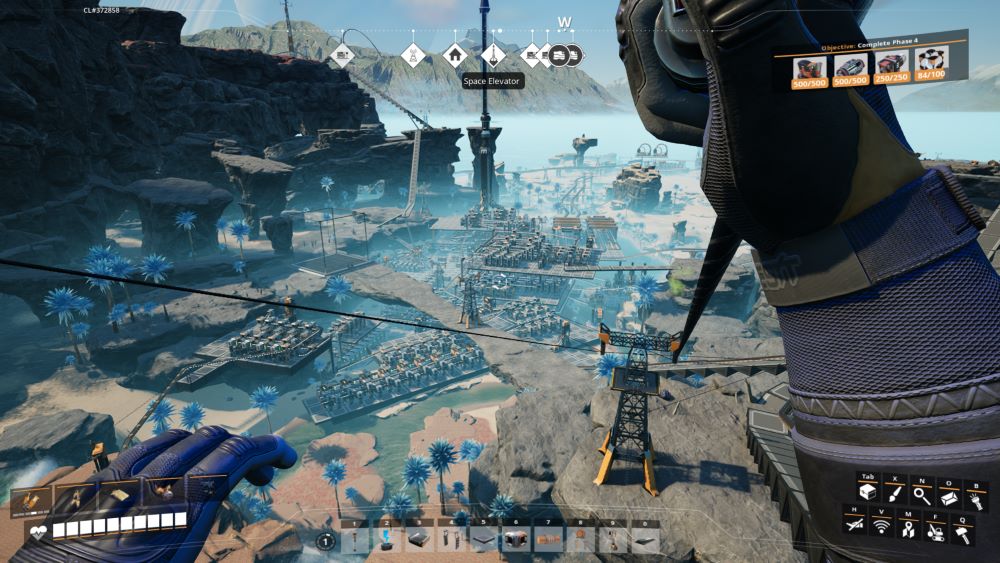
Satisfactory is an automation game in the same vein as Factorio, aside from taking place in a first-person perspective of a very detailed 3D world. Like all of the other games in the genre, the goal is to craft a series of production buildings to harvest, smelt, and otherwise produce an ever-more complicated string of widgets to achieve certain milestones that unlock fancier widgets that require other widgets to produce, et cetra. The joy and satisfaction comes from planning and then executing these complicated production lines and witnessing the factory coming to perfectly efficient life.
Well, mostly efficient. 80/20 Rule applies.
I’m not an expert on the automation genre. Previously, I played Factorio for a few hours and bounced off; Dyson Sphere Program was starting to get good, but then it left Game Pass. So, coming into Satisfactory, I was a bit skeptical. It is difficult at this point to tell whether it was the genre itself that finally clicked for me, or whether Satisfactory itself had enough tweaks to the formula to break through, but… it did. In a big way. I played nothing else for almost four weeks straight. The genre jury is still out for me, but thus far the evidence points to the latter.
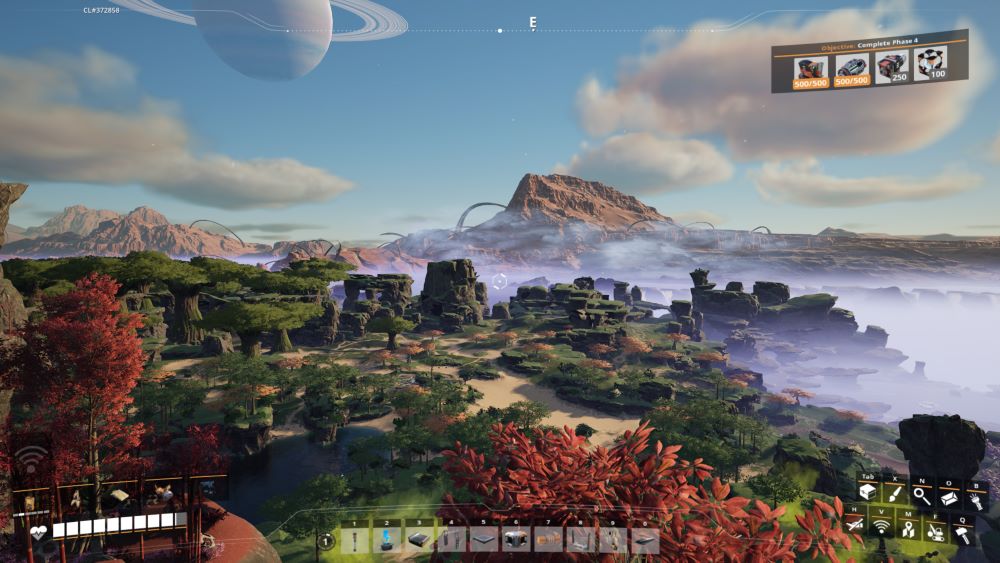
The first thing to understand about Satisfactory is that resources are infinite. When you find an Iron Vein and plop a Miner Mk1 on it, you will receive 120/minute of Iron Ore. Forever. Believe it or not, this is not actually common in the genre. What this certainty allows for is the construction of permanent supply chains. That 120/minute Iron Ore can be fed into enough Smelters to output 120/minute Iron Ingots, which then get split into different conveyer paths leading to Constructers outputting X/minute Iron Plates and Y/minute Iron Rods. The only time things would slow down/stop is if your power grid goes down or if there is nowhere for your end products to go.
That sort of subtlety of design ended up being the secret sauce for me. Is perfect efficiency required? Nope! It may just take longer, and maybe you’re okay with that. Progression in the game comes from taking ever-increasing volume (and complexity) of goods and blasting them into space. If they want 1000 of something and you’re making 5/minute, well… it’s your choice whether to do something else for 200 minutes or try to pump up the other number(s). Maybe you need to tap another Iron Vein somewhere to increase supply. Do you know of an untapped node somewhere close, or will you need to explore? Do you transport the raw ore back to your home base, or just the finished products? Have you unlocked alternate recipes via Hard Drives found in the world that could change entire production chains? I swear to god, Civilization’s “One More Turn” got nothing on this game.
It is hard to identify downsides, as this genre is new to me and I obviously had a lot of fun in this one. Something I will say though, is that there was somewhat of an insurmountable dissonance between the need to automate and the need to explore in Satisfactory. Hitting Milestones and unlocking new resources like Coal? Absolutely, let’s prioritize setting some Coal Generators up. Inbetween that though, there is an entire alien world you can (and should) explore. Not just for its own sake, but because there are Hard Drives that unlock (unfortunately) random alternate recipes, and alien artifacts that will similarly change the way you play the game later. But when can you explore? Those “wait 200 minutes” Milestones I mentioned before don’t arrive till later, so it’s more of a dilemma between “wasting” potential factory output time or just turtling up at your base and exploring only after 80+ hours.
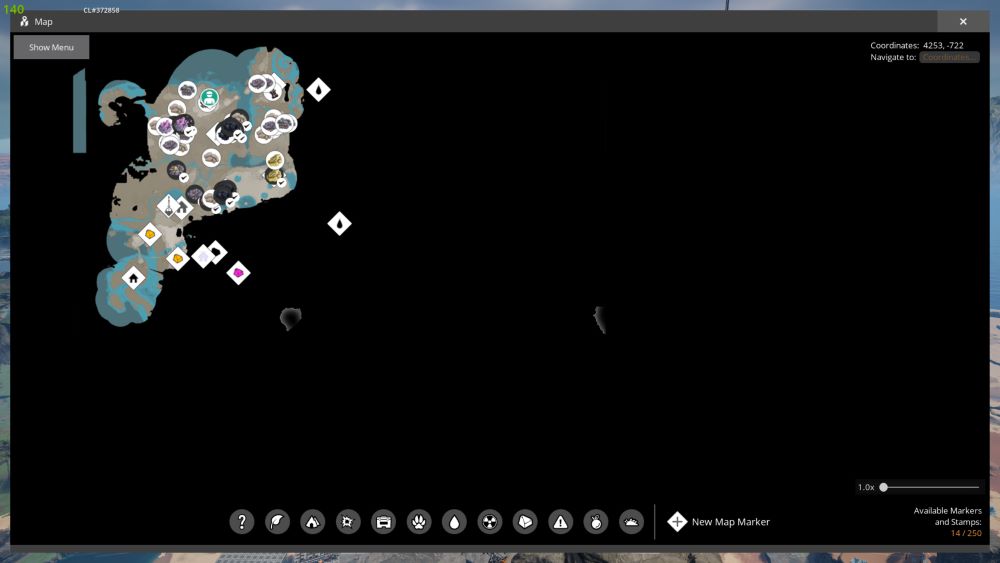
The latter of which, ironically, is very possible because the devs actually over-engineered the world.
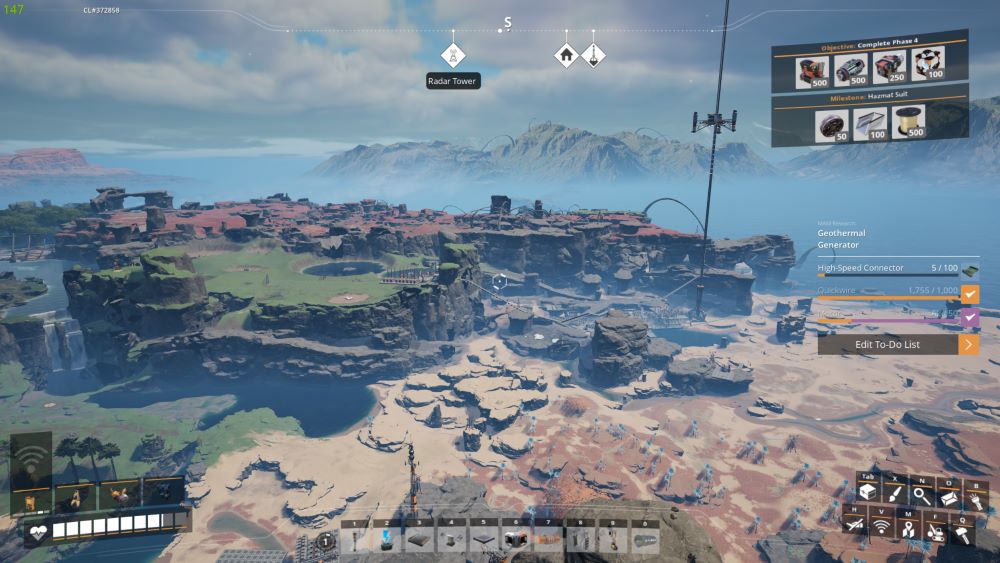
Seeing YouTube videos of other peoples’ massive factories and dozens of train track lines made me originally believe that sort of thing was going to be required. Surprise! Not at all. Part of the reason the world is large is because the devs give you the option of several different starting locations. But also… just because, apparently. The sheer size of the world naturally encourages you to invest in the more advanced transportation options, although you can certainly just run conveyer belts everywhere. Or be like me and spend 80 hours along a little tiny slice of the coast until more esoteric recipes required me to branch out. I guess my point is that you have options in exploring early if you want. Or not.
What more can be said? Satisfactory is great. I’ve spent more hours playing it than Skyrim, Fallout 4, Dragon Age: Origins, and actually most other games. Is it better than all those? Nah. I would personally rate a good survival title over Satisfactory any day, let alone a meaningful RPG experience. Buuuuuut… if you want possibly 120+ hours of almost-pure wirehead experience, this game has you covered.
And sometimes that is exactly what you need.
Frostpunk 2
I have played and completed Frostpunk 2 via Game Pass in about 15 hours.
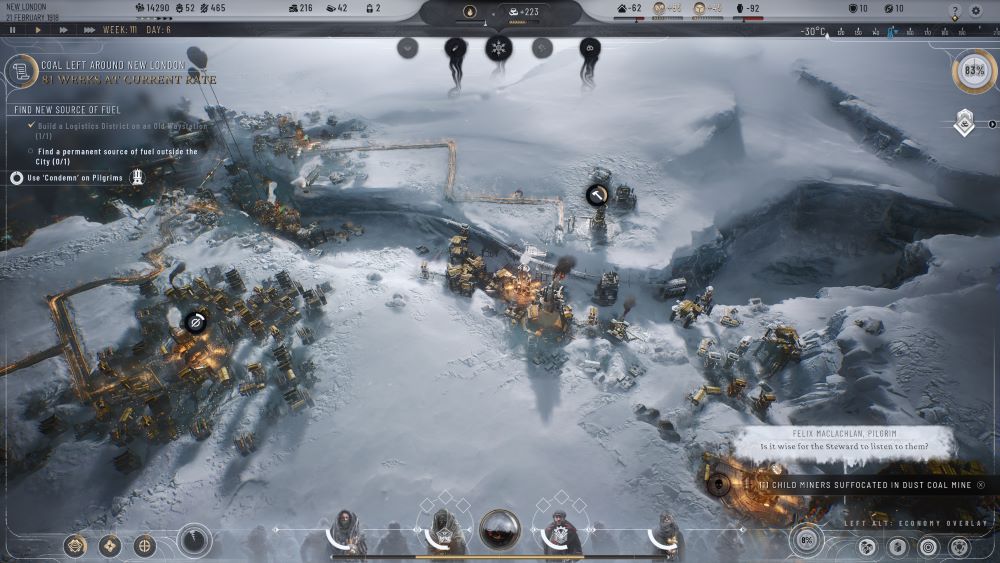
Frostpunk 2 is a sequel to the original both narratively and from a gameplay perspective. New London survived under the Captain’s rule in this alternative history 1899 ice age, but with his death, the fate of the city now rests in the Steward’s (aka your) hands. With a much more zoomed-out perspective, you must carve out space for various districts, explore and set up outposts, and placate diametrically-opposed factions whilst also ensuring the city never falls to the cold.
In the original game, the “plot” was broken into various Scenarios. With Frostpunk 2, there is a single narrative thread composed of five Chapters, throughout which your city progress is maintained. This continuity resolves a lot of the issues I had with the original game, wherein tech tree unlocks seemed pointless considering you barely had time to research any of them before the Scenario was over. Continuity also makes your early decisions much more important, as you continue to receive the benefits of it for a dozen hours. For example, your scouts might discover wreckage and give you a choice: gain important materials, or get +800 Workforce permanently. Choosing the resources might get you out of an immediate crisis, but there actually is a “long-term” to consider here.

Of course, that also becomes a problem. Although I beat Frostpunk 2 in ~15 hours, realistically the game was over after about 8 hours. By the time Chapter 3 rolled around, I had maximized the citizens’ Trust, all Factions supported me, and I was running a surplus of every material with an immense stockpile behind it. I played on the equivalent of Veteran difficulty, and so it’s possible that this is an indication I should have challenged myself further. However, I doubt harsher RNG events and a poorer start will make some of the “binary” choices/tech less obviously OP. If anything, I am now much more savvy to which Laws are critical to unlock early and which can wait.
On the other hand, the likelihood of my playing again is kind of low. Having a strict narrative thread means experiencing the same events in the same order, exploring the same map, and maybe making different choices for roleplaying purposes. The game is extremely engaging in the moment – way “worse” than the Civilization “just one more turn” hour evaporation – but a lot of that depended on the consumption of novelty. There is an Endless Mode option available, although how interesting that may be is dubious; as I mentioned previously, there are actually ways to end up effectively infinite even within the base game. Best I can do is hope there are updates in the future that add new Scenarios in.
Overall though, Frostpunk 2 is an extremely slick and fun city-builder for the time I spent with it. Given how much was changed, it’s hard to say whether someone who loved/hated the original would find the sequel any better. It’s on Game Pass though, so it’s relatively easy to give it a whirl.
Review: Planet Crafter
Planet Crafter really surprised me by keeping my attention all the way to… just before the very end.

The premise of the game is that you are dumped onto a barren, hostile world and tasked to terraform it into something more hospitable to life. The “twist” is that there is no combat. At all. The planet is barren, after all, so what would even attack you? But what intrigued me was precisely how intrigued I stayed for the 35 hours I played. And that’s quite the trick considering I am not much of an Explorer type nor someone typically into Factorio-style automation games.
The secret sauce is probably the sense of progression.
When you first start out, you have an extremely tiny oxygen meter and will be doing some desperate loops around your starting capsule to gather raw materials. Eventually, you will start building a rudimentary base and start stockpiling supplies. However, almost all crafting recipes and upgrades are gated around one’s Terraforming Index (Ti) score. Improving this score is only possible by creating machines to generate Heat, Pressure, Oxygen, etc, to first form an atmosphere, and so on. Certain resources to build these machines are not located on the ground like most everything else, so you will need to go explore deeper afield – including inside the wrecks of spaceships – to gather what you need.

And so a cadence is formed: build up machines to improve Ti, go exploring for new material, come back and build new machines that got unlocked while you were exploring. Each loop will increase your ability to travel further as you expand oxygen capabilities, movement speed, and inventory space, and start fostering a sense of curiosity about what’s over the next ridge or inside that cave.
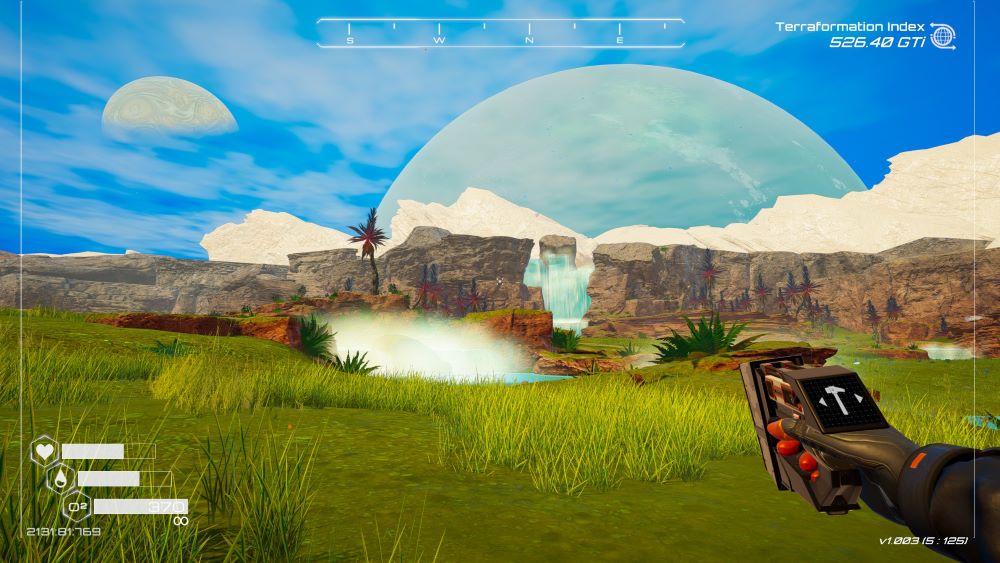
It’s also worth mentioning the more visual sense of progression as you improve Ti: watching the planet bloom. Glaciers recede, opening new travel and resource opportunities. Liquid water starts to form. Weather occurs. You start building Flower Spreaders, grass starts generating, then you upgrade to Tree Spreaders. By the time endgame rolls around, you are flying around searching for the last remnants of secrets left behind, occasionally stopping to gaze at the previously lifeless stone arch now covered in an explosion of color and growth. It’s a real treat.
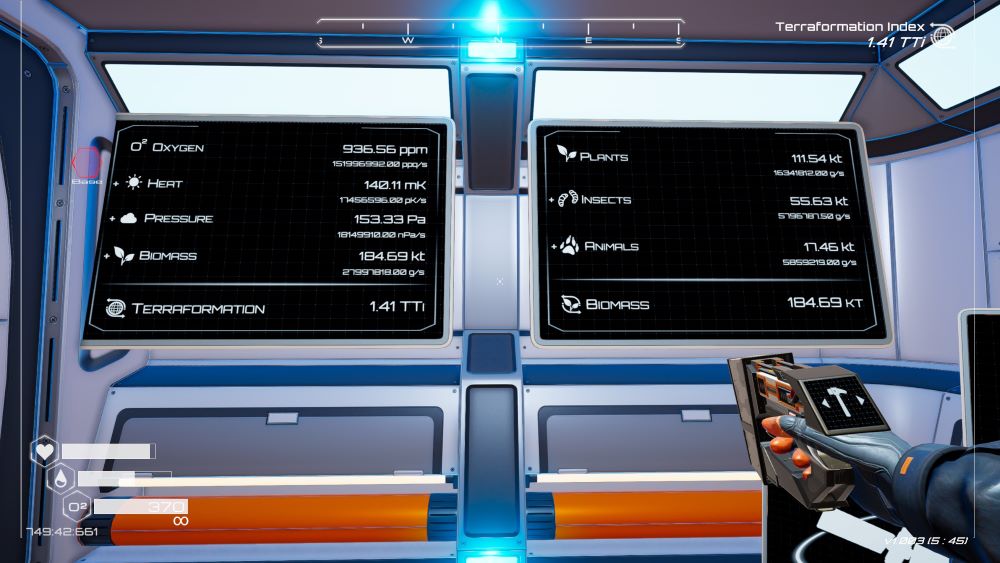
The only shame then is the final stumble. I have unlocked every technology except the final one to end the game. I have explored procedurally-generated wrecks, I have optimized my automation, I have uncovered every mystery on the planet, consumed every bit of novelty. My score is sitting at 1.43 TTi and 5 TTi is the end. After timing it, I would need to leave the game running for 5.5 real-world hours to get to that number.
Could I speed it up? I mean, hopefully. I’ve already built 6+ T5 generators of various types (Pressure, etc), overlapping Optimizers fitted with boosters, dozens of satellites that further juice the numbers by 1000% a pop. Each added machine makes the overall number increase by what feels like an insignificant amount. I spent the entire game waiting for the “Spam End Turn in Civilization” inevitability to kick in, and was surprised every time Planet Crafter bobbed and weaved out of the way. But, alas, it did come after all.
Nevertheless, Planet Crafter did deliver an extremely solid 20-30 hours of entertainment without once leaning into combat or contrivances. If you’re looking for Subnautica minus the thalassophobia, or the first half of Breathedge minus the chatty sidekick, then Planet Crafter is your game.
Review: Tiny Tina’s Wonderlands
It’s… okay. Which is actually kind of an accomplishment given the risks Gearbox took with it.

Tiny Tina’s Wonderlands (TTW) is a non-baseline Borderlands game with the same general conceit as Tiny Tina’s Assault on Dragon Keep, a DLC from Borderlands 2. The eponymous Tiny Tina is running a Bunker & Badasses (e.g. D&D) game and all of the action takes place within that setting. The first few guns are repeating crossbows and there is actually a dedicated melee weapon slot that is useful to most characters, but there are eventually regular guns, rocket launchers, etc. The grenade slot has been replaced with Spells though, which is basically what grenades have turned into in the series anyway.
What is interesting though is how… distilled the Borderlands experience is in this game.
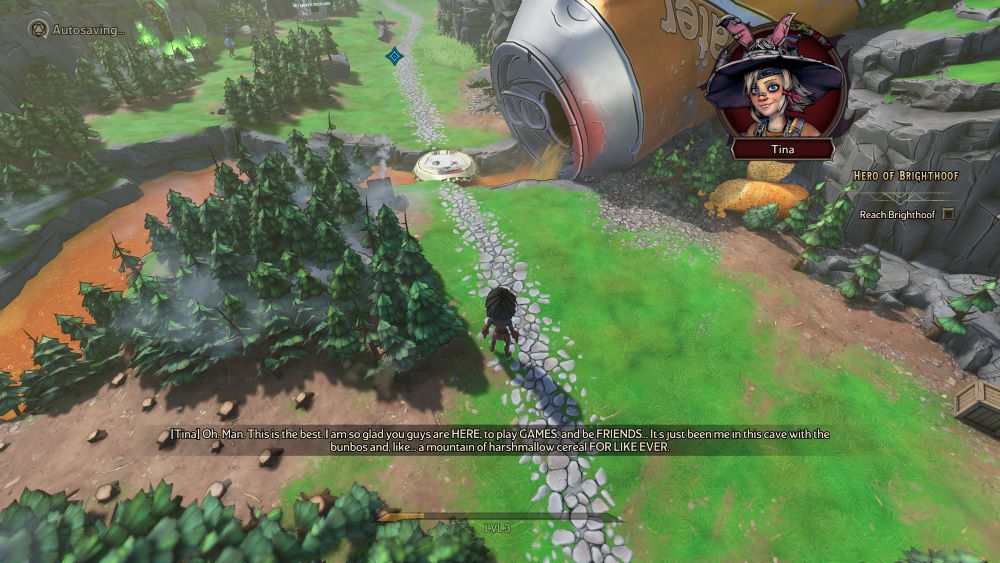
In the mainline titles, you spend a lot of time working through certain locations, and then traveling vast distances via vehicles to reach the next biome. In TTW, the overworld is literally a tabletop you navigate your bobblehead figurine around. It didn’t take me long to realize that I actually preferred this method of getting around Borderlands – the vehicles were always the weakest part of the gameplay.
Walking in tall grass in TTW will sometimes spawn enemy figures, but if you punch them before they fully form you can avoid the random battle. Getting into these battles (or any of the side-quest dungeons) presents you with one of a half-dozen arenas filled with random themed opponents (e.g. pirates, skeletons, sand-sharks, etc). There is nothing to “explore” in these specific areas, so you just blast away until the meter says you have killed enough to move on. Again, basically Borderlands.
To be fair, there are actually a lot of traditional, hand-crafted areas of the game that do feature a lot of exploration. Not only are these areas large, they are also seeded with special loot D20s that will permanently increase your loot luck each time you find one. There are other collectible widgets too if you so desire. A few of these areas are completely optional side-quest zones, which is kind of impressive when you consider that they can easily be skipped entirely.
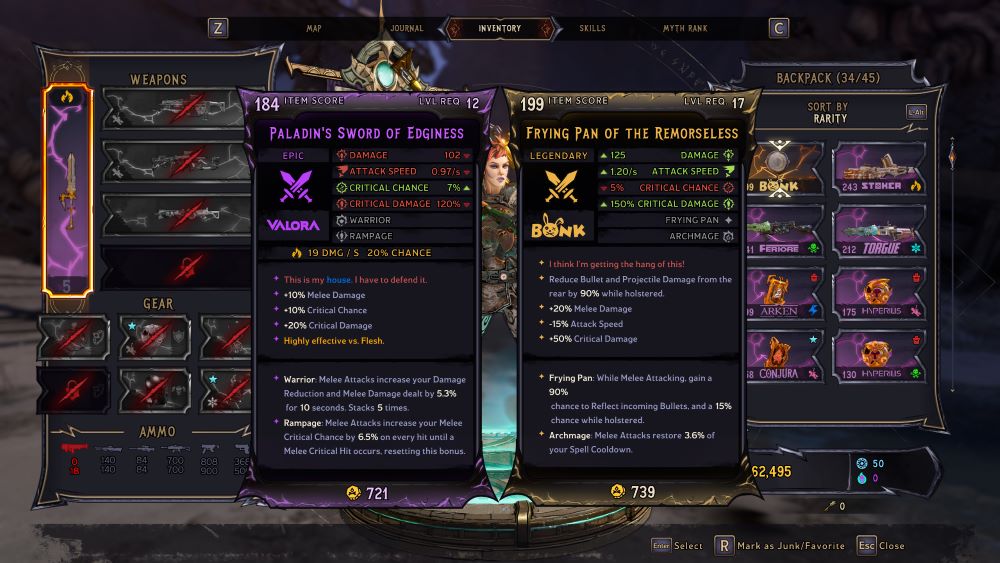
Another thing that worked out well was the class system. You choose a class at the beginning and see a traditional Borderlands talent tree. Once you reach a certain stage in the game though, you get to multi-class. In the mainline games, each character had 3-4 talent trees, sure, but their main ability and general role was locked down. Here you could mix and match and take some classes in radically different directions.
Having said all that, there are a few things that bring the experience down.
First, character and gear progression is locked behind the main story, rather than levels. What this meant is that I was stuck with just two weapon slots until level 15+ which just felt awful. Considering that you can pause the game at any time and swap out weapons in the menu just meant I had to constantly interrupt the action once I ran out of ammo of a particular type.
Second, TTW continues the unfortunate series tradition of punishing you for doing side-quests. Everything scales with your level, from enemies to rewards, and since side-quests can grant you unique weapons, you are either getting a neat weapon to use for half and hour or “saving” the side-quests until after the main story is completed, so you can guarantee a max-level roll.
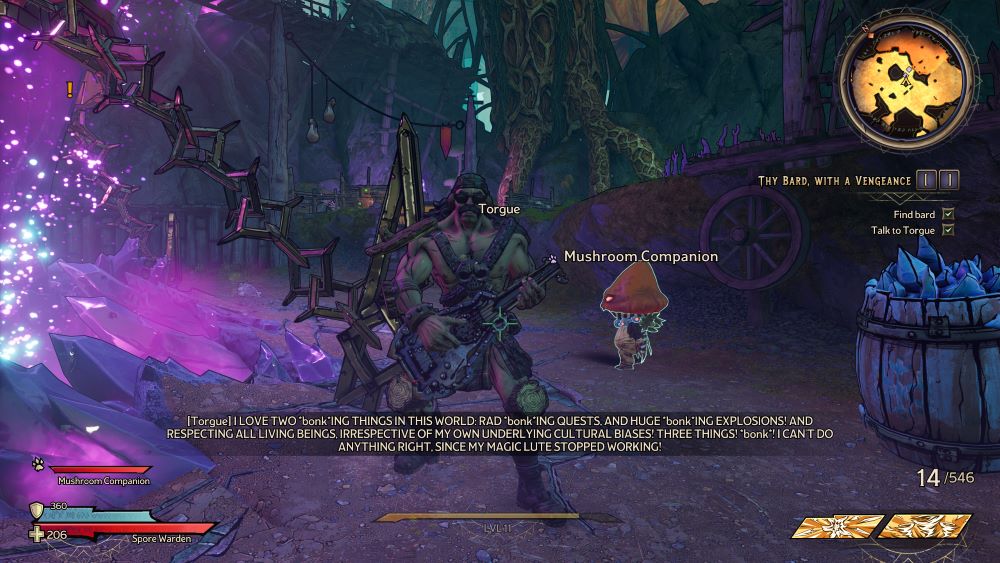
Finally, while the quality of the Borderlands series writing is an acquired taste at the best of times, the disadvantage here is that the story doesn’t “matter.” For as widely panned as the Borderlands 3 plot is, it at least moves a narrative forward. I actually like Tiny Tina’s character (and humor) in the series but TTW doesn’t really explore anything new. “She’s lonely.” Okay. “People don’t stick around.” It’s a cave. “She’s just 13 looking for friends.” Yeah, as established in Borderlands 2 & 3, the DLC, and the Pre-Sequel.
It really wasn’t until the credits at the end that I sort of realized what was really going on with the game. No, not some extra post-credits reveal – the devs just thanked everyone for playing and explained that they built the game during the pandemic while working from home. Suddenly the whole “power of friendship” throwaway storyline, the bold design decisions (e.g. cutting the overworld, etc), and the truncated post-game support made sense. Regarding that last point, the mainline games typically allowed you to do a New Game+ equivalent so you could farm Legendary drops from specific bosses and/or negate the penalty for doing side-quests below level cap. In TTW, that doesn’t happen. Instead, you can play in Chaos arenas against random enemies waves with random buffs for your random loot. Similar, but very much not the same.
So, yeah. If you’re not a fan of the series, this won’t change your mind. If you are a fan, this is… fine.
Cyberpunk 2077, Completed
Finally finished Cyberpunk 2077 over the weekend. Total playtime was a combined 148 hours.
Years ago, my initial playthrough was as a female V, romancing Judy. Progressed up to the Parade mission, realized that things were probably going to go down, so I took an off-ramp into… literally everything else. Completed every single side-quest, and sucked the very marrow from the progression system. After that, I lost interest in going the final mile, never completing the game.
The second playthrough came as a result of the Phantom Liberty DLC release. Actually, a second playthrough would never have happened without the corresponding 2.0 overhaul of the Talent/Perk system. That overhaul really did turn everything around, making it a more cohesive, interesting experience. It didn’t hurt that Phantom Liberty was actually an extremely well-built DLC. In any case, I decided to start a fresh character using the “skip to Act 2” option to check out things as a male V, romancing Panam. And yeah, it was a “I studied the blade” playthrough (until I realized that sucked).
Ironically, I almost bailed at the exact same place as last time. Technically, in fact, I did: stopped playing in November after about 68 hours, right in front of the parade quest, having completely consumed all of Dogtown and thinking of what I had to do to unlock the various ending options. Already surpassed the old level cap, maximized gear, no progression of any kind to look forward to. Why bother slogging through to the end of this Civilization Conquest victory? I put the game away for a few months.
The main impetus of getting me over the finish line? My 2TB gaming SSD was getting too full. Yep.
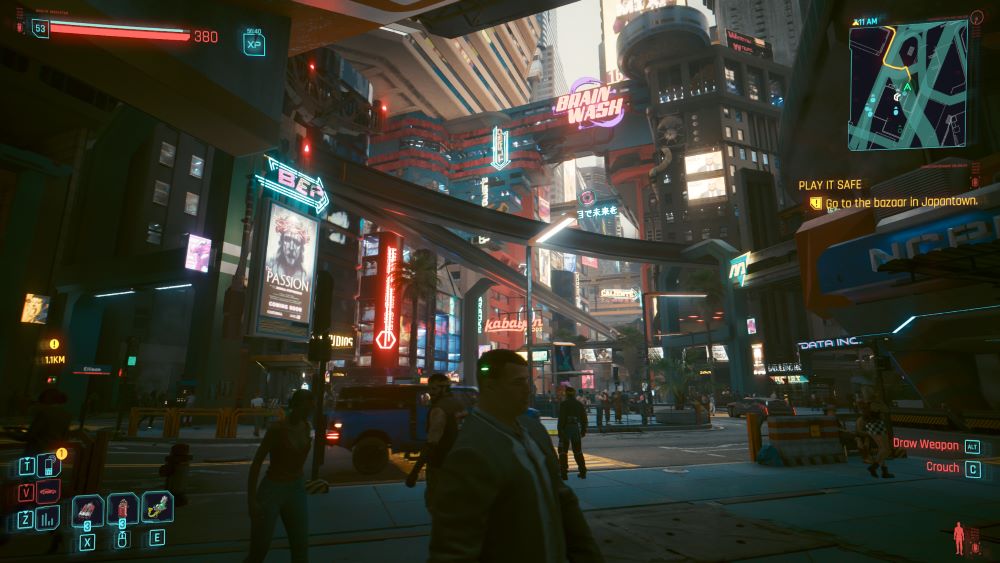
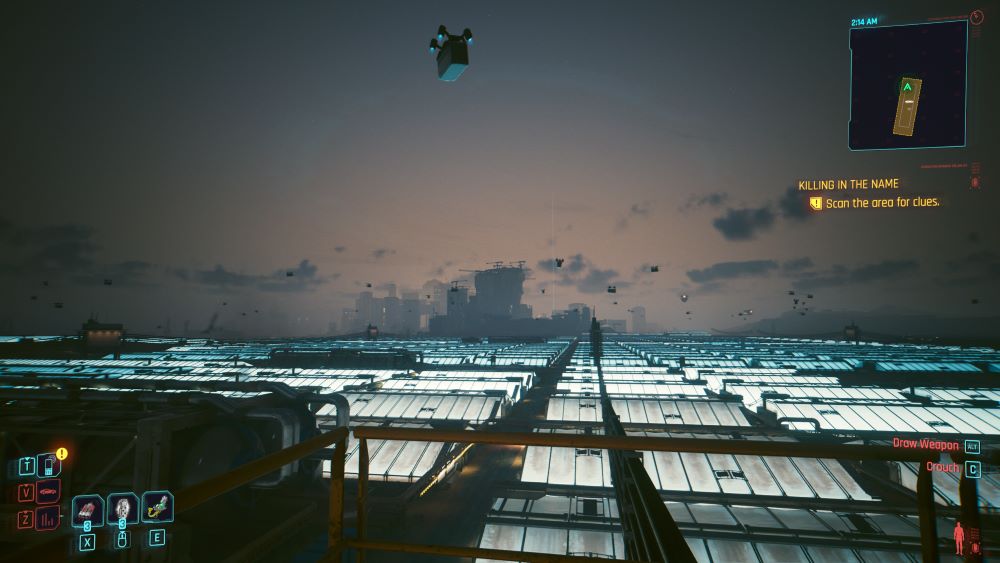
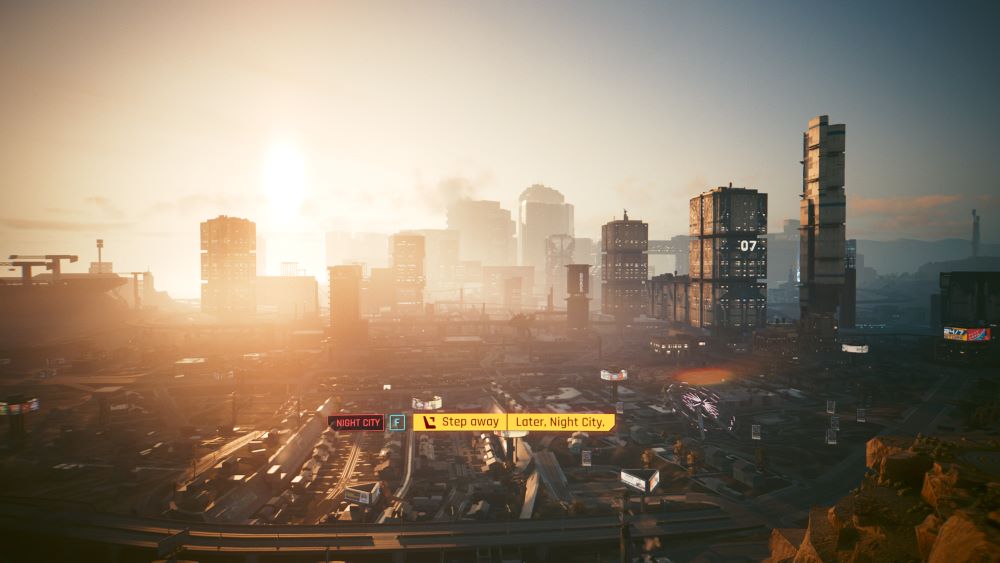
Now, my reticence over finishing may sound as an indictment of the game overall, but that is not the case. Cyberpunk 2077 is an amazing achievement, featuring one of the most cohesive, believable gaming cities ever designed. The streets feel lived-in, puked on, bled over, and cyberpunked.
The commitment to immersive first-person perspective is bone-deep, but what sells it the most is the level of humanity present in the movement of NPCs. A decade ago, characters winking in Mass Effect elevated the entire medium for me. And while I am fortunate enough to have experienced the vicarious joy of the devs when it came to Final Fantasy 7 Remake, Cyberpunk 2077’s contributions are on the next tier higher. Being able to walk around characters as they are talking, seeing them casually step over chairs, or light a cigarette, or any of the general actions that, while scripted, never feel overally scripted sets a bar unlikely to be topped for years. Granted, most of this comes from extensive (and expensive) mo-capping, putting it firmly out of reach for the majority of developers out there. But once you leave Cyberpunk and try any other supposedly AAA game (cough Starfield), you feel the difference.
Having said all that, I’m still not entirely sure how I feel about finishing the game.
Actually, hold up. Let me find that… here it is.

I’m not going to go into the nitty-gritty details of the ending(s), but you’ll be able to infer some things.
…buffering…
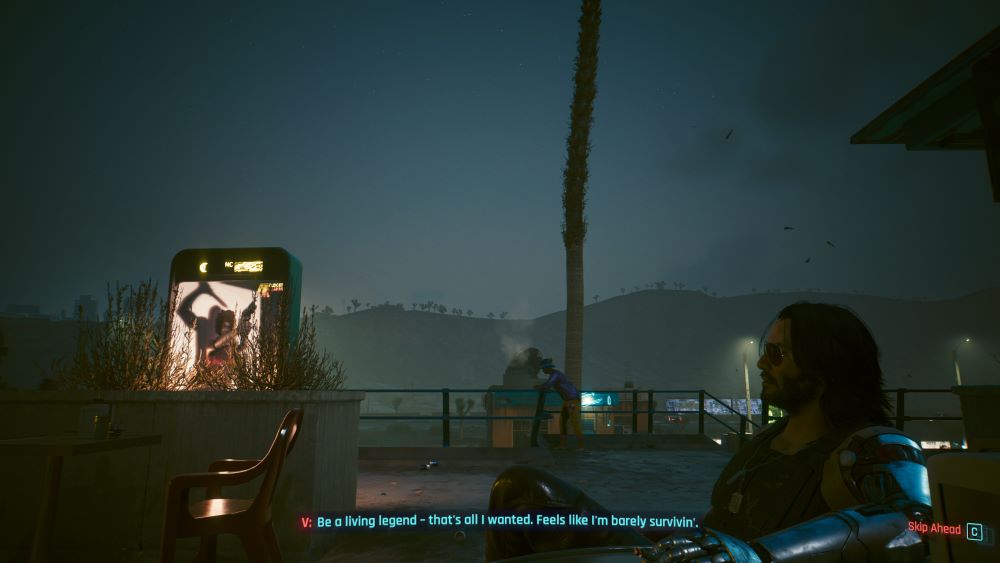
I found the overall narrative unsatisfying. To a degree, this is likely by design. Night City is a corpo-dystopia, poverty is rampant, gang violence is routine, and attempts to do the right thing usually end in worse outcomes for everyone involved. The primary motivation of the main character, established early on, is to become a famous mercenary and get rich. And while you do have the option to be a bit more, ahem, mercenary in a few quests, the language of action throughout is always centered on killing and/or stealing and/or sabotaging for cash, regardless of whether your heart is gold or lead.
From a gameplay perspective, that is perfectly fine – I relished every opportunity to cyber-ninja around Night City. But at some point there came a severe narrative dissonance in how much time I was spending killing random gang members as opposed to the corporations that were responsible for the dystopia itself. Maybe that is “too big” of a goal to accomplish, assuming I could even work towards that end with a ticking time bomb in my head. Maybe the point of the story is to demonstrate the corporations always win and the best you can do is disconnect and drive away into the desert.
You know, the ole’ Wargames “the only winning move is not to play” end. Which is second only to “it was all a dream” in terms of dissatisfying plot.
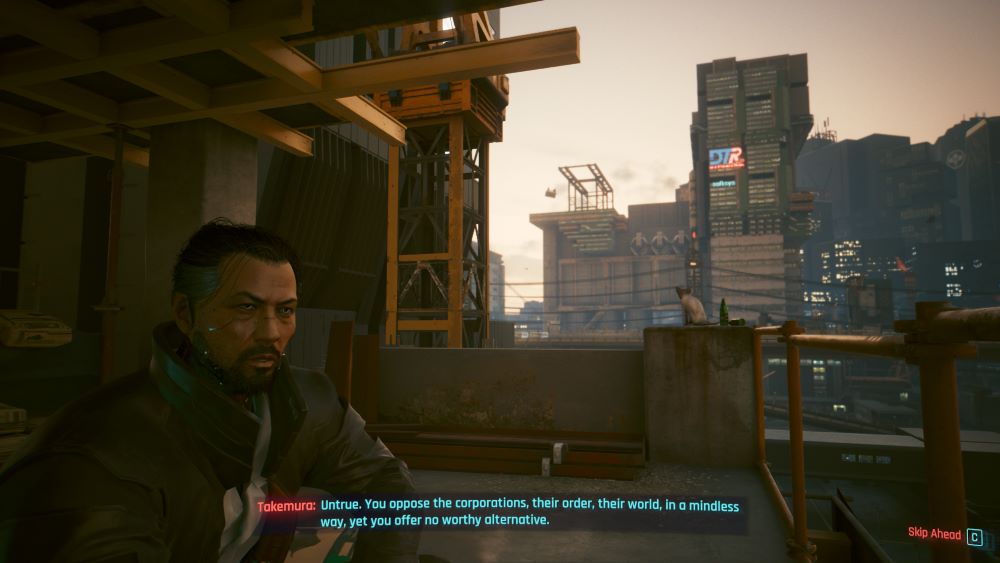
For most of the game, I also actively hated the Johnny Silverhand character. While there were some later quests that softened the rougher edges, for the most part, Silverhand just reminded me of one of those overly-dramatic friends whom the world is always out to get – defensively cantankerous, never realizing that if everything smells like shit, maybe you should check the bottom of your shoe. However, that thought led me to imagine a Cyberpunk where Silverhand wasn’t in your head. And… I don’t think it works. Not so much because Silverhand’s relentless cynicism enhances the narrative, but rather that it is structural crutch to an otherwise unsupported plot.
Like, imagine that you still have the Relic malfunctions and blackouts, and thus still have motivation to seek a cure. What else changes? Well, a shit-ton of dialog goes missing. And that was when I realized: Silverhand is the embodiment of a failure to “Show, Don’t Tell.” He’s the player’s digital conscience, ever critical of actions that contribute towards the preservation of the Corpo status quo… which is all of them. But the insufferable needling is necessary because the game otherwise doesn’t Show any of it. Arasaka and the other corps are right bastards in the lore, but aside from a few assassination attempts, they may as well not exist. The game should have been called The Gangs of Night City for how much gameplay ultimately revolves around Maelstrom and Tyger Claws.
Again, I get it, having players just fight corps is probably a hard game to make. Plus, part of the “point” of the setting is that these corps are all but unassailable outside of a few acts of targeted sabotage. Even ultimately bringing down Arasaka doesn’t do shit within Night City – Militec immediately fills in the vacuum and the status is quo’d once more. This is the cyberpunk genre 101.
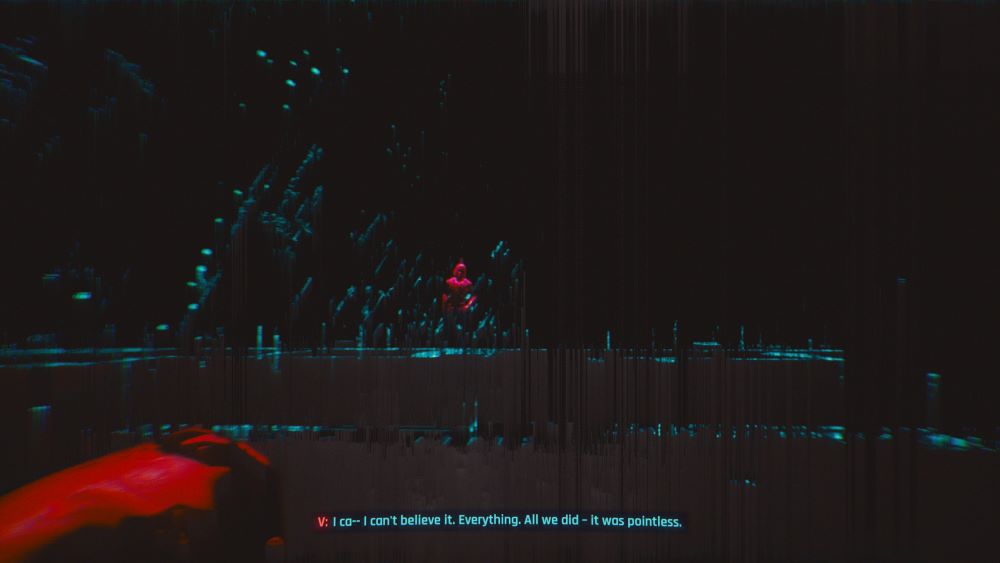
But… I dunno. I’ve played grimdark games before, I’ve played Far Cry 2 where by the end I as a player wanted my character to sacrifice themselves. I actually have a high regard to games that embody the Starfish Parable in the face of inevitability elsewhere. And yet, Cyberpunk 2077 somehow feels bleaker than even that. If that is the vibe the devs were going for, well… congratulations. You won, I lost.
Perhaps it is thus in a moment of supreme irony that I still recommend you play the game.
Not because of the “friends you made along the way,” or any sort of deep philosophical insight, or because of a game-inducing sensation of nihilism. Rather, you should play Cyberpunk 2077 because it’s a technological marvel. You can mod it into virtual photorealism rather easily, but even without mods the fidelity is on a level beyond all peer. Crysis was a gaming benchmark for decades, and I can see Cyberpunk 2077 occupying a similar niche for years to come.
But what really ties it together is the Immersion impact. Some Call of Duty sequel or whatever may end up being prettier, but what can you actually do in the game? Skyrim might technically be more immersive in terms of interacting with the environment, and Grand Theft Auto 5 also has a lot of activity. But I cannot stress enough: Night City feels real. You are in an environment. From now on, if I cannot jostle NPCs out of the way while moving through a crowd, that game is crap.
So, yeah. Cyberpunk 2077.
Buy it, play it, live it, and then end the game on your terms. Preferably before the parade mission.
Book Review: Three-Body Problem
I have just completed reading all three novels of the Remembrance of Earth’s Past series, e.g. the Three-Body Problem trilogy. This was an eventual (albeit unlikely) goal I espoused a few weeks ago, but I surprised myself by plowing through all of them in about 7 days. That had not been the plan.
Personally, I blame Bhagpuss. In the comments, he noted:
I got maybe 30 or 40 pages into The Three Body problem before I gave up. Very dull, pedestrian prose, possibly the translation, and a not very interesting storyline.
For triangulation, I read more than one book a week on average and have done pretty consistently since I first learned to read. Of the books I start, I probably fail to finish no more than two or three a year. They have to be *very* dull before I give up on them. This one was that dull.
And with the petulance of (comparative) teenagers everywhere, I thought: How bad could it be?
Insert LarryDavid.gif
To Bhagpuss’ credit, he is correct on all points. I’m not a literature expert, but the books definitely felt like they had discovered a third state of writing: poetry, prose, and then this. I kept at it though, because part of me was trying to figure out why it felt so dull – not in a “where are the good bits” sense, but trying to identify the gap in myself that was not connecting. A big part, undoubtedly, is in the fact the series was written by a Chinese author in the Chinese language for a Chinese audience. Translating works into another language is obviously possible, and although there is some loss thereby, I have read plenty of, say, Camus and Nietzsche (of course) and been deeply appreciative of the subtleties of both the philosophies and the prose itself. Same with the, admittedly fewer, classical Japanese novels I read through in college. Then again, I was specifically taking courses on Japanese literature at the time, so perhaps I was more primed to recognize the stylizations and themes of the text.
Whatever. This was not intended to be a book report for credit, so let me be more direct.
The value of this series exists entirely in the concepts and philosophies that it presents. In the Three-Body Problem, a significant amount of time is spent setting up history and background for completely unlikeable characters. Once the stage is set, the book – and series overall – functionally reads a lot like Isaac Asimov’s Foundation series insofar that it is a mystery/thriller novel with hard sci-fi elements. Unfortunately, the author takes great pains in presenting an impossible scenario, spending a lot of time explaining how there is no hope, and then revealing a miraculous solution with zero foreshadowing. That last bit is the key: the solution didn’t exist until it appeared. In a traditional murder mystery, there may be plenty of red herrings, but once revealed, you experience the same “a-ha!” moment of the detective as you trace the threads back to the start. Here, there is no such satisfaction.
Aside from the poor dialog, characterization, overall story structure though? Really good.
To be clear, the 2nd book (The Dark Forest) literally coined a term for a possible solution of the Fermi Paradox. Most of the hard sci-fi elements were extremely intriguing and novel. And even though the “mysteries” were not especially well-structured from a reader point of view, the concepts therein got the juices flowing. It’s a pretty good sign that when I set the final book down, I felt like it was obvious that we shouldn’t be attempting communications with aliens, and also that someone inevitably would try anyway, resulting in our extinction. The philosophical axioms presented seem pretty hard to beat.
I just wish the whole thing was written a bit better. For example, this passage:
Cheng Xin thought she saw exhaustion and laziness in those eyes, but there was also something deeper, something sharp that made her uncomfortable. A smile appeared on Wade’s face, like water seeping out of a crack in the frozen surface of a river; there was no real warmth, and it didn’t relax her.
And this line:
The stories turned into empty baskets capable of carrying any goods.
Those were good! And… those were the only lines I found, coming only in the third book. Compare that to Malazan where I basically filled up a Notepad file full of them with every novel. Again, perhaps something was lost in translation, but with how the books are structured, I kinda doubt it. If you have ever wondered if the “Show, Don’t Tell” principle can be failed in the written word, this series is exhibit A-to-C on how. That works when describing four-dimensional space or the power of strong-attraction weapon technology, but no so much the human drama bits.
Ultimately, while it holds zero-dimensional candles to classics like Dune, I do feel like the Three-Body Problem series is Important sci-fi, with an uppercase I. Whatever you think about, say, Ringworld (1970), it is undeniable that the concepts explored (megastructures) imparted a kind of gravity wave that is still rocking pencils 50+ years later. It remains to be seen how big the ripple Three-Body Problem extends, but I know that I personally will be looking askance at every other sci-fi book if they do not address the “dark forest” inevitability. Just wish the hike to said forest was a bit more entertaining.
P.S. Netflix is releasing a Three-Body Problem show next month, headed up by the Game of Thrones directors (David Benioff and D.B. Weiss). You can watch the trailer here. While what D&D did in Season 8 of Game of Thrones was criminal, at least here the source material is already completed. Indeed, provided the overall concepts explored in the Three-Body Problem remain the same, even a clumsy adaptation would be a huge improvement over the original.
Dead Island 2, Completed
I have completed Dead Island 2 and the Haus DLC after roughly 32 hours.
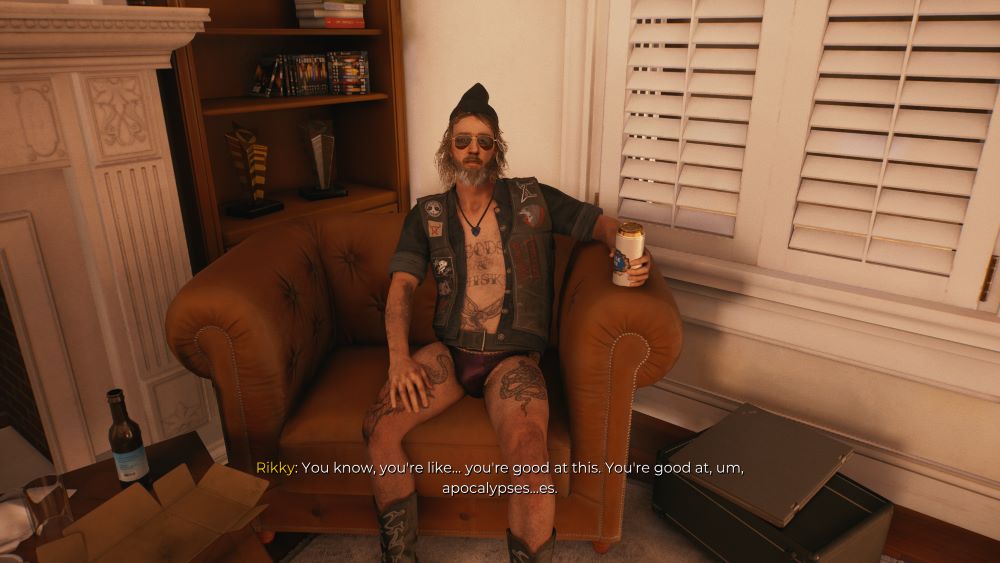
In my first impressions post, I was concerned about the map being cramped, the existence of skull-level enemies that further discouraged what little exploration was possible, and how the emphasis on environmental hazards combined with the first two points led me to focus on carrying around car batteries (etc) instead of weapons. Over time and after gaining levels, the 2nd and 3rd points evaporated on their own. “Hell-A” as a general area though, remained very restricted for the entirety of the game.
What did improve was a rather hilarious (to me) and overpowered strategy to zombie combat: maiming. In most zombie games, attacks to the head are the only way to kill them. That works here too, but the problem is that different zombies walk/run with different gaits, making precise targeting difficult. Missing a Heavy Attack with a spear leaves you very vulnerable to attacks from other zombies, or even the one you’re trying to kill; I’ve been reduced to 25% HP from the flailing of even the most basic of Shamblers, after missing several times in a row. Nevermind the fact that Runner zombies actually can dodge your Heavy Attacks.
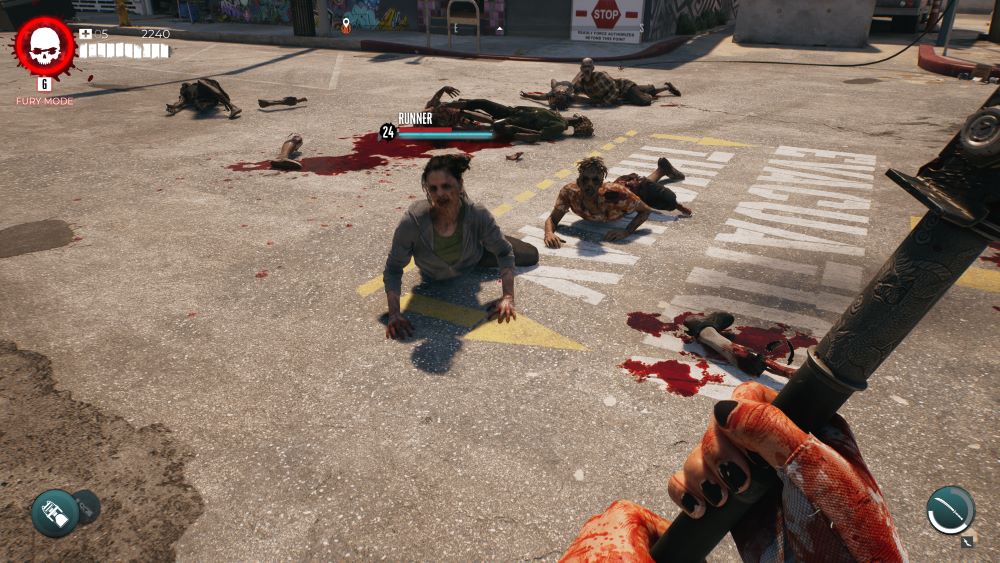
What is considerably easier than landing a head shot is a leg shot. With, say, a Claymore or Katana. With the right Perk Cards and weapon mods selected, limb hits become automatic critical hits that grant buffs to further enhance damage. Some level of which becomes unnecessary as you straight-up chop zombie legs right off with one hit. What happens then? Slowly crawling zombie. At that point, you could cut off one of their arms to instantly kill them – zombies with no arms or no legs will keep attacking, but apparently the coders couldn’t handle half-n-half – or kick them and follow-up with a head stomp for an instant kill that way. Regardless, facing a huge arena full of running undeath and reducing it to a pathetic pile of flopping undeath never stopped being funny to me.
Apex zombies, as you can imagine, didn’t lose their legs as quickly. (Un)fortunately, most of them have attack moves that leave their heads in a static position, making headshots with a hunting rifle quite easy. I’m not sure whether the devs intended you to delete the Apex ones with 2 shots from a rifle and render everything else inert with leg-chopping, but that’s what I did the whole way through.
That’s about all the good things I can say about Dead Island 2.
Yeah, that was good stuff. Everything else was extremely dumb or half-assed, at best.
The Perk Card system has to be one of the worst character progression mechanics I have seen in any game. The premise is that you can mix and match different abilities (cards) based on your play style, but you literally never know what any of the cards are until you unlock (or find!) one, so it’s all just something that… happens. Nothing to look forward to, nothing to build towards, it may as well not have existed. This isn’t even getting into the fact that most of them are incredibly weak or so hyper-focused as to be useless. Literally who gives any shits about making zombies explode in specific ways when you kill them during your “ultimate” mode? Every zombie dies at the same speed by holding down left-click in said mode.
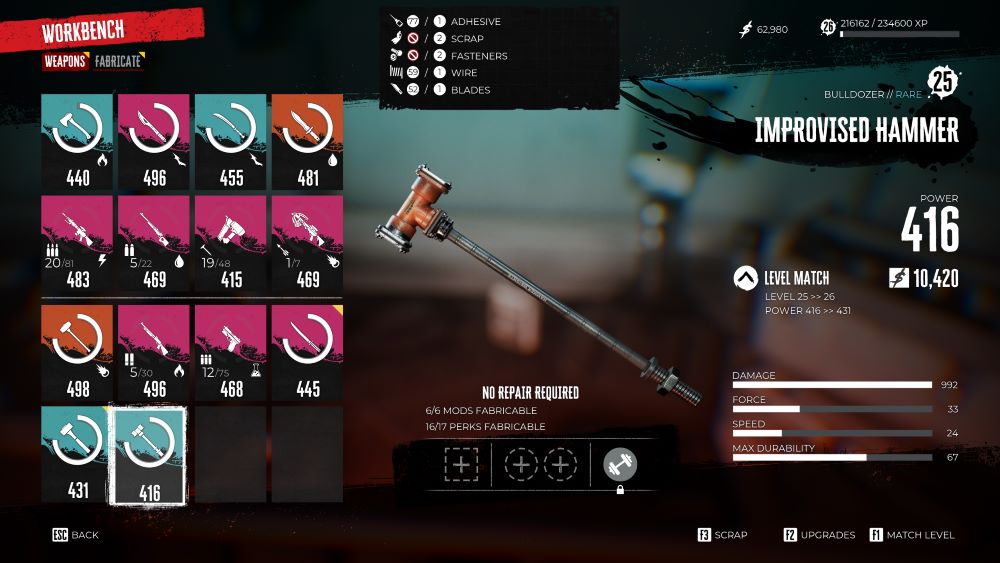
The “economy” of the game and general gear progression is similarly disappointing. I started typing up a long explanation of the mechanics, but it’s irrelevant. Suffice it to say, there is an immense bottleneck for basic crafting components that only gets more and more ridiculous as time goes on. Like, you originally might not be able to add Electric damage to a knife because you don’t have enough Electronics. That’s cool. But when you are in the endgame and can’t mod shit because everything takes 10 Scrap, that’s dumb. Vendors will sell literally 1-2 pieces of Scrap and that’s it. What the fuck is the point? “Disassemble the weapons you pick up instead of selling them.” Let me disassemble this epic worth $7,000 and… oh cool, 6 Scrap. All this encourages is for you to settle on 3-4 weapons and upgrade them (using cash) to match your level, rendering all other drops as vendor trash you don’t bother even trying out because you can’t afford to mod them to see if they are any good.
And don’t get me started on the sidequests. Ran my ass around three different maps reconstructing the dude-bro antics of a thieving pool boy and a goddamn generic-ass blue sword popped out of the chest at the end. I understand that I completed this sidequest later than “immediately once it was available” but after I looked at the Wiki for the others, they were similarly dumb. It’s Dead Island not Fallout, I know, but if you’re designing a Looter Slasher, you might want to actually ensure there’s a reason to do all the chores you set up.
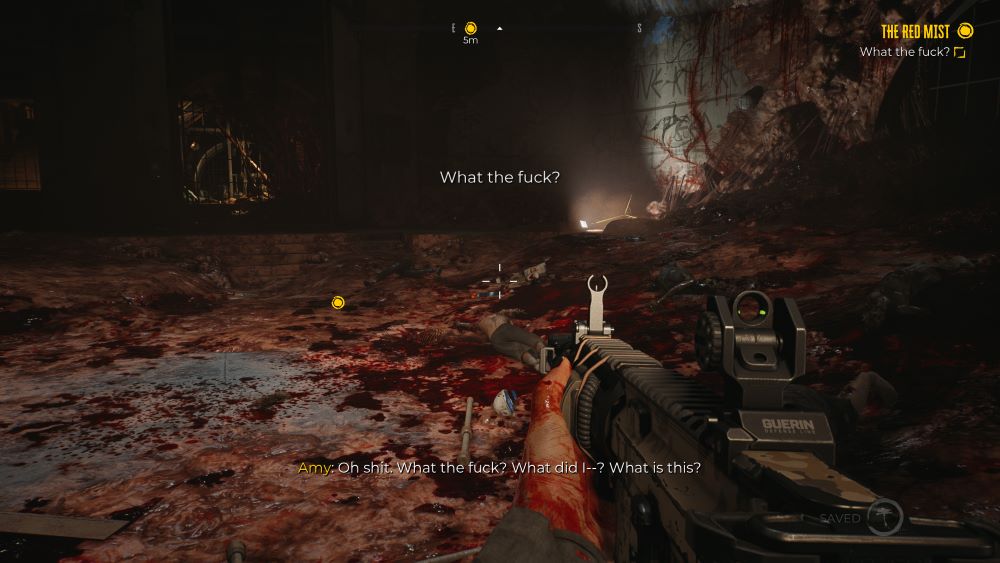
The overall story is also dumb. Again, it’s Dead Island, I’m not expecting some treatise on the human condition. But I don’t know what’s worse: how blatantly they are setting up story resolution in a future DLC (Haus did fuck-all), or that they’re pushing it off into a Dead Island 3. They didn’t leave a story thread dangling, it’s the whole goddamn shirt. This is one of those games where you’re not even sure you did anything at the end.
So… that’s that. Unless you were a super-fan of the original Dead Island, or even if you were, Dead Island 2 is not something I would particularly recommend.
Far Cry 6
I just finished Far Cry 6 after 34 hours. I should have stopped after about four.

As someone who has completed all the prior Far Cry games aside from Primal (got about halfway), there were some interesting twists to the formula in FC6. The game really leaned into the guerilla fighter schtick, wherein you could walk near soldiers without attracting too much attention before unleashing attacks. The wingsuit is unlocked from the start and being airdropped from any fast-travel location – provided you destroyed the anti-aircraft cannon in the area – made navigating the huge island of Yara a bit easier. After a bunch of silent protagonists, we’re back with a chatty psychopath. Also, you can choose to be a male or female Dani, which was also nice.
That said, there are a number of awful twists to the formula that I hope they never repeat.
First, there is really no tangible sense of character progression. Instead of Perks/Skills, all special abilities are wardrobe-based. As in, you open special chests located across the map, and unlock helmets, vests, pants, shoes, and wrists in a predetermined order. Later on, you can purchase specific items out of order to complete your “build,” such as it is. The problem is that 90% of the options are functionally useless, and once you unlock the good ones, there is zero incentive to do anything else or explore.
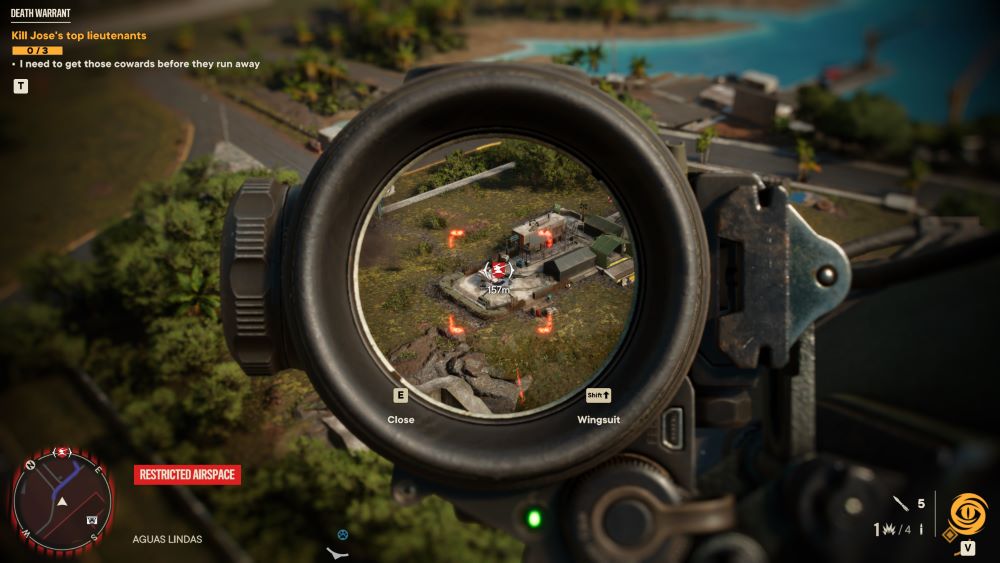
Plus, it’s hard to tell how gamey the designers actually want you to be. For example, equip all the stealth-based clothes to infiltrate the base, but the moment the alarm is raised, pause the game and instantly Sailor Moon transform into your anti-bullet clothes until you jump into a vehicle, where you swap it out again for pants that enable auto-repair. Is that really what they were going for?
There is similar banality in the weapon department. An early mission makes a big deal about the character visually tagging enemies using their cell phone, as it displays the enemy’s weakpoints. Normal soldiers are weak to soft-point bullets, the armored guys to armor-piercing rounds, the poison gas dudes to explosions, and so on. Which is cute, but I’m pretty sure armor-piercing bullets to the face are everyone’s weakness. As it turns out… it’s actually arrows and throwing knives. Yes, some enemies may actually take more than one round to the face with an armor-piercing bullet fired from a .50 caliber sniper rifle, but an arrow from a compound bow or thrown knife will take them down 100% of the time. Which gets real fun when you equip the wrist item that makes throwing knives auto-track targets – curving mid-flight even – allowing you to basically obliterate the army with a flick of your wrist.
I mean, whatever, #GameLogic amirite? It’s just sad when there are 50+ other weapons in the game and none of them are fun or useful despite firing explosive bullets or flaming shotgun shells because the enemy soldiers are resistant to all the damage. Again, did the developers intend you to pause the game mid-firefight and swap your entire arsenal of weapons to counter the one specific soldier you were shooting? It’s dumb. And don’t get me started on the wasted potential of the poison mechanic, where soldiers are supposed to go berserk and shoot each other and be extra weak to explosive damage. Or, you know, just kill them with fewer actual bullets or one arrow/knife.
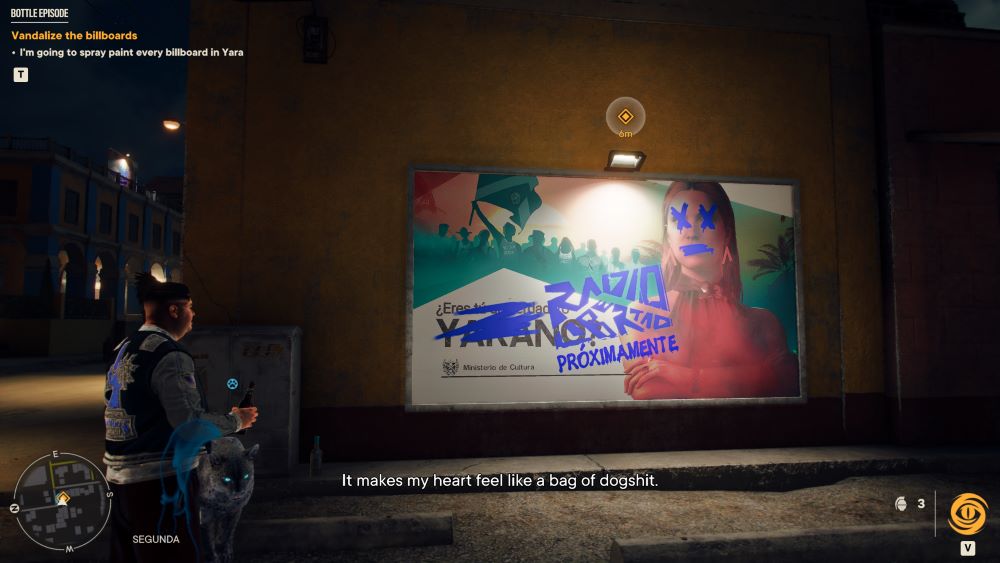
Finally, the overall storyline and antagonists were weak as shit. This is perhaps the most damning bit to a Far Cry game. The story follows Dani as they go from attempted refugee to guerilla mastermind, but there’s a level of Far Cry shenanigans that just never develops. There are three major regions you unite by taking down the Castillo lieutenants stationed there, but only one of them has any personality whatsoever. Castillo himself is played by Giancarlo Esposito, but he must have been charging per line of dialog because he has more screentime on the box art and about as many dimensions.
Oh, and I guess the game is also attempting be Live Service? There’s a mini-game element where you can send out squads to roll dice on completing objectives – complete with XCOM-level success rates in terms of losing 95% rolls – but weirdly the squads take real-time hours to get to the target. There are also weekly Insurgent modes once you clear the campaign and Lola special missions to complete with co-op strangers for some reason. I’m all for designers throwing spaghetti at the wall and being inventive, but the spaghetti has to be, you know, at least partially cooked and hypothetically edible.
Overall, I regret stubbornly sticking to the end. But now it’s over, this post is done, and I won’t be thinking about Far Cry 6 any more.
Warhammer 40K: Mechanicus
I have read descriptions of Warhammer 40K: Mechanicus (Mechanicus) as being a cross between Warhammer 40K and XCOM. The short version? Sure, close enough. The long version? Not at all.
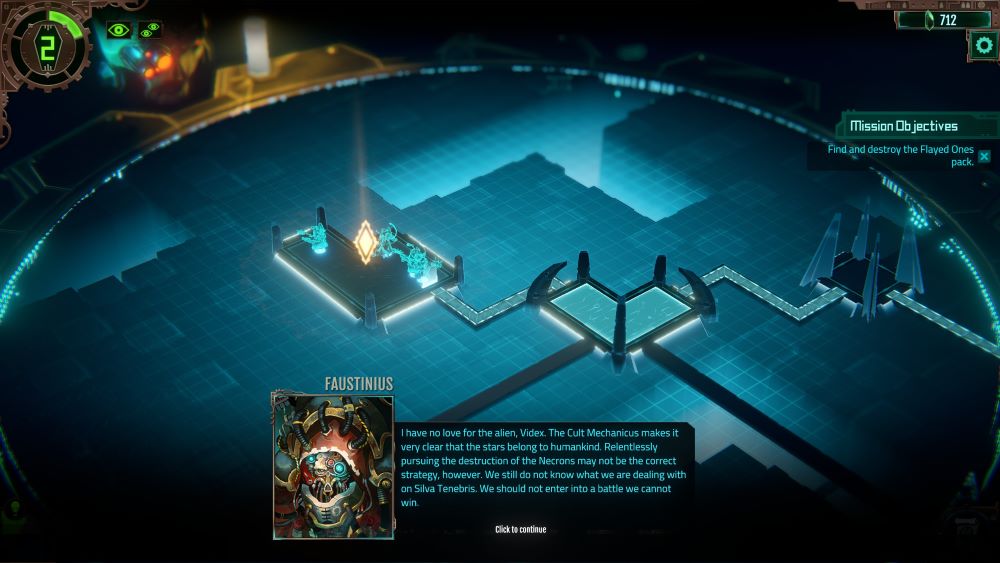
At the base level, Mechanicus is a unit-turn-based RPG set in the Warhammer 40K universe following the Adeptus Mechanicus branch of the Imperium of Mankind. This already sets it apart from the dozens of its licensed peers, who typically follow the overdone Space Marines. I am a general fan of the Warhammer 40K setting, so the implicit lore taking place (and overwrought dialog) were pure bonuses. If you are not similarly inclined, or find the glorification of Imperium problematic, then you may want to sit this one out.
The reason I say this is because the gameplay is rather simplistic. When I think XCOM, I think about cover and missing 95% accuracy shots seven times in a row. In Mechanicus, there is no cover and no accuracy – if you are within range and have Line of Sight, you hit your target. The combat wrinkle is Cognition (Cog): a persistent, spendable team-wide resource needed to fire larger guns and utilize abilities. In the beginning, your primary source of Cog is from the expendable Servitor redshirts you bring along with you to soak up enemy fire. Deploying Servitors costs 1 Cog, but they grant 1 Cog each time they take damage. Enemies that are downed also grant 1 Cog if a Tech-Priest is nearby to extract it. Aside from that, there are usually several structures around the battlefield that grant 1-3 Cog per turn if a Tech-Priest walks nearby, or if they send their Servo-Skulls (drones on a cooldown) to go collect it.
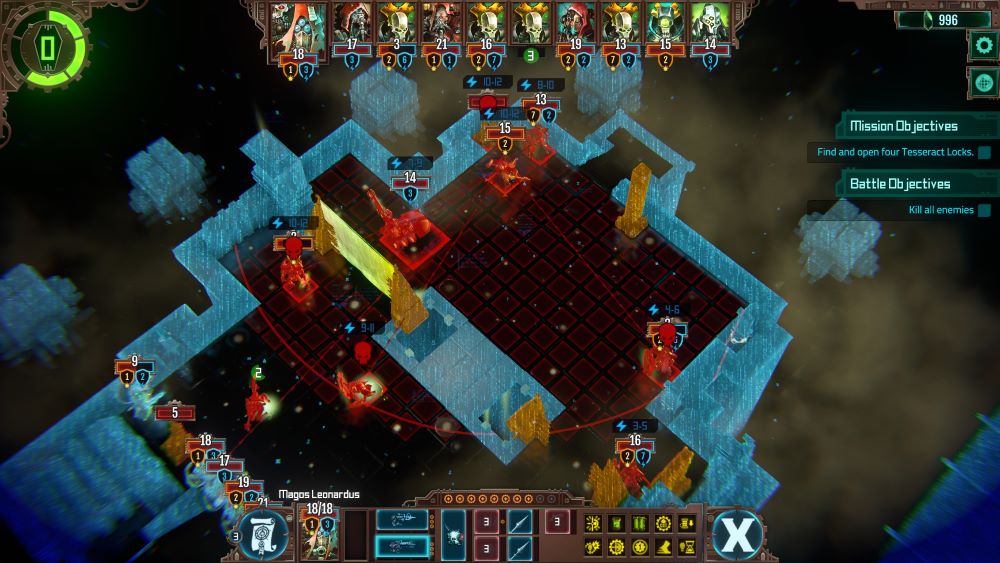
There are technically other tactical considerations. Ranged weapons cannot be used when in melee range, and there is an Attack of Opportunity when you move out of a threatened square. Units can block each others’ Line of Sight. Necron units will come back to life after a few turns unless you spend time attacking their downed forms. There is an Armor system of sorts that reduces the damage from either Physical or Energy attacks by a flat amount. Necron unit HP/Armor is unknown unless they are scanned by Servo-Skulls or attacked with specific weapons that indicate that said info is captured. Spending time to Scan computer consoles will award you more “Blackstone,” which is an upgrade currency for your Tech-Priests.
But honestly? Heading into the mid-game none of that really matters. Once you have figured out a combination of abilities to keep your team loaded with Cog, you can just blast every enemy out of existence with relative impunity. Indeed, it gets amusing once a character or two unlocks the “Immune to Attacks of Opportunity” skill, as it allows you to freely traverse the map. See, your units can move X spaces normally, but they can spend 1 Cog to extend that range another X spaces. And another, and another, as long as you have Cog to spare. Which means one Tech-Priest can run around the map collecting all the Cog from structures as he goes, scanning all the consoles, and then end up where he started with a full Cog gauge, depending on abilities.
One such ability? Fill your entire Cognition gauge, on a 5-turn cooldown.

Outside of combat, you are basically playing a Visual Novel with a series of frustratingly Blind Choices. Decide which icon room to enter next, decide which of three choices to pick, and then act surprised when they are terrible outcomes. Within each mission there is an Awakening Meter that increases for each room you enter, increases per turn of combat, and also depending on the Blind Choices you make. As the meter fills, more Necrons join the fight and otherwise things go more badly for you. Once you successfully complete a mission, the Awakening Meter gets added to your overall Awakening Meter (e.g. 3 Awakening = +3%), which leads to a Game Over at 100% if you haven’t unlocked the final boss yet. There are usually a few ways to reduce the Awakening Meter within a mission, but it’s otherwise a race against time and actively discourages you from exploration. Which is necessary, because your units get god-like pretty quickly if left to their own devices.
Overall, I did have a good time to the tune of 20 hours. Then I played another 8 hours in order to finish the game, which was pure slog. If you picked up Mechanicus as part of a bundle and you can tolerate the Warhammer 40K setting even a little bit, it is worth installing and giving it a whirl. But if your interest starts to wane, go ahead and drop it within guilt. The game stays exactly the same the whole way through, and nothing about the final battle or ending moves the needle.
Citizen Sleeper
I appreciate a game that hits from an unexpected angle, and that’s why I appreciate Citizen Sleeper.
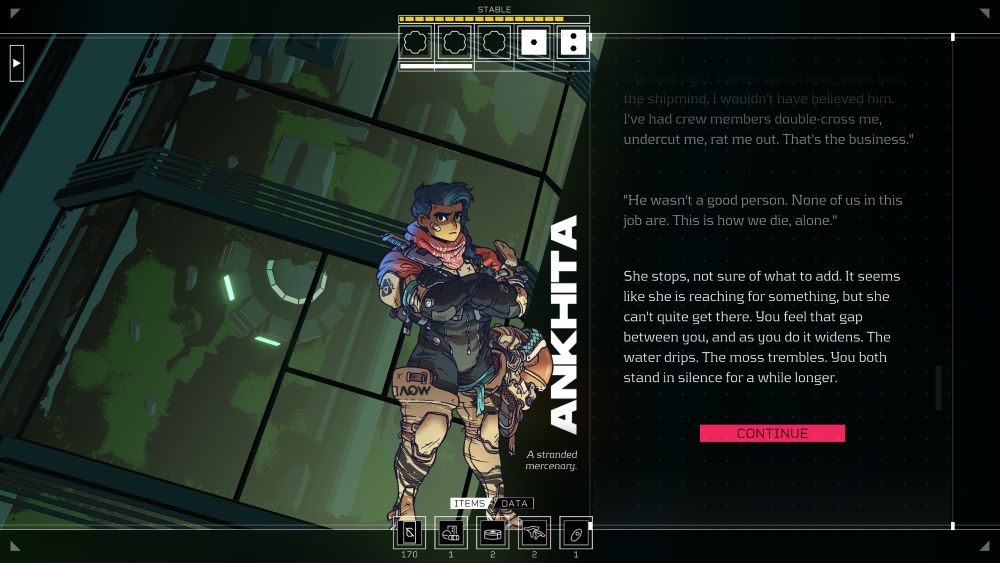
In Citizen Sleeper, you play as a “Sleeper”: an emulated mind in a biomechanical body, desperately fleeing the corporation that owns your total being. You awake in a shipping container, near broken, starving, and alone. Well… not quite alone. The scrapper who found you is hesitant, but allows you to work with him for some meager pay and sleep in the shipping container. From there, you attempt to build what little life you can from whatever you can cobble together.
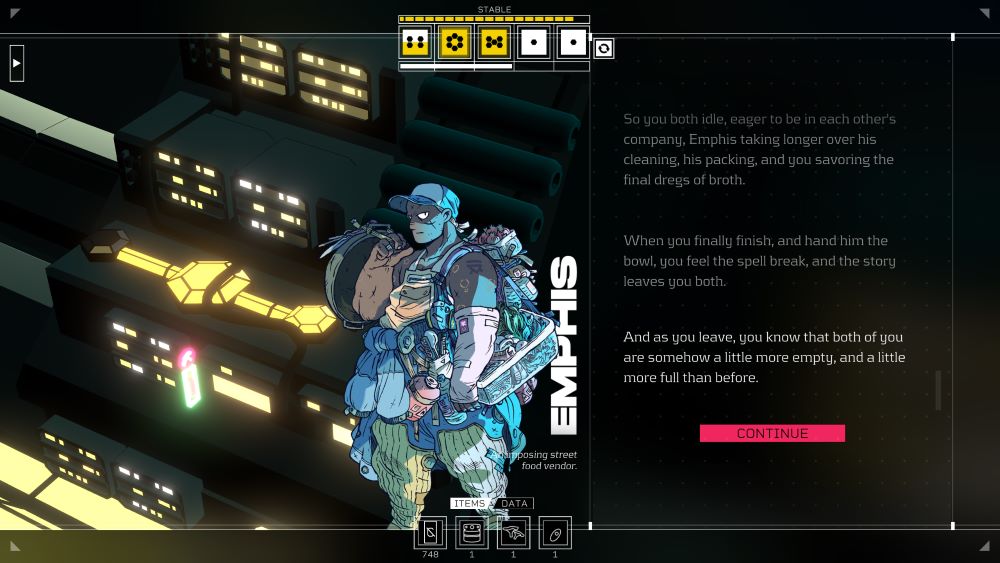
For the most part, the game is essentially a visual novel with some “diceplay” bolted on. Each morning, you roll up to five dice depending on the condition of your body, and then choose what actions to spend those die on. The numbers on the dice you spend correspond to RNG outcomes associated with the actions – a 6 is always a 100% positive outcome, whereas lower numbers can be as poor as 50% neutral/50% negative. In this way, you have some measure of control over actions, even though things are random. However, since your condition dictates how many dice you have in the first place, this is definitely a “rich get richer” slash failure cascade mechanic. Especially considering how you must earn money to purchase food (starving results in condition damage), earn money to purchase the drugs that repairs condition damage (you decay each day), and negative results can sometimes lead directly to condition damage.
If that sounds stressful… that is kind of the point. Probably.
Once you manage to get a toehold somewhere though, the ramshackle space station begins to open up. You can start spending dice on things other than immediate needs. Start socializing at the neighborhood bar. Chat up the noodle vendor. Start helping the mercenary stuck in the docks. Maybe utilize your quasi-AI mind to dive into the abandoned corners of station. Each encounter adds a splash of color to the otherwise bleak setting, both emphasizing how alone everyone is and yet how much a helping hand can change one’s trajectory.
The unexpected hit I got from Citizen Sleeper was the understated poignancy of the many offramp endings. There are quite a few different endings you can focus towards, but the nature of the game sometimes passively (dice rolls) and actively (wait periods) prevents you from just mainlining them. Which leads you to perhaps explore some of the other stories and meet other kindred spirits. And so there I ended up at the precipice of one such ending, a simple Yes away from escaping my fate on the station… and realizing that in so doing I would be abandoning everyone I met. That particular ending was not Good or Bad – you are not a Chosen One, you have no preexisting connection or responsibility to anyone, and the station and its inhabitants would have just grinded on without you.
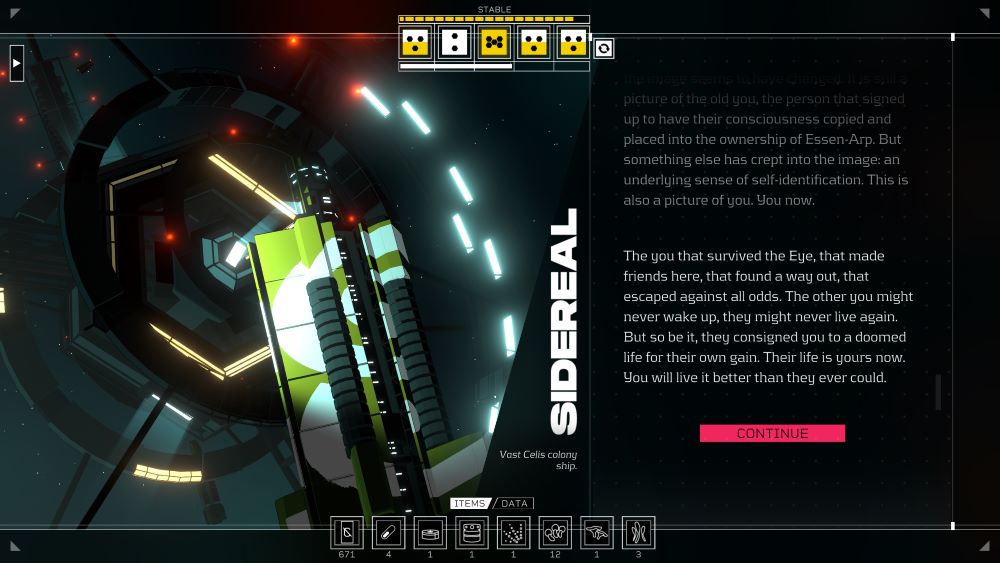
But I was there. I was making a difference for people I could touch. And so I chose to continue doing so.
Now, granted, I also was interested in getting all the various storylines fully maxed out before choosing a preferred ending. Yeah, I optimize even visual novels. HOWEVER! I did actually get a pang of melancholy there, despite the fact that I had copied the save file to a separate location so that I could choose other endings without having the play the game all over again. I never did though. I completed all the storylines and chose to stay behind, until it was time to go with the family I made over the course of the game.
Overall, I recommend giving Citizen Sleeper a try on GamePass.
 In An Age