Category Archives: Review
Review: Fallout 4
Game: Fallout 4
Recommended price: $25
Metacritic Score: 84
Completion Time: 22-100+ hours
Buy If You Like: Fallout 3, FPS Skyrim, Post-apocalypse recycling simulators
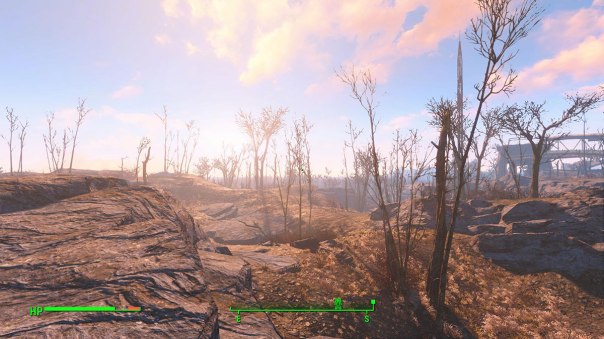
Not your father’s wasteland.
After 95 hours of gameplay, I have come to one conclusion: Fallout 4 is one of the strangest games I have ever played. It is simultaneously brilliant and baffling; moving the franchise forward and pulling it back again; an unfinished and undocumented disaster packed with the most intricate of details.
Like I said: strange.
The main thing to understand right away about Fallout 4 is that it is almost a direct continuation of Fallout 3 (in terms of feel), and not Fallout: New Vegas. While many people say that New Vegas was the pinnacle of the (3D) series – and that may well be the case – it was also developed by an entirely different design team. Fallout 4 is a Bethesda game, not a Obsidian game, and so it has more in common with Skyrim than anything else.
From a gameplay perspective, Fallout 4 is the best that the series has ever been. The gunplay and FPS elements have been refined to the degree that it is now entirely possible to play the game without using the VATS system at all. Indeed, even when using VATS, time no longer freezes, but simply slows down, always keeping the player in the middle of the action. The addition of Legendary enemies (and their assorted loot) keeps enemy encounters relevant and exciting throughout the entire game. Many of the staple monsters in the game have received a conceptual facelift, such that Feral Ghouls, Deathclaws, and even the Sentry Bot feel both “new” and like they should have been that way all along.
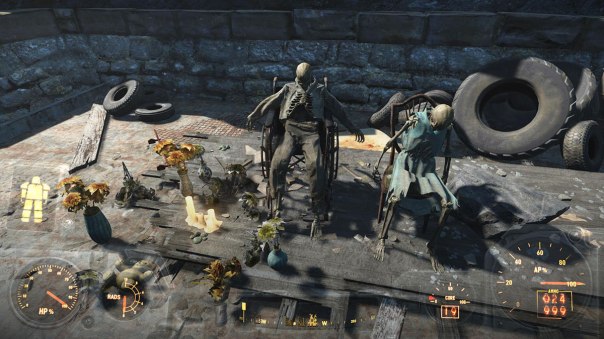
Textless stories.
Then there is the crafting. Oh, the crafting. Every single piece of post-apocalyptic debris is now salvageable into crafting components to support the Settlement-building part of the game, or the gun modding. This one “small” change completely shifts one’s exploration perspective, as now suddenly all the empty rooms you might encounter are full of the priceless treasures that are typewriters, office fans, and aluminum cans. Indeed, this might almost work too well, as it is easy to get distracted with salvaging these things rather than seeking out other, more hidden loot.
By the way, let me just say that Bethesda seriously nailed the ambiance and setting in general. Boston felt like a real (ruined) city, and not just a series of loading screens and skyboxes. Even the surrounding cities and suburbs felt like actual towns. Putting aside their gameplay elements, the addition of Settlements really went a long way in making the wasteland feel populated by real people, rather than simply being trash heaps from which raiders and enemies spawn.
That said… a lot of the rest of the game just feels off.
The Lockpicking and Hacking minigames are back, directly lifted from their original incarnations, unexplained in any real way in-game. Speaking of unexplained, the Settlement system has one of the worst UIs I have ever seen in a videogame. The Perk system overhaul is similarly ugly as sin, giving the illusion of depth but none of the functionality. Perhaps the Skill point system wasn’t all that much better, but at least each level felt like it had tangible progress towards a goal.
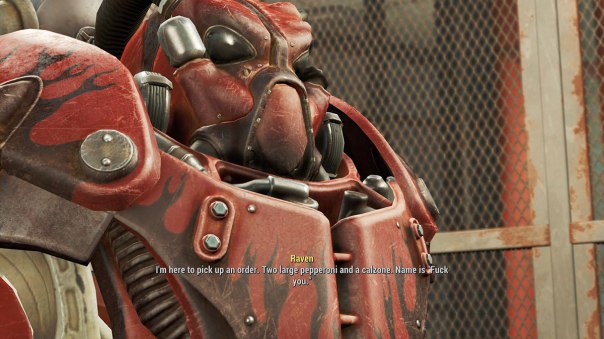
Some lines are okay.
The voice-acting is extremely good, but the dialog itself (and the choices given) all seem rather bad. Indeed, this was the first Fallout game I have played in which the main story quest felt inconsequential, incomplete. Several times I had to look up what the main quest even was, as the “find your son” narrative receded into the background radiation of the wasteland.
All told, I played Fallout 4 for 95 hours and still ended up skipping a tremendous amount of the game. In all that time, I never got around to doing any quests for the Brotherhood of Steel, or visiting Salem, or even really poking around the bottom-right part of the map. There is so much more that can be done… and I’m unlikely to muster the drive to see it through. Does this indicate the game is deficient in some (many) ways? Perhaps. On the other hand, what right do I really have to complain about a game that generated 95 hours of entertainment?
The bottom line is that Fallout 4 is a game worth playing, whether you are a fan of the series or if this is your first Fallout title. I don’t think Fallout 4 is possible to become anyone’s favorite game, but there is more here than in 99% of the other games you could be playing.
Review: The Witcher 3
Game: The Witcher 3
Recommended price: $15
Metacritic Score: 94
Completion Time: ~68 hours
Buy If You Like: Medieval fantasy immersion, witty dialog, terrible game design

Things will get muddled all right.
Having finally seen the ending credits after 68 hours of gameplay, I can now officially conclude that the Witcher 3 (TW3) is the worst best game I have played. That is not a typo. The typo is TW3 receiving a 94 Metacritic rating from the gaming press that spends more time praising TW3’s visual novel bits than the actual gaming bits – which are not only bad, but actively depress the few parts of TW3’s muted brilliance.
If I had to point to one particular quality that the Witcher series as a whole has nailed down better than any other game, it would be Immersion. This series has always excelled in conjuring a dark (but not grimdark) medieval fantasy zeitgeist, and it is as true in TW3 as the others. Isolated villages feel isolated; muck-covered peasants cough with believable phlegm; people are petty, cross, and rather accustomed to living as though they could be killed by monsters at any moment.
In a word, TW3 is authentic.
This authenticity more or less carries over to the questing elements of the game. Gone are the “kill 20 drowners” garbage quests from TW2. Indeed, there is a developer interview floating around out there that states the team was basically tasked with coming up with quest ideas first, before anything else. This ends up making them feel more like distinct, mini-novellas than the side quests one might be accustomed to in other RPGs.
This distinctiveness has a double-edge however, and the full weight of all the other poorly designed systems causes the blade to backbite deep.

Psst… he’s talking about this sword.
For example, the overarching plot and impetus to action in TW3 is for Geralt to find Ciri before the Wild Hunt does so. As you might imagine, Ciri and the Wild Hunt always feel one step ahead of you – it would be a rather odd game indeed if she was found in the first place you looked. But the issue is that in your search for Ciri, the people with the information you need always have problems of their own… problems that you must solve for them before they divulge that Ciri has been gone for weeks. And those problems have sub-problems, sometimes nested four-deep. And in the course of solving those nested problems, you will encounter hundreds of entirely meaty side quests that have nothing to do with Ciri at all.
In any normal game, the Take Your Time trope that this turns into would be just whatever. But TW3 is not “just whatever,” it is a game that has to leverage its immersion for full effect – an effect that evaporates into the mists once you realize that you just spent 20 hours doing random shit that doesn’t matter in finding Ciri. Why create this huge open-world map to explore when the central plot is a supposed race against time? When you stop taking the central plot seriously, even the “meaningful” side-quests start sounding hollow; the writing tries to make you feel something about the world, while cheapening it at the same time by simply existing.
Every other thing about the game just gets worse from that baseline.
I could spend hours on how poorly designed everything is about TW3’s core systems – and who knows, I still might – but I feel the root revolves around the gutted crafting system. In prior titles, you collected all the things because you needed all the things to keep stocked on potions, oils, bombs, and so on. In TW3, you only have to craft a given item once, to essentially unlock unlimited amounts of them; crafting Swallow (the ever-useful health regen potion) might only give you 3/3 uses, but an hour meditating restocks all consumables. This has tremendous cascade effect on the rest of the game systems.
Using Swallow as an example again, the recipe calls for one Dwarven Stout, one Drowner Brain, and five Celadine (a plant). Craft it once, and you’ll have unlimited Swallow potions. There are upgrades to potions and bombs and such, but… do you know how much Celadine you’re going to ever need? Thirty (30). That’s enough plant material to craft every single thing in TW3 that requires Celadine. Drowner Brain? Six (6). Do you have any idea how many Drowner brains you’re going to accumulate throughout TW3? A fucking million. And every one of them after the first six are going to be useless.

Okay, fine, it’s a damn pretty game.
As you might imagine, needing only a tiny fraction of items you loot to gain immense power essentially makes looting pointless. At least, if not for the fact that TW3 also has random loot. Not just random loot, but unbounded random loot, such that you can find a level 20+ sword recipe in a burlap sack at level 3. Or never find it at all anywhere. There are some sanity checks involved regarding actual gear, but ingredients are all over the place.
What gets me the most is how much this affected my own sense of immersion. There were a lot of things wrong with the first Witcher game, but the convoluted Alchemy system felt right in the setting. You were in a dirty medieval world, crushing flower petals to combine various elements together to create a potion that was pure poison to a normal, non-mutated man. You had to keep collecting herbs and monster organs because otherwise you wouldn’t be powerful enough to survive the next encounter. That kind of system has a positive feedback loop with immersion. The one in TW3? It is a negative feedback loop. One and done, everything else is trash.
Then there is the combat itself, which is similarly streamlined dumbed-down. Left-click to light attack, Shift-left-click for strong attack, right-click to parry, Alt to half-dodge and Spacebar to full dodge. Use Signs and Bombs and whatever as you need them. At the 3rd-highest difficulty, combat was always a snooze-fest even if I died; a level 12 Drowner took out my level 22 Witcher in 5-6 hits because I got too lazy to time Alt correctly. Having to pay attention is usually a hallmark of an engaging, difficult combat system, but it simply isn’t in TW3’s case. It is more that actually paying attention and being careful makes TW3 combat a joke; it is only hard precisely when you’re trying to speed through it because you want to be done.
Don’t get me started on the talent trees and Rune systems. They’re bad, whoever designed them is bad, and every single person who allowed them to occur should feel bad. Seriously, after you spend 20 talent points in the Signs tree, the entire 3rd row of talents you unlock is… +5% Sign Intensity for a given Sign. The first two rows granted new abilities and effects to your normal Signs and you follow-up with +5% to an incomprehensible stat? And that’s exactly what all those precious Rune slots in weapons and armor are: +2% chance to stun, +3% Igni Intensity, and similar garbage. It’s like the designers aren’t even trying.
At the end of the day, the people out there praising this game are praising the Telltale Presents: the Witcher 3 story. From a game mechanics standpoint, this is one of the worst designed games I have played. It’s not clunky, it just works against all of the strengths that the game otherwise brings to the table. In other words, the worst best game I have ever played.
Anime Review: My Little Monster, Your Lie in April, Plastic Memories
My Little Monster
Episodes: 1-13
Genre: High School, Romance, Comedy

My Little Monster is a charming and sometimes ridiculous romantic high school comedy focusing on the evolving relationship between Mizutani Shizuku, a girl who wants nothing more than to study and be alone, and Yoshida Haru, the namesake “monster” who ends up turning her peaceful life upside down. Both social outcasts, once Haru encounters Shizuku and immediately declares his love, Shizuku is left trying to salvage her grades and worldview from a boy who doesn’t even really seem to know what love is.
There isn’t much else I can say about this anime other than I enjoyed it. The show was entertaining to watch and still relatively satisfying even though it never really comes to a cathartic conclusion.
Your Lie in April
Episodes: 1-22
Genre: Drama, Romance, Junior High, Music

Your Lie in April is… well, as beautiful as it is devastating.
It follows the life of Arima Kousei, a Junior High school piano prodigy who has been living life in monotone. Following the death of his abusive, piano-instructing mother, Kousei can no longer hear the notes he plays, and thus has abandoned the craft for the past two years. Forcibly introduced to Miyazono Kaori one evening during a friend’s double-date, the boisterous and free-spirited Kaori begins to reignites his world with color.
Almost every single element of this anime is brilliant and well-executed. The art direction is amazing, including how the designers incorporated Kousei’s monotone worldview into the actual color-scheme, while gradually having Kaori’s vibrantness bleed through. Then there’s the music, which forms the basis around which the plot pivots. While I already liked some classical piano pieces, in the context of this show I began to appreciate them on a higher level. Then there is the devastating emotional payload, which reminds me of why I watch these sort of things in the first place: to feel something. And it succeeds in doing so.
In short, Your Lie in April has, to my own surprise even, become one of the best anime I have ever watched. It’s sad, it’s beautiful, it’s fantastic.
Plastic Memories
Episodes: 1-13
Genre: Sci-Fi, Drama, Devastating Emotional Payloads

Plastic Memories is a pseudo-Sci-Fi anime that follows the life of Tsukasa Mizugaki as he joins the Terminal Service Department of SAI Corp, and attempts to get along with his partner Isla. This particular department is responsible for the removal of the family androids who are approaching the end of their seven-year lifespans. What follows in this short, half-season anime is a series of devastating emotional payloads that, despite seeing them coming from a mile away, you nevertheless get destroyed by. Or maybe that was just me.
The closest analog to this anime would be Anohana: the Flower We Saw that Day, in the sense that the premise itself is sad, but you continue to get absorbed by the narrative and how exactly things will play out. You see the knife coming, but you still yearn to feel it twist. And in that regard, Plastic Memories does so with particular vigor. In spite of this, I came away from this catharsis with a greater appreciation of the relationships one can form, even if they prove to be temporary.
After all, that is exactly what everything is.
Anime Reviews: Mitsudome, Cross Game, SCHOOL-LIVE!
Mitsudomoe
Episodes: 1-13 (S1), 1-8 (S2)
Genre: Comedy, Slice of Life

Mitsudomoe is a risque comedy slice-of-life that ends up a combination of Azumanga Daioh and Kodomo no Jikan. It mostly follows the misadventures of the Marui triplets as they (intentionally or not) torment their 6th grade teacher and classmates with rampant misunderstandings, usually of a suggestive nature. For example, in an early episode they end up officially naming the class hamster… Nipples. Hilarity ensures.
In truth, how much of the humor actually gets a reaction out of you will depend on your willingness to let the show do what it does. I compared the show to Azumanga Daioh and Kodomo no Jikan, but both of those shows are far, far superior to Mitsudomoe as they have a sense of progression and deeper meaning underlying the jokes. Mitsudomoe? It’s basic, frivolous comedy. Don’t get me wrong, as I found the show quite funny. But if you aren’t looking for 24 minutes of 6th grade humor and panty jokes, you can keep on looking elsewhere.
For the record, there is a 2nd 8-episode season of this show, but it really felt like the entire second season consisted of jokes cut from season 1 for not being funny enough. Unless you are some kind of masochistic completionist (like I can sometimes be), feel free to skip it.
Cross Game
Episodes: 1-50
Genre: Sports, High School, Drama
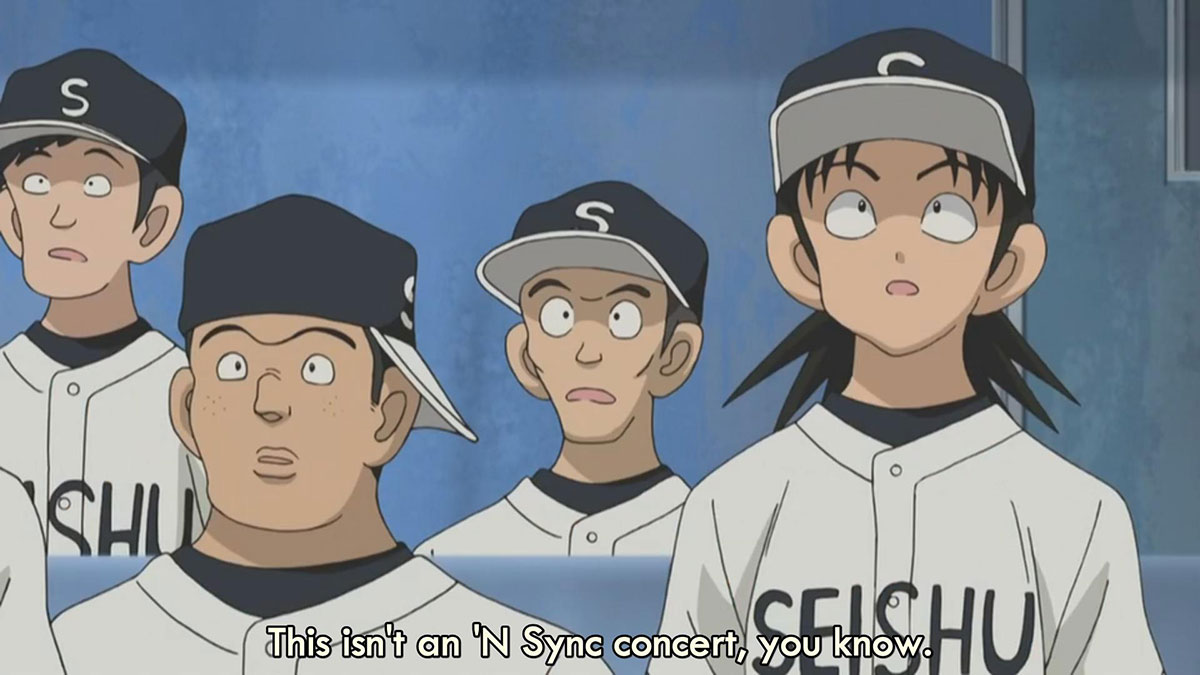
Cross Game is an old-school-looking, baseball-themed anime centered around Ko Kitamura, the Tsukishima sisters who live nearby, and the struggle of growing up with loss.
In truth, it is difficult for me to really summarize Cross Game, for one specific reason: the anime is 50 episodes long. This is not to suggest that the show was boring or had any particular amount of filler – indeed, I sat down and watched 20 episodes in a row one evening – but rather its ultimate theme takes form over such a distance as to make the thematic transition gradual. Which, in a way, is noteworthy on its own; this is an anime of small gestures, long silences, poignant looks, and accumulated experiences. The character progression feels completely natural, and there is ample time to grow acquainted with just about every character.
At the same time, I could not help but feel like the anime would have been more impactful had it been, say, 26 episodes. Or even less. Indeed, what I keep circling back on in my head is how shows like Your Lie in April or Plastic Memories or Anahona can in 13 episodes deliver an emotional payload on a greater scale than Cross Game does in 50. The relationships in Cross Game are “thicker” with the sheer volume of experiences, but… I dunno.
Ultimately, whether Cross Game is worth your time is going to need to be a call you make yourself. You do not need to be a baseball fan to watch the show (I’m not into sports), but you do need to be prepared to buckle down for the long haul. It will be a satisfying journey if you aren’t in a hurry.
SCHOOL-LIVE!
Episodes: 1-12
Genre: High School, Drama, [spoilers]

Holy shit, you guys.
I almost don’t want to write a review for this anime at all, as the best way to watch it is to go in completely blind, as I did. So this will be your first chance to stop reading and go watch it yourself without getting spoiled in any way.
…Continue?
The basic premise of School-Live is that a group of four high school girls have started a club with their teacher adviser called the School Life Club. In this club, the rules are that they are not allowed to leave the school building, and otherwise have to stay on school grounds. The anime follows their everyday life in this club, the various activities they get into, and the struggles they have with classmates, and adapting to living in the school building.
…
Last chance to stop.

…
The huge, mind-blowing juxtaposition this show presents is that all of this occurs after the zombie apocalypse. I literally almost turned the show off before the end of the first episode, as it seemed just another goofy high school comedy. As it turns out, the “narrator” of that first episode, Yuki Takeya, has completely blocked out the mental trauma of seeing everyone she liked die during the fall of the city, and thus sees everything as “normal.” So Yuki goes to class and sees a normal classroom, whereas in reality it is an empty room littered with blood, broken glass, and other debris.
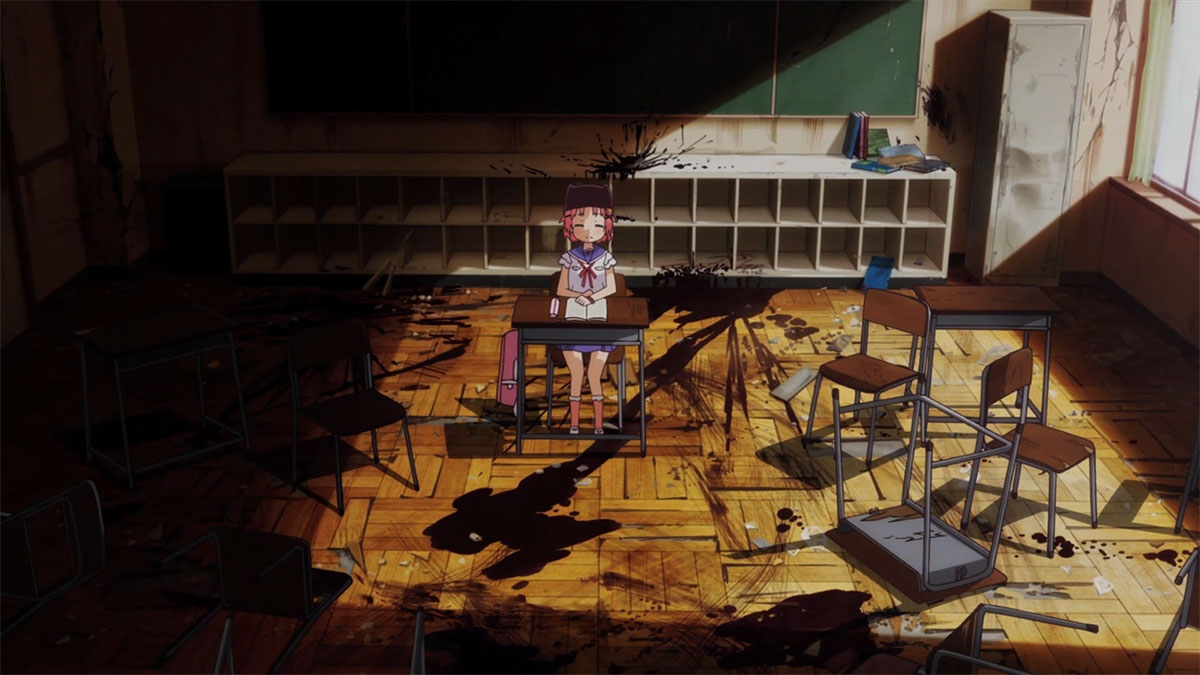
And the most amazing thing about School-Live! is how it plays all this straight. These are not girls with magical powers, unlimited ammo, or even particularly strong constitutions. The only real weapon they have is a shovel, and only one of them is strong enough to even use it. They are simply trying to survive on the upper floors of their school, while Yuki inadvertently keeps their spirits up by suggesting club activities as if everything was fine. And in so doing so… it somehow is.
As stated the juxtaposition is the best part of School-Live! After the first episode reveal, the title sequence changes to reflect reality (and continues to change as a foreshadowing mechanism), but the cute anime style stays the same. By “cute” I do not mean that School-Live! avoids sucker-punching you in the throat on occasion (especially towards the end), but rather the style remains consistent throughout. These characters could be air-dropped, personalities and all, into any other anime and perfectly fit in. But they still work beautifully and devastatingly here as well.
In short, this show is worth your time. It might not change your life, but it will make you feel something.
Anime Reviews: Steins;Gate, Toradora!
Steins;Gate
Episodes: 1-24
Genre: Sci-Fi, Near Future, Drama

Steins;Gate is a gripping, emotional drama that also reminds me of why I hate time travel as a narrative mechanic so much. The anime follows the eccentric teenage “mad scientist” Rintaro Okabe and his two friends/Lab Members as they spend their days fighting the “Organization” and otherwise goofing around with gadgets. After going to a conference on Time Travel, Okabe encounters a woman stabbed and lying in a pool of blood. Shaken, he texts his friend about the incident while the Phone Microwave gadget was running… and his text arrives 5 days in the past, changing the future.
What is brilliant about this anime is exactly what I dislike about the conceptual narrative. The first half of the anime explores the nature and limitations of the “D-Mail” system – the ability to send a phone text to someone in the past – and each successful D-Mail permanently changes the world and resets everyone’s memories to match it… other than Okabe, who remembers everything. Later on, the anime darkens considerably once Okabe realizes the butterfly effects of all these changes and the seemingly inevitable future it portends. And that is the rub. Each time the world is changed, everything that happened previously ceases to be. Okabe (and you) remember that other world, but it’s irrelevant in a practical sense, erasing huge swaths of continuity and character development.
Make no mistake, Steins;Gate is a superb, shocking, draining anime and by far the best version of Time Travel I have encountered in fiction. I still hate Time Travel as a narrative mechanic though, and my attachment to the characters of Steins;Gate and their sacrifices (which are erased) only deepens my antipathy for it.
But if you have no issue with Time Travel? You should see this anime yesterday.
Toradora!
Episodes: 1-25
Genre: High school romantic comedy

In a nutshell, Toradora is a high school romantic comedy with enough dramatic elements and interesting characters to set it apart from what otherwise amounts to another entry in the busiest anime genre of all time. The show follows Ryuji, a high schooler who looks like a delinquent but is actually fairly sensitive and domestic, and his new neighbor Taiga, the short “palm-top tiger” with an even shorter temper. Once the two of them realize that they have crushes on the other’s best friend, they set differences aside while trying to set the other up with their crush. As you might expect, misadventures and misunderstandings abound.
Overall, I really enjoyed Toradora to the tune of crushing all 25 episodes across two days. As mentioned, there is enough drama and emotional scenes to set the anime apart from its peers, if the quirky characters did not do so already. And most importantly? There is actually catharsis by the end; this is no harem comedy in which nothing is resolved by the final credits.
Review: Metal Gear Solid 5
Game: Metal Gear Solid 5: the Phantom Pain
Recommended price: $35
Metacritic Score: 96
Completion Time: 50+ hours
Buy If You Like: Metal Gear Solid, Hideo Kojima, 3rd-person Far Cry
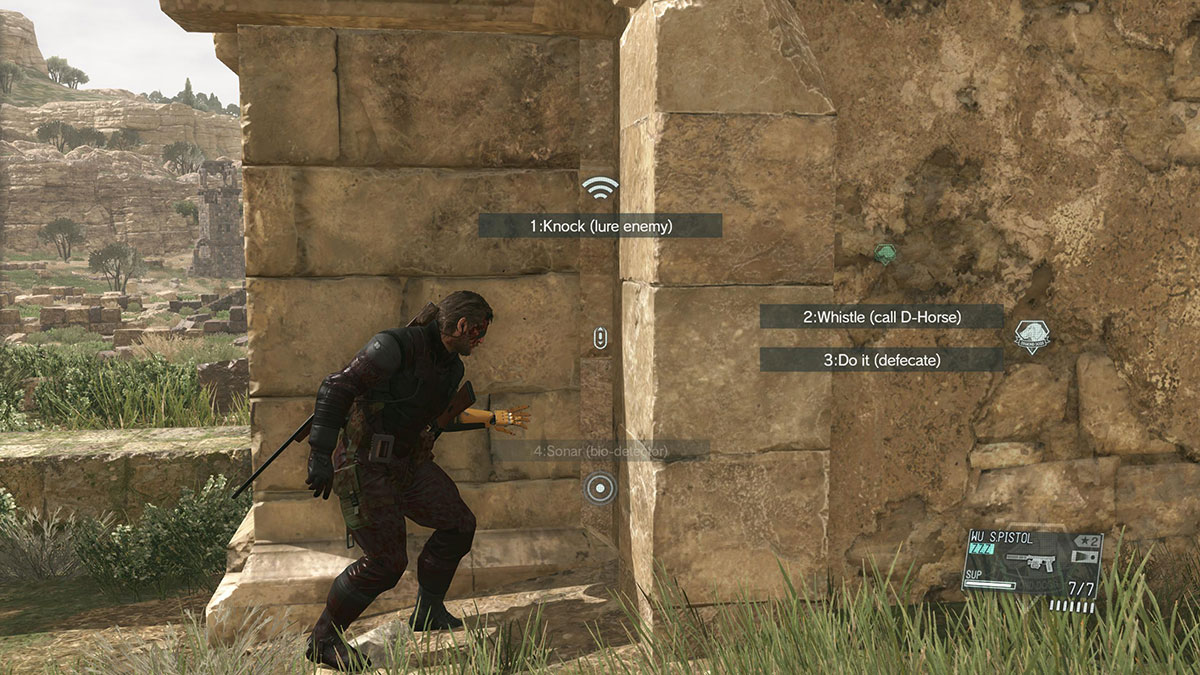
A serious game for serious people.
Metal Gear Solid 5 is one of the most engaging games I have ever played. The completion time up there is a general estimate, but I personally clocked in 75 hours before I reached the end. The core gameplay loop is incredibly tight, the visuals (with a GTX 970) are impossibly fantastic, and never before I have felt like such a badass, one-man infiltration army.
At the same time, I can empathize with those who feel this Kojima swan-song is the weakest entry in the Metal Gear Solid franchise. Or simply an incomplete game.
As you will undoubtedly see in the weeks and months to come, a lot of people were incredibly disappointed with… let’s just say Chapter 2. The “first Chapter” comprises what felt like was the entire game – it is almost an entirely self-contained 40+ hour narrative, with a capstone boss battle and rolling end credits. When I saw “Chapter 2” flash on the screen afterwards, I was legitimately surprised. “What?! There’s more? Wow!”
What becomes immediately clear across the half-dozen or so story missions though, is that Chapter 2 is more Epilogue than anything. Or, if I’m being honest, a desperate last-ditch attempt by Kojima to throw in plot material he wasn’t able to work into the main narrative before the release deadline. Which is really a goddamn shame, because Chapter 2 has some of the most emotional missions in the entire game.
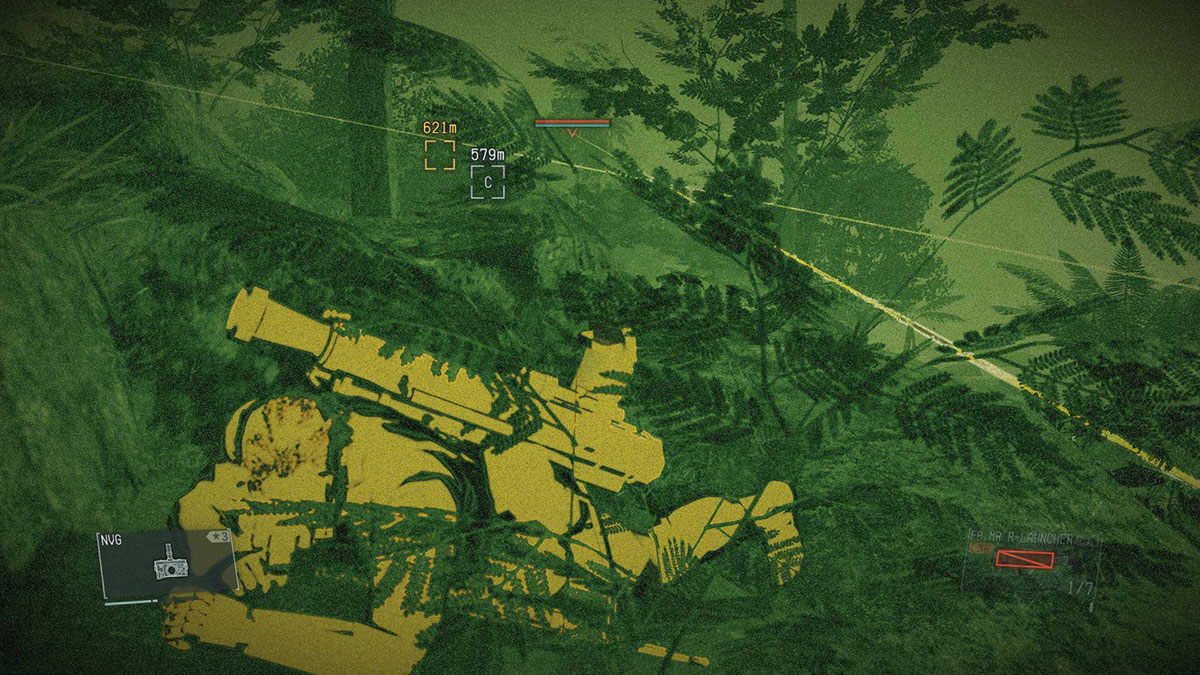
The boss battles were a little weak, but no different than the other games IMO.
I am mentioning all of this at the beginning because it’s important to ask yourself what kind of gamer you are. If you are a diehard MGS/Kojima fan who bought into the trailer hype, you’ve memorized the lore, and are looking forward to having this 5th (and presumably last) game wrap everything up in a manner consistent with the other games… you will be disappointed.
The spectacle is there. The ridiculous plot points are there. The zany scope is there. What’s missing is at least one critical story mission (which was included as a video in the Collector’s Edition, but can also be viewed on Youtube) and some filler missions to coherently link together what exists in Chapter 2. This isn’t like the end of MGS 2 where you’re wondering what the hell just happened, or the 2nd disc of Xenogears when the team apparently ran out of money. The Chapter 2 missions feel like they were created first, and awaiting a context in which to place them later, but it never arrived.
Indeed, they are missions that in all likelihood should have been cut out altogether, until and unless they could be finished as DLC.
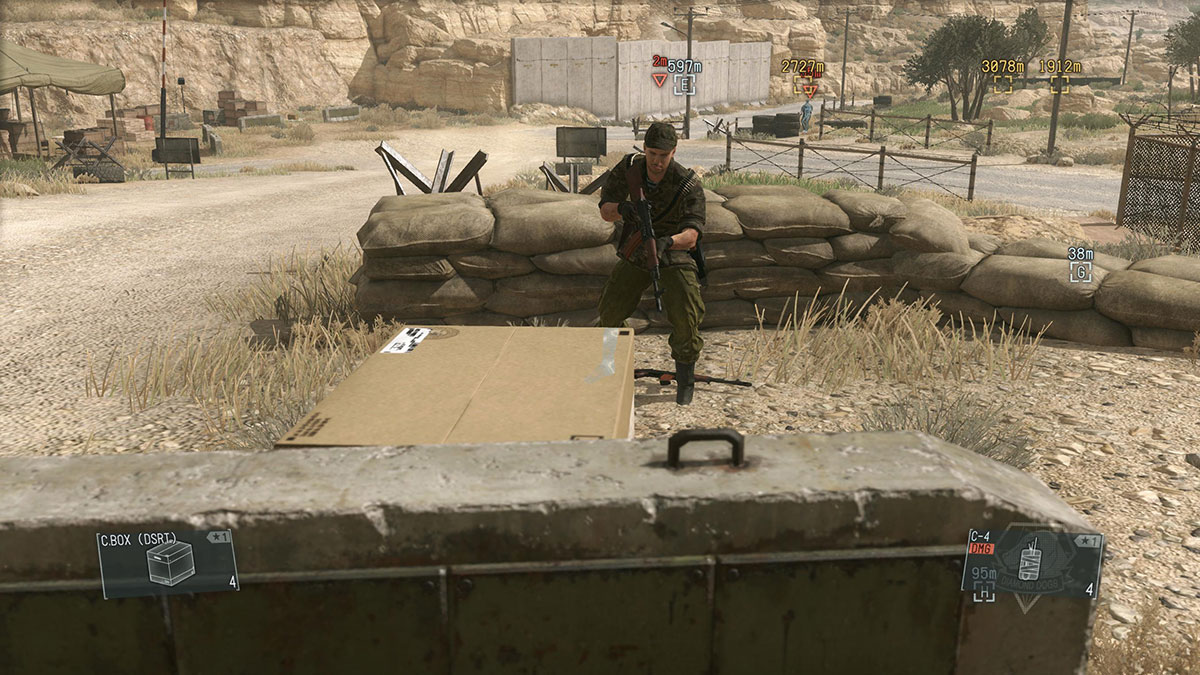
What’s in the booooox?
On the other hand, if you are a gamer capable of enjoying a game for what it is, or otherwise have few expectations coming in, MGS 5 is going to blow your mind.
As I mentioned before, the core gameplay loop is incredibly tight. You might be tasked with rescuing a prisoner for example, but are otherwise left to your own devices (literally) as for how to accomplish that. Binoculars will tag enemies and allow you to track their movements through walls, so scouting is encouraged. Mother Base is always in need for more and better-skilled recruits, so tranquilizing and extracting enemies soldiers is encouraged. If you manage to get in close-quarters with the enemy, you can interrogate him into telling you where prisoners and resources are located, so getting real close to enemies is encouraged. It is a hell of a lot easier to do all of those things when the entire base isn’t trying to kill you, so stealth is encouraged.
Note how all of this is “encouraged” as opposed to being required. You can absolutely run and gun your way to S-rank level completion if that’s how you want to play. Or, you know, if someone raises the alarm when you’re 80% done with the mission every goddamn time and you can’t be asked to reset it yet again.
There have been some complaints for how much of the story was relegated to cassette tapes. As someone who attempted to complete MGS 4 before the release of this game, all I can say is: thank Christ. Having the plot mechanics tied to cassette tapes instead of the Codec system allows the player to A) listen to them at their leisure, including while on Side Missions, and B) opens up the ability to hear historical information, including conversations in which Big Boss was not present. Removing the Codec system might have contributed to the looser overall narrative of the game, but honestly I’d take that over the awkward, rambling Codecs of titles past.
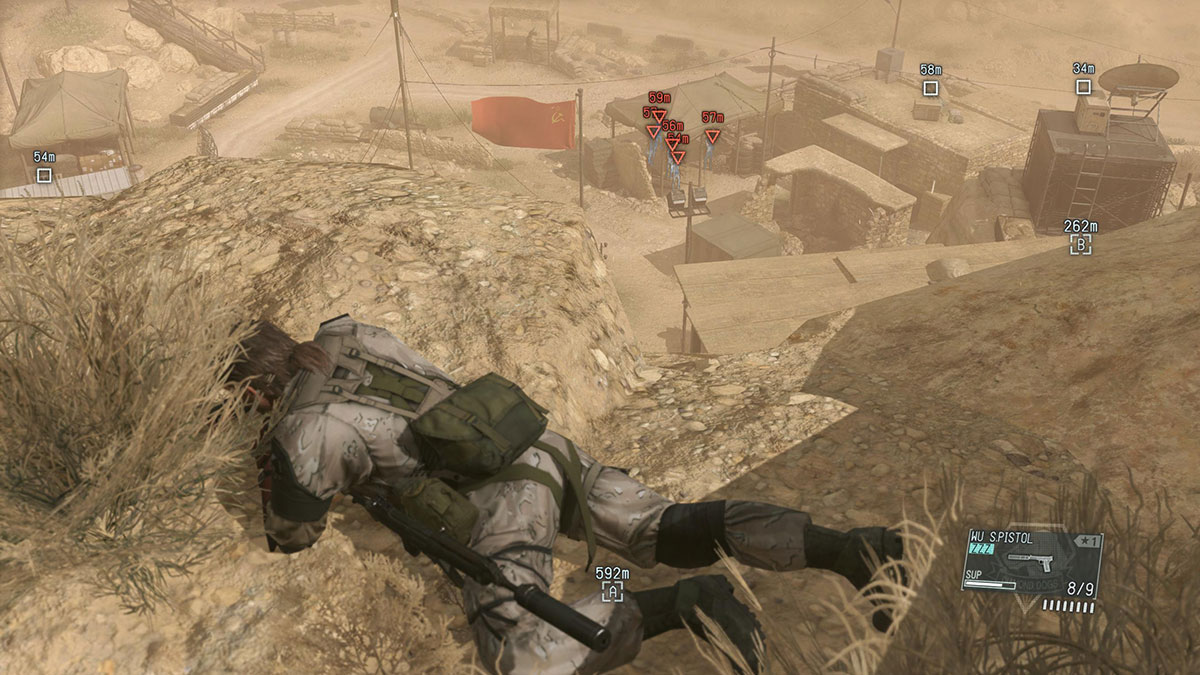
Perfect grenade opportunity: ruined.
Since I played this on the PC, I just want to take a moment to talk about my experience playing exclusively with the mouse & keyboard. For the most part, it worked well. The two specific issues you will encounter is with sneaking and throwing grenades. The default crouch speed is fast enough that guards can hear you with 5-10 meters, unless you hold down Ctrl, which is agonizingly slow; with a controller analog stick, you would be able to hit a sweet spot between the two speeds while remaining undetectable. That said, you can unlock a Sneaking Suit fairly early on that will allow you to move around a maximum Crouch speed with no issue. With grenades, there is an overhand and underhand throw option, supposedly determined by tapping the left-mouse button versus holding it down. After having enough perfect grenading opportunities foiled by this finicky detection system, I resorted to overhand throws always.
There are some additional mouse & keyboard unfriendliness in the many menus – mouse scroll doesn’t work, you need to press 1 & 3 to navigate menus, etc – but it’s not disruptive enough to forgo mouse aiming IMO.
In the final analysis, a day or two removed from the end of the game, I still feel like Metal Gear Solid 5 is an incredible experience. There are people out there with completely legitimate grievances with the game, both mechanically and narratively, and I empathize with them. At the same time, I feel less that MGS 5 “doesn’t fit in” with the rest of the series and more that the rest of the series would have been better off being more like MGS 5. You know, minus the rushed, unfinished nature of Chapter 2.
Review: Prototype
[Blaugust Day 23]
Game: Prototype
Recommended price: bundle
Metacritic Score: 79
Completion Time: ~13 hours
Buy If You Like: GTA Supervillain, Collateral damage simulators
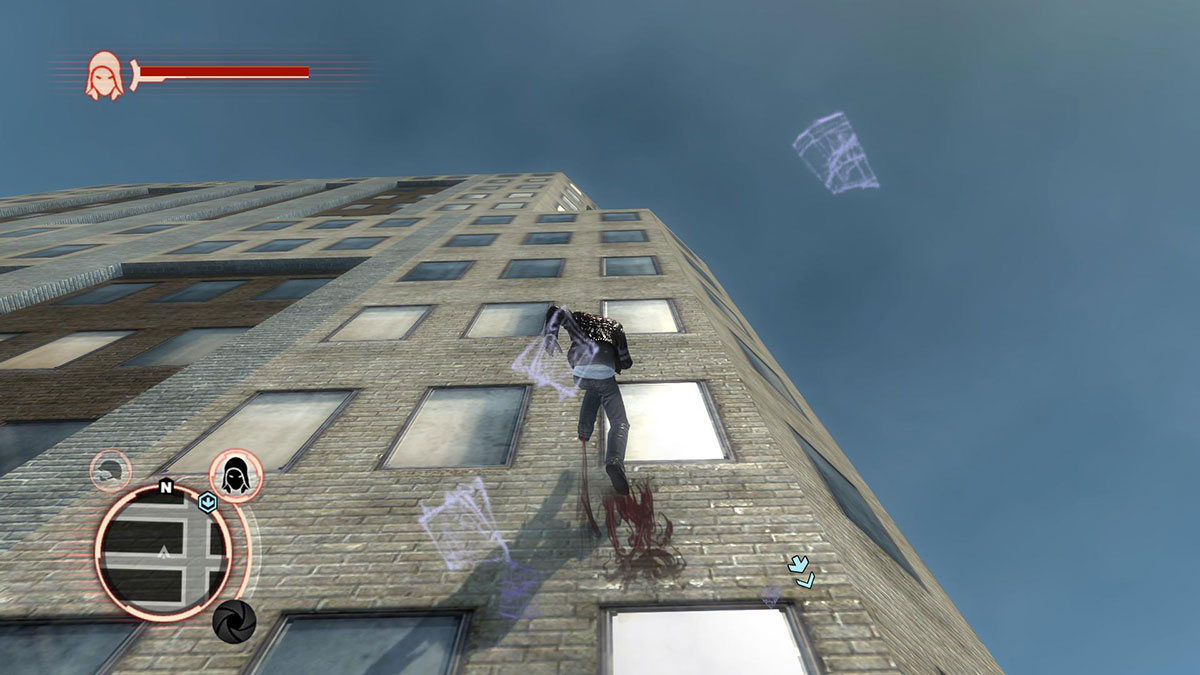
Definitely scores points for having cool abilities at the start.
Prototype is a 3rd-person open(ish) world game that is GTA meets… the opposite of Batman. You play as Alex Mercer, a recently infected man who, once killed, finds himself resurrected as some kind of viral superweapon. The game revolves around Alex trying to figure out what’s happening to him, and the conspiracy that surrounds both his infection and the events leading up to it.
In one of the articles I read about the controversial game Hatred, someone pointed out that the coverage surrounding Hatred was especially hypocritical given we already had games like Prototype. Having completed Prototype, I am inclined to agree. Prototype doesn’t intentionally reward you for killing random civilians, but between the bystander density in New York City and the collateral damage you cause simply by walking around, there may as well be a body count score in the corner of the screen. And when you aren’t just walking around? Holy slaughter, Batman!
See, Alex Mercer’s powers come from consuming organic matter, or perhaps just specifically human beings. If you are running low on health, you can snatch the nearest person and kill them in a context-sensitive but always-gruesome manner, then consume them whole to heal. This ability is actually an important plot mechanic, as you hunt down members in the “Web of Intrigue.” See, as you kill and consume these individuals, you can not only copy their form, but you gain their memories. This leads you to infiltrate military camps by consuming scouts, then the base commander, then entering the base itself to consume the juicy (and skilled) members inside, upgrading your abilities to use machine guns, fly helicopters, order artillery strikes, and so on.
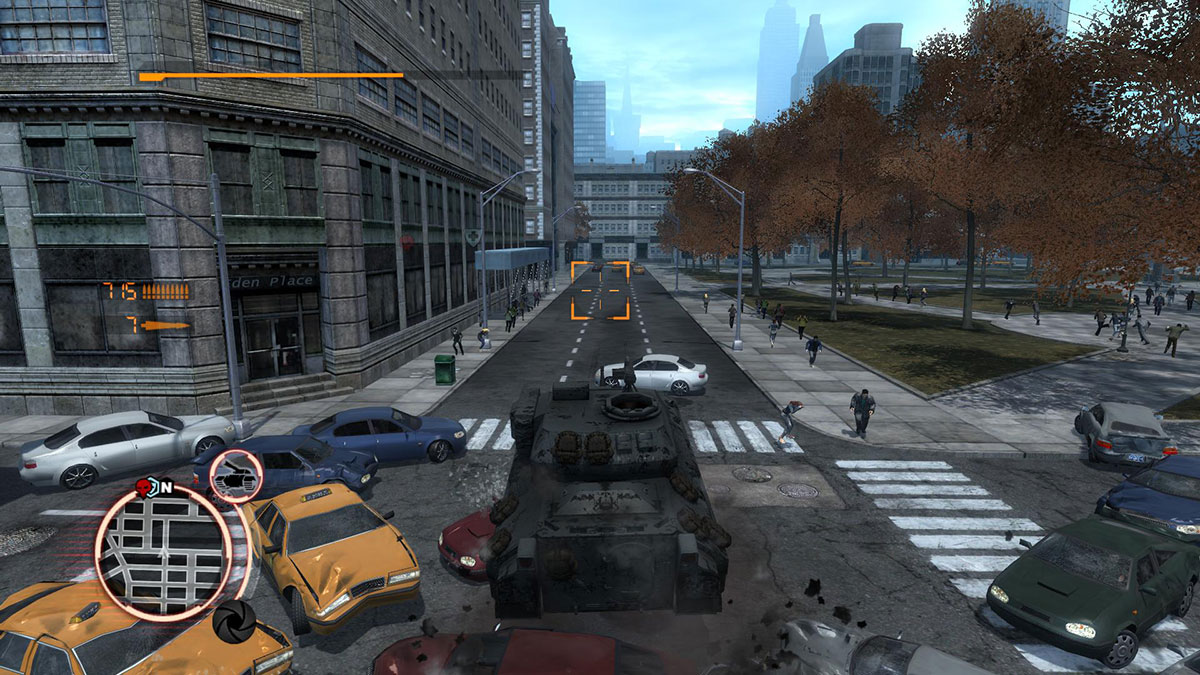
I was actually trying really hard to not kill a million people there.
After a while, everyone just looks like walking power-ups.
The gameplay of Prototype is both visceral and involves viscera. Attacks are controlled with just the left and right mouse buttons, with E occasionally thrown in there. While the moves are limited, the various powers and upgrades that become available are not. As you complete story missions and the various side events, you unlock additional upgrades by spending Evolution Points. These upgrades give you new attacks – claws for hands, tentacle arms, etc – and all sorts of other goodies, like more mobility. Even from the very beginning, Alex Mercer automatically parkours his way across vehicles and smaller obstacles while being able to run up the sides of skyscrapers. Later unlocks will have you leaping 60 ft into the air with a single press of the Spacebar, changing direction in mid-air twice, and Gliding into the alleyway.
While I enjoyed my time in Prototype overall, there were a number of areas and missions that were absurdly frustrating. Some of those involved waves of enemies, in which death or mission failure (due to escort dying or similar) cause you to restart the entire wave sequence over again. Other times, you will be facing bosses in which the limited control scheme starts making you suicidal. For example, one of the supermoves you can do is “In the air, hold Left-Click, Press E.” If you press Left-Click + E simultaneously, that completes a different move. But if you hold down Left-Click too long before pressing E, you suddenly perform a jump-kick straight into the gaping maw of the hideous beast. Other times, the weird targeting system causes you to grab or fail to the grab the wrong thing at the wrong time. Would this have played better on a controller? Maybe. Still, I wish there was a “Bind Devastator move to Q” option or something like that.
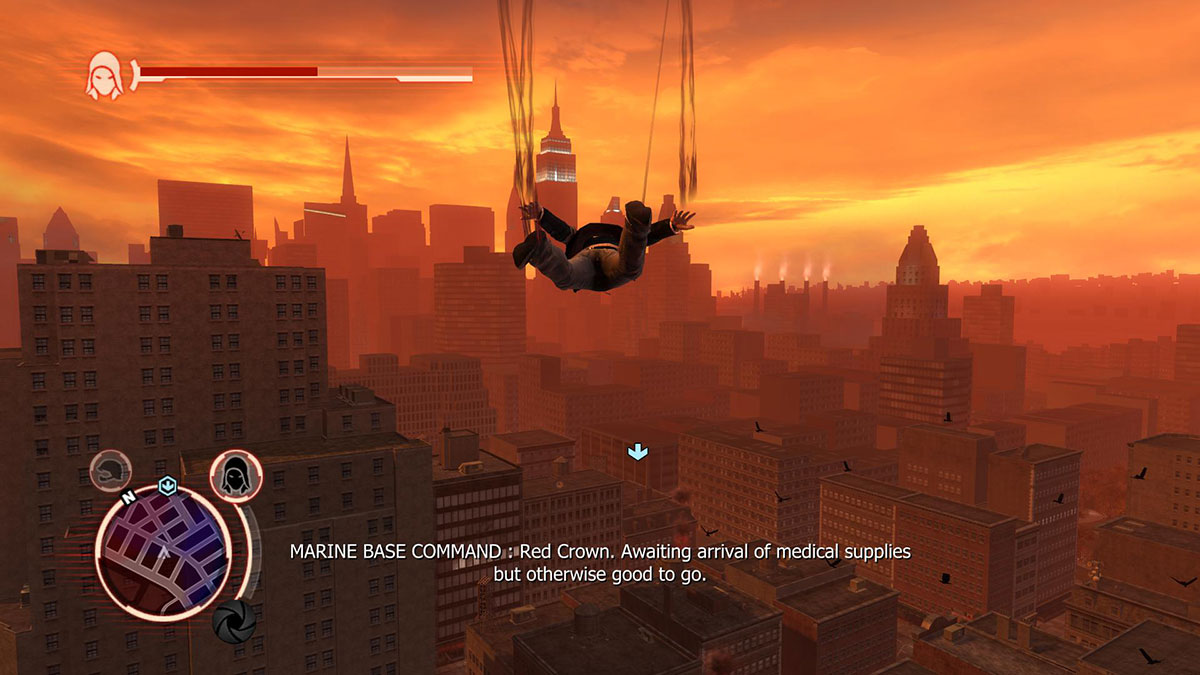
Okay, this kind of thing was really cool.
Prototype is not exactly a game that I would recommend people to spend money on specifically; there are a lot of other, better games out there. But if you look at your Steam library tonight and notice that Prototype happens to already be on there for some reason, go ahead and boot it up. If you aren’t having some amount of fun within the first 10 minutes, you can go ahead and uninstall because the game is basically going to be that for the next ten hours.
Review: Dead Rising 2
[Blaugust Day 9]
Game: Dead Rising 2
Recommended price: bundle
Metacritic Score: 78
Completion Time: ~17 hours
Buy If You Like: GTA Zombies, Frustrating mechanics, Improvised weapons
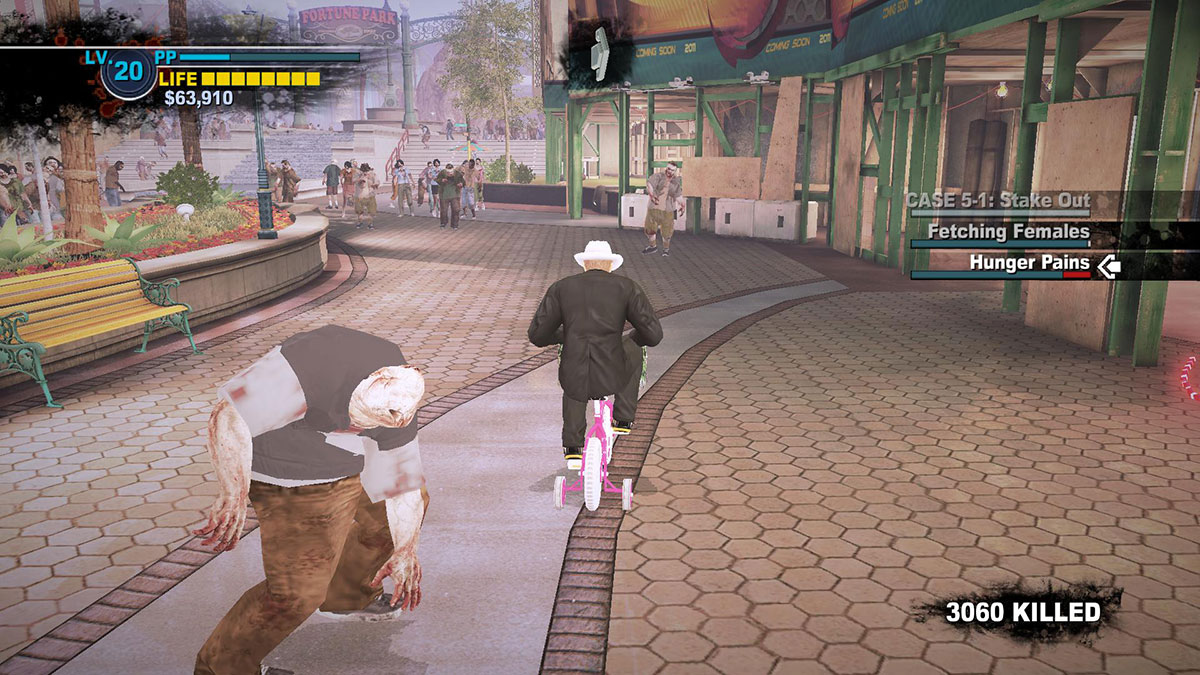
A very serious game for very serious people.
For the record, Dead Rising 2 is the only entry in this series that I played. Coming into this entry, my expectations were fairly minimal, and I knew only that the game featured wacky weapons and… that was it. What I discovered was a title that both exceeded my expectations wildly, and one that almost immediately squandered all the goodwill it generated.
The premise of the game is that you play as Chuck Greene, a father desperately trying to make ends meet and pay for his daughter’s Zombrex, the toxic daily prescription drug that is the only thing standing between her and undeath. Unlike many other titles in this genre, the setting takes the zombie apocalypse as a given – Chuck participates in a televised gameshow with prize money being awarded to whomever is able to kill the most zombies with their chainsaw-motorcycles. After the latest Live event, someone dressed as Chuck manages to frame him for terrorism when they release said zombies into the greater Fortune City casino area.
What follows is perhaps one of the most, if not “authentic,” certainly the most interesting takes on the zombie apocalypse. There are zombies everywhere, hundreds of them. Frankly, there are so many zombies on screen at a time that I’m honestly surprised that the devs were able to pull it off.
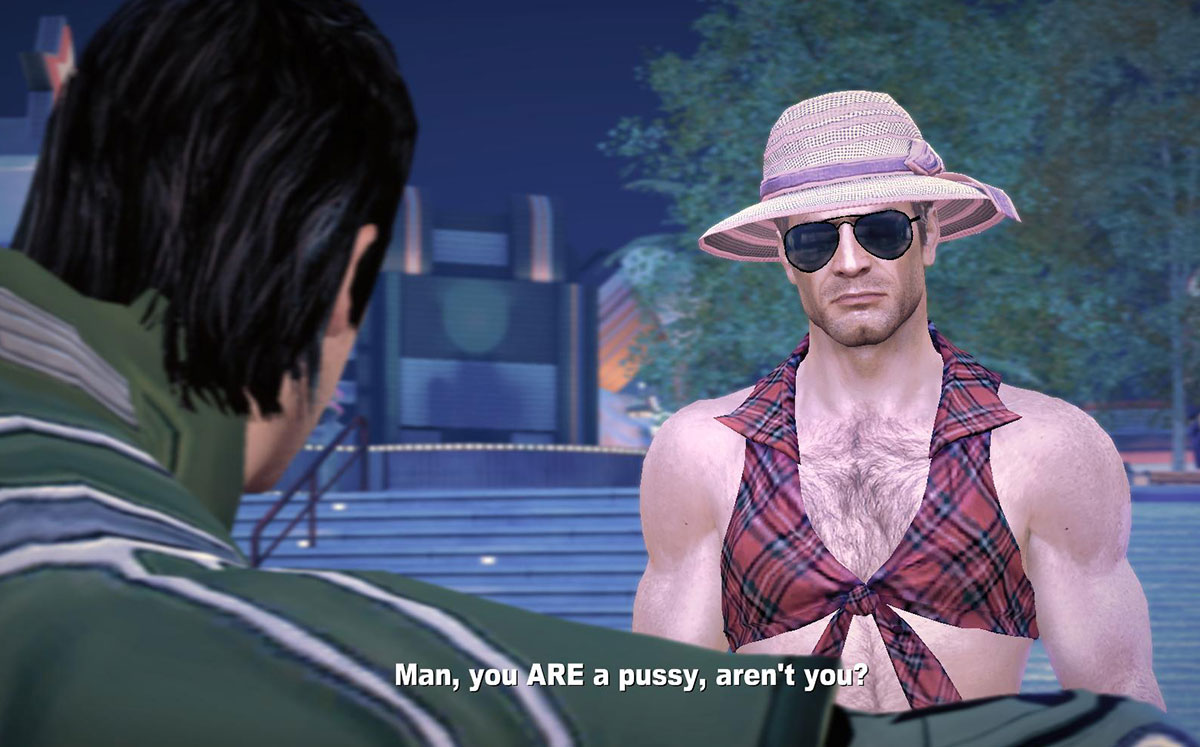
Submitted without comment.
Despite said zombies being of the shuffling variety, they always feel like a threat by sheer numbers alone. At the same time… it’s difficult to describe, but the zombies felt like understandable obstacles. By the midpoint of the game, I found myself not just capable of weaving through dense crowds of them without stopping or even taking damage, but it feeling correct for this to happen. In other words, it wasn’t that the zombie AI was dumb or that I “exploited” their behavior, but rather that the zombies followed natural rules in terms of range of motion and the like. If you approach a zombie from behind, for example, it had to turn to its left before it could attempt to lunge, and thus you could escape by passing on the right. And even more than that, said swiveling zombie would act as an obstacle to the zombies that were following behind you.
Another great aspect of the game was the refreshing take on narrative. The game is structured around the inexorable passing of time – your daughter needs Zombrex every 24 hours at a minimum, and your window of opportunity in clearing your name similarly closes with each passing hour. Inbetween the big events, you will get notifications about trapped survivors and such, most of whom will be dead soon without assistance. You might be having fun crafting weapons and collecting cash on one end of the Strip, for example, but unless you book it to the other side in a hurry, those survivors will be zombies themselves right quick. The clock creates a subtle tension throughout the game, without (usually) being too overwhelming.
The problem with Dead Rising 2 are the Psychopaths, e.g. boss fights. Along with survivor quests, you will occasionally get vague quests to head over to a specific location. Once there, some random survivor will have snapped from the stress and be out for human blood. Generally speaking, these fights are total gimmicks and stupidly, inexplicably deadly. Whereas you might be able to sustain 20+ zombie bites across a period of time, Psychopaths will kill you in a few hits or less, especially if you don’t immediately understand the gimmick.

Some weapons are more effective than others.
Compounding the problem, the Save Game structure of Dead Rising 2 is that progress is ONLY saved when you go to the bathroom. Psychopath on the other side of the Strip across four screens of zombies and nary a Porta Potty in sight? Guess what you’ll be replaying over and over? This isn’t even taking into consideration that Psychopath fights are scripted to occur at specific locations at specific times, which means you can suddenly find yourself in the middle of one while you were trying to escort some abysmally dumb survivors across a sea of zombies.
Indeed, I remember one Psychopath battle in particular as it was the most god-awful situation I have experienced in videogames. Basically, this encounter was with four redneck snipers who decide to take residence in the central open area of the game. You know, the place with the most zombies per capita? That you had to routinely cross through all the goddamn time? And they never left, even after the end of the proper game. What the literal shit, Capcom? Those snipers hounded me the rest of the game, on into the epilogue, and by that point I did not have the time or ammo to take them out.
The bottom line was that Dead Rising 2 felt and played as an innovative zombie game, with enough cool things going on to make one horribly disappointed with the superfluous bullshit tacked on for no good reason. From what I gather, Dead Rising 2 is actually uncharacteristically serious compared to the other titles in the series – a sort of Saint’s Row to, say, Dead Island’s GTA – and that’s certainly interesting trivia. I didn’t play the other games, and based on my experiences with this game, I probably never will. If you can snag the game on the cheap though, I think it’s worth trying out if only for the first ~5 hours or so, as you steep in the goodness that is a freeform zombie apocalypse.
Reviews: Ori and the Blind Forest, The Swapper
Game: Ori and the Blind Forest
Recommended price: $10
Metacritic Score: 88
Completion Time: ~8 hours
Buy If You Like: Journey, Metroidvania, Action Platformers

Random gameplay screenshot, or million-dollar painting?
The simplest summary of Ori and the Blind Forest would be “Journey Metroidvania.”
After playing through the equivalent of the opening scene from the movie Up, you are thrust into the controls of Ori, a sort of cat creature as she (?) begins a quest to return life to the Spirit Tree. While the gameplay can be described as Metroidvania, I consider it more along the Action Platformer scale – certainly the majority of the challenge of the game comes from the platforming elements rather than defeating enemies. As you explore the map and solve various platforming puzzles, you eventually unlock additional movement abilities such as Wall Jumping, Double Jumps, Floating, etc, which allows you both access to brand new areas, and new corners of old spaces.
One thing that shocked me while playing was the difficulty. For as lush and beautiful as the game looks, Ori spares no punches with insta-kill mechanics. While the player can create save locations practically anywhere (at the cost of a renewable resource), the onus is on the player to remember to do so. Spend 15 minutes backtracking to grab that HP power-up, only to get squished by a falling stone trap? Well… I hope that power-up is now worth 30 minutes of your time. Indeed, later stages of the game become absurdly difficult with 2-3 minute (or longer) “chase” sequences in which any mistake is punished with death, forcing you to redo the entire sequence. Reminded me of Super Meatboy in that respect.
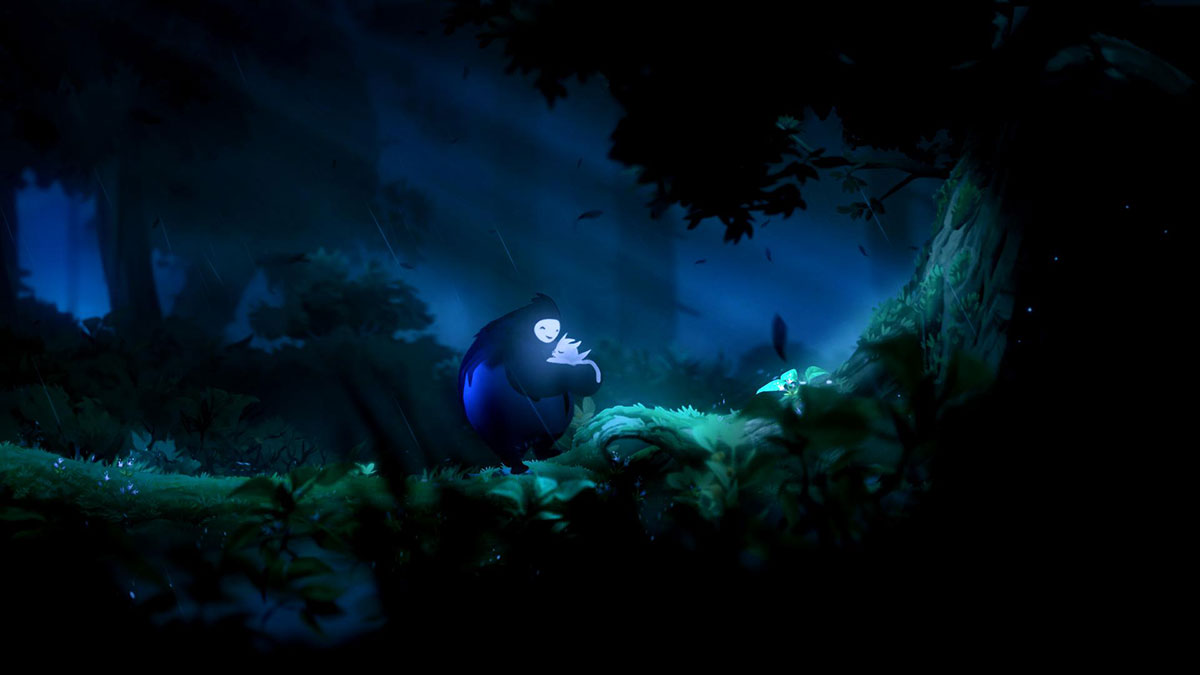
How I felt playing the game.
All that being said, though? I absolutely loved my time spent in Ori. The game is a visual feast, the soundtrack amazing, the animation fluid, and the gameplay interesting. Indeed, one of the movement unlocks later in the game – called “Bash,” which was a complete misnomer – single-handedly took the game from good to great in my eyes; the move allows you to grab enemies or projectiles, pause time, and then rocket yourself one direction and the grabbed object in the other. You end up needing to use Bash a lot by the endgame, but it was fun enough that I would play an entire game based around just that mechanic in the way Ori used it.
Highly recommend picking the game up next time a Steam sale or Humble Bundle comes along.
___________________________________________
Game: The Swapper
Recommended price: $5
Metacritic Score: 87
Completion Time: 5 hours
Buy If You Like: Puzzle Games, Unique Premises, Questioning the Nature of the Soul
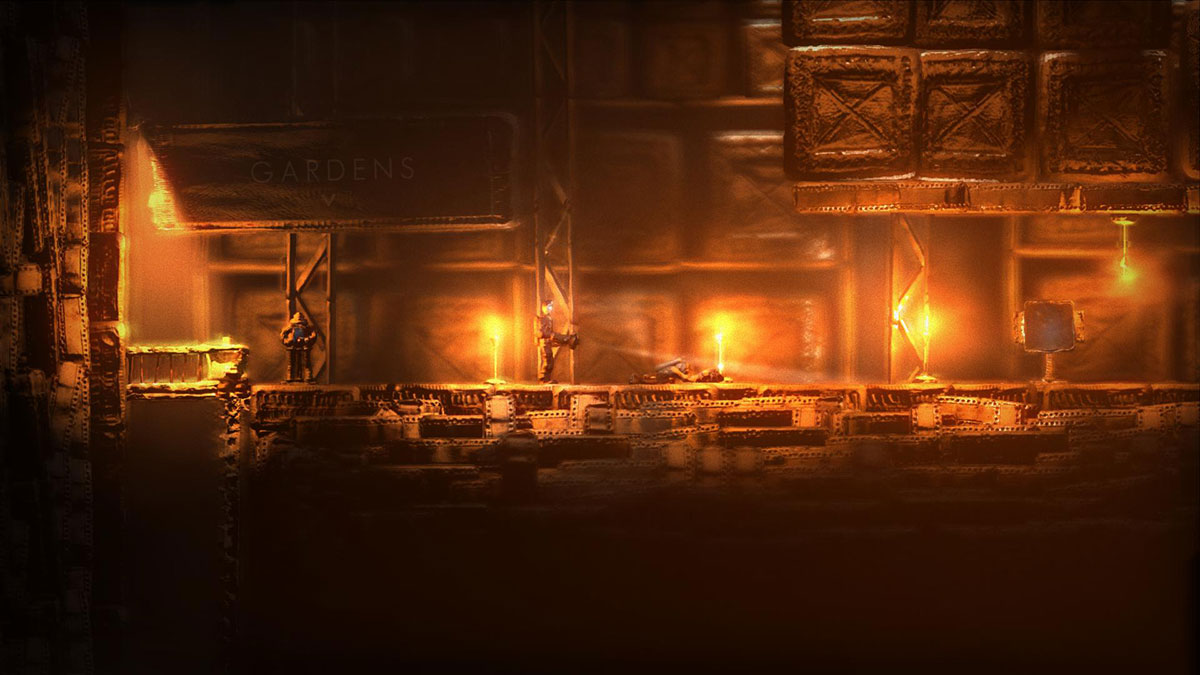
Gazing upon the crumbled remains of myself… and I feel nothing.
The Swapper is one of the more innovative puzzle games I have ever played. Not so much exactly for its puzzle mechanic – you create clones that mimic your actions, like that level in Braid – but the way in which the mechanic is intertwined with the narrative is unparalleled.
Things are mysterious and surreal and dark from the very start, as you make your way from being stranded on a mining colony to back on a seemingly derelict spaceship. In such a setting, finding a gun that creates clones of yourself doesn’t seem that big a deal. Which then leads you to start being a little cavalier with your clones, as you leap off ledges, slow time down to create a clone already standing on the rapidly approaching floor, then “swapping” your soul between the two as your now-empty original self smashes itself to pieces on the bulkhead below. You can do the same thing in reverse, creating a vertical body of soul bridges, each clone creating one more at the height of its vision, with all but the last falling to his/her death, their last moments spent walking in the void, just as you do, towards a door they shall never reach.
The Swapper is precisely the type of game that inspires sentences like the previous one.
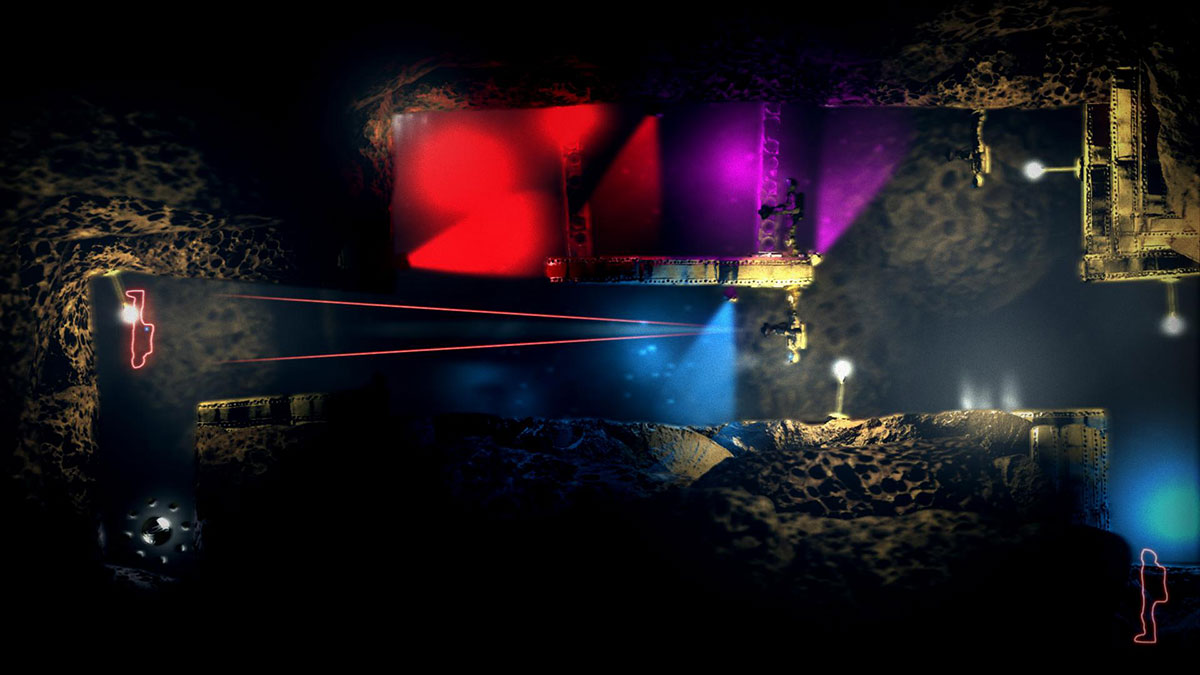
It’s sad that you can’t appreciate exactly how awesome I am in this moment.
The puzzles themselves straddle closely the “too clever for their own good” side of the scale, and a few require more reflexes than I thought entirely necessary. The primary impediments are the different colored lights, which impede clone creation, soul swapping, or both. Beyond that, the majority of the time you are creating, killing, and scratching your head over how to arrange clones on the correct floor switches. While it might sound monotonous, again, the overall mood and narrative absolutely sells the entirety of the five-hour game.
Given the above, I must both recommend that The Swapper gets played, but at a discount. It’s worth a spot on your wishlist in time for the next sale.
Review: The Banner Saga
Game: The Banner Saga
Recommended price: < $5
Metacritic Score: 80
Completion Time: 10-12 hours
Buy If You Like: PC ports of mobile tactical games, Kickstarter games
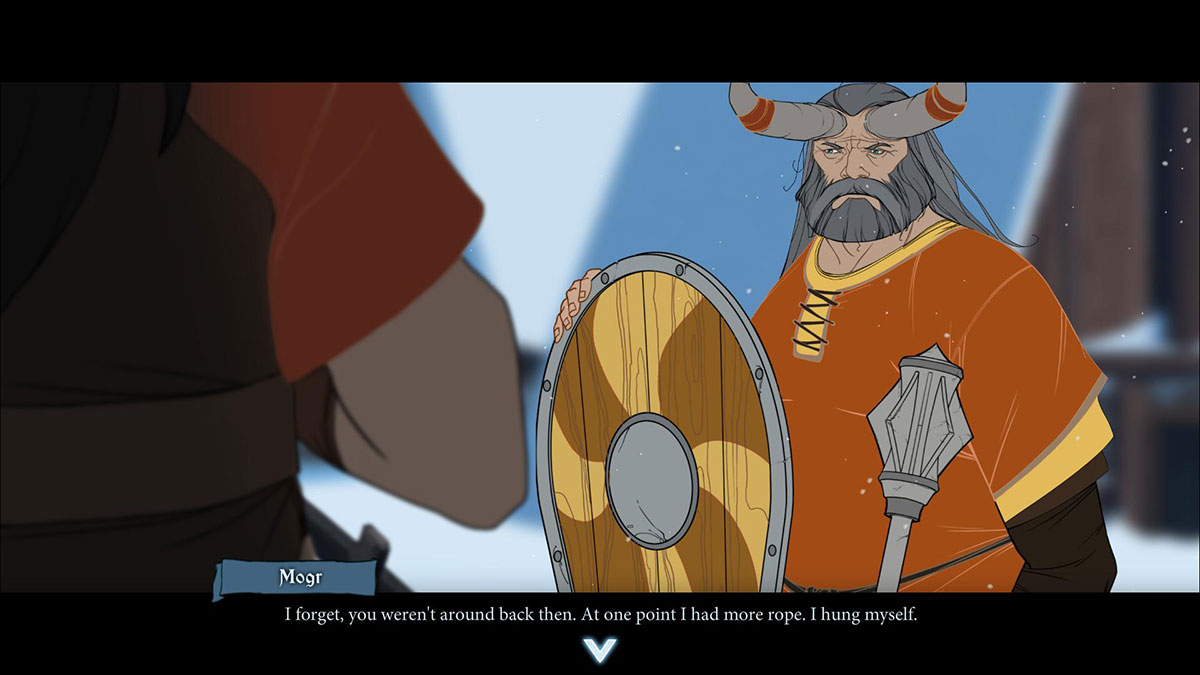
Oh, you. Wait, was he serious?
The Banner Saga is one of those darling Kickstarter stories in which a scrappy development team (or professional game designers) achieves high accolades for a beautifully drawn, epic soundtrack-having mobile-to-PC tactical RPG port. When judged against its Kickstarted peers, it stands rather tall amongst them, especially for having actually made it to release. When judged on its own merits however, The Banner Saga falls somewhat short despite it’s high Metacritic rating.
The basic thrust of The Banner Saga is one of Norse-style apocalypse. The gods are dead, the historical baddies (Dredge) are flooding the North, and everything is going to hell. The plot follows two separate caravans as they rapidly become refugee trains fleeing the destruction. Along the way you are presented with a series of Choose-Your-Own-Adventure blind choices and are rewarded or punished (mainly punished) with abrupt character deaths, loss of supplies, and similarly depressing news. Oh, and occasionally battles.
The tactical combat system in The Banner Saga is not one I have seen before, and I’m tempted to say that was for a reason. Every unit has both an Armor meter and a Strength meter, the latter of which is also your HP. Damage is calculated as “Your Strength – Their Armor = They Lose X Strength.” I already consider such systems a Red Flag simply for how many times it leads to snowball situations: wounded characters immediately lose most of their combat value. “Luckily” enough, damaging Armor isn’t tied to Strength at all (Armor Break is a separate stat you can increase), so even a character with 1 HP (i.e. 1 Strength) can do something useful. Also, some character classes have special abilities that do a set amount of damage no matter that’s character’s Strength.
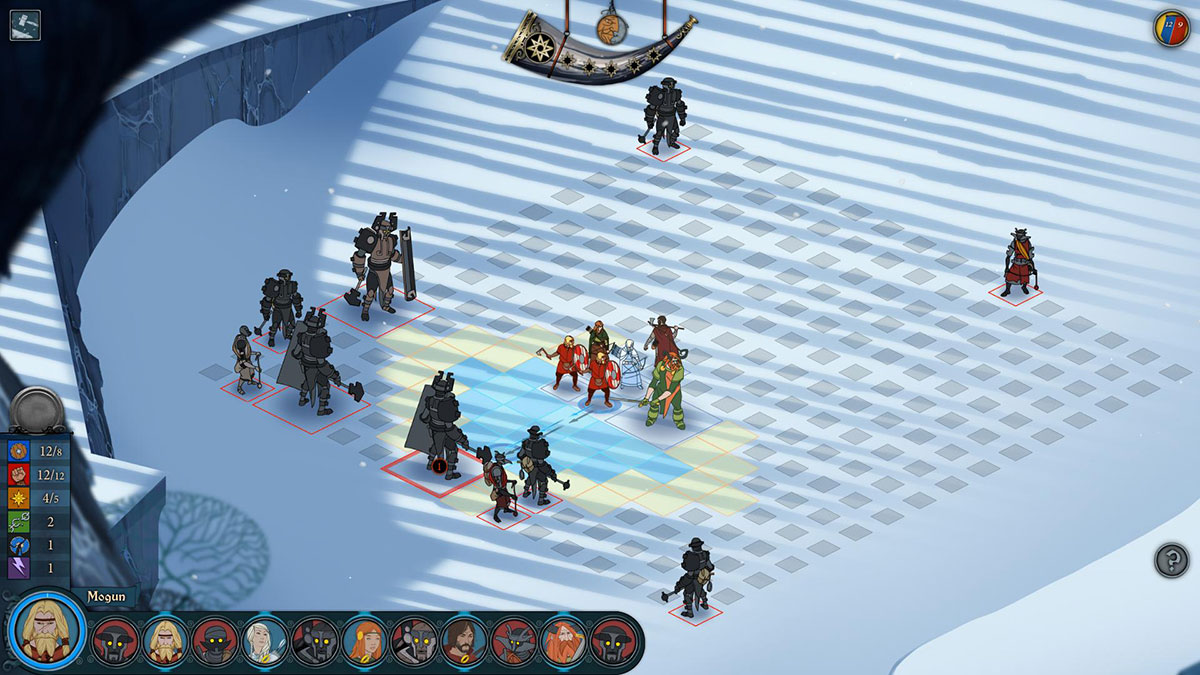
Another day, another grid with the same enemies.
My issue with things comes from the Turn Order system. Simply put: it alternates. Before you get into combat, you can decide which of your party members goes in which order. Once combat begins, it starts with your 1st member and then goes to one unit on the enemy’s side. If you manage to kill an enemy before their turn, the next enemy in the turn order will take their spot and everyone else moves down. This continues until there is only one enemy left, which starts “Pillage Mode” and your whole team gets one turn for every one that the last enemy receives.
The entire system leads to bizarre scenarios wherein an enemy unit can suddenly get 3-4 free turns of attacks off on a character before you can react, as you uselessly move around other out-of-range characters. In other words, the enemy gets more dangerous the more enemy units you kill; conversely, this never seems to improve your own odds of success when put in similar situations.
The other major problem I had with the game design was… well, the rest of it. You receive Renown points after battles, and Renown pulls double duty as both currency to purchase items/Supplies for your caravan and as an upgrade currency. If you want to level a character up from 2 to 3, that costs 10 Renown, for example. The problem here is that there is never enough. Which, okay, it’s Ragnarok, what are you going to do? But The Banner Saga is not at all gun-shy about killing your playable characters without warning in one of the frequent dialog choices, taking the 30+ Renown you’ve invested along with them. I couldn’t help but feel like the developers were trying to make the game be a roguelike but only going halfway. Am I supposed to reload my last auto-save when I find out that X died? Or will there be enough Renown later to off-set the loss?
Spoiler alert: no.
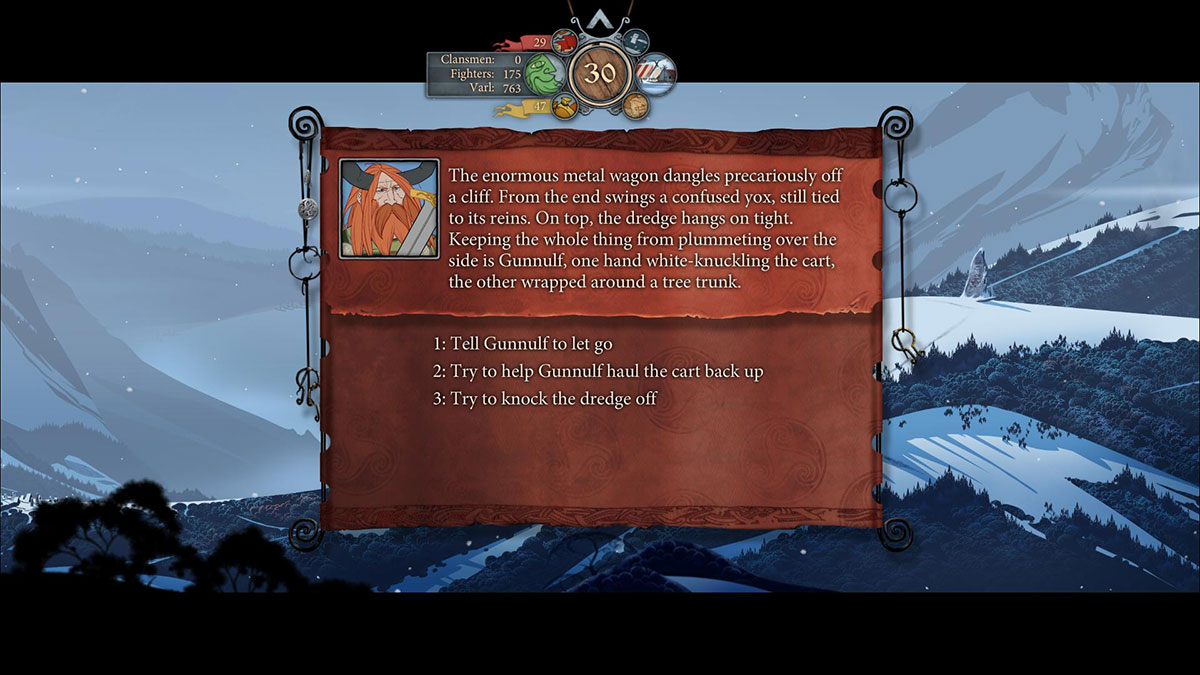
Know what’s fun about these sort of choices? Nothing.
In the end, I find it somewhat hard to recommend The Banner Saga, at least with even a fraction of the fervor it was recommended to me. If you are looking for a solid tactical RPG ala Final Fantasy Tactics, you will be disappointed. If you are looking for an engaging roguelike, you will be disappointed. If you are looking for a regular RPG with a great story, you will be disappointed – the game ends abruptly with a cliffhanger, as it was designed as a trilogy from the start. If you are looking for an iPad game to play for more than 10 hours, you will be disappointed.
There is some good things going on in The Banner Saga – the music, artwork, and animations are fantastic – but it’s not a complete project. The less you treat it as a serious game and more as an interactive picturebook, the better off you will be.
 In An Age