Review: Dungeon Raid
Game: Dungeon Raid [Android]
Recommended price: $1.99 (full)
Metacritic Score: 80
Completion Time: 10+ hours
Buy If You Like: Match-3 games, Time Killing, 10000000
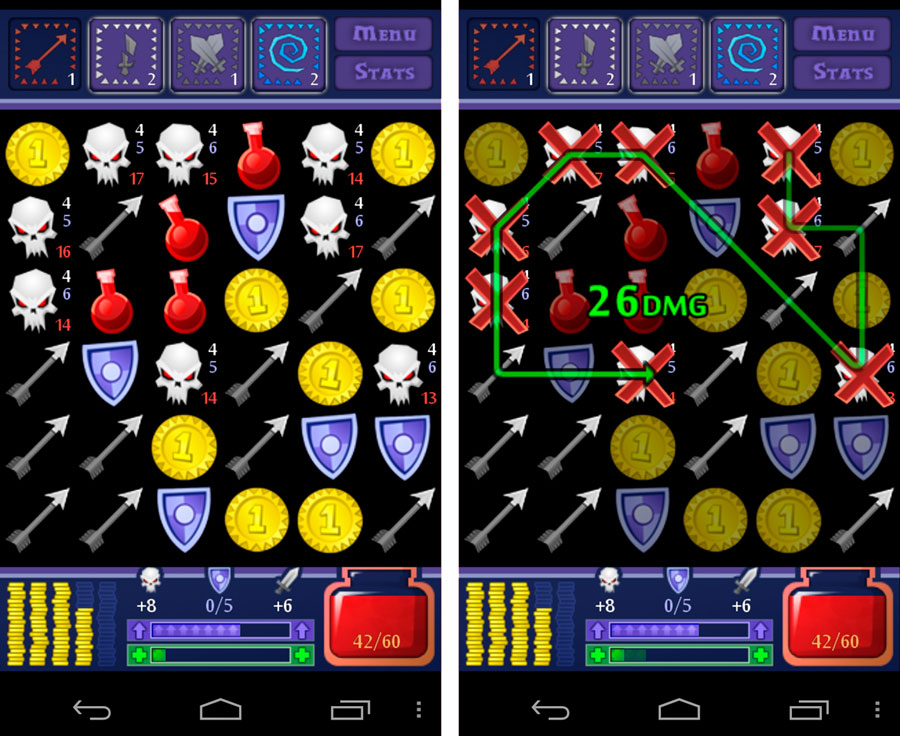
Arrows are special “Sword” tiles that can match 1 extra tile away.
Dungeon Raid is a rather brilliant and addicting “Match 3” roguelike game in the same sort of design space as 10000000. Whereas 10000000 focused on fast reflexes combined with steady progression, Dungeon Raid has a more tactical focus with only sporadic RPG-esque progression.
The first thing you’ll notice when playing is that there is no timer or other reason to rush. Additionally, while three is technically the minimum number you need to match to capture tiles, there is no limit on how long a chain can run. Even more interesting, you can capture/trace a path diagonally if you like, opening up many more opportunities to capture tiles.
The tiles themselves are relatively simple: potion, coin, sword, shield, and skull. At the end of each move, all the skulls on-screen will deal their damage to your armor and then your HP. You “capture” skull tiles by dealing enough damage to them to bypass their armor and reduce their HP to 0. The damage you deal is determined by your base attack and then increases by your weapon damage for each sword tile you cross; skulls and swords can be chained, of course. Potions tiles refill your HP, Shield your armor, and coins increase your wealth.
The RPG mechanics come in several forms. You earn XP mainly for killing Skulls, and each level lets you pick 2 of 4 random upgrades. Some of those upgrades will be special powers (max of 4) which can have impressive effects like turning all Coins to Swords, or getting an entirely fresh board (Teleport); once used, these skills take X number of turns to recharge. Capturing Shield tiles while already at full armor will increase an armor XP bar, which lets you chose 1 of 4 upgrade options for your current gear. Filling up the Coin “XP” bar will also let you upgrade gear.
Layered on top of all of this are the bonus/penalties that come from your class, your race, and what abilities you put in your pool to randomly pick from. Classes need to be unlocked by defeating boss Skull tiles, which have their own special abilities and necessary tactics. Sometimes they drop nothing but gold, sometimes they drop a new class item, and sometimes they drop class upgrade items instead. The higher level a class is, the more you can customize it by, say, turning your priest into an Orc for the racial bonus (etc). Nothing caries over inbetween games other than these class unlock/upgrade items though, so a run in which no boss drops a token is basically “wasted” (hence the “sporadic” progression). This does suck once you realize it, but the plus side is that you won’t be “beating” the game as quickly as 10000000.
All of this sounds complicated, sure, but it becomes intuitive and fun pretty quickly and ends up feeling more like FTL and Binding of Isaac than a typical phone game. It’s fast, it’s fun, and it’ll break your heart when you lose +10 Regenerating, 30 Armor, +8 Poison Weapon toon. But you’ll immediately start again despite the fact that your lunch break ended two hours ago.
Highly recommended.
All Over the Place
My gaming time, when I actually use it to game, is all over the place lately.
While the Currently Playing sidebar is technically correct, I find myself at the end of the day spending crazy amounts of time playing an Android game called Dungeon Raid. I think the problem is that my current gaming menu is full of open-ended loot games that lack otherwise meaningful progression. While I am genuinely interested in the Tiny Tina DLC storyline in Borderlands 2, for example, I have a hard time treating it like a “normal” game. Could I plow through the story missions and call it a day? Certainly. But… it’s DLC. Skipping the sidequests feels like a waste – especially when the sidequests in BL2 proper are usually hilarious/fun – and that goes double when they are DLC quests. I don’t feel the need to find all the secrets, but the sidequests? I need them all.
Of course, not all sidequests are created equal. Spending 15-20 minutes on some boring chores saps the motivation to go further. And while I largely solved the gun issue I had earlier, I am approaching the other side insofar as I suspect I should be playing this on Ultimate Vault Hunter Mode. Which means finding a Slag weapon. Which means more grinding. Sigh.
I thought I was done with Hearthstone, but I came slinking back in a moment of CCG weakness. Finally did an Arena as a Shaman. Went 0-3. And while I was mercilessly curb-stomped in all three games, on a certain level I just had to be impressed with the thoroughness. One of the games was against a Priest at 12 HP who Mind Controlled my 6/6 creature with Windfury one turn, and then followed up the next with a temporary Mind Control on my Taunt blocker and then cast a copy of Bloodlust from my own goddamn deck. I mean, Jesus Christ, man… good job. My secret Arena MMR must be setting me up against fucking top-decking wizards whereas I never even had an epic card available to pick from.
If that is really what’s going on – as opposed to a huge coincidence of pro players after 9pm – it’s definitely a strike against what I thought was an awesome innovation in Booster Draft gameplay. You always had “that guy” in your Magic Online drafting group, but there were at least even-odds that you’d face similar players first. Scrubbing out at 0-3 when you spent four days doing dailies to get enough gold to get it is demoralizing, to say the least. Is asynchronous Booster play worth it? I’m not so sure anymore.
Card Hunter is as it was (i.e. excellent), but I can’t seem to get any information as to whether the campaign is actually any longer than it was in the Beta. Because if it just sort of peters out at where it did, then I’m not sure purchasing the 30-day subscription/buying the Treasure campaigns is worth the $20 or whatever. And as both I and Tobold pointed out, you basically need to make that decision early on, as it decreases in value/usefulness pretty quickly.
Path of Exile is alright, but after wondering whether my minions build (think Diablo 2 Necromancer) would actually be useful at the higher levels – the boss battle I did a few days ago was an exercise in frustration when she one-shot my zombies and there were no more corpses to resurrect – I more or less metagamed a bit too deep. Once you see things like this, there is no going back. Which is somewhat literally true, since I already “wasted” a lot of my talent points and PoE is “old-school” when it comes to respecing. Even my more modest goal of acquiring a Summon Skeleton gem so my Witch isn’t left defenseless during bosses appears to be best achieved by rolling an alt and completing quests in Chapter 1.
So as I muse on which game I want to play that leaves me least hollow and empty on the inside, I fill the void with Dungeon Raid. Which is a roguelike akin to 10000000 minus the assured progression. But it’s shiny, it’s on my shiny phone, and it’s goddamn addicting in that Candy Crush way without microtransactions.
Yeah, I’m scared too.
Loot 2.0
The big news of the week has been Blizzard’s rather unprecedented decision to shut down the Diablo 3 AH in March of next year. While I suppose that the start of a new expansion is as good a time as any, I still find it interesting that they are bothering at all – a bit late to close those barn doors, yeah? Then again, I suppose with all the other changes they have made in the time since I stopped playing (a whole year ago?!), the “economy” has become more warped and functionally useless than before. Making it five feet in Act 2 Inferno used to require Resistance scores out the ass, but between the general elite nerfs, the player-decided mob-levels, and the Paragon system, you can probably make it through the game without buying anything.
You would still want to, of course. Even a child should be able to understand that a 5% chance at something good is worth less than buying exactly what you want from someone who was going to vendor the thing anyway. Or anyone playing the game for more than an hour during the open beta weekend, for that matter.
The question though, is what system will replace it? Apparently Blizzard feels it is Loot 2.0:
- New game modes including Loot Runs with guaranteed special item drops when successfully completed.
- Smart drops where a dropped item is guaranteed to roll the appropriate mainstat for the class that finds it.
- Fewer but better item drops, where players will see far fewer items, but the items (especially the rares) will have better stats.
- A new NPC Artisan, the Mystic who has the abiilty to reroll one selected affix on an item.
- Legendary (including Set Items) will get an across the board quality buff.
- Legendary items will drop more often, especially for lower level characters with guaranteed legendary drops from the first kill of many story/quest bosses.
- Legendary items will roll with less low-end variability, to reduce the likelihood that they are complete junk.
- Legendary items will gain variable item levels with stats scaling appropriately — current high level items legendaries will drop on lower difficulties and low level Legendaries will drop in the end game. All stats on these items will scale up or down to be appropriate for the level of the monster that drops them.
Item binding is going to be a key feature of Loot 2.0, with some of the found items, and most or all of the crafted items or items upgraded with the Mystic gaining BoA or BoE to restrict them from being traded or sold. Full details are not yet finalized.
I counted three instances of the word “guaranteed” in there. Not something I usually associate with Diablo games, but hey.
While the above is not an exhaustive list of the Loot 2.0 paradigm – I’m pretty sure that not even Blizzard knows what else they’ll toss against the wall before March – we can see the sort of trajectory taking shape. What is a huge unknown to me though, is what exactly Blizzard plans to do with all the gold left in the economy when the AH doors close. Will the Mystic be an expensive gold sink? That might work… but what about the people who haven’t stockpiled? Will the feature not be for them? Between that and the possible stockpiling of crafting materials, I almost have to assume that Blizzard plans a “currency reset” with the expansion, to go with the inevitable gear reset that comes with an increased level cap.
In any case, watching things play out this week has been interesting while playing Path of Exile on the side. I mentioned before that PoE has something more akin to a lore-based barter economy, but I am finding it even more interesting than before. Effectively, I find myself rolling my own loot back in town when I go to vendor things. Useful Magic/Rare/Unique items do drop out in the wild, but I am finding that the addition of colored gem slots adds another depressing layer of randomness to everything; a given item might be awesome for your class/build, but if it is replacing an item with a good spell-gem configuration, you might end up banking it instead. While there are “currency” items that can add/change sockets, I am finding it almost easier to hold onto normal items with good sockets and then spend my “money” turning that into a Magic/Rare item instead.
That can sort of happen in Diablo 3’s crafting system, but it lacks the granularity and impressive nuance that PoE brings to the table. Scrapping four items to get another shot at getting a useful fifth isn’t the same as being able to choose to reroll an item’s magic properties, adding a new property, adding sockets, adding connections between sockets, changing a socket’s color, and/or stripping the item clean and then possibly rerolling it into a Rare/Unique.
Can I also just mention how addicting just leveling in Path of Exile can be? It’s the standard sort of hack-n-slash, but since your gems can level up too, it feels like I “level” a half-dozen times every 30-40 minutes. “Getting kinda sleepy and I still have 8 bars before level 24. Oh, wait, there’s like a centimeter left on my Raise Zombie gem XP bar. Hmm… let’s go clear out the NW corner.”
But, yeah, loot systems. Borderlands 2 is feeling pretty archaic right now in comparison.
Item Build Paradigms
As you may recall, I have been having a rough time in Borderlands 2. I bought the Season Pass back when I bought the original game, but sort of let things slide somewhere around 95 hours /played, about the time the Hammerlock campaign was released. My main issue, aside from general burnout, was that my character is Zer0, the melee-based ninja/sniper character. Simply put, I was having a hard time surviving in the extended difficulties as someone either in the middle of the action (where mistakes kill you quickly) or trying to snipe when 10 people are shooting at you (whom are extremely accurate with their assault weapons).
Now, I can already hear those of you in the audience: “But, Az, Zer0 is like one of the strongest characters in the game! He can solo the raid bosses!” Sure he can… with a very specific loadout of Legendary/Unique weapons, which either requires luck, grinding, duping, or all three. While I am obviously not allergic to chasing gear drops in games, in this instance all I really wanted to do was finish the Hammerlock DLC and then complete Tiny Tina’s Dragon Keep DLC. You know, at a level in which it’d be challenging and rewarding too – there isn’t any real reason to blow through it on Normal or anything.
Unfortunately, I was stuck between a rock and Ultimate Vault Hunter Mode (UVHM). I beat the game on True Vault Hunter Mode (TVHM) way back when, plowed through it again in “2.5” mode where everything is scaled up to level 50 (the cap at the time), leaving all of the sidequests alone so that I could give myself the option of getting the highest-level versions of the various unique gear. Hell, I even farmed the last boss a few times. UVHM steps it up a few notches though, including a level cap increase, and basically makes Slag elemental weapons (which increase the damage of all other sources) required. Not only did I not really have any of those weapons, my current gear was simply not cutting it… or anything, really.
This past weekend, I finally decided I was going to give it one more shot. My plan of action was to grind to level 51 and then cash in my ~40 Golden Keys and hope that the level-cap inflation on guns would give me something worth shooting. Since I was grinding anyway, I decided to do so in the Torgue DLC, in the repeatable Bar Brawl quest area; each run gives you special DLC currency to purchase, among other things, an Unkempt Harold, e.g. a Legendary everyone seems to use.
So I did. And got it. And now it feels like a whole different game.
The basic gist is that the gun says it deals ~14k damage per shot, but the “bullet” is actually a missile that splits off into 3, 5, and 7 missiles depending on how much distance it gets before impact. The Double Penetrating Unkempt Harold, which is the version I got, does the same thing x2. So, depending on how close something is, a shot from this pistol deals ~196,000 damage. Meanwhile, my best rocket launcher deals 226,000, with a 3-round clip and 7.4 second reload speed. I can carry 700 pistol rounds and reload in under 2 seconds. I could technically pick up another Unique item from a sidequest (The Bee shield) which would add something crazy-stupid like 40,000 damage to my bullets – which ends up being added to each bullet from the Unkempt Harold – but it is already making my TVHM-ish run somewhat of a joke.
What all of this is making me realize is that I don’t like this paradigm. Specifically: the gear-based-build paradigm. “Get item X and now you can do build Y.” Another of the items I picked up was a weapon (the Rubi) that gives heals you for 12% of the damage you inflict while having it equipped. It is another of the sort of “required” weapons for endgame Zer0 builds, as you can abuse the life-gain by dealing melee or grenade damage; the gun itself will never hold a candle to others, but firing one and then swapping back to it before impact will still basically let you heal to full. Combined with the “health-gating” hidden mechanic that prevents you from being one-shot (50% + 1 HP and you will survive any hit), this lets Zer0 basically melee raid bosses.
The problems, as always, are A) getting the gear and B) what to do until you get the gear. I am 100% for different character builds. I don’t even have much of an issue with talent choices leading to different stat weightings, e.g. choosing Talent X makes Haste worth more than Crit or whatever. But building an entire character around single pieces of (rare) equipment? That feels awful to me. Either you don’t have the item yet, in which case you feel weak/incomplete, or you do get the item and suddenly everything else that drops is useless/unrewarding. Plus, there is the whole side-effect of the fact that your character identity feels weakened or nonexistent; do my character choices even matter in the face of my item collection? Am I Zer0 at all, or am I simply “some dude with a Rubi and DPUK?
I decided to take a break from Borderlands 2, and started playing Path of Exile as a backup game. And… whoops! Just like many hack-n-slash games, it too features rare items that you can/should/(have to?) build entire characters around. Because that’s fun. To someone. Sigh.
Design Conundrums: 1 HP vs 0 HP
The difference between a character with 1 hit point and a character with no hit points remaining is immense. Obviously, right? But as I was musing on the extreme nature of the binary state, I started wondering if there was not some better way to handle the situation.
After some reflection, I am not sure that there is.
First, is there a problem at all with the conventional binary system? I’d suggest there is, at least enough of one to go through the thought exercise. One issue is that there isn’t much of difference between 1 HP and 100,000 HP – you are just as powerful and dangerous at one as the other. Some games might have “Execute” abilities that cause you to care about how many HP you have left, but all that is really doing is making the 1 HP “range” larger or simply making it more ambiguous as to your actual HP state.
The more salient problem with the 1 HP to 0 HP divide is what I’d term the Fail Cascade. Card Hunter (out of beta!) provides an especially stark example of this phenomenon. If one of your characters is reduced to 1 HP, they can still drawn 3 new cards each turn, can still attack at full strength, and can otherwise contribute meaningfully on the battlefield (limiting enemy mobility, being the target of spells, etc). Conversely, a dead character contributes nothing: all their cards are discarded, their body is removed from the battlefield, and you are left with potentially 10 cards to kill the remaining enemies instead of 15 cards. A character’s death is especially brutal in Card Hunter because the abilities you have access to are randomly determined from the cards in your deck. Instead of six chances of drawing an attack card to win the game, you are left with four.
Of course, sometimes the sacrifice of a character can turn out to be a winning strategy. In a 3v3 Arena game in WoW, it might be worth losing a DPS to take out the enemy’s healer in pursuit of an stalling game. In Card Hunter, taking out a Goblin Brute or other dangerous foe is worth it if the enemies remaining aren’t as immediately deadly in comparison. But under most circumstances in just about any other game (including the two mentioned), losing one character is an immediately 33% reduction in fighting capacity, and possibly more painful from a synergy point of view.
Is the alternative really that much better though? We could imagine a game where your health as a percentage is tied to your damage as a percentage; if you are are at 10% HP, your attacks only deal 10% of their normal damage. Personally, I recoiled at the very thought of such a system. Whereas the current design is a hard binary, it at least leaves open the possibility of a come-from-behind victory. If taking damage reduced your ability to deal damage in return, the outcome of most battles would be forgone conclusions within the first minutes of any engagement. Indeed, it is arguable whether we would be trading the binary at 1-to-0 HP for the same binary at the other end of the spectrum (whoever dealt damage first).
Now, I would be remiss if I did not mention the Downed State solution in games like Guild Wars 2 and Borderlands 2. Having played both for a while, I definitely appreciated the extra little window it offered between 1 HP and dead. It is certainly better than the alternatives we have currently.
At the same time though… how different is it really? I can still perform at peak capacity at 1 HP, so my HP totals are 1, 0, and -1 instead of just 1 and 0. The other issue is that I felt as though the Downed state started being an excuse for adding in more “sorta instant death” attacks. If a raid boss in WoW has a mechanic that kills you instantly, it has to give you reasonable warning given how powerful it is. Conversely, an attack that instantly sends you to a Downed State is common in both Borderlands 2 ¹ and GW2. It is a “safe” mechanic to use because it can (usually) be recovered from while still retaining a sense of awe/fear from the player.
Perhaps this isn’t even an issue at all, from a design perspective, as the devs rely on the player to gauge his/her own sense of danger. Personally, I don’t really glance at my HP bar until I start dipping below 80%; once at 50% or so, I start actively playing defensive and looking for ways to replenish HP; at 20% or below, I generally stop caring unless victory is in sight, as I see my demise as inevitable. Thus, my reaction is tailor-made for my play-style, rather than dictated by the devs who might want me to care at X% HP when I don’t, and vice versa.
I dunno. Realism rarely makes for more engaging gameplay, but I sometimes think HP is too abstract.
¹ Technically, there is “health gating” in BL2 which prevents any one attack from killing you instantly as long as you have 50% HP + 1. So, I suppose BL2 has both the tri-HP state plus an execute range.
Android
So I may or may not be writing this from a Nexus 4 (hint: I am). While these sort of updates aren’t going to be common, it’s worth mentioning because I barely know what I’m doing. In fact, this is my first smart phone. Prior to this I just had my “dumb” phone and iPod Touch.
So, basically, if you have any advice or recommendations for apps to get or things to do, let me know in the comments. So far, I just have SwiftKey and Reddit and obviously this somewhat annoying WordPress app.
P.S. I find it amusing that the swipe text feature refuses to recognise “iPod”.
Book Review: The Malazan Book of the Fallen
The Malazan Book of the Fallen
Author: Steven Erikson
Genre: Epic Fantasy
Books: 1-10 (complete)
I waited until finishing the very last book in this epic fantasy series before writing this review, but going forward, I am not entirely sure whether that is the best way to handle works of this size and scope. Especially series of this size and this scope.
At its base, The Malazan Book of the Fallen mostly follows the tale of the Bridgeburners, a special squad of marines in the Malazan army as they are tasked with acts of sabotage and subterfuge in a world with magic, undead warriors literally hundreds of thousands of years old, actually immortal shapeshifting dragon mages, gods, ascendant gods, elder gods, reality-destroying chaos magic, and good old-fashioned armies of human meat and bone and iron. While the Bridgeburners are an integral story arc, there are actually two more completely different ones that are of similar heft and importance.
The very first book, Gardens of the Moon, was perhaps one of the worst possible opening books in any epic fantasy series that I have ever read – it immediately tosses you into this new world, confuses the hell out of you with a cast of hundreds of individual characters, and doesn’t pause to explain anything. For example, the magic in this world comes from Warrens, which are a sort of pocket dimension aligned with certain traits. Thus, when the books says “they opened a warren,” it can both mean they are casting a spell or actually opening the warren as a means of physical escape. Or both, simultaneously. None of that is explained anywhere in Book 1.
I’m highlighting the failing of the first book because the rest of the series is so mind-boggling good. It does not have the cleverness of Name of the Wind or the timelessness of Lord of the Rings, but it’s close. Each book is designed to sort of stand on its own, following the world’s (suspiciously convenient) tendency towards a convergence of powers, but the weaving of characters and story arcs is tremendously good. While the internal monologs are consistent with the book’s fiction, they often bring up devastatingly good philosophical arguments regarding the realities of war, the existence of god, and the general ugliness of the human condition, all with not being too overt.
This is the sort of writing you can expect:
There is something profoundly cynical, my friends, in the notion of paradise after death. The lure is evasion. The promise is excusative. One need not accept responsibility for the world as it is, and by extension, one need do nothing about it. To strive for change, for true goodness in this mortal world, one must acknowledge and accept, within one’s own soul, that this mortal reality has purpose in itself, that its greatest value is not for us, but for our children and their children. To view life as but a quick passage along a foul, tortured path – made foul and tortured by our own indifference – is to excuse all manner of misery and depravity, and to exact cruel punishment upon the innocent lives to come.
I defy this notion of paradise beyond the gates of bone. If the soul truly survives the passage, then it behooves us – each of us, my friends – to nurture a faith in similitude: what awaits us is a reflection of what we leave behind, and in the squandering of our mortal existence, we surrender the opportunity to learn the ways of goodness, the practice of sympathy, empathy, compassion and healing – all passed by in our rush to arrive at a place of glory and beauty, a place we did not earn, and most certainly do not deserve.
And this (a piece of narration):
He hurried on, grimacing at the ache in his chest, still feeling the parting kiss of his wife on his lips, the careless hugs of his children round his waist.
He was a man who would never ask for sympathy. He was a man who sought only to do what was right. Such people appear in the world, every world, now and then, like a single refrain of some blessed song, a fragment caught on the spur of an otherwise raging cacophony.
Imagine a world without such souls.
Yes, it should have been harder to do.
Still gives me chills. Maybe you have to have been there read the greater context. In any case, the series can feature both heavy emotion – there were three separate instances across all the books where I contemplated killing the author – but also welcome moments of great levity. Some examples from the latter:
‘Excellent, and your name is?’
‘XXXX. Er, we got references—’
‘No need. I am confident in my ability to judge character, and I have concluded that you two, while not to be considered vast of intellect, are nevertheless inclined to loyalty. This here will mark an advancement in your careers, I am sure, and so you will be diligent as befits your secret suspicion that you have exceeded your competence. All this is well. Also, I am pleased to note that you do not possess any parasites of a debilitating, unsightly sort. So, XXXX, go yonder and find us one, two or three additional guards. In the meantime, I will attend to YYYY.’
And another (context: the female sergeant is an alcoholic):
‘That snake! I knew it, a conspiracy! Well, I’ll deal with him later. One mass-murderer at a time, I always say.’
‘This is madness, Sergeant! Let go of me – I can explain—’
‘Save your explanations. I got some questions for you first and you’d better answer them!’
‘With what?’ he sneered. ‘Explanations?’
‘No. Answers. There’s a difference—’
‘Really? How? What difference?’
‘Explanations are what people use when they need to lie. Y’can always tell those, ’cause those explanations don’t explain nothing and then they look at you like they just cleared things up when really they did the opposite and they know it and you know it and they know you know and you know they know that you know and they know you and you know them and maybe you go out for a pitcher later but who picks up the tab? That’s what I want to know.’
‘Right, and answers?’
‘Answers is what I get when I ask questions. Answers is when you got no choice. I ask, you tell. I ask again, you tell some more. Then I break your fingers, ’cause I don’t like what you’re telling me, because those answers don’t explain nothing!’
‘Ah! So you really want explanations!’
‘Not till you give me the answers!’
The bottom line is: if you enjoy fantasy novels at all, I highly highly recommend picking up the entire series. However tempting it might be to skip the first book based on my experiences, it would be a costly error – the characters introduced in the first book are integral in how the rest of the books play out. The first five books can technically stand on their own, but everything will be more meaningful if you know what the characters had to go through to get to that point.
Which, believe me, is a lot. I mean, Jesus, wait till you get to the Chain of Dogs. Or the Pannion Domin. Or what happens to your favorite characters in Darujhistan even though you can cynically see it coming from a mile away and yet you squirm and sweat and try to close your eyes but you can’t because you’re reading a goddamn book and the words were already written anyway and oh no, this can’t be happening… why do you do this to me Steven Erikson?! Why does your fiction both inspire and destroy my faith in all that is good and right in the world?
Ahem. Read these books.
Progression
I am probably nearing the end of my focused Hearthstone play. Why? Two words: beta wipes. All progress, cards, gold, etc, will be wiped at least once in the upcoming weeks, and possibly more than once. If you happened to purchase something for real money, you will get the equivalent amount of gold once Hearthstone goes Live.
All of this is known information, so why am I bringing it up? That’s actually an interesting question, as I examined my roiling emotions after a string of recent Arena losses. Scrubbing out at 1-3 or – god help you – 0-3 sucks. Hard. Each Arena buy-in requires $1.99 or 150g, with the latter amount requiring roughly three days of dailies plus 30 wins in Ranked/Unranked play (i.e. against other people) to collect. Or just complete four dailies. Going that route actually works out pretty good as long as you keep Hearthstone as your sort of “side game” that you play for 30-45 minutes each day before playing your main game; as long as you keep yourself from getting too into things, you can legitimately play (Arena) for free pretty easily.
Alternatively, if you win at least 7 Arena matches in the buy-in, you get enough gold to play again.
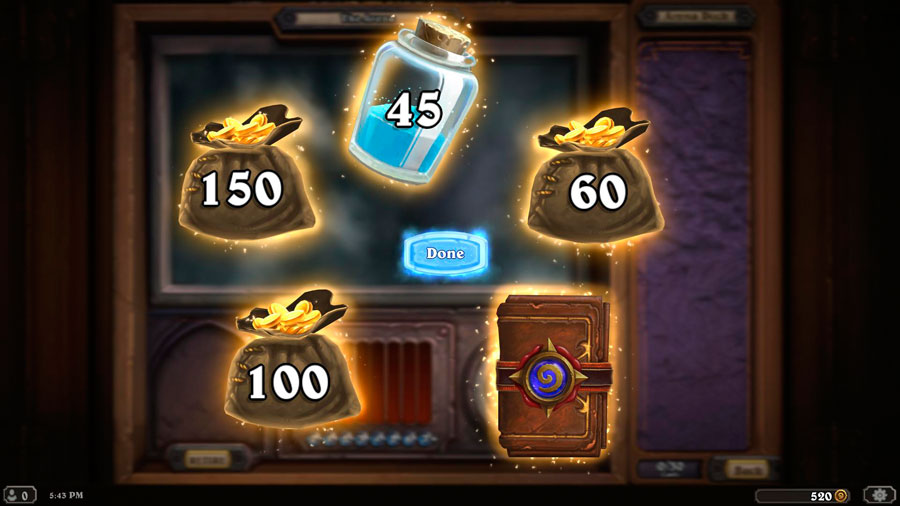
Money in the bank.
As you can see, I received 310g for having gone 9-2 with the Rogue (nine wins is the maximum). An earlier 8-3 record resulted in 215g. Needless to say, I was feeling pretty pleased with myself, especially given the Arena portion of the game is significantly more interesting to me – playing against Constructed decks feels pretty rote in comparison. Plus, where else would I get to screw around with Legendaries in what feels like a guaranteed draw for each Arena match? You aren’t likely to see those and other high-powered cards from packs you open, but seeing epics and such is pretty common across 30 random draws.
But then the RNG floor fell out. I felt I was getting a good handle on which Heroes were best in Arena – things are much different than in Constructed where you can build around combos – but I suddenly realized how exceptional my winning decks truly were. My 8-3 Druid deck had eight removal cards, including AoE removal. The 9-2 Rogue deck had two Saps, a bunch of Silence creatures with multiple ways of returning them to my hand, a fistful of removal, and two Defias Ringleaders that make going second a complete joke when you drop a 2/3 and 2/1 on your first turn.
Here was the deck:

Building this was so much fun.
You don’t need to know anything about the Hearthstone other than that this deck was unfair. Three Fan of Knives, two Blade Flurry, two Sap, two Patient Assassins, Betrayal… Jesus, it was sublime. Hearthstone Arena is entirely about tempo, and let’s just say most games involved me playing dubstep to their John Cage 4’33”.
Needless to say, I have spent the past three days falling back down the Bell Curve face-first. A string of awful Hero choices plus awful card choices plus opponents who all but win by round four (having demolished my early game). It is entirely possible this all has been by design, via hidden MMR rankings. One of the biggest Hearthstone innovations amongst the pile of others has been the fact that Arena games are unmoored from any particular tournament. If you play a Booster Draft in Magic Online, you’re playing either for 15 minutes or two hours depending on your record, against whomever happened to stroll into your tournament with you. In Hearthstone, you can play one Arena game and then come back a week later if you want. This is fantastic… provided you don’t rely on being a big fish in a small pond for your wins.
All this losing made me realize that I don’t like it. Losing, that is. A fair ranking system is based around ensuring you lose 50% of the time, but it seems to me that losing feels much worse than the positive winning emotions, especially when losing results in opportunity costs and/or costs you real money. Presumably the delta between winning and losing is compensated by the fun you have actually playing the game. But I am coming to the realization that it isn’t enough. I need a tangible sense of progression too. Knowing that the pity packs are full of cards going away in X number of months means losses are simply time consigned to the abyss.
The obvious counter-points are A) new gear tiers in MMOs result in obsolescence of progression, B) time spent gaming is technically “wasted” by default, and C) how in god’s name did you play Counter-Strike for four years then?
The answer to the first is pretty simple: properly-formatted achieved goals can’t be taken away. My goal in WoW was never “have BiS gear in every slot” – that is just a recipe for disappointment. Instead, my goals were more general, like “be better off than I was yesterday.” Grinding Valor, getting raid drops, capping Conquest… all of these things resulted in a feeling of sustained progression that persisted even when new tiers came out. In fact, my “investment” in gearing up paid off in getting the new gear quicker or more easily.
Obviously I quit playing WoW, but I still don’t see that time as wasted; leisure activities being a waste of time presupposes an (nonexistent) objective purpose in life, which answers point B.
As for C), well… that’s the pickle. I feel games like Counter-Strike allow you to experience meaningful fun even as you ultimately lose a round/match, probably because winning/losing doesn’t matter in the first place. As long as I pulled off some kind of crazy kill before dying, I could walk away satisfied even if our team was otherwise destroyed. Which is leading me to believe that the existence of progression in a game sets up its own failure, given that losing progression (either directly or via opportunity cost) makes me feel worse than gaining progression. At the same time, I tend to gravitate towards games with “investment” opportunities over games where I am “just” killing time. All games kill time, but killing time + progression makes it feel more meaningful on top of whatever arbitrary goal-achievement neurochemistry is going on.
All of which is an extremely roundabout way of saying that I lost a bunch of Hearthstone Arena matches this weekend and am sad as a result. Going from being more than self-sustaining to practically in-the-hole playing is bad, and there not being any sense of long-term progression (in the beta) makes it worse. Also, trying to unlock Shaman cards in Constructed play feels terrible; seriously, Blizz, why did you put all the juicy Shaman cards in the packs? Chain Lightning is practically required to get anywhere.
Wait a minute, why am I in-game again? Might as well knock out this daily…
Beta Impressions: Path of Exile
That’s right, I’m all beta, all the time up in this joint.

Okay, Trade Chat being on by default in the opening seconds is a little immersion-breaking.
For those not keeping track at home, Path of Exile is a F2P love letter to Diablo 2, and the Diablo franchise in general. It features six classes, a 1350-point talent tree forest, the Materia system from Final Fantasy 7, extremely gritty and realistic graphical style, and an outstandingly clever commitment to the game’s own setting. It is currently in Open Beta, and you can download it here.
While the central concepts of Path of Exile may seem strange at first, they are all pretty logical once you get past the unfamiliar veneer. For example, let’s talk about that 1350+ point talent tree. It is not an actual talent tree as you are familiar with, at least unless you played Final Fantasy X. The tree itself is entirely passive abilities and stat increases that act as nodes you activate with talent points you receive from leveling up or getting as quest rewards. The overall tree encompasses all six classes, with the difference being the starting location for each class. Thus, for example, the Witch starts on one corner of the board nearest all the +Intelligence and other magic boosting nodes.
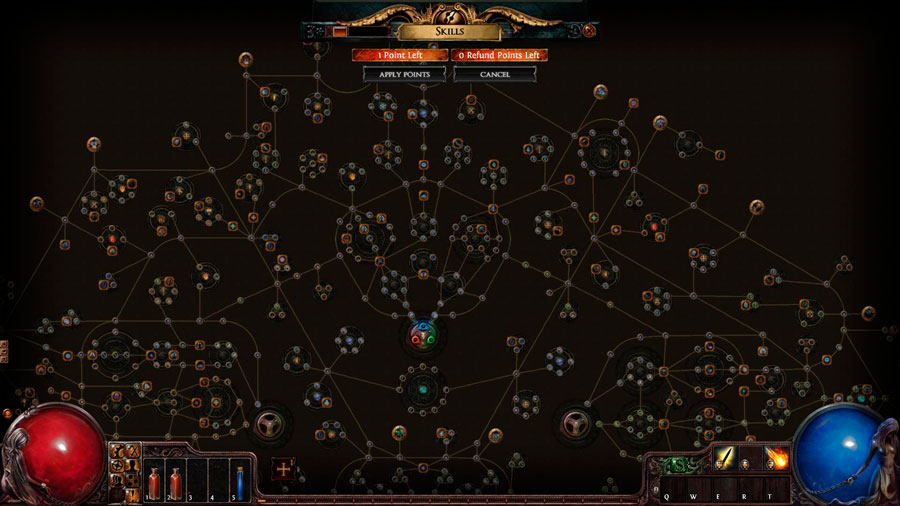
Hey, remember when this was fun?
The bigger nodes give bigger bonuses, and the extremely large ones are sort of capstone goals to help guide your character’s overall build. While your talent selection generally builds itself, it is possible to work your way across the board into other classs’ territories, if you are so inclined. That said, while the tree is certainly impressive the first few times you look at it, I’m not entirely sure of its practical use beyond standing out from the crowd. I spent 30 minutes mousing-over everything, decided which nodes I eventually wanted, and now will spend the next fifty levels getting variations of +10 Int or +20% mana regeneration. Woo, choice.
Meanwhile, the FF7-esque Materia system that Path of Exile emulates… is exactly what it sounds like. Basically, all the abilities your character has access to is governed by Skill Gems you socket into open slots on your gear. Want to use Raise Zombie? You need to fit that Skill Gem into an open blue slot. Fire Trap? Green slot. Shield Bash? Red slot. As you kill enemies, any socketed gems gain XP and level up just as you do, under the normal sort of hack-n-slash scheme (+1-2 damage, +1 mana cost each level). Later on, you will receive gear with Linked sockets which – again, exactly like in FF7 – let you link, say, a Fireball gem with a Multiple Projectile gem to (drumroll) shoot multiple Fireballs.
It is worth mentioning that, for the most part, any class can equip any Skill gem. I found a Shield Bash gem while running around with my Witch, for example, although I was unable to equip it because it required a Strength score of 16 (I had 14). While there will presumably be some +Strength gear somewhere, I could also raise that stat by navigating my way to a +Strength node in the talent tree. Pretty cool, IMO, although I believe the downside is a more limited selection of skills available for everyone overall. Shield Bash appears to be Shield Bash for everyone, so if X, Y, or Z skill is OP or garbage, you will likely be using the same skill loadouts no matter what class you pick.
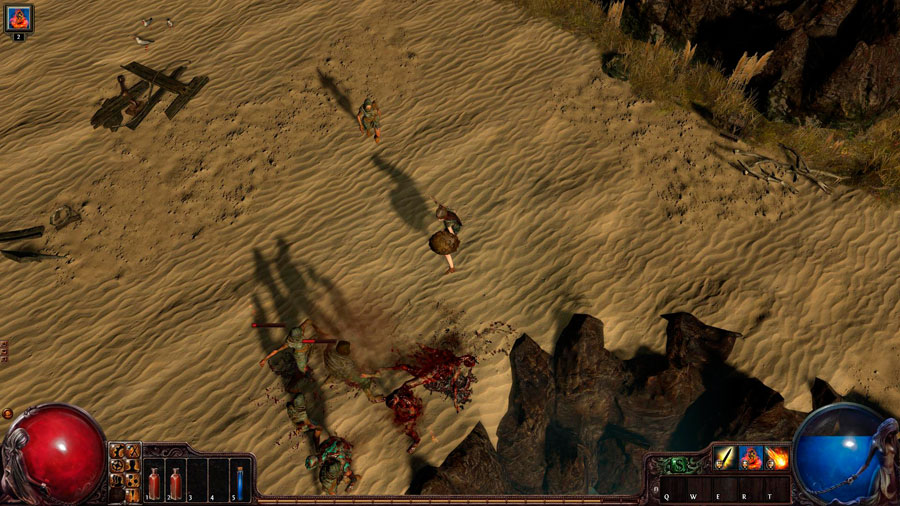
The Hack-n-Slash is hack and slashy.
What is beyond reproach and, frankly, goddamn brilliant is Path of Exile’s integration of the game’s setting into the gameplay. The premise of the game is that your character has done something or pissed someone off enough to be exiled to some hideous and hostile land to die (think: colonial Australia). So while the game looks understandably dark and gritty, it actually goes much farther than that. For example, when you sell items to a vendor, the currency is… scraps of an Identify Scroll. Five scraps equals one full scroll. Which you can then consume to identify an unknown magic item, ala Diablo. There are other barter currencies that double as actually useful items (Transmutation Orbs turn normal items into magic ones, other orbs randomize a magic item’s properties, etc) too, which sets up some interesting dilemmas insofar as using them as currency to buy better gear or use them to possibly make what gear you already have better.
Now, seriously, how amazing is that economic system? Every prototypical hack-n-slash would simply have used gold pieces as the medium of exchange here. Hell, I don’t think anyone would have cared if gold pieces were used as the currency in Path of Exile, even though it doesn’t make any logical sense for there to be a vast sum of wealth in a prison colony. It reminds me of Metro 2033 where your currency for buying guns and such were rounds of military-grade ammo, which you could technically load into your guns and fire.
Are there downsides? Sure. Since there is nothing worth less than a scrap of scroll, the beginning hours of gameplay highly encourages you to loot 100% of all junk since 5 pieces of anything = 1 useful scroll. This goes the other way too, wherein selling a magic item nets you a rounded-down amount of other material rather than 1400g vs 1100g. Vendor items get a bit goofy too, when they charge the same price for a necklace that provides 2 HP/sec regeneration with another necklace that provides 3.7 HP/sec regeneration.
Another example of the noble commitment to rational setting consistency? Instead of health/mana potions, you have health/mana flasks that use X number of Y charges for Z effect. And they recharge when you kill enemies. I mean, sure, there isn’t much of a logical reason why the Frost Elemental slime drops a wooden tower shield, but at least you’re not seeing more glass beakers full of replenishing liquid mowing down zombies as you’d find in an alchemist’s lab. Monsters drop less items as a result of this artistic/setting direction, but it still manages to feel similar to the loot explosions of Diablo (if less intense).
So, basically, I am having a lot of fun thus far with Path of Exile. While the devs have posted a sort of cash shop manifesto for this F2P game, they appear to actually be taking the “no P2W” mantra seriously. Hell, I don’t think they are even selling +XP potions, which is something I have simply come to expect from these games. The one lingering concern I have is the whole Ranged vs Melee (im)balance, which is something they do have on their roadmap to address. But beyond that? If you liked Diablo 2, play this game. Hell, if you liked (or disliked!) Diablo 3, play this game. It’s a F2P hack-n-slash, so what do you have to lose?
Other than your time, of course.


October Surprise(s)
Sep 30
Posted by Azuriel
October is shaping up to be a busy month.
Hearthstone is going to have its first (and only) beta wipe coinciding with a large rebalancing patch. And apparently more opt-in beta waves. Which is an important distinction from open beta, which this will not be. The good news is that there isn’t going to be any further beta wipes, so progression for those that are in the beta is going to be permanent thereafter.
The “rebalancing” is of most interest to me (of course), as Blizzard is going to have a thread a needle made out of graphene. I have talked about some of the imbalanced cards before, but the most salient point is that the devs do not have the same access to the balance “knobs” as they do in, say, WoW or Diablo 3. Hypothetically, making the Pint-Sized Summoner go from costing 2 mana to 3, for example, is an enormous balancing change that has wide-ranging repercussions on how (and if) the card is played at all. I would personally change the Pint-Sized Summoner to be a 1/1 or maybe a 1/2; the former makes it a dead draw against Mage and Rogue decks, but honestly, I don’t feel like an Arena game should revolve around whether you have a turn-2 removal spell in your opening hand. Maybe they could change it to be only 1 mana off the cost of creatures and leave the rest alone?
Speaking of digital card games, Hex will be beginning its Alpha testing on October 8th. To be honest, even with the weekly Kickstarter updates, I sorta forgot about the fact that I pledged $85 (!) to this game nearly 5 months ago. And even more honestly, Hearthstone kinda sucked all the oxygen out of the CCG room. For however lame its been to go 0-3 or my most recent 3-3 record in the Hearthstone Arena, at least I could choose to pay $0 for those games; going back to $6 drafts will be rough. The Alpha test will give everyone 4 copies of all PvP cards, so at least I won’t have to decide whether to “waste” all my Kickstarter packs before the game comes out (which hopefully dilute the skill pool a bit).
Although I have not been playing it regularly, PlanetSide 2 is due for a huge optimization patch on October 23rd. I’m not actually all that excited about it, even though the devs are supposedly touting a ~30% gain in frame rates across all types of computer configurations. Why? First of all, this optimization work is at the expense of everything else. Changes to the Infiltrator class? Pushed back. New air weapons pushed back. New continent pushed back. And so on.
A fire was clearly lit under someone’s ass about poor performance, but with players leaving in droves, I’m not sure that chasing after the ones that left over computer issues is a winning proposition. And that leads me to reason number two: it’s all really a cynical ploy to get the game ready for the PlayStation 4. “Cynical” as in they only bothered caring about performance nearly a year after release, and only when the opportunity to cash in on a new market presented itself.
I’m a little bitter, if you can’t tell. Every time I get the bug to go play some more of PS2, I hit Instant Action and am sent to some deserted facility that changed hands an hour ago. And when I do happen to find some action, it inevitably dies down quickly and I’m left staring at the 5, 10, 15 minute capture timer. “Open world” and “emergent gameplay” is nice and all, but when I end up playing longer on my phone waiting for something to happen in the main game, something has gone horribly wrong. Ain’t nobody got time to wait around empty bases.
Luckily for me, and rather unfortunately for Sony, Battlefield 4 comes out October 29th.
I am not really all that certain I will be purchasing it on Day 1, although I had a blast playing Battlefield 3 for the six or so months that I was doing so. Looking back in my archives, I didn’t really talk about my experiences with it all that much. Basically, I see it as PlanetSide 2 without the waiting. While BF3 is technically more similar to Call of Duty than a sort of “open world” like PS2, the reality is that all PS2 brings to the table (or my table, anyway) is the ability to hop into a vehicle or airplane without having to wait/steal it from someone else. Every single other thing is better in BF3 – the shooting, the graphics, the action, the tactics, the depth. Again, technically, PS2 can have deeper strategy via Outfits and the like, but to the average player in the average game session, BF3 can’t be beat.
I haven’t really been following the Battlefield 4 news all that closely, but I find it interesting that the new game modes are being heavily skewed towards Call of Duty. Not that CoD invented any of them, of course, but I am more referring to that sort of play-style. Domination, Defuse, Team Deathmatch, Squad Deathmatch, and Rush are all CoDish to me. Conquest is still there in all its glory though, and Obliteration sounds somewhat interesting with its hot potato gameplay. But sometimes I just feel like shooting people in the face, you know? So that’s probably okay. Plus, technically every game mode will be available in all 10 maps, so it is not as though you’re stuck in the same handful of maps for every Conquest game.
Also coming in October: Terraria‘s 1.2 Patch, Don’t Starve‘s final two content patches (October 1st and presumably the final one 3 weeks later), and I guess GTA Online.
Regarding the latter, I am, of course, holding out for the PC release.
Posted in Commentary
Comments Off on October Surprise(s)
Tags: Battlefield 3, Don't Starve, GTA 5, Hearthstone, Hex, PlanetSide 2, Terraria