Review: Terraria
Game: Terraria
Recommended price: $10 (full)
Metacritic Score: 83
Completion Time: 50+ hours
Buy If You Like: 2D Minecraft, procedurally-generated Metrovania platformers
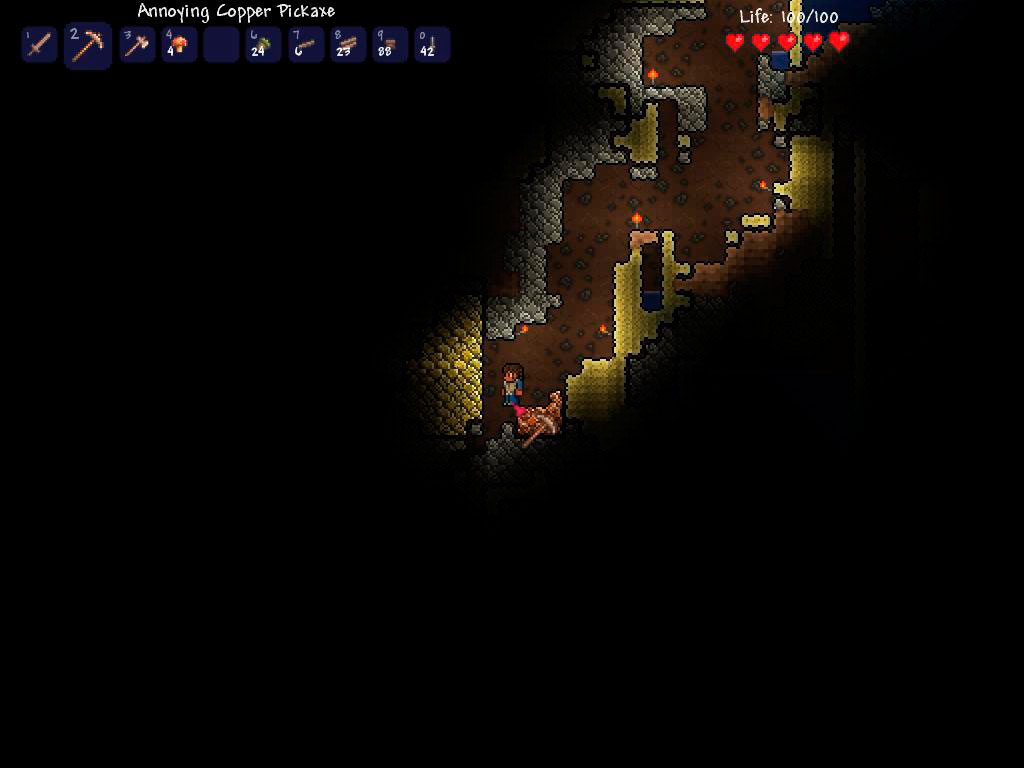
WHY IS THIS SO FUN?! *sobs*
Up until I started playing a few weeks ago, the entire mental space Terraria occupied for me can be summed up as “that 2D Minecraft knock-off.” I am not even sure which game came first, and it did not seem to matter: Terraria was just another game about digging for ore and crafting better pickaxes to mine for more ore. In only two dimensions.
After seeing an entire weekend evaporate in a flurry of clicking pixel blocks however, I am here to say that Terraria is not just a 2D Minecraft clone. It is an unholy union between all the addictive parts of Minecraft combined with legitimately entertaining Metrovania gameplay with a liberal dose of SNES graphical/musical nostalgia thrown into the mix.
Terraria starts out innocently enough, with your character equipped with a copper sword, axe, and mining pick. The beginning hours will be spent chopping trees, building your first crafting station, killing some slimes to turn their quivering innards into fuel for your torches, and so on. Much like Minecraft, zombies and other uglies come out at night which drives you to create shelter and then start digging underground for wont of something else to do.
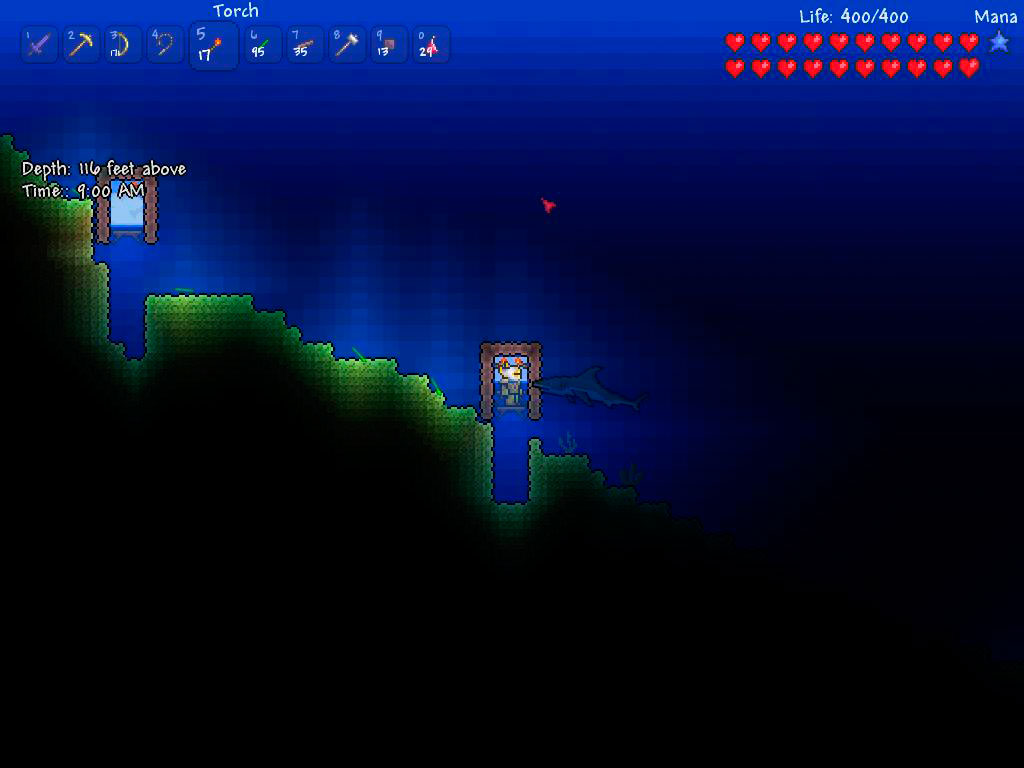
C’mon, this is easily more explainable than average Minecraft shenanigans.
While it might not initially seem so at first, there is a surprising amount of depth (har har) to Terraria’s gameplay. While you are hunting around for Copper and Iron ore, you will of course encounter enemies in the deep places of the earth. You will also frequently encounter priceless clay pots of a forgotten age which can be broken and looted for coins. You will eventually start coming across chests filled with goodies/equipment, and even crystalline Hearts, which can be broken and then consumed to increase your HP.
As you hit certain milestones, the world around you changes. Once you have accumulated 50 silver pieces, a Merchant will hang around your house, provided you build a room for him to sleep in. Finding and hoarding bombs will cause the Demolitionist to start peddling his explosive warez. And once you surpass 200 HP, there is an increasing chance the Eye of Cthulhu (the first boss) will settle its gaze upon your growing hamlet.
Not only does all this progression feel natural, it is also addicting. Your hunt for better ores to craft better armor and weapons to make your life easier leads to encountering stronger foes and ever more secrets. While crafting is a lot less complex than with Minecraft – you can talk to the Guide to see every craftable item that a given ingredient can produce – it simultaneously feels a bit deeper. Hitting Diamond could be accomplished relatively quickly in Minecraft, at which point you were essentially in the endgame. Contrast that with Terraria, where the natural hardiness of your foes directs your exploration of the whole of the game map before culminating in a Final Boss… whose defeat unlocks the Hardmode version of your world, with new enemies and even harder bosses.
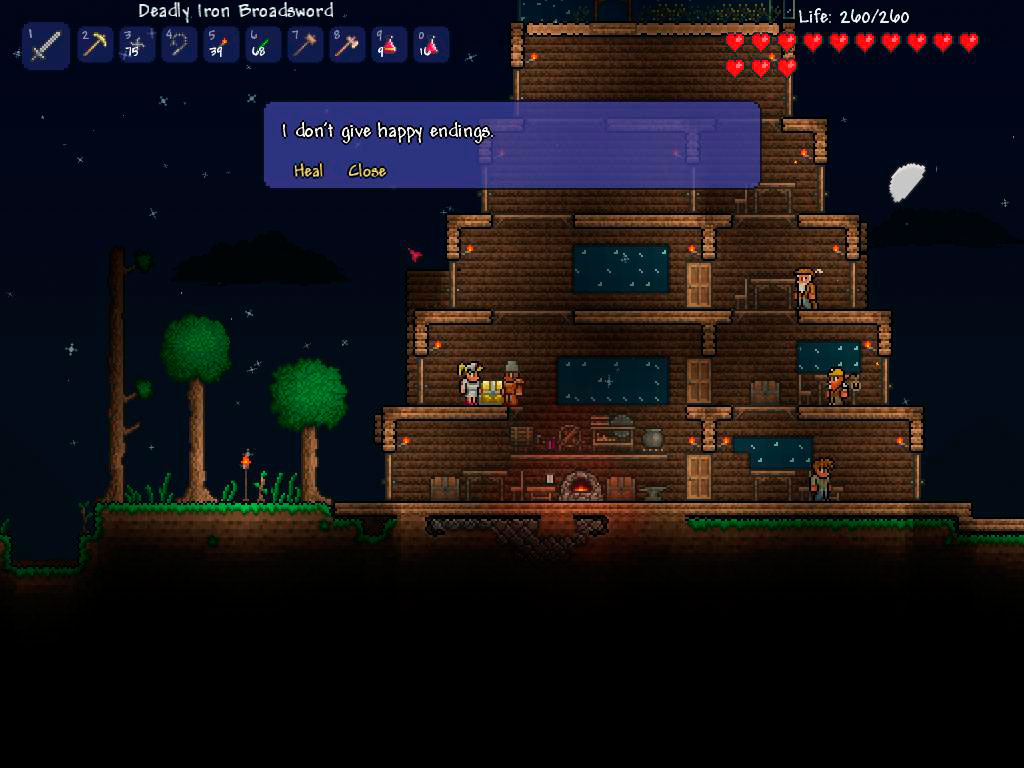
I… I’ll see myself out.
Of course, all of this implicit progression leads to a necessarily more finite resolution. While there are quite a few different set pieces to play around with, you are probably not going to spend the same amount of time building castles and mountain fortresses here as you would in Minecraft. That said, my game clock read 53 hours by the time I finished off the last of the Hardmode bosses and crafted the final piece of my ultimate armor. I could farm these bosses a few more times for their exclusive material drops – who wouldn’t want to run around with a flamethrower? – but it almost seems superfluous at this point. What would be next? Would I reroll a new character in a new procedurally-generated world? I could. But I feel I have already mastered these mechanics, and would simply arrive at the same destination a bit faster this time around. Hell, I could even equip my new character with the flamethrower and best pickaxe in the game to further speed along the process. Or I could go play something else.
Overall, the only real regret I have with Terraria was having spent all the time up to this point thinking of it as just a 2D Minecraft. Both games share many similar qualities, but why would another instance of “cause one to lose all track of time” or “become obsessed with mining better ore” be considered a deficiency? Both games are fun, in slightly different ways. Indeed, I am not even sure which one I would recommend first to someone who has played neither. Show Minecraft first, and like me, you might be a tad disappointed in the more limited forms of customization and Terraria not quite comparing to the sheer scale of an infinite 3D world. With Terraria going first though, you run the risk of having the person balk at Minecraft’s lack of direction and flat sense of progression.

Yes, that’s a lava moat below a lever-operated trapdoor.
In any case, having indie game companies force these tough choices on us when the AAA industry is falling over themselves pumping out derivative, 6-hour long sequels is ultimately a good problem to have.
First Impressions: Dust 514
After talking about this F2P title on and off for the most of last year, I decided it was about time to put my conjecture where my mouth is. Err… hands? You know what I mean.
After quite literally dusting off my PlayStation 3, I started the process of downloading the 1.3gb game. To kill some time, I started playing Journey while downloading Dust 514 in the background. I didn’t make it more than five minutes before stopping Journey and doing some research as to how I could take screenshots on the PS3 because damn. An hour later, I stopped looking at $150 video capture cards and finished installing Dust 514. Ten minutes later, I begin updating the game. Forty-five minutes later, Dust 514 finishes downloading and installing a patch larger (!?) than the entire original download.
Now, if it has not already been clear from historical record, let it be noted that I am not much of a console gamer. This was not always the case. In fact, all the way up until the end of the PS2 era, I was a console purist. With the notable exception of Balder’s Gate and the original Deus Ex, I felt like PC RPGs were cheap imitations of the holy JRPG (i.e. Squaresoft), which could do no wrong. In my prior life as a freelance RPG reviewer, I have 60+ “published” RPG reviews attesting to that fact; I even gave Planescape: Torment a below-average score because the combat system was bad.
I’m bringing this up to illustrate the fact that this entire console generation has left me behind until now. Or, rather, I left it behind. Although I was in college during the Halo heyday and thus have experience playing its first three iterations many times in the fraternity house, I never personally owned an XBox. Ergo, my skill at thumbstick shooters is abysmal. Give me a mouse and keyboard and I will shoot your aim-assisted face off any day. Ask my thumbs to do more than spam the Spacebar though, and I’ll have some rehabilitation issues.
Enough preface, let’s dive in.
First Minutes
God damn this game is ugly. This seriously looks like I’m watching a 480p Youtube video of someone playing Turok: Dinosaur Hunter. Yes, the Nintendo 64 version. Don’t get me wrong, it looks better than Darkfall, but it also looks like it was drawn entirely in watercolors on a soggy canvas. Or I’m looking at it through goggles filled with river water. My first red flag should have been the 1.3gb download, I suppose, although Skyrim was Skyrim with just 5.8gb. Then again, that was on the PC…
I made Azuriel Inanage a Gallente something something race, a decision based entirely on the look of the face mask. In my defense, the entire race decision seemed somewhat pointless considering everyone is in armor all the time, mercenaries can fight for any race, and you can train every race’s gear. I sat through several tutorial screens which showed me around the basic lobby interface, with its amusing “Would you like to learn more?” Starship Trooper prompts. They start out giving you 500,000 Skill Points and 250,000 ISK and then… basically drops you off at the pool.
Now, I still struggle with the judgment as to whether a game developer deserves a pass for this sort of design. Is it the noble “sink or swim” attitude, or is it “crunch time, we’ll fix it in a patch later” lazyness? I’m personally willing to muddle my way through a considerable amount of bullshit in search for that one kernel of fun, but that’s mainly because I’m a masochist at a minimum it becomes easy blog content. And I am not even really saying that Dust 514’s Skill/etc system is hard. It’s just… opaque. 100% function, 0% form.
You basically cannot spend Skill Points until you pay ISK for a Skill book that unlocks that specific Skill. So to start, I needed to purchase Skill X for Y ISK and then spend Z SP to unlock Rank 1. Some of the skills are “empty,” in that their sole function seems to be to sink ISK/SP by forcing you to rank up just for the privilege to access other skills. Others are more functional, like increasing shields by 2% per rank. The system seems to promote unlocking as many Rank 1-2 skills as possible (these ranks only cost 18k-36k SP), but you are gated pretty hard by ISK, at least at first.
So let’s go get some ISK.
It is worth noting, before I get into the outcome of my first few matches, how this game works. You start out with a few different loadouts with basic gear that you can always equip no matter what. Every other thing in the game, from weapons to side-arms to grenades to the very dropsuit you wear is a consumable resource. Meaning, each time you die and respawn, you lose everything you were wearing. Did you just buy some uber-gun but get ambushed at the spawn point? It’s gone now.
I suppose this is designed to evoke a feeling of risk and gravity as a counter-point to the more standard suicidal FPS inclinations. I wouldn’t say that I am completely risk-adverse per se, but I absolutely hate the feeling that I would have been better off not playing at all. Losing WoW Arena games back when hitting 1800 represented a huge leap in combat effectiveness, for example, felt brutal; there was no worse feeling than starting at 1780 Rating and then losing six games in a row. Dust 514 evokes that same feeling, as not only can you lose a bunch of purchased gear right away, but that gear also represents ISK you could have spent buying Skill books instead.
As it turns out though, those ISK concerns may be moot.
My first match was pretty bad, entirely due to my aiming like… well, like I was holding a gun using just my thumbs. It was a “Skirmish” map, which breaks down as a pretty standard cap and control game. At the end of the match, it turns out I received ~150,000 ISK for losing. Based on my experience thus far, the payout seems to be mainly based on time spent; the difference between a win and a loss seems to be around 50k ISK. Also, you can end up receiving “salvage” in the form of guns/equipment. I am still technically in the “battle academy,” aka the kiddie pool, but I would be surprised if you end up earning less out in the game proper.
Given how much ISK you get either way, any consumable equipment concerns are severely diminished. Even a top-tier assault rifle only costs ~11,000 ISK. There was not a full match in which I died more than 8 times, so I would still have turned a profit despite losing all those guns. Plus, presumably a better weapon would mean dying less in the first place. The value of a whole suit loadout is probably more substantial, but quibbling over the 700 ISK mid-tier guns suddenly seems silly. If this is the paradigm though, why bother with all the ISK nonsense to begin with?
Ah, right. Free-to-play.
Instead of purchasing items individually, you can buy blueprints which give you an infinite supply of them. These blueprints, assuming they don’t drop as salvage, can only be bought via Aurum, the RMT currency. Now, Dust 514 is probably cheaper in the scheme of things compared to, I don’t know, Planetside 2. But in this particular case, the game mechanics themselves feel a bit more insidious. Granted, it could just be my bias showing through, especially given how Dust 514 lets you preview the weapons or effectively “buy them” for significantly less than the Planetside 2 equivalent.
Honestly, I just don’t like consumable anything, even if I have more than I would ever need. I’m the guy still hesitating to use the stockpile of Elixirs while fighting the final boss. It makes no rational sense, but there it is. Ergo, I’m leery of CCP having my number, so to speak, when it comes to these blueprints. I’m not actually going to buy any, but I will feel bad all the same.
Anyway, those are my Day 1 impressions of Dust 514. Like always, I will stick with the game for a bit longer just to ensure that I give it as fair a time as is possible under the circumstances.
PlanetSide 2 – Six Months Later
So, it has been almost 6 months since I started playing PlanetSide 2. Am I still having fun?
Short answer: Yes.
Long answer: …yes.
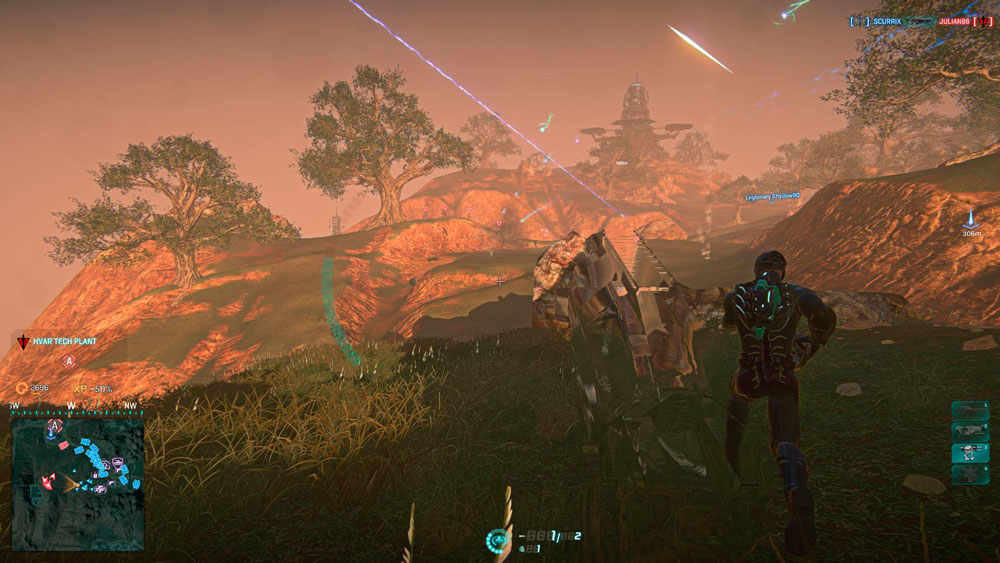
Everything a sniper likes to see.
Aside from a brief 1-2 week experiment with Outfits (aka guilds), I continue to have fun despite playing solo. While many of the problems I outlined in my prior article are true regarding organized PvP, they are perhaps a tiny bit less true now. Anti-Aircraft units have not been nerfed, but I am a bit more cognizant of of where they might be and thus avoid them. Or perhaps, given the server mergers, there may simply less people playing.
The biggest “problem” I consistently have with PlanetSide 2 are its break points.
Have you ever sat down at an MMO (or any game) and find yourself easily able to play for 2, 3, 4 hours at a time? That sort of thing doesn’t happen by accident; it’s part of a game’s intentional design. In PlanetSide, I occasionally sit down prepared for a long night of gaming… and then log off after 30 minutes. Finding a compelling fight isn’t necessarily the problem: the problem is finding the next one.
Momentum can stall. Spawning at a Sunderer and throwing yourself into the meat-grinder attack of a base feels awesome. And then you win. Err… what now? Sometimes the attacking force splits up. Sometimes you stay together as a cohesive unit, only to find that the next base you find is empty. It can take 8+ minutes to cap even an empty base. That is eight literal you-only-have-41 million minutes of your life, staring at the wall.
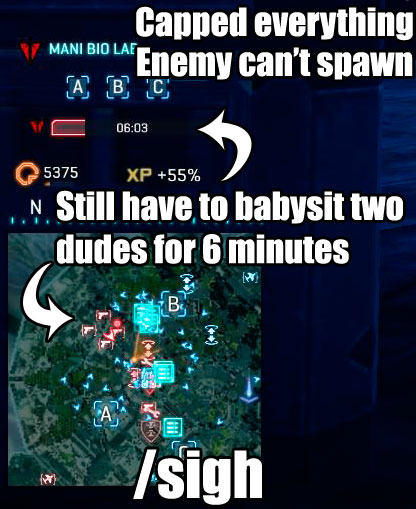
Thankfully, this shit should be changing soon.
Part of why I stick with this game though is because of how much communication and iteration there is between the devs and the community. There are major game updates roughly every two weeks. The community asked for test servers so broken mechanics and (new) bugs stop appearing, and now we have a Public Test Server. The devs are pretty active on the Reddit forums, soliciting suggestions and advice.
I don’t think the designers have all the right answers – the devs clearly have some issues coming up with interesting Vanu mechanics, not unlike the issues Blizzard has with the paladin kit – but they are visibly trying. I am excited in particular regarding the upcoming lattice system. Assuming everything works, this could go a long way in fixing the problems with the gaps in engagement I experience after capping a base. And changes to the capping of a base – where destroying the Spawn Control Unit allows an attacking team to actually move on – will lessen the dead time after overwhelming a position.
So… good news all around.
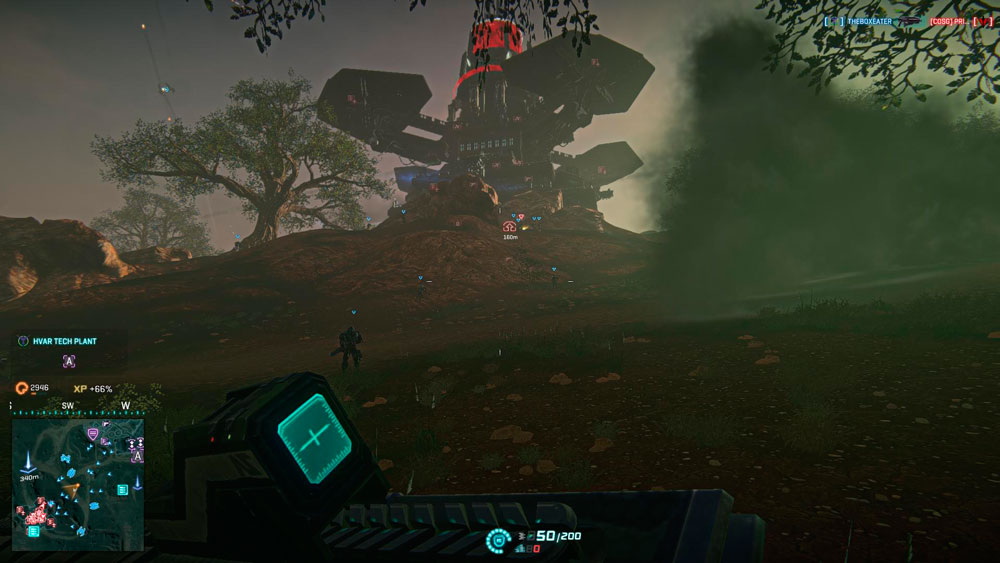
Still such a thrill rushing an enemy base as a spontaneous group.
If you are curious about the personal effects of Cert-Gate a month later, let me assure you that I don’t feel like it has changed all that much about the way I play. Yes, I have most every upgrade. Yes, I care a bit less about capping empty bases, given that I don’t feel like the 2-5 bonus Certs are worth 2-5 minutes of my time. On the other hand, I naturally have a hard time committing all of some limited resource to something. For example, I have ~2800 Certs left out of my stockpile. There are two guns I could buy with those Certs… but I won’t. Because I know that there will be new shiny things coming out in a few weeks, and I like the option to purchase those instead. But I might not buy those, and instead hold out for the new gun releases after the next batch. And so it is almost as if my 2800 Certs don’t even exist. It’s a bit irrational, but that’s how I roll.
So, yeah, I’m still having fun. PlanetSide 2 isn’t my main game (largely because it can’t be, given the breaks), but it is still a game I constantly think about and can’t wait to play for a bit when I get home. And the best thing? I don’t have to make apologies to anyone for those days when I just don’t log in.
Who is enjoying the MMO single life? This guy.
Instant Gratification vs Fun Investment
All this talk about Magic: the Gathering makes me want to revisit a topic I briefly touched on last week, in the comments here and elsewhere. Namely, the sort of denigration of “instant gratification” and the elevation of investing in “long-term fun,” which is presumably shorthand for “doing a series of boring things for a reward later.”
The choice between instant gratification versus an investment in long-term fun is a false dichotomy. Gaming is an instance in which you can have your cake and eat it too.
One of the examples activities that was used to illustrate how “boring gameplay” can lead to bigger returns in fun was painting figurines in a tabletop game like Warhammer. Simply purchasing already-painted figurines would just not be the same despite having no direct gameplay relevance. I agree. I also agree with the notion that, say, using cheat codes to become immortal, having infinite money, and so on right at the start of the game likely diminishes the overall amount of fun you can derive from it.
But here’s the thing: someone who paints their Warhammer figures probably finds the act of painting them fun.
I used to play a lot of Magic: the Gathering back in high school. The games were nothing serious, just some 3-5 person chaos multiplayer amongst friends. However I would routinely spend about 10 hours crafting decks for every 1 hour a given deck would actually see play. In fact, if any of my decks began to routinely win, I stopped using them and built new ones.¹ And I had fun!
Deck-building was almost better than playing the actual game for me. There is something deeply satisfying in seeing a complicated scheme all fall into place, top-decking the one perfect counter that changes the game right when you need it to. But running all those scenarios through my head, pouring over all my available options, whittling down a pile of 250 cards I wanted to use into a perfectly-tuned 60-card machine was pure entertainment in of itself.
Another example: D&D. I ran a 4-year campaign throughout all of college, and a little beyond. As a DM, I let my players have ample freedom, but I made sure the world they inhabited was scaffolded in lore such that they had a place in it. In other words, I wanted to give them the ability to take the world as serious as they wanted to. Of course, most sessions started and ended with them starting a bar fight rather than the existential pondering I secretly wanted them to do. But it is not much of a stretch to say that I spent 20 hours per week in preparation of one 3-6 hour session. Never once did I consider those 20 hours a chore. I was excited to DM those games because it gave me the opportunity (and justification) to spend all that time world-building.
Now, clearly, what an individual finds fun is going to be subjective, and possibly something that changes over time and circumstance. But my point here is that the sort of activities necessary for long-term enjoyment – figure-painting, deck-building, world-creation – can be fun in of themselves. Not only can, but should. This extends to all in-game activities.
I do not buy the argument that something like Darkfall/EVE’s AFK resource-gathering systems is fun “because it gives you the time to do something else.” An activity doesn’t become fun by adding in a separate fun thing; an activity is either fun in of itself or it isn’t.² An unfun thing can become tolerable when mixed, but that is not a point in the base activity’s favor. Being punched in the face is alright if you give me $1,000, but I would rather just have the $1,000. Is desiring just the money considered “instant gratification,” or is that simply rational?
You can rightly question why I am not currently building Magic decks or constructing D&D campaigns if they are so fun in of themselves. The truth is that without the payout, without the destination at the end of the journey, these (investment) activities are not as fun to me. However, while they might not be as fun – that is, they are less fun than other things I could be doing instead – keep in mind that they still are fun. An actual destination acts as a force multiplier, if you will, to the entertainment of the journey. Contrast that with many of the in-game “investments” we are tasked to complete which make no sense to perform at all without reward, e.g. they are the punch to the face.
The distinction is important, because I feel it is far too easy to for us gamers to fall into the cognitive dissonance trap of “retroactive fun” and Sunk Cost fallacy. “I spent 5 hours farming herbs, it must have all been worth it!” Even if there is no real difference between actual fun and retroactive fun in practice (and isn’t that a depressing thought?), it does matter when comparing games mechanics in the moment.
All things considered, you should desire the mechanics that are both fun now and even more fun later. We simultaneously can and deserve to have both.
¹ A successful deck was a sort of “proof of concept” for me. Could my infinite damage combo reliably work in an actual hostile environment? Coming up with combos was a lot easier than constructing a deck capable of pulling them off, after all. Plus, my goal was never to craft a (P2W) deck that beat my friends 100% of the time; that sort of thing is never fun to play against anyway.
² It’s probably more accurate to say fun is a gradient rather than a binary distinction, one that can shift from one moment to the next. But I still believe that the unfun half of the scale hits zero right near the border.
Hex Followup
Is it just me, or does the word “followup” just look weird after a while?
…anyway. Here are some relevant Q&A straight from the forums regarding the now-funded Hex:
Q: Any chance this might be headed to IOS as well?
A: Our immediate launch plans are PC and Mac, but the tech has built from the ground up for mobile.
Q: I would also like to know about the card rotation plan. Will there be standard and unlimited formats, or will all cards be legal to play forever?
A: Right now we’re planned for a 2 block format, as well as an everything format. That is the current plan. We might revisit it after 2 years of data.
Q: The estimated delivery sep 2013 is that for the full game or the beta stages ?
A: September is the estimated delivery for the beta, which will have all of the PvP content and some of the PvE content.
Q: Will the game require a big internet connection? I’m currently working 6 month a year in a inuit village with Satellite internet connection and wireless modems and I get a 5000 ping in online games like Path of Exile here. Wondering if the game will be playable in those condition (Drop out, Lags, ect).
A: The internet overhead of the game is very, very low. The amount of data that goes back and forth to the server is minimal, and we have a 3 minute reconnect timer, that if you lose connection during a game, you have 3 minutes to log back in and you will be automatically rejoined to that game. Any single player experience just uses save states, so you can actually rejoin almost any time after disconnecting.
Okay… hold up a sec. “Working 6 months a year in a inuit village”? You know what, nevermind.
Q: Weird question i know, but any plans of a post beta wipe, getting packs and such back?
A: We will not do a post-beta wipe. Once we give you something, we won’t take it away in even the most seemingly kind way (eg, by refunding packs.) If you open a super rare awesome card it’s yours until you decide to trade it.
Q: So there is currently no other way to get cards for PVP except through initial pledge and buying $2 each?
A: The only way to get PvP packs is through the KS rewards, at $2 each, or as rewards for playing in drafts/constructed tournaments. We will also have an auction house, and I’d expect that PvP commons can be easily picked up off there at budget prices.
So it’s official: you cannot earn booster packs in PvE content. In other words, the only way anyone is playing Limited/Draft formats is for them to have bought, traded for, or won boosters themselves. Based on other questions, it appears the first set is 350 PvP cards that only come from boosters, and 300 PvE cards that are only earned in PvE and cannot be used in normal PvP games (but there might be “anything goes” formats for fun). Now, it is likely you will be able to sell a particularly nice rare you got in a Draft (that you otherwise lost) to help purchase boosters to try your luck again, but otherwise these games are going to cost you $6 a pop for less than an hour of play.
By the way, the stretch goal for $540,000?
540K – Add Primal Packs
Primal Packs are “god packs” that will drop for lucky players when buying HEX booster packs. It is not a separate item in the HEX Store. Every card in this booster is a Rare or Legendary! In addition, each Primal Pack will contain a Legendary Treasure Chest that will hold some truly incredible items, which you can open or trade in the Auction House. Speaking of which, should you be lucky enough to get one of Primal Packs, they are tradable and can be given or put in the Auction House for others just like any other pack. To maintain balance in a tournament setting, you cannot get a Primal Pack during a draft.
“Yo dawg, I heard you like gamble boxes. So we put gamble boxes in your gamble boxes […]”
If it sounds like I am being unduly harsh, it’s simply because I know the effect these sort of games have on me. Drafting is addicting: you get to see 24 boosters being opened, passed around, and picked apart, plus the 30 minutes of frantic deck-building, plus the very-real pressure of best-out-of-three duels with the prize being enough boosters to join another draft for free. That’s a sex, drugs, and rock & roll combo of endorphins right there.
But you’re going to pay. A lot. Unless you’re good, I suppose, in which case the poor players will be subsidizing your gameplay.
Just screwing around in 1v1 Standard duels is fun and all, but you won’t be getting any new cards; there is no progression without pay. Then again, I suppose that is what the whole PvE side of the game will be about. Will it be enough? You cannot use your PvE cards in PvP. Then again, PvE cards do not “expire” and yet there will be additional PvE sets in the future, presumably along with additional monsters/dungeons/raids, so… yeah. Maybe Cryptozoic will be able to shore up the one weakness Magic Online has.
I suppose we’ll see in September, once the Beta is released.
Hex
In the event that you didn’t read last Friday’s Penny Arcade, they talked about the Cryptozoic Kickstarter for a “MMO-TCG” called Hex. Basically, Hex is Magic Online meets WoW TCG meets cards that can get socketed gems, equip gear, gain XP, earn achievements that expand artwork and upgrade cards to foil versions. Also, there will be PvE, apparently including dungeons and raids. And all of this is Free to Play.
Of course, just like with Hearthstone, calling a TCG “F2P” is criminally misleading.
I have some concerns with Hex. First, while I am frankly excited about the unique opportunities involved with an all-digital TCG – cards that buff your creatures do so for the rest of the match, you can put tokens on cards that get shuffled into your library, and all sorts of crazy nonsense that physical card games couldn’t pull off – this game skews so heavily towards Magic Online that I’m surprised Wizards of the Coast hasn’t issued a takedown notice.
Seriously, look at this video:
I’m not talking about Apple’s “rounded corners” copyright bullshit, I’m talking about Grand Theft Mechanics. Creatures have summoning sickness, there is First Strike, Haste, seven cards in the opening hand, 20 life per player, four copy limit on individual cards, 60 cards per deck, land cards, instants, discrete turn phases (Draw phase, main phase, declaring attackers/blockers/combat damage, end step), and even the goddamn Stack.
That’s not even really my concern here though. My concern is what occurs about 200 times in the bottom right corner of that video: spamming of the Pass Priority button.
This is alpha footage, things can change, etc etc etc… but not really. Magic is an incredibly nuanced card game with thousands of pages of technical rules that few follow to the letter in non-tournament settings; friends usually don’t ask each other if there is any response to their Draw Phase, unless one of them was packing a relevant card in their deck. My initial few weeks with Magic Online was a brilliant experience because the game reminded you of all the sort of routine Upkeep triggers and the like that can bog down/derail completely a physical game when you forget one. Trouble is, Magic Online is going to ask you every damn time because it has to. You can manually change your settings to ignore certain steps if you want, but again, Magic is an incredibly complex beast – if you aren’t careful about when you cast a spell or use an ability, you can snatch defeat from the jaws of victory in an (cough) instant.
So that’s concern number one: the Pass Priority button is going to simultaneously be annoying as hell and be the reason you lost a perfectly winnable match. It’s also incredibly high-brow for as much as Hex is being marketed as “easy to get into.” I was a tad disappointed at first when I watched the Hearthstone duels and realized that there would be no “in response I play X!” back and forth. But seeing Hex and being reminded about how cerebral Magic can get… I think the Blizzard folks are on the right track, at least for a casual audience.
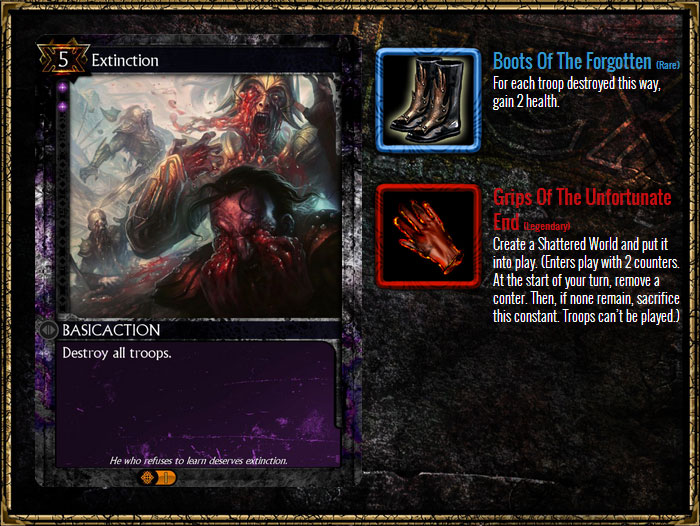
Calling it now: this will sell for at least $60. Each.
Concern number two? You’re going to spend probably $100-$200 a month playing this F2P game.
Look at this paragraph from the official website regarding the above card Extinction:
Every last troop in sight bites the dust. This card will be a crucial staple of many control decks in any tournament format for a long time to come. In other words, in addition to being awesome, these will be quite valuable to all types of players. If you’re dungeon crawling instead of tournament crawling, you can even keep troops off the board for another two turns while you finish your master plan, with the all-powerful equipment Grips of the Unfortunate!
Translation: everyone will be paying out of the ass for this “crucial staple” of a card.
Even if you don’t see yourself competing in the sort of obvious P2W Constructed deck format (or presumably high-end PvE raiding), you will still probably be spending many times the average monthly subscription if you are remotely interested in the game. It is all right there in the Kickstarter page:
For experienced TCG players, we have designed the card set around Booster Draft and Limited play. We have engineered the card sets to launch three times a year, like a standard TCG.
In Magic Online, a Booster Draft = eight players buy three booster packs apiece. Open pack, take one card, pass remaining to the left, repeat. Build deck. Limited = buy six booster packs, open them, build deck. Booster packs in Hex will cost $2 for 15 random cards, which is half of what WotC charges. Magic Online rewards the winners of these mini-tournaments with extra booster packs, such that those coming in 1st and 2nd place can generally leave with a profit of a few packs; I assume Hex will reward similarly. Everyone keeps the cards they play with, so you don’t leave empty-handed if you lose, but… well. Suffice it to say, I finally overcame my game subscription aversion when I realized I spent $24 in the course of a one hour in Magic Online. Suddenly, a mere $15/month seemed like a total steal. Cue WoW purchase.
Frankly, Booster Drafts and Limited are the best Magic tournament formats to play in because there is no Pay 2 Win pressure – everyone starts with the same random chance to get good/bad cards, and skill plays an exceedingly strong role thereafter. But, again, in Hex you are looking at dropping $6-$12 to participate in “content” that evaporates after an hour, if you’re lucky. This is to say nothing about the fact that new sets will come out three times a year, which means most of your cards will be unplayable in Standard settings (which is the big set and its two smaller components in Magic). You can still play older cards in Magic, but only in Extended formats where most people are still packing the overpowered cards of 5 years ago, not the leftover garbage from your Limited games that just became old news.

My deck-building sense is tingling. Or that could be the withdrawal.
If you haven’t noticed, I am extrapolating a lot about Hex from how Magic Online worked, but Cryptozoic has already stolen so much shit I feel safe that they will keep the theme going here. Perhaps Hex will feel a little different since it will have a PvE aspect, where some of your “outdated” cards might find a long-term home. Perhaps you could even earn boosters from said PvE – that would at least make the F2P claim less of a bald-faced lie. But make no mistake here: Hex, like any TCG (digital or no), will contain the two worst components of consumer-gouging videogame design: Pay 2 Win and gamble boxes.
And goddamn it if I’m still reacting like an ex-junkie, credit card in shaking hand.
Review: Fallout: New Vegas
Game: Fallout: New Vegas
Recommended price: Full Price ($20)
Metacritic Score: 84
Completion Time: 70+ hours
Buy If You Like: Fallout 3, Oblivion
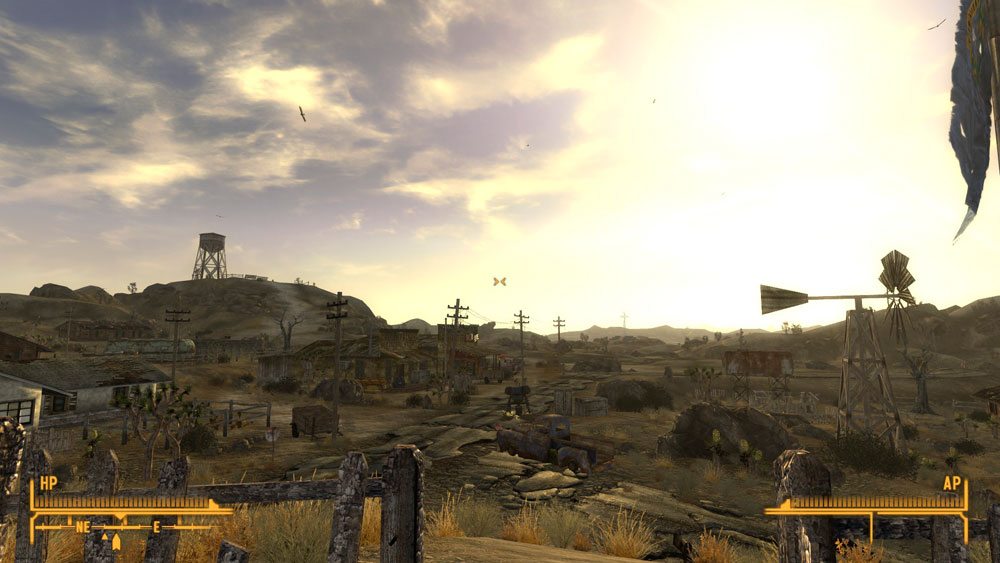
The ever-important first vista shot.
When I played Fallout 3, it completely revolutionized the series to me. A storied veteran of the original Fallout, Fallout 2, and Fallout Tactics, the idea of a first-person non-grid-based combat game filled me with dread. Would it feel like Fallout? Why turn this series into a FPS?
By the end of the first hour, my fears (and free time) melted away in the vast furnace of Fallout 3’s immersive, brilliant post-apocalyptic world. I had already played games like Oblivion, but it was not until Fallout 3 that I truly appreciated the depths in Bethesda games; the ability to just strike out and roam. While it lacked the brilliant storytelling of the prior games, I felt it made up for it in all the unspoken narratives of the world around you. Suffice it to say, Fallout 3 remains in my top 5 games of all time.
This is not, of course, a Fallout 3 review.
Fallout: New Vegas is a noble attempt at having it both ways: the exploration and the narrative. You start not as a fresh-faced Vault Dweller, but as a middling Courier, shot in the head in media res ala Uma Thurman in Kill Bill. And in typical narrative-driven fashion, your quest for revenge starts at Point A and leads inexorably to Point B.
This is roaming on rails, at least for the first few dozen hours, with the slightest deviation leading to certain death. Strike North from the starting city and you will face level 20 Giant Radscorpions. Stray too far West outside the plot-directed Southerly route and Super Ghouls will eat your face off. Cut through the mountains to the East and you will inexplicably face the Blind Deathclaw guarding the path, conveniently immune to the effects of even your Stealth Boy invisibility cloak.
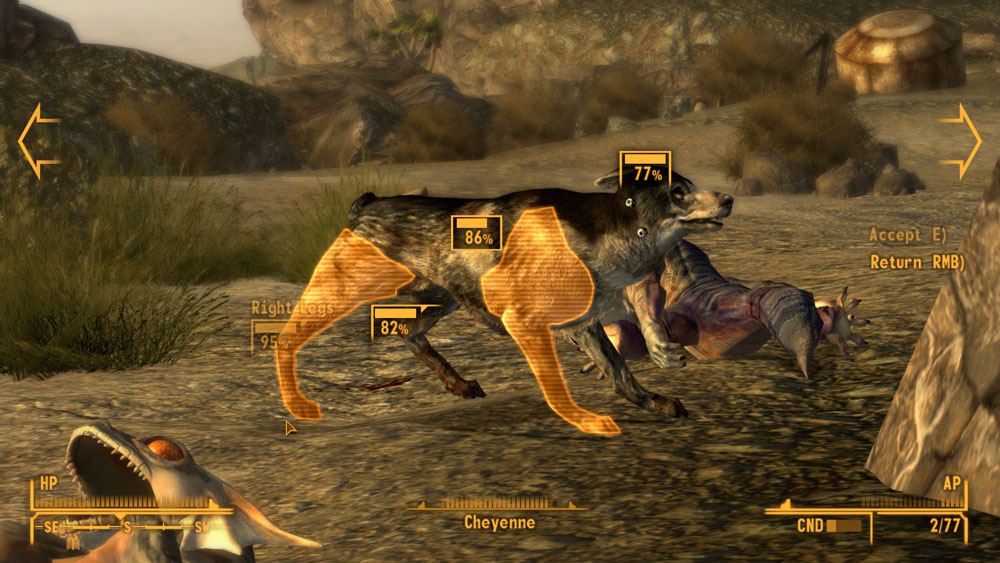
Decisions, decisions.
Between the visible fences of high-level monsters and being able to see New Vegas’s Lucky 38 tower from any vantage point in the game, F:NV starts off by feeling microscopic in comparison to Fallout 3. But a curious thing happens as you finally reach the Southern reaches of I-15 and turn East. “Tutorial Mode” over, the game suddenly opens up, blooming with hidden depth and density like some desert flower. There is still the highlighted yellow-brick plot road to follow, but you can actually strike out on your own at this point with less risk of instant death. I decided to plow my way to New Vegas proper at this point, stopping only at the various locations within sight along the way.
It ended up taking me over 40 hours just to reach the gates.
Combat in F:NV is more or less identical to Fallout 3: you can still treat the entire game as a normal FPS or you can pause the action in VATS mode to specifically target enemy extremities. Weapons skew a lot more towards traditional Spaghetti Western fare as befits the motif, but classic laser/plasma guns are not too far behind.
F:NV does feature some interesting innovations compared with its predecessor, including the use of Factions with mostly independent reputations. Don’t like the New California Republic? Join Caesar’s Legion. Or vice versa. Or screw them both and embrace Mr. House’s vision of the future. Or screw him too and embrace your own brand of justice. While the burgeoning complexities of the midgame collapses into an endgame constant, fundamentally the ending is one you can choose. Classic Fallout.
Well… mostly. While all of the set pieces are in place, including many of the same (recycled) posters last seen around the D.C. area, I could not help but feel that F:NV was… missing something. Something ephemeral, something intangible. F:NV is set in the same Fallout universe with the same people and the same post-apocalyptic problems. And perhaps that is what felt off. If this were the 1990s, F:NV would have been an expansion pack to Fallout 3, not a spiritual sequel.
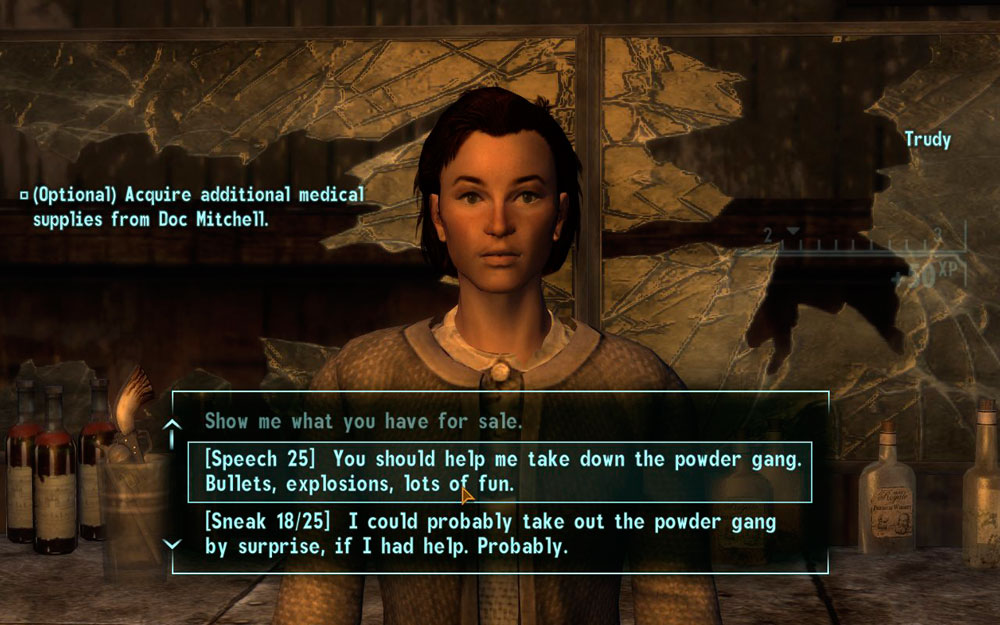
I do kinda miss the Fallout 1 & 2-style depth to responses.
Don’t get me wrong, there is more than enough to do in F:NV to justify its own existence. But it felt more like Fallout 3.5 than its own game. And yet, at the same time, F:NV feels like it didn’t have to be a Fallout game at all. Sure, there are Vaults and Nuka-Cola and Super Mutants aplenty. But the overarching narrative of revenge never felt personally compelling, and the coming clash between NCR and Caesar’s Legion seemed a digression. This game was Fallout when I was just wandering around, eager to scavenge what I can out of crumbling ruins I see just on the horizon. When I was the Courier just trying to make a final delivery for no particular reason? Not so much. The Platinum Chip is not too different from the Water Chip when it comes to plot McGuffins, but it felt different just the same. I wasn’t protecting my home, my family, nor was I my own person. I was… the Courier, a stranger in familiar skin, following a past everyone knows about but me.
Ultimately, Fallout: New Vegas is not Fallout 3. For some people, that will be a relief; for others, a deficiency. But it is important to keep in mind the scale of this particular comparison. I am pulling out the microscope and judging the relative merits of Mt. Everest versus the Grand Canyon. I am quantifying and comparing the love felt for a firstborn son with that for a granddaughter. Fallout: New Vegas cannot be fairly judged by a jury of its peers because it has no peers other than Fallout 3… and possibly Skyrim/Oblivion. So while I still feel that Fallout 3 is better than Fallout: New Vegas, the latter is better than damn near every other videogame I have played. I am being so critical not because Fallout: New Vegas is a bad game, but precisely because it is so good.
DLC
There are four main pieces of DLC for Fallout: New Vegas, although at this point they will all likely be bundled with any Game of the Year copy you will buy. Briefly though, I will describe them for posterity.
Honest Hearts: Technically speaking, this was my least favorite of the DLCs. Heading into the outskirts of New Caanan, the Courier gets to interact with Burning Man, the hitherto presumed-dead former leader of Caesar’s armies. While there is a main plot concerning the story of revenge/redemption, it simply does not flow too well, in my opinion. I never really cared about the plights of the tribes or the lands they occupied.
Conversely, the sort of understated plot line of “The Father in the Cave” revealed via in-game computer archives was one of the more poignant mini-narratives I have seen in Fallout, if not in games period. If you’ve chosen to never play F:NV (and are still reading this review for some reason), go read the transcript here; it is presented in the Wiki exactly as you see it in-game, aside from actually exploring some of the locations (and seeing the traps) mentioned in the text.
Outside of that, the Hearts DLC does feature a lot more plant materials for use in homemade stimpacks, and an abundance of clean drinking water for those doing a Hardcore run.
Old World Blues: Modeled on 1950s-era space dramas, I found this DLC to be exceptionally fun and funny both. The premises push the boundaries of believability even in the Fallout universe (your brain is scooped out right at the start), but after a while it ceases to be particularly relevant as you blast giant mechanical radscorpions and other ridiculous enemies. As a sort of bonus, by the end of the DLC you essentially receive a remote mountain base with all sorts of crafting stations and other amenities that you can teleport to at any time.
Dead Money: While this DLC opens up with my least favorite gaming trope – the sort of Metroid-esque “remove all your gear” mechanic – it does sort of ratchet up the tension and make the rest of the storyline work. Collared with explosives, you are forced to try and open up a vault underneath one of the few surviving casinos outside of the New Vegas area. The limited weapon selection and deadly dust clouds skews the DLC more towards survival-horror than Fallout sidequest, but I was pleased with the plot, imagery, and ultimate payoff.
Lonesome Road: Out of the four, this DLC most fits the narrative of the game proper. I felt it a smidge too linear for my liking (although not as linear as Dead Money) and a bit too ridiculous in other places (trigger nuclear bombs to move wooden debris out of your way, what?), but out of the four this most fit the tone of Fallout games.
Ouch. WoW down another 1.3 million
As reported by MMO-Champion, the subscriber total was 8.3 million at the end of the quarter, a loss of 1.3 million subs since Q4 (which had its own 400k loss). For those keeping track at home, Blizzard had 9.1 million subs back on August 3rd, 2012, during an eight-month lull of zero content at the end of Cataclysm, i.e. pre-Mists of Pandaria. That is a net loss of 800k this expansion – with a 1.5 million sub rollercoaster in the middle – and the lowest subscriber count WoW has had since 2007.
By the way, RIP to MMOData.net, which has not made an update in nearly nine months now. How can we pontificate without graphs? Sigh.
I went and signed up to listen to the investor report as there was not a transcript available, wondering where MMO-Champ got the rest of those bullet points. Plus, you know, Press™:
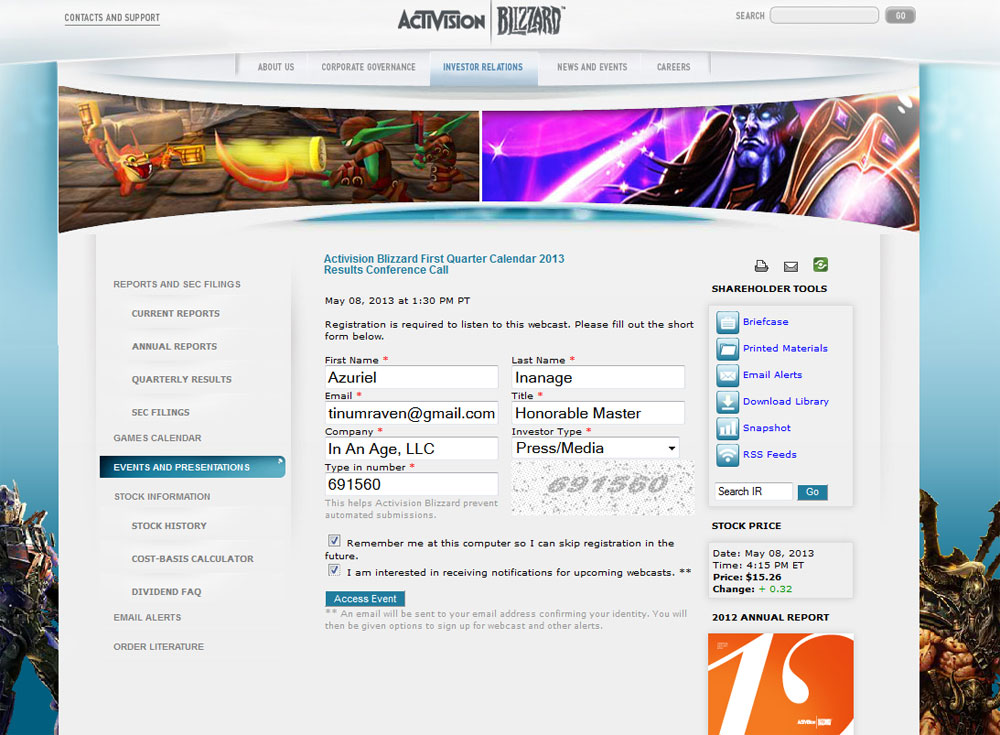
Nothing could go wrong with this.
To save yourself 38 minutes, just trust me when I confirm MMO-Champ got all the relevant information.
What did interest me though was hearing how ultra-conservative Activision Blizzard is. I mean, that sort of thing isn’t a particular trade secret, but when Bobby Kotick explained that the company wasn’t interested in the mobile sphere because the Top 10 titles change every year, I cocked an eyebrow. Call of Duty and WoW still have a lot of viable milking years ahead of them, but this is the same company that gushed about their $1 billion Skylanders franchise that didn’t even exist two years ago. If CoD: Ghost ends up pulling a Warfighter along with the further expected losses (their words) in WoW subs, you can almost imagine a scenario in which they conserve themselves right off a cliff by the end of this year.
But, alas, the money machines continue unabated.
Finally, I sort of chuckled at this part of the WoW presentation:
- There has been less engagement by casual players.
Well… yeah. What did they imagine would happen when you release one of the most alt-unfriendly expansion in the history of the game? And then proceed to put everything behind a triple-gate of dailies and rep, all but remove leveling dungeons (only to put them back), and then essentially stop all production of 5m dungeons for the rest of the expansion? Oh, and don’t get me started on the continued embarrassment of no-pop servers languishing.
At this point, all I’m really interested in is Hearthstone (as hopefully a cheaper Magic: Online) and maybe Bungie’s new game; Titan has been too much of a cocktease for too long to even get a rise out of me anymore. Otherwise Activision-Blizzard might join the ranks of EA as a big-budget publisher who only produces one title that I am remotely interested in, with all the “risky” indie ventures soaking up the money I leave on the table.
And as Doone points out, that’s probably the best thing for everyone involved.
 In An Age
Xbox One11!one1!
May 23
Posted by Azuriel
The Xbox One reveal reminded me, forcibly, that Microsoft is the company behind the console. I mean, obviously, right? But between Windows 7 and Bill Gates building better condoms, I temporarily forgot about Games for Windows Live, Windows 8, and all the markedly cynical shit the Redmond company pulls as it endeavors to further erode all consumer surplus and out-EA EA.
Remember the always-online brouhaha? Well, the new Xbox doesn’t require an always-online internet connection. Except when you play a game for the first time. Or if the game company feels like pulling a Maxis and “off-loading computations to the cloud.” And just kidding, your Xbox needs an internet connection to phone home once every 24 hours or it presumably bricks itself until you do.
Oh, how nice of them that your Blu-ray movies “should” be accessible when your internet connection is interrupted.
In return for all of these restrictions, you get to opportunity to… pay full MSRP for all your games! There are no used games for Xbox One, there are simply game disks which will prompt you to pay a “fee” of the full price of the game to play it. Remember when we thought EA eliminating the Online Pass was a gesture of contrition and good will? Surprise! It was cynical bullshit because Microsoft is handling the Online Passes now and adding them to 100% of all future Xbox games.
A lot of the Xbox Apologists have pointed at Steam in making their arguments that things are not so bad. In fact, there is talk that you may be able to sell your used games game licenses to other people on the Xbox Marketplace, in a sort of virtual GameStop setup. Okay… details? If it is true, and assuming you can set your own price, and assuming there isn’t exorbitant fees, then great! We just had to give up renting games, letting your friend borrow your games, and in the case of Steam comparisons, getting 50% discounts on brand new games released just three months ago.
I am not an Xbox customer; I neither bought any of the prior consoles nor plan to purchase this new one. But this sort of shit will affect every one of us. We already see DLC for our PC games delayed because of “Xbox exclusives.” Ports of future Microsoft games could be pulled from Steam just like EA pulled theirs, ostensively so we can have the privilege of paying more money for no conceivable consumer gain. What we see today is what we can expect more of tomorrow – not just from companies like Microsoft, but from everyone who thinks they can get away with it.
And that sucks.
Posted in Commentary
2 Comments
Tags: Always Online, Consumer Surplus, EA, Fee, Game License, Online Pass, Used Games, Xbox, Xbox One