[Dark Souls] Day 2
For the first time since becoming a father, and probably a bit before that, I played a game until 5AM. It was… ill-advised. For reasons unrelated to the game.
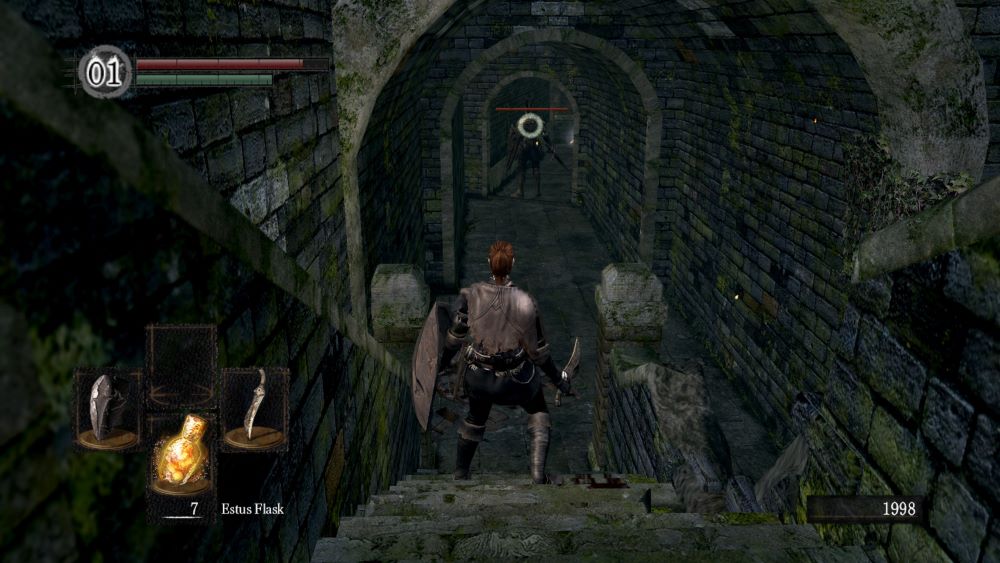
Suffice it to say, I’m having a good time in Dark Souls.
After spending mumble-mumble hours farming in the Undead Burg zone around the Bonfire, I started pushing some more progress. Dead bodies that have loot have a sort of white glow around them, and the fact that you retain items upon death naturally leads one to the occasional questionable strategic decision. Do I engage this clearly-powerful sub-boss dude, or try and run past him and loot the goods?
My first attempt to fight him actually went very well, until I died – got a lot of successful parries and ripostes, which deal massive damage. The next half-dozen were inexplicably worse. So I farmed some more levels, came back, and then… got curious how far he would chase me around. The answer is pretty damn far. Which meant I could circle back around an area, drop down to the dead body with loot he was guarding, snag it, and then re-engage in peace. As with many things, once the anxiety surrounding the reward was gone, I was able to casually poke him to death rather than committing to try and parry him.
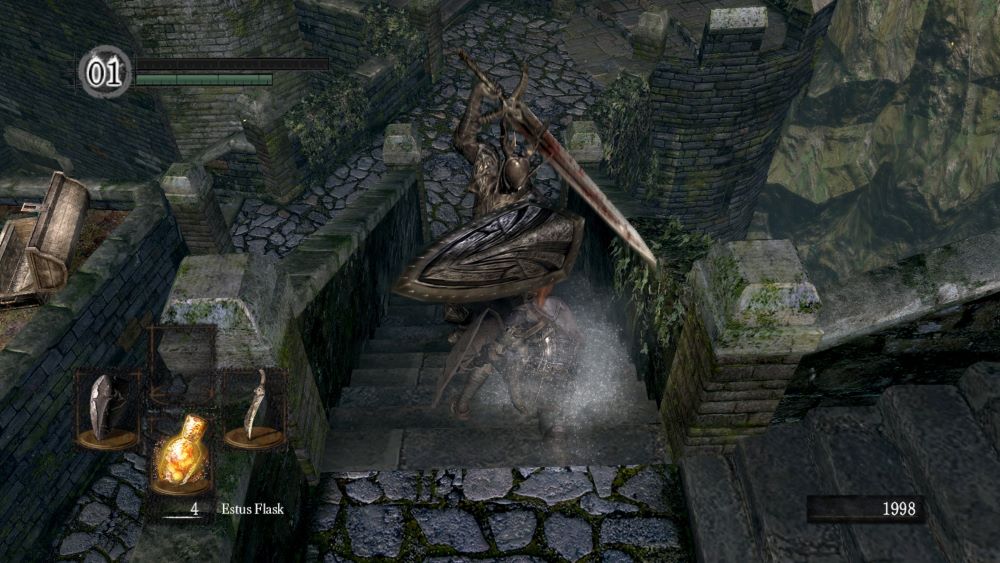
In the next area, I went down a spiral staircase, encountered another sub-boss looking guy, and was one-shot through a shield at full health. Noted, game.
In the next area, I went down up a spiral staircase and encountered the second main boss. It took two or three attempts to down it, but that was mainly because I don’t have a real good grasp on dodge-rolling yet. Does it give i-frames? Sometimes it looks like it does, and other times it clearly does not. Eventually I brute-forced learned the combat mechanics and down the boss went.
In the new zone, I eventually found the Blacksmith. This is actually the first vendor I found in the game. I am aware there is supposed to be another vendor in Undead Burg, which would have been real fucking convenient because 100% of my gear has came from rare (trash) drops from regular mobs. My character is a Thief with no Dexterity weapons aside from the starter one. I still don’t actually know where the other vendor is, but I’ll look later. Took down a sub-boss with the ole leisurely poke-in-stab, looted a reward that makes my health potions stronger, and apparently (hopefully) unlocked the ability to quickly traverse from this 3rd zone back to the beginning one. Or maybe that elevator was one-way?
Honestly, it wouldn’t surprise me either way.
[Dark Souls] Day 1
Killing the first boss on the first attempt was not that surprising. Technically, this was not my first rodeo.

Steam says I had two hours on Dark Souls (Prepare to Die Edition) with a Last Played of 2018. At that time, I was a tourist, sticking around just long enough to get the experience of being instantly killed on the ledge, or later after dodge-rolling off a cliff. That sort of experience was just not what I was looking for at the time. I then proceeded to play Dead Cells, Hollow Knight, Sundered, Hades, Salt & Sanctuary, and probably a dozen similar games over the next five years. So “coming back” to Dark Souls, everything clicked right away. Hell, it was surprising to learn that you had 5 Health potions to start – everyone else is so damn stingy.
Anyway, my character is Thief because getting a free Master Key sounded useful. I also chose the Witch’s Charm or whatever because that wasn’t a consumable and otherwise sounded like it could be useful somewhere.
A big part of the Dark Souls experience is exploration. However, when the very first body I looted contained 3 “Humanity,” I sighed and looked up some beginner tips. Do those disappear on death? (No). Is there a reason to use them now? (Technically no). Am I going to screw things up if I use them right away? (Technically no, but ill-advised). There are some things I am willing to learn via experience, such as boss attacks or where traps are. But obfuscated gameplay mechanics or Blind Choices are things I take a dim view on. Which… might be a problem with Dark Souls. Presumably.

Speaking of experience, I walked down some steps and got utterly mauled by the skeletons down there. They didn’t have levels over their heads, but when a single attack brings me to half-health and my attack deals 2% of their HP, I can take the hint. Was I frustrated? Nope. Fallout: New Vegas predates Dark Souls, and walking anywhere but south out of Goodsprings brings death and pain.
Plus, you know, a decade of Soulslike games.
Another learning opportunity was: Poison attacks hurt. For an absurdly long amount of time. Didn’t think much of the Poison meter when I was eating some Giant Rat attacks, but once it got full and started draining health, I started paying attention. Through literally three health potions. Noted, game.
Made it to the second Bonfire after clearing out some Hollow mobs in a new area. Resting/saving your game respawns all enemies, which is intended to create some Press-Your-Luck tension. Which it would… once I’m done farming this infinite pile of respawning Souls steps away from a Save Point. I’m going to assume that gaining five levels this way isn’t going to bite me in the ass later. While farming, I end up getting two “liquid” Humanity (as opposed to the “solid” items), which is a resource that goes away when you die. So, I spent one Humanity to turn into a Human, and then another to Kindle the Bonfire, which grants me more health potion uses for this area. Again, I’m assuming this won’t set me back permanently somehow.

And that was Day 1.
Time will tell how long I stick around farming in the immediate Bonfire area. “Until you get bored” is not a particularly healthy target, but it also feels silly to not make a few more circuits when you can gain levels within 5-10 minutes. Then again, the farm option would still be there if I just plow forward until hitting a brick wall. Hmm.
Let’s be real: I’m going to farm the shit out of this area, aren’t I?
Warhammer 40K: Mechanicus
I have read descriptions of Warhammer 40K: Mechanicus (Mechanicus) as being a cross between Warhammer 40K and XCOM. The short version? Sure, close enough. The long version? Not at all.
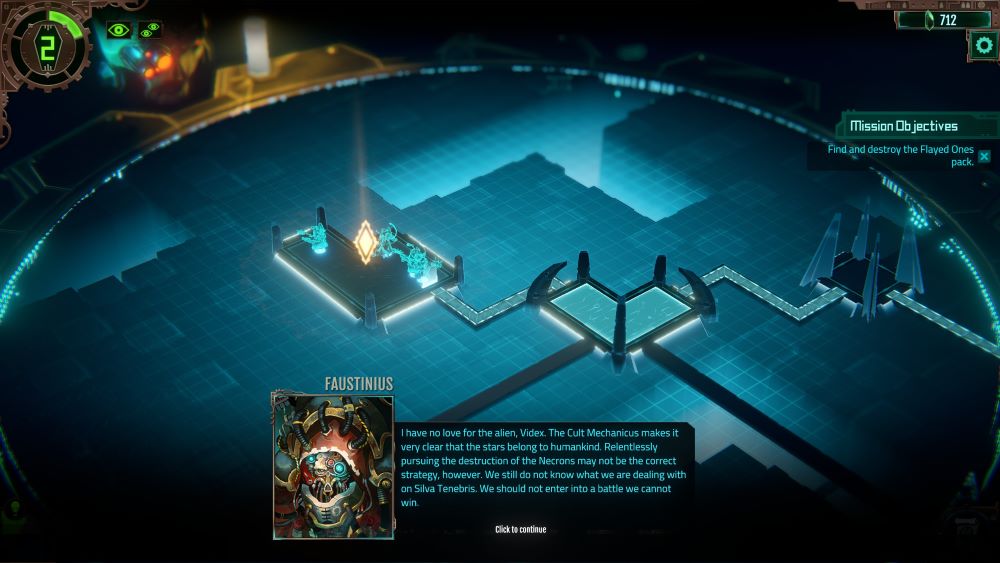
At the base level, Mechanicus is a unit-turn-based RPG set in the Warhammer 40K universe following the Adeptus Mechanicus branch of the Imperium of Mankind. This already sets it apart from the dozens of its licensed peers, who typically follow the overdone Space Marines. I am a general fan of the Warhammer 40K setting, so the implicit lore taking place (and overwrought dialog) were pure bonuses. If you are not similarly inclined, or find the glorification of Imperium problematic, then you may want to sit this one out.
The reason I say this is because the gameplay is rather simplistic. When I think XCOM, I think about cover and missing 95% accuracy shots seven times in a row. In Mechanicus, there is no cover and no accuracy – if you are within range and have Line of Sight, you hit your target. The combat wrinkle is Cognition (Cog): a persistent, spendable team-wide resource needed to fire larger guns and utilize abilities. In the beginning, your primary source of Cog is from the expendable Servitor redshirts you bring along with you to soak up enemy fire. Deploying Servitors costs 1 Cog, but they grant 1 Cog each time they take damage. Enemies that are downed also grant 1 Cog if a Tech-Priest is nearby to extract it. Aside from that, there are usually several structures around the battlefield that grant 1-3 Cog per turn if a Tech-Priest walks nearby, or if they send their Servo-Skulls (drones on a cooldown) to go collect it.
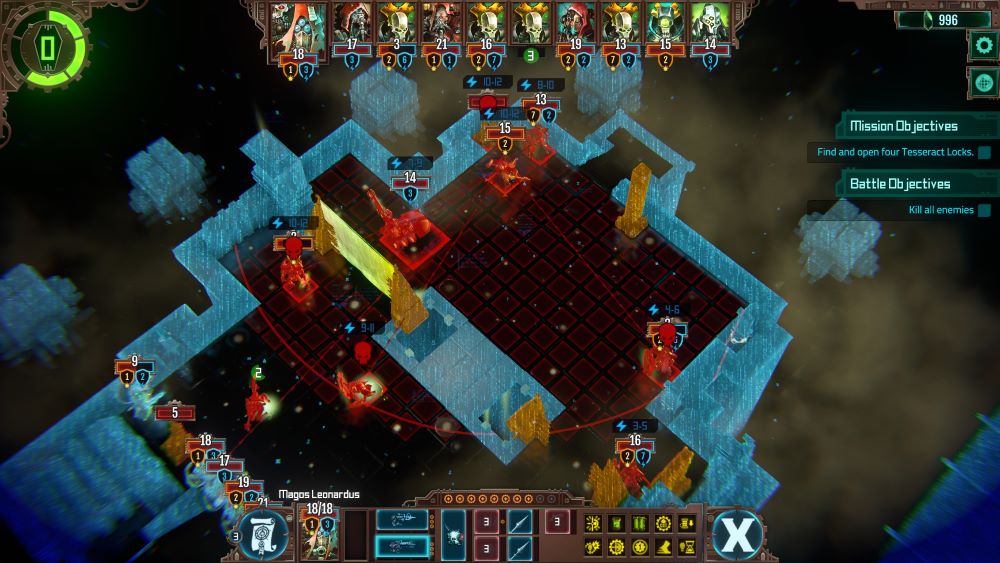
There are technically other tactical considerations. Ranged weapons cannot be used when in melee range, and there is an Attack of Opportunity when you move out of a threatened square. Units can block each others’ Line of Sight. Necron units will come back to life after a few turns unless you spend time attacking their downed forms. There is an Armor system of sorts that reduces the damage from either Physical or Energy attacks by a flat amount. Necron unit HP/Armor is unknown unless they are scanned by Servo-Skulls or attacked with specific weapons that indicate that said info is captured. Spending time to Scan computer consoles will award you more “Blackstone,” which is an upgrade currency for your Tech-Priests.
But honestly? Heading into the mid-game none of that really matters. Once you have figured out a combination of abilities to keep your team loaded with Cog, you can just blast every enemy out of existence with relative impunity. Indeed, it gets amusing once a character or two unlocks the “Immune to Attacks of Opportunity” skill, as it allows you to freely traverse the map. See, your units can move X spaces normally, but they can spend 1 Cog to extend that range another X spaces. And another, and another, as long as you have Cog to spare. Which means one Tech-Priest can run around the map collecting all the Cog from structures as he goes, scanning all the consoles, and then end up where he started with a full Cog gauge, depending on abilities.
One such ability? Fill your entire Cognition gauge, on a 5-turn cooldown.

Outside of combat, you are basically playing a Visual Novel with a series of frustratingly Blind Choices. Decide which icon room to enter next, decide which of three choices to pick, and then act surprised when they are terrible outcomes. Within each mission there is an Awakening Meter that increases for each room you enter, increases per turn of combat, and also depending on the Blind Choices you make. As the meter fills, more Necrons join the fight and otherwise things go more badly for you. Once you successfully complete a mission, the Awakening Meter gets added to your overall Awakening Meter (e.g. 3 Awakening = +3%), which leads to a Game Over at 100% if you haven’t unlocked the final boss yet. There are usually a few ways to reduce the Awakening Meter within a mission, but it’s otherwise a race against time and actively discourages you from exploration. Which is necessary, because your units get god-like pretty quickly if left to their own devices.
Overall, I did have a good time to the tune of 20 hours. Then I played another 8 hours in order to finish the game, which was pure slog. If you picked up Mechanicus as part of a bundle and you can tolerate the Warhammer 40K setting even a little bit, it is worth installing and giving it a whirl. But if your interest starts to wane, go ahead and drop it within guilt. The game stays exactly the same the whole way through, and nothing about the final battle or ending moves the needle.
ChatGPT
Came across a Reddit post entitled “Professor catches student cheating with ChatGPT: ‘I feel abject terror’”. Among the comments was one saying “There is a person who needs to recalibrate their sense of terror.” The response to that was this:
Although I am bearish on the future of the internet in general with AI, the concerns above just sort of made me laugh.
When it comes to doctors and lawyers, what matters are results. Even if we assume ChatGPT somehow made someone pass the bar or get a medical license – and they further had no practical exam components/residency for some reason – the ultimate proof is the real world application. Does the lawyer win their cases? Do the patients have good health outcomes? It would certainly suck to be the first few clients that prove the professionals had no skills, but that can usually be avoided by sticking to those with a positive record to begin with.
And let’s not pretend that fresh graduates who did everything legit are always going to be good at their jobs. It’s like the old joke: what do you call the person who passed medical school with a C-? “Doctor.”
The other funny thing here is the implicit assumption that a given surgeon knowing which drug to administer is better than an AI chatbot. Sure, it’s a natural assumption to make. But surgeons, doctors, and everyone in-between are constantly lobbied (read: bribed) by drug companies to use their new products instead. How many thousands of professionals started over-prescribing OxyContin after attending “all expenses paid” Purdue-funded conferences? Do you know which conferences your doctor has attended recently? Do they even attend conferences? Maybe they already use AI, eh?
Having said that, I’m not super-optimistic about ChatGPT in general. A lot of these machine-learning algorithms get their base data from publicly-available sources. Once a few of the nonsense AI get loosed in a Dead Internet scenario, there is going to be a rather sudden Ouroboros situation where ChatGPT consumes anti-ChatGPT nonsense in an infinite loop. Maybe the programmers can whitelist a few select, trustworthy sources, but that limits the scope of what ChatGPT would be able to communicate. And even in the best case scenario, doesn’t that mean tight, private control over the only unsullied datasets?
Which, if you are catering to just a few, federated groups of people anyway, maybe that is all you need.
Goal Wars 2, pt 2023
Yep, still playing Guild Wars 2. About 3 months ago, my goals were:
Play through Icebrood Saga contentPlay through End of Dragons contentTry some of the new Elite specsWork towards completing “Return of” achievements for free LegendaryWork towards unlocking Skyscale mount- Work towards unlocking some Legendary gear
As you can see, I have knocked damn near everything off my list.
ArenaNet introducing the “Return of” achievements with a “free” Legendary amulet carrot at the end (plus Legendary weapon precusor in the middle) has to be one of the most genius marketing moves I have seen an MMO developer take. With the stroke of… uh, some achievement code, they instantly made damn near their entire catalog of Living World content relevant again. The immediate impact was to give the general population something to do before the release of the End of Dragons expansion. But for someone like me, it also generated a means of incremental, meaningful progress that weren’t daily quests.
Plus, it kinda forced me to shell out $10 buying the Living World episodes I missed over the years.
The question is “what now?” I have completed End of Dragons content – and the original story conclusion, 10 years late – so there isn’t really anything left in the plot department. Ostensibly, my goals included unlocking some additional Legendary gear. The options I have been looking at include:
- Weapon (Axe)
- Backpiece (PvP)
- Accessory (Vision)
- Accessory (Aurora)
Of those, the Backpiece has been an interesting consideration. There are three different pathways to a Legendary Backpiece: PvE (Fractals), PvP, and WvW. Right from the get-go, WvW is out – it would take an absurd amount of time just sitting in WvW to accomplish anything. Conversely, PvP is achievable from just about anyone, as none of the requirements involve being particularly successful, e.g. top ranks. The roadblock I have with PvP at the moment though is that you need to complete 50 matches before you unlock the ability to queue into Ranked matches, which the achievements revolve around. It shouldn’t necessary be a “roadblock” for someone who enjoys the experience, but… well, let’s just say I am still figuring that out.
Unlocking the Backpiece via Fractals would perhaps be the most preferred method, but I have not been super successful in finding groups for that. Indeed, I only just recently went into my first Strike Mission, which are sort of mini-raids with just a single boss. It probably does not help that I only play late in the evenings. While the general consensus is to just start your own groups and see what happens, I am not necessarily that committed to the endeavor.
As for the accessories… sigh. To unlock Aurora, you first need to complete a collection achievement for four different items across Season 3 Living World episodes. Just one of those involves finding forty (40!) tokens across a map, some of which are hidden in the infamous Chalice of Tears jumping puzzle. Just look at this Wiki page. That’s just ONE piece. Of four. Then you have to charge the final product up at 21 other locations around the world. Then combine that charged up product with three other collections of materials, which are themselves collections of other materials. The whole thing is rather ridiculous when laid out all at once.
Of course, continuing to play GW2 at all might be considered rather ridiculous.
We’ll see what happens. I am making some headway in other games, and I can see further progress on the horizon if/when I free up extra time by putting GW2 on the backburner/on ice. The tricky part will be actually doing that. It’s seductively easy to log in, collect some easy rewards on each of the characters, and then log off. But before then, oh hey, this meta event is going on, let me just get those rewards. And now I just have an hour left to play “real” games. It’s a rough life, I know.
Impression: Potion Craft
Potion Craft is one of the most brilliant gameplay experiences I have had in years.

The premise of the game is that you are a new alchemist moving into an inexplicably abandoned former alchemist house. As the title indicates, your job is to wake up, craft potions for townspeople, get paid, buy ingredients, experiment a bit, go to bed, repeat. Unlike a lot of other titles in this sort of storefront genre, there is no looming debt payment or other time constraint whatsoever. It’s just you, the ingredients, and a bit of alchemy.
It’s that very alchemical gameplay though that is so fundamentally brilliant and elegant and intuitive.
To craft a potion, you must move a potion icon around a map and land on a specific, potion-shaped effect. To move around the map requires you to place an ingredient into the caldron and stir. At the beginning, you start off with a limited amount of basic herbs and mushrooms. Hovering over each one reveals the properties of that ingredient, showing you where it will move the potion icon. What you will notice is that there is a sort of baseline distance you move, and then a further distance denoted by a dotted line. If that extra distance is desired, you must place the ingredient into a mortar and then pestle it as desired. Put the resulting mash into the caldron, stir, and repeat until you reach your destination.
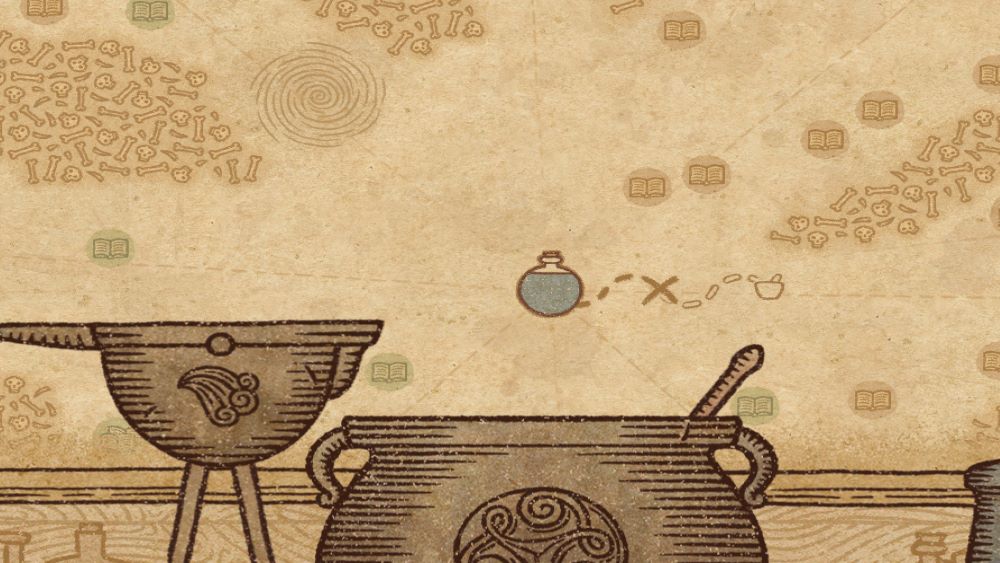
Everything about this is so deliciously analog. When using the mortar & pestle, you do not have to grind things up fully – you can choose to stop at almost any pixel distance. Additionally, the quality tier of the potion is dependent on how close you end up overlaying the potion icons. Just touching? Tier 1. More than half? Tier 2. If you want Tier 3 though, you start slowing way down, grinding herbs just so, stirring the caldron ever-so-slightly, and diluting the mixture with water (which moves the icon back towards the center of the map) drop by drop. Until, until… ahh. Perfection.
What continues to amaze me is how… correct all of this feels. The alchemical map starts off nearly blank, and you explore its boundaries by experimenting with what herbs you have available. Finding a new potion effect on the map is exciting because you don’t know what it is until you brew it. Thankfully, Potion Craft does allow you to save custom recipes (limited by magic paper you purchase) so you don’t have to manually recreate every single potion every time. But as you help out your herb/mushroom suppliers, you get greater access to new ingredients that have different pathways. This then allows you to create the same potions with different (and usually) fewer total ingredients, improving the efficiency of your business.
Seriously though, I am deeply, deeply impressed with this gameplay. Indeed, I have spent the last three days trying to figure out if there is a term for what the designers have accomplished here, by so tightly marrying the concept of alchemy with this gameplay that embodies it. The closest I have gotten is “the opposite of Ludonarrative dissonance.” If you have better words for this, let me know.

Having said all this, I do want make an important distinction here: the gameplay is brilliant… but not necessarily engaging long-term.
There are a set of tasks that reward XP that sort of guide you through the general game, which is fine. But after about 8 hours, I have seen pretty much everything I imagine I will be seeing in Potion Craft. It is sometimes fun to realize you can use different herbs in novel ways to improve the efficiency of a recipe, but at the end of the day you are still selling a potion to a random customer for X amount of gold – once you have enough of a income stream, it doesn’t matter too much. And all that XP? It grants you Talent points which you spend to… improve the uncover distance of the alchemy map, increase bonus XP nodes on said map, and increase profit percentages. It’s a very shallow, closed loop.
There does appear to be an ultimate goal to create the Philosopher’s Stone, but it all seems kinda arbitrary. “Craft this precursor with these five potions, craft stage two precursor with these ten potions with an eclectic mixture of effects, etc.” This was all much less interesting than exploring the original map, trying to figure out how in the world you would make it past that obstacle, or figuring out that a potion which previously took 5 herbs to make can be done in two. The process novelty is very finite, in other words.
Be that as it may, I do commend the designers of Potion Craft and encourage anyone subscribed to Game Pass to give it a shot. It is a very unique, grokkable experience which is very rare these days.
End of Year: 2022 Edition
Just like 2021, except we all just gave up.
Workwise, I ended the year still at the same company but promoted to a more senior role. There have been a number of bonuses and raises offered company-wide, as management starts understanding that, yeah, this new labor market is here to stay. There are apparently some more raises in store for my specific department, but we’ll have to see how that pans out. Despite spending literally $15,000 in daycare this year, my family is doing perfectly OK. Which means I made it, I guess. My options trading and crypto are most definitely not making it, but I’m in a position where I can realize some losses and at least not pay taxes on the gains this year, while still having some upside exposure. It has to rally again someday, right guys? Guys?
Family is doing great. My kiddo is potty training like a champ.
Enough real life. Let’s talk games. First is the Steam lineup:
- Meteorfall: Kromit’s Tale
- Black Book
- FAR: Lone Sails
- My Friend Pedro
- Per Aspera
- Borderlands 3
- Before We Leave
- Raft
- Necromunda: Hired Gun
- Legend of Keepers
- Despotism 3K
- SOMA
- Core Keeper
- Satisfactory
- Sigil of the Magi
- Gordian Quest
- Rimworld
- DOOM (2017)
- Cardpcalypse
- Slay the Spire
- Noita
Although many of the games don’t necessarily have a defined “win state” (and many are Early Access besides), realistically I only finished Meteorfall, FAR, Per Aspera, and Borderlands 3. It was especially egregious with games like SOMA, wherein I played to the first area where the first monster appears, Alt-Tabbed to see what happens if they get you, realized that there is an EZ-mode with no real consequences, and then never actually booted the game back up again. At the same time, I have been trying to embrace the whole “Spark Joy” Kondo-ism a bit more than in years past. Play games when they are fun, stop when they aren’t. Just a shame that games stop being fun before they’re over.
For the Epic Game Store:
- Horizon: Zero Dawn
- Cyberpunk 2077
- Everything
- Final Fantasy 7 Remake
I… think that’s literally it. And again, I only really finished FF7R from that list. Going forward, I think I’m going to have to start making a concerted effort to completely ignore side quests and such for the more open-world games. Or maybe not. Sometimes the sidequests end up being much more interesting than the main quest for a lot of those kind of games.
By the way, the Epic Store interface is still embarrassingly shitty in 2022. When I go to my library and choose “Sort by Recently Played,” I would expect the games to be sorted by, you know, how recently they were played. But they’re not. You can’t even have the games sort themselves by most played. Ugh.
For Game Pass:
- Dreamscaper
- Amazing Cultivation Simulator
- Offworld Trading Company
- Citizen Sleeper
- Deathloop
- Grounded
- Sable
- Metal: Hellsinger
- Superliminal
- Unsighted
- Vampire Survivors
- Turnip Boy Commits Tax Evasion
- Hardspace: Shipbreaker
- Loot River
- Nobody Saves the World
- Tunic
- Sunset Overdrive
- We Happy Few
- Outriders
Once again, Game Pass is the de facto best place to try out games you wouldn’t otherwise play unless they were wedged in a random bundle. Of the list, Grounded was the clear winner here with a whopping 68 hours played… and I haven’t even beaten it yet. We’ll see if I ever pop back in.
For completeness’s sake, I also continued to play Hearthstone and Guild Wars 2 throughout 2022.
Looking at 2023, my goal is to actually sit down and play Red Dead Redemption 2, Disco Elysium, Death Stranding (played 7 hours and fell off), Chained Echos, Wildermyth, and… SOMA. Maybe Assassin’s Creed Odyssey or Origins. And finish off Cyberpunk 2077 and Horizon: Zero Dawn. According to HowLongToBeat, that lineup is 256 hours all by itself (main stories only). Which is like 5 hours a week, so not unreasonable even if I pretend to be a responsible father figure. We’ll see.
I really enjoyed Void’s “Games of the Year” schtick over at A Green Mushroom, where there was a running tally of games played and how they sorted themselves over the year. I’ve always struggled with “justifying” creating a blog post about some of the random shit I try to play (e.g. Nobody Saves the World, Metal: Hellsinger, etc), even though personally I enjoy reading every single article by anyone still posting on my blogroll. So, heads up, there may be some experimentation with that format in 2023. Or maybe I just continue doing my own thing, which apparently continues to work.
Well, “work,” for given definitions of work.
…which I’m defining as being awesome. See you in 2023.
Rimworlder, part 2
Instead of doing minor edits and publishing the last post, I continued playing Rimworld for about 25 hours over a week. Yeah, all other games in progress (aside from GW2 dailies) have been blown away. However, in that time, I have come to a number of conclusions. Or maybe just a primary one from which all others follow.
The Rimworld DLCs make no sense.
Royalty was the first DLC to be released. The big addition was the sort of Fallen Empire faction that you interact with almost immediately in every playthrough. If you ally with the Empire, you can select one or more pawns to start accruing Honor via quests and such, which is used to ascend royal ranks, which in turn unlocks the ability to have Psycasts. Higher ranked pawns will need increasingly spurious luxuries befitting their titles, requiring the creation of a throne room, better quality clothes, and so on.
If you don’t ally with the Empire, you basically don’t get to play with Psycasts. There are a few opportunities to waylay Imperial caravans and steal the items that grant Psycast levels, but they are few and far between from what I have heard. That said, each map also has an Anima Tree somewhere that allows Tribal-based (and only Tribal-based) pawns to meditate/worship at its trunk to eventually unlock all Psycasts and assorted goodies, no Empire needed.
In practice, the entire Royalty DLC feels at odds with its premise. Roleplaying as a royal colony and eventually using the Empire as a win condition (joining the Imperial flotilla) is perfectly fine. Tying Psycasts to royal titles is not. The earliest Psycast that has any particular use (Vertigo Pulse) requires the Knight rank. The next one is Praetor, which unlocks Skip (tactical teleport) and Wallraise (cover on demand). These are very useful abilities, but each individual pawn would need their own separate throne room and gain the appropriate amount of individual Honor to gain them. It also gets a bit goofy having a Count, whom “might have a personal fleet of capital ships,” be slumming around with the rest of the fighters to take out a Mechanoid Cluster.
Tribalists being able to short-circuit the entire Psycast system by spending time at an Anima Tree kinda drives everything home. I haven’t done so myself, but there is plenty of chatter about how you can get your entire Tribal colony to be level 6 Psycasters very easily, which would otherwise require a half-dozen throne rooms and other goofiness the “normal” way. There are probably mods out there to fix things, but why not have rituals or research or whatever to allow non-Tribals access to Anima Tree benefits? Royal ranks would still have a purpose – Permits are enough of a thing IMO to justify the title system – plus perhaps you could make it easier for royals to find/buy/hand out the Psycast-level items.
For the Ideology DLC… there isn’t much to say, actually. It opens up some directed roleplaying and/or absurd min-maxing opportunities. In my current playthrough, it doesn’t really add much to the gameplay aside from some annoyances. For example, at least two of the main factions on the planet are Supremacists, which means they are effectively permanently hostile (on top of the always-hostile pirates, raiders, etc). Beyond that, my colony can… uh… perform one dance party a year. Two of my pawns can give a few speeches, but even if you max out the chance of success, there’s still a minimum chance of failure. There are also a series of quests to find a relic, but near as I can tell, that ultimately gives a mood buff equivalent to eating at a table during the once-per-year dance party.
For the Biotech DLC, we come around again to absurdity.
Using Biotech to create custom starting scenarios is perfectly fine. Cannibal mole men? Beautiful furkin? Straight-up vampires? Go for it. However, there’s a big chunk of the mid-game revolving around Genebanks and such that allow you to acquire genes (purchased or extracted) and augment your pawns. But… why? The system is extremely random and requires a colony with excess resources to the point that you may as well just be installing bionic limbs and such. Moreover, if you are creating a custom xenotype at the outset, things would be much faster just having your existing pawns have children of said xenotype versus some convoluted system of extracting genes from your pawns and mashing them together into a former prisoner you converted. There may be some point to the system once you start looking at the more OP Archite genes, but that requires purchasing Archite capsules, then the Archite genes, and then implanting them. All to do what? Make one pawn superhuman in a way fully bionic organs in Cataphract Armor does not?
On the other hand, children are amazing in Biotech. It allows your colony to grow in an organic way, it ups the stakes during raids, and I appreciate watching them become more useful additions to the family. The stories that get generated in this way are also novel. For example, I took in a small refugee family of a father, mother, and small child. Things were going well… until I got the notification that a Fennec fox was hunting the child, who for some reason was trying to haul boulders from across the map. Unable to reach the fox in time, the child was downed and then eaten. This caused the mother to fly into a murderous rage… in the middle of a classroom where she was teaching my colony’s first child. She beat him to death with a club, which I had not removed from her inventory.
And that’s how I learned to always restrict the zones where children can roam. And disarm refugees.
After I reloaded an earlier save game, of course. Iron man, I am not.
Rimworlder
As feared, I succumbed to Rimworld yet again.
The experience of playing Rimworld 1.4 with all the paid DLC has been interesting. And yet, simultaneously, an outrageous slog. Principally, my problem with Rimworld is the opening act. The “game” doesn’t really start until you have a working refrigerator and a relatively stable colony of 5-6 people. Before that point, you do not have the resources or manpower to engage much with the Research tree, rituals, caravans to other settlements, or any of the fun war crime shenanigans that just sort of happen on the way down the slippery slope.
To back up a bit, let me talk about my first scenario this time around: Rich Explorer. Instead of crash landing with three pawns, you land with just one but with a pile of money and a tech tree unlocked enough to built turrets right away. For some reason, this particular scenario has been speaking to me for months now – possibly because it speaks to the sort of survival games I enjoy. What I discovered was… pain, and not just because I run the Randy storyteller with the 2nd highest difficulty. Basically you have to have Construction 5 skill on your pawn in order to craft turrets, so I was defending solo for the first year. Not that it would matter much, because turrets require power, which was difficult to set up when you are also trying to sow crops to survive the winter. And that’s another deviation from my historical Rimworld attempts, e.g. not selecting a temperate zone that has year-round crops.
I persisted with that playthrough all the way to the next summer, until the moment that the four pawn colony I had scraped together all managed to get food poisoning at the same time. I wasn’t under attack or anything, I was just frustrated beyond reason that all four of my pawns were vomiting constantly, weak with fatigue, and I was zoomed in, watching pixels to see if they managed to actually finish eating the meal or would get interrupted and then collapse on the floor from starvation or not. It’s very possible that the colony would be fine, but I didn’t want to waste my time even on the highest game speed to see if they would.
Honestly, I don’t remember much about the 2nd attempt. I just abandoned it for similar reasons.
The third and current attempt is somewhat of a “cheese” run. Using the Biotech DLC, I decided to create my own xenotype that includes the Iron Stomach trait that makes them immune to Food Poisoning. I also used the Ideology DLC to create a belief that organ harvesting is OK, seeing corpses don’t provide a negative debuff, and research speed is increased. My pawns are genetically addicted to Psychite though and the area I settled in only has two growing seasons. Plus, any recruits beyond those initial three won’t have the xenotypes or Ideology bonuses without extra work.
That said… it’s still a slog. I’m currently surviving (thus far) the winter and barely have had time to research any new techs, let alone anything that utilizes the rest of the DLC material. Which is not necessarily the “point” of the game, but come on. All the fun stuff (to me) occurs when you have a somewhat stable base and can start meaningfully interacting with the rest of the game world. I’m still very far from being able to do anything with gene editing, Psycasts, or anything other than try and survive the winter without multiple psychological breaks.
Welcome to the rim, I guess.
 In An Age
Like Souls
Feb 13
Posted by Azuriel
In the past two weeks, I played a few hours of Blasphemous and Salt & Sanctuary. Both of these games are in the increasingly crowded 2D Soulslike genre, made famous by Dark Souls (or Demon Souls if wish). As I was farming some currency to level up a bunch of times in Salt & Sanctuary – and before remembering I had previously played the game for 10 hours a few years ago – I had a thought. I have played a lot of Soulslike games over the years… and not actually Dark Souls. That’s weird, right?
So, it’s happening.
Not certain whether I’m going to chronical this shit, or just give the occasional summaries. Not much oxygen left in the room between Elden Ring and decades of Youtube videos of people beating the entire Dark Souls trilogy without taking a single point of damage while using a DDR dance pad as their controller. That might be two separate videos. Whatever.
If you want to see me “Git Gud” or otherwise maintain my adequate levels of Gud, buckle up.
Posted in Commentary
Comments Off on Like Souls
Tags: Dark Souls, Git Gud, Soulslike, What Could Possibly Go Wrong?