PAX Day Three: Final
And thus PAX came to an end.
The more charitable conclusion is that I simply came during an off year. Or perhaps an off PAX. But what I truly want to say is that the show sucked. At least to this particular non-con going groupie. And I’m thinking that the allure of cons are getting diminished by the same forces that generated a niche market in making physical boxes for all-digital games.
The Twitch booth out on the show floor was extremely hard to miss. After a few minutes, the irony of my having spent a considerable amount of money to fly into the Boston snowpocalypse just to come to PAX and watch a Twitch stream in person was too much to bear. The same principle held for Overwatch and the new expansions to GW2 and FF14 – why stand in line for 2+ hours to play these particular games that will either be released or in public beta in a number of months? Maybe it made sense back in the days when we got our gaming news from magazines (remember those?), but not today.
I mean, they had a bunch of booths for iPad games for god’s sake.
Luckily, I came because of friends. PAX definitely had a better setup for free-playing various games than GenCon. But that was about the long and short of it. If I could do things over again, I probably would have bought a PS4 and just took a 5-day staycation.
PAX Day Two: Lined
Went to two major panels on Saturday, one after the other. First was FF15 and the second was Pillars of Eternity.
In regards to FF15, I actually haven’t been following the already-released information close enough to tell what was breaking news. The panelists mainly drove home the “road trip” and “Buddies” aspect of the game. Which, if I’m honest, probably wouldn’t have been nearly as interesting if I were not hearing their passion in person.
There was a moment while watching the gameplay that I asked myself “is this a Final Fantasy game at all?” I never really played 12 or the 13 series, so I’m not sure if there’s a huge precedent for the sort of Action RPG gameplay I watched on-screen – especially the bit where he hook-shotted up a telephone tower to wait for his MP to regen. The panelists did sort of address this subtly as they mentioned the kind of themes common throughout the series, such as the hero never being alone.
It’s not that seeing the party run down a highway avoiding traffic or that the lack of an ATB gauge is throwing me off; FF7 and 8 had a number of similar high-tech elements, and they are amongst my favorites. Honestly, it could just be that the last Final Fantasy game I completed was FFX-2. This series went from being the single most important thing in my gaming life – I jumped on the original Playstation precisely because I was following Squaresoft – to something I pick up on Steam sales, like everything else. And so “Final Fantasy” to me is/was a game that defines a particular gaming epoch, or it isn’t one at all.
Baggage aside, the game looks great, the road trip thing could be interesting, party banter is always welcome, and the remixed music was pure nostalgia.
The Pillars of Eternity panel was pretty much the devs just playing the game for about twenty minutes. Which certainly isn’t the worst kind of panel, and there wasn’t much they needed to sell for me to be onboard in the first place. They even had an Oprah moment with the whole “check under your chair for a prize.” Everyone got a free upgrade to the Champion edition, assuming you purchase the base game, and a few got upgrades to the highest tier.
While Pillars is a guaranteed purchase by me at some price-point, the pause-based tactical combat really hit home how much I prefer the FFT or other Tactics game type. It’s fun queuing up that initial volley of attacks in these sort of CRPGs, but things quickly end up coming down to micromanaging one or two characters, at best, and hoping that a third character is actually going to finish their attack animation and drink a potion before they die. The devs mentioned that there wasn’t going to be anything much in the way of AI, so you are kinda left with the worst of both worlds.
One day to go.
PAX Day One: That’s A Lot of People
I wouldn’t say this was the most amount of people I’ve been around, even at a convention, but still:

We're going to need a bigger boat.
Place was packed, in other words. To be expected.
I didn’t actually stand in any lines, as while playing the new GW2 expansion sounds somewhat fun, waiting two hours to do so does not. The line for Overwatch was… well:

This is the end...
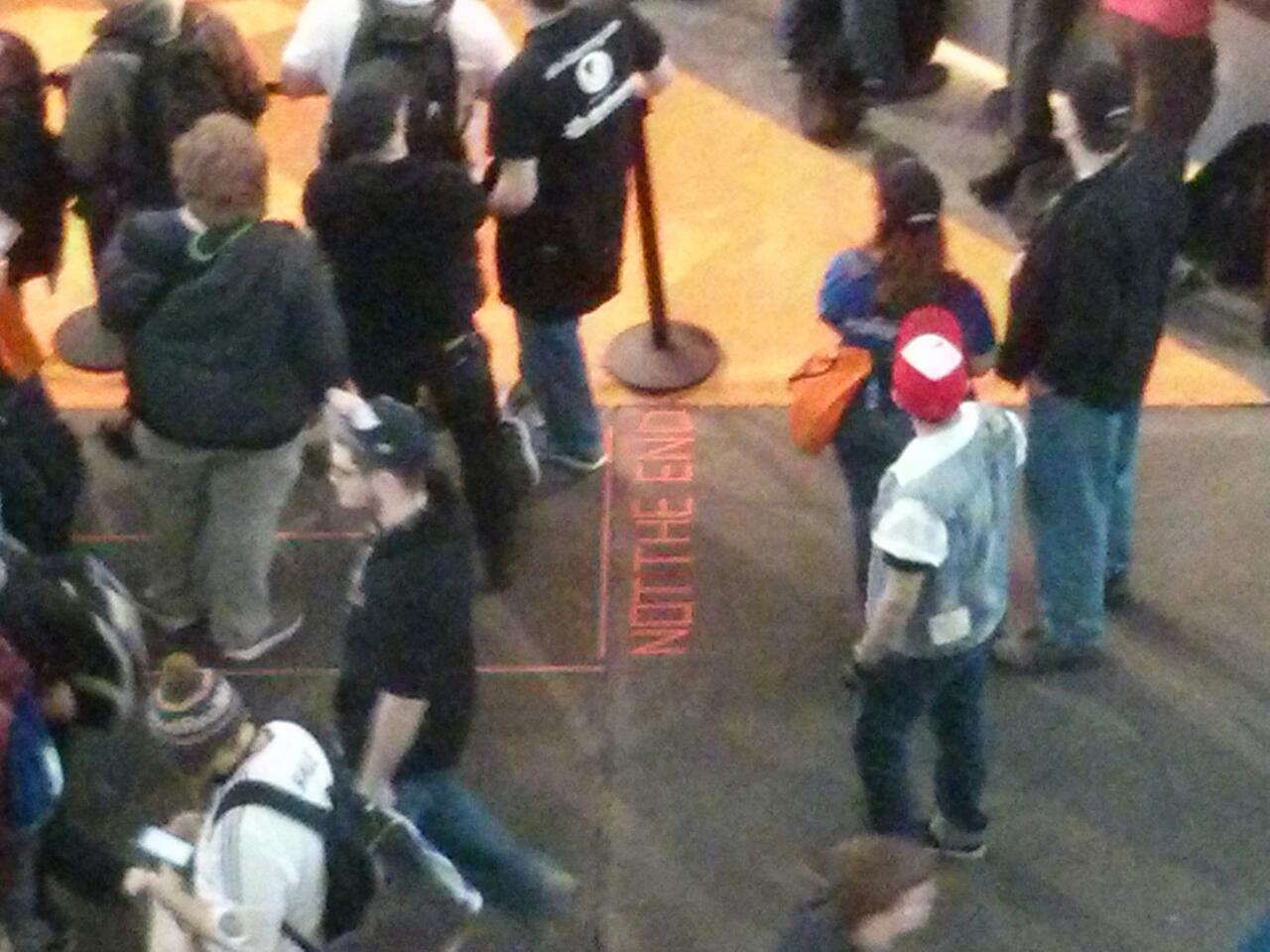
... okay, maybe not the end.
I missed a chance to meet some of the Wildstar devs at a local bar, but I’m not too tore up about it. We’ll see if any similar opportunities present themselves.
PAX Day Zero: Schmoozing
So, hey, I’m (hopefully) at PAX East!
I’m not sure yet what the internet situation is going be like, so you can expect either radio silence or frequent updates. Probably the former, let’s be honest. That said, I am fully prepared for the PAX schmoozing campaign:
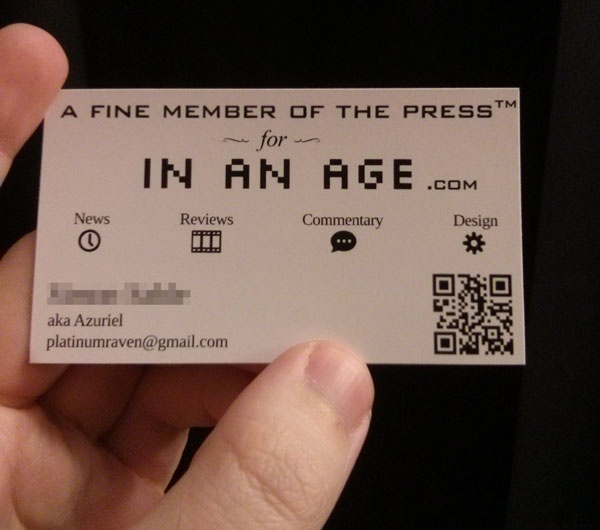
“Look at that subtle coloring. The tasteful thickness.”
Of course, if any developer scans the QR code the day I start reverse-pickpocketing these on their person, they’re going to see this post up top.
In which case… hello! Please send me all the review copies you have. Thank you.
[Crowfall] Sweet Summer Child
In the comments yesterday, Scree disagreed with my prediction that Crowfall will have a major “3rd/4th/Nth Faction” problem, saying:
Further, players aren’t going to “give up” as the world draws to a close. In fact, your likely to see just the opposite based on Crowfalls Kickstarter Update #6 which indicates the materials you’ve gathered during the campaign… only a percentage of these transfer over to your Eternal Kingdom. That percentage is based on how you did during the campaign. You want to give up because 3 days are left? No problem, I’ll be happy to move up in the rankings and get more loot.
According to the Kickstarter, the most generous map type allows you to keep 30% of your scavenged goods upon a loss. In the next best world-type, there are 6-12 factions with (presumably) only one winner; the rest are stuck with 25% goods, maximum. It gets worse for the losers from there.
In fact, given how you need to physically haul your loot to the “Embargo area” to bank them – and the Devs even point out how nice of an ambush spot this is, implying either full or partial looting of your corpse – it might be that the winning side simply camps that area too and you are left with whatever you can squirrel away at 3am on a Tuesday. The kicker is that right now the Devs are saying that what loot gets saved at the end is actually random:
Do I have any control over which item(s) are kept and which item(s) are lost from my Embargo?
Maybe. Right now our design is simple: we will randomly select which item(s) and materials will be released and which item(s) and materials will be lost. We could certainly change this design later, to give preferential treatment to certain items based on rarity, size, value or player preference.
Spoiler alert: that’s a terrible idea and will be changed.
The “fix” Scree mentioned in the Kickstarter update is that these percentages are scaled based on your personal performance in the overall battle, including either time spent or when you entered the map (it’s not clear which). This does indeed prevent or at least discourage people from being able to hop into a winning map that is almost over and reap the higher rewards.
However, it does nothing at all in encouraging people to continue playing a losing match.
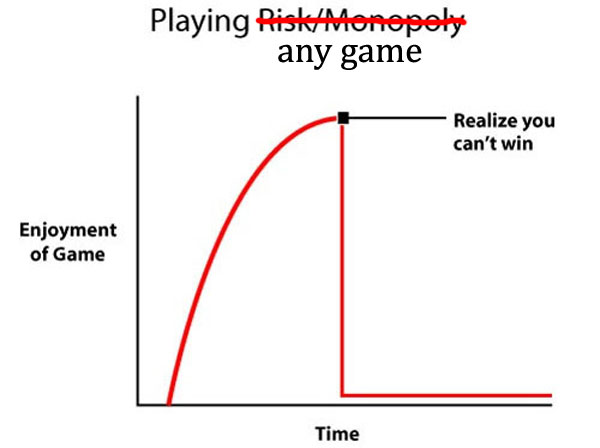
Basically all games.
The problem is simple: opportunity cost. Scree indicates he/she would be fine with me dropping out, as that would make his/her rank go up in the process. But who is really going to be fighting tooth-and-nail for the maximum value of the 25% pie? That would be crazy, especially if I could earn 35% by half-assing a winning map.
There are really no good solutions to this problem, and plenty of ways to make the problem worse. And Crowfall seems poised to do exactly that. For example:
1) Make it easy to hop in/out of maps.
The easier it is to exit a losing map, the more people will do so. As near as I can tell, Crowfall does lock you into a Campaign when you zone into one. I have been unable to quite tell what exactly that means though. Are you locked into that particular map type, but can go elsewhere? As in, can you go into a God’s Reach map and also a The Shadow map? Or are you locked totally down, such that your character ain’t going nowhere for the next three months? The latter might seem the most logical, but take a moment to really absorb what that potentially means to your day-to-day gameplay. You could be stuck in a shitty strategic situation and/or gametype for nearly a quarter of a year, grinding away for that 30% payout months from now. How excited are you for that?
Don’t worry too much though, because the concept of alts lets you easily bypass the restrictions and bail out of the failboat. Is your main doing poorly? Hop on to whichever of your two alts are doing better. Indeed, there is no rational reason to even have a main, considering:
2) Make loot Account-Bound.
This is actually the current Crowfall design. With the resources you gather in these maps being Account-Bound, it actively encourages you to cheese the system via alts as much as possible. It would be dumb to fight hard in a losing battle on your main if you could sail to an easy win on an alt – all loot goes into the same pile at the end, which means your main will benefit just the same.
I’m honestly shocked that Crowfall is heading down this route, especially given how prevalent the alt issue is in other games. I don’t normally believe conspiracy theories, but it’s hard to argue against the notion the Devs are doing this precisely to sell more subscriptions (for the multiple character passive skill gains) by making alt-hopping the best way to play. Put all three character slots into three different maps and play enough on each to get some middling reward, or extra hard on whichever map is a winner. If you have a subscription, you lose zero progress on any character by playing this way.
So what are some potential fixes? Well… there’s not many due to the nature of Crowfall’s design. Alt-hopping isn’t much of an issue in games like EVE and Darkfall precisely because the world is persistent and corps/guilds will likely vet your character to prevent spies. Then again, most EVE players have multiple accounts in the first place, so… maybe not the best example. People drop out of short-lived BGs in other MMOs all the time (and are punished by timers), but since the rewards are tied to the character, there’s not much of a point to switch to alts; switching factions for a win isn’t possible because you’ll never get back into that specific BG anyway.
Crowfall’s uniqueness is this regard presents a uniquely difficult problem.
What is realistically going to need to happen is for the losing (or even just disadvantaged) side to be rewarded with something else. Someone in EVE might fight for pride or survival, but Crowfall’s worlds are temporary. Someone in WoW might realize it’s faster to stick out a lopsided WSG match than the Deserter timer, but Crowfall’s fail states could last weeks. The people making a protracted, futile last stand in Crowfall need to be earning either bonus XP or skill points or perhaps another currency akin to Honor to make their time losing worthwhile.
Otherwise we might just see an emergent, Tol Barad win-trading situation all over again.
Defiance
For the past few weeks or so I have been playing Defiance. As a refresher, Defiance was a subscription-based, TV show tie-in shooter that has since gone F2P. The game plays and handles a lot like an over-the-shoulder Borderlands, in the sense that waves of enemies appear and are dispatched with a large assortment of random weapons.
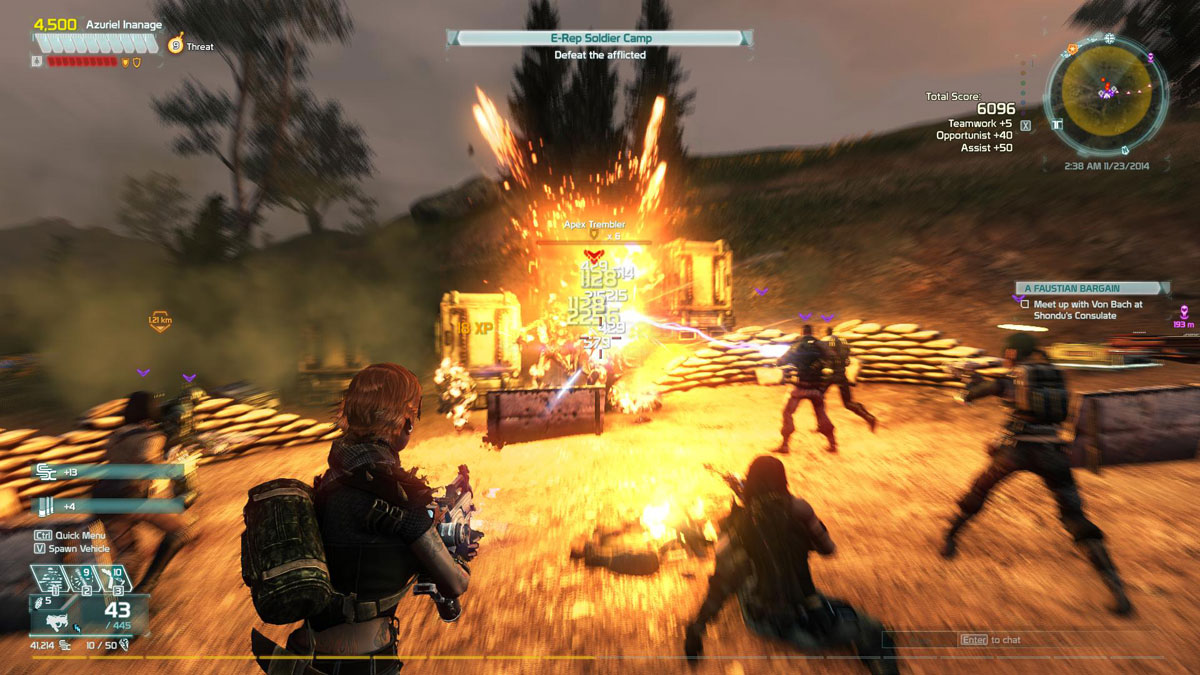
In crowds, enemies become armor-plated bullet sponges.
At this point, I think the show is more popular than the game, and that is too bad. Defiance has story quests that are voice-acted and pretty-well put together. You get a vehicle almost immediately after character creation. There are a number of “arkfalls” at any given time, which are dynamic random events which tend to congregate players around specific points on the map. There are a bunch of (repeatable) side-quests which involve racing, sniping, and other such things.
That said, the biggest problem with Defiance is a more fundamental one: the game is only fun with a fun weapon.
Loot in Defiance is random, just like in Borderlands. There are a number of rarities and status effects and such, but the actual number of gun types are pretty well defined. In the course of my ~20 hours of play, my favorite loadout involves a machine gun that pretty much empties a full 75-bullet clip in three seconds and a shotgun that shoots grenades. I was having a lot of fun running around with these weapons when I got them, but as I have scaled higher in “EGO Rating” (roundabout levels) enemy health has scaled such that my favorite weapons are no longer viable. You can upgrade old weapons to near your EGO Rating, but you can only do so once. And I have since outleveled them again.
In the meantime, I am at the mercy of RNG dropping a higher-level version of the guns I enjoy, or really any weapon that is serviceable. There is somewhat of a push to make all of the weapons viable, but there isn’t much you can do to, say, pistols to make them fun to use. Even with super-high damage and a fast fire rate, you would likely be better off with a LMG with 10x the magazine size. Rocket Launchers face the same sort of issue with faster, higher magazine grenade launchers outputting more DPS overall while giving you a buffer in case you miss your shot.
To say nothing about, you know, a shotgun that shoots grenades with 12-14 rounds in a clip and a 250 shell capacity vs the smaller explosive round.
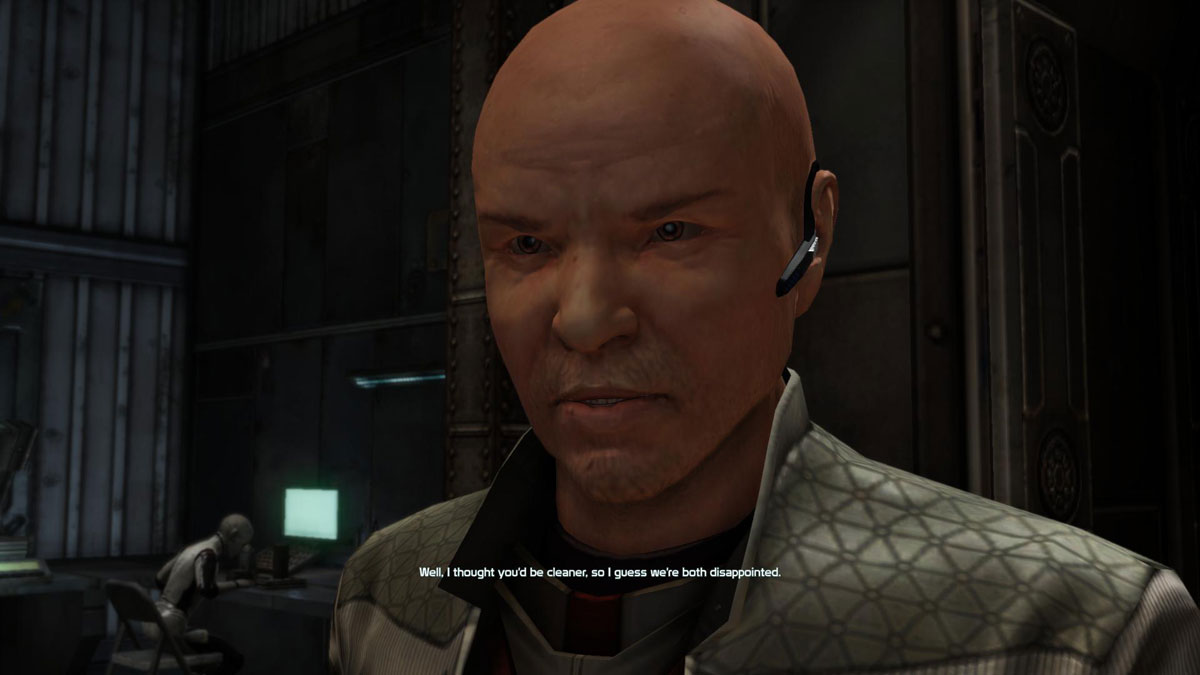
Oh, Von Bach, never change.
In any case, I’m not entirely sure how much longer I will be playing Defiance. As mentioned, the story scenes are actually quite amusing in the sarcastic banter sense, and I’m interested in seeing where it goes. The weapon issue though… it does make it difficult sometimes to slog through waves of enemies with crappy weapons to get there.
Crestfall
So everyone seems to be talking about Crestfall Crowfall, the latest unreleased Jesus game from veteran Jesus game developers. Included amongst them is the perennial nostalgia favorite, Raph Koster, bringing up the consultant rear. Or as I like to call him, the M. Night Shamamamalan of video game design. I mean, I’m looking at his Wikipedia and I’m seeing a huge blank starting from around 2006 onwards. I’m not a game designer, of course, but if I were, I would like to think that the people who deserve recognition are, you know, actually making games people are buying. Maybe even in the last five years!
In any case, I’m not exactly sure why we’re supposed to care about Crowfall right now. I suppose there’s a deep, philosophical difference between straight, corporate PR advertisements (e.g. Guild Wars 2 manifestos) and… Kickstarter campaigns, right? It used to be that these companies paid hundreds of thousands of dollars in advertising into the face of a skeptical audience, but now the script has been fully flipped:
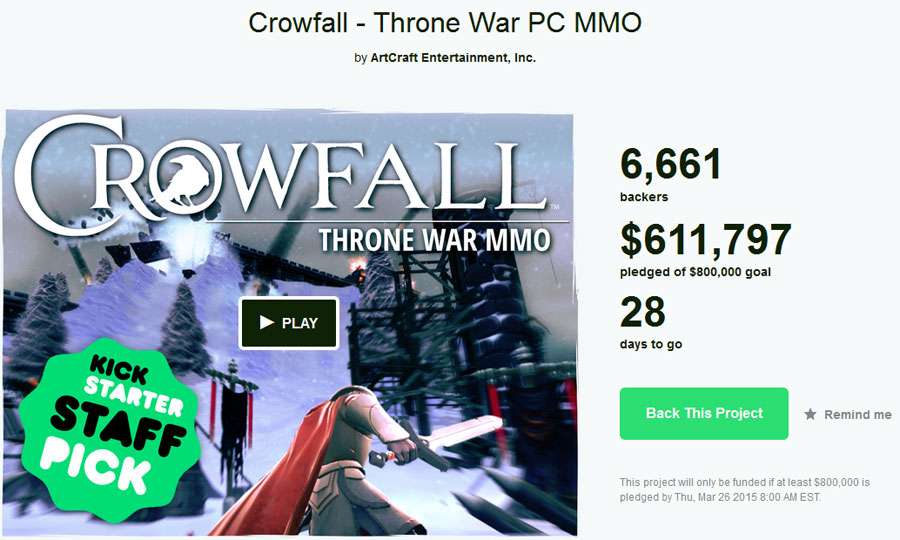
As of 10pm EST, 2/25/15.
That is an average of almost $92 per backer, by the way.
What I will give Crowfall some much deserved credit for is its very evocative premise:
We are Immortal. The Gods choose the best of us to be Champions. They send us to the Dying Worlds to fight, to collect the souls of Damned. The Mortals fear us. They see us as Executioners and Scavengers. They call us Crows…
That has a lot of juice. It neatly solves the conceptual problems of “why do worlds reset” and “why does my character respawn” and even “why am I doing this?” You can almost immediately hear the fanfiction being written – perhaps you’re not a champion, but a slave forced to collect food for a parasite god. Or you’re condemned to your own Sisyphean torment. And were these worlds “dying” before a bunch of hungry godlings showed up? This description greases the wheels even further: “The Shadow Worlds lie closer to the Hunger, where even the Gods dare not tread.” What do the gods fear from the Hunger that you yourself don’t? Mmmm.
But that is where this whole Crowfall hype thing both begins and ends with me. I mean, how many “genre-saving MMOs” are we up to now? Who is still playing ArchAge or Wildstar or whatever? There is jaded cynicism on the one hand, sure, but irrational exuberance (at best) is the other. Maybe everyone is just happy it’s not another endgame raiding MMO, I dunno. I do think we would all be better off pumping the brakes a bit so we can actually see what Jesus features make it off the cross of development.
Talk is cheap. Actually delivering a product that anyone still cares about when released is more difficult.
Dynamic vs Random
Keen has another post up lamenting the stagnant nature of modern MMO game design, while suggesting devs should instead be using ideas from games that came out 15+ years ago and nobody plays today. Uh… huh. This time the topic is mob AI and how things would be so much better if mobs behaved randomly dynamically!
Another idea for improving mob AI was more along the lines of unpredictable elements influencing monster behavior. “A long list of random hidden stats would affect how mobs interact. Using the orc example again, one lone orc that spots three players may attack if his strength and bravery stats are high while intelligence is low. A different orc may gather friends.” I love the idea of having visible cues for these traits such as bigger orcs probably having more bravery, and scrawny orcs having more magical abilities or intelligence — intelligence would likely mean getting friends before charging in alone.
The big problem with dynamic behavior in games is that it’s often indistinguishable from random behavior from the player’s perspective. One of the examples from Keen’s post is about having orcs with “hidden stats” like Bravery vs Intelligence that govern whether they fight against multiple players or call for backup. Why bother? Unless players have a Scan spell or something, there is no difference between carefully-structured AI behavior and rolling a d20 to determine whether an orc runs away. Nevermind how the triggers being visible (via Scan or visual cues) undermine all sense of dynamism. Big orc? Probably not running away. If the orc does run away, that’s just bad RNG.
There is no way past this paradox. If you know how they are going to react based on programming logic, the behavior is not unpredictable. If the behavior is unpredictable, even if it’s governed by hidden logic, it is indistinguishable from pure randomness. Besides, the two absolute worst mob behaviors in any game are A) when mobs run away at low health to chain into other mobs, and B) when there is no sense to their actions. Both of which are exactly what is being advocated for here.
I consider the topic of AI in games generally to be one of those subtle designer/player traps. It is trivially easy to create an opponent that a human player could never win against. Creating an opponent that taxes a player to their limit (and not beyond) is much more difficult, and the extent to which a player can be taxed varies by the player. From a defeated player’s perspective, there is no difference between an enemy they aren’t skilled enough to beat and an unbeatable enemy.
You have to ask yourself what you, as a hypothetical designer, are actually trying to accomplish. That answer should be “to have my intended audience have fun.” Unpredictable and tough mobs can be fun for someone somewhere, sure, but as Wildstar is demonstrating, perhaps that doesn’t actually include all that many people. Having to memorize 10+ minute raid dances is bad enough without tacking convoluted mob behavior outside of raids on top. Sometimes you just want to kill shit via a fun combat system.
Themepark MMO players enjoy simple, repetitive tasks – news at 11.
Review: Dragon Age: Inquisition
Game: Dragon Age: Inquisition
Recommended price: $25
Metacritic Score: 85
Completion Time: 40-90+ hours
Buy If You Like: Dragon Age, CRPGs, Bioware titles
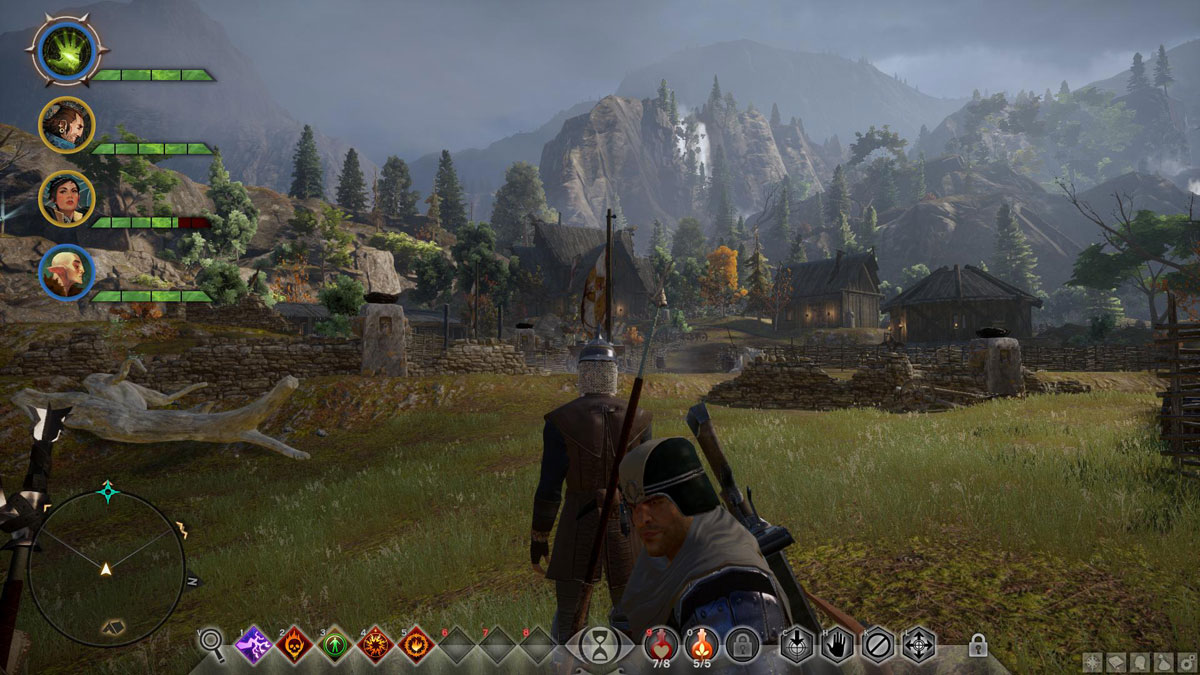
1080p, Medium settings, ~50 fps.
Dragon Age: Origins felt like a seminal moment in computer gaming when it came out back in 2009. Here was an epic RPG written by Bioware that followed in the Baldur’s Gate style with all the conveniences of modern gaming. The lore was deep for a brand new IP, and turned many of the traditional fantasy tropes on their head (elves are actually slaves in the ghettos instead of immortal elites, etc). While certainly not the first title to do so, Origins also featured quite a few deliciously vexing moral decisions with no good answers. Although it stumbled here and there, the game nevertheless took me on a 100+ hour journey with characters I sorely missed after the ending credits.
Then there was Dragon Age 2. It went okay.
The first dozen or so hours in Dragon Age: Inquisition felt distressingly similar to Dragon Age 2. For example, combat remains more Action than Tactics. In fact, Bioware removed the pseudo-AI programming you could do in the prior two games and replaced it with… not much. The plot begins with a limp handshake via two factions warring that I care nothing about and no inklings that things will get better. In short, I was very, very worried.
Once I finally had a base of operations though… you know that feeling in the Mass Effect series once Shepard reaches the Normandy? Inquisition had that moment for me, and suddenly it felt as if my peripheral vision widened. The fun switch was flipped and stayed on for pretty much the entire ride.
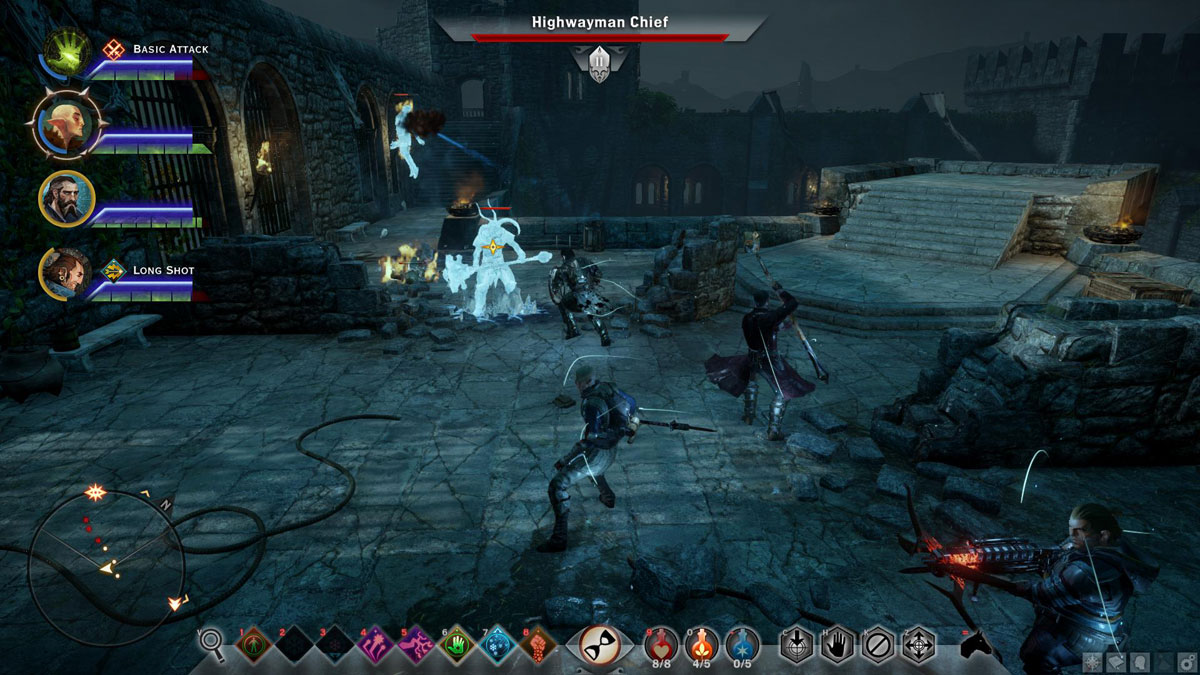
You can get sorta tactical with CC.
The game feels massive. In fact, one of the big criticisms of Inquisition is that people end up staying in the first map (Hinterlands) doing quests for 15+ hours, long past the point when they could be exploring new lands. And I totally fell into that same trap myself. Honestly, Inquisition could easily have been the first draft of Dragon Age Online. It would not at all have felt out of place to see other Inquisitors running around, killing bears and closing Fade portals. Hell, the game already features a rather needlessly complicated and fiddly crafting system complete with dozens of resources nodes spread across the map.
Combat is much more like Dragon Age 2, as mentioned before, but gone are the magically spawning waves of enemies. As a result, most of the enemies you encounter feel as though they are actually part of the world you inhabit, and thus fighting them feels “real.” It also helps that there aren’t necessarily any prescribed “combat zones” – you could be fighting in the woods with trees blocking projectiles, or attacking up the side of a mountain, or using a boulder for elevation to trigger your Archery talent for bonus damage. Indeed, the sheer amount of verticality in the game is a huge triumph in making the world feel more organic.
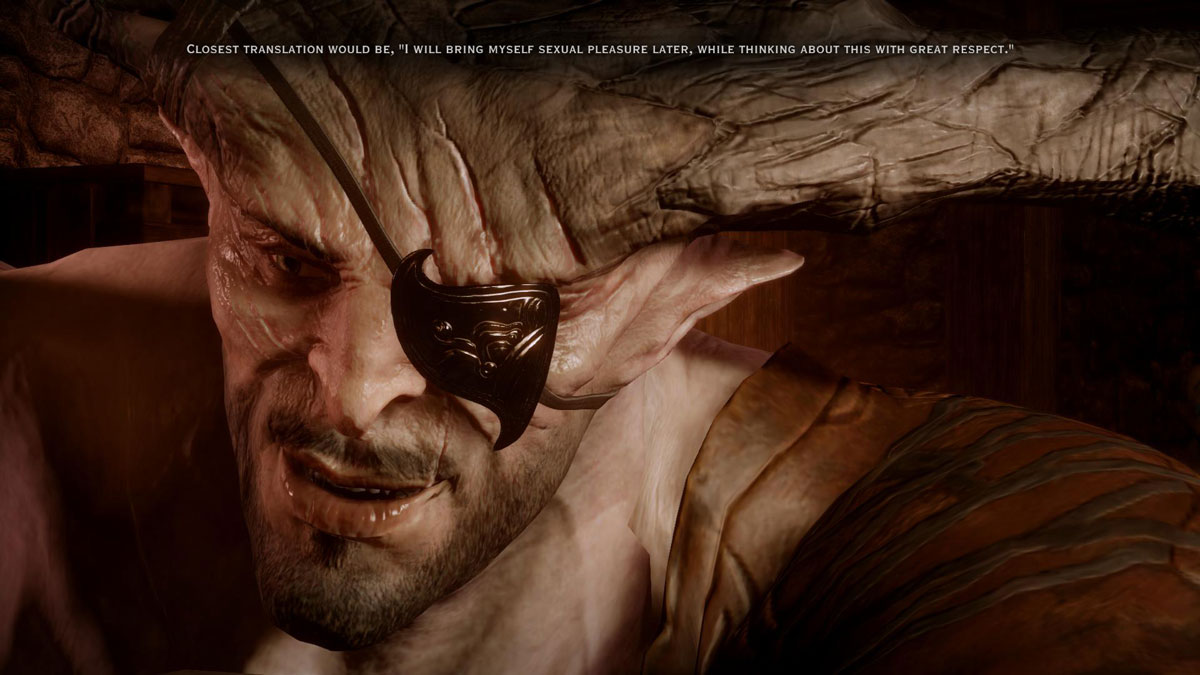
Serious competition with Varric for best party member banter.
In terms of plot, character development, and companion dialog, it is difficult to nail down my feelings on the matter in terms of whether it surpassed prior titles. I ended up playing Inquisition for over 90 hours, largely because I wanted to squeeze every ounce of party banter blood I could from even the stones of irrelevant sidequests. At the same time, most of the excellently written characters were from the first or second games (notable exception: Iron Bull), which feels like… cheating, somehow. Were they particular good in this game, or was I carrying over emotions from prior ones? Tough to say.
What is not at all tough to say is that I very much enjoyed my Inquisition experience overall, and am sad to see it go. I would not rank it amongst my favorites of all time, but Inquisition is the Dragon Age game we deserved after Origins. In short, it has renewed my faith and interest in the series as a whole, and was a joy to play besides. I am ready to follow Bioware into whatever form Dragon Age 4 takes.
 In An Age
Is Crowfall an MMO at all?
Mar 3
Posted by Azuriel
It seems like a simple enough question, but few people seem intent on asking it. Hell, even I had trouble describing my feelings on the matter until Bhagpuss came right out in the comments last time and proclaimed the emperor nude:
In the Kickstarter video, the devs state that Crowfall is a marriage between a strategy game with a defined end-state and an MMO. However, most of the MMO community seems fine in describing it as a straight-up MMO. An MMO with… non-persistent worlds. Divided into servers. That end via victory conditions. Which sends you back to the Lobby, cough, Eternal Kingdoms.
Let’s call a spade a spade: Crowfall is Alterac Valley. With Landmark bolted on.
PvP focused gameplay? Check. Victory conditions? Check. Gather resources? Check. Instanced worlds? Check. Persistent characters that progress in levels? Check. Defined beginning, middle, and end? Check, check, and check.
Competition for the Dregs space was fierce.
The analogy isn’t perfect, of course. You don’t bring out your Gnome bones or whatever outside the individual AV match… unless you count Honor and/or Reputation as resources (which they are). But my point is that Crowfall isn’t an MMO unless you happen to extend that definition to encompass a lot of lobby-based games. Such as, I dunno, League of Legends. Or Clash of Clans, even. Or, you know, every other lobby-based online game out there.
I’m not suggesting that Crowfall will be bad because it’s not an MMO. In fact, it might precisely be because it’s not an MMO that Crowfall avoids all the traditional pitfalls of the genre. As SynCaine points out though, there are all sorts of other problems that can occur once you start dealing with defined, close-to-zero sum competitions. What motivation is there to continue fighting a losing battle when another server is a click away? Hell, if the devs aren’t careful, the whole “multiple passively trained alts” thing could resemble P2W considering you could swap your losing alts for one on the winning team. Then again, everyone already has experience with these sort of issues in, you know, battlegrounds in other MMOs. So perhaps it won’t be that big a deal.
If you enjoyed old-school Alterac Valley though, Crowfall seems like the MMO game for you.
Posted in Commentary, MMO
14 Comments
Tags: Alterac Valley, BGs, Bhagpuss, Crowfall, Lobby, WoW