Blog Archives
That JAB vs Trump Hearthstone Game
The Hearthstone Americas Champion tournament aired this past weekend, and one particular game stood out: JAB vs Trump, Game 5. Or more specifically, this game-deciding bit of RNG at the final moments:
Now, the first thing I’m going to say is this: listen to that crowd. They’re loving it. I was watching the stream live and even I was going “OoooOOOoooh!” For all the derogatory “coin-flipping” and RNG flak Hearthstone gets, I think it’s pretty clear that watching these games can still be pretty exciting. Certainly more exciting than watching a perfectly mechanical, zero RNG game in which the outcome is known by turn four.
But as someone who watched the entire match-up, what gets me is how everyone always boils the RNG down to the final sequence… but seemingly ignore everything that lead up to it. This the final match in its entirety:
There is a ton of RNG at the beginning of the match, including a lot of amazing top-decks that changed the tone of the game. If Trump didn’t draw that Big Game Hunter to answer Dr. Boom, if the Shredder outcomes were different, if some other combination of cards were drawn… and so on. It reminds me of sports like football or baseball when mistakes are made with the final field goal or bottom-of-the-ninth plays. Everyone always remembers that last failure, and not all the other equally critical failures that lead up to it.
That thought then brought me to the Reddit thread in which someone wrote this:
You missed the whole pont, people say Hearthstone can’t be an esport because RNG isn’t affected by skill (mostly), so it’s more like playing bingo than a real sport in which there is 0% luck like soccer, or an esport like StarCraft 2.
There is no question that there is a lot of RNG in Hearthstone. But it is also beyond absurd to not recognize how much random bullshit occurs in meatspace sports as well. It is like suggesting all these soccer goals were 100% intentional, including the one where the guy tries to headbutt the ball, misses, and it bounces off his hip into the goal. Is the fact that a literal random number generator is not involve somehow make those “1cm to the right and it’d have bounced off the pole” scores less random?
Point being: randomness is involved in every asymmetric game, up to and especially including real-life sports. Are soccer games determined by coin-flips? Not ones we can see, anyway. But how else would you describe a penalty kick-off in soccer? That goalie has to arbitrarily decide to jump left or right, pretty much instinctually and before they see where the ball is heading. Or going back to card games like Poker – which a lot of people take very seriously – the most skillful aspect of the game is… bluffing. But what is that? If you read someone perfectly, all that really tells you is “they like/don’t their hand.” It doesn’t tell you what cards they have, or if yours could beat theirs.
I dunno. I don’t play Hearthstone as much as I used to, but I still enjoy watching it quite a bit. To suggest it can’t be an esport due to it having RNG moments though, is just ridiculously wrong. The randomness in other games is just more well-hidden. Perhaps we can say Hearthstone has too much of some arbitrary amount of RNG to be successful in an esports sense, but… is that really the criteria? Or is it “this is fun and exciting to watch?”
Seat of Pants Design
[Blaugust Day 12]
During the past few days of combing the internet for Hearthstone tidbits, I came across and interview from back in May which illuminates the… bold way Blizzard is approaching Hearthstone design. Basically, flying by the seat of their pants:
[…] We always try to add a little bit of craziness to the game and let people discover it. When we put Grim Patron in we didn’t know exactly how good it was going to be. We had a good idea, because we played it a lot. We knew there was going to be some variance once people figured out what the best version was, and what the meta was going to be. I think we’re going to keep making some crazy cards in every set that are dangerous and hopefully going to work out.
This was not the only time they said something like this. Here is an interview from last Saturday:
Several high-level players were recruited to join the team. What effect has this had on your game design?
The balance team makes sure cards are clear, well-designed, and well-balanced. We recently hired people from the tournament circuit to make sure things are more balanced, but we also try to make risky cards that push the limits and scare us. Lock and Load is a good example of a card that is risky and could be unbalanced.
There is something to be said about not being too conservative in these sort of endeavors. All the really cool cards in most CCGs – the ones that set your mind on fire about the possibilities – are typically the least balanced ones. “If I just had this one card, I would turn the game around.” You just never get that sense with cards that, you know, aren’t capable of turning around games by themselves.

“Should I play Dr Boom?” Is it turn 7? Then yes.
On the other hand, I feel like Blizzard is having their cake and eating it too. Dr. Balanced, aka Dr. Boom, is a joke precisely because of how long it has survived unscathed from a tuning pass. Is Dr Boom warping the metagame? Not necessary. Is Dr Boom far and away one of the most absurdly powerful cards in the game to the point he’s in ~37% of all decks? Yes.
Many point out that that’s only because the other 7-drop creatures are so bad. Well, okay. Now imagine how much stronger the card that replaces (or even just matches) him is going to have to be.
Of course, the cynical part of me realizes that deliberately creating “chase rares” in a CCG is nothing new. Like most everything in this genre, Magic: the Gathering invented it. Chase rares sell packs, which in turn creates every incentive for designers to create more. “This new card is probably completely broken and going to push a million packs.” Yeah, totally scary. Especially when you can ignore the problem and watch players fall all over themselves stuffing their decks with Epic/Legendary cards to counter the shit you just left steaming on the table.
…I might be a little bit bitter.
That aside, it kinda makes me wonder whether Hearthstone is the only place this design philosophy rules. Certainly when I look at some of the WoW design changes in Warlords, I see a team of devs running riot past everything that was remotely successful about all their previous expansions. Look at the raids, and see how it’s all a perfectly linear evolution of what came before. Then look at flying, reputations, crafting, Garrisons, resource gathering, gear rewards, PvP balance, class design. I’m not even sure if those devs were flying with pants on.
Nevertheless, I kinda get it. Being bold is how Blizzard (or anyone for that matter) got anywhere in the first place. Even if that boldness is straight-up stealing all the good shit from everyone around you. Like I said earlier, the craziness is what gets the juices flowing.
So… I’m conflicted.
Or maybe things are a lot simpler than I’m making it out to be. Flying by the seat of your pants is exciting and better than the alternative… provided you stick the landing at the end.
Hearthstone Data Points
[Blaugust Day 6]
It has been yet another Blizzard Investor Report in which Hearthstone metrics have been bundled or otherwise obscured, but this latest report added a few more variables with which to solve for X.
One of the juicier parts was this bit (provided by TheStreet):
Note that this quarter was an important inflection point for Blizzard. In spite of World of Warcraft subscriber declines, which were more concentrated in the East and partly affected by the success of Diablo III in China, Blizzard grew its Q2 revenues 29% year over year at constant FX.
This performance was driven by the strong performances of Diablo, Hearthstone, and Heroes of the Storm, which in Q2 made up the majority of Blizzard revenues. The franchise diversification inside Blizzard is happening rapidly, and even more importantly, the aggregate Blizzard community is healthy and growing.
In order to fill in some blanks, we now have to turn to the Activision Blizzard website. According to the slides (PDF) and press release (PDF), we get some more data points:
- Destiny, Hearthstone, & Heroes of the Storm: >70M players & >$1.25B non-GAAP* revenues, LTD
- Destiny: >20 million registered players have played about 100 hours each since launch
- Diablo III has sold-through over 30 million units to date globally
- Hearthstone: Key engagement metrics nearly doubled year over year, largely on account of the new content/platforms.
- Overall Q2 net revenue GAAP = $1.044 billion, non-GAAP = $759 million.
- WoW specific GAAP revenue for Q2 = $221 million; non-GAAP $157 million.
- Asia Pacific net revenue for entire company: GAAP $105 million, non-GAAP $131 million.
- Blizzard specific revenue for Q2: $385 million.
That last data point was not specific in whether it was GAAP or non-GAAP, but I’m assuming it is the latter as otherwise WoW couldn’t be less than half of the Blizzard total, which is what was stated in in the investor report. So here are a few of rudimentary calculations we can draw:
- Blizzard’s non-WoW revenue for Q2 = $228 million (385 – 157).
- Hearthstone + Heroes of the Storm registered players = ~50 million
- Hearthstone = 30+ million registered players as of 6/5/15.
- Ergo, Heroes of the Storm has ~20 million registered players (70 = 20 + 30 + X).
- Destiny + Hearthstone brought in $850 million in 2014.
- The Q1 2015 report (PDF) stated Destiny + Hearthstone had $1 billion non-GAAP revenue LTD.
- Destiny + Hearthstone + Heroes of the Storm = ~$250 million combined in Q2 (1.25b – 1b).
- Diablo 3 sold 20 million copies as of August 2014. Thus sold another 10 million copies in last year.
So… yeah. Still feels like we’re missing too much information to draw any major conclusions.
That said, we can deduce that Hearthstone made less than $250 million in Q2, and less than $150 million in Q1. How much less remains to be seen. Also, while a lot of noise was made about the (F2P!) success of Diablo 3 in China, it bears mentioning that all franchises in both Activision and Blizzard (including WoW) totaled $131 million in revenue in China. In other words, it isn’t as though Chinese Diablo 3 is going to claim the lion’s share of the non-WoW pie.
As always, if you see an error or otherwise have put enough skill points in Language (Economics) to make better sense of the Investor Report numbers, by all means correct me in the comments below. If I had to guess, I’d peg Hearthstone at around $75-$100 million per quarter.
WoW Down 2.9 Million Subs
In news both kinda expected and yet still rather shocking, WoW is down 2.9 million subscriptions from last quarter.
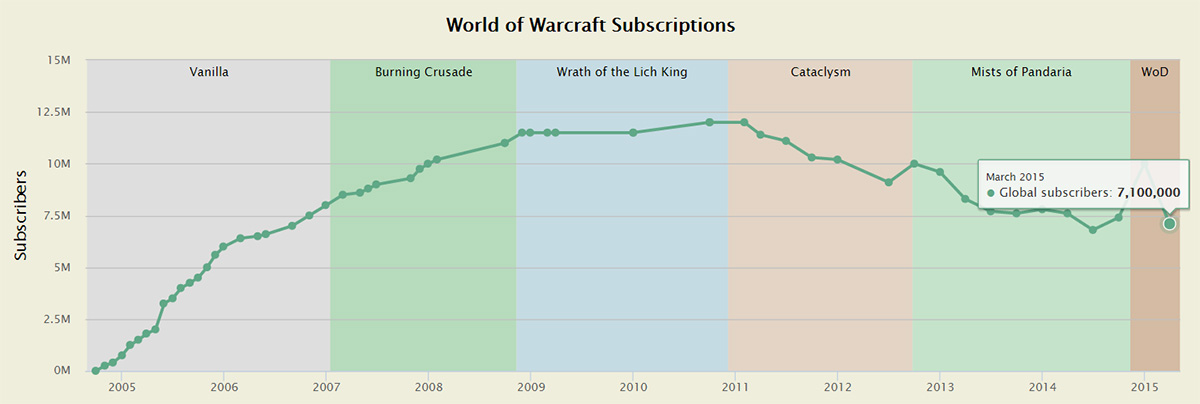
Whiplash.
At a certain point, the sheer magnitude of the change makes commentary moot. You don’t lose nearly three million people because of Garrisons. Or screwing up professions. Or having easy-mode raids. Or hard raids. Or whatever. And as I mentioned when we first heard about the 10 million sub surprise, the numbers are too big to ascribe to the expected MMO Tourism/Locust Effect either. I mean, yeah, the numbers jumped to 10 million and then back down, so people went somewhere. But unless we’re willing to state three times as many wished to tour Draenor than Pandaria, it had to be a confluence of all sorts of things.
Whatever those things are, it’s clear that it isn’t enough to last a full quarter.
There is no transcript of the call as I write this, but I went ahead and listened to the whole 42 minutes of PR bullshit anyway. No real juicy tidbits were found… unless you consider Guitar Hero on your phone to be juicy. The whole WoW Token thing was mentioned only in passing, which makes sense considering any of its effects won’t appear until Q2. Oh, and I suppose there was this bit about Hearthstone (PDF):

Two franchises that go together like peas and carrots.
Still doesn’t clear anything up in terms of the money part of Hearthstone’s success, but I suppose another data point is another data point.
On Randomness, Again
A little over a year ago, I talked about randomness in Hearthstone. Since that time, the amount of RNG cards has only increased. In fact, the Goblin vs Gnomes expansion added a full 24 cards with the word “random” on it, some of which have gone on to be staple cards in many decks:

The one of the left is an auto-include in every deck.
At the time of the article, I mentioned that Blizzard’s stance on RNG was possibly at a turning point given how Hearthstone’s nascent e-Sports scene was starting to take off, much to the surprise of Blizzard itself. As we well know today however, Blizzard has stuck with their RNGuns and doubled-down on wild board swings.
And… I think I can appreciate what they’re doing.
The downsides to randomness are rather apparent to most people, insofar as you can go from winning to losing by virtue of a coin-flip. Watching Pro Players losing tournaments on the back of a 1% chance (or even less) of bad luck makes the game look like amateur hour sometimes.
On the flip side (har har), an element of randomness allows one to stage surprising comebacks. Top-decking just the right card to win a game has always been a staple of even the highest levels of the Magic: the Gathering professional scene. Since Hearthstone has less than half as many cards as Magic (and no land cards to gum up the works), Hearthstone arguably needs the extra randomness just to be less deterministic. Nobody likes playing unwinnable matches.
The real upside to Hearthstone’s randomness though? The stories.
If you were the other guy playing this match, you would probably be justifiably upset about how utterly screwed you got from that Piloted Shredder outcome. Or would you be justified? As I mentioned before, randomness is just another consideration that skilled players need to account for in their strategies. Getting Lorewalker Cho out of a Piloted Shredder as Oil Rogue is bad, but there was always a 1.5% chance of it happening in every game; if you don’t want to sometimes lose to the randomness of your own card, take it out of your deck. About 70% of the time, Piloted Shredder summons a better-than-expected minion, which is why so many people run it.
But as I was saying, that match went from “just another video demonstrating a deck” to “high-class entertainment” in my eyes. You can see the gears whirling in the streamer’s head as soon as Cho hit the board; it was unexpected, and the unexpected is much more fun for the viewers at home. Even if I were playing that game though, I think I’d be alright with it. Nobody really cares that you won yet another game as Oil Rogue or whatever is Flavor of the Week. Winning in spite of Cho? That would be epic. And even though the other rogue loss due to Cho, he/she now has the option to mentally blame bad luck instead of being outplayed. That attitude can prevent new players from improving of course, but it can also prevent new players from simply giving up in the face of veterans.
The next Hearthstone Adventure set, Blackrock Mountain, is due to be released sometimes in April. We haven’t seen nearly all the cards yet, but we already know about a reverse-Shredder card called Hungry Dragon, which summons a random 1-mana minion for your opponent. So at this point, I believe it safe to say that randomness is here to stay. Time will tell if Hearthstone in general does the same.
(I give it a 92% chance.)
Blizzard’s Q4 2014 Report: Hearthstone Edition
The big news in the Activision Blizzard Quarterly Report everywhere else is that WoW appears to have stabilized at 10 million subscriptions. Also, that Hearthstone has 25 million registered users, whatever that means. After reading through the transcript of the earnings call however, it turns out that we can estimate exactly how well Hearthstone is performing. Spoiler alert: it’s pretty damn good.
First, we have this quote from Bobby Kotick:
Last year, we launched 2 of the most successful new entertainment brands, Destiny and Blizzard’s Hearthstone. Combined, they attracted over 40 million registered players worldwide and generated more than $850 million in non-GAAP revenue, a testament to our team’s proven abilities to capture the imaginations of millions of people around the world time and time again.
Then from Eric Hirshberg (CEO of Activision):
So in closing, over the last 3 years, Activision Publishing has methodically expanded its portfolio, and for the first time in its history, now has 3 tent-pole properties, each of which generated over $500 million in non-GAAP revenue this year and drove the highest digital revenues in Activision Publishing’s history.
So by the power of inductive reasoning, we can say Hearthstone made around $350 million in revenue last year. Further, according to Thomas Tippl (COO), Destiny and Hearthstone are “tent-pole franchises” that were “profitable out of the gate” and are expected to “contribute to [Activision Blizzard’s] results every year in a significant way.” Combine that with Mike Morhaime confirming that the December release of the Goblins vs Gnomes expansion resulted in the highest monthly active players and highest revenue quarter-to-date, that indicates Hearthstone is still growing a year later. That’s kind of a big deal.
Now, it’s entirely possible that “more than $500 million” means Destiny has a larger slice of the $850 million combined revenue pie than I am assuming here. Maybe Hearthstone “only” achieved $300 million. Or even as little as $250 million. It’s helpful to keep some perspective though: all of paper and digital Magic: the Gathering brings in $250 million in revenue. So, on the low end, Hearthstone is already a bigger franchise than Magic: the Gathering. And apparently growing.
Not bad for a “casual app with a PC port.”
Titan Felled
I spent about 10 minutes coming up with various clever variations on Titanfall and Attack on Titan, but alas.
Blizzard has killed Project Titan after seven years in development. That Polygon article is overflowing with choice quotes.
“We had created World of Warcraft, and we felt really confident that we knew how to make MMOs,” Morhaime said. “So we set out to make the most ambitious thing that you could possibly imagine. And it didn’t come together.
“We didn’t find the fun,” Morhaime continued. “We didn’t find the passion. We talked about how we put it through a reevaluation period, and actually, what we reevaluated is whether that’s the game we really wanted to be making. The answer is no.”
Some would certainly argue that Titan isn’t the only project they can no longer find the fun/passion for.
“Are we the MMORPG company?” he added later, in conclusion to that line of questioning.
Morhaime answered that last rhetorical question quite simply: “We don’t want to identify ourselves with a particular genre. We just want to make great games every time.”
Like… wow. (Err… no pun intended) That has “exit strategy” written all over it. And speaking of that:
Throughout the interview, Metzen and Morhaime suggested that the recent trend of smaller-scale Blizzard releases like Hearthstone and Heroes of the Storm has played a part in the company moving away from Titan. […]
He explained that Hearthstone had helped the studio realize that they don’t need to fit themselves into the box of only making products of a certain scale.
I didn’t get the chance to mention it earlier, but Hearthstone hit 20 million players. Or “players,” whatever. It is still 10 million more than they had in March. While it’s tough to actually come to any sort of definitive conclusions about the significance of those numbers given how it’s a F2P game that is hitting mobile devices, it is clear that it wasn’t just a flash in the pan. If this analyst from CinemaBlend.com (…err) can be believed, Hearthstone could pull in $30 million in revenue this year… which is basically 14% of what WoW brings in yearly. Not bad for a team of 12-15 people.
Back to Titan though, being cynical is easy and mostly safe. However, I am beginning to agree with Gazimoff of Mana Obscura in that this might be the death of the super-genre MMO. “We won’t see another heavyweight MMORPG released by a major studio in the next two years.” I was going to say that EverQuest Next sort of proves that wrong, but that is probably a bit more than two years out, and who knows if it even gets released at all; Landmark might just cannibalize it, if it doesn’t cannibalize itself first. But surely there is something else… oh. Maybe not.
Whether you are celebrating the news – perhaps hoping that more tightly-focused niche MMOs will spring up in the vacuum “as they should be” – or lamenting the loss of AAA tourism, I do want to take a moment to mark the occasion. Because it is an end of an era, or another sign of it at the least. And while we can sit back and suggest that WoW “ruined” “real” virtual worlds like Ultima Online or Everquest or whatever, I do feel a bit sad to think that what we have is it. Specialization is great and all, but when I look at the ex-WoW guild member friends I have made, I see a group of people whom I have never consistently played any other games with. The “super-genre” WoW was pretty much the extent of our shared gaming interests; there is some tiny overlap here and there, but getting the hardcore Civ, the Team Fortress 2, and The Sims players all together as an officer core for a 5-year old guild was goddamn magic.
Titan was unlikely to have rekindled things for my disparate, dispersed cohorts, true. Sometimes things just reach their natural conclusions. And maybe there is something to be said about making friends with more similar interests in the first place. Still… I can’t help but feel a loss, somehow.
Dust, Draenor, Destiny
The one bit of news out of CCP’s Fanfest 2014 that peaked my interest was Project Legion. Which is, for all intents and purposes, a rebooting of Dust 514 on the platform it should have been released on in the first place: the PC. I’m not actually sure a sandbox PvP/PvE hybrid shooter MMO is what I’m looking for anymore, but given I have continued to grudgingly slink back to PlanetSide 2 for my FPS urges, let’s just say that I’m not exactly opposed to new experiences. It should be noted that in that article, CCP basically states that Dust still has 100,000 active daily players, which is around 100k more than it seemed to have any reason to have last time I played.
Incidentally, NoizyGamer believes that this year or the last one might have marked the last year of consecutive EVE subscriber growth. That’s noteworthy specifically because the ~10 consecutive years of growth itself was noteworthy. And rather annoying to argue against with my MMO market saturation theories.
Speaking of bodies, WoW lost another 200k of them since last quarter, bringing the total to a mere 7.6 million. I’m not really sure what to think about this sort of thing anymore; at the moment, I’m leaning towards simple incredulity that there are 7.6 million people paying a subscription to a game that will be going on a full year without any new content. I mean, I too was that guy years ago, but that sort of shit doesn’t fly with me these days.
Speaking of questionable Activision Blizzard moves, the console-only FPS MMO Destiny is reportedly going to cost $500 million:
To put some perspective on this, the money being spent on Destiny is more than twice the amount EA reportedly spent on Star Wars: The Old Republic and a little less than double the $265,000,000 Rockstar paid to get GTA V made. The Reuters article cites analysts saying that Destiny will have to sell 15-16 million copies at $60 to break even. So, the final game has to make a very, very good first impression.
For reference, Borderlands 2 cost ~$35 million and sold 8.5 million copies as of February 2014. It’s worth noting that the first link estimates Destiny at $140 million, so it’s entirely possible that the $500 million is in reference to the entire 10-year franchise run that Activision Blizzard purchased from Bungie rather than the BorderHaloLands game we have on display.
Still… goddamn. This doesn’t even seem like the same ultra-conservative game company of a year ago, who didn’t want to branch out into the mobile space simply because the Top 10 games change every year. I’d like to imagine those executives with a fat Hearthstone egg on their face, but great handfuls of money make for surprisingly effective yolk removal.
 In An Age
WoW Down to 5.6 Million Subs
Aug 5
Posted by Azuriel
[Blaugust Day 5]
Holy shit. WoW is down 1.5 million subs in three months.
Decade boomerang.
As the graph from MMO-Champion indicates, the last time WoW had 5.6 million subs was back in December 2005. While there are quite a few people out there saying the expansion spike into Warlords “shouldn’t count” due to hype trains and such, it bears repeating that WoW had 10 million subscriptions six months ago. Four point four million subscriptions is a fucking genre’s worth of tourists.
Assuming you can still call the 1.5 million people who left between months 3 and 6 “tourists.”
For the record, Cataclysm dropped from 12 million at its height down to 9.1 million at the end, a 24% loss. Mists started at 10 million, and ended around 7.4 million, a 26% loss. Even if we completely disregard Warlords’ spike in subs for no reason, going from 7.4 million to 5.6 million is a – drumroll please – 24% loss. And the year is only half over. And the final raid has already been released more than a month ago.
When Blizzard said they wanted to speed up expansion cycles, I didn’t think they meant cramming in two years’ worth of losses into half a year.
I went ahead and listened to the conference call myself, but the MMO-Champ summary is pretty much spot on. The only thing I wanted to mention was how early on in the call they pointed to Hearthstone specifically as being one of the largest drivers of revenue in Q2. Which, of course it is, everyone knows that. Additionally, at some point during the call Blizzard admitted that Hearthstone, Diablo 3, and Heroes of the Storm combined made up the majority of Blizzard revenue in Q2. As in, at least 50% + 1. Who would have saw that coming 3-4 years ago?
Some questions remain. While I have no doubt WoW Tokens are included in revenue stream, whether they count as subscriptions in of themselves is a question mark. Sure, a redeemed one should count as a one-month subscription just like a game card. But what about my eight Tokens sitting on an inactive account? Am I “subscribed?” This remains to be seen.
In any case, if this upcoming expansion announcement isn’t literally the best thing in the world, I think we can expect to see some more timely exits from Blizzard staff and players alike in the coming months.
Posted in Commentary, WoW
9 Comments
Tags: Blaugust, Hearthstone, Investor Report, Loss, Q2 2015, Subscribers