Blog Archives
1000xRESIST Complete
I finished 1000xRESIST about a day or so ago. Verdict: it’s very good.
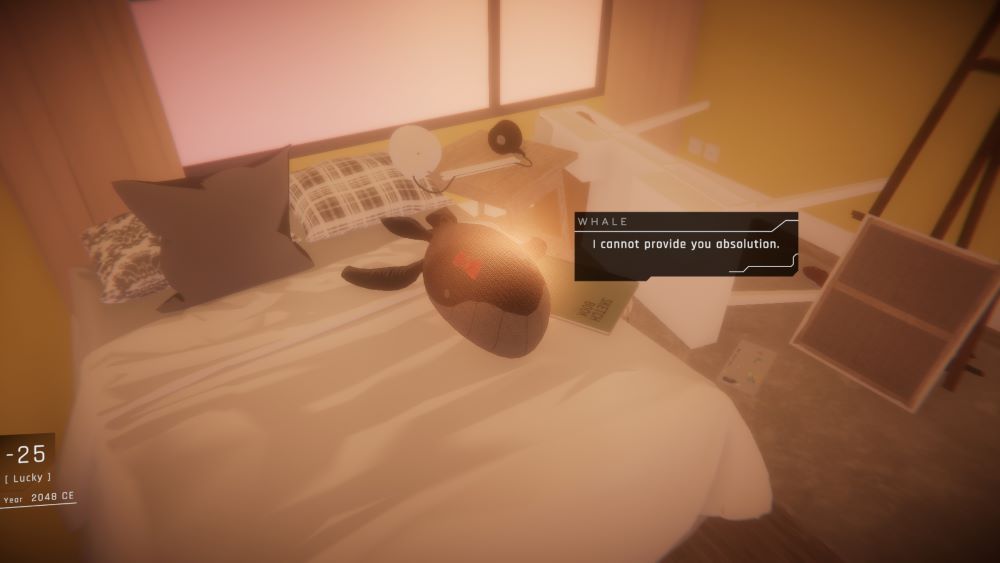
Also, fair warning, it’s longer than you think. I kept getting into sequences where I’m like “oh they’re wrapping things up” and… nope. Another entire section. And then another. Total playtime for me was 13 hours. The game doesn’t overstay its welcome or get too diluted necessarily, but it’s one of those things you should keep in mind as you play.
Speaking of “playing,” as previously mentioned, 1000xRESIST is definitely on the walking-simulator side of things. You have to talk to certain people to move the story forward, but you can also run around and talk to a bunch of different people too. I very much encourage you to do so, because there were surprisingly poignant side stories that were tucked away in unassuming spots. That said, there are definitely some really cool time jump sequences where you can bounce back and forth to navigate around obstacles. Plus, the devs really mix things up with perspectives at times.
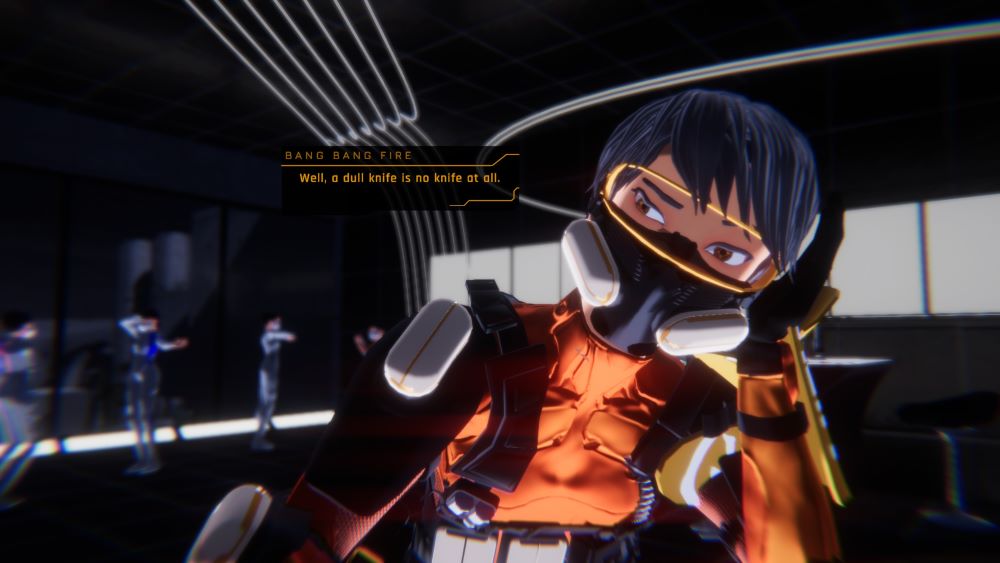
So… what’s it all about? It’s tough to go in deeper than a surface level without getting into spoilers.

Essentially it’s a sci-fi story wrapped in a coming-of-age story wrapped in generational trauma and real-world (Asian) political events. Specifically, the Hong Kong riots of 2019. At times, this both worked and didn’t work for me. There is a kind of banality when it comes to political metaphors in fiction, IMO, especially when things are so on-the-nose. The 3-Body Problem book series starts out with Mao’s Cultural Revolution, but it’s not about the Cultural Revolution. With 1000xRESIST, the game is mostly about the Hong Kong riots back in 2019 and ensuring diaspora; not only were the parents of Iris protesters who eventually fled, but the alien beings who invade are labeled Occupants, the deadly disease they bring causes you to leak water from your eyes (tear gas), etc, etc.
That said, the rest of the dialog and interpersonal relationships within the game make it worthwhile. Seriously, I ended up taking over 100 screenshots throughout the game from when the writing shocked me and/or made me abruptly laugh. The banter is witty, biting, and sometimes all too real. The shifting gameplay elements are unique and kept things interesting. I’ve mentioned it previously, but I also extremely enjoyed the world-building language of the game as well. Still want to use “hair to hair” IRL.
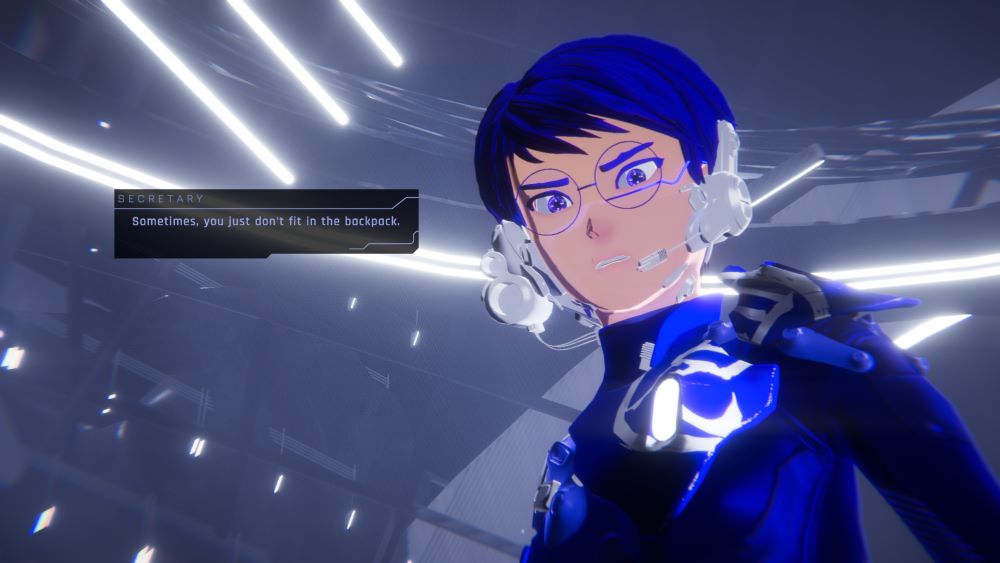
Overall, I enjoyed my time.
The Outer Hype, Also
I finished Outer Wilds last week. Finally.
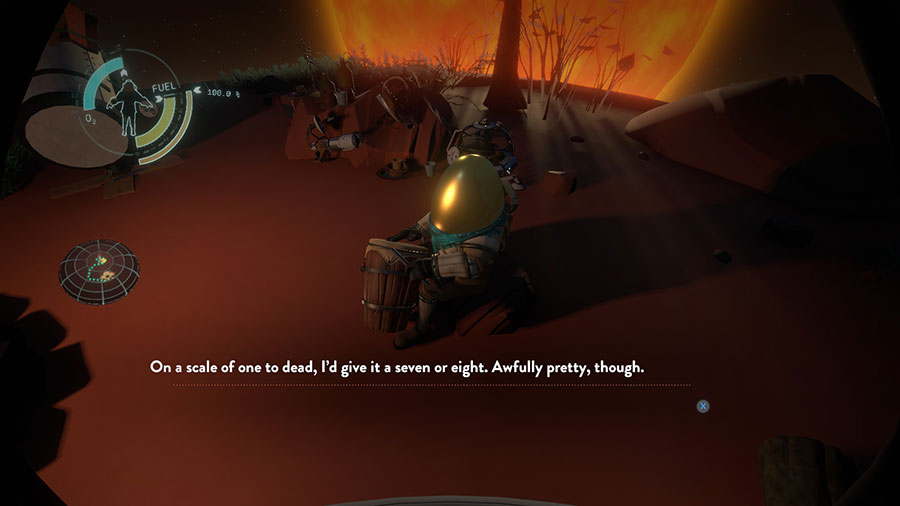
As with its similarly named cousin, The Outer Worlds, I walked into this experience under the cloud of effusive praise. Polygon named Outer Wilds Game of the Year 2019 and added it to their Game of the Decade list (#25). Which… makes sense, I guess. It would be kind of awkward for a GOTY to not be good enough for the decade.
But if Outer Wilds is Game of the Year 2019, then 2019 must not have been a good year for games.
To be fair, there are a number of praise-worthy elements to Outer Wilds. The premise of a time-loop mystery is fairly unique (Majora’s Mask notwithstanding). The lack of any form of combat is similarly rare. The game does a really nice job of simply letting you jet around the solar system right from the get-go. The soundtrack is great and the visuals and setpieces can be breathtaking. In truth, there is a lot to like here. The fact all this novelty and ambition came from an indie dev with a dozen people is the commendable bow on top.
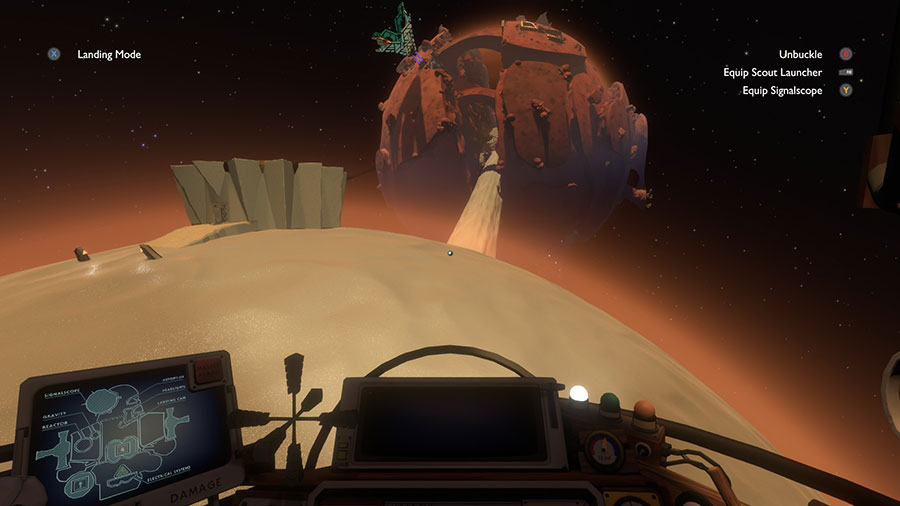
It’s just that… the game isn’t for me. Or possibly you.
Everything was great for about two-thirds of the experience. Once you get the controls down, you can wake up from the beginning of the time loop and be orbiting any planet in the solar system within minutes. The impending supernova did grate on my nerves a few times, as it always seemed to occur when I was 90% done exploring a specific location, requiring me to make a return trip to finish up and then suiciding so as not to limit exploration time somewhere else.
As with all videogames though, things escalated from there. Exploration started requiring some gnarly platforming, where failure often resulted in survival… but lost minutes, of which you only ever have 22. So it may as well have been death. Then the game required gnarly platforming AND specific timing. It wasn’t enough to discover where you needed to go for the next clue, you also had to be there at a specific timeframe.
Up to this point, I had been doing everything on my own. But when I encountered a particularly annoying timing puzzle I could not solve after repeated attempts, I was ready to abandon the game. As is often the case, when I broke down and looked up the solution, it was something that should have been obvious. But immediately following that one sequence were many more that would not have been obvious (to me) at all. Still later sequences require you to sit on your hands for 7+ minutes before getting the opportunity to finish navigating a hallway that becomes impossible to complete within 30 seconds of the window of opportunity opening. Who is this fun for?
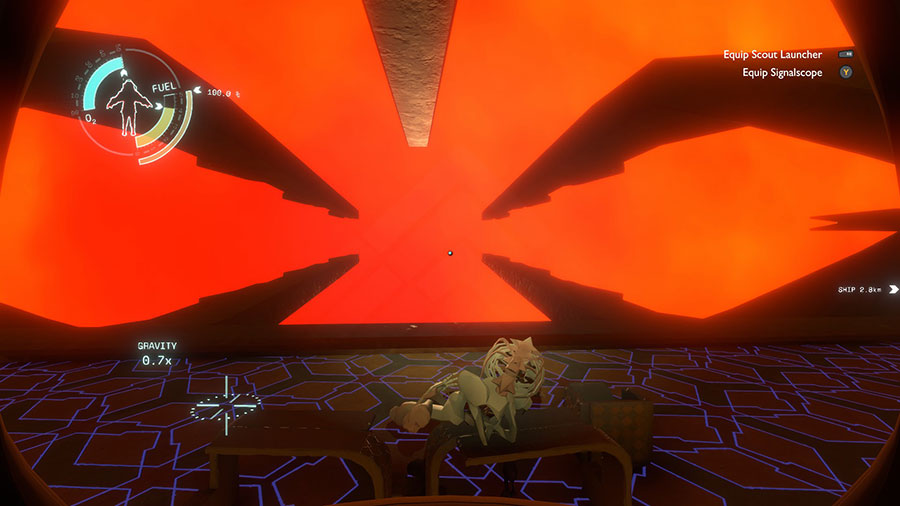
And that’s the $25 question. Or in my case, $17.80. And the answer is: Not me.
This should not have been much of a surprise. I don’t actually like Adventure/Puzzle games. Or more specifically, I abhor games in which you can come to a hard stopping point and flounder around not even knowing what it is the game is asking you to do. Can’t beat a boss? Gain more levels, or memorize its attacks, or try a different strategy. Can’t get into a locked room? Well, unless there are some movable statues right outside or a monster with the key, then good luck. There could be any number of reasons why the door is locked, up to and including the fact you aren’t supposed to go through the door. And when the solution ends up being “attach a probe to it and then wait FIFTEEN MINUTES for the entire structure to be sucked into a black hole and ejected out into space and then go through a different opening altogether,” I’m not exactly happy at the designer’s cleverness.
Nevertheless, I am glad I played Outer Wilds, if for no other reason than to see for myself as to whether it is a transformative experience. Again: not for me. I can see how it could be for some people though. Maybe. I’m not really sure, actually, because I find it difficult to imagine the sort of person who is capable of working through the entire game without a guide and also receptive to its underlying message. The guides I used didn’t ruin any of the details, but the experience itself gets a bit disjointed when you’re Alt-Tabbing every few minutes.
But if you are a fan of timed, Adventure platforming roguelikes though, you are in for a treat.
Impression: Fell Seal: Arbiter’s Mark
Oh, how sweet is that feeling of consumption. Well, not that consumption… the other one, when you have had gaming ennui and then you boot something up and it consumes your entire mindspace.
Fell Seal: Arbiter’s Mark (FSAM) is a rather unapologetic Final Fantasy Tactics clone. From the bottom of the Steam description:
Strongly influenced by games such as Final Fantasy Tactics (original and Advance versions) and Tactics Ogre, this tactical RPG stands on its own as a worthy successor of those classics, bringing a slew of improvements and additions to the tactics genre.
Which is fine. We all need some more FFT in our lives.
For the most part, FSAM is pressing all the right buttons. Your characters start out knowing just a few jobs classes like Mercenary or Scoundrel or Mender. As you complete battles, each participating unit will earn AP which can be spent buying abilities in that class in a very limited “tree.” Each purchased ability raises the level of the class, which can unlock new classes. For example, raising Mender to Rank 2 unlock the Wizard class, which then is necessary to unlock other classes, etc.
What really gets the juices flowing is the customization of skillsets. Each character can have a primary class (Abilities + Passives) and a sub-class (Abilities only). So, maybe you want a Knight that also can heal like a Mender. There are two additional Passive slots and a Counter slot you can fill with skills from any class you have purchased though. So instead of being stuck with the Mender’s Passives, you can maybe choose the Ranger’s Evasion Up (13% dodge chance) and the Templar’s Defense Expert (scaling +Defense). And then, instead of something boring like Counterattack, you can choose Evade Magic from the Fellblade class, so you are immune to spells. So, yeah, super tanky Knight in heavy armor with a high dodge rate and immune to spells and can heal themselves or others. Just one combo of a whole raft of similar possibilities.
Another thing I appreciate is the Item system. Basically, Items like Potions and such have per-encounter uses that automatically replenish after combat. Collecting crafting material will allow you to upgrade the potency and unlock additional uses in the future. No more need to hoard X-Potions or the like for a time that may never come.
There are elements where the game falls a bit short. The penalty for death during battle is an “Injury” which is a -10% stat debuff until the unit sits out a battle (or more if multiple injuries). While it’s encouraged to have a larger army of rotating characters so you can sub one out, it’s easier to just travel to an early encounter node and get into a random battle with level 3 enemies, crush them, and then your injured guy is ready for the next story mission. I really just preferred the whole “you have 5 turns to revive your guy” that FFT had. This system is compounded by the sometimes wildly vacillating difficulty, wherein specific units can get piled on if you are not extremely careful, but meanwhile it’s more difficult for your team to alpha strike enemies all in one go.
I am not quite sure about the equipment system and related buff/debuff system yet. Right now I am being offered a raft of generic elemental-themed items (yawn) and a few choice weapons that apply Bleed or Blind (interesting). Debuffs in this game are just as powerful as they are in any turn-based game – battles go bad very quick if anyone on your team gets hit with Berserk/Charm/Sleep/etc, as it consumes your healer’s turn even if you fix it right away. At the same time, characters can equip 2-3 accessories so blanket immunity to many effects are possible. On top of that, enemies will often have these items equipped, so I have found my Fellblade (has a lot of debuff attacks) a little useless when 90% of enemies are immune to Poison/Bleed/Blind.
Overall though, I am having a lot of fun. It’s definitely knockoff FFT quality – there are no Line-of-Sight restrictions, presumably because that’s too difficult to code for an indie team – but for a lot of things in life, a knockoff of something great is still pretty good. Especially when you have apparently been unknowingly craving that thing this whole time.
Graveyard Keeper
In my still-limited free time, I have been playing Graveyard Keeper.
Even before I purchased the game – or got it through a bundle, I forget – Graveyard Keeper had been unfavorably compared to Stardew Valley. Specifically, how the game devolves into an inordinate grind. Having played the game now for about 25 hours, I have to agree. But it is not the grind that is the problem, but the overall disjointed experience.
As you might imagine from the name, the primary task is the maintenance of the graveyard and nearby chapel. Bodies will be delivered periodically, and interring them can not only improve the overall quality of the graveyard, but gives you a Burial Certificate which you can trade for coins. As things progress, you get the ability to perform autopsies to improve the “quality” of the bodies before burial – primarily by removing “sinful” organs – such that higher quality headstones and such can unlock the full potential of a buried corpse.
So, the gameplay loop starts relatively tight. You chop trees and mine stones/ore to build headstones and such to improve the graveyard. Improving the graveyard eventually allows you lead sermons that generate Faith resources, which allow you to research further technology.
Things fall apart in the mid to late game. The ultimate goal of the game is to collect six items from certain NPCs in town and spend 12g on a last item. 12g is 1200 silver and you get 1.5 silver for each buried/burned body. Thus, you need alternative means of making money. Which is fine, because the quests necessary to get the special items are long and involved and require you to do all sorts of tech-tree development, building dozens of workstations, and basically creating a little empire. However… you can’t specialize. The bartender will purchase the wine you make, for example, but each bottle sold will reduce the price of the next bottle, and prices only recover slowly over time. Which means you need to do all the things all the time, when there will never be enough of it to matter.
To me, that is not even the worst part. The worst part is that your time horizon is ever only seven in-game days. In Stardew Valley, you had seasons and yearly events to plan towards. Sometimes that was a massive pain and source of min-maxing, given that you could spend a lot of time on crops only to have them all die a day before harvesting because the calendar changed. But it also gave you a focus. Hell, you could focus on just a few things, e.g. fishing vs animals vs growing crops, depending on your mood. Graveyard Keeper requires a generalized approach of running around all day every day, never really getting a sense that you’re making progress on any particular thing.
I even have some zombies now to assist in automating resource collection, and I still never have time to do all the things I need to do to feel satisfied on my progress. At one point, I just abandoned the whole corpse part of the game for several in-game weeks because I couldn’t be bothered. I was trying to unlock the second-tier Alchemy Bench so that I could actually start using the Embalming techniques I had unlocked 10 hours beforehand, but the convoluted tech tree and components meant I couldn’t do much of anything. Even when there are interesting choices to make, such as removing more organs than necessary to turn them into alchemical ingredients at the cost of corpse quality, all it becomes is just another chore to do on the path to something else.
It is difficult to discern why I still like playing this game. Well, perhaps not too difficult: it’s a game that encourages planning and thinking even when not actively playing. Same with Fallout 76, really, in that even at work I am strategizing on what I plan to do in-game when I get home. But this chronic tension and sense of never making particular headway is also exhausting, and the last thing I need more of in my life.
Impressions: Subterrain
Subterrain is a poorly named, but surprisingly excellent indie-ish game that came as part of the April Humble Monthly bundle. It is essentially a top-down survival horror crafting game, minus any base-building. As someone with an interest in survival-type games, this one scratches the itch very well.
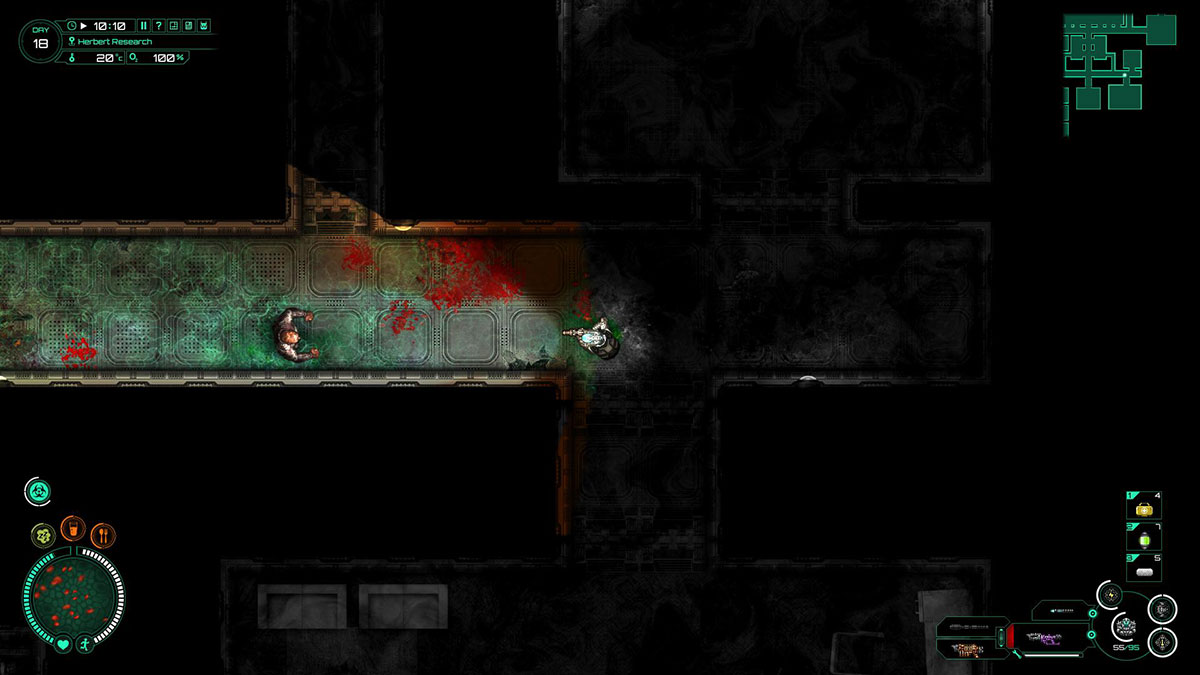
Limited field of vision can lead to nasty surprises.
The premise is that you are a researcher on a Martian base who gets thrown in jail, and then the power goes out. For a week. You eventually escape the prison and work your way to Central Command, and try to piece together what happened and why there are infected zombies and other creatures running about.
I’ve spoken about Economy of Design before, and there’s a compelling, intuitive call to action in this game. Specifically, the complex’s powerplant is slowly grinding down. There is already too much damage to sustain power to every single zone, so you have to choose which zones to send power to, with the others getting no Oxygen or Heat (assuming their Oxygen and Heat generators are even online). As it turns out, the infection plaguing the colony spreads faster in cold, non-oxygen environments. As each zone gets more infected, more powerful enemies appear, and at 50+% infection a bunch of zombies appear in Central Command and try to destroy the generator. So there is a race to find materials and blueprints to craft replacement power plant cores to power more zones and slow down the infection.
You have to balance the running around implied above, with more mundane concerns like food, water, sleeping, and even toilet activities. Each zone you enter typically needs to have Oxygen/Heat generators repaired too, so you have to bring along your own temporary supply of both lest you suffocate/freeze while exploring. There are enemies too, of course, so having a good supply of weapons and healing supplies are a must.
All the while, the clock is ticking and the infection is spreading…
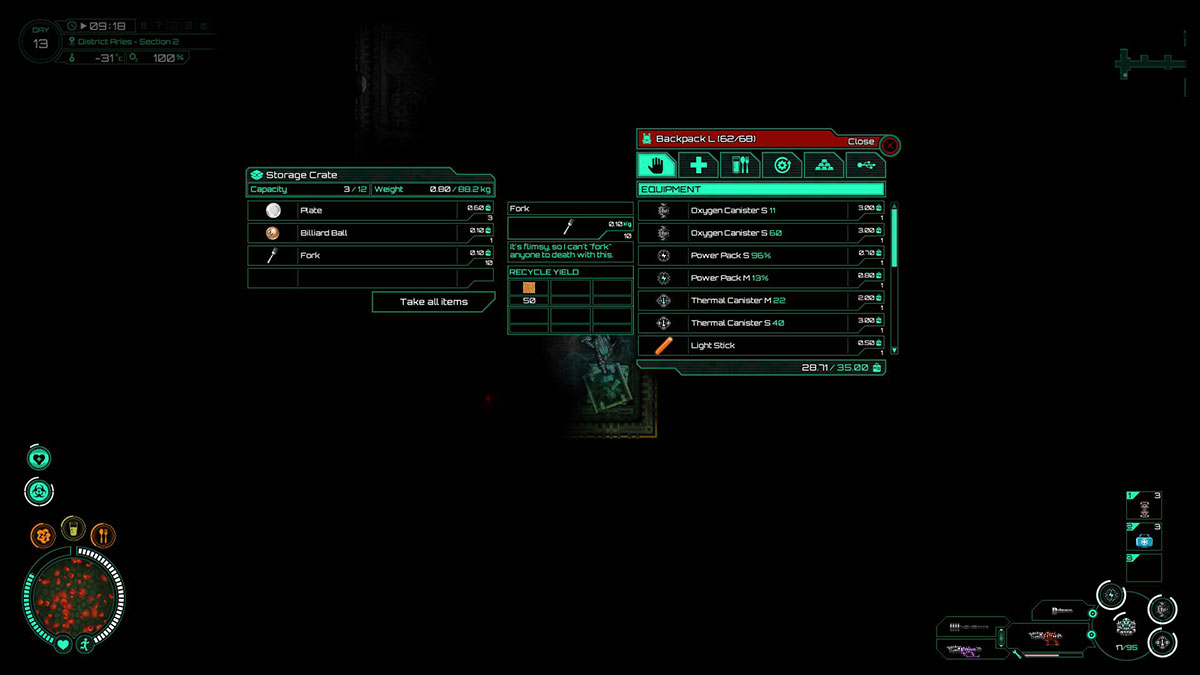
No, really, I was super excited about finding forks.
To be honest, despite the above, it’s difficult for me to say how much fun the game actually is. I’m certainly enjoying it thus far, as it pressing a lot of my buttons in terms of survival and crafting and planning shit out. Fighting enemies is pretty easy, and exploring becomes quicker once you realize that 99% of everything is shit not worth sorting through. To an extent, I hate how formulaic it gets in the mid-game, where I’m at. I’ve unlocked everything in Tier 1, for example, and now to get the Shotgun v2 and Improved Nightstick (etc) I have to unlock Engineering Software v2 and Research Software v2, both of which were found in the 5th floor of X location.
In the meantime, I’m spending my time playing this instead of Destiny 2 because I like collecting all the things regardless of the pointlessness of the activity.
EA Impressions: SPAZ 2
The original Space Pirates and Zombies (SPAZ) was a hidden indie gem back in the day, and saw me through almost 40 hours of gameplay. Granted, it had some lousy pacing and the early portions of the game weren’t particularly great either. But hey, it was done by a two-man dev team, and hit some great notes in the middle there somewhere. Hearing about SPAZ 2 being close to Early Access graduation and on a Steam sale to boot, I just had to take a look.
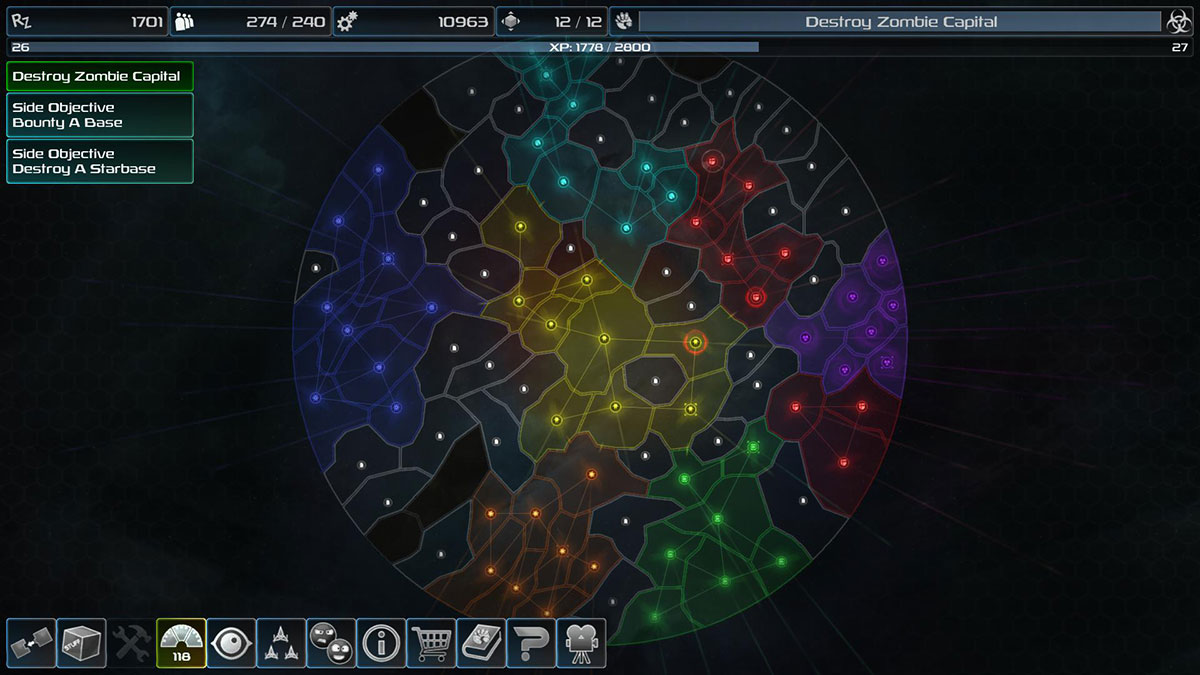
Where 99% of the gameplay takes place.
Well, then.
SPAZ 2 is set in same universe as the original, and even continues the story a bit. That and the ship names are pretty much the only things left in common with the original title. The principle “game” here is a sort of galaxy map… thing. I don’t really know what to call it. Simplified RTS? Except time only moves when your ship moves, so Real Time doesn’t fit. Nor does Strategy, now that I think about it. If anything, it reminds me of games like Eufloria, where you are basically collecting infinite resources and expanding your empire while everyone else is doing the same.
In the original game, combat was sorta handled like a twin-stick shooter. In SPAZ 2, combat is a formality. While you can elect to aim your weapons like you wish to actually play a videogame, the game’s tutorial advises to stick to “Battle Wagon” mode, which is where your weapons automatically fire and reload according to their ability to hit things within their range. The former supposedly allows you to target specific sections of enemy ships in an effort to break them off and commandeer them as your own, but the reality is that none of it really matters. Scrap, the currency of SPAZ 2, is abundant, and you’re unlikely to know what components your opponents are using anyway.
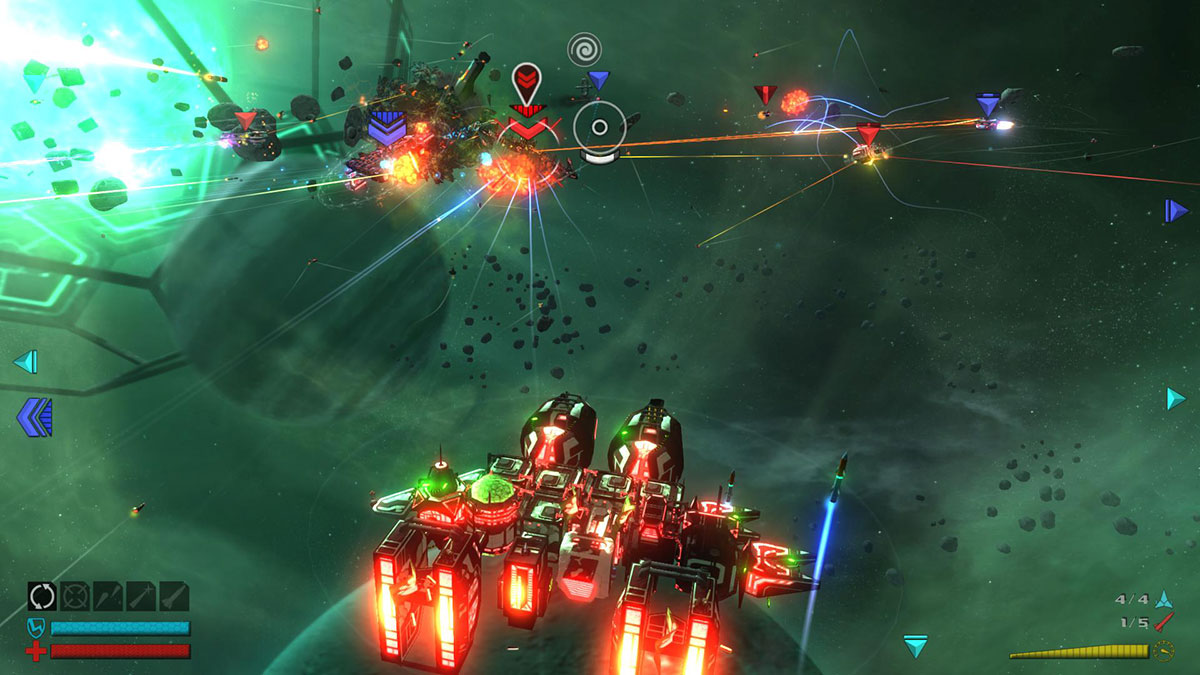
Look, Ma, no hands!
The utter lack of regard towards the combat system is, frankly, baffling. There is a video on Steam from the devs demonstrating how to play SPAZ 2 in VR mode. Holding RMB down even brings up a targeting reticle. But… why? No game systems support, encourage, or require any manual control during battles. I mean, there’s a tiny element in the bizarre looting system they have, as the components shot off from downed enemies is not assured to be in the normal post-combat loot table. But you can’t collect these pieces – you must physically bolt them onto your own ship. Which is another whole gameplay element that isn’t even defrosted, let alone half-baked: if components are popping off your ship, you are dying, and you won’t live long enough for it to matter.
Maybe all of this is due to me being in the early game still? Maybe it’s due to Early Access? I dunno. What I do know is that the fun of the original SPAZ came from combat, and everything else was a chore. In SPAZ 2, combat is now a chore, and you are left with extremely simplified empire management as your only element of gameplay.
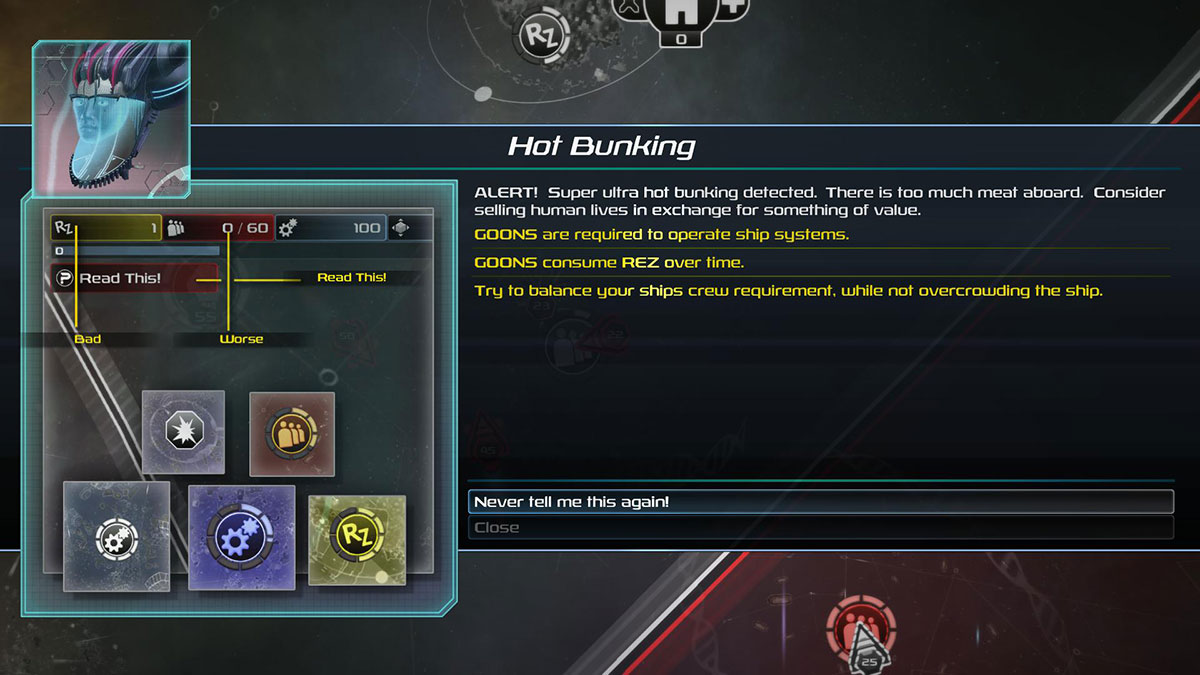
Humor is there, at least.
Hopefully this gets better, because I’m already past my Steam refund window.
Portable Steam Machine
[Blaugust Day 15]
Remember when I was complaining about the Vita yesterday, and how I was never play though old games again anyway? I was about to add on a throwaway line to the end of the post about how the first company to make a portal Steam machine would make a lot of cash.
Well, turns out there’s one scheduled for a late 2016 release:
Smach, the company touting the portable Steam OS device, says the handheld will ship out during the fourth quarter of 2016. That $299 price (€299 in Europe) is apparently the device’s pre-sale price only. We’ve reached out to the company for more details on pricing.
The Smach Zero — the Steamboy project’s new name — claims to be “the first handheld console to play Steam games on the go.” The device will play “more than 1,000 games” from Steam’s library on day one, with a hardware spec that will balance performance and cost.
Best part? MicroSD card slot. The rest of the specs are in the article.
To an extent, I almost wish for lower specs and not higher. I don’t want something capable of playing GTA IV on the go – I want something capable of playing the million and a half indie games cluttering up my Steam page. If I could boot this thing up during my lunch break at work, perhaps I would find the time to start playing games like To the Moon, The Walking Dead, and the Legend of Grimrock. The lower the specs, the less expensive the machine, the longer the battery life, and so on.
Incidentally, here is another article about the same handheld, this time with benchmarks:
- The Elder Scrolls V: Skyrim (2011) on Low and 1280×720: 16 FPS
- World of Warcraft (2005) on Medium and 1024×768: 43 FPS
- Diablo III (2012) on Low and 1024×768: 38 FPS
- Assassin’s Creed IV: Black Flag (2013) on Low and 1024×768: 16.5 FPS
Technically those benchmarks are for the Radeon 8400E (or Nvidia GT 740M), which is the equivalent graphics card that this thing has. So, yeah, Skyrim is right out, and Diablo 3 isn’t looking too hot either.
That said, do you know what would play just fine? Civilization 5. And Total War: Shogun 2 (although you’d need at least a 64gb microSD card). And a whole host of other similar titles whose only question marks would be whether they’d be able to run in SteamOS in the first place. Details, details.
So what do you guys think? Would a portable Steam player excite you in any way?
PAX Day Three: Final
And thus PAX came to an end.
The more charitable conclusion is that I simply came during an off year. Or perhaps an off PAX. But what I truly want to say is that the show sucked. At least to this particular non-con going groupie. And I’m thinking that the allure of cons are getting diminished by the same forces that generated a niche market in making physical boxes for all-digital games.
The Twitch booth out on the show floor was extremely hard to miss. After a few minutes, the irony of my having spent a considerable amount of money to fly into the Boston snowpocalypse just to come to PAX and watch a Twitch stream in person was too much to bear. The same principle held for Overwatch and the new expansions to GW2 and FF14 – why stand in line for 2+ hours to play these particular games that will either be released or in public beta in a number of months? Maybe it made sense back in the days when we got our gaming news from magazines (remember those?), but not today.
I mean, they had a bunch of booths for iPad games for god’s sake.
Luckily, I came because of friends. PAX definitely had a better setup for free-playing various games than GenCon. But that was about the long and short of it. If I could do things over again, I probably would have bought a PS4 and just took a 5-day staycation.
Review: The Stanley Parable
Given the extremely recent news that it sold 1 million copies in the last year, I figured I’d go ahead and throw out my brief review of The Stanley Parable.
Game: The Stanley Parable
Recommended price: Bundle
Metacritic Score:
Completion Time: ~3 hours
Buy If You Like: Choose Your Own Adventure games, experimental indie titles
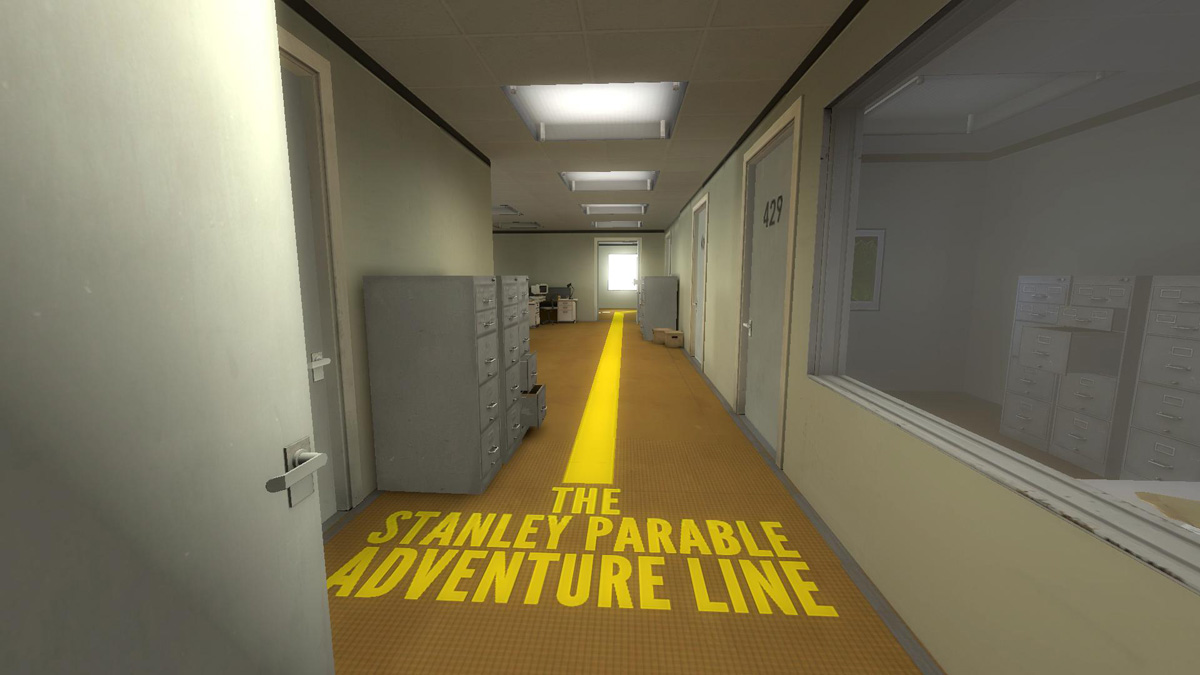
I see what you’re doing here.
The Stanley Parable is a visual Choose Your Own Adventure tech demo that extremely briefly examines the nature of narrative choice in video games. The “game” consists of moving around in the first-person and exploring an office building while a narrator details all the things you are doing, Bastion-style. The meat of the gameplay consists of getting to one of the endings (sometimes taking as little as 5-7 minutes) and then doing something different on the next play-through.
And… that’s about it. While the concept itself is novel, and some of the meta-humor actually relevant/damning, there isn’t really anything resembling a game here at all. The entirety of the “parable” could have just as well been summed up in a single blog post, but I suppose that would have meant forgoing the opportunity to charge $15 for the privilege of hearing it.
Nevertheless, I do recommend keeping an eye out for when The Stanley Parable appears in one of the many gaming bundles. I might not be willing to put a dollar price on this experience, but it does add value to whatever the overall bundle you might be looking at. So… take that for what you will.
 In An Age
Broken FOMOmeter
Dec 2
Posted by Azuriel
It’s really sad to see games at 40%+ discounts still end up being almost $40.
I guess it’s not that much of a difference back (in my day) when games MSRP’d for $60, but psychologically… nope. Not doing it. Dragon’s Dogma 2 is probably not the best example either.
Even with all the other sales going on, it was ironically Satisfactory that most recently broke my internal FOMOmeter. I typically try to stock up on cheap games to assuage my ephemeral gaming moods, as not doing so can lead to ruining an experience by forcing myself to play something else. In the depths of mainlining Satisfactory though, I would throw some discounted games in my Steam cart… and leave them there. A few days later, I would check back and realize they were no longer on sale. *Empty cart*.
A few cycles of that and the spell was broken.
We’ll see how long it lasts, but so far, so good. If nothing else, the fact that Satisfactory is an indie game that consumed my life for 120+ hours whereas I have a literal graveyard of half-finished AAA titles should give me pause. Or maybe I’m just fully into survival-crafting/deckbuilding/roguelike/automation territory now. It can go either way.
Posted in Commentary
Comments Off on Broken FOMOmeter
Tags: Broken FOMOmeter, Indie, MSRP, Satisfactory, Steam Sales