Blog Archives
Do the Ends Justify Never Starting?
Rohan posed the question of “Would You Recommend a Work With a Disappointing Ending?”
But I don’t know how that would work for other series. The canonical example in gaming is Mass Effect. I don’t think I’d recommend only playing ME1 and ME2. Maybe one could say that you should play the series, even though the ending is very disappointing.
Television-wise, I understand Game of Thrones had a similar issue. I did not watch it, but many fans disliked the last season. Would you still recommend the show?
My answer is: it depends.
First, how bad is the ending? Some endings are disappointing compared to the brilliance that came before. Some end with a whimper, possibly due to budget cuts or outside reasons. Other endings are so awful that it poisons the memories and joy you experienced up to that point. Obviously the latter is not something you want to be recommending.
Second, how good is the rest of game/book/etc? Is it possible to be worth experiencing for that alone?
With the Mass Effect series, I would agree that the originally-designed ending was poor. But between the enhancements and just perspective in general (10?! years later), I am now inclined to believe that the game “ended” well before the last fight. For what is an ending, if not a desire for closure and/or emotional payoff? Even with the wounds of the original endings still fresh, I said this back in 2012:
Bioware cannot take away the feeling of immense depth with Mordin, when the Salarian stereotype fell away to reveal a reservoir of guilt for necessary evils; a doctor moved to inflict harm, faced with impossible choices. Bioware cannot take away my own feeling of guilt when I heard Kaiden’s “Belay that order!” command repeated in the forest dream sequence; a sacrifice I readily accepted at the time to save a woman I had feelings toward and ultimately passed over. Bioware cannot take away EDI and Joker and all the other hilariously poignant moments in the entire series, but ME2 in particular. Bioware cannot take away the bromance with Garrus, or the absolute struggle I had in choosing whether to intentionally miss that shot or not.
In that same post, I talked about the Wheel of Time series which, at the time, had not been completed. But it also didn’t matter, because I experienced a moment in the 9th book that was so perfect, so cathartic that it justified my time spent. Compared to that build-up and release, the actual ending was merely perfunctory. Which was fine, because the author died and someone else had to write it. But even if he was still around (or they followed his notes exactly) it would not have mattered that much to me because I got the payoff for reading the books already. Anything else was just gravy.
For something like Game of Thrones… that shit is hard. Again, show me another low-magic medieval fantasy I can even compare it to (the Witcher these days, I guess). There were also a lot of satisfying character development throughout the series. Between those and the amazing battle sequences, I would recommend Game of Thrones to just about anyone remotely interested. And yet, I also believe the ending was so bad that it basically poisoned my memories of the show. That same character progression was thrown in the garbage for arbitrary reasons, by studio executives who were hungering to direct Star Wars. Which they didn’t end up doing, by the way, so triple-whammy right there. Or perhaps, bullet dodged?
The more I muse on this, the less it seems like the ending should be the deciding factor.
Consider something like Firefly, which just sort of gets canceled. Or Evangelion, which ends bizarrely due to budget reasons. And I’m assuming that we’re not counting melancholy endings like with the His Dark Materials series. Or the ones that will never actually be completed, like the Kingkiller Chronicles or A Song of Ice and Fire. Do we just not recommend any of these things? Would you consider yourself better off for having not experienced the disappointment? Are there really so many more good games/shows/movies with superb endings out there that afford you the luxury of avoiding the bad ones entirely?
Maybe there is. If so, I would like to know where the list is so I can start working my way through them. But if we’re honest, I think most endings – assuming we even reach them – are just… sorta there. Which is probably the ideal, considering the baseline experience was obviously good enough to shepherd the audience to said ending. I would say the grid of possibilities looks something like this:

So I would argue, again, that the baseline experience is really the determining factor as to whether something should be recommended or not. That is, unless you think there are actually enough great experiences out there in the world that we can exclusively stay in the upper-left side of the grid. In which case, damn dude, stop hiding that shit under a bushel and let us know what they are.
Is Fandom is Broken?
No. The answer to a question in a headline is always no.
I was made aware of the “Fandom is Broken” article from a Twitter push notification, which immediately reminded me that I should really delete the app. Then I read the article. Which starts off with, of all things, a “lesson” from the Mass Effect 3 ending debacle.
“This isn’t really a new thing – way back in 2012 I named Annie Wilkes the Patron Saint of Fandom after the childish, ridiculous uproar over the ending of Mass Effect 3. What I couldn’t have known in 2012 was that the Mass Effect uprising was just a preview of the main event; that tantrum happened under the auspices of being a ‘consumer revolt,’ which would be the same kind of language behind which terrorist hate group GamerGate still hides. And in the years since Mass Effect 3 it seems as if the crazy has been ramping up, and as the wall dividing creators and fans gets ever thinner with each new social media platform the number of voices being raised has grown.
The article gets worse from there, with a meandering diatribe vaguely conflating consumer entitlement with the rise (?) of Twitter death threats to game/movie/etc creators. But by far, the most puzzling element of the article is this part:
The corporatized nature of the stories we consume has led fans – already having a hard time understanding the idea of an artist’s vision – to assume almost total ownership of the stuff they love. And I use that word ownership in a very specific sense – these people see themselves as consumers as much as they see themselves as fans. This is what the “Retake Mass Effect” movement was foreshadowing. They see these stories as products.
Wut.
Of course these games/movies/books have been products. They have always been products. If there has ever been an inflection point at which “artistic vision” meant anything, it died the moment the creator cared about the people who consumed the art at all. Focus groups? PR departments? Franchise opportunities? All of that calls into question “artistic vision,” decades (if not centuries) before Twitter ever became a thing.
And, really, let me take a moment to say how much of a bullshit weasel-word “artistic vision” is to begin with. It conjures into being a sacrosanct defense that apparently renders the artist immune to criticism or critique. One should not point out the many plotholes of the original Mass Effect 3 ending, because apparently the half-assed nature of it was intended. And how do we know it was intended? Because the artist released it like that. So, ispo facto, that’s the vision. If you think it’s bad or could have been better, you’re entitled!
When Bioware released the expanded endings, however, that apparently isn’t “artistic vision,” so tainted was it by the unruly demands of the unwashed masses. Or maybe Bioware was just embarrassed enough from being called out on their bullshit and decided to finish what they started. Or maybe Bioware was just concerned about future Mass Effect: Andromeda sales.
That there is the rub, of course. Fans are more connected to creators these days not because of the means and mediums, but because the creators make themselves more available. And why do they do that? Because they want that feedback, they want to foster that investment, because they want to stoke the engines of the hype train to ever greater levels. Sometimes that works. Sometimes that doesn’t, as the creators of No Man’s Sky are seeing, as the hype train is late pulling into the station.
In any case, it is regrettable that death threats are being thrown about. Nobody really deserves those, and anyone who sends them should be punished accordingly. But… they are also largely unavoidable these days. If 99.99% of a given, million-strong fandom are perfectly rational people, that still means there are 100 people spewing bile directly into your Inbox. Which is a lot of people! And as long as Twitter continues being a platform basically dedicated to consequence-free instant abuse, I don’t know what the solution is.
I can tell you what isn’t the problem is though. It’s not the fandom.
Review Bombing
Three years ago, I wrote a post called The Weaponization of QQ in which I discussed “review bombing,” e.g. the practice of people writing negative user reviews out of spite. At the time, one of the particular objects of ire was Mass Effect 3. The user rating has trended upwards from 3.7 to today’s 5.4, but there remains 2518 positive vs 2372 negative reviews. And the vast, vast majority of the latter straight-up include passages such as the following:
I would have given this [Mass Effect 3] just a five, as it’s just that, an average game. However, since it’s clear that Bioware bribed journalists and reviewers to give their game a good review, I decided to counter the inflated reviewer scores and give this game a zero.
Now in the waning days of 2015, I am here to say that the practice is, unfortunately, alive and well.
One of the more topical targets is Fallout 4, which also sits at 5.4, primarily due to “reviews” like this:
Overrated Bethesda is back at it again, and they created another piece of garbage idiots to j!zz over. For starters this isn’t a 0/10, it’s more of a 4/10 but I’m trying to even the score because the fanboys are giving the game a 10/10 without explaining anything.
The above opening continues with some actual criticism of game mechanics and such, which puts it in a shockingly vanishing minority of these sort of reviews. Many are just like this:

Slacktivism at it’s finest.
It is not entirely clear how many of these people even played the game.
Fallout 4 is not, of course, the only high-profile victim. Even media darlings like GTA 5 are not immune:
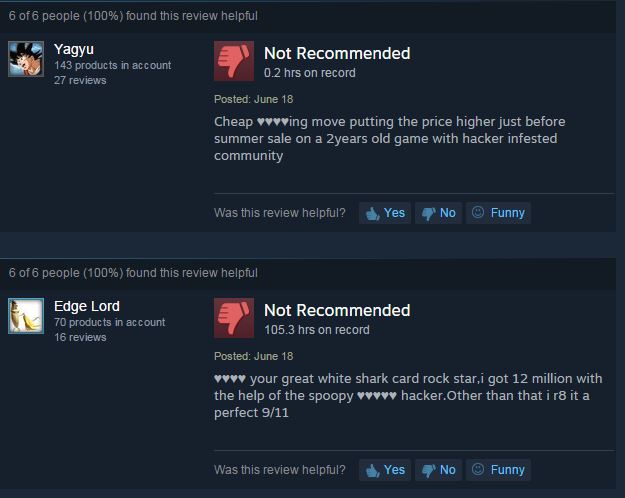
Useful.
Back in June, I had to scroll through thirty-eight (38!) negative Steam reviews to find even one that contained useful information about the actual game. The rest were simply outrage over one of the Steam sales in which Rockstar apparently increased the price ahead of the sale, via adding in-game currency as the only available bundle, thereby possibly disabling Steam refunds. Which is certainly an entirely valid concern by itself, but not one that really has anything to do with reviewing the game.
The first time I brought this up, I was concerned about what possible effects these user review bombings might have on the direction of developer game design. Now? I’m much more concerned about how devalued this practice has rendered user reviews and, by extension, all our opinions. Perhaps developers have never been overtly concerned with user reviews, so review bombing doesn’t matter. But they mattered a bit for me, when determining if a game might be worth playing. And now that resource is gone, to be replaced with the outrage of the day.
Interesting Choices
Tobold put up a rather cringe-inducing critique of Mass Effect 3 the other day, prefaced by the Sid Meier quote of “good games are a series of interesting choices.” From there, Tobold argued that ME3 was not a good game, because the story choices being presented did not lead to gameplay changes. Indeed, he goes so far as to say in the comments:
My point is that this is supposed to be a GAME, and not just some interactive story. Choices that only affect the story, but change nothing in gameplay shouldn’t be in a game. Otherwise I might as well wait for “Mass Effect – The Movie”, and not bother playing at all.
First, that argument is so absurdly cliche that I started questioning whether he was simply trolling us at that point.
Secondly, in point of fact, you could not simply wait for Mass Effect: the Movie because any such film could not encompass the varied plot choices you can make over the course of the game. Characters can die in Mass Effect 1 & 2 and thus not show up in Mass Effect 3, cutting out entire swaths of character arcs. Who makes it through the Suicide Mission? Would the film feature a male Shepard or FemShep? Would the choices be primarily Paragon or Renegade? Which races get the shaft? Would the conclusion be the Red, Blue, or Green Cupcake?

The green one. Always the green one.
Third, I believe Tobold’s stance is exceedingly pernicious to the maturation of gaming as a medium. It simply boggles my mind that a self-professed lover of D&D would twist “interactive story” into a pejorative; are non-interactive stories supposed to be preferable?
Individual agency has a way of submerging players into a narrative in a way that traditional storytelling does not. Just look at the mind-bending (at the time) twist in the original Bioshock and the narrative arc in Far Cry 2. Even if you were not particularly impressed with the depth of these narratives, those story mechanisms simply cannot be replicated in book or movie form. Reducing games to their mere mechanical components would be an incredible tragedy of potential.
What the exchange highlighted to me though, was how squishy the venerable Sid Meier quote actually is.¹ To me, the choice between curing the Krogan genophage or deciding not to was interesting. In fact, I spent ten minutes or so agonizing over it when the dialog wheel was presented. Was it fair of us to cripple an entire species because we feared their hardiness and breeding speed? At first, I was worried about that hypothetical. Once the Reapers were gone, who is to say that the Krogans don’t simply out-breed and out-muscle the rest of us out of the universe? Then I thought: wait a minute, is this not the same sort of argument used against inter-racial marriages in the past, and even concerns about Islam today?
In contrast, Tobold simply picked whatever gave him the most War Assets.

This was meaningful to me, god damn you.
I do agree that a good game is full of interesting choices. But what should be obvious to anyone spending more than a minute thinking about it, is that what is interesting to one person can be boring/irrelevant/pointless to someone else. “Interesting” is not an objective term; Sid Meier may as well quipped “Good games are full of fun” for all the sage wisdom it contains.
¹ The full quote is actually: “According to Sid Meier, a [good] game is a series of interesting choices. In an interesting choice, no single option is clearly better than the other options, the options are not equally attractive, and the player must be able to make an informed choice.” (Rollings & Morris 2000, p. 38.) This does not meaningfully change my objections, as whether an option is “clearly better” and/or “equally attractive” is necessarily subjective. For example, I almost always prefer passive abilities to active ones, to the point that most of the WoW talent tree levels have only a single rational (to me) option.
SimCity and Meta-Criticism
After a long period of reflection, I had originally decided to not join in on all the schadenfreude surrounding the SimCity debacle beyond my post two weeks ago. Not out of any moral sensibilities – heavens no! – but simply out of a lack of fucks given. That, and I certainly couldn’t keep up with the torrent of other blogger updates on the developing story, when it seemed some new embarrassment was revealed daily. Kotaku even had a SimCity Disaster Watch graphic created to handle all the articles.
At one point though, I was almost tempted to purchase SimCity myself out of a longing for gonzo journalism combined with the thought of a free EA game. Then I simply browsed EA’s catalog, realizing that unless they gave away Dead Space 3 (they did, dammit), I either had all the games or the value’s promotion was $20 max.
I do, however, want to commit to internet posterity my intense loathing regarding articles like this one from Time.com. These middle-road Apologist articles and their asinine, straw man arguments infuriate me to heights even EA cannot hope to surmount. Consider the following:
EA was never, ever obliged to make SimCity a single-player game, nor do these accusations (accurate or no) from modders that the existing code is just a few steps away from being a single-player game hold much water when it comes to EA’s obligations. So what if the game could have been a single-player game.
First, who said a single goddamned thing about obligation?
Look, I can follow the twisted derailment of thought that conjures forth the implied “obligation.” Someone stating that SimCity should have had a single-player mode is assuming a sort of game design high ground, harkening towards a moral edifice that does not strictly exist. Because the game should have been a certain way, Maxis/EA has an obligation to Comment out Line #22 in the code design a single-player mode. That’s where the implied obligation comes from, right?
If so, we live in a terribly nonsensical world, one immune to criticism or judgment of any kind. Did McDonald’s give you cold french fries? Too bad, because they aren’t obligated to give you hot ones. No complaining! Did you tell the waiter you wanted a medium-rare steak and they gave you well-done? The chef isn’t obligated to bend to your whims, knave! He or she is an artiste! Movie previews aren’t obligated to represent the actual feature film, and if you don’t like it, go back in time and don’t buy a ticket!
Of course, the author clearly is being pedantic here. The point most people are bringing up is that SimCity, both conceptually and literally, doesn’t need to be always-online. There is no requirement for it to be so, despite the rather flagrant falsehoods claimed by the development team and embarrassingly contradicted by the modding community and a Maxis insider. Maxis/EA has no obligation to accede to reason, of course, but they certainly invite the valid criticism that accompany such quests for profit at consumer expense.
Which segues nicely into this nonsense:
You can ask, you can even petition, but I’d like to think we’re not at the point where we’re now telling painters, musicians, writers and artists of whatever stripe — game designers included — what they have to do.
You can’t have it both ways. You can’t shake your fist indignantly and shout “but games are art!” then hold game designers to a different standard.
This is truly an despicable appeal to diversion. “Stop complaining about game design direction, or else games won’t be art anymore!” First of all, there is nothing sacrosanct about art. Authors have editors. Directors have focus groups. Fundamentally, all art is an exchange, and every artist considers his or her audience when making a piece for presentation (even if they imagine it is an audience of just themselves). And this is besides the fact that these game companies are businesses selling a product for profit. Games can be artistic products, but these companies are selling them to consumers, not putting (selling?) them in museums.
The pernicious worm at the core of this abhorrent article is the same one I have seen in similar, depressingly frequent articles: an implicit admonition of criticism itself. “Stop complaining,” these authors say, “you are lucky the artists deign to create anything for you filthy plebs.” No, I deny your thinly-veiled nihilism. Gamers have a right to reject anti-consumerist design. Gamers have the right to call out poor gameplay. The gamers who made the SimCity franchise successful in the first place have a right to protest design they feel is taking said franchise in the wrong direction. Is EA/Maxis or any game maker obligated to do anything? Of course not. Does that make levied criticism illegitimate? Hell no.
You are always entitled to your own opinion, and people can judge for themselves whether it an opinion worthy of consideration. And it is my opinion that Time’s article of meta-criticism – and all articles in the same vein – are specious nonsense, and nihilistic besides. Nothing is beyond reproach, else it demonstrates a perfection impossible to manifest in a universe of subjective minds.
I can only hope that the next EA CEO coming in can spare the 5 minutes of his or her time to understand why the company continues topping the worst company in the world charts. A quick memo to Maxis authorizing an offline mode would pull the teeth out of this endless negative PR; a gaming policy of not monetizing every single pixel with endless online passes could even get gamers to forgive Origin (or maybe just running some goddamn sales).
Bam, done. You’re welcome, EA.
P.S. While writing this article, a friend of mine pops up on Steam chat saying that the Mass Effect 3 servers were down, meaning he couldn’t play the single-player DLC he legitimately purchased through Origin weeks ago. This is the world we live in, folks.
So, About Those Extended Endings
Three months to the day ago, I decided to write a post called What I Want to See from Bioware, vis-a-vis the proposed Extend Cut of Mass Effect 3.
And now I have seen those endings. All four of them.
That is your warning, kiddos. Spoilers dead ahead.

In that prior post, there were a number of things I was looking for from Bioware, in Best Case/Worst Case scenarios. The biggest one was the Normandy scene at the end, which made no goddamn sense whatsoever – it essentially ruined the endings for me all by itself. What I wanted to see in the Extended Cut was:
What I want to see from Bioware:
- Best Case: an explanation of how the crew (EDI and Liara, in my case) got back on-board the Normandy, what the Normandy was doing while I was on the Citadel, if they knew/suspected Shepard was alive or dead, and why they were running away.
- Worst Case: ensure that the crew with you on the final mission don’t show up in the final scene.
Mission accomplished. In a big way.

Yes. Yes he did.
In the interests of being somewhat objective, the “answer” they gave to where your crew members were at was… a bit hard to swallow. With Harbinger easily knocking out tanks and fighters left and right, it seemed quite out of character for him to let the Normandy land, for people to be evacuated, for there to be time enough for one last tearful goodbye, and then an escape back into orbit. If the Normandy was capable of landing, why not just drop off a bunch of people at the beam itself?
I am willing to entertain the notion that Harbinger would not care about Normandy picking people back up, as long as they were not being moved closer to the beam, although that seems a bit weak.
Outside of that gripe? Smashing success on the other points. I laughed out loud when Hackett said what he did in the screenshot above; partly from the unexpected bluntness, and partly from the beginnings of a catharsis I had been missing for the last three months.
The next section of that prior post was about Indoctrination:
What I want to see from Bioware:
- Best case: Settle the Indoctrination debate once and for all. If Indoctrination is real, include a true final battle scene, potentially followed by the same sort of choices.
- Worst case: Remove the breath scene.
As far as I am concerned, the Indoctrination theory is kaput. It was actually kaput months ago, but the mini-epilogues following each ending serves as final nails. In the scheme of things, Indoctrination was a better ending than what we were originally given, but these new ones supersede the old in a good way.
The breath scene is unfortunately still in the game, but since March I have come to understand that the Destroy ending is actually truly Renegade. Ironically, all those Indoctrination videos had led me to believe that Control was bad and Destroy good, (i.e. the real ending), when that really was not the case. It is true that “nuking the site from orbit is the only way to be sure,” so to speak, but condemning all synthetics to death, including EDI, when other options are available is undeniably Renegade. Control may not seem like the way the Reaper threat should be handled, but a Paragon Shepard would take that chance. The consensus says: these units do have souls.
The final section was general plot holes:
What I want to see from Bioware:
- Best case: Shore up these plot holes via Codex entries, FAQs, or at least acknowledge they exist.
- Worst case: leave everything vague and unsettled.
Many of the points I raised regarding the Citadel were answered by the expanded Catalyst dialog, if a bit weakly. Not the biggest one, though. Why the Reapers did not simply reassert control of the Citadel immediately upon emerging from dark space is probably one of those “Why didn’t the Eagles just fly Frodo to Mount Doom?” questions for the ages.
The Endings Themselves
Talk about night and day compared to the previous ones, eh?

Should have shipped like this.
The amusing thing to me, is how my very first extended ending was the new one.
Unintentionally.
After slogging through the Cerberus base and the London battle and the unskippable post-beam dialog, the very first thing I did when I regained control over Shepard was shoot the Catalyst in the face. His Harbinger-esque “So be it” response took me aback, as did the unexpectedly poignant “Failure” ending. I remembered that time-capsule scene with Liara, and was even touched by the knowledge that though we had failed, the cycle was eventually broken by the next generation of intelligent species. Whom, while still looking suspiciously like asari, nevertheless had the gumption to actually take Reaper threat goddamn seriously. “Was that so hard?” I asked the monitor afterwards.
I played through all three of the other main ones, and was immensely satisfied. It is still Synthesis – aka the Green Cupcake – all the way for me, but I felt that Bioware did an excellent job at handling the Control ending as well. They all felt a bit… Deus Ex. In a good way. I have no idea how they will rationalize additional post-ME3 games in the Mass Effect universe, at least without holding Destroy up as canon, but I suppose we will all jump off that bridge when we come to it.
Months ago, a friend asked me as to whether I would purchase any future ME3 DLC. At the time, I replied “It will depend on how Bioware handles the Extended Cut.” Although I am extraordinarily happier with the series now than I was back in March, I am not sure that I want to revisit Shepard and crew again. Say what you will about the writing or “cheap emotional tricks” or whatever else, but this series truly has affected me in ways few games (or books, or movies) have.

I forgive you, Joker.
I am thankful for the experience, of course. I just know that the longer I stay in Manse de la Shepard, the less likely I am to enjoy all the other experiences out there. It is hard enough handling regular post-game depression, without also having to question why I am not a better man in real life.
I am only half-way joking.
Mass Effect 3’s Ending DLC Coming Tomorrow
I do not want to sound ungrateful or anything (at least until I see the expository scenes for myself), but… err, Bioware? Telling us on Friday that the ME3 Extended Cut DLC will be out on Tuesday comes across as somewhat guilty. You know, when you were a kid and tried to sneak in the one bad thing you just did into a stream of all the other random things in the hopes that Mom wouldn’t notice.
“AND THEN I PLAYED WITH BOBBY IN THE BACKYARD, AND THEN WE WENT TO THE CREEK, AND I CAUGHT A FROG BUT IT HOPPED AWAY, and I broke Mr. Wilson’s window, AND WE RODE BIKES TO THE PARK BUT IT WAS GETTING DARK SO WE CAME BACK, AND WE PLAYED POGS AND I TOTALLY WON THREE TIMES.”
I haven’t been giving the ending DLC much thought beyond casually musing how, at this point, Bioware could probably get away with not releasing anything¹. It has been more than three months, after all, which is the equivalent of 10 years in the modern news cycle. Mass Effect really isn’t A Thing to me anymore, especially after I sort of capped out of interest in the multiplayer.
Listening to this (low-budget) PR interview though…
Have you ever started dating an ex again? You remember how much fun you had together, how much everything just clicked. And then you also remember how (badly) things ended last time, getting a little steamed all over again with events long since past. The video basically evokes that, to me.
Anyway, the scab is coming off tomorrow, or whenever it is I am able to sit down and make out with ME3 again. Maybe never. Realistically, as soon as humanly possible.
¹ I don’t actually believe they could get away without addressing the ending. Not because fans “deserve” a better one, but rather because I have no doubt Bioware would like to sell some actual story DLC. I imagine that the market for story DLC to a 3+ month old RPG is likely limited to the very people most pissed off by the ending.
Quick & Dirty Guide to ME3 Multiplayer
There are a couple of things going on.
First, I removed the Currently page and turned it into a sidebar item instead. Time will tell if I actually update it with any more regularity than I did with the original page, but I’ll jump off that bridge when I come to it. In the meantime, it is accurate.
Second, I have a new menu page entitled Design. The only item in there currently is my Quick & Dirty Guide to Mass Effect 3 Multiplayer. I thought about posting it in its entirety here, but the idea is that the guide itself is going to be a permanent resource that can and will be updated occasionally. Indeed, when I started writing it in the weeks after ME3’s release, the goal was to send it off to GameFAQs as there were no similar resources at the time. Unfortunately, someone beat me to the punch, so who knows whether it will be accepted there now. The goal for the guide itself is to be something I wish I had available when I first started playing the game. If that interests you, check it out.
In any event, the Design page will eventually be home to other projects I have been working on that I want to be able to upload in a semi-permanent location. Most will be game-related, but some may not be. Unlike these blog posts, I will not be vouching for their peerless quality and relevancy to your daily lives.
Finally, I am going on vacation for a week, starting tomorrow. It is unfortunate that I shall miss the launch day of Diablo 3 in the process, but I will try and trooper on from the condo’s 2nd-floor beachfront balcony. I may schedule some posts ahead of time for you to read, or you may have to waste away the hours of my absence by forlornly browsing the archives. Either way, it shall be full steam ahead starting back on the 21st.
 In An Age
Of All Time
Dec 9
Posted by Azuriel
I was browsing a Reddit thread called “We haven’t seen a good space opera game where you play a spaceship commander with a loyal crew since 2012”. The image in the post was for Mass Effect 3, to remove any doubt of to what space opera they were referring. Quite a few people pointed out that, in fact, the Outer Worlds series has been released since then. Amongst the pushback that the Outer Worlds is even remotely close to Mass Effect quality, was this rejoinder:
It’s funny to imagine being a part of a cadre of human beings for which it’s somewhat possible to have a comprehensive experience on a matter. Like, if you were to ask what is the greatest adventure novel of all time, you would have literally a thousand years of human written storytelling to go through. Conversely, the first videogame RPG came out in 1980, depending on your definition of RPG. Even if you limit it to “classical” console-style RPGs, that moves the needle to 1986 with Dragon Quest.
My own personal experience with videogames started in the late NES era, and only really kicked off in the halcyon Squaresoft/SNES days of the mid-90s. Although, even then, there were gaps. For example, I never played Final Fantasy 4. Indeed, I tried playing it a few times in the last decade or so, and couldn’t really bring myself to get particularly far. Which shouldn’t be too surprising considering how few modern videogames (that I even paid for!) I complete on average.
And that sort of brings me back to the quote. Obviously young people exist – I hear their distinct cries of “six SEVEN” down the road all the time. And there is always a conversation surrounding whether old games hold up to modern play, even by the people who profess their greatest of all time status. But it nevertheless feels… tragic? Is that an appropriate word? It feels tragic to imagine a young person’s entire view of quality being limited to such a small time horizon.
That is, of course, how everything works. Has always worked. “GOAT” has always had asterisks galore, even (or especially) if denied. Greatest (in my subjective opinion) of All (that I’m aware of) Time (up to this moment). GIMSOOATIAOTUTTM just didn’t have the same ring to it though.
P.S. This makes me officially old, doesn’t it?
P.P.S. I already had an Officially Old tag from two years ago?! I’m actively turning to dust right now.
Posted in Commentary
4 Comments
Tags: GOAT, Mass Effect 3, Officially Old, RPG, Space Opera, The Outer Worlds 2