Blog Archives
Review: The Last of Us
Game: The Last of Us [PS3]
Recommended price: $30
Metacritic Score: 95
Completion Time: ~17 hours
Buy If You Like: Metal Gear Zombie, brilliant storytelling, good games
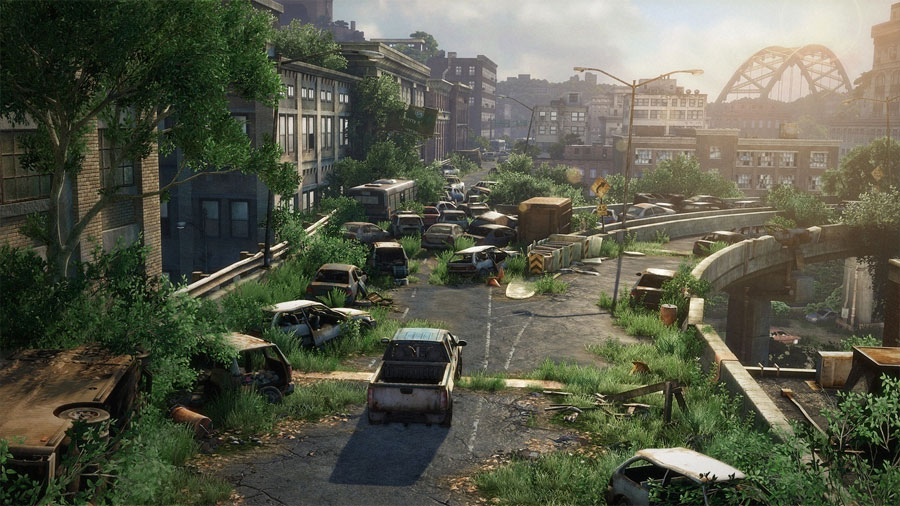
You can almost say the post-apoc was an improvement.
When it came down to a decision as to whether I should do an extremely late jump into this (now past) console generation, I really only had one question: did I want to play The Last of Us, or the Halo series? Despite ultimately choosing the PS3, I waited on purchasing The Last of Us for quite some time. This was the reason I bought this console, and I was a bit apprehensive about putting that $200+ decision to the test. After all, everyone raved about Bioshock Infinite at release and looked how that turned out for me. How could this Metacritic 95/9.1 game live up to the expectations I have levied upon it?
The answer is “Easily.”
The Last of Us (TLoU) is 3rd-person, stealth-emphasized cover-based shooter set twenty years into a “zombie” post-apocalypse. An outbreak of mind-destroying spores has nearly wiped out humanity, and the survivors are doing their best to stay alive in a world of infected bites, raiders, and mundane starvation. You play as Joel, a professional smuggler and hardened badass, who along with your partner Tess is looking to get even with a guy who robbed you both of a shipment of guns. After a series of close calls, Joel & Tess take up one last job: to smuggle a 14-year old girl out of the city and to a safe house.
The principal gameplay is exploring, sneaking, and killing from an over-the-shoulder perspective. While the environments are extremely linear and the number of enemy types fairly basic, I found the gameplay itself to never get dull. Supplies are almost always limited, so some real decisions will need to be made as to whether you take the time to sneak around and get some stealth kills versus lobbing a Molotov cocktail into that group of enemies right now. Compounding this, the human AI is brutal in its sensibility – enemies will fan out, attempt to flank you, send only one guy to investigate noises while the others watch, and so on.
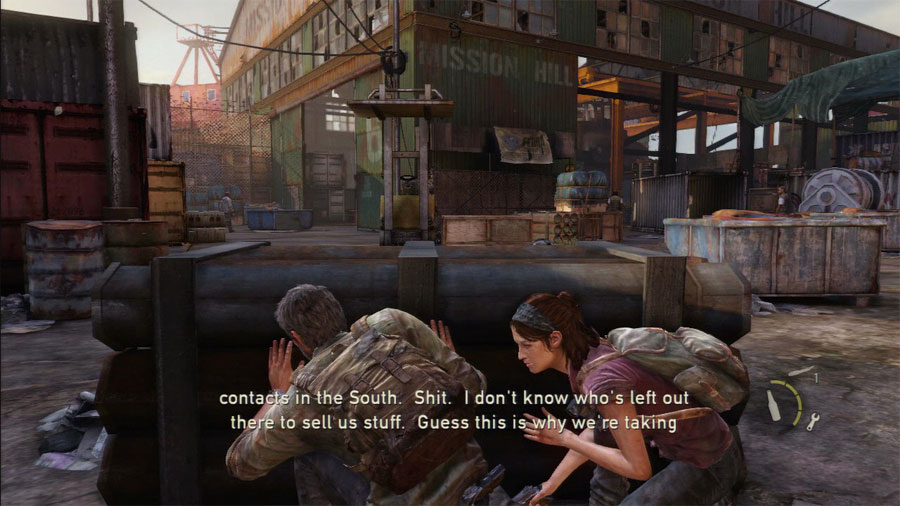
There will be a lot of waist-high obstructions to crouch behind.
About the only complaints I have about the combat side of things is the reverse difficulty curve and checkpoint system. Like many similar games, TLoU is harder in the beginning and only becomes progressively easier as time goes on. Part of that is familiarity with effective strategy, given how there aren’t a lot of new enemy types, and part of that is from access to more/better weapons. Indeed, facing human enemies became somewhat of a joke later on since they would frequently congregate in small groups at the beginning of encounters, which made it extremely easy to blow them all up at once with a nail bomb. And while I give Naughty Dog some credit for a truly seamless checkpoint system, it ends up doing some strange things to the difficulty insofar as discreet encounters only end up being ~5 minutes long.
For as fluid and exciting the combat system may be, where the game truly shines is everywhere else. The visual juxtaposition of ruined human civilization and a greenery of nature reclaiming the space filled me with sadness and wonder simultaneously; it feels like the most compelling combination between the movies I Am Legend and The Road. The musical score is amazing in its ambiance and willingness to not take over a scene. As for the voice acting, well, I never really noticed there being voice acting at all – it was just normal, natural dialog.
The overall narrative is likely the thing most everyone talks about when TLoU is brought up, and I can confirm that it is about as amazing as advertised. The weird thing is that there was not one particular moment in which I remember sitting there thinking “Wow, that’s some good videogame plot.” Instead, I felt permanently affixed to my screen, playing in five-hour increments, as each scene segued perfectly into the next and I eagerly devoured every little detail.
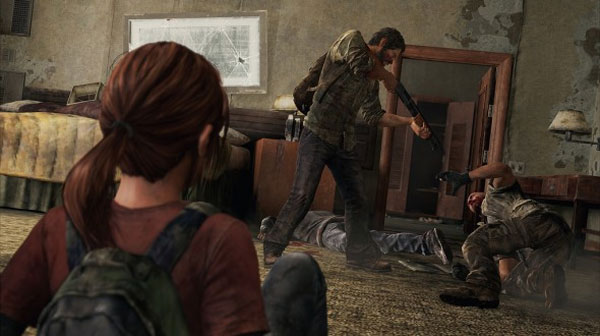
That queasy feeling you get when you realize you’d probably do the same thing.
Now that I think about it, there actually were a few details in cut scenes in which my jaw dropped at the excellence of Naughty Dog’s craft. When Joel ever-so-briefly looked at his watch, for example, I was taken back to that first wink in Mass Effect when I understood, for the first time, how much farther gaming as a storytelling medium has evolved. These subtle-yet-significant gestures hold such a hidden depth of emotion that it boggles my mind that their meaning wasn’t as belabored in-game as I am doing right now. I mean, the gesture would be ruined if it called more attention to itself, but it is such a calculated risk that I’m surprised they did not.
Ultimately, The Last of Us is one of those shining examples of Games As Art that also happen to be extremely compelling to play. And unlike some other titles which overreach in their attempts to be narratively “deep” and complex – *cough* Bioshock Infinite *cough* – The Last of Us simply presents its case amongst gripping gameplay and, story told, drops the mic as the screen fades to black.
Badass
I have been playing Borderlands 2 quite a bit lately.
At one point, I had a mission to rescue a dude at the top of this dam. I fought my way through several rooms, saw some interesting stuff, solved some pseudo-puzzles, killed all the things. As I bust out of the final door onto the dam proper, everything goes to hell: the orbiting space station starts launching artillery shells, armed robots start landing, bullets start flying everywhere in this now-three-way battle royale. I take down a few more enemies with my corrosive sniper rifle, and then crouch behind some cover while I reload.
Then this music started playing.
I emerge from cover while tossing a holographic decoy out, stealthing to the first robot and meleeing it in the goddamn face. As robotic limbs fly everywhere, I switch to a ridiculously large shotgun, aim, and fire at a second robot. The shotgun shoots 17 pellets that each individually explode on contact, and firing it sounds like God slamming a car door shut.
Whump. Chik-Chik. Whump. Chik-Chik.
As I stroll down the middle of the ramparts like I own the place (and I do), I am suffused with a feeling of Badass. This whole sequence is staged, minus the explosive shotgun; the designers specifically put this music, with these enemies, in this order. It is the definition of themepark content, as single-player games are wont to be. But that doesn’t matter. I had been having fun before, but this was on its own elevated level. And after the sequence is over and I move on to the next (decidedly less cool) quest it occurs to me to ask: when was the last time I felt this way while playing a game?
I had to go back, waaaay back to my guild’s first Mimiron kill¹ in WoW. Like I said, I have had fun in plenty of games in the past three years. I have done some crazy moves in Deus Ex, there are some epic moments in the Mass Effect trilogy, and double-dagger Elementalist in GW2 was great fun originally. But the specific feeling I had owning faces up on Bloodshot Ramparts? Very fleeting, very rare, but much appreciated.
If you guys have experienced something similar in a game lately, feel free to share below.
¹ Please excuse the editing and the decidedly non-epic music accompaniment. 2009 was a long time ago.
Uninstalling is Hard
Although it shouldn’t be, I found it somewhat emotionally difficult to uninstall Mass Effect 3 this weekend. I haven’t played the game in more than five months, and I had not planned to start again either. All the extra DLC feels moot to me after the endings, and while the multiplayer was surprisingly good, I got my fill of it after a few weeks.
There is no particular reason for me to feel this way.
And yet… uninstalling may as well be the kiss of death. I can always reinstall later, of course, but the mere knowledge of a 5-6 hour download is enough to send my thoughts elsewhere. For a while, I had entertained a fantasy that I would replay the entire series again, start to finish, this time as Renegade FemShep. The whole ending debacle stymied that fantasy, but there always seemed to be a spark of hope that I would come back around and just do it.
But… not anymore. I need the hard drive space. And I probably need to move on for real, like I thought I already had. No reason to keep holding onto those old pictures of your exes.
In other news, I uninstalled Diablo 3 this weekend and felt relief. Of course, I did so after cashing out my gold, although the exchange rate is a whopping $0.52 per million gold right now. I did not talk about it, but I booted D3 up two weeks ago and went ahead and beat Diablo on Inferno, just to say I did so. The gear inflation/power creep/nerfs made it feel like a completely different game.
But then again, I am not sure I enjoyed the game that it had been all that much anyway.
What Could Mass Effect Online Look Like?
[Spoiler-Free Zone!]
In the last three days I have spent probably around 8-10 hours playing ME3’s multiplayer. My conclusion? Bioware might be onto something.
At its core, the ME3 multiplayer consists of ~11 rounds of 4-player co-op, Horde-style survival across six maps taken from the single-player game itself. Every third wave is what I’d call a “cash round,” in which you get a specific objective: King of the Hill, Kill 4 specific mobs, or Activate 4 Nodes. Completing those cash rounds successfully earns you credits whereas all the other rounds awards XP. During the final extraction wave, you have to be in the evac area by the end of the mission timer in order to get the highest point score bonus (e.g. XP).
The first thing I would say is this: the multiplayer is fun. It probably goes without saying, but if you enjoy the combat in any of the three Mass Effect games, you will enjoy it here too. You shoot from cover, you gain XP, level up, decide which weapons/mods to outfit your character with and so on.
Other bloggers have mentioned the similarities between the gear situation and Magic: the Gathering… and it’s true. There are three tiers of gear packs – 5k, 20k, and 60k credits – and each pack has 5 random “cards” that represent either one-use consumables (Medi-gel, extra ammo, missile launcher), new weapons (or upgrades to already found weapons), weapon mods, new races for a class, or class XP (which raises the baseline level of new characters of that class). The mid-line Veteran Pack comes with 1 Uncommon item or better, while the Spectre Pack has a guaranteed Rare “or better” (whatever that means).
I am not a huge fan of companies putting literal gambling in even their F2P offerings, mainly based on my Magic Online experience. I played the physical form of M:tG for nearly a decade already, but after a particularly bad night of Magic Online wherein I realized I paid $60+ on a series of Booster Drafts, I deleted the game off my hard-drive and went and bought WoW the next day.¹
That got me thinking though… how different is that really from random loot in MMOs? Could, in fact, Bioware turn Mass Effect into an MMO without much effort at all?
Most of the set pieces are already in place.
Classes/Talents/Abilities
Check, check, and check.
Originally, I found the ME2 pivot towards Biotic/Tech power spam (6 second cooldown Biotic Charge, what?) to be disconcerting. I suppose it doesn’t make any less sense than Omni-Tools materializing out of thin air or the titular mass effect, erm, effect in general. By the time I was halfway through ME3, the dynamism of power use was a core part of the entertaining gameplay.
You could even go so far as to imagine the Trinity system existing within the game realm, without too much of a stretch. Unlike Star Wars, it seems intuitively viable to heal people with Tech (Medi-Gel) or even Biotics, or perhaps simply refreshing their shielding with either. Or we could (perhaps preferably) see them go the purported Guild Wars 2 route and have shared role responsibilities – anyone can rez any downed member in the ME3 multiplayer, for example.
Races/Setting/Enemies
Mass Effect has them all in spades.
There are six races in multiplayer already, all with their own sort of racial-esque abilities, motivations, politics; we can imagine Batarians, Geth, Vorcha, or even Protheans being added to that count. I am not a fan of two-faction systems, so I would be overjoyed to see a situation wherein there are no “red vs blue” factions period, but rather players fighting for specific (mercenary?) movements of their choice. Did you choose Krogan and your friend choose Geth? No problem!
Indeed, without spoiling anything, the time period following the events of ME3 would be perfect, perfect for this kind of integrated gameplay. As Mass Effect players, we are already used to mission-based activities spread throughout the galaxy, taking orders from quest-givers, and so on and so forth. Expansions could come in the form of dormant² Relays or new star systems being discovered without breaking any suspension of disbelief.
As far as enemies go, while the main three – Geth, Cerberus, Reapers – have been… explored to various degrees, again, the time period following ME3 will undoubtedly be a fairly chaotic place. And remember, we got along perfectly fine in ME1 without having the geth be the only bad guys. There is no reason why pockets of resistance couldn’t spring up, pirates, mercenary groups, terrorist cells, or even the Salarian STG (or Spectres!) could decide they need to achieve X or Y goal, in opposition to your orders.
Shepard made galactic peace possible. It is up to us to maintain it.©
Itemization/Rewards/Crafting
Whether Bioware makes itemization deeper or keeps it fairly level, the fact is that it already exists. Shepard can wear 6-7 different helmets with different stats, independent of what kind of leg armor he/she has. “Tier sets” exist. There are dozens of different guns, upgrades, and weapon mods. It has been established that new item technologies can be researched and produced, all in the same universe in which “Fabrication Rights Management (FRM)” technology can keep certain items unique (e.g. effectively soulbound).
Now, I have a hard time imagining that chasing +5 Flaming Shotgun M-23 Katana V upgrades would sustain any sort of ME:O endgame the same way fantasy MMOs can get away with it. But sort of assumes there is necessarily an endgame gear grind at all. Which leads me to…
MMO Structure/Themepark vs Sandbox
I am going to suggest Synthesis here.
Is it possible to have a sandbox in the themepark? I have no idea. But as I was glancing at the Galaxy At War map, I could not help but notice how the southern portions were labeled as Earth Systems Alliance Space, Inner Council Space, Outer Council Space. Meanwhile the northern portions were the Attican Traverse and the Terminus Systems. So… perhaps Terminus = nul-sec? Hell, we can already imagine fighting over bases, planets, and star systems in the Mass Effect universe right? Meanwhile, the people who want missions from High Command can get them while following a proto-typical MMO/ME storyline.
It does occur to me that, in many ways, SWTOR has already laid claim to this particular niche. Voice acting, the dialog wheel, everyone having their own spaceship, and so on. But I believe, in retrospect, that Mass Effect Online would have been a much better fit; with SWTOR, too many mechanics were shoehorned into the MMO mold. The odds of Bioware eating up their own market-share with such a thematically similar product is basically zero, of course.
Something is going to happen with the franchise, though, and I can’t wait to see what that is.
P.S. Apparently Massively beat me to the punch by a day.
P.P.S. Then there is this.
¹ My entire opposition to MMOs up to that point had been “I refuse to keep paying for a game I already bought.” That $60 lasted me about 3 hours in Magic Online, but would have been four months in WoW.
² Shh… it could happen.
Enthusiasm Tax
As a general rule, I try not to get too excited by anything.
Part of this is due to the standard sort of defense mechanism against disappointment. As the saying goes, a pessimist is either right, or pleasantly surprised. Of course, that often leads to pretty dreary life experiences, so there are certain realms in which I let it all hang out.
But the main reason I strive to keep skepticism high is out of simple and repeated experience: you are always punished for your enthusiasm.
Case in point:
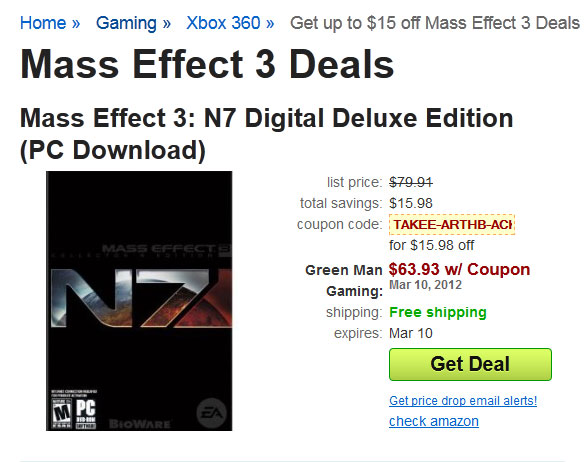
Never again.
If you will recall, I ended up paying ~$85 for Mass Effect 3: Digital Deluxe Edition about two days ago. Had I waited those two days, I could have spent $16 somewhere, anywhere else. I am not in a financial situation in which the $16 necessarily matters, but it matters to me that I essentially paid an Enthusiasm Tax.
The deal was via Dealzon, and I was made aware of that via Kotaku’s The Moneysaver article. It expires today (March 10), in case you are interested. Then again, I have little doubt that you could wait a month or two and get an even better deal.
Incidentally, based on my ME3 experiences thus far, it is worth waiting for the price drop.
Lesser Evils
Ughhhhh…

Free shipping on digital downloads? New deals every week? Sign me up!
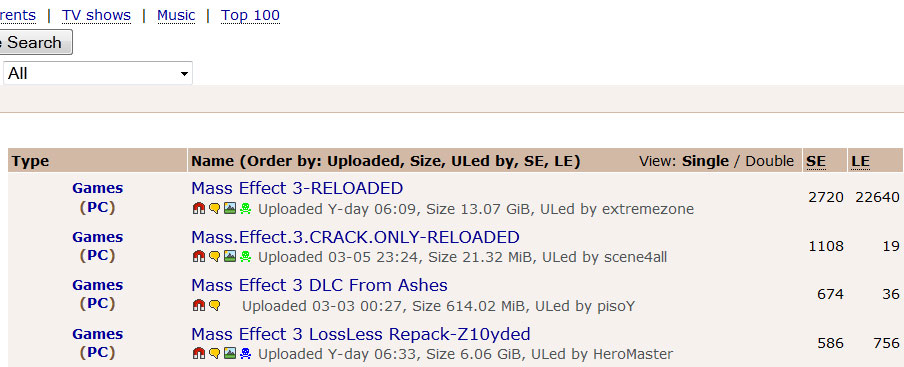
“Step 4: Copy the cracked content located in the Crack directory on either disc into BinariesWin32 of your installation directory, overwriting existing files.”
So… which is worse? Day 1 DLC? Piracy? Requiring multiplayer for the best ending (thanks to Tesh for the heads up)? Not being able to do multiplayer later? How do I choose?
/sigh
/paragon
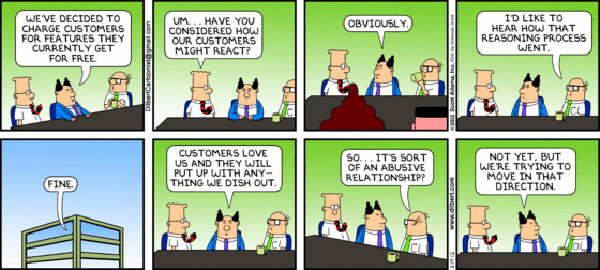
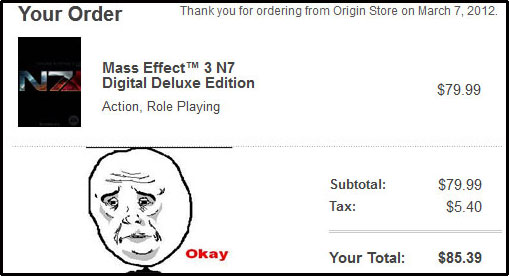
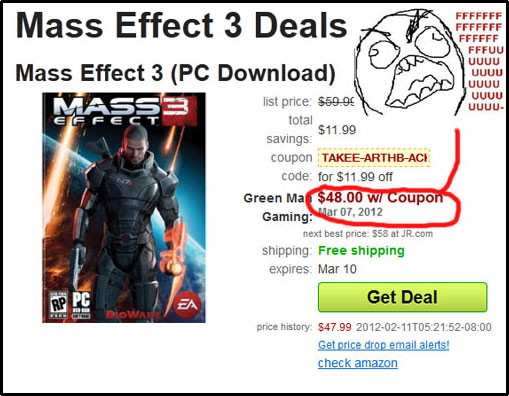
P.S. I know the Digital Deluxe edition is different from the one in the deal. But my DLC calculus was $70 vs $80 (plus soundtrack + whatever), not $58 vs $80. Considering that I already know there is no way in hell my recommended price in my final review will be $80 or even $60, I feel extra dumb for paying the “3:43am purchase so I can download overnight and be a part of this geek cultural event for once” tax.
P.P.S. Has anyone mentioned Origin sucks donkey balls before? I am now having to reinstall ME3 because it originally refused to install anywhere other than on my 64GB SSD. Sorry, no, you get in the back of the D: drive like everyone else.
P.P.P.S. Then this happened:

P.P.P.P.S. Finished redownload after 2+ hours. Despite changing default install location, ME3 was installed on C: again. Now I’m going to have to fucking mess with creating virtual links from the CMD line and hope I don’t break anything. Congratulations, EA, you have made this bullshit more complicated than mounting ISOs and didn’t even have the curtsey to include a KeyGen chiptune reach-around.
P.P.P.P.P.S. Steam or bust.
Review: Mass Effect 2
Game: Mass Effect 2
Recommended price: $25
Metacritic Score: 94
Completion Time: ~36 hours
Buy If You Like: Mass Effect, or cover-based 3rd person action-RPG shooters
It was with no small amount of trepidation that I booted up Mass Effect 2 (hereafter ME2) for the first time a few weeks ago. Having been so late to the Mass Effect party generally, the ongoing internet narratives surrounding ME2’s quality and “worthiness” as a sequel had already congealed into a crusty shell of opinion. I heard claims about “dumbing down,” that Bioware was losing its way and letting the RPG bits drift, abandoned in the dark places between stars. What would I find, coming from the original which so thoroughly and completely sucked me into a new universe?
What I found in ME2 was highly enjoyable, more… streamlined game.

Commander Badass reporting for duty.
A lot of my issues with the original Mass Effect came down to Bioware trying to shoehorn in RPG bits where they did not really fit. There were talents and upgrades and items without the underlying structure of, say, inventory management or character stat screens. In ME2, all of that has basically been removed. You can still find or purchase new weapons, but each weapon is not necessarily better than the ones you already have – it is more akin to alternate weapons in normal FPS games. There still is not a coherent stat screen, but the talent/power-choosing process has been truncated down to the point where it is not necessary.
While that is an improvement over the last game, I was left with the nagging feeling that it doesn’t really make sense to have levels and XP at all anymore; since you inevitably level up after each mission, why not just give players the talent points? Similarly, I was also left with the impression that there really was not much difference between Biotic and Tech-based powers. I could not tell you offhand what the mechanical difference between Tech and Biotic was in the original Mass Effect, but it seemed pretty clear that Biotics was supposed to be special and rare. Now it seems like more than half my crew was Biotic along with most of the organic enemies.
Although the nuts and bolts being streamlined could be viewed as good or bad depending on tastes, the combat itself feels much, much better in ME2. Taking cover feels a lot more fluid, firefights are longer and include more enemies, and with the radically shortened cooldown on Powers, you can do some pretty outrageously dynamic things. There may have been a lined crossed somewhere along the way – perhaps when I was warp-charging through cover every 6 seconds to punch heavily-armored bosses in the face – but I will take dynamic, exciting combat over rote realism any day. After all, how believable is it to have ample chest-high obstructions in every other room to begin with?
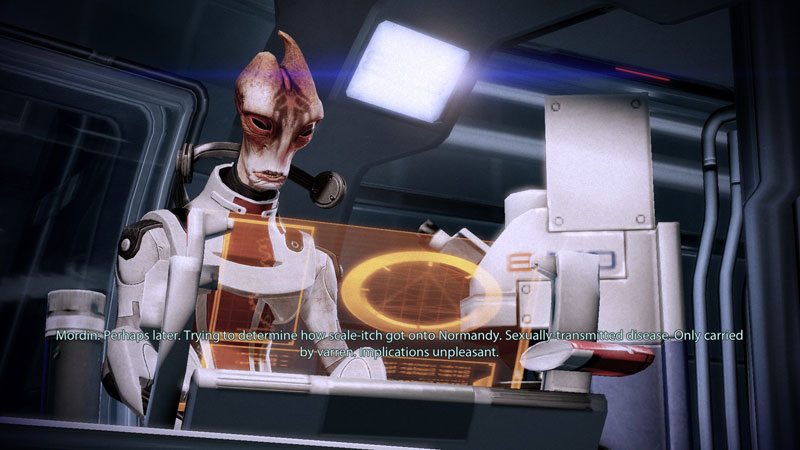
Best party member since Minsc.
My favorite aspect of the original Mass Effect was the integration of non-verbal dialog into the narrative, and the general narrative itself. In ME2, that is kicked up a notch^². Characters smile, nod, gesture, facepalm, wink, and otherwise emote in subtle, natural ways. Indeed, these little actions end up becoming part of the dialog, creating nuance and meaning that words themselves could not convey. Some scenes are punctuated with Quick Time Event-esque moves, such as interrupting a bad guy speech by just shooting him, or stopping someone from doing something they will later regret. While QTEs are normally cheap, annoying gimmicks to force players to pay attention, the ones in ME2 felt a natural part of the narrative… including when you went ahead and let a teammate squeeze off a round in the criminal’s kneecap. I have not played a proper RPG since starting up this Mass Effect experiment, and I am still nervous about whether I could ever go back to static character portraits, scrolling text, or (well-done) narrative QTEs again.
One other thing about the dialog that deserves special mention: this is one of the most goddamn hilarious games I have ever played. Sometimes ME2 crosses the line into absurdity – the cigar-smoking Elcor shopkeeper, anyone? – but most of it evoked more literal LOL moments than eyerolls. That is not to say there is not any drama or serious things going down. Rather, it is precisely these moments of sardonic levity that drive home stakes. You end up liking these characters, wanting to hear what quip they will bust out next, and then are suddenly confronted with the very real possibility they will die based on your actions.
What really ended up surprising me was when what originally appeared to be a simple “alien + personality quirk” party member, suddenly unfolded into a paper crane of origami complexity. I am specifically talking about Mordin, whom I felt practically stole the show aboard the Normandy. The transition between him being a “stereotypical” Salarian with a humorous ADHD staccato manner of speaking, to a weary doctor haunted by the ethical ghosts of his past is nothing short of brilliant. In fact, it is not even really a transition of his character, but a transition of your perception of his character; he didn’t become deeper, you merely discovered the depths. While the other characters are perhaps less complex in comparison, that is practically true of most characters in any RPG that I can recall.
Dialog and characterization aside, I am sympathetic to claims that ME2 streamlined the plot a bit too much. I wasn’t a huge fan of driving the Mako on every random planet, but when that option is replaced with a (decently fun) scanning minigame and combined with exploration mechanics that discourage exploration (we have fuel now?), it ends up making the universe seem a bit too small. Plus, I am not a huge fan of the Restart at Level One trope to begin with, or really how it was presented here. Instead of an epic, unified journey, ME2 really felt like 2-3 missions with about a dozen sidequests between you and the third. I want to stress though, again, this is a weakness with the story structure, rather than the story itself. Each of those episodic sidequests were worth experiencing on their own, but I do recognize how little effect they seemed to have on the overall plot.
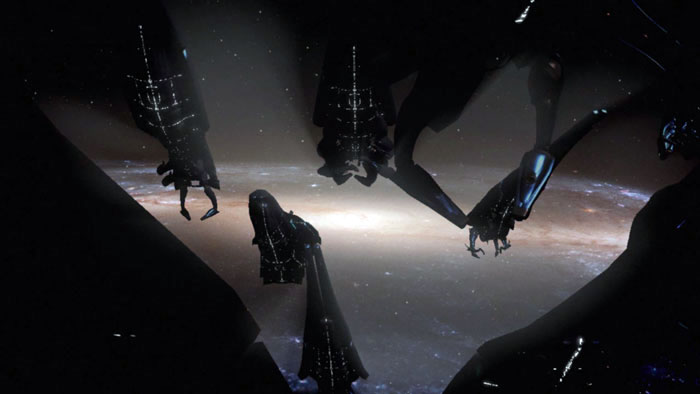
"You know, somehow, 'I told you so' just doesn't quite say it."
Is Mass Effect 2 as groundbreaking as the original? Of course not. The first game had the task of creating an entire universe filled with races and peoples, and had to go about getting you to care about learning more about them. In that respect it succeeded admirably. It is difficult to add something to an already completed picture though, and so I got the impression that Mass Effect 2 was concerning itself with making you care about Shepard. Not in the sense that Shepard is the most interesting man/woman in the galaxy, but rather in the sense that you genuinely care about the choices you will soon be forced to make in the coming war. Mass Effect was about world-building, and Mass Effect 2 about filling that world with individuals. As Mordin says:
No. Aware survival unlikely. Actually contacted him for personal connection.
Hard to imagine galaxy. Too many people. Faceless. Statistics. Easy to depersonalize. Good when doing unpleasant work.
For this fight, want personal connection. Can’t anthropomorphize galaxy. But can think of favorite nephew. Fighting for him.
Does Mass Effect 2 emulate the mechanics of RPGs as well as the first game? No. Did Mass Effect 2 capture the soul of RPGs, the essence of what makes them worth experiencing?
Absolutely.
I May Be Ruined
I am about ~15 hours into Mass Effect 2.
Everything is going swimmingly, although I am beginning to suspect (all) other games have been ruined for me in two very specific ways.
First, I am not sure I can go back to text boxes in RPGs anymore. It is not just about BioWare’s penchant for fully-voiced stories, it is about the equally gripping body language. Everyone has heard about the whole “93% of communication is nonverbal,” right? We are now at a point in game design when at least one company is capable of delivering on that 93% and I do not know if I can go back.
It isn’t just about the smiles, the winks, the nods, or the scare quotes by characters with only three fingers either. It is about the more subtle touches that keep my eyeballs glued to the story exposition. For example:
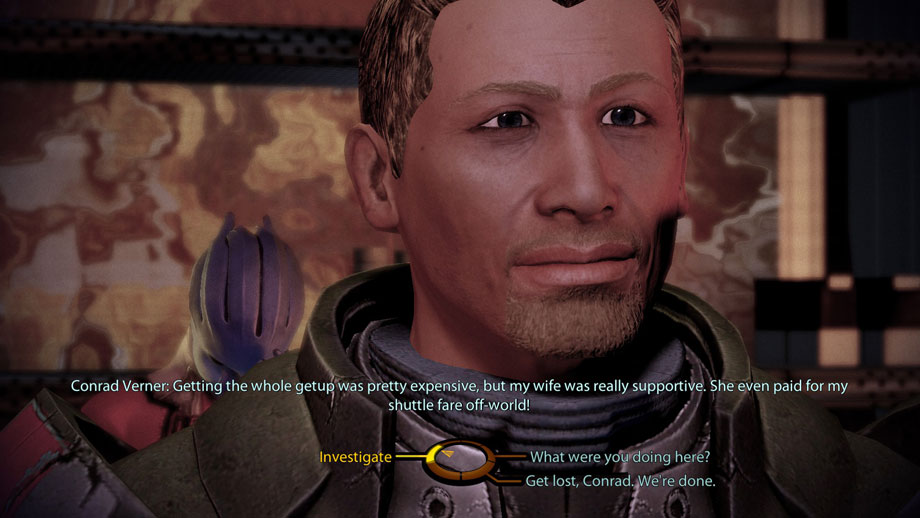
I should have shot him in the foot when I had the chance.
The asari bartender in the background facepalms when Conrad speaks the part about his wife buying the ticket. I actually had some difficulty taking that screenshot because the time between the background facepalm and the camera switching back to Shepard is less than a second – I had to redo that part of the conversation twice to get the shot.
Think about that for a moment. Someone actually went through the trouble of programming a facepalm into a (presumably) throwaway, non-required dialog option, with less than a second of screentime. Understated is an… er, understatement.
Going back to strict text and using my imagination to fill in the blanks? I am not quite sure it will feel the same knowing that the blanks are literal blanks; unless the developers clearly make up for it in other areas of the game, I suspect I will recognize the gaps as deficiencies rather than “imagination opportunities.”
The second way I have been ruined actually came via The Witcher, and is very clearly manifesting itself in Mass Effect 2. Specifically, I now believe I can and should be able to romance anyone and everyone, simultaneously.

Romance All the Things!
I first noticed this tendency when I was flirting with the ship psychiatrist – whom should really know better – and became nervous that things might get out of hand before the entire playing field became available, so to speak. This was not a problem in The Witcher; in fact, you typically only had a single opportunity for “romance” at any given time, so it was a series of all or nothing encounters.
To be honest, this probably has more to do with my methodical nature in gaming than anything else. The baseline assumption I operate on is that I will only ever play a game once – I am looking to maximize my fun, not fill time, and 2nd playthroughs almost always lose out to the dozens of other games available. Ironically, this leads to counter-intuitive game behavior wherein I suck the very marrow out of a game’s bones, completing every sidequest and bonus mission long after such things have ceased being fun and/or make sense to do. Exploring every planet in every system cluster in Mass Effect 1, running Miscellaneous quests in Skyrim as a level 54 character with 100k+ gold, and so on.
As you might suspect, mutually exclusive romance options present a certain difficulty to me.
I do have a residual desire to play ME1&2 again as FemShep, which I would have done originally if not for the availability of romance options at all (that’s another post). The ideal romance scenario would be the “Deus Ex ending” one, wherein you could save right before the critical choice and I could reload to see each outcome. I am getting the impression that this is not how things will shake out.
Youtube exists, but it is just not the same.
By The Way: Mass Effect edition
I believe this was my favorite line in the game:
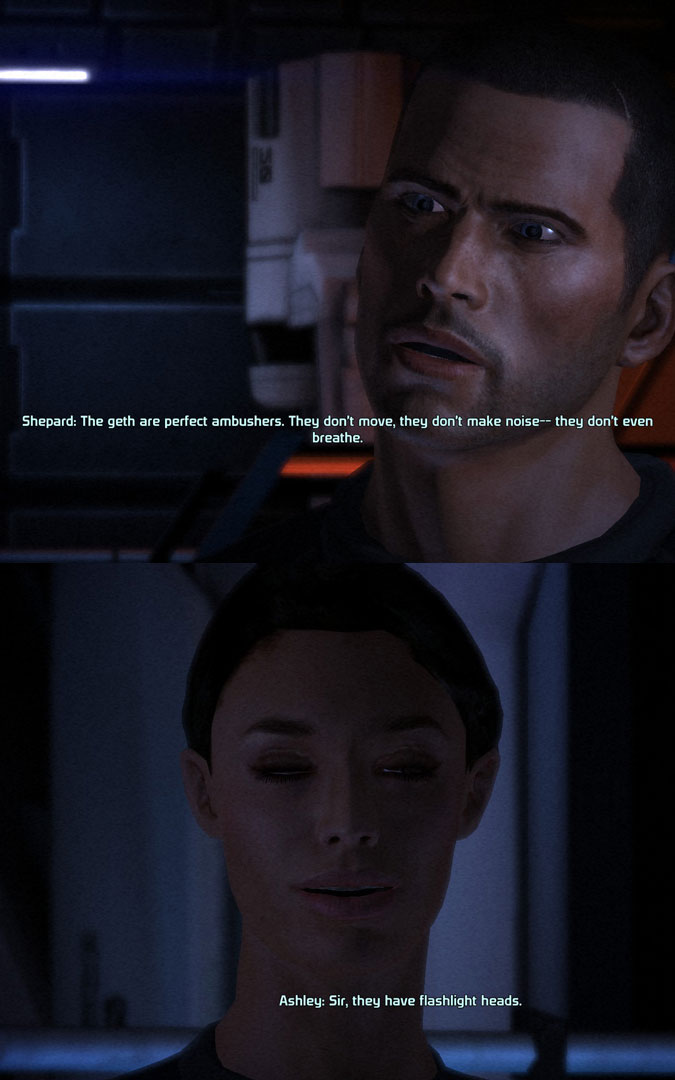
Ashley's unintentional "Derp" face only enhances the experience.
I laughed for probably a whole minute. This wasn’t bad either:
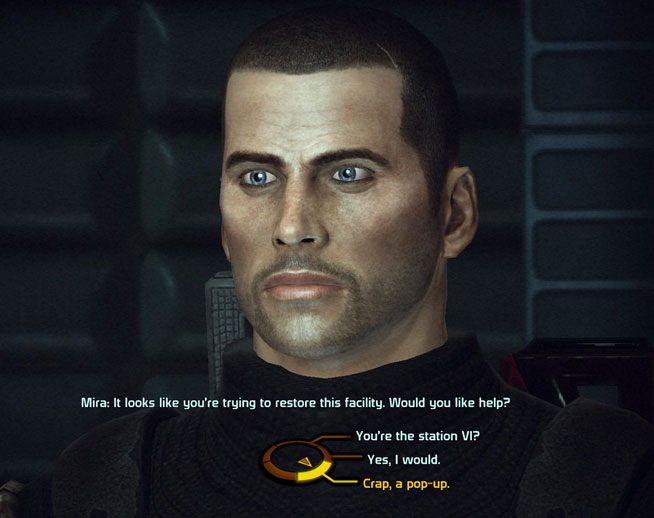
Oh you, guys.
 In An Age
Interesting Choices
Apr 15
Posted by Azuriel
Tobold put up a rather cringe-inducing critique of Mass Effect 3 the other day, prefaced by the Sid Meier quote of “good games are a series of interesting choices.” From there, Tobold argued that ME3 was not a good game, because the story choices being presented did not lead to gameplay changes. Indeed, he goes so far as to say in the comments:
First, that argument is so absurdly cliche that I started questioning whether he was simply trolling us at that point.
Secondly, in point of fact, you could not simply wait for Mass Effect: the Movie because any such film could not encompass the varied plot choices you can make over the course of the game. Characters can die in Mass Effect 1 & 2 and thus not show up in Mass Effect 3, cutting out entire swaths of character arcs. Who makes it through the Suicide Mission? Would the film feature a male Shepard or FemShep? Would the choices be primarily Paragon or Renegade? Which races get the shaft? Would the conclusion be the Red, Blue, or Green Cupcake?
The green one. Always the green one.
Third, I believe Tobold’s stance is exceedingly pernicious to the maturation of gaming as a medium. It simply boggles my mind that a self-professed lover of D&D would twist “interactive story” into a pejorative; are non-interactive stories supposed to be preferable?
Individual agency has a way of submerging players into a narrative in a way that traditional storytelling does not. Just look at the mind-bending (at the time) twist in the original Bioshock and the narrative arc in Far Cry 2. Even if you were not particularly impressed with the depth of these narratives, those story mechanisms simply cannot be replicated in book or movie form. Reducing games to their mere mechanical components would be an incredible tragedy of potential.
What the exchange highlighted to me though, was how squishy the venerable Sid Meier quote actually is.¹ To me, the choice between curing the Krogan genophage or deciding not to was interesting. In fact, I spent ten minutes or so agonizing over it when the dialog wheel was presented. Was it fair of us to cripple an entire species because we feared their hardiness and breeding speed? At first, I was worried about that hypothetical. Once the Reapers were gone, who is to say that the Krogans don’t simply out-breed and out-muscle the rest of us out of the universe? Then I thought: wait a minute, is this not the same sort of argument used against inter-racial marriages in the past, and even concerns about Islam today?
In contrast, Tobold simply picked whatever gave him the most War Assets.
This was meaningful to me, god damn you.
I do agree that a good game is full of interesting choices. But what should be obvious to anyone spending more than a minute thinking about it, is that what is interesting to one person can be boring/irrelevant/pointless to someone else. “Interesting” is not an objective term; Sid Meier may as well quipped “Good games are full of fun” for all the sage wisdom it contains.
¹ The full quote is actually: “According to Sid Meier, a [good] game is a series of interesting choices. In an interesting choice, no single option is clearly better than the other options, the options are not equally attractive, and the player must be able to make an informed choice.” (Rollings & Morris 2000, p. 38.) This does not meaningfully change my objections, as whether an option is “clearly better” and/or “equally attractive” is necessarily subjective. For example, I almost always prefer passive abilities to active ones, to the point that most of the WoW talent tree levels have only a single rational (to me) option.
Posted in Commentary
2 Comments
Tags: Bioshock, Choices, Far Cry 2, Game Design, Genophage, Interactive Storytelling, Mass Effect, Mass Effect 3, Sid Meier, Tobold