Blog Archives
AIrtists
There’s some fresh Blizzard drama over a Diablo Immortal + Hearthstone colab artwork:
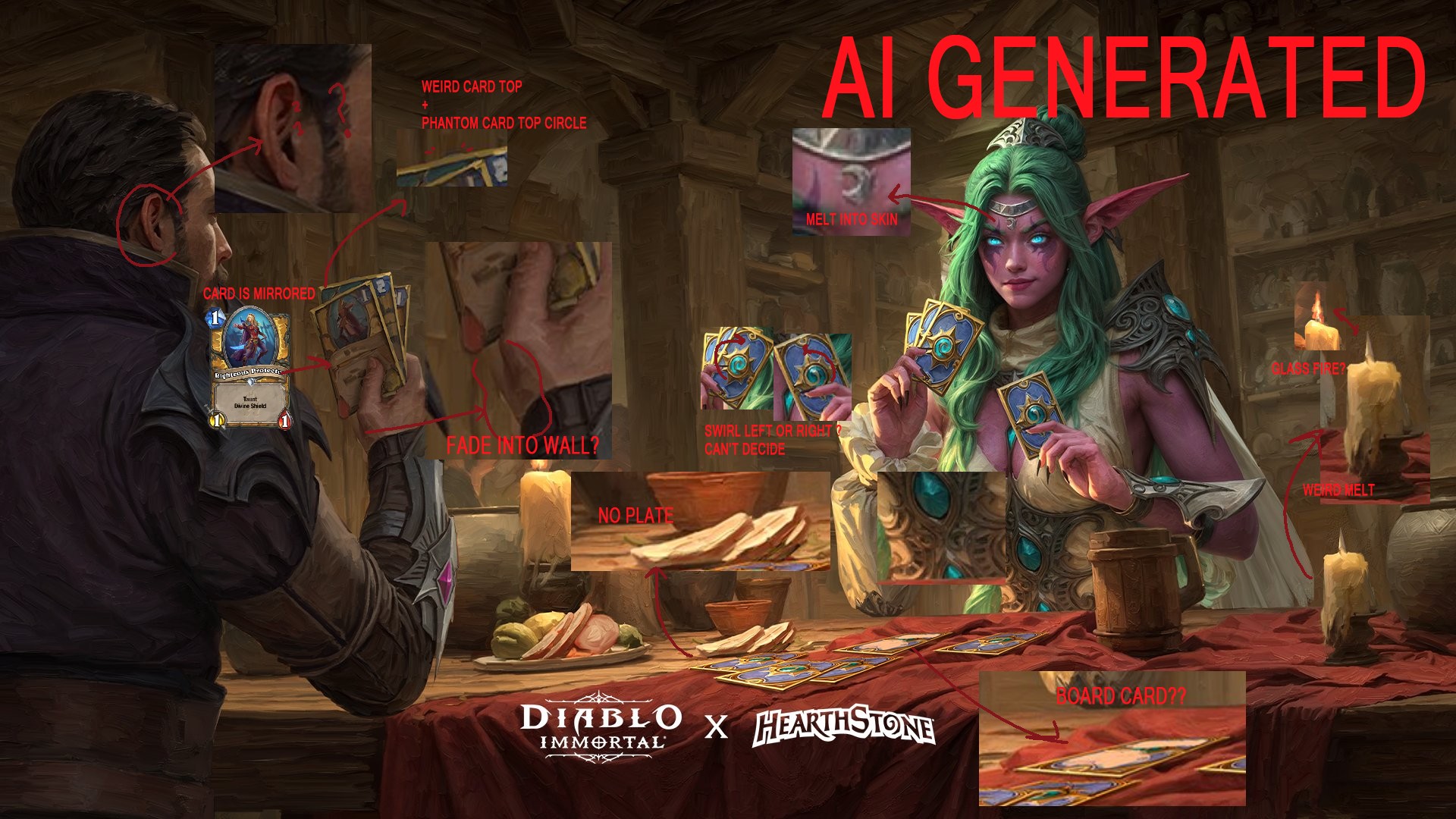
The top comment (1700+ upvotes) is currently:
Guess $158 pets aren’t enough to pay an artist to draw the image for their colab lmao.
I’m all for piling onto Blizzard at this moment, precisely because what they are currently doing in, for example, Hearthstone is especially egregious. It’s not just the pets, though. The dev team had been advocating for reducing the power level of sets for a while – ostensively to fight power creep – but after like the third flop set in a row, their efforts are beginning to become indistinguishable from incompetence. The Starcraft miniset has been nerfed like 2-3 times now, but people are still playing cards from there because they’re more powerful than the crap we got today. First week of the expansion, and the updated Quest decks all had winrates of less than 30%.
Having said that, it isn’t all that clear that the AI artwork is actually Blizzard’s fault.
Last year, there was another AI art controversy with Hearthstone regarding the pixel hero portraits. While there was no official announcement, all signs pointed towards the artist themselves being the one to submit the AI-generated product rather than Blizzard actively “commissioning” such a thing. And remember, even the small indie devs from Project Zomboid got burned when they hired the same person that made their original splash screen and said artist turned around to submit AI-smeared work.
This sort of thing used to sound insane to me. Why would an artist use a tool that specifically rips off artists and makes their very own future work less valuable? Is there no sense of self-preservation?
On the other hand, that Hearthstone hero portrait “artist” almost got paid if it weren’t for those pesky Reddit kids. Considering that Microsoft is now requiring its employees to use AI in their jobs, perhaps the artists were just ahead of the curve. In my own meatspace job, AI tools are being made available and training being required if only to styme certain employees from blindly pasting sensitive, personal data into ChatGPT or Grammarly. Because of course they do.
Regardless, I am interested in seeing how it goes down and what eventually wins. AI does, obviously. But do people stop caring about AI-generated product art because so many examples eventually flood the zone that it becomes impossible to keep up? Will it be a simple generational change, with Gen Alpha (etc) being OK with it? Or will AI advance enough that we can no longer spot the little mistakes?
All three are going to happen, but I wonder which will happen first.
Unsustainability
Senua Saga: Hellblade 2 recently came out to glowing reviews and… well, not so glowing concurrent player counts on Steam. Specifically, it peaked at about 4000 players, compared to 5600 for the original game back in 2017, and compared to ~6000 for Hi-Fi Rush and Redfall. The Reddit post where I found this information has the typical excuses, e.g. it’s all Game Pass’s fault (it was a Day 1 release):
They really don’t get that gamepass is unsustainable. It works for Netflix because movies and tv shows can be made in a year or less so they can keep pumping out content each year. Games take years to make and they can’t keep the same stream of new content releasing the same way streaming services do.
Gamepass subs are already stagnating, they would make more money if they held off putting new exclusives on gamepass like movies do with putting them in theatres first before putting them on streaming. (source)
Now, it’s worth pointing out that concurrent player counts is not precisely the best way to measure the relative success of a single-player game. Unless, I suppose, you are Baldur’s Gate 3. Also, Hellblade 2 is a story-based sequel to an artistic game that, as established, only hit a peak of 5600 concurrent players. According to Wikipedia, the original game sold about 1,000,000 copies by June 2018. Thus, one would likely presume that the sequel would sell roughly the same amount or less.
The thing that piqued my interest though, was the reply that came next:
Yeah, even “small” games like Hellblade and Hi-Fi Rush, which are both under 10h to complete, took 5/6 years to develop. It’s impossible to justify developing games like these with gigantic budgets if you’re going to have them on your subscription service.
I mean… sure. But there’s an unspoken assumption here that these small games with gigantic, 5-6 year budgets would be justified even without being on a subscription service. See hot take:
Hellblade 2 really is the ultimate example of the flaw of Xbox’s “hands off” approach to game dev.
How has a studio been able to take 5 years making a tiny game that is basically identical to the first?
How did Rare get away with farting out trailers for Everwild despite the game literlaly not existing?
Reddit may constantly slag off strict management and studio control, but sometimes it’s needed to reign studios in and actually create games…
Gaming’s “sustainability problem” has long been forecast, but it does feel like things have more recently come to a head. It is easy to villainize Microsoft for closing down, say, the Hi-Fi Rush devs a year after soaking up their accolades… but good reviews don’t always equate to profit. Did the game even make back its production costs? Would it be fiduciarily responsible to make the bet in 2024, that Hi-Fi Rush 2 would outperform the original in 2030?
To be clear, I’m not in favor of Microsoft shutting down the studio. Nor do I want fewer of these kind of games. Games are commercial products, but that is not all they can be. Things like Journey can be transformative experiences, and we would all be worse off for them not existing.
Last post, I mentioned that Square Enix is shifting priorities of their entire company based on poor numbers for their mainline Final Fantasy PS5 timed-exclusive releases. But the fundamental problem is a bit deeper. At Square Enix, we’ve heard for years about how one of their games will sell millions of copies but still be considered “underperforming.” For example, the original Tomb Raider reboot sold 3.4 million copies in the first month, but the execs thought that made it a failure. Well, there was a recent Reddit thread about an ex-Square Enix executive explaining the thought process. In short:
There’s a misunderstanding that has been repeated for nearly a decade and a half that Square Enix sets arbitrarily high sales requirements then gets upset when its arbitrarily high sales requirements fail to be met. […]
If a game costs $100m to make, and takes 5 years, then you have to beat, as an example, what the business could have returned investing $100m into the stock market over that period.
For the 5 years prior to Feb 2024, the stock market averaged a rate of return of 14.5%. Investing that $100m in the stock market would net you a return of $201m, so this is our ROI baseline. Can the game net a return higher than this after marketing, platform fees, and discounts are factored in?
That… makes sense. One might even say it’s basic economics.
However, that heuristic also seems outrageously unsustainable in of itself. Almost by definition, very few companies beat “the market.” Especially when the market is, by weight, Microsoft (7.16%), Apple (6.12%), Nvidia (5.79%), Amazon (3.74%), and Meta (2.31%). And 495 other companies, of course. As an investor, sure, why pick a videogame stock over SPY if the latter has the better return? But how exactly does one run a company this way?
Out of curiosity, I found a site to compare some game stocks vs SPY over the last 10 years:

I’ll be goddamned. They do usually beat the market. In case something happens to the picture:
- Square Enix – 75.89%
- EA – 276.53%
- Ubisoft – 30.56%
- Take Two – 595.14%
- S&P 500 – 170.51%
And it’s worth pointing out that Square Enix was beating the market in August 2023 before a big decline, followed by the even worse decline that we talked about recently. Indeed, every game company in this comparison was beating SPY, before Ubisoft started declining in 2022. Probably why they finally got around to “breaking the glass” when it comes to Assassin’s Creed: Japan.
Huh. This was not the direction I thought this post was going as I was writing it.
Fundamentally, I suppose the question remains as to how sustainable the videogame market is. The ex-Square Enix executive Reddit post I linked earlier has a lot more things to say on the topic, actually, and I absolutely recommend reading through it. One of the biggest takeaways is that major studios are struggling to adjust to the new reality that F2P juggernauts like Fortnite and Genshin Impact (etc) exist. Before, they could throw some more production value and/or marketing into their games and be relatively certain to achieve a certain amount of sales as long as a competitor wasn’t also releasing a major game the same month. Now, they have to worry about that and the fact that Fortnite and Genshin are still siphoning up both money and gamer time.
Which… feels kind of obvious when you write it out loud. There was never a time when I played fewer other games than when I was the in the throes of WoW (or MMOs in general). And while MMOs are niche, things like Fortnite no longer are. So not only do they have to beat out similar titles, they have to beat out a F2P title that gets huge updates every 6 weeks and has been refined to a razor edge over almost a decade. Sorta like how Rift or Warhammer or other MMOs had to debut into WoW’s shadow.
So, is gaming – or even AAA specifically – really unsustainable? Possibly.
What I think is unsustainable are production times. I have thought about this for a while, but it’s wild hearing about some of the sausage-making reporting on game development. My go-to example is always Mass Effect: Andromeda. The game spent five years in development, but it was pretty much stitched together in 18 months, and not just because of crunch. Perhaps it is unreasonable to assume the “spaghetti against the wall” phase of development can be shortened or removed, or I am not appreciating the iteration necessary to get gameplay just right. But the Production Time lever is the only one these companies can realistically pull – raising prices just makes the F2P juggernaut comparisons worse, gamer ire notwithstanding. And are any of these games even worth $80, $90, $100 in the first place?
Perversely, even if Square Enix and others were able to achieve shorter production times, that means they will be pumping out more games (assuming they don’t fire thousands of devs). Which means more competition, more overlap, and still facing down the Fortnite gun. Pivoting to live service games to more directly counter Fortnite doesn’t seem to be working either; none of us seem to want that.
I suppose we will have to see how this plays out over time. The game industry at large is clearly profitable and growing besides. We will also probably have the AAA spectacles of Call of Duty and the like that can easily justify the production values. Similarly, the indie scene will likely always be popping, as small team/solo devs shoot their shot in a crowded market, while keeping their day jobs to get by.
But the artistic AA games? Those may be in trouble. The only path for viability I see there is, ironically, something like Game Pass. Microsoft is closing (now internal) studios, yes, but it’s clearly supporting a lot of smaller titles from independent teams and giving them visibility they may not otherwise have achieved. And Game Pass needs these sort of games to pad out the catalog in-between major releases. There are conflicting stories about whether the Faustian Game Pass Bargain is worth it, but I imagine most of that is based on a post-hoc analysis of popularity. Curation and signal-boosting is only going to become increasingly required to succeed for medium-sized studios.
Microsoft Fallout
About a week or so ago, the rumor mill was a-churnin’ about how the surprising popularity of the Fallout TV show – 65 million viewers in 16 days! – was causing Xbox execs heads to extend (pardon my Seuss). Even Todd Howard was saying Bethesda wants to “find ways to increase our output, because we don’t want to wait that long either.” Which is funny, considering that it is Bethesda’s own metered cadence which will ensure that Fallout 5 is not released until the 2030s; Elder Scrolls 6 is next in line after the tepid Starfield, with Fallout 5 not coming out until, presumably, the ending of the TV series.
Welp, cue that monkey paw finger-curl:
Microsoft has closed a number of Bethesda studios, including Redfall maker Arkane Austin, Hi-Fi Rush and The Evil Within developer Tango Gameworks, and more in devastating cuts at Bethesda, IGN can confirm.
[…] Arkane Lyon, which is working on Marvel’s Blade, survives the cull, as does Bethesda Game Studios (Fallout, The Elder Scrolls, Starfield), and Machine Games (Indiana Jones and The Great Circle). Doom developer id Software is also unaffected.
A further quote from Matt Booty, head of Xbox Game Studios, says:
Today I’m sharing changes we are making to our Bethesda and ZeniMax teams. These changes are grounded in prioritizing high-impact titles and further investing in Bethesda’s portfolio of blockbuster games and beloved worlds which you have nurtured over many decades.
To double down on these franchises and invest to build new ones requires us to look across the business to identify the opportunities that are best positioned for success. This reprioritization of titles and resources means a few teams will be realigned to others and that some of our colleagues will be leaving us.
Cruel irony abounds, considering a year ago Matt Booty said Microsoft has no plans to shut down Arkane Austin “right now,” after the disastrous Redfall launch. And I guess he was technically accurate. There are fewer charitable interpretations for axing Tango Gameworkers though, considering the effusive praise Hi-Fi Rush received from Microsoft brass – “Hi-Fi RUSH was a break out hit for us and our players in all key measurements and expectations. We couldn’t be happier with what the team at Tango Gameworks delivered with this surprise release.” Certainly seems like they could have been happier after all.
I don’t want to undersell the sad reality of thousands of game devs losing their jobs. That shit sucks.
…however. In the specific case of Arkane Austin, I have to wonder if there is the barest glimmer of a silver lining. For one thing, it is worth pointing out that no one at Arkane actually wanted to develop Redfall. It was a studio known for immersive sims, and Redfall wasn’t that. In fact, that same report stated that 70% of the team members who worked on Prey left the company during Redfall development. So, really, Microsoft is kinda putting the zombie studio out of its misery.
Oh, but know what might be an interesting franchise for an immersive sim? Fallout. That is wild-ass speculation on my part, and contradictory besides considering most of the immersive sim devs already left. But. BUT! Can you imagine? Of course, it would probably be best (and poetic besides) for Obsidian to take up the mantle of Fallout again, especially considering both studios are under the same (reaving) Microsoft umbrella. Unfortunately, Obsidian is releasing Avowed this year and they are also working on The Outer Worlds 2 for some reason. Seriously though, was anyone asking for that?
Alas, we will have to see how things shake out. Just… goddamn, could someone give me more Fallout?
Blizzard Decimation
It’s been rough going in the game development world, and it’s getting rougher: Microsoft has laid off 1,900 Activision Blizzard staff. Layoffs are an expected reality after corporate mergers, and certainly the industry trend is towards cutting staff this past year. But this… also cuts a bit deeper.
The changes announced today reflect a focus on products and strategies that hold the most promise for Blizzard’s future growth, as well as identified areas of overlap across Blizzard and Microsoft Gaming. Today’s actions affect multiple teams within Blizzard, including development teams, shared service organizations and corporate functions. As part of this focus, Blizzard is ending development on its survival game project and will be shifting some of the people working on it to one of several promising new projects Blizzard has in the early stages of development.
There’s some irony in Blizzard’s abandonment of the survival game project just as Palworld is eating the genre’s lunch – copying existing games and making them slightly better was Blizzard’s whole M.O! No doubt the layoffs were planned months ago, but part of me wonders whether the calculus would have changed had they known of Palworld’s viral success. Then again, if Blizzard released something to less acclaim, then that would be pretty embarrassing.
I’m actually low-key devastated that we won’t see Blizzard’s take on the genre. It may seem like there are a lot of options available – and there are – but it’s quite rare to see AAA development in this space. Right now, it’s like… Fallout 76 and maybe Grounded. No Man’s Sky might count? Just imagine your character running around with the detail of Overwatch rigs. Blizzard already has experience building giant, seamless worlds too. Although… hmm. If you squint hard and ignore the questing, I guess WoW itself really might feel like a survival game already. Maybe that slight overlap was the problem.
In any case, another unfortunate outcome of the axed survival game is the fact that the devs working on it were pulled from other areas months ago, only to be laid off. From a Hearthstone Reddit thread:
—FORMER Hearthstone Devs that were on cancelled Survival Game have been laid off!:
-Matt London – Designed Book of Mercenaries (solo adventures/stories/characters), Twist, and Caverns of Time Expansion
-Ates Bayrak – Designed Duels
—Current Hearthstone Team members laid off:
Cynthia Park – Hearthstone PR Manager
On second thought: oof. Book of Mercenaries was not good content, Twist has been an epic disappointment, and Caverns of Time was an insane cash-grab that’s especially egregious considering they “paused” Twist for months. Meanwhile, Duels is was… cut from the same cloth, let’s say. I don’t want to kick anyone while they’re down or anything, but I’m starting to wonder if Blizzard was really assembling an A-Team for the survival project. Maybe these devs were the ones most willing to take risks to see what works. And perhaps the monetization strategy wasn’t their idea. Who knows?
Oh well. Pour one out for the game that was not to be.
Microsoft (All But) Acquires Activision-Blizzard
The FTC has lost its injunction case against the Microsoft and Activision-Blizzard merger. Minutes later, the remaining regulatory holdout in the UK appears to be in back-room discussions with Microsoft. Although the FTC can still technically appeal the decision, in all likelihood things will be buttoned up by the time this post goes live.
I have not been following the court case itself too closely. The armchair legal experts on Reddit though suggest that the FTC’s arguments were weak, but don’t really go into convincing detail as what alternative arguments would have been stronger. On the face of it, everything seemed to hinge on Sony – who currently owns 45% of the entire console market – being negatively impacted by the merger. Considering Xbox is just 27.3%, one might surmise that the merger would actually increase competition in the console space. At least the UK’s argument was about cloud gaming… something that basically doesn’t exist, with even Google and Amazon unable to get it to work.
I am sympathetic to the argument that buying publishers and game companies is detrimental generally. There are no doubt millions of PS5 owners who probably wanted to play Starfield on their console of choice. Sort of like how I would have liked to play Ghosts of Tsushima on PC, which isn’t even considered a console by Sony/courts, but nevermind.
Perhaps it’s a bit myopic, but I’m obviously in Team Game Pass. I don’t care about Call of Duty and I doubt WoW will change, but potentially seeing Diablo 4 show up without having to spend $70 on it is a welcome surprise. No doubt the good times will come to an end at some point, especially considering the recent subscription price hikes, but it’s still worlds better (and cheaper) than the alternatives.
Will everyone come to regret this outcome 10 years from now? I kinda hope so. Because that means things are normal enough in 2033 that we can still give a shit about video games and not play Fallout 5 by walking outside our front doors.
MFST and ATVI Sitting in a Tree
… M E R G I N G.
Sorta. More like Activision Blizzard being bought by Microsoft for about $70 billion. You already knew that though, because your news feed was probably about as filled as mine was yesterday. And now I’m adding this one to the pile. At least I went with a different title, eh?
There are really just two thoughts I wanted to examine, and leave everyone else with the more mundane (IMO) details.
First, this does interesting things for Game Pass. From the Microsoft article:
Upon close, we will offer as many Activision Blizzard games as we can within Xbox Game Pass and PC Game Pass, both new titles and games from Activision Blizzard’s incredible catalog. We also announced today that Game Pass now has more than 25 million subscribers. As always, we look forward to continuing to add more value and more great games to Game Pass.
Will we really see the next Call of Duty come out as a Day 1 Game Pass release? The franchise has been a cash cow forever, and almost never sees a discount of any appreciable amount. It’s a given that Overwatch will be on there. Probably Diablo 2 Resurrected, along with all the StarCrafts.
But… what about WoW?
My guess is that WoW will remain off of the Game Pass, assuming the merger occurs. It’s cute to imagine the possibilities of a Game Pass subscription taking the place of a WoW subscription, but The Elder Scrolls Online is not currently on the PC version of the Game Pass, and maintains its separate subscription option even for consoles (according to this). Then you would have issues with what happens with WoW Tokens and game time. EA Play is currently included as a free bonus in Game Pass, but that is more of a general subscription service and not something for a specific game.
The second thought came from Tobold’s take on the news:
My take on it: They overpaid. Whatever made Blizzard great back then is gone, and they pay big money for a rather empty shell.
As pointed out by others, Blizzard is really the third wheel to the cash motorcycle that is Activision and King. Blizzard ain’t nothing, but they clearly weren’t the draw here.
It does raise an interesting point about studios and rockstar talent though. Is the current state of Blizzard, and WoW specifically, due to the immense brain drain of talent over the past few years? Greg Street in 2013, Chris Metzen in 2016, Mike Morhaime in 2019, Michael Chu in 2020, Jeff Kaplan in 2021, and Alex Afrasiabi. The last one was a bit of a joke… but do we actually know what he contributed (beyond sexual harassment)? We would hope nothing, but there are certainly plenty of examples of famous artists with fantastic output that we then pretend is meaningless after finding out how awful they are IRL. Mel Gibson, Keven Spacey, Arnold Schwarzenegger, Louis CK, and so on.
Don’t be too smug – Joss Whedon is next, by the way.
Comment bait aside, it’s an open question as to whether WoW can, literally, ever be as good as it was (to us) again. Was it only ever good because of these specific frat boys in this specific Cosby room? Shadowlands represent a new low from a narrative standpoint, and Blizzard’s “reinvent the wheel every patch” systems floundering looks especially amateurish as the flagship burns. Many games are a product of their time, groundbreaking because they broke ground first. So there’s a time, a place, and then there’s specific people too. Can it actually ever be recreated with competent, nameless devs?
I suppose the existence of WoW Classic is a testament to the bones remaining solid, for at least X amount of people. And the present state of FF14 proves that MMOs can still thrive and grow its playerbase years later. But can the latter’s success be attributed to the committee of devs that surely exists, or to specific rockstars like Yoshi-P, aka Naoki Yoshida? Would a hypothetical acquisition of FF14 be moot if it did not include him?
I don’t know. A lot of this may be Survivorship Bias – these individual devs are famous because their games were successful and they made themselves the face of it. Who is the face of Hades? Or Doom? Or GTA5? But perhaps in the final tally, having the right person in the right place at the right time does make all the difference.
And then you get bought by Microsoft for $70 billion.
Microsoft Buys Bethesda, the World
File this under Holy Shit, Batman:
Today is a special day, as we welcome some of the most accomplished studios in the games industry to Xbox. We are thrilled to announce Microsoft has entered into an agreement to acquire ZeniMax Media, parent company of Bethesda Softworks.
As one of the largest, most critically acclaimed, privately held game developers and publishers in the world, Bethesda is an incredibly talented group of 2,300 people worldwide who make up some of the most accomplished creative studios in our industry across Bethesda Softworks, Bethesda Game Studios, id Software, ZeniMax Online Studios, Arkane, MachineGames, Tango Gameworks, Alpha Dog, and Roundhouse Studios. These are the teams responsible for franchises like The Elder Scrolls, Fallout, Wolfenstein, DOOM, Dishonored, Prey, Quake, Starfield and many more.
https://news.xbox.com/en-us/2020/09/21/welcoming-bethesda-to-the-xbox-family/?ocid=Parterships_soc_omc_xbo_fb_Video_buy_9.21.1
As it says, Microsoft is buying ZeniMax and all its subsidiaries, of which Bethesda is a part. Among other things, this means that Starfield, Elder Scrolls 6, Fallout 5, etc, will be coming to Game Pass on Day 1. That link also indicates the deal was for $7.5 billion. Which is like… 3.5 Minecrafts.
Another amusing detail is that Bethesda and Obsidian are going to be under the same roof again. Perhaps there could be another New Vegas-esque collaboration? Obsidian are good storytellers when they don’t have to build worlds from scratch. When they do, we get garbage like Outer Worlds.
What else could this mean? Well… since Microsoft is going all-in with the Game Pass, there’s a remote chance that Bethesda-specific subscriptions get rolled into Game Pass itself. For example, Fallout 76 has the Fallout 1st subscription and then there’s Elder Scrolls Online’s sub. Like I mentioned yesterday, Game Pass doesn’t include everything, like DLCs and such. That said, EA Play’s subscription is getting rolled into Game Pass for no extra charge. So who knows?
Overall, I am extremely excited. I feel the same way currently as I did way back in the day, when the first few Steam sales started. I hated that Valve was forcing me to download Steam just to play Half-Life 2 and otherwise jump through a lot of hoops. Then once the sales started, it all clicked that this was the future. Well, the future is happening again. And now instead a future heralding the sale of horse armor, we get a timeline where you can play AAA games on Day 1 for $4.99 $9.99/month.
I Bought the Thing
An hour or so after yesterday’s post, I went ahead and bought State of Decay 2. Life is short, I have the money, let’s do the thing.
Just as a warning though, Microsoft doesn’t make it easy.
State of Decay 2 is not on Steam. Further, there is no express PC copy. The game is apparently part of Microsoft’s “Play Anywhere” initiative, which means you end up having to buy the Xbox One copy, which can also be played on Windows 10 machines. I purchased on Amazon because of my 5% cash back card, but I suppose you could do so from the Microsoft store a bit more directly.
The problems were just beginning though. One of the first things I had to do was associate my PC with a Microsoft account. My copy of Windows 10 is legit, but I never bothered to register it or anything, so now apparently I had to reconfigure how I sign into my own damn computer just to get access to the storefront. Once that was done, I took my digital code, followed the links, and redeemed the code in the Microsoft store. But… where was my download button? Where was My Games? Every link I followed just took me around in circles.
In case you follow my lead, hopefully this link works:
https://microsoft.com/en-us/p/state-of-decay-2/9nt4x7p8b9nb
That will hopefully take you directly to the game’s page. Be aware that you’ll probably still need to add your PC as a Device on Microsoft’s servers or whatever, but you should be able to eventually download it from there.
I cannot comment much on the gameplay thus far, beyond confirming that it’s definitely scratching the itch. I’m not a fan of the game giving me a mission to kill a Plague Heart, pointing me to an NPC that gives me explosives for free, and then surprising me with the fact that the very items it told me to use were not enough to actually kill said Plague Heart, but whatever. I’m looting things, building a base, and killing some zombies. That’s exactly what I wanted to do in this moment.
Games as Services
If you have forgotten, Scrolls is that one card game from Mojang that no one ever played. And after July 2016, no one else ever will.
I actually had a Beta review up of Scrolls nearly two years ago, and that more or less marked the last time I spent any serious amount of time with it. I did pick it up again for a hot minute last year (I think), but the structural problems I already talked about were still present, so I stopped again. Probably because of Hearthstone. But, the CCG genre is not a genre one can go in half-assed anyway- it is strictly full-ass or bust.
While Scrolls getting an expiration date is not even remotely similar of an impact as an MMO shutting down, it is example #1765783 of the dangers of Games as Services. This is a game that I paid $20 for (two years ago, admittedly) that I will not be allowed to play in another year. Do you know what I played last month? Vampire: the Masquerade – Bloodlines, an RPG that came out in 2004. And while it certainly costs money to keep an MMO server running each month, Scrolls had a perfectly fine single-player experience against the AI. Hell, I’m not even sure what the cost of running Scrolls matchmaking software would even be. Surely not that much?
Alas, it is not meant to be. While we can question whether it was Microsoft swinging the ax or normal market forces, the fact remains that the ax was always there. A veritable Sword of Damocles hanging over every game-turned-service, not threatening mere removal, but extinction. Will there even be a museum where these games could be played in the future? Or will these orphaned blog posts be all that exists, a Google search result that becomes less relevant with each passing year?
Nothing is permanent. But clearly some things are more impermanent than others.
 In An Age
Price Hike
Oct 16
Posted by Azuriel
You have likely heard the news already, but in the last few weeks Microsoft has increased the price of Game Pass, kind of significantly. The Ultimate tier went from $19.99 to $29.99, for example, which is a 50% increase. Even the PC tier where I’m at went from $11.99 to $16.49, which is a 38% increase. While Microsoft has tried spinning the “value added” from things like free battlepasses to a few F2P games, most everything is the same or worse.
I have a couple of things I wanted to say about this.
First, the amount of “I told you so!”s from people – including former FTC chair Lina Khan – who suggest the price increase is a result of the Activision Blizzard merger is kind of ridiculous. Yes, $55 billion is a lot of investment money that Microsoft expects a return on. However… do we imagine the Game Pass subscription was going to stay at the same level if the merger didn’t occur? Was Microsoft not going to lay off the same game devs as before? Subscriptions go up and to the right. It doesn’t take Nostradamus to predict that Netflix and Disney+ will have a(nother) price increase within the next two years, with or without any mergers.
Incidentally, the math on people canceling their subscriptions is interesting. Even if just under one-third of people cancelled their subscription… Microsoft would still break even. Hell, depending on the network traffic and other server costs, Microsoft probably comes out ahead even if half of everyone quits.
For the record, I’m not here to defend the price hikes or Microsoft in general. We are absolutely seeing an across-the-board decrease in Consumer Surplus as a result of this, and it behooves everyone to double-check their internal math to see if Game Pass still makes sense. If all you’re playing is Hollow Knight: Silksong for the month, well, you were better off just buying it outright. Even the “free” copy of Call of Duty is going to start costing you extra starting in month 3 versus 7+ now.
But let’s not pretend that where we’re at today wasn’t worth how we got here. Microsoft was going to Microsoft anyway. The fact that we got to enjoy a comparatively cheap way to play videogames for years and years was phenomenal. The party is over now? Oh no, back to… buying videogames again.
Compare that to what’s going to happen when the AI music inevitably stops.
Posted in Commentary
1 Comment
Tags: Consumer Surplus, Inevitable, Microsoft, Price Hike, Xbox Game Pass