Blog Archives
SWTOR Drops an EVE in Size
In other words, SWTOR lost 400,000 subscriptions in the last three months:
Star Wars: The Old Republichas dropped from 1.7 million active subscribers to 1.3 million, publisher Electronic Arts said today in an earnings statement.
That’s a loss of nearly 25% for the massively multiplayer online role-playing game, or 400,000 subscribers. […]
Update: In a conference call this afternoon, EA said the decrease was indeed due to “casual and trial players” cycling out of the game.
It is worth noting, of course, that the 1.3 million current subscribers is circa March 31st; things may have stabilized or gotten worse sense then.
Remember the whole brouhaha concerning the free month of game time given to Bioware’s “most valued players?” That took place two weeks into April. So while that may still have been a cynical move to prop up subscription numbers, we can be reasonably certain that the 1.3 million figure is not being finessed by anything (the 1.7 million figure at the beginning of the year had some vague language).
I’m not sure I’m going to follow SWTOR with the same level of attention I give to WoW’s subscription/raiding numbers, but for some future reference, here is an Xfire screenshot:
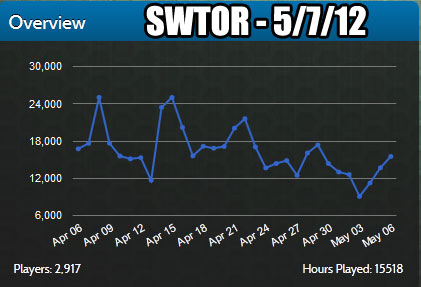
I… guess that’s a downward trend?
I personally don’t like using Xfire as a metric – the sample of players here are playing SWTOR for 5.3 hours at a time if I’m reading that right, and I’d assume even happily subbed players play less over time – but there you go. Damning evidence of EAware’s hubris and impending downfall, or signs of a much healthier MMO than most releases have achieved in the last few years. Obviously 400k is nothing to sneeze at, but 1.3 million is much better than analyst predictions of 800k.
Spin that narrative however you please.
Scroll of Ridiculous Value
Obviously there has been a lot of talk about the Scroll of Resurrection‘s instant level 80 character thing. But equally fascinating to me is all the other value-added things they stuffed in there. When they took the Scroll down the first time, I assumed it was because Blizzard was seeing people being Scroll’d and then defeating Deathwing via LFR before the week(s?) was up. Now? This is what you get:
- Upgrade to Wrath. ($19.96)
- Upgrade to Cataclysm ($26.99)
- 7 Days of game time. (~$3.50)
- Server Transfer. ($25.00)
- Faction Transfer. ($30.00)
- Free level 80 toon ($X)
Total potential value: $105.45 + $X.
When I quit WoW ~6 months ago, my criteria for ever returning was basically “when they started discounting server/faction transfers.” The game itself had not stopped being fun, it was the gradual bleed of friends that made me question the subscription. Even if I resubbed tomorrow, I would still be on the same shit low-pop server, stuck with the same inverted community. I have five level 85 characters and 400k+ gold that I’m not about to let rot, but neither am I paying $50+ a pop to save them. Simply put, there is a pretty severe barrier to reentry at this point.
So when said friends hit me up on Vent yesterday to chat, I knew the Scroll pitch was coming. And in some ways it was very, very tempting. The mental scenario played out like this:
- Friend rolls level 1 Horde toon on healthy server, sends Scroll.
- Accept Scroll.
- Delete an unused character, roll level 1 druid.
- Get the druid to level 80 instantly.
- Load druid up with 50k gold (the max transfer limit), other items.
- Free Server Transfer + Faction Change the druid.
- Paid Server Transfer + Faction Change for main.
That would get me a decent fraction of my wealth onto a new server, plus the ability to perhaps LFR Deathwing in that free week, plus a level 80 version of the only class I never played before, and technically a server/faction transfer at 50% off.
There are some unknowns, of course. Would I have to do the Server/Faction transfer immediately, or could I delay it? Are you leveled to 80 only after you move? Can someone send a Scroll from a level 1 character? Do I really want WoW back in my life, now, when there is probably another 6 months of just Deathwing?
The funny thing is… maybe it doesn’t matter. Even if I simply accept the Scroll on my main in order to just get the free server/faction transfer, maybe that’s enough. Log in, move the one toon, screw around for a week, let it expire. Then wait for the next promotion. By the time Mists finally rolls around, perhaps I will have moved several more toons somewhere else by using Scrolls every 3 months.
But OMG instant level 80 WTF?
It may be my relative distance from the game, but this does not strike me as particularly controversial or counter-intuitive as it may seem.
First, the Scroll can only be used on paid accounts created before March 4th. Brand new players are not getting level 80 toons right off the bat.
Secondly, and more importantly, nobody is really “skipping” the revamped 1-60 Cataclysm content here. If you were a veteran, you either saw it already or don’t exactly care about the questing your alts do. And if you do care, well, just don’t accept the level 80, yeah?
If you were someone who quit before Cataclysm, say at the end of Wrath or TBC or even vanilla, you are already past the revamped starting experience. This piece of the promotion is about skipping TBC and Wrath leveling, not 1-60. And if you are making a level 1 toon to take advantage of the instant leveling, then you have already decided that the new questing experience isn’t worth your time.
Does this set a troubling precedent? Well, maybe, maybe not. Death Knights are instant level 55. The Recruit-a-Friend promotion grants triple XP to both characters, and the referring account gets free levels to apply to toons up to level 60 – back in the day, I “recruited” myself to dual-box a rogue and priest to 60, then gave my level 28 hunter the free levels until he was 58. Nowadays, the triple XP lasts until level 80, and you can grant a total 40 free levels.
The one argument I am sympathetic towards is the lack of veteran rewards. If you have been dutifully playing and paying WoW all this time, you have gotten nothing. Sure, you have had the enjoyment and wonder of playing the game for the last X years, but you have paid for it in cash and tears. Promotions like the Scroll are great for people like me who might not have ever been tempted to hop back on the train, but it also makes the calculus of bothering to tough out the dry spells awfully fuzzy.
If I do end up pulling the trigger, I’m definitely letting the sub lapse again later. Because… why not? An unstable subscription is apparently worth more to Blizzard than a stable one. It sounds backwards and dumb, but it is perfectly rational in its own way. I paid $85 for a game (ME3) on Day 1 when I could have gotten that same game for $50+ less a few months from now. The people already subscribing/buying Day 1 are money in the bank; they need no convincing.
Moral of the story: it pays to play hard to get.
Of course, that probably works about as well in the long-term as it does in real relationships.
The SWTOR Figures Thus Far
You have probably already heard about the 1.7 million subscription number, 2 million boxes sold, and so on surrounding SWTOR’s launch. What I am finding a bit more interesting are some of the investor call break-downs as gathered by Darth Hater. For example:
Q: What are your plans at expanding the global market?
A: We are looking at the Asian market. Expanding into Australian market on March 1st. We’re looking specifically at opportunities to expand in the Asian market.
Q: How long will it take to get into the Asian market?
A: Australia/New Zealand is the low-hanging fruit. Think in months rather than weeks. Individual Asian markets will be announced in the future, we’re bound by confidentiality agreements. When WoW was introduced in 2004, they were in Korea shortly after, and 9 months after in China. It was easier in those days – server outages were considered par for the course, that is not the case today. We hope to execute as well in Asia as we did in the NA/Europe launch.
Q: You’ve previously said you need about a half million subscribers to be profitable, is that still the case?
A: At 500,000 subscribers, we’d break even. At a million, we’d be making a profit but nothing worth writing home about. As it scales up from there, we’re talking about a nice profit. At this point with the successful launch, we can take the worst case scenarios off the table.
The ability for SWTOR to launch in Asian markets was one of the biggest concerns I had with the game from a success standpoint, as you may recall. Indeed, if/when the game is released in China, that will be the moment beyond which we will be unable to talk about its subscription numbers with any sort of coherency – not because it will necessarily be super-popular over there, but because, just like with WoW, millions of Eastern subs obfuscates armchair analysis. Remember Nils saying “[…] I would now say that EA could be happy if they had 500k subscribers one year after launch”? Would it “count” if there was some Western mass-exodus down to 250k but 2 million Chinese subs?
In any event, there are still legitimate questions about how the game will perform 3 to 6 months down the road, when there is less ambiguity surrounding whether 1.7 million was as-of December 31st or as-of the investor call (and what “most” means in the context of “Most of those 1.7m are paying at this point”). Then we have Frank Gibeau who says:
In the next phase, our goal is to grow the number of subscribers with frequent releases of content that make the game even more exciting. […] We plan on delivering another major update, even larger than the first, in March.
It is kind of interesting, on several levels. Can Bioware keep such a pace for any length of time, or will there be a drought soon after March wherein the reserve content drys up? Do frequent patches even drive subscription growth to begin with? Blizzard’s Mike Morhaime said back in November that patches were mainly about reducing churn, not growth. Maybe it’s different for games below market saturation? And speaking of games and markets, let’s not forget at least a half dozen high(ish) profile MMOs will also be dropping this year, including the mythical Guild Wars 2 and Mists of Pandaria. No doubt there will be some impact, eh?
Time will tell, but so far so good.
P.S. If you had bought EA stock after it dropped 3% in mid-January, when people were laughing about SWTOR’s “disastrous launch” based on that one analyst, you’d be sitting on a 10.22% return on your investment a little more than two weeks later. Or, hell, a 6.1% return between yesterday and today.
P.P.S. Christ. BRB opening eTrade account.
SWTOR Will (Probably) Be Fine
With the 1-month honeymoon coming to its end, and a series of “amateur-hour” missteps combined with other bad news, the general feeling seems to be coalescing around SWTOR’s present or future inevitable “failure.” While everyone is entitled to their own insipid pessimism, the sorts of reasoning being provided are a little weak.
1) Absurdly High Standards
There are two main flavors of absurdity under this umbrella. The first is simply ridiculous, the sort that sees WoW going from 12 million to 10 million as a failure, a sign of collapse, of crushing moral defeat. Or, going from 32 to 26.667 times the size of EVE, the MMO yardstick whose robustness is the de facto definition of success. I agree that WoW deserves the subscription loss, that it is directly linked to Cataclysm, and further that WoW may never recover those subs and/or continue a sub decline for the foreseeable future.
However, let’s be honest here: if that is the sort of yardstick we are using, the entire MMO market is an abysmal failure.
The second, lesser form of absurdity is identifiable in this quote from Nils:
[…] I would now say that EA could be happy if they had 500k subscribers one year after launch.
In other words, SW:TOR failed. And it failed for EXACTLY the reasons we, the blogosphere, had predicted for at least 2 years prior to launch. We should be proud – and sad.
For comparison, EVE is the second largest Western MMO on the market at, by last count, 375,000 subs. Between 25% and 62.5% larger than 2nd place is a failure? Really?
You know what, though? I think it is important to have a discussion about what “success” really means – just like with “casual” and other loaded terms, having some kind of idea where people actually stand would reduce the effects of talking past one another.
2) Vague Definitions of Success
“Success” is largely arbitrary, and depends on the goals one sets for oneself. If you set out to run an 8-minute mile and can only get to down to a 9-minute mile, you have “failed.” That you improved from a 15-minute mile to 9-minutes is irrelevant in an objective sense.
Success in a market sense, is a little less arbitrary – you are either making money or you are not. According to the information we have available (circa last May), SWTOR needs a minimum of 375k subscriptions to break even, and ~500k to be reasonably profitable. So in the Nils quote, SWTOR would be a success at 500k.
But what of the analyst who sent EA stocks tumbling 3% based on “disappointing sales” and churn rates? Since we don’t have access to his data or methodology, it is difficult to appraise his conclusions. However, the very next day EA stocks went back up 2% after three separate brokers said SWTOR is “performing in line with expectations.” One of them went on to say:
Evan Wilson of Pacific Crest wrote Friday that he has raised his sales estimate for “Star Wars” to 2.2 million units from 1.5 million units for the quarter, and said he remains “comfortable” with his 800,000 subscriber target when the company’s fiscal year ends in late March.
“Admittedly, we set our expectations as if Star Wars was to be a good, not great, MMO,” he wrote. “Fortunately, we think the company did too.”
Hardly a ringing endorsement, but there it is. There is a line between the soft bigotry of low expectations and aggressive schadenfreude – the challenge is finding it. “Good, not great, MMO” might be a bit too low for even my standards, especially given write-ups like these in the LA Times (turns out SWTOR officially cost $200m). We will know more about the numbers in February when EA’s financial statements become available, but I am inclined to say that if SWTOR can achieve/maintain 500k-800k subscriptions for the year it will undeniably be a success.
3) Endgame Concerns
About a week ago, Tobold was discussing Richard Bartle’s feelings towards the SWTOR endgame (which are rather interesting, by the way). Down in the comment section, Tobold said something I wanted to highlight:
In short, I know why I prefer leveling in SWTOR to leveling in WoW. I don’t know why I would prefer raiding in SWTOR to raiding in WoW. Do you?
It is an interesting question because by all accounts, we have no idea what the average WoW player is doing. Looking at Cataclysm, only approximately 17.28% of the Western audience killed 1 raid boss in T11 content, and ~12.69% killed 1 raid boss in T12. Even if my methodology¹ is flawed, it is likely we are looking at a game in which over two-thirds of players do not participant in raiding, i.e. the “accepted” endgame. So… what are they doing? Heroics? Battlegrounds? Goldshire RP? Everyone seems to agree that the WoW leveling game has been irreparably destroyed, and yet there seems to be no other explanation as for what the vast, vast majority of the playerbase seems to be doing.
In this respect, SWTOR’s raiding endgame seems as likely as not to be irrelevant. Perhaps the social mechanisms of organized raiding trickle down to the masses, perhaps raiding increases player engagement, perhaps you need hardcore gamers to bind a community together long enough for a population’s sheer gravity to take over. These are open questions. Until we get some usage statistics from Blizzard though, I feel comfortable enough suggesting that the depth of SWTOR’s endgame is not particularly important to its overall success/failure; it clearly is not in WoW.
Retention is a function of social ties, which inevitably take place primarily in the endgame, but they are not about the endgame per se. As long as Bioware steps up its guild infrastructure plans and its Show & Tell aspects, as I said before I see no particular problem with retention at whatever sub level they achieve.
Flowers, Sunshine Aside…
The real challenges SWTOR faces are more systemic in nature.
Nearly everyone has expressed concerns when it comes to the full voice acting, for example, but I am much more concerned about the related problem of localization. According to that LA Times article I linked earlier, SWTOR is only localized in two languages (German and French). In contrast, WoW has been localized into eight: German, French, Spanish, Brazilian Portuguese, Russian, Korean, and both Traditional and Simplified Chinese. While SWTOR catches somewhat of a break when it comes to the aliens speaking gibberish that can be Cut & Paste, just imagine the ridiculousness that is recording all other voice work in three separate languages (plus male/female differences!), let alone additional languages in the future.
This is relevant because, quite honestly, WoW could shut down all US/EU servers and still probably maintain 5+ million Asian subscriptions into perpetuity (Aion inexplicably has 4 million after all). Meanwhile, SWTOR does not have access to the Asian MMO market and thus has much shorter reach. Assuming, of course, that Star Wars is even a hot commodity over there to begin with.
The other systemic issue is the gravity of the game itself. While I believe SWTOR will probably be fine in maintaining at least ~500k subs (and be successful as a result), needing at least 375k subs to be worth the $200 million endeavor is somewhat worrisome. All MMOs probably have some kind of break-even point, well-publicized or not, but generally speaking a game company grows in relation to the success of the game. The question arises as to how long EA would tolerate sub-375k performance before more drastic measures were enacted. Given EA’s rather public rivalry with Activisn-Blizzard when it comes to Call of Duty vs Battlefield 3, I am inclined to believe they will go to heroic lengths to keep SWTOR in the fight should it fall, but it may well go the other way too.
In any case, things are shaping up to be an interesting year.
¹ I actually think my methodology is better than the sort of Armory audits appearing on MMO-Champ as of late. The problem with Armory audits is the “white noise” of alts. Since I extrapolate based on guilds, it is much more likely that a raider’s alts are filtered out rather than included, and thus not diluting the figures. Of course, MMOData.net hasn’t been updated since WoW started hemorrhaging subscriptions, and so finding the current US/EU/KR/TW baseline is impossible, thus possibly skewing the percentages of T12 and beyond.
Delving Into the Earnings Call
The last time I talked about an Activision Blizzard earnings call, I had just quit the game myself. Now in Q3, you have undoubted heard that a further 800k subs were lost, bringing WoW down to 10.3 million. For those keeping track at home, the last time WoW was at ~10 million was in 2008 right during the release of TBC in China.
While sites like MMO-Champion and WoW Insider are nice for giving us summaries, I’m interested in the nuance inside the earnings call itself. Feel free to read alongside me at home (curtsey of Seeking Alpha).
1. Majority of the sub loss is occurring in the East.
You have probably already read the above bullet-point summary, so I’m here to assure you that Morhaime does not get more specific than this.
2. Implicitly, the difficulty of Cataclysm content was the cause of sub losses.
Feel free to try and read something different from these paragraphs (emphasis added):
That said, we know there are improvements that we can make in gaming content. The level-up content in Cataclysm is some of our best works. But it was consumed quickly compared to our past expansions set, Wrath of the Lich King. Once players reached max level, the end-game content in Cataclysm is more difficult. Balancing this content for our diverse player base can be very challenging.
Our development team is constantly analyzing the game, and we’re continuing to explore ways that we can adjust the game to better satisfy both hard-core and casual players. To that end, our next free major content update for World of Warcraft is already in testing and will be available for players in the coming weeks.
Now, the funny thing about this is how Blizzard may have cost themselves millions of dollars in lost revenue by pushing Cataclysm on the Chinese instead of letting Wrath work its magic. After all, Cataclysm was released in China on July 12th whereas Wrath was out in mid-August of 2010, a difference of 11 months. I am not sure whether Cata heroics came pre-nerfed like they ended up in the West, but even if they did it would still be worlds different than how it was in Wrath.
Which, no matter your feelings on the expansion, gained ~1 million subs and largely kept them until Cataclysm.
3. Expect some (more) “aggressive” World of Warcraft marketing.
Specifically: “We have other aggressive marketing plans in the coming months for World of Warcraft, but we’re not ready to share details yet.” Morhaime was then grilled in the Q&A section for further information.
Can you give us some additional color on what’s happening to engagement and subscriber levels for World of Warcraft, particularly following that big expansion pack announcement? Where do you think the subscribers are actually going? And I’ve got a quick follow-up.
Okay. Well, as you know, we don’t provide a forecast on subscribership levels. But I’ll say is that the announcements at BlizzCon were incredibly well received. There’s a lot of excitement around the expansion and the upcoming content in the next patch, which will be introduced in the next couple of weeks. It is currently in test on our public test realm, and we’re very excited about that content. I guess, I can say this, the majority of the declines were in the East. China still represents more than half of our global player base and historically, December has been a very good month for subscriber trends. We have a number of initiatives planned. We plan to be very aggressive in terms of our marketing promotions, and we’re looking forward to the end of the year.
It is an open question what kind of aggressive marketing Blizzard can even do with WoW. If they lowered prices on some of the other services like server transfers or even weekend sales or whatever, that might go a long way in getting me back – I’m not coming back to a dead server and then immediately spending $35+ to move one toon and just 10% of my wealth somewhere else.
Beyond that, what can they do? I doubt something like the cost of the box is keeping people away.
4. Patches are more about recapturing the recently churned.
Nothing ground-breaking, I just find it interesting.
Just out of curiosity, when you’ve had big patches before with World of Warcraft, what type of subscriber uplift do you typically see?
Well, historically, with the content updates that we’ve done, it’s really not intended to go out and drive new user acquisition, that’s a whole other strategy. But it does drive engagement with the game, and so that will impact churn, if we do it successfully and eventually will drive win back, as players tell each other about the content they’re enjoying. We’ll hopefully see a lift in our ability to win back players that may have already churned.
And that wraps up the earnings call.
Inevitability of Decline
Nils and I have been debating here lately over whether the decline of WoW’s growth had something to do with Wrath and Cataclysm’s design. One of my biggest pet peeves when it comes to WoW discussion is the notion that subscription numbers are somehow correlated with endgame design. They are not. As I mentioned in that article, only ~20% of subscribers killed the easiest (non-Naxx) boss in the entirety of Wrath and the stats for Cataclysm thus far¹ are not any better: 17.9% have killed Magmaw, even after the nerf. But my actual argument goes further than that:
The decline of WoW was/is inevitable. That is to say, WoW’s subscription growth would have slowed and eventually declined no matter what Blizzard did. This is in contrast to the implied argument from Nils and others that had Blizzard simply copy & pasted TBC, they would have gained 2 million subs per year into perpetuity. My argument about the inevitability of decline has further consequences when it comes to MMO game design, because I believe that good design decisions can still lead to net loss in subscribers. Bad design decisions can certainly increase the magnitude of the hemorrhaging, but the best you can hope for with good design is to stave off the inevitable as long as necessary. This argument rests on a few premises.
Premise 1: Fun has diminishing returns.
I explored this premise a bit in The Diminishing Returns of Fun post. The basic idea is that Novelty is the ineffable quality of “newness” of a game that is consumed as the game is experienced. It can also be expressed by the quotes “You can’t go home again” and “You can’t step into the same river twice.” Novelty can be about learning new systems (i.e. rules) within a game, but it can also be about seeing new areas². Part of the “ineffable” problem is that novelty is not just about new things in of themselves. A jigsaw puzzle you previously solved does not become novel simply because new rules are introduced, like forcing yourself to not start with edge pieces or playing Tic-Tac-Toe before being able to place a piece. Once you feel confident of the contours of an experience, the remaining novelty quickly evaporates.
Nils described this once as: “The longer you play a game, the lower its potential to keep your mind busy, because you get ever better at it. If you so want, the game is in the cache now and you don’t have to think as much to play it.”
How this relates to WoW can be expressed in this investor call quote from Blizzard president Michale Morhaime:
“As our players have become more experienced playing World of Warcraft over many years, they have become much better and much faster at consuming content,” he said at the time. “And so I think with Cataclysm they were able to consume the content faster than with previous expansions, but that’s why we’re working on developing more content.”
Players become much better and faster at consuming content because the novelty of said content has already been experienced. A quest that might once have been novel (despite being built from un-novel components like Kill X Foozles, etc), becomes much less so the Nth time around. With the novelty gone, there is no compunction against finishing the content as quickly as possible – the quest becomes a task to be completed, instead of an experience to be sensed. Anyone can open a book to its final chapter and read how it ends, find a plot summary or otherwise “spoil” it. That we do not do this is a function of our desire to experience the story, which (typically) only occurs by limiting ourselves to reading it in order from beginning to end.
Unfortunately for Morhaime, developing more content will not stop the decline, no matter how good it is.
Premise 2: Market Saturation exists.
As I talked about in Saturation, Tom Chilton made the intriguing comment in an interview that:
” […] if you look at the way the population breaks down, we’re at a point in our history where there are more people that played World of Warcraft but no longer play World of Warcraft than currently play World of Warcraft.”
If measured at the peak of WoW’s reported subscription rate of 12 million, that means roughly 24 million people have played WoW at some point in time. How many more people would play WoW that have not done so already? That is somewhat of an open question. However, if we look at the Wikipedia list of best-selling games of all time we see that more people have bought World of Warcraft than Halo 1-2-3 combined (5m, 8m, 8.1m), more than Super Mario World (20m), more than Super Mario 64 and Mario Kart 64 combined (11.62m, 9m), more than The Sims (16m), and damn near two-thirds of the way of overcoming the original Super Mario Bros that came with every single NES (40m).
I doubt that Chilton was including Free Trial downloads in his statement, but either way, it is difficult to believe that the market has been anything other than tapped. If we assume that Blizzard is staffed with rational bussinessmen (if not designers), then we can infer from Chilton’s statements that the market for WoW has peaked according to Blizzard’s own data, and further sub growth is more likely to come from additional localizations than, say, capturing/retaining more US/EU subs.
Premise 3: Players consume content faster than designers create it.
The difference between this and Premise 1, is that Premise 1 is about how it becomes increasingly difficult to create subsequent content as novel as the original. This particular premise is simply how long it takes to create content versus how long it takes to consume it, novel experience or no.
Factoid: There were 8.75 million subscribers in vanilla.
Back in my Subscription and Correlation post, I augmented a graph from MMOData.net to show the release date information of the WoW expansions for illustration purposes. This is what it looked like:
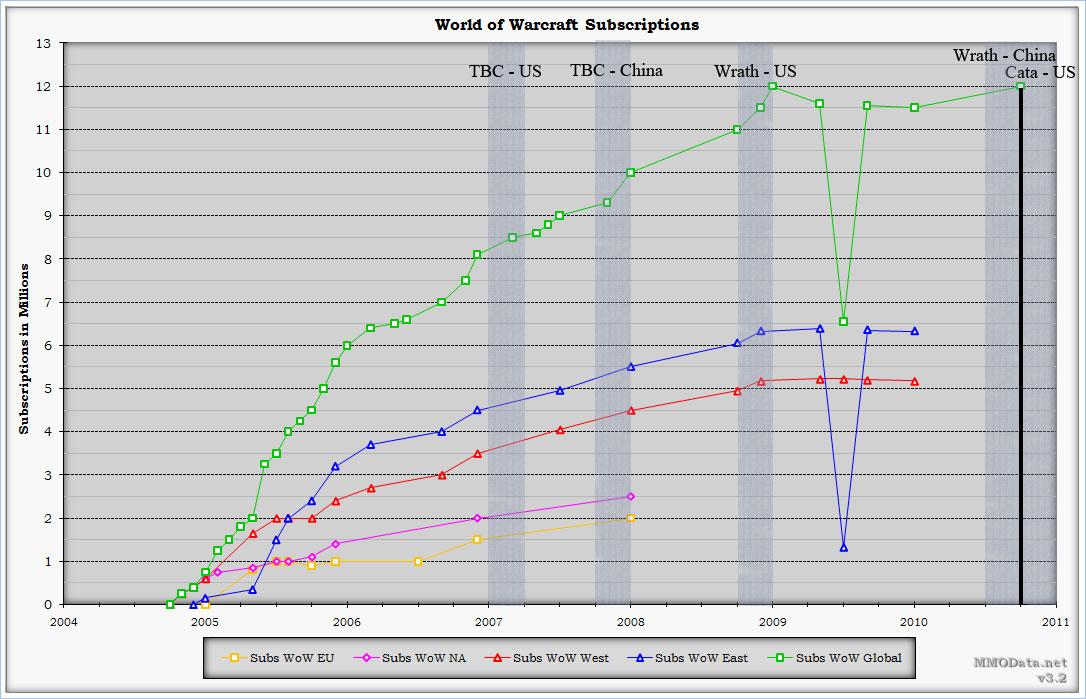
The interesting thing to note is that the total subscription numbers (the green line) is actually above 8 million before the release of TBC. China did not get TBC until the end of 2007, so if you add that interim period (the blue line) to the whole, we get WoW’s vanilla population at 8.75 million.
I believe this factoid is important because that 8.75 million segment can be considered the Baby Boomers of WoW. Indeed, between 2006 and 2007 the sub population grew from 6 million to 8 million – churn notwithstanding, it is possible that 6 million subs aged for an entire year. Compare that with 2005 to 2006, where less than a million subs could be said to be one year old by the end. In other words, starting in 2006 the volume of veteran players more than likely outpaced new players.
Premise 1 + 2 + 3 + Factoid = The decline of WoW was/is inevitable.
Ultimately, I wanted to stake out this argument because A) I do not see many people that do despite implicitly acknowledging it (e.g. growth is always finite), and B) good MMO design decisions tend to be indistinguishable from the bad when viewed through the one-dimensional prism of subscription numbers.
For example, the general (blogging) zeitgeist surrounding Wrath of the Lich King was that it killed the goose that laid the golden eggs. What does not get separated was, say, how the questing experience was orders of magnitude better than questing in TBC (does anyone seriously disagree?), and how I feel that the episodic raiding model is a lot more honest, and better designed than a strict linear progression model. Yes, raid difficulty was poorly handled. Yes, turning heroic dungeons into 5-man daily quests burns people out (starting with TBC, mind you). None of those raiding missteps can realistically can be responsible for more than a fraction of sub losses, but that is neither here nor there.
The mechanics of what I am asserting can be visualized in the crude image below:
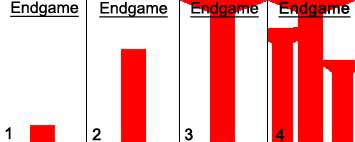
In frame 1, a player has just begun playing. In frame 2, they have carved a path through the majority of the game on their way to the level cap. In frame 3, they have reached the endgame, where most of their activities involve repeated content such as dungeon runs, raiding, dailies, and so on. In frame 4, the player either rolls alts or otherwise backtracks in search of novel experience in the content they missed (different leveling zones, class-specific quests, the opposing faction, etc). As expansions are added, the frames get taller… but not by much. Whereas the original leveling experience might have taken 300 hours, leveling in an expansion takes a fraction of that. If an expansion is released when you are in frame 2 or 3, that is fine. But if you are in frame 4… the end is (already) near.
So, in summation, WoW would have inevitably declined no matter what Blizzard did. That the decline “began” during Wrath is largely an irrelevant coincidence compared to the Baby Boomer population wave reaching the natural end of their novel experiences. The Baby Boomer hypothesis can be falsified should we ever get average age of account statistics or character maps of activity, but it would not affect the soundness of the underlying argument either way. Raid design decisions are unlikely to have anything but marginal effects on subscriptions compared with what the bulk of players are doing – which we know to be not raiding. And I believe that a lot of better game design could be achieved if we spent less time fixating on a drawn-out, endgame experience.
The deserved popularity of WoW proper came from the strength of its IP narrative, its pacing, its humor, the vastness of its game world, the underlying character of each of its zones, the uniqueness of its classes and how each demonstratively created their own novel experience. We should not take its declining subscription rates as anything more than the natural decline of an otherwise well-lived life. Here is to hoping that Blizzard opts for hospice care instead of the intensive life support that is currently in vogue.
If not… well, here is a raised glass to Diablo 3 and Titan.
¹ WoWProgress says 64,642 guilds have killed Magmaw as of the time of this writing. Assuming 18 raiders per guild (charitable considering 10-man raiding is vastly more popular), that means 1,163,556 players. WoWProgress only tracks NA/EU/KR/TW guilds, which number ~6.5 million. Ergo, 17.9%.
² You can probably argue that exploration equates to “learning the rules.”
Saturation
There is a fascinating quote from WoW’s Tom Chilton in this IGN interview that, I believe, conclusively discredits the notion that Wrath of the Lich King (or really any expansion) was somehow responsible for the stagnation and peaking of subscriptions:
Moving forward beyond 4.3, Chilton explained the focus of the development team. “I would say that the majority of our mindshare as a team goes toward our existing player base. How do we keep them entertained and how do we keep them enjoying World of Warcraft? I don’t know if that’s necessarily the right approach as time keeps going on. If you look at, if you look at the way the population breaks down, we’re at a point in our history where there are more people that played World of Warcraft but no longer play World of Warcraft than currently play World of Warcraft. That was totally not true four or five years ago, and so in a way the demographic of the potential returning player becomes more and more important over time.”
On the one hand, some might argue that this phenomenon is not particularly noteworthy at all. If a MMO sells 100 copies and two months later only 49 are still subscribed, then more players have played that MMO and stopped than continue to play it – that does not means that there could not be another 100 potential customers who might not have known about the MMO.
The difference with WoW, of course, is one of magnitude. Depending on when Chilton looked at the population breakdown, that means WoW could have had in the neighborhood of ~24 million players overall. How much bigger can we imagine the market for a fantasy-based Warcraft IP MMO be? While we can only speculate, I think it is reasonable to assume based on Chilton’s response that the market is saturated to the point that Blizzard’s time is better spent recapturing lapsed players than it is marketing new ones. Surely they have done the market research, and if we accept them as rational businessmen, then this interview (and their actions) confirm the hypothesis of market saturation. In which case, as I argued several months ago, raid/reward philosophy shifts in Wrath of the Lich King (and Cataclysm) likely had little to nothing to do with slower subscription growth.
Beyond that, what is similarly fascinating about that interview is the very next paragraph:
“I don’t think we’ll ever be able to stop feeding the beast,” said Chilton. “It’s kind of what we call trying to keep the players entertained, you know the guys bored right now and you know what are they going to do next month? But I think that for us to continue to be successful we have to think more and more about the new players that are coming into the game now and the potential returning players. What are we doing to the game that lowers those barriers to entry?”
I suppose it could be read multiple ways, but I got the impression that going forward Blizzard’s design will be less centered on keeping existing players happy and more on enticing back former players. Obviously, things like tier sets on vendors and more accessible raids make hardcore players unhappy, but this seems a confirmation that – in true triage form – the designers would rather make you (an existing customer) unhappy if they could potentially lure back two former customers. The ideal would be that they could both make you happy and former players happy simultaneously, of course. That said, this is the first time I have come across so candid a game designer.
As a former player myself, it will be interesting to see how this shakes out.
OT: Subscription and Correlation
Did you know that ice cream makes it more likely you will drown? It’s true. When ice cream sales increase, so do the number of drowning deaths. Clearly linked! Speaking of spurious correlations…
I fully expect Rift to now follow in the footsteps of WoW, in that it will decline. Vanilla and BC days had challenging content, and it’s not a surprise that sub numbers grew. WotLK made things ‘accessible’, and surprise surprise, the response was pretty meh (sub numbers dropped in the US/EU, but were offset globally by WoW launching in new regions, hence the overall stagnation). Cata tried to play both sides of the fence, but a combo of too little too late, a gimmick of progression (hard mode rehashes rather than straight-up new content), and a one-track, insult difficulty 1-85 game did it in. With no new regions to offset things, subs are dropping.
(SynCaine in the post “Accessibility killed Rift“)
World of Warcraft’s growth rate went from a perfectly stable 2 million subscribers per year during 2006 to 2009, to zero during WotLK. This was exactly the time when Blizzard changed the character progression mechanic.
(Nils in the post “Smoke and Mirrors“)
“If developers design a game which requires too much effort from the average player for too little gain, the average players will start leaving the game. “
This is the part I strongly disagree with, and WoW’s sub history does as well. Vanilla/BC, which had a MUCH harder end-game that fewer players saw to completion, saw massive growth. WotLK/Cata, with raids being cleared by all who stepped inside, have brought decline.
(SynCaine in a comment on Tobold’s post “Syncaine on Accessibility“)
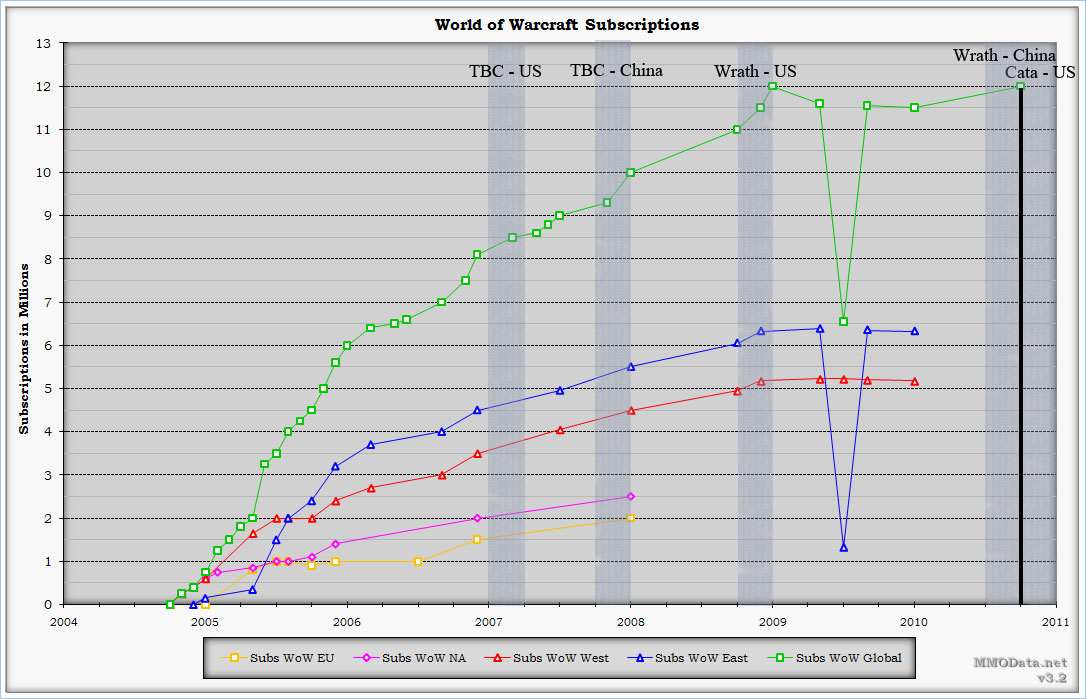
The reason I bring these examples up is because this type of thinking (or lack thereof) is what I consider one of the most pernicious, asinine fallacies in any discussion of World of Warcraft. It is intellectual laziness at best, intellectual dishonesty at worse. Before I begin in earnest however, here is a slightly augmented graph from MMOData that most people refer to when they talk about WoW subs:
1) Correlation does not mean causation.
Standard preface to any claim that X means Y. Ice cream and drowning are only “linked” because there is a third factor involved.
2) Even if correlation did mean causation, why this particular correlation?
This specific point is the reason the argument is intellectually lazy. When you look at the graph, it is true what Nils and SynCaine said about there being a relatively rapid period of growth during vanilla and TBC that was not apparent after the release of Wrath. However, tying that solely (or even partially) to accessibility/character progression/difficulty/etc is a completely unsupported leap of logic.
There is zero evidence given by either author as to why it was “existence of more challenging content” and not, I dunno, the introduction of the PvP Honor System and BGs in the summer of 2005, which coincides with a 500k sub spike in WoW-West on graph. Or the release of ZG in September of that year, also suspiciously near another 500k sub bump. Or if I looked at WoW’s overall numbers like Nils does with his “2 million per year growth” argument, perhaps I could argue Patch 1.12 with it’s wildly successful:
The stage is set for intense, objective-based land battles as Horde and Alliance vie for control over important strategic positions and resources around Azeroth. Head out for Silithus and Eastern Plaguelands to engage the enemy on the field!
…was responsible for the corresponding bump of 1 million (!) subscribers. Clearly, clearly, more things like Silithus and the old Eastern Plagueland towers is just what WoW needs.
3) What does endgame accessibility/difficulty have to do with anything?
This is another intellectually lazy part of the argument that the authors never bother to address. What percentage of the playerbase ever actually makes it to the endgame, and is this percentage big enough to even impact subscription growth? That is an open question.
The best metric that I can come up with is to look at the number of guilds who killed Beasts of Northrend in 10m ToC after two years of it being out (86,187 guilds), multiply that by something charitable like 30 players, and then divide by the approximate population in the graph above while only taking into account the regions in which WoWProgress collects data (~6.5 million). The result is 39.77% of players killing the easiest boss in the easiest tier of which we have data (something like Noth the Lootbringer from Naxx 2.0 would have been better, but alas…). That actually sounds like a lot of people, and 19.88% assuming only 15 raiders per guild is not too shabby either when referring to raid content.
That said, there is no evidence whatsoever from those two that difficulty-related gyrations amongst the top 1/3rd of players doing raiding content has a meaningful impact in comparison to whatever the remaining 2/3rd non-raiders are doing. Between 2005 and 2009 the subscriber base was growing at ~25% per year. Is it even remotely likely that the top 40% had anything to do with a meaningful drop in growth rate?
4) Growth, or lack thereof, does not really mean anything other than what it is.
What I mean by this is that you cannot simply look at growth as anything other than what it is: growth. It does not mean anything else without further information. For all the talk about growth rate percentages and “the design decisions that caused them,” look at the pink line for a moment. That represents subscriptions in NA alone. Unfortunately MMOData stopped tracking that information individually (or perhaps Blizzard stopped giving it out), but the whole of TBC resulted in ~650k more subscriptions in NA over a two-year period.
Is 325k sub growth per year more than the apparent zero sub growth in the year of Wrath? Sure… but we have no real way of knowing why that growth was occurring. Was player churn less of a factor in vanilla and TBC? Was the growth simply due to the release of WoW in additional regions? Does market saturation have any impact? Do we simply ignore, I dunno, one of the worst global recessions in world history?

Oh, wait a minute… early 2009 was when the markets were at their worst? And yet WoW subs were relatively stable in most regions during that entire year? Clearly Wrath’s accessibility and stress-free raiding were the only things stopping WoW’s overall decline in a tough market, as evidenced by Cata’s increased difficulty leading to subscription loss once markets improved. QED, amirite?
The bottom line here is that you cannot use WoW subscription numbers as evidence of a claim without first proving said numbers have anything to do with said claim. Did World of Warcraft gain six million subscriptions worldwide in its first year? Yes. Was that because of the strength of its class balance? Its risk versus reward structure? Its accessibility? No one can really say; all of it would be conjecture.
Personally, I believe the initial rush was due to the strength of the IP – I know I certainly gave WoW a shot because of how much I enjoyed Warcraft 3 – and also due to the strength of the Blizzard brand. The designers also got a lot of things down perfectly that I feel other MMO designers stumble across to this day, such as letting characters jump, making solo-play possible, having quests with interesting plots, getting the reward faucet just right while questing, and so on. The tone and tenor of game balance has certainly shifted quite a bit from when I began in TBC, but where I disagree with Nils and SynCaine is that I feel that Wrath was actually a step in a better direction in most (not all) ways. Unfortunately, until the duo, and others who believe as they do, let go of the absurd notion that “the numbers” support their conclusions, it is impossible to have any rational discussion about it.
There is a separate argument as to linear raid progression vs episodic progression, but that is an OT for another time.
OT: What Players Actually Want
If you come across anyone on any forum related to WoW exclaiming that Blizzard is nerfing content “because of the (baddies/Wrath babies/etc) whining on the forum,” you can correctly call them morons. This quote from Bashiok officially dispels such nonsense for what it is.
Blizzard, you do how little people post on the forums yes? how about doing some in game polls to really see what people want, and not what the idiots on the forums want
You want them to not be nerfed, you’re on the forums…
Just saying.
By looking at actual stats, actual progression, time spent playing, where, and to what extent, we can see that most people are looking for more accessible raid content, so yes, we absolutely are able to tell without a doubt that the plan we’re enacting is actually what players playing the game want and need, and are not just listening to people on the forums.
No reading between the lines is necessary, but let me emphasize this again for posterity:
By looking at actual stats, actual progression, time spent playing, where, and to what extent, we can see that most people are looking for more accessible raid content, so yes, we absolutely are able to tell without a doubt that the plan we’re enacting is actually what players playing the game want and need, and are not just listening to people on the forums.
“Want and need.” Blizzard’s words. I sketched the writing on the walls way back in March, and nothing has changed since that time… well, other than even more players leaving for lack of content tailored to their skill level. That is why Morhaime’s investor call comments are so thinly-veiled:
As our players have become more experienced playing World of Warcraft over the many years, they have become much better and much faster at consuming content. And so I think with Cataclysm, they were able to consume the content faster than with previous expansions.
As of this writing, WoWProgress states 55,797 guilds have killed Magmaw, among the NA, EU, KR, and TW population it tracks. Looking at MMOData’s WoW sub numbers, there are ~6.5 million non-Chinese accounts. The average raiding guild probably has 15 members killing bosses (most WoWProgress kills are from 10m), but let us also be charitable and also use 30 member guilds. Plugging in those numbers results in this:
55,797 * 15 / 6,500,000 =12.87%
55,797 * 30 / 6,500.000 = 25.75%
Cataclysm has been out for 6+ months and at best ~26% of the population has downed a single raid boss. The comparison is not entirely fair since not everyone is even interested in endgame raiding. Then again, I do consider it a fair question to ask how many of the 74% would be interested in raiding if things were not being designed around catering to hardcore players and/or being difficult out of principal. Only Blizzard knows for sure, but the answer appears to be “enough to matter.”
 In An Age
Closer Look: Blizzard’s Q4 2011
Feb 10
Posted by Azuriel
When we last left our intrepid heroes in Q3 2011, WoW had lost 800,000 subscriptions and the following four salient points were made in the earnings call:
I suppose the holiday box sale and Annual Pass count as aggressive marketing, but let me not get ahead of myself. If you want to read along from home, Seeking Alpha will hook you up.
1. Is Bungie not working on Titan?
Eric Hirshberg from Activision Publishing buried this gem 25 paragraphs into vapid gushing of COD and Skylanders:
Looking further out, we continue to lay the foundation for our new universe from Bungie, one of the world’s best developers. Bungie continues to make incredible progress on what we expect to be a genre-defining new IP that will provide us with tremendous new opportunities and which remains one of our key strategic growth pillars for the future.
This may or may not seem a non sequitur, but I have always entertained the notion that the Bungie acquisition might have had something to do with Blizzard’s Titan development. Why?
Let’s look at the entrails. First, both Joe Staten and Rob Pardo have been playing it coy as recently as 2 years ago about Bungie working with Blizzard. But we also know that Bungie’s secret project “Destiny,” is slated as a sci-fi MMOFPS that is, quote, “WoW in space.” If you have a tinfoil hat handy, things can get even more bizarre when you consider that Ensemble Studios was working on a Halo MMO to directly compete with Blizzard… that was code-named Titan. And when Ensemble Studios was disbanded, several ex-members joined Blizzard. And now Bungie is here with a 10-year contract, making a brand new MMOFPS IP to be a “strategic growth pillar” for Activision Blizzard at the same time Blizzard is making a “casual” new-IP MMO that isn’t supposed to compete with WoW… that is code-named Titan.
Technically a lot of this is old news, and the earnings call did not reveal anything new either way. But in reading that paragraph under the Activision Publisher heading, it occurs to me that it is entirely possible that we could see two new, separate MMO properties out of Activision Blizzard even with WoW still sucking most of the oxygen out of the MMO room. In some respects, that outcome is crazier than Titan turning out to be a Blizzard-Bungie joint MMO.
2. Around 1 million Annual Passes sold… in the West.
Another initiative that has been very successful is the World of Warcraft Annual Pass. This program was announced at BlizzCon this past year. Under its terms, players who commit to being a World of Warcraft subscriber for 1 year will get a free copy of Diablo III, unique digital items in World of Warcraft, and other benefits. To date, we have signed up more than 1 million players in the West for the World of Warcraft Annual Pass.
The more I think about that number, the crazier it ends up being. While the Annual Pass appears to be non-binding (your access to D3 will simply go away), can you otherwise imagine another MMO who can count on 1,000,000 Western subscription accounts being locked in for 12 months? That would make SWTOR automatically profitable for an entire year.
3. Mists of Pandaria information out on March 19.
Some of you may have seen recent news about the upcoming World of Warcraft expansion, Mists of Pandaria. Last week, we began inviting global press to visit our office to get a hands-on look at the game. The press visit will take place next month, and our players will be able to read the latest news on the game on March 19. We’re looking forward to showcasing the game to our community and collecting more feedback as we prepare for the upcoming beta for Mists of Pandaria.
By the way, that means there is an automatic 1 million beta-testers for Mists, yeah?
4. Chuck Norris was super effective!
Neil A. Doshi – Citigroup Inc, Research Division
Mike, I was wondering if you could provide us a little more detail around the subs for World of Warcraft. What was the impact from some of your marketing efforts? And then how many subs did you add from Brazil? And if you have any comments on trend that you could share with us, that would be great.
Michael Morhaime
Okay. So we were very pleased with the results of the marketing initiatives in Q4. The Chuck Norris spot was very effective. We’ve got over 29 million views of the spot on YouTube. And I think, just looking at how well the subscribership held up during our most competitive quarter ever, we’re very happy with that. Engagement of the player base is very strong. We do not break down regional. We do not provide regional breakdown of subs, but we’re off to a good start in Brazil. And I don’t have any detail on churn.
Nothing to add to that.
As reported everywhere, WoW did implicitly lose another 100,000 subs in the quarter. There have been a lot of “See? Not dying!” posts over in the MMO-Champ and WoW Insider comments, but it’s worth pointing out that A) if someone unsubbed for SWTOR, then they won’t count as “missing” until January, e.g. Q1, and B) WoW launched in Brazil this quarter, as noted above. There are several more high-profile MMO launches coming this year, and let’s not forget that everyone is stuck with Dragon Soul until Mists actually launches… which could be six months from now, or more.
In any event, sub numbers really only matter to me in the context of having objective data by which we can interpret future design philosophy, and MMO player desires by extension. If Blizzard’s reaction to losing 1.8 million subs is to make the game easier, then we can assume that they believe a hard game is why people left.
It’s crude, it’s imperfect, but it is all we really have as armchair game designers.
Posted in Commentary, WoW
9 Comments
Tags: Activision, Blizzard, Bungie, Earnings Call, Mists of Pandaria, Morhaime, Subscription, Titan