Blog Archives
Once More, With Feeling
Allow me to revise my previous post a bit. The fundamental question I was asking was:
“Is it a good use of designer resources to specifically construct one-time events (in MMOs)?”
The traditional sort of knee-jerk response would probably be “Yes.” My answer is No.
A one-time event is essentially the most extreme example of planned obsolescence in MMOs. If you get upset at the idea that nobody does Tier N content when Tier N+1 is released, then you should be grabbing pitchforks at the very mention of one-time events. Were you upset when ToC made Ulduar irrelevant? Were you sad when Cataclysm redesigned the entire leveling experience, including removing your favorite quests? Do you support attunements as a means to make all raids relevant through the duration of an expansion? Are you sad about how fast leveling has gotten in WoW, or how many dungeons are being “wasted?” If you answered Yes to any of those questions and yet still enjoy the idea of the AQ gate opening just the one time ever, then you have some serious cognitive dissonance going on.
A raid being rendered moot by the next patch’s 5m heroics is just another form of planned obsolescence; it is another form of one-time events, same as the leveling speed changing, dungeons becoming empty, and so on. The only difference is one of duration, e.g. months/years versus an hour on a Sunday afternoon.
There is, however, an important distinction to make here.
When ToC made Ulduar irrelevant, Ulduar still existed. In fact, you can still zone into Ulduar today and go have fun. Will it be the same experience as it was when it was the new hotness? Of course not – you can never cross the same river twice. The difficulty changed quite a bit following the months of its release, to say nothing of the changing abilities of players, the higher level cap, and so on. But fundamentally the place is still there and still capable of generating new memories. The planned obsolescence was social in nature, not structural. Blizzard did not simply remove the raid portal, or leave all the bosses dead. Few people wanted to do Ulduar after ToC was released because better gear was available elsewhere, they had gotten their fill of Ulduar content, they wanted to tackle new challenges, or whatever.
This brings me to a smaller point I was trying to make yesterday: social obsolescence happens naturally, automatically, and inevitably. If ToC was released with just sidegrades available, there still would have been fewer people raiding Ulduar; the exodus might not have been as abrupt, but it still would have occurred. Even in horizontal-progression games, you do not see an evenly distributed population. People generally crave novelty, and will mob whatever new content is introduced, leaving barren ghost towns in their wake. Nobody cares that you have got the Kingslayer title yesterday.
And so now we have arrived at my larger assertion: making events only occur once adds little to nothing to the experience.
Liore and Syl in the previous comments said that the AQ opening would have been less epic/less people would have showed up if it were repeatable. Based on what? Did those people know, for sure, that the gong would never be struck again? Would the significance of the first opening have been diminished in any real way if the event was available the very next year? Or weeks later? I have a hard time believing that could be the case, because Firsts are always special. Neil Armstrong is the first human to step on the moon; his accomplishment is in no way diminished by the fact eleven other dudes have also stepped on the moon. Have you heard of Eugene Cernan or Harrison Schmitt? Those are the last two people to have rung the gong on the moon, so to speak, but no one really cares. Neil still is/was the man.
Ultimately, to me, it comes down to a question of where best to utilize limited designer resources. When new raids and dungeons are released, there is always a special moment attached to it. A camaraderie that exists as thousands and thousands of players try something for the first time, race to the top, and otherwise share an experience. Undoubtedly that is the same goal of one-time events, to evoke those same feelings and perhaps pretend that this is a game world that is always changing (at 12:00 PM Pacific Time/19:00 GMT this Sunday only). The difference is that with the latter, the content is thereafter removed, generating no new experiences, no new memories, and no lasting history beyond the recollections of an ever-dwindling veteran playerbase.
I want game worlds to get bigger by having more things in them, not less, and not temporary things. Designers should stick with making the tools and toys; let the players bring the dynamic themselves.
And if you need something to only happen once to enjoy it the most, 1) I feel bad for you, and 2) the first time only happens once already. Enjoy the feeling as it lasts… don’t just take the ball and go home.
Systemic Concerns About the GW2 Economy
It may seem a bit premature to wonder about the Guild Wars 2 economy, considering the game has only be out for a week or so. But a comment by Chris K over on Syncaine’s GW2 Review post got me thinking about whether the game’s structure makes the economy unlikely to ever “recover” from its current bizzaro state:
“The trend [of crafting being pointless] will not persist. Currently people are levelling crafting only for the xp gains. It is, essentially, buying levels with gold. When the majority of these people hit the level cap then you’ll start seeing a decent economy forming.
At least I hope so…”
I have reported before that the GW2 devs made it a point of pride that the crafting system alone can get you to level 80, assuming you feed an alt enough mats. But Chris makes an astute observation that crafting, even when the market is vendor+1c, has a point: easy, scaled XP gains.
So think about it. Going 1-400 in one profession will net you 10 levels of XP at increasingly large costs (primarily in vendor mats, but also karma recipes, etc). Or you could simply go 1-40 (etc) in all eight crafting professions and net 8 levels’ worth of XP much more easily. Why wouldn’t you do this on all your alts? Or your main for that matter, considering that you continue earning Skill points for “leveling” past 80 to spend as Mystic Forge currency.
Changing crafting professions to a new one is a completely painless process with no upfront costs, and all your progress in a dropped profession is saved. Switching back to even a 400-level profession only sets you back 40s – not a completely trivial amount at current gem exchange rates, but way less than I expected. There are no profession bonuses that I know of, and even if there are BoP gear recipes, the lack of gear progression at endgame makes it a mostly moot point.
All of this + the global Trading Post + the existence of Buy/Sell Orders makes me think it unlikely that the Guild Wars 2 economy will ever meaningfully mature from its current state. I have every incentive to start all eight crafting professions on all five of my character slots, and so does everyone else. Doing exactly that will continue to put huge Demand pressure on low-level mats, even if gold inflation raises prices across the board. I can maybe see higher level gear selling for more than vendor+1c once fewer people are leveling crafting past 125 (etc), but the moment it does there will be ten thousand wannabe goblins squeezing into the margins.
Not that I am particularly complaining about the ease in which I can finance cash shop purchases here. I just think ArenaNet really screwed up in the incentive department, on the same level and scale as Blizzard did with Diablo 3. I never thought I would look back on WoW’s discrete Auction House markets and extreme Profession-hopping disincentives with nostalgia, but here we are.
If there is ever a Crafting system failure metric, the “vendor+1c” phenomenon is it.
Collective Individualists, or Individual Collectivists
I usually do not participate in theme weeks, but Stubborn’s recent Individualist vs Collectivist post struck a chord. A discordant one.
But first, as always, we have to define the terms of the debate. Throughout Stubborn’s post, for example, he seems to be using “grouping” as interchangeable with Collectivism. While grouping is certainly something Collectivists do, that is like calling me a Landscape Artist when I mow the lawn. The intention matters.
But rather than get too philosophical about it, I have an easy quiz you can take to determine whether you are a Collectivist, or at least have Collectivist tendencies. Have you ever felt:
- Shame, or
- Guilt, or
- A sense of obligation
…to do or refrain from doing some action in an MMO? If you answered “yes,” congratulations comrade, you are a Collectivist!
I knew the precise moment my WoW days became numbered: six weeks after having killed the Lich King in ICC. There I was, logging on at 9pm sharp, trying to drum up support for yet another ICC run that I did not want participate in, let alone tank and raid lead. So why did I do it? Because I knew that 4-5 of my guild mates wanted to do it, that if I did not personally pull the group together the raid would not form, and that each raid which failed to form would drive said guild mates further and further away (into other guilds, or simply away period). Collectivism is about putting the needs of the Collective ahead of your own. You sacrifice your own enjoyment for the benefit of the whole, because the guild/group/corp/etc is intrinsically linked to your own enjoyment.
Contrast the above with Stubborn’s assertion that Diablo 3 ranks highly on the (arbitrary) Collectivist scale:
D3 gets the most collectivist score because it has no add-ons, heavily emphasizes grouping at harder difficulties, and has individual loot. I’d give it a 5, but I have hopes for more collectivist MMOs to come around, and besides, it stinks.
Do you care about the other people you group with in Diablo 3 beyond their potential function as loot efficiency creators? Do you feel guilt for leaving such a group, or a sense of obligation to stay, or shame when you “fail” them? Probably not.
But… maybe you do. In which case, this debate becomes even more abstract as we are awkwardly forced into quantifying how much a game may or may not encourage Collectivist tendencies in players. Is the game anti-Collectivist, or are the players simply pro-Individualists (read: rational entertainment consumers)?
Here is how I see it: Collectivism is something you bring into the game from the outside.
A game can force you to group with other people in order to play, but whether you identify with that group is 100% up to you. Everyone readily agrees that WoW’s random LFD groups are five individuals looking for loot, but Trade Chat groups were not the opposite by default. Did I have a higher tolerance for failure back in TBC? Yes… because if I did not carry that terrible player through heroic Shadow Labs, it meant I was playing zero dungeons tonight. Walking that player through detailed text explanations of each boss encounter was necessary like wearing a shield and pressing Consecration was necessary – in both cases I was simply pressing buttons, not connecting to another human being.
Perhaps I should just quote Samus, who needs nominated for Best Metaphor of the Year:
Any social element is IN SPITE OF the design of these games. You are sitting in a room with all the chairs facing the wall, praising the room for the great conversation you still managed to have.
Having said all that, I can still agree with Syl vis-a-vis being glad that MMOs like Guild Wars 2 are moving towards “bonus instead of malus” incentives for grouping. If I wanted to be social (the most important step!), many MMOs would make being social difficult; simple things like penalizing group XP, throwing quest barriers up, and placing people in awkward Mineral Rights scenarios (“You take the Copper node.” “No, you!”). These days, I would also include general looting rights, even in raiding. While loot system is traditionally the backbone of a raiding guild’s identity – Loot Council vs DKP vs Main spec > Off spec rolls, etc – it can also be divisive. I might like playing with Bob, but if he is in a guild with Loot Council… well, we can no longer be friends raid together.
Ironically, in a certain light, relaxing these grouping barriers actually seems to make games more Individualistic. And it does. Everyone says LFD is the most Individualistic, community-destroying feature ever… and then praise GW2’s auto-grouping, auto-scaling, individual looting, no-words-necessary Dynamic Events in the same breath¹. And the multiple guilds thing, which is great, but sort of undermines the whole guild loyalty/identity thing though, right? Maybe, maybe not.
I feel like this is one of those rare situations in which the otherwise terrible relationship cliche of “set the bird free, and if it comes back, it was meant to be” is applicable. After all, even a sociopath can fake relationships long enough to get the loot, so to speak. A Collectivist cares about the Collective, and will return even if they are not penalized for leaving. A closet Individualist on the other hand… well, they need the handcuffs in spite of themselves.
Of course, the thoroughly legitimate fear is that there ain’t that many Collectivists after all. And I am inclined to agree. So it is simply up to you to decide whether or not the chance of fake becoming real via going through the motions is worth all the cognitive dissonance and hand-waving.
I say open up that cage and let’s see what happens.
¹ LFD might be worse for basically never grouping the same people together again, but simply seeing the same few dudes in Events multiple times is not all that more social by itself. It is the difference between paying for gas at the pump and paying the cashier inside.
That Panda Trailer
Why must you make it so difficult?
From a technical perspective, the Mists of Pandaria trailer was good. I even laughed when the human handed the orc the spear. But like Rohan, I was left confused as to its purpose. The Pandaren are not a third faction, and all the Pandaren that would be joining the Alliance or Horde are obviously not fighting for “harmony.” I am already sold on the idea of the expansion and the lack of a unifying, spotlight villain. But this trailer… does not excite me in any way.
Just take a few minutes and watch the original WoW trailer again:
I have not watched that in 3+ years and I still got chills from it. Same with the TBC trailer, especially with the WotLK cinematic, and… well, it is still kinda cool how the Cataclysm trailer presented the whole “welding plates on a dragon” thing, even though I cared not for Deathwing himself.
I dunno. As mentioned before, I have nothing against pandas, Pet Combat systems, or anything that comes across as overtly “childish.” I mean, c’mon: gnomes.
But I am also acutely aware that MoP is going to be fighting an image battle for its entire duration, regardless of the merits of the actual game itself. And more to the point, people playing MoP are going to be the ones fighting that image battle alone, if this cinematic trailer is any indication. This expansion is going to be filled with bloody, Horde vs Alliance massacres and betrayals, and Blizzard reinforces the stereotypes at the tips of everyone’s tongues the moment they hear the words “panda” and “monk.”
This is either going to be a long two years, or a short one.
Where Are All the Bodies?
WoW subscriber losses since Q1 2011: 2,900,000.
SWTOR subscriber losses since Q1 2012: ~700,001.
Aion subscriber losses since 2011: ~600,000¹.
RIFT subscriber losses since 2011: 350,000¹.
LoTRO subscriber losses since 2011: 300,000¹.
EVE subscriber losses since Q2 2011: ~20,000¹.
Where are all the bodies?
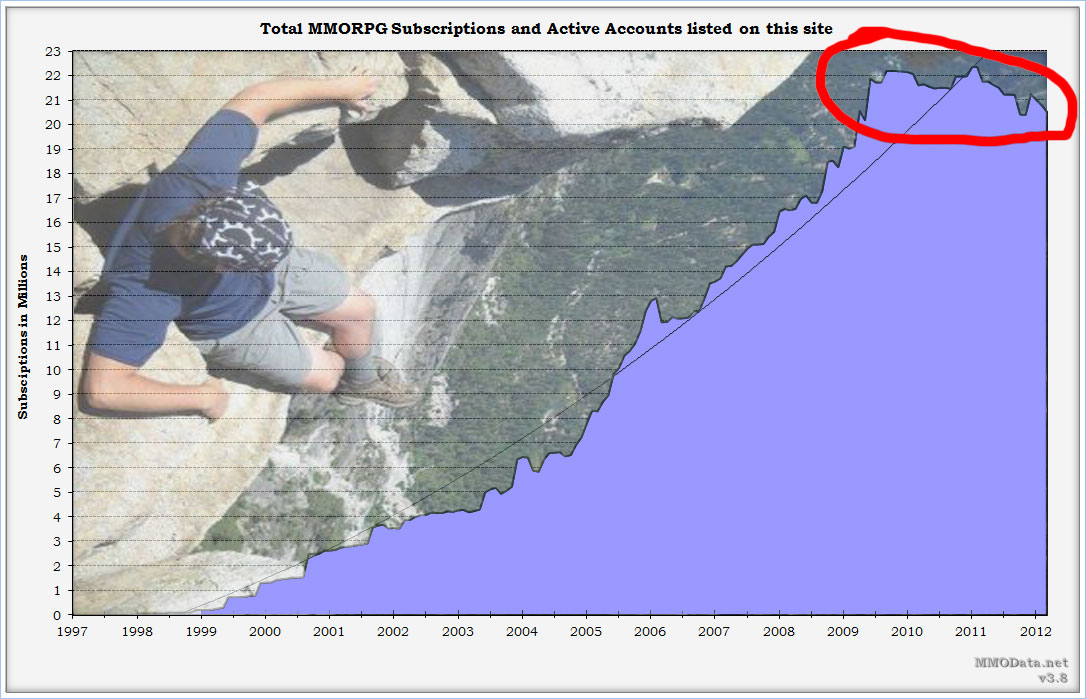
Talk about fiscal cliffs…
It is seductively easy to imagine the MMO landscape as a zero-sum, closed universe. One developer’s bone-headed design mistake is another MMO’s gain. “Guild Wars 2 is going to nail the coffin shut on SWTOR/steal another million from WoW.” But it is fact that there are less people playing “traditional” MMOs today than there were in mid-2009. And there were fewer game options back then!
The graph up there is somewhat misleading in two ways. It does not represent the entire MMO market (browser-based games, etc), so it is entirely possible that in the journalistic sense the “MMO” market is doing perfectly fine. But it is misleading in the other direction too: do you really care how Second Life and Dofus and Asian MMOs are doing? There are a lot of games you will never play and/or people you cannot possibly play with that are propping up those numbers. The Truth™ is liable to paint a much bleaker picture.
I think we may need to start entertaining the notion that the entire genre – as we know it – has peaked. Not just the hot topic of F2P vs Subs, but the whole damn shebang. Classical arguments like “WoW lost subs because grinds/attunements/etc are good” become embarrassingly moot (if they were not already). Where are the bodies?
Whoever is leaving does not appear to be coming back for a second date, or even meeting new people; they have simply vanished back into the ether. Speculation on the whys seems moot as well, because there is zero indication the ex-pats transition anywhere else. Rather than go to the alternative MMOs that offer grinding/feature no grinding, they simply go away.
On a tangentially related subject, yesterday was my one-year WoW anti-anniversary:
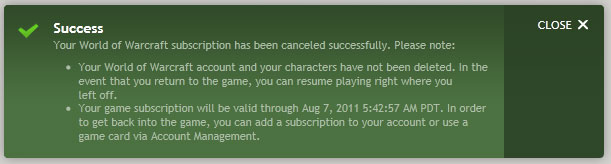
A year ago yesterday I was doing Firelands dailies.
So… we have located at least one body. A body with an extra $179.88 in its pocket at that.
Where are the rest?
¹ Based on eyeballing this chart, which hasn’t been updated in a while.
WoW Loses Another Million+ Subs
That is right, kiddos, WoW is down to 9.1 million. It hasn’t been this low since January 2008.
In what must only be completely unrelated news, WoW has shattered all previous records for “longest time without a new content patch.” No, seriously. Dragon Soul was released November 29th, 2011. It is now eight months later. When I relayed this to my friend, he didn’t believe me. The gap between ICC and Cataclysm felt like more than a year. Well, I said, let’s look at the timeline:
- December 8th, 2009 – ICC released.
- February 2nd, 2010 – final wing of ICC opened.
- June 30th, 2010 – Ruby Sanctum released.
- September 7th, 2010 – the gnome/troll world events start.
- October 7th, 2010 – WoW hits 12 million players (!).
- October 12th, 2010 – Patch 4.0.1, with all the new talents/class changes.
- November 23rd, 2010 – The Shattering, all new 1-60 experience.
- December 7th, 2010 – Cataclysm launch.
So, yes, in a strictly literal sense it was a whole year between ICC release and Cataclysm launch. Looking at that list though, shit happened. There was a filler raid, there were world events, and I always have a blast when we get to toy around with the next expansion’s talent changes early. In between TBC and the Wrath launch, I remember soloing most of heroic Underbog on my Ret paladin to cap out my Sporeggar reputation, for example.
Now look at Cataclysm:
- November 29th, 2011 – Dragon Soul released.
- …
- …
- August 3rd, 2012 – I wrote a blog post.
I mean, come on. A $300 million MMO was released, floundered, and went F2P in that same timeframe!
Only Blizzard gets away with this shit. Good lord.
Blue Balls
I debated titling this “Diablo’s Blue Balls,” but [spoiler] Diablo doesn’t have balls.
To the ongoing amazement of all (including myself), I have continued to play Diablo 3. You know, the game that I quit twice? In fairness, “playing” consists of 40-60 minute circuits of Act 1 Inferno with 177% Magic Find as I farm random items to sell on the AH for gold to purchase actual items, so that some semblance of progression can be squeezed from the rock that is Act 3 Inferno.
After three days of putting off another progression attempt like one does a dental appointment or a particularly difficult bowel movement, I finally sat on the chair and grit my teeth while awaiting the verdict. It was worse than I imagined. The “awesome” 1.5 million gold weapon I purchased actually decreased my DPS and survivability. In a panic, I scoured the AH for other upgrades… upgrades which helped in the sense of elongating the amount of time it took my face to collapse from the champion pack curb-stomp.
Up until now, I have been treating Diablo 3 as I treated daily quests in WoW: a not entirely joyless task in service of the greater goal of progression. The allure of rare items netting real money certainly added spice to the stew, but the endpoint always was taking down the titular Diablo on Inferno. As has become increasingly clear, that goal is no longer entirely reasonable.
Mike Morhaime has some words to say about Diablo 3 at this two-month mark, although you have to swim through six paragraphs of PR bullshit to find any:
You’ve seen some of that work already in patch 1.0.3, and you’ll see additional improvements with patch 1.0.4. On the game balance front, this update will contain changes designed to further deliver on the team’s goal of promoting “build diversity,” with buffs to many rarely used, underpowered class abilities. Another topic we’ve seen actively discussed is the fact that better, more distinct Legendary items are needed. We agree. Patch 1.0.4 will also include new and improved Legendary items that are more interesting, more powerful, and more epic in ways you probably won’t be expecting.
[…] On the flipside, we are also committed to ensuring you have a great experience with Diablo III without feeling like the auction house is mandatory, which was never our intention. Thank you for all the feedback about that.
[…] We’re also working on a gameplay system that will provide players who have max-level, high-powered characters new goals to strive for as an alternative to the “item hunt.” We’re not ready to get into specifics just yet, but I can say that we’re actively taking your feedback into account as we plan out the future of the game.
After thoroughly washing my hands, what I got from all that was: nothing.
To suggest that the designers never intended the AH to be mandatory is simply ludicrous. I do not mean that in a “greedy corporation cash shop” sense, I mean that in a “did these morons ever do any projection analysis of what the hardest difficulties require in their own goddamn game” sense. It matters not that a pro player can cheaply gear themselves well enough to go through Act 2 when all that budget gear came from other players. Was the design really that a player would spend 2+ months farming an Act for upgrades to progress to the next one when that is eight times as long as it took to get there in the first place? And, please, spare me the Diablo 2 anecdotes unless it involves the necessity of specific gear to finish the final boss.
…that is kind of the rub though, right?
As a player, I want both the fun to never end and the satisfaction of a completed experience. Meanwhile, the designers of MMOs and cash shop games want to delay the gratification for as long as possible while still retaining player interest. If the tacit tension between both parties is maintained successfully, both profit. After all, a game that abruptly ends before the player wants it to is just as bad as an unfinished game drained down to the curdled dregs at the bottom of an otherwise bone-dry barrel of fun.
…except that is wrong. The latter is worse than the former, and you do not even really need balls to appreciate that fact. Simply examine every unsatisfying ending to any game you have played – the one quality they will all have in common is lack of closure. Of release.
If Inferno was easier, there is little doubt that I would have completed it and shelved Diablo weeks ago. Many could argue that Blizzard was doing me a favor by setting forth this Sisyphean task, as those are (presumably) weeks of fun I would not have otherwise had. But that is not what happens. What happens is I sit here, without even the satisfaction of a logical endpoint, miserably looking back on those weeks of “fun” with a jaundiced eye and two blue balls.
And what I see is time spent playing Diablo 3 when I could have had more fun playing damn near anything else.
 In An Age
Badass
Oct 22
Posted by Azuriel
I have been playing Borderlands 2 quite a bit lately.
At one point, I had a mission to rescue a dude at the top of this dam. I fought my way through several rooms, saw some interesting stuff, solved some pseudo-puzzles, killed all the things. As I bust out of the final door onto the dam proper, everything goes to hell: the orbiting space station starts launching artillery shells, armed robots start landing, bullets start flying everywhere in this now-three-way battle royale. I take down a few more enemies with my corrosive sniper rifle, and then crouch behind some cover while I reload.
Then this music started playing.
I emerge from cover while tossing a holographic decoy out, stealthing to the first robot and meleeing it in the goddamn face. As robotic limbs fly everywhere, I switch to a ridiculously large shotgun, aim, and fire at a second robot. The shotgun shoots 17 pellets that each individually explode on contact, and firing it sounds like God slamming a car door shut.
Whump. Chik-Chik. Whump. Chik-Chik.
As I stroll down the middle of the ramparts like I own the place (and I do), I am suffused with a feeling of Badass. This whole sequence is staged, minus the explosive shotgun; the designers specifically put this music, with these enemies, in this order. It is the definition of themepark content, as single-player games are wont to be. But that doesn’t matter. I had been having fun before, but this was on its own elevated level. And after the sequence is over and I move on to the next (decidedly less cool) quest it occurs to me to ask: when was the last time I felt this way while playing a game?
I had to go back, waaaay back to my guild’s first Mimiron kill¹ in WoW. Like I said, I have had fun in plenty of games in the past three years. I have done some crazy moves in Deus Ex, there are some epic moments in the Mass Effect trilogy, and double-dagger Elementalist in GW2 was great fun originally. But the specific feeling I had owning faces up on Bloodshot Ramparts? Very fleeting, very rare, but much appreciated.
If you guys have experienced something similar in a game lately, feel free to share below.
¹ Please excuse the editing and the decidedly non-epic music accompaniment. 2009 was a long time ago.
Posted in Commentary
4 Comments
Tags: Badass, Bloodshot Ramparts, Borderlands 2, Cool, Deus Ex: Human Revolution, Guild Wars 2, Mass Effect, Mimiron, Themepark, WoW