Monthly Archives: January 2019
Meaningful Experiences
I was browsing Kotaku the other day, and a paragraph struck me:
Nobody ever asks why anyone stopped playing Halo 2. No response would merit it. The game came out in 2004, and three years later, there was Halo 3. At some point, it got old. Another game came along. Friends moved on. It was just a thing you did, and then you went and did something else.
This is something I struggle with, internally. Not Halo 2, but with the general concept.
I used to play a lot of Counter-Strike back in the day. So much so that I was extremely bitter when version 1.6 came out and changed the way a lot of the guns fired (1.5 for life). I transitioned into Warcraft 3-modded Counter-Strike servers – Night Elves went invisible when they stopped moving, Undead had low-gravity and regain health when dealing damage, etc – before finally moving on entirely to Battlefield 2. I played that damn near daily for like four years. Then Magic Online for a while, then World of Warcraft for a decade.
Looking back, what can I even say about any of those decades of gaming?
“I had fun playing Counter-Strike.” Maybe someone else can say “me too,” and then commiserate about X or Y change in the intervening years. But that’s it. We can’t really share our experiences in any further detail – you had to be there in that moment, else it’s just a vague sentiment, if one tries to communicate the feeling at all. WoW is different in the sense that I eventually met my guildmates in the real world – and invited each other to our weddings – but I can’t imagine meaningfully talking with some random WoW player on the street.
Contrast that with, say, any of the Final Fantasy games. Or Silent Hill. Or really any single-player, narrative experience. If someone says their favorite game is Xenogears, I could meaningfully talk with them for hours. We could discuss our favorite team compositions, how shocked we were about X revelation, how funny the mistranlations were, and so on. That means something in a way that “This one time on de_dust…” does not. We played the same game, but had different experiences.
At the same time, I don’t want to denigrate other peoples’ experiences. I wouldn’t suggest that someone hiking in the woods or fishing is wasting their time, despite those discreet events being equally ephemeral and unrelatable. There are people who simply enjoy wandering around virtual worlds, like there are people wandering around the real world. If that’s what you like, keep doing it.
I worry about myself though. I started Hellblade: Senua’s Sacrifice the other day, and enjoyed the play session. After that, it’s been days and days of Slay the Spire (Ascension 12 with the Silent) and 7 Days to Die. The latter is especially egregious, considering it is in an unfinished Alpha state. Why not put it down and go back to Hellblade, which is – by all accounts – a much deeper experience? Because, in that moment, these other (potentially vapid) experiences are 5% more pleasurable.
“If you’re having fun, what does it matter?” Well… wirehead. Also, having fun, in of itself, is not relatable. Which, I suppose, belies an underlying desire of mine to be relatable or at least capable of conveying relatable experiences. Even if there were people who wanted to read “I had fun playing videogames today,” I wouldn’t want to write just that. There should be something more.
I dunno. It would be one thing if the dilemma was between playing videogames and completing some meaningful task IRL. It’s not. There is nothing more #firstworldproblems than angst surrounding which two leisure activities provides the most long-term utility. Nevertheless, the worry exists, alongside a deeper one as to whether wirehead experiences have increased my fun tolerance beyond the reach of narrative games altogether. Or perhaps I am simply playing the wrong narrative games.
Quick & Dirty Guide to Starbound (Frackin’ Universe)
Frackin’s Universe (FU) is a Steam Workshop mod that revitalizes (and complicates) the entire Starbound experience. It is not recommended for a first playthrough – go beat the base, vanilla game first. Then, just when you think you’ve had enough, come back, load the mod, and play what feels like Starbound 2.0.

Beyond FU itself, I highly recommend the following (compatible!) mods:
- Character Extender (required)
- Improved Containers
- Frackin’ Music
In particular, Improved Containers will change your Starbound life. They added a button to automatically stack anything you’re carrying into an existing stack in a container. Great for off-loading one of the dozens of new ore types introduced in FU after coming back aboard your ship.
Beginning Recommendations
Play or skip the tutorial. When it asks whether you want the default ship or the Build Your Own Ship (BYOS) option, choose BYOS. This allows you to skip a huge block of vanilla Starbound progression and immediately construct a ship of your dreams.
Incidentally, you can construct your dream ship out of any materials lying around. Including dirt. Despite floating in deep space, you are free to destroy the walls and background tiles of your ship at any time; there are no decompression mechanics in Starbound. Just note that “loose” items/blocks fall to the bottom of the screen, and walking onto a spot without background tiles puts you in an airless, zero-g environment. This will likely be fatal to you at the start of the game, so construct your ship from the other side of a wall first.
Get off the starter planet ASAP. Complete the required quests first, but try to get to a different Lush or whatever planet when you can. Tungsten Ore is an especially vital part of early-game progression, and the starter planet probably doesn’t have any.
Get a Mining Laser ASAP. It is better than Mining Picks, Mining Drills, and the best, most upgraded Matter Manipulator any day. You will still want to upgrade the latter over time though, as the Mining Laser burns through both normal and background blocks, which can be problematic in certain edge cases. Like when the background is full of lava, for example.
Roughly 99% of your deaths will be related to fall damage. That is not so much a recommendation as it is a fact. Mitigating fall damage is super important, but you won’t have very many options at the start, especially considering how dark FU is generally. Until you can get armor/Augments to assist with the issue, your best bet is to focus on unlocking Physics Field tech in the Tech Console. That way you can press F if you notice yourself falling to prevent all damage.
Cheese the lighting system by printing lighted signs. One of the FU changes is that you no longer emit a minimum aura of light. Combined with the fact that EPP upgrades are not cumulative, you will often be in a situation where you need to craft thousands of torches to see anything. Alternatively, once the Pixel Sign maker is up at the Outpost – unlocked after the first artifact – you can create a white, lighted sign that practically shines with the force of a thousand suns.
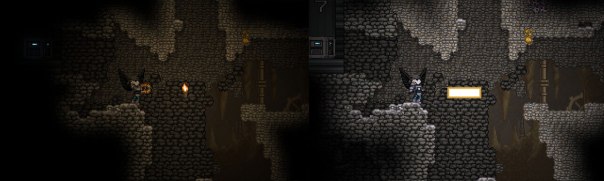
It also costs nothing but the effort of spam-clicking the print button. Torches are still useful in that they don’t require background tiles to work, but signs are otherwise better when you can use them.
Check every vendor you see. Most of the time, a vendor’s inventory is randomly set when you meet them. This can sometimes result in fortuitous situations like a vendor selling unlimited amounts of, say, Graphene for 28px a pop.

Base Recommendations
Build your first base on an Ocean planet. If you are anything like me, you’re concerned about where your “real” base should be located. So you go planet to planet, looking for the perfect spot, and meanwhile junk and crafting benches continue to accumulate wherever you placed them (probably on your ship). Eventually, by the time you find the ideal location, you’re overwhelmed by all the items you have to move, so you stick with your first “choice.”
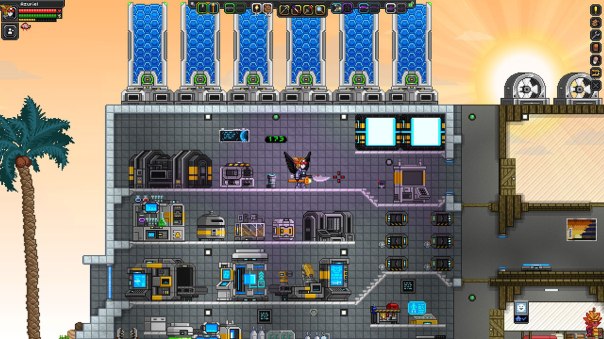
I recommend an Ocean planet base for two reasons. First, it’s a planet. Ship bases are perfectly viable options, but you essentially forgo easy power generation from Solar/Wind stations, and easy materials from Atmospheric Condensers. Second, Ocean planets have infinite water tiles. There are craftable Wells and other water sources wherever you are, but nothing beats the convenience of holding down left-click and soaking up as much water as you need. Or automating it all later.
Keep a Sifter up and running 24/7. A full stack of 1000 Sand will keep a Sifter occupied for quite some time, but the end result will be a dozen or more different materials, some of which can be loaded back in an Alternator to power the Sifter to continue generating free goodies. The Centrifuge is similarly useful, but certainly less perpetual… unless you have Solar panels on an Ocean planet.
Farming Recommendations
Did you build a base on an Ocean planet? Lobsters are EZ-Mode. Craft some Lobster Traps and watch as they magically fill up with free food. Lobsters stack to 99, do not require cooking to eat (but you can if you want), and actually sell for a decent amount (1980px per 99 stack). While there is an indication of freshness, lobsters do not appear to spoil; this may be a bug that is fixed later.
Rice is the easiest vegetable crop to manage. Uncooked rice stacks in your inventory, never goes bad, and you only need a Campfire to cook it. Wheat is similar, but Rice does not need to be replanted (assuming you aren’t using Growing Trays). You forgo any fancy buffs, but it is incredibly straight-forward. If you haven’t found rice on a planet yet, “purchase” it from a Greenhouse.
Grow Trays/Hydroponics are niche tools. On paper, they sound amazing: drop in three seeds, a stack of water, maybe some Fertilizer, and off you go. The problem is that there isn’t a good visual indication of when the product can be harvested. Or when it runs out of water. Or when all of the output slots are full of spoiled food.
Where Grow Trays excel is when they are used either with a stackable product, such Silk, or with a food item that normally despawns when harvesting, such as Wheat. In most other situations, I prefer planting crops in dirt.
Aeroponic or Hydroponic Tubing is strictly better than dirt, once you unlock them. They are kinda expensive considering dirt and the broken sprinkler are so early in the tech tree, but there are benefits to be able to pack more plants into a smaller area (sprinklers need height to water everything). Just keep in mind that you do have to “till” the tubing before planting.
If you want the most-filling food, then you’ll want Ultimate Juice. Incidentally, it also provides +20% Jump/Energy/Health/Run Speed and a Rage effect. This requires six different crops to craft though: Boneboo, Feathercrown, Oculemon, Neonmelon, and Toxictop. Finding these crops before reaching the endgame will be a challenge.
Critical FU Functionality
Frackin’ Universe adds a lot of very complicated systems. Here are the most important/useful ones.
Power – Both Power Generators and Batteries (when charged) output X number of Watts. Plugging a 4W battery into an Arc Smelter (req. 40W) isn’t going to work. That said, wattage is cumulative on a wire. Connect ten 4W batteries to that Arc Smelter – or preferably, to a Wire Relay – and you will be in business. Just note that if you are using 40W, that is 40W less on the wire. If you have multiple stations running simultaneously, you will need a power surplus to keep all the lights on.
Terminals – A Terminal is a clickable interface that grants you access to an “Item Network.” Linking all your storage units together into an Item Network means you can use Terminals to search for and retrieve your items from a single location, e.g. the Terminal itself, instead of having to manually look for it across all your storage units.
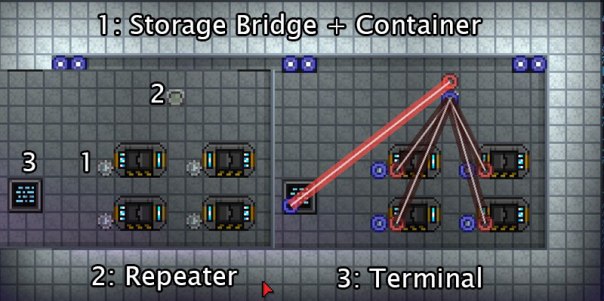
What you’ll need:
- Storage unit(s) full of stuff
- Craft and place Storage Bridge near storage unit(s)
- (optional) Craft and place Repeater to hook into multiple Storage Bridges
- Craft and place Terminal near crafting stations
- Connect the blues to the reds, e.g. Storage Bridge to Repeater/Terminal
Item Movement – If you want to take something from one container and physically put it into another container, you want an Item Transference Device (ITD). If you click on the ITD, you will get a bunch of pseudo-programming options that I have zero interest in learning or explaining. Instead, all you really need to know is that it basically works out of the box. Connect the red circle of your container to the blue circle of the ITD, then connect the red circle of the ITD to the blue circle of the other container. Bam. All items that appear in the first slot of the first container will get moved.

For me, the most practical use of an ITD was moving items from a Lobster Trap or Growing Tray to a box automatically. If the box is actually refrigerated storage, then all the better. Red, blue, red, blue, done. If you want something more fancy, you are on your own.
Survival Recommendations
One of your quick-slot items should be Dirt. If you find yourself in trouble, close off the tunnel you’re in with dirt; it will block melee and the majority of ranged attacks while you heal yourself or escape. While it’s a kinda cheesy move in vanilla Starbound, the enemies in Frackin’ Universe are exceedingly more deadly. Some enemies can pass through walls though, and explosive damage can penetrate tiles, so take care.
Always deploy with your Mech on new worlds. Depending on how much (if any) time you spend with the Mech-building side of things, your Mech will not make you invulnerable to planet effects or damage for long. That said, it will absolutely extend your life by a few precious seconds in case you get beamed down in the middle of a USCM camp full of snipers that can one-shot you. Just note that if your Mech explodes, you die with it. So either beam back up to your ship or bail.
Craft a few dozen flags and plant them everywhere. Flags are cheap to craft and act as bookmarks that allow you to get back to where you want to be quickly. Think you might die or encounter a tough fight? Plant a flag. If you come across a planet with a lot of good resources, plant a flag and name it “Penumbrite (Acid, Hot)” or whatever. This will save you oodles of time if you find yourself in a situation of needing more of X resource but being in a Y system instead.
Get an X (Radiation, etc) Ball Wand/Staff. Regardless of your fighting style, having a Wand/Staff with Radiation Ball (or whatever) will change your life. Specifically, it will allow you to attack enemies around corners/from range with guided death. Even better, you can dig a 1-block hole in a wall or floor and then squeeze your orb of death through it to murder your foes with impunity.

I snaked a Radiation Ball right through the one-tile gap to fry that guy.
Cheap? Sure. Effective? Hell yeah.
Armor Combinations – There are over 100 sets of armor added with Frackin’ Universe, so determining what you want to wear can be a challenge. For the most part though, it’s best to craft a bunch of mannequins and just have specialized sets ready for each planet you beam down on. That said, here were my go-to options:
Nautilus Armor / Kraken Armor / Leviathan Armor
This armor series eventually grants you Acid, Poison/Bio, Gas, Pressure, and Oxygen immunities once you reach the end. If you combine this with the Thermal Shell EPP, you will be immune to the most common damage types. A Field Generator EPP will make you further immune to Radiation, at the expense of making lava a concern again. This will cover just about everything aside from Shadow and Insanity, which can handled with EPP Augments.
Valkyrie Armor
With this set, you get Oxygen, Gas, Pressure, and Radiation protection, plus technical immunity to fall damage (you float downwards). This seems like considerably less protections than the same-tier Leviathan Armor set, and it is, but the Valkyrie gear boasts a 500% weapon damage modifier instead of 276%. Definitely a glass-cannon set, with half the armor of Leviathan and a third of War Angel.
Sunwalker Armor
This is a “War Angel-lite” tier-6 set that provides Radiation, Heat, Cold, Breath, and Pressure immunities. Additionally, there is an extra 40% Radiation resist and a +15% bonus to Plasma weapon damage.
War Angel
Basically an endgame armor, this nevertheless makes you immune to Pressure, Cold, Heat, Radiation, knockback, and all fall damage. On top of that, it provides 35% Physical Resist, so you’ll be taking less damage from mobs. Oh, and 93 Armor and tons of extra HP. Definitely a tanky set. Chain Swords deal 250% extra damage in your hands with this set as well.
EPP and Augments – Much like with Armor, there are dozens of different types of EPPs and Augments to slot into them. The ultimate goal is find a combination that works for your play-style and providing the necessary protection to survive whatever planet you’re on. That said, some of the choices are better than others.
[EPP] Thermal Shell
Providing protection against heat, cold, lava, and burning on top of 20% Fire and Ice Resistance, the Thermal Shell is one of the most useful EPPs in the game. Many armors can give you heat immunity, but none of them will save you from taking damage in lava, which is weird. Even the Field Generator, which appears to be a strict upgrade to the Thermal Shell given how it includes Radiation protection, makes you vulnerable to a lava bath once again.
[EPP] Repulsor Field Pack
While outclassed in the midgame, the Repulsor Field Pack is a fantastic early-game EPP since it provides 20% Physical and Fire Resistance. The “penalty” to Cosmic Resistances isn’t particularly relevant until much later in the game.
[EPP] Plasma Light Pack
The final word in backpack light generation, the Plasma Light Pack doesn’t appear until the endgame and may end up being a fool’s errand to chase after. While it provides Breath and Pressure Immunities, most armors offer the same by then.
[Augment] Immunity I & Immunity Field
Pretty much the final word with Augments, Immunity I provides protection against Heat, Cold, Gas, Radiation, and Proto-Poison at a base level. Immunity Field is a recent, stronger addition that grants a 2nd level protection to those same qualities while adding on Radiation Burning, Poisoning, and Liquid Nitrogen immunities. Still does nothing versus Shadow/Insanity/etc damage, so be wary of what planets you are beaming to. Although having a specialized armor set against those qualities with a Thermal Shell with an Immunity Field Augment to handle the rest will do you well.
Slain Spire
Remember when I said I wouldn’t buy Battlefield 5 because it would consume all my free time but not “accomplish” anything? Well, I did resist the purchase…
…and promptly put like a dozen or so “empty” hours into Slay the Spire instead.
I think my total hours /played in Slay the Spire at this point is north of 50 hours. Those are rookie numbers compared to Zubon at Kill Ten Rats, who probably put more hours into writing Slay the Spire posts last year than I have playing the game. Which it entirely deserves, by the way – it is a thoroughly enjoyable experience. It’s just not a novel experience (to me) anymore, and yet I feel compelled to boot it up any time I spend more than thirty seconds looking at my Steam library.
That’s probably a sign of good game design.
Last year, the devs at MegaCrit tweeted that they were looking at a Switch and mobile version of the game after coming out of Early Access. It’s 2019 and the game is still in Early Access, although there has been a third class added and, more recently, Steam mod support. If and when Slay the Spire ever receives a mobile port, is likely the day that I earn a Corrective Action Report at work.
I can’t wait. Because then I might be able to get home sated, and ready to play something else.
Opaque RNG is Indistinguishable from Rigging
My patience with enforced 50% win rates is paper graphene-thin.
“A fair game is one in which you win half the time.” It’s hard to argue against such a notion. What is more fair than a coin flip? The problem is that players aren’t equal sides of a coin, nor are the thousands of potential actions reducible to two, easily predictive binary outcomes. Some approximation is required. Or a developer thumb on the scale.
I am still playing Clash Royale despite the disastrous pivot towards blood stone squeezing, and the conceptual breakdown of all progression for long-term players. But some of their shit is driving me up a wall, and will eventually drive me from the game entirely. Specifically, Clan Wars, and even more specifically, a particular game mode with preconstructed decks.
To be sure, there are learning curves involved. Supercell basically took some “top decks” and added them to a pool, from which you are randomly assigned one for a single game. The problem is that some of these decks are just objectively terrible with no redeeming qualities, and still others are straight-up countered by some of the other matchups. For example, these two Classic Decks Battles:
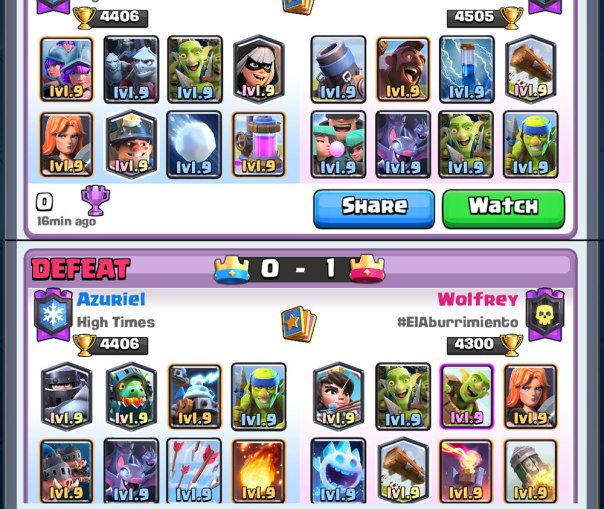
Bullshit on the left, winners on the right.
In the first match (at the bottom), my Royal Hogs are immediately countered by Valkyrie, Mega Knight is immediately countered by Inferno Tower. Amusingly, Royal Hogs are also countered by Inferno Tower and Mega Knight by Valkyrie, assuming my opponent times it right. Meanwhile, while I can counter his Goblin Barrel with Arrows, they both cost 3 Elixir and thus end in a wash… with the slightest error on my part resulting in easily >30% tower damage. Meanwhile, my Zappies are basically useless, my Inferno Dragon even more useless, and I can’t use Arrows to counter his Princess or Goblin Gang because then I become vulnerable to Goblin Barrel. I also can’t hope to Fireball him out because he also has Rocket, which deals way more damage than Fireball. The ONLY way anyone could possibly win with the deck I was given was if the opponent was AFK. 1
For a WoW analogy, think Warrior (me) vs Frost Mage (opponent).
The second matchup wasn’t technically as lopsided, but still awful. Bandit is straight-up countered by pretty much every card in the opponent’s deck. Rascals + Zap took care of Minion Horde every time I threw one down, and Hog Rider/Mortar/Goblin Gang meant I could be punished immediately for dropping Elixir Collector or Three Musketeers. Which is what happened, pretty consistently. If I played better, I might have been able to distract a Mortar with my Valkyrie or Bandit in the other lane, and then split a Three Musketeers or something in the middle, followed by a split Minion Horde. Even then, if he played defensive for 20 seconds, my shit would have been countered.
Were these match-ups truly random? Or “enforced” 50% win rates? There is no direct economic incentive for Supercell to “rig” the Classic Decks Battle mode, but the RNG is opaque and it would certainly be a method to ensure that winrates do not get too lopsided.
The third clan war battle I played was Draft. In this game mode, you are given a choice of one of two cards, four times total; whatever you don’t pick goes to your opponent. I’m not sure if the card pairings are 100% random, but you can absolutely get stuck with some extremely shitty decks and/or matchups. And yet I’m fine with that. You as the player have some agency, even with imperfect information, e.g. choosing Minion Horde when opponent might have chosen Arrows. Indeed, Minion Horde in particular is a classical risky pick because of how many cards can counter it… but if your opponent doesn’t have any of those counters, it can be an overwhelming advantage.
My feelings on enforced winrates have changed over the years. Initially, it seemed fine. Necessary, even. But it is rigging, especially in the methods that many game developers go about it: pairing you with terrible teammates, matching you against strong counters, etc. The end result is that I simply cannot trust game developers with (opaque) RNG anymore. They have no incentive to be actually fair – however fairness is defined – and every incentive to produce favorable (to the devs) results. Even if they showed me the specific game code that chooses the matches, I have no reason to believe it operates in that way. This age of monetization and consumer surplus erosion has pushed me past the Cynicism Horizon, from which no trust can escape.
The only thing that game designers can do, and the thing they should be doing, is increasing player agency in the RNG elements. Drafting feels fair, even when the results are not. Maybe it is just another psychological trick to employ, giving someone the “choice” between a rock or a hard place. But it is an important one for not appearing so nakedly rigged in favor of one particular outcome.
1 If you can produce some videos of pros beating non-AFK people with the decks I was given, I’ll concede that I need to L2P. I typically end the season at 4800 trophies and can acknowledge mistakes, but on paper and in practice, those match-ups felt lopsided as hell.
Review: Far Cry 5
I completed Far Cry 5 a few days ago.

The visuals are quite amazing.
Mechanically, this is the best Far Cry in the series. The gunplay is smooth and tight, weapons are reasonably varied, and vehicles are generally fun to drive. Many of the more rote Far Cry-isms have also been removed. You are no longer forced to climb towers to explore the landscape, nor hunt down sharks to craft a bigger wallet. The whole map is available to explore right away. Screen clutter is practically non-existent, and what quest markers exist are fairly subtle.
Narratively, I feel it is one of the weakest in the series.
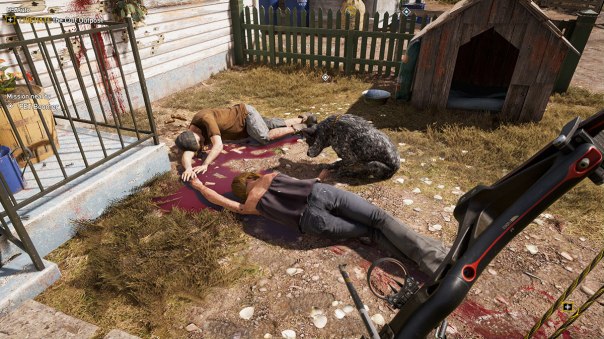
That dog ends up being a very Good Boy.
I have no problem with the Christian iconography, the political parallels to present day, the rehashing of Spec Ops: The Line-esque navel-gazing about who the real demon is (hint: it’s you), or the sometimes absurdly comical cruelty. A lot of that is part and parcel to the Far Cry series. What is fairly new is the simple fact that the player is kidnapped NINE TIMES over the course of the story. The purpose is obviously to engineer a scenario in which the player can interact with the cult lieutenants and witness some exposition first-hand. The frequency though, and the ham-handedness, obliterates any semblance of story cohesion.
Seriously, one time I completed a mission, got the “You’re Being Hunted” message, and was apparently taken out by a blowdart… while piloting an attack helicopter hundreds of feet in the air. Cue cutscene and sub-boss taunting, in which it was revealed I had been imprisoned for seven days (!?!) undergoing psychological torture and starvation. Then (spoilers) I broke out of prison for what had been the fifth time at this point, and went back to what I had been doing originally.
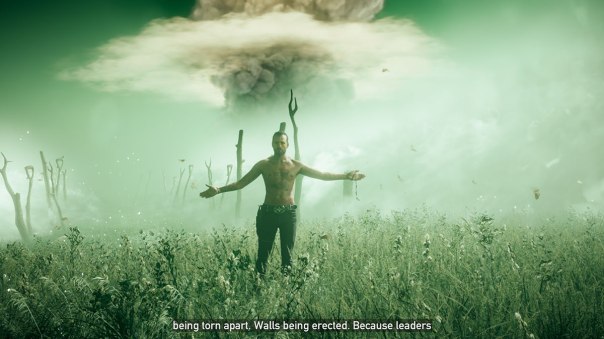
Walls, eh?
I think the principle problem is that Ubisoft simply cannot outrun the shadow of Far Cry 3. That game had an insufferable trust fund frat boy as a protagonist, but it also had a narrative arc with some progression, substance, and you know, a main character that talks. With the lack of any sort of internal dialog, the devs leaned real hard on Vaas wannabes and contrived capture scenarios. Hell, the main character might have been captured just as many times as in Far Cry 3, but it never felt this arbitrary before.
In any case, after 15 hours, that’s that. Far Cry 5 has good gameplay and a stunningly beautiful open world playground to blow up stuff in. But… so do a lot of other games these days. What sets the series apart isn’t the open world or general shenanigans, it’s the story and general narrative experience. And that’s unfortunately lacking this time around.
Waxing my Wane
I’m generally a pretty frugal guy. Parsimonious, even. And yet I just bought half a dozen games in as many days, after having avoided doing so for these specific titles for as many years. “They were on sale though.” They were on sale last year too. What changed?
The void.
Specifically, I finally exhausted my desire to play modded Starbound (Frackin’ Universe)… after 100 hours. One. Hundred. Hours. When you get up to triple digits like that, with any game, the entire experience becomes more than just “having fun” and instead morphs into a whole routine. I would play in the evenings, lie in bed planning my actions the next day, and browse wikis and such during the day. It all really hearkened back to my heydays of WoW. Minus a few thousand hours, of course.
Then, one day, it’s all just gone. Whether it’s the game ending or just getting tired of it, the experience is over.
I am not sure how other people handle post-game depression. My go-to move appears to be ennui of unknown duration. I know of games that could probably suck me right back into mainlining. But I don’t feel like it. In this lucid state, smaller experiences seem like the better course of action. If I don’t play them now, I definitely won’t be playing them later when absorbed in something else.
So out comes a little retail therapy.
We’ll see how it goes. Right now the routine is playing a few missions in Far Cry 5, followed by an area or two of Knife of Dunwall (Dishonored DLC). The segmentation is not on purpose – I can only seem to stand playing either one in short bursts. Not exactly a glowing review, but I blame the ennui more than the gameplay itself. After these two, hopefully the pallet will be cleansed, and I can get into the more cerebral titles like Hellblade, Prey, and/or Final Fantasy XV.
And then… we’ll see.
Gaming Outlook for 2019
Based on my blog roll, this seems like a Thing To Do, so let’s discuss what’s on the docket this year.
To Be Played
I am currently playing Far Cry 5. While the overall experience is similar to Far Cry 4 (which was similar to Far Cry 3), the exact formula has been broken up a bit. Instead of running around trying to skin Honey Badgers for a larger wallet, for example, most character progression is based around achievements and finding prepper caches. It’s subtle, but it does change my focus a bit. A more detailed impression will need to wait for later.
Other games recently purchased on sale:
- Final Fantasy XV
- Dishonored DLC (Knife of Dunwall; Witches of Brigmore)
- Dishonored 2
- Prey
- Hellblade: Senua’s Sacrifice
My Dishonored kick might seem a bit out of nowhere… and it kinda is. My criticism from way back 2012 still hold thus far in the first DLC: the game is almost painfully easy even at the highest difficulty. Well, at least so far on the first level. That’s more a stealth game thing than a Dishonored game thing specifically. Nevertheless, I kept reading praise for the DLC specifically, so I snagged it on sale and here we are.
The rest of that list is basically a rehash of what I had been keeping an eye on since Black Friday.
Might Be Played
I have not booted up Fallout 76 in several weeks now. While it has been trashed up and down the internet – for some legit, and some not so legit reasons – the primary reason for my disconnect might be silly: Rifle schematics. Specifically, my character is focused on Rifles, and the two best kinds of Rifles in the game (Homemade Rifle, Lever-Action Rifle) can only be crafted after snagging their schematics from a vendor’s random inventory. The “correct” way to get them is to check the vendor, and then log off and back on again to be shunted to a new server, and then checking the vendor again. Some people report doing this for hours. No thanks. If that nonsense gets fixed or some new content appears, then I might be back.
Battlefield V is another trashed title, but I have been resisting purchasing it even at a $30 price-point simply because I know what’s going to happen. Specifically, it will probably consume my free-time for a few weeks, and I will eventually awaken from a fugue state, realizing that I had not “accomplished” anything meaningful. I mean, games are games, but there’s a difference (IMO) between seeing the ending credits of three games vs spending that same amount of time seeing the End of Match report of a shooter. I’m not here to just kill time with my gaming anymore.
On Their Way Out
My time with Hearthstone is approaching its end, if it has not already snuck up on me. It’s not so much the mechanics or the meta or the card grinding so much as it is… exhaustion. I have never had a particular desire to compete on the ladder; my goal had been to complete the Dailies and other low-hanging fruit. But that still requires you to put a deck together, research the meta, and otherwise go through the motions. Or I could just turn on Twitch and watch other people play Hearthstone, and experience roughly 85% of the joy that I derive from the game.
On a similar note, WoW is definitely on ice for the foreseeable future.
 In An Age
Zombie Smarts
Jan 24
Posted by Azuriel
I have been playing some more 7 Days to Die (7DTD) now that the Alpha 17.1 patch came around. There have been a lot of tweaks to the progression mechanics and Perk system, including some level-gating on Iron/Steel tool recipes. The biggest change, however, was to zombie AI.
In short, zombies are now impossibly smart… and impossibly dumb.
It’s been long enough that I don’t even remember how zombies behaved in prior patches. What zombies do now though, is behave in perfect tower defense intelligence: the shortest distance between them and you, with walls adding a virtual number of steps. Zombie are also perfectly prescient, knowing exactly which wall blocks have the lowest remaining health, and will attack that spot en mass to get to you. At the same time, zombies prefer not attacking walls to X extent, if they can walk there instead.
The result? Cue the Benny Hill theme:
Essentially, the current 7DTD meta is to not create bases at all, but rather mazes that funnel zombies into kill zones and/or large drops that loop them around until they die of fall damage. The devs have added a “zombie tantrum” mechanic to try and get some damage on looped mazes – zombies will attack anything nearby when they fall, possibly weakening your support pillars – but that will be metagamed away with multiple platforms or deeper holes.
To be clear, the prior zombie meta was solved by simply building an underground bunker. At that time, zombies could not dig into the ground, and disregarded the Z axis entirely – it was possible to hang out in the middle of a bridge and often have a nice grouped pile of zombies directly below you to hit with a Molotov. I played the game enough to recognize which Point of Interest had a pre-built bunker located underneath it, and often sought it out immediately after spawning so I could all but ignore the titular 7th day horde attack.
That said, how smart should zombies be?
The only way to answer that question is to ask what the game you’re making is supposed to be about. When you add tower defense mechanics, you get a tower defense game. This will preclude people from building nice little houses in the woods, and instead opt for mazes and obstacles and drops. It becomes a much more technical game, solvable with very specific configurations. Having dumber zombies frees up a lot more base designs, on top of possibly requiring a lot more attention to one’s base after an attack, as a single “dumb” zombie could be weakening a support in an unused corner.
My initial “solution” would be to mix and match, but I think that’s actually the worst of all possible worlds. Instead, I think zombies work best as environmental hazards. Bunkers might make you invulnerable to nightly attacks… but you have to leave sometime. Shouldn’t the punishment for hiding underground be the simple lack of information of what’s going on, combined with having to spend your morning hours slaying the zombie hordes milling about outside?
I guess we’ll see what the devs eventually decide. At present, there simply seems to be a maze-based arms race at the expense of any sort of satisfying nesting. If the 7DTD devs want to double-down, well… thank god for mods.
Posted in Commentary
1 Comment
Tags: 7 Days to Die, AI, Game Design, Tower Defense, Zombies