Author Archives: Azuriel
Impressions: Nightingale
I had low expectations rolling into Nightingale – a Mixed review score on Steam and its own game directors professing disappointment will do it – but the game was surprisingly good. To be fair, I only started playing until after the Realms Rebuilt reengineering, so perhaps I would have been less surprised with the original rollout.
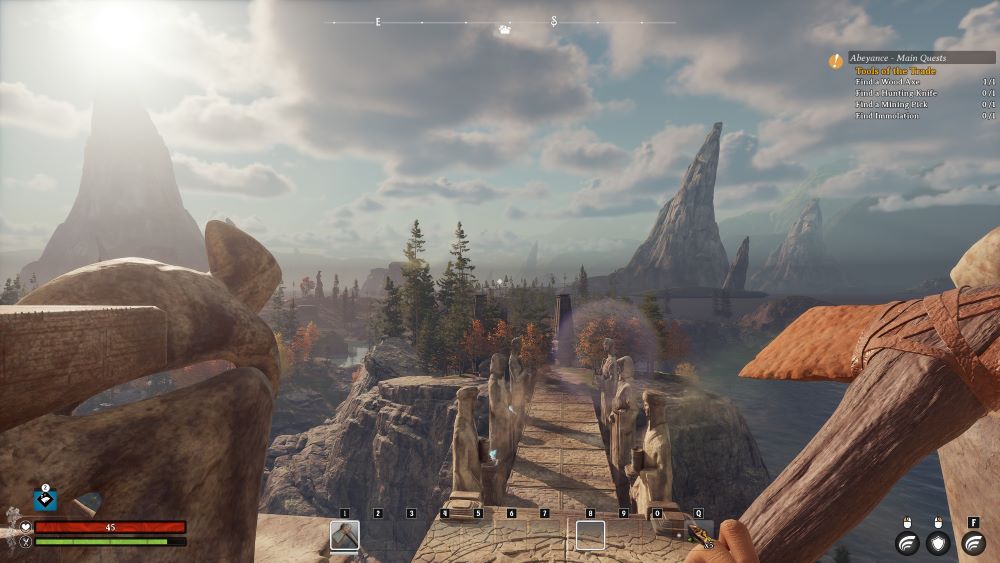
What I do want to note for posterity is my current giddiness and wonder surrounding the principle conceit of the game: portals to fae realms. I have played a lot of survival crafting games in my time, and it’s not particularly often that the world itself (or the potential thereof) excites me. But this initial Abeyance realm? Very excellent first impression. And as I was exploring the island, I kept thinking about how many problems realm-walking solves. Usually, carving up the world into disjointed instances is more of a programmer shortcut than artistic design, but it simply synergizes perfectly here. The only other games that achieved this level of environmental design brilliance for me was Starbound and No Man’s Sky. Getting that same feeling in a non-sci-fi setting is practically unheard of.
Now, it’s important to understand I haven’t actually made it off of this tutorial island yet. All this potentiality in my mind is exactly that: a superposition of imagination not yet intersected with reality. I have no doubt the waveform will eventually collapse and we’ll see, yet again, that the cat died in the box. But regardless of what ends up happening with Nightingale, I do want to see more things like this. I think having a more fae and/or eldritch angle on the genre is an otherwise untapped vein of novelty.
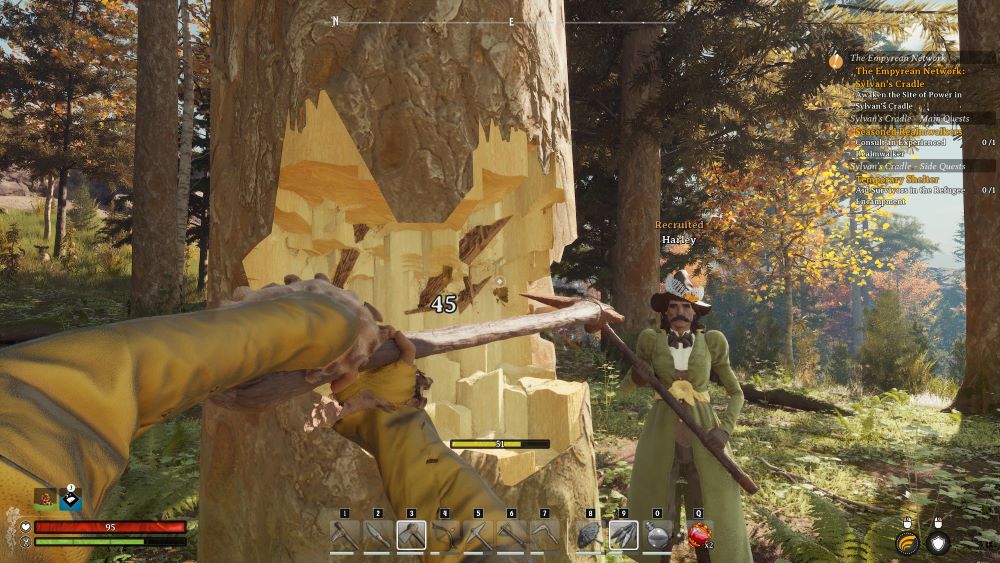
As far as general gameplay, Nightingale again surprised me in several ways. Chopping trees breaks off chunks, mining ore chips away rock where you hit it; little details like that go a long way with me. I remember reading people complaining about combat and the AI, but so far it appears serviceable, if not robust. The pseudo-zombie Bound mobs run, crawl, lurch towards you from multiple angles. Your character can block, get knocked around from attacks, and have a dedicated dodge button. Non-standard traversal is also supported, with a Mary Poppins-style umbrella glide and rock-climbing picks that you can also throw at surfaces to grappling hook yourself up. Again, all on the tutorial island.
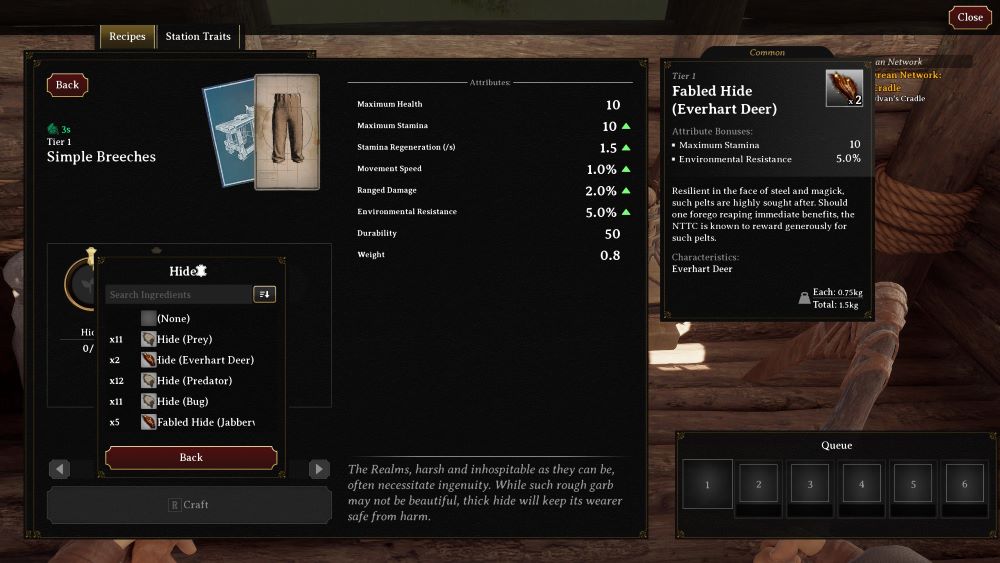
One huge innovation that I hardly ever see in any game is the fact that multiple different resources can be used in recipes. For example, one cooking recipe calls for two Raw Edible Plants – this can be satisfied with mushrooms, blueberries, barberries, etc, or mixed and matched. This may not seem like a big deal, but think about all the times you’ve had wolf meat in a game but couldn’t craft something because it required boar meat or whatever. Additionally, all these resources have specific bonuses associated with them. Gloves need Hide to craft? Okay, well, you can use Hide (Prey), Hide (Predator), or Hide (Bug), and they will confer +Stamina, +HP, or +StaminaRegen respectively.
Having said that, there are definitely some… let’s say opportunities for quality of life improvements.
I was able to recruit a follower NPC who helpfully assists me in combat and also picks up resources automatically. That’s great! Their inventory is not weight-based like mine though, it’s item-based. While this works out in my favor if I’m loading them down with heavy resources like wood or stone, they are just as likely to fill their pockets with leaves and twine, necessitating some awkward inventory management. Furthermore, while I greatly appreciate being able to craft from storage, could we craft from NPC inventory too?
Also, while I love the idea of “decorative” objects conferring a bonus to crafting stations and items created, it feels real dumb to have no control over which bonuses take precedent. Maybe this is a “problem” that gets solved later on with higher-tier crafting stations (that have more than two enhancement slots), but once I realized I had to move the Hunting Trophy across the house in order for the Training Dummy to grant my crafted Knife +Critical Damage, I wanted to throw the entire system in the trash. Like, what’s the design intention, folks? Am I supposed to have two separate Crafting Tables set up, one surrounded by objects that grant me 20% ammo per craft and +Damage on ranged weapons, and the other near objects with +Melee modifiers? Or is my “pick it up and place it in another room” workaround the design goal? Just… let us toggle which ones are active.
——
Having made it to the 2nd island, things are getting a bit more abrasive. The enemies are much harder, presumably tuned to be a challenge for players in Tier 2 equipment. But the only real way to get Tier 2 equipment is to gather Tier 2 essence to unlock the upgraded crafting stations. Meanwhile, surprise, the realm has a negative modifier that reduces your HP regeneration. The whole situation was a bit brutal. But now I’ve unlocked a bow that literally deals 100 more damage per arrow than I deal currently, using materials I can gather from my Abeyance realm. Which… is not the way that is typically supposed to work. Anyway, once that gets crafted, I’ll continue onwards to farm mobs for essence to unlock more crafting stations so I can craft the gear that will allow me to be actually successful in exploring the area.
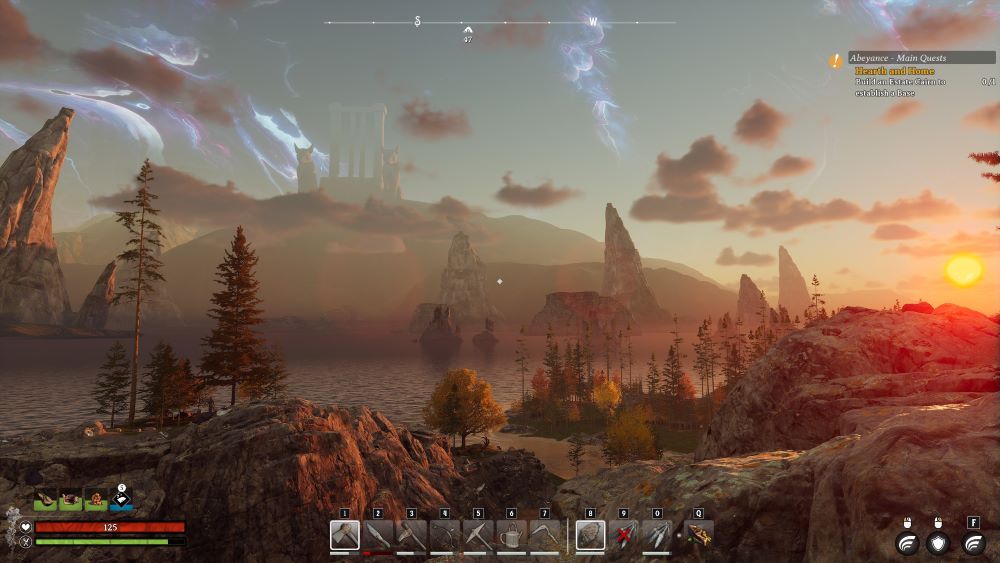
Anyway, if I had to sum up the things I would like addressed over Early Access thus far, it would be:
- Toggle active Augmentations on crafting stations
- Craft from NPC inventory
- Sort by Weight option when viewing NPC inventory
- Remove or reengineer Hunger Meter (Food buffs mean you’re always full anyway)
- Reimagine the Magick/spells system entirely (it’s barely supported and boring to boot)
- Tighten up traversal mechanics, e.g. what can be climbed, grappled, etc
- Allow us to build bridges
Other than that, so far, I’m very impressed.
This AI Ain’t It
Wilhelm wrote a post called “The Folly of Believing in AI” and is otherwise predicting an eventual market crash based on the insane capital spent chasing that dragon. The thesis is simple: AI is expensive, so… who is going to pay for it? Well, expensive and garbage, which is the worst possible combination. And I pretty much agree with him entirely – when the music stops, there will be many a child left without a chair but holding a lot of bags, to mix metaphors.
The one problematic angle I want to stress the most though, is the fundamental limitation of AI: it is dependent upon the data it intends to replace, and yet that data evolves all the time.
Duh, right? Just think about it a bit more though. The best use-case I have heard for AI has been from programmers stating that they can get code snippets from ChatGPT that either work out of the box, or otherwise get them 90% of the way there. Where did ChatGPT “learn” code though? From scraping GitHub and similar repositories for human-made code. Which sounds an awful like what a search engine could also do, but nevermind. Even in the extremely optimistic scenario in which no programmer loses their jobs to future Prompt Engineers, eventually GitHub is going to start (or continue?) to accumulate AI-derived code. Which will be scraped and reconsumed into the dataset, increasing the error rate, thereby lowering the value that the AI had in the first place.
Alternatively, let’s suppose there isn’t an issue with recycled datasets and error rates. There will be a lower need for programmers, which means less opportunity for novel code and/or new languages, as it would have to compete with much cheaper, “solved” solution. We then get locked into existing code at current levels of function unless some hobbyists stumble upon the next best thing.
The other use-cases for AI are bad in more obvious, albeit understandable ways. AI can write tailored cover letters for you, or if you’re feeling extra frisky, apply for hundreds of job postings a day on your behalf. Of course, HR departments around the world fired the first shots of that war when they started using algorithms to pre-screen applications, so this bit of turnabout feels like fair play. But what is the end result? AI talking to AI? No person can or will manually sort through 250 applications per job opening. Maybe the most “fair” solution will just be picking people randomly. Or consolidating all the power into recruitment agencies. Or, you know, just nepotism and networking per usual.
Then you get to the AI-written house listings, product descriptions, user reviews, or office emails. Just look at this recent Forbes article on how to use ChatGPT to save you time in an office scenario:
- Wrangle Your Inbox (Google how to use Outlook Rules/filters)
- Eliminate Redundant Communication (Ooo, Email Templates!)
- Automate Content Creation (spit out a 1st draft on a subject based on prompts)
- Get The Most Out Of Your Meetings (transcribe notes, summarize transcriptions, create agendas)
- Crunch Data And Offer Insights (get data analysis, assuming you don’t understand Excel formulas)
The article states email and meetings represent 15% and 23% of work time, respectively. Sounds accurate enough. And yet rather than address the glaring, systemic issue of unnecessary communication directly, we are to use AI to just… sort of brute force our way through it. Does it not occur to anyone that the emails you are getting AI to summarize are possibly created by AI prompts from the sender? Your supervisor is going to get AI to summarize the AI article you submitted, have AI create an agenda for a meeting they call you in for, AI is going to transcribe the meeting, which will then be emailed to their supervisor and summarized again by AI. You’ll probably still be in trouble, but no worries, just submit 5000 job applications over your lunch break.
In Cyberpunk 2077 lore, a virus infected and destroyed 78.2% of the internet. In the real world, 90% of the internet will be synthetically generated by 2026. How’s that for a bearish case for AI?
Now, I am not a total Luddite. There are a number of applications for which AI is very welcome. Detecting lung cancer from a blood test, rapidly sifting through thousands of CT scans looking for patterns, potentially using AI to create novel molecules and designer drugs while simulating their efficacy, and so on. Those are useful applications of technology to further science.
That’s not what is getting peddled on the street these days though. And maybe that is not even the point. There is a cynical part of me that questions why these programs were dropped on the public like a free hit from the local drug dealer. There is some money exchanging hands, sure, and it’s certainly been a boon for Nvidia and other companies selling shovels during a gold rush. But OpenAI is set to take a $5 billion loss this year alone, and they aren’t the only game in town. Why spend $700,000/day running ChatGPT like a loss leader, when there doesn’t appear to be anything profitable being led to?
[Fake Edit] Totally unrelated last week news: Microsoft, Apple, and Nvidia are apparently bailing out OpenAI in another round of fundraising to keep them solvent… for another year, or whatever.
I think maybe the Dead Internet endgame is the point. The collateral damage is win-win for these AI companies. Either they succeed with the AGI moonshot – the holy grail of AI that would change the game, just like working fusion power – or fill the open internet with enough AI garbage to permanently prevent any future competition. What could a brand new AI company even train off of these days? Assuming “clean” output isn’t now locked down with licensing contracts, their new model would be facing off with ChatGPT v8.5 or whatever. The only reasonable avenue for future AI companies would be to license the existing datasets themselves into perpetuity. Rent-seeking at its finest.
I could be wrong. Perhaps all these LLMs will suddenly solve all our problems, and not just be tools of harassment and disinformation. Considering the big phone players are making deepfake software on phones standard this year, I suppose we’ll all find out pretty damn quick.
My prediction: mo’ AI, mo’ problems.
Live Service
In “researching” my Concord post, I came across this IGN article in which analysts were asked why the game failed. One answer in particular was extremely interesting in a state-of-the-industry way:
“Live service games have a high failure rate,” Deane said. […] But while the risks are big, so are the rewards. It’s no secret that many of the highest-earning games in the market today are live service games. According to our data, only about 16% of the total revenue of the games market now comes from traditional full-game sales. Publishers are going to keep chasing that 84%.”
On the one hand, it shouldn’t be that shocking, right? Fortnite, Genshin Impact, GTA Online, Call of Duty, every MMO, and almost every mobile game are all live-service titles. Fortnite by itself generated an estimated $5.7 billion in revenue in 2023, for example. That’s per year. Genshin is another billion per year, GTA Online (aka GTA5) is approaching $9 billion lifetime revenue, and so on. Also, apparently Call of Duty mobile hit $3 billion total revenue in only four years and is now officially where the majority of CoD players are. Oh, and I guess Minecraft is also a live service game too? Another $300 million or so.
On the other hand: Jesus fucking Christ. 16%?! What the goddamn shit? Holy mother of god.

Ahem. Well, there you go. That’s the state of the industry right now. Or I suppose been the state of the industry longer than I’ve been paying attention. If you’re interested in just making like, a game, you’re competing over literal scraps. “Why are there so many live service games these days?” Right now I’m amazed there are still regular games. Of course, 16% of $350 billion is still $56 billion, but that’s much less than, say, $294 billion. And of that much smaller number, you are competing across all the available genres of regular games. Good thing development costs aren’t too prohibitive…
Cut the Concord
Statistically, you have never heard of it, but Sony is shutting down their new Overwatch-like hero shooter called Concord. After two whole weeks. On Steam, Concord apparently never broke 700 concurrent players at launch. The writing was probably on the wall from earlier when the open beta population was worse than closed beta – plus it launching as a $40 B2P in a sea of F2P competitors – but the sheer scale of the belly flop is shocking nonetheless. It is rumored to have cost $200 million, and for sure has been in development for eight (8!) years.
And now it’s gone.
You know, there are people out there that argue games should be more expensive. Not necessarily because of the traditional inflation reasons – although that factors in too – but because games costs more to make in general. Which really just translates into longer development times. And yet, as we can see with Concord along with many other examples, long development times do not necessarily translate back into better games. There is obviously some minimum, but longer isn’t better.
And yet, we have these industry leaders who suggest MSRP should be higher than the now-standard $70. To be “priced accordingly with its quality, breadth & depth,” as if any of that is really knowable from a consumer standpoint prior to purchase. We have reviews, sure, and Concord score a 70 from IGN. What does that tell you?
The overall way games are made is itself unsustainable, and an extra $10-$20 per copy isn’t going to fix anything. Indeed, there seems to be a blasé attitude in the industry that a rising MRSP will lift all the boats instead of, you know, causing the ones on the periphery to slide down the demand wave curve. Suppose GTA6 is released at $80. Is the argument that a consumer’s gaming budget will just indefinitely expand by an extra $10/year? Or will they, I dunno, just spend $10 less on other titles? Higher prices are certainly not going to expand the market, so… what?
As far as I can see it, the only reasonable knob to turn appears to be development time and nobody seems able to do it. I’m not trying to handwave away the effort and brute labor necessary to digitally animate mo-capped models in high fidelity. Or creating and debugging millions of lines of bespoke code. But I am asking how long it does take, how much of it is necessary, and how often these visually stunning games fall flat on their faces in the one function of their intended existence, e.g. being fun.
Throwing more money at the problem certainly doesn’t seem to be working.
Losing the W
Monday, through an unfortunate series of events, a small stack of wood smashed the tip of my middle finger on my left hand. Nothing was broken, no bleeding under the fingernail, just a puffy, painful bruise (thus far). After the initial pain went away, I expressed gladness that at least it wasn’t either of my index fingers or thumbs – those would be much worse to lose the use of for general computing.
…unless, as I quickly realized, you are a PC gamer. Turns out the W and S are pretty key components of the whole WASD control scheme. And, you know, WASD is prevalent in just about every survival game.
So, yeah, sucks for me for a while. Technically, I could use a controller, as long as the left trigger button isn’t too critical, but that’s definitely not what I would prefer using with first-person titles. Perhaps I should just use this opportunity to catch up on TV shows or play some Rimworld or something.
Hmm. Wonder how Neuralink is coming along…
The Forever Sigh
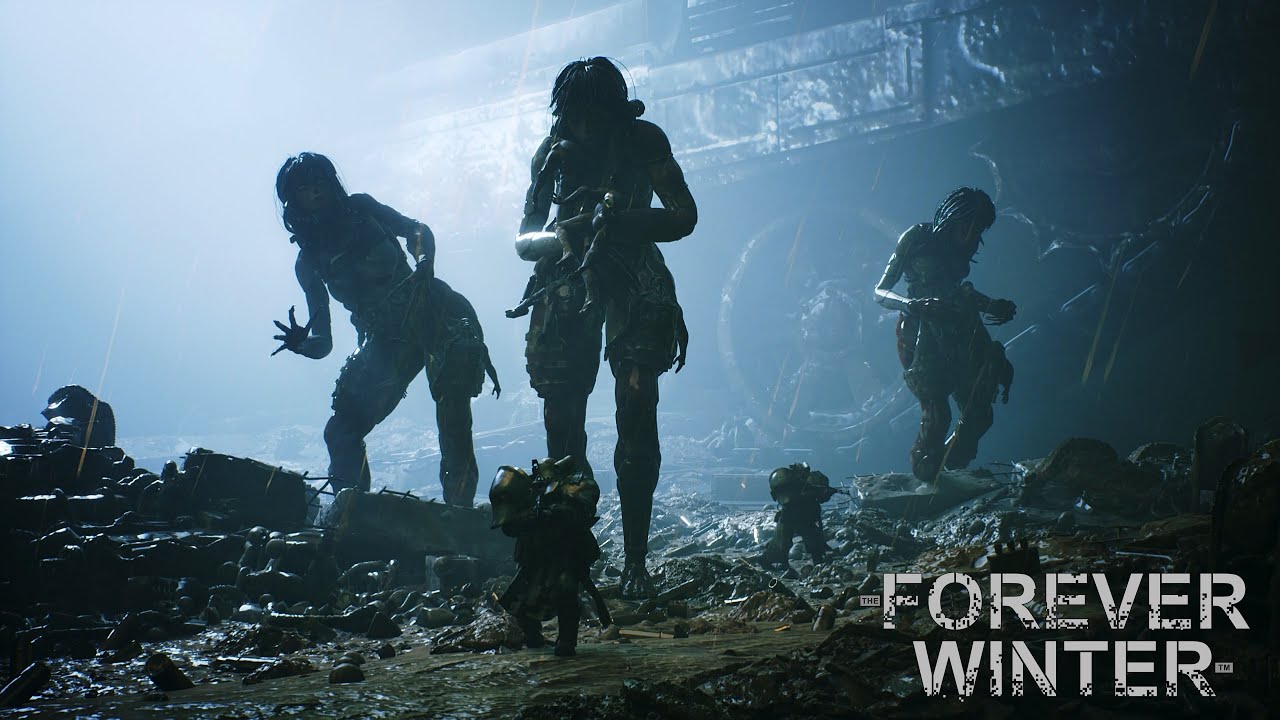
A few months ago, I was very interested in The Forever Winter, the post-apocalyptic extraction shooter.
After reading this PC Gamer article though, my interest has dropped precipitously:
Then there’s the water situation. This is the most essential resource, and when my hub runs out completely the area is reset, costing all of the practical and cosmetic enhancements I’ve made, and my inventory will be gutted. Even before then, when it’s critically low, some services become unavailable. And this all happens in real-time.
“One of the things that actually came up in our beta, that we’re keeping, is that the water level has real-time degradation,” says Gregg. “If you and I log off with 10 days left and you come back three days from now, you’ll have seven days left, even if you haven’t played. It’s a hardcore game, you can build up a large surplus, but that is actually part of our co-op: to make sure people help each other.”
Good fucking luck, chief.
The great irony here is that I praised them before for basically being concept artists following through on their vision way outside the norm. Not many other devs would put spacesuit-wearing flame-thrower units using American flags as hoods into their games, nevermind the battle-tanks covered in corpses as camouflage. That’s cool! If you go grimdark, go all the way.
Having an expiration timer count down even when not playing though? That’s not “hardcore,” that’s just fucking stupid. I don’t even care how easy water is to get in-game, because that is irrelevant. What is the design attempting to accomplish? Because by default, what this tells players is that any break from the game may as well be permanent. Meanwhile, the people who are playing the game aren’t even affected by this “hardcore” feature. Ask the Icarus devs how that shit worked out for them.
I guess we’ll see how it plays out. The Forever War will be in Early Access at the end of September.
Wishlist – August 2024
A non-exhaustive list of game wishes at this time interval:
- SCUM ($15.99, 60% off)
- Terminus: Zombie Survivors ($15.99, 20% off)
- ASKA ($19.99, 20% off)
- Enshrouded ($29.99, MSRP)
- Sons of the Forest ($29.99, MSRP)
- Bellwright ($29.99, MSRP)
- Nightingale ($29.99, MSRP)
- Soulmask ($29.99 , MSRP)
SCUM would certainly seem to be the sort of survival crafting game within my strike zone, but there is just something… off-putting about it in the videos I have watched. I’m not opposed to super-realistic/detailed survival games (e.g. Green Hell), but they have a tight fun-rope to walk. Need to balance your macronutrient intake with a literal stomach size constriction? OK. Need to remember to remove dirty pants if you get a laceration on your leg lest you get an infection? Cool.
But what is this all in service towards? “Prevent the player from just eating berries all day in the woods, forcing them into dangerous zones.” I can get behind that. Of course, the actual gameplay looks kinda janky, zombies are all of the same type but a few are randomly screamers that spawn in dozens of new ones to immediately chase you down, etc, etc, etc. All of sudden, it seems a bit less “realistic” and more nakedly game-y. That sort of thing works in 7 Days to Die, but not here.
On the other end, watching videos of Terminus makes it seem like something I’d be interested in. Mostly. It’s a kind of top-down survival roguelike with action points, different builds, meta-progression, and so on. Part of my hesitation though is that it doesn’t feel like the sort of game where you would, you know, actually build a base and stay put. If you’re just going node-to-node, you may as well be playing a more traditional roguelike instead. Also… not to be that guy, but $16 on sale still feels like a lot for an indie game within this visual league. There are amazing 100+ hours experiences with worse graphics, of course, it’s just that this definitely feels like a Game Pass and/or Humble Bundle title. Literally hit 1.0 last week so that’s kinda shitty of me to say, but I said it.
Finally, I must admit it difficult to remember what ASKA is all about off-hand. It arrived in Early Access around the same time as Enshrouded, Nightingale, Bellwright, and Soulmask, all of which are survival crafting games with various shticks. In reviewing the literature, it appears ASKA is the one with “skill based combat” and the recruitment of NPC villagers. Err… the one without masks involved. Or medieval plots against the crown. That one. But, hey, it’s on sale!
The other games aren’t on sale, so I’m not going to talk about them. We don’t MSRP around here.
What’s In A Game?
Dragon Age: the Veilguard is coming out on October 31st. How I feel about it is… complicated. Veilguard’s first trailer received a lot of flak, but there have been a few subsequent ones that show a more a traditional Dragon Age vibe, as opposed to what felt sort of Fortnite/Borderlands-ish irreverence. Besides, what’s not to love about it being more Dragon Age, featuring a romanceable Scout Harding, and the fact that it’s a BioWare game.
…or is it?
I mean, yes, it’s a BioWare game. It’s also an EA game, proven by the fact that it has a deluxe edition, pre-order bonuses, and a $150 Collector’s Edition with a physical LED dagger and other items that hilariously doesn’t come with a copy of the game. You seriously can’t make this shit up.
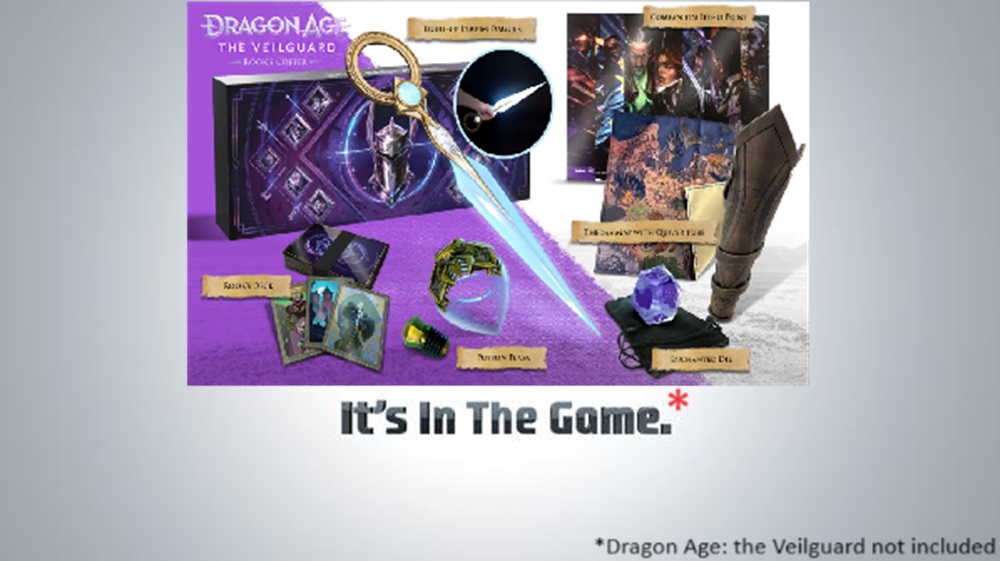
But what is a “BioWare game,” or any game for that matter? Not in an existential sense, but what is meant when we say these things? When I say BioWare game, emotionally I’m referring to a nebulous sort of companion-focused, squad-based RPGs with branching endings based on player dialog choices. Basically, the Mass Effect and Dragon Age series. Which I have historically enjoyed, including even (eventually) Mass Effect: Andromeda. It’s a type of game with a particular vibe to it.
Having said that, being a “BioWare Game” is really just branding and marketing. BioWare also released Anthem, which was a commercial failure; Andromeda wasn’t that hot either, considering how all DLC and follow-up expansions were canceled. Rationally, there should be no expectation that just because BioWare is releasing Veilguard, that it will be of the same quality of [insert favorite Dragon Age game here], especially after the franchise’s 10-year hiatus. But that touch of skepticism should still be the case even if Anthem and Andromeda were smash hits.
I have long cautioned against the sort of hero worship that game developers sometimes generate, especially when it comes to “rockstar” designers. There are people who fall to their knees at the altar of Fallout: New Vegas and Chris Avellone. To which I say: why? Even if New Vegas is your favorite game, there were a lot of cooks in that kitchen. In fact, you probably should be worshiping at the feet of John Gonzalez instead. Or, preferably, worshiping no one, including the companies themselves.
Game design is a collaborative endeavor – solo indie titles aside – and it’s a nigh-impossible task to nail down exactly who did what to make the game as compelling an experience as it was. Especially including the very staff who did it. Back in the day, there was an argument that Blizzard was sending in their B-Team for the Wrath of the Lich King expansion, and that is why subscriptions started to decline for the first time (notwithstanding the 12 million sub peak). As it turns out, that wasn’t the case – most everyone from vanilla and TBC ended up working on Wrath and subsequent expansions. Hell, the most controversial addition to the game (Looking for Dungeon tool) was something the original “rockstars” devs wanted to release in vanilla. It wasn’t the bean counters or the C-Suites or whatever design boogeyman you want to define; the calls were coming from inside the house.
There are times where it appears one very visible person seems to make a difference. Hideo Kojima immediately comes to mind. It is also difficult to argue against the apparent influence of, say, Yoshi-P when it comes to FF14. Or Hidetaka Miyazaki of FromSoftware fame. They could not build their games alone, of course, but leadership can and does set expectations and gives direction in these endeavors. There is a level of consistency – or consistent craziness in Kojima’s case – that is pretty rare in gaming.
By and large, though? Every game is a gumbo and no knows what went into it or why it tastes the way it does. That’s… a pretty strong nihilistic take, I admit, but riddle me this: if someone figured it all out, why is it so hard to bottle the lightning again? Boredom? Fear? Ever-changing audience mores? There are so many moving parts, between the game designers coming and going from the company, to the gaming zeitgeist of the time, to competing game releases, all of which can influence a title’s success. You can’t just say “Obsidian should just make New Vegas 2 and it will be a smash hit” because A) most everyone from the original team has left, B) none of the people who left appear to have taken the secret sauce with them, and C) New Vegas was massively outsold by Fallout 4 in any case.
So, am I still looking forward to Veilguard? Well, two words: Scout Harding.
Seriously though, I don’t want the takeaway to be that you shouldn’t look forward to anything. I have no idea what the plans are for Mass Effect 5, but I still want to find out. Just not on Day 1 (probably), and not with any sort of expectations that because Company A or Game Dev B made it that the end result will be C. If you’re going to base your hype on anything, base it on what the game is promising, not the people who made it. After all, the best games end up taking on a life of their own.
Arcane and Edgerunners
While on my vacation a few weeks ago, away from my PC, I finally found the time to watch both Arcane (e.g. the League of Legends-based show) and Cyberpunk: Edgerunners. Here are my thoughts:
Arcane: Season 1
An amazingly compelling and nuanced show that is better than it really has any right to be. Arcane is at a quality level that it makes you start thinking that Riot created League of Legends as a means to fund the development of Arcane, the thing that they wanted to make all along.
The overall show follows the life of Vi and Powder, two sisters growing up in the undercity slums, and how they try to survive amidst gang wars and oppression from enforcers from the city proper. A series of unfortunate events breaks them apart, and their differing paths through the developing tension between the upper and lower cities forms the backbone of the plot.
I really don’t know what else to say about Arcane. I have never played League of Legends nor have delved into any character lore to see if anything in the show is “accurate.” None it really matters, as the show stands on its own. In fact, outside of a few moments late in the series where there is clearly some “ultimate ability fan service,” you probably wouldn’t ever know it was based on a game.
In any case, whether or not you choose to invest the time in watching Arcane for yourself, I highly recommend at least listening to What Could Have Been and Goodbye. The overall soundtrack is next-level, with a wide range of genres and tempo, but those two in particular elevate the experience.
I am eagerly awaiting the release of Season 2, which is coming out soon.
Cyberpunk: Edgerunners
Cyberpunk: Edgerunners is a Japanese anime based within the Cyberpunk 2077 game world. It follows the life of David Martinez, a teenager who is thrust onto the merciless streets of Night City after a senseless tragedy. Mirroring the base game themes, we see how David tries to make a life for himself despite being surrounded by violence and corruption and cyberpsychosis at every turn.
I watched Edgerunners with the English dub, and that is something I recommend too – the quality is excellent, but the real treat was hearing the same sort of Cyberpunk slang (choom, gonk, flatlined, etc) that you do in-game. Indeed, seeing as how I watched the anime after having played the game in which they added Edgerunner gear as bonus items, it felt as if I were literally watching an in-game show.
Overall, I enjoyed the kinetic, violent affair, but recognize that it might not be for everyone (especially the squeamish). If you liked playing Cyberpunk 2077, you owe it to yourself to watch the show. If you didn’t, but enjoy the cyberpunk genre and are okay with over-the-top gore, then go for it. There is a ton of drama, tragedy, and an impeccable soundtrack (some of which come direct from the game radio).


Me-Haul
Sep 13
Posted by Azuriel
Ever have a birthday, say, two weeks ago and then just ask yourself “what about second birthday?” That’s where I’m at right now. So, I bought some games and now I’m going to talk about them.
The first two items there are survival crafting games I’ve had an eye on for months.
Nightingale in particular is interesting because the developers are pulling a full FF14 Realm Reborn angle called, er, Realms Rebuilt. It is not uncommon for Early Access games to have to completely retool after realizing they drove off a design cliff – Icarus will forever be my go-to example – but a total progression wipe and pivot towards non-procedural generation seems a bit weird when the central conceit of your game is ever-changing fae realms. Also, the CEO straight-up said: “We are not satisfied with where the game is at, we’re not satisfied with the overall sentiment, we’re not satisfied with our player numbers.” The Art Director then went on to say:
Gotta say, I appreciate the candor. At the same time… I can’t quite pin down why it all feels strangely off. Nightingale getting an offline mode two days after “release” was a hard pivot based on overwhelming player feedback. That’s good. Changing the narrative structure of your game based on the sales figures of other Early Access survival crafting competitors? That’s… certainly one way to do it. Hopefully it works out, considering I just bought the game, but I also hope it works out for the people who already enjoyed how the game was up to this point. Although it certainly seems like they’re saying there’s not enough of them to matter.
The second two titles are both truly random picks based on A) being on sale, and B) me hearing effusive praise for them on Reddit. Who says advertising doesn’t work? 1000xRESIST is not a game I could easily describe, and after reading the IGN 9/10 review for it, I somehow feel like I know even less than before what it’s going to be about. From what I’ve read about killer7, that one may be even more incomprehensible. But, well, I’m a simple man, and if you invoke Evangelion, Neir: Automata, Kojima, and/or Disco Elysium enough times, my wallet will appear. Provided it’s not MSRP.
Posted in Commentary
5 Comments
Tags: 1000xRESIST, Enshrouded, Hard Pivot, Haul, killer7, Nightingale, Who Buys Games Anymore?