Author Archives: Azuriel
Reviews: AaAaAA!!! – A Reckless Disregard for Gravity, Frozen Synapse, From Dust
Game: AaAaAA!!! – A Reckless Disregard for Gravity
Recommended price: $0.99/Bundle
Metacritic Score: 81
Completion Time: ~3-4 hours
Buy If You Like: Falling simulators, super-twitchy Pilot Wings
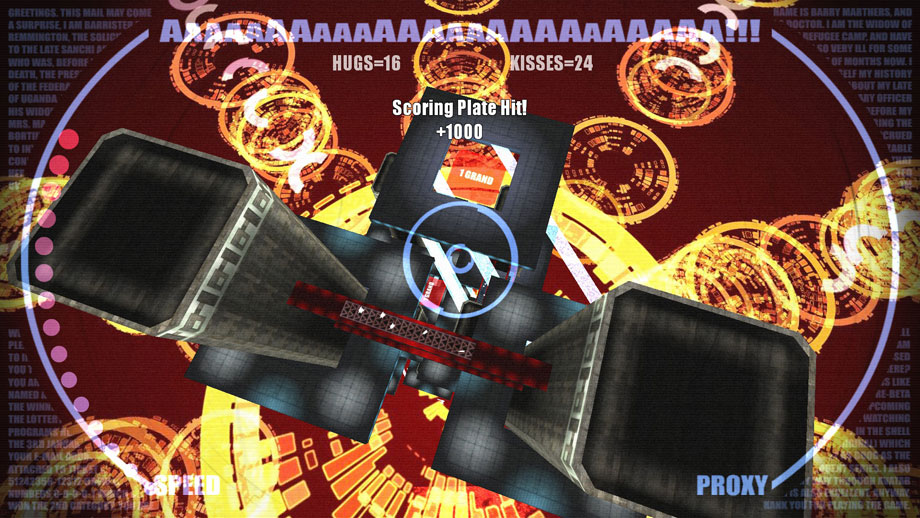
Not for those with vertigo.
It is both easy and difficult to describe AaAaAA!!! as a videogame.
It is an indie game with personality, in which you use the WASD keys (and sometimes mouse) to control your descent as close as possible to floating buildings, through Score Plates, and hopefully landing at the bottom area at a speed somewhat less than 54 m/s. Points are awarded for Hugs (every second spent within a few feet of an object), Kisses (one-time bonus for getting close to individual buildings), giving a thumbs up/flipping off your fans/protestors on nearby walkways (i.e. Left or Right clicking while in range), spray-painting government buildings (pressing Middle mouse button near green-striped buildings), and some other miscellaneous actions. If you land safely, your points are tallied and you are given up to a 5-star rating, which rewards Teeth (the game’s currency) so that you may pay to unlock new levels.
Obviously the above does not begin to capture the adrenaline that comes from a combination of induced vertigo, rocking soundtrack, visual overload, and split-second twitch action. There are 80 levels which can be completed in a relatively non-linear manner, plenty of dark humor, Steam leaderboards, and… well, yeah. AaAaAA!!! does not pretend to be anything it is not, and what it happens to be is a decently entertaining distraction.
_____________
Game: Frozen Synapse
Recommended price: $5
Metacritic Score: 85
Completion Time: ~18 hours
Buy If You Like: Squad-based, ultra-tactical games
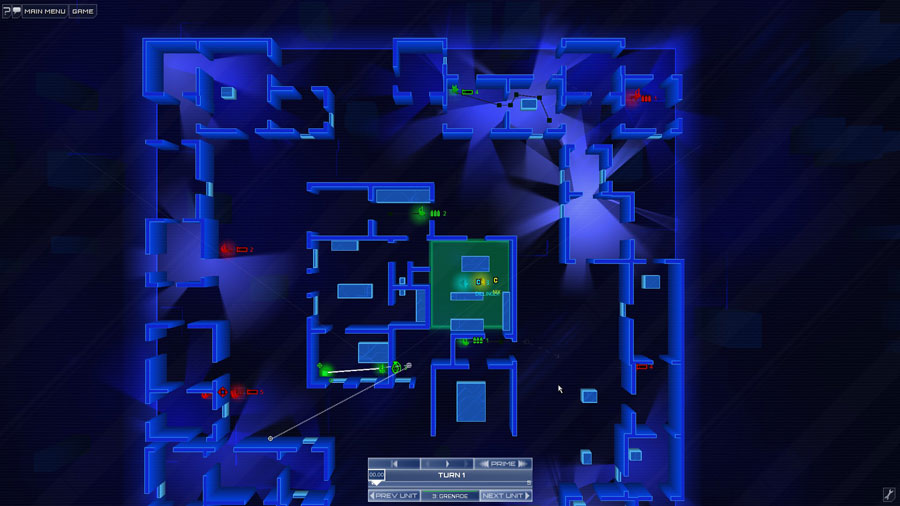
Would. You. Like. To. Play. A. Game?
My initial impression of Frozen Synapse was that it was a terrible, terrible game. I am not at all a fan of the sort of Rainbow 6-esque “spend 10 minutes planning a room breach, then instant Game Over within the first 5 seconds” gameplay, and that is almost exactly what Frozen Synapse consists of. Additionally, when you “submit” your moves, the game actually features a 5-10 second loading screen as if my $1200 computer that runs Skyrim on Ultra-max settings cannot handle the AI calculations.
After stubbornly slogging through the game out of spite, I would come to discover that Frozen Synapse is actually a decently good game. And potentially one that would temper my distaste of this sort of ultra-tactical gameplay.
The key to enjoying this game is to understand the underlying rules. There are three basic units that follow Rock-Paper-Scissors rules: Shotguners kill first at close range, Machine gunners at middle range, Snipers at long range. The prior rules are overruled depending on which unit sees the other first (there are vision arcs), obstructions do count for something, and standing units beat moving units in “ties.” Rocket launcher units do not auto-fire, their rockets continue in straight lines, and kills only come from splash damage. Grenade launcher units can bounce grenades off walls, can only shoot over waist-high obstructions if they are nearby.
The real turning point though, came when I understood that the sense that the “computer cheats” stemmed from my not simulating how the computer can screw me. You see, you can spend a lot of time planning out your own moves within the intuitive interface, getting the timing down perfectly to kill the red units… when they are statically standing around. But as soon as the Submit button is pressed, the computer is going to engage in its own plans, and typically it does not include standing around looking at the corner.
So the solution is to plan out what the computer could possibly do to ruin your own plans. If the hostile machine gunner goes to the window instead of the door, will your shotgunner still get the kill? Instead of leaving it to fate and possibly losing a match 10-turns deep, make the computer do that, press Play, and see what would happen. The computer can still surprise you from time to time, but it almost became a game unto itself to see how many loose ends and blind spots my various tactical gambits contained.
It is worth mentioning that 99% of the maps are procedurally generated, and the same with troop placement, even in single-player. The campaign itself is fairly amusing and quite varied, with later missions really turning on the heat with super-units and occasionally not letting you see enemy units unless one of your own has a visual (e.g. typically getting shot at). If you thought planning enemy moves was fun, try doing it to the “ghosts” of units you lost track of for the last six turns. In addition to the single-player campaign, there is also multiplayer and instant skirmishes, although I had got my own 18-hour fill with just the campaign.
Ultimately, Frozen Synapse is not for everyone – it wasn’t even for me initially – and certainly not for anyone at the default price of $24.99. Catch it for $5 and/or as part of a bundle though, and it could definitely be worth your time.
_____________
Game: From Dust
Recommended price: $0.99/Bundle
Metacritic Score: 76
Completion Time: ~5 hours
Buy If You Like: Literal sandboxes, water simulators
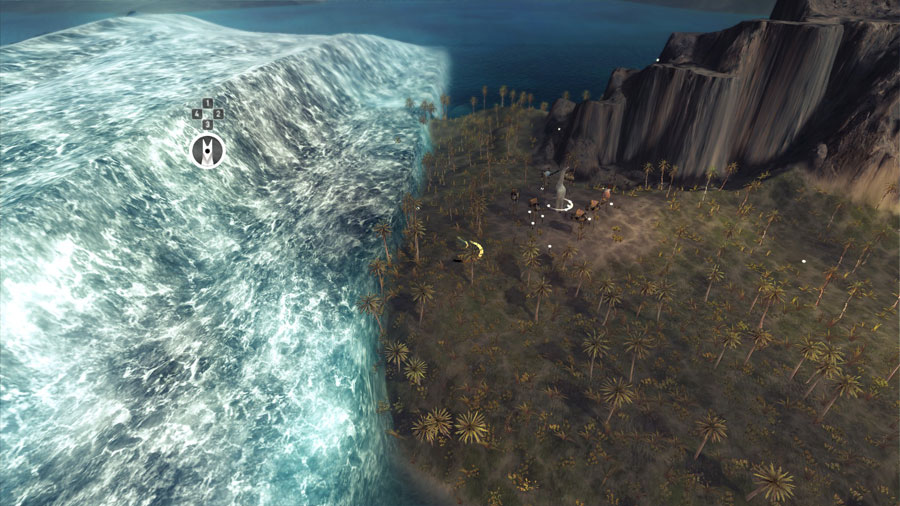
Uh oh.
As a tech demo or proof of concept, From Dust is stunning. Whatever water/physics engine they have running this thing is ready for the mainstream. Water has currents, erodes earthen embankments, and wipes out landmasses in the form of tsunamis quite beautifully; volcanic eruptions spew lava that gradually builds up and up until suddenly it is overflowing into the stream nearby, creating a impromptu dam, and starting a bushfire in the process.
As a game though, From Dust skates the very edge between too simple and frustratingly complex.
The basic gameplay consists of shepherding a handful of tribesmen to the white totems around the map, so they can erect villages. You control a glowing worm-like cursor thing that can pick up sand, water, or lava, placing them in strategic locations to get said villagers across obstacles. Each village gives you more powers, such as the ability to Jellify Water (it turns into almost a solid, letting you part the sea Moses-style), Evaporate Water (lower the water table), Amplify Breath (lets you suck up/dump more matter), and four other abilities. Smaller totems dot the landscape, and getting a shaman safely to them will give each village a “kite” that can Repel Water or Repel Fire, depending on the map.
The learning curve for From Dust is quite gradual, but the difficulty complexity ramps up significantly towards the end. Special plants start appearing that either soak up water (bursting when too full, or releasing when fire gets nearby), evaporate water (and set fire to nearby plants), or simply explode when near flame (being the only method of destroying rock). Meanwhile, that river of lava you had been ignoring for the last three minutes has “suddenly” changed course and now your third village is aflame. Truly, nothing just suddenly happens – everything follows well-defined logical rules – but you can easily find yourself running back and forth putting out literal fires only to realize that something else you had been neglecting rendered your prior efforts moot.
Ultimately, I found the challenge invigorating, the mechanics sound, and the visuals gorgeous. My problem was just that the game… felt somewhat hollow. It is difficult to describe; perhaps it was almost too much of an emphasis on the mechanics? All that I know, is that From Dust came across to me as a tech demo or proof of concept, albeit one that is quite worth a second glance provided the price is right.
A Sudden Renewed Interest in Diablo 3
At some point yesterday, this happened:
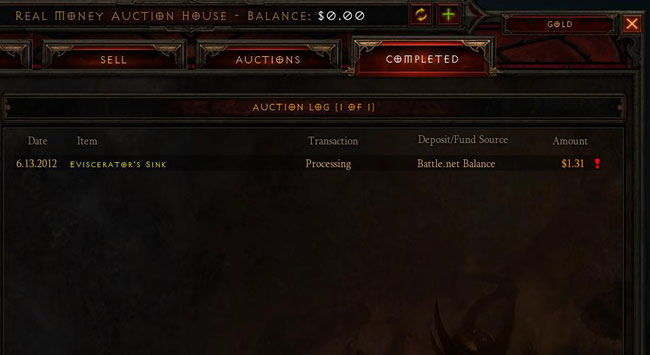
I… wha… who…?
The real-money AH went Live on Tuesday, but it was not until I went to check on my auctions the next day that I realized it. After collecting my meager sales, I decided to see if the RMAH side of things used the same 10-item limit as the Gold AH. As it turns out, you get a full ten more slots to sell things. So, in the interests of clearing out some Stash space, I tossed 10 items up on there. I let the AH set a default bid/buyout price, which simply appears to be adding a decimal to the vendor price, e.g. something that vendors for 231g becomes $2.31.
…and someone bought the Eviscerator’s Sink.
Blizzard sends you an email too:

Pics or it didn’t hap… oh, wait.
I have no idea what kind of item Eviscerator’s Sink is. My highest-level character is 40, and I technically stopped playing the game a week ago. I vaguely remember the item being in the level ~26 range, which makes the sale all the more bizarre. A quick search of the RMAH shows there are actually quite a few four-digit DPS level 60 items up for $1.25 buyouts (the minimum, netting the seller a whopping $0.25 each). So… was it a misclick? Or did somebody somewhere really want to be awesome for the next two hours?
The title is a bit facetious, although I did experience a brief spell of euphoria. That was quickly dispelled upon the sobering realization that I would have to continue playing Diablo 3. I stopped halfway through Act 2 Nightmare because I had encountered a Whirling Dervish champion pack with Vampirism and Lightning (?) qualities, as a Monk. What ended up happening was I would blow a lot of cooldowns attempting to kill them right away, they would start their Bladestorm-esque attack with a 15-yard range, and by the time I was able to move out of the damage, they had regained all the health they had lost.
Could I have augmented my talent loadout to better combat their abilities? Yes. Could I have simply avoided them? Sure. Could I be bothered to do any of that when I have a perfectly fun Battlefield 3 as an alternative? Hell-to-the-no. I did end up killing that champion pack, but when they dropped garbage rares outclassed by blue items I bought hours earlier, the loot-for-loot’s sake gameplay got suplexed by Final Strawman. Maybe I will return once melee is buffed to actually, you know, be able to reliably stay in melee range when attacking, but the future isn’t looking bright.
For me to pick Diablo 3 back up, I mean. Blizzard already made their $60 + $1 from me, and 3.5 million other people, so no water off their back. Especially not with their gold-plated umbrellas and fancy weather machines.
And The Rest
Let’s go ahead and wrap up the rest of my Guild Wars 2 impressions.
Point 10: Making Bank
Guild Wars 2 has, by far, the best inventory management system I have seen in a videogame. And it was a feature I only discovered accidentally in my final few hours of playtime.
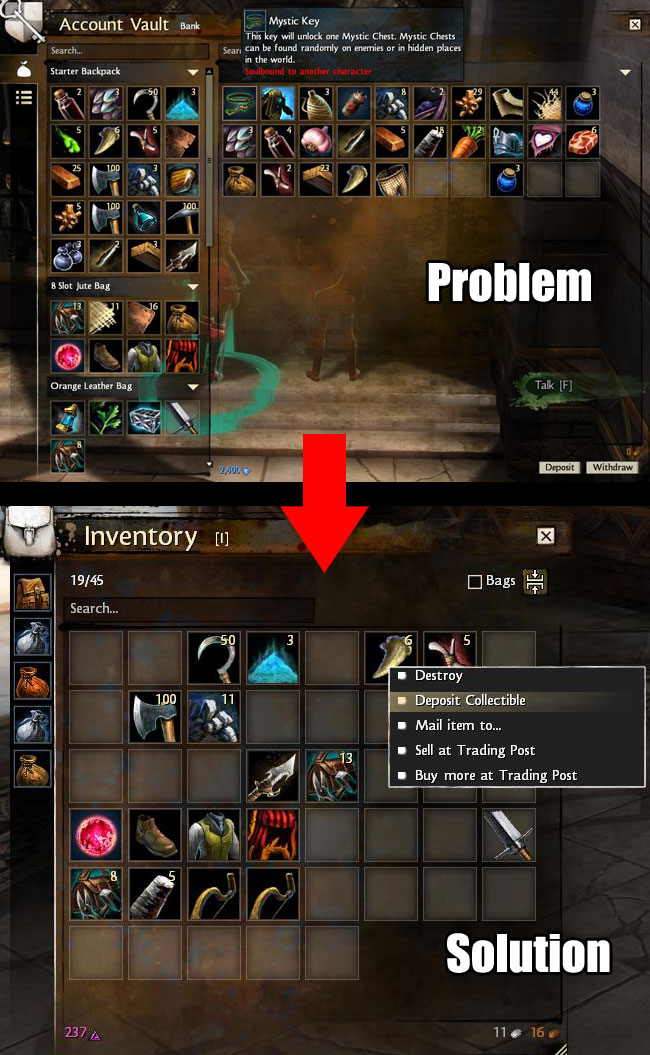
This needs to be in all games, ASAP.
It is called the Collectible Tab and it is to my eternal shame that I did not take a screenshot.
Essentially, the Collectible Tab is hundreds of organized, square silhouettes that represents all of the trade and crafting goods in Guild Wars 2 (and maybe more besides). Instead of you needing to waste precious bank space with your stacks of Jute scraps (e.g. Linen Cloth), you merely drag it to the Collectible tab and it automatically gets sorted and contained in its own little square. Or, you know, you can simply right-click the item and select the “Deposit Collectible” option. From anywhere. And by “anywhere” I mean, literally, anywhere you can open the Inventory screen. Farming bandits and find your bags are overflowing with the pilfered trophies from corpses of men you murdered in cold blood? Two clicks and you are done.
I did not think to check whether there is an upper-limit to the stack size of items stored in the Collectible Tab. All I know is that I no longer will need to do my OCD WoW bank routine wherein I manually alphabetize herbs by expansion, rarity, and the aesthetic qualities of the icon. Simply put, the banking system in Guild Wars 2 is built out of win.
Point 11: The AH on the other hand…
There is a very specific thing that happened to the AH, for a very specific reason, and it has soured my experience with it somewhat. What happened was this:
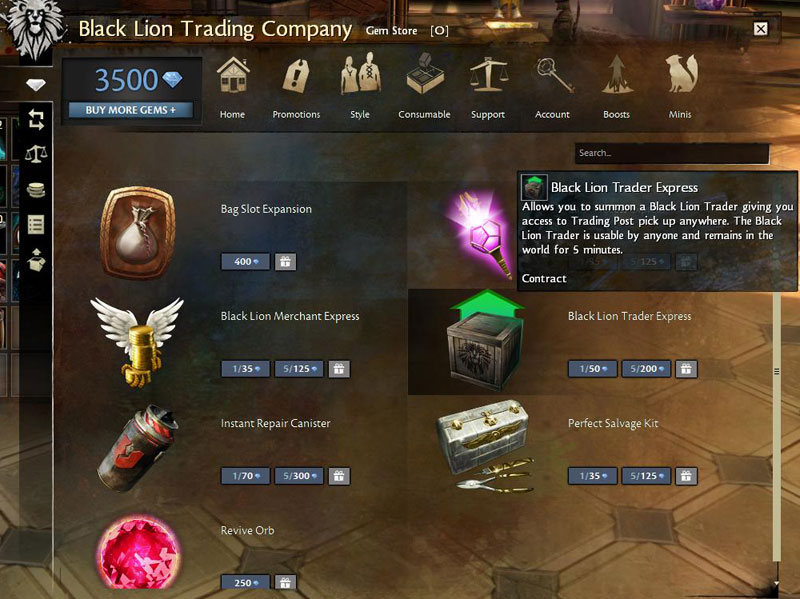
Oh, RMT. Is there ever a bridge too far?
Basically, ArenaNet took the ability of players to retrieve their successful auctions from anywhere, limited it to the Trading Post NPCs, and then are selling consumables in the cash shop to allow you to pick up your items anywhere… for 5 minutes. Considering you can teleport to within 30 yards of the Trading Post NPCs at any time from any where, this might come across as a tad… nitpicky. Entitled, even.
But let us be clear what is going on here. You can sell, buy, and browse the AH from anywhere in the game world at any time. And during the first beta weekend, you could also pick up your successful auctions (money and items both) from anywhere as well. Now you cannot, and there is consumable cash shop item that temporarily restores the functionality. Granted, the Trading Post NPCs did not have much of a purpose before, but that is a design problem with an easy solution, e.g. remove them. Or leave them as reminders to those who forgot you can access the AH from anywhere by pressing “O.”
I can recognize the cognitive dissonance between my accepting as intuitive the fact that you cannot withdraw from your bank from anywhere, and the obviously analogous Trading Post situation. Maybe this is only an issue with my seeing the monetizing team in action – had this been in the first beta weekend, it might be that I wouldn’t have thought any different. Nevertheless, I seen what they did last summer, and I had/have a problem with this change.
Everything else about the AH is fantastic, although I must admit that Buy/Sell orders somewhat diminishes the thoroughly soothing gameplay I find in searching for AH bargains.
Point 12: Guilded
I did not actually join a guild, but I thought this was a good idea:
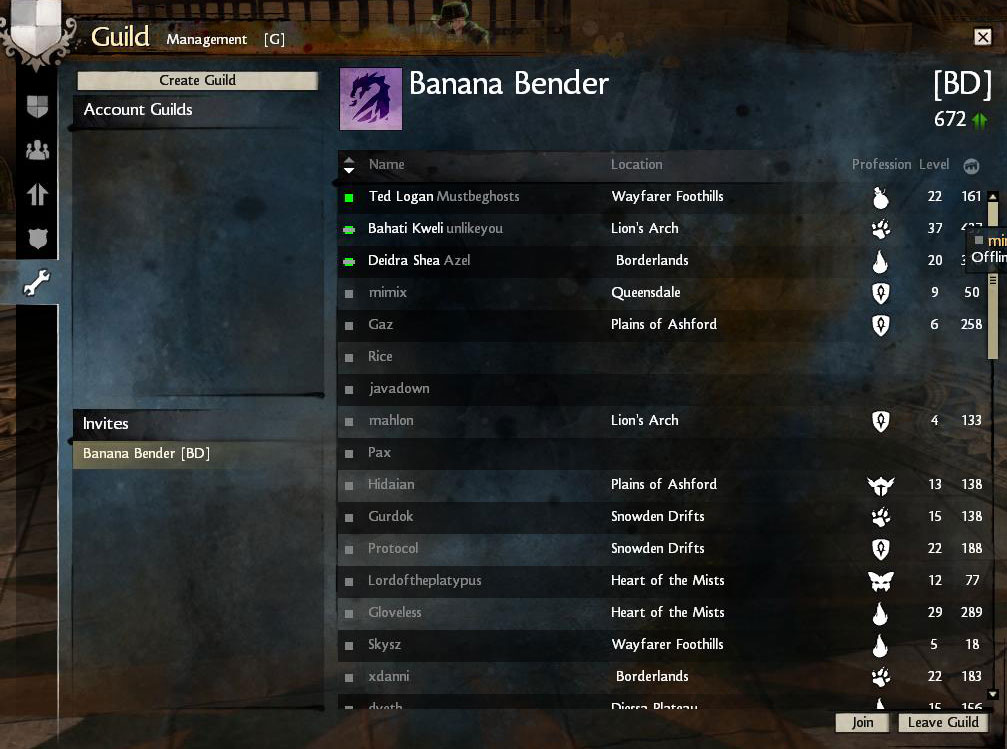
Kinda like a Background Check.
When you click on a Guild invitation, it takes you to a screen that allows you to actually look at said Guild’s roster before joining. This is another of those common sense features that you wonder why are not in more games. The only thing missing is a Cover Letter and perhaps a list of three things the Guild is bad at.
Point 13: Minecrafting
This is 100% a personal preference thing, but I’m not a huge fan of the crafting system in Guild Wars 2. There are a number of surprisingly complicated base recipes – when was the last time you saw a game that requires you to construct a wristguard strap and wristguard padding before combining the both with a 3rd ingredient to make a pair of gloves? – but the vast majority of recipes comes from the “Discovery” system, aka the Trial & Error system.
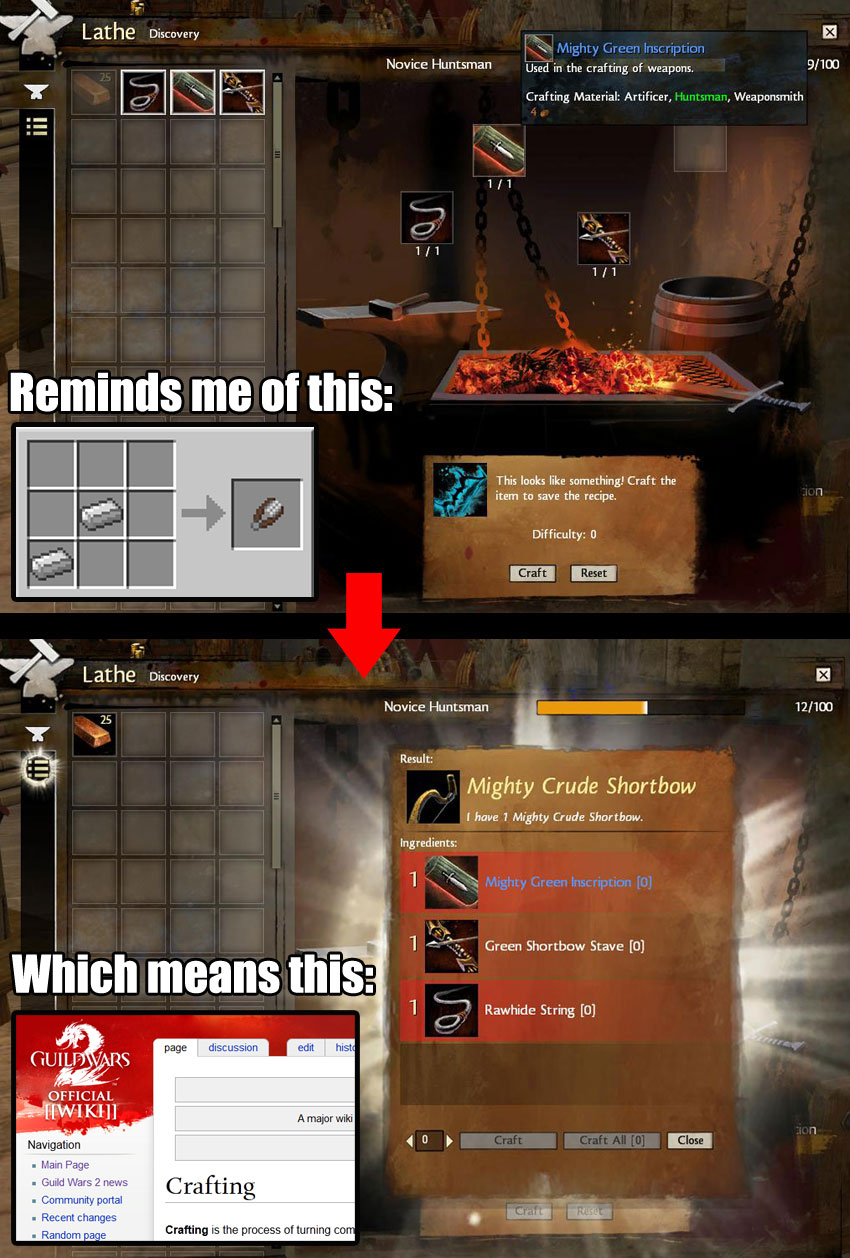
Oh, good.
Or, perhaps most likely, the “Just look at the damn Wiki” system.
The bow in the above picture is a lame example, of course, but I otherwise find zero entertainment in such “just try it!” crafting systems. My brain simply doesn’t work that way; I am too damn methodical. Do you know the first thing I did when I built a crafting table in Minecraft? I put a piece of wood in the first empty square. Then I put another piece of wood in another square beside the first. And then I moved the second piece of wood over one square. And then moved it again, in sequence, around the remaining empty squares. Then I added a third piece of wood, and repeated the process. If you asked me to crack the combination code to a briefcase, I would start with 0-0-1 and end with 9-9-9, X number of hours later… if I did not simply throw the briefcase out the window beforehand.
Don’t get me started on Word Finds, or that Doodle God app.
I saw the following quote during the first beta, but I forgot to specifically notate it:
Originally posted by Linsey Murdock
Cooking is considered our advanced craft. It will cost you more money, karma, and time traveling the world than any other crafting discipline.
Pro Tip: Every cooking recipe in Guild Wars 2 is a real recipe for real food in real life (or a basic approximation). If you think you are close to figuring out one of the combinations, google a recipe for the food you suspect it might be, and odds are, you can find a bunch of recipes for things like that to try out.
If you like this sort of thing, you will like Guild Wars 2 crafting quite a bit. If you don’t, you will probably be Alt-Tabbing to the Wiki like myself.
Incidentally, this is also true of the crafting system:
Originally posted by Linsey Murdock
The way leveling XP gain works in crafting is this: For leveling a discipline from 0-400, you will gain 10 levels along the way. By maxing out all 8 disciplines, you will gain 80 levels. That means you could dedicate a character to crafting, feed it all the mats you get on other characters and level it all the way to 80 without ever needing to kill a thing. As hardcore crafters, we think that is pretty cool.
__________
Conclusion
That about sums up my impressions of this second beta weekend. If/when the third beta weekend comes along, my tentative goals will be the following:
- Test the Norn/Charr areas more thoroughly to see if I run into the same pacing issues I experienced in Queensdale.
- Verify whether it was user-error in Queensdale after all.
- Level a character high enough to see how the “trinity-less” dungeons work.
- Sell my gems on the AH so I’ll have more than 10 silver to rub together.
- Continue being angry at puppies, rainbows, and the laughter of small children.
So look forward to that. I know I am.
The Problem with GW2’s Questing
[Update: Please note the missing link photo]
Reading some of the positive comments about Guild Wars 2’s “Explorer-friendly” questing, I cannot help but feel… confused. I understand that there are people out there that do not like traditional questing. That is fine. The problem presents itself when ArenaNet decides to go through the motions and try and placate those of us who like our themeparks to have, you know, themes. And let’s not kid ourselves: Guild Wars 2 is a themepark. Maybe one with a few sandbox rides, but a themepark all the same.
Rather than attempt to explain the problem again, and why it is a problem how ArenaNet is handling it, I am going to simply show you. My apologies to those with 16.6k baud modems.
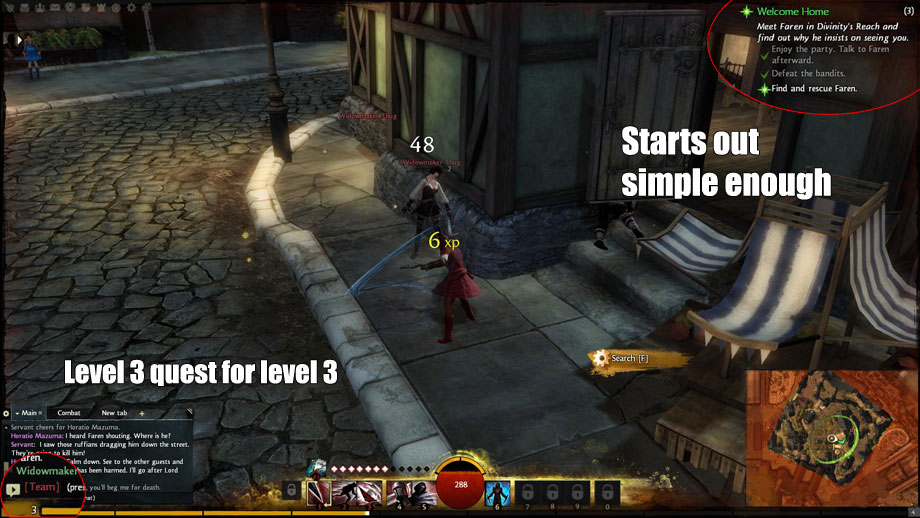
Step 1, Start doing the Personal Story.
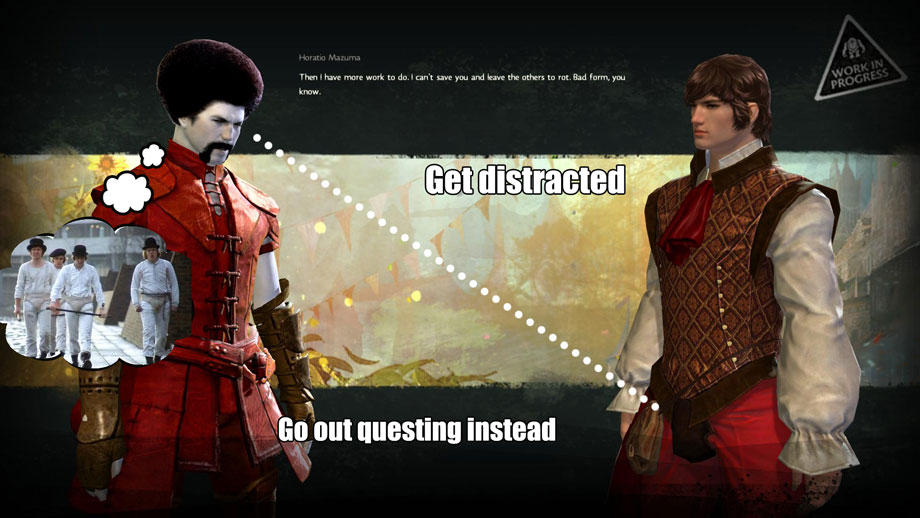
Step 2, decide you want to help farmers for a while.
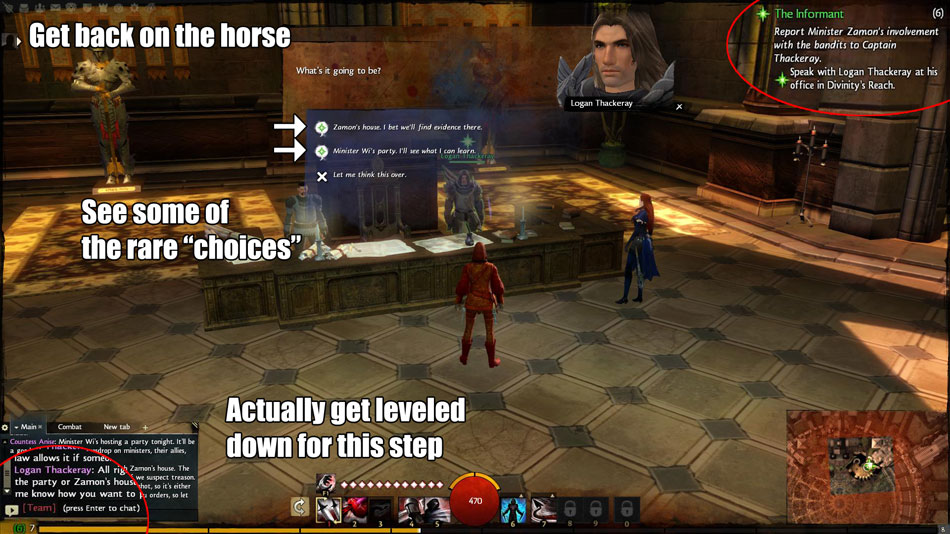
Step 3, Get a little ahead of the curve.
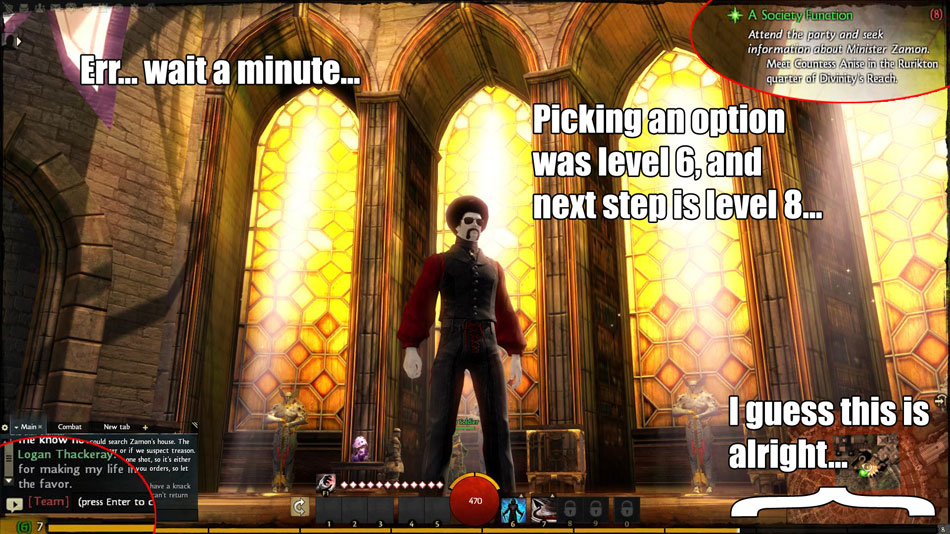
Step 4, Start getting worried.
_________________________
[Edit: The following picture was accidentally left out of the series, and provides some much needed context for the remainder]
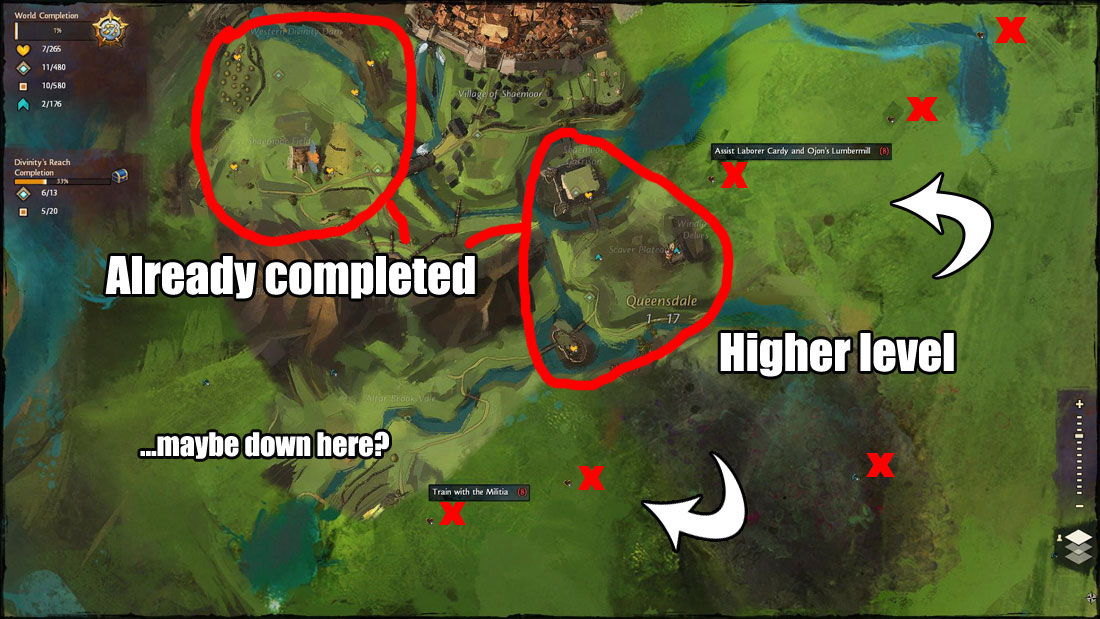
Step Missing Link, I have done all that you asked.
If the above is not immediately clear, I was looking at my map to see if there were Renown Heart quests undone in my endeavor to finish level 7 and start the next step in the Personal Story quest. The only available quests were set for level 8 characters, although I never saw what was down in the South-West. While it is possible to quest above your level, GW2 makes it abundantly clear that it takes levels very seriously – as evidenced enough by the fact the game will de-level you down to the “appropriate” level for questing to be challenging. [end-edit]
_______________________
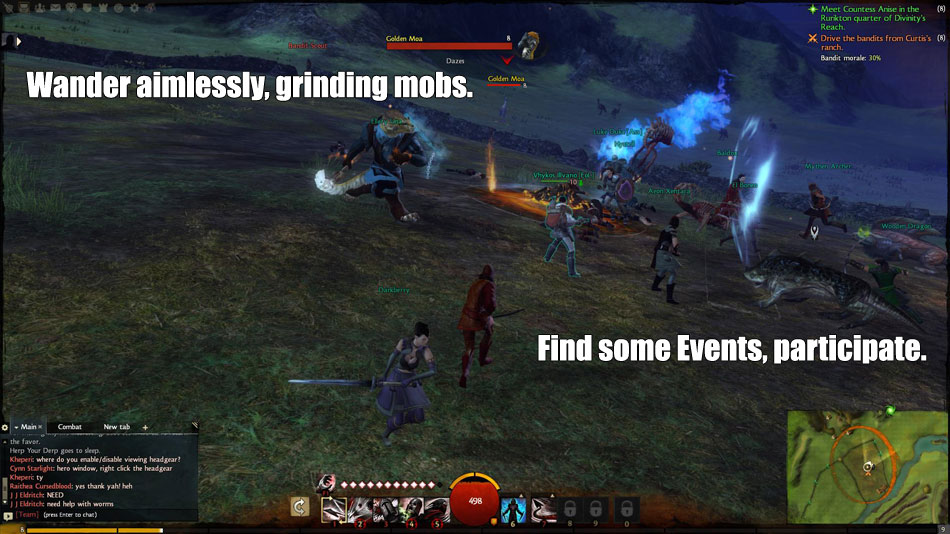
Step 5, Just do it.
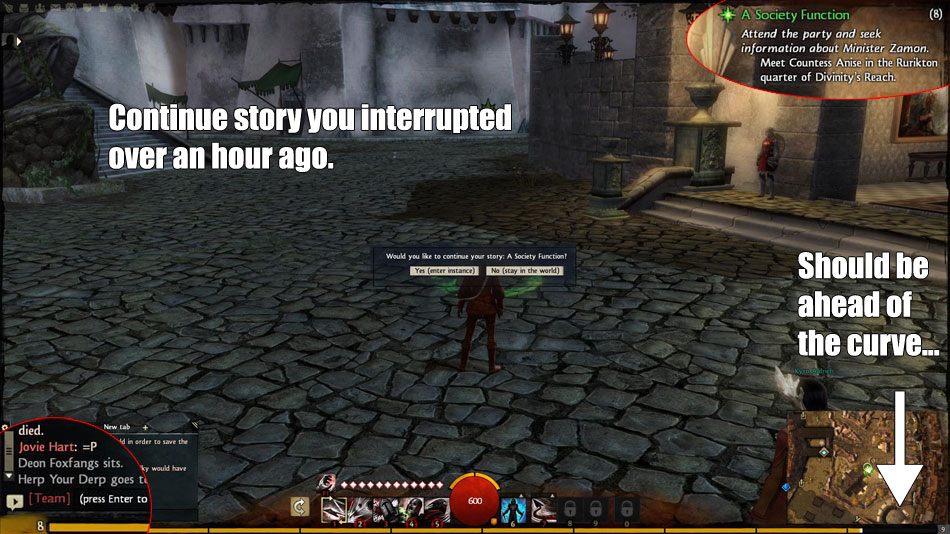
Step 6, Back to doing what you want to do.

Step 7, Have some fun.
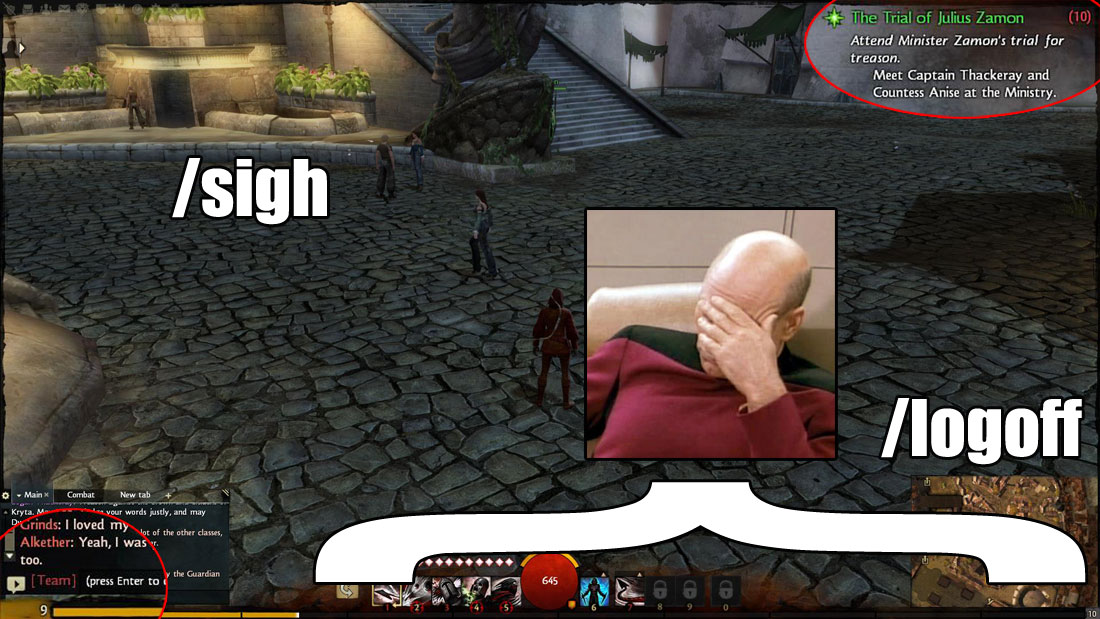
Step 8, Go play another game.
To be clear, I have nothing against an Explorer-based leveling game, or one that allows you to reach max level solely by PvP or chain-running Events or even grinding mobs. Hell, I do not have anything against strict sandboxes either, even if I do not play them all that much.
The problem here is one of coherency. The Personal Story thus far is perfectly serviceable, all the way up to the point where you choose to attend a dinner party and discover you need to go play outside for an hour for an entirely arbitrary reason, e.g. you haven’t leveled enough. As Keidot pointed out in the comments yesterday, it does make a certain amount of theoretical sense to structure the game this way. If you can level solely by the instanced Personal Story quests, what is the point of the outside world? Grouping them up better (instead of spacing each quest out by 2 levels) could potentially leave you performing nation-defining epic actions by level 10, diminishing the weight of your future exploits. Clustering them sounds good, e.g. 1-10 and then 15-25 (etc), until you realize that there had better be 5+ levels of interesting grinding/Event activities to participate in.
I do not have an easy solution to this problem. And believe me, it is a problem. It is one thing to be given a vague motivation to go out and do random Renown (aka Heart) quests, and be satisfied. It is quite another to be following a storyline and then be constantly interrupted to complete tasks that have nothing at all to do with the storyline itself. People talk about joys of not having to read quest text anymore, and maybe they even believe that, but this sort of textual background radiation is what differentiates the character and tone of one MMO against another.
And nevermind what this suggests more generally about the designers’ (future) abilities to pace their own content.
Guild Wars 2: First Blood
So apparently I still pre-own Guild Wars 2.
Have you ever received a rebate check for a product you do not remember purchasing? That is about how I felt towards this Beta Weekend part deux. “Oh. This is still a thing, isn’t it?” I asked myself, rhetorically. “Better get on with it, then.”
When we last left our brave adventurer, I was on Point 5. So…
Point 6: You will never be as cool as me
Exhibit A:

Go ahead, you can stare.
I was tempted to leave that glamor-shot in its full resolution – you know, for the ladies – but it is already dubious as to whether the RSS feed can handle this level of BAMF, let alone with an extra thousand unfiltered pixels. Horatio Mazuma simply has that effect on people.
Point 7: Combat still feels… meh?
I spent a lot more time playing as the rogue Thief this time around, aka Horatio, and I am beginning to doubt the… legitimacy (for lack of a better term) of the combat system. When running around with double-daggers, your five skills are:
- Auto-attack.
- Heartseeker: Leap attack; more damage the less HP target has.
- Leaping Death Blossom: jump behind enemy, inflicting 3 Bleeds.
- Dancing Dagger: Ranged snare that bounces between 4 enemies.
- Cloak and Dagger: Inflict debuff and then stealth for 3 seconds.
Sounds cool, right? And it is. There is a kind of intuitive logic to those abilities, a sort of rhythm when you use them. Something woefully missing with many other weapon “combos.” For example, bust out a sword + pistol and you get:
- Auto-attack.
- Infiltrator’s Strike: Shadowstep to enemy, press again to teleport back to original location.
- Pistol Whip: Stun, then stab with sword.
- Black Powder: Basic shot + blinds nearby enemies.
- Head Shot: Basic shot + interrupt.
Those might sound alright, but in practice it just feels weird. None of those have a feeling of rotation or synergy, and it feels especially awkward to me when I couldn’t use Infiltrator’s Strike to “charge” to the next enemy because the return teleport option doesn’t go away for a long time. I suppose that this weapon combo may be better suited for PvP than PvE, now that I think about it. All I know is that the combat felt bad during this time period, and felt similarly bad when I was on the warrior unlocking other (possibly PvP) weapon skill sets.
Incidentally, the “play melee at your own risk” warning applies the same as before. I joined a “group” of players for a nearby event on two separate occasions with melee characters, and both times the mobs suddenly gained 2+ levels to “compensate” for the number of participants with predictably bad results. Nothing quite like running a level 6 event and then have a swarm of level 8 ghosts instantly spawn and mow down the front ranks.
Indeed, the more I experience the combat system in general, the less legitimate it comes across. Presumably you are supposed to be circle-strafing all the time to avoid positional damage, right? Or at least actively Dodging. But I am finding it incredibly difficult to ascertain the difference between a “Dodge this or else!” attack and a run-of-the-mill claw to the face attack. The mobs with a breath weapon? Sure, that’s simple. However, I am not in any particular mood to start memorizing the arbitrary Poker tells of a hundred different fantasy monsters when I am grinding XP yet again. In fact, let’s talk about that too.
Point 8: Quest Contortionist
By which I mean: the questing in Guild Wars 2 is disjointed.
You are given a “My Story” plot-driven series of quests which, at first blush, appears to be the “point” of the PvE game. There is some murder, some intrigue, a little treason, and enough hooks to get you to want to see where all this is going. But… you can’t. After finishing a quest wherein we decided to gather evidence against a particular government official, I found that the next step of the quest was 1.5 levels away. So… yeah. I opened my map, looked for a “quest heart” in my level range that wasn’t already filled in, and teleported to a field I knew bandits frequented so I could start farming the 0.5 levels I needed to gain before I could reasonably complete the quest hearts I found. Apparently there is an expectation that you will be filling in every heart and every Event in the area, or perhaps supplementing the XP gaps with WvWvW.
Or purchasing the +50% XP potions from the cash shop. Just sayin’.
Thing is, I did not care about these stupid farmers with their Israeli Settlements in centaur country. None of that had anything to do with the plot against the crown, which I was just in the middle of solving. Why am I out here again? There is zero connection. This is not equivalent to the sort of expansion-wide story arcs of WoW; this is literally a quest saying “I think Minister Wi was involved. Go gather evidence from that cave (Recommended level: 8).” And instead of doing that, I need to kill the spiders infesting the apple orchid because pies.
Point 9: Sharing is Caring
Remember how individual looting was the sort of wild-idea innovation that felt so good that you wonder why so many MMO companies did not jump on it earlier? Well, I have another one of those: individual resource nodes.

Genius!
If the picture is not clear enough, both myself and the esteemed Luke Duke [Ass] are mining the same Copper Ore node. As in, both of us are getting the customary 3 ore from this node. What makes this noteworthy is that to reach this node, we had to defeat 5-6 giant spiders to get there. Had this been, say, WoW or many other MMOs, I would have either glanced warily at my competition and went elsewhere, or attempted to ninja the node while Luke Duke [Ass] was occupied with spiders. Instead, we each had a common cause, a reason to work together, to get to the same exact location. It was 1+1 = 2, rather than the zero-sum game it typically is.
_________
More impressions about crafting and other miscellaneous items will have to wait.
The Pulitzer Prize for Videogame Narrative Goes to…
…Diablo 3, of course.
Super Meat Boy had just pulled ahead with the judges, until this narrative bomb dropped:
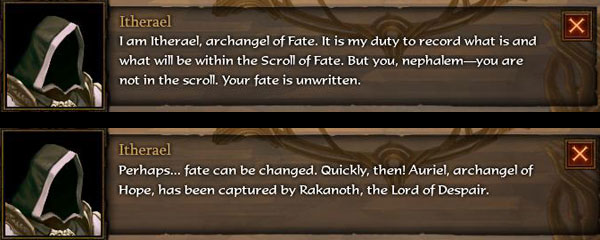
Technically, I guess this constitutes a spoiler…?
Do not let that last line wash over you; let it sink in. “Auriel, archangel of Hope, has been captured by Rakanoth, the Lord of Despair.” Hope had been captured by Despair! Is there a word to describe a metaphor so superficial and goddamn literal that it becomes a mockery unto itself?
All I can think of is “nadir.”
Neither the Diablo series¹ nor the hack-n-slash genre is exactly known for their compelling narratives, and that is fine. Campiness has its place, and that is fine too. But the shit Diablo 3 attempts to pull with a completely straight face is simply ridiculous, bordering on insulting. It feels like placeholder plot, especially in a severely truncated Act IV.
Take, for example, the exchange I posted above. Scroll of Fate? What does it add to this story that such a thing exists, or that the character is outside of it? I am not talking about the idea of a Scroll of Fate and an unbounded main character – that is perfectly fine as a story device, such as in Kingdoms of Amalur, etc – but the Diablo series has never been about that. Remove that bit of dialog (please), and nothing materially changes about the narrative. Maybe there is a tie-in between the prophesy at the beginning of the game and this Scroll of Fate, but that link is so tenuous that the writer is either being too subtle by half, or in wont of an editor with a backbone.
And then there is the Enchantress, whom is introduced as a character by being a wizard kept in stasis for 1,500 years to aid the hero in his/her prophesied time of need. While there was apparently a legitimate attempt to have this add something to the story, I could not help but think that maybe the Prophet should have let the Archangel of Fate look at his crib notes since the hero was apparently featured in them.
It could be that all of this is a setup to an expansion (or two) in which we explore all the random, seemingly banal things the companions said. But, again, that would necessitate a level of subtlety on the part of the writer(s) that is simply incongruent with the John Madden-ning the Prime Evils do throughout every step of Acts II-IV. “What’s that, Diablo? I will never close your portals to Hell? I will never close your other portal to Hell? I will never make it past your lieutenant? I will never make it to you in time? I will never actually read in-game text that is not magic item properties after this and all subsequent playthroughs?”
Damn, you’re good.
¹ I realize that this is actually an arguable point. As one forum poster described, the narrative was much more poetic and Biblical throughout (most of) D2 at a minimum. The Moldy Tome, for instance.
Console Exclusives Need to Go
It is 2012. We should not be living in a world in which I cannot play The Last of Us without buying a six year-old, $250 console. I mean, look at this:
Metal Gear 4 wasn’t enough, but goddamn if The Last of Us pushes me to it. Probably not really, but who knows what kind of holiday sales there will be between now and then. Hopefully one that includes the Ico/Shadow of the Colossus HD pack, MGS4, and… err, the Uncharted series? Am I missing something else exclusive to the PS3 worth playing?
Also, looking forward to Far Cry 3. Luckily, it will be on the PC.
The Diablo 3 AH is Dumb
The Auction House in Diablo 3 is stupid. By which I mean dumb. Idiotic, even. Both Auction House and whoever designed it. And not because of what it may or may not do to the entire balance of the game, but because it is poorly designed period.
You can sort by Buyout price, but not Bid price. Presumably the latter is disabled because the Bid mechanic itself is broken. Much like eBay, you specify your top bid amount and then things are auto-bidded up until someone has the new highest bid. Except the Bid price is not updated in the main auction pane, nor is it reliably updated when you hit refresh. The only true method of discerning the new high bid is to bid once so that it goes to your Auctions page and looking at it there.
By the way, you cannot sort by Time Left either. At first, I thought Blizzard was doing this for our own sakes so as to not recreate the eBay-esque last-second sniper fields. But it occurs to me that the sellers actually win when people do last-second bid wars; the losers would be Blizzard themselves when they get 100,000 people spamming the Refresh button and eating up all their bandwidth.
The AH has a 46-page limit. It is thus possible that if you are searching for any old magic weapon in your level range, sorting by lowest buyout price may leave you with no auctions with buyout prices at all since “null = lowest.” If you want to ONLY look at auctions with buyout prices, you will need to specify a maximum price. Put something cheeky in there like 10,000,000g or whatever, and then sort from there.
Want to sort by weapon DPS? Good luck.
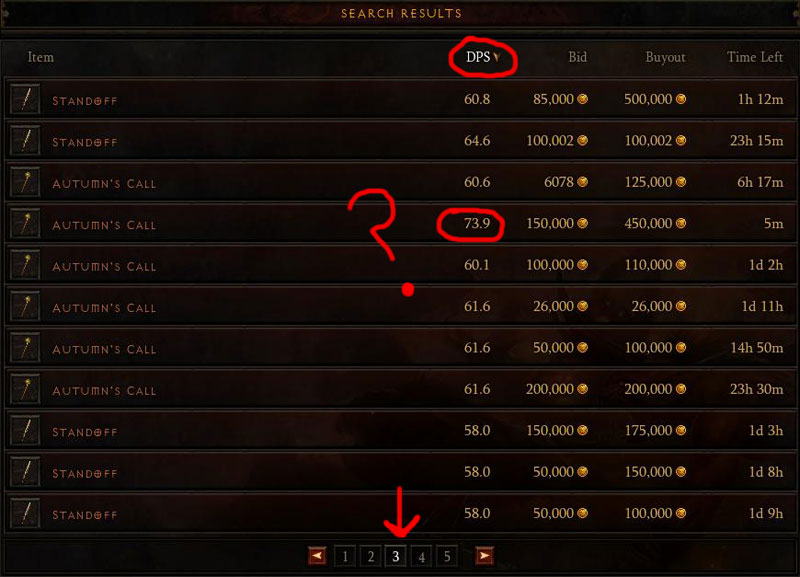
Because that makes sense.
Apparently the “Sort by DPS” script only looks at at the vanilla weapon DPS without factoring in any bonuses, such as +damage or +weapon speed. Which would be one thing, if some secondary script did not compute that exact thing in the DPS column. So if you are using this method to look for weapon upgrades, make sure you check several pages in to be sure some errant +10% weapon damage stat doesn’t outclass all of the items on the first two pages. And, of course, don’t forget how your class’s primary stat will likely further affect things.
Also, big props for the Blizzard designer who thought it would be a keen idea to have the Repair All button not apply to items in your Stash. Since you cannot sell items on the AH with durability damage, it becomes a fun Hide-n-Seek mouse-over minigame (or a Memory one, I suppose) each time you are forced back into the game when the item you want to sell has 48/49 durability.
In other news, I beat the game on Normal with the Monk. Because, hey, Barbarian was fun but I have played the first Act nearly a dozen times already. The pop-up after the final boss reminded me of something though…
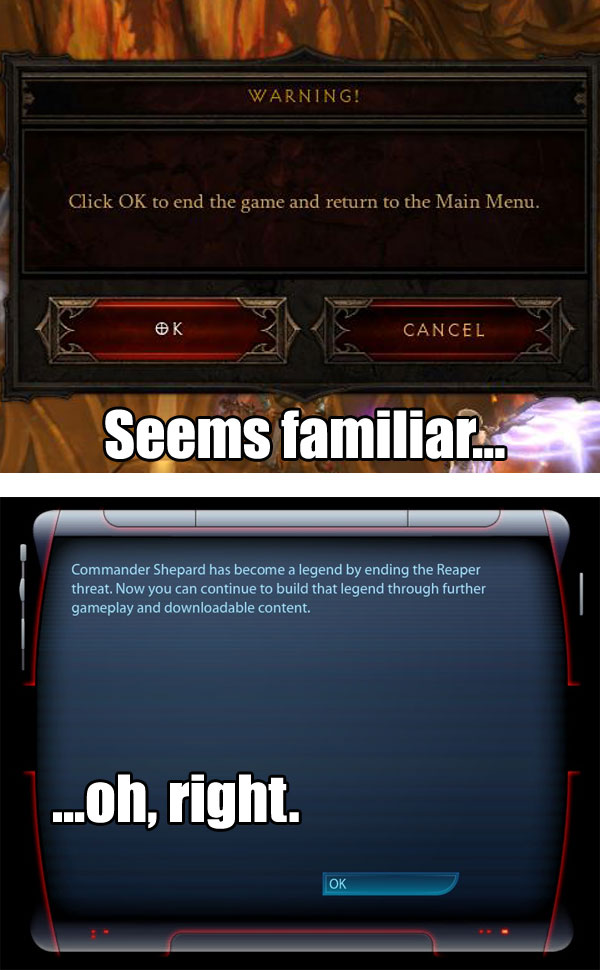
Must have been brothers from another mother.
My current time /played says 14 hours and 5 minutes, but that includes however long it took to breeze through Skeleton King in Nightmare. I remember the very first zombie in Diablo 2 kicking my Necromancer’s ass in Nightmare – the weakness of any skeleton army build is needing unused skeletons – but perhaps my ill-gotten AH goods have been keeping me ahead of the curve. Or perhaps the difficulty wall is down the road.
Regardless, I will probably keep playing the Monk until I’m forced to kite as a melee character, at which point I either see if I can stomach another character through the campaign or simply play something else more deserving of my time, as the case may be.
In Fairness
If it appears as though I am being unduly harsh towards Diablo 3, it is probably because I am juggling at least two other extremely fun games simultaneously: Tribes Ascend and Battlefield 3. My normal M.O. is to focus on one game to the exclusion of all others until completion, perhaps for this very reason, e.g. I start making unfair comparisons. Do I really want to gain 7 levels on the Witch Doctor to get a summon that won’t die instantly to mob packs, or do I want to charge through a photo-realistic shooter and knife that cocky sniper right in his camping throat?
Also, explosions.
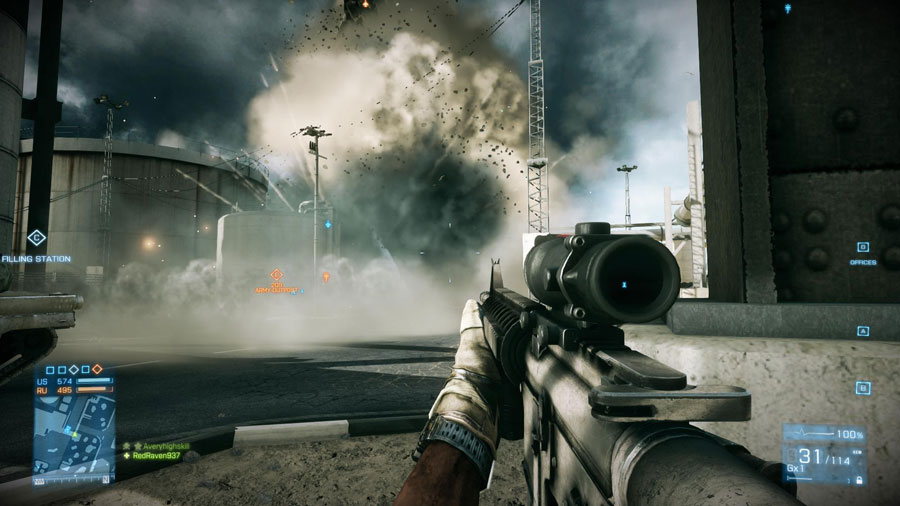
This sort of thing just happens.
So what has been going on lately is a division my time between those three games. And since I have already covered my Diablo 3 experiences, it seems only fair to talk about the other two.
Tribes Ascend Impressions
I never played any of the prior Tribes titles, although I know of them by reputation. After many weeks of suggestion, a friend of mine finally convinced me to download this ostensively F2P title. I cannot speak of the fidelity of the experience as compared to the past games, but I do find it quite enjoyable.
The biggest thing I want to mention though, is how HiRez handles the F2P side of the game.
It is, in a word, insidious.
Right up front, they tell you that if you become a VIP member, i.e. spend any amount of money, you will get a permanent 50% boost to XP gains. While I am typically inoculated to the sort of XP boosters that are common in F2P-land, the knowledge that for every match that I waffled on the issue would be half a match’s worth of XP lost got under my skin right away. Indeed, considering that you can unlock classes/upgrades/weapons with either XP or gold (RMT), it felt like a decision between a double whammy or double rainbow. And the $10 minimum buy-in? Seemed reasonable anyway.
And that’s when the thumbscrews come out.
First, there is a “deal of the day” that discounts anything from a weapon to a class to anything inbetween by 25-50% gold. Then, you get a +1200 XP bonus from your first win of the day. So already it is giving me the same vibe I get from Steam, wherein I feel like I need to at least log on for a few minutes to see what’s what. Getting that first win is not always forthcoming, and while you are stewing on an embarrassing loss, you get to thinking about that 240 gold (~$3 at the worst exchange) or 100,000 XP (~29 VIP matches or 45 free ones) weapon that would wildly change the nature of whatever class you like. Or whether you should go ahead and splurge a few thousand XP and upgrade your current gear to get extra grenades or armor or whatever.
The game is still fun, and it is great that you can go check it out for yourself to see if it’s your own cup of tea, but I vastly prefer these F2P game companies to NOT have my number down to the second decimal place. For my own protection.
Battlefield 3 Impressions
Meanwhile, BF3 can have all my digits, if you know what I’m saying.
Now that I think about it, things are oddly coincidental. Freshman year of college, I came to the dorms with my big bulky Gateway computer loaded with Diablo 2. Then I was introduced to Battlefield 2 my Junior year and played it with a depth of intensity that rivaled even my most solipsistic WoW days. And now the circle is complete.
In any case, there were some concessions made in BF3 to the CoD movement – the removal of the Commander role being the largest – but trying to sneak around the backside of a tank to plant some C4 while jets dog-fight in the air above you is exactly the same. Indeed, what has been the most difficult part of the acclimation process is training yourself to ignore the wildly amazing graphics and actually find the dudes you are supposed to shoot at.
Also, you die really fast. Bullets are OP. Until you are shooting them, then it sometimes feels like you’re shooting a Terminator.
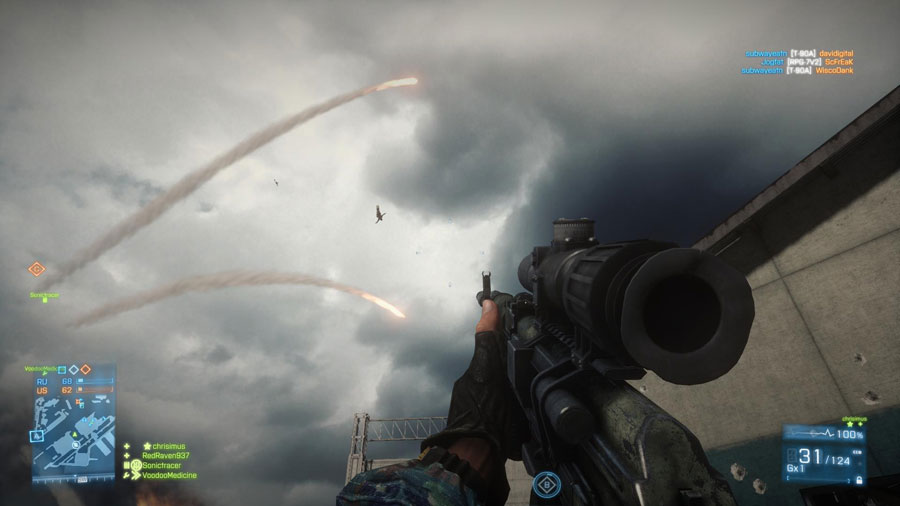
That guy won’t be back.
Technically BF3 has the same sort of unlocking mechanism Tribes does – complete with “shortcut bundle packs” for a whopping $40 – although it feels in no way necessary. As much fun as I will have once I finally unlock Claymores, I am having plenty fun already with the “base” classes.
One of the things I have always loved in BF2 that is back in full force is the incentivising of teamwork. Killing a guy results in 100 XP, with headshots adding +10 XP. If you notify your team about a hostile soldier’s location (i.e. look at them and press Q) and someone else kills them, you get 10 XP. Shoot at a dude in cover, while your teammate circles around back and kills him? 50 XP. Help cap a flag? 200-250 XP for making the flag neutral, and another 200-250 XP for capturing it. Giving your teammates ammo or health packs is 10-20 XP per tick. If a member of your 4-person squad chooses to spawn at your location instead of a normal spawn point, you get 10 XP. Reviving a teammate as the medic ahem, “Assault” class is 100 XP. And so on.
In a very real sense, this is exactly the genius of the series. You do not have to be a pro-shooter with lightning reflexes to A) have the most points, or B) make a difference. You can lead the boards by going 0-10 and simply playing support to those with better shooting skills than yourself. More importantly, matches are not All or Nothing, zero-sum affairs. You can lose and still come out with more XP than most of the players on the winning side. This is the way I wish more MMOs were. Things would need to be tweaked, of course, but what exactly is the point of the winners walking away with three times the Honor of the losers? I join a lost-cause match in BF3 and you know what? I fight exactly the same as if we had a chance, because that is what’s fun and I won’t be punished for “wasting” my time.
Anyway, it will be interesting to see if I feel the same a month down the line, as I acknowledge that my spiritual experiences with Battlefield 2 might be overwhelming the rational centers of my brain concerning the sequel.
So far, very good.
Design Notes I Like to See
From the latest Dev Blog:
That said, we also wanted to let you know we’re keeping a close eye on Inferno. The intent of incoming damage is that it should be a very consistent drain on your health, and mitigating that drain is a major part of what makes Inferno mode difficult. Right now, there’s a lot more damage “spikiness” occurring than feels right, and that’s one major area we’re looking to adjust in patch 1.0.3. While we don’t have any specifics yet, our design goals are to support and promote build diversity; continue to ensure that a mix of champion packs, rare packs, and boss fights are the most efficient way to acquire the best items in the game; and ensure that all classes are viable in Inferno.
[…]
We’ve also seen some people saying our intention with Inferno is just one-shot you to make it difficult. While damage is a bit spikier than we’d like, we’re actually seeing a pretty significant number of people attempting Inferno without sufficient gear. There’s a good chance that returning to the previous Act to farm upgrades will do the most to help you survive. That said, we’d like to shift some of the focus away from survival and more toward using a variety of offensive tactics to succeed. Survival will still be important, but finding ways to maximize your damage while staying alive is more exciting. We’re not particularly concerned with whether or not a boss is “beatable,” though it should feel epic and challenging to defeat it. We’re more concerned with ensuring that acquiring 5 stacks of Nephalem Valor and taking on as many Champions and Rares as you can remains the most challenging and rewarding way to play.
And then there is this bit about the crafting:
Other areas of concern have been both the gem combination system and Blacksmith leveling and crafting costs. The intent, especially with the Blacksmith, is that he’s leveling with you, you’re able to use him as an alternate source for upgrades. Our design goal is that once you get to level 60, his recipes are actually good enough to help fill a character’s potential itemization gaps. To correct these issues, we’re looking to adjust the Blacksmith costs for training (gold and pages) and crafting from levels 1-59, and reduce the cost of combining gems so that it only requires two gems instead of three (up to Flawless Square). Both of these changes are scheduled for patch 1.0.3.
I had been avoiding crafting altogether because A) what’s the point when you have access to the AH, and B) what’s the point when vendoring magic items is more profitable than Salvaging them? Then again, the Commodities portion of the AH has been down since launch (I believe) and I am somewhat convinced it was precisely to get people to do their own crafting/salvaging.
In any case, after hearing the news that maybe the endgame isn’t supposed to be about endlessly kiting mobs around, I leveled up the Monk up to 17 to get Seven-Sided Strike. Decently fun ability. While I was moving talents around, I decided to give Crippling Wave another try as my left-click ability now that I unlocked a Rune for it. As soon as I did this, I ran into a pack of the flying wasp creatures and proceeded to get kited the fuck around. I cannot imagine a worse feeling than getting kited around by a mob in a hack-n-slash game.
So I logged back onto the Witch Doctor, looking for that cave with the first piece of the sword. As I was walking around, I encountered one of those bull-like creatures with the charge attack. That one move by an otherwise unremarkable mob one-shot my Zombie Dogs.
All of them.
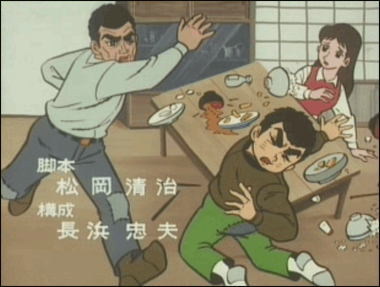
Translation: Fuck this game.
While on the level 6 Wizard, it occurred to me that I have no particular desire to kite things. If a bunch of zombie torsos leap (!) out of the bushes, I do not want my first instinct to be to Frost Nova and left-click myself away. Nor do I want to wait for however many levels it takes to get the spells necessary to actually deal what feels like some legitimate damage.
So I did the only thing left of me. I uninstalled rolled Barbarian.
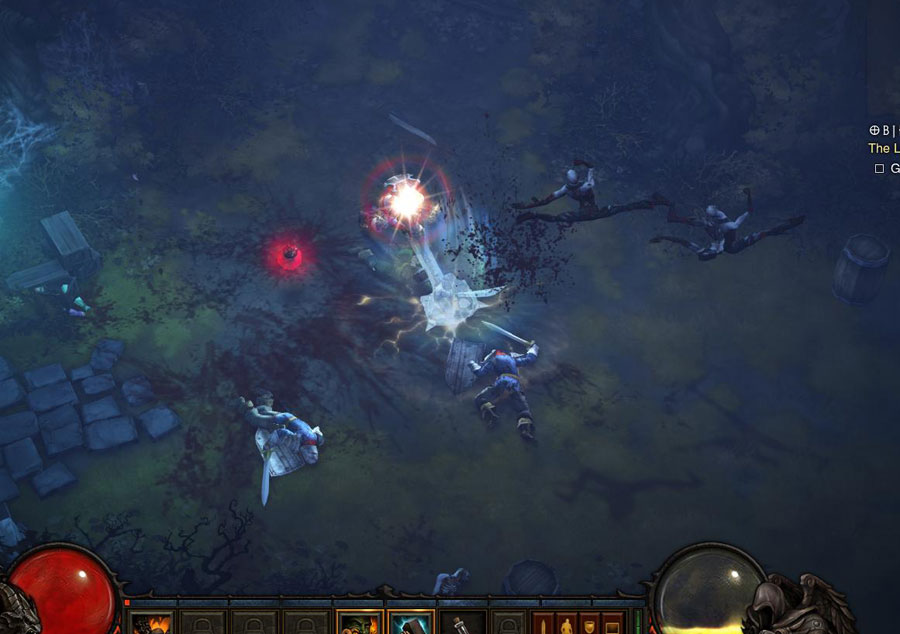
Two Lords A-Leaping~
Now, this? This feels good.
P.S. And this doesn’t look bad either.

