Author Archives: Azuriel
[Dark Souls 2 ] 45 Hours later
I’m continuing to progress through Dark Souls 2. Things have really started coming together.
Which is a shame, because it only serves to highlight how awful the general design philosophy is/was in this game. When first starting out (especially as a Sorcerer) you really don’t have the tools to survive well, presuming you weren’t already a veteran of the Souls genre. Each defeat reduces your maximum HP by 5% down to 50%, and the consumable that reverses that is not is ready supply. And you wouldn’t really know that unless you looked things up. Nevermind the invasions from other players who are likely to kill you. Which, by the way, counts as a regular death meaning your HP goes down too.
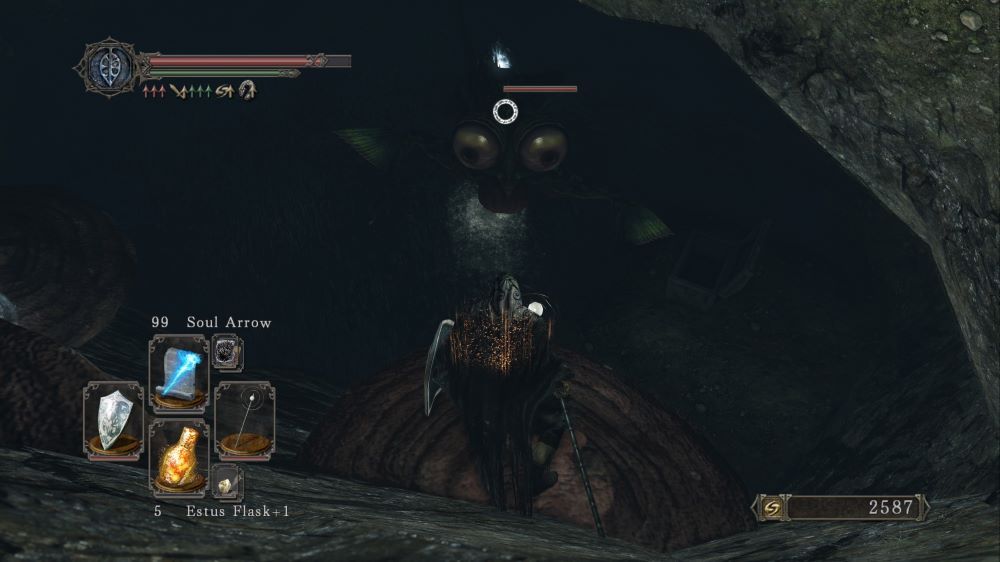
At a certain point though, things improve. My character was heading towards a pure Sorcerer build, but then veered off into Hexer and I’m loving it. Early on you barely have enough casts to step 20 feet from the Bonfires before running dry, but now I have 50 Dark Orbs, 75 Soul Arrows and whatever else I want to slot in. And those consumables? I have 38 of them ready to go.
Aside from being bullied in No Man’s Wharf, I encountered no other PvP invasions for probably another 20ish hours. Until Iron Keep. The fight was actually going my way for a bit, until the invader popped the Warmth spell on the bridge, a stationary AoE healing spell. Then he got in a stable rhythm for dodge-rolling my Affinity/Dark Orb casts and I was stuck either trying to bait him into overextending or run into melee myself. Eventually I baited him out, but an ill-timed block on my part (instead of just dodge-rolling) meant I got staggered and then he executed some combo attack on me that deleted 70% of my HP. Then he finished me off when I tried to stand up.
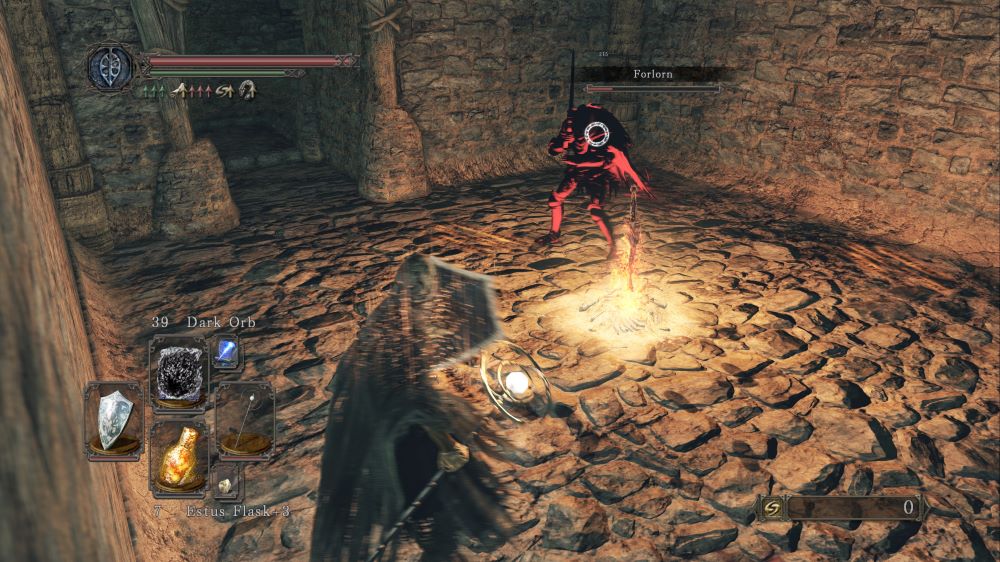
After the fight, I was kicking myself for not slotting in Dark Fog. See, Dark Fog is a ranged, obscuring fog that can poison foes very quickly. Aside from using it for area denial (like around his Warmth spell), it would also be good for casting spells through to hopefully give opponents less time to react. Plus, most Hex spells are hard to distinguish during the cast, so it can also bait them into rolling before/after the damage is done.
But the thing is… that’s dumb. Dark Fog has some PvE applications, but there’s a reason I didn’t already have it “equipped” in Iron Keep. That’s when I realized this is all by design. The threat of PvP is a “balancing” mechanism that keeps you from focusing on pure PvE (not equipping optimum souls-farming gear/spells), or if you ignore it, actively slowing your progress by killing you with invaders. Indeed, there are numerous spells in the game whose only real purpose is as PvP fodder – the “homing” spells are harder to dodge but deal less damage than normal, for example.
I understand the design logic. Adding PvP increases the design depth (“useless” weapons might be good against human players) and adds longevity and relevancy to your game. From what I have seen on some forums, Dark Souls 2 still has a relatively thriving PvP scene despite being eight years and two sequels old. That can be considered a design win, even if I don’t personally care for it.
Luckily for me, I figured out how to disable PvP via Windows Firewall. So I did.

Time will tell if I continue playing however. One of the common criticisms of Dark Souls 2 is how much of it involves “gank squads,” e.g. enemy ambushes. I can absolutely confirm that the majority of the game indeed feels like jump scares. While the original Dark Souls had plenty of surprises, Dark Souls 2 takes them to another whole level with just an absurd amount of harassment. I appreciate that enemies do not technically pop into existence (except when they do, like the Pursuers… and Forlorn… and NPC invaders…) and thus you can often snipe them from certain angles if you are aware of them. But it gets really exhausting stopping at every single doorway and swiveling the camera around to check the corners all goddamn day. Earthen Peak in particular took ages.
“So why keep playing?”
Because I want to play Elden Ring but don’t want to spend $52 (current sale) on it. Other games exist, but when I develop an itch to play a particular genre, playing something else as a distraction doesn’t make the itch go away.

Plus, you know, I do have fun after a fashion. The game is gorgeous, the dopamine hits from defeating bosses/unlocking Bonfires are legit, there is a tangible sense of both character and player progression, and the buttons feel good to press. In fact, if not for the HP penalty for dying (which amplifies the gank squad problem), I would rate Dark Souls 2 very high. There are a lot of improvements it brings to the formula, which I might talk about in a later post.
It’s just hard to enjoy a 1,000 mile journey with a rock in your shoe.
[Dark Souls 2] Day PvP
When I played the original Dark Souls, it was the Prepare to Die edition, which never had multiplayer reenabled after the hacking exploit back in 2022. As such, I never experienced seeing the messages on the ground, being able to summon friends to help with bosses, or indeed, to be invaded by players.
Well, I have since had the distinct pleasure of getting invaded in Dark Souls 2. Twice. By the same guy. And yes, this was a legit player and not an NPC – I got the Armorer Dennis experience separately.

In case you aren’t familiar with the system, here it is: you can be minding your own business, and suddenly a warning message will appear that “so and so is invading.” At that point, you cannot leave the general area (fog gates appear), you cannot fast travel via Bonfire, and a red invader (player) will show up somewhere. Oh, and you cannot Save & Exit the game. You are essentially locked into non-consensual PvP for the next 15 minutes until either you or the invader dies. Also, any regular enemy NPCs that are still around will still be around and will only attack you.
If you die, you drop your Souls wherever you are. If you manage to kill the invader, you supposedly get X amount of Souls. I wouldn’t know, because I was killed both times I was invaded.
Because here’s the thing: I didn’t sign up for PvP. In the original Dark Souls, the system was that you could only be invaded when you were Human form, e.g. something you deliberately triggered with a consumable. Dark Souls 2 has no such limitation. In fact, my max HP was already reduced by 20% because I was working my way through No-Man Wharf, which features enemies that will deal 90% of your HP in damage if they catch you with a combo. I already lost 17,000 Souls in this area just from NPCs. Well, NPCs and falling into the water once. So when I saw the invasion text, I ran back to the Bonfire at the start of the map with the idea that “at least my Souls will be near the respawn point.”

I haven’t mentioned it yet, but I’m playing a Sorcerer build. It’s been okay-ish for regular enemies, but it definitely leans towards the glass cannon side of things. Certainly, the invader I faced had a significant HP lead on me, as even though I managed to get a few full combos off on him, it only amounted to about 30% damage. And that’s the thing about this: the invader gets to pick the time and the place. Well, I guess I picked the place by running over to the Bonfire, but I was already out of spells both times he invaded, and I was running around with Soul Gain+ equipment rather than items more geared for PvP. Meanwhile, the invader can gear themselves however they want, with whatever spells they want, and they have to be in Human form to invade in the first place, which means they have their max HP. I think the only limitation is that they cannot regain HP from flasks/consumables, which sounds like a bigger deal than it is considering they aren’t likely to give you the opportunity to pop a consumable yourself. Plus, you know, I had already used most of my flasks working my way through the map.
At this point, I’m not quite certain what I’ll do. The option exists – one way or another – to basically play the game offline. That will mean zero chance at getting invaded, but will also remove the player messages and bloodstains. The messages have pretty much exclusively been memes, but occasionally there are warning about traps or illusionary walls. Is that worth having my gameplay interrupted to such a massive degree? If I tried to engage the invader where I was and died, I would have had to work my way through the entire level all over again, past enemies and traps that could kill very quickly. Nevermind the fact that since I did die, all of those enemies respawned, setting me back again. I did manage to trigger some shortcuts inbetween invasions, so I won’t start from scratch, but still.
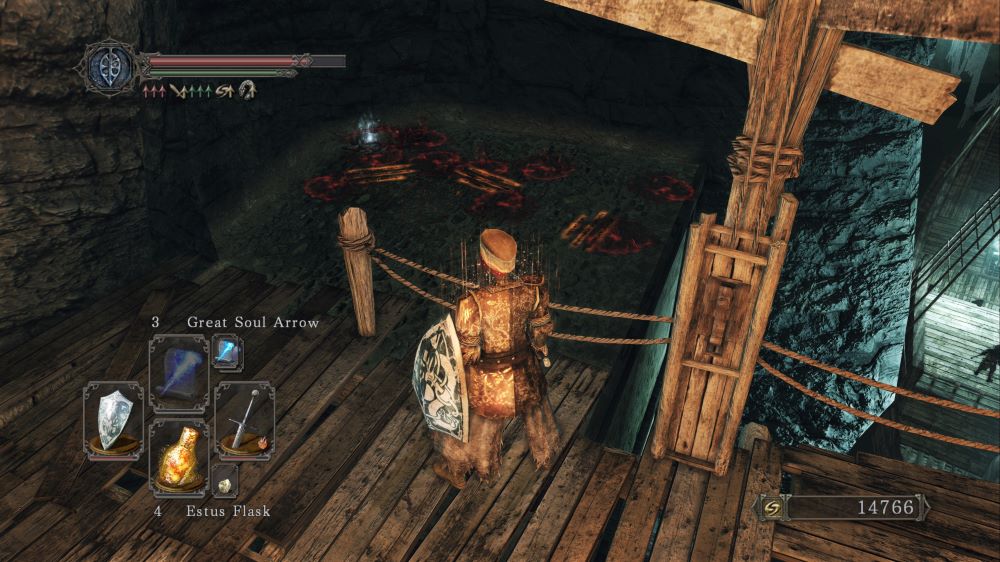
From what I read you can also just Alt-F4 to shut the game down and boot the player. Supposedly this “flags” your account and you cannot invade or play co-op until you use a special item that respawns after many in-game hours. Which would be just fine by me. My hesitation though is around the rather opaque auto-save mechanics. How much progress would I lose (if any)? Would it be perhaps worth it?
I dunno, man. Helistar recently questioned why I would continue playing this game if I already hated its fundamental design, e.g. failure cascades, etc. And that’s fair to ask. At the base level, I am having fun… after a fashion. I like the sense of incremental progression, working my way through a hostile map, and having spells/items/etc to look forward to. And remember: I’ve played dozens and dozens of survival and roguelike games over the years prior to this series, so this sort of thing is up my alley.
But we’ll see. Non-consensual PvP is not up my alley, and if the game feels worse without “social” elements, then that will be that.
[Dark Souls 2] Day…WTF
I started playing Dark Souls 2 a few days ago. And I have been in a near-constant state of aghast since.
See, the devs messed with the formula, but they did so in cruel and unusual ways. It started when I made it to the first formal Bonfire only to find no option to level up. I talked to the NPC nearby twice, but still didn’t know what was going on, so I thought maybe I had to unlock it further on. So I went forward down the only path that was visible: the one leading to Heide’s Tower of Flame. Needless to say, I was very confused as to how the armored knights were an appropriate challenge for new players who couldn’t even level up yet. Then again, this was Dark Souls.
So, spoiler alert, you have to talk to the NPC near the fire THREE times before it is revealed that she is the only way you can level up in the game. You can teleport between Bonfires right from the get-go, which I suppose is handy since you’ll be coming back to the starting area dozens of times.
After dying a bunch of times to the armored knights – which were not as obviously “you came to the wrong neighborhood” as the skeletons in the original Dark Souls – I then understood something fundamental: Dark Souls 2 features failure cascades.
As you may be aware, dying in a Dark Souls game means you drop all the Souls (upgrade currency) you had collected up to that point, you get sent back to the last Bonfire you rested at, and all enemies in the area respawn. If you manage to get back to your corpse you can collect all those dropped Souls, but if you die beforehand, those initially dropped Souls are gone forever. In terms of harsh death penalties in games, it’s the industry standard for pretty fucking rough.
In Dark Souls 2, dying ALSO reduces your maximum HP by 5%. Per death. Down to a limit of 50%. What in the ever-loving Christ is the point of that? The game still prominently includes “surprise, you’re dead!” traps and ambushes, which means you spend a lot of the game with less than max health, which then makes it easier for you to die again. There are Human Effigy items you can consume to reverse the HP reduction, but they are a limited resource (at first?) which only serves to excessively punish people learning the game. Did I mention you must be in Human form (no HP reductions) in order to summon friendly NPCs/players to assist you with boss fights?
Oh, and get this: regular enemies stop respawning in an area after 12-15 resets. One might assume that this would make things easier for struggling players… but think this through. If you’re dying a bunch, about the only thing that you can do outside of “git gud” is farming Souls so you can level up and gain higher stats. But now the enemies you farm no longer exist after a dozen resets. In my particular case, I got caught in a failure cascade on the way to re-attempt the Pursuer fight. Killed the enemies on the way, started the boss fight, desperately collected my dropped Souls, then died to the boss again. Repeat a bunch of times, and now the enemies on the way to the boss aren’t respawning, and realize that if I die before retrieving my dropped Souls, not just those accumulated Souls are gone, but so are any potential Souls on that path to the boss. Again, what the fuck?
In the game’s defense, there are technically ways of getting enemies to respawn. First is the Bonfire Ascetic, which is a consumable that can be used to essentially “upgrade” an area to the New Game+ version. This, of course, means all of the enemies that respawn are the NG+ versions of themselves, which might not be an appropriate solution for someone trying to farm Souls to overcome regular enemies. The second option is joining a specific Covenant that unlocked infinite spawns… in return for a massive increase in enemy attack and defense, and a decrease in damage you deal for as long as you stay in the Covenant. So, yeah, not a great solution either.
I honestly don’t understand what the devs were going for with these changes. Did they just not like players farming Souls and experiencing incremental progression that way? Were they trying to save players from themselves? Did they intend to double-punish people who weren’t able to retrieve their corpse? The Bonfire Ascetic mechanic is a cool addition, but everything else they “added” to the formula feels like hot garbage and I really want to know why/how they thought it was a good idea.
Tearjerker of the Kingdom
Browsing Kotaku and I caught this article titled Nintendo’s New Zelda Trailer Is A Very Sad Movie. It revolves around this trailer for the upcoming Legend of Zelda: Tears of the Kingdom:
As far as trailers go, it’s one of the most unique ones I have ever seen. In fact, I would be hard-pressed to specifically identify any game trailer I’ve ever seen. Yeah, I watch dozens of them each year, but they just sort of wash over you. Back in 2018 I wrote down the trailers that have left their mark on me, and I’ll need to add this one to it. Seriously, this is like the Dead Island one in terms of left field.
But that isn’t even what I want to talk about.
In the Kotaku post, there is updated information about the “origin story” of the trailer. Apparently, the concept was inspired by a Japanese Amazon review for Breath of the Wild. The article includes the full review ran through Google Translate, whose results are a bit rough in some places. I do recommend reading the whole thing though. Because towards the end, there is this bit:
[…] Don’t say it’s just a game. We were born in the golden age of gaming. Have you ever seen your family move with Mario’s jumps? Do you remember playing Smash with a controller? Have you ever discussed strategies for Chrono Trigger or FF7 with your friends? I know it now. I used to be a fucking kid, but my parents were on birthdays and Christmas, That you bought me fucking expensive hardware and software. On the side of being naughty, you managed to buy an expensive game for me with the house money.
I’m impressed that I’ve realized just now that I didn’t realize that I was working so hard on my life. I should have been more filial.
★5 There’s nothing more I can say because all the reviews are good. This Zelda gives me the “challenge and reward” that I forgot. You can experience an exciting adventure where you can freely explore the world without a map. We of the same generation are sick every day in order to surpass tomorrow. But don’t be disappointed in life. The adventure I was hoping for was in a place like this.
That last line, though. Goddamn.
All of this kinda makes me want to buy a Switch, which clearly is a marketing win for Nintendo. But I’m also a parsimonious bastard who is not about to buy a 7-year old console when there is possibly a Switch 2 on the horizon (someday?). On the one hand, Nintendo titles never receiving real discounts incentivizes you to purchase them Day 1 without worry that they will be 50% six months later. On the other hand, if a game is the same price basically indefinitely then if you have waited years already, you may as well keep waiting.
So for now, I will have to settle for the adventures I found elsewhere.
Redfallen on Face
Redfall was recently released and the results… aren’t great.
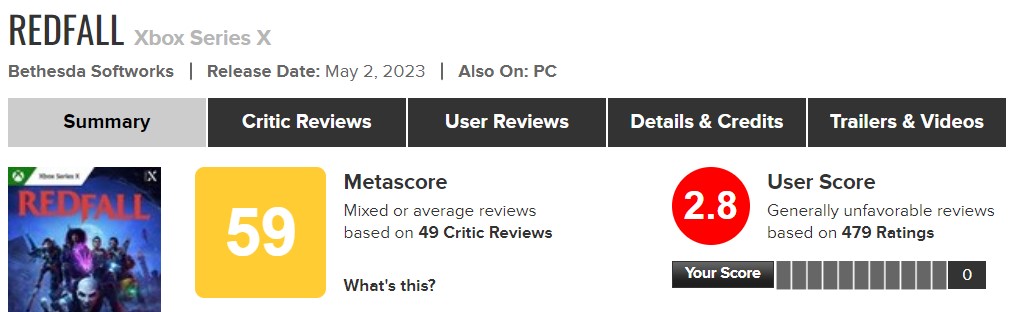
Developed by Arkane Studios Austin, the same developers behind Dishonored and Prey, Redfall is a $70 game (also on Game Pass) pitched as an open-world, story-driven, action-shooter. The premise is that some vampires showed up in town of Redfall, and you are one of four characters with special powers that can do something about it.
The problem is that the game is terrible. And it is terrible for a lot of fundamental reasons. You may or may not have heard already about the braindead AI or the incredibly lazy art assets. Those are embarrassing corners cut that can be glued back together – update the AI, add some shaders to the chimney, ensure each area has different dead body models.
What cannot be fixed is the overall direction of the game and the utter destruction of any semblance of “immersive sim” the studio is known for.
The “open-world” in Redfall is basically dead. The enemies you face are vampires, a cult of humans working with the vampires, and more humans working with a corporation that attacks everyone on sight. However, the game itself is structured like a looter-shooter: you gain XP to level up and gain skill points to upgrade your powers, and you can loot more powerful guns from drops or in certain containers. So things play out like Borderlands… minus the inventive weapons, the vehicles, the enemy variety, the humor, or simple enemy density.
It is “immersive” that there are no NPCs running around outside, because vampires. It is also “immersive” that there aren’t zombies or a more filler enemy type that you plow through. But the end result is that you spend a lot of time walking around an empty world where 99% of the buildings are boarded up, desperately seeking any gameplay, only to face the same two enemy types over and over.
Amusingly, Phil Spencer (head of Xbox) addressed this vision problem in his recent apology tour:
Spencer also addressed a common question: Why not delay Redfall until it’s ready? (The game was already delayed significantly in 2022.)
“There are quality issues and we’re working on those, but I think there’s a fundamental piece of feedback that we get that the game isn’t realizing the creative vision that it had for its players,” Spencer said. “That doesn’t feel like a Hey, just delay it [situation]. That feels like the game had a goal to do one thing and when players are actually playing they’re not feeling that thing, that creative execution of the team.”
Polygon
Ouch.
Phil does say that they are committed to continue working on improving the game, but I have no idea how they imagine that will go. If they are going for a Borderlands vibe, they are going to need more enemies, like vampire dogs, necromancers, or anything else that might fit the “vision.” What they got right now doesn’t work. Like there is supposed to be a spooky vibe, but all the game systems revolve around you farming XP and getting better guns to farm XP faster. And while you can sort of handwave away the human body count, at a certain point the sheer number of vampires you kill as a matter of course gets ridiculous.
When it comes to game vision pivots, Fallout 76 successfully went from no NPCs to a more traditional Fallout NPC experience because the systems were already there. You technically already talked to robots and got quests and the game world supported all of that. It’s hard to imagine Redfall changing in this way. It’s not like Arkane can suddenly start leveraging their Dishonored or Prey experience, and fully committing to the Borderlands direction would make it even more generic than it already is.
Redfall was and is simply a bad idea.
Impressions: Against the Storm
Against the Storm (AtS) is a roguelike city-builder, and may very well be the first of its kind. Each game feels like the early to midgame turns of a Civilization match as you explore the foggy forest in pursuit of randomized resources that will force you to adapt your builds in new ways every time. And right as the combination of production synergies and passive abilities make your base amazing… the match is over, and you prepare to do it all over again somewhere else.

Random really is the name of the game. The win condition is raising your Reputation bar to maximum before the Queen’s Ire bar fills up. To raise your Reputation, you complete randomized Orders (quests), solve randomized Events/Caches strewn in glades on the map, leverage randomized Cornerstone abilities (passives), or raise the Resolve (happiness) meter of one or more of your races past a certain point to earn a steady trickle. You’ll do all of these things by collecting resources randomly distributed on the map, with buildings that were chosen from, you guessed it, a random assortment.
If all that randomness sounds a bit off-putting, well, it is. At first.
The genius of the game’s design is how it leans into adaptability. For example, if you wanted to make Beer, it’s very possible for there to be no Wheat on your map and no Farm building offered to grow Wheat. That sucks. But Beer can be made from Wheat or Roots. Or maybe you get offered a series of choices that leads you towards Wine or something else instead, which you trade for Wheat. Damn near every production building in the game has 3+ alternative inputs available, and since some buildings are more efficient than others, you are passively steered in certain directions that might be out of your comfort zone. I’ve had maps where I was just never offered something fundamental, like Planks or complex foods, and had to radically alter my gameplan to survive.
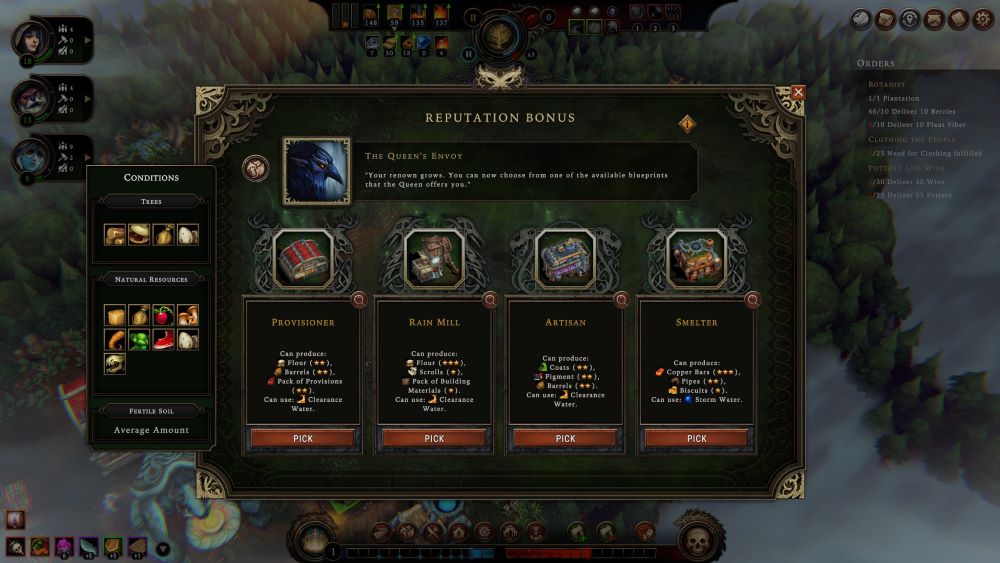
Remember Sid Meier saying games are a series of interesting decisions? That’s Against the Storm.
Successfully completing a map gains you progression currency you spend unlocking passive bonuses and other goodies back at the Smoldering City. After that, it is back to the world map and selecting the next hex to tackle. Each possible biome has a general theme and resources that appear more frequently. Select your randomized starting party, add some specific resources of your choosing, and then spend the next 5 minutes with the game paused to study the randomized buffs/debuffs you have received, and choose your randomized starting three building blueprints. You will repeat this cycle 5-6 times until the entire world gets reset (except for meta-progression) and you start everything again.
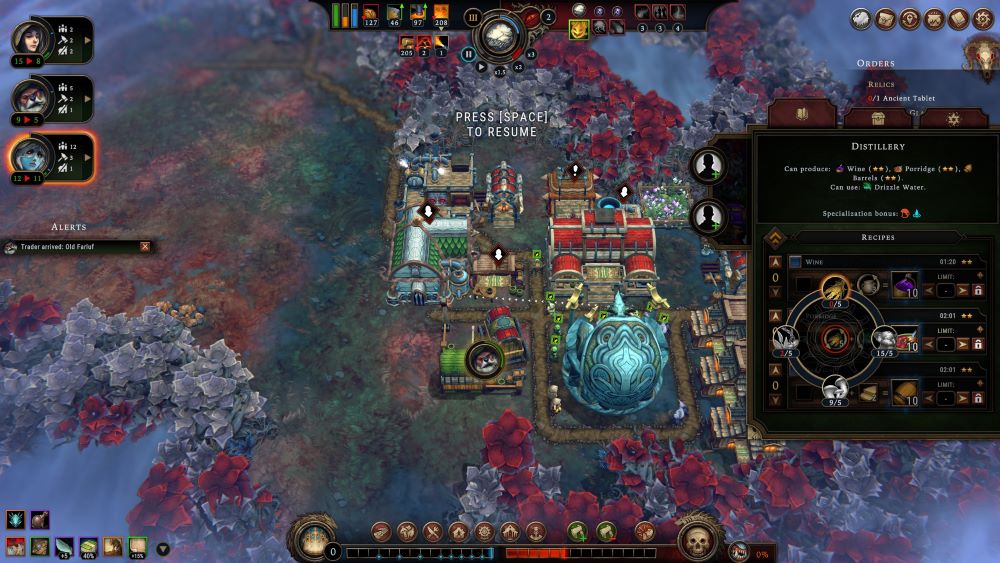
It is worth noting here that I don’t actually like city-builders all that much. I played SimCity 2000 for hundreds of hours ages ago and Frostpunk was okay, but I’m not especially a fan of games where you alternate between Pause and 3x speed. AtS is especially egregious in this regard because of all the interlocking parts with production buildings and various, randomized resources. That very randomness though, is precisely what has kept be playing for the last 25 hours – specifically the desire to optimize the madness. Each map will take you 1.5-2 hours to beat and then you are given a clean slate, so don’t come in thinking you will be making a self-sustaining colony or anything.
Overall, I am very impressed.
The game is starting to wind down for me though, as I have noticed my desire to win just for the upgrade currency to unlock new passives… that will make wining again easier. The offset for that are higher difficulties, including “Prestige” (aka Ascension) ranks that have ever-increasing maluses, but that’s not exactly what I’m looking for. And if I was, I would just play Slay the Spire.
Planetside 2: A Decade Later
Ok, it hasn’t been exactly a decade, but close enough.

It was an interesting experience coming back to PS2. Some things had changed – apparently people can build little outposts and fly capital ships around – but most of the game was exactly the same. Fighters spam rockets from the sky, except when you’re flying one, in which case you get a personal dog-fighter stuck to your ass. Tanks soak spawn points with fire. No one goes after the enemy Sunderer. Just Planetside things.
And yet… there are the same moments of brilliance. Breaking the back of an attack, and then running across the fields towards the enemy base in a counteroffensive. Actually finding a good spot and doing some work as an Infiltrator. Grabbing an AA rocket launcher and harassing everything in the sky.
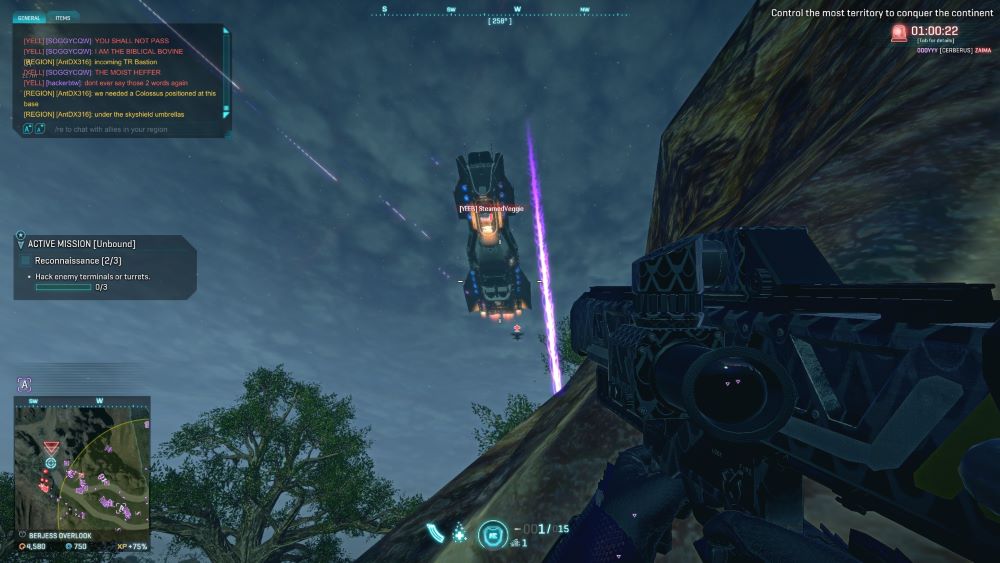
The problem now is the same problem then: the fun is inconsistent. When it’s good, it’s good. When it’s bad, it’s awful and l want to uninstall. It doesn’t help that after a decade the remaining population is a congealed mass of bittervets who will waste you in any fair 1v1 situation. Kill screens show you the equipment of your betters, but it’s hard to tell what weapons they actually used and whether it would have made a difference. I’m glad there’s a testing ground where you can fire guns before purchasing, but the stat screens for these things are borderline nonsense.
At the end of the day though, Planetside 2 certainly feels like a better Battlefield game than any I’ve played since BF4. You have the spectacle of outrageously large fights with air support, and an actual ability to pull vehicles yourself. And individual skill can turn the tide if you C4 a key Sunderer.
But I think the days of spending 5 hours a night playing are, well, a decade behind me.
Impressions: Arcanium
Arcanium is a lane-based, multi-character deckbuilding roguelike. You control the actions of three different furry characters with their own distinct card pools, passive abilities, and equipment. There are always three different enemies in the opposing lanes, although you can spend resources to get them to retarget other lanes (Taunt cards) or swap lanes with your own characters to distribute damage and/or fire off attacks. Defeating foes grants you rewards, new cards to add to your deck, and all the sort of things you would expect from a deckbuilding roguelike.
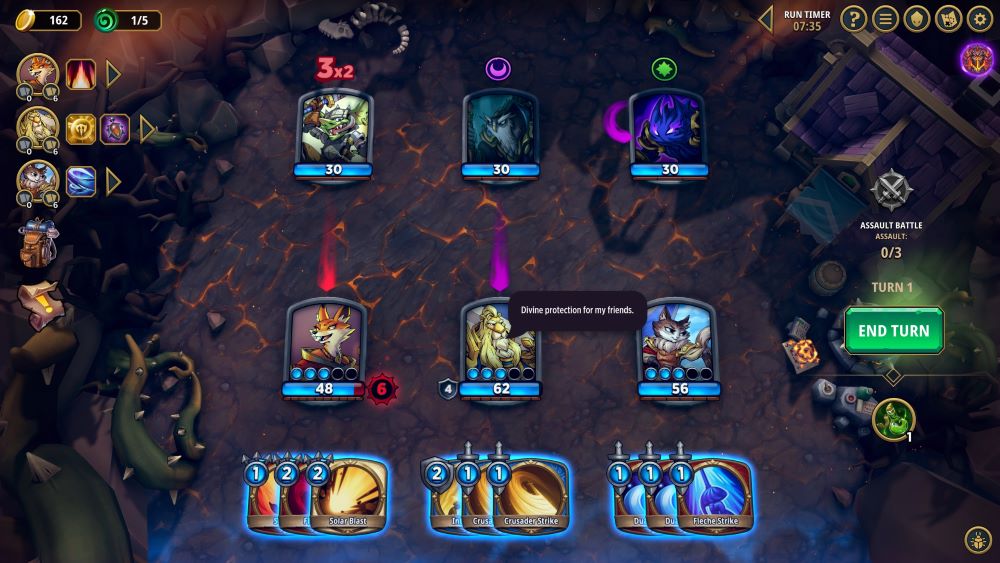
And, uh… that basically sums it all up.
I’ve played a lot of deckbuilding roguelikes over the years and Arcanium is OK. Fine, even. What it reminded me most of was Roguebook, in that you have multiple characters with their own decks, traverse a hex-based map trying to uncover new nodes, and there being incentives to maximize deck size. I also appreciate the new trend (?) for these games to allow banked energy – you start with 3/turn, but can carry up to 5 over to your next turn, if you don’t have a use for it. That part, along with the equipment, reminded me of Across the Obelisk.
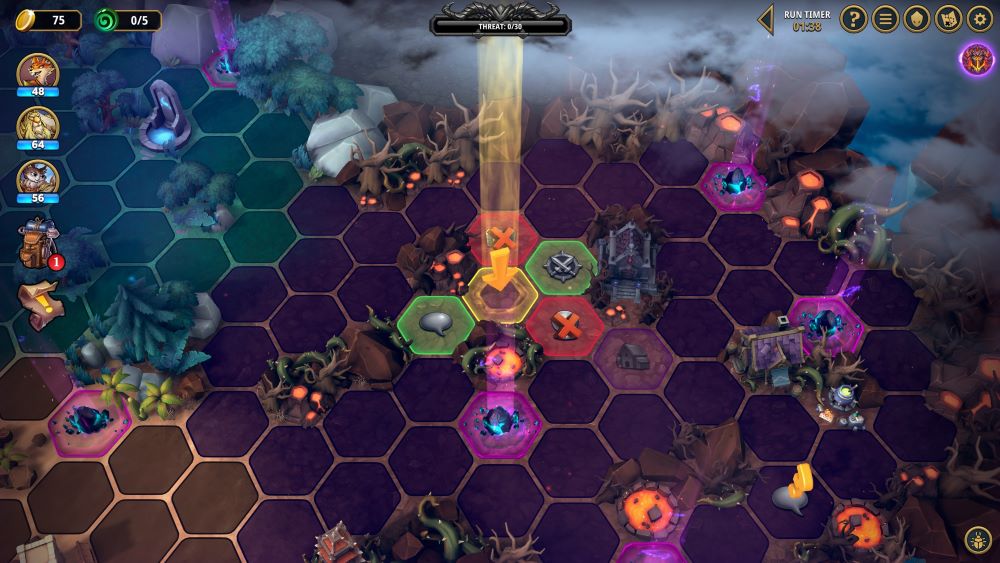
I do have some issues with the game, although they are difficult to articulate. For example, a lot of the enemies feel the same: they attack for X amount, deal a debuff, perform an area attack for Y amount, or gain armor. That sort of reductionism can be made for Slay the Spire too, right? Perhaps it feels worse in Arcanium due to the lane-based nature of the game. After all, enemies always target down their lane, and you cannot target things more than one lane away.
Another issue I have is that the sort of highest-difficulty fights reward you with Heirloom Equipment, which are character-specific items that synergize with their passive abilities/cards in various ways. Getting all three characters their Heirlooms is very important… but once that’s done, those hard battles thereafter become mostly pointless, as you’d rather get regular equipment for the other slots. Technically you get an already-upgraded card choice from the rewards and closer to unlocking character upgrades (more energy/cards per turn), but again, it just feels bad doing these fights with the Heirlooms being wasted. I wish there was a way to scrap them or trade for regular equipment.
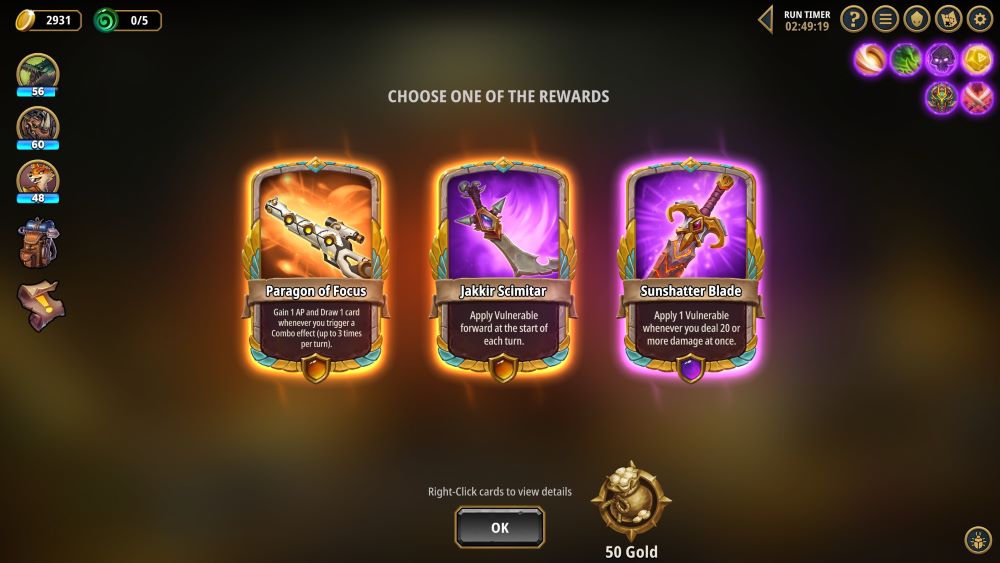
Overall, Arcanium is a perfectly serviceable deckbuilding roguelike. Unlocking new characters by doing specific things during each run feels rewarding, and cards are similarly unlocked and added to the pool all the time. Each character and their card pools feels unique, and you can be rewarded for discovering synergies between them. Having said that, I have played Arcanium for 15 hours and feel like I’ve seen all that I want to, whereas most deckbuilders taper off after 40 hours for me. Take that for what you will.
Legendary Grind
I continue to play Guild Wars 2.
One of the ancillary goals I have within the game is unlocking a Legendary weapon. These weapons are not actually more powerful than Ascended weapons (stats are the same), but they feature some nice quality of life features. Specifically, their stats can be switched any time outside of combat and they are basically unlocked on all your characters at the same time. Regular Ascended weapons can have their stats switched by sacrificing some items, and they are not soulbound, so technically they can be swapped around on your characters as well. So it’s really about the ultimate convenience.
Legendary weapons in GW2 are part of a monstrously insane grind, however.
I was looking at “Gen-3” Legendary weapons tonight, which are those introduced in the End of Dragons expansion. When you purchase the expansion, you get a free “precursor” weapon, which is the first hit of crack to start you on the downward spiral. I originally chose the Axe, so let’s look at that path. To create the Legendary, you need the following:
- Gift of Aurene’s Rending
- Dragon’s Rending (the precursor)
- Gift of Jade Mastery
- Draconic Tribute
Oh, hey, only three items! That should be easy, right?! No. Not at all.
Starting from the top, Gift of Aurene’s Rending:
Aside from Mystic Runestones, which are purchased at 1g apiece from a vendor, the other three items have, you guessed it, four additional components each. The Poem on Axes requires 10 Tales of Adventure, 10 Lamplighter Badges, and two other minor items of no particular consequence. Completing the expansion storyline gives you 14 Tales of Adventure, so technically that’s not a stretch until you want to make another Gen-3 Legendary. The Lamplighter Badges though, require you to achieve map completion on Cantha maps, e.g. explore the entire map and unlocking all the points of interest, Vistas, and so on. You can get 1 per map, so you technically either have to do complete map exploration on more than one character, or repeat an achievement that has you lighting lamps all over the place. All of this is not technically difficult, especially if you have a Skyscale mount so you can fly around, but it is time-consuming.
The Gift of Research… sorry, did you think we were onto a different step? The Gift of Research is straightforward in that you need 3.75g of vendor mats, 250 Essence of Luck, and 500 Hydrocatalytic Reagents which themselves requires 2500 Research Note currency. The Essence of Luck comes from disenchanting gear which you accumulate in abundance; training one character as an Artificer will allow you to combine lower-level Luck into the needed type pretty easily. Research Notes comes from disenchanting crafted items in a way that doesn’t produce Luck, so this step is really all about destroying stuff. There are websites out there that will give you up-to-date info on the cheapest items to craft/buy and destroy for Notes.
Gift of the Mist. This one is where I start shaking my head a bit. This one requires Gift of Glory, Gift of Battle, Gift of War, and Cube of Stabilized Dark Energy. Glory requires 250 currency from PvP, Battle comes from the very end of a WvW Reward Track, War comes in small amounts from WvW Reward Tracks, and the Cube is crafted from two materials gained from salvaging Ascended gear (most efficiently from Fractal content). So, basically, this is the “go do all the other bits of game” step.
Hey, since we already have the precursor, we’re halfway (?) there!
Gift of Jade Mastery has four components.
The Bloodstone Shard costs 200 Spirit Shards, which is one of those currencies you either have thousands of or are starved for, depending on how long you’ve (passively) played GW2. Suffice it to say, you cannot directly purchase them, and must earn them via gaining XP at max level, doing three daily quests, and so on. Gift of Cantha is no big deal, as it requires four items you get from map completion, which you were doing anyway. Antique Summoning Stones, aka ASS, is a currency you can purchase 5 of each week, and earn from doing meta events. Realistically, you are probably buying 3-4 a week unless you are running Strike Missions.
Gift of the Dragon Empire. Oh boy. First is 100 Jade Runestones, which come from special chests in the expansion maps. There used to be an exploit of sorts that allowed you to get one per character parked at the end of a jumping puzzle, but that was recently nerfed and the price has skyrocketed as a result. I have toons parked around the other easiest chests, and I can get 5/day for about 20 seconds of work. Next is 200 Chunks of Pure Jade, which you are technically time-gated on, but it’s as easy as mining ore nodes in one of the maps over the course of three days. Next is 100 Chunks of Ancient Ambergris and this comes from fishing. You can get 1/day from turning in a specific fish, 5/day from turning in Flawless Fish Fillets, and occasionally get them from the fish themselves. Last is Blessing of the Jade Empress x5, which is an item that costs 500 Imperial Favor apiece, a currency you get from completing Events and such around the expansion. This technically isn’t hard to accumulate, but cannot be fast-tracked and requires time on the ground.
Alright, we’re in the final stretch! Draconic Tribute requires:
For the most part, this is the “random bullshit, go!” step. Mystic Clovers are typically acquired 7 at a time at the end of a 28-day daily login reward cycle. You can gamble for them too, or use some more expense currencies to purchase them in limited quantities each week. Gen-1 and Gen-2 Legendaries require 77 of them instead, so Gen-3 is a bit more forgiving in that. Amalgamated Draconic Lodestone can randomly be acquired from a variety of sources, or crafted from components that are randomly acquired. It can also be purchased directly (3/week) using Super Adventure Box currency, which is a once per year festival currently going on. It takes me about 30ish minutes each day to earn about half the required amount of currency. Finally, you have Condensed Might and Magic, which are themselves made up of four Gifts which correspond to the generic loot you may have been accumulating your entire GW2 career, e.g. Fangs, Totems, Scales, etc.
After all of that grind, throw everything into the Mystic Forge and you get your Legendary!
…
…
…or just straight-up buy the Legendary from the AH. The Axe is currently being sold for 2550g. The price conversion of gems to gold changes daily, but right now it’s approximately 35g per 100 gems. So that’s 7285 gems or roughly… $91. Yep. $91.
Granted, you can also farm 2550g through the course of the game and just buy it that way without even playing the expansion or doing anything special. Or you can purchase the majority of the necessary crafting items and skip certain sections of the grind. Indeed, it is the only way some of those 5/week limited items are at all reasonable. Plus, this site is showing how you can technically make almost 802g profit by crafting the Legendary Axe with materials you purchased from the AH. Options!
Nevertheless, I find it difficult to get over the $91 thing. Guild Wars 2 is about finding your own goals, as the Exotic Gear you got 10 years ago is still good enough for raiding today. Crafting Legendaries certainly feels like one of those things you can steadily chip away at as a form of content that gets you out in the world playing with other people.
Or you can just open your wallet.
 In An Age
(Un)Rewards
May 15
Posted by Azuriel
The other day Bhagpuss was talking about the myriad reasons why Guild Wars 2 had fallen off of their radar. Of particular note was this one:
As someone who still logs in daily to hit up static treasure chest spawns and immediately sell their contents (Jade Runestones) across four characters before logging off, I can confirm this assessment. The game felt unrewarding back in 2018 and especially so in 2012. There are dozens of Youtube guides on how to achieve 20g+/hour of farming certain things, but even the most profitable paths have you churning hundreds of low-value items through the AH in apparent fulfillment of someone’s big-box retailer fantasy.
I do want to correct one thing though: there are very clear risks in certain GW2 meta-events, e.g. the risk of it failing and resulting in nothing. I recently got involved in a Dragon’s End meta wherein we got the dragon to be ended down to 2% HP before time ran out. Poof. Zero rewards after 45 minutes of pre-events and the fight itself. In contrast, winning would have resulted in approximately 23g worth of stuff. There is a reason why this particular meta is so dead despite being one of the top earners.
Putting that aside, the question to me became: what does rewarding mean in an MMO?
Bhagpuss identified rewarding (in part) as being able to “complete an entire project in no more than one gaming session and preferably in about ten minutes.” That, of course, lends itself towards a very player-driven motivation basis. For one thing, how many 10-minute projects could you possibly generate? “Infinite!” no doubt, but seriously.
For me, tangible progress towards a discrete goal is rewarding. Which means GW2 should be right up my alley, because goddamn the game is filled to the brim with insane stretch goals in terms of achievements and Legendary items and the like. The problem is the “tangible progress” bit. The designers’ adherence to the volume-based loot system leads straight to the early Diablo 3 disaster that was “vendor everything, buy what you want.” For example, one component (of many) for the Gen3 Legendary weapons requires 100 Antique Summoning Stones. You can buy 5/week from a vendor, earn another 5/week by doing Challenge Mode Strike Missions, and 1/day from doing the Dragon’s End meta (which routinely fails, remember). That is six weeks of some hardcore grinding the most challenging content.
Or you could just buy them off the AH.
Another example: Bolt, the Legendary Gen1 sword. One component requires 100 Charged Lodestones. How do you get those? The AH, basically. Charged Lodestones are random drops across core content, although you can technically target a half-dozen drops or so on a rotating basis through specific maps. But basically you are very obviously never intended to collect them yourself. Maybe that is supposed to be a good thing? You know, to give you options to farm whatever content you want and collect gold instead of in specific areas. Somehow though, the exchange does not feel rewarding to me. Probably because gold is fungible and not specific to the thing I was working towards.
Thinking back, I would say WoW’s World Questing system was perhaps one of the more rewarding game mechanisms I have encountered in any MMO. You could view them and the rewards from the map (no randomness), completing them was easy (no grind), the rewards themselves were often direct gear upgrades that scaled all the way up to a cap (meaningful), but the incremental upgrades meant the rewards didn’t become useless for a while (longevity). Plus, it was extremely useful for your alts.
Of course, the counter-point is the derisive “log in, collect epix” charge, or perhaps the more salient “what now?” when the goals are (easily) achieved. But… is that actually a concern for anyone anymore?
My own MMO apostasy no doubt clouds my vision, but that era of ascetic toil seems over. Possibly has been for years. There are some holdovers in Classic WoW, no doubt, but is that population derived from nostalgia-hunters or actual new blood seeking flagellation? And I do not mean to imply that this is a generational issue – it is simply a rational consequence of people wanting to actually enjoy their time with games now, rather than possibly maybe after months and months of grinding.
Delayed gratification is a virtue and we desperately need more people willing to plant trees whose shade they will never enjoy. But when it comes to gaming, well, let’s just say that the Marshmallow Experiment becomes a bit moot when you can just eat the marshmallow and then enter another of the 37 rooms running the same experiment.
Posted in Commentary
1 Comment
Tags: GW2, Marshmallow Test, Rewards, Sense of Pride and Accomplishment, Welfare Epix