Category Archives: Commentary
Daybreak at SOE
Talk about an unexpectedly busy couple of days in MMO news.
Multiple struggling age-old companies shedding otherwise profitable enterprises for… reasons. First you have AOL unceremoniously dumping Joystiq and every blog under that umbrella, including WoW Insider and Massively. And now you have Sony selling SOE to an investment firm in what sounds like a shady back-alley deal. I mean, you’d think if it were a positive, on-the-level thing, there would be talk leading up to the deal, you know? Not just coming to work and seeing this out front:
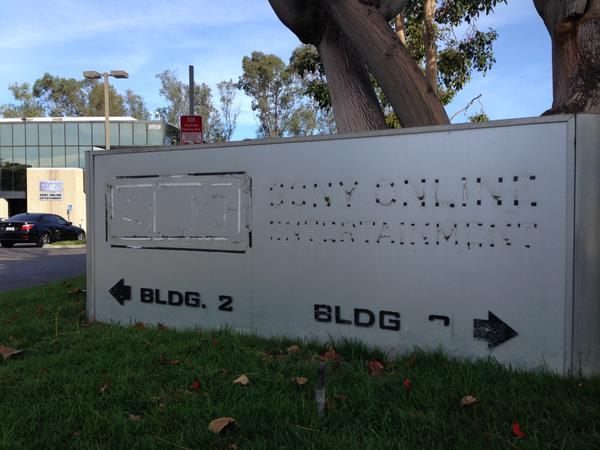
I expect to see those letters on eBay tomorrow.
There has been a lot of schadenfreude in terms of SOE/Massively bashing, but I’m not entirely sure that is the actual lede here. Sony hemorrhaged $1.29 billion last year, while restructuring itself out of the PC and low-range TV markets. While most articles mention that SOE specifically lost ~$60 million, that seems to be largely based on shuttering Free Realms, Star Wars: Clone Adventures, Vanguard, and Wizardly Online, not necessarily the profitability (or lack thereof) of SOE’s other titles. The other thing to keep in mind is that SOE’s losses are less than 5% of Sony’s total losses. So this deal seems a lot less like Sony dropping an under-performing asset and more like Sony pawning its laptop to make the rent payment.
As far as AOL goes, their primary aim these days is to sell ads, apparently.
We can suggest that the sale of SOE indicates that SOE is in trouble, but thus far the (optimistic?) indications are that its business as usual. PlanetSide 2 just started becoming profitable. No studios are being shut down (yet?). H1Z1 is… selling betas? EverQuest Next is still in the pipeline. Is there actually a better time to sell SOE to investors than right now, at the bottom of a potential growth curve? It is still entirely possible that “SOE being SOE” will ruin everything, but my point is that the sale itself is not indicative of anything in particular. Sony is about a half hour away from turning tricks on the street corner; can’t really blame SOE for that.
Well, other than the four failed MMOs closed last year, but that could happen to anyone.
One final note on the SOE thing: one of the senior managers of the no-name investment firm that bought SOE is Jason Epstein, who personally brokered the deal to buy Harmonix (Rock Band, etc) back from Viacom. While rhythm games have gone out of vogue in the US, Harmonix was still releasing games in 2014. So at least one guy knows his way around videogames.
I’m sure the true fallout has yet to start raining down, but as someone not at all invested in the outcome, I suggest keeping the wailing/high-fives to a minimum just yet. This could in fact be good news for Bitcoin SOE.
H1Z1, HotS, TESO
There have been a number of gaming developments in the past week, but I find them difficult to write about. First, because I remain distracted with the whole television vs projector search. Indeed, I went from 98% gung-ho for a projector to finding out I could get a 40″ TV for ~$205. For such a value-crazed individual as I am, it’s tough to imagine a better deal. But, projector, man. I could be playing Shadow of the Colossus on my wall, instead of on a TV a mere CD-length wider.
Secondly, I just don’t know how to feel about some of these news items.
For example: H1Z1. Much has already been said about SOE reneging on their promise of no P2W shenanigans, which the airdrops certainly were. Originally. The airdrops have since been nerfed to basically have a 10% chance of containing a pistol or shotgun, so… now what? Do we pack up the pitchforks and go home? Or do we stick around and stab some things since we’re here?
One of the terms being thrown around regarding the airdrops is “Pay 4 Content,” in the sense that buying an airdrop means luring other players to come fight you and/or others for supplies. I find it difficult to argue with that bit of cash shop jujitsu. Similar games like Rust already have random airdrops, so is there much of a difference beyond one’s ability to “advance the timer” in H1Z1?
Framed like that, it almost sounds cool. “This is boring – let’s shake things up a little.” If airdrops were exclusively a crafted or rare lootable resource, I doubt anyone would drop them out of boredom; the eccentric players would get one or two at most, instead of the effectively infinite amount they have under this scheme.
Aside from airdrops, I have been following the other bits of news from the game and it reminds me of why F2P is bad: it engenders cynicism and paranoia. For example, the looting system was described this way:
The lot [sic] system is very intelligent. It keeps track of where all the items are in the server and balances loot spawning accordingly. If everybody is all looted up and hoarding loot, then it’s time to hunt some players or steal from their stashes.
When a player logs out, the server knows that there is now less potential loot on the server and will begin spawning more. When a player logs in and puts the server over it’s limit, the server will stop spawning loot (of the kind that the player has) and you’ll need to begin fighting for it.
The first thing I thought of was: of course your looting system would be like this in a F2P cash shop game. Self-sufficiency isn’t profitable. Smedly was more than forthright in explaining the PlanetSide 2 implant nerf was intentionally done to squeeze extra cash out of players “to keep the lights on.” How would you trust any design decision under such a rubric? Your options are to imagine that SOE wanted a gritty, The Road-esque survival game with few resources, or… they’re just another exploitative F2P developer out to make a quick buck. I sure as hell don’t believe that there is a legitimate game design reason why my Town Hall takes six real-world days to upgrade in Clash of Clans, for example. Nor do I believe that Candy Crush’s candy placement/generation is entirely random either.
In the meantime though, it appears looting is getting buffed along with a number of other action items. The game is Early Access, which makes it difficult to feel justified in one’s outrage. This sort of thing is what Early Access is for, right?
Speaking of Early Access, there seems to be some internet consternation in regards to Blizzard charging $40 to get into the Heroes of the Storm Beta. Apparently, if Blizzard copies what everyone else is already doing, then… uh… er, isn’t that the standard Blizzard MO? People also seemed to have forgotten that paying Blizzard for Beta access already happened: the Annual Pass that granted Mists of Pandaria Beta access. While the Annual Pass was also tied to a “free” copy of Diablo 3, I know more than a few WoW players who bought it specifically for the Beta access.
The chances of Blizzard charging for HotS beta access having an effect on any other developer’s decision to charge for beta access is less than zero. Between Kickstarter and Early Access, the days of a privileged beta have long-since died. And even before those programs, people were selling GMail invites on eBay for hundreds of dollars. Beta access has value whether you choose to believe it or not, and I don’t begrudge these game companies cutting out the middle-man. As long as, you know, they slide me a few extra keys.
Finally, The Elder Scrolls Online has dropped its subscription and went Buy-2-Play. While such a scheme is dubious ethically, this sort of payment model trajectory could be a way out of the otherwise unfortunate design trap of $60 million MMO budgets for ~150,000 player audiences. Obviously these companies would prefer a million-plus subscribers, but chances are they wouldn’t be able to get their investment back if they released with B2P, or developed the game under a lower budget at the start. It sucks for the early adopter, of course, but life has always sucked for them.
We’ll have to see how this move plays out for TESO. The game has never been on my radar and more or less remains that way currently, even though I very much want Skyrim 2. When I start seeing it on sale for $20, perhaps I will take a closer look.
Tautology of Value
Keen has a post up on the nature of F2P that, at first blush, reads as a truism. Namely, that one should be suspicious of any F2P title – after all, if the developers thought it were a valuable product, they would be pricing it accordingly.
Why do we have to pretend games are free or better yet that they have to be free in order for people to want to play them? MMO gamers are capable of identifying whether a product is worth being paid for or not. A good product will sell. A poor one will not.
This prescriptive sentiment has always bugged me. In one of the comments someone else asserts:
A great product will sell itself.
These all read as tautologies to me. How do you know if a game is great? It sells itself. And games that sell themselves are great, by definition.
…except we all have examples of underrated masterpieces, and garbage that sells millions of copies every year. Unless we are ready to admit that Star Wars Galaxies was terrible and Candy Crush Saga is one of the best videogames of all time, we need to decouple a game’s quality from its sales performance. There is correlation on a good day, but just as often there is not.
Similarly, the trend towards F2P is not necessarily one of naked greed and cynicism. I will be the first to admit that I prefer the antiquated “buy the box” or subscription models, as I believe it properly aligns developer incentives (i.e. make better content vs more cash shop items). But in 2015, there is one reality every developer must face:
1) F2P competition exists.
If you are all set to release a subscription-based MOBA in an environment where League of Legends still exists, you are going to have a bad time. The same is true for subscription-based MMOs these days. It is easy to claim that Wildstar (etc) failed not because of the subscription model, but because it wasn’t good enough to justify a subscription model. But that still sounds tautological to me. “If the game was good, it would not have failed.” Or to shorten it: “If it were good, it would not be bad.”
In the present MMO environment, it isn’t enough to simply be good – one has to be as good or better than all the alternatives, many of which are F2P. This is especially salient in MMOs considering the social dynamics are pretty much the only reason why you would continue playing the game. We can imagine a scenario in which the perfect (to you) MMO is released… but it ends up as a ghost town, and subsequently loses most (or all) of its value.
Which makes this part of Keen’s post a little ridiculous:
Charging for a game is absolutely acceptable, and it won’t dissuade people from playing.
Of course charging a subscription or box price will dissuade people from playing, else lowering prices would not generate any increased sales. Obviously there are people out there willing to purchase $60 titles on Day 1; what is less obvious is whether there are enough. Unless you are willing to settle for Minecraft, most MMOs are released with $60+ million price-tags which need to be recouped by volume. Populations in the 100,000 range simply can’t cut it anymore, nevermind the negative social effects of low server concurrency. It is quite a pickle that you place MMO developers in when they either need to craft a more valuable product than WoW (etc) or go with an extremely low-budget project… which will still be called a failure anyway due to low sales volume. “A good product sells,” remember?
Overall, I do think the warning vis-a-vis F2P games is sound – there is no payment model better suited to erode consumer surplus than F2P. And there are certainly a million and one examples of very bad, very cynical F2P cash-grabs. But I do not agree that good games necessarily sell (or sell themselves), I do not agree that sales is necessarily an indicator of quality at all, and I would suggest that developers have many perfectly valid reasons to “give their product away” even if they could have charged for it. In fact, they very well may have to these days, just to get enough warm bodies in the door to achieve the social critical mass that MMOs require.
Why Aren’t You Playing Minecraft?
A lot of people are:
As noted in the Reddit thread where I first heard of this, the nigh-million concurrent players is only counting “PC (win/osx/linux) only, versions 1.3 and higher, modded or vanilla it doesn’t matter.” So not only is that number not even close to peak time, it does not count anyone playing on consoles or mobile devices. Or, you know, anyone playing offline.
For the record, as of June 2014 the sales broke down like this:
- PC/Mac: 15 Million
- 360: 12 Million
- PS3: 3 Million
- iOS/Android (Pocket Edition): 16.5 Million
It’s probably not a stretch to say Minecraft achieves concurrency numbers of 3 million or more any given day.
So the question I have to ask everyone – especially those constantly pining for “virtual worlds” – is why aren’t you playing Minecraft? Is this not everything you want in game? Crafting? Check. Small communities where name recognition matters? Check. No LFR/LFD? Check. Customization options? Check. Freedom to progress at your own pace? Check. A virtual world where things that matter happen around you? Check and check. And hey, it’s also a Buy-2-Play box model without a cash shop or other F2P shenanigans (as far as I know). If this isn’t a Jesus game, it’s at least a Moses.
I’m only being somewhat facetious here.
Minecraft isn’t for everyone (although it is for a lot of people), of course, but I always find it somewhat interesting in the reasons people give for why it isn’t good enough. Maybe there aren’t enough people per server? Maybe it’s the graphics? Or perhaps you are a little more attached to the traditional WoW content structure than you would have everyone else believe. After all, with the notable exception of Star Wars Galaxies and perhaps City of Heroes, many of the Jesus games are still around. Here is Dark Age of Camelot. Here is Ultima Online. Or if you prefer, Ultima Online Forever. EVE continues to be a thing. Hell, even EverQuest is still churning away. Is… there a reason you are not playing them instead of complaining about the “sorry state” of current MMOs?
I mean, I get it. A remade FF7 would be the ultimate exercise in nostalgerbation for me. There is no particular shame in saying you want an MMO to look like Wildstar but play like something that came out a decade (or more) ago. But I think it safe to say that it is a bit unrealistic. The original EverQuest and Dark Age of Camelot had budgets around $3 million back in 1999 and 2001. By the time the original Guild Wars came out in 2005, that went up to $20-30 million. RIFT was $60-70 million. SWTOR was around $200 million. I don’t think you often get green-lit for budgets of that size for game-types that clearly weren’t profitable enough to save the original title (in the case of SWG/CoH).
Still, there may yet be hope for… well, if not for you, perhaps your kids. Minecraft is the third-best selling videogame of all time, behind Wii Sports and Tetris. Microsoft bought it for $2 billion. This type of game will very clearly continue to be serious business. Then again, I’m not entirely sure that (F2P?) copies of EQN: Landmark are flying off the digital shelf, nor that ArchAge is doing particularly well, nor that virtual world supporters are supporting (supposed) virtual worlds like The Repopulation.
Camelot Unchained got funded, although the release date appears to be mid-summer 2016. Star Citizen will also (maybe) come out in 2016, with it’s $68 million in crowdfunding. So there’s a horizon out there at least, even if the actual long-term profitability of virtual worlds remains to be seen.
In the meantime… you could always play Minecraft.
What is Dragon Age Even About?
I was trying to describe the Dragon Age series to a friend the other day, and failing miserably. You see, this friend is a huge fan of the Mass Effect series. Should be easy, right? “It’s like a fantasy Mass Effect. It’s even made by the same studio!”
Except that is not really true.
I mean, yeah, it’s made by Bioware. But the longer I look at the Dragon Age series as a whole, the less it looks like a coherent narrative and more a mishmash of one-dimensional fantasy tropes. Dragon Age: Origins was a breath of fresh air with the Mage/Templar relationship, turning Elves into wandering Gypsies, and otherwise subverting a lot of traditional fantasy. Perhaps the genre has evolved in parallel or the novelty has worn off, as these days I’m finding the Dragon Age setting floundering for an identity.
I liked the Grey Warden schtick in the first game, even if it ultimately meant you were fighting dragons and orcs. In Dragon Age 2, you really weren’t doing anything of note; things just happened around you. While there is still time for Inquisition to kick into gear plot-wise (no spoilers, please), I’m at a bit of a loss in mustering up the motivation to care about anyone around me. Don’t get me wrong, party banter is pretty much the reason someone plays Bioware games; I just find it hard to like someone when there’s no real context for their decisions or personality.
For example, I have lost all investment in the Mage vs Templar narrative arc. The concept of anti-mage knights overseeing mage initiation rituals was pretty cool in the first game. It evoked a sort of Wheel of Time “mad dog on a leash” image; I started thinking that perhaps a similar thing should exist in the Star Wars universe vis-a-vis Jedi. It gets the mental gears moving, you know?
But now we are left with insane Mage vs insane Templar generic fantasy 101. My next Inquisition plot point indicates I will need to choose between seeking Mage support or Templar support, with the decision being mutually exclusive. I’m honestly about two seconds away from looking it up on the Wiki and making a decision based on which side gives the better loot. Quite simply, the game hasn’t given me any reason to care about the outcome. Compare that to my utter agony over the Genophage decision in Mass Effect 2. Same sort of binary, morally grey decision, but Mass Effect managed to get me to care. Dragon Age doesn’t even try anymore.
If someone asked you to sum up the Mass Effect series, you could say “scrappy Commander gets ship, builds galactic coalition to defeat Reapers.” As for summing up Dragon Age… uh… hmm. “Series of unrelated scrappy heroes collects NPCs and fights mobs.” Obviously it’s a lot harder to come up with a coherent narrative when you change heroes every game, but I’m not sure how much slack Dragon Age deserves. The Far Cry games have nothing to do with one another, and yet I can feel the thread that binds them. Where is the Dragon Age thread? What is Dragon Age even about?
I think Bioware would have been a lot better off sticking to the Grey Warden angle. Having a new Blight every game would be pretty formulaic (and unsustainable), of course, but I would of loved to have seen a more nuanced exploration of what life is like for the condemned Wardens in the post-Blight period. Sort of like a subverted fantasy plot, wherein your coalition and party members start strong and then fade out, slowly ground to dust via political machinations that find the Warden treaties inconvenient once the world is no longer ending. Perhaps there is a schism that develops amongst Wardens that desire children and security for their families. Maybe the Mage vs Templar rebellion could have started by the Mages deciding to free themselves en masse by joining the Warden cause.
Shit, can you imagine? Do you allow the Mages to essentially subvert the Warden code to emancipate themselves? They get their freedom, but there won’t be enough safeguards amongst the Wardens to keep a check on their power. Plus, what of the nobles who suddenly see the Wardens become a stateless army whose treaties supersede their sovereignty? Do the Wardens become complicit in the subjugation of Mages by rejecting them, especially when the Templars crack down extra hard after the attempted mutiny? Meanwhile, an Archdemon stirs from the all the conflict and bloodshed…
That would be an interesting decision. Not choosing between two NPC leaders that I was introduced to 10 seconds ago.
Who knows, maybe Inquisition will turn out to be super interesting in the final analysis. It isn’t terribly interesting now though, and it will have a hell of a time matching the plot I just invented a minute ago. The game is still fun, but I’d rather be playing Skyrim 2. Since I can’t, Inquisition will have to do.
Dragon Age Online
After around 20 hours of Dragon Age Inquisition, I am more convinced than ever that this is all an elaborate beta testing of the inevitable MMO sequel. Seeing other Heralds running around and closing rifts would not at all have seemed out of place. Hell, there are already dungeons, bosses, grouping, abilities with cooldowns, action combat, mining and herb gathering every 5 feet, crafting, gear upgrades, something approximating reputation meters, companions, mounts, talent trees, and repeatable/grindy quests.
After 20 hours, I am also convinced I am playing this game all wrong. Witness:

Do all the things.
Basically, I have 4 Inquisition perks, 67 “Power,” and hit level 10… all before recruiting another party member beyond the default ones. No, I did not stay entirely within the Hinterlands; I simply did most of everything aside from the Main Plot that naturally unlocked as I leveled up. If they didn’t want me completing the swamp zone until after the first major encounter with the Chantry, perhaps they should have made the enemies stronger.
Or… maybe they did, and I didn’t notice because I’m goddamn level 10. Oops.
Although I have clearly screwed the game up for myself this way, I am not entirely convinced it is my fault. The genre in general – and Dragon Age in particular – is fond of having plot progression tied to permanently closing areas and eliminating quests. Which isn’t necessarily a bad thing in of itself, but if I am always paranoid that this particular foray into Zone X might be the last chance I have to acquire Something Something Y, you can bet I am going to do all the things.
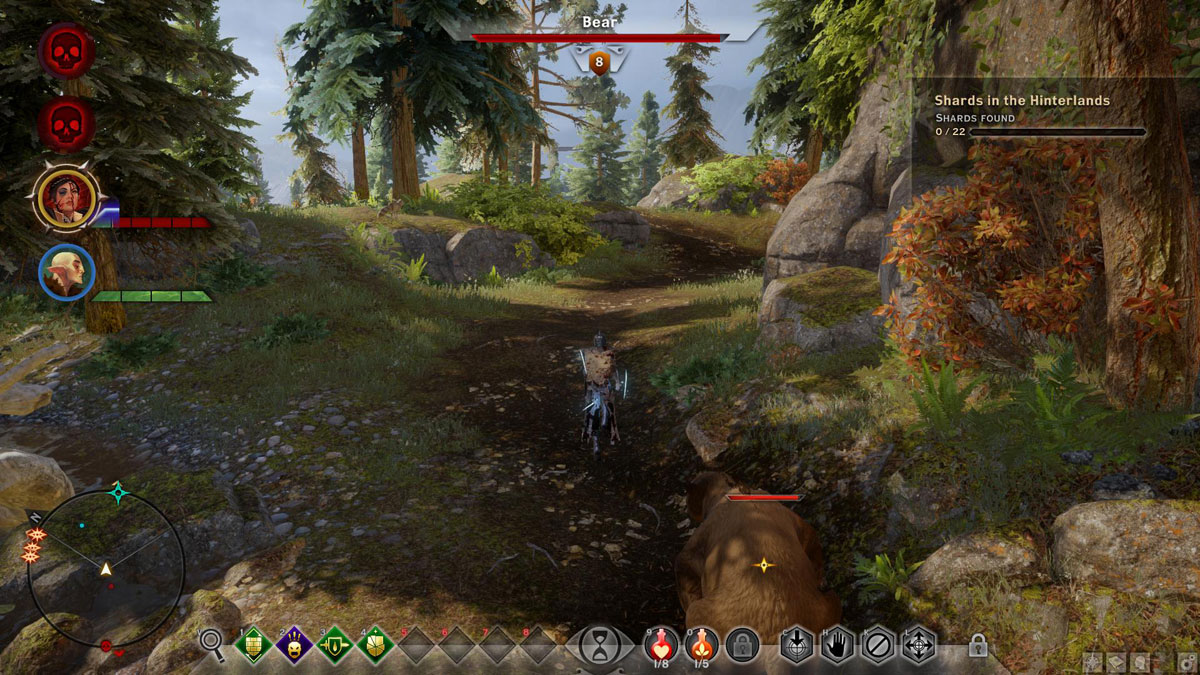
At least I’ll never have to run away from bears again.
It is one of those unfortunate Design Catch-22s wherein you give the player a variety of activities to complete (in case they don’t like a particular kind) and then the player ends up doing everything. What’s the real alternative though? Only having a very limited selection of quests? Relying on a player’s self-control to move on from an area simply because one has become a god amongst men?
Hah! We’re MMO players: we pay by the month for the privilege of performing pointless activities.
In any case, an hour or two after I took that screenshot I advanced the plot by one degree and suddenly recruited four new party members. I am guessing that there is still one more out there somewhere, if only because my total party is otherwise mirror images of each other: male/female shield warrior, male/female mage, male/female ranged rogue, and then just male 2H warrior. Perhaps it will be a melee rogue, just to shake up the symmetry.
I’ll find out eventually, I suspect. Just as soon as I feel like advancing the plot one more degree. In the meantime, I got some more shards to find.
Falling Behind the Curve
As you may have noticed in the sidebar and/or prior post, I have picked up Dragon Age: Inquisition. I have not played it as much as I should have been however, because it is the first PC game in which I’ve ran into a hardware wall.
I am still strategically turning settings down, but I’m talking about Medium settings and getting maybe 40 FPS on a good day. Yesterday, my gaming session was cut short by the game randomly diving down to a literal 4 FPS level every 30 seconds. I “solved” that issue by spending a long time on Youtube weeding through arcane practices, many of which sounded suspiciously similar to “blow on the dice to make them roll high” from D&D players. One of the suggestions was to turn off FRAPS and other FPS counters; I was, of course, unable to ascertain whether it actually worked or if things ran better because I was unable to actually tell how bad it was running.
In any of these sort of situations, I come back to my experience with Skyrim. Basically, if your game doesn’t look as good as Skyrim on my machine, that’s your fault. Perhaps it’s not entirely fair to have that as a benchmark – I do notice a lot more NPCs milling about in Inquisition – but I still end up questioning whether my rig is truly outdated or if the designers got lazy with the PC optimization.
Regardless, my Inquisition FPS woes motivated me to start looking at weak points in my gaming rig:
- i5-2500K Processor (4x 3.30GHz/6MB L3 Cache)
- 8 GB [4 GB X2] DDR3-1600
- NVIDIA GeForce GTX 560 Ti – 1GB – EVGA Superclocked – Core: 900MHz
Now, I’ve heard a lot of people talk about getting GTX 970 cards recently, so I figured that my ole 560ti might finally have been gotten to its obsolescence phase. On the other hand, I am not about to spend $300+ on a new graphics card either. What I want slash need is a way of determining the price points of various GTX cards in terms that I can understand.
For example, while I like this chart, it doesn’t really tell me much:

Again with the numbers.
Actually, the chart did tell me quite a bit, as I was very seriously considering the GTX 750ti because bigger numbers equals better, right? I would have been quite pissed at that $100+ purchase for the tiniest of gains, let me tell you. But off-hand, I have no idea what 20,000 more… units translates into FPS terms. Eyeballing PCPartPicker.com shows that a 760 costs $170, the 770 is $260, and the 780 sits at $283. Which is a little weird considering the performance increase on the chart, and the fact that the rest of the 780s on the list are north of $400, above even the the 970s.
What ended up further confusing me is the fact that YouTube videos like this one exist. For the click averse, the title is “Battlefield Hardline ULTRA SETTINGS – NVIDIA GeForce GTX 560TI 1GB DDR5 @ AMD A-10 6800k 4.30Ghz.” And it looks like it runs okay, although there is no framerate counter in the corner. So… what gives? I’m pretty sure I wasn’t playing BF4 on Ultra on my rig. I think the person might have been playing at a lower resolution than 1920×1080, but would that make that big of a difference? I’m pretty used to 1080p at this point though, and am not sure I want to give it up even if it magically fixed all my problems.
From my research on the processor side of things, I have heard that the i5-2500K is still pretty pimp as far as things go. I did verify the speed at 3.3ghz, which means it has not been overclocked. I basically know nothing about overclocking other than what I have read on the internet, so I’m not sure whether that is an avenue worth exploring versus the risk of my machine bursting into flame. Then again, it is liquid cooled, so… yeah.
What this post boils down to is this: I’m open to any suggestions. It could be Inquisition settings, GTX card comparisons (I’m sticking with Nvidia), overclocking guides if that would actually help, and so on. As it stands, it’s still early enough in Inquisition that I likely won’t miss much by turning down settings before I get too invested in my characters actually looking good, but I’d prefer that they do. I mean, come on, Far Cry 3 and Tomb Raider and Titanfall looked fucking fantastic. Why can’t Inquisition? Bah.
[Fake Edit]: I did end up finding this site that compared Inquisition FPS on Ultra settings across multiple cards. The short version is that the 760 gets 30, 770 has 39, and the 780 hits 45. The 750ti is the closest equivalent to my own card, and it eked out 22 FPS. Which, let me tell you, is not indicative of in-game FPS at all at Ultra settings. Still, at least I have some sense of scale now. Will I spend hundreds of dollars on a new card to get 8 more frames per second? Well, I don’t actually need Ultra settings, so hopefully that 8 multiplies out a bit on, you know, High settings or whatever.
On FF7 Remakes
As you may or may not have heard, Sony trolled their fanbase pretty hard during the Playstation Experience event a little over a week ago. Basically, the big announcement was Final Fantasy 7… being ported to the PS4. No HD remake, no enhanced graphics, just the Steam port. Good job, guys, way to be. If Sony spent half as much time on IT security as it does teasing FF7 fans, perhaps their executives would still have access to email.
One of the articles that popped up on Kotaku amidst the memes though, was basically making the argument that a FF7 remake shouldn’t happen. The argument goes that there are essentially two scenarios, A and B. In Scenario A, Square Enix updates the graphics and leaves everything else alone. This is bad because… the game is so good that we all already played it. No, really:
In other words…we’ve done this all already. Many of us, several times. A remake that overhauled the graphics but kept everything else the same-that’s what most people want. But as we’ve all journeyed through this world many, many times already-and in fact, revisited it through things like Crisis Core, Dirge of Cerberus, and Advent Children, a graphical-but-otherwise-identical remake would initially wow us…but we’d end up feeling empty afterward. Where would the excitement be? Every one of us can recite the story by heart. Every one of us knows how to breed a Gold Chocobo, how to beat Emerald Weapon, and we all have the high score on G-Bike.
So, I ask you: what does a remake really offer? There’s nothing new there.
I find this to be a highly bizarre argument, especially since it seems to apply to all remakes everywhere. You know, like the FFX/FFX-2 HD one. Or any of the earlier FF games.
In Scenario B, Square Enix remakes FF7’s graphics and then essentially changes the entire game with a new battle system or whatever. I agree that such an outcome would be bad, but that is because the scenario itself is dumb. That is no longer a remake, it is an entirely new game with the same characters. Which at this point I would probably play, but nevermind.
In the comments for these sort of articles, there is inevitably one or more individuals who feel to the need to express the sentiment that FF7 is overrated. Perhaps you even share that sentiment. In which case I feel the need to punch you in the face suggest you are objectively wrong. The game came out 17 years ago and it still consistently appears at the top of Most Wanted Remakes surveys in Japan. It has remained the best-selling Final Fantasy game ever released to this day. It was only ever outsold by Gran Turismo on the original Playstation. Just think about that for a minute: the second-most popular game for the entire life of a console system was a JRPG. One that outsold Halo, Resident Evil, GoldenEye, and similar (gaming) cultural touchstones of the era. If that is still considered overrated, I have to ask what you would consider “rated,” e.g. a game that matches its critical reception and/or reputation.
All that being said, I admit there would be issues. I haven’t played the game in decades (!) but I am not sure how an HD version of the Honey Bee Inn sequence and similar goofiness would translate. The general structure of the game means the artists would have to generate entirely new 3D environments pretty much the whole way through. And perhaps archaic mechanics such as random battles and limited save points would start to grate a bit on the newer (or even older) generation of gamers.
Nevertheless, I still feel like it is one of those things that just needs to happen. I don’t sit around believing that it will, but it should.


Time is Fair
Feb 6
Posted by Azuriel
Tobold has a series of posts now in which he simultaneously blames players for the failure of F2P games and then denigrates everyone who, you know, plays RPGs for supporting/enjoying “Grind2Win.” Apparently it is unfair for someone who has played an RPG for longer than you to have any advantage whatsoever. I can only imagine what he thinks about XP as a concept.
In short: Tobold is against any form of progression that you can’t buy your way past; merely playing the game more is asking too much.
Perhaps I am being less charitable here, but I consider the entire “debate” to be, quite frankly, insane. If you spend more time reading a book than me, you will be further along in the story than I. That is… logic, working as intended. Meanwhile, time and money are not analogous; the former is distributed equally to all persons and the latter is not. Perhaps you could argue that more money allows for more day-to-day freedom (i.e. time), but that extra freedom still requires one to spend the same hours playing a game as anyone else.
There is literally no more fair a payment than time. Unless you are dying by mid-evening, everyone has the same 24 hours in their day and every single one of those hours is valuable. Conversely, money has a marginal utility such that $10 to one person is a rounding error and to someone else it’s food for the week.
One of Tobold’s complaints is that Grind2Win lessens the importance of skill. Well, yes and no. If two players of equal skill are fighting, the one who spent more time playing the game will probably win. And that’s… a terrible outcome, I guess? A great moral failing of design? I mean, how dare someone who spent more time in an activity have an advantage over someone who has not! A truly Just World would… have exactly that design.
In clashes of unequal skill however, the outcome is usually less clear-cut than what is being assumed here. Outside of level differences in RPGs and time-management games like Clash of Clans, it’s hard to say how big an advantage grinding gets you. Gevlon did demonstrate it was possible to clear an entire WoW raiding tier in blue gear. Indeed, the surprisingly large delta between skill and gear becomes obvious in most MMOs – squeezing in an extra attack per rotation (skill) will almost always trump a blanket 5/10/15% better DPS stats (time). In MMO PvP, 10% more health isn’t going to save you from being dismantled by a Pro Player.
So what Tobold seems to be really upset about is that small band of conflict between a mediocre player who plays a game often and the slightly-less mediocre player who doesn’t. Sorry, I can’t quite get worked up about the “inequity” of that situation. Not only is one’s time-advantage frequently capped – in MMOs via raiding tiers – it is not much to ask a player to… play the game. Even the most skilled Chess player in the world has to, you know, play a lot of Chess matches to move up the ladder.
All of this really ignores the fact that “Grind2Win” doesn’t even exist as a monetization strategy on its own. Without a cash shop bypass, “grind” really means “pacing” – you can complain about the pacing being off or too slow, but that’s about it. You can’t even argue that MMOs like WoW have weekly raid lockouts to milk subscriptions because it makes no sense. The world-first competition is over within a few resets, long before anyone can “grind” anything. And then the entire tier lasts six months or more, leaving plenty of time for anyone else that cares to get all the gear they want/need. The only scenario that one needs to be suspicious of is when a task is made arduous while there is a cash-based workaround.
The bottom line here is that Pay2Win and Grind2Win are not “equally unfair” and its insulting to even suggest it. I know it sucks to lose to a “no-lifer” who is really a human being that has spent more time playing a game than you, but it’s not even in the same league as someone buying their way to the endgame. A hundred dollars to a F2P whale is not of equal value to a hundred dollars from someone living paycheck to paycheck. Hours spent, though? That’s a direct correlation with how valuable a given activity is to you. And if you are unwilling to spend the time on something, what are you even complaining about?
Posted in Commentary, Philosophy
25 Comments
Tags: Advantage, F2P, Grind2Win, Time-Rich, Tobold