Category Archives: Commentary
My Issues with the Bioshock Infinite Plot
As you might imagine, the following post contains many spoilers. Read at your own peril.
I did want to get two things out of the way first (and help create some extra spoiler insulation). The first is to reiterate, as I did in my review, that I very much enjoyed certain aspects of Bioshock Infinite. The characterizations were quite good; Elizabeth in particular was fantastic. I also enjoyed the art style and the music. The combat was particularly weak in my opinion (and others), but not terrible enough to preclude suggesting the game to other people, at least at a lower price-point.
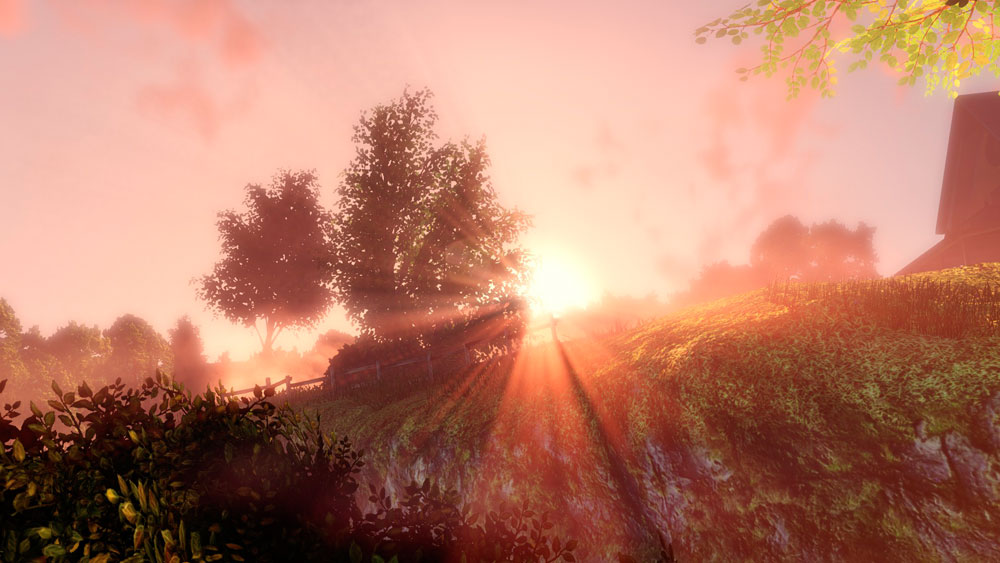
The imagery alone is worth, like, nearly $10.
Secondly, there is almost nothing in this world more personally maddening than when people suggest a given narrative is good (or the best ever) simply because it appears complicated. Why is convoluted nonsense confused for depth? I had to turn off this Kotaku audio spoiler discussion because the hosts actually suggested that not thinking about (for example) time travel paradoxes makes time travel plots better. Well… yeah. That works because you are taking away the bullshit plot as it actually exists and then substituting your own, better version in its place. And odds are that your own version doesn’t make any more goddamn sense, cobbled together as it is with your vague, unexamined good feelings rather than the jumbled pieces presented by the original writers.
I am not asking for a happy ending. I am not asking for Saturday Morning cartoon simplicity. Hell, I am even completely fine with leaving things up for interpretation; Inception’s ending was perfect, for example. What I am not fine with is when vague nonsense is elevated to absurd heights. If Bioshock Infinite’s plot is actually any good, then surely it can stand up to some peanut gallery criticism. Right? Right.
And by all means, if I am talking out of my ass on any of the below points, or you want to provide a different perspective, call me out in the comments below.
.
.

.
.
Redefinition of what Alternate Universes mean.
First off, this may seem like a minor quibble, but I think a lot of the confusion and suggested paradoxes stem from the fact that Bioshock Infinite is inventing its own version of multiverse/time travel theory. Levine is basically saying “I’m going to take this hackneyed, impossible-to-do-right concept and solve it with three words: ‘Constants and variables.'” What about the Grandfather Paradox? “Constants and variables.” What about all the universes in which Comstock is a good guy, or those in which Booker doesn’t sell Anna? “Constants and variables.” Why couldn’t Elizabeth just stage an intervention to keep Booker from drinking and gambling? CONSTANTS AND VARIABLES.
I’m sorry, presenting a multiverse theory in which there are “millions and millions” of other Comstocks and yet certain outcomes are arbitrarily 100% set in stone is simply lazy storytelling. I mean, it is not even inconsistent for there to be universes in which Booker never sold Anna! It almost feels like Levine crafted the “constants” based entirely on being able to railroad the player in that one room with the baby. You can still have an impetus to stop Comstock in any of the universes in which he turns into a bad guy, even if it is not ALL universes. Or, hell, add some moral ambiguity to the story by suggesting eliminating the bad Comstocks is “worth” killing all the good ones too.
“Constants and Variables” might be a novel “solution” to the problems of alternative universe storytelling, but only because no other writer thought anyone would actually buy into it. This feels like deus ex machina ^ ∞.
“There are a million million other Comstocks”

Someone has some daddy issues.
This was my literal reaction to Elizabeth’s line about why the game wasn’t technically over after killing Comstock:
“So what?”
Seriously, so what if there are a million million other ones? There are a million million other bad things in alternate universes too – not to mention real life in 1912 – but we don’t seem to be solving those. Was what Comstock did in the Columbia period so bad that killing him at the point in the timeline which we did, was not good enough? Let’s drown him a million million times in that same fountain, as god only knows our conveniently omnipotent Elizabeth can time travel us there; there isn’t even the Constants and Variables bullshit to get in our way. Elizabeth and Booker quite literally have all the time in the world.
When did the drowning occur?
Speaking of drowning, when did Booker get drowned by the Elizabethes? Before or after the baptism? If before, why did that not kill off all Bookers/Annas/Elizabeths, e.g. make the after-credits scene impossible? If it occurred after the baptism, as the extra scene seems to convey, why is it so important for Booker to come to the “smothering” decision? Why is the player’s Booker smothered, instead of watching a new Comstock get smothered? Narrative convenience?
At first, I thought the answer was easy. In the game proper, it seems as though Booker shares the memories of any universe he has been in. For example, after bringing in the weapons, Booker has memories of being a hero of the Vox. In this way, by traveling to the past (time travel and alternate universes, this is so deep u guyz) and presumably merging with the post-Baptism-yet-pre-Comstock Booker, we can have a scenario in which a not-yet-Comstock Booker realizes what is going to happen and accept the need for his own drowning.
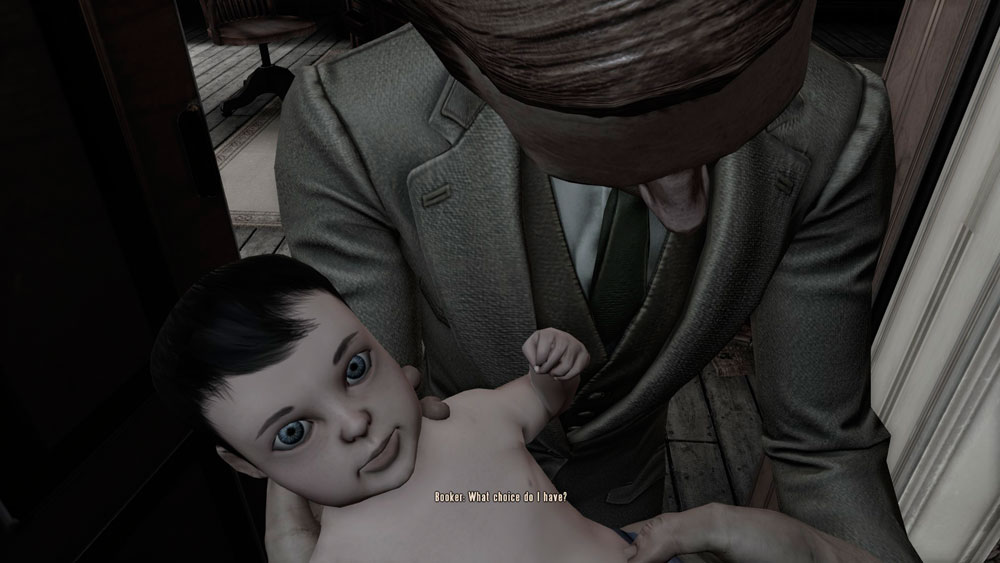
None, apparently.
Which is… a pretty shitty moral scenario, if you think about it. More on that in a moment.
Of course, if the above is actually the case, then how is it possible for Booker and Comstock to exist in the same universe in the first place? Why doesn’t Booker have Comstock’s memories the moment he wakes up in the row boat, or when getting into Columbia, or when physically drowning Comstock in the baptismal fountain (ooo, foreshadowing) in the game proper?
To be honest, I might have missed the explanation for why Booker wasn’t a drooling, nosebleeding basketcase like the other dead-now-alive soldiers. Or why those soldiers were having such a hard time when, at best, they were “remembering” alternate universes in which they were dead. If the dead soldiers were now alive due to us changing things in the past, what does that really mean for the great swaths of population we killed across Columbia even in a no-Comstock scenario?
Negating all events that were experienced

Right in the feels.
Let us pretend for a moment that the ending makes perfect sense, there are no plot holes, and everything is wrapped up with a neat little bow. Hell, let’s pretend the ending is even happy, despite the fact that Booker is still a murdering, gambling, union-busting alcoholic single father with enough debt to legitimately consider selling his own daughter to the first person who opens a checkbook. And let’s further assume that he retained the memories of all that he accomplished in the game, perhaps giving him an impetus to try and set everything right instead of dropping baby Anna off in a basket at the closest orphanage.
In this best case scenario, Bioshock Infinite is a game in which all your actions are voided. Everything you struggled to accomplish is erased. None of it happened. Every moral choice you made, every time you refrained from stealing from cash registers, every interracial kindness you demonstrated never matters because those people/scenarios never exist. It boils down to a “it was all a dream” scenario, which is the most pernicious storytelling mechanic in the history of narrative.
If I had no other problems with the story, this alone would be enough to throw my hands up in disgust. Do you really feel like a game in which you endeavor to negate everything that happens is deep and meaningful? You can accomplish all the game has set you out to accomplish by simply not playing. As prophesied by WOPR in 1983: “the only winning move is not to play [Bioshock Infinite].”
Moral of the story?
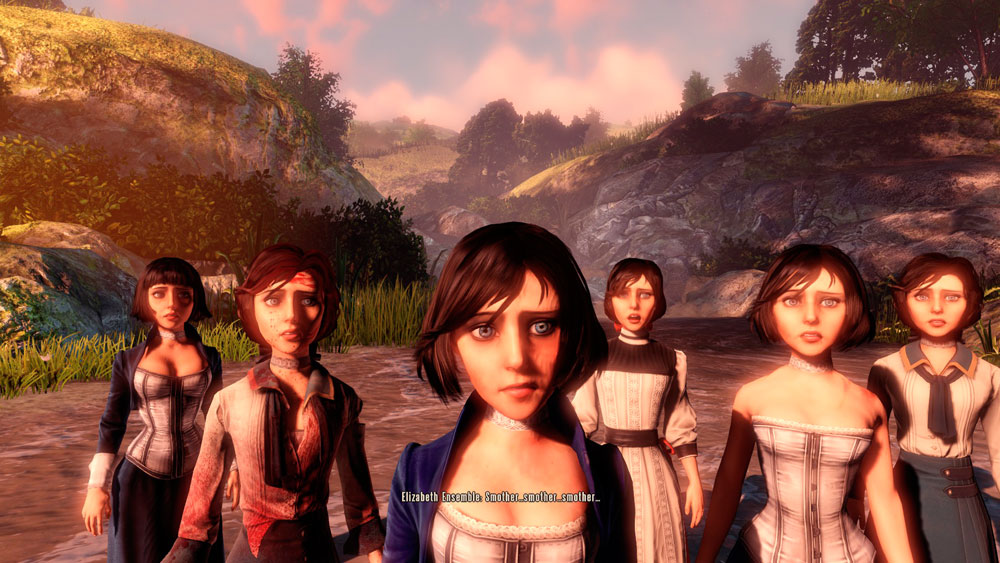
Creepy Level: The Shining
Finally, let me kind of wrap all these various ingredients up into one complete shit sandwich. What exactly is the message being conveyed here in Bioshock Infinite? What is the theme, the moral of the story?
At the beginning, I almost felt like Booker was trying to make up for his sins, to seek forgiveness and redemption, to put things right. But what is Booker’s actual crime that he is repenting? To stop a person he never turned out to be from entrapping the person he is into a crime a third version must now stop? Booker choosing to be drowned seems a noble sacrifice until you realize what exactly he is undoing: choices he never made. Or, even worse, stopping a man (Comstock) he had no choice into becoming. There is never any “good Comstock” because apparently being bad is a constant. Fate. Predestination.
What is the message here about personal responsibility, free will, and choice? You have none because Constants and Variables. And suddenly, infinite universes means you are implicitly responsible to consequences that you never chose and never happened in your own universe. Do you remember when you donated to charity instead of setting a baby on fire? Well, you should feel real bad anyway because the not-you baby-arsonist is running amok and it’s up to you to stop yourself like you already did by not setting the baby on fire in the first place. GUYZ, DEEPEST PLOT EVAR.
Even worse, apparently Booker is the one on the hook for what the Lutece twins are ultimately responsible for. Who invented the Tear machine? Who gave it to Comstock? Why isn’t this game about the Lutece twins stopping themselves from transdimensional kidnapping, extortion, and/or human trafficking?
Ah, right. “Constants and variables.” And when the Lutece twins invent the Tear machine anyway and give it to the next megalomaniac – a real shortage of those in the early 1900s, let me tell you – it will once again be somebody else’s alternate-reality problem.
_______
Fake Edit: After “playing” through the ending sequence again, I believe the drowning question can be put to bed. Elizabeth(es) specifically say:
Preacher Witting: Booker DeWitt, are you ready to be born again?
Booker: What is this? Why are we back here?
Elizabeth: This isn’t the same place, Booker.
Booker: Of course it is, I remember – wait. You’re not… you’re not… who are you?
Elizabeth: You chose to walk away. But in other oceans you didn’t. You took the baptism. And you were born again as a different man.
Booker: Comstock.
Elizabeth: It all has to end. To never have started. Not just in this world. But in all of ours.
Booker: Smother him in the crib.
Elizabeth Esemble: Smother… smother… smother..
Elizabeth: Before the choice is made. Before you are reborn.
Preacher Witting: And what name shall you take my son?
Elizabeth: He’s Zachary Comstock. He’s Booker DeWitt.
Booker: No… I’m both.
In other words, it was not Comstock that was smothered in the crib, it was Booker before he made the choice to be baptized or refuse. Meaning, both Booker and Comstock are dead. Meaning, the after-credits scene is either a vision of an afterlife, or a cheap plot hole to make you feel better while masquerading as deep storytelling.
Please, tell me I’m wrong about any of this. Tell me there is a legitimate reason people are praising this plot, as if it holds even the slightest of candles to the original Bioshock. Am I missing something? Perhaps, you know, the Tear into an alternate universe in which Bioshock Infinite’s plot is any good?
Bioshock Infinite Impressions: Day 1
I am hoping things get better than this.
Granted, I do not consider myself “in the game” quite yet; given how prominently Elizabeth displayed, I’m guessing everything up to her will still be considered tutorial. Of that tutorial though, some things are becoming more and more clear to me:
1) Fantastic visuals have the opposite effect on me.
The visuals, objectively, look awesome. The visuals are also immensely distracting. When I am trying to shoot a guy with a pistol, seeing a particularly well-done cumulus cloud in the background adds nothing positive to that gameplay experience. I had the same issue with Battlefield 3 in the beginning – it was difficult to “see” enemies amidst the Ultra-High settings – so this is something likely to get better over time, e.g. when I start tuning out the visuals.
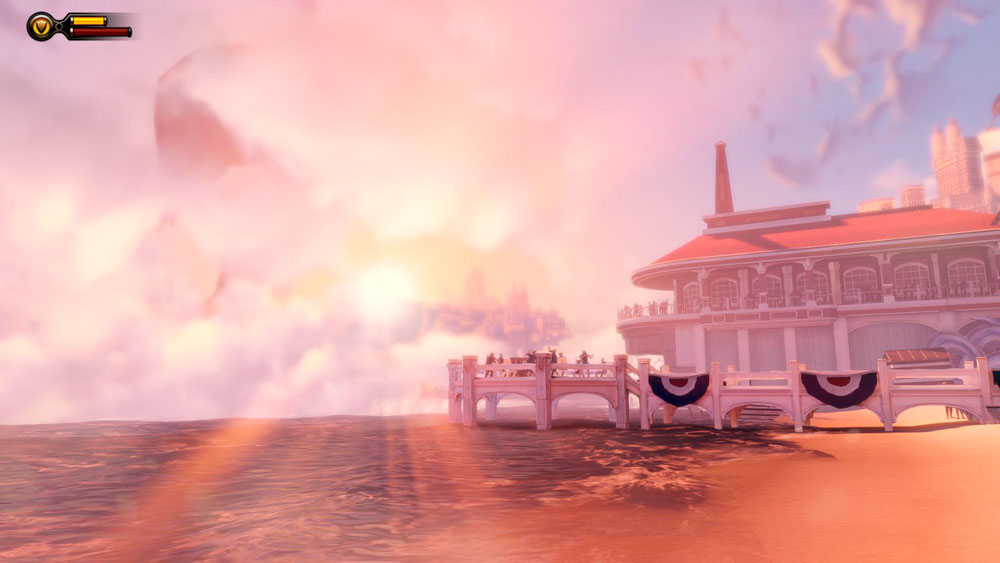
Just gotta ignore all of this.
Incidentally, I never had this problem with Borderlands 2, and I think that is because the moments of cel-shaded beauty are more spaced out, and act as breaks inbetween more functional battlefield back-drops. I don’t want ugly games, of course, just games where you are not overloaded with visuals at time when precision and quick reflexes are called for.
2) Thus far, the theme isn’t all that compelling.
In the original Bioshock, the theme was taking Libertarianism to its extreme conclusion – a gaming subject matter particular novel for its time. Bioshock 2 introduced the opposite, showcasing the nefarious side of Collectivism. While it is still early yet, Bioshock Infinite’s theme of religious extremism slash Isolationism slash historical fetishism is… somewhat rote in comparison.
Bigoted religious cults in videogames are right up there with zombies, Nazis, and demons when it comes to stereotypical bad guys. This might be the first time we have seen such (intentional) overt racist imagery in a game, but I feel like I can already plot the rest of the story from here. There is still plenty room for surprises… yet Bioshock Infinite is going to have to surprise me, lest its thematic message be no different than the one you have seen dozens of times in the 32-bit era, or watching Glenn Beck for more than ten minutes.
Also… aside from some nice clouds and sunsets, so far the underwater motif of the original Bioshocks feels worlds better than open sky of Infinite. There was implicit danger at all times in the ocean, along with a sort of fantastic plausibility; underwater buildings are more impractical/expensive versus impossible. Conversely, in Infinite, sometimes it is not especially noticeable that you are in the air at all. Just look at that screenshot up there again.
3) Console Port
The very first sign a game is a console port is when it is Checkpoint-based. My dismay at discovering there was no Quick-Save was both immediate and visceral. Technically Borderlands 2 is also Checkpoint-based, but the difference is that A) those Checkpoints are a known quantity (you know where they are), and B) you can still save at any time when you Exit the game.
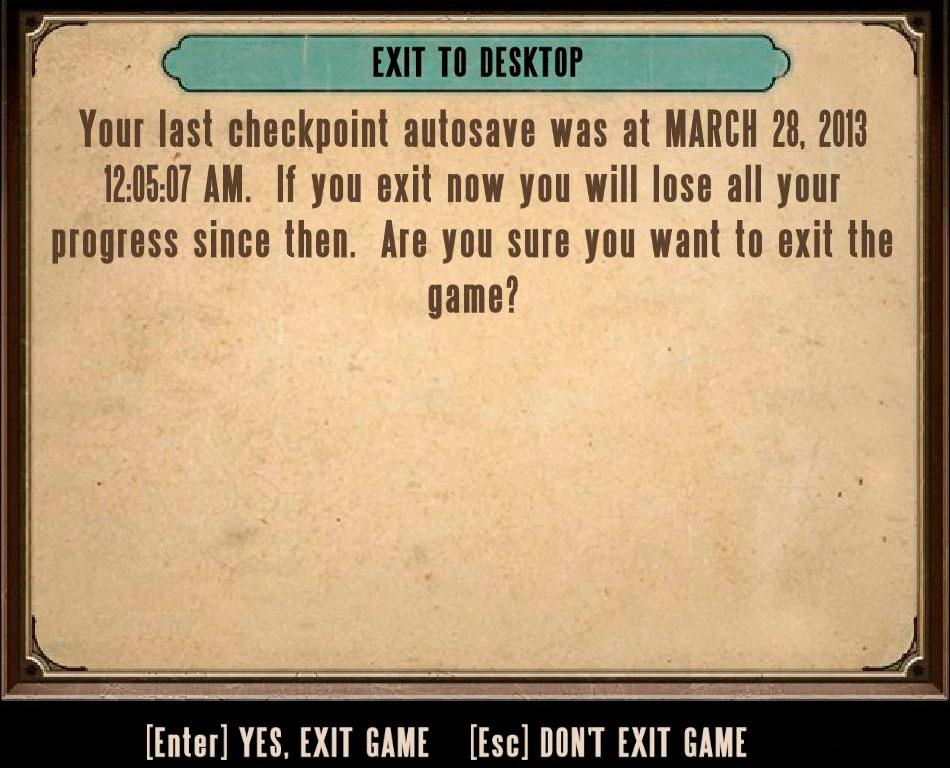
Ugh, really?
I am going to trooper on, of course, and perhaps it is a little unfair of me to expect brilliance from Minute 1. But given that I broke my Day 1 Embargo for Bioshock Infinite, I am a little bit weary of Buyer’s Remorse. I mean, I passed on Far Cry 3 for $30 for god’s sake!
Here is to hoping that I get blown away in the game proper, instead of musing as to whether I might have more fun playing Recettear like I was two days ago.
Bioshock Infinite
I was not going to purchase Bioshock Infinite on Day 1, for a variety of reasons. Between the delays, the abortive multiplayer aspirations, and the high profile resignations, the deck was stacked against an early purchase in my mind. Plus, I already have dozens and dozens of games I have yet to play/install, so why get a brand new one when I can instead wait for the price drop in 2-3 months? Also, First World Problem alert, I already owned all of the games being offered as bonuses for preordering.
And then… I watched this review by Adam Sessler:
I bought my “preorder” at 1am through Green Man Gaming, whose cash-back promotion technically means I got it for $45 (plus some Steam keys for games I already have).
By the way, “Infinite” might be referring to the amount of hard drive space required to run the game: 17 gigs. That is nearly 3 times the size of Skyrim, and almost as big as WoW by itself. I have some games still installed that I probably should clear out from lack of use, like Guild Wars 2 and Fallout: New Vegas, but it’s still a lot of hard drive real estate.
Hearthstoned
Oh, my. I don’t think anyone saw this coming, but Blizzard is making a(nother?) Collectible Card Game.
Like I imagine many people in the non-apoplexy camp, I spent a large portion of my formative nerd years with Magic: the Gathering. My original shoebox of cards were from Ice Age, gifted from some obscure cousin of a family friend, but the first real entry into M:tG came with Tempest. Which then led into the Urza trilogy, with Urza’s Saga still remaining my favorite expansion of all time.

Not the most OP, but some of my favorite art/effects from Urza’s Saga.
My high school friends and I continued playing weekly up through, I believe, Ravnica. At that point, we were all scattered from life and interest waned. I dabbled with Magic: Online, still in the Ravnica era, and I was midway through busting out my credit card for another $17 tournament entry fee when I realized my objection to WoW and other MMOs with subscription fees was somewhat hypocritical.
I have little doubt that Hearthstone will be fun, at least for anyone who enjoys CCGs – it is difficult to screw up the innate simplicity and surprising depth to deck-building games. Any reservations I have is entirely based on the payment scheme.
Can we be frank for a second? Calling a Collectable Card Game “Free-to-Play” is such rank PR bullshit as to make even David Reid nauseous. Of course a CCG is free-to-play. You already bought the cards! Who is selling collectable cards and then charging a subscription for the privileged of keeping them? EA? This sort of nonsense is like calling Chess a F2P game. Maybe we are so mired in novel payment schemes that such a distinction (misleading as it is) is nevertheless necessary as signals to consumers.
And all of this obfuscates the underlying snare of all CCGs, Magic included: they are Pay-To-Win by design. I love M:tG, I really do. There are Pauper leagues (all common cards), Drafts, and some historical decks in which many of the key cards were no more than uncommon. But those things are only noteworthy insofar as they were the exceptions. If you look at standard tournament decks, they will cost between $250 to $650+ (!), stuffed as they are with Rare (or Mythic Rare, these days) cards. I used to read the WotC design articles, and at that time I almost swallowed their premise that these rares were justified in their rarity based on their complexities. “Commons are, well, common. You wouldn’t want the average player to crack open a pack of 12 complicated cards.”
Yeah, you’re right, we wouldn’t want that. It is just a huge coincidence that the more complex cards are the most objectively powerful and the most (artificially) rare, thereby forcing people to buy more booster packs in order to compete. I mean, we couldn’t possibly keep things proportional, like limiting rare cards to 1 specific card per deck instead of 4.
I mention all this because there is one indelible truth to CCGs: someone with more money to burn is going to ruin your day. Over and over and over again, until you can’t whip out your credit card fast enough. If you don’t think this is the first thing that will happen in Hearthstone, I don’t know what to tell you. Cynicism? Bitch, please. I am a Grade A recovering CCG addict and I know what’s coming for you and anyone else with less street-smarts to know that the first hit from the dealer is always free.
SimCity and Meta-Criticism
After a long period of reflection, I had originally decided to not join in on all the schadenfreude surrounding the SimCity debacle beyond my post two weeks ago. Not out of any moral sensibilities – heavens no! – but simply out of a lack of fucks given. That, and I certainly couldn’t keep up with the torrent of other blogger updates on the developing story, when it seemed some new embarrassment was revealed daily. Kotaku even had a SimCity Disaster Watch graphic created to handle all the articles.
At one point though, I was almost tempted to purchase SimCity myself out of a longing for gonzo journalism combined with the thought of a free EA game. Then I simply browsed EA’s catalog, realizing that unless they gave away Dead Space 3 (they did, dammit), I either had all the games or the value’s promotion was $20 max.
I do, however, want to commit to internet posterity my intense loathing regarding articles like this one from Time.com. These middle-road Apologist articles and their asinine, straw man arguments infuriate me to heights even EA cannot hope to surmount. Consider the following:
EA was never, ever obliged to make SimCity a single-player game, nor do these accusations (accurate or no) from modders that the existing code is just a few steps away from being a single-player game hold much water when it comes to EA’s obligations. So what if the game could have been a single-player game.
First, who said a single goddamned thing about obligation?
Look, I can follow the twisted derailment of thought that conjures forth the implied “obligation.” Someone stating that SimCity should have had a single-player mode is assuming a sort of game design high ground, harkening towards a moral edifice that does not strictly exist. Because the game should have been a certain way, Maxis/EA has an obligation to Comment out Line #22 in the code design a single-player mode. That’s where the implied obligation comes from, right?
If so, we live in a terribly nonsensical world, one immune to criticism or judgment of any kind. Did McDonald’s give you cold french fries? Too bad, because they aren’t obligated to give you hot ones. No complaining! Did you tell the waiter you wanted a medium-rare steak and they gave you well-done? The chef isn’t obligated to bend to your whims, knave! He or she is an artiste! Movie previews aren’t obligated to represent the actual feature film, and if you don’t like it, go back in time and don’t buy a ticket!
Of course, the author clearly is being pedantic here. The point most people are bringing up is that SimCity, both conceptually and literally, doesn’t need to be always-online. There is no requirement for it to be so, despite the rather flagrant falsehoods claimed by the development team and embarrassingly contradicted by the modding community and a Maxis insider. Maxis/EA has no obligation to accede to reason, of course, but they certainly invite the valid criticism that accompany such quests for profit at consumer expense.
Which segues nicely into this nonsense:
You can ask, you can even petition, but I’d like to think we’re not at the point where we’re now telling painters, musicians, writers and artists of whatever stripe — game designers included — what they have to do.
You can’t have it both ways. You can’t shake your fist indignantly and shout “but games are art!” then hold game designers to a different standard.
This is truly an despicable appeal to diversion. “Stop complaining about game design direction, or else games won’t be art anymore!” First of all, there is nothing sacrosanct about art. Authors have editors. Directors have focus groups. Fundamentally, all art is an exchange, and every artist considers his or her audience when making a piece for presentation (even if they imagine it is an audience of just themselves). And this is besides the fact that these game companies are businesses selling a product for profit. Games can be artistic products, but these companies are selling them to consumers, not putting (selling?) them in museums.
The pernicious worm at the core of this abhorrent article is the same one I have seen in similar, depressingly frequent articles: an implicit admonition of criticism itself. “Stop complaining,” these authors say, “you are lucky the artists deign to create anything for you filthy plebs.” No, I deny your thinly-veiled nihilism. Gamers have a right to reject anti-consumerist design. Gamers have the right to call out poor gameplay. The gamers who made the SimCity franchise successful in the first place have a right to protest design they feel is taking said franchise in the wrong direction. Is EA/Maxis or any game maker obligated to do anything? Of course not. Does that make levied criticism illegitimate? Hell no.
You are always entitled to your own opinion, and people can judge for themselves whether it an opinion worthy of consideration. And it is my opinion that Time’s article of meta-criticism – and all articles in the same vein – are specious nonsense, and nihilistic besides. Nothing is beyond reproach, else it demonstrates a perfection impossible to manifest in a universe of subjective minds.
I can only hope that the next EA CEO coming in can spare the 5 minutes of his or her time to understand why the company continues topping the worst company in the world charts. A quick memo to Maxis authorizing an offline mode would pull the teeth out of this endless negative PR; a gaming policy of not monetizing every single pixel with endless online passes could even get gamers to forgive Origin (or maybe just running some goddamn sales).
Bam, done. You’re welcome, EA.
P.S. While writing this article, a friend of mine pops up on Steam chat saying that the Mass Effect 3 servers were down, meaning he couldn’t play the single-player DLC he legitimately purchased through Origin weeks ago. This is the world we live in, folks.
SimSlum
I have less than zero interest in the latest SimCity.
Granted, I have not played a Sim City since SimCity 2000, or Streets of SimCity if that counts. Indeed, Streets of SimCity was perhaps one of my favorite PC games from the 90s (has it really been two decades?) precisely because you could import your SimCity 2000 save files and then drive around at street-level. One of the augmentations to your vehicle, aside from rocket launchers and machine guns, was a sort of gliding mechanism that allowed you to fly around if you hit a sufficiently high hill. So, of course, I would use the infinite money “cheat” (about as silly as saying Minecraft building-mode is cheating) to construct the largest possible hills and then sail my way across thriving metropolises. SimCopter, I believe, also allowed you to fly around your own cities, but I never had that game.
Regardless, the latest SimCity has a number of fairly baffling changes to the core formula, the foremost of which is a sort of forced multiplayer integration, from which all other terrible design flows. Yes, you can play it single-player… by creating your own private region and not inviting other people in. But the concept of “regions” at all exists because the default is building cities connected to other peoples’ cities. Which, in a vacuum (preferably the vacuum of space), is fine if it were not for the results:
- No offline mode.
- No individual Save/Loads. As in, you cannot build your city up, unleash a disaster, then reload once you’ve had your fill.
- Rollbacks due to server strain/lag/failure means you can lose hours of progress.
- Individual cities are microscopic compared to the series.
- No ability to landscape the terrain.
If I have mischaracterized any of the above qualities, please let me know.
Again, this is somewhat moot considering I skipped over SimCity 3 and 4, making it unlikely I was going to purchase SimCity 5 to begin with. But… well, this sort of direction for a venerable franchise makes me less likely to ever buy back in. I never really “got” the people who decried radical franchise reboots like Syndicate until this version of SimCity came out. Interacting with individual Sims is cool and all, but the rest of the social nonsense was never what these games were about, at least to me. And yet, now, to an entirely new generation of gamers, it will be.
Sigh. Get off my lawn.
Resistance is… Probably Not a Good Idea.
My (probably futile) attempts at conquering the Gratuitous Space Battle campaign mode continues. After looking at the available ship options, I decided to change races to the Empire. Some of the different races get access to unique weapons or ship layouts, but for the most part everything is the same. Except maybe not for the Empire. Most of their ships look like space stations, and come with a ridiculous number of standard module slots to match.
That and basically everything else likely means nothing to you, but just roll with it for now.
So my fleet composition looks something like this. First, the I-Point, which is essentially a damage-soaker featuring multiple shield generators and power plants to match. Under most circumstances, a ship will likely have ~200 shield HP, but the I-Point has 800+. It has a few weapons, but it’s orders are simply to close to EMP range and otherwise take the hits. Stuck in rigid formation behind it is at least one I-Help, which is a Frigate whose sole purpose is to use the Empire-specific shield-mending beam on the I-Point and on anyone else nearby. Tank and heals old-school style.
The big surprise, at least as far as effectiveness goes, came from the I-Battery. This ship design is fairly unique in what I have seen thus far, with it capable of housing 8 weapons in a Frigate hull. As tempted as I was to put missile launchers in every slot, I decided that I would instead go with the almost-as-good ranged Plasma Cannons. Cost-wise, the I-Battery were surprisingly cheap, which gives me leave to build 1-2 of them each turn.
Finally, rather than replace any of my Plasma Cannons with anti-fighter laser weapons, I decided to simply field a bunch of fighters myself, flying Escort mode around my I-Point. They are not as powerful as the fighters of other races, but they are the fastest in the game.
I was undefeated for a while, conquering planets at a pretty good clip under my balanced doctrine… until disaster.
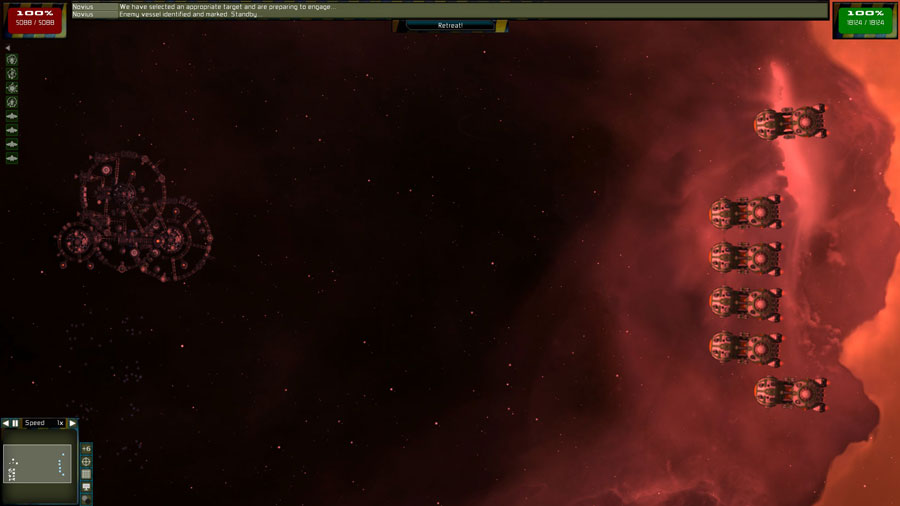
Hey, this looks familiar.
With a full fleet that was poised to take over a few isolated systems, I was instead attacked by a six cruiser complement of one of the DLC race ships. Their loadout? Missiles. ALL the missiles. I took special care in putting at least one Guidance Scrambler on each one of my ships, and their combined effort up to this point was usually enough to clear the sky. Not these missiles though, and not in this volume. I was annihilated by a specialized force – a missile force – and thus came full circle.
I did not give up yet though. Oh, no. I made an I-Screen ship, with Point Defense Mk 2 in every weapon slot to shoot down enemy missiles and nothing else. Remembering my failure with the fighters last time, I nevertheless fielded four squadrons of 16. And this time, I also made special orders for all ships to follow Vulture orders, e.g. always target the most damaged ship in range.
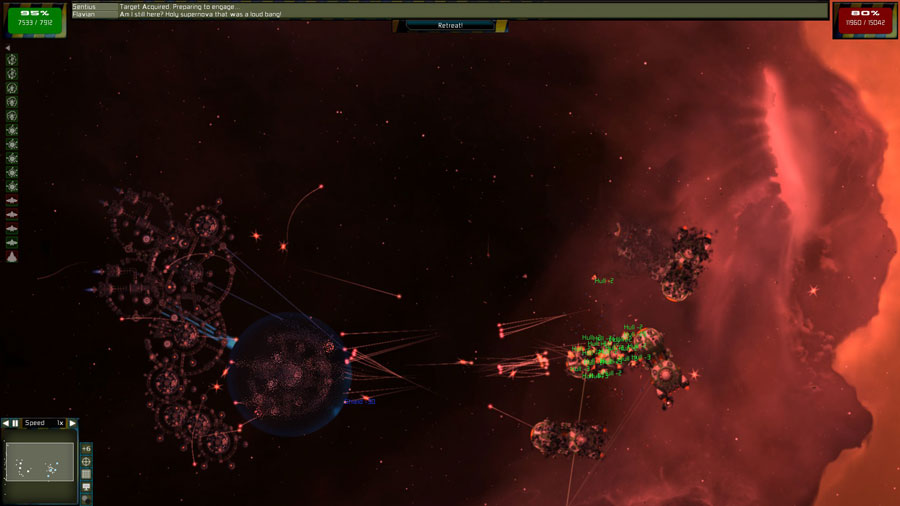
Remember me now?
The result was almost comical. I don’t know whether it was the Vulture orders or the extra squadron or something else, but my fighters blew two of the ships up and crippled two more before my cruisers even got within range. The I-Screen largely turned out to be useless, as the range of its anti-missile guns was too short to prevent them damaging the shields of the I-Point, and yet it was too fragile to place in front (defeating the purpose of the tank). In any case, the revenge was sweet.
But it would not last.

Misty day, remains of Judgment.
Riding high on my prior victories, I was complacent until a nest of vipers landed in my lap in the form of five Parasite cruisers. It almost didn’t seem fair… for them. I had a slightly bigger fleet than before, after all. As it turns out, the Parasite race has access to an AoE flak cannon that simply shredded my fighters like so much tissue paper. Even with the combined might of my fleet, I was not able to collapse even one shield amongst their ships. Instead of the normal Guidance Scramblers that deflect missiles, they have a version that turns the missile around and causes it to hit you, all with a greater range.
My fleet destroyed once again, I attempted to mount a counter-offensive with a new fleet after 10 turns. The result was even worse than before. Then, they captured my only planet with a shipyard, effectively ending the game.
There is no reloading saved games in GSB. One’s failure is absolute.
_____________________
I should note, in passing, that the most frustrating aspect of GSB campaign mode is also one of its most novel. You see, 100% of those fleet compositions I talked about are player-generated. In the vanilla game, you could submit your own fleet as a sort of “puzzle” (aka Challenges) that other players could battle and then rate. I played a few of these maps, but it all felt a bit pointless after a while, especially when it didn’t reward Honor (the in-game currency for unlocks). Wrapping this all up in a cloak of purpose via campaign mode though, did indeed breathe life into the concept as evidenced by my repeated head-banging.
Of course, this also means campaign mode operates with no rhyme or reason, as you charge headlong into truly random and insipid battles that you cannot hope to prepare against. Specialization beats Generalization every time, but the player is never afforded the luxury of anything else. It reminds me of the great debate of Critical Hits in paper D&D. On the one hand, rolling a 20 and getting double-damage feels awesome. On the other hand, the players will always face hundreds more dice rolls against them than they ever will roll against individual mobs. Ergo, players are more penalized by critical hits than they benefit, increasing the chances of a Total Party Kill… unless the DM fudges the rolls behind the screen.
Questionable Space Battles
Sometimes I find myself inexplicably drawn to building spaceships and watching them explode. With Steam having a 75% sale on the Gratuitous Space Battles DLC this past weekend, it seemed as good a time as any to try and get that fix.
The problem is that I am having a hard time convincing myself that the game isn’t complete bullshit.
You can read my original review here, but suffice it to say, GSB is essentially a game about building spaceships and nothing else. I think one of the DLCs or patches gave you the ability to change orders mid-battle at the cost of high score tracking or whatever, but under normal circumstances you design ships, give general orders, and let’em go. I mentioned in the review that I quickly came across a strategy that essentially wins 100% of the time – basically missile spam with occasional target painter that makes missile 100% accurate – but it seems clear to me now that it has been nerfed to oblivion. Anti-missile tech existed in the vanilla game already, e.g. guidance scramblers and Point Defense batteries, although it seems much, much stronger than it ever was so many months ago.
It is fine having counters to things, whatever. When I was looking at alternatives to missile spam though, I kept running into problems with the ship building aspects. As you might imagine in these sort of games, you have to juggle each component’s energy usage, crew requirements, weight, and so on. Except… all roads lead to the same max-level components and heavy mixing of weapons. It feels… banal. If I want an all-beam ship, let me build an all-beam ship without gimping on shields or armor. The weakness of specialization is supposed to be being vulnerable to counters, not it being nigh-impossible to actually specialize.
Or maybe I’m just all sour grapes because this happened:
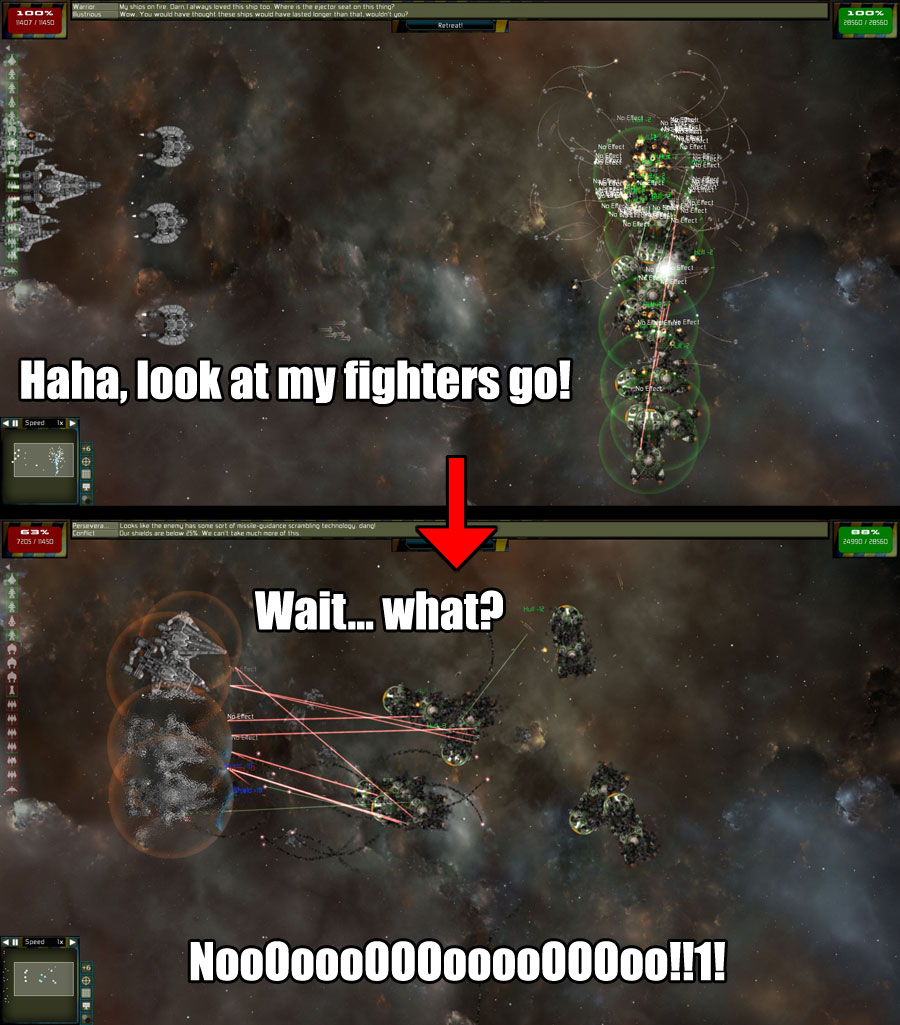
Was totally wiped out, killing zero enemy ships. They all had ~20% HP or less.
I will continue plugging along with Gratuitous Space Battles for a while longer, but in the meantime, if you have any suggestions for spaceship designing/battle games, let me know in the comments below. I was obsessed with an ancient game called Stars! back in the day, and spent 40+ hours most recently on Space, Pirates and Zombies; dunno if FTL really counts, but I spent a lot of time with that one too. It can be a 4-X game, it can be FPS, it can be whatever it is, as long as it has a ship-designing component. And, preferably, no bullshit.
It just can’t be EVE. I have little interest in experimenting resulting in the destruction of weeks of game time.
XCOMed
By the time this gets posted, I will probably be done with my first play-through of XCOM: Enemy Within after ~20 hours.
Taking the advice of many others, I started out with Normal Ironman difficulty which turns the game into a sort of roguelike. While I have lost quite a few agents, the majority of them were rookie redshirts I tasked with carrying around the stun gun to take the aliens alive. A sort of morbid hazing ritual, if you will. An unfortunate few were grizzled veterans who got one-shot by new alien types before I had a chance to realize the danger. Or simply victims of poor planning when the only guy with a Medkit is the one bleeding to death. Too bad all the people standing around him cannot, you know, take the Medkit from his pocket and spray him, but I suppose knowledge of medicinal nanomachine application is only imparted at the character select screen.
I always find it interesting how I start developing relationships with the randomly generated characters though. Name, gender, nickname, nationality, and even class are all randomly determined, but you can customize some of those qualities. One stun gun redshirt managed to beat the odds and survive the bagging of two new alien species… and suddenly I am taking Chloe Dupont the saucy German Assault trooper with me everywhere. Mechanically, Chloe is indistinguishable from any of the other max-level Assault troopers, but I have had more fun ordering her watching her aggressively breach UFOs armed with a shotgun and the same stun gun she has carried since her initiation than any of the others. Just yesterday there was a rather hilarious moment when I put her on Overwatch mode, and during the enemy turn one Muton Elite turned a corner only to get an Alloy shot in the face, while a second Muton triggered her auto-reaction shot when it climbed a ladder I didn’t realize she was standing next to. It was practically a scene out of an action movie.
Other times, I sorta feel bad bringing, say, any new sniper because that entire class is cursed. “Sorry, Yoshio Saito of Japan. You’re probably going to die.” Sure enough, that is the mission when the aliens start using grenades, a redshirt bites the dust, my other redshirt panics and, in defiance of his accuracy rate for the entire goddamn mission up to this point, shoots Saito in the back of the head, killing him instantly.
Anyway, game is pretty fun thus far and the full review will need to wait until A) I finish, and possibly B) I try out Classic Ironman. The only negative I have is the slight impression that the game isn’t really all that deep for a “tactical” game. A lot of times I feel like I’m playing a turn-based Dawn of War 2, or one of those WW2 squad-based cover games. Also, the game is terrible when it comes to indicating at which locations (and elevations!) you can actually see/shoot at the aliens someone else sees before moving there. If you have already committed your game to having grid-based movement, give me grid-based weapon ranges and Line-of-Sight indicators.
XCOM is no Final Fantasy Tactics, or Tactics Ogre for that matter, but it is pretty good nevertheless.
 In An Age
The Next Xbox May Have Always-Online Requirement
Apr 8
Posted by Azuriel
The rumormill is a-churning away on this piece of news:
“Unless something has changed recently,” one of the sources told us over email, “Durango consumer units must have an active internet connection to be used.”
Durango is the codename for the next-gen Xbox.
“If there isn’t a connection, no games or apps can be started,” the source continued. “If the connection is interrupted then after a period of time–currently three minutes, if I remember correctly–the game/app is suspended and the network troubleshooter started.”
Lending a sort of credence to the entire affair, and once again proving that people become drooling morons on Twitter, is this series of Tweets from the Microsoft Creative Director, Adam Orth. I will go ahead and transcribe them here instead of just posting pictures of tweets like the dozen lazy websites I checked before realizing that no one else was going to do it:
Microsoft apologized for the tweets by someone “not a spokesman for Microsoft” a day later.
Personally, I feel this is one of those rumors stupid enough to be true. Microsoft is already requiring the Kinect to be running the entire time the Xbox 720 is on, because somehow it’s important to Microsoft for there to be a camera trained on your living room the entire time you are playing Halo 5. Besides, this is not even the first time we have heard about this – here is an article back in February from an insider saying that Xbox games will require an online activation code and installation to the HD, thereby making the disc worthless to anyone else. It is not much of a leap to go from online activation keys to always-online.
Lost in all of this, of course, is what possible benefit there is to the consumer. Always-Online is not a feature, no matter how hard EA’s COO spins it, it’s a restriction. You have to be online to pay an MMO, or PlanetSide 2, or whatever other multiplayer game, yes, but that is because those individuals are not in your house. The single-player campaign or indie game or whatever is in your house and doesn’t require outside intervention except arbitrarily. Remember the SimCity fiasco? There were zero server-side calculations, or at least calculations that needed to be sent out to EA’s bank of super-computers (…lol) to process. Even if you could argue that Leaderboards or cloud saving were worthwhile features, no rational arguments were given as to why they could not simply have been optional.
Adam Orth’s analogy with cell phones is particularly instructive in regards to these corporate drones’ idiotic thought processes. Does your smartphone simply shut down and become unusable the moment you lose coverage? Or can you continue playing Angry Birds or taking photos or listening to music you saved to the device? Whether I am always-online already or not, there is no benefit to the requirement.
In any case, I cannot possibly imagine a better advertisement for the PS4 than the next Xbox coming out with an always-online requirement. Will it sway a majority of people away from the Xbox? Probably not. But as the margins in the console business continue getting slimmer, perhaps there will be enough losses that these anti-consumer practices will stop making their way out of the fevered wet dreams of CFOs everywhere.
And if not, well, there is always the $99 Ouya, right?
Posted in Commentary
16 Comments
Tags: Adam Orth, Always Online, Drama, Kotaku, Ouya, PS4, Rumor, Twitter, Xbox, Xbox 720