Category Archives: Hearthstone
On Randomness, Again
A little over a year ago, I talked about randomness in Hearthstone. Since that time, the amount of RNG cards has only increased. In fact, the Goblin vs Gnomes expansion added a full 24 cards with the word “random” on it, some of which have gone on to be staple cards in many decks:

The one of the left is an auto-include in every deck.
At the time of the article, I mentioned that Blizzard’s stance on RNG was possibly at a turning point given how Hearthstone’s nascent e-Sports scene was starting to take off, much to the surprise of Blizzard itself. As we well know today however, Blizzard has stuck with their RNGuns and doubled-down on wild board swings.
And… I think I can appreciate what they’re doing.
The downsides to randomness are rather apparent to most people, insofar as you can go from winning to losing by virtue of a coin-flip. Watching Pro Players losing tournaments on the back of a 1% chance (or even less) of bad luck makes the game look like amateur hour sometimes.
On the flip side (har har), an element of randomness allows one to stage surprising comebacks. Top-decking just the right card to win a game has always been a staple of even the highest levels of the Magic: the Gathering professional scene. Since Hearthstone has less than half as many cards as Magic (and no land cards to gum up the works), Hearthstone arguably needs the extra randomness just to be less deterministic. Nobody likes playing unwinnable matches.
The real upside to Hearthstone’s randomness though? The stories.
If you were the other guy playing this match, you would probably be justifiably upset about how utterly screwed you got from that Piloted Shredder outcome. Or would you be justified? As I mentioned before, randomness is just another consideration that skilled players need to account for in their strategies. Getting Lorewalker Cho out of a Piloted Shredder as Oil Rogue is bad, but there was always a 1.5% chance of it happening in every game; if you don’t want to sometimes lose to the randomness of your own card, take it out of your deck. About 70% of the time, Piloted Shredder summons a better-than-expected minion, which is why so many people run it.
But as I was saying, that match went from “just another video demonstrating a deck” to “high-class entertainment” in my eyes. You can see the gears whirling in the streamer’s head as soon as Cho hit the board; it was unexpected, and the unexpected is much more fun for the viewers at home. Even if I were playing that game though, I think I’d be alright with it. Nobody really cares that you won yet another game as Oil Rogue or whatever is Flavor of the Week. Winning in spite of Cho? That would be epic. And even though the other rogue loss due to Cho, he/she now has the option to mentally blame bad luck instead of being outplayed. That attitude can prevent new players from improving of course, but it can also prevent new players from simply giving up in the face of veterans.
The next Hearthstone Adventure set, Blackrock Mountain, is due to be released sometimes in April. We haven’t seen nearly all the cards yet, but we already know about a reverse-Shredder card called Hungry Dragon, which summons a random 1-mana minion for your opponent. So at this point, I believe it safe to say that randomness is here to stay. Time will tell if Hearthstone in general does the same.
(I give it a 92% chance.)
More Hearthstone Revenue Speculation
Because two posts aren’t enough!
Actually, the real reason is because during the comment back-n-forth with Syncaine, Wilhelm mentioned something I had never realized before: Blizzard actually does post revenue numbers for just World of Warcraft. You can follow along at home by navigating to the Activision Blizzard Investor page and the Q4 2014 Excel document entitled 12-Quarter Financial Model. On the Rev Mix by Platform tab, you get the following (edited) table:
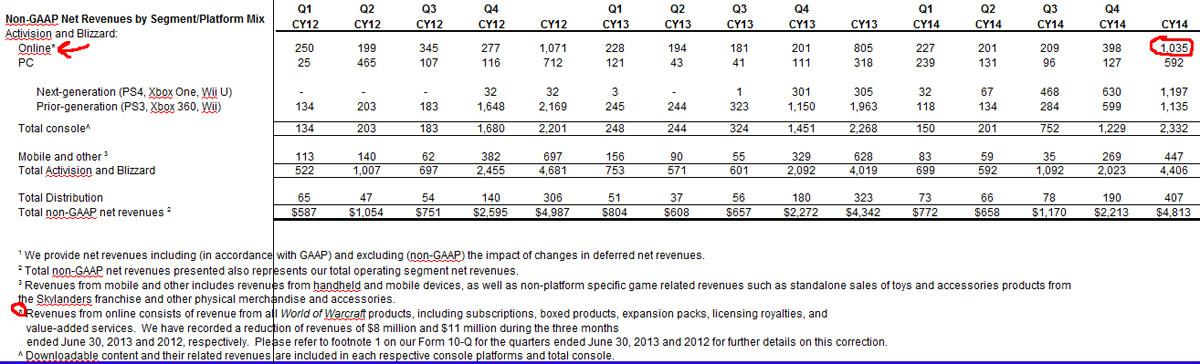
Numbers.
The asterisk indicates that “Online” revenue solely has to do with WoW related subscriptions and services. So for 2014 WoW raked in $1.035 billion. Interestingly enough, this point of reference allows us to flip back to the NR and OI by Segment tab, which breaks down total revenue for just Blizzard (again, chart edited):
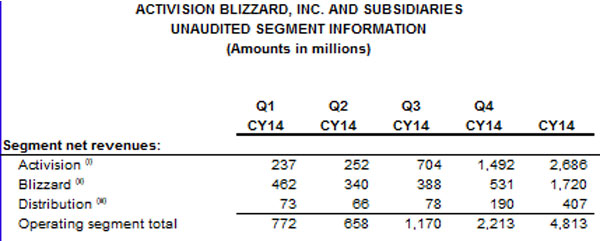
More numbers.
Apparently you can get a much easier summation of the above information from this PDF, which I only realized after the fact.
So, for 2014 Blizzard made $685m in non-WoW revenue. For the curious, those non-WoW figures were $319m in 2013 and $538m in 2012. As far as I know, only the Diablo 3 expansion and Hearthstone were notable releases in 2014, although obviously there is X amount of revenue coming in from incidental sales of D3, Starcraft, and such.
I was unable to find exact figures of total Reaper of Souls sales other than 2.7 million copies in the first week. Assuming $40 apiece, that lowers Hearthstone’s possible share by another $108m at a minimum. If the opening paragraphs of D3’s Wikipedia page can be believed, the original game has sold 15 million copies. Combined with news that D3 + expac sold 20 million altogether as of August 2014, that pushes the Diablo portion to $200m, minimum.
Going back to what we know, the Hearthstone revenue formulas are thus:
- [Hearthstone] = $850m – [$500m+ Destiny], or
- [Hearthstone] = $685m – [$200m+ non-WoW]
Incidentally, most of the Destiny reporting says it achieved $500m in revenue on Day 1. That’s not actually true – there was $500m in shipped product, but only $325m in actually-sold games in the first five days of release. Or about 5 million units, physical and digital. There are two near-as-we-can-tell figures that incorporate all of 2014: VGChartz’s 9.3 million units and 13 million unique players as of Christmas. Depending on how charitable you wish to be, that range is either $558m to $780m (@$60/copy), or $604.5m to $845m (@$65 average/copy). Which means Hearthstone is anywhere from $292m to… er, $5m.
I think I heard Syncaine fall off his chair from here.
All told, I still feel it’s entirely possible that Hearthstone made at least $100m in 2014, if not $200m. That’s a quite a reduction from my earlier post vis-a-vis $350m for Hearthstone, of course. And I’m fine with that in light of this new information; if I’m factually incorrect, then I will acknowledge it and move on. My only real horse in this fight is the ridiculously specious argument that A) Hearthstone is a mobile port, and B) it’s not that successful. Not only does current reality defy A, in terms of B it’s entirely possible Hearthstone (eventually?) outstrips Magic: the Gathering in yearly revenue.
Either way, not bad for a card game that came out of nowhere.
Or Maybe We Won’t See
Once again, Blizzard has buckled under the weight of people giving them money:
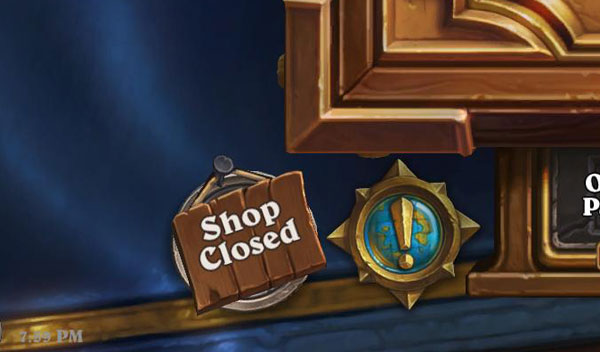
#ZerothWorldProblems
I would call something like this unprecedented, but I suppose I have experienced something similar firsthand back when Guild Wars 2 came out (Jesus, was it really 2.5 years ago?). I mean, it’s one thing to take people’s money and then not let them play because the servers are on fire; it’s something else entirely to not take the money in the first place.
In related news, someone on Reddit provided the following Twitch screenshot:
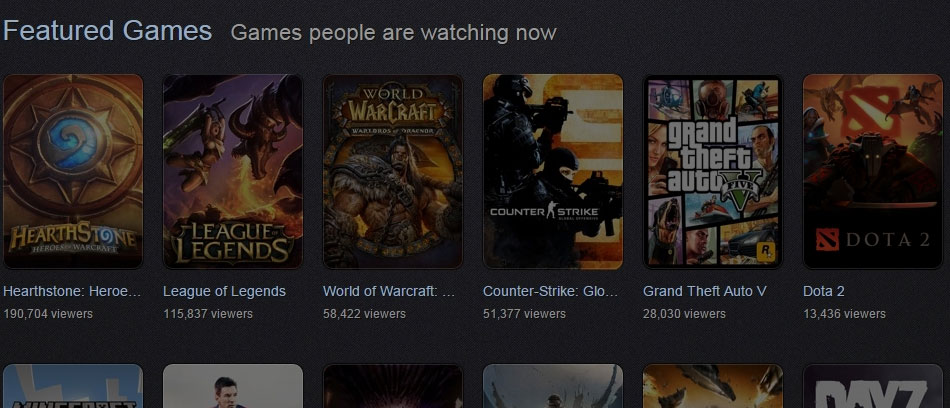
Rather unprecedented, I think.
In case that’s hard to see, it says Hearthstone had 190,704 viewers on Twitch.tv – higher than the next two games combined, which were… League of Legends and WoW. At the time I’m writing this post, it has decreased to ~86k viewers, but it’s still beating out LoL by a few thousand. New expansion and all, sure, but that’s still not a bad performance for a “casual app with a PC port.”
Hearthstone Naxx Pricing
Can I make a post via bluetooth keyboard on the deck of a beach condo with my smartphone getting 2 bars of signal? Let’s find out!
Anyway, as you may or may not know by now, Blizzard released the official Naxx mini-expansion pricing scheme for Hearthstone. Needless to say, it’s a bit convoluted. As promised, the first wing is free to everyone… who logs in sometime during the first month. The other wings are 700g apiece, or $6.99 each. Unless of course you buy them at bundled prices, which knocks it down to roughly $5 per wing.
I honestly don’t know what to think about these prices. A daily quest will reward you with 50g on average (40g is the lowest + 3 wins is 10g) so it sorta makes sense to tie things to two weeks of dailies per wing. Since the wings are going to be gated to one per week already, this means you will have a slight pressure to either purchase the later wings or fall behind, but not by too much. And this sort of assumes there won’t be any gold rewards for actually beating any of the bosses (which could go either way).
But the thing I come back to is, of course, the opportunity cost. A booster pack is 100g. So, basically it costs 7 booster per wing to unlock, with the total being 28 boosters (2800g). The lowest RMT cost of packs is $2.99 for 2 boosters. The cost of unlocking all of Naxx assuming you log on post-patch is $19.99, which is the same price as 15 boosters.
So… yeah. Depending on whether or not you are morally opposed to spending any money on a F2P* title, it seems as though your choice is either spending $20 or grinding out the equivalent of $40 worth of boosters. I can’t check my Hearthstone account at the moment, but I have around 1400g saved up, I think. Even though I am halfway there, I am not entirely sure I want to commit to a month or more of dailies all to save money and end up getting $20 less boosters.
Perhaps this is exactly why the pricing is so convoluted in the first place; Blizzard accountants working their dark magic to get people on the fence to pony up the cash. But Jesus Christ, man, remember those days when you didn’t have to do differential calculus to figure out if something was worth buying? I suppose the good part is that I’ll be able to see if the rest of Naxx is worth getting based on the free wing first.
Then again, anyone who doesn’t end up getting all 5 wings is just going to be hosed in Constructed Ranked play. Unless, of course, Blizzard has made the expansion cards perfectly balanced and optional and not power-creep-y at all.
Yeah, about that.
Hearthstone is Released, Weirdly Balanced
So the blues weren’t kidding about Hearthstone being released Soon™… because it came out today. Surprise!
Speaking of surprises, the patch notes were somewhat full of them. Or rather, not full of them, which itself is surprising. The most obvious changes were to two Legendary cards I talked about last month: Nat Pagle and Tinkmaster Overspark. Pagle’s nerf was brilliantly subtle, taking the form of moving the card-draw coin-flip from the end of your turn to the beginning. It almost doesn’t feel like a nerf at all, but the reality is that Pagle isn’t likely to be haunting the upper echelons of tournaments any longer; that one extra turn of being able to deal with Pagle before the draw engine full gets started is actually pretty huge.
In contrast, the Tinkmaster nerf has all the subtlety of Jay “And double it!” Wilson game design. Which may as well have been the case, since the card was “fixed” (in the veterinarian sense) by doubling the RNG.
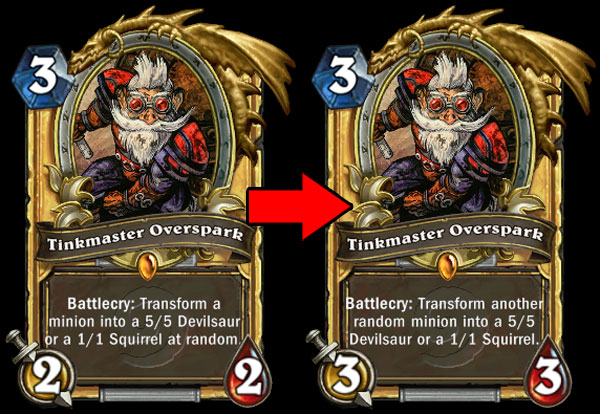
From hero to zero.
Where things get interesting is the peek into the Hearthstone card balance logic when the blues explained the Tink nerf:
Tinkmaster is a neutral card that silences and often shrinks big creatures. This reduces the amount of big, fun creatures in the environment. We think this change will increase the amount fun creatures in the environment, and bring him more in-line with his cost and overall power. Tinkmaster should still show up in certain types of decks, but will no longer be appearing in every high level deck.
While they did talk about cost and overall power at the end, the main concern was how Tink was “reducing the amount of big, fun creatures in the environment,” e.g. other Legendaries, presumably. Cards like Ragnaros and Ysera are win conditions in of themselves, and have pretty much gone unchanged since they were introduced; people who were holding out hope that perhaps these Legendaries would get the Pagle treatment seem out of luck. Hearthstone is not Magic: the Gathering, of course, but it appears this fact will need to be repeated a few more times before it fully sinks in.
And speak of the devil:
Secrets can now only activate on your opponent’s turn.
- Activating your own secrets feels a little strange, but mostly, the ability to do this was preventing us from creating new and powerful secrets that trigger off of events you can easily control (like a minion dying). They end up functioning just like spells, instead of trying to bait your opponent into a bad play. This change keeps secrets working like traps you lay for your opponent, instead of spells that you cast and use on your own turn.
I would characterize this Secret change as a huge Paladin nerf, but Paladins are pretty much nonexistent at high levels of play, and their Secrets are gimmicky at best. However, this change turns those gimmicks into Disenchant material. For example, Redemption is a Paladin Secret that says the next minion of yours that dies, gets brought back to life at 1 HP. Pair that with a value creature with Charge like Argent Commander, and you can suicide into a minion and come back to deal some extra damage. Or, of course, you could use Redemption with a Legendary for some serious card advantage.
Well, not anymore.
In any case, Hearthstone is out, it’s fun, and it’s F2P for US audiences… and merely Free-to-Download, In-App Purchases Optional (F2DIAPO) for those in the EU. Blizzard is offering a WoW mount for those willing to get rolled by beta veterans until three wins are grinded out, so there’s that too.
Hearthstone and other Game News
According to the Blues, Blizzard’s F2P “Free to download, optional in-game purchases” Hearthstone will be released for real in a matter of weeks:
How close to the end of the beta are we? Don’t need an exact date, because I know that would be horrendous, but is this a matter of days or weeks or months?
I can’t say exactly, but it is soon. Not months.
Although there are a number of annoying bugs still kicking around, I have largely considered the game to be ready for Prime Time since the closed beta. The level of polish when it comes to sound effects, the implied physicality of the game pieces, and everything else is pretty astounding considering the size of the development team. For a while there were rumors floating around that the game wouldn’t be released until the iPad version was up, but it seems like that might be referring to the planned single-player Adventure Mode.
Whatever the case, I am very much looking forward to the release and any potential card tweaks that might go along with it. To an extent, it’s easy to sit on the sidelines and call the release of new card sets/expansions as “greedy,” but goddamn does it get annoying after a while when you see the same dozen cards get played in game after game. The metagame is in a healthy state of flux, but the core staples of most every deck do not.
In news that I likely care about more than any possible reader, apparently there is a 4th (5th?) entry in the Deception series called Deception IV: Blood Ties and it’s being released this month. While it is obscure as hell, the Deception series was a set of rather groundbreaking PS1 games that were the precursor to games like Orcs Must Die. Essentially, you set up a number of nefarious traps in a mansion and then must lure trespassers to their doom by controlling an otherwise unarmed Gothic lady.
Here’s a video from Kagero: Deception 2, which is the sort of foundation of the series:
The graphics were pretty hideous even by the time the 3rd game was released, and the plot was Japanese nonsense, but the gameplay? Equal parts brilliant and hilarious. A large part of the game revolved around chaining trap combos, both because traps had cooldowns and because getting the bonus currency was required to unlock more traps/upgrade existing ones (and there was no farming). A fairly simple chain would go like this:
- Bear Trap at bottom of stairs.
- Giant Boulder crashes down stairs, knocks target into back wall.
- Push Wall knocks target back onto Bear Trap.
- Repeat.
Sounds quaint, right? Well, it should, considering Deception started doing it in 1996 and Kagero in 1998. Those were good years – FF7 was 1997, FFT was 1998 as was Xenogears.
…all of which happened almost 20 years ago. Sigh.
On Randomness
As you may or may not be aware, there was a bit of RNG controversy in a recent Hearthstone tournament. Heading into the tie-breaking Final match, the following occurred:
But as the match started, something immediately went quite awry. During the first turn of the first game, Doge House coined out a Nat Pagle. And so the scene was set for the most RNG-dependent series Hearthstone had ever seen. […] The final tabulation of RNG is shown below with perhaps the most staggering statistic being the Nat Pagle procs. Throughout the series, Doge House received eight out of a possible eleven cards from Nat Pagle while Liquid Value received only one card out of a possible seven.
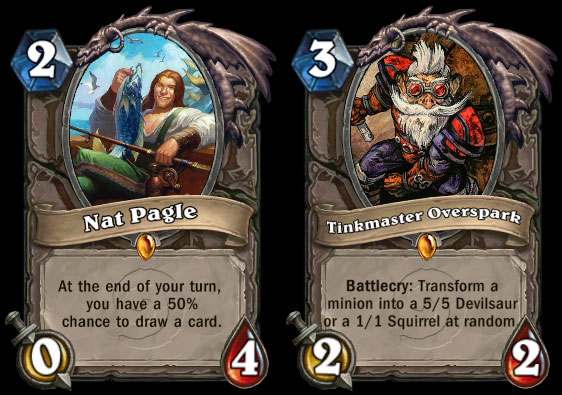
The suspects.
You can watch the offending match here. The RNG of Pagle was set in particularly harsh relief considering both players played one in the opening turns of the game, but only one side seemed to draw any cards off the ability. That prompted a rather lengthy, if compelling post by @TL_Monk detailing the negatives of RNG generally. Indeed, the case becomes even more reasonable when he compares Blizzard’s somewhat sophomoric (in comparison) responses thus far with those of Mark Rosewater, head developer of Magic: the Gathering.
So, RNG is bad right? Well… maybe. It’s worth noting that despite the final tournament game being a blowout in terms of coinflips, the Mage still could have won by a single top-decked Fireball. Had his own Pagle had a comparable draw-rate as his opponent, he would have won easily. And that’s sorta the thing.
This is the counter-point post on Reddit, talking about randomness and the overall RNG aspect of certain cards/situations in Hearthstone. The post itself essentially states that RNG is good for the game for precisely the reason why people think it’s bad: it allows a chance for weaker players to win. Without RNG, the outcome of every encounter is based on the skill of the players which, while fair, ultimately means you will never have a shot at beating someone better than you. The post goes on to assert that another card game tried the no-RNG approach and was never able to reach critical mass because it chased all the middle-tier (and lower) players away.
As an aside, Nat Pagle’s meteoric rise in use is perhaps the best possible demonstration of unintended consequences, as it was a card virtually unknown before the nerf of Novice Engineer (which used to be a 1/2 creature). Of course, Pagle was also previously bugged so that the card draw only occurred 25% of the time instead of 50%, so perhaps that had something to do with it as well.
How I feel about the subject is mixed. As someone who has some small measure of confidence in my gaming abilities, I dislike RNG. Then again, I also believe that a component of skill is being able to take RNG into account when making strategic decisions. The sensible line between good RNG and bad RNG people usually take is when the entire outcome of a match comes down to a single coin-flip. I agree that that is exceedingly lame, but… well, what is a card game if not already a series of coin flips?
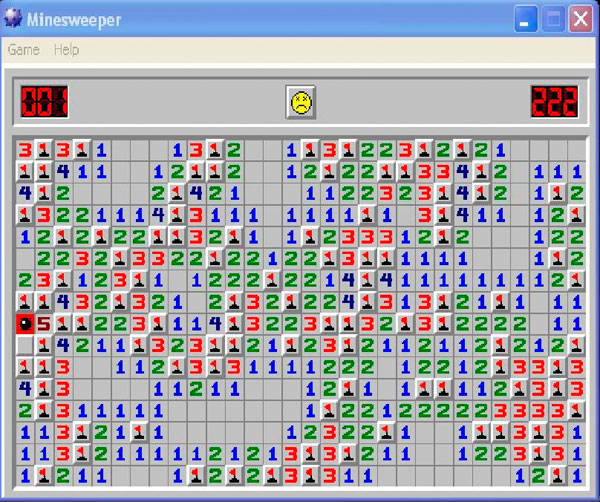
Example of bad RNG.
I was watching one of Trump’s streams where he had two creatures out against a Hunter who just played Ragnaros; if the Ragnaros hit Trump’s face next turn, it’s likely he would lose. Between a Fireball and creatures on the board, Trump could have outright killed Ragnaros, but he instead chose to dump his hand of creatures to reduce the odds of Ragnaros’ random 8 damage attack of hitting him in the face. Trump went on to win the next turn once Ragnaros hit a random minion, but would the game have been less strategic if it killed Trump instead? I might suggest that that particular game would have been less strategic without the RNG factor, because the correct moves would be more obvious. In this sense, the RNG is simply another manifestation of risk and dealing with imperfect information, just like when playing creatures when your opponent might have a board clear in hand.
If you want to see some of Trump’s RNG surfing, it’s tough to go wrong with this one.
When it comes to Nat Pagle specifically, I do sorta agree with the detractors: it’s a boring card. I have one, and it’s a no-brainer card that goes into just about every deck. Worst case scenario, Pagle draws nothing and is a 2-mana 0/4 taunt that trades with removal. Best case? It’s ridiculous. Indeed, it reminds me of the “good design on paper, bad design in practice” card Fact or Fiction in Magic: the Gathering. There was never any reason to not use it in every deck that could support the mana cost – so much so, that it was banned/restricted in the older formats for over nine years.
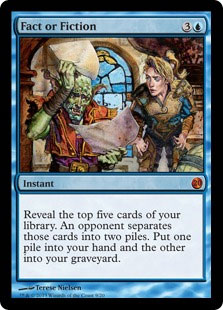
Seems almost quaint, more than a decade later.
For the time being, my opinion on RNG remains mixed. Randomness provides variance that would not otherwise exist, pretty much by definition. Random loot extends the life of a gearing game. Random layouts and outcomes are a fundamental principal of rougelikes. All (?) card games feature randomness in terms of what cards are drawn and in what order. And I’m still largely fine with people rolling the dice with a Ragnaros attack. At the same time, I do feel sheepishly guilty whenever I drop a Mad Bomber that manages to kill their 3/2 (or 2/3!), because damn that sucks for them.
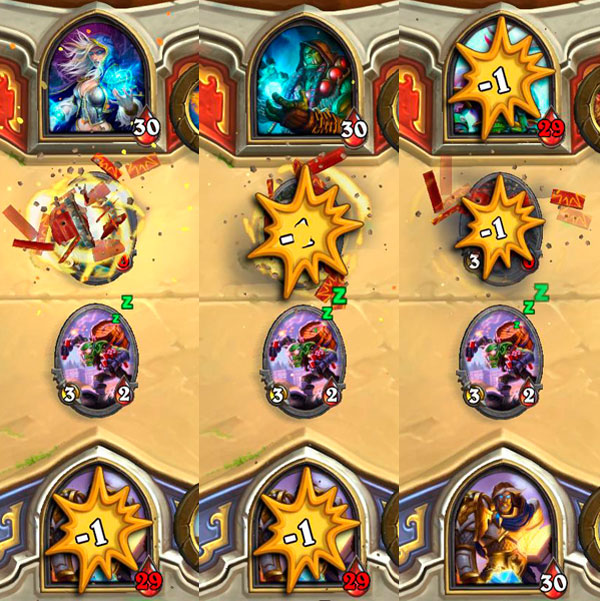
At this point, I play this card solely for the stories.
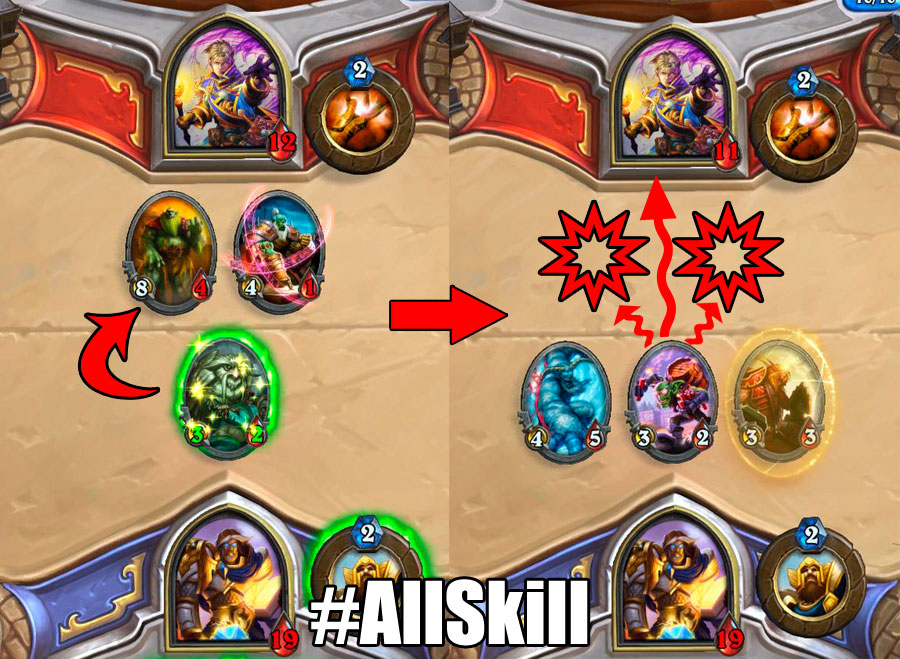
#AllSkill #Outplayed
I suppose in the final analysis, it really comes down to the sort of tone the designers are attempts to set. There were a number of coin flip cards in Magic’s history, some extremely important ones in fact, but they never really felt “right” for the game. As pointed out in the Reddit thread, that most likely was because Magic already had a randomness factor of whether you drew a good amount of lands when you needed to vs getting mana-screwed/flooded. In Hearthstone, there simply isn’t any RNG beyond what cards you draw, and what the cards do themselves. Having a lot of cards with random effects thus provides that sense of variance instead of inevitability in Hearthstone, even when it occasionally feels worse.
Do cards like Pagle make Hearthstone a worse e-sport? Possibly. But consider this interview with the senior e-sports manager at Blizzard, Kim Phan. Most sites focused in on the news about there being a Spectator Mode in Hearthstone’s future, but I was most struck by the fact that, prior to BlizzCon, the senior e-sports manager had zero understanding that Hearthstone would develop into a credible e-sport in its own right. In fact, she even downplayed it a bit in that interview, despite Hearthstone tournaments being played in the background. So, basically, it’s entirely possible that we’ll see less RNG cards going forward if Blizzard decides e-sports is a path it wants to go down with Hearthstone. Or, potentially, we could see a doubling-down on the “for fun!” casual mechanics that get so much ire in competitive play.
I’d say there’s a 50-50 chance of it going one way or the other.
 In An Age
Blizzard’s Q4 2014 Report: Hearthstone Edition
Feb 9
Posted by Azuriel
The big news in the Activision Blizzard Quarterly Report everywhere else is that WoW appears to have stabilized at 10 million subscriptions. Also, that Hearthstone has 25 million registered users, whatever that means. After reading through the transcript of the earnings call however, it turns out that we can estimate exactly how well Hearthstone is performing. Spoiler alert: it’s pretty damn good.
First, we have this quote from Bobby Kotick:
Then from Eric Hirshberg (CEO of Activision):
So by the power of inductive reasoning, we can say Hearthstone made around $350 million in revenue last year. Further, according to Thomas Tippl (COO), Destiny and Hearthstone are “tent-pole franchises” that were “profitable out of the gate” and are expected to “contribute to [Activision Blizzard’s] results every year in a significant way.” Combine that with Mike Morhaime confirming that the December release of the Goblins vs Gnomes expansion resulted in the highest monthly active players and highest revenue quarter-to-date, that indicates Hearthstone is still growing a year later. That’s kind of a big deal.
Now, it’s entirely possible that “more than $500 million” means Destiny has a larger slice of the $850 million combined revenue pie than I am assuming here. Maybe Hearthstone “only” achieved $300 million. Or even as little as $250 million. It’s helpful to keep some perspective though: all of paper and digital Magic: the Gathering brings in $250 million in revenue. So, on the low end, Hearthstone is already a bigger franchise than Magic: the Gathering. And apparently growing.
Not bad for a “casual app with a PC port.”
Posted in Commentary, Hearthstone
8 Comments
Tags: Bobby Kotick, Crushing Success, Hearthstone, Investor Report, Magic, Mike Morhaime