Category Archives: Philosophy
Going in Blind
Now that enough time has past since GenCon, allow me to admit to a little secret: I don’t actually like card/board games that much. Crazy, right?
My issue with these games have nothing to do with their mechanics or pieces, so perhaps it’s a little misleading to say that I don’t like them. What I actually don’t enjoy is learning a new game in a competitive environment. I have no problem with the inherent randomness of rolling dice or drawing cards, but having to make blind decisions based on rules I’ve been introduced to moments ago? It always feels horrible to me.
One of the evenings after GenCon, the group retired to a hotel lobby to play Ladies & Gentlemen. The game itself was utterly fascinating in the way it effectively kept 9 people engaged 100% of the time without any awkward waiting for everyone else to take their turn. You pretty much have to have a minimum of 7 players for it to be fun (three teams + the Mistress), but it’s definitely a game I would recommend.
Unfortunately, I lost by two points. Not even “my partner and I lost”: me specifically. Because during one of the early turns I bought a purse (I was a Lady, of course) that was worth two points… but due to a rules misinterpretation on my part, it could not be counted as part of my “outfit score” at the end. And nearly three weeks later I am still stewing about it. Not because I lost, but because I lost for a really dumb reason.
Same deal back when I was learning to play Dominion with friends. I understood the rules for the most part, but it wasn’t until Game 3 or so that I began to understand the cadence, the rhythm behind the game. Which cards were better than others, the tension between buying more cards and diluting your own deck, the power of trashing certain cards, and so on. I went from the guy blindly spamming the A button in Super Smash Brothers to Sheik, nightmare princess. Until I get halfway down the mastery route though, I have close to zero fun playing these games, friends notwithstanding.
“Just go with it.” NO U. I’d rather flip a coin than make a blind decision, because at least with the coin we can all acknowledge that there was no actual choice involved. I will lose Risk, Texas Hold’em, and a dozen other card/board games graciously all night because I clearly made meaningful choices (or risk assessments) that did not pan out. A blind choice has no meaning to me, and a choice is blind until I fully understand the choice’s place in the full context of the game. Which, as you may imagine, is hard to do when you are playing it for the first time and have no reason to ever own it yourself.
#GamerGate
If you are confused as to what this #GamerGate thing is… you are not alone. Because it really isn’t one thing any more, but a series of things that have all sort of been mixed together. For a summary of ongoing events, I recommend this Forbes article. In the meantime, I wanted to touch on the three main elements in reverse order.
Gaming Journalism
I pretty much agree with the recent Slate article titled “Gaming Journalism is Over.”
The attacks on the press have ranged from well-reasoned to offensive to paranoid, but the gaming journalists unwisely decided to respond to the growing, nebulous anger by declaring that “gamers” were dead. Such articles appeared concurrently in Gamasutra (“ ‘Gamers’ are over” and “A guide to ending ‘gamers’ ”), Destructoid (“There are gamers at the gate, but they may already be dead”), Kotaku (“We might be witnessing the ‘death of an identity’ ”) and Rock, Paper, Shotgun (“Gamers are over”), as well as Ars Technica (“The death of the ‘gamers’ ”), Vice (“Killing the gamer identity”) and BuzzFeed (“Gaming is leaving ‘gamers’ behind”). These articles share some traits in common besides their theses: They are unconvincing, lacking in hard evidence, and big on wishful thinking. A good number of them link to an obscure blog post by academic Dan Golding, “The End of Gamers,” which argues, again without evidence, that “the gamer identity has been broken” and that the current unrest “is an attempt to retain hegemony.” Kotaku writer Nathan Grayson linked to a similarly obtuse piece of academic argot (“ ‘Gamer’ is selfish … conservative … tribalistic”), which in Grayson’s words “breaks down the difference between ‘gamer’ as a manufactured identity versus loving games on multiple levels.” I’ve written essays comparing games to the work of artist Kurt Schwitters and poet Kenneth Rexroth, and even I can’t muster this level of vacuous self-importance on the subject.
Returning to the real world, the biggest problem with all these claims is that they are demonstrably untrue. A quick glance at financials shows that “gamers” are not going anywhere. If “gamers” really are dying, no one told the marketing departments for these publications, which continue to trumpet their “gamer” demographic to advertisers. What is going on instead is projection. As long as these journalists held a monopoly on gaming coverage, they could maintain a dismal relationship with their audience in spite of the fact that “most games coverage is almost indistinguishable from PR,” in the words of disaffected game columnist Robert Florence, who himself wrote about corruption in gaming journalism before quitting Eurogamer. But all that’s changing with the rise of long-form amateur gaming journalism and game commentating on YouTube and Twitch.tv, the latter of which was just bought by Amazon for $1 billion as the gaming press was declaring the end of gamers.
I am not entirely sure whether there is anything to add to that.
Well, I guess I will say that this “reckoning” (assuming anything at all actually changes) was a long time in coming. After all, how long have we existed with a review rubric in which numbers 1-6 did not exist on the 10-point scale? Professional gaming journalism simply doesn’t occur without the “charity” of the game developers’ review copies, or access for interviews, or any number of similar perks that understandably evaporate into the ether the moment an honest reviewer costs the company tens of thousands of sales. I was given a free Press™ pass for Darkfall: Unholy Alliance, but do I anticipate another such email from Aventurine? No, I do not. Unless perhaps I’m such small fries that their PR person doesn’t bother purging the rolls. (Assuming they still have a job.)
But even these small perks are becoming increasingly irrelevant in an age of paid Alphas and Steam Early Releases. With the notable exception of Hearthstone, I pretty much have had the same access to the games I have written about as anyone who reads the posts. Obviously, “real” game journalists get all-expenses paid trips to conventions and hands-on impressions with AAA games that might be coming out, but the margin between gatekeeper and gamer is narrowing. You don’t need to trust an established game journalist as to whether the latest release is worth $60 anymore, assuming you could trust them in the first place – just play the alpha/beta/early release yourself.
Indeed, at this point the most valuable person in gaming is whomever is out there telling you that a given game exists at all.
Who Are Gamers?
If I were being a purist, I would argue that Bhagpuss’ inadvertent definition is best:
And that’s probably at the root of why I don’t identify as a Gamer. It’s not an age thing. It’s a prestige thing. After university, where having the high score on Galaxians was something to be envied, I rarely encountered any social situation where identifying as a Gamer wouldn’t have been socially damaging.
In other words, you are a Gamer if you say you are a Gamer, accepting all the consequences of the admission.
I will admit a certain level of envy for the gamers just now entering high school, as they will likely not experience near the abuse that my generation (and older) endured when gaming was the reserved domain of nerds and outcasts. No doubt it was the same for comic book readers and others. There is indeed a sense of belonging that occurs amongst a persecuted group, and yes, identity. However, any sense of diminishment by widespread gaming acceptance is purely psychological. And, frankly, backwards.
Your identity as a Gamer should be tied to your unashamed passion for games. Full stop. Anything extra is a separate, superfluous identity you tacked on after the fact. “I liked this thing when it was hard to do so.” Great… so you are a Gamer and a Pariah. Do you want a cookie?
Zoe Quinn, Anita Sarkeesian, etc
Nope.
Last Word
There really is no conclusion to this post, other than a rather mild surprise as to how much has melted down in the past three weeks or so. Seven gaming publications basically simultaneously asserting their readers no longer exist (or are horrible)? Who the shit has the time to browse internet articles about games but Gamers? Hell, I didn’t even play a game today due to reading gaming forums and writing this post.
Nevertheless, gaming journalism is one area in which I believe a total breakdown in “the establishment” will have a good outcome in the long-run. I mean, right now we have highly politicized real-world news monopolies (Fox vs CNN vs MSNBC) that only serve to insulate and divide people from alternate viewpoints. That’s bad. But the same thing really can’t exist in the gaming world because we ultimately play the games. If the game is shit, it’s shit, no matter who told you it was roses. And now you have 10,000 alternative voices that will admittedly likely coalesce into a few power-brokers, but again, reality will be the final arbiter.
I Miss Ghostcrawler
There, I said it.
Luckily for all of us, apparently the people of the LoL forums occasionally goad him into talking about WoW design. Here are some of the bits I found most interesting:
Was there a specific wow example that you think changed the balance too much? Whether you meant to shift the game that way or not, it seems like the playerbase thinks this has happened.
If I had to point to one controversial change, I’d say that in vanilla and BC to a lesser extent, there were many specs that weren’t really viable for PvE or PvP. We felt like they needed to be viable in order to justify being in the game, and we were reasonably successful in getting all of them much more competitive. I’ll be honest that there were times when there was still one dominant PvP spec, one dominant PvE spec and one more-or-less dead spec per class, but we did get a lot closer than ever before, especially in the most recent expansion. (And that was the team that accomplished that — I take very little credit.)
So why was this direction controversial? One, it was just flat out harder to balance since there were more variables. It led to all sorts of religious debates such as whether pure classes “deserved” to do more damage than hybrids. In order to guarantee that a particular class or spec wasn’t mandatory for raiding or Arenas, we had to share utility among more classes. (One example is shaman were no longer the only ones to bring Bloodlust.) This did homogenize classes, and some players were understandably not excited about that direction. I’m not sure of a better approach though. Maybe WoW should just have had 10 classes and not the 30 that different specs brought. Maybe some specs should have just stayed dead. I still think about this a lot.
As someone who mained a Paladin throughout TBC, I am a little biased against the whole “leave dead specs in” design. I was not a particular fan of Paladin healing, which left… precisely zero viable PvE/PvP specs for me for most of that expansion. Hell, Illidian as a raid boss was entirely designed around having a Warrior tank. And don’t get me started on how Retribution was only viable as a DPS option on Horde side (Seal of Blood was Blood Elf specific). Paladins ended up being 5-man tanking kings by the end of TBC, but I still remember the growing pains into of Ulduar in which General Vezax basically meant I had to level up a Death Knight alt just to main-tank it.
Still, I almost wonder how a “just 10 classes” design would work. Perhaps like Guild Wars 2? Or would there simply be tanking classes and healing classes?
Do you ever regret opening the game up to be more casual? Instead of taking the kind of direction you are with league?
Different approaches work for different products, and I don’t want to second guess the WoW team. Let’s just say that after working on Age of Empires and World of Warcraft for a total of 16 years, it’s really refreshing to work on a game where I don’t have to worry whether someone’s grandmother can pick it up or not.
Would like to see GC’s grandmother (or mother or father or brother etc) kill Heroic 25m Siegecrafter Blackfuse!
Blackfuse is not the standard by which most of the game is designed. It’s memorable in fact because it’s so much harder than 99% of what you do in the game. Very few players even try (though it is a great fight). You don’t wipe 100 times leveling up. Few players quit running dungeons because they’re too hard. In much of the game, death is unlikely and not much of an obstacle when it does happen. That’s just the way the game was designed and the way nearly all players experience it. I’m not even commenting on whether I agree with that philosophy or not, but it was the philosophy.
Regardless of whether anyone’s grandmother can beat Blackfuse or attain Challenger tier is really besides the point. The points (and these are facts, because I was on the staff of both dev teams) are:
1) WoW spends a lot of effort to make sure almost any player can pick up the game, learn the ropes, level to 90 and even raid if that’s their interest. LoL spends almost no effort making sure almost any player can pick up the game. It does expend some effort to make sure that players who self-identify as gamers can pick up the game.
2) As a result of these efforts and different definitions of potential audience, WoW has a much broader audience than LoL. That’s fine. Different strategies work for different games.
My point was that I spent a lot of development time on both Age of Empires and WoW trying to make the games approachable to a wide audience without compromising the game design. I don’t have to do that anymore, which is s nice change of pace.
Well that’s certainly a confirmation of a lot complaints about WoW’s difficulty curve in solo content.
I love WoW but if not for heroic raiding, I likely would have left a long time ago.
I’m a heroic (mythic) raider. That’s how I fell in love with WoW. But they can’t sustain the game alone. (Source)
There’s a widespread misunderstanding that most people even want to be “brought up.” Everyone has the tools and capability to do anything. How many do it? (Bashiok)
We thought in Cata that we could entice players to rise to the occasion to do harder content. But, you know, some players just said that’s not why they play the game. More power to them. (Source)
The notion that gaming exists (entirely or in part) as a means to improve the skills of the player is a topic all its own, but let me briefly say: that’s dumb. Games are entertainment products. Some people are indeed entertained by honing their skills and seeing increases in finesse. But in many ways that is ultimately a zero-sum endeavor – being “too good” eliminates a wide swath of potential games for you on the one end, and the limits of your own physical abilities removes games from the other end. Meanwhile, everyone can experience, say, character progression at any level.
In a game entirely based around competition, sure, go ahead and “train” your players. Some of us just want to press some buttons, experience a little escapism, and/or need an excuse to (virtually) hang out with online friends and do things together.
I’d like to know what Blizzard considers to be the big barriers.
Well *I* consider the biggest barrier being it’s a 3D WASD game with a movable camera. (Bashiok)
I agree. So does a lot of data. (Source)
Man, I always supported you with WoW changes and felt really bad when you left, but that WoW comment… ouch.
We updated Elwynn Forest twice while I was there to make the game accessible. It was a lot of work. There are very hardcore aspects of WoW but there are also casual ones. Catering to both (or all) is a big challenge. That’s all I meant. I earned a reputation for “dumbing the game down” which is bizarre to me. I was countering that supposition. No offense intended.(Source)
I’m reading a lot of comments confusing accessibility with difficulty. Learning to play WoW is accessibility. Raiding is difficulty. WoW’s intent when I was there (I can’t speak for it now) was to appeal to a wide audience. Developing for a wide audience is very hard. Ulduar (my favorite raid) had two raid sizes (and optional hard modes). After that we added more difficulty tiers to broaden raiding appeal.
Is that something you didn’t want to do?
You can argue it exposed more players to the fun of raiding, but might have diminished the psychological reward of doing so. Raids also self nerf over time as players gear up, and we did across the board nerfs as well. So dedicated players would eventually get to see the content. The change was more about whether players deserved to see new content when it was new vs several patches later. (Source)
Adding multiple tiers per raid is more work. Appealing to a broad audience is more work. For once in my career, I don’t have to do that. (Source)
People struggled through bad design and confused it with mastery of difficulty.
There also was very little concept of damage meters or optimal rotations in Molten Core. The audience matured. (Source)
The raiding bit was interesting, but the fact that the very fundamental 3D interface being an issue is… illuminating. The things was take for granted, eh?
What by your experience are the constant things that come up that make learning a game hard?
1) Identifying the goal, 2) Understanding the controls, 3) Realizing where the fun is going to be. I mention that third point because too many tutorials strip away too much fun out of fear of burdening a new player.
Hand held guidance vs joy of discovery and freedom. Can`t have both.
Yes, but you can make the hand held guided part fun. Maybe you can see a dragon even if you have no business fighting one yet. (Source)
Explained another way, when you see a big drop off in players after only a few minutes then they are probably very confused. Players can’t usually tell if a game will be fun that quickly, but if they have no idea what’s going on, then they may quit. You see this a lot when casual players can’t mouse look, a skill second nature to many core gamers. (Source)
Look, you can play a very demanding game casually or invest many hours in a simple iPhone game. WoW appeals / tries to appeal to many gamers who don’t fit the traditional gamer mold. League doesn’t go after those gamers. Simple as that. (Source)
I can mouse look, play WoW, and adventure games. Dont consider myself (hard)core gamer. Core/casual split seems so limiting
It is very limiting. However, when even game developers watch a brand new player struggle with controls it’s eye opening. (Source)
Alright, I’m good.
Still… see what I mean? Could someone point out where else we could read some rather frank discussions on the nuts and bolts of game design? Developer blogs are almost entirely marketing vehicles that only tangentially resemble the final product. I am not suggesting Ghostcrawler is necessarily best designer out there, or even a good one. He might not be the one we deserve, but he’s the one we need right now.
No Further Explanation Necessary
So, I have been playing through Eador: Masters of the Broken World recently a month or so ago. While sitting through the opening cinematic describing the fight between immortal Masters over control of floating islands, I had a particularly strong negative reaction once it started to specify that these Masters were in reality fighting the forces of Chaos by bringing Order to the blah blah blah.
Why explain the narrative any further? Immortal god-like beings fighting over possession of floating islands is more than enough. That’s pretty cool! The fighting Chaos with Order bit? Not so much.
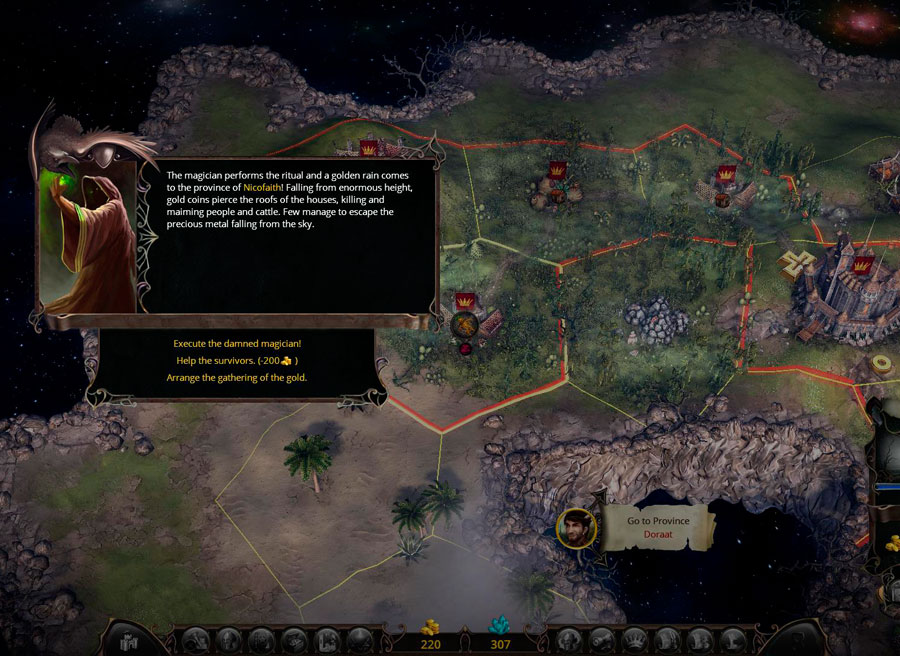
See this? THIS is good.
I’m a narrative guy – I love stories, lore, and world-building. But between a half-assed story and a no-assed story, it’s much better to go with no-ass every time. Own your wacky premise!
Nobody is sitting around getting excited about stopping the forces of evil for the millionth time just because… evil. Keep your cliche, overarching theme if you must, but just don’t try explain it right away. If I’m not interested in becoming a more powerful god by capturing floating islands in goddamn space, facing the forces of Chaos isn’t going to move the needle either.
MMO vs Co-Op
I was browsing the official Wildstar forums yesterday, and came across a(nother) thread on the building toxicity of the game’s LFG tool in Veteran (e.g. heroic) Dungeons. Anyone who has ever played WoW for more than a hot minute could point out the problem with the bizarre, and frankly naive, design decision Carbine has settled on: beginning Cataclysm-era coordinated difficulty combined with Gold Medal or Bust reward structures. I mean, what kind of intelligent person says “If any of this group of five cross-realm strangers dies, they get no epics even if they eventually succeed” and believes that is a good idea?
By the way, do you remember back in WoW when you could kick someone before the last boss dropped its loot? Yeah, Wildstar allows that. If you queue into a 3-man guild unit, you will only receive a chance to roll on gear on their mercy. TBC BRILLIANCE, HO!
Anyway, the typical Apologist refrain is “just don’t PUG veteran dungeons.” Hard to argue with that. Until now:
And you see thats a sad part …..why play an mmo if your only playing with certain people to get things done? your in an mmo ffs, why not try and actually get things done with random people you don’t know? thats sort of defeating the purpose OF being an mmo and not just a coop game =/
I don’t know about you, but this (poorly punctuated) post turned nearly everything I just blithely accepted as given in MMOs on its head.
People criticize solo-friendly designs – “You’re taking the Massively Multiplayer out of MMO!” – and yet not much forum-space has been given to the notion that being sequestered in your guild of friends/acquaintances isn’t very MMO-ish either. What’s so Massively Multiplayer about your even 40m (or typically much less) raiding guild? Does it even matter that there are other players running around outside of your guild tag?
Seems to me that when you zoom out a bit, there just isn’t a whole lot of difference between the srsbsn guild member and solipsistic solo player – everything outside of the circle is just background radiation.
Goldsinks
It’s all Wildstar, all the time up in this joint, but what is interesting is how many times I’ll encounter something that makes me reexamine more general MMO concepts. For example: goldsinks. Every MMO needs them, and yet Wildstar can sometimes feel like it has sinks within sinks (sinkception).
One example near and dear to my heart are AH fees. Wildstar features a 12% tax on sold goods. Having one at all is pretty standard, although wasn’t the cross-faction goblin cut 15% in WoW? Anyway, there is also a 2% or 5 silver (whichever is higher) fee on purchasing goods. And a listing fee. This can burn you pretty bad if you aren’t paying attention, as a 2s item suddenly costs 7s if you just buy the one, a 350% increase. Purchase 100 of them though, and that fee is just 2.5%.
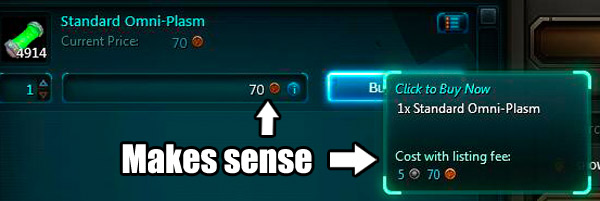
70 copper purchase balloons into 570 copper.
Not impressed? Okay. I’m just getting started.
A more bizarre goldsink is that of respeccing. WoW has had respeccing fees forever, right? Sure. In Wildstar though, repeccing abilities is free and quick and absolutely painless… EXCEPT when it comes to AMPs. In other words, I can take a minute and go from DPS to healer no problem. I can mix and match anything on my action bar, including moving the “tiered” ability points around. What I can’t do is rearrange all those passive AMP points without getting dinged at an increasingly large rate. At level 50, it costs 50g. At current CREDD prices on my server, that means AMP respecs costs about $4. Every time.
Or, hey, maybe you just want to dye your clothes. Hopefully you enjoy pastel colors, because otherwise you are looking at 9.26 platinum (926g) to dye your clothes red, and a similar amount with the ever-suspiciously-rare black dye. That is quite literally $80. For one channel, out of three.

Or maybe you just want to unlock the AMP that is responsible for 20% of your class’s theoretical DPS. Sorry, it’s an ultra-rare world drop. Current price? 12p on the AH. Or $100.
Isn’t it wonderful what RMT does to one’s perspective?
I am not doubting the necessity of goldsinks¹. But I do agree with the posters on the forums that there is a profound difference between, say, an absurdly priced mount versus something that directly impacts day-to-day gameplay. Repair bills are one thing, as they act as a sort of death tax, encouraging specific behavior. But what does high AMP respecs accomplish? Discouraging people from utilizing their roles, after the deliberate design choice of making every class a hybrid? If it costs to change both AMP and Abilities around, that would at least be consistent. Instead, you have the ability to… be a crappy healer/tank at any time. Gee, thanks.
And then there’s the dye thing, which just seems pointlessly cruel. There are tons of housing sinks – including weekly upkeep on each of your plugs – but this just feels different to me, for some reason. Maybe because you already had to luck into/purchase the rare dye to begin with?
I am very much in favor of goldsinks in the form of WoW-esque 100,000g vendor mounts and other such extravagances. But the reason I am in favor of those things is because they are progressive goldsinks. In other words, these are goldsinks designed to hit players who can actually afford to pay them. Contrast that with, say, respecs. That hits everyone, in an extremely regressive way (nevermind the 70c AH item getting taxed to 5.7s). I feel like repair costs are perhaps the ultimate regressive tax, hitting the poor and inexperienced harder for essentially no good reason. I have always said that failure is its own punishment; you better have a good reason for adding an injury on top of the insult.
There have been a few people mentioning that these sinks will likely become irrelevant in the coming weeks and months as the playerbase matures. “These sinks were designed for the long haul,” they say. So, uh, is that supposed to make them better design choices? Making shit extra harsh in the free month off of release, only to fade into irrelevance as the playerbase thins out? Maybe it’s fair to assume that the negative PR of jacking goldsink rates up later is worth the initial hit now.
Still, I’d much prefer that other players act as the goldsinks (in terms of profit-taking) and not core gameplay mechanics. The latter ends up feeling a bit suspicious when you sell the means to bypass it (i.e. CREDD) in the game store.
¹ If I’m honest, I do kinda want to doubt them. The goldsinks in WoW are extremely minor at basically all levels of play, and easily circumvented with daily quest income. And yet it’s not as though the AH barons with seven-figure stockpiles are locking the average guy out from necessary AH goods.
Challenge is Overrated
Rohan posted the other day that the modern MMO tendency towards making leveling alts easier runs afoul of Raph Koster’s Theory of Fun¹. “Leveling alts should be harder, not easier!” Allow me to offer an alternative Theory of Fun: it’s about Novelty, not Challenge.
While I have forwarded this thesis almost three years ago, I am more convinced than ever that the Novelty theory better explains fun than Challenge. For one thing, when was the last time you were truly challenged in a videogame? When were your abilities pushed to their maximum? Okay, now think about the last time you had fun playing a videogame. Did you ever have fun without being challenged? QED.
Part of this debate is semantic – Challenge is Novel by definition, else it would not be challenging. But Challenge does not model the demonstrated ability of players to derive fun and entertainment from picking herbs, mining copper nodes, exploring the map, fishing, and so on. Neither Skyrim nor MineCraft are particularly challenging, and yet people can sink MMO-esque amounts of time into them.
What challenge is taking place in the imagination of a child at play?
The other problem with Challenge as Fun is how clearly there is a hard limit on it. Even if you avoid crossing the line into too challenging to complete, sustained challenge can be exhausting. Which makes sense, as challenge is an exertion of effort above the median. Sustained challenge also presupposes a sort of boundless limit for self-improvement. Even if I believed that everyone could do anything if they simply put their mind to it (I don’t), it’s undeniable that one’s effort hits diminishing returns rather quickly. Is it worth 15 hours of additional practice to realize 1% gains? Maybe someone thinks so. I raided with a Hunter back in ICC whose DPS improvement was literally squeezing in one, single additional Kill Shot into an eight-minute fight. But even he would be unlikely to spend 30, 60, 90 more hours to squeeze in a second one.
Plus, you know, he did end up quitting WoW despite there being plenty of challenge left.
The way I am describing Novelty is not necessarily as “a completely unique experience.” All it has to do is simply feel new to you. The subjectivity is an important facet, just as with Challenge, and it explains how someone can still have fun picking herbs when the action itself is fairly rote and well-defined. For myself, I consider Progression to be Novel; increasing in power and effectiveness is fresh and exciting to me. I start making plans for my ever-increasing hoard of Peacebloom (etc), or imagine what I could purchase after selling it. Others could see the act-in-time to be Novel – they have never picked Felweed at this particular time and place before, and who knows if a member of the opposite faction could be lurking around the corner. Of course, there is also the people-element that can make the most mundane of tasks into cherished memories.
In the end, I might almost say that the most universal quality in fun games is Engagement. Challenge can be engaging, Novelty can be engaging. However, it is not particularly useful to suggest a game be more Engaging any more than it is useful suggesting a game be more Fun. One can certainly suggest a game be more Challenging or Novel though. I would just suggest going with the latter.
¹ I have not actually read Koster’s book, so it’s entirely possible he isn’t arguing Challenge > everything. In fact, I seem to recall it being more about learning things, which puts it more in line with my Novelty argument. Nevertheless, I don’t feel like a game has to be Challenging to be fun, and I have no idea why challenge is so fetishized in game design.


Parity as Entitlement
Sep 16
Posted by Azuriel
I wrote a post about Entitlement and the problems surrounding its (ab)use in gaming discussions back in 2012. Nothing has changed since then – I still consider anyone who uses it in a semi-serious way to essentially be Godwin’ing their own argument. What I did not expect to see two years later is “entitlement” to be even further warped as a pejorative to paint even those that desire parity in their games. Or presumably, by extension, anyone who has any desires whatsoever.
From Tobold’s blog:
The context of this quote comes from a larger discussion on the escalating price of “Founder’s Packs,” e.g. the extremely clever corporate jujitsu that resulted in people paying $150 for the “privilege” of alpha-testing even F2P games. Tobold’s larger points are that A) “too pricey” is subjective, and B) game companies are better off selling digital goods in their Collector’s Editions (as opposed to expensive physical goods) if it were not for the fact that “entitled” gamers don’t like that.
“Entitlement” clearly being a trigger word for me, I asked: “Is an expectation of parity now considered entitlement?” Tobold replied:
(That almost sounds like game companies feel entitled to my money, but nevermind.)
Now, it seems to me that he is making the accusation that people only like what games they are good at. Which… is a bad thing, I guess? There really cannot be any other possible explanation for your friends getting mad at you bringing real-world dollars into a game of Axis & Allies (or Chess, etc etc) other than taking away their advantage of more skillful play, right? Those entitled jerks… it’s all the same!
I enjoy parity in games. In fact, I expect it. Arguably the hallmark of any “game” is consistent rules that apply to every player equally (assuming the game isn’t based around asymmetry). If someone beats you in a fair game by virtue of better skill or strategy, who could legitimately complain? Even if they won by virtue of simply having spent more time playing the game, how could you object? Tobold and others may point out that some people have more time than money, but I do not know anyone who has 25 hours in their day. In contrast, the dollar amount anyone could have on hand is effectively unbounded. You could have $10, you could have $1,000,000.
Perhaps this disagreement comes from differing definitions of parity. Tobold in later comments suggests no MMORPG features parity because different people have different amounts of time to spend playing the game. This is not a dilemma to me – as I mentioned previously, the both of us have the same 24 hours in a day in which to allocate our time. I have zero issue with you receiving greater rewards (etc) for having spent more time playing the game than I. In fact, it sort of boggles my mind that this is even a point of contention. Is that not how any activity should inherently work? “You spent more time reading a book and got farther into than I did… unfair!”
I might be able to see where people could get angry about someone meeting or exceeding your own skillful play by simply repeating a low-skill activity for days and days. But even then, the results of your skill is self-evident: you achieved the result more quickly with less (wasted) time.
Bringing real-world money into a game is NOT analogous to either skill nor time. The amount of money any of us have is the result of an entirely different “game,” which operates on entirely different “rules.” It is like me getting an extra Queen in a game of Chess simply because I won a game of Checkers last year. Did that giant pile of real-world money give you the freedom to spend more time playing the game than me? That is both okay and irrelevant. The uber-rich guy, the 12-year old on summer break, the dropout college student, or the oil rig worker on his two weeks off all value the time spending playing the game equally for as long as they do.
Desiring parity in the games you play is not entitlement. Desiring that fewer companies tether their business model to the rules of the games they make is not entitlement. Desiring to play games you are good at is not entitlement. Desire is not entitlement. When you use the word “entitlement” as a pejorative, all you are doing is asserting that someone has unreasonable expectations about something, without actually bothering to offer an argument or explanation as to why it is unreasonable.
Posted in Commentary, Philosophy
5 Comments
Tags: Entitlement, F2P, P2W, Parity, Tobold