Category Archives: Philosophy
WoW PLEX, pt 2
In the comments on the last post, Kring took me to task a bit for not delving deeper into the sort of game design considerations regarding WoW’s impending (?) PLEX introduction. Part of the reason I didn’t was because how it impacts me in pretty fundamental: it introduces dollar signs into my gameplay. Whether the concept or implementation of PLEX itself fits WoW is immaterial to me – it could be the best thing ever done in the history of the game… and I’m still going to be calculating my repair costs and AH cuts in USD.
That’s my own neurosis though, so perhaps it’d be interesting to look at the broader picture.
Who is WoW PLEX for?
Kring suggests the following:
Blizzard has problems to gain new players. I’m sure that if you can tell LoL players that “good player can play WoW for free” that has some appeal. And I think that’s their primary goal. To spread the news that “WoW is F2P for good player”. Which means PLEX must stay in a reasonable range, they don’t want “good player” to complain that it is “too expensive”.
Here we have the first question. Who is the player base which Blizzard thinks will constantly buy PLEX for Euro to sell it for gold?
The real answer to this question is pretty simple: WoW PLEX is for the tens of thousands of players currently purchasing from illicit gold sellers every month. And that is probably the extent to which Blizzard has thought about PLEX being utilized. We saw this exact same line of reasoning single-handedly birth the abomination that is was the Diablo 3 AH, and I have little reason to believe there is some deeper design significance going on. WoW PLEX is solely to combat illicit RMT.
While there may be X number of AH barons who will be able to PLEX their accounts year-round, I do not suspect it will be the norm for them, let alone the average person.
Are there enough gold sinks in WoW?
Second, I have my doubts that WoW at the moment has big enough gold sinks to keep enough player interested to buy PLEX with Euro and sell it for gold. PLEX will be consumed on a monthly basis, which means they must also be supplied on a monthly basis.
I think WoW must be changed to add gold sinks. New huge gold sinks. And they must hurt the players which Blizzard intends to sell PLEX for Euro in the future.
Four words: Black Market Auction House:
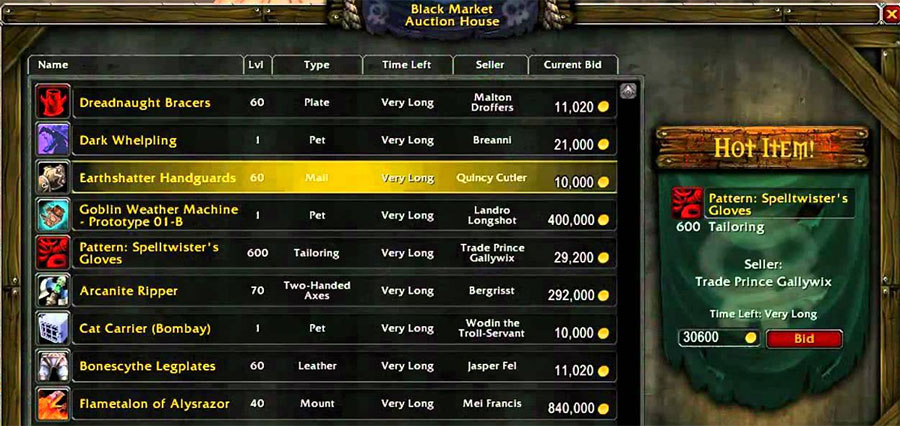
The Mariana Trench of Gold Sinks.
I could also include the more traditional “100k gold vendor mount” but that seems like small potatoes compared to the above screenshot of 840k (and counting) for the Flametalon mount. The genius of the BMAH – besides being able to have auctions get into the million-gold range – is that it targets everyone: the people chasing rare pets/mounts, the collector looking for one-of-a-kind or extremely limited items like the Arcanite Ripper, and then even the hardcore raiders with Mythic loot drops. Indeed, I don’t see much stopping even ultra-casual players from grabbing uber-high gear to help out in dungeons or to make rep grind dailies easier. Well, nothing stopping them other than needing tens of thousands of gold… which, hey, what a coincidence!
Now that I think about it, the true genius of the BMAH may well be that it was introduced first. Can you imagine the backlash if Blizzard dropped in WoW PLEX and then opened up the BMAH a week later? I don’t really believe Blizzard is that nefarious, primarily because that would require the ability to actually think ahead and plan accordingly. Which is demonstrably missing, as evidenced by their inability to release expansions on time.
Will WoW’s game design change because of PLEX?
Yes, but perhaps not for the reasons you might think.
Blizzard will shift resources to mainly create content for the player base that buys PLEX with Euro. This will be their primary target and this will be the group that will get the most updates. Take a look at GW2. They setteled on a biweekly rythm of adding new items to the cash shop and delivering small parts of their living story. Blizzard will have to add a new gold sink on at least a monthly basis and deliver something for the PLEX with Euro buying player.
What does that mean for the other player? Will we get even less “free” content? (free = not shielded with an insane gold wall).
I do not believe that Blizzard will move towards anything resembling biweekly game additions, basically because I don’t believe Blizzard is capable of creating content with such speed. That’s certainly a snarky response, but it is somewhat rooted in the dev team’s rather consistent push-back against obviously-goofy things in the game. For example, the rather strict Transmog rules which prevent you from wielding giant fish. There have certainly been plenty of silly toys and such over the years, but I don’t think we’ll ever see the sort of GW2-esque Quaggan backpacks. When you cut out those category of items, you are left with a much harder problem in spending artist time designing in-universe gear.
The real impact might well be to go the other direction: being more cautious around implementing gold sinks. I’m not quite sure what the total gold cost of the Garrison ended up being, but imagine something like Epic Flying at 5000g when PLEX is sitting at 15,000g apiece. Honestly, PLEX will probably be closer to 150,000g than anything, but Blizzard will nevertheless need to be careful to not appear to be jacking prices up for PLEX sales. Some percentage of players might sell PLEX to keep up, but there is another (likely larger) percentage that would balk at paying a double-subscription fee and just get squeezed out of the game entirely.
Is this baby steps towards F2P?
Technically it could be, but I feel like people lose the proper sense of scale when it comes to WoW.
F2P really only makes sense for a game if F2P revenue > Subscription revenue, right? One of the fundamental ways of measuring F2P revenue is ARPU, which is Average Revenue Per User. As of April, SuperDataResearch lists World of Tanks as the highest ARPU amongst several high-profile F2P titles, such as League of Legends and TF2. That amount? $4.51 ARPU. Now, LoL is sitting at $1.32 ARPU in comparison, but it of course has tens of millions of more players and thus generates much higher overall revenue than World of Tanks.
The ARPU for (Western) WoW players is at least $14.99, if you have forgotten.
Would WoW attract and ensnare at least 30+ million F2P players such that F2P would make economic sense? Could WoW attract that many? It’s very doubtful in my mind, and a rather absurd risk when you are already taking in a billion dollars a year doing exactly what you are currently doing. Blizzard won’t even enable flying in Silvermoon and you think they’ll restructure the entire payment scheme for the game? I can perhaps see them doing so sometime in the distant future, but that is the same future in which WoW drops below 5 million subscriptions. Which is still twice as many as anyone else has ever had.
Final Thoughts
Ultimately, I think WoW PLEX is a bold move on Blizzard’s part entirely meant to combat gold selling. I do not believe they are making an overt move towards F2P, I do not believe this change heralds the introduction of more gold sinks, and I do not believe many people are asking the right questions. Namely: how are you going to feel about dailies (etc) once this gets introduced? I already know it’s going to suck for me, because it sucked in Diablo 3 and Wildstar vis-a-vis hoarding currency for no particularly rational reason.
The idea is sound, and will likely work out for a lot of people. Just not me.
Learning to Let Go
For the longest time, I was a believer in playing games to completion no matter what. A large part of this sentiment was codified back in my semi-official reviewing days in which we were required to beat a given game before we could review it. That always seemed like a reasonable request, and it meshed rather nicely with my general sense of optimism (…stop laughing) regarding the possibility of a game making up for its earlier shortcomings in the 11th hour. Kind of like… err… huh. I can’t think of any examples at the moment, but I’m sure there are some. And maybe this next game will be the one!
In the past few weeks, I have made a concerted effort to abandon such sentiments.
You might have noticed that I am reviewing less games these days. While I still enjoy writing reviews, I’m less convinced that many of the games I play either need or deserve them. I finished Batman: Arkham Asylum a few days ago, for example, but who out there would really benefit from my take on a game which has two sequels and a derivative (Middle Earth: Shadows of Mordor) already? It’s an open question if anyone benefits from any review I do, but at least more topical games are easier to justify to myself. Once the “review potential” of a game is reduced to zero, I no longer feel any need to finish it.
Or, in some cases, even start them. My original plan was to start playing the old Tomb Raiders before starting the Square Enix reboot, but I just “Nope’d” out of there after seeing some screenshots. Company of Heroes was played just long enough to start realizing that I liked Dawn of War better. I started playing Thief Gold two days ago and stopped this afternoon. Minutes before writing this post, I was going through the tutorial of Fable: the Lost Chapters; camera was a little too wonky for my tastes though, and now here we are.
I still do feel a little bad when I banish a Steam game into my Finished category, as obviously I spent some amount of money acquiring it at some indeterminate point in ages past. But on the other hand? I can acknowledge that I have likely past the threshold beyond which there are more legitimately fun games that I am actually excited to play than I have time on this mortal coil to do so. Perhaps it is crass to say, but… if I had cancer, would I spent my remaining time playing the original Hitman? Or, really, any of the Hitman games (I’ve heard Blood Money is the best though)? Probably not.
It pains me to know other people will not likely experience the joy that was Xenogears or Tenchu or whatever, but I understand the dilemma now more than ever. No matter how good Game X was for Y reason, sometimes the Z era was what made it so. Can I really appreciate the original Thief in the proper context of its time? Well, I did make it to the third level before shutting it down. I have heard conflicting reports as to whether the Thief reboot lived up to its lineage, but I am now more inclined to spend the $6 (deal is over, alas) to purchase the new one than I am to play through the original(s).
In any case, that is where I am at the moment. I’m not opposed to older games, but they will have to work extraordinarily hard (and quickly) to keep my attention, starting now. Ain’t nobody got time to play games out of some misguided sense of obligation.
Voting with Your Wallet
Tomorrow is election day over here in the States, so I wanted to talk about a tangentially related topic:
“Stop complaining and just vote with your wallet.”
Sometimes I wonder whether people understand how voting works. Even if we assume that not voting (i.e. not buying a game) counts as a No vote in any meaningful sense, a single vote in isolation is functionally irrelevant. Beyond that, your No vote is indistinguishable from the same No vote from someone who simply can’t buy the game until the next payday. Or the person who never realized the game was coming out. In other words, your No is actually a Potential Yes. There is no “other person” you can vote for instead, no other means of actually expressing why you voted in the manner you did other than actually talking about it.
All of this is besides the extremely relevant fact that if I spend time on a soapbox complaining about something, and I convince other people to (also) not buy that something, the size of the wallet I am voting with has increased exponentially. Not voting is meaningless; conversely, removing Yes votes is priceless. Your opinions, positive or negative, have currency only when you voice them. So get out there and get dirty.
Anyone telling you to be quiet and simply vote with your wallet is actually getting you to vote with theirs.
Cardboard Throne
Much as with the base game before it, I believe I’m done with Beyond Earth for now.
This is not to suggest that I believe Beyond Earth to be a bad Civ game. There are quite a few issues – some imbalances, some questionable design philosophies, etc – as pointed out in various Reddit threads dedicated to the game. However, it absolutely captures that whole addictive “I pressed End Turn for six hours in a row” part of the Civ experience. Even now, I’m getting the urge to boot it back up.
What is stopping me is the realization that what I like about the game and what the game actually does are two separate things.

It’s all downhill from here.
My favorite part of a Civ match is the beginning, when your strategy is largely formless, reactive, as you cast your eyes about an unknown and hostile world. “Okay, let’s scout out that island.” “Ooo, a city here would capture three strategic resources!” This feeling lasts maybe the first 100 turns, beyond which everything becomes a formality, a known, an inevitability. Yes, perhaps disaster strikes, perhaps you lose a city, perhaps an enemy Civ suddenly wins with a surprise victory condition. Nevertheless, you still know what you have to or should be doing at that point – it all just becomes the mechanical action of carrying it out.
All for what? The personal satisfaction of grinding the patience of a machine to dust? If Firaxis changed the Retire button to a No Longer Delay the Inevitable button, I would win the same amount of times with at least some in-game acknowledgment of the hours poured into the equivalent of a roguelike. Do I really need to conquer those last two capitals before the game is officially over? The game was arguably decided hours ago when I stopped exploring and building cities.
This sort of reminds me of when I used to be really into RTS games like Command & Conquer and Starcraft, up until I understood the concept of Actions Per Minute. Suddenly, the game I was hitherto playing was no longer. I could not unlearn how horribly inefficient my “build six Protoss Carriers” strategies were, nor how much better I could have been playing. The three aspects of gameplay were (still) entertaining – building bases, ordering units around, micromanaging one unit’s abilities specifically – but I both understood that I was incapable of engaging in more than one of them at a time, and not particularly motivated to try to get better. If you had time to turtle up to spam endgame units, you probably had time to win much earlier. Which means I was doing… what, exactly?
There is nothing necessarily wrong with enjoying a game outside of its intended purpose, but if the box brings more joy to the cat than the toy it contained, maybe you should just have bought a box instead. Or go find a better toy.
Like I said though, if Civ and Beyond Earth is your type of game, more power to you. I used to think it was mine. But now that I see myself sitting upon a virtual throne of cardboard boxes, I am not quite sure what to think. Other than maybe I should go play something else.
More Than Fun
Some people play videogames just to have fun. I am not one of them.
Have you ever listened to a mindless comedy sketch or watched a show like America’s Funniest Home Videos (or equivalent)? Or realized that you somehow sat through the national average of 5+ hours of television a day? I always feel empty inside afterwards – I had “fun” in the moment, but then the moment is over and the fun evaporates as if it never existed. Because arguably it never did.
To me, having fun isn’t enough. I am not in search for some meaningless amusement to while the time away until oblivion; if that is all you’re looking for, I might recommend heroin or masturbation. I am looking for fun + X, where X is something I am going to remember more than five seconds into the refractory period. It doesn’t always have to be a profound, life-changing epiphany. It just has to be something.
Some people just view videogames as entertainment. Games are certainly that. But they don’t have to be just that however, and I would say that they shouldn’t be just that. If something can be more, it should be more.
I want games that set fire to my imagination, that grip me emotionally, that change the way I look at the world, that make me want to be a better person. I will also settle for games that break new ground or do familiar things in clever ways. The world has plenty enough slot machines and similar wirehead simulators; we don’t need more Loot Caves, we need more Plato Caves.
Are there better avenues than videogames to sate these desires? Maybe. Books have been changing peoples’ lives for thousands of years, for sure. At the same time, I don’t see a particularly compelling argument that we need sequester life-affirming experiences to one particular medium or another. As we have seen, games can be accessible in ways that Tolkien (etc) may not be. A substitute, even a poor one, is often better than nothing.
If you say such games do not exist, I will disagree. I have played them. Chances are you have played them too. They will be the ones at the top of your “most favorite games” list. They will be the titles you still think about and talk about decades after you stopped playing them.
There is a time and a place for the Flappy Birds and Candy Crush Saga games of the world, don’t get me wrong. But just like this compilation video of guys getting hit in the balls, you’re going to turn it off and feel nothing. Except, perhaps, remorse.
Cooperation Requires Incentives
Both Tobold and Rohan were musing about a similar issue last week: why isn’t there more cooperation in survival MMOs? Or more PvE-only survival MMOs in the first place?
Let me turn the question around: why would you cooperate? Tobold is thankful that our real-life ancestors were not as blood-thirsty as the average DayZ player, but I am not even sure whether or not that is true. Recorded history is filled with the conquest of the weaker, and who knows what happened in the darkness of the forest millennia before that?
The problem in gaming, as is often the case, comes down to incentives. Specifically, if there are no extrinsic bonuses for assisting someone in any game, I generally only do so if I happen to be in the mood and it’s easy. For example, I have no problem playing Medic classes in PlanetSide 2 or Battlefield 4 because reviving teammates A) gives me as much XP as a normal kill, and B) the revived character is likely to get me closer to the goal of winning the match/flag/etc (i.e. more XP). Guild Wars 2 also did a pretty good job in incentivising reviving other players along similar lines. Obviously 5-man dungeons and such offer similar carrots.
In the absence of the extrinsic carrot though, a game designer cedes control to the player’s own nebulous intrinsic motivations to govern behavior. Unless you are a particularly extroverted individual looking to make more internet friends, there is really no reason you would ever cooperate without the carrot. If it’s a free-for-all scenario, not killing another player on sight is a huge risk. And even if you are willing to take that gamble and it succeeds, the “reward” is generally limited to what you can accomplish within that play session… unless you go out of your way to befriend them.
What if you don’t want more friends?
For a PvE survival MMO to work, I think constructing the proper incentives for cooperation would be Priority #1, and they would need to be extrinsic incentives. I am not a huge fan of the permadeath ideas Rohan was tossing around, but imagine if permadeath were a possibility, and killing other players (without cause) increased that chance? Let’s say the odds of permadeath were 10% baseline and increased by 25% for each player you killed. Meanwhile, if you healed, revived, traded/interacted with, or perhaps simply were in X radius around another player on your friends list, the baseline permadeath chance dropped to 0%. The “stain” of unjust PvP would not diminish – unless as a result of some penance or whatever – and yet it would give both groups the relevant incentive to do stuff with others.
I do not necessarily think it is wrong for game designers to rely on players to want to make friends to enjoy their game properly, but that ship has long sailed for me. I got my ex-WoW buddies, some IRL friends, and this blog if I want to talk shop with someone; I’m not entirely in the mood for the arduous vetting process and necessary synchronized timing necessary to make new friends. Needing to join a guild or Outfit or whatever to get the “full experience” simply means I won’t ever be getting the full experience in your game.
And if your game offers nothing else, then I won’t be playing it.
Unlikely Encounters
There are a lot of tropes in RPGs that go largely unexamined, but I experienced one in Dragon Age 2 recently that seemed especially egregious: the impossibly unlikely encounter.
Now, you know how it is, you are walking around town and just so happen to stumble across a conversation between a woman looking for her son and guards clearly not interested in searching for him. What were the odds you would be walking by that one-minute exchange in the middle of a sprawling city? It’s a trope, but I can forgive that out of necessity; how else could you really set up such a quest organically, right? I’m not talking about those sort of encounters.
No, I’m talking about the part in Dragon Age 2 when I run across a band of Elvish assassins confronting a human along a desolate path on the Wounded Coast. The human is apparently a former werewolf who inadvertently killed the mother of the main Elf assassin, but the Warden from the first game has cured his lycanthropy. You get the choice here between letting the assassin finish the job, defending the man, or trying to shame the Elves into leaving. I did the latter, got paid 50 silver by the grateful man, and both parties left.
Err… what?
This wasn’t even a quest. It was just a goddamn throwaway encounter miles from any sort of civilization and/or rational explanation for how the two people could have met one another just in time for me to waltz by. It wasn’t like this dude was trying to assuage his guilt by watching the beach. As far as I can possibly determine, there was no reason for him to be there at all; he was not a trader, nor hermit, nor on the run. I would have been infinitely more sympathetic with my suspension of disbelief if this occurred in the city. Or in a cave he was hiding in. Or as part of a plot-line or rumor which suggested someone was looking for a former werewolf. Instead, this scenario gets more and more ludicrous the longer I think about it.
I mean, sure, most of the quests that I have seen in Dragon Age 2 so far seem rather unlikely. Who exactly is going to trust a complete stranger who was conveniently eavesdropping on your conversation in the first place? Actually, it might be fun for there to be an RPG in which all of these sort of tropes are subverted; some sort of deranged, manic dude cavorting into the middle of groups of people and “completing their quests” based on random snippets of dialog. But, man, that Wounded Coast encounter is on an impossibly absurd level of its own.
Crushing Success
The final tally for Microsoft’s purchase of Minecraft is $2.5 billion. Markus Persson’s (aka Notch) personal take is reported to be $1.8 billion.
What is almost more interesting though is his thought process behind selling at all:
[…] I’ve become a symbol. I don’t want to be a symbol, responsible for something huge that I don’t understand, that I don’t want to work on, that keeps coming back to me. I’m not an entrepreneur. I’m not a CEO. I’m a nerdy computer programmer who likes to have opinions on Twitter.
As soon as this deal is finalized, I will leave Mojang and go back to doing Ludum Dares and small web experiments. If I ever accidentally make something that seems to gain traction, I’ll probably abandon it immediately.
It is almost funny, in a way. Can you separate the making of games from the business of making games? One can imagine some hobbyist painter who inadvertently crafts a masterpiece… that simply stays in the attic for decades. Or a writer who simply creates a book for themselves. The process is what they desired, not the outcome.
But games? Like information, games yearn to be free. A game without players is incomplete. So while I can understand the sentiment behind Notch’s desire, it seems somewhat futile. Being a game designer does not make one a good entrepreneur, true, but once released a game takes on a life of its own.
I will admit that my first reaction was to be a little petulant over Notch’s payout, because $1.8 billion. But looking at Minecraft itself and how it got there… who can really complain? This isn’t a game that preys on the weaknesses of the human psyche with microtransactions and cash shops (in the base game). This isn’t a game built around its business model. This is Old School purity in which a game relied on its own merits to sell more units. Sure, there is merch and movie deals these days but the core of the game remains the same.
So… good on you, Notch. This sale puts you around #1013 on Forbes’ billionaire list. Or to put it another way, Minecraft single-handedly made you equivalent to 2-3 JK Rowlings. Or about a Gabe Newell and a half.
Crazy world.


Peril of Subjectivity
Oct 17
Posted by Azuriel
As noted in the sidebar, I have been reading the Art of Game design. One part of an early paragraph sort of jumped out at me, and is kinda relevant to the topic of the usefulness of game reviews:
Now, on the one hand, this is pretty straight-forward advice for a game designer. Just because you like the game you are creating doesn’t necessarily mean other people will. But it seems to me that there is a hidden edge to that sentiment, an implication that a well-designed game is one that most players enjoy.
Duh, right?
Well… doesn’t that mean Candy Crush Saga is one of the best games of all time? As of March of this year, 143 million people were playing it every day; the company’s revenue went from $164 million in 2012 to $1.9 billion in 2013 almost entirely on the back of a single game. While the game’s popularity is declining (as is King’s stock price), the takeaway should be that perhaps the quality of a game’s design is not necessarily a function of it’s popularity. Good games can languish in obscurity and bad games can sell beyond all reason.
Which, really, should not come to a surprise to anyone who has ever turned on a television, read a book, or seen a movie.
Here is the Wikipedia link of the best-selling books of all time (minus religious/political works), for example. The top looks pretty good: A Tale of Two Cities, The Lord of the Rings, and so on. Then you hit The Da Vinci Code and your eye might twitch. It’s only when you scroll down to the book series section when you realize that 50 Shades of Grey sold more than 100 million copies. I wasn’t able to find how many each individual book in the series sold, but if we assume 33 million apiece that means the original 50 Shades of Grey is “better” than To Kill a Mockingbird or Gone with the Wind. Or Nineteen Eighty-Four. Or a whole swath of cultural brilliance.
You probably don’t even need to look at the highest-grossing movies listing to know it’s even worse. There is a Transformers movie at #7 and #11, for the record. And the one at #11 was released, oh,
a weekfour months ago.As in literally seven days ago as of the time of this posting[Edit: I misinterpreted the Wikipedia note; the movie is still in theaters though] . I mean, it should really have been bad enough that Indiana Jones and the Kingdom of the Crystal Skull is at #48, ahead of all its infinitely better predecessors.I suppose my point is that, going back to Tobold’s post, it does not surprise me in the least that Destiny received a 76 Metacritic score and yet has 3.2 million daily players. Just as it shouldn’t be surprising to see how little overlap there is between RottenTomatos’ Top 100 movie list and highest-grossing movie one. I mean, Transformers: Dark of the Moon got a 36% score, and is #7 highest-grossing of all time with over $1.1 billion worldwide. That’s more than LotR: Return of the King (94% fresh) which clocks in at #8.
So, basically, no – game reviewers are no more irrelevant than reviewers of any kind of medium. I mean, unless you think movie reviewers are there for some other reason than to direct you towards movies worth watching… in which case they should have just said “Transformers,” apparently.
I cannot really comment on Destiny’s actual merits for two reasons: A) it wasn’t released on the PC, and B) I’ve been playing PlanetSide 2 for an hour or more each day despite actively hating the game at least 60% of the time. I do not consider the latter indicative of Ps2’s game design brilliance so much as a personal deficiency.
Posted in Commentary, Philosophy
10 Comments
Tags: Art of Game Design, Candy Crush Saga, Reviews, Subjectivity, Tobold, Transformers