Wishlist – August 2024
A non-exhaustive list of game wishes at this time interval:
- SCUM ($15.99, 60% off)
- Terminus: Zombie Survivors ($15.99, 20% off)
- ASKA ($19.99, 20% off)
- Enshrouded ($29.99, MSRP)
- Sons of the Forest ($29.99, MSRP)
- Bellwright ($29.99, MSRP)
- Nightingale ($29.99, MSRP)
- Soulmask ($29.99 , MSRP)
SCUM would certainly seem to be the sort of survival crafting game within my strike zone, but there is just something… off-putting about it in the videos I have watched. I’m not opposed to super-realistic/detailed survival games (e.g. Green Hell), but they have a tight fun-rope to walk. Need to balance your macronutrient intake with a literal stomach size constriction? OK. Need to remember to remove dirty pants if you get a laceration on your leg lest you get an infection? Cool.
But what is this all in service towards? “Prevent the player from just eating berries all day in the woods, forcing them into dangerous zones.” I can get behind that. Of course, the actual gameplay looks kinda janky, zombies are all of the same type but a few are randomly screamers that spawn in dozens of new ones to immediately chase you down, etc, etc, etc. All of sudden, it seems a bit less “realistic” and more nakedly game-y. That sort of thing works in 7 Days to Die, but not here.
On the other end, watching videos of Terminus makes it seem like something I’d be interested in. Mostly. It’s a kind of top-down survival roguelike with action points, different builds, meta-progression, and so on. Part of my hesitation though is that it doesn’t feel like the sort of game where you would, you know, actually build a base and stay put. If you’re just going node-to-node, you may as well be playing a more traditional roguelike instead. Also… not to be that guy, but $16 on sale still feels like a lot for an indie game within this visual league. There are amazing 100+ hours experiences with worse graphics, of course, it’s just that this definitely feels like a Game Pass and/or Humble Bundle title. Literally hit 1.0 last week so that’s kinda shitty of me to say, but I said it.
Finally, I must admit it difficult to remember what ASKA is all about off-hand. It arrived in Early Access around the same time as Enshrouded, Nightingale, Bellwright, and Soulmask, all of which are survival crafting games with various shticks. In reviewing the literature, it appears ASKA is the one with “skill based combat” and the recruitment of NPC villagers. Err… the one without masks involved. Or medieval plots against the crown. That one. But, hey, it’s on sale!
The other games aren’t on sale, so I’m not going to talk about them. We don’t MSRP around here.
What’s In A Game?
Dragon Age: the Veilguard is coming out on October 31st. How I feel about it is… complicated. Veilguard’s first trailer received a lot of flak, but there have been a few subsequent ones that show a more a traditional Dragon Age vibe, as opposed to what felt sort of Fortnite/Borderlands-ish irreverence. Besides, what’s not to love about it being more Dragon Age, featuring a romanceable Scout Harding, and the fact that it’s a BioWare game.
…or is it?
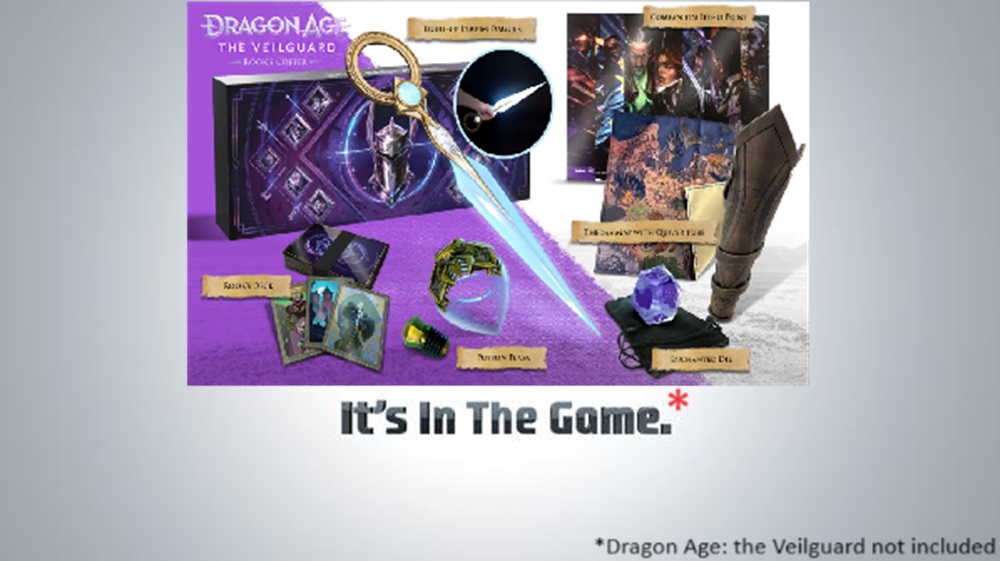
I mean, yes, it’s a BioWare game. It’s also an EA game, proven by the fact that it has a deluxe edition, pre-order bonuses, and a $150 Collector’s Edition with a physical LED dagger and other items that hilariously doesn’t come with a copy of the game. You seriously can’t make this shit up.
But what is a “BioWare game,” or any game for that matter? Not in an existential sense, but what is meant when we say these things? When I say BioWare game, emotionally I’m referring to a nebulous sort of companion-focused, squad-based RPGs with branching endings based on player dialog choices. Basically, the Mass Effect and Dragon Age series. Which I have historically enjoyed, including even (eventually) Mass Effect: Andromeda. It’s a type of game with a particular vibe to it.
Having said that, being a “BioWare Game” is really just branding and marketing. BioWare also released Anthem, which was a commercial failure; Andromeda wasn’t that hot either, considering how all DLC and follow-up expansions were canceled. Rationally, there should be no expectation that just because BioWare is releasing Veilguard, that it will be of the same quality of [insert favorite Dragon Age game here], especially after the franchise’s 10-year hiatus. But that touch of skepticism should still be the case even if Anthem and Andromeda were smash hits.
I have long cautioned against the sort of hero worship that game developers sometimes generate, especially when it comes to “rockstar” designers. There are people who fall to their knees at the altar of Fallout: New Vegas and Chris Avellone. To which I say: why? Even if New Vegas is your favorite game, there were a lot of cooks in that kitchen. In fact, you probably should be worshiping at the feet of John Gonzalez instead. Or, preferably, worshiping no one, including the companies themselves.
Game design is a collaborative endeavor – solo indie titles aside – and it’s a nigh-impossible task to nail down exactly who did what to make the game as compelling an experience as it was. Especially including the very staff who did it. Back in the day, there was an argument that Blizzard was sending in their B-Team for the Wrath of the Lich King expansion, and that is why subscriptions started to decline for the first time (notwithstanding the 12 million sub peak). As it turns out, that wasn’t the case – most everyone from vanilla and TBC ended up working on Wrath and subsequent expansions. Hell, the most controversial addition to the game (Looking for Dungeon tool) was something the original “rockstars” devs wanted to release in vanilla. It wasn’t the bean counters or the C-Suites or whatever design boogeyman you want to define; the calls were coming from inside the house.
There are times where it appears one very visible person seems to make a difference. Hideo Kojima immediately comes to mind. It is also difficult to argue against the apparent influence of, say, Yoshi-P when it comes to FF14. Or Hidetaka Miyazaki of FromSoftware fame. They could not build their games alone, of course, but leadership can and does set expectations and gives direction in these endeavors. There is a level of consistency – or consistent craziness in Kojima’s case – that is pretty rare in gaming.
By and large, though? Every game is a gumbo and no knows what went into it or why it tastes the way it does. That’s… a pretty strong nihilistic take, I admit, but riddle me this: if someone figured it all out, why is it so hard to bottle the lightning again? Boredom? Fear? Ever-changing audience mores? There are so many moving parts, between the game designers coming and going from the company, to the gaming zeitgeist of the time, to competing game releases, all of which can influence a title’s success. You can’t just say “Obsidian should just make New Vegas 2 and it will be a smash hit” because A) most everyone from the original team has left, B) none of the people who left appear to have taken the secret sauce with them, and C) New Vegas was massively outsold by Fallout 4 in any case.
So, am I still looking forward to Veilguard? Well, two words: Scout Harding.
Seriously though, I don’t want the takeaway to be that you shouldn’t look forward to anything. I have no idea what the plans are for Mass Effect 5, but I still want to find out. Just not on Day 1 (probably), and not with any sort of expectations that because Company A or Game Dev B made it that the end result will be C. If you’re going to base your hype on anything, base it on what the game is promising, not the people who made it. After all, the best games end up taking on a life of their own.
Arcane and Edgerunners
While on my vacation a few weeks ago, away from my PC, I finally found the time to watch both Arcane (e.g. the League of Legends-based show) and Cyberpunk: Edgerunners. Here are my thoughts:
Arcane: Season 1
An amazingly compelling and nuanced show that is better than it really has any right to be. Arcane is at a quality level that it makes you start thinking that Riot created League of Legends as a means to fund the development of Arcane, the thing that they wanted to make all along.
The overall show follows the life of Vi and Powder, two sisters growing up in the undercity slums, and how they try to survive amidst gang wars and oppression from enforcers from the city proper. A series of unfortunate events breaks them apart, and their differing paths through the developing tension between the upper and lower cities forms the backbone of the plot.
I really don’t know what else to say about Arcane. I have never played League of Legends nor have delved into any character lore to see if anything in the show is “accurate.” None it really matters, as the show stands on its own. In fact, outside of a few moments late in the series where there is clearly some “ultimate ability fan service,” you probably wouldn’t ever know it was based on a game.
In any case, whether or not you choose to invest the time in watching Arcane for yourself, I highly recommend at least listening to What Could Have Been and Goodbye. The overall soundtrack is next-level, with a wide range of genres and tempo, but those two in particular elevate the experience.
I am eagerly awaiting the release of Season 2, which is coming out soon.
Cyberpunk: Edgerunners
Cyberpunk: Edgerunners is a Japanese anime based within the Cyberpunk 2077 game world. It follows the life of David Martinez, a teenager who is thrust onto the merciless streets of Night City after a senseless tragedy. Mirroring the base game themes, we see how David tries to make a life for himself despite being surrounded by violence and corruption and cyberpsychosis at every turn.
I watched Edgerunners with the English dub, and that is something I recommend too – the quality is excellent, but the real treat was hearing the same sort of Cyberpunk slang (choom, gonk, flatlined, etc) that you do in-game. Indeed, seeing as how I watched the anime after having played the game in which they added Edgerunner gear as bonus items, it felt as if I were literally watching an in-game show.
Overall, I enjoyed the kinetic, violent affair, but recognize that it might not be for everyone (especially the squeamish). If you liked playing Cyberpunk 2077, you owe it to yourself to watch the show. If you didn’t, but enjoy the cyberpunk genre and are okay with over-the-top gore, then go for it. There is a ton of drama, tragedy, and an impeccable soundtrack (some of which come direct from the game radio).
Vintage Story – Modified
TL;DR: Mods help, fundamental issues remain.

While my Impression post went up on Monday, I actually wrote it few weeks ago. In that time since, I have downloaded the following mods for Vintage Story:
- Primative Survival
- Better Ruins
- A Culinary Artillery / Expanded Foods
- HUD Clock
- XSkills
- Carry On
- Animal Cages
- Prospect Together
As you may imagine from the titles, the mods add a lot of interesting elements to the game. Or at least would, if I was not still gated behind a Copper Saw. But let’s start at the beginning.
Once I had all the mods installed, I decided to go ahead and start a new game. I left most of the settings as the default, although I did increase the chances of surface copper, and also disabled class-specific recipe locks. Upon zone-in, I found a temporally-stable area, built a dirt house, found some clay, and basically got myself back where I was in my prior save within about 2 hours. While sifting some Bony Dirt, I actually got a Copper Hammer Head, which boosted me significantly into the Copper Age… sorta. I still needed to collect copper for a Pickaxe and then some for a Prospecting Pick, which you use as a method to determine what ore is nearby.
I then proceeded to spend literal hours of my limited gaming free time wandering around the map, prospecting stone to determine where copper might be. Now, you can find surface copper nuggets and then mark that area on your map due to the likelihood of there being copper deposits below there. However, that doesn’t necessarily mean you will find any before your Copper Pickaxe loses all its durability just smacking regular stone. No way of repairing tools, by the way.
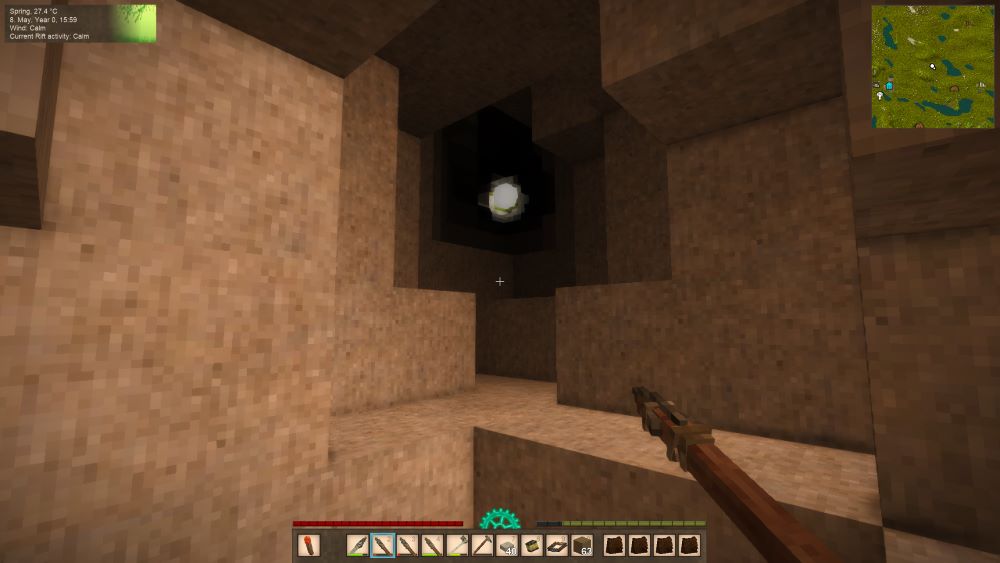
Fast-forward some more hours, and I actually found a cave that had real copper nodes clearly visible in the walls. Yay! I collected those went back to base and… just stopped playing. I had enough for a Copper Anvil, which is necessary to create the Copper Saw, but I realized (via Wiki) that you need a Bronze Anvil to craft Iron Tools, and that making Bronze is a better use of your copper than making an anvil. After a few attempts at getting some Tin to make Bronze, I gave up. Arguably, I should have just made the goddamn Copper Anvil and then Saw and then seen what was what.
Fundamentally though, I just wasn’t having fun.
What about the mods though? Well, Primitive Survival adds a lot of food options, including the ability to chop meat into jerky, which helps with preserving food in the early-game. There is also some enhanced fishing capabilities that doesn’t rely on literal fish mobs spawning. The extra food stuff from the other mods didn’t really come into play because I didn’t enter the Wood Board Age. Or maybe I was just too dumb to understand the trick behind easier recipes or whatever.
Out of all of them, XSkills had the most promise. Basically, the mod adds character progression to the game, which is absolutely something I feel Vintage Story lacks. The default XP rate is abysmal, but you can boost it via editing some files. One of the skills grants a chance of collecting Resin from chopping trees, which is essentially all I ever really wanted from the game. There seemed to be some neat stuff in there, amongst the more generic +5% X and similar, but I didn’t earn enough XP to reach anything of particular note. I definitely recommend it though.
Weirdly enough, I do sorta still have a vague desire to play Vintage Story. I’m not quite sure if its the equivalent to Stockholm Syndrome, wherein you spend so much time understanding the intricacies of a game that leaving it makes you yearn for it more, or what. It is fun exploring the map and potentially discovering something amazing right around the next bend. The problem is that everything circles back around to an incredibly dull, “realistic” mining simulation and arbitrary gatekeeping. Fighting feels bad, the lack of armor options feels bad, it feels bad when your map doesn’t spawn any goddamn Horsetail which is the only early-game source of healing items.
It is entirely possible the game is simply not built for someone like me. And I guess that is OK. I’m not even sure what changes they could make in future updates to make it more palatable. Maybe a more cohesive early-game where you can make leather without needing Wood Boards, or perhaps more armor options with just Hides? Maybe not needing to already have copper to mine copper?
We shall see.
Impressions: Vintage Story
Vintage Story is a ponderous, “realistic” survival crafting sandbox in the style of Minecraft. Pretty much the exact style of Minecraft, in fact, although it supposedly has a different codebase that allows it to do some interesting things. How interesting those things are will greatly depend on how slow and methodical you like your gaming.
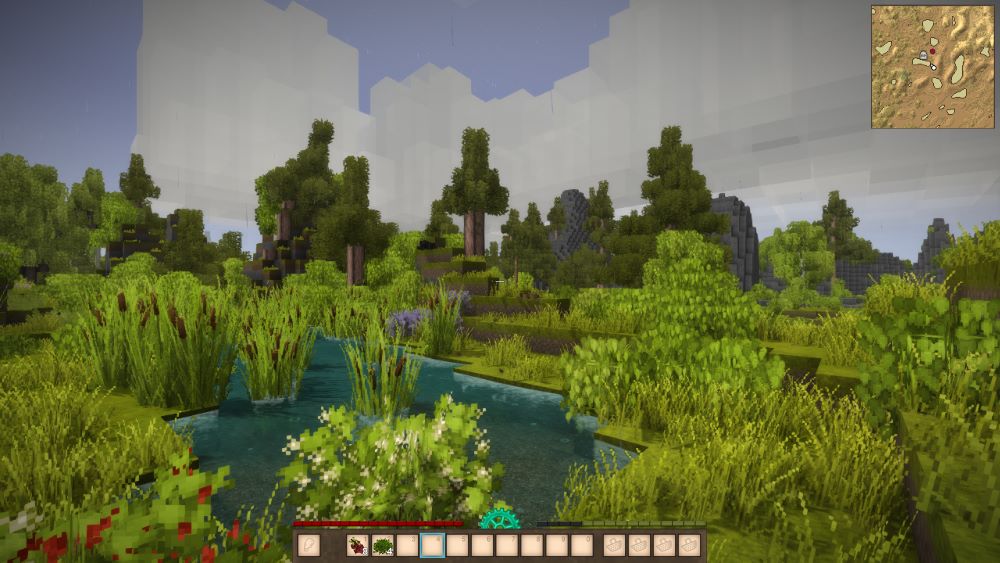
As with most survival games, you start out with just the clothes on your back. From there, you collect flint or some other hard rock to make tools. In Vintage Story though, you literally make the tools: you place the flint down on the ground, and use another piece of flint to “knapp” (e.g. chip) the other piece according to a voxel pattern. Combine the knife head (etc) with a stick in your Minecraft menu and voila, a flint knife. This will allow you to collect things like reeds to be turned into baskets or dry grass to help start a fire. You can’t just punch everything to get the proper resources here.
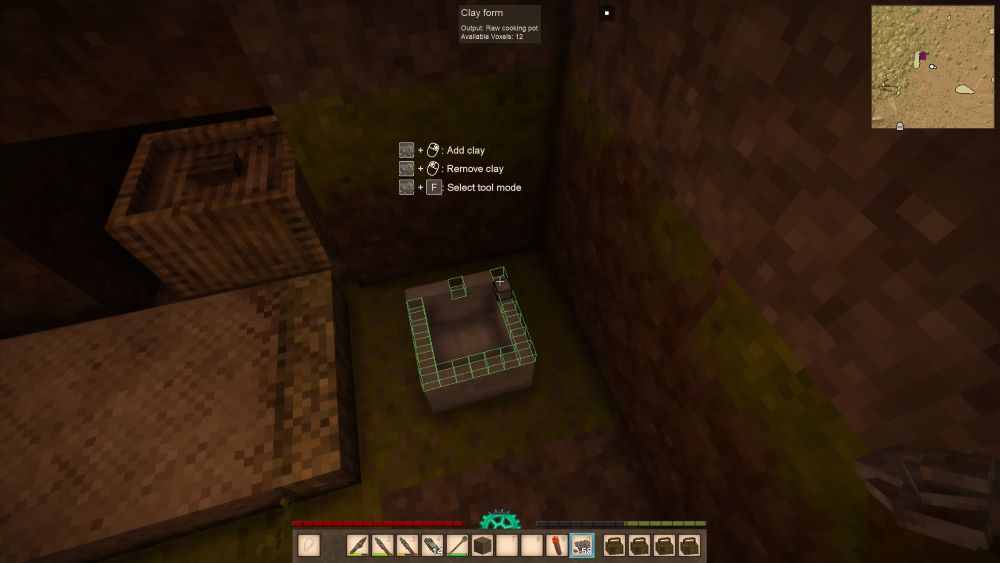
At this point, Vintage Story doubles-down on the intentionality. Flint tools are fine, but you really need clay to get to the next stage of development. Search far and wide for clay deposits, dig up a bunch, and then place some on the ground. You now have the option to create various clay vessels, like bowls, cooking pots, storage vessels, jugs, and so on. Crucially, you will also need tool molds, such as for a pickaxe and hammer. All of these things have to be sculpted, voxel-by-voxel, which is equal parts tedious and zen. Once completed, congratulations… you have still have raw, wet clay. Now you need to dig a hole, fill with dry grass, sticks, and firewood, light it on fire, and then wait 24ish hours for the pieces to harden. Oh, and make sure it’s covered from the rain and also away from flammable material.
Next comes copper. While traveling the overworld, you may come across a few pieces of copper nuggets on the surface. You can collect these – and mark your map since there is ore underground there – but will likely have to pan sand/gravel for additional nuggets. Once you have ~40 copper nuggets, you can begin the smelting process. Which requires charcoal, because firewood cannot hit the necessary temperature. Making charcoal involves digging holes, filling it to the brim with firewood, building a fire on top of that, lighting it, and then covering the whole thing up. A day later, you have charcoal. Go back and heat up the nuggets in a (fired) clay crucible, and using some wooden tongs – can’t have molten copper in your bare hands, of course – pour the copper into the (fired) clay tool molds… and wait. Once it cools, you have a copper pickaxe.
And now, finally, you can dig rocks!
I typed all that out because that is the type of game Vintage Story is. Mostly. Cooked food spoils at a reduced rate inside a clay Storage Vessel, and at an even further reduced rate in a cellar, and at an even more reduced rate if the food itself is stored in a clay Crock Pot sealed with animal fat. Neat. Meanwhile, you can construct your house and cellar by punching dirt blocks and placing them ala vanilla Minecraft. Making flint knives and other tools is a cool process, but the blade and handle are just magically connected somehow. I bring this up because the process of making a bow meanwhile requires twine, made of flax fiber, collected from flax (or looted from Drifters). Getting the first “tier” of armor above basically nothing requires Resin, which only comes from Pine trees at world creation, and only at an extremely limited chance. Like… why? We can hold molten copper in wooden tongs but can’t get some pine resin from pine trees?
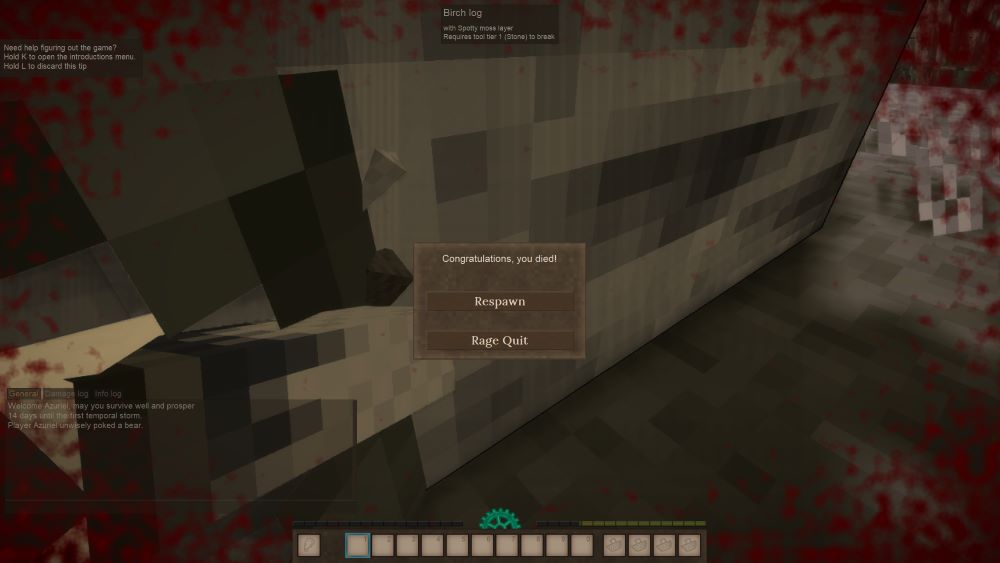
This sort of strained duality extends elsewhere. Wolves and bears are dangerous and will kill you in 1-2 hits. You can avoid them though by using a nerdpole, e.g. quickly placing blocks underneath yourself while jumping. Ore deposits are “realistic” in that they follow veins in specific sort of shapes. Getting to them can be sped up by either digging straight down and nerdpoling your way out, or creating an infinite waterfall via bucket and swimming straight up like in Minecraft. Crops take ages to grow – sometimes more than 1-2 in-game months – but animals generally spawn everywhere. Pemmican doesn’t exist, and not every animal has fat. And so on.
Those design choices are one thing, but the one that’s a bit more unforgivable (IMO) is the back-loading of content. The “real” game doesn’t really start until you can make wooden boards, which requires a copper saw, which requires a copper anvil, which requires enough copper nuggets gained from mining with the copper pickaxe. How do you get copper nuggets to make a copper pickaxe you ask? Panning sand, basically. Anyway, wood boards give you a ton of building and storage options, but the big ones are buckets and barrels, which then allow you to process things into leather, pickle food, and basically… everything. I understand that perhaps the intention was a sort of “congratulations on surviving until the Copper Age!” but that doesn’t mean the early game should be less interesting.
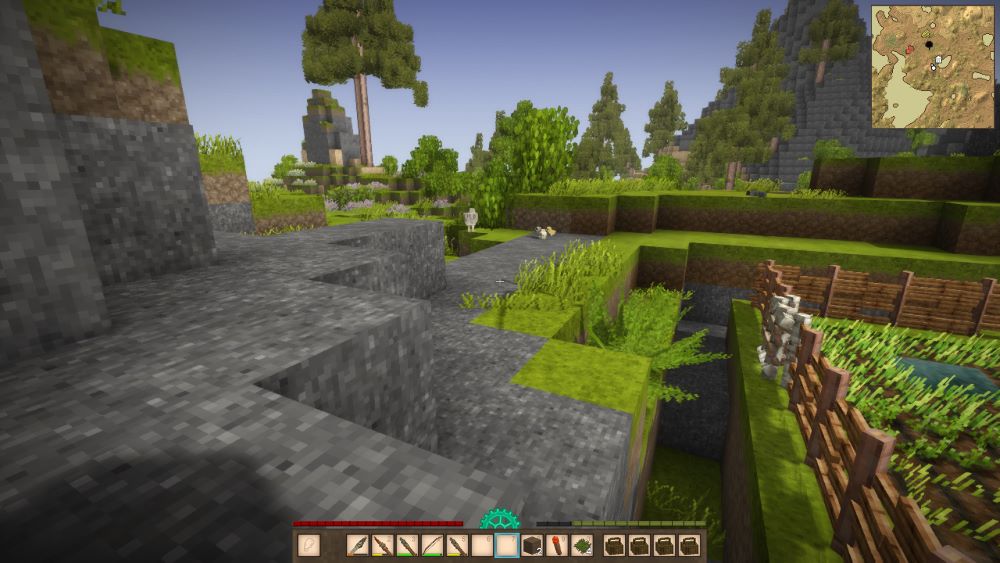
Vintage Story also suffers in the “now what” department. Surviving the first winter with limited resources is a massive struggle. After that? Farms will provide all your caloric needs rather easily. You can eventually craft some windmills and other mechanical tools to automate some tasks too. There are caves to explore and Drifters to fight and teleporter devices that can send you to far distance places. But… that’s it. I’m not saying other survival games do not have a similar endgame issue – there’s no “point” to 7 Days to Die or ARK – but the crucial difference is that playing these other games is, well, fun. They have good moment-to-moment gameplay, they have character progression mechanics that make you want to reach the next level, and so on.
That sort of thing is missing here. Once I finally got my Copper pickaxe and then realized how difficult it was going to be to find copper nodes, I was basically done. Plus, you know, if you lose your Copper Pickaxe somewhere (either by dying in a deep hole or via durability) you have to literally start all over.
Having said all that, Vintage Story is definitely a novel approach to the more traditional survival crafting genre. It is not in early access, still gets beefy updates, and was built from the ground up for mods. Indeed, there are supposedly a lot of mods out there that tackle many of the fundamental issues that I have brought up. I may end up rolling a new world with some of these mods installed and see if that smooths out the experience and make it more interesting.
Which, for the record, it was for a time. Just not enough. For now.
Impressions: Abiotic Factor
Short version: Highly impressive survival crafting game in Early Access.
The overall vibe Abiotic Factor has going for it is the original Half-Life (complete with polygon counts from 1998) from the perspective of the scientists. You play as a new recruit to a secret Australian (?) underground laboratory doing SCIENCE… on things from another dimension. Something happens literally during your first day of orientation, the base goes on lockdown, and you are basically on your own to escape.
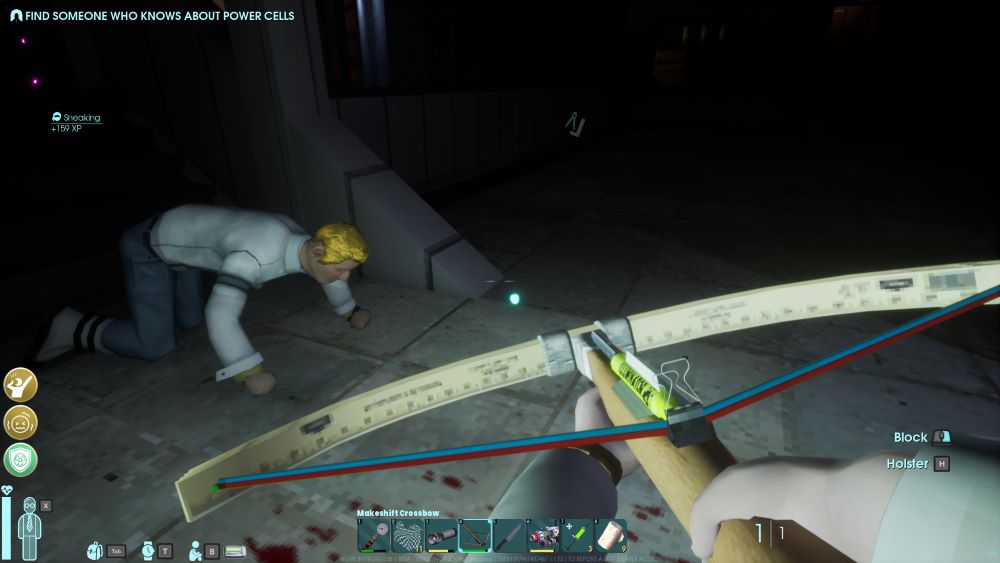
One thing I loved immediately was the novelty of the survival experience. Playing this game reminded me of playing Subnautica for the first time when none of my “punch trees” experience applied. Sure, the wooden crates give wood, but you’re mostly in an office setting at first, and wood isn’t even really what you need to craft the basic items. You might not think slinking through cubicles, snatching keyboards and breaking monitors for their sweet, sweet coils while hiding from alien monsters would be fun… or maybe you would. Because it is. There was some primal pillow fort energy when I set up my base in the gym area, hiding in terror from the rampaging night bots, and then making forays into the break rooms for literal supplies – including buying food from the vending machines to tide me over! – while getting my in-game bearings.
Are there some rough edges? Sure. One of those edges is, in fact, somewhat systemic: being a survival crafting game at all in a relatively linear, plot-driven narrative. While you can possibly spend in-game weeks in the first area, the fact of the matter is that you need to specifically craft X using resources from Y to open the next area Z. Once in that new area, you will encounter new obstacles, new crafting material, and new things to take into account, which is good. What wasn’t immediately clear to me though is that I should have packed up everything I built in the first zone and carted it with me rather than starting from scratch in the new zone. It certainly feels lame leaving an upgraded workbench that can auto-heal and warm you by proximity and going somewhere with a dearth of the more basic building materials. It especially felt super lame when I got locked into an extended journey sequence that resulted in my entire plant farm dying from lack of water while I was gone. So much for utilizing the more advanced cooking options, eh?
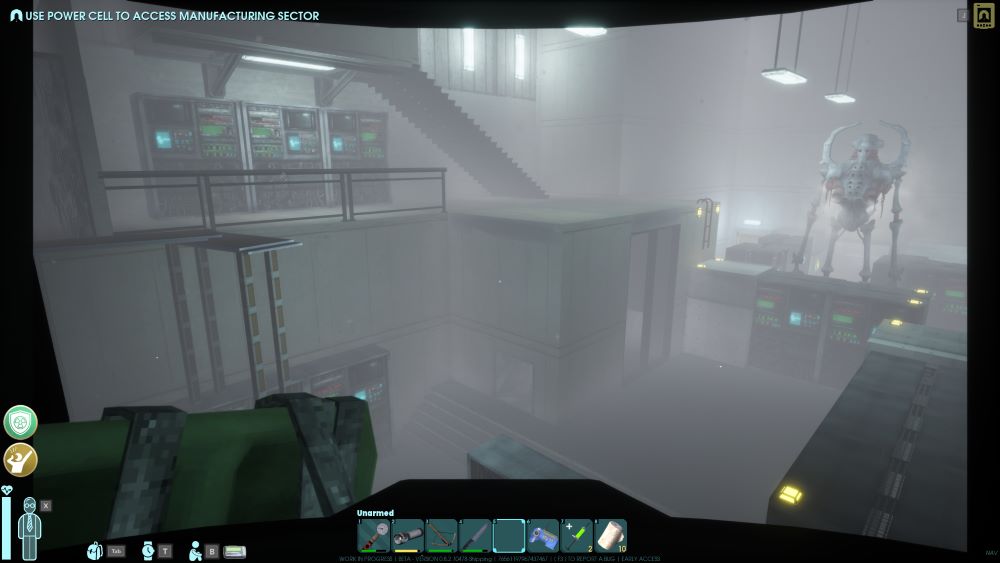
Aside from those sour grapes though, Abiotic Factor nevertheless gets high marks from me. While most workbenches require power and thus need to be located near power outlets, everything else can be placed just about anywhere. Which includes literal ramps and platforms that allow you to skip certain areas entirely. Now, whether you actually want to skip any opportunity to hoard bundles of pens, deconstructed file cabinets, and other debris is up to you. Personally, I tend to steal everything not nailed down and sometimes even that stuff too. You just never know what may come in handy.
What I do know is that I liked Abiotic Factor enough to stop playing, so the devs can finish cooking.
Blaugust 2024 – Day 1
I have chosen to participate in Blaugust 2024 this year, despite the fact that I am currently on vacation.
Hello. My name* is Azuriel and I have been blogging for almost 14 years now. In the early days, my blogging was focused on World of Warcraft. In fact, “Azuriel” is the name of my main in WoW. I started Player Vs Auction House for the release of the Cataclysm expansion, and despite that ultra-niche topic, the blog did well enough for itself. Over time though, I started to realize that chasing gold trends was less interesting than the design philosophy behind the game, so I pivoted to that. Once I started drifting away from WoW itself, it was time for another pivot towards “let’s talk about whatever else I want.”
That is probably enough as far as introductions go. If this is your first time here, I recommend clicking on the drop-down over on the right labeled The Goods, and selecting Philosophy. Everything that I post is top-quality, but those trend towards a higher level. Or you can check out this list of posts, back when I participated in Blaugust 2015. Nevermind that my best work seems to be from years ago.
Otherwise, well, welcome.
*Not my real name, of course.
Impressions: Icarus
TL;DR: Empty wildlife murder simulator.
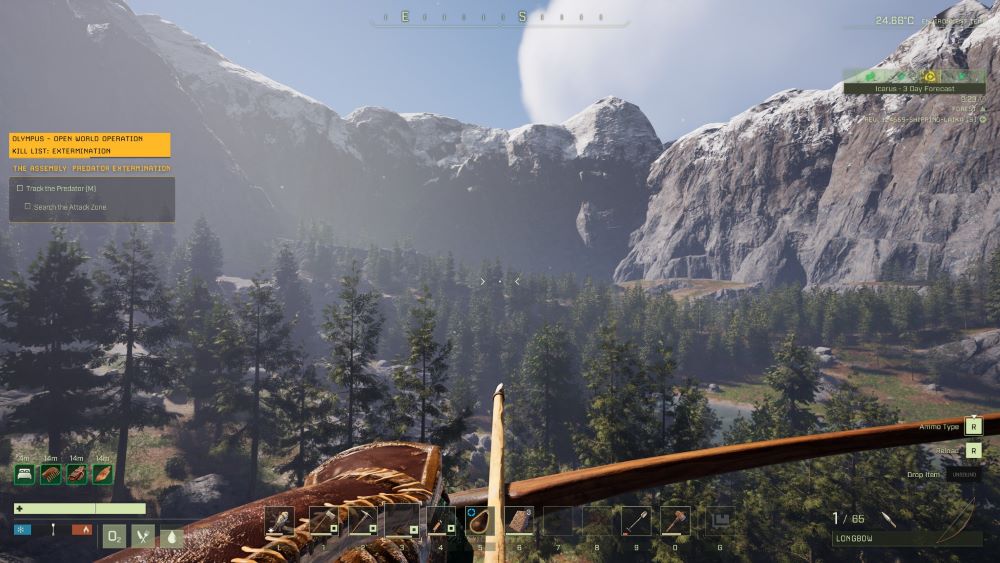
To understand what Icarus is all about, you need to know what it was about. At release, Icarus was intended to be a sort of survival roguelike, where you are dropped off at a location, fulfill a mission before the timer expired, and then bailed on the world (including anything you built) within a few days. In fact, it was originally so hardcore that if the timer expired before you left – and it counted down even with the game turned off! – your character would straight-up be deleted. Successful missions granted you a currency that could be used to both research and then later buy items that you could then bring with you planetside in the future. For example, instead of starting at zero every time, you could start with an upgraded spacesuit, a backpack with bonuses, weapons, etc.
As you may imagine, that novel approach didn’t sit well with many people. Indeed, it’s difficult to imagine a worse genre mashup… although I suppose 7 Days to Die somewhat pulls it off (e.g. eventually enemies get too tough). But generally, the beginning stages of punching trees is the least interesting part of survival games, and losing progress is the worst. Icarus had both. The developers suddenly had to pivot, and so they eventually released a more traditional open-world survival mode.
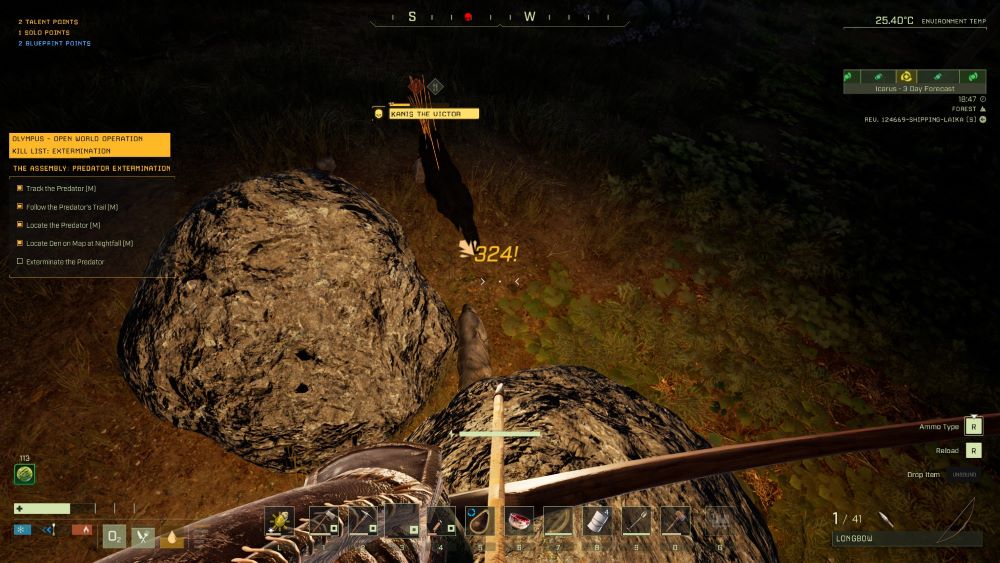
The pivot has taken some time, although the developers have sustained a weekly update schedule for over two years now, which is impressive. Or would be, if the game was fun or interesting at all.
The fundamental issue with Icarus is that there isn’t much going on. There is a relatively solid survival crafting framework in place, with XP and levels and recipe unlocks and talent points and such. The world is gorgeous and thick with trees, bushes, rocks. There is even a semi-voxel thing going, with fallen trees being satisfyingly split into logs, and ore/rock nodes deforming exactly where you are hitting them. All of which will sustain genre fans for a few hours past the refund window.
But after a while, you start to realize what you have in Icarus is basically the window dressing of other games. A forest with deer, rabbits, wolves, goats, moas, bears? A desert with hyenas and scorpions? Snow biome with polar bears and mammoths? Other titles like 7 Days to Die, The Forest, ARK, etc, have those things… aaaaand the rest of the game game. Without the parameters (and timers) of Missions, the Open World aspect falls flat. Technically, you can craft a radio that opens up both short and longer-form Missions even in the Open World, but you still run into the issue of “why.”
“Why do anything at all in any game, eh?” Because shooting zombies and looting things is fun? Because delving into caves and uncovering mysteries while running from mutants is (supposedly) fun? Because dinosaurs are fun? With Icarus, what you see is literally what you get. Kill thousands of animals to farm XP and unlock more crafting benches so you can kill more animals efficiently. Or build a quaint little abode in the woods. Which is fine for the people that want to do that, but you can also do that in (cheaper!) games that have more meat than potatoes.
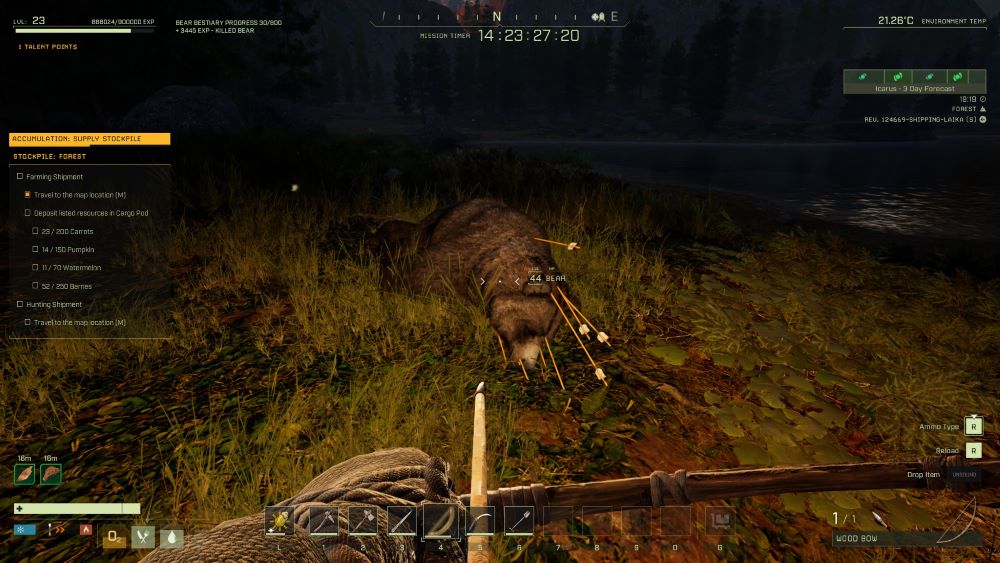
In an effort to be totally fair, I did go ahead and run a few Missions, e.g. the way the game was designed to be played, once the open-world lost its luster. And… it was pretty much as bad as it seemed. After the tutorial one, the next Mission was to collect up meat and vegetables into two different drop pods. Cool. What they neglected to mention was the fact it was going to be like 150 Pumpkins, 200 Carrots, and so on. The only possible way of gathering that much was going to be setting up a farm, and then hanging out for a while. Which I did. Next was the meat, which was something absurd like 300 meat, 400 hide, and 300 fur or whatever. I got about halfway through murdering literally every single mammal that moved before the tedium overtook me and I uninstalled.
Having said all that… is there anything good going on in Icarus? Sure. Although it is a limiting factor, the existence of oxygen as a necessary meter to watch gave texture to the survival experience. It helps that Oxite Ore is in most places, so you aren’t as constrained as in, say, Breathedge. The storms in Icarus are also interesting. Staying outside in one fills up an Exposure meter that begins hurting you when full, and the storms themselves do damage to most buildings. Now, you usually just spend the storm inside your base running around and smack-repairing things with a hammer, but it elevated “weather” from a pure, ambiance detail in most games to one that you must account for. And you do have to account for it: your walls will collapse if they take too much damage from the weather or anything else.
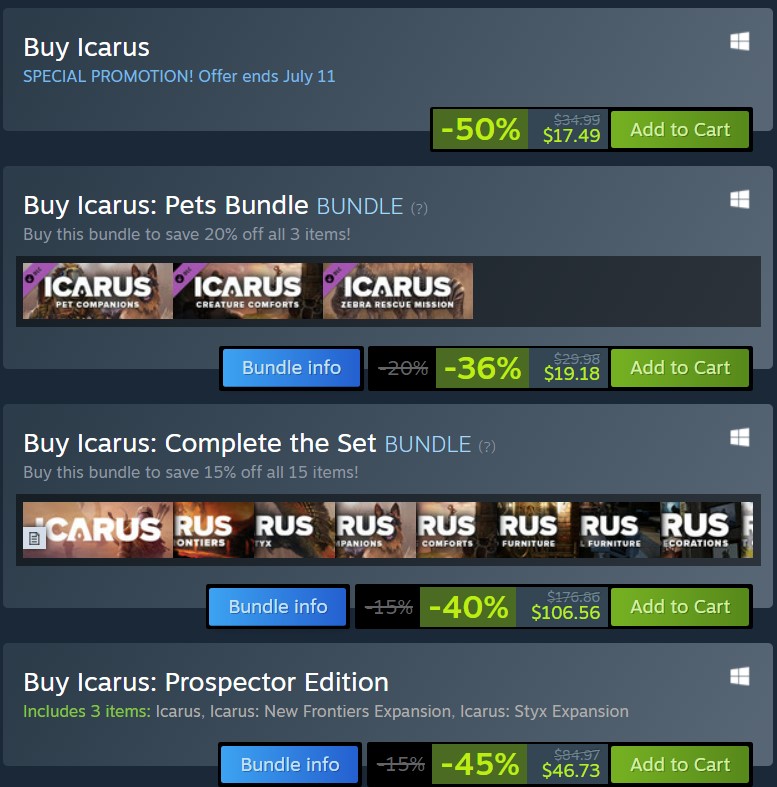
That’s about it, though. Part of me feels bad for the devs since they likely had to scrap a lot of their post-release plans when they pivoted to a more traditional open-world structure. But then I look at how much they are charging for the game + DLCs in its current state and those feeling go away.
Boardgate: Hearthstone Edition
Hearthstone is releasing a new expansion next week called Perils in Paradise, but they aren’t releasing a new board along with it. And this is heralding the beginning of the end. Possibly.
As with most things, it’s not about the game boards themselves, but what they represent. Every Hearthstone expansion has had a new game board – there are 30+ of them – so the absence of one is notable, especially given this year will be the 10th (!!) year anniversary. Of course, this is the same year that Blizzard discontinued the Duels mode and enacted some boneheaded changes to the quest system in an apparent attempt to inflate engagement metrics.
It doesn’t help when the official Blizzard response plays right into everyone’s fears:
We hear your questions on what’s changing and why, including why there is no new board for Perils in Paradise.
Hang tight, as we’ll be sharing an update next week on that, along with what the team is focusing on for the future.
Why not just, you know, address it this week? Because the $50/$80 preorder bundles are still going until next week. There may be a less cynical argument that discussion over future Hearthstone changes is more appropriate in an flashy expansion release post. On the other hand, there have been plenty of those teaser-esque posts in the weeks leading up to the expansion, and Blizzard community managers have been bobbing and weaving the “where board?” questions for just as long. All the delays accomplish is elevating the doomsaying ahead of what should otherwise have been talk about the expansion itself.
Incidentally, when Blizzard removed Duels it was spun this way:
As we think about the future of Hearthstone and where the team can best focus their efforts, we’ve made the difficult decision to discontinue support for the Duels Mode. […] This change will allow us to shift our resources to where we feel they will have the most impact, including Traditional Hearthstone, Battlegrounds, and more.
Looking at the current state of Hearthstone more generally, it’s difficult to identify what “focusing efforts” has accomplished. Game balance in Standard mode is amongst the worst it has ever been; power is no longer creepin’, it be runnin’. Battlegrounds has re-introduced Buddies (presumably for a limited time), which is worst of the three types of historic meta-shakeup mechanics. Battlegrounds Duos is a mode no one asked for, is rife with trolling, and basically a content-creator dead-end. What could the devs possibly be focusing on, aside from updating their resumes?
I suppose we will see more next week. My guess is that they will start offering Premium Boards in the shop as another channel of monetization. Which, whatever. That, at least, would be less problematic than them coming out and saying “we’re only making one new board per year so we can focus on other things” and then those other things never materialize because it was shareholder value all along.
 In An Age
Blarghest
Aug 12
Posted by Azuriel
The last time I officially joined Blaugust was back in 2015. Back then, the conclusion I came to was that it wasn’t really worth the effort: posting every single day for a month did not meaningfully increase page views. I’m not trying to chase page views per se, but you can’t become a fan of something if you don’t know about it. Discoverability is a real issue, especially if you don’t want to juice SEO metrics in suspect ways. So, on a lark, I decided to rejoin Blaugust nine years later (e.g. this year) to at least throw my hat back in the ring and try to expand my (and others’) horizons.
What I’m finding is not particularly encouraging.
More specifically, I was looking at the list of participants. I’m not going to name names, but more than a few of the dozen I’ve browsed thus far appear to be almost nakedly commercial blogs (e.g. affiliate-linked), AI-based news aggregate sites, and similar nonsense. I’m not trying to be the blogging gatekeeper here, but is there no vetting process to keep out the spam? I suppose that may be a bit much when 100+ people/bots sign up, but it also seems deeply counter-productive to the mission statement of:
Ahem. The calls are coming from inside the house, my friends.
[Fake Edit] In fairness, after getting through all 76 of the original list, the number of spam blogs did not increase much. Perhaps a non-standard ordering mechanism would have left a better first impression.
Anyway, we’ll have to see how this Blaugust plays out. I have added 10-20 new blogs to my Feedly roll, and am interested to see where they go from here. Their initial stuff was good enough for my curiosity. The real trick though, is who is still posting in September.
Posted in Commentary
3 Comments
Tags: AI, Blaugust, Blogroll, Gatekeeping, Search Engine Optimization