Language of Action
This amusing comparison was posted on Reddit the other day under “Morrowind vs Skyrim vs Dark Souls”:
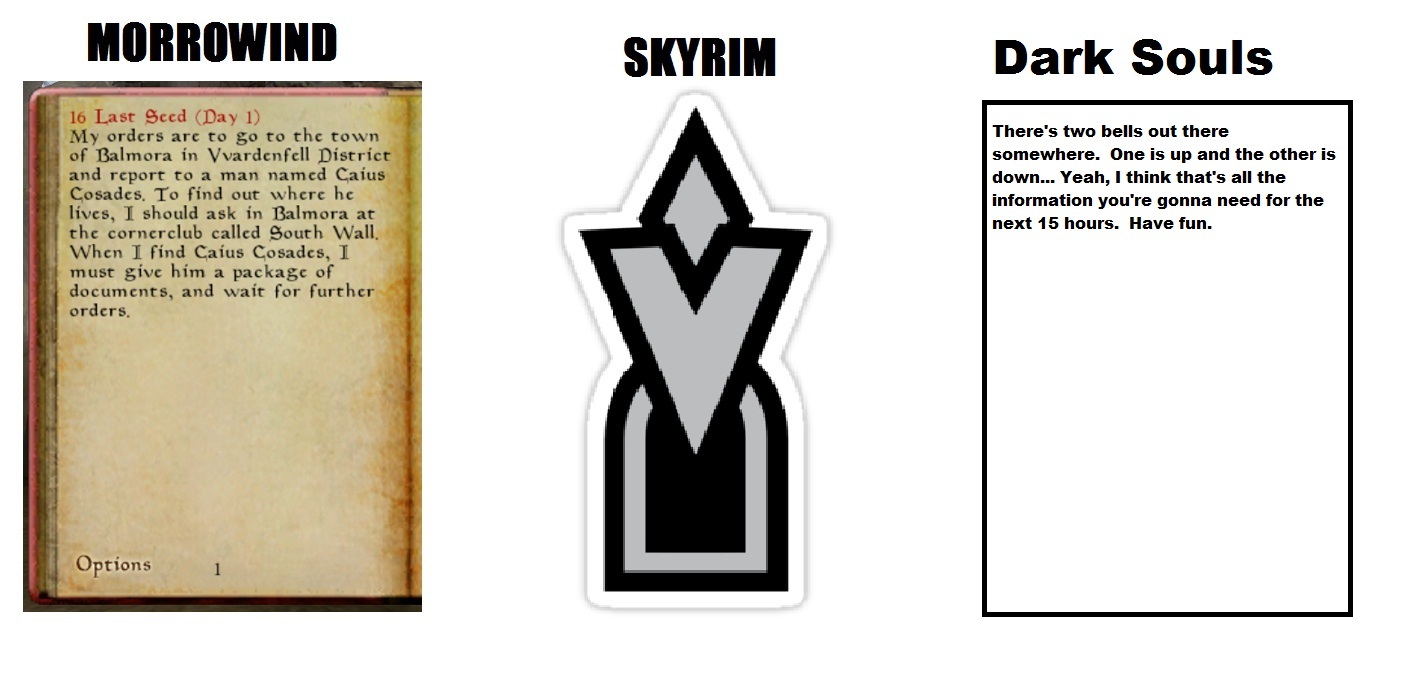
/slowclap
The implication here is (presumably) that games these days are being dumbed down, or at least are not being made as challenging as their predecessors (Dark Souls aside). This sort of “hand holding” is pretty much the de facto standard in MMOs as well, in the form of highlighting of the questing areas and the like. ¹
To which I say: “Good.”
If there is one particular scenario I despise more than anything else in videogames, it is when I sit down to play one and then can’t. I do not mean that I try and fail and am unable to progress – that part is good! It’s gameplay, it’s doing things, it’s actively engaging my faculties. Rather, I mean when the game is not even allowing me to try anything because I am missing something and don’t even know it. Or maybe I am not missing anything and the game is at fault. Indeed, whenever I get stuck in a game, these are the usual possibilities:
- I cannot solve the puzzle.
- I missed an invisible quest trigger.
- I cannot locate the quest objective.
- I do not know where to go next.
In all those scenarios aside from #1, we can entertain the possibility that it is the game designer’s fault. And that’s the problem! Sure, occasionally it is my own damn fault for not reading the quest text correctly or I didn’t pan the camera 110° to the right or whatever. But after 20+ years of playing videogames, I can assure you that my default assumption is not that these designers do everything on purpose. Games are art, but if you set out to evoke a particular emotion with a piece and it generates the exact opposite, we can say that that piece of art failed in its goal. Sometimes mistakes can make a game better (like… Gandhi in Civilization), but an equal or greater amount of time they are simply mistakes.
Things can go too far the other way, of course. In the opening scenes of The Witcher 2, as you approach the ominously empty bridge, you get a prompt telling you which buttons to press to avoid dragon fire. “What dragon? Oh.” Quests in Skyrim which ask you to find the artifact that has been hidden for centuries… and there’s a very visible quest marker that appears directly over it. I can concede that something like this other Reddit picture is too much:
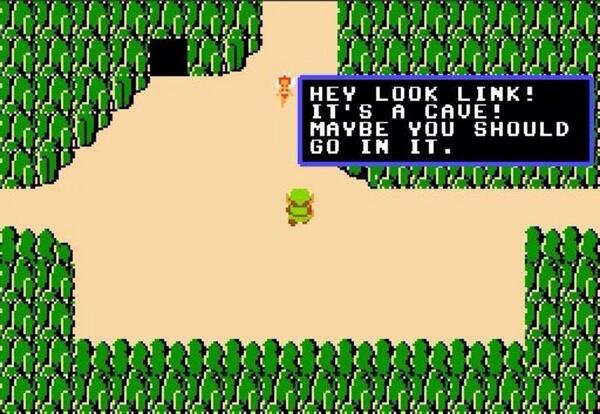
I hated Navi anyway.
At the end of the day, though? I am playing videogames to do things. I do not consider walking around a room pressing the Interact button every few steps as doing something. There is a place for games in which the “doing” is figuring out where to go or what to do next. And that place is “Pile of Games I’m (Literally) Not Playing.”
¹ I still remember the river of tears that resulted from WoW adding quest givers to the minimap back in Patch 2.3. Yes, seriously, tears.
Bring It, 2014
The normal sort of thing to do is look back on what 2013 brought us, but ain’t nobody got time for that. And 2013 sucked anyway. Let’s see what’s in store for next year, yeah?
The Repopulation
For as much as crusty old bloggers harp about Star Wars Galaxies and Ultima Online, I find it amusing how not a one of them (that I am aware of) has mentioned The Repopulation. What is it? Why, according to Kotaku it is the love child of SWG and UO. MMO? Check. Open-world sandbox? Check. Build your own towns? Check. No levels or classes? Check and check. Can just be a crafter all day, or dancer, or street performer? Ayep. Hell, they even claim you can seamlessly switch from hotkey MMO style combat to an action-oriented 1st/3rd-person shooter perspective. It’s a veritable pantheon of Jesus features.

You can craft a Portal turret pet. Need I say more?
Apparently the game is already in Alpha from a successful Kickstarter campaign in 2012, although they are giving it another $50k Kickstart for some reason or another. Closed Beta for backers starts in March. The end result will be a F2P MMO that sells “memberships” in tiers for a one-time purchase, which is perhaps the most novel business model I’ve seen yet. In fact, I think that was the last undiscovered videogame payment scheme. Achievement unlocked.
WildStar
It’s a thing.
Elder Scrolls Online
Also a thing.
EverQuest Next: Landmark
If Landmark ends up being anything more than a commercial disaster, it will be in spite of having the most vague, nonsensical marketing strategy I have ever witnessed. I mean, watch this promotional video. That was uploaded on December 6th, 2013, so it’s not from back when they didn’t know how they were going to cover up the EQN delay.
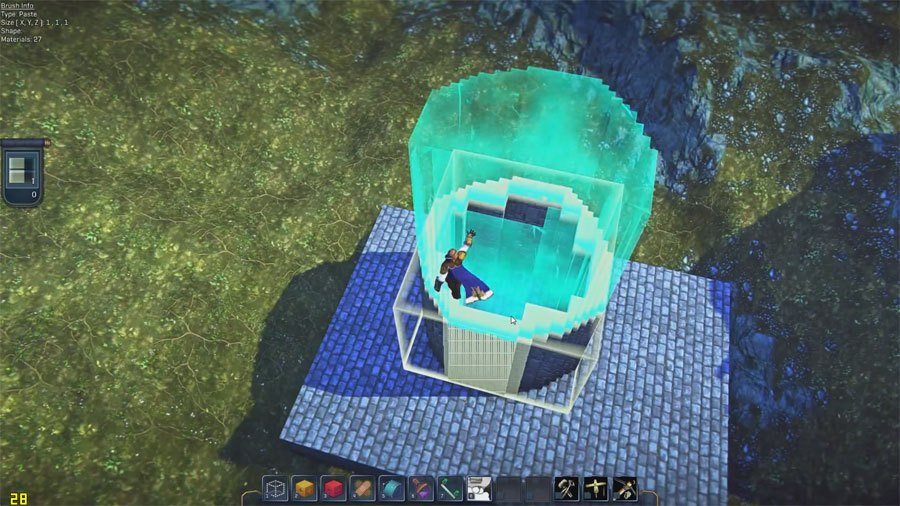
Okay, this does look kinda interesting.
That being said, I am always keenly interested in anything that allows players to freeform create things in game spaces. I’m not talking about building a house somewhere in UO or other nonsense. I’m talking about actually being able to craft something that can effectively be used as a portfolio of game design. Hell, I still have all 11.6 gigs of Portal 2 installed because I imagined that one day I would get around to building my own puzzle as an example of level design. Did it happen? Nope. Could it have happened? Yep. PlanetSide 2’s Player Studio deal apparently had some budding designers banking $5000-$8000 in a quarter, for crafting the equivalent of hats and camo. Landmark will have the same sort of system in place, on a much larger scale.
So, Landmark is on the radar. I’m not convinced that it will actually be a “real” MMO in terms of it being entertaining to play the non-crafting bits, but who knows? Certainly not SOE, that’s for goddamn sure.
Destiny
Not a thing. Seriously, it’s Borderlands 2 Online minus a PC version. Which means I’m not playing it.
Firefall
I hadn’t even thought about this game since I ran into a bugged quest back in July. Actually, I take that back. I had an entire post ready to go entitled “Firefail” and it was to be accompanied by this picture:
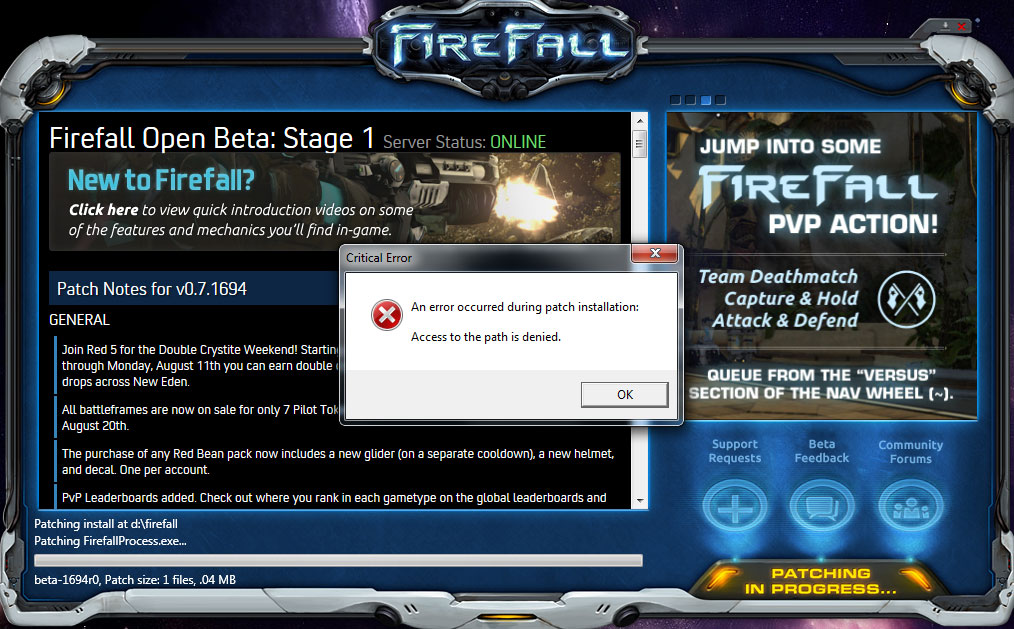
Welp, so much for that.
Basically, I tried patching the game and got stuck at the last 0.04 MB. I truly did try everything, including a full uninstall of the game client and a redownload.
As it turns out, I might have dodged a bullet there. Apparently, the CEO of the game studio was fired after having spent millions of dollars on high-end camera equipment and, no joke, converting a tour bus into a mock-up of in-game transport. That bus job cost $3 million from an MMO game studio’s coffers. Oh, and I guess apparently the CEO announced that he unilaterally cancelled all PvP in a forum post? You can read a sort of insider view of the dirty laundry in this (verified!) Reddit thread.
WoW: Outlands 2.0
Probably a thing.
Holiday
I’m still on one, technically.
In the meantime, please enjoy the three new anime micro-reviews I uploaded: Nichijou – Everyday Life, Planetes, and My Teen Romantic Comedy: SNAFU.
Review: The Last of Us
Game: The Last of Us [PS3]
Recommended price: $30
Metacritic Score: 95
Completion Time: ~17 hours
Buy If You Like: Metal Gear Zombie, brilliant storytelling, good games
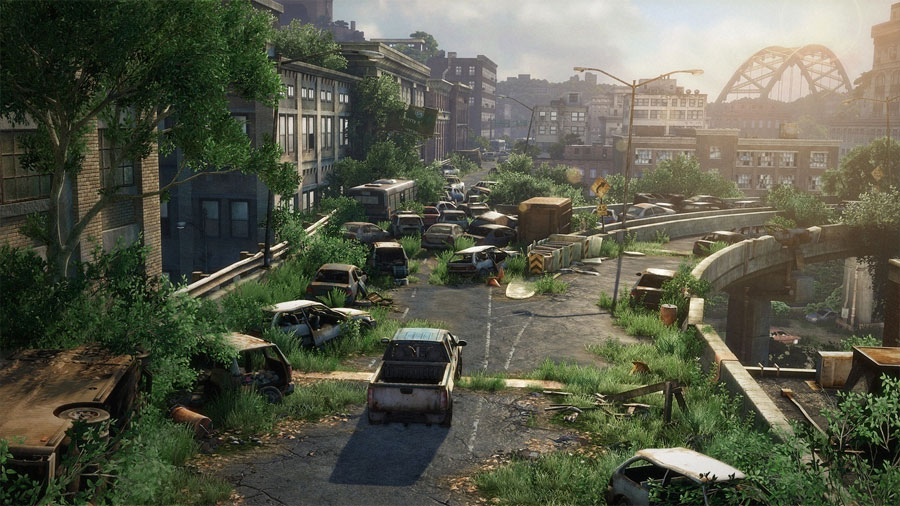
You can almost say the post-apoc was an improvement.
When it came down to a decision as to whether I should do an extremely late jump into this (now past) console generation, I really only had one question: did I want to play The Last of Us, or the Halo series? Despite ultimately choosing the PS3, I waited on purchasing The Last of Us for quite some time. This was the reason I bought this console, and I was a bit apprehensive about putting that $200+ decision to the test. After all, everyone raved about Bioshock Infinite at release and looked how that turned out for me. How could this Metacritic 95/9.1 game live up to the expectations I have levied upon it?
The answer is “Easily.”
The Last of Us (TLoU) is 3rd-person, stealth-emphasized cover-based shooter set twenty years into a “zombie” post-apocalypse. An outbreak of mind-destroying spores has nearly wiped out humanity, and the survivors are doing their best to stay alive in a world of infected bites, raiders, and mundane starvation. You play as Joel, a professional smuggler and hardened badass, who along with your partner Tess is looking to get even with a guy who robbed you both of a shipment of guns. After a series of close calls, Joel & Tess take up one last job: to smuggle a 14-year old girl out of the city and to a safe house.
The principal gameplay is exploring, sneaking, and killing from an over-the-shoulder perspective. While the environments are extremely linear and the number of enemy types fairly basic, I found the gameplay itself to never get dull. Supplies are almost always limited, so some real decisions will need to be made as to whether you take the time to sneak around and get some stealth kills versus lobbing a Molotov cocktail into that group of enemies right now. Compounding this, the human AI is brutal in its sensibility – enemies will fan out, attempt to flank you, send only one guy to investigate noises while the others watch, and so on.
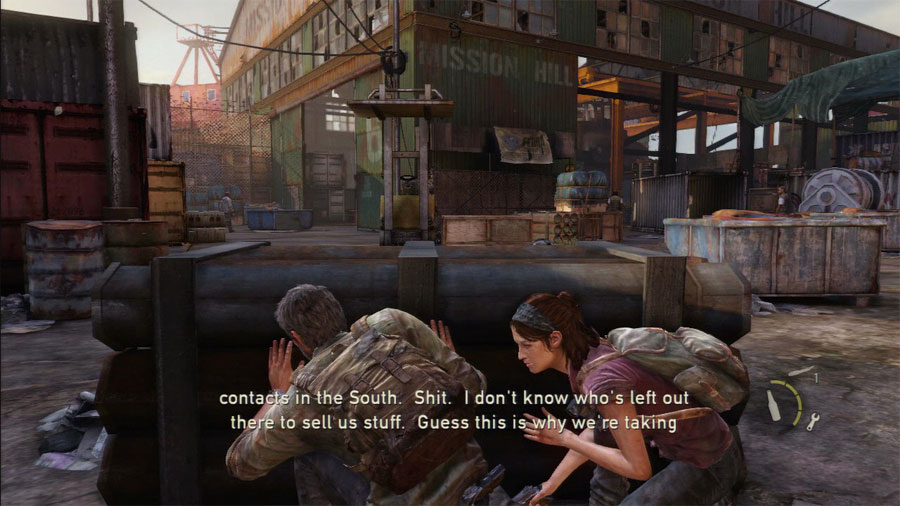
There will be a lot of waist-high obstructions to crouch behind.
About the only complaints I have about the combat side of things is the reverse difficulty curve and checkpoint system. Like many similar games, TLoU is harder in the beginning and only becomes progressively easier as time goes on. Part of that is familiarity with effective strategy, given how there aren’t a lot of new enemy types, and part of that is from access to more/better weapons. Indeed, facing human enemies became somewhat of a joke later on since they would frequently congregate in small groups at the beginning of encounters, which made it extremely easy to blow them all up at once with a nail bomb. And while I give Naughty Dog some credit for a truly seamless checkpoint system, it ends up doing some strange things to the difficulty insofar as discreet encounters only end up being ~5 minutes long.
For as fluid and exciting the combat system may be, where the game truly shines is everywhere else. The visual juxtaposition of ruined human civilization and a greenery of nature reclaiming the space filled me with sadness and wonder simultaneously; it feels like the most compelling combination between the movies I Am Legend and The Road. The musical score is amazing in its ambiance and willingness to not take over a scene. As for the voice acting, well, I never really noticed there being voice acting at all – it was just normal, natural dialog.
The overall narrative is likely the thing most everyone talks about when TLoU is brought up, and I can confirm that it is about as amazing as advertised. The weird thing is that there was not one particular moment in which I remember sitting there thinking “Wow, that’s some good videogame plot.” Instead, I felt permanently affixed to my screen, playing in five-hour increments, as each scene segued perfectly into the next and I eagerly devoured every little detail.
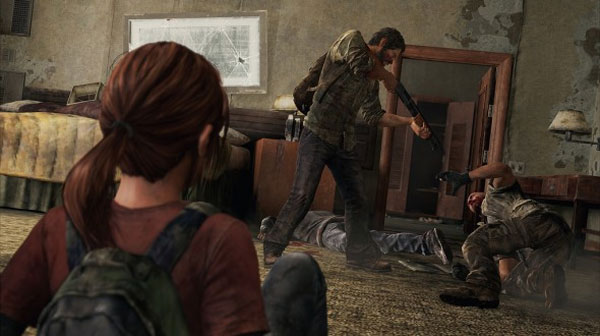
That queasy feeling you get when you realize you’d probably do the same thing.
Now that I think about it, there actually were a few details in cut scenes in which my jaw dropped at the excellence of Naughty Dog’s craft. When Joel ever-so-briefly looked at his watch, for example, I was taken back to that first wink in Mass Effect when I understood, for the first time, how much farther gaming as a storytelling medium has evolved. These subtle-yet-significant gestures hold such a hidden depth of emotion that it boggles my mind that their meaning wasn’t as belabored in-game as I am doing right now. I mean, the gesture would be ruined if it called more attention to itself, but it is such a calculated risk that I’m surprised they did not.
Ultimately, The Last of Us is one of those shining examples of Games As Art that also happen to be extremely compelling to play. And unlike some other titles which overreach in their attempts to be narratively “deep” and complex – *cough* Bioshock Infinite *cough* – The Last of Us simply presents its case amongst gripping gameplay and, story told, drops the mic as the screen fades to black.
Gaming Verisimilitude
On Thursday, I popped The Last of Us (TLoU) into the PS3 just to see if I needed to do some sort of lengthy install, but ended up playing for 5 hours straight. The game, simply put, is quite amazing thus far. However, I am experiencing some game design tropes that are grating on me to a higher degree than normal, perhaps precisely because everything else is so good.
Early on, you are basically told that while you can treat the game like a cover-based shooter to some extent, sneaking around is likely the best method given the chronic lack of supplies. That’s fine, sure. What is less fine is when you silently take down an entire warehouse full of guys very clearly armed with guns, and only happen to scrounge up 3 bullets of ammo from nearly a dozen corpses. Were the guns just for show? The last two guys were fine with shooting the conveniently-placed, waist-high obstruction I was hiding behind for almost a full minute, but in a moment of extreme bad luck, must have been killed right after they fired their last bullet.
I understand that this is One of Those Things in gaming in which we are supposed to suspend disbelief. I remember running a D&D campaign a few years ago in which I decided early on that I was going to rebel against gaming tropes and having the party’s human opponents drop everything they were carrying. In retrospect, it ended up being a perfectly foretold disaster: the party became understandably obsessed with looting each body clean and making frequent trips to Ye Olde Item Shoppe to peddle their warez. If I were able to loot full clips of ammo from each enemy I downed in TLoU, it would likely ruin the resource-tight mood by the end of the first hour of gameplay.
I am finding myself less sympathetic towards two other semi-related aspects that are not exactly TLoU’s fault but nevertheless somewhat jarring. First, the game is not and has never appeared to be an open-world sandbox or anything of the sort, which is fine. However, I feel subtly punished for exploring when the designers take the time to add in secret caches of goods in off-the-path locations. See, the issue is that I do not ever know if this “secret” door I’m opening isn’t actually the trigger for a cutscene or the path to the next area. I want to explore every nook and cranny of the game world! And yet I feel like I can’t, because I’m paranoid about inadvertently moving the story forward and being unable to backtrack. I’m seriously starting to miss the “Chrono Footsteps” feature from Singularity which highlighted the exact path you should take, so you know for certain which areas you could explore safely.
Compounding this issue is when I’m in the opposite scenario in which the game is clearly telling me where those story triggers are. “Oh, you want me to hurry up and walk over to that door? Good, now I know I can explore this whole half of the city instead.” The game is not Fallout, has never pretended to be Fallout, but I simply can’t help myself from treating every open building as an opportunity to scavenge for supplies. It’s the post-apocalypse! Let me spend hours combing the area for scrap metal and duct tape! I do this shit for fun.
Finally, Naughty Dog, really? I have a hunting rifle, shotgun, bow, two pistols, three Med Kits, a metal pipe with scissors taped to the end, three Molotov cocktails, a few proximity mine-like explosives, and a goddamn brick in my backpack… but I can’t carry more than 7 rifle rounds? Or more than four pairs of scissors? Inventory management is one thing, but limiting ammo to this degree is so overtly gamey that it sucks me right out of the narrative and back into optimization mode. “Hmm, if I use the shotgun to clear this next room instead of sneaking through, I can double-back and pick up those shells I left behind.”
Although I am complaining quite a bit, I need you to understand that it is only because these (ultimately minor) issues stand out in brilliant contrast to an otherwise amazing game. This isn’t so much a fly in the ointment as it is a hangnail the day after a big promotion. You know, minor, almost trivial annoyances that you nevertheless can’t quite stop thinking about.
Regression to the Mean
Tobold and others are fundamentally correct about Hearthstone’s metagame essentially being reduced to a small set of cards. The speed at which the metagame changes in response to pro-player feedback also approaches the speed of light; Argent Squire went from being something I never saw in the last three months to something I now see every game. In fact, if you want to win damn near every game you play, all you need to use are these cards:
- 2x Novice Engineer
- 2x Loot Hoarder
- 2x Gnomish Inventor
- 2x Shattered Sun Cleric
- 2x Acidic Swamp Ooze
- 2x Faerie Dragon
- 2x Dark Iron Dwarf
- 2x Chillwind Yeti
- 2x Defender of Argus
- 2x Argent Commander
I cannot begin to tell you how many games I have lost due to Defender of Argus. Some of these cards will be nerfed soon, but not all of them (including Defender of Argus), and I’m not even convinced the nerfs will hurt their inclusion in nearly every deck.
The funny thing though, is how simply using these cards does not necessarily mean you win automatically. They are strongest possible cards for their cost, no doubt, but what they do not do is tell you is who’s the beatdown. They do not tell you whether you should play the Faerie Dragon or the Loot Hoarder on turn 2. They do not tell you which class to play, which class cards to choose for the rest of the deck, and whether to spend mana on removal this turn or send everything to your opponent’s face. In short, they don’t tell you what to do in this scenario:

So many possibilities…
As I have said before and will undoubtedly say again, sometimes Hearthstone can be played by a monkey. Sometimes you only have one rational move, and sometimes you will win no matter what you play because your opponent got screwed by RNG. And vice versa. But none of this should suggest there is not room for skill, acumen, and calculated risks. It’s not about seeing the same pieces day in and day out, it’s how those pieces interact with one another.
Hearthstone has its issues – Blizzard can’t pretend that Mage isn’t OP for too much longer – but a metagame revolving around X number of cards isn’t one of them. It would be better if more cards were viable, sure, but there is plenty of meat and marrow on these bones.
Battlefield 4 Impressions
I have spent the past few days gorging myself on Battlefield 4, and feel it’s time to come up for some air and reflect on my self-abuse. As you might recall, I dabbled in the BF4 beta for a hot minute and was none too impressed. That opinion is… mostly still intact, although there are some definite surprises.

Lens flare technology has definitely improved.
Right off the bat, the game does not feel materially different from BF3 in any way, shape, or form. The environments are detailed, geography diverse, the physics palpable, and actually seeing people to shoot without an over-reliance on Q-spam is a study in #firstworldproblem frustration. “The game is too beautiful to notice the bad guys.” All of this existed in BF3 to an indistinguishable degree. The “levolution” upgrade to the engine makes for some nicely-done scripted destruction, but that appears to be it. Well, the weather effects are pretty damn amazing too.
Indeed, about the only thing that became immediately apparent in terms of differences between BF3 and BF4 is how DICE continues to lurch further away from anything resembling intelligible UI design. The Battlelog fiasco is fine, whatever. What I’m talking about is how convoluted the menus and unlocks and the rest happen to be. Back in BF2, you earned ranks via XP and received an upgrade of your choice for any class (occasionally there were prerequisites). In BF3, all this was shook up with the introduction of assignments/etc, which had you to unlock weapons/items via the completion of what, in retrospect, closely resemble MMO quests: getting 20 kills with gun X and doing Y twice to unlock Z.
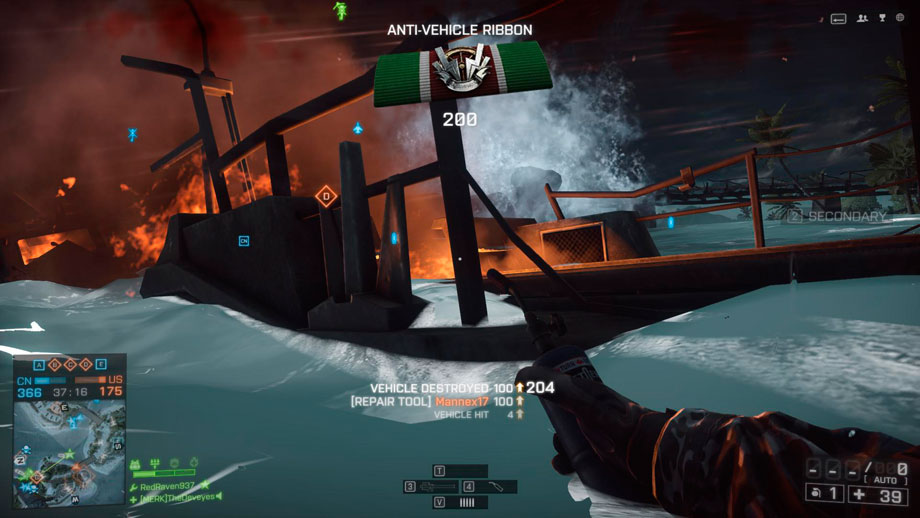
That’s right. I took out an armored patrol boat with a blowtorch. It only had 4hp but STILL!
For the most part, BF4 does away with that unlock scheme. Instead, weapons are unlocked linearly based on XP earned using any particular weapon in that class, e.g. using any LMG eventually unlocks more LMGs. The “problem” is that there is (still) really no incentive to use the newer weapons because you’ll likely be stuck with iron sights and no other accessories (bipod, laser sight, etc). The workaround appears to be via “Battlechests,” which are basically briefcases you earn via leveling up (and sometimes randomly in a match) that contain XP boosts, attachments, cosmetic items, and so on. Unfortunately, the accessories you earn can be for any weapon, including ones you haven’t even unlocked yet, so it’s too random to be useful for assuaging the new weapon issue.
One of the worst parts of BF3 was that feeling of utter uselessness that came with being a brand new player with zero unlocks; not only were you likely bumbling around getting no kills, even if you were in a position to be useful, you couldn’t really pull any of it off with the tools available to you. Even the DICE developers came out and said they “should be slapped” for it.
Well, the devs must have been talking about their BSDM preferences because BF4 proudly continues in that hazing tradition. The default Engineer anti-vehicle tool, for example, is a dumbfire rocket launcher that sometimes-maybe veers towards the roof of vehicles if it passes nearby. Which sounds neat, except this rocket hits like a dry pool noodle. You get stocked with five of them, and all five rockets are required to kill a single tank, assuming the driver is dumb enough to just let you launch five rockets at him. Or smart enough, I guess, because he’ll likely live past the barrage via passive vehicle repair and meanwhile you’ve just spent a full minute accomplishing nothing. Thankfully, the later weapons are significantly better in every possible fashion, but it’s still a ridiculous way to handle the new player experience, IMO.
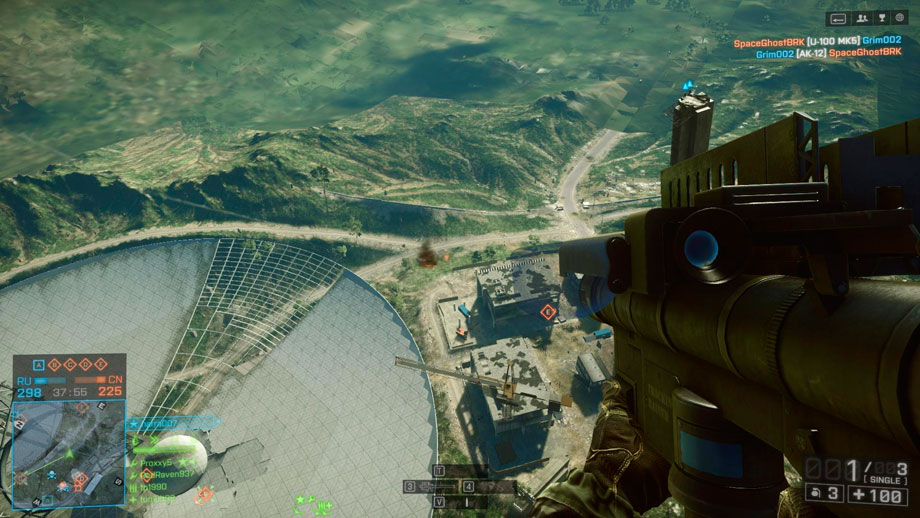
Shooting lock-on rockets at vehicles while parachuting from 5,000 ft is my favorite thing.
It would not be a DICE game review without mentioning the bugs. I would say in the ~25 hours of play time I’ve racked up this far, I have to Ctrl-Alt-Del my way to the Task Manager and End Process about once every 2-3 hours; the Ctrl-Shift-Esc shortcut is apparently not powerful enough to break through whatever memory hole BF4 generates. Rubberbanding is occasionally an issue, although it mainly appears to be a server-specific problem. I have not encountered any obvious hackers, but I’m sure that’s inevitable. I still get in a full round of Candy Crush before the level will load when starting a session for the first time, but that’s been the case since BF3. DICE is saying they’re putting future expansions on hold until they sober up enough to fix the problems, which has to start sounding embarrassing to someone over at EA since that seems to be the case with every game they release.
Overall though? I’m having a lot of fun for my $26 thus far. I’m extremely burnt-out on PlanetSide 2, and BF4 scratches an itch in the way only someone slightly resembling your long-gone ex can. “Remember when you played Battlefield 2 for four years in college?” Yes, yes I do, BF4. You’re not BF2, but you’ll do. For now.
Who’s On First (Beatdown)
In the comments for Unleash the Rage, Rohan and I had a little back and forth on whether or not I could have handled the Unleash the Hounds situation differently. While I am still rather certain that the game would not have materially changed, Rohan is correct in stating that a different sequence of actions would have resulted in a better board position.
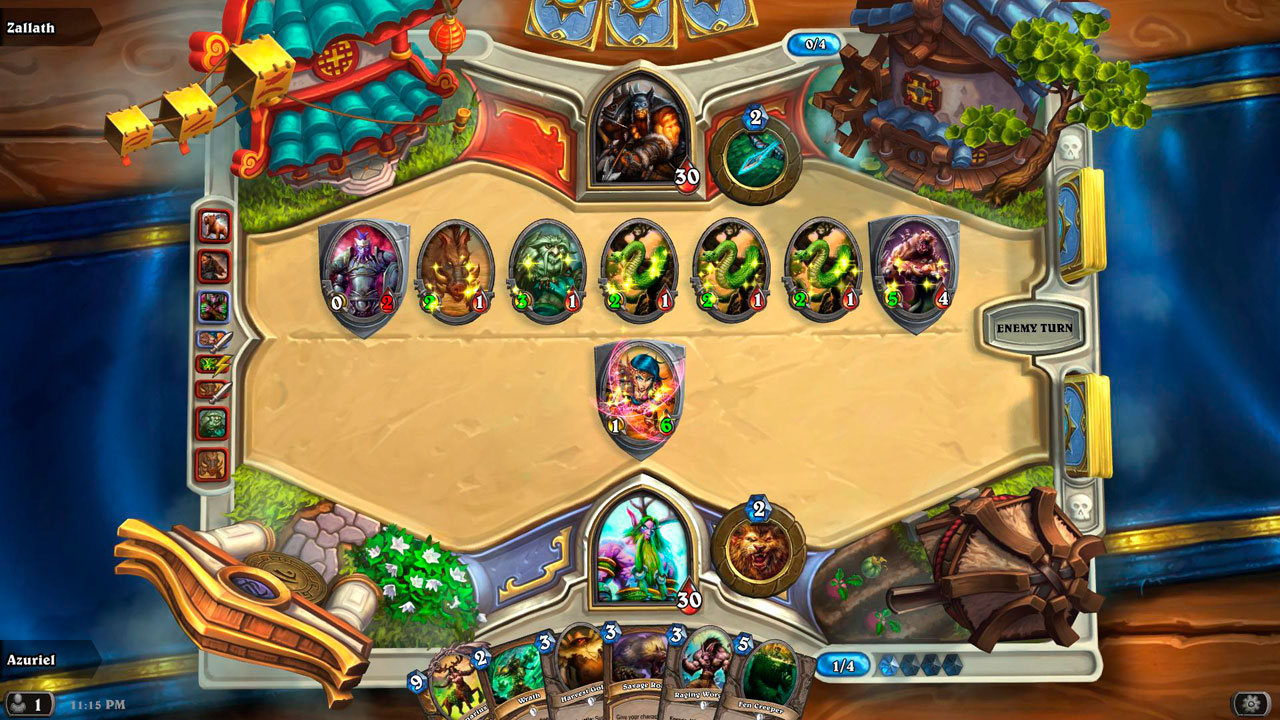
Balance!
Namely, using Wrath to kill Shieldbearer, using the Novice Engineer to kill the Stonetusk Boar, and then using the Druid Hero Power to kill the Owl. The Snake Trap still would have triggered, Mishra would (presumably) still have come down, and I would be eating 11 immediate damage to the face with no board position. A single Swipe would have turned the situation around next turn, had I the opportunity to draft one, but the point remains that things could have been better handled.
I was not playing an aggressive deck. Indeed, this was the deck I drafted:
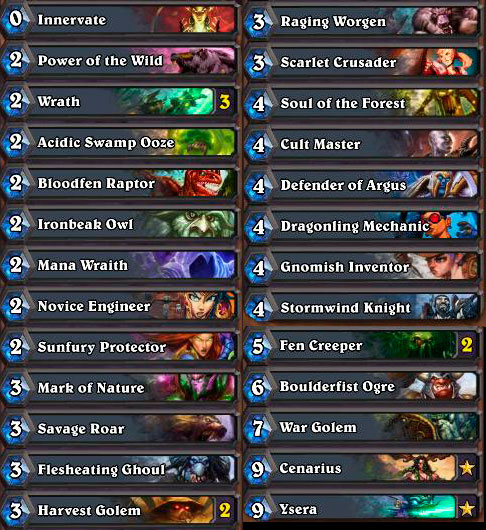
Definitely a late-game deck
That’s right, two Legendaries, one of which was Ysera. I ended up going 3-3, losing to a Paladin and Mage the turn after I cast Ysera. So, pretty much from the start, I played the deck as Control (minus much control) seeing as how I had an extremely strong late-game presence.
The interesting thing to note though, is an article Rohan referenced in the comments: Who’s the Beatdown. This was an article written the in ancient days of 1999 concerning Hearthstone’s progenitor, Magic: the Gathering, but like most things written about Magic strategy, it is still quite relevant. Fundamentally, the article asserts that in any given match, the player that wins is the one who correctly understands the role he/she is playing: control vs beatdown. If you think you are control but are really supposed to be beatdown (or vice versa), then you will lose. This seems fairly straight-forward until you start thinking about what happens when two aggressive decks go head-to-head.
The Unleash the Hounds game was not a good example of misappropriation of roles, but look at this scenario:
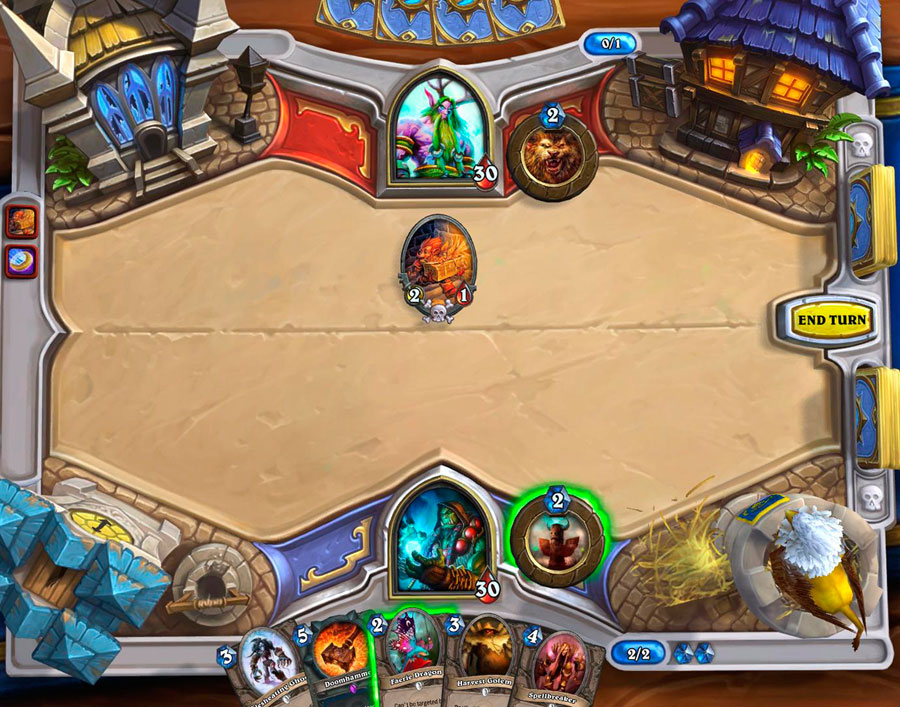
Who’s the beatdown? Spoiler: not him.
I drafted a fairly aggressive Shaman deck that had some mid-range direct damage to try and seal the deal before my opponents realized that I had no Bloodlusts. Encountering a 2/1 Loot Hoarder coined onto turn 1, however, and suddenly my Beatdown deck must shift gears into Control. So instead of casting a creature that will likely die immediately, I cast a totem (it ended up being a Healing totem) and pass the turn. My opponent then… kills the totem with the Loot Hoarder. Okay then. Who’s the Beatdown? I shift mental gears again and go on to play aggressively and win.

The soon-to-be 6/3 with windfury certainly helped.
Arena is not quite like Constructed, and Hearthstone is not quite like Magic. Coining into Loot Hoarder on Turn 1 isn’t necessarily a sign of anything beyond perhaps being presented other choices that were even worse. The key point here is that you can play a Beatdown deck in a controlling manner, or a Control deck aggressively. Once you recognize those situations in which you should shift gears, your odds of winning will increase along with the odds your opponent will screw up. You might not always have a choice given what is in your hand or your deck, but that only makes it all the more important to recognize and act on it when you do.
The Turkey Haul
I had half a mind to forgo any videogame purchases this Black Cyber Fronday, because sometimes a 50+ game backlog just becomes ridiculous to consider adding to. (Un)Fortunately, the half of my mind that controlled the credit card was the other one. I picked up:
- Battlefield 4 Digital Deluxe version ($26)
- The Last of Us ($30)
- 12-month PlayStation Plus subscription ($30)
It could have been worse, of course. I did exercise restraint in not picking up Shadowrun Returns and State of Decay; not because they might not be worth it, but because I have no particular reason to have them right now. Perhaps after, I dunno, I get around to finishing The Witcher 2. And Crysis. And the half-dozen indie games I started but not finished. And…
 In An Age
Maybe Too Much Verisimilitude
Dec 18
Posted by Azuriel
So, I guess the devs from FFXIV just released the prices for in-game housing and no one is happy. The pushback from the devs was phrased this way from Massively:
In other words, the concern was that the wealthy players would go around and snatch up all the land before the average player/guild could do so, Monopoly-style. Considering that the housing area is already going to be instanced away from the game world, which is itself already segregated into identical servers, this seems like an Extraordinarily Dumb Problem to Have.
In fairness, I have never thought that “in the world” player housing was ever a good idea, in any game. I’m sure that it “worked” (for very narrow definitions of the word) in various games, but the whole thing strikes me as a kind of bizarre pyramid scheme. What’s the content? Where’s the gameplay? If you are first in line, congratulations, you have an exclusive advantage on into perpetuity and everyone behind you is screwed all in the name of… what? Some vague sense of permanent ownership in a virtual world? Don’t get me wrong, I fully support player housing in general. I just don’t see the point in finite plots of land in a game ostensibly being played by hundreds of thousands of players. This sort of nonsense is why I never got into playing multiplayer Minecraft – where is the fun in traveling to the shit ends of the world because all the prime real estate is taken?
But hey, Square Enix, good job with that heavy, capitalistic dose of realism in your escapist fantasy MMO. Maybe you could add some adjustable-rate mortgages in the next patch, or just allow the rich players to become landlords and rent out property.
Posted in Commentary
2 Comments
Tags: FFXIV, Game Design, Player Housing, Square Enix, Verisimilitude