Reviews: Mirror’s Edge, SPAZ
Game: Mirror’s Edge
Recommended price: $5
Metacritic Score: 81
Completion Time: ~5 hours
Buy If You Like: First-person platforming, parkour, novel videogames

More of this, please
I had somehow missed most of the other reviews out there regarding Mirror’s Edge, so when I booted the game up I was a blank canvas upon which the designers could paint a visually-striking first-person platformer that worked (far better than others, anyway). And while I have seen those other reviews in the time after having completed this game, their legitimate criticisms does not change my mind regarding badly wanting Mirror’s Edge 2.
It is difficult to say much more than “first-person platformer” because that pretty much sums up Mirror’s gameplay. You control a Runner named Faith, as she delivers packages and unravels a conspiracy in the unnamed City sometime in the (not so distant?) future. Most of your time is leaping from rooftop to rooftop, vaulting over AC units, scrambling over fences, busting down doors, shimmying up or down pipes, and basically making a circuitous path from Red Point A to Red Point B. Pretty soon, helicopter gunships and trigger-happy police officers are firing on you as you maintain an addicting sort of manic momentum and leaps of faith. Perhaps ironically, I felt more like a ninja in Mirror’s Edge than I ever did in Assassin’s Creed, despite this game being more realistic in terms of your ability to take falls and so on.
Unfortunately, the reviews are correct in criticizing the game’s split personality when it comes to combat. While you have the choice early on to simply run around the police you encounter, by mid-game you are frequently required to take on armed guards with your relatively ineffectual unarmed attacks. There is a disarming method that will take out a guard in a single button press, but the timing is so ludicrously short – even with your recharging slow-mo ability – that most times you are better off flailing at the guards until you or they go down. Once the first guy drops, you can pick up his gun and take out the others with however many bullets are left in the clip.
Ultimately though, when Mirror’s Edge is good, it’s great. Much like Portal 2, you will end up surprising yourself with the solution of “how the hell am I going to get over there?” – and managing to get a few stages correct the first time left me with a metaphorical runner’s high. Other times you will get stuck, shot, or take a flying leap off a building only to realize that wasn’t what the game wanted you to do. If you can accept the (minor) frustrations as the price of admission though, I highly recommend checking out the show.
Game: Space Pirates And Zombies (SPAZ)
Recommended price: $5
Metacritic Score: 74
Completion Time: ~38 hours
Buy If You Like: Overhead view spaceship pseudo-RPG action games
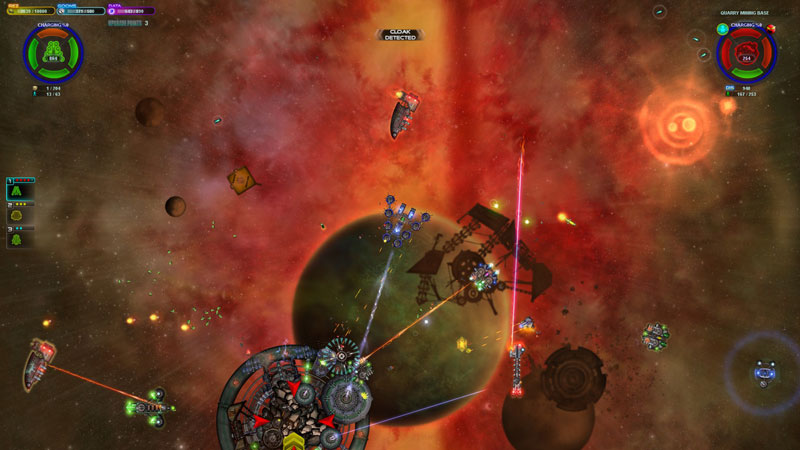
Amazing visuals for a 2-man indie game.
Originally, I pooh-poohed SPAZ based on the demo not being not particularly impressive. Having acquired the full game as part of an indie game deal, I decided to give the game proper another shot. And what I discovered, 38 hours later, is both a deeper, more impressive game… and one sorely in need of a larger-than-two-developer crew.
The basic structure of the game is destroying other spaceships, reverse-engineering their designs so you can build them, collecting Rez to build said spaceships, and basically having around seven different excuses missions to destroy said spaceships. In many ways, SPAZ is sort of like Gratuitous Space Battles aside from being able to control the ships flying around. The underlying problem with the setup though, doesn’t creep up until around hour 10-15: pacing.
The early game is extremely exciting with each new encounter resulting in new ships to pilot, there being many new components/weapons to try out, and so on. Unfortunately, the game becomes considerably less fun when you are piloting the same exact ship you were dozens of hours ago. Then, when you finally get towards the endgame and unlock those capital ship designs, the game’s difficulty evaporates as you steamroll them with a clearly overpowered design. I defeated the last boss in literally 20 seconds of holding the left mouse button down while stationary.
Overall, it’s tough to be too critical though, especially considering the game held my attention for 38 hours. There is a lot to like about the things SPAZ accomplishes well, and rather than being disappointed with some of its failings, I simply wish MinMax Games had the additional resources to polish up on its potential.
Doing Bioware Some Favors
I was really perplexed about Bioware’s recent marketing flops concerning SWTOR, just like approximately ten thousand other bloggers. At least, I was perplexed until I hit up their job postings page and realized they are looking for a Marketing Analyst. Glancing at the requirements only confirms my suspicions:
- Analyzes performance of strategic marketing campaigns to acquire new consumers and cross-promote games to retain and maximally monetize players against established benchmarks and or forecast objectives
- Analyzes consumer behavior and response to media investment and creative messages
- Using data-driven insights, recommends actions to improve campaign performance.
- Collaborates with other areas of marketing, (including brand marketing, marketing management, acquisition and retail teams, online & social media marketing, CRM) as well as product development and product management teams to validate campaign content and ensure programs are effectively reaching customers
- Candidate should have a good knowledge of general marketing paradigms and standard campaign management and measurement strategies along with video game industry experience
Yep. Bioware clearly doesn’t have anyone over there with those qualifications.
But you know what? I am a self-starter team player. So, Bioware, I am going to give you some marketing advice for free – just have the intern print off two copies of this post and send the other one to HR as my application, and we’ll call it even. Deal? Alright.
1) Words matter.
I would have thought this was an easy lesson to learn from the Mass Effect team – considering that even the Better Business Bureau acknowledged the ME3 endings constituted false advertising – but perhaps the teams are too compartmentalized. In any event, the basic idea here is that it matters what you say and how you say it. Let’s look at what you put out in your promotion:
As a thanks for being one of our most valued players, all active subscriber accounts with a Level 50 character as of April 12, 2012, 12:00 PM CDT, 5:00 PM GMT, will receive 30 days of game time** at no charge in appreciation for your support and loyalty.
Yes, I am sure someone thought they were so terribly clever in that meeting for including the qualifier “one of,” as that allows you to claim that non-level 50s can also be included in the category of “most valued players.” Unfortunately, it also matters how you say things. And in this case, the implication is that even if a sub-50 player is included in the most valued category, you nevertheless are not “appreciating” their support and loyalty in the same way. In fact, the whole framework of the promotion is dumb, since levels have nothing at all to do with loyalty; if you wanted to reward loyalty, give a free month to the people who subscribed continuously for the last 3-4 months.
But I understand, there are probably specific metrics out there showing that specifically the players at the level cap need an incentive to stick around a little longer. In which case you may as well make the free month as broad as possible considering the promotion will imply that you’ve fucked up your MMO either way; having compelling endgame content is damn near the entire point of themepark MMOs, as that is where you will inevitably end up spending most of your time. Unless you unsub right after hitting the cap… oh, wait.
Bottom line: a turd can hold only so much polish. Don’t evoke loyalty and “most valued players” when in reality you are offering compensation for bored level 50s.
2) Play up the retraction.
Or as Cave Johnson would say, “When life gives you lemons, have your engineers invent combustible lemons and burn life’s house down.”
Dr. Greg Zeschuk came out and mentioned that the free month of game time will be extended to non-level 50s. That is a good step, of course, probably necessary even. But what the retraction doesn’t do is connect all the dots laying out there. I’m not talking about the dots concerning the health of the game (or potential lack thereof). I’m talking about how players have until April 22nd to earn their one month of free game time by hitting level 50 or some combination of high-level alts.
Right now, you can buy SWTOR for $39.99 from Origin, which of course comes with a free month. But if you manage to hit the level cap within the seven days between this post going live and the promotion ending, you will get a second month for free. If that wasn’t an intentional marketing move, it should have been. I’m damn near tempted to try it myself.
3) Fill that Marketing Analyst position ASAP
You don’t actually need someone fancy. You just need a somewhat normal person, or someone capable of passing for normal, who is both willing and allowed to tell you something is a bad idea. Had I been in the meeting that spawned this promotion, my hand would have been the first one up after the presentation, even if I had a level 50.
Hindsight is 20/20, but come on. This sort of thing shouldn’t have passed the smell test.
Kickstarter, Cash Shops, and Ultimate Capitalism
The perfect capitalist scenario is full price discrimination. That is to say, the ability to charge each individual customer the maximum amount they are willing to pay (consumer surplus = $0). Under normal situations, this is exceedingly difficult in non-monopolistic markets. If my maximum for a game is $85 and yours is $250, the monopolist would have to have some way of preventing me – or, say, Gamestop – from (re)selling the game to you at a discount.
Enter F2P and cash shops.
Every customer pays the same entrance fee (be it literal F2P or some cover charge or $X+ for the “collector’s edition”), but now you have the ability to engage in some voluntary price discrimination. Want some costumes? $10. How about a shiny mount or horse armor? $25. Server transfers? Hats? Keys to unlock chests? Speed the game up? Unlock a dungeon? Cha-ching!
When Guild Wars 2 comes out, there will be some people out there that bought it for $60. Others will have bought it for $80. Still others will spend $150. And many more will spend $5, $10, $100 more over time via the cash shop. Nearly perfect voluntary price discrimination. Same game, same amount of development (those developers would have been creating said content regardless), different prices for different customers.
Enter Kickstarter.
A lot of bloggers have been covering Kickstarter here lately. Two of the “previewed” games caught my eye: The Dead Linger, and Faster Than Light (FTL). The latter game is a roguelike space exploration game that has successfully received 2,005% of its funding goal. After watching the video and reading about it, I am somewhat sad I missed the chance to “buy-in” with $10.
The Dead Linger is an opportunity to buy-in at $25 for a game that sounds like a cross between Left 4 Dead and Minecraft (25,000 km procedurally generated worlds, 16-person multiplayer, PvP modes if you want, etc). Then I looked at the $100 option, which included the game and goodies, plus your name or handle as part of a street sign or graffiti. “How cool would it be to see people posting their screenshots and then seeing ‘Azuriel was here’ in the background?'” I thought.
That’s when I remembered how cool $100 is, especially when compared to a game not even in playable alpha yet.
The interesting thing to me about Kickstarter in a cash shop world are the implications. In effect, it proves that there are people out there just looking for the opportunity to give their money away. If I was fanatically in love with Bioware and Mass Effect 3, how could I show my appreciation for what they do? Buy the Collector’s Edition? Buy the novels? In each case, what is taking place is a sale, a transaction, a transfer of goods for compensation. My “contribution” is not distinguishable as an act of charity or praise; Bioware simply gets the feedback that I deemed the product a good value for the money.
Kickstarter is different. Sure, a lot of people treat it as a extra-early preorder. But you can also contribute anonymously. If I sent Bioware a check for $1000 in a the mail, would they cash it? I have no idea. What Kickstarter has done is package up charity and enthusiasm into a “product” that can be sold.
Rationally, it is no different than sending a check in the mail, but it feels different. There is a meter that fills up, there are (limited!) time-sensitive bonuses, there is the satisfaction of needs going on (the game wouldn’t exist without this funding), there is a sensation of fellowship with other Kickstarters. In short, it is brilliant marketing. Utterly and completely brilliant.
As a skeptical consumer, however, I worry. The gamification of charity aside, I am concerned about how the industry marketeers must already be foaming at the mouth. How long is it until it is not just Day 1 DLC we see, but “Pay $100 for your name in graffiti on Station Omega?” It already appears as though pre-order “bonuses” (if you pay for it, it is not a bonus) in the form of DLC is here to stay. When is Kickstarter’s methodology entirely co-opted, and eventually devalued?
Oh, wait. Resident Evil 6’s Premium Edition, which includes a real-life replica of Leon’s leather jacket, costs over $1,000. The future is now.
Well, There is Always That
Remember that real-life interview I had back in February?
The selection process for the 2012 JET Program has now concluded. We regret to inform you that we are not able to offer you a position on the program this year. Please know that this decision is not a reflection on your personal qualifications, but on the nature of the JET Program selection process. As it is ever year, competition was stiff and the available positions were few, and unfortunately, many qualified applicants had to be turned down.
We hope you will reapply for the JET Program in the future and we wish you the best of luck.
So… yeah. Japan is a no-go.
I was a little ashamed that the realities of MMO gaming was a (small) thing I had thought about throughout the whole application process. People clearly play WoW from Australia and endure the cross-Pacific lag and whatnot, but it was a bit daunting to realize the likelihood that you would ever game with the same people again was effectively zero by the time differences alone.
Sure, there is always the chance that someone you hang out with in WoW or wherever can suddenly evaporate. There are dimensions to leaving the country though, that gave me some pause. Would Guild Wars 2 be playable over there? Could I even play Diablo 3’s single-player without lag? In a strange bit of coincidence, EVE was just localized in Japanese a week ago; perhaps it was would have been a sign?
Given those questions, I had not been thinking about upcoming MMO releases or even the current ones all that much. Would you even want to play a new MMO if you knew – for sure – you’d have to give it up in 2 months? Now that I know I will be sticking around, I suppose it is time to start looking towards a much more predictable future. A future that includes a lot more gaming than I necessarily expected.
And alcohol. Lots of alcohol.
Review: Mass Effect 3
Game: Mass Effect 3 + Multiplayer + DLC
Recommended price: $40
Metacritic Score: 89
Completion Time: ~32 hours
Buy If You Like: Mass Effect; story-driven, cover-based sci-fi shooter RPGs.
By far, Mass Effect 3 (hereafter ME3) is the hardest review I have ever tried to write.
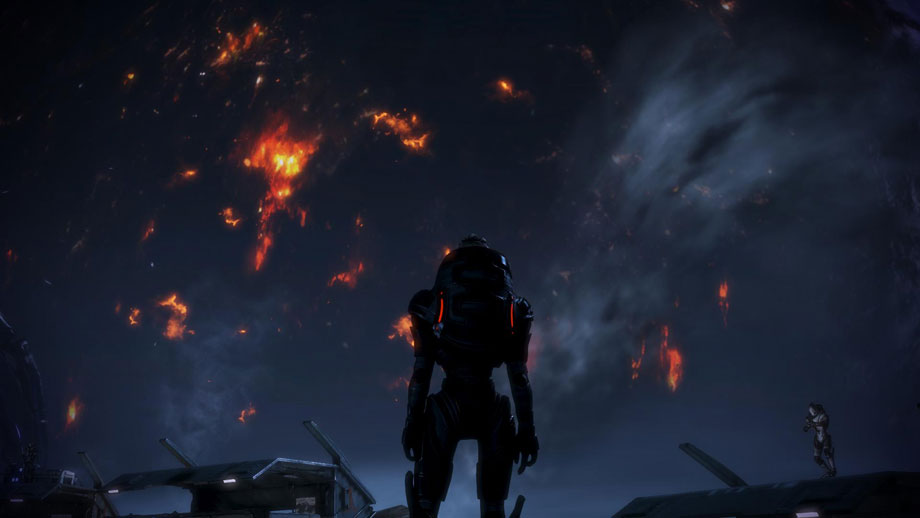
Cue the Stages of Grief
There are three entirely different prisms through which this game can be judged. The first is as the 5-year culmination of arguably the most important sci-fi videogame story of our time. The second is as a comparison between the individual components of the trilogy, as in how it stacks up compared to the first two titles. The third is as an independent game, divorced from the accumulated emotional detritus and hype of the series.
The distinctions are important precisely because no matter how grating certain features or design decisions are in isolation, I have found myself literally incapable of escaping the rose hue of the first prism. This is not to say I did not notice the deficiencies, but rather they seemed to matter less in the final analysis. Your mileage may vary.
For example, things feel off from the very start. The Reaper invasion – the nightmare scenario that formed the impetus to action in the first two games – has finally arrived. Earth is under attack. And… I feel nothing. Outside of a Lunar sidequest in Mass Effect 1, this is the first time Earth has ever actually appeared in the series in any real way. My Paragon Commander Shepard has never been fighting for Earth, or even humans specifically, but for the right of all sentient life in the galaxy to exist. Indeed, humanity has almost represented a background bumbling bureaucratic force, a one-dimensional foil to Shepard’s actions throughout the trilogy that lacks the novelty of the alien scenarios.
It does not help that throughout the Earth invasion, throughout your leaping from burning building to burning building, throughout the panning of cameras to the monstrous Reaper capital ships landing among the skyscrapers… there is nothing but an eerie, empty silence. Where is the stirring music? I spent the first twenty minutes of Mass Effect 3 wondering if my game had glitched, perhaps setting the music volume slider at 0%. There are plenty of amazing songs in the rest of the game – the absolutely haunting “Leaving Earth” comes to mind, or the stirring “The Fleets Arrive” – so the lack has to be some inexplicable design choice.
Certainly, it won’t be the last such inexplicable choice.
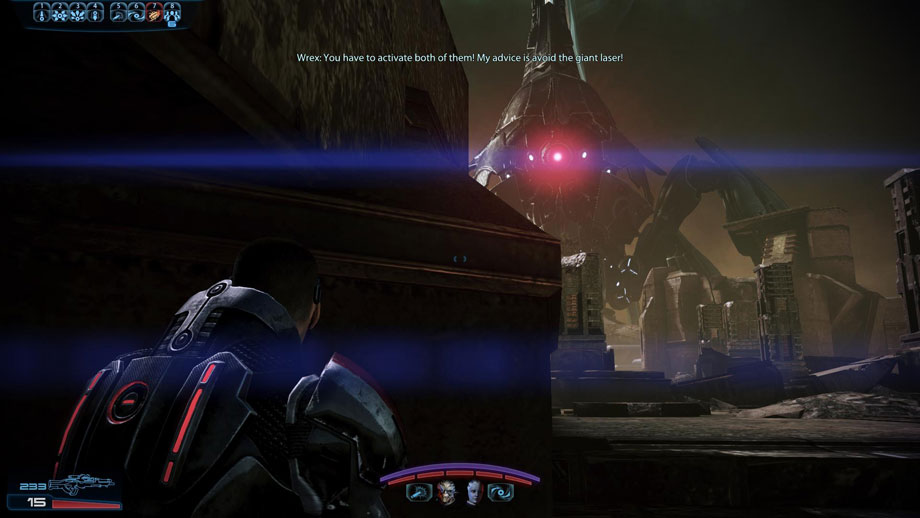
Wrex: the Krogan Sun Tzu
Once Commander Shepard is back aboard the Normandy though, the game once again feels like Mass Effect. And it really was not until ME3 that I could point out what that even meant. The brilliance of the series, in my mind, is the notion that one ship and one crew can make a difference, in a relatively believable manner – the sort of “right place, right time” effect. At no point did I feel like Shepard was a god amongst men, even as I was performing miracles and uniting species after centuries of war. Flying around the galaxy in a desperate attempt to cobble together a coalition for a final stand against the Reapers… yes, this is Mass Effect.
One thing that deserves special attention is the combat system. Simply put, it’s rather brilliant. For the most part, combat in ME3 is the same as ME2 aside from some subtle, key differences. The first is the inclusion of Carrying Capacity, which I will admit to having a strong negative reaction to at first. Shepard and crew can carry all five types of weapons if they wish, but the lower the percentage of Carrying Capacity utilized, the greater rate at which Biotic/Tech abilities recharge. In other words, if Shepard takes an assault rifle, shotgun, and sniper rifle into battle, he/she may get a -150% modifier on cooldown times. Alternatively, if Shepard only takes a sniper rifle and pistol, he/she may have a +50% modifier. Given the radically increased power of Biotic/Tech abilities this time around, choosing a loadout actually becomes a choice, especially since some guns are balanced around their weight.
On a related note, the gunplay in the missions themselves has never felt more fun and exciting. You will still spend 80% of the game crouching behind chest-high walls, but the obstructions are less obviously arbitrary, and the environment/graphics look amazing. More importantly, the enemies are radically more varied, have a deeply cunning AI that will flank you or flush you out of cover with grenades, and otherwise keep you in the moment and on your toes.
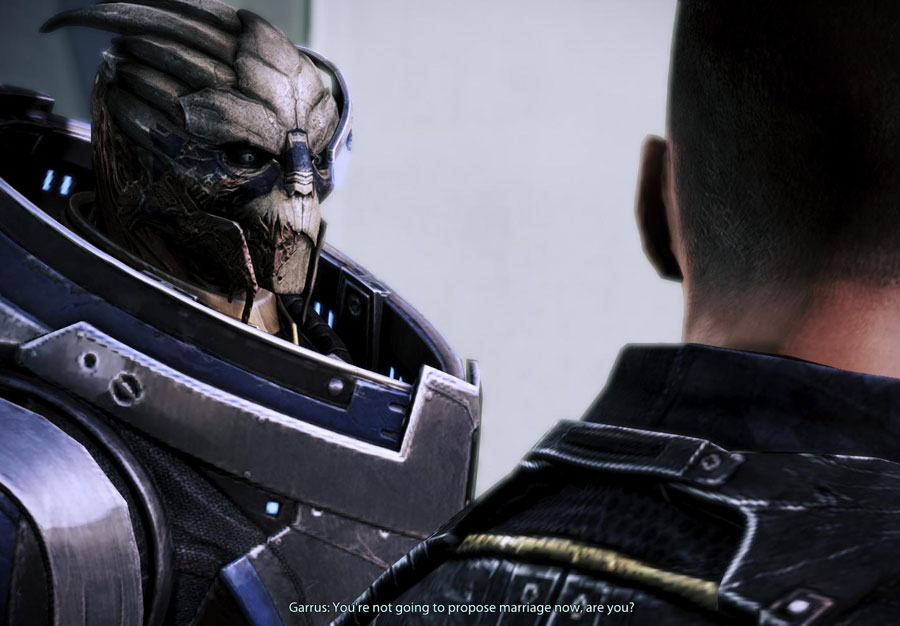
Damn, Garrus. Way to shoot me down.
Any review of ME3 would be remiss to not mention what has become, if not the most, at least one of the most controversial endings in gaming history. Without getting into spoilers, the thing to understand about why it is as big a deal as it has been in the gaming media comes down to this: catharsis. Simply put, there was not any. And with as much passion as the franchise has generated, I do not find it surprising in the least that so many people have taken the pent-up energy to the forums and blogs (as I myself have done). As of the time of this writing, Bioware has taken the rather extraordinary step (if you think about it) to begin development of a free, epilogue DLC to be released this summer. If said epilogue is able to honor the choices players have made in this franchise, if it is capable of giving me the catharsis I hunger for months after the fact, then Mass Effect could very well unseat the sacred cows of Chrono Trigger, Final Fantasy 7, and perhaps even Xenogears in my Top 3 games of all time.
As it stands, there is really no question that you should play Mass Effect 3 if you have at all enjoyed the first two titles in any capacity. Objectively, I think Mass Effect 2 as an independent experience (insofar as that is possible) edges out Mass Effect 3, but… well. To quote Fight Club: “You know how they say you only hurt the ones you love? Well, it works both ways.” Without a doubt, Mass Effect 3 has wounded me in ways no other game has ever done, and that in itself is a remarkable triumph.
“I think we ought to read only the kind of books that wound and stab us… We need the books that affect us like a disaster, that grieve us deeply, like the death of someone we loved more than ourselves, like being banished into forests far from everyone, like a suicide. A book must be the axe for the frozen sea inside us.”
–Franz Kafka
Multiplayer
The multiplayer that comes with Mass Effect 3 deserves its own special section, because in many ways it is almost a second, complete game. Indeed, its development started originally as a first-person shooter spinoff before it was enfolded into ME3 proper.
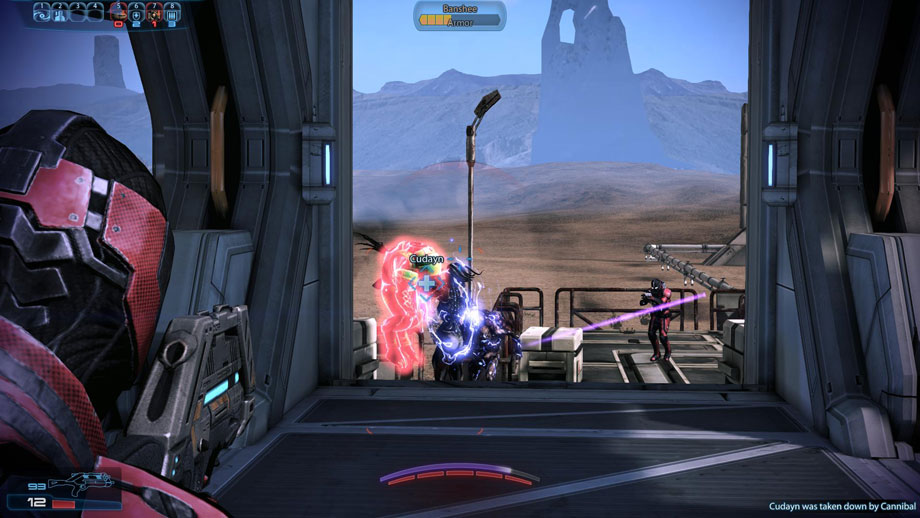
You're going to need a LOT of Medigel for that one, buddy.
In effect, multiplayer is a stand-alone, four-person co-op survival mode. Although winning multiplayer matches increases the Galactic Readiness Rating in the single-player game (essentially allowing you to skip sidequests and still achieve your goals), there is otherwise zero overlap. You pick one of the six classes, one of the five races, a weapon loadout, a difficulty level, and then head into one of the six maps to face one of the three enemy factions. Each map has 11 waves, three of which will consist of special objectives that will be a King-of-the-Hill, activating four beacons, or assassinating four specific enemies amongst the others. Successfully completed maps will take around ~30 minutes, you will gain XP for the class you chose (with a level cap of 20), and Credits.
The replay factor, aside from the entertaining gunplay, comes from the unlocking of packs. Starting out, you have access only to the five most basic weapons and human versions of the six classes. As you earn Credits, you can purchase different levels of packs – Recruit, Veteran, and Spectre – which unlocks new weapons, weapon mods, races, character customization options, and one-use items or buffs to give you an edge. Obviously this can lead to frustration at times, especially if you opt to buy packs via Bioware Points (i.e. microtransactions) instead of Credits, but it does give you an incentive to try and make weapons or classes you would not typically pick, work.
The sort of bottom line is this: if you had fun with Mass Effect’s combat system, you will have a ton of fun with the multiplayer. I have already spent more time playing multiplayer than I have playing Mass Effect 3 itself. And at the time of this writing, there is a free multiplayer DLC (Mass Effect 3: Resurgence Pack) coming to introduce two new maps, new race combinations (including Geth and Batarian), and new weapons. Given that packs can be purchased with real money via Bioware Points, it is entirely possible all future multiplayer DLC may be free.
DLC: From Ashes ($9.99)
From Ashes is the poster-child for everything evil about Day 1 DLC: it is hideously overpriced, lacking in content, and has fundamentally shifted my perspective about the nature of the Mass Effect plot. What you are purchasing is one throwaway stand-alone mission, a Prothean squad-mate (Javik), a new weapon (a particle rifle with regenerating ammo), and a bunch of new dialog between Javik and the other party members (especially with Liara).
The problem is that without the DLC, the Protheans were always this unknown, almost magical race who fell to the Reapers in the last cycle and whose artifacts you spend a lot of time collecting. Interacting with Javik, however, reveals the Protheans as a belligerent, almost xenophobic race that would have enslaved or destroyed the races we have come to love in the Mass Effect franchise. In other words, by the end of the game I honestly felt that the Reapers did us a big favor by wiping out the Protheans.
So while From Ashes is not in any way essential to the plot of Mass Effect 3, I personally believe that its absence radically limits the scope of the narrative. In other words, I consider it both required and overpriced. Then again, honestly, you could probably just read the Mass Effect Wiki and watch the Youtube videos for the same effect, saving yourself $10.
The Virtual Line
Tobold has an interesting post up today on what he considers the defining characteristic of games: “a game is a risk-free environment in which you can try out various actions for fun or for learning without fear of the consequences, because the consequences aren’t real.”
The second paragraph is this:
As you can see there is a growing trend of “games” turning into “ungames”. There are many reasons for that, one of which is Maslow’s hierarchy of needs. Once you climb up that pyramid high enough, you are leaving the real world needs behind. If somebody’s needs are for status and achievement, he can fulfill that need in a virtual environment, and these virtual environments are usually designed to offer a lot of that status and virtual achievements for less effort than it would take to achieve something in the real world. There are now a sufficient number of people who are sufficiently well-off that they can spend real money on virtual status symbols or game achievements. That is bound to be used by those who are still lower on the pyramid and are just trying to make a buck. The danger is that people become confused about where the border between real and virtual is, which leads to stories like the Chinese guy who murdered a friend who borrowed and then sold his virtual sword.
Hagu knocks it out of the park with the very first comment:
I think “”played” to earn real money” is a bit restrictive.
In real life, if I had a $5 bill, a glass I paid $20 for but with no resale value, and a manuscript I spent 1000 hours creating, then I would be increasingly unhappy with the item being destroyed.
I would regret far more the lost of an item I spent hundreds of hours acquiring than a D3 sword I can sell for $5
The question I want to ask, though, is this: where is the border between real and virtual?
I am not asking that to be cute or contrary. I am literally asking what difference does it make? When have the consequences of a game not been real? Is the emotion you feel by reading fiction different to you than the emotion from an encounter in the real world? Is the frustration you feel at work different to you than the frustration you feel playing a videogame? Anger? Sadness? Disappointment? Embarrassment? Social pressure? Joy? Victory?
One cannot derive nourishment from a virtual apple. A virtual fire will not stave off hypothermia. Beyond that though? How exactly “real” is, say, Security under Maslow’s hierarchy? As any parent, victim of a crime, or survivalist can tell you, security is, at most, a state of mind. A paranoid schizophrenic won’t feel safe in a padded cell; conversely, there are people who voluntarily live in Detroit and St. Louis, the two US cities with the highest violent crime rates as of 2010. If you can feel safe without actually being safe, I think that begins to call into question “consequence-less gaming.”
When I play videogames, I do not think of the stresses of the day, the drama, the frustration with my job, or really anything from the real world. About the only difference between my gaming state and actually having no stresses, drama, or a frustrating job is that, perhaps, the feeling would persist beyond the end of the gaming session. Then again, biologically, we are designed to take things for granted; happiness has diminishing returns. Nevermind that (arguably) the persistence and permanence of anything is just wishful thinking on our parts.
Obviously, the subjective solipsism rabbit hole can get pretty deep.
I am not advocating that virtual relationships are as equally valuable as real ones, all other things being equal. If someone has the choice between a friend IRL and a game friend, I hope you would choose the one whose couch you could actually crash on. I just think it should be recognized that gaming is not really all that far removed from real life as Tobold (or Syncaine for that matter) might suggest. And that the things you experience in your head are as real to you as anything else; phantom limb pain is still pain.
The Chinese guy who murdered his friend over a game item gets our attention because the item wasn’t as “real” as, say, a family heirloom with no monetary value but priceless sentimental value. I’m suggesting that perhaps that is a distinction without all that much difference. Is the attachment to one more real than the other? Is murder more “understandable” over one than the other? The virtual sword isn’t real, but the emotions are.
“It’s just a game.” Sure. That folded American flag is just cloth and dye too. It’s what it means to you that matters. And meaning only exists in your head.
Entitlement
“Entitlement,” like “casual” before it, is such a loaded word these days that I consider any gaming argument in which it is included to be a lost cause. How can you reason with someone who sees no merit in criticism, or (apparently) believes the rightful state of the consumer is to be one of permanent, ingratiatory groveling? I suppose we should be happy developers deign to part with their digital goods at all, yes?
Keen made a recent post on the subject of people being skeptical about proposed game features that have already been “proven” to work in older titles; things like 500 people fighting over keeps in DAoC, non-instanced player housing, and so on. I was going to write on the subject, when this section of a user comment jumped out of nowhere:
For an entitled gamer, why play a game where you can’t have something when there are plenty of games that will bend over backwards to hand it all to you on a silver platter? And unfortunately, the majority of gamers are entitled. Note that I am not using the word casual here because there are some casual games who are not entitled and some serious gamers who are.
I hate this system. I hate that the vast majority of new games shoot for the lowest common denominator to get as many subs as possible rather than finding a niche in the market and shooting for a reasonable slice of the pie.
At first blush, you may be tempted to agree. Don’t.
It’s dumb, it’s contradictory, it’s asinine. Look at all the whiny, entitled gamers in these sort of comments wanting player housing and 100+ player PvP battles, amirite? Having a preference does not make someone entitled. Wanting to be catered to as a consumer does not make someone entitled. Seeking maximum value for one’s gaming dollars does not make someone entitled. Buying/supporting only the games you like is not being entitled.
I wonder if people even understand what they are saying when they type things like “the vast majority of new games shoot for the lowest common denominator to get as many subs as possible.” That presupposes there is a “higher common denominator” that is being neglected when their own desires are equally fantasy bullshit. It is suggesting that games and mechanics these days are not being built to the satisfaction of their own refined palate, as if they were entitled to that.
You can’t have the argument both ways.
I understand and empathize with the sentiment. We live in a world where Firefly gets canned after a dozen episodes while Jersey Shore will be running its sixth season. Shit is unfair. And I would also agree that (MMO) gaming is in an era of extreme loss aversion; if something like Darkfall could make enough money to finance a sequel, surely that is “successful” enough, right? An investor flight to AAA quality has, in many respects, killed off the “middle class” of game designers. Without said middle class, it is entirely possible there are no designers catering to your preferred play style, and indie games can only go so far.
That said, twisting “entitlement” into (even more of) a pejorative and otherwise demonizing your fellow consumers is ultimately counter-productive. Begrudging them their satisfaction of capitalism working as intended (to them), gets you no closer to your dream game sequel. Instead, it leaves us all bitterly divided, rooting for each others’ failures, while those actually responsible continue eroding consumer surplus in the form of on-disc DLC, always-online DRM serving no other game purpose, and similar nonsense.
In other words: don’t blame the players, blame the game (designers). It is the latter saying your money isn’t good enough.
Bioware Cupcakes
Best ending line in a gaming news article goes to Kotaku.
The short version of events leading up to that article is that, similar to the (shut down) Child’s Play charity drive, a group of gamers decided to “protest” Mass Effect 3’s ending by sending Bioware 400 cupcakes… each one identical, aside from red, blue, or green frosting. The cupcakes arrived, and then this happened (emphasis mine):
Writing on the company’s forums, Chris Priestley says that while “we appreciate creative and thoughtful” acts of feedback, “we decided ultimately the reason that they were sent was not done in the context of celebrating the work or accomplishment of the Mass Effect 3 team.”
As a result, instead of eating them all up, BioWare donated all 400 cupcakes to a local youth shelter. Where, presumably, after picking their colours and finishing their last bite, the kids were left wondering whether their choice had really been that important, and if somebody could please come in an explain what the hell just happened.
I’m sure that, one day, I won’t find these stories so goddamn hilarious. Today is not that day.
—
In other news, I have added a new section to the site called “Currently,” as in Currently Playing/Reading/Watching. I do not expect it to become relevant to the blog proper, but if you enjoy occasionally seeing what other bloggers are up to (as I do), there you go.
The Gray Moral Morass
You may or may not have been following the whole EVE cyberbullying thing.
Syncaine being Syncaine, he is both morally repugnant and technically correct in his deconstruction of the argument. What exactly can one do in defense against the emotional blackmail of “I’m suicidal?” Is that not carte blanche acquiescence to every situation, including purely PvE concerns of “loot didn’t drop, so I might as well”? And what about the in-game incentives CCP purposely built into EVE to encourage competition, subterfuge, and retribution?
So, on a whim, I decided to check EVE’s Terms of Service. And I don’t even recognize what game they believe it’s for (emphasis mine):
As an Eve Online subscriber, you must observe and abide by the rules of conduct and policies outlined below, as well as the End User License Agreement. Failure to comply with these regulations can result in the immediate termination of your account and you will forfeit all unused access time to the game. No refunds will be given.
1. You may not abuse, harass or threaten another player or authorized representative of CCP, including customer service personnel and volunteers. This includes, but is not limited to: petitioning with false information in an attempt to gain from it or have someone else suffer from it; sending excessive e-mails, EVE-mails or petitions; obstructing CCP Employees from doing their jobs; refusal to follow the instructions of a CCP Employee; or implying favoritism by a CCP Employee.
2.You may not use any abusive, defamatory, ethnically or racially offensive, harassing, harmful, hateful, obscene, offensive, sexually explicit, threatening or vulgar language. (Alternate spelling or partial masking of such words will be reprimanded in the same manner as the actual use of such words.)
3.You may not organize nor be a member of any corporation or group within EVE Online that is based on or advocates any anti-ethnic, anti-gay, anti-religious, racist, sexist or other hate-mongering philosophies.
4.You may not use “role-playing” as an excuse to violate these rules. While EVE Online is a persistent world, fantasy role-playing game, the claim of role-playing is not an acceptable defense for anti-social behavior. Role-playing is encouraged, but not at the expense of other player. You may not create or participate in a corporation or group that habitually violates this policy.

Did I pick the wrong ToS? This is for EVE – EVE – right?
There was also Rule 9:
9.You may not advertise, employ, market, or promote any form of solicitation – including pyramid schemes and chain letters – in the EVE Online game world or on the website.
…but after some thought, it was probably intended to prevent IRL pyramid scheme spam.
So, assuming that CCP enforces their own ToS, there clearly are lines in-game actions can cross, the people behind the pixels are protected to an extent, and it is not the exact free-for-all that it is made out to be. That said, I do wonder about the degree of dissonance between the “no harassment” policy and in-game bounties, war-decs, and general grief potential. Is there any evidence that CCP has acted on this policy before? Is it harassment if I get shot down by a Goon ship every time I enter Goon territory? They just won’t leave me alone!
Incidentally, here is Blizzard’s stance on harassment on PvP realms:
Ongoing Harassment
The Ongoing Harassment policy does not apply when there is a PvP resolution available on a PvP realm, as physical confrontations are considered a facet of PvP combat and players in opposing factions are unable to communicate verbally. Characters have the ability to address their conflicts through combat and GMs will only involve themselves in extreme circumstances.
In related news, the deal will probably be over by the time this post goes up, but did you know this happens:

Cheaper than most F2P games!
That’s… almost tempting. And kinda ridiculous at the same time.
 In An Age
The Mass Effect 3 Extended Cut
Apr 9
Posted by Azuriel
It is official:
What can fans expect from the Extended Cut DLC?
Are there going to be more/different endings or ending DLCs in the future?
What is BioWare adding to the ending with the Extended Cut DLC?
It is coming out this summer, and it’s free. Mission Accomplished.
Also of note is that there is some free multiplayer DLC that should be launching on Tuesday. I have officially spent more hours playing ME3 multiplayer than ME3 single-player, so this is of interest to me. It is pretty clever of EA/Bioware though, in that undoubtedly all of the new content (other than maps) will likely be need to be unlocked via the random packs purchased via in-game credits… or Bioware Points. All of the goodwill of free DLC, along with all the subsidization of microtransactions.
Regarding the nature of the Extended Cut, Kotaku dug a little deeper, and provided some more details. Namely, that A) Bioware is shifting its DLC plans to make sure this comes out first, B) it will include cinematic sequences (!) and epilogue scenes, C) Command Shepard isn’t (likely) to have any new/revised lines of dialog, D) “‘should be able to grab a save file before the endgame and experience the new content from there.’ (Keep a pre-endgame savefile, folks!)” E) Indoctrination theory is probably kaput.
Some general endgame details.
Regarding the latter, it was Liveblogged that they said:
That does not particularly sound like a response from people who intentionally wanted it all to be a dream. Ironically, since Bioware will essentially be designing the epilogue based on fan feedback/questions, it is entirely possible that they may fit in Indoctrination-y wiggle room. I hope not, but we’ll see.
This exchange was also interesting, for different reasons:
Err… okay. Not exactly sure how it makes a lot of sense for the Reapers to be in control of the Citadel for X length of time and not handle all the armed civilians (my Shepard encouraged the formation of a militia), but perhaps that goes a ways towards this making sense. Incidentally, I actually have a serious problem with the breath scene being “canon,” but I suppose we will have to see how things pan out this summer.
P.S. This comparison between Mass Effect and Lord of the Rings highlights why all this was necessary to begin with. You know, if my writing about it constantly for the last three weeks wasn’t enough.
Posted in Commentary
1 Comment
Tags: Bioware, DLC, Ending, Liveblog, Mass Effect 3, Spoiler Alert