A Bad Good Idea
Or would this be a good bad idea? You be the judge (emphasis added):
[…] Finally, we’re also going to have players be able to queue against other players [in Pet Battles]. But one of the important values for us with the queuing system is that we keep this very light and very casual. And as a result of that, we are doing everything that we possibly can to eliminate the shame of defeat. One of the things that really keeps a lot of players out of PvP types of activities is feeling bad about when they lose. ‘Cause ultimately, that’s really what drives a lot of people out of it. So we’re trying to do everything that we can to make sure that you do not feel bad about losing this.
We’re doing that in a number of different ways. For one, when you’re fighting an opponent in a match made battle, you’ll have no clue who they are, and they’ll have no clue who you are. So you’re playing this cross-server against who knows who. You won’t see their character name. You won’t be able to talk to them. They won’t be able to talk to you. So there won’t be any trash talking going on as they stomp your face in or whatever. Or you won’t be able to trash talk as you stomp their face in. It will feel a lot more like just some relatively intelligent AI then it would a normal kind of PvP ingame. In addition, not only will you not know who they are or not be able to communicate, but we also aren’t going to tabulate a running number of losses that you had. We’ll keep track of how many wins you had in your own statistics page, so you can always look at that out of curiosity. But the game is not going to record how many times you’ve lost. Again, we are really trying to eliminate all the sort of negative emotions that go along with PvP. So, that sums it up for the pet battles.
I know there are going to be people going into an apoplectic shock after reading this.
Something that should qualify as good good idea:
Could the gear scaling that is being added for challenge mode dungeons be applied in a similar manner for older content, allowing players to go back and play through old dungeons with an appropriately powerful character?
It’s like someone is reading our minds. That’s something that could 100% work for that. What we are starting with for challenge modes is the concept of doing it with the shipping dungeons for Mists of Pandaria. Then we’re going to watch it, see how it plays out and see how things go. Then the idea is if that goes well, we totally want to backdate that to some of our older dungeons. I mean, obviously it will probably be in thing like Scholomance, because that’s coming as new dungeon. But if it works out well, there’s no reason we couldn’t backport that to older dungeons. That could end up being in any of the more classic dungeons that players really like. That’s the kind of tech that we develop at the beginning to know that it could work in other places. Gear scaling that is something that could also work in a scenario if we really wanted to because it’s an instance. We could decide that we could build a scenario for say level 35, it takes place in say Southern Barrens, but then you could also play that scenario at level 90 because we could scale your gear. So in that way we could make content that works for the level up, but also for the max level. So there’s a lot of options of being able with being able to scale gear on players that we can use.
Yes, other games did it years ago. Yes, Guild Wars 2 will be doing it this summer. But just imagine: all the people who loved TBC could (potentially) go back play that content at its intended difficulty! Assuming you could find 24 other people willing to do so, of course.
What Could Mass Effect Online Look Like?
[Spoiler-Free Zone!]
In the last three days I have spent probably around 8-10 hours playing ME3’s multiplayer. My conclusion? Bioware might be onto something.
At its core, the ME3 multiplayer consists of ~11 rounds of 4-player co-op, Horde-style survival across six maps taken from the single-player game itself. Every third wave is what I’d call a “cash round,” in which you get a specific objective: King of the Hill, Kill 4 specific mobs, or Activate 4 Nodes. Completing those cash rounds successfully earns you credits whereas all the other rounds awards XP. During the final extraction wave, you have to be in the evac area by the end of the mission timer in order to get the highest point score bonus (e.g. XP).
The first thing I would say is this: the multiplayer is fun. It probably goes without saying, but if you enjoy the combat in any of the three Mass Effect games, you will enjoy it here too. You shoot from cover, you gain XP, level up, decide which weapons/mods to outfit your character with and so on.
Other bloggers have mentioned the similarities between the gear situation and Magic: the Gathering… and it’s true. There are three tiers of gear packs – 5k, 20k, and 60k credits – and each pack has 5 random “cards” that represent either one-use consumables (Medi-gel, extra ammo, missile launcher), new weapons (or upgrades to already found weapons), weapon mods, new races for a class, or class XP (which raises the baseline level of new characters of that class). The mid-line Veteran Pack comes with 1 Uncommon item or better, while the Spectre Pack has a guaranteed Rare “or better” (whatever that means).
I am not a huge fan of companies putting literal gambling in even their F2P offerings, mainly based on my Magic Online experience. I played the physical form of M:tG for nearly a decade already, but after a particularly bad night of Magic Online wherein I realized I paid $60+ on a series of Booster Drafts, I deleted the game off my hard-drive and went and bought WoW the next day.¹
That got me thinking though… how different is that really from random loot in MMOs? Could, in fact, Bioware turn Mass Effect into an MMO without much effort at all?
Most of the set pieces are already in place.
Classes/Talents/Abilities
Check, check, and check.
Originally, I found the ME2 pivot towards Biotic/Tech power spam (6 second cooldown Biotic Charge, what?) to be disconcerting. I suppose it doesn’t make any less sense than Omni-Tools materializing out of thin air or the titular mass effect, erm, effect in general. By the time I was halfway through ME3, the dynamism of power use was a core part of the entertaining gameplay.
You could even go so far as to imagine the Trinity system existing within the game realm, without too much of a stretch. Unlike Star Wars, it seems intuitively viable to heal people with Tech (Medi-Gel) or even Biotics, or perhaps simply refreshing their shielding with either. Or we could (perhaps preferably) see them go the purported Guild Wars 2 route and have shared role responsibilities – anyone can rez any downed member in the ME3 multiplayer, for example.
Races/Setting/Enemies
Mass Effect has them all in spades.
There are six races in multiplayer already, all with their own sort of racial-esque abilities, motivations, politics; we can imagine Batarians, Geth, Vorcha, or even Protheans being added to that count. I am not a fan of two-faction systems, so I would be overjoyed to see a situation wherein there are no “red vs blue” factions period, but rather players fighting for specific (mercenary?) movements of their choice. Did you choose Krogan and your friend choose Geth? No problem!
Indeed, without spoiling anything, the time period following the events of ME3 would be perfect, perfect for this kind of integrated gameplay. As Mass Effect players, we are already used to mission-based activities spread throughout the galaxy, taking orders from quest-givers, and so on and so forth. Expansions could come in the form of dormant² Relays or new star systems being discovered without breaking any suspension of disbelief.
As far as enemies go, while the main three – Geth, Cerberus, Reapers – have been… explored to various degrees, again, the time period following ME3 will undoubtedly be a fairly chaotic place. And remember, we got along perfectly fine in ME1 without having the geth be the only bad guys. There is no reason why pockets of resistance couldn’t spring up, pirates, mercenary groups, terrorist cells, or even the Salarian STG (or Spectres!) could decide they need to achieve X or Y goal, in opposition to your orders.
Shepard made galactic peace possible. It is up to us to maintain it.©
Itemization/Rewards/Crafting
Whether Bioware makes itemization deeper or keeps it fairly level, the fact is that it already exists. Shepard can wear 6-7 different helmets with different stats, independent of what kind of leg armor he/she has. “Tier sets” exist. There are dozens of different guns, upgrades, and weapon mods. It has been established that new item technologies can be researched and produced, all in the same universe in which “Fabrication Rights Management (FRM)” technology can keep certain items unique (e.g. effectively soulbound).
Now, I have a hard time imagining that chasing +5 Flaming Shotgun M-23 Katana V upgrades would sustain any sort of ME:O endgame the same way fantasy MMOs can get away with it. But sort of assumes there is necessarily an endgame gear grind at all. Which leads me to…
MMO Structure/Themepark vs Sandbox
I am going to suggest Synthesis here.
Is it possible to have a sandbox in the themepark? I have no idea. But as I was glancing at the Galaxy At War map, I could not help but notice how the southern portions were labeled as Earth Systems Alliance Space, Inner Council Space, Outer Council Space. Meanwhile the northern portions were the Attican Traverse and the Terminus Systems. So… perhaps Terminus = nul-sec? Hell, we can already imagine fighting over bases, planets, and star systems in the Mass Effect universe right? Meanwhile, the people who want missions from High Command can get them while following a proto-typical MMO/ME storyline.
It does occur to me that, in many ways, SWTOR has already laid claim to this particular niche. Voice acting, the dialog wheel, everyone having their own spaceship, and so on. But I believe, in retrospect, that Mass Effect Online would have been a much better fit; with SWTOR, too many mechanics were shoehorned into the MMO mold. The odds of Bioware eating up their own market-share with such a thematically similar product is basically zero, of course.
Something is going to happen with the franchise, though, and I can’t wait to see what that is.
P.S. Apparently Massively beat me to the punch by a day.
P.P.S. Then there is this.
¹ My entire opposition to MMOs up to that point had been “I refuse to keep paying for a game I already bought.” That $60 lasted me about 3 hours in Magic Online, but would have been four months in WoW.
² Shh… it could happen.
Enthusiasm Tax
As a general rule, I try not to get too excited by anything.
Part of this is due to the standard sort of defense mechanism against disappointment. As the saying goes, a pessimist is either right, or pleasantly surprised. Of course, that often leads to pretty dreary life experiences, so there are certain realms in which I let it all hang out.
But the main reason I strive to keep skepticism high is out of simple and repeated experience: you are always punished for your enthusiasm.
Case in point:
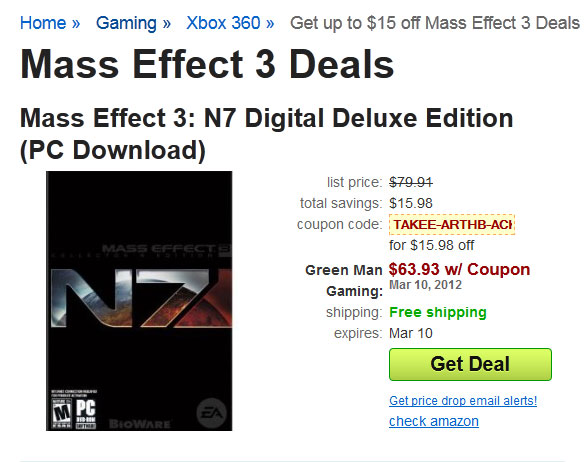
Never again.
If you will recall, I ended up paying ~$85 for Mass Effect 3: Digital Deluxe Edition about two days ago. Had I waited those two days, I could have spent $16 somewhere, anywhere else. I am not in a financial situation in which the $16 necessarily matters, but it matters to me that I essentially paid an Enthusiasm Tax.
The deal was via Dealzon, and I was made aware of that via Kotaku’s The Moneysaver article. It expires today (March 10), in case you are interested. Then again, I have little doubt that you could wait a month or two and get an even better deal.
Incidentally, based on my ME3 experiences thus far, it is worth waiting for the price drop.
Scroll of Ridiculous Value
Obviously there has been a lot of talk about the Scroll of Resurrection‘s instant level 80 character thing. But equally fascinating to me is all the other value-added things they stuffed in there. When they took the Scroll down the first time, I assumed it was because Blizzard was seeing people being Scroll’d and then defeating Deathwing via LFR before the week(s?) was up. Now? This is what you get:
- Upgrade to Wrath. ($19.96)
- Upgrade to Cataclysm ($26.99)
- 7 Days of game time. (~$3.50)
- Server Transfer. ($25.00)
- Faction Transfer. ($30.00)
- Free level 80 toon ($X)
Total potential value: $105.45 + $X.
When I quit WoW ~6 months ago, my criteria for ever returning was basically “when they started discounting server/faction transfers.” The game itself had not stopped being fun, it was the gradual bleed of friends that made me question the subscription. Even if I resubbed tomorrow, I would still be on the same shit low-pop server, stuck with the same inverted community. I have five level 85 characters and 400k+ gold that I’m not about to let rot, but neither am I paying $50+ a pop to save them. Simply put, there is a pretty severe barrier to reentry at this point.
So when said friends hit me up on Vent yesterday to chat, I knew the Scroll pitch was coming. And in some ways it was very, very tempting. The mental scenario played out like this:
- Friend rolls level 1 Horde toon on healthy server, sends Scroll.
- Accept Scroll.
- Delete an unused character, roll level 1 druid.
- Get the druid to level 80 instantly.
- Load druid up with 50k gold (the max transfer limit), other items.
- Free Server Transfer + Faction Change the druid.
- Paid Server Transfer + Faction Change for main.
That would get me a decent fraction of my wealth onto a new server, plus the ability to perhaps LFR Deathwing in that free week, plus a level 80 version of the only class I never played before, and technically a server/faction transfer at 50% off.
There are some unknowns, of course. Would I have to do the Server/Faction transfer immediately, or could I delay it? Are you leveled to 80 only after you move? Can someone send a Scroll from a level 1 character? Do I really want WoW back in my life, now, when there is probably another 6 months of just Deathwing?
The funny thing is… maybe it doesn’t matter. Even if I simply accept the Scroll on my main in order to just get the free server/faction transfer, maybe that’s enough. Log in, move the one toon, screw around for a week, let it expire. Then wait for the next promotion. By the time Mists finally rolls around, perhaps I will have moved several more toons somewhere else by using Scrolls every 3 months.
But OMG instant level 80 WTF?
It may be my relative distance from the game, but this does not strike me as particularly controversial or counter-intuitive as it may seem.
First, the Scroll can only be used on paid accounts created before March 4th. Brand new players are not getting level 80 toons right off the bat.
Secondly, and more importantly, nobody is really “skipping” the revamped 1-60 Cataclysm content here. If you were a veteran, you either saw it already or don’t exactly care about the questing your alts do. And if you do care, well, just don’t accept the level 80, yeah?
If you were someone who quit before Cataclysm, say at the end of Wrath or TBC or even vanilla, you are already past the revamped starting experience. This piece of the promotion is about skipping TBC and Wrath leveling, not 1-60. And if you are making a level 1 toon to take advantage of the instant leveling, then you have already decided that the new questing experience isn’t worth your time.
Does this set a troubling precedent? Well, maybe, maybe not. Death Knights are instant level 55. The Recruit-a-Friend promotion grants triple XP to both characters, and the referring account gets free levels to apply to toons up to level 60 – back in the day, I “recruited” myself to dual-box a rogue and priest to 60, then gave my level 28 hunter the free levels until he was 58. Nowadays, the triple XP lasts until level 80, and you can grant a total 40 free levels.
The one argument I am sympathetic towards is the lack of veteran rewards. If you have been dutifully playing and paying WoW all this time, you have gotten nothing. Sure, you have had the enjoyment and wonder of playing the game for the last X years, but you have paid for it in cash and tears. Promotions like the Scroll are great for people like me who might not have ever been tempted to hop back on the train, but it also makes the calculus of bothering to tough out the dry spells awfully fuzzy.
If I do end up pulling the trigger, I’m definitely letting the sub lapse again later. Because… why not? An unstable subscription is apparently worth more to Blizzard than a stable one. It sounds backwards and dumb, but it is perfectly rational in its own way. I paid $85 for a game (ME3) on Day 1 when I could have gotten that same game for $50+ less a few months from now. The people already subscribing/buying Day 1 are money in the bank; they need no convincing.
Moral of the story: it pays to play hard to get.
Of course, that probably works about as well in the long-term as it does in real relationships.
Lesser Evils
Ughhhhh…

Free shipping on digital downloads? New deals every week? Sign me up!
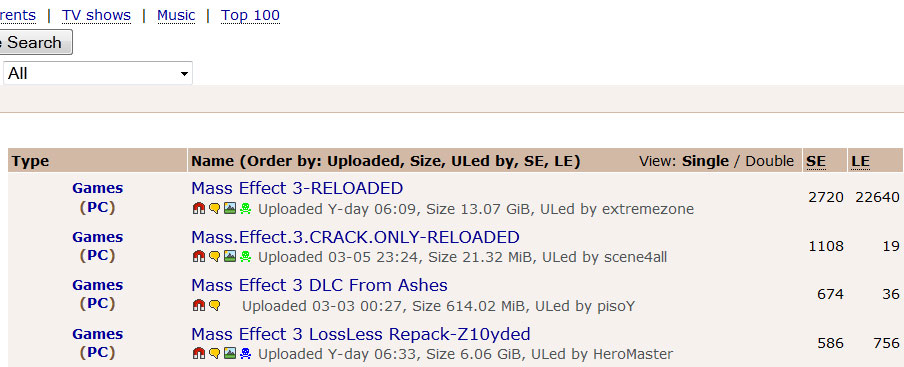
“Step 4: Copy the cracked content located in the Crack directory on either disc into BinariesWin32 of your installation directory, overwriting existing files.”
So… which is worse? Day 1 DLC? Piracy? Requiring multiplayer for the best ending (thanks to Tesh for the heads up)? Not being able to do multiplayer later? How do I choose?
/sigh
/paragon
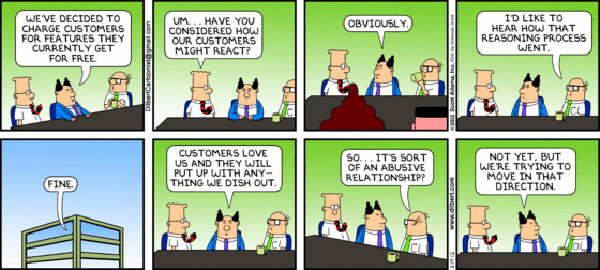
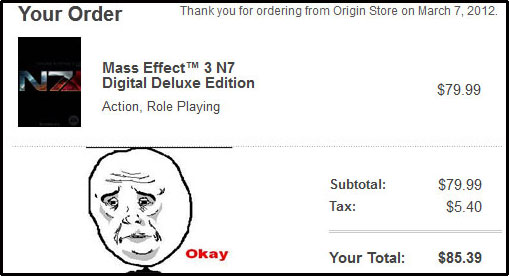
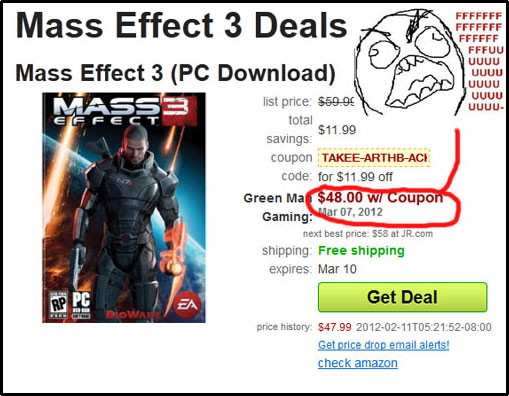
P.S. I know the Digital Deluxe edition is different from the one in the deal. But my DLC calculus was $70 vs $80 (plus soundtrack + whatever), not $58 vs $80. Considering that I already know there is no way in hell my recommended price in my final review will be $80 or even $60, I feel extra dumb for paying the “3:43am purchase so I can download overnight and be a part of this geek cultural event for once” tax.
P.P.S. Has anyone mentioned Origin sucks donkey balls before? I am now having to reinstall ME3 because it originally refused to install anywhere other than on my 64GB SSD. Sorry, no, you get in the back of the D: drive like everyone else.
P.P.P.S. Then this happened:

P.P.P.P.S. Finished redownload after 2+ hours. Despite changing default install location, ME3 was installed on C: again. Now I’m going to have to fucking mess with creating virtual links from the CMD line and hope I don’t break anything. Congratulations, EA, you have made this bullshit more complicated than mounting ISOs and didn’t even have the curtsey to include a KeyGen chiptune reach-around.
P.P.P.P.P.S. Steam or bust.
Review: Mass Effect 2
Game: Mass Effect 2
Recommended price: $25
Metacritic Score: 94
Completion Time: ~36 hours
Buy If You Like: Mass Effect, or cover-based 3rd person action-RPG shooters
It was with no small amount of trepidation that I booted up Mass Effect 2 (hereafter ME2) for the first time a few weeks ago. Having been so late to the Mass Effect party generally, the ongoing internet narratives surrounding ME2’s quality and “worthiness” as a sequel had already congealed into a crusty shell of opinion. I heard claims about “dumbing down,” that Bioware was losing its way and letting the RPG bits drift, abandoned in the dark places between stars. What would I find, coming from the original which so thoroughly and completely sucked me into a new universe?
What I found in ME2 was highly enjoyable, more… streamlined game.

Commander Badass reporting for duty.
A lot of my issues with the original Mass Effect came down to Bioware trying to shoehorn in RPG bits where they did not really fit. There were talents and upgrades and items without the underlying structure of, say, inventory management or character stat screens. In ME2, all of that has basically been removed. You can still find or purchase new weapons, but each weapon is not necessarily better than the ones you already have – it is more akin to alternate weapons in normal FPS games. There still is not a coherent stat screen, but the talent/power-choosing process has been truncated down to the point where it is not necessary.
While that is an improvement over the last game, I was left with the nagging feeling that it doesn’t really make sense to have levels and XP at all anymore; since you inevitably level up after each mission, why not just give players the talent points? Similarly, I was also left with the impression that there really was not much difference between Biotic and Tech-based powers. I could not tell you offhand what the mechanical difference between Tech and Biotic was in the original Mass Effect, but it seemed pretty clear that Biotics was supposed to be special and rare. Now it seems like more than half my crew was Biotic along with most of the organic enemies.
Although the nuts and bolts being streamlined could be viewed as good or bad depending on tastes, the combat itself feels much, much better in ME2. Taking cover feels a lot more fluid, firefights are longer and include more enemies, and with the radically shortened cooldown on Powers, you can do some pretty outrageously dynamic things. There may have been a lined crossed somewhere along the way – perhaps when I was warp-charging through cover every 6 seconds to punch heavily-armored bosses in the face – but I will take dynamic, exciting combat over rote realism any day. After all, how believable is it to have ample chest-high obstructions in every other room to begin with?
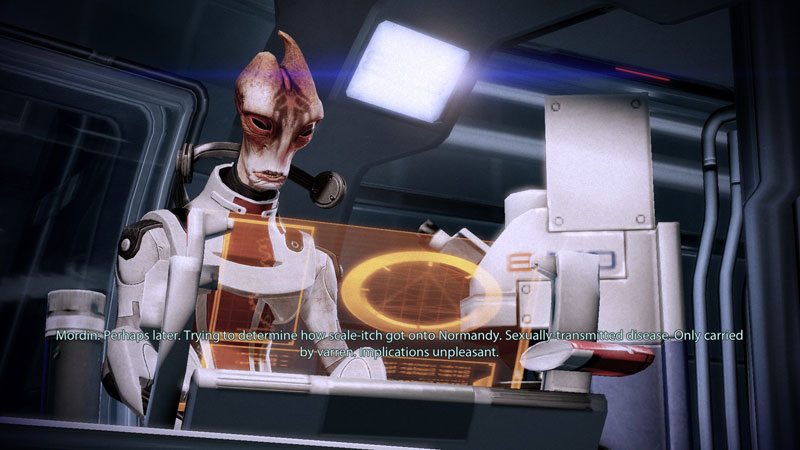
Best party member since Minsc.
My favorite aspect of the original Mass Effect was the integration of non-verbal dialog into the narrative, and the general narrative itself. In ME2, that is kicked up a notch^². Characters smile, nod, gesture, facepalm, wink, and otherwise emote in subtle, natural ways. Indeed, these little actions end up becoming part of the dialog, creating nuance and meaning that words themselves could not convey. Some scenes are punctuated with Quick Time Event-esque moves, such as interrupting a bad guy speech by just shooting him, or stopping someone from doing something they will later regret. While QTEs are normally cheap, annoying gimmicks to force players to pay attention, the ones in ME2 felt a natural part of the narrative… including when you went ahead and let a teammate squeeze off a round in the criminal’s kneecap. I have not played a proper RPG since starting up this Mass Effect experiment, and I am still nervous about whether I could ever go back to static character portraits, scrolling text, or (well-done) narrative QTEs again.
One other thing about the dialog that deserves special mention: this is one of the most goddamn hilarious games I have ever played. Sometimes ME2 crosses the line into absurdity – the cigar-smoking Elcor shopkeeper, anyone? – but most of it evoked more literal LOL moments than eyerolls. That is not to say there is not any drama or serious things going down. Rather, it is precisely these moments of sardonic levity that drive home stakes. You end up liking these characters, wanting to hear what quip they will bust out next, and then are suddenly confronted with the very real possibility they will die based on your actions.
What really ended up surprising me was when what originally appeared to be a simple “alien + personality quirk” party member, suddenly unfolded into a paper crane of origami complexity. I am specifically talking about Mordin, whom I felt practically stole the show aboard the Normandy. The transition between him being a “stereotypical” Salarian with a humorous ADHD staccato manner of speaking, to a weary doctor haunted by the ethical ghosts of his past is nothing short of brilliant. In fact, it is not even really a transition of his character, but a transition of your perception of his character; he didn’t become deeper, you merely discovered the depths. While the other characters are perhaps less complex in comparison, that is practically true of most characters in any RPG that I can recall.
Dialog and characterization aside, I am sympathetic to claims that ME2 streamlined the plot a bit too much. I wasn’t a huge fan of driving the Mako on every random planet, but when that option is replaced with a (decently fun) scanning minigame and combined with exploration mechanics that discourage exploration (we have fuel now?), it ends up making the universe seem a bit too small. Plus, I am not a huge fan of the Restart at Level One trope to begin with, or really how it was presented here. Instead of an epic, unified journey, ME2 really felt like 2-3 missions with about a dozen sidequests between you and the third. I want to stress though, again, this is a weakness with the story structure, rather than the story itself. Each of those episodic sidequests were worth experiencing on their own, but I do recognize how little effect they seemed to have on the overall plot.
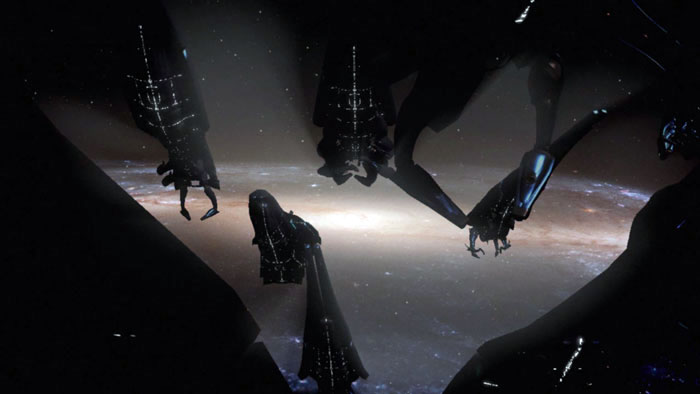
"You know, somehow, 'I told you so' just doesn't quite say it."
Is Mass Effect 2 as groundbreaking as the original? Of course not. The first game had the task of creating an entire universe filled with races and peoples, and had to go about getting you to care about learning more about them. In that respect it succeeded admirably. It is difficult to add something to an already completed picture though, and so I got the impression that Mass Effect 2 was concerning itself with making you care about Shepard. Not in the sense that Shepard is the most interesting man/woman in the galaxy, but rather in the sense that you genuinely care about the choices you will soon be forced to make in the coming war. Mass Effect was about world-building, and Mass Effect 2 about filling that world with individuals. As Mordin says:
No. Aware survival unlikely. Actually contacted him for personal connection.
Hard to imagine galaxy. Too many people. Faceless. Statistics. Easy to depersonalize. Good when doing unpleasant work.
For this fight, want personal connection. Can’t anthropomorphize galaxy. But can think of favorite nephew. Fighting for him.
Does Mass Effect 2 emulate the mechanics of RPGs as well as the first game? No. Did Mass Effect 2 capture the soul of RPGs, the essence of what makes them worth experiencing?
Absolutely.
File Under: Eyebrow Raised
The following two bits of random news caught my eye yesterday.
Breaking News: Cataclysm heroic dungeons were too hard, long
There is a new Cataclysm “post mortem” interview with Scott “Daelo” Mercer that just went up. It is a PR puff-piece so whitewashed they had to run over to San Bernardino to pick up more lime, but it did contain at least one visible kernel of truth in the pile of bullshit:
Q. What didn’t work out as planned or expected?
Initially, we started off the Heroic dungeons at too high of a difficulty. The difficulty level rather abruptly changed when compared to the Heroics players experienced at the end of Wrath of the Lich King. This major change caught many players off guard, and frustrated some of them. The difficulty also increased the effective amount of time required to complete a dungeon to a longer experience than we wanted. With the release of patch 4.3 we’re now in a much better place. We’ve always talked about being able to complete a dungeon over lunch, and the Hour of Twilight dungeons get us back to that goal. End Time, Well of Eternity, and Hour of Twilight all provide epic play experiences to our players, but at the real sweet spot of difficulty, complexity, and time commitment.
This is a drum that I have been beating for a week shy of a full year. It is not especially relevant these days – does anyone really care or disagree at this point? – especially given the Mists announcement back in October that heroics were going back to WotLK-style. But it is always nice to have some measure of extra closure on things.
Dust 514 is F2P, for real this time
Last month, I pooh-poohed David Reid’s speculation that EVE could become the biggest game in the world by the end of 2012 via the “tens of millions” of Dust players. While Reid is (one of) the most filthy, vile marketeer(s) in the history of videogames, the latest news via Eurogamer is that Dust is in fact F2P:
Eurogamer can megaphone that Dust 514, the exclusive PS3 MMOFPS that will exist within Eve Online, will now be free to download and free to play.
There was going to be a $10 to $20 cover charge for the game on PSN, but that has now been scrapped.
“It was a relatively confusing proposition,” executive producer Brandon Laurino explained to Eurogamer, “and we wanted to make it unambiguous that this is a free-to-play game.”
Laurino goes on to stress Dust won’t be Pay 2 Win – “There is no micro-transaction that you can do that gives you an unfair advantage over someone who hasn’t paid anything” – but a few paragraphs later this happens:
Items available include vanity goods to customise appearances with; boosters that save time, such as double skill point (SP) boosters; variants of weapons that aren’t necessarily more powerful – “side-grades” that look or play differently; services like character respecs; and lucky dip treasure boxes. “It’s what has emerged as best practice,” Laurino said.
Oh, I see.
I suppose there is room to say things like double-XP potions and the like don’t actually count as P2W. And maybe they will actually get the weapon side-grades balanced right. But… “lucky dip treasure boxes?” TF2 has those crates you unlock with keys or whatever, but I would never accuse TF2 of taking itself particularly seriously. I am always skeptical when someone feels the need to hardcode lottery tickets into their game… do they have no faith in the product itself to engender poor financial decision-making?
All that aside, it is pretty big news for Dust to be launching F2P out of the gate. I do not have a PS3 and I believe launching Dust as a PS3-exclusive (i.e. no PC version) was the worst idea in the history of ever, but this is something I am definitely keeping my eye on. As I said in an earlier article on the subject, Dust would have been the perfect vehicle to transition someone interested in the EVE concept from the fence to being podded in-game. We will have to see how the game actually plays, but being F2P gets a lot of feet in peoples’ doors.
Specialization is Key
I was reading Syl’s Monday post on GW2 when a particular section leaped off the page:
Some people still doubt that GW2 will manage without any holy trinity, but I actually do – and if there’s ever going to be more “dedicated” healing or tanking going on in a specific encounter, it will probably be a situation in which everyone must take turns or decides on a random player.
If you have attempted group content in WoW at any point in the last two years, you probably recoiled in horror as I did at the thought of looking forward to shared group responsibility. We have a term for that now – The Dance – and every indication that it was the principle cause of the nearly 2 million subscriber exodus.
After all, by making every player vital to the group’s success (e.g. everyone must Dance correctly), the strength of the group is reduced to that of its weakest member. And if we follow the “down with the holy trinity!” argument to its inevitable conclusion, we end up in Dance Dance Central.
When I asked whether Syl really wanted shared responsibility, the response was:
You mean, would I rather have groups share the responsibility of control or be flexible about it, rather than putting the entire responsibility and blame on just one person? of course I would. I think this is one big reason why WoW pugs were so horrible.
The sentiment is interesting to me, because I approach it from the 100% opposite direction.
There are some responsibilities that I do not trust other people to accomplish. I was the guy in school/college that would do all of the heavy lifting in the group project – picking the topic, doing the research, writing the paper – while you sailed to an easy A by reading two (of 10) paragraphs in front of the class.
Actually, “trust” is not even the operating word I am looking for, as that implies an uncertainty of contribution. It wasn’t a question of whether you would perform, or even how. It was a matter of your capacity for performance, and whether the final outcome would be better or worse with said contribution.
Is that arrogant? No.¹ Ability brooks no morality. Being better at the “game of school” did not/does not make me a better person, or someone else worse for their lack. The unilateral determination of the value of the contribution might be construed as arrogant, but the final grade was always a true arbiter. Just as the death of the boss is an arbiter of a raid strategy.
Which segues me back to raiding and the following claim: specialization is better for group-based activities.
People are NOT experts at everything, nor should they have to be. If the content requires precise movement at specified times, who do you want in that position? Probably a person meeting the following criteria: A) best internet connection, B) the most experience, and C) someone who wants the responsibility. Maybe you’re thinking long-term and want to get another guy trained and battle-tested. Maybe someone wants to branch out and test the tanking waters. That’s fine! Do what works for your team.
What no one wants is for the person chosen to randomly be the easily excitable, newbie friend raiding on WiFi. It’s not fun for him, it’s not fun for you, it’s not fun for anyone. It creates friction in group scenarios, even when you are raiding with good friends.
This brings me to Guild Wars 2, and two conditional claims/predictions.
1) Trinity specialization will be required to succeed at endgame content; or
2) Endgame content will be mostly trivial.
The “everyone can pitch in” group content philosophy is simply zerging. The “trinity should die” desire is the desire for Dance 2.0.
Syl goes on to mention:
combat that revolves around tanking and aggro, is different from combat that revolves about shared control and therefore needs less dedicated healing, too. tactically speaking it’s an interesting approach you can already find in many FPS online games where every player is carrying some type of rifle and team strategy, self-sufficiency, quick reactions and improvisation are where it’s at. okay, you can distrust the average MMO players currently out there to be any use at this type of cooperative game – a fair point, but not exactly a good argument against improving combat design. to ME the current combat is boring.
Putting aside the question of the actual value of teammates in CoD/BF/TF2 games (and the fact that a lot of FPSs are in fact class/role-based), I want to talk about improvisation. The ability to change strategies, to adapt to changing conditions, to snatch victory from the jaws of defeat… that was actually my favorite part of raiding in WoW. The Mimiron kill video was one of the most epic experiences in the game for me. Same with our first Yogg-Saron kill.
The rub is that improvisation requires room to screw up and not fail. In other words, improvisation requires a lower difficulty. It requires mistakes to not matter as much. I am not at all a fan of pass/fail mechanics, so I actually DO hope there is room for improvisation in GW2. But if a group of 5 Necromancers can clear all the content, chain rezzing each other, swapping weapons to “be the tank” when they are randomly the target of the boss, requiring no specialization at all (or worse, requiring everyone to “specialize” in everything)… well, have fun with that.
A certain continuum exists between the two extremes, but it is not as wide as many believe. The only way to reliably hit that mark, IMO, is to require specialization in tasks – specifically being able to choose the 1-2 people around which an encounter pivots – and extend the margins of victory for everyone else. Think the ooze-kiter in the Rotface encounter, or the two portal healers in Dreamwalker.
Allowing those 1-2 people to be anyone (tanks/healer/DPS) would be an amazing innovation, but I’m not entirely convinced that is what will be going on in GW2.
¹ Although it’s probably arrogant saying it.
 In An Age
Moving Past Mass Effect
Mar 14
Posted by Azuriel
First, I apologize in advance for another “blank” entry.
As someone who typically plays games that are old and on Steam sales, I can appreciate the frustration of people who are waiting on ME3 and yet are inundated by spoiler-laden posts on their Readers/blogrolls. In fact, I do not even like friends telling me they liked or disliked an ending to anything – my mind immediately starts analyzing the kinds of things my friend likes/dislikes (“Hmm, he wasn’t a fan of FF7’s ending…”), and extrapolates possible ending scenarios from there.
If you are such a person, or don’t want ME3 spoilers generally, last chance to bail.
Yeah, we kinda do.
Since finishing Mass Effect 3 Monday night, I have been in turmoil. Post-game depression is fairly typical for me, and endings like this one are a sort of double-whammy.
Rohan described the break as being “pre-beam” and “post-beam,” but it actually started earlier for me. The invasion of Earth itself was curiously… off. What should have been a momentous emotional occasion was, well, not. Where was the stirring music? Fires and Reapers and silence. For a while, I was actually worried that there was a bug preventing any music from playing.
Once back aboard the Normandy, things started feeling right again. This was Mass Effect, this was what it was about. In fact, it was not until ME3 specifically that I even felt I knew what the series was about. Interstellar war was one thing, but what I cared about was landing in a situation, and being the right man at the right time. Shepard was not setting out to dictate galactic policy, Shepard was not some god-figure who arbitrates which species lives and which dies. He (or she) simply happened to find himself in that position, at that turning point in history, and does the best that he can.
It is in that context that I felt the post-beam sequence was fine, for what it was.
Through the prism of the ending, I felt that Shepard the character got the closure he needed in the hours leading up to the end. The romance section put it in sharp relief: I was so worried about getting “locked-in” too soon that I accidentally past the point of no return without anyone at all. When I reloaded and made my choice, the stark difference between my feelings of the game – based simply upon those two scenes, one alone and the other with Liara (sorry, Tali) – drove home the fact that I love this series, no matter what happened.
Ever read The Wheel of Time series by Robert Jordan? As of today, the series is one book away from completion, and I have become so invested in the final outcome that I can barely stand it. But… what kind of ending should there be? The one I want, or the one I deserve? What if the ending is simply terrible, like how I felt ME3’s was at the time I was experiencing it?
With Wheel of Time, that answer is largely moot. There was one point in Winter’s Heart (book 9), one perfect moment, when everything in the narrative came together for me; a great character catharsis, independent of any kind of grand action event. I remember sighing, and a tension I did not even know existed, releasing. No matter what happens in Book 13, no matter what the Wheel weaves, they can never take that moment away or cheapen it.
I am coming to understand the same with Mass Effect.
Bioware cannot take away the feeling of immense depth with Mordin, when the Salarian stereotype fell away to reveal a reservoir of guilt for necessary evils; a doctor moved to inflict harm, faced with impossible choices. Bioware cannot take away my own feeling of guilt when I heard Kaiden’s “Belay that order!” command repeated in the forest dream sequence; a sacrifice I readily accepted at the time to save a woman I had feelings toward and ultimately passed over. Bioware cannot take away EDI and Joker and all the other hilariously poignant moments in the entire series, but ME2 in particular. Bioware cannot take away the bromance with Garrus, or the absolute struggle I had in choosing whether to intentionally miss that shot or not.
Here, here.
So, if you struggled as I have, or struggle still, I have a recommendation. Listen to To Build a Home by The Cinematic Orchestra. Listen to it again. Then read this Kotaku article. Then remember every time you felt this way before – maybe Cowboy Bebop, maybe End of Evangelion, maybe Saving Private Ryan – and try to remember the last time you have felt so wounded by a video game. Have wanted something different so bad you could taste it.
And then… try to let go. If you are anything like me, I am having an exceedingly difficult time wanting to.
Good game, Bioware. Good game.
P.S.Epilogue: For what it’s worth, I still believe Bioware should have handled the ending better (and I am aware of the “secret ending”). The tone and recycled outcomes were one thing, but the incongruent Normandy bit was quite another. At first, I railed against the notion that Bioware was planning on going the “if you want the true ending, it’ll be $9.99 DLC” route, and the implicit dream/indoctrination sequence that implies. But the precedent already exists: Bethesda did just that in the Fallout 3 “Broken Steel” DLC.The difference being, of course, that Fallout 3 was immensely cathartic in wrapping things up at the end, straight out of the box.
Posted in Commentary
10 Comments
Tags: DLC, Ending, Kafka, Mass Effect 3, Post-Game Depression, Spoiler