Broken Games
It was my mistake for taking Divinity: Original Sin 2 (DOS2) more seriously than the designers. Here I was getting all worked up about a useless crafting system that includes products worse than either of the ingredients, or a Skill system featuring dozens of pointless “gotcha!” choices.
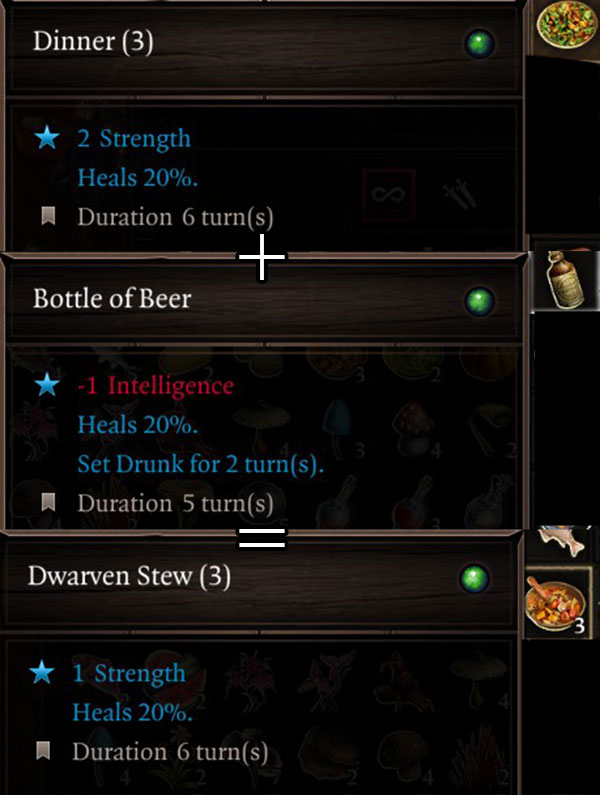
Seriously, no redeeming factors here.
As it turns out, the devs are just morons. Case in point: Thievery.
This is a Civil Skill you need to put points into in order to Lockpick and Pickpocket. At level 1, you can pickpocket up to 300g worth of goods. It then quickly scales out of control:
- 1: 2kg / 300gp
- 2: 4kg / 450gp
- 3: 6kg / 1100gp
- 4: 8kg / 2350gp
- 5: 10kg / 3800gp
- 6: 12kg / 6000gp
It actually scales up even higher than this (224k at level 14?!), but Thievery 6 is where I’m at currently with my gear bonuses. I’m in the first major town in Act 2, and most vendors have ~3500g on them, and selling multiple epics/Legendary items… which is its own thing, but nevermind. So, I purchase the expensive goods, then pickpocket 6000g back. The victim will try and find the thief for about two minutes, but that’s it. The only limitation on this mechanic is that you can only pickpocket a given NPC one time… per character. Respeccing is free though, so it’s no big deal to turn anyone into a master thief long enough to rob entire kingdoms blind.
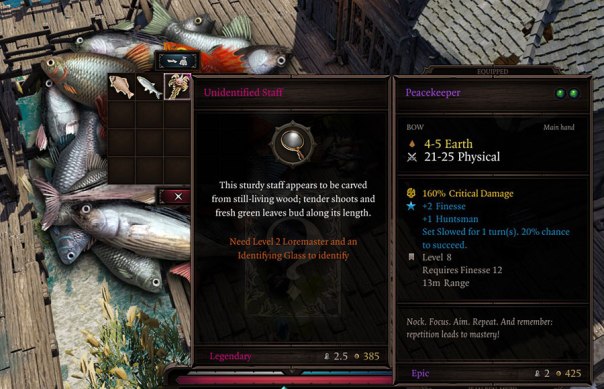
Lucky Find can also break your game with free Legendary items in every X containers.
There is so much wrong with this, that I don’t even know where to start.
So… I won’t. DOS2 is a very pretty game with an interesting combat system submerged in hot, sloppy garbage game design. I wouldn’t expect this level of disregard for balance from Early Access shovelware.
…
…I mean, do you understand? Crafting being weaksauce (on purpose?) is one thing; that simply means the game is balanced around loot drops. Vendors being able to sell you Epic/Legendaries is whatever, as that simply makes it necessary to collect all the things so you can save gold and buy them. Having a crazy-scaling Thievery skill though, with zero repercussions, that can succeed at any Sneak level by simply creating a smoke cloud, essentially means every single vendor in the game gives you entire dungeons’ worth of loot for nothing. And it’s not just vendors either – I saw a fisherman with 2900g just walking around, so I nabbed that too.
What was this game supposed to be balanced around? Anything?! “Just don’t pickpocket vendors.” Or maybe the professional (?) game designers could change the Pickpocket values to be a tiny bit more consistent or sane. Each step value varies wildly between 40-140%. Go up 300g each time, or increase it by 50% each time, or something. The latter would make level 6 Thievery worth 2278g per vendor, which is still probably game-breaking, but at least not to the same degree.
Know what’s really laughable? One time I stole 5000g from a random non-vendor NPC, but actually got caught. I was given a few dialog options on how to respond, including trying some Persuasion checks or attacking the NPC outright. Or… I could bribe them… with 151g. And, you know, keep the remaining 4849g I just stole from them. So I did.
I could… not do these things. That is a choice that I have. It is also a choice I shouldn’t have to make. I should not have to handicap myself to have fun playing a game. Nevermind the fact that the fun I have playing games usually comes from leveraging my whole mind against the systems in the game, and puzzling out a solution. Optimization is fun. When it’s this brain-dead easy, it’s less fun. When it’s clear that the designers can’t be bothered to care about balance at all, it’s even less fun still.
Everyone has their hang-ups. Maybe it’s cringy dialog, cliche plot, bad graphics, slow leveling, too many random battles, etc, etc etc. For me, it’s when there is evidence the developers stopped caring, didn’t bother to playtest, or never knew what the hell they wanted to do in the first place.
Epic “Competition”
The Epic Game Store has poached another high profile new release from Steam: The Outer Worlds.
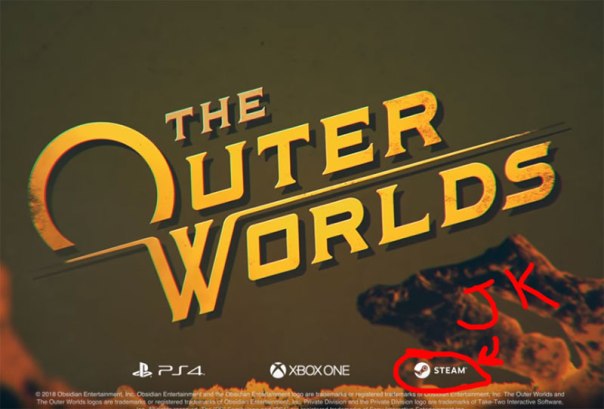
As if trailers weren’t already misleading enough.
As with Metro: Exodus, this is a timed exclusive meant to expire after 1 year. Unlike Metro though, Outer Worlds is also slated to be released on the Windows Store as normal. So if you really wanted to play it Day 1 without using the Epic Store, you can. Of course, that means… you have to use the Windows Store, which comes with its own issues.
The backlash from the continued poaching of games is pretty widespread on Reddit (and Youtube comments, etc) although there is also a tremendous amount of counter-backlash. Most of the counter-arguments seems to boil down to “why so serious?” Which should not be unexpected from /r/SubredditDrama or /r/GamingCircleJerk users, of course. Nevertheless, it is question worth asking.
But before I get to answering it, let’s review why Epic is doing this in the first place:
When asked for his take on these reactions, Sweeney reiterated the aim of the Epic Games Store is, “breaking the 70/30 stranglehold that’s pervaded the industry for more than a decade,” and that its methods in doing so were never going to please everyone.
“Changing the way that games are sold is a big disruption to everybody,” he says. “I understand that — I’ve personally unsubscribed from Netflix twice as their selections of movies changed. But this is a necessary step forward for the games industry if we want to enable developers to invest in building better games, and if we want the savings to ultimately be passed on to gamers in the form of better prices.
Ah, it’s all pure altruism for the good of all gamers.
On Sweeny’s Twitter though, he admits:
UbiSoft agreed to a co-exclusive on UPlay and the Epic Games store. Epic Games seeks exclusive games in order to have a unique lineup of games so there’s another reason for gamers to come to our store.
In fact, here are the brass tacks:
That’s one of the biggest complaints about the Epic Games Store: it lacks features. Indeed, it didn’t even have a search tool until recently. But Sweeney points out that there’s no use taking on a “dominant storefront” (ie, Steam) unless the exclusives, prices and developer relationships are there.
“It’s nearly perfect for consumers already… There is no hope of displacing a dominant storefront solely by adding marginally more store features or a marginally better install experience,” he said. “These battles will be won on the basis of game supply, consumer prices, and developer revenue sharing.”
It may seem like a “duh” moment, but I just wanted to reiterate the fact the Epic CEO admits there is no other way to compete with Steam on the merits. That the Steam store is “nearly perfect for consumers already.” And thus, the only way that the Epic store can hope to compete is by restricting the game supply via exclusivity agreements.
Which is a bit of a weird way to foster “competition,” don’t you think?
If you want to know why I consider Epic’s shenanigans as anti-consumer, timed exclusives is it. Competition between storefronts means I have the choice to purchase it from Steam or from Epic or whomever. For some reason, Sweeney feels like competing on price or developer revenue sharing isn’t enough. Possibly because Epic has a shitty store lacking in basic functionality. Forcing people to use said store if they want to play X game isn’t doing consumers any favors, even if it’s hypothetically “for our own good” years from now.
I get it. Disruption is required to break into mature markets. But typically – or at least ideally – the disruption comes out in favor of the consumer right away. Uber and AirBNB and Netflix and all the rest broke monopolies by offering not just lower prices, but superior service/opportunities in most cases. Uber didn’t just swing big-dick Fortnite money around and buy up all the cabs around the airport and tell people that the next five years are going to be super exciting for cab drivers.
Crafting is Required
Divinity: Original Sin 2 (DOS2) has a terrible crafting system.
At first, I felt like this was okay. Crafting in the original game was often a bit overpowered, such that most of the time you were better off crafting upgrades than you were trying to loot them. This was a problem in Skyrim too, which I talked about back in 2012:
Short of the sandbox-esque nuclear option of destroying gear and/or permanent durability loss, I do not see a worthy payout for the costs of strong player crafting. I just completed a long questline to reconstruct a 1,000+ year old amulet whose power started a war and led to it being split into three parts and sealed away; the names of amulet keepers were to be forgotten under the pain of death. After finally reforging it, I held it in my hands and… oh, +30 to Health/Mana/Stamina? I created an amulet with +67 to Health and +40% extra Bow damage nearly 50 hours ago.
/vendor
I am not sure any game has gotten the craft vs loot tension correct. If the best items come from looting, players are incentivized to kill things for loot and ignore crafting. If the best items are crafted, players craft them and don’t care about killing stuff. Sometimes you can make hard enemies drop exclusive crafting material instead of loot, but that’s just loot with extra steps.
The problem is when game designers decide to have a weak crafting system, then seed their game with thousands of random pieces of debris. There is shit everywhere in DOS2: flowers, mushrooms, plates, cups, parchment, individual keys that exist forever for some reason, nails, hammers, and so on and so forth. Well over 90% of it is completely useless, despite it being integral to some crafting recipe or another. The existence of these items and your ability to interact with them is an invitation to their collection. Which, ultimately, just serves to pad game time and make inventory management a chore. It’s all a designer trap, outside maybe 2-3 arrow/scroll recipes.
So why not just get rid of crafting, if it’s going to be nigh-useless? Well… what are they going to do with all these cups and silverware so meticulously seeded on every table? Seems as though if you want interactable widgets, you need a crafting system of some kind to justify it. We’re well past the Metal Gear Solid 2 days when breaking single wine bottles or watching ice melt was an innovation.
Just because it’s an RPG doesn’t mean you have to be able to pick up all the things. But you damn well better have a useful reason to pick stuff up, if you allow it. Which makes crafting required.
Not Hurting Enough
No matter the dire economic news surrounding Activision Blizzard, one thing always keeps me grounded: when there’s a WoW “sale.” Then it’s made clear they aren’t hurting enough.
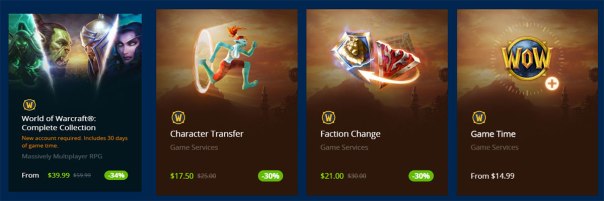
A bargain at 70% of the price, clearly
Stock price of ATVI was $83.19 in September 2018, and it closed $42.92 Monday. That’s damn near half the value in six months.
Now, obviously, cutting prices for (apparently) extremely lucrative services will cut into profits, but it nevertheless boggles my mind that twenty-one dollars ($21) is the sale price of this sort of thing. Or that moving servers – which is a cell on a data table somewhere – costs seventeen fifty ($17.50) on a discount. Especially when you can buy an entirely new copy of same goddamn game for $40. And that comes with all the expansions, 30-days of game time, and a level 110-character boost.
Blizzard has gotten a bit clever over the years though, as it says “new account required.” It used to be that you could buy another box and basically merge them under one account, thus netting you a level 110 boost token for the sale price of a box instead of the $60 or whatever nonsense they sell it for in-game. Maybe it still works that way? Regardless, the process is obfuscated enough to likely dissuade most from realizing it.
As for me, it’s a bit of a moot point. Even if the BfA expansion was any good at all – it isn’t – I have less than zero desire to head back to WoW at the moment. Seeing the naked hubris of “sales” like this though, only reinforces my resolve to stay away from a game in which people are so invested that these prices “make sense.”
Pebbles Can Still Ruin Your Day
Pebbles are small, but if one finds its way into your shoe and you can’t get it out, it can be enough to ruin your day. Or in this case, your gaming experience.

Another pebble: needing to walk around with Alt held down all the time
I started playing Divinity: Original Sin 2 (DOS2) recently, and it’s been fun thus far. There are a lot of interesting new design directions this time around, and I might talk about them in a different post. In this post though, we need to talk about a pebble: inventory management.
…actually, that might not be the root of the issue. This pebble has layers.
DOS2 and the series in general makes a big deal about the autonomy and uniqueness of each character. Characters have origin stories, personal quests, unique special abilities, and their own dialog options. Talk with one distraught woman as Ifan and she shouts “stay away from me you disgusting pig!” Talk with the same woman as Sebille, and you’ll hear her story. It’s immersive… to a point. It’s also awkward, considering you are a player controlling four unique beings, one of which is supposed to be the “main” character.
The awkwardness extends out into the game proper too. Some of the “Civil Abilities” you can put points into are Persuasion and Bartering. The former will let you overcome conversation checks, while also improving your discount with a vendor; the latter improves just the latter. That’s fine, right? It’s typical for CRPGs to essentially encourage specialization, such as you have someone really good at disarming traps, someone running interference for your wizards, and so on.

It’s 2% now, sure, but it’ll be higher later… and not even the point
The problem is when the “main” character isn’t the one with the Persuasion skills. I had been playing for about 5 hours and wanted to offload some goods at a local vendor, only to realize that the person with the biggest discount wasn’t carrying any of the merchandise. And there was zero way to move items around except one at a time. That’s the pebble. There’s a “workaround” where you stash everything inside a backpack that you can then pass around, but that still involves manually moving one item at a time into the backpack. Why isn’t there a “move all items” option?
My characters are like level 3, and the difference between the “main” character I had been controlling and scooping up all the loot with and the guy with the highest discount is 2%. No big deal, yeah? Also, there is apparently a magic mirror in Act 2 or whatever that allows you to freely respec all your characters any number of times, so I’ll be able to solve this Persuasion situation to make my “main” character also be the primary seller.
Like I said, it’s a pebble, not some bottomless chasm.
…at the same time, this little pebble is drawing my attention to the fact I’m walking on a trail full of them. With sandals. I made Ifan a Summoner, who is apparently going to need to be the most Persuasive out of the bunch if I want to be using him to click on treasure chests and dead bodies. Or I could keep the Red Prince as the sell-bot since he’s already the best at it, but that would mean I’ll need to be using him to pick up stuff and talk to people. That would mean I’ll miss out on Ifan’s dialog options though, so I’ll need Ifan to be the sell-bot. But he’s a Summoner, not a warrior, so my carrying capacity is lower. I guess I could move crafting material around to compensate…

Significantly more chatty than when I clicked on her with Ifan
By the way, there’s another Civil Ability called Lucky Charm that gives you a chance of finding special loot in every container you check. Originally, this proc’d only if the character who had the skill checked the container. It’s since been patched to be party-wide, which is nice. Because that is otherwise insane. Which is what is kinda feels like for the rest of these abilities.
All of the above because I noticed a 2% discount between characters. But try walking for 80+ hours with a pebble in your shoe and tell me it doesn’t become a big deal over time. And make you question why you can’t just take off your shoe for a second and get it the hell out.
Transition Gap
Sometimes gaming progress does not happen smoothly. Instead of one thing immediately leading into another, there is a sort of gap that must be leapt across. While not insurmountable, this break in progress can become a source of resistance to continuing to play a game at all.

Oh, an Iron Volcano in my Ice biome. That’s gonna be a Future-Me problem.
I am playing Oxygen Not Included (ONI) again. As I have described before, the game is deceptively easy at the start, but there are disasters looming in every detail. Some things are obvious, like your Dupes running out of Oxygen. Other things are much less so, like the fact that your Dupes just dug out a section of rock – which you told them to do – and then placed the 40°C (!!) rock in a storage container in the middle of your base, and now everything is heating up. Oops.
For the most part, it is generally easier to start a new game with a new map than it is to try and fix a disaster in progress. Plus, it’s fun seeing what goodies the RNG fairies might deliver to you. Cold biome nearby? Natural Gas Geyser ready to be tapped? Awesome.
Nevertheless, there is a specific transition gap that I inevitably reach and often quit playing rather than make the jump. In ONI, that gap is the Electrolyzer. This is a device that turns water into Oxygen and Hydrogen, and is pretty much the solution for breathable air for the rest of any ONI run.
It’s also a pain in the ass.
Up to this point, you make air by burning Algae, and it’s relatively straight-forward. With the Electrolyzer, you have to worry about piping the Hydrogen somewhere else, as otherwise it will clog the ceiling of whatever room you are in.
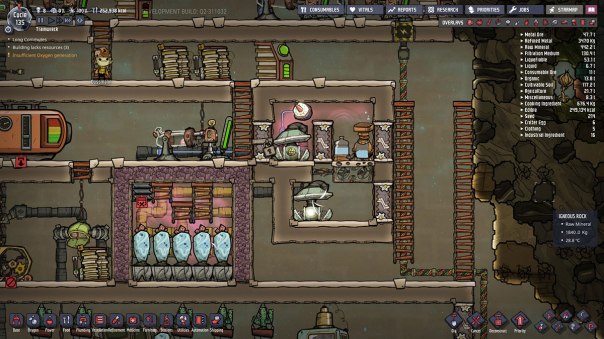
Pictured: mythical SPOM
In ONI-land, there is the mythical SPOM, or Self-Powering Oxygen Module. This is a solved solution for creating an effectively infinite air source with no maintenance or upkeep aside from water; a Hydrogen Power station powers the Electrolyzer, which supplies the station with fuel.
Despite there being a ready-made solution to the problem, or perhaps in spite of this fact, I typically end my ONI runs here. The SPOM is not particularly intuitive, so I basically need to copy it part-by-part from a Youtube guide. Even if I don’t create the SPOM specifically, the Electrolyzer still necessitates your base to account for mixed gases. Ignore the problem long enough, and it’ll be even more a pain in the ass later.
Finally, even with a cut-and-paste SPOM, you still need a ton of water at the ready to feed the beast. Where will all that water come from? Typically, the only long-term solution is to find a Steam Geyser somewhere on the map, but that could take a while, and possibly be nowhere close to you. If you set up a functioning plumbing system, you can technically harvest some additional H20 via that route. Of course, that will also require extensive planning of your base, and how you’ll be handling the hot water that comes out of a Water Sieve.
Good times. Or, maybe not so much.

Made the leap, not sure I’m enjoying the other side.
I have bridged the the Electrolyzer gap before. It’s not an insurmountable problem, especially considering the ubiquitous of the SPOM design in guides. It just takes a lot of mental headspace at a very specific moment in an hitherto casual colony management sim. Or rather, it is at this moment that Oxygen Not Included reveals itself to be a more complicated beast than you have imagined.
Many games have these transition gaps. The best designed among them either shorten the gap, or get you in the habit of hopping long before you reach the gap that matters. Otherwise, the devs risk players landing on their face. Or perhaps worse: practicing to make the leap, doing so, and then being bored on the other side.
Prey in Conclusion
I completed Prey over the weekend, after about 35 hours.

I could craft 870 rounds of ammo, if I wanted. Or if it mattered.
The majority of my concerns were comically overblown. Prey does tally up your behavior during play, but it only merits a single line of commentary at the end, and didn’t tip the scales in any case. I got the “best” ending doing the sort of things one would expect to merit a best ending, and that was that. Feel free to take all the special powers you want, unless you are specifically going for the achievement for not doing so.
How do I feel overall? Disappointed.
There are parts of Prey that are amazing. The GLOO Gun is an amazing tool that remains useful for 99% of the game. You can spend a lot of Neuromods to augment your jumping capabilities… or you can create your own path pretty much wherever, and whenever you want. At the same time, the GLOO Gun “platforms” are just tricky enough to utilize that you never think that it’s required to progress. In other words, it feels like the designers threw it into the game as a toy to play with, rather than a central mechanic (e.g. Gravity Gun in Half-Life 2), and thus you feel clever every time you use it to bypass obstacles.
The set pieces and overall level design are top-notch as well. The environment is cohesive and dense, making you feel as though you are exploring a real place. There is a ton of backtracking, which gets pretty annoying by the end of the game, but it also doesn’t necessarily feel artificial. Yes, if you want to track Volunteers, go to the Volunteer terminal. Yes, if you want to do something with Neuromods, go to the Neuromod area (again).

At least it’s not sepia-toned, but still… ugh.
Where the weakness starts creeping in is two-fold. First, the designers fell into the same design hole as Dishonored vis-a-vis “detective vision.” One of the marquee enemies you face in Prey are Mimics, which are capable of perfectly disguising themselves as chairs, coffee mugs, etc. After a few hours of exploring, you get a Psychoscope that will allow you to scan for Mimics. At this point, the rest of your gameplay experience will tunneled down a blurry circle, with buzzing in your ears.
Do you have to use the Psychoscope 24/7? No. It’s possible to pop it on to quickly glance through a room for Mimics, then turn it off. Hell, by the mid-game you likely have so many supplies and weapons that it won’t matter if you get ambushed by half a dozen at once. Nevertheless, you aren’t overtly punished for Psychoscoping the whole time… other than ruining the ambiance for yourself. Which, IMO, the is dev’s fault.
The other disappointing element is the ending.
Spoilers are below, but let me go ahead and create some more buffer.
…

…
Last chance… okay.
This is basically Bioshock Infinite all over again. Not specifically with Alternate Universes, but in the fact that the devs thought they could take another of the most reviled, cliche plot devices in history and polish that turd till it gleamed.
Nope. Even a polished turd is still a turd.
The ending actually failed on multiple levels for me. First, it was essentially spoiled in-game around halfway through by completing a quest. I expected a bad ending for trying to bail from the station via escape pod without even doing anything, but wanted to “get it out of the way” so I could continue the correct way. What I wasn’t expecting was Alex’s words after the fade-to-black. Whoops!
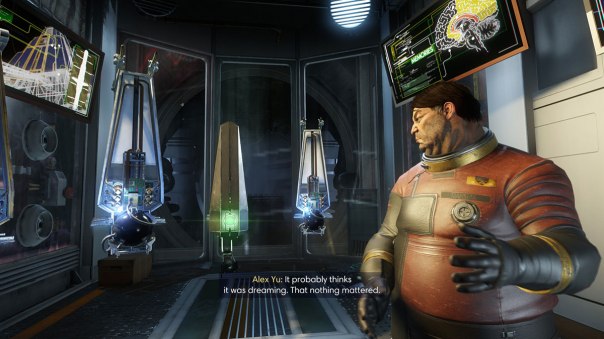
Yeah, actually, that’s exactly what I’m thinking.
The second level of failure was using the “it’s all a dream” cliche, period. I have read some arguments that state this implementation actually made your simulated in-game actions matter, given the extra-special reveal. Nope, still doesn’t work for me. Just because I’m being evaluated on my simulated actions, doesn’t mean I view simulated actions with any particular regard – none of it actually happened. Maybe it’s “based on a true story” when it comes to Morgan, but if all my actions can be rebooted with the flick of a switch, I’d rather them not have occurred in the first place.
Which… they didn’t.
Finally, the ending actually ruined a lot of the nuance I had hitherto been impressed with. For the majority of the game, your one directive was blowing up the space station. Given that, the still-living crew were effective dead already… so why bother helping them out? Was it not more cruel to give them hope before killing them all? At the same time, I felt better easing their more immediate suffering, so they could relax and eventually accept their fate when the time came.
Oh, but hey! Now we have a sudden third solution that magically makes everything better, revealed in the final act! Those dilemmas aren’t really dilemmas anymore. And they never were anything but contrived, simulated scenarios in the first place to judge your empathy. Congrats on playing through the trolley problem – not metaphorically, but literally. Woo!
I’m sure the ending worked for some people, just as there are people who feel Bioshock Infinite is a real deep narrative instead of the total bullshit cop-out it is. The special, second reveal at the end of Prey was indeed surprising, and I guess novel in the scheme of things. Nevertheless, I did not feel any better about how none of what occurred actually did, nor did it apparently matter to the people of Earth. Hell, we still don’t even know what happened, or if anything is real. It could be simulations all the way down.
And that’s why the plot device is such bullshit. A sequel, assuming one ever exists, would have to have a radically different tone or go through a lot of effort to convince the player they weren’t being duped again. But I guess we won’t be seeing a sequel so none of it really matters.
Sort of like any of your actions in the game.
 In An Age
DOS2: An Examination
Apr 4
Posted by Azuriel
I have been writing a lot about Divinity: Original Sin 2 lately. Despite my displeasure with its balance decisions, I did want to take a moment to consider them in greater detail. First, because people are still defending the game for some reason. But more importantly, second, because it’s a good reflection on what balance is “supposed” to mean.
Armor Mechanic
One of the biggest changes from the prior title is the introduction of the Armor system. While I do consider it one of the reasons the rest of the game is so imbalanced, I also actually like the system a lot. It’s extremely elegant and intuitive. Physical damage first reduces your Physical Armor before touching your Vitality (HP); same principle with Magic damage. These Armors can be restored with spells and abilities, and are derived from the equipment you choose to wear. You can focus on one or the other or a balance of both.
The secondary mechanic with Armor is its defense against debuffs. You are generally immune to debuffs of the corresponding type as long as you have Armor of that type remaining. If you have Physical Armor, you cannot be Knocked Down or get the Bleeding debuff. If you have Magic Armor, you cannot be Charmed, or Stunned, or Poisoned, etc. Most debuffs come from attacks that deal that type of Armor damage in the first place, so if any damage breaks through, you get the debuff.
In isolation, I like the Armor mechanic, especially compared with other games. I “know” that +5 Defense is better than +3 Defense, but exactly how much better is often opaque and requires math. In this game, you can simply see the numbers go up. Indeed, DOS2’s system reminds me of Final Fantasy Tactics, wherein armor just straight-up added HP to your character. I’d like to see this sort of Armor mechanic in other games.
Crowd Control
This is were DOS2 falls off the rails. Hard.
Simply put, losing a turn in a turn-based game is crippling. What’s worse is how easy it has gotten to essentially stunlock a character. Before, you sort of had to combo effects if you wanted to try to CC someone. For example, you needed to hit them an ice attack to give them the Chilled debuff, and then another ice attack to promote that status to Frozen. Or get them Wet before an lightning strike. That still exists in DOS2 as well, but the combo itself is useless if they still have Magic Armor. So the strategy is to get them to zero Armor as quickly as possible so that your abilities actually do something else.
I’ll talk about specific broken abilities in moment, but I just want to emphasize how terrible it is that these effects are so binary. For example, if you are Knocked Down, it takes your entire turn to stand back up. Why? Why not have a gradient of effects? The Shocked debuff gives you -1 AP, whereas Chilled reduces movement speed by -35% (both reduce Dodge by -30%). You hardly ever see these sort of debuffs though, because it’s much easier – and more powerful – to upgrade them to “lose a turn” instead.
Overpowered Skills
Chloroform is one of the most broken skills in the game. It costs 1 AP, has a 13m range, destroys 80+ Magic Armor, and then puts the target to Sleep if they have no Magic Armor. Each turn, your characters will only get 4 AP, and the vast majority of the attacks in the game cost at least 2 AP. So why the hell does Chloroform cost only 1 AP and also deal a significant amount of Magic damage and also inflict Sleep?
Chicken Claw is probably more balanced, but also seems ridiculous. It costs 2 AP, requires melee range, and does nothing if the target has Physical Armor. If they don’t though, it turns them into a chicken for two turns, and runs around aimlessly. This works even on boss characters.
Medusa Head is another straight-broken skill. For 2 AP it gives you a buff for two turns that grants a passive petrifying aura – any enemies without Magic Armor within 3m turn to stone. This can keep them petrified for two turns if you keep them in range. The secondary effect of the skill is to grant another 2 AP skill, Petrifying Visage, which deals a lot of AOE Magic damage and then tries to petrify enemies within a larger range. You know, just in case a petrifying aura wasn’t strong enough.
Some skills are overpowered in combination with Talents. Specifically, the Torturer talent allows certain debuffs to apply despite the existence of Physical/Magic Armor. Making someone bleed or burn is usually not a big deal. Having a 100% chance to apply the Entangled debuff via Worm Tremor on the other hand, effectively CCs everyone in a huge, targeted circle for three turns. Well, mages and archers can still use ranged attacks, but none of them can move or teleport.
Attributes/Abilities
The actual stats portion of character building is a huge mess in DOS2 and contributes greatly to all of the problems I have with its game balance.
Abilities are broken down into Combat Abilities and Civil Abilities. Some of them are just completely useless wastes of code. Perseverance lets you regenerate 5% of your Physical or Magical Armor after recovering from CC. As noted earlier though, having your characters get CC’d and otherwise lose entire turns means your whole party will be dead. Retribution reflects 5% of the damage you take back to the attacker. Even if I had 1000 HP and 1000 Armor, that’s… 100 “free” damage. And a dead character.
There are ten Combat Abilities that govern the learning of Skills. For example, you need at least 1 point in Warfare to learn Battle Stomp. Putting that 1 point in Warfare also increases all Physical damage you deal by 5%. This can make for some awkward choices though, considering there are weapon-style Combat Abilities competing for the same points. Single-Handed increases damage and accuracy by 5% when using only a 1H weapon with an empty or shield-wearing offhand.
The important thing to know is most Combat Abilities scale poorly, or not at all. Each point you put into Necromancer increases Life Steal by 10%. That’s not useless, but it also doesn’t cause your Necromancy spells to hit harder – those generally scale by Intelligence, which has its own separate pool of points. Scoundrel increases your critical multiplier and how far you get move per AP. Each point placed in Polymorph grants you 1 free Attribute point to place wherever. The more elemental-sounding Abilities do increase the elemental damage from those spells, but it’s just 5% per point.
Oh, and have I mentioned that you can learn and use skills without investing any points at all, if you have equipment with those bonuses? It may be a waste if you end up replacing a critical piece of equipment later, but there’s nothing stopping you turning anyone into a Pyromancer just because they’re wearing pants with +2 Pyrokinetic.
The bottom line is that the whole design of the game is away from specialization.
At my level, my characters have 15 Ability points to play around with. I could give my warrior character 15 points in Warfare and call it a day. That would give me… 75% more physical damage dealt. Or I could have +65% damage and put one point in both Scoundrel and Polymorph, gaining access to Chloroform and Chicken Claw respectfully. Hell, that one point in Polymorph gives me a free Attribute point I could put in Strength, increasing my damage back up 5%. In which case, I may as well go to Polymorph 2 so I can memorized Medusa Head. Polymorph also has Tentacle Lash, which is real handy for dealing a pile of damage and disarming people at range. Know what else is real handy? Trading another 10% damage to put two points in Aerothurge so I can learn Teleport.
The only real scenario where specialization is encouraged is Summoning. Each point increasing your summons’ HP and damage by 10%, which is whatever, but at Summoning 10 your Summon Incarnate spell summons a real big, beefy minion instead of the normal imp. In all other scenarios, you’re basically just trading 5% damage for entire new ways to CC people.
That seems like a no-brainer choice (i.e. broken) to me.
All Together Now
As you can kinda tell by now, the battle system in DOS2 is broken, but it’s broken in a lot of different ways. If you nerfed the power of Chloroform and similar skills, it’s not entirely clear whether that would be enough to balance anything. Changing the way debuffs work would fundamentally alter combat, but I think people would still be encouraged to go wide on their skill sets. Fixing Ability scaling would probably result in the best change, as specialization nerfs CC in natural ways, e.g. you have less different methods in your back pocket.
At the same time, you don’t necessarily want to lose what makes this game an Original Sin title. Specifically, crazy scenarios with tons of enemies and vast fields of burning poison clouds and electrified blood and slippery ice. From this perspective, I… almost give the designers a pass. DOS2 is probably the closest I have ever felt to playing a digital D&D game, minus a DM who allowed us to overpower everything with spell combos. The whole thing is so out of control it feels like its was intentionally designed to be a sandbox experience.
Unfortunately, there are so many actually broken things and designer traps that remind me that, no, it’s far more likely the designers were just bad at their jobs. That all this chaos is fun is very much unintentional and just blind luck.
Posted in Commentary
2 Comments
Tags: Balance, Battle System, Broken, Divinity: Original Sin 2, Game Design