Opaque RNG is Indistinguishable from Rigging
My patience with enforced 50% win rates is paper graphene-thin.
“A fair game is one in which you win half the time.” It’s hard to argue against such a notion. What is more fair than a coin flip? The problem is that players aren’t equal sides of a coin, nor are the thousands of potential actions reducible to two, easily predictive binary outcomes. Some approximation is required. Or a developer thumb on the scale.
I am still playing Clash Royale despite the disastrous pivot towards blood stone squeezing, and the conceptual breakdown of all progression for long-term players. But some of their shit is driving me up a wall, and will eventually drive me from the game entirely. Specifically, Clan Wars, and even more specifically, a particular game mode with preconstructed decks.
To be sure, there are learning curves involved. Supercell basically took some “top decks” and added them to a pool, from which you are randomly assigned one for a single game. The problem is that some of these decks are just objectively terrible with no redeeming qualities, and still others are straight-up countered by some of the other matchups. For example, these two Classic Decks Battles:
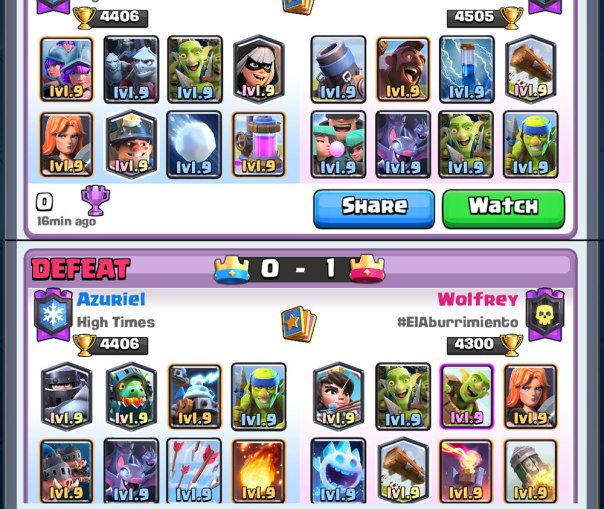
Bullshit on the left, winners on the right.
In the first match (at the bottom), my Royal Hogs are immediately countered by Valkyrie, Mega Knight is immediately countered by Inferno Tower. Amusingly, Royal Hogs are also countered by Inferno Tower and Mega Knight by Valkyrie, assuming my opponent times it right. Meanwhile, while I can counter his Goblin Barrel with Arrows, they both cost 3 Elixir and thus end in a wash… with the slightest error on my part resulting in easily >30% tower damage. Meanwhile, my Zappies are basically useless, my Inferno Dragon even more useless, and I can’t use Arrows to counter his Princess or Goblin Gang because then I become vulnerable to Goblin Barrel. I also can’t hope to Fireball him out because he also has Rocket, which deals way more damage than Fireball. The ONLY way anyone could possibly win with the deck I was given was if the opponent was AFK. 1
For a WoW analogy, think Warrior (me) vs Frost Mage (opponent).
The second matchup wasn’t technically as lopsided, but still awful. Bandit is straight-up countered by pretty much every card in the opponent’s deck. Rascals + Zap took care of Minion Horde every time I threw one down, and Hog Rider/Mortar/Goblin Gang meant I could be punished immediately for dropping Elixir Collector or Three Musketeers. Which is what happened, pretty consistently. If I played better, I might have been able to distract a Mortar with my Valkyrie or Bandit in the other lane, and then split a Three Musketeers or something in the middle, followed by a split Minion Horde. Even then, if he played defensive for 20 seconds, my shit would have been countered.
Were these match-ups truly random? Or “enforced” 50% win rates? There is no direct economic incentive for Supercell to “rig” the Classic Decks Battle mode, but the RNG is opaque and it would certainly be a method to ensure that winrates do not get too lopsided.
The third clan war battle I played was Draft. In this game mode, you are given a choice of one of two cards, four times total; whatever you don’t pick goes to your opponent. I’m not sure if the card pairings are 100% random, but you can absolutely get stuck with some extremely shitty decks and/or matchups. And yet I’m fine with that. You as the player have some agency, even with imperfect information, e.g. choosing Minion Horde when opponent might have chosen Arrows. Indeed, Minion Horde in particular is a classical risky pick because of how many cards can counter it… but if your opponent doesn’t have any of those counters, it can be an overwhelming advantage.
My feelings on enforced winrates have changed over the years. Initially, it seemed fine. Necessary, even. But it is rigging, especially in the methods that many game developers go about it: pairing you with terrible teammates, matching you against strong counters, etc. The end result is that I simply cannot trust game developers with (opaque) RNG anymore. They have no incentive to be actually fair – however fairness is defined – and every incentive to produce favorable (to the devs) results. Even if they showed me the specific game code that chooses the matches, I have no reason to believe it operates in that way. This age of monetization and consumer surplus erosion has pushed me past the Cynicism Horizon, from which no trust can escape.
The only thing that game designers can do, and the thing they should be doing, is increasing player agency in the RNG elements. Drafting feels fair, even when the results are not. Maybe it is just another psychological trick to employ, giving someone the “choice” between a rock or a hard place. But it is an important one for not appearing so nakedly rigged in favor of one particular outcome.
1 If you can produce some videos of pros beating non-AFK people with the decks I was given, I’ll concede that I need to L2P. I typically end the season at 4800 trophies and can acknowledge mistakes, but on paper and in practice, those match-ups felt lopsided as hell.
Review: Far Cry 5
I completed Far Cry 5 a few days ago.

The visuals are quite amazing.
Mechanically, this is the best Far Cry in the series. The gunplay is smooth and tight, weapons are reasonably varied, and vehicles are generally fun to drive. Many of the more rote Far Cry-isms have also been removed. You are no longer forced to climb towers to explore the landscape, nor hunt down sharks to craft a bigger wallet. The whole map is available to explore right away. Screen clutter is practically non-existent, and what quest markers exist are fairly subtle.
Narratively, I feel it is one of the weakest in the series.
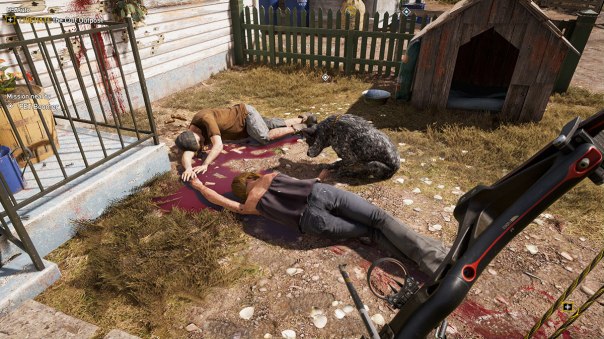
That dog ends up being a very Good Boy.
I have no problem with the Christian iconography, the political parallels to present day, the rehashing of Spec Ops: The Line-esque navel-gazing about who the real demon is (hint: it’s you), or the sometimes absurdly comical cruelty. A lot of that is part and parcel to the Far Cry series. What is fairly new is the simple fact that the player is kidnapped NINE TIMES over the course of the story. The purpose is obviously to engineer a scenario in which the player can interact with the cult lieutenants and witness some exposition first-hand. The frequency though, and the ham-handedness, obliterates any semblance of story cohesion.
Seriously, one time I completed a mission, got the “You’re Being Hunted” message, and was apparently taken out by a blowdart… while piloting an attack helicopter hundreds of feet in the air. Cue cutscene and sub-boss taunting, in which it was revealed I had been imprisoned for seven days (!?!) undergoing psychological torture and starvation. Then (spoilers) I broke out of prison for what had been the fifth time at this point, and went back to what I had been doing originally.
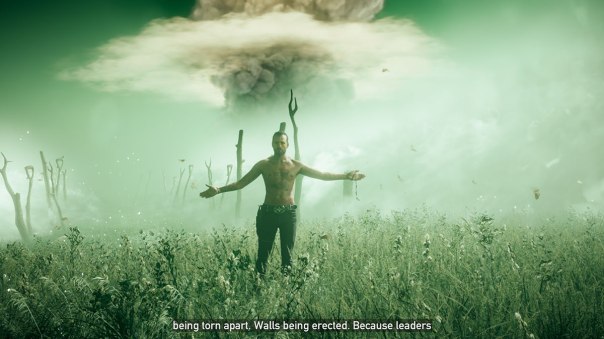
Walls, eh?
I think the principle problem is that Ubisoft simply cannot outrun the shadow of Far Cry 3. That game had an insufferable trust fund frat boy as a protagonist, but it also had a narrative arc with some progression, substance, and you know, a main character that talks. With the lack of any sort of internal dialog, the devs leaned real hard on Vaas wannabes and contrived capture scenarios. Hell, the main character might have been captured just as many times as in Far Cry 3, but it never felt this arbitrary before.
In any case, after 15 hours, that’s that. Far Cry 5 has good gameplay and a stunningly beautiful open world playground to blow up stuff in. But… so do a lot of other games these days. What sets the series apart isn’t the open world or general shenanigans, it’s the story and general narrative experience. And that’s unfortunately lacking this time around.
Gaming Outlook for 2019
Based on my blog roll, this seems like a Thing To Do, so let’s discuss what’s on the docket this year.
To Be Played
I am currently playing Far Cry 5. While the overall experience is similar to Far Cry 4 (which was similar to Far Cry 3), the exact formula has been broken up a bit. Instead of running around trying to skin Honey Badgers for a larger wallet, for example, most character progression is based around achievements and finding prepper caches. It’s subtle, but it does change my focus a bit. A more detailed impression will need to wait for later.
Other games recently purchased on sale:
- Final Fantasy XV
- Dishonored DLC (Knife of Dunwall; Witches of Brigmore)
- Dishonored 2
- Prey
- Hellblade: Senua’s Sacrifice
My Dishonored kick might seem a bit out of nowhere… and it kinda is. My criticism from way back 2012 still hold thus far in the first DLC: the game is almost painfully easy even at the highest difficulty. Well, at least so far on the first level. That’s more a stealth game thing than a Dishonored game thing specifically. Nevertheless, I kept reading praise for the DLC specifically, so I snagged it on sale and here we are.
The rest of that list is basically a rehash of what I had been keeping an eye on since Black Friday.
Might Be Played
I have not booted up Fallout 76 in several weeks now. While it has been trashed up and down the internet – for some legit, and some not so legit reasons – the primary reason for my disconnect might be silly: Rifle schematics. Specifically, my character is focused on Rifles, and the two best kinds of Rifles in the game (Homemade Rifle, Lever-Action Rifle) can only be crafted after snagging their schematics from a vendor’s random inventory. The “correct” way to get them is to check the vendor, and then log off and back on again to be shunted to a new server, and then checking the vendor again. Some people report doing this for hours. No thanks. If that nonsense gets fixed or some new content appears, then I might be back.
Battlefield V is another trashed title, but I have been resisting purchasing it even at a $30 price-point simply because I know what’s going to happen. Specifically, it will probably consume my free-time for a few weeks, and I will eventually awaken from a fugue state, realizing that I had not “accomplished” anything meaningful. I mean, games are games, but there’s a difference (IMO) between seeing the ending credits of three games vs spending that same amount of time seeing the End of Match report of a shooter. I’m not here to just kill time with my gaming anymore.
On Their Way Out
My time with Hearthstone is approaching its end, if it has not already snuck up on me. It’s not so much the mechanics or the meta or the card grinding so much as it is… exhaustion. I have never had a particular desire to compete on the ladder; my goal had been to complete the Dailies and other low-hanging fruit. But that still requires you to put a deck together, research the meta, and otherwise go through the motions. Or I could just turn on Twitch and watch other people play Hearthstone, and experience roughly 85% of the joy that I derive from the game.
On a similar note, WoW is definitely on ice for the foreseeable future.
End of Year: 2018 Edition
Things were going pretty excellent last year, and this year was even better. On the personal front, not the gaming front. Gaming has been pretty bad. Or perhaps just more recently bad.
My gaming goals from last year:
- Complete the vanilla, HoT, and PoF story content in GW2. [only HoT complete]
- Play through some of those PS3 games I bought five years ago. [Errrm]
- Embrace the notion of shorter, possibly more frequent posts. [Not really]
- Use my Blizzard balance to pay for all my Blizzard gaming. [Success]
- Clear at least 40 games from my Steam backlog. [Success]
Guild Wars 2 has been an interesting experience, as I have played it off and on all year long. I feel like not very many MMOs could work this way, even if they didn’t have subscriptions, but somehow it does. It also helps that the Necromancer is a class I enjoy playing. While I finished the HoT story and stopped, there’s a good chance I’ll get back on the horse at some point and finish out PoF and maybe even the main storyline.
I’m just conceding the PS3 game situation as a moral failing and moving on. Well… maybe. It’s been a useful cudgel in preventing myself from buying a PS4 or other gaming system. One day, though.
The shorter posts thing definitely didn’t work out, or at least it doesn’t feel that way. There were more entries in 2018 than in the last two years, but 10% less than the 2012-2015 time period. I prefer writing articles to quips anyway, but quips are generally better at generating comments, clicks, and all other metrics that demonstrate traffic. Luckily, I have no need for traffic, and would be shouting into the void regardless. Nevertheless, I do appreciate the company down here in the void.
I got in relatively early on the Battle for Azeroth gold train in WoW, and so all my Blizzard activity can be financed for the foreseeable future. Provided, of course, I were still interested in playing any Blizzard titles. As it stands, my balance is around $90 and will continue to be at that level probably through 2019. And possibly beyond, unless I run out of other games to play.
My final goal was clearing 40 games from my Steam backlog. Looking at my Recently Played stats, I can see the following titles listed in 2018 with at least a few hours on them:
- Homefront
- Furi
- Lone Survivor: Director’s Cut
- Closure
- Scanner Sombre
- Warhammer 40k: DoW 3
- Salt & Sanctuary
- Talisman: Digital Edition
- QUBE 2
- Darkwood
- SuperHOT
- Wasteland 2: Director’s Cut
- The Banner Saga 2
- Insanely Twisted Shadow Planet
- Monster Slayers
- Galactic Civilization 3
- Clustertruck
- Guild of Dungeoneering
- Dark Souls
- Metal Gear Survive
- The Long Dark
- Nier: Automata
- Slay the Spire
- Rise of the Tomb Raider
- Civilization VI
- Dead Cells
- Subterrain
- RimWorld
- Stellaris
- Conan Exiles
- Stardew Valley
- Nuclear Throne
- Hollow Knight
- The Forest
- Oxygen Not Included
- Fallout 76
- Subnautica
- The Division
I tried to put the more substantial games in the right-hand column. The above 38 do not include the ~7 Visual Novels I cleared, nor the games from 2017 I’m still playing (e.g. Starbound), nor the games I played for about an hour and uninstalled (e.g. Dead Rising 4), so I’m well past the 40 mark.
As I sit here thinking about gaming goals for 2019, I’m a bit at a loss. It almost feels as though an inflection point has been reached beyond which “clearing the Steam backlog” is less a Sisyphean task and more… an irrelevant one. I used to find value in doing so not because of sunk cost fallacy, but with the hopes of finding the diamond in the rough. In a similar fashion, I used to download an Indie-Rock playlist with hundreds of crap songs just for those rare moments of discovering a new band I liked, and the joy of experiencing their whole discography. Never heard of the band Sleeping At Last until this year, for example, and now they’re one of my top favorites of all time. If I hadn’t put myself out there in the weeds in the first place, I may never have had them in my life.
But when was the last time that happened in a gaming sense? Something like Slay the Spire might have qualified, had it not been the fact that I already knew the game was awesome and confirmed the game is awesome. I feel reasonably in tune with my own gaming preferences these days – including the realization that survival games push all my buttons – so most things seem figured out.
It might also be fact that I’ll be a father around May and will thus have less gaming time. Either/or.
For fun though, let’s write some stuff down:
- Seriously, dude, play some of those PS3 games
- Clear at least one story path from SWTOR
- Finish up the PoF story content in GW2
- Clean up Steam library by removing titles not likely to play
- Be a (passably) responsible gaming dad
Five months is plenty of time to get everything done, right? Easy. Yep. No problem.
…
Narrator: It wasn’t.
Being the Change
You never quite realize how much the internet requires unceasing, anonymous effort to function… until it doesn’t. I’m not so much talking about keeping the lights on and the modems running, although there is that too. I mean something like keeping a game Wiki up-to-date.
About six months ago, I opined that a lot of Stellaris’ historical Wiki information was no longer correct or missing altogether. Having recently spent over 100 hours with Starbound’s Frackin’ Universe mod, I can safely say the same situation applies. It’s actually almost worse in a way, because someone ran some script to auto-generate pages for most every item, and then never touched it since. The result is a false sense of information that hasn’t been accurate for months, if not years.
Frustratingly, even the Frackin’ Universe mod creators will routinely mention that the Wiki is out of date. It’s like, dude, you made it out of date by changing stuff. How about you take some time to post change notes or update it yourself?
As I was lamenting the situation, it occurred to me that, you know, I could be the change I was looking for. The whole point of Wikis is to crowdsource information, right? The struggle though is A) I’m pretty much done with Frackin’ Universe at this point, B) I surely have better uses of my time in any case, and C) it’s possible everything is going to just change and be wrong later anyway.
On the other hand… maybe. I’m already in the process of writing up a Quick & Dirty Guide for the mod, as I sometimes do for certain games. Part of my hesitation on updating the Wiki as I went along was the simple fact that “testing” things is a pain in the ass in a normal environment – you have to gamble resources you spent hours collecting on a potentially useless item. Now that I’m basically done with the mod, giving myself /admin powers no longer threatens the integrity of the experience.
Hmm. Wait a moment, what’s written at the bottom of this page?
WARNING – This is an “automated” page. As the Wiki is getting an extensive overhaul, any content added to this page may get deleted in the near future! If you think this page needs a particular piece of information, join us on the Discord server:
…on second thought, maybe not.
Impression: Frackin’ Universe (Starbound mod)
So, about 100 hours later, I continue to play Starbound’s Frackin’ Universe (FU) mod.

Just to reiterate: FU is a mammoth mod that fundamentally changes complicates nearly all aspects of the vanilla Starbound experience. For example, the vanilla experience has you leveling up an Environmental Protection Pack (EPP) to survive the elemental rigors of planetary progression – from no breathable oxygen to radiation immunity to cold immunity to fire immunity. Each EPP upgrade was a strict upgrade, incorporating all of the immunities of the prior ones. This progression path ensured that you went to the correct systems in the correct order on your journey to defeat the giant tentacle monster final boss.
In Frackin’ Universe, all that is thrown out the window. There are now at least 33 EPPs with wildly varying effects, none of which give you blanket immunity to everything. You are expected to use the proper EPP with a relevant Augment (21 choices) with a corresponding armor (101 new sets) tailored to the planetary conditions. Which have gotten more granular as well, of course. A fiery planet might have three degrees of flammability, tied to 20/40/60% resistance levels, affected by all the previous items plus your race’s innate resistances (if any). Having high resistances might be good for normal exploring, but extreme weather events might end up overcoming said resistances too.
Does all of that sound too complicated? I agree.
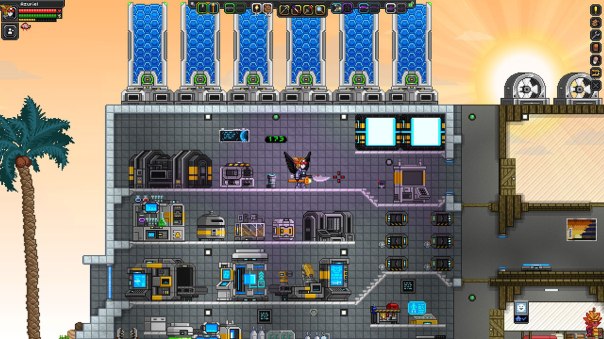
My current base. Not pictured: Healing Water hot spring.
What has won me over are all the changes made to support the above complexity. Dozens of new elements and ores have been added to the game. There is now a large number of completely new planet types, and every planet has been infused with micro-biomes. Difficulty is increased across the board as well, making the exploration and exploitation of these new worlds require a lot of attention.
After every night that I play this game, I spend a few minutes in bed thinking about what I plan on accomplishing during the next playing session. “I need to restock my supply of lead.” “Okay, I built the armor set that gives me immunity to proto-poison, so I should be able to get some Protocite Ore.” “I should really create an ocean base for the free water.” “Why haven’t I gotten my crop situation in order?” It never seems to end. Which is great because, at the moment, I don’t want it to.
That said, I did struggle in the beginning. There was too much to take in. There are some tutorial quests that kind of guide you around, but almost all of them simply exist to get you to construct one of the many new crafting stations and leave you staring at yet another huge list of miscellaneous nonsense. The only way past the Analysis Paralysis is to hyper-focus on the one thing that you want to craft, and follow that one thread all the way to the bottom.
A few days ago, I finally constructed my Terminal network. What does it do? It allows me to link together a bunch of storage containers and then output the results on terminal stations placed around my ship, such that I can type in a name of something, then have it spit out the requested item into my inventory. You know, functionality that… exists by default in most of these sort of games. But it doesn’t here, and now it does, and I feel very satisfied about it.

Sometimes you have to be unfair.
One additional positive I want to mention here is that I like how the mod author(s) included means to bypass some of the systems. Between the various vendors in the new science outpost and a craftable Ansible Network station, you can outright purchase a lot of the more rare ores and components, if you haven’t been able to track down their locations on planets. It costs pixels (aka money), sometimes A LOT of pixels, but it is there as an option if you just so happen to need three more bars of Quietus Ore or whatever.
What I will say though, is that not every aspect of the game is especially coherent. The Medical Station allows you to craft healing items, like in the base game. The Medical Kit II recipe requires Honeysilk Bandages though, which requires you to to engage with the whole Beekeeper system. Meanwhile, Medical Kit III goes back to more typical FU materials, and you don’t need to have crafted the prior version to unlock this one. The armor system behaves similarly – there are redundant sets (sometimes a good thing), many completely useless ones (comparatively), and a few that are clearly superior in every way.
Oh, and you can craft booze too. Unlike the Bee things though, I can’t tell that any part of it is necessary. Maybe for roleplaying purposes?
In any case, there it is. After ~100 hours of mucking about, I feel like I’m within spitting distance of some of the best armors in the game, and likely the end of novel experience. The skeleton of Starbound’s linear story remains in place, but I’m not sure that I’ll continue on with it once I get bored of flying around. Unlike other random-gen games, Starbound doesn’t benefit from multiple playthroughs, as you can pretty much go wherever you want, making anything you want, as soon as you want.
That is, of course, one of it’s biggest strength too.
Fallonomics
We live in interesting times.
Eurogamer is reporting that even the /r/Fallout76 subreddit is rebelling against the high prices of the Christmas cosmetics in the Fallout 76 Atom Store. A Santa/Mrs. Claus outfit plus Stuffed Radstag CAMP decoration and matching player icons is retailing for 2000 Atoms, or basically $20. Then there’s a Red Rocket Mega Sign for $14, set of Holiday Emotes for $12, and the perennial Power Armor paint jobs that debut on release for $18.
The article ends on this note:
It’s worth pointing out all this stuff does not affect gameplay, beyond the aesthetic. You can’t pay for a powerful weapon or more perk cards, for example. Still, at these prices, it’s easy to see why players feel like they’re getting ripped off.
It’s also not a good look for Fallout 76 at this point in its life, a month after the disastrous launch. It is (was) a full-price game. Selling skins at the kind of price you’d expect to see from the free-to-play Fortnite doesn’t make a lot of sense for those who paid full whack at release.
It’s worth noting (again) that you earn Atoms from in-game activities. At level 70, I have accumulated around 3000. The bulk came from one-time “challenges,” but there is a trickle of daily quest-esque rewards and some weekly ones that, combined, will give you about 570 Atoms per week. The angle is clear for all to see though: Bethesda wants you to purchase a few big-ticket items with the first hit of cash shop crack, and then bust out your credit card for the rest.
This, of course, makes Bethesda a monstrous, amoral scumbug, charging nearly half the cost of the base game for the modern equivalent of horse armor. Did they think they could get away with it because Fortnite charges more?!?!?!
Clearly, you should log out of this always-online multiplayer game and log into Guild Wars 2…
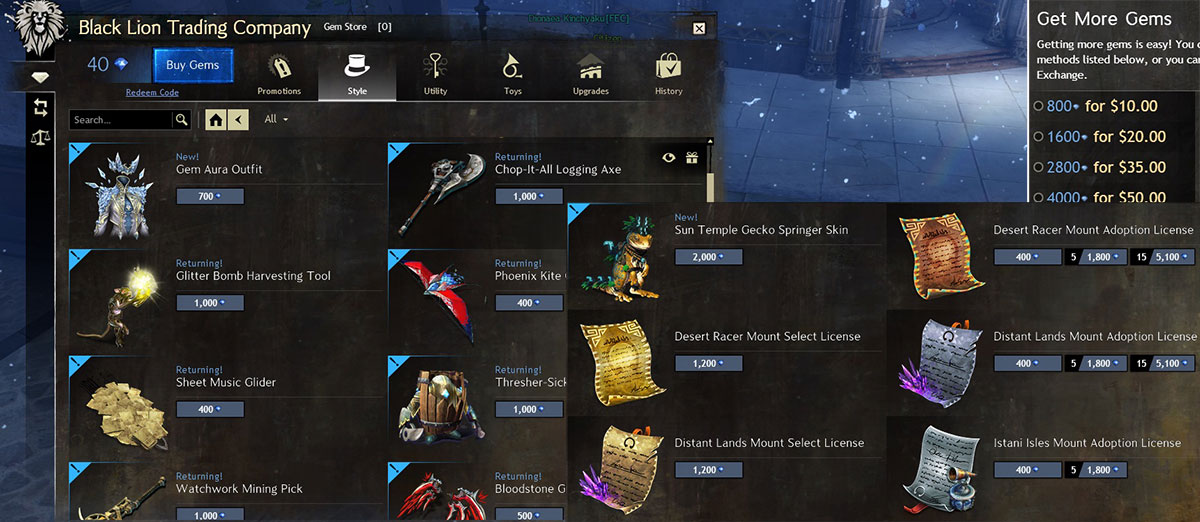
When you convert the tricky gem prices, you get $8.75 for cosmetic clothes, $5 for glider skins, $12.50 for new resource node animations, $5 for random mount skins, $15 for a specific mount skin, or $25 for a super-special mount skin. This is to say nothing about selling bank tabs and bag slots in a game especially designed to fill your inventory with massive amounts of junk.
Let’s log into WoW instead…
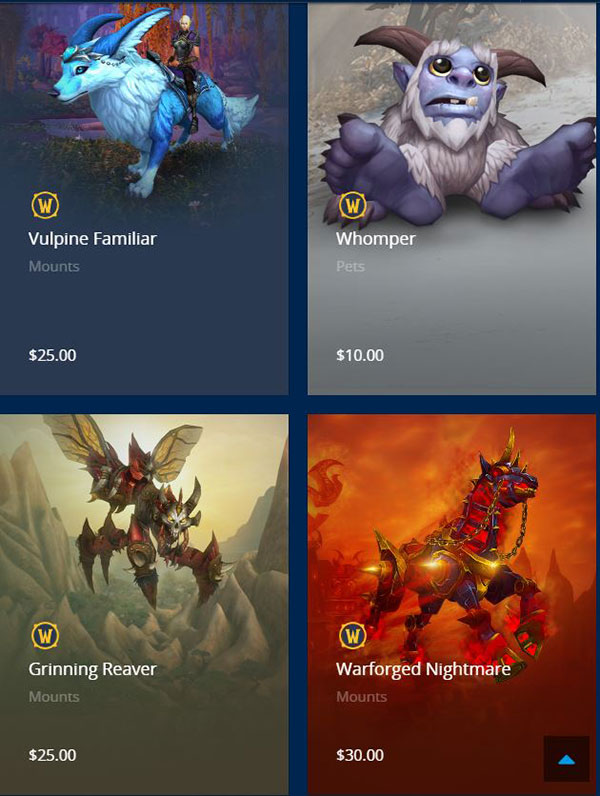
Ah, almost the original home of the $10 pet and $25 mount, to say nothing about the completely outlandish prices for character services like name changes and server moves.
Or maybe log onto Elder Scrolls Online…
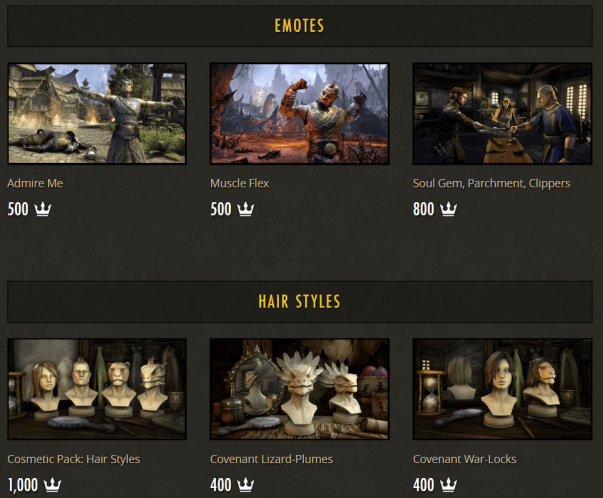
Crowns appear to be 100:$1 ratio when not on sale, so that’s about $4 for hair, $5 for emotes, and between $9 and $30 for mounts. There is also a housing section in the store that features, at the top end, “The Orbservatory Prior” clocking in at $150 (furnished). I don’t know enough about ESO to comment on the value proposition of that purchase, but there it is.
“Fallout 76 isn’t an MMO!” I agree. But we all knew going in that Bethesda was going to pay for Fallout 76’s ongoing costs by way of cash shop purchases. Some of these complaints seem to be from people awakening from cryogenic sleep, discovering modern multiplayer gaming for the first time. While many are saying that the prices should be lower, I am not entirely convinced it could ever be low enough to bypass the “controversy.”
Did I think at the end of 2018 that I would be defending Bethesda cash shop purchases? No. The Atom Shop stuff is certainly more expensive than I would ever pay, if I did not have about $30 worth of credit from playing the game. And I am sympathetic to the argument that a full-fledged MMO has a greater volume of content that could conceivably justify higher prices elsewhere.
That said, complaining about the Fallout 76 store is a reach. If/when Bethesda starting putting shit in lockboxes – like they did with Fallout Shelter, a F2P mobile game everyone praised – that’s when the knives should come back out. Until then, stick to the legitimate, if boring, stuff like bugs and PR.
Game Developers as Chefs
Estebon had an interesting comment on my prior Entitlement Culture post, in defense of the experts:
There is, unfortunately, a general zeitgeist of mistrust toward expertise in the world today, which has bled over to gaming. Gamers, particularly of the self-identified variety, make for an especially fertile ground for that sort of thing, for cultural reasons.
Game devs are supposed to be the experts in their field. They’re the ones who, at least in theory, beat the hiring/funding gauntlet on their merits. That their opinion on how to make a good game ought to carry greater weight than that of the person in the street used to be… more or less self-evident, as with any other profession.
It’s difficult to imagine a set of statements that I disagree with more strongly on a fundamental level.
First, suggesting game developers are “experts in their field” because… they’re game developers… is a tautology. We might assume that these bigger game companies have some kind of hiring standards, but that never really seems to be the case. Instead, it’s often more recursive like “previously sold a popular game” or “already worked for us in QA” or “nobody else applied.”
Remember Greg Street (aka Ghostcrawler) of WoW (in)fame(y)? From his Wikipedia article:
Street graduated from McDaniel College in 1991 with Bachelor of Arts degrees in Biology and Philosophy, later earning a PhD in marine science. Between 1996 and 1998, Street worked as a Research Assistant Professor at the University of South Carolina.[8] […]
Game Design career
Ensemble Studios, the team behind the real-time strategy series Age of Empires, employed Street as a designer in 1998.[8] With no education or experience in the game industry, Street suspects he was accepted due to his “writing and teaching experience, historical breadth, personal hygiene, gudd speling [sic], creativity, [and] my talent at capturing live alligators”, as well as the user-created scenario for Age of Empires he submitted with his application, which later appeared in Age of Empires: The Rise of Rome. Street helped develop every Age of Empires game from Rise of Rome on, until his departure from the company. At first he designed in-game scenarios and maps, and later graduated to being the team’s lead designer.[9]Street was hired by Blizzard Entertainment in February 2008, and was the lead systems designer on the MMORPG World of Warcraft until November 2013.[8]
Now, you can hate Ghostcrawler’s philosophy during his WoW tenure – I personally thought it was fine overall – but the fact remains that this marine biologist worked for like two years, wrote an Age of Empires scenario, and then a decade later became a billion-dollar franchise game developer (or a prominent cog in the machine thereof). Twice! We have to either assume that Ghostcrawler is a hidden genius, or there are no particular standards that apply to game designers generally.
There is a third option too: the M. Night Shyamalan effect. You know, the producer of the 1999 cultural touchstone film, Sixth Sense? He followed-up with Unbreakable and Signs which were whatever. After that, it was solid decade of unremitting garbage films. Shyamalan is a supposed expert in his field, as evidenced by movie companies continuing to hire him, but clearly he lost whatever magic he had. Or perhaps more likely, the seam of magic he just happened to tap into shifted, and he wasn’t able to find another.
I bring a lot of this up because I find the hero worship of brands or developers (or anyone) to be… misguided, at best. For one thing, if these people were “experts in their field,” one would expect less game studios to be closing down or laying off staff. As I pointed out a few years ago, most of the same people have been working on WoW this whole time, so any declines in perceived quality can be attributed to the Shyamalan effect.
The only measure that matters for an expert (game developer) is continued, consistent results. Did they make your favorite game back in the early 2000s? Good for you… but why are you still waiting for them? It boggles my mind whenever someone talks about Bethesda and Morrowind, for example. That game came out in 2002. It can still be great, but you knew after Oblivion that something changed. How many new Shyamalan films are you going to sit through before you give up?
From the player side, Estebon pointed out:
J. Allen Brack got memed for his “you think you do but you don’t” line, and devs and customer relations reps have long been trained to pay lip service to the idea that the untutored mob knows best, but people routinely say and demand things that are not remotely reflected in their behaviour or proclivities as reflected in the internal metrics available to game developers. Elsewhere, insane fortunes have been built by paying attention to what people do, not say, and giving us things we never asked for or imagined we needed.
I actually agree with that. Players are generally bad with coming up with the solutions to their problems, even when the solutions aren’t inherently contradictory. What players are exceptionally good at though, is identifying that a problem exists in the first place. The problem might only be impacting them, specifically, but that’s all that really should matter to them or anyone.
All of this is to set up my title analogy.
Game developers are chefs. You don’t need to go to culinary school to be a good chef, and having a degree doesn’t mean you always cook tasty food. Being the best chef in the world will not stop a dish tasting like shit if there is too much salt/it’s burnt/etc. We might expect a master chef to avoid rookie mistakes, but there is another integral component to the dish: the tastes of the person eating it.
In a restaurant, we can assume the customer is choosing a dish they think they will like. If it comes out too salty to their taste, no one bats an eye at said customer complaining about it. “Entitled diners not wanting their food caked in salt!” The relationship is inherently transactional, and there is an expectation of quality. There are limits, of course; no one should expect Chik-Fil-A or KFC to sell burgers, for example. It is also unreasonable for ten chefs to cater to the individual palettes of ten million individuals.
Is that going to stop you from complaining when you get served a salty steak, or if the French Fries are limp at a chain restaurant? Should that stop you? No. I couldn’t cook a restaurant-quality meal, but I sure as shit can criticize one if it comes out poorly. Gaming today is no different.
Granted, it used to be different. The last bit of Estebon’s comment was:
I struggle to think of any other form of entertainment where the audience claims the right to meddle in the details of the creation process quite to the same extent, as opposed to just letting the product succeed or fail as a whole, in a binary way.
Back in the day, games were done. Cartridges were manufactured, CDs were pressed, and physical media was sent to stores. If there were still game-breaking bugs or exploits that got past QA, well, hopefully they weren’t bad enough to sink an entire $10+ million investment. Games in that era were more akin to traditional entertainment like movies or books in the sense that fans could only possibly influence future decisions. Once it was out, it was out.
As we are abundantly aware today though, games are now a service. Something like a Day 1 patch clocking in at 40 GB is not uncommon. No one expects to unwrap a PS4 on Christmas and immediately start playing anything. Moreover, game developers want us to know that development is an ongoing process. A game in maintenance mode is “dead,” and one which is no longer receiving updates is “abandoned.” We barely even have the language to describe a finished product anymore.
Gamer entitlement didn’t get us here. Game makers leveraging social media for free PR and turning “lip service” into a competitive advantage got us here.
Which is just as well, because I’m not especially convinced anyone knows what they are doing. Did Notch know he created a $2 billion game when he released Minecraft? The original dev team for WoW certainly didn’t know they would have 8 million subscriptions by the end of 2008, nor have they been able to do much to stem the bleeding over the last decade. We can’t attribute all of this to corporate malice, because that doesn’t explain why these rockstar developers can’t recapture lightning in a bottle when they move elsewhere.
If you can’t reproduce results, what does that say about your expert game development science?
I think the important thing is to not put game developers on a pedestal. They aren’t scientists (anymore) doing peer-reviewed studies changing the way we understand the world. They’re just people who have eaten food before and think they could come up with something better. Occasionally they do, and even more occasionally they do it on purpose. But can they do it again?
Entitlement Culture
Apparently I write about (gamer) entitlement every two years.
Well, here is the 2018 version, inspired by this section from MMOBro’s recent post:
The problem with trends is that businesses chase them to the detriment of innovation and traditional success stories. It also reinforces the entitlement culture gamers have developed over the years. Read responses to any game developer’s tweet if you don’t believe me. “I supported you for 10 years and now you RUINED Magic Turtle Kingdom by adding BLUE HAIR! READ THE LORE! You’re so stupid I uninstall and never support you again.” This is an issue with society at large, but game design continues to move in a direction that feeds player entitlement. Games tell players they earn their wins but aren’t to blame for their losses, and egos balloon as a result.
All of this creates more toxic communities, games developed for the common denominator, less creative character development, and less chances to show player skill. It’s not where I want see game development money heading, but you can’t outrun a tsunami.
The Bro’s overall post was about the lamentation of the “MMOification” of all gaming genres. Which is a thing more commonly referred to as “adding RPG elements,” but seeing as RPGs are becoming rather scarce these days, MMOs are probably a good enough example to explain what is happening. Which, basically, is a cross-generation acknowledgment that XP and seeing meters fill up is pretty universally compelling (to a point).
But what I actually want to talk about is this part:
It also reinforces the entitlement culture gamers have developed over the years.
No.
First, using “entitlement” as a pejorative is a thought-terminating cliche that absolves one of examining whether the implicit claims make any sense. By saying “entitled gamer” you really mean “gamer who erroneously believes their opinion has value” without bothering to explain A) why that opinion holds no value, and B) why your own opinion does.
But it’s worse than that. The (presumably hypothetical) example of a gamer tweeting criticism of an apparent lore discrepancy is meant to make the entire exchange seem ridiculous. Not just the threatening of uninstalling part, but also, implicitly, the giving so much of a shit about lore/story/world in the first place. I agree that such a tweet is bombastic and the tone counter-productive. But instead of having a conversation about whether the designers actually ignored the rules of their own game fiction, we’re talking about “entitled gamers.”
Second, there is a presupposition that gamers have changed over the years at all. Did you really not know anyone who behaved like this hypothetical entitled gamer prior to the age of MMOification? Did not see them in high school, or the Returns section of Wal-Mart, or at the sidelines of their kids’ soccer games? Did you not encounter them playing Magic: the Gathering, or in Counter-Strike lobbies, or in your D&D group? Did you perhaps only encounter them once you started playing with large groups of completely random people from across the country/globe?
What changed was access. If someone was really upset about Super Metroid, they mailed a letter to Nintendo Power or otherwise shouted into the void. You never heard it. These days, they shout in your Twitter feed, your Facebook timeline, or in your subreddit. None of which existed prior to 2004, by the way, and didn’t get really popular until years later. We’re barely a decade into this grand “give everyone a voice” experiment, and as it turns out, not everyone has something nice to say.
Even worse/better, the developers want the shouting! Probably not the death threats and general ugliness, but absolutely the feedback and passionate, free advertising that spreads by digital word-of-mouth. These companies are not handing down stone tablets from on high – they are selling a product. And when you are in sales, it literally pays to attend to the ministrations of your customers.
This positive attention, not generalized entitlement, is what encourages a quite literal feedback loop. Maybe this loop counts as changed behavior, but that’s a function of attention, not egos inflated by game mechanics. I still contend that we’re only more aware of the nonsense these days because the devs have Twitter accounts (etc) to conveniently compile all the nonsense in a single location, which we then encounter as we try to glean nuggets of design wisdom from the chicken entrails.
In summation: when you pool everything in the same place, of course the turds float to the top.
The irony is that, at the end of the day, we all want better games, yeah? We may disagree on what “better” consists of or how to accomplish it, but we all desire fun things to play. The one sure-fire way to not achieve that goal is to claim one’s opponents as “entitled” or that there is an “entitlement culture” and thereby erode the very notion that gaming can (or should) be taken seriously at all.
If the kind of games you want to pay for are no longer being made, that’s a market failure. Threatening to quit over blue-haired turtles is rather silly, but I’d rather have developers attentive to details than the opposite, and you should too. Because, eventually, it will impact your favorite game.
And then you will not be entitled to complain about it.
 In An Age
Waxing my Wane
Jan 7
Posted by Azuriel
I’m generally a pretty frugal guy. Parsimonious, even. And yet I just bought half a dozen games in as many days, after having avoided doing so for these specific titles for as many years. “They were on sale though.” They were on sale last year too. What changed?
The void.
Specifically, I finally exhausted my desire to play modded Starbound (Frackin’ Universe)… after 100 hours. One. Hundred. Hours. When you get up to triple digits like that, with any game, the entire experience becomes more than just “having fun” and instead morphs into a whole routine. I would play in the evenings, lie in bed planning my actions the next day, and browse wikis and such during the day. It all really hearkened back to my heydays of WoW. Minus a few thousand hours, of course.
Then, one day, it’s all just gone. Whether it’s the game ending or just getting tired of it, the experience is over.
I am not sure how other people handle post-game depression. My go-to move appears to be ennui of unknown duration. I know of games that could probably suck me right back into mainlining. But I don’t feel like it. In this lucid state, smaller experiences seem like the better course of action. If I don’t play them now, I definitely won’t be playing them later when absorbed in something else.
So out comes a little retail therapy.
We’ll see how it goes. Right now the routine is playing a few missions in Far Cry 5, followed by an area or two of Knife of Dunwall (Dishonored DLC). The segmentation is not on purpose – I can only seem to stand playing either one in short bursts. Not exactly a glowing review, but I blame the ennui more than the gameplay itself. After these two, hopefully the pallet will be cleansed, and I can get into the more cerebral titles like Hellblade, Prey, and/or Final Fantasy XV.
And then… we’ll see.
Posted in Commentary
1 Comment
Tags: Ennui, Mod, Parsimonious, Post-Game Depression, Starbound, Steam Sales