Impressions: Oxygen Not Included
Oxygen Not Included (ONI) is a base-building and resource management game currently in Early Access, in the vein Dwarf Fortress and RimWorld. At least, that is what people tell me, as I have not played either one of those. What I have played is Craft the World (pt1, pt2), and ONI is basically that, minus the dwarves and goblins.
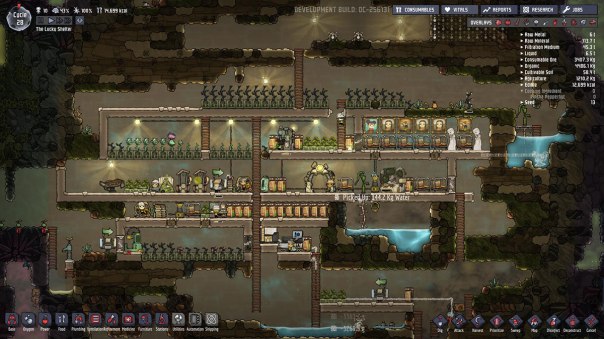
My first base. Doomed to failure.
The premise of ONI is actually kind of compelling. After picking three Duplicants from a roster of randomly generated ones, they appear in the middle of an asteroid. The ostensible goal is to survive as long as possible using what resources you have available. Instead of controlling them directly, you the player can generate and prioritize tasks like digging out certain squares, constructing machines, etc, and your Duplicants will work to make that happen. Contrary to the title, some basic oxygen is included in the form of oxygen-generating rocks, but it is not nearly enough to last long-term.
Indeed, oxygen-management is indicative of what you will be working on over the arc of the entire game. In the beginning, you will create machines that convert algae (mined from special squares) into oxygen to supply your base. However, your Duplicants exhale CO2, and that will gradually accumulate in the lower reaches of your base (science!). So, eventually, you are going to need to either research technology to convert that CO2 into some other form, or at least pipe it elsewhere. Meanwhile, you also have to grow food, find water, and research some method of disposing of all the poop (or polluted dirt, if you prefer) your Duplicants generate. Have I mentioned there are germs and stress to worry about too? And the fact that you are in the middle of an asteroid, so the whole “pump the CO2 elsewhere” is really just delaying the problem for another day?
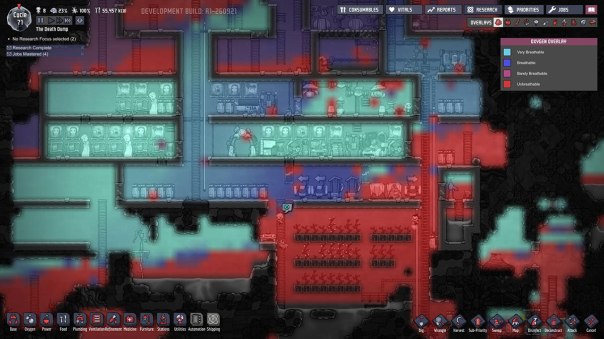
Gas management is much better in my current base.
As of right now, I do not believe there is a story or “campaign mode” for ONI, and I do not know if there is any planned either. The goal is to survive as long as possible, and there are some very optimized base configurations out there to ensure that is the case. However… I’m not sure that is enough for me, game-wise. Klei’s other popular game, Don’t Starve, also features an implicit goal of surviving as long as possible against escalating threats. The end-state of death there though, usually comes from violence or mistakes rather than slowly running out of finite resources. I felt much more agency in Don’t Starve, in other words, even if the outcome was very similar.
What I will say is that Oxygen Not Included grabbed my attention very early with a compelling premise, and makes me wish there were more Terraria/Starbound/etc survival games out there that I haven’t already played . Hmm… maybe it’s time for RimWorld then…
A Bridge Too Nier
I have completed Nier: Automata (N:A) all the way.
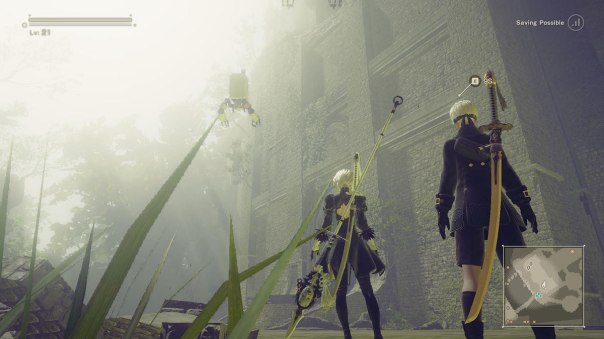
Again, the visuals were extremely good.
As I mentioned a few days ago, the major impetus for my buying N:A in the first place was the seemingly unrelenting stream of praise it received. “Best game ever!” “GOTY 2017, if not of all time!” Those sort of proclamations immediately actives my Bullshit Sense, honed as it is after the Bioshock: Infinite debacle. That was almost five years ago now, and I’m still mad that it gets any praise at all. Seriously, people, that was not a good game.
Suffice it to say, Nier: Automata is not Bioshock: Infinite. In fact, it is extremely good.
But does that mean N:A lives up to its hype? Well… yes and no.
When I look back on the games I view as true epics with moving storylines and compelling characters, I see games like Xenogears. FF7. Chrono Trigger. The Mass Effect trilogy. In this context, I did not feel that N:A’s plot achieved a spot on that pantheon. At the same time, I can also recognize that Xenogears was released in 1998, which is possibly before many fans of N:A were even born. So, in a sense, I can see how someone can view N:A as being the best story they have experienced.
However, pure epic story-telling is not the only prism through which a narrative can be judged. When I think about my experience with Far Cry 2, for example, I found it deeply moving and incredibly clever from a meta-narrative perspective.
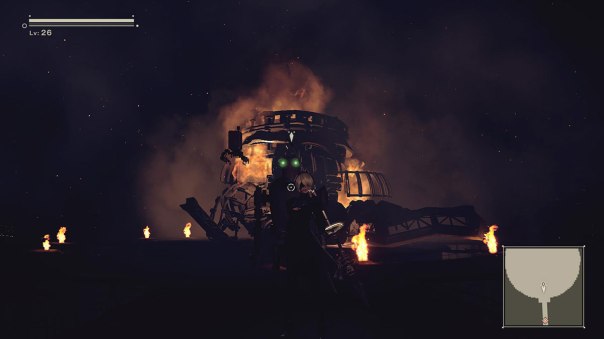
Robotic hearts in the darkness.
Far Cry 2 was a slog of bloody, seemingly pointless firefights against interchangeable factions all the way to the very end. And that was the point. The gameplay itself was being used as an emotional vehicle for the player to show them experience the pointlessness of the conflict firsthand, and feel your own culpability in perpetuating a cycle of violence for ultimately selfish ends. When I was finally given the option at the end to either escape Africa or stay and sacrifice myself to save some refugees, the weariness and resignation I felt via the protagonist was real to me too. Staying behind to manually blow the bomb came as an immense, cathartic relief.
It is in this sort of reference point that Nier: Automata actually deserves the praise it receives. N:A is no Xenogears, but it is a Far Cry 2. Or Metal Gear Solid 2. Or Spec Ops: The Line. Not in the content of its message necessarily, but in its clever use of gameplay mechanics and subverting expectations to elicit emotions rather than relying on plot alone.
Indeed, one of the most poignant and moving sequences in the game occurs during the closing credits of the E ending. I went from rolling my eyes, to mild interest, to frustration, to finally… an emotion I had not experienced since Journey. And right at the very end of it all, the game asks a final, devastating question of the player, that I was not expecting nor prepared to answer.
And I blinked. Days later, I still feel somewhat guilty.
You would be forgiven for wondering why the above is not enough for Nier: Automata to take a seat next to Xenogears. I might just be obstinate. Or it may simply be as banal a reason that those PS1 classics came first, or were experienced in my more formative years, or both. But still, I hesitate.
Honestly, it is probably better for everyone to temper their expectations anyway. If you go into Nier: Automata thinking you will experience a 10/10, or something far and away better than whatever you view as your favorite game, you will probably be disappointed. If instead you go in with eyes open, acknowledging the fact that you will essentially need to beat the same game twice (from two different perspectives) before the “real” game begins, you will likely be more open to the emotional notes that the game elicits.
Plus, I hope you like action games. And twin-stick shooters. And… you get the idea.
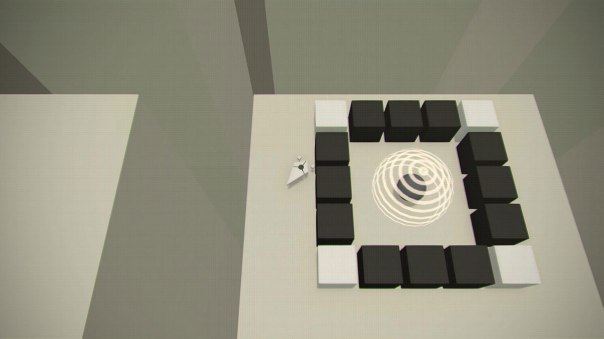
And hacking! Can’t (ever) forget that.
Speaking of notes though, the soundtrack is every bit as amazing as they say. It is a complete aural experience, with familiar themes expanding during epic moments, or contracting when the action inverts for a hacking mini-game. Some soundtracks have a few good songs, but Nier: Automata is good the entire way through, at every moment. Haunting, melodic… perfect. It absolutely deserves a seat with Mitsuda’s Xenogears and Chrono Trigger, even if thematically they differ.
So, yeah. Nier: Automata is worth playing. It’s not perfect, but it’s so goddamn ridiculous and bold and eccentric and sometimes horrifying and sad. And, ultimately, meloncholy. There are bad bits, some boring parts, and some questionable design decisions. Yet, more than anything, this is a game that ignored what everyone else was doing and shot for the moon. That ain’t nothing.
caRNaGe
There is a lot to be said about the RNG inherent to Hearthstone. A lot of the games can be decided by coinflips, outrageous Discovery choices, and all sorts of random nonsense.
You know what’s infinitely worse IMO? Not drawing your cards.
Jesus Christ, I have had some insanely bad luck in the last four games I played. We’re talking getting to the last 7 cards in my deck, which consisted of four mana-ramping cards, the Malfurion DK Hero, Ultimate Infestation, and Jade Idol. As in, I somehow held on and dug through my deck that far, but not far enough for it to matter. If any of those had been closer to the top of the deck, I might have had a fighting chance. Switched decks to Spiteful Priest, then faced the mirror match wherein my opponent hit both his Spiteful Summoners on Turn 6 & 7, but mine were nowhere to be found.
Do I care that his summoned a 7/14 creature that I had no clean way to counter? Nope. RNG is RNG.
What I care about vastly more is how badly my deck(s) have bricked the last half dozen of games. Your opponent top-decking the exact answer they need, or having a God-Hand that kills you on turn 4 is not something you can really do anything about. Your own deck not giving you anything – literally against all odds – is something else entirely. Give me those 50/50 losses over an improbable streak of 10% failures that leave you with no options.
Except, it’s worse than 10%. Seriously though, look at this:
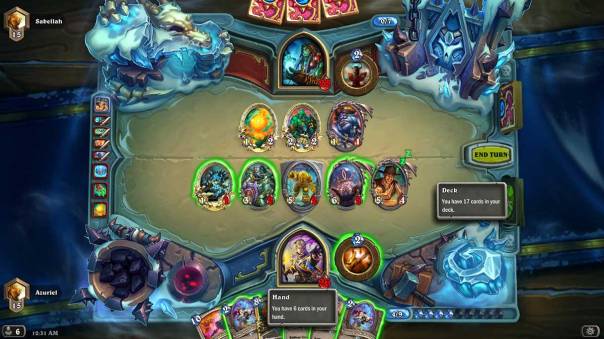
Sadly, the deck tracker is an overlay that wasn’t captured.
I ended up 14 cards deep into my deck before drawing my first dragon, when there is eight of them in there. According to this Hearthstone calculator, the odds that I should have had at least one in my hand by then is 99.5%. That doesn’t even account for the fact that I mulliganed two cards.
Statistically, 0.5% days happen. But when multiple of them happen in a row, when you only play ~20 games a week… yeah. Let me play against my opponents and lose due to a bad matchup or poor trades. Don’t let me lose to the equivalent of Mana Screw in Magic: the Gathering. That is way worse than losing coin flips, IMO.
Action Gameplay
I’m still making my way through Nier, and it’s an interesting experience to analyze in situ.
Aside from the moments when it turns into a bullet-hell shoot-them-up, Nier is an action game in the vein of Devil May Cry. You have a Light attack, a Heavy attack, a Ranged attack, and a special skill. There are technically combos, I think, but I’m not sure it’s especially more productive than just mashing buttons. The only real “decision” is when to press the Dodge button. Which, by the way, can be spammed with no penalty to essentially gain infinite invincibility frames.
The end result is a relatively simplistic combat system. And it’s… still fun? I guess.
One of the common complaints regarding older MMOs like WoW is that tab-targeting combat is boring. Or mindless. 111211131141. While Nier is certainly more active from a combat perspective, I’m not sure that it is less mindless. XXXYYYXXY with some RT in there (on a controller) to dodge. If I just stood there and didn’t dodge in Nier, sure, the enemies I’m fighting might be able to kill me; conversely, most enemies in WoW can be face-tanked. But does that really matter?
The whole situation kind of reminds me of the difference between driving to the movie theater and watching the movie. The action of driving somewhere is much more involved than watching the screen – there are thousands of more individual choices and reactions necessary to drive somewhere safely. But is it more engaging? At the end of the night, which do you remember more?
And really, this is a problem with Action games even in the absence of thousands of incidental enemies you have to mow down. Furi features action combat that focuses just on bosses. I played it for a few hours, got to the second boss, and ended up setting the game down. It’s just not particularly compelling. Sure, it feels good to be able to perform the button presses necessary to avoid death. That’s a sense of personal progression.
But… I don’t know. Just like with driving, I kind of zone out the experience when I’m killing enemies in Action games. Or rather, become so hyper-focused on the moment-to-moment reactions to stimuli that I lose the overall plot. Once I get to my destination safely, the process by which I got there exits my short-term memory and becomes no more than a fuzzy recollection of time spent.
Perhaps this is less an indictment of Action combat generally, and more a specific Nier issue. Perhaps I should crank up the Difficulty slider up a notch. But I’m not sure that that would accomplish anything more than slippery road conditions would “improve” the driving experience. Common enemies would require greater focus, and yet the “reward” would be the same.
Maybe that’s just it: action combat is typically less overtly rewarding. Nier enemies drop currency and occasionally crafting mats, but it’s not on the same scale as a WoW mob. There are simply more and multi-faceted reward types in RPG-esque games than Action ones. Action games focus on the action, and generally try to reduce downtime. Go too far, and you end up the Borderlands Zone where you have to take a 5-second break after each gun drop to compare it to your equipped arsenal. That sort of thing completely breaks the flow in a way that, say, Skyrim does not.
I dunno. I’m not even through my first playthrough of Nier – New Game+ is apparently mandatory to see the rest of the plot – and I think that I had better buckle down and ignore sidequests from here on out. If I don’t, I think there is a serious chance that the combat becomes too boring to finish.
[Fake Edit]: Completed both A & B endings this weekend. Combat got more boring in B, which I didn’t think was possible. Let’s just hope C+ is a bit better…
Impressions: Nier: Automata
For months and months, I have been reading praise of Nier: Automata across Reddit and Steam forums with extreme skepticism. How good could this game be, really? So when the game finally hit 50% off on Steam recently, I bought it with an implicit goal of “getting the facts straight.”
Based on 5 hours thus far, I can safely conclude this: it’s pretty damn good.
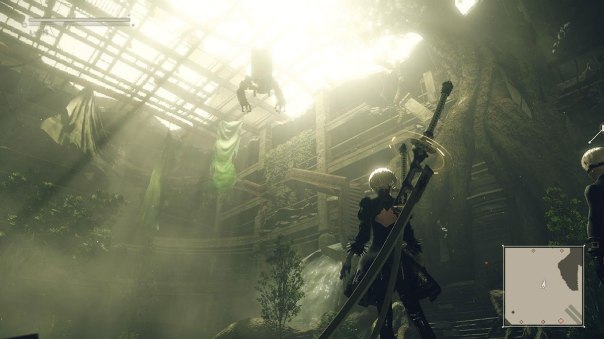
Looks pretty damn good too.
It’s still extremely early, but part of that goodness is wrapped up in how incredibly bold the game is in its own style. The starting section of the game is you piloting a ship like in an old-school, top-down shooter, including dodging slow-moving energy spheres. Then your ship “goes mobile” and things turn into a twin-stick shooter. Then you finally dismount and start attacking enemies in a 3rd-person action game ala Devil May Cry. But then there is a section where you’re running along a metal walkway, and the camera pulls out so you can face enemies in a side-scrolling style. Minutes later, there’s another section where you do the same thing with the camera directly overhead.
Any particular one of these camera tricks would be a gimmick. But, somehow, doing all of them… works. The expectation is now set that the game style will change to fit the scenario, and I’m either on board with it or I can leave. The game feels… confident, in an unapologetic JRPG kind of way.
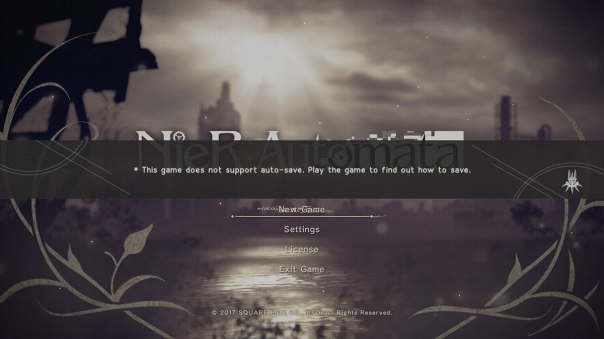
Oh, of course.
The unapologetic-ness is really a reoccurring theme, actually. I checked out the forums before I started playing, because I had heard that the game is non-functional without the fan-created FAR mod, which fixes framerate issues. For the record, the game runs perfectly fine for me out of the box. One of the threads mentioned the fact that if you die in the hour-long opening sequence of the game… you have to redo the entire thing all over again. There are no checkpoints, there are no quick saves. As someone who has been playing Dark Souls-esque games lately, this is familiar territory.
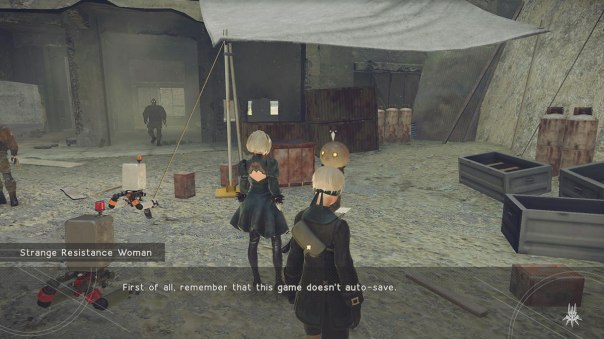
OK, yeah, I got it.
That said, by default 2B is equipped with a “plug-in chip” that will automatically consume a potion when damaged below 30% HP, and enemies certainly don’t one-shot you as they can in other games, so it’s not too punishing. Plus, if you change the Difficulty to Easy, you can equip additional chips that will even automatically Dodge attacks for you. I’m actually not quite sure how that works, as I’m playing on Normal, but at least there’s an option.
One thing I did want to mention in this initial post too was the music. Wow. I just got to the second area and there is already music with actual lyrics just playing casually. Running around the ruined city nearby produced a track that heavily reminded me of Xenogears. Which, by the way, was probably the moment I felt myself just relax and settle into my chair, in a sort of metaphysical way.
Plus, you can fish. Androids fishing up mechanical fish in a post-apocalyptic Earth, to sell for cash to buy healing potions. Because Japan. It’s great.
So count me converted on Nier: Automata already. I’m in it for the long run.
The Long Starve
I was reading through The Long Dark’s (TLD) wiki the other day, when I came across the missing piece of the game’s puzzle: it’s okay to starve. Mind. Blown.
Fundamentally, you die in TLD when your Condition meter reaches zero. There are four separate meters (Needs) that affect the Condition meter: Warmth, Fatigue, Thirst, and Hunger. If any of those meters reach zero, you start losing Condition. However, you can still do things while a Need is zero, e.g. chop wood while hungry or thirty or cold. When at zero, the Condition loss per hour is:
- Warmth -20%
- Fatigue -1%
- Thirst -2%
- Hunger -1%
While you technically regain Condition as long as all four Needs are above zero, the gain is like 1% per hour. Meanwhile, if you sleep in a bed for 10 hours, you can regain up to 65% of your Condition bar in one go. The requirements? Drink some water before bed and consume ~600 calories. That’s it.

The exact calorie cost depends on a lot of variables.
To understand the implications, here is a paragraph from the wiki:
2800 calories would be consumed during 14 hours harvesting carcasses. But if no calories are available (Hunger is empty), about 15% of condition would be drained instead. Only 600 calories are required during 10 hours of fully replenishing sleep. So eating only 600 calories prior to sleeping can maintain a character with only briefly lowered condition taken as a trade-off. This is a great reduction from the 3,400 calories that would have been required to keep hunger satisfied the whole day.
In other words, instead of consuming X calories a day, you really only need ~600.
I always thought it was a bit too gamified how I had to maintain such a large calorie intake for normal things, but I chalked it up as one of those weird genre requirements. Turns out that was not the case. So, if you were like me thinking The Long Dark was a bit too brutal of a survival simulation with the constant juggling of resources… just stay hungry, my friends.
Impressions: The Long Dark
I first played The Long Dark ages ago back when it was in Early Access. It was back then, and still is today, a survival game of another kind: a true Player versus Environment. Your primary foe is hunger, thirst, and a cold Canadian wilderness hostile to your continued existence.

Welcome to the middle of nowhere. Population: You.
Having played it for a dozen or more hours now, I can safely say that I am pining for some zombies.
When I said your primary opponent is the environment, I meant it. Outside of the story mode (broken down into Episodes), there are no NPCs. Fauna consists of rabbits, deer, wolves, and bears. I have heard there might be moose involved, and I guess you can technically fish up, er, fish. But that’s really it. While you can eventually craft a bow or loot a rifle, this is not an action survival game by any means.
Given the above, the fundamental gameplay tension is food and warmth. The Canadian tundra is cold, the windchill is colder, and blizzards are colder still. Keeping warm is a challenge, and just finding shelter is not necessarily good enough. That’s when The Long Dark’s thumbscrews come out.
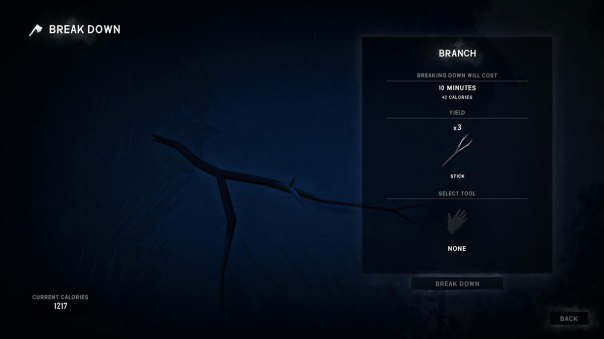
Don’t do this by hand. Or in a Blizzard. Or, really, ever.
See, picking up sticks is easy. Come across a branch that can be broken down into sticks? That’s going to take 10 minutes by hand. Which the game fast-forwards through, but your warmth meter is depleting rapidly all the while (depending on weather and your gear), and now you’re at risk for hypothermia. And those three sticks you got from breaking said branch? That’s maybe 22 minutes of heat in the campfire, which might not be long enough to regain the Warmth you lost breaking the branch outside, nevermind the other firestarting materials. Oh, and it took 42 calories.
The Long Dark takes counting calories to a whole new level. Sleeping takes 75 calories per hour. Breaking down a crate for wood for a fire takes ~62 calories. Walking around for an hour takes 270 calories. Harvesting meat from an animal, so you can cook it to regain calories, takes X calories. Hopefully less than the amount it took you to kill said animal, but not always.
What ends up happening is that you never really feel safe, anywhere. Sure, finding a sufficiently warm shelter is nice. But necessity will drive you from that place eventually. Water is abundant, but needs fire to be produced. Which needs fuel to be collected. Which needs calories to burned. Which needs food to be scavenged or hunted. Which needs you to be outside, in the cold, taking risks.
Being naturally driven from your comfort zone in a quest for survival is brilliant game design. But it is also dissatisfying. Instead of feeling like I have agency, I instead feel despondent. In 7 Days to Die, I forage for supplies so that I can construct defenses capable of outlasting next week’s Blood Moon. In The Long Dark, I forage supplies so I can… stave off the inevitable for another 24 hours. Technically they might be the same in principle, but one feels a hell of a lot better than the other.
Having said all that, I am currently working through Episode 2 of the Story mode and having a plot to follow makes things a bit better. Plus, the locations where the story NPCs live have a fire going 24/7, which makes things considerably easier. Not having the ability to unlock schematics and such as one does in the regular Sandbox version can be a bit stifling (e.g. not being able to craft a bow), but the overall experience is quite good, if a bit linear and directed.
Slay the Spire: Quick Strategy
I have beaten Slay the Spire two times as the Ironclad and three times as the Silent. All of the runs were quite different insofar as specific cards and interactions go, but the overall strategy was basically the same for each one:
Avoid Losing Health
This probably sounds like I’m trolling, but I am quite serious.

Not losing HP anytime soon.
As with many games, HP is a resource in Slay the Spire. However, regaining HP comes at a much higher cost in this game. At each Campsite, you can regain 30% of your max HP, or you can upgrade a card. While sometimes necessary, each time you heal at a Campsite instead of Upgrading a card, you are forgoing dozens, if not hundreds of opportunities of using said upgraded card over the rest of the run. Even if you end up grabbing a specific card or Relic that heals you somehow, that is typically at the expense of a different selection that might have helped you in a different way. Much better to simply not need to heal at all.
So here are my tips in avoiding losing health.
Understanding and Loving Block
Blocking often feels bad, especially when it isn’t enough to absorb an entire attack. Instead of being one turn closer to ending the fight, you instead do nothing and take 2 damage, right?

Fist full of Curses, but Block still set me free.
Well, imagine instead that there was a 1-mana card that said “Gain 5 HP.” Would you play it? Yeah, you would probably play it as much as you could. Guess what. That’s what Block does any time it absorbs damage. There will be times when you will save more HP by burning down an enemy than blocking half the damage, but you also have to look beyond the current battle. If you save 10 damage now by burning down the enemy quickly, but lose 30 HP three fights from now, you have ultimately made a poor trade.
Now, there will be times where you have a fist full of Block cards while your opponent is doing nothing but buffing themselves. Those times will suck, and it’s possible you’ll take more damage overall later. However, consider the opposite case where you have a fist full of attack cards and a pile of damage coming back your way. The latter is much more dangerous than the former.
Combat is for the Fortunate
If you do not have a reliable means of avoiding damage via deck/Relic combos, you should not be taking unnecessary risks in combat. Or getting in combat at all. This means picking a route that bypasses as many regular and Elite encounters as possible. Yeah, combat gives you a chance to add cards to your deck, and Elites giving a Relic is cool, but you can also get cards and Relics in those “?” encounters, typically without losing HP. Do those instead.
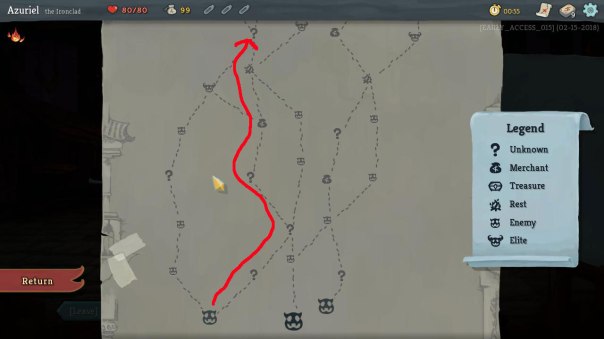
This sort of route is ideal.
The biggest exception to the general rule is everything on the 1st floor. Since you are just starting a run, it behooves you to take as many risks as possible now, when failure does not sting as much, rather than later when you could lose hours of progress.
Relics Will Carry You
Your overall run will, in a large part, be dictated by the Relics you acquire. Nab the one that gives you 3 Block every time you discard a card? You should probably start picking everything that lets you discard cards. The beginning of a run is more free-form as a result, but you generally can’t go wrong with a fast cycle deck. Just make sure you pick up some Answer cards along the way.
Answer the Encounter Questions
Slay the Spire is currently in Early Access so this can change, but generally the “questions” that an encounter will pose and the subsequent answers are:
- Single, large attack | Apply Weaken
- Multiple attacks | Apply Weaken or reduce Strength
- Escalating Buffs | Kill faster
- Punishing Attack usage (thorns, etc) | Kill faster, or Passive damage
- Punishing Skill usage | Attacks that also gain Block
- Punishing Power usage | Only use highest impact Powers
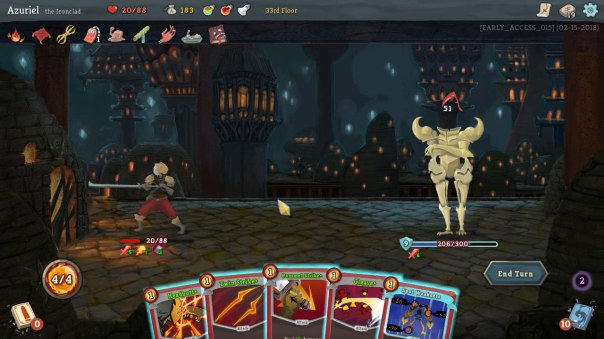
Exhibit A
Generally, you are going to want to have at least one card that applies Weaken no matter what. Several bosses have one uber-attack that will deal more than 40 damage at a time, so that one Weaken card will end up being the equivalent of “Gain 15+ block.” Would you draft a card that said “Deal 9 damage, gain 15 Block”? Of course you would.
Beyond that… well, it depends on the character you chose and the relics provided. Playing as the Silent means you have specific access to some very nice cycling cards, and can pick up cards that apply Poison. Tons of Block + Poison = eventual win. With Ironclad, you are generally more reliant on attacking, but don’t forgo Block cards on your way to stack Vulnerability (+50% damage). I had the most success with Ironclad when I kept a lean deck and upgraded the 0-cost card that buffed my Strength for the turn.
Accumulate Advantage
Some of the cards and relics you pick up during a run have an impact beyond any individual combat. For example, the Feed card gives you an increased max HP when it deals a killing blow, and the Alchemize card grants you a Potion. There are also relics that heal you when you cast a Power, or perhaps grant you a special action when you reach a campsite.
This may seem like another duh moment, but… do those things.
Specifically, engineer scenarios in which you can take advantage of them all the time. If you get a Feed/Alchemize card, start drafting card draw or extra block so that you can stall combat long enough to capitalize on them. If you get a bonus action at campsites, make sure you are not wasting the opportunity by having to heal up. You should avoid having to heal at campsites anyway (so you can upgrade cards instead), but that goes twice as much when one of your precious relic opportunities is consumed by something that is useless otherwise.
Impression: Slay the Spire
Slay the Spire is basically a deck-building roguelike in the vein of Hearthstone’s Dungeon Run with a splash of Dominion. While still in Early Access, damn near everything about the game was compelling enough to grab my attention for 20+ hours immediately after purchasing.

Not a good hand at the moment.
The basic gameplay cadence is to pick one of two classes, and then complete encounters on your way up the Spire. At the start, you have 10 cards in your deck, and three energy to spend each turn. After each turn, cards you played (and any you didn’t) go to the discard pile and you draw 5 more cards. When you run out of cards, the discard pile is shuffled into a new draw pile, repeat ad infinitum.
Your beginning deck is basically filled with 1-energy Attack (deal 6 damage) and Defend (gain 5 block) cards. As you defeat enemies, you get a choice of one of three cards to add to your deck. Some of these are strict upgrades to your basic cards (Deal 5 damage AND gain 5 block), but many of them are completely different mechanically (discard your entire hand, draw that many cards). Adding these new cards to your deck makes it more powerful, but just as with Dominion, a deck with 30+ cards is not as powerful as a deck with 15 cards – you are simply less likely to get the combo pieces you need when you need them.
This is where the brilliance of Slay the Spire comes in. For one thing, it allows you to forgo getting new cards if you wish. Additionally, in shops and certain non-combat encounters, you can choose to remove cards from your deck. This is good both for thinning the lower-impact cards from your deck, and also removing Curse cards (usually just a dead draw) you might have inadvertently picked up. In addition to cards, you can also get one-use potions, and gain Relics, which are typically passive abilities that augment your run in some way.
All of this is on top of a robust buff/debuff system, a dozen or so different enemy types with their own behaviors, a bunch of bosses/elite encounters, some non-combat events, Shops that let you purchase new cards, one-use potions with nice effects, and so on and so forth.
Oh, and have I mentioned that the two available classes have different card pools?
Since purchasing the game last week, I have beaten the final encounter a couple of times with both classes, using (by necessity) several different methods based on which relics I managed to pick up. For example, one relic gives you 3 Block each time you discard a card. Suddenly, Calculated Gamble (Discard your hand, draw that many cards, costs zero) becomes the best defense card in the game, while simultaneously moving you closer to a your win condition cards. Other games required playing and fetching the same two cards as many times as possible. Still other games saw me die to the first elite encounter I faced, three moves into a run.
Roguelikes sometimes dislike rogues, know what I’m sayin’?
In any case, if you were looking for something less RNG than Hearthstone’s Dungeon Run, or enjoy deckbuilding in general, I highly recommend Slay the Spire. It is in Early Access, so technically it could get better or worse, but they would have to essentially gut the entire game at this point to make it not worth the $13 (on sale) I already paid. Buy it, or keep it on your radar once it releases for real.
 In An Age
Clever Flow
Mar 26
Posted by Azuriel
Despite not being initially impressed with Oxygen Not Included (ONI), I continued playing. And now I’m very impressed with the rather clever gameplay flow that Klei has touched upon.
My most successful base thus far.
Like I mentioned before, every game of ONI starts with three Duplicants appearing in the middle of an asteroid. While you have enough supplies for a few days, there is always a bit of a frenzy of activity hollowing out some living space for your Duplicants. Amusingly, toilets end up being actually a higher priority than even water. By the end of the second day or so, I’ve got a water pump set up, some toilets, a bunch of resource compactors (e.g. storage), some beds, a Microbe Musher, and perhaps a manual electricity generator hooked up to an Algae Deoxydizer.
This is where the subtle genius of the game design kicks in.
Ostensibly, your base seems self-sufficient. The Algae Deoxydizer is converting algae into oxygen, the Microbe Musher is turning dirt and water into Mush Bars (e.g. calories). And you presumably have a nice supply of water handy. For now, everything seems fine. Emphasis on the “for now.”
The whole time your Duplicants have been running around, they have been exhaling CO2. This pools in the lower reaches of your base, turning certain sections into unbreathable rooms. Even if you dig out a trench beneath your base for the express purpose of giving CO2 somewhere to go, it never actually goes away – it will eventually become dense enough to spill into upper rooms. So, you’re going to need to research technology to try and filter that CO2. Something like the Carbon Skimmer sounds great… but using that requires turning drinkable water into polluted water. Where is that polluted water going to live? Hmm, perhaps you need to research methods by which you can filter polluted water back into drinkable water…
And round and round we go.
While this seems like Game Design 101, I do appreciate the flow ONI has set up here. At times, things can seem incredibly frustrating insofar as a fundamental flaw in your base design reveals itself far too late for you to realistically do anything about it. But most of the time, I just get a bit more excited to start back over with a fresh world and learn from my mistakes.
Found a valuable Ice biome… through a Chlorine-saturated hot zone.
And somehow, these sort of things feel like my mistakes, rather than the game being cruel. “CO2 is heavier than Oxygen, so of course I shouldn’t have built my beds on the bottom floor.” “Oh, damn, I accepted one too many Duplicants, and now my food generation isn’t enough.” “Shit, I have been relying on six different machines that consume algae, and now I’m running out!”
Oxygen Not Included is still in Alpha, so there are a lot of things that can change. While I’m having more fun with it than I was originally, in the back of my mind, I also sort of recognize that the game is “solved.” As in, there are optimal base configurations that maximize output and minimize waste. While the same could sorta be said for other survival games, the issue is that ONI is all about managing a finite amount of resources. With something like Don’t Starve, I could always just strike off and head into the wilderness and take a chance.
I dunno. The asteroid itself is randomly seeded with biomes each time, so I can see encountering special circumstances that might change a strategy. For example, most people head towards Electrolizers and Hydrogen Generators, because they combo really well in powering your base and providing Oxygen (at the expense of water). I was heading that way too, before I discovered a Natural Gas Geyser – geysers being the only source of renewable resources – within sight of my starting point. All of a sudden, I was rushing to figure out how to exploit burning natural gas. “OK, it dumps out polluted water and a bunch of CO2. The CO2 scrubber deletes CO2 and also produces polluted water, so I should pipe that through a Water Sieve to reclaim the pure water, then send that into an Electrolyzer… but what about the Hydrogen?”
Like I said, there is a lot about Oxygen Not Included that can be compelling.
For now though, I’m going to stop generating new worlds and wait for some more releases to flesh out the rest of the game. The recent “Rancher” update overhauled a lot of the alien critter mechanics, invalidating certain strategies and presumably enabling a few others. I’m hoping that after a few more of those kind of patches, we’ll start to see something resembling a story-mode, and/or a way to make the march to endgame a bit more varied. The Rancher updates does this a little, but I feel we still end up with Hydrogen Generators and abusing Wheezewort (cooling plants) mechanics.
Posted in Commentary, Impressions
2 Comments
Tags: Clever, Flow, Game Design, Oxygen Not Included, Science