Missed Effect
Mass Effect: Andromeda was finished over the weekend.
My overall impression? Serviceable. Adequate. My /played time was about 90 hours, so it is a tad difficult to ascertain whether the characters blossomed by the mid-game or if it was a sort of Stockholm Syndrome effect. Well, I can say for sure that I immensely enjoyed Peebee and Drack’s company. Vetra too, perhaps, but she’s no Garrus. Cora can take a hike.
The combat and general environments are easily the best the series has offered. I played the entire game on Hard, which was appropriately named. It has been mentioned before, but a lot has been done to incorporate waist-high barriers into the environment in a logical manner. In fact, a sizable portion of the game have none. Which is real shame given how many enemies have beam laser effects, which effectively melt you outside of cover. Still, Hard is Hard, so it was a welcome challenge (most of the time).
The environments and the Frostbite engine in general were exquisite. I got a little tired of the theme planet trope (Desert planet! Ice planet!), but the terrain overall was varied and the organic vistas were amazing. Indeed, I can see now why such a big deal was made regarding wonky character animations given how outrageously polished the rest of the game looks – it seems so out of place.
What also felt out of place were the poorly-implemented mechanical aspects of the game. Fighting feels great. Switching abilities mid-battle feels less great. Downtime inventory management feels awful. Scanning things give you Research Points, which you then use to buy weapon blueprints, which then take resources collected from driving around to craft, which then take Augments and/or Mods you receive from fighting to improve. I’m sure it sounds like a reasonable way to tie all the player experiences together, at least on a whiteboard. In practice, you end up wasting tons of Research Points because every single gun is available from the start and you don’t know how it feels to shoot till you get one in your hands. By the mid-game though, you’ll have needed to pour all your points into upgrading a specific type of gun (e.g. Black Window) through its various iterations (e.g. III, IV, V, etc) to maintain combat effectiveness. So… either settle on something early, making the multiple pages of menus irrelevant, or try all the things and always wonder whether a specific gun sucks, or if it would have been good at max rank.
I played a little bit of the Andromeda multiplayer, and it was… basically ME3’s multiplayer. ME3’s multiplayer was a hidden gem and significantly extended my playtime of the game well beyond the (original) poor ending. That may have been a time and a place thing though, as I had basically zero drive to continue playing Andromeda’s multiplayer, despite an objectively more refined combat system. For the uninitiated, it is a 4-player Horde game mode where one caps out at level 20, but items/weapons/character options are gated behind lockboxes. Open a Black Widow sniper rifle? Now you can take it with any character. Unlock a second one, and now you have a Black Widow Mk 2 with slightly higher stats. And so on.
So far, most of this has been high praise, so you might be wondering why the game is “serviceable” and “adequate.” It’s relatively simple: Andromeda is not better overall than any of the prior trilogy. Graphics and combat? Better. Characters, plot, themes, cohesive narratives, emotional gravity, witty one-liners? Not better. I find it extraordinarily silly to judge Andromeda “on its own merits” considering it has Mass Effect in the title. Andromeda is better than a whole lot of other single-player RPGs, yes, but better Mass Effects (overall, mind you) exist. If you had to make an exclusive choice between all the titles, I’d recommend one of those other ones instead.
And perhaps that is part of the reason why Andromeda may be the last in the series. At first, I was a bit sad, but it kinda feels like the right move now. The Mass Effect name has a lot of baggage attached and, outside of the various character races, there wasn’t exactly a whole lot tying Andromeda to it. Yes, all these people are from the Milky Way, there are various Easter Eggs and such pointing to Reapers and Shepard, and so on. But there didn’t have to be. The fact that it was tied to the franchise just made the world-building easier – no need to explain five humanoid races tooling around with each other relatively peacefully. Andromeda could have been the story of five human nations from Earth and little would have changed, narratively. Hell, the eponymous “mass effect” was uttered like twice in the whole game, always in reference to shields. Eezo sickness could have been any other miraculous plot disease.
Ultimately… I dunno. Andromeda is certainly better than any random given RPG out there. Andromeda is not better than any given Mass Effect title. It is worth experiencing, but it is not essential to experience right now. Perhaps in another couple of years when we finally get some more concrete idea as to whether Bioware is closing the Mass Effect door for good.
Looking Forward
Everything got put on hold due to my Darkest Dungeon infatuation. Now that I might be coming out of that fugue state soon, I wanted to take stock and see where things are headed everywhere else.
Final Fantasy 14
I have officially paid for an entire month’s subscription without logging in once.
The good news on this front is that my miserly ways will allow me to get Heavensward for free should I buy Storm Blood. I haven’t actually bought anything yet though, for the very real chance that I never make it to the original endgame. For example, one of the things that happened right before I drifted away from playing was a 20+ minute DPS queue for a mandatory “dungeon” which consisted of a single boss and no trash. Mandatory. Because reasons.
Guild Wars 2
While I have not logged into GW2 for a hot minute, there was a period of a few weeks where I was logging on everyday to complete the daily quests “achievements” for 2g and a few assorted goodies. Especially the One Free Level books every week or so. It is not as though there is particularly much to do in GW2’s fashion endgame, but it gets really boring running through the same beginning zones over and over whenever you try finding a class that is fun to play.
That said, there is supposedly another expansion coming in the Fall. And just like with FF14, buying the expansion gets you the previous expansion for free. So, no thanks ArenaNet, I’m going to pass on the recent $15 Heart of Thorns deal.
Hearthstone
New expansion comes out in August, and it’s set in Northrend. Time will tell how the new cards affect the meta… but to an extent, it almost doesn’t matter. I never really play Hearthstone more than an hour or two at a time, maybe once or twice a week. Most of the time I find it almost as fun (if not moreso) to watch other people play on Twitch. Say what you want regarding how RNG makes skill meaningless, but goddamn does it make spectating amusing. All of the excitement and none of the salt, because the bad stuff isn’t happening to you!
As usual, I expect to spend zero real-world dollars on the expansion. Gold and Dust should be enough to hold me over, as it has in the prior few expansions.
7 Days to Die
Since I last brought it up, 7DTD has rolled over into 16/16.1 Alpha Stable release. There aren’t any major changes to anything, but this does mean that the dev team can start working on A17 and “settlements,” whatever that ends up looking like. If the devs end up adding actual NPCs into the game (rather than Traders who don’t move from their counter), that will change the gameplay rather significantly. After a while, one gets used to easily meleeing zombies to death with clubs; Bandits with firearms sniping from rooftops would be something else altogether.
Mass Effect: Andromeda
I really should go ahead and start finishing this, shouldn’t I? Just to say I did.
End of Mass Effect
So it is looking more and more like the Mass Effect series is done. Latest word is that Mass Effect: Andromeda will not be getting any single-player DLC. While I do not normally care for DLC – much less story-based DLC – this is not a particularly good sign for the health of the series.
And that’s a damn shame.
Andromeda is not remotely close to being as good as any of the original trilogy titles. But… it’s not bad, either. Animations are still wonky, especially when compared to what came before. At the same time, the actual graphics and alien vistas are phenomenal. Combat too is probably the best it has ever been, in terms of cadence and action. While there are still waist-high barriers around in most areas, it certainly doesn’t feel as forced as it did in prior titles. The side crew can’t hold a candle to the OG team from the Milky Way, but perhaps they could have caught up in the next few games.
The problem seems to have been development run amok. I have seen a lot of people decry those derisive animation memes as the reason for the game’s poor reception, but few people examine why the animations were poor to begin with. Despite being in development for 5 years, the game only really coalesced a year and a half before launch. It boggles my mind that the designers were thinking a No Man’s Sky approach to Mass Effect was ever a good idea, e.g. thousand of procedurally generated random planets. This is a flagship franchise – if you want to screw around with the formula, do it with another property!
To date, I still have not completed the main story in Andromeda. As is custom, I got to a stage in which I felt like the endgame was approaching, so I quickly veered off into sidequest territory. I even completed that stupid sidequest that required 16 mineral readings from every crag of the ass end of the universe. Not because it’s fun, but because I’m cruising around with fun company. I mentioned it elsewhere, but I could listen to Peebee and Drak shoot the shit for hours. And I have.
I will be sad when it is over.
While I am a big believer in finding meaning and purpose in every action one takes, I also hate unfinished stories (Kingkiller Chronicles much?). You can certainly have fun with Andromeda, as I have thus far. But I am weary of encouraging anyone being sucked into an orphaned narrative.
Regression Towards the Mean
I’m sure that 7 Days to Die (7DTD) is a rather niche topic of interest to most people here, much less discussion about experimental Alpha builds of an Early Access titles, but I feel like the things going on with its development are applicable more generally.
When the first Alpha 16 (A16) experimental build arrived, it was transformative. Sleeper zombies seems like a minor change, but it fundamentally changed how you interacted with buildings. Prior to A16, you knew pretty much instantly how many zombies were inside a given structure, and once you killed all of them banging on the doors trying to get out, you were free to loot the place in peace. That is no longer the case – now you must actively sweep each room, and double-tap each body on the floor to ensure it stays where it is. There are still some bugs with these Sleepers suddenly spawning right behind you, but the overall effect is that nowhere is safe until you make it so.
Then came the balance changes.
First, since the Sleeper zombie system necessarily increases the amount of zombies one faces, zombie loot was decreased across the board. This makes sense, as if prior loot rates stayed the same, you might end up getting more loot from the zombies inside a building than the building itself.
In practice though, reducing zombie loot makes fighting zombies considerably less fun, especially on Horde nights. Zombies essentially become resource drains, to be avoided if possible. Which… maybe makes sense. Games like Dying Light featured that model, with zombies that functioned as speed bumps and possible death traps, nothing else. The problem is that Dying Light also featured impenetrable home bases, whereas even a few ignored zombies in 7DTD can bring down the strongest base in time.
Another change? Resource gains were reduced significantly. Up to this point, there was a “last hit” bonus drop of resources when you finally cut down a tree or smashed a boulder. Not only were the bonus resources great, but it was also viscerally satisfying getting that last burst of stuff concurrent with destroying the object you were mining. Apparently it made the early game too easy for the devs’ tastes however, so they got rid of it. Now when you fell a tree, you get the same 2-3 pieces of wood you got from whacking it the first 30 times.
More recently, the devs have also messed around with Stamina gains and losses. Stamina has always been a bit weird in 7DTD. There are a lot of Perks that correspond with Stamina gains – from making Sprinting cost less, to making Stamina recharge faster, and everything inbetween – but none of them really felt necessary. There was even Coffee and Beer items one could craft to recharge Stamina faster, but why bother? You could get into trouble being chased by a bear after cutting down a tree, but Stamina otherwise served the purpose of preventing you from Sprinting across the map 24/7.
Now? Iron/Steel tools will pretty much instantly drain all of your Stamina. Setting aside the more realistic concern of whether a steel shovel would make digging a hole easier than a stone shovel, the change seems rather ham-fisted. Yes, by making it virtually impossible to complete any tasks without Stamina Perks, the devs have made Stamina Perks relevant. But I’m not sure any thought was spared regarding whether Stamina Perks were a good idea to begin with.
Waiting around for Stamina to recharge is boring gameplay. It is literally no gameplay. Even if the idea is for the early game to be more “dangerous” or difficult, even if the goal is to tangibly demonstrate how improved your character gets over time, this is NOT the way to do it. Having Sleeper zombies haunt every house already shoots the difficulty of the early game through the roof. Reduced Wood gain has made crafting your own base impractical for the first few in-game weeks. Making early lucky finds like an Iron Pickaxe practically pointless until well after the point at which you could create one yourself? Mind-bogglingly stupid.
Experimental builds are experimental, and all this could be reverted tomorrow. Still, it remains concerning to me that the devs are placing such a high premium on “older” ideas rather than iterating on what actually feels fun about the game currently. Half a dozen Stamina Perks do not feel fun, nor does funneling skill points into them. They seem committed to keeping them simply because they had them already, in some weird Sunk Cost Fallacy manner.
Hopefully, things will change – if not soon, then by the beta.
On Sidequests
Syp over at Biobreak recently suggested a bold move: killing the MMO sidequest.
While I can certainly defend main story quests — such as zone/planet-wide chains or a personal story arc that goes through most of the game — side missions lack positive qualities that make them desirable. Let’s call them for what they really are: busy work. Side quests are small tasks that offer no real story, no significant reward, and only serve to pad out your quest log and allow dev teams to be able to boast ridiculously high quest tallies for patches and expansions (“200 new quests! Of which only 15 are memorable in any way!”).
[…]
Let’s think about it. If your favorite MMO one day yanked all of its side quests, leaving only factional, zone, dungeon, and overarching story arcs intact, would it really suffer for it? Would you bemoan their loss? Players are forever asking to be able to just play through the main storylines without all of these diversions down rabbit trails, so why not give it to them? Just increase XP for the main quests and work on providing other forms of much more meaningful content that can serve as a focus for players’ time.
Following the post, there were a dozen or so commenters who were in favor of the proposal. Which got me thinking… are they on to something?
Not really.
Sidequests are vitally important to any MMO, or single-player RPG for that matter. Or, at least, they should be. See, one of the primary purposes of sidequests is pacing. Which is absolutely different from filler. Filler is the pointless busywork that a designer adds to pad the game’s playtime. I am all for the death of filler, which is bad pretty much by definition.
Pacing, meanwhile, is all about enhancing the main story. How do you enhance a story? By fleshing it out. Giving context to its development. Allowing breathing room in which to digest the latest narrative bombshell. Bringing the world in which the story exists to life.
For example, Lord of the Rings is a 1178-page story about [spoiler alert] destroying a magic ring. Frodo’s travails towards and around Mount Doom are the Main Story Quest (MSQ). Hell, I’ll even concede that all that business with Aragorn and Helm’s Deep and the throne of Gondor and all of those pitched battles are a part of that same MSQ, despite them being a literal distraction so that Frodo could complete the only quest that actually mattered.
Having said that, the reason why we care about Frodo destroying the ring in the first place is because of the rest of it. We care about the supporting characters, we care about the Shire, we care about the world in which these people inhabit. MSQs are good at driving action forward, but they are terrible at world-building. That is sort of by design: there is an expectation that details included in a MSQ will be relevant to the future of the MSQ, Chekhov Gun-style. You cannot have the MSQ examine the life of an average farmer toiling under the weight of an oppressive regime without expecting said farmer eventually being executed/liberated in a later chapter.
Sidequests are the mechanism by which imaginary worlds are built. Bad, filler sidequests do not tell you anything about the world other than its inability to kill ten rats. Good sidequests create minor characters and story hooks and introduce you to the world which you are trying to save… even if you are still killing ten rats to do so. The MSQ asks you to save the world, and sidequests tell you why.
Then there are the mechanical, game design aspects of sidequests. In an MMO, there is often considerably more physical world built than strictly necessary to drive the MSQ forward. Indeed, a MSQ that somehow forced you to explore every inch of every zone in sequence would feel forced and arbitrary (see: FF14). Sidequests, meanwhile, provide optional incentives to explore all four corners of the map, to face different enemy types in different areas, and so on. Well, “optional” unless the XP from sidequests are required in order to level up enough to fight in the next zone. However, again, that would be an example of bad sidequests.
About two months ago, I was less bullish on sidequests than this post. At the time, I was playing FF14, which is exceptionally bad in the boring, vapid sidequest department. In fact, FF14 is exceptionally bad in the MSQ department, with nearly everyone stating that the story really starts getting good… once you reach the original endgame. In the meantime, I suppose I’m just expected to endure these pointless, trivial tasks like flying around to the various capitals and deliver letters?
On the other hand, I have also been playing Mass Effect: Andromeda. While not as good as the original trilogy, Andromeda absolutely has engaged me in even the most repetitive of sidequests. Why? Because I like it there. I like the world Bioware has created, I like the characters and the amusing banter they get involved in. I could listen to Peebee and Drack talk about shit all day. In fact, I have, inbetween sidequests to scan minerals and other “busy work.” Work that required me to explore every corner of each planet and have an “excuse” to engage in one of the best iterations of a Mass Effect combat system yet.
If you do not care about the game world, or do not care for the combat system, then yes, there isn’t much distinguishing legit sidequests from filler. But in a well-crafted game, the sidequests shouldn’t be mandatory to begin with. In which case, there isn’t a reason to kill them; just ignore them and move on with the story.
Burn of the Day
Bhagpuss playing the “new” Secret World: Legends:
So, perhaps nothing much has changed after all. The big revamp has altered enough to annoy almost everyone who loved the game, but there were never enough of those to keep the lights on anyway. At the same time it may not have done nearly enough to satisfy all those who wanted to like The secret World but couldn’t, or who never even pretended to want to like it in the first place.
Impression: Darkest Dungeon
As I alluded to before, I ended up refunding my purchase of Isaac: Rebirth. Deciding I was still in the mood for a roguelike, I put that $10 into purchasing Darkest Dungeon instead. Now more than dozen hours in, I myself feel like a character succumbing to mania over the experience.
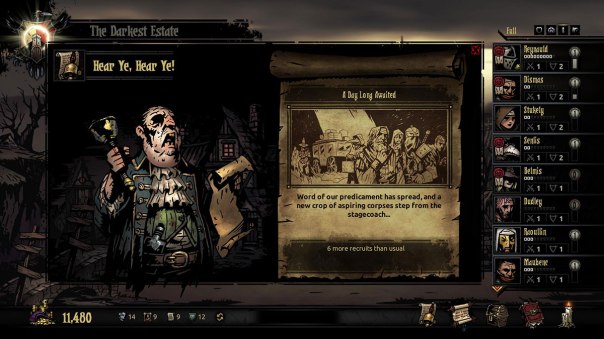
The art style and tone are an acquired taste, but I have acquired it.
The core gameplay loop of Darkest Dungeon is simply superb. Pick a group of four adventurers, buy them supplies for a dungeon delve, and then crawl through said dungeon killing and looting. Successful completion or not, those four particular adventurers are likely going to need a break to recover from the ordeal, so spend a bunch of your gold on (mentally) healing them. For the rest of the profits, use heirlooms to build up the Hamlet, then spend gold to upgrade the gear of another set of four adventurers… who then will need provisions for their own expedition. Wash, rinse, and repeat.
That might sound boring or perhaps grindy, but there are so many considerations and decisions to be made on a micro level that I find the hours melting away in a Civilization “One more turn” kind of way. For example, you can’t recruit just anyone: you get a small pool of recruits to choose from each “week.” Even if it’s a class that you wanted, out of the 8 possible Skills that class has, they will have 4 random ones. You can spend gold training the specific ones you desire, of course, but that’s 1000g less you have to spend on something else. Other times you have exactly the class and spec you want for your particular dungeon strategy, but they end up accumulating too many Diseases or negative Quirks such that it’s easier/cheaper to just let them go than keep them. Finally, even if you upgrade the Stagecoach such that you get higher-level recruits hand-delivered to you with full upgrades out of the box, they might not have enough positive Quirks to justify the limited roster space.
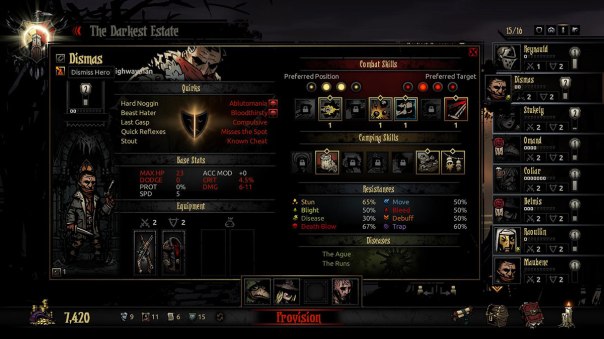
Even if I liked Highwaymen (I don’t), this hero is too expensive to treat.
None of this even gets into the combat and dungeon exploring parts of the game.
At the beginning, I thought the combat system was kinda dumb. Each character has the ability to do one thing each round in a turn-based manner. There are priest-esque classes and others with healing abilities, but they can only perform these actions in combat. Yeah, that’s a particular “gamey” limitation, but the longer I played, the more I realized how the entire point of this game is resource management. A turn spent healing is a turn not spent attacking.
However, considering that HP is only a concern in a dungeon, whereas Stress carries over into town and future dungeons, you have to start considering the relative merits of either. Leaving up the weak spellcaster who “only” inflicts Stress on your team so that you can spend multiple rounds healing your team to full HP might not be worth (literally) the trouble. Then again, if you have to end up Retreating from a battle/quest because everyone is about to die, well, they end up getting penalized with Stress/quirks regardless.
Then you have the boss fights, which possibly toss aside all your carefully laid plans. I defeated an Apprentice Necromancer with barely an issue already. Fighting the Wizened Hag though? I have faced her three times thus far, and retreated each time, nevermind the three other attempts that were aborted before even reaching her chambers.
The Hag has a Cookpot that takes up the first two “positions” on the field, with herself in the last two. Invariably, one of your team members gets thrown in the Cookpot and takes damage each individual turn until released. Thus, not only do you lose the actions of that team member, but your remaining members are usually out of their normal position (most abilities have position limitations), and then you have to consider whether to attempt to free the person or attack the Hag. Freeing the person is fine… but the Hag will throw someone else in the pot almost immediately afterwards.
Which can be the same person. /sigh
Having been defeated by this encounter so many times before, I am now in a holding pattern of leveling up my lower-level people to get a pool of acceptable candidates to try and kamikaze my way through the encounter, or perhaps overwhelm her with higher-level gear. Repeated dungeon clears of the other locations unlock additional bosses though, so perhaps I ignore her for now. And, oh, this other quest offers a pretty good trinket for that one class, so perhaps I grab that first.
Around and round I go… loving every single minute of it.
So, yeah. I’ll be curious to see how I end up towards the endgame; if this gameplay loop still entertains or if I get ground down by the repetition/familiarity. I ended up choosing Radiant difficulty based on the, ahem, horror stories from others who played originally. Indeed, some of the original mechanics sounded outright dumb: the inability to take characters back into the final dungeon more than once, for example. Some of those have been address since the game’s launch, but it’s a bit sobering to read that Radiant was designed to bring down the play-time “from 80 hours to about 40.”
Fake Edit: took down the Hag with this handsome group of characters:
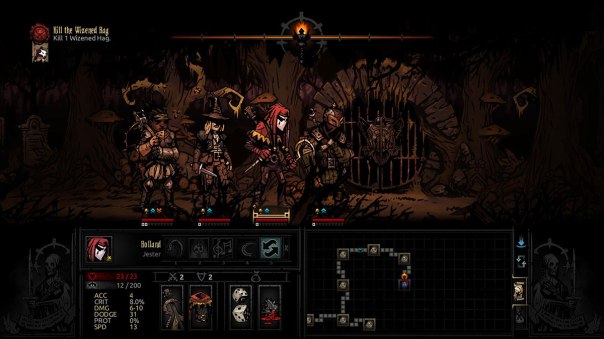
What does not kill you, stresses you out.
Hearthstone Welfare Legendaries
OK, not really. But word is out from the Brodester that as of the next expansion:
- Every time you open a legendary card it will be guaranteed to be one that you don’t have before.
- Everyone will be guaranteed to open a new legendary card within the first ten packs of the new set.
- Both of these changes will start when the next expansion hits.
I have actually received multiples of the same Legendary before, so this is absolutely an improvement of the current system. Also confirmed is that you can go ahead and craft the Legendaries you want right away without fear that you might open it in your next pack – the system will automatically update to skip over a Legendary you already have. There really isn’t a downside here for anyone.
At the same time, it’s a bit tough to say that Blizzard is really giving much away either. If anything, this undeniable Quality of Life improvement might encourage players to buy more packs overall.
And, honestly? This announcement came out in the middle of Shadowverse doing this:
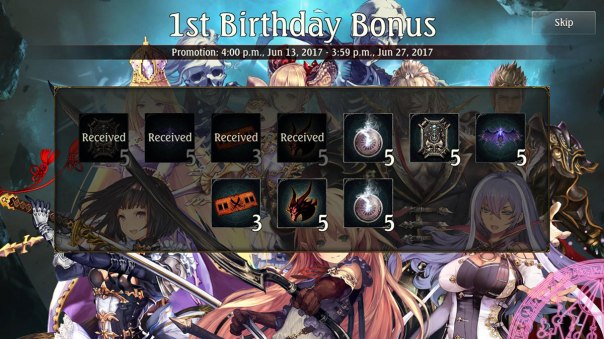
Not all that uncommon.
Logging in once a day results in 5 free packs of cards of alternating sets, or the equivalent of 3 free Arena runs. On top of the normal daily log-in bonuses. On top of the normal daily quests you can complete for additional prizes. On top of the dozens of achievements that unlock goodies.
It’s just kinda a shame that Shadowverse’s current meta is worse than Hearthstone and about a third of its cards are softcore hentai. We could use a bit more competition between the top F2P CCGs.
Impressions: Binding of Isaac: Rebirth
It’s kinda funny, looking back and seeing my original review of The Binding of Isaac being posted in November 2011. 11/11/11, in fact. Nearly six years ago is a pretty long-ass time. And yet here I am buying the re-release of a game and its expansion for another go-around. Maybe.
The truth is: I don’t know.
Ostensibly, I bought Rebirth (and Afterbirth DLC) because it was on sale and I had read all the people praising it on Reddit as being far better than the original. One person mentioned that it was simply relaxing to play. Certainly, I felt slightly similar back when I first played the game insofar as I compared it to Solitaire. Just something to play for a little bit without a sense gravity.
At the same time, I constantly found myself pausing the game and going to the Wiki. What does this Tarot card do? What the hell is this buff? Why is this room empty aside from a spike pit in the middle? These mysterious things are traditional trappings of roguelikes in general, but I feel like Isaac spends an inordinate amount of time in being obtuse. Random effects or items? Fine. Obfuscated abilities? Not fine.
It took me three runs to make it down to and defeat Mom, which resulted in about 15 achievements. Among other things, this unlocks the other half of the game (post-Mom), new items that get added to the random pool, new characters to play as, and Challenges. The latter is new to me, but is basically normal Isaac runs with some kind of penalty added on. In fact, pretty much everything I’ve seen so far is just piling on difficulty.
I’m not sure this is me anymore though. It was certainly relaxing to play in the moment… until I started pausing every other room to double-check the Wiki. I’m not going to stop doing that either, as I find blind choices fairly abhorrent. I don’t need to win every time I play a roguelike, but I’m also not going to let myself ruin an otherwise good run with some bullshit “Gotcha!” moment either.
So, yeah. Perhaps this will be my 2nd Steam refund.
 In An Age
Mobile Mindspace
Aug 1
Posted by Azuriel
The rise of the mobile gaming over the last couple of years has been covered rather extensively already. And up to this point, I would have argued too extensively. As a phenomenon, it is certainly interesting seeing a market emerge in real-time, but it never really seemed to impact me. The “gamer” population swelled with the ranks of people playing Candy Crush, which had little to do with any core gamers. Maybe a few well-known studios released a mobile app, whatever.
This past weekend ended up being pretty busy, but I still managed to squeeze in around 5-7 hours of gaming. And close to 100% of that time were spent in mobile games on my phone.
Granted, a few of those hours would have been dead time had I not had my phone with me. But close to half of the total was literally me sitting at my computer desk, dicking around with Clash Royale and similar “time wasters.” Part of it was undoubtedly post-game depression stemming from completing Mass Effect: Andromeda. It is always tough for me to mentally transition from 80+ hours of one title into a brand new game that promises similar hours required.
The other part, though? I am wondering whether it is due to my age that I am gravitating towards more instant gratification. Or maybe traditional game designers are getting worse at their jobs?
I spent approximately 20 minutes playing FFXIV over the weekend. I logged in, talked to some NPCs, teleported to some cities, talked some more, then had to take a minute Chocobo ride back to the main base camp to complete the quest. The main story quest, mind you. I had more fun in the 60 seconds of dead time on the Chocobo than I did in the entire 20 minutes playing overall, as I was able to boot up a mobile game, snag some rewards, and restart some locked chest timers.
Now, of course watching chests explode with goodies is a cheap, diversionary tactic at best; it is hardly fair to compare such things to the slow burn of a (supposedly) epic narrative. At the same time, those now-empty chest slots drew my eye to the 2v2 Battle button hovering just above, fat with the promise of compelling and amusing gameplay just a press away. And if I just get 6 more crowns from destroying enemy towers, I can unlock another chest with even more goodies. Hmmmmm.
Needless to say, I logged off FFXIV soon after getting off the Chocobo.
I guess what I’m getting at is the shift towards mobile is a multi-layered “problem.” There is the vapid dopamine rush from getting easy rewards, sure. There is also the front-loaded fun gameplay in quick gaming sessions. Then there is a whole class of game (MMOs) which are utterly reliant on back-loaded… everything. And it is not even that clear that such back-loaded fun is actually required to be back-loaded – that is simply how things have traditionally been done. Why doesn’t Waking Sands in FFXIV have a teleporter when just about every other town does? Is there a legit reason?
I am beginning to question everything. Opening a chest is a vapid reward. Is it more vapid than gaining levels in a traditional MMO? I am playing a Monk in FFXIV, and even after the revamped combat that came with the Stormblood expansion, I’m getting bored to tears with such a limited amount of abilities. I am stuck with limited abilities because the designers don’t want me to get all of them at the beginning because they are afraid I won’t feel rewarded enough in levels 20-60 after having received my full rotation. And they are right to be worried about that – it sounds awful.
Know what else sounds awful? Spending my time playing this game when I can play something else and be having fun right now.
Mobile gaming has not completely consumed my gaming mindspace, as evidenced by the fact that I spent 90 hours in Mass Effect just before this. But I am finding that the proverbial Fun Floor has risen dramatically over the last few months for me, more than it ever has before. Presumably, I am going to remember the twists and turns of FFXIV’s (later) story way beyond Quick Battle #4,872, and thereby justify the time investment.
But sometimes you just want to, you know, have fun when you play videogames. Right now.
Posted in Commentary
3 Comments
Tags: Candy Crush Saga, Clash Royale, FFXIV, Mobile, Post-Game Depression