Avowed – The End
Got the end of Avowed after 66 hours.
Despite souring on the combat, I did not rush through the end. Aside from a few hidden treasures in the last zone, I otherwise completed all of the side-quests available. Due to the strange open-endedness of Avowed, sometimes it was not clear whether these were legit side-quests or just required story beats done out of order. Either way, I wrung out every ounce of whatever value Avowed had.
And in the final analysis? Avowed was not redeemed in my eyes… but it got closer than I expected.
To me, there was a disconnect between the story and the plot. Maybe those are the wrong terms, but follow me for a moment. I consider the plot to be the main quests and decisions you make in each of the four zones. None of those bits were especially interesting, and not just because I didn’t know what my motivation was supposed to be – the “choices” were just too comically extreme. For example, the game tells you Animancy is banned in your empire, that it’s dangerous, etc. What the game doesn’t do is show you it’s dangerous, or why it’s banned, just that it is. You then get asked if you want (or accidentally allow) every Animancer in the area to die. Huh? The fourth area was even worse.
The broader story on the other hand, I did find more interesting. Each zone has a god totem you can put together from pieces hidden about, and the first time I completed one and then heard their conversation… I was quite intrigued. I did not finish the first Pillars of Eternity game, but I am vaguely aware that the gods get involved a bit more personally in the setting (although what RPG endgame doesn’t, amirite?), and I’m all for it. That bit was very interesting to me, and may be a seed that grows into a desire to play PoE 1 & 2 later. Then again, I technically already know what happened.
In any case, I have zero interest in any future Avowed DLC and have already uninstalled the game.
Avowed – What’s My Motivation?
I haven’t written much because I’m trying to work my way through Avowed. And it really is work at this point, because Avowed is not a good game. But I feel it is not good in a similar way that Bioshock Infinite was not good: the most frustratingly nuanced ways imaginable.
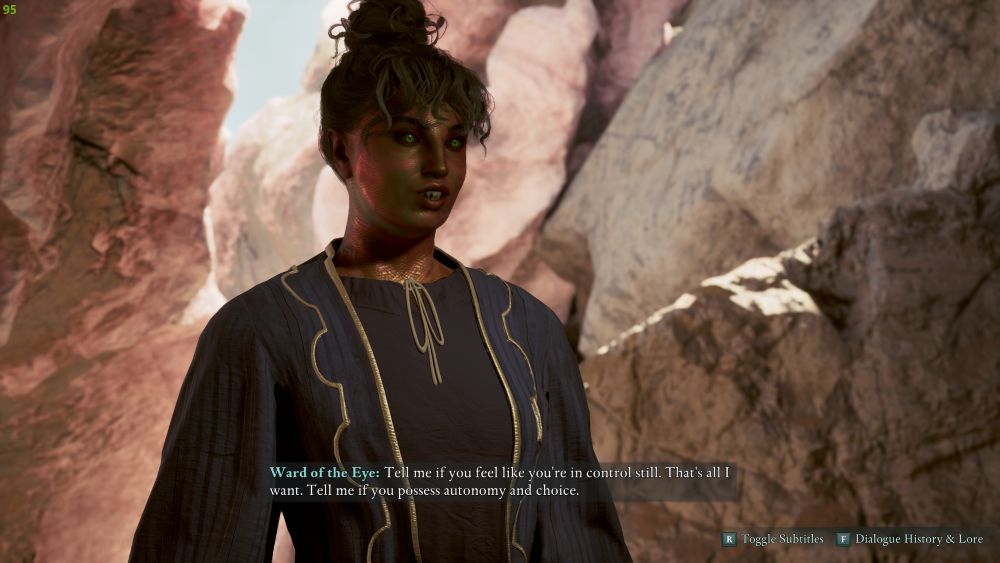
One example is with the combat system. I’ve talked about it all before, in that Ranger was strong but boring, Warrior was active but weak, and Wizard was both active and strong. About halfway through the 3rd zone though, none of it really mattered – even the Wizard became a chore. There are a lot of little reasons that quickly add up in the background until it hits you all at once.
- Very few enemy species (mostly beetles, spiders, bears, lizardmen)
- Very few enemy types (shield guy, magic guy, healer guy, ranged guy, summon guy)
- Zero percent chance any dropped loot is useful in any way
- 99% chance all the encounters feature 6+ enemies
- 100% chance all the encounters play out the same exact way, regardless
- Leveling and upgrading largely become perfunctory starting in 3rd zone
Regarding the last point, Avowed has a really shitty talent/skill tree. It’s not something I’ve seen many other people talk about, but it’s one of the most uniquely uninspired one I’ve ever seen in a game. Seriously, look at this shit. Warrior has 6 buttons to press, Ranger gets 5, and Wizard… 21, technically. But look at the level 15 and level 20 bands, which is where one might assume you’re getting the biggest power boosts. Outside the active button, Fighter gets shit like… perfect (!!) blocks rebound arrows, and you deal 70% of the damage you received. Ranger gets increased crit chance (already 100% when you hit weak spots), and bonus damage on unaware enemies. Wizards get… increased elemental accumulation, but you have to spec into each element individually.
Oh, and on the ultimate level 20+ band? Fighters can… heal companions by 10% when you kill enemies! Rangers can… deal more stun accumulation with power attacks with ranged weapons! Wizards can… get fucking nothing, unless you want to learn Meteor Shower without a spellbook, which you never would because spellbooks give you like an 80% Essence discount on that otherwise meter-eating spell. Yes, Arcane Seal is something a Wizard can take at 20+ and effectively have infinite Essence regen. But at that point in the game, you effectively have infinite regen already from the hundreds of random vegetables you’ve collected throughout the game.
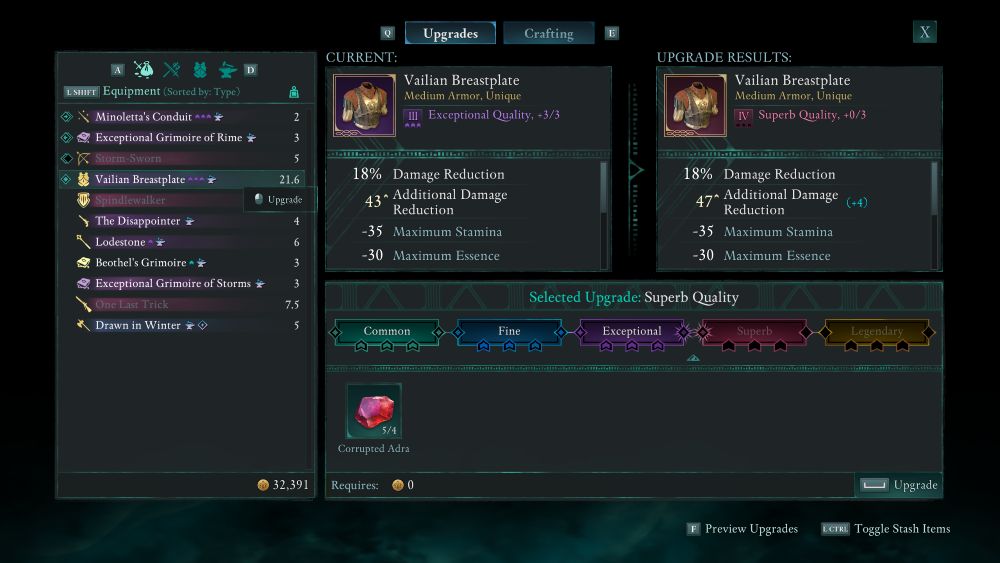
The other half of character progression is also shit. Getting Uniques out in the world has long ceased to be exciting. First time you replace a generic weapon with Unique? Fantastic. The second time? Frustrating, because you likely sunk a bunch of upgrade mats into the first one. Then you start to realize that none of the special abilities of Uniques matter all that much compared to the overall “tier” due to the asinine enemy “level” balance. If your stuff is blue and they are purple, you deal 35% less damage and take 35% more damage. Meanwhile, each time you upgrade a weapon or armor, you get silly shit like +9 damage or -4 damage received. Upgrading a Unique never boosts the special effects… why?
Finally, I want to talk about the story in general terms. I’ll throw a Yellow spoiler warning just in case, but the short version is: the game never answers the question of “what’s my motivation?”

The general premise of the game is that you are a godlike of an unknown god, working in the court of an Aedyran emperor. You are then tasked with solving the Dreamscourge plague problem in the Living Lands, an isle that the emperor is interested in taking over. You are sent over as an Envoy of the emperor himself, granting you leeway in resolving the Dreamscourge crisis in any manner you deem fit.
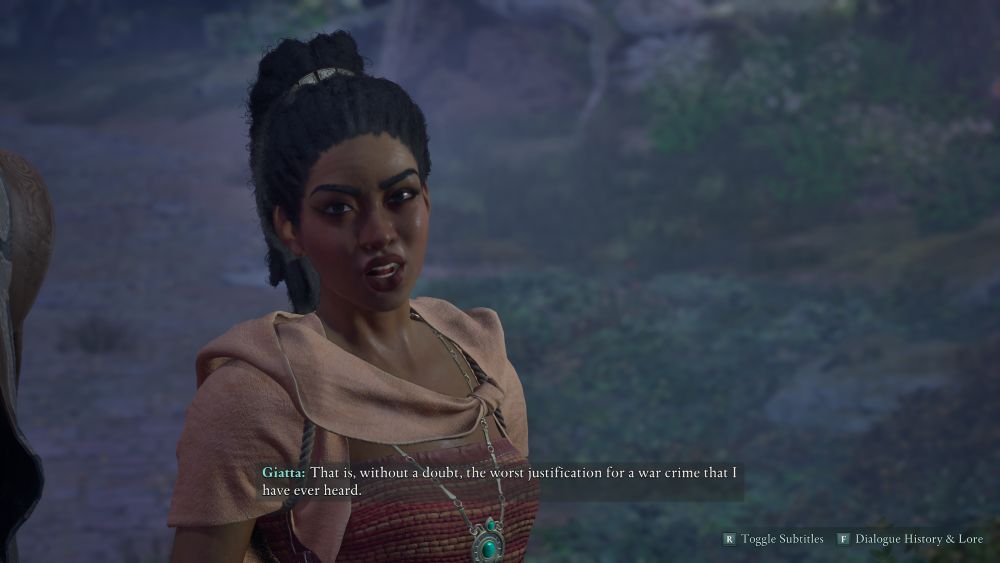
The problem is that all the Aedyran empire stuff just up and evaporates as soon as you step on the docks, unless you commit to being cartoonishly evil for the rest of the game. And if you do, all of your companions are from the Livings Lands, so they’ll be mad at you for everything you do. Having evil options in RPGs is a good thing even if players do not typically engage with it, but the problem is setting up your game to support it. None of your Avowed companions will leave you no matter what choices you make. There are no Aedyran or Steel Garrote companions, which would make such an evil playthrough more reasonable. And while I have not yet finished the game at the time of this writing, I haven’t really seen any good motivation to even care about the Aedyran side of things. Nobody is reminding you of your duty to the emperor, or even really questioning your loyalty.
This is not the first place Avowed leaned so far into “roleplay” that it fell directly into RPG mad libs. There are frequent dream sequences throughout the game where you are asked to choose how events in the past played out. Some of these choices lead to you getting one godlike ability versus another, but the majority of it is just… there. I understand that there are (presumably) people who like this sort of thing, but Avowed just sort of drops it on your porch and leaves. There’s no context, no sense of purpose. Again, what’s my motivation? Am I training somebody to be more forgiving or spiteful, depending on my dream answers? Or am I literally playing one-person mad libs?
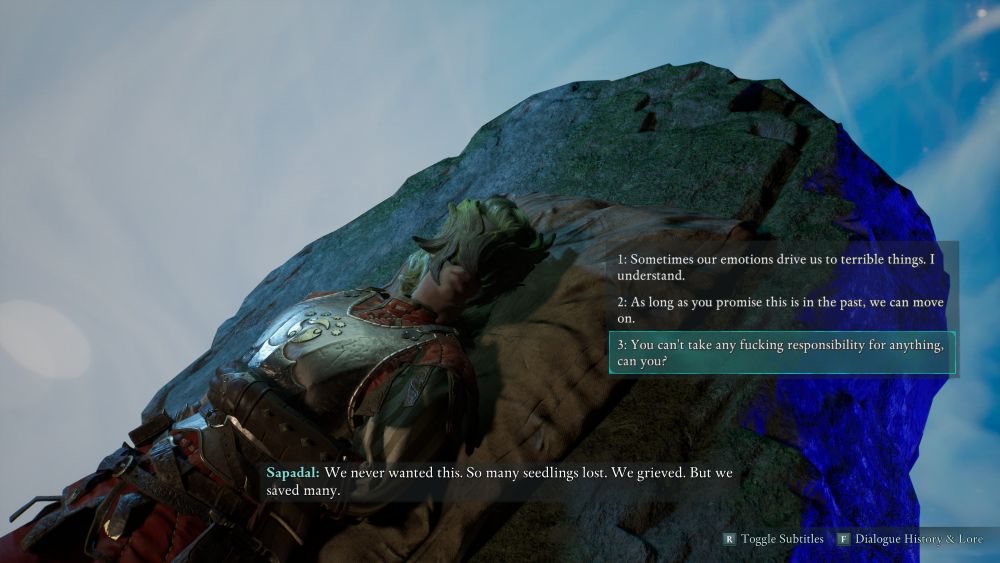
I get that this may not sound all that different from all the normal RPG choices you encounter in the genre. In Baldur’s Gate 3, you can choose to free a gnome strapped to a windmill or send him flying by cranking up the speed. That choice doesn’t matter too much in the scheme of things, either way. Except, of course, to the gnome, and possibly some party members. But that at least has some immediate context and consequences and feels like a real choice. There are some quests vaguely similar to that in Avowed, but they all ring hollow. Perhaps in the abstract the quests are identical, and I’m just not invested in the world of Avowed in the same way as BG3 or Mass Effect or anything else. Or perhaps the devs simply were painting-by-numbers and forgot to include a soul in their creation.
And that brings me back to the Bioshock Infinite comparison from the top. There are some games in which I can understand people enjoying, even when I do not. League of Legends? That’s definitely of no interest to me, but I get it. Overwatch 2? Sure, I enjoyed the original for a time as well. Call of Duty? I prefer the Battlefield series, but a more arcade feel can be fun.
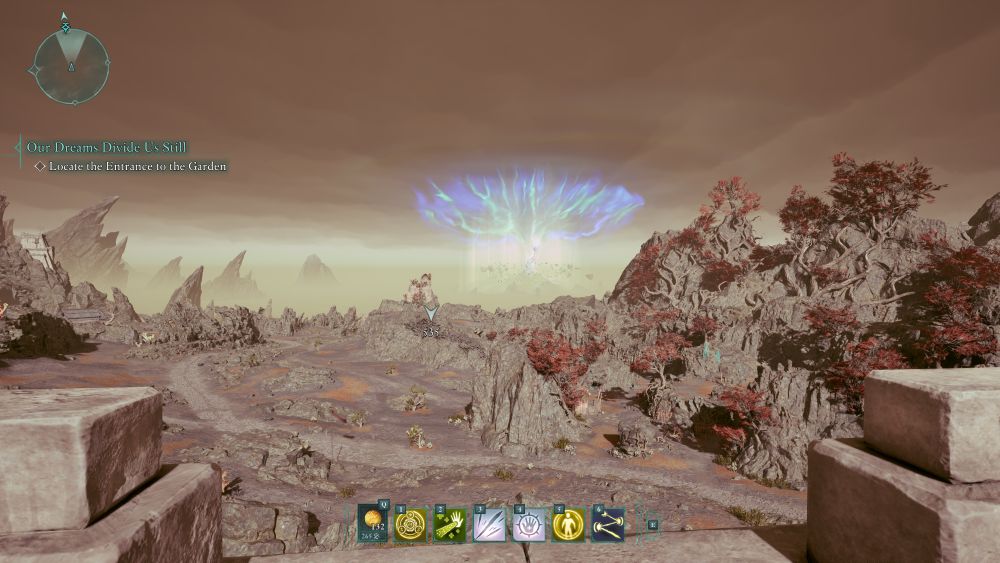
If someone says Bioshock Infinite is one of their favorite games though, my eyebrows go all the way up. Maybe the DLCs fixed the plot later, but Bioshock Infinite’s story was otherwise objectively terrible, like Mass Effect 3 original ending terrible. I feel the same way when I see people online say Avowed is a 9.5/10 or they are eager for another playthrough. I don’t even want to finish this first playthrough, let alone running around opening chest after chest of the same random crafting materials again. Some aspects of Avowed are fantastic genre improvements, like the feel of melee and the feel of exploration via jumping/traversal. Unfortunately, tragically, there is just no follow-through, no stuck landing.
The only way I can see Avowed being someone’s favorite RPG or deserving of a high score is if they simply haven’t played better games before. Which, given that many of my own favorite games came out 10-20 years ago, might be increasingly understandable. What a bummer.
I suppose there is still time in the 4th Act and resultant endings for Avowed to pull a miraculous redemption. Well, aside from the combat and itemization and character progression and world interactivity – those ships have already sailed. We’ll see if the plot payoff was worth the pain.
Avowed – Veneer Off
I have added another 16 hours into Avowed (total: 32), clearing the entire second zone. And while some of what I reported earlier is still accurate – traversal is fun! – the game’s veneer is definitely rubbing off.
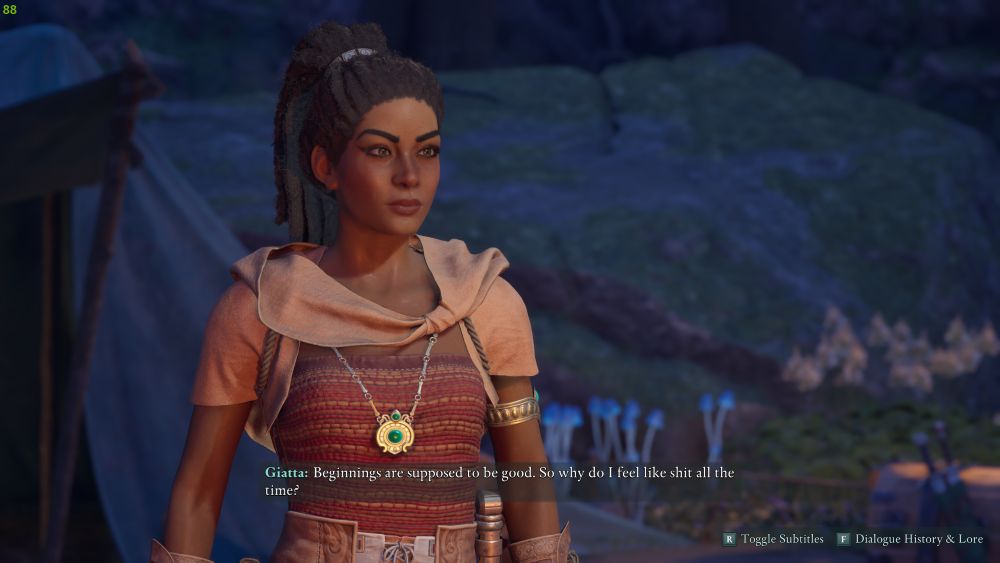
Combat, which hitherto has been fun, is now very rote. For the first half of the second zone, I respecced into a Ranger gun build and almost ended up abandoning the game entirely. There was… just no buttons to press. Sure, Ranger has a sort of vines CC ability, but aside from that, it was power attacks from pistols and nothing else to actively press. Technically I could have grabbed some more active buttons from Wizard as well, but Ranger is the only real splash-class, and trying to elevate your Intellect stat to the point where spells are relevant is a fool’s errand without just being a Wizard.
During the last half of the zone, I went into Fighter, first with a 2H weapon focus and then 1H with shield. Fighter had some more buttons to press – including a very satisfying Charge – and was a more dynamic experience overall with the Parry mechanic and blocking. The issue is that the DPS was just not really there. Avowed loves to throw groups of 5+ enemies at you, which is understandable considering Rangers/Wizards will nearly one-shot most of them from range in the opening salvo. As a Fighter, it’s not satisfying at all spending all your Stamina trying to block/dodge so many enemies. Although you do have two squad mates to help spread aggro around, the reality is that so do Rangers/Wizards, and those classes can actually eliminate enemies quickly. Which technically goes against the “gameplay” of Fighter, as if things die before you get into Parry chains or full attack combos, a lot of the Fighter-based weapons are useless. Which they are anyway, since they don’t kill quickly.
The other major issue that I glossed over previously was the world in general and interactivity in particular. Avowed is not Skyrim. Which is fine, most games aren’t. But as a first-person fantasy game that came out 14 years after Skyrim, Avowed is incredibly static. NPCs barely move (if ever), there is no world reactivity, there is no “stealing,” and every object out in the world is bolted onto the floor, aside from some breakable crates. To be fair, this is more an intellectual criticism, as I hardly noticed anything amiss in-game. But now that I have, I see signs of a Hollywood set everywhere. Which might have been fine, if this were not a fantasy RPG released in 2025 for $70 MSRP.
The final thing that is really dragging me down is the upgrade system and Unique weapons. I have been playing the game “as intended” when it comes to looting and experimenting, but have come to find out that the devs punish that playstyle. For one thing, all the respeccing I have done required me to upgrade several weapons that, oops, I am no longer using. Then I found out that all unique weapons in the world scale to the highest upgraded weapon you own at the time of pickup. What this means is that if the best weapon you have is Fine (blue quality), all the uniques you discover will be Fine. However, if you funnel all your upgrades into one particular weapon and get it to Exceptional (purple), those same uniques would have been Exceptional. And this works all the way into Superb (red) and Legendary.
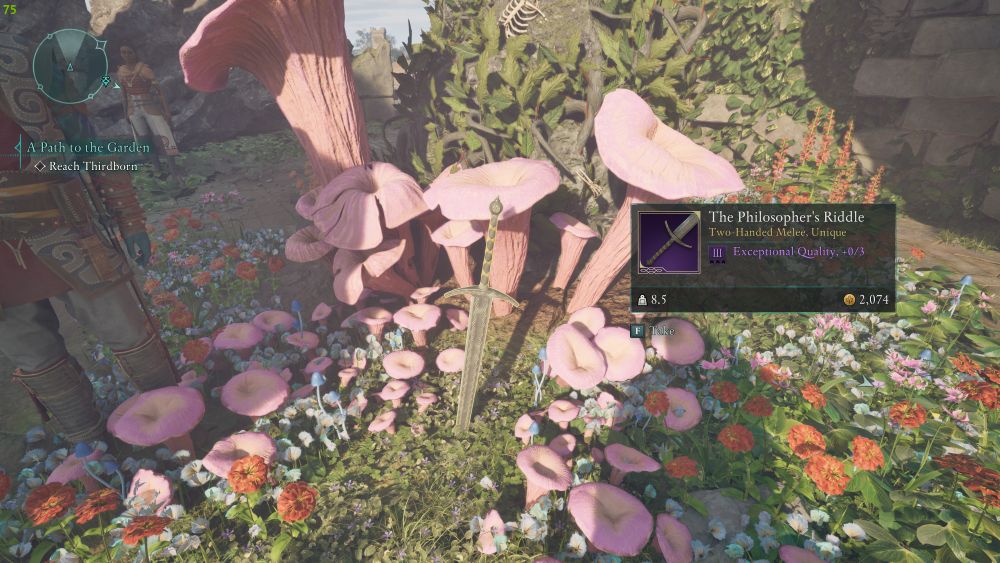
Do you like exploring the map and picking up things organically, doing a few upgrades here and there? Punished! Because now if you decide to go with another weapon or playstyle, you will need to double (or more) the upgrade materials required to level them up. Which, let me remind you, is very necessary because weapons and armor get a debuff if they are more than a few “tiers” below the enemies you are facing. Also, remember that enemies and money is finite in this game, so it is very possible to just screw yourself and be locked into something that is no longer fun.
Which might just be the entire game itself for me, at the moment.
I don’t know, guys. Not everything I play needs to be Game of the Year material; lord knows I play plenty of trashy survival games for hundreds of hours. But, truly, Avowed feels like a game that would have been really great… in 2015. Or maybe 2010. Obsidian is not Bethesda, yes. But this also ain’t New Vegas. And between this and Outer Worlds, I’m thinking that Obsidian needs to stick to what they do best: iterating on the shoulders of better games, rather than trying to make their own.
Grounded was great though, so… ¯\_(ツ)_/¯
Avowed – Early Impressions
I have played about 16 hours of Avowed via Game Pass. Early impressions: mostly great!
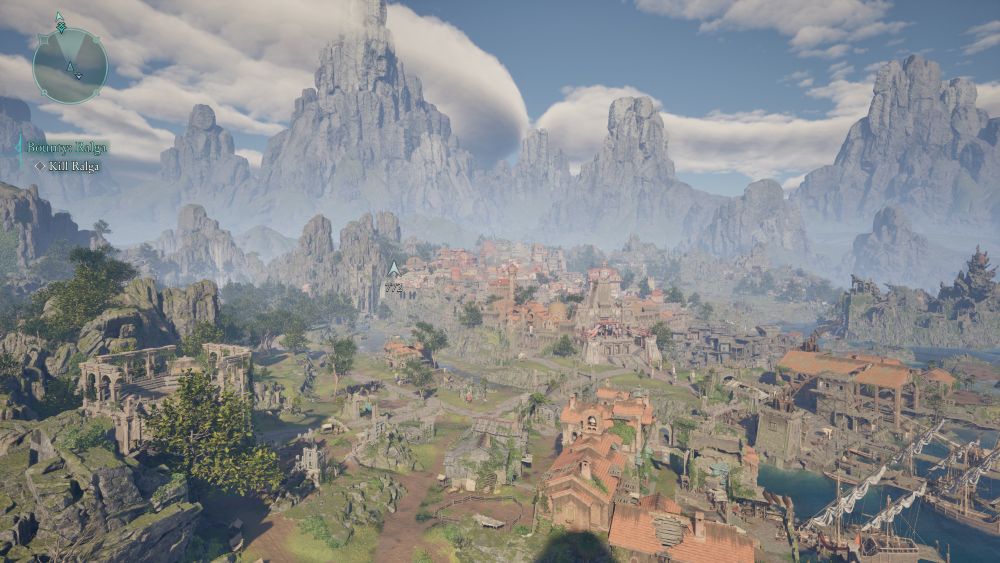
Although I have not yet stepped outside the first area, Avowed is a very gorgeous game. More than that, it is a joy to walk around in. It cannot be understated how much I like a first-person perspective in exploration games, which is elevated further when the character actually feels competent within it. There are marked ledges with the stereotypical yellow ropes, but there is almost no areas in which I felt I could not reasonably scramble up. This isn’t climbing sheer cliffs BotW/Genshin Impact-style, but it’s enough to feel like the world is explorable. It honestly feels one step below Dishonored in how good it feels walking around – if more games could have shadowstep-like abilities, that would be great.
Combat also feels really, really good. I am currently focusing on a Wizard character which gives me, honestly, too many options. The great thing though, is that there is a lot of variety in builds (on default difficulty) and how you engage with enemies. For example, I was rocking the standard wand + spellbook loadout, but I didn’t like how short range the wand ended up being. So, I have a pistol + spellbook. Plus, I have chosen a spellbook that allows me to conjure up a magic staff to beat people with if things get too hairy in close-quarters. Honestly, I kill most things with alpha strikes from a bow and follow-up pistol shots, so I’m leaning towards respeccing more into the Ranger class altogether. Which is easy to do, as it only costs a small amount of currency to respec, which is another plus.
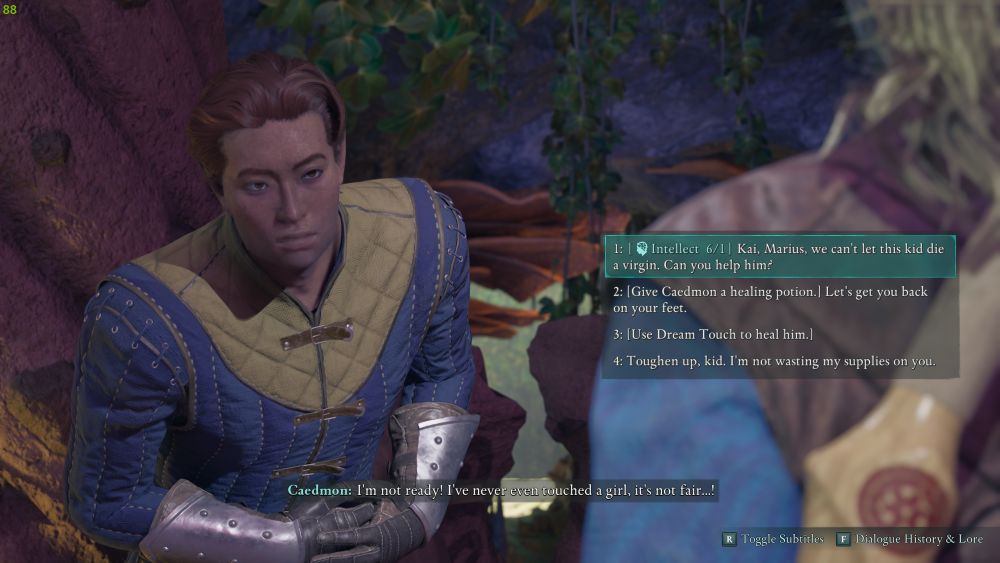
I’m not going to comment much about the story, especially given how early in the game I am. What I can say though, is that I like how the game takes itself seriously without also being too far up its own ass. Being able to view a glossary of all the Proper Nouns during a conversation is helpful, but it’s not always necessary either. Which is great! I did play the original Pillars of Eternity enough to get some of the references, and there were plenty of references to the second game I did not get, but still understood from context clues. I never fully expected Avowed to follow The Outer Worlds irreverence, but nevertheless I am glad the slapstick is relegated to only minor side quests.
Having said all that… yeah, I do have some criticisms.
First, enemies are finite – once you clear an area, it stays cleared. I’ve seen some people praise this as being “immersive,” but it honestly leads to un-immersive player behavior. For example, I was walking in an area and saw some of the lizard creatures battling with spiders. That is great dynamic happenstance (assuming it wasn’t scripted)! But instead of letting them duke it out and attacking the weakened victor, I immediately jumped into the fray because I realized that any incidental monster deaths was a permanent reduction in my possible XP. Now, I am assuming that there is a level cap that can be reached way before the end of the game proper. But this is also a game that gives you more abilities than you have points for, and thus I want to get any many as I can, as soon as I can.
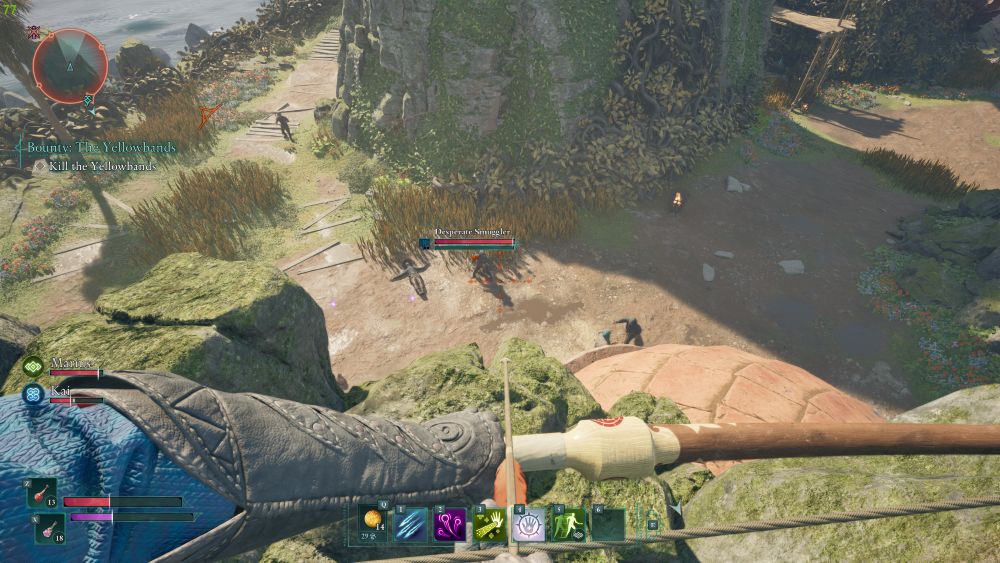
It did occur to me that the original Pillars of Eternity – and most CRPGs – also have the “feature” of finite battles. So perhaps that is not entirely out of place. But even aside from the metagaming aspect, combat itself is fun enough to want more of. I’m seeking out more of these random battles because it’s fun to push the buttons. Which is great! But I hate the idea of knowing they are a dwindling resource.
Another metagame aspect I do not enjoy is the carryover of The Outer Worlds’ “unique item” system. Essentially, the progression mechanic in Avowed is to choose amongst the the items you pick up and then upgrade a few of them over and over. Indeed, almost all of the loot you get from battles and hidden treasures are simply upgrade materials. The problem is that Avowed is also peppered with unique items that have bonus effects that regular items do not. What this means is that if you really like using Bows as a weapon, you are wasting upgrade materials on any regular bow, and should use something else until you get a unique Bow. The problem with that strategy is that weapons are debuffed against enemies of “higher quality” than the weapon used, because… reasons.
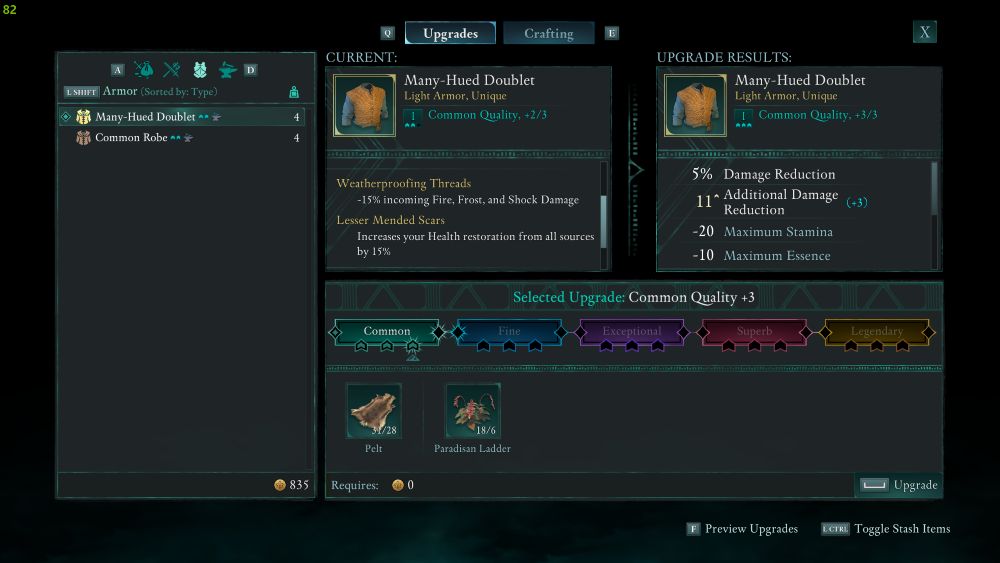
So, remember how I said I was using guns instead of wands for my wizard character? Aside from my range concern, what pushed me towards guns was the fact that I found two unique pistols and no unique wands. Without looking it up, I don’t even know if I’ll find a unique wand in the second area either. Which means I either waste upgrade materials on a regular wand so I can keep up with mobs, or I do something else. Similarly, upgrading spellbooks feels bad because you are locked into getting bonuses to just four spells. You can spend your precious few skill points to memorize spells without needing a spellbook, but you don’t get those bonuses that come from an upgraded spellbook.
Pressing buttons feels good, but each level up (and item upgrade) leaves me feeling unsatisfied.
Overall though, I do anticipate playing Avowed to completion. Perhaps the Wizard life is not for me, and the Ranger will be straight-forward enough to feel satisfying to level. It also helps that I have those unique weapons for the ranger already. Will I grow bored of using just those though? Well, it hasn’t happened yet. And perhaps I’ll accumulate enough Wizard uniques by the time it does.
…and hopefully I’ll still have enough upgrade materials to get them up to speed.
Let’s see how it goes.
Stars’ Rug-Pull
Stars Reach is the Raph Koster moonshot that, as far as I can tell, has immediately shot itself in the head. The official Kickstarter will be active at the time of this post, but some of the pertinent details have become clear in a fireside chat with Koster (emphasis added):
[…] The game itself, however, will be free-to-play at its full post-early-access launch, with an optional sub (called a “property pass”), supporter packs, a cash shop, all for cosmetics, not P2W items. “We’re not gonna break the economy for the sake of the Kickstarter,” Raph Koster says.
The devs don’t want players thinking of the property pass as a subscription – “We’re avoiding saying the word,” Koster admits – but it pretty much is; that pass will be required to own homesteads and to receive early access to new cosmetics. If you let the pass lapse, your house will just pack up and be ready for you to place again when you resume (Stars Wars Galaxies, basically). […]

Let’s review for a second. Stars Reach is a game about exploration, gathering resources, fighting mobs, all with an entirely player-based economy. It is being billed on the official website as a “massively multiplayer sandbox RPG” meant to “immersing yourself into an alternative world of adventure.” And it will be Free-to-Play!
…unless perhaps you want live anywhere you will be playing. That will cost you a $10/month subscription.
But it potentially get worse! I was taking it as a given that players would have some base-level ability to set up crafting stations inside a spaceship or whatever, even if you weren’t paying space-rent. You know, like in Starbound or No Man’s Sky. But according to the preview on homesteading:
A Homestead is a patch of a world that you claim as your own. You set up a camp, register that camp with the Transplanetary League, and voila!, it is yours.
Now you can build on that plot of land. You can create a home, a shop, a manufacturing facility, a farm, a giant robot…whatever you desire. If you claim a homestead in space, you can build a starport, or hollow out the interior of an asteroid as a smuggler’s base, and more.
Combine that with this other Reddit AMA thread:
Proximity will matter a lot.
- You have limited inventory. Ships also have limited inventory. If you want to transport a lot, you will be dragging it behind you in wagons or containers.
That means you will have to physically (and relatively slowly) move goods from the wilderness to your spaceport, from orbit to a wormhole to another space zone, across that other space zone, across however many astroid fields, nebulae, etc, as there may be, until you get to orbit around the destination planet, land, then schlep the stuff to its delivery location. And monsters are probably going to be trying to steal it the whole way.
Neither of which indicates to me that the space hobo way of life is especially supported. By which I mean any F2P player. Because what are you going to be able to do on a foundational level? All items decay and have to be replaced with player-produced ones. Lugging around resources is apparently going to be painful. I’m taking it as a given that players will be able to craft basic items without needing a homestead, but who even fucking knows at this point? There’s a flowchart on the “Stars Reach Tour” that I have helpfully annotated with the latest information regarding the property pass:
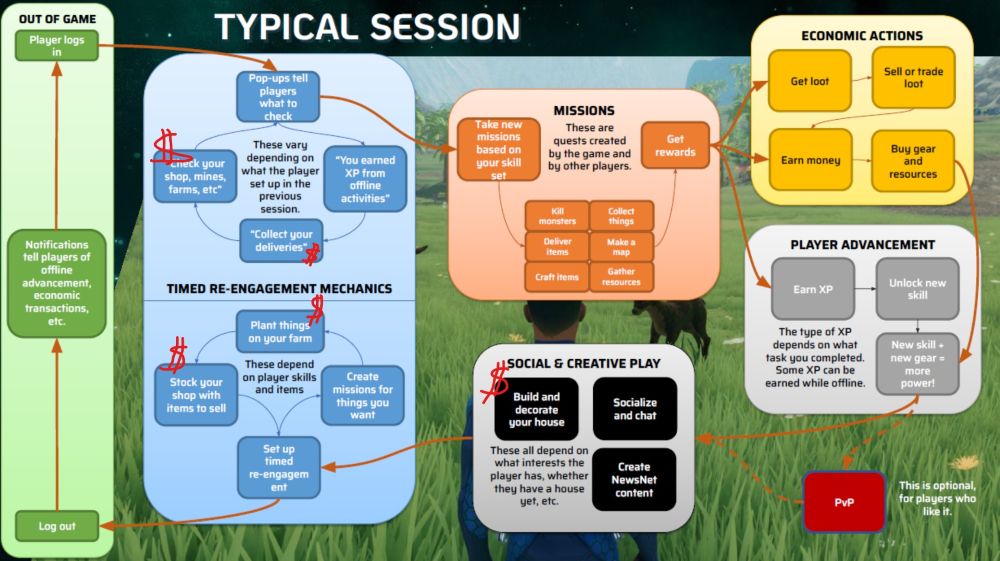
It truly boggles the mind. Or would, if these “industry veterans” were not a font of dumbass ideas.
I have less than zero interest in Stars Reach at this point. It was already conceptually hostile to solo players, but I still had it in the back of my mind as a sort of “challenge” to engage with down the road. But paywalling the one aspect of the game that is remotely sticky enough to get players to stay? No thank you. It’s almost as bad as the devs from Forever Winter with their real-time water mechanic.
Flu A
I’ve never gotten a 102+ degree fever for five days in a row before, and when your whole family gets the same thing at the same time… no bueno.
The extra dumb thing comes after you “recover”: round two secondary diseases! Laryngitis, sinus infection, whatever happens to be laying around the house, etc. We’re slowly unburying ourselves over here, but it’s going to be taking a while. Mask up, or if you have young kids, well, good luck.
Shadowverse: Worlds Beyond… your wallet
I have not played Shadowverse in… whoa, about eight years. So, while it affects me personally very little, it did still come as a shock recently when I found out that Shadowverse had been put on maintenance mode last year while Cygames rolls out a sequel called Shadowverse: Worlds Beyond.
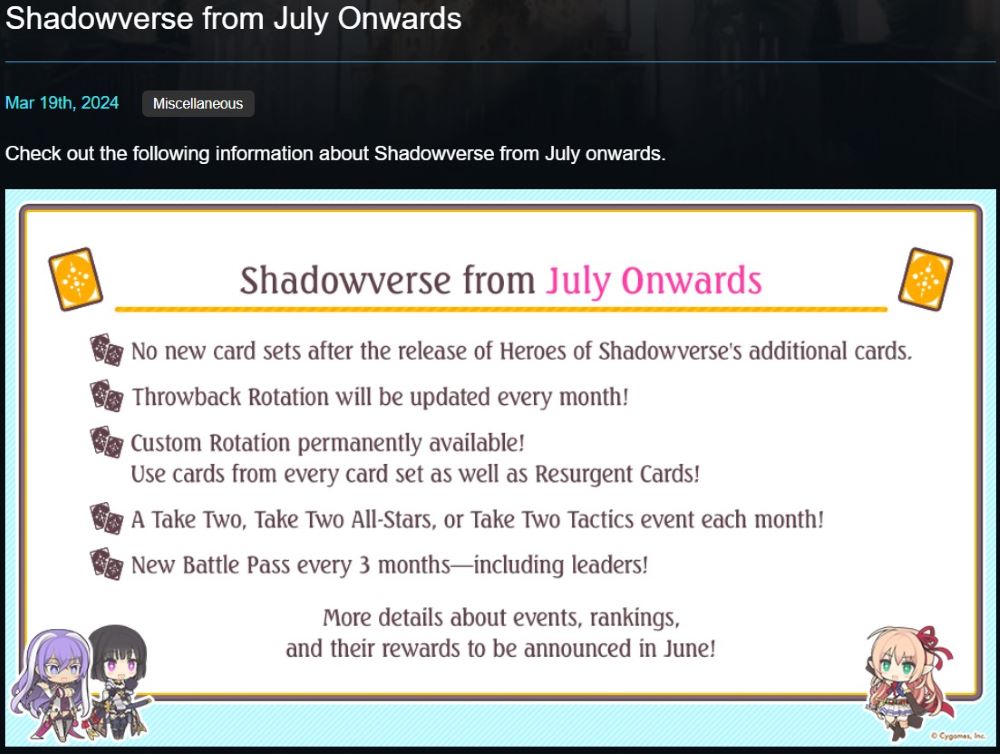
Of course, this is not the first time a game company has released a direct sequel to a Live Service game while hoping everyone migrates to the new one. EverQuest immediately comes to mind as a classic example, along with the original Guild Wars. But I haven’t quite heard about this happening in the CCG space before. Maybe Magic Online vs Magic Arena counts? Anyway, I suppose maintenance mode is better than oblivion (see SolForge, Hex, Artifact, etc), but there is an extra bit of salt in the wound when there’s a sequel being developed with only the barest of cosmetic carryovers and zero of the, you know, potentially purchased cards.
Which sort of begs the question of why there is a “sequel” in the first place. I mean, I’m assuming the answer isn’t simply cash cash money. Technical debt? The new game does look very slightly flashier, and would offer the opportunity to switch up game engines. Also, there is a “metaverse” looking lobby with chibi avatars, fishing, mahjong, and more for… reasons. Presumably Cygames knows what their audience wants.
…or perhaps they are looking for a new audience. In which case, caveat emptor.
Impressions: Stoneshard
I’ve played almost 40 hours of Stoneshard in the last two weeks. My opinions are… mixed, but hopeful.
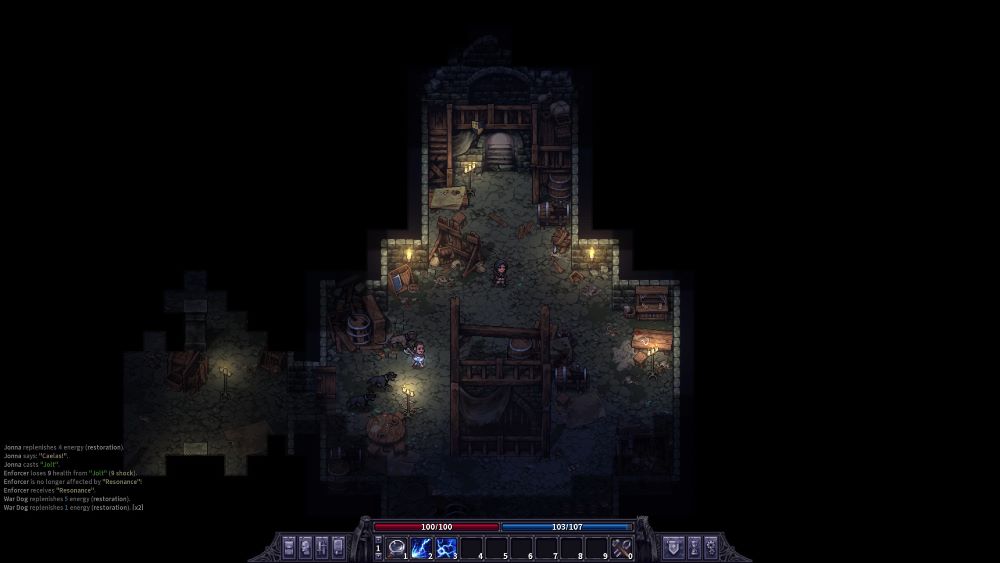
Stoneshard is a brutal, turn-based fantasy/mercenary game where death is always around the next corner. It’s one of those “you’re not the hero” kind of stories, although in practice that just means you can run into super high-level enemies early on if you aren’t careful. The general gameplay consists of taking contracts to do X inside dungeon Y within 3 days, and then returning for your reward. Eventually, the contracts dry up at your original location, so you have to trek to another town and start the process again, hitting harder and harder dungeons. The most recent update (0.9.1.0 – Rags to Riches) includes a caravan feature that makes moving through the world much easier.
The brutality of the game comes in two flavors: cascading failure, and time disrespect.
Let’s start with time disrespect first. The world is broken up into tiles that you move through, just the same as you would move through a dungeon. While you can click on a distant spot to have your character “hop” square to square quickly (outside of combat), the fact remains you still have to walk. If the dungeon is six tiles away, that’s six full screens you have to get through. There are a bunch of herbs, mushrooms, berry bushes and the like to occupy yourself with – you need to craft a lot of fodder to fuel your caravan – and there is always the risk of an ambush from bandits or hostile wildlife as well. So, it’s not always boring to travel long distances. Plus, sometimes it’s fun to kind of vibe with the very excellent music and ambient noises.
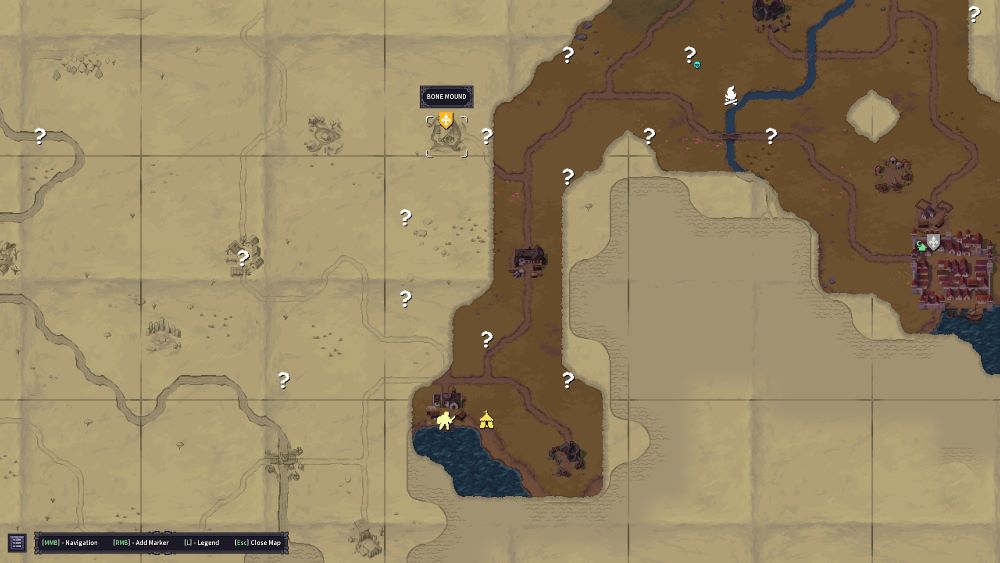
Here’s the thing though: you can only save the game when resting. If you travel for those six tiles, survive a few ambushes, clear an entire dungeon (including the boss), and then get bit by a hidden snake and die a tile away from town… you lose all progress since the last time you rested.
Technically, there are ways to mitigate this sort of disaster. You can buy/purchase bedrolls, which take an enormous amount of limited bag space, to create a one-time use resting spot outside of the dungeon. This will prevent you from having to re-walk to the dungeon, but of course do nothing about the dungeon itself or the walk back. Or perhaps you can bring two bedrolls, use one, stash the other outside the dungeon, and then use the second once you complete the dungeon. The latest update introduces the caravan, which you can technically park close to the dungeon and mitigate the worst of it, if you’re willing to burn a bunch of time (there’s a cooldown after parking the caravan). Of course, the existence of the caravan “workaround” calls into question why there’s no Quicksave, or a smaller Meditation Mat, or whatever.
[Note: there is a Save & Quit feature, allowing you to exit the game. This save is deleted after loading.]
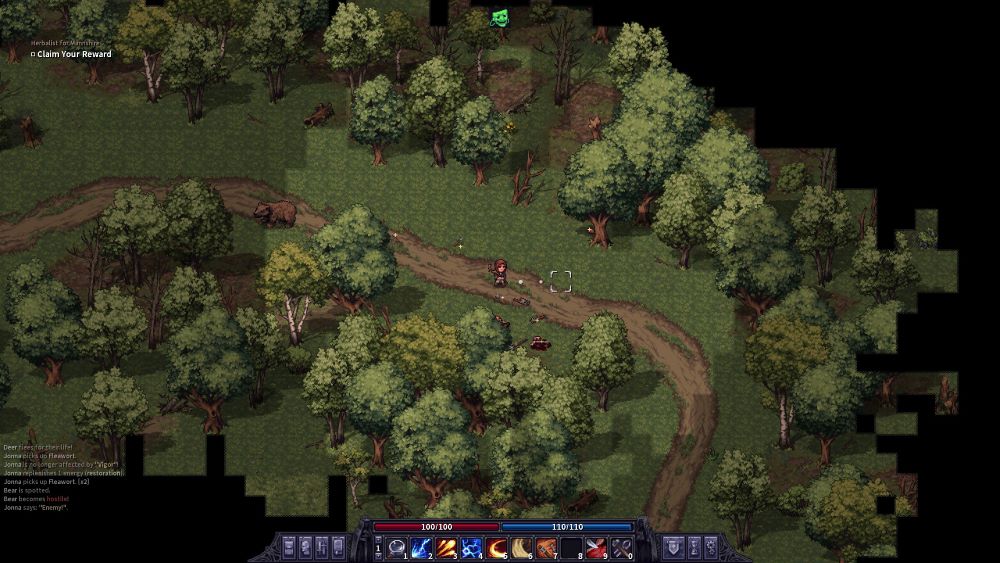
It’s important to know about this sort of thing because Stoneshard has a lot of cascading failure opportunities. You have Hunger and Thirst, which necessitates bringing a waterskin and snacks. When you are hit, damage is dealt to specific limbs, which can develop wounds or even Bleeds; make sure to pack Splints for the former and Bandages for the latter. Oh, and limbs have a Condition meter that reduces your maximum HP until they are healed, which is another consumable. Even if you heal the damage away, you have an overall Pain meter that accumulates unless reduced by beer/drugs. Enemy abilities can Stun, Stagger, Daze, Confuse, Immobilize, Ignite, and/or Poison you. Fatigue, Intoxication, Morale, and Sanity are also things. And all of these typically compound on one another, like how Pain gives you a debuff at certain thresholds that constantly drains Morale.
I am not actually opposed to all these “crunchy” systems. Choosing how many healing items to bring to the dungeon is a meaningful decision, and rewards the collection of crafting components and otherwise planning ahead. What I am opposed to is how often and how quickly these interlocking systems go from irrelevant to run-ending in a way you can do nothing about. Bleeding out at the end of a fight because you didn’t bring any/ran out of bandages? Fair play. Getting Dazed (turns off all your abilities for a few turns), then Immobilized, and then chopped in half within two turns? Okay then. The slow descent into insanity works in, say, Darkest Dungeon because damage is usually spread amongst a party and you get worn down. Here, you often just get hit a few times and die.
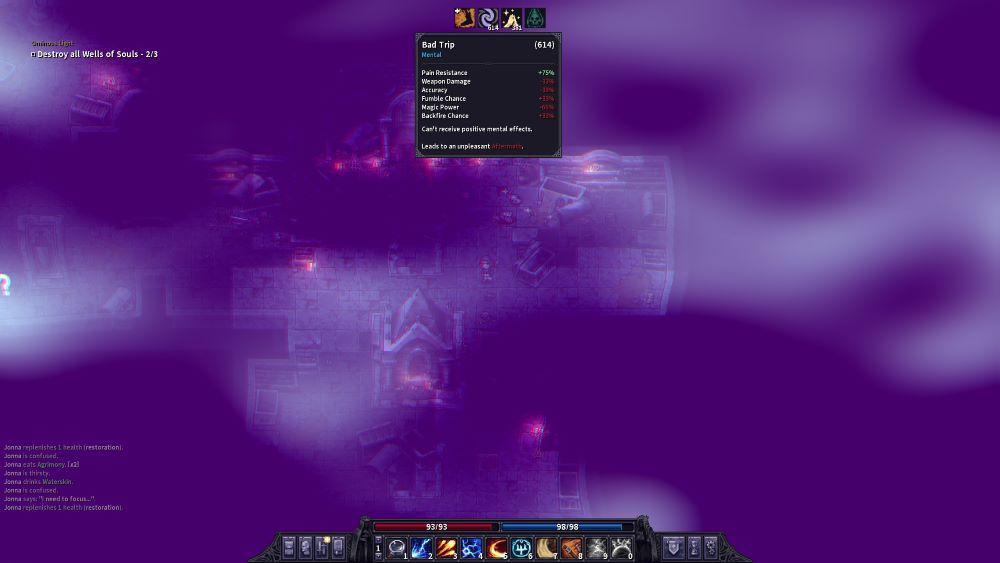
Ironically, that scenario doesn’t play out that often because you are always, 100% of the time trying to lure enemies out one at a time. Which is super effective! And sometimes boring. I play an Electromage with a few finishing moves via Staff. Electromancy is all about low cooldown spells that can Knockback or possibly Immobilize enemies. I just cleared out a 3-skull dungeon full of bandits and only got hit once, by an enemy that had a charge+attack move. So, perhaps my experience is a bit more skewed than if I were straight melee, sword & board with heavy armor; perhaps there’s more survivable damage.
Anyway, that’s Stoneshard. It’s still in Early Access, has been for years, and the updates themselves do not come quickly. That said, this is a game that has good “bones” and I can see it meaningfully improving with some tweaks and enhancements. The latest “Rags to Riches” release apparently changed the game’s compiler, which destroyed all existing mods – if/when that gets fixed, I could see mods coming to the rescue too. I’m certainly looking forward to being able to Quicksave anywhere.
The Hopes of the Game Industry
In short: they hope GTA 6 will cost $100 so they can raise their own prices.
As reported by VGC, Epyllion’s Matthew Ball just released a report focusing on the “State of Video Gaming in 2025”, which shares his thoughts on what might happen within the industry this year. Of course, a lot of that focus is out on GTA 6 which is primed to be one of the biggest game releases of all time, with some analysts predicting that it’ll make more than $1 billion in pre-orders alone.
Within the report, Ball claims that there is “hope” within the industry between publishers and developers that Take-Two will respond to all of the excitement and hype surrounding GTA 6 by raising the default price of the game to $100. Considering the fact that GTA 6 is going to sell well no matter how much it costs, the industry is reportedly hoping the price gets raised so that others can follow suit.
There is a ridiculous sort of myopia associated with seeing (and/or experiencing) high-profile commercial failures and escalating production costs, only to come to the conclusion everything would be better with higher unit prices. How about… *checks notes* … lower production costs? “But players demand AAAA-quality graphics!” Do they? I can appreciate the dilemma faced by developers, wherein the last game cost $400m and not wanting to gamble with a $350m (or lower) sequel. But if the acknowledgement is that the status quo of ever-increasing production costs is unsustainable, higher prices at best stems the bleed temporarily. At some point you need to address the root cause.
I was curious at this point as to what “the industry” actually thought about things, and if GTA 6 selling for $100 was all of it. So, the article I linked to above points to this VGC article, which then points to a 222-slide presentation by Matthew Ball, whom appears to be a “strategy advisor” to, presumably, the games industry (and others). If you have the time, I do very much encourage you to take a look yourself, as it is surprisingly straight-forward and facts-based. A summary:
- 2011-2021 saw the game industry grow at 150% annually
- However, in 2022 revenue fell -3.5% and remained flat in 2023-2024
- This mismatch in prior projections has dried up VC pipelines and investments
- The growth of the prior decade was due to multiple “innovations” that has since exhausted themselves
- Think microtransactions, mobile gaming, Battlepasses, etc
- Assumed new innovations are not bearing out (AR/VR, etc)
- Worse, rise of social video (TikTok) is actually eating into mobile leisure-time in a significant way
- PC and Steam growth appears to be bright spot… but all because of China
- Chinese game companies are exporting and directly (and successfully) competing with Western devs
- Game industry has unique struggles in variable pricing, and cannot easily pass on inflation
- Overall engagement is decreasing in gamers, including the hardcore ones
- Most of all gamers’ playtime is with existing titles – only 12% is spent on new games
- Network effects mean players stay playing the games their friends are playing
The final section of the presentation includes thoughts on potential new growth engines. And it does include GTA 6, but also several others.
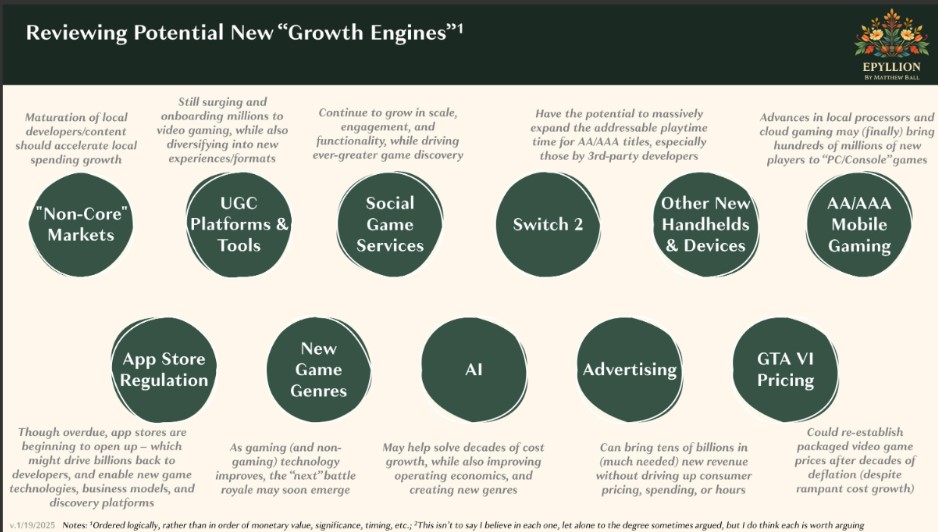
Again, I think it is worth looking at the presentation yourself, as each of the 11 bubbles there get multiple slides that introduce, justify, and even caution about the “solution.” Well, aside from GTA 6, which is noted would be the cheapest GTA ever (in real terms) if it comes out at $70. GTA 5 was released in 2013 at $60, which would be over $80 today, for example. Notwithstanding the billions of dollars GTA Online brought in, of course.
Overall, I did come away a bit more sympathetic to the plight of the games industry. Some of the headwinds I can personally attest to. For example, there have been multiple nights in which I found 2-3 hours of my “gaming time” consumed by Youtube Shorts scrolling. The network effect or “black hole” games are certainly a challenge as well, as anyone who has spent years playing MMOs can attest to. How do you compete against Fortnite, Minecraft, Roblox, and/or all the others?
“Raise prices,” of course!
Unfortunately, the actual solution is both pithy and hard to achieve: make fun games. Note how that solution did not include the words “spend 8 years painstakingly rendering every blade of grass.” Also note that I’m not saying that coming up with a fun game is easy either. But the industry seems stuck in this death loop of hiring more artists, programmers, marketers, and greenlighting enormously long development times… only for the game to fall flat because the fun wasn’t there. You can’t just hire more people to increase the fun quotient. And sometimes the fun that is achievable is only experienced by a narrow slice of the market, too small to be sustainable for the larger companies.
I don’t know the solution. If I did, I certainly wouldn’t be giving it out for free. But it might well be… decimation for the industry. I think a lot of publishers are just going to go bankrupt trying to spend their way out of the tailspin. AI could be a big disrupter, but disruption favors small indie shops, not the big guys. And while I do feel like longer development times is the obvious root issue for ballooning costs, I don’t see how the industry moves towards shorter development times and… then what? More releases? I mean, I wouldn’t be mad about a new Fallout every 2 years. If they keep the releases the same with a shorter development time though, that just means an implosion in the game jobs market. Not ideal.
…or maybe it is?
I dunno. I’m just a dude looking for fun games to play with my ever-decreasing amount of free time and eroding consumer surplus. When I look at my most-played games though, what I don’t see is full-priced titles with photo-realistic graphics and 8+ years in development. Well, I guess some Early Access titles were being worked on for that long, but it was like with three guys, not three hundred.
Anyway, Take Two can try and take $100 if they want and everyone raise prices as a result. Maybe it works, maybe it doesn’t. Nevertheless, my parsimony will abide.
 In An Age
Switch 2 Paying Too Much
Apr 2
Posted by Azuriel
In the weeks leading up to today, I was actually looking forward to hearing the details about Nintendo’s next console, Switch 2. Which might seem odd, considering I let the entirety of the original Switch lifecycle pass me by. And, actually, the last console of any kind that I purchased was a PS3 and I barely played any of the games I bought on that. I did upgrade my PC in 2022, and that is where I do most of my gaming. But… well, I have recently started being interested in portable gaming and figured that if I were to jump into the waters, maybe the Switch 2 would be as good a place as any.
Except, perhaps, when it costs this fucking much:
Leaks were suggesting $399, and it’s “just $50 more” as some say… but look at the game prices now. We were just talking about analysts suggesting (and begging) for Grand Theft Auto 6 to launch at $100, and it seemed like an absurdity. But here’s Nintendo leap-frogging the new $70 “standard” and going right for $80. And since it is Nintendo, these game prices are going to basically be set in stone for the decade – no Summer Sales or discounts for us.
Well, aside from the $500 console bundle with Mario Kart, saving you $30 one time.
The grand irony is that I had started getting interested in the Switch 2 because I developed a renewed interest in handheld emulators. I fell into a deep YouTube rabbit-hole around the explosion of these handhelds, and even picked one up myself on the cheap (Miyoo Mini+). This was technically (even more) unnecessary considering I still have a PSP and even an OG DS which are both set up to be emulators. In my mind though, I wanted something dedicated to emulation specifically, with a smaller formfactor, with the assumption that I may give it to my son once he gets into gaming. With me playing it in the meantime, of course.
After playing around with the Miyoo Mini+ though, I discovered strange sort of nostalgia holes. It will play up to PS1 games no problem, but I started thinking about the N64 games I might want to play again. Or GameCube. But not PS2, for some reason. Anyway, once you start looking into that direction, your options shrink until you start hitting the “Steam Deck” tier which is $400 (or more). At which point, well, here we are again. Although potentially tackling my Steam backlog…
…I wonder how long it will take for the Switch 2 to be cracked? Best of all worlds, potentially.
In any case, god damn, Nintendo. There are plenty of talking heads saying that $70/$80 games are “necessary” to “save” the industry. What’s not often mentioned is how many chairs will be remaining once the music stops. Gamers were already spending 60% of their time playing 6+ year old games back in 2023, so how many new $80 titles do you think they’ll be buying in 2025 in this economy? Nintendo will probably be fine. Other studios? Probably not so much.
Posted in Commentary
2 Comments
Tags: Emulator, Nintendo, State of the Industry, Switch 2, Too Damn High