FF14 Subscription Number Speculation
How many active subs does Final Fantasy 14 have? More than WoW?
The answer to the latter question is “lol no,” but the former is a bit trickier. The official word circa July 2015 was the following:
During today’s Japan Expo, Final Fantasy XIV Producer Naoki Yoshida shared that the game has accumulated a total of five million paid subscribers during its 21 months on the market.
To be clear, the current subscriber count hasn’t been announced, nor has Square Enix ever shared this figure. The five million subscriber total doesn’t include trial accounts, and only those who have at one time or another paid the $12.99/$14.99 monthly fee making it a substantial feat.
Estimates place FFXIV at around 800,000 to 1.2 million subscribers after a one million subscriber bump from February’s announced total of four million, averaging at around 9,000 new players per day over four months. Significant post-launch updates and the arrival of Final Fantasy XIV: Heavensward have been key components to recent growth
An embarrassingly large number of people have taken the “5 million registered accounts” news to mean 5 million active subs, but that does not pass the smell test. Which smell test? The March 2015 yearly report smell test (PDF):

The graph above shows that all Square Enix MMOs generated around 6 billion yen on a quarterly basis, or roughly $49 million. If we assume that 100% of those dollars came from FF14 subs at the $12.99 price-point, that would put the sub numbers at $49m / 3 / 12.99 = ~1.25 million subs.
We can be more charitable in our calculations, if we wish. Let’s take the yen/dollar exchange rate from back in 2014, so 6 billion yen is now… erm, way less than $49m. Nevermind.
Okay, let’s assume that the chart actually refers to 2014 sales (or projected 2015 sales) instead of what it’s labeled as. We know that FF14 had 4 million registered accounts in February 2015, followed by 5 million in August 2015. Looks like it also had 2.5 million in December 2014. That amount of box sales + 2nd month sub fees is nothing to sneeze at, especially 1.5 million over the holiday season. Assuming a 100% retention rate, if we add the 2.5 million to what we have already established, we get 3.75m subs, which is the closest any MMORPG has ever gotten to WoW.
Of course, that’s all a bit silly.
What we know from other sources, is that there are 408k characters (not players) at the highest level cap in the five months since the expansion was released; the number of level 50+ characters stands at 1.3m. Maybe FF14 takes people longer to level through, sure, fine. So lets now assume that the chart we used before speaks about all of Square Enix’s MMOs and not just FF14, and the fact that it includes box sales, so whatever FF14’s portion of those numbers actually is, is reduced again.
Still think FF14 has 5 million active subs? Half that? Even a third?
There is every indication that FF14 is a great MMO, and I expect that it is. What I do not expect is for the Square Enix 2016 report to show even 2 million active subscriptions throughout this year.
We’ll have a better idea around this coming March, I suppose.
Review Bombing
Three years ago, I wrote a post called The Weaponization of QQ in which I discussed “review bombing,” e.g. the practice of people writing negative user reviews out of spite. At the time, one of the particular objects of ire was Mass Effect 3. The user rating has trended upwards from 3.7 to today’s 5.4, but there remains 2518 positive vs 2372 negative reviews. And the vast, vast majority of the latter straight-up include passages such as the following:
I would have given this [Mass Effect 3] just a five, as it’s just that, an average game. However, since it’s clear that Bioware bribed journalists and reviewers to give their game a good review, I decided to counter the inflated reviewer scores and give this game a zero.
Now in the waning days of 2015, I am here to say that the practice is, unfortunately, alive and well.
One of the more topical targets is Fallout 4, which also sits at 5.4, primarily due to “reviews” like this:
Overrated Bethesda is back at it again, and they created another piece of garbage idiots to j!zz over. For starters this isn’t a 0/10, it’s more of a 4/10 but I’m trying to even the score because the fanboys are giving the game a 10/10 without explaining anything.
The above opening continues with some actual criticism of game mechanics and such, which puts it in a shockingly vanishing minority of these sort of reviews. Many are just like this:

Slacktivism at it’s finest.
It is not entirely clear how many of these people even played the game.
Fallout 4 is not, of course, the only high-profile victim. Even media darlings like GTA 5 are not immune:
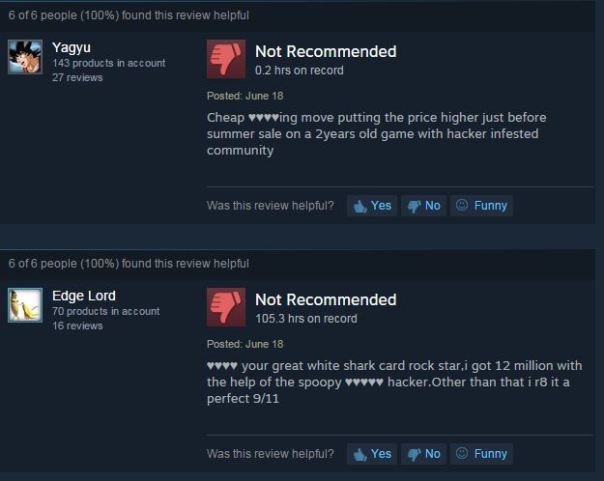
Useful.
Back in June, I had to scroll through thirty-eight (38!) negative Steam reviews to find even one that contained useful information about the actual game. The rest were simply outrage over one of the Steam sales in which Rockstar apparently increased the price ahead of the sale, via adding in-game currency as the only available bundle, thereby possibly disabling Steam refunds. Which is certainly an entirely valid concern by itself, but not one that really has anything to do with reviewing the game.
The first time I brought this up, I was concerned about what possible effects these user review bombings might have on the direction of developer game design. Now? I’m much more concerned about how devalued this practice has rendered user reviews and, by extension, all our opinions. Perhaps developers have never been overtly concerned with user reviews, so review bombing doesn’t matter. But they mattered a bit for me, when determining if a game might be worth playing. And now that resource is gone, to be replaced with the outrage of the day.
Review: Fallout 4
Game: Fallout 4
Recommended price: $25
Metacritic Score: 84
Completion Time: 22-100+ hours
Buy If You Like: Fallout 3, FPS Skyrim, Post-apocalypse recycling simulators
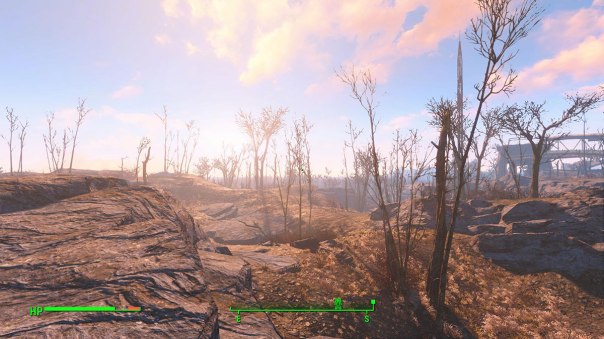
Not your father’s wasteland.
After 95 hours of gameplay, I have come to one conclusion: Fallout 4 is one of the strangest games I have ever played. It is simultaneously brilliant and baffling; moving the franchise forward and pulling it back again; an unfinished and undocumented disaster packed with the most intricate of details.
Like I said: strange.
The main thing to understand right away about Fallout 4 is that it is almost a direct continuation of Fallout 3 (in terms of feel), and not Fallout: New Vegas. While many people say that New Vegas was the pinnacle of the (3D) series – and that may well be the case – it was also developed by an entirely different design team. Fallout 4 is a Bethesda game, not a Obsidian game, and so it has more in common with Skyrim than anything else.
From a gameplay perspective, Fallout 4 is the best that the series has ever been. The gunplay and FPS elements have been refined to the degree that it is now entirely possible to play the game without using the VATS system at all. Indeed, even when using VATS, time no longer freezes, but simply slows down, always keeping the player in the middle of the action. The addition of Legendary enemies (and their assorted loot) keeps enemy encounters relevant and exciting throughout the entire game. Many of the staple monsters in the game have received a conceptual facelift, such that Feral Ghouls, Deathclaws, and even the Sentry Bot feel both “new” and like they should have been that way all along.
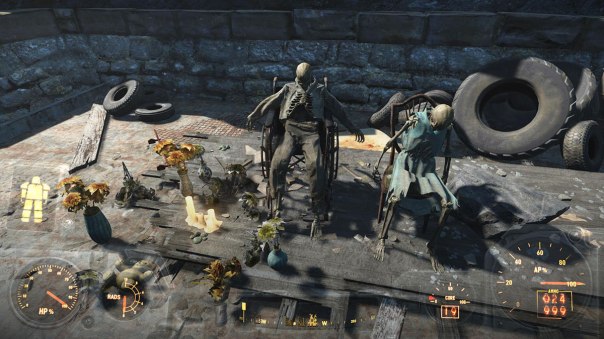
Textless stories.
Then there is the crafting. Oh, the crafting. Every single piece of post-apocalyptic debris is now salvageable into crafting components to support the Settlement-building part of the game, or the gun modding. This one “small” change completely shifts one’s exploration perspective, as now suddenly all the empty rooms you might encounter are full of the priceless treasures that are typewriters, office fans, and aluminum cans. Indeed, this might almost work too well, as it is easy to get distracted with salvaging these things rather than seeking out other, more hidden loot.
By the way, let me just say that Bethesda seriously nailed the ambiance and setting in general. Boston felt like a real (ruined) city, and not just a series of loading screens and skyboxes. Even the surrounding cities and suburbs felt like actual towns. Putting aside their gameplay elements, the addition of Settlements really went a long way in making the wasteland feel populated by real people, rather than simply being trash heaps from which raiders and enemies spawn.
That said… a lot of the rest of the game just feels off.
The Lockpicking and Hacking minigames are back, directly lifted from their original incarnations, unexplained in any real way in-game. Speaking of unexplained, the Settlement system has one of the worst UIs I have ever seen in a videogame. The Perk system overhaul is similarly ugly as sin, giving the illusion of depth but none of the functionality. Perhaps the Skill point system wasn’t all that much better, but at least each level felt like it had tangible progress towards a goal.
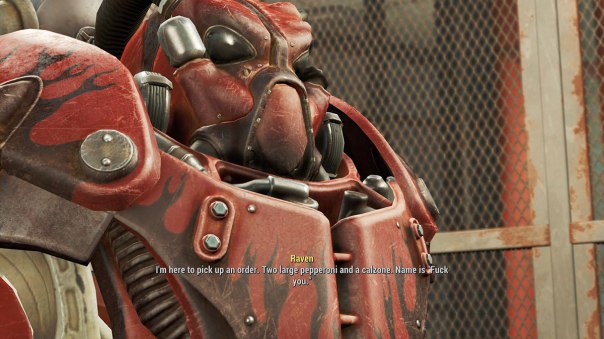
Some lines are okay.
The voice-acting is extremely good, but the dialog itself (and the choices given) all seem rather bad. Indeed, this was the first Fallout game I have played in which the main story quest felt inconsequential, incomplete. Several times I had to look up what the main quest even was, as the “find your son” narrative receded into the background radiation of the wasteland.
All told, I played Fallout 4 for 95 hours and still ended up skipping a tremendous amount of the game. In all that time, I never got around to doing any quests for the Brotherhood of Steel, or visiting Salem, or even really poking around the bottom-right part of the map. There is so much more that can be done… and I’m unlikely to muster the drive to see it through. Does this indicate the game is deficient in some (many) ways? Perhaps. On the other hand, what right do I really have to complain about a game that generated 95 hours of entertainment?
The bottom line is that Fallout 4 is a game worth playing, whether you are a fan of the series or if this is your first Fallout title. I don’t think Fallout 4 is possible to become anyone’s favorite game, but there is more here than in 99% of the other games you could be playing.
More Final Fantasy 7 Remakes
It has been an interesting weekend.
In case you missed it, Sony released a gameplay trailer of the upcoming FF7 Remake:
People are saying that the combat system looks pulled from FF15, but I never played the demo, so I wouldn’t know. What I do know is that it looks a lot more Action and a whole lot less classical Squaresoft. Which is probably to be expected, given how Squaresoft hasn’t been Squaresoft since 2003.
What wasn’t expected, at least not by those without hearts crafted out of solid jade, was this part (emphasis added):
LOS ANGELES (Dec. 6, 2015) – During this past weekend’s PlayStation Experience in San Francisco, SQUARE ENIX® debuted a new trailer for FINAL FANTASY® VII REMAKE, the full remake of the award-winning role-playing game, FINAL FANTASY VII. The new trailer features the first CG scenes as well as gameplay footage. FINAL FANTASY VII REMAKE will be told across a multi-part series, with each entry providing its own unique experience.
It’s difficult for me to even know how I feel at this point. A year ago, I said:
In Scenario B, Square Enix remakes FF7’s graphics and then essentially changes the entire game with a new battle system or whatever. I agree that such an outcome would be bad, but that is because the scenario itself is dumb. That is no longer a remake, it is an entirely new game with the same characters. Which at this point I would probably play, but nevermind.
Six months later, I was a gushing fanboy again. Now? I don’t know what to believe.
The explanation that has been given is that in the process of remaking FF7, the game simply became too big for a single title. Which, to an extent, I can see. Part of what blew my mind 18 years ago (…Christ) was when you defeated those Shinra guys during the highway chase and finally reached the outskirts of Midgar. And… the game kept going. Every single thing that you had been doing up to that point – the grandeur of Midgar, the assaults, the Section 7 destruction, Sephiroth, all of it – was just one town on the world map. I fully expected Midgar to be the only city in the game, and thus I can see Square Enix doing something exactly like that in the Remake.
But, man, there are so many different ways to fuck this up.
When they say “episodic,” do they mean dividing the base game up into individual pieces? Some have suggested Disc 1 would be Episode 1, etc, although that makes Disc 3 rather sparse. Or would they go with the scenario I outlined above, and have the first episode take place entirely in Midgar? I could see that happening, but they would have to change quite a bit to make a full game out of it. Or maybe they wouldn’t, and just leave it as a 10-20 hours or whatever. But what do they mean by “each entry providing its own unique experience?” Different viewpoint characters? Will progression be reset inbetween? Doesn’t this imply that sections of the world will be cut off either way?
I dunno. As I mentioned last time around, a rather large part of me is happy that this Remake is a thing in the first place, even if they screw it up royally. Of course, I would actually like this to be amazing. As they say though: “Wish in one hand, shit in the other, see which one fills up faster.”
Still, I want to believe.
Pacing
Pacing is an incredibly important concept in game design. Pacing can be defined by the ability of a game to remain fun and novel for a player throughout the beginning, middle, and end of the gaming experience. In other words: for a game to end while you are still having fun. Otherwise perfect games can be destroyed by bad pacing, even if you had immense amount of fun while playing, simply because you often remember your final experiences with a game more than the first ones.
Pacing is also almost entirely subjective, often depends on variables outside of designers’ control, and is sometimes impossible to force.
I was thinking about pacing the other night as I was playing Fallout 4. I am basically at a point in the game where what I do doesn’t matter. I am level 46, I walk around in the highest-level Power Armor 24/7, I have 25,000+ caps, and have more than enough supplies to build whatever kind of Settlements I want, if I ever cared to do so.
There is nothing left to challenge me. This fact was rubbed in my face last night when I fell down into a basement area and a Legendary Alpha Deathclaw walked into the room, 10 ft away. I shot it with a Gauss Rifle around 3-4 times and it died, never having the opportunity to even attack. This is on Survival difficulty.
For all intents and purposes, I am done with the game. But the game isn’t done.
This is not Fallout 4’s fault, per se. RPGs are always tricky to balance, even when they are on rails, simply because grinding XP to out-level challenging content is a pretty standard, time-tested strategy. Add in an open world, and pacing pretty much goes out the window. Or, at least, there is an implicit expectation in open-world games that the player will supply their own pacing.
Unfortunately for me, I am utterly incapable of pacing myself.
At this point, what I should be doing is ignoring everything but the main story and plowing forward. And that is precisely what I keep intending to do. At the same time, I do not anticipate playing Fallout 4 again until after the first DLC get released, at a minimum. In such a scenario though, there is always the possibility that I put a game down and never pick it back up again. I would rather breeze through trivial encounters in order to experience interesting side quests than possibly never see them at all.
Of course, I would rather experience them in a challenging, tightly-paced manner even more.
This is Why People Pirate Things
You might have read that I picked up Grand Theft Auto 5. You might also have heard that “Rockstar Social Club” is Rockstar’s laughably bad, Origin-esque attempt at creating a platform for their, like, two games or whatever. Why not just use Steam (which they are also on)? Probably because they must be digging through the couch cushions for quarters, given how they already cut corners on their goddamn server technology.
Case in point:

Party like it’s 1999.
I knew the download was big (60gb), so I started it overnight. I woke up to that. 230 KBs? You’re telling me I have to leave my computer on for three days straight to finish a download? My Steam games download at 1.2 MBs on average. It’d be one thing if I were trying to download from a small outfit or whatever, but this shit is a clown show. “It’s after Black Friday and everyone is downloading at the same time, overloading the servers.” You know who doesn’t have this problem? Steam. Blizzard (minus Diablo 3 launch). Pirate Bay. Any semi-intelligent network engineer who can plan ahead.
I mean, seriously, after seeing that speed I started researching to see if I could just download a pirated copy and sign in with a legit account at the end. That was when I found this Youtube video talking about a program called Ultrasurf. Downloaded, launched it, and picked my jaw up off the floor:

The one “quirk” with this “solution” is that Ultrasurf cycles through various proxy servers at certain intervals, which technically interrupts the download. For the most part, the GTA 5 launcher will pause and then resume the download no problem. After 5-10 cycles of this though, it will stop the download entirely, forcing you to press Retry to get it moving again. I’m not in a particular mood to babysit this download for eight real-time hours, so I had to look for another solution.
Enter Advanced Mouse Auto Clicker 4.0:

Embrace the Dark Side.
Just so we’re clear, I had to download a proxy server program that can supposedly defeat the Great Firewall of China, then set up an auto-mouse clicker program that checks to see if the Pause button changes into the Retry button. Just to fucking download my legitimate copy of GTA 5. I mean, sure, I could have bought it from Steam and paid an extra $9 to get a stable download. Or I could have paid nothing and got a stable download from Pirate Bay.
HMM. I wonder what I might be more inclined to do next time?
Rant over.
 In An Age
Digital Resale
Dec 21
Posted by Azuriel
As you might have heard, a French consumer group is suing Valve over, amongst other things, the inability of customers to resell their Steam games. The actual likelihood of this case being successful is rather low, as a German consumer group sued Valve (for the 2nd time) and lost last year. Which is interesting, considering reselling software licenses was ruled legal in Europe back in 2012.
The entire issue is fascinating to me though, as it touches on a lot of philosophical, economic, and even political points. There has been this historical dichotomy in gaming since at least the 90s, where we (in the US) have just simply accepted that computer games cannot be resold, but an entire industry can be built around reselling console games. I mean, think about it: why? Why the difference?
It seems we just kinda decided – rather arbitrarily, I might add – that because the PC disk wasn’t necessarily after installing the game, or that it’d be too easy to copy, that we shouldn’t be able to resell it. But what does that actually matter from a rights perspective? “You don’t own the game, you own the license.” Yeah, unless it’s an Xbone copy of Call of Duty, or a music album, or a DVD, in which case it apparently doesn’t matter.
If you have been following this blog for any particular length of time, you might know that I am a stalwart consumer advocate. And thus, I also agree that we should have the right to resell game licenses. None of the counter-arguments are at all compelling, and mostly seem to revolve around “it’s always been that way” or “think of the
childrengame developers!” About the only halfway interesting one was something along these lines:Some people also brought up the Xbone launch debacle. The problem is… these are non-issues. The Xbone was going to require a constant internet connection, or at least the ability to phone home every 24 hours, which has nothing at all to do with licenses. Requiring a connection for when you purchase or sell a license? Uh… yeah. That’s fine. You’ll presumably need a connection to download or sell the goddamn game in the first place. There is zero reason to require verification after that, other than to be nosy.
As for the impact to game developers? I mean this in the kindest way possible: not my problem. Nor is it yours. It is intellectually dishonest to wring your hands over such a development if you aren’t already very concerned about, say, Steam sales in general. Businesses are abstract, amoral entities that don’t give two shits about you. They are not your friends. If it were up to them, games would cost $2,000 apiece and require you to drive to their headquarters to play them.
Will game companies start doing more micro-transactions/DLC/services bullshit to recapture funds lost by a used game license scenario? Maybe. Then again, that sounds exactly like the same dumb argument that we shouldn’t be paying fast food workers more because it encourages businesses to replace workers with robots. Guess what? They’re going to do it anyway.
Honestly, just like with everything, it’d be best for everyone involved if game companies got ahead of the legislation on this. I don’t see any reason why Value couldn’t implement a system of resale that includes a cut for both Valve and the developer. When I sell a Steam trading card for $0.10, Valve takes two cents. No particular reason why Valve couldn’t take 30% (or even more) of the resale value for facilitating the transaction, and give X amount of that to the developer. If Valve, et al, tries to fight the future on this one, they might be stuck with a defined activation fee at best, while gamers trade licenses on eBay, Craigslist, etc.
Posted in Commentary
11 Comments
Tags: Consumers, DRM, Game License, Steam, Used Games