Blog Archives
More Impressions: FF7 Rebirth
I am still plugging away at Rebirth. Don’t worry, no story spoilers here.
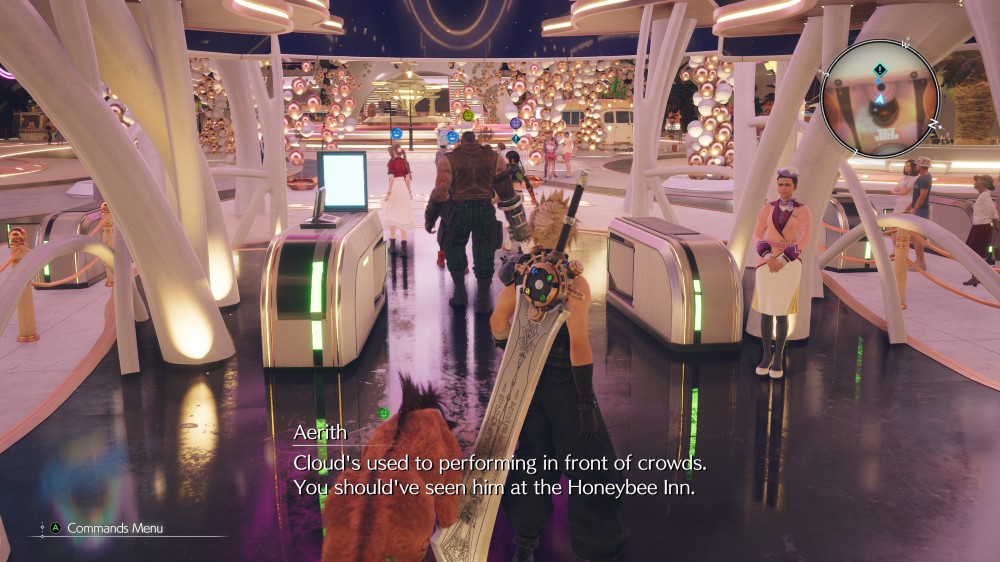
What I did want to talk about (again) is just how baffling the game systems are. There are some things that are just awkward and annoying, but true to the original, like having to meticulously move Materia around every time your party is forced to change. Mercifully, the devs do allow you to equip Materia into a slot from someone else, eliminating some of the tedium.
But then there is all the new stuff. Which exists for… some reason, to the detriment of the game.
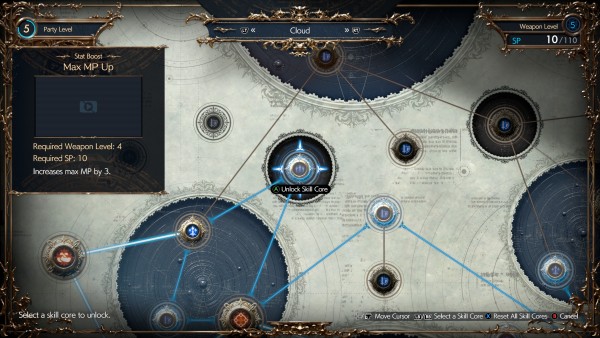
Weapons have Weapon Skill slots, which act like Materia (e.g. slot them), but I honestly have no clue where they come from. Maybe I missed the tutorial for that part and they automatically unlock? Anyway, they are pretty minor and largely inconsequential fiddly bits you have to mess with on occasion. Then you have the Folios, which reminds me of the Sphere Grid from Final Fantasy X. Or would if any choices there mattered either. Yes, the Folios are where you unlock Synergy Abilities and special magic attacks that don’t require MP. But along the way you have to spent points on things like “increase MP by 3” and “increase whatever by 5%.” Filler by itself is not always bad, but this is just one of a myriad of new systems introduced, again, for what reason?
And by the way, what Rebirth has done with spellcasting makes me wonder why they bothered with it at all. One of the issues of the first game (Remake) is wandering into a boss fight that hinges on you exploiting an elemental weakness that none of your team has equipped. With the Folios, all characters can unlock specific abilities that allow them to cast most elements without needing the Materia or even MP. That’s cool. However, the introduction of Synergy Abilities – which require two characters to perform ~3 ATB actions apiece – places a huge emphasis on executing actions that “count” towards them. What doesn’t count? Spells and those abilities that cast spells. Which… why not? Seriously. Combined with characters that have elemental-based ATB attacks like Cloud’s Firebrand, the whole spell system feels de-emphasized.
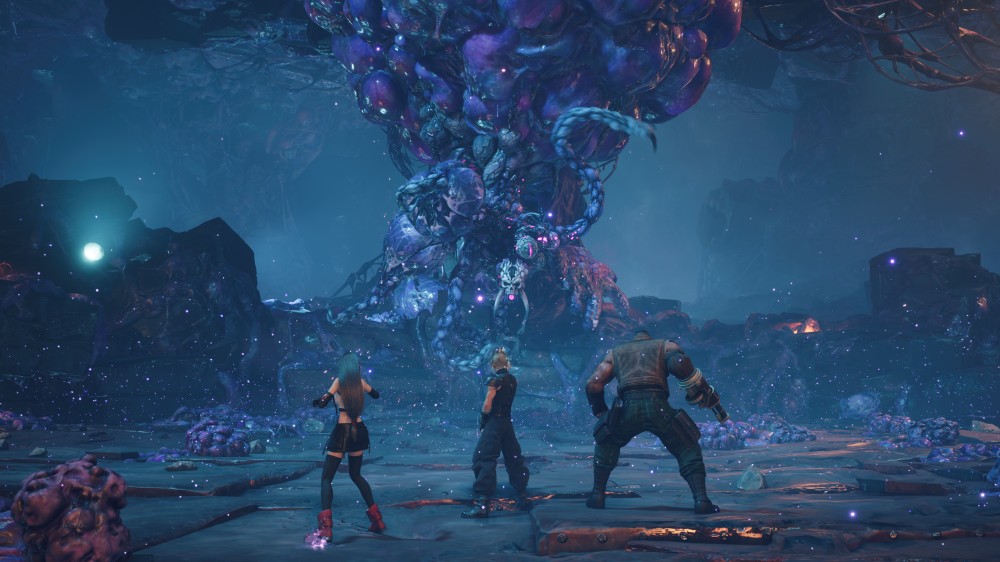
The other element (har har) that is becoming more annoying to me over time is the disparity between the characters themselves. Specifically, Tifa and Red XIII versus Yuffie. Both Tifa and Red XIII are melee-only characters that end up facing what feels like 80% flying enemies thus far. Not only can they not hit these flying mobs to gain ATB, many of their abilities won’t hit either. Enter Yuffie: primarily a melee character, that can also throw her Shuriken at distant/flying foes as a secondary attack. If it hits, a second tap of the button will teleport her to the Shuriken and allow her to start melee attacking the target, even in mid-air. Alternatively, if you start hitting the regular attack button, Yuffie will start attacking with her elemental ninjitsu, which is an instantaneous ranged attack. Did I mention she can change the element of the ninjitsu to target weaknesses?
I will concede that perhaps the devs feel a bit boxed in here. Tifa has the same attacks she did in the first game, as does Yuffie… who was released as a solo DLC character, and thus needed to have a broad spectrum of attacks to make up for it. At the same time, with all the craziness of Remake, I don’t think anyone would bat an eye at Tifa/Red having some way of engaging flying foes. Whatever the case, the end result is that while I want my party to be Cloud, Tifa, and Aerith, the classical trio is way outclassed by Cloud, Yuffie, and Barret. Sure, I could just do what I want and just take the OG crew, but that will make the enormously boring fights take even longer.
There are two final things I wanted to talk about, that are possibly only “me” problems. I’m very important, of course, so these are major issues. Those issues are Pacing and Tone.
From a Pacing perspective, Rebirth effectively has none. What typically happens is that you get to a new area, have a few Main Story Quests (MSQ), and then the next stage is far away into a blank map. Some of the time it is possible to make a direct approach and ignore the 20+ map icons and side quests and towers and collectibles and so on and so forth. There was even a time when the MSQ was almost directly in sight and you had to go out of your way to leave the area to hit up all the extraneous stuff. Other times you do have to unlock a certain amount of things and/or need to hit certain level milestones to not be stomped by the next boss. Regardless, I’m not a completionist or an achievement hunter, but I do actually care about extracting every drop of interaction I can from these characters that occupied so much of my youth, so I end up finishing everything I can stand.
Unfortunately, the end result is that I spend 2-3 play sessions doing busywork with this awful combat system and just can’t bring myself to push further into the story until I mentally recharge.
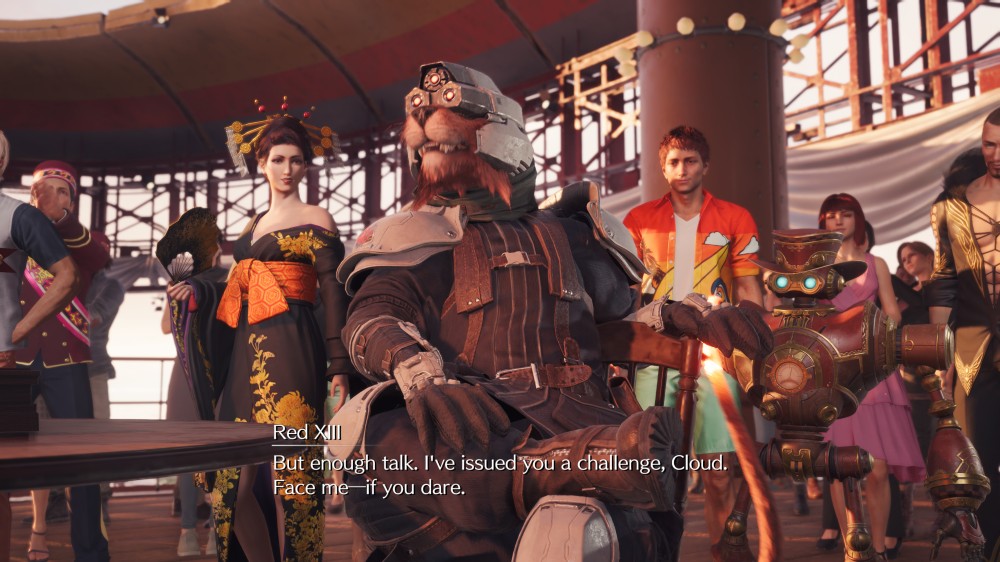
Double-unfortunately for me, the Tone for this game is all over the place. The original FF7 had extremely weird sections and comic relief at regular intervals, of course – the entire Wall Market sequence, for example. But I feel like the devs decided that every air pocket created from stretching the game into a trilogy needed to filled with nonsense. And not just a little nonsense, but ridiculous nonsense. Which again, fine, comic relief is a thing. However, the game isn’t that heavy to justify this amount of relief. Indeed, it’s hard to take much of anything seriously based on the in-game presentation. For example, there is a section in which Shrina soldiers are gunned down and everyone is somber and clutching pearls. Fast-forward past a bunch of filler quests (god, I wish I could have), you face off against a bunch of Shrina soldiers… that you gun down. What.
If it sounds like I’m not having a good time, you would be correct. I am currently sitting at 46 hours and sort of wish things had ended 30 hours ago. In the interest of plowing ahead, I have started to actually ignore the more Ubisoft-styled busywork, but it’s still tough.
This game is not the follow-up to Remake I was hoping for.
Impressions: FF7 Rebirth
I started Final Fantasy 7: Rebirth, middle-child of the “break glass in emergency” remake gambit trilogy.
The first game started extremely strong, with an overdose of weapons-grade nostalgia straight to the jugular. Midgar exceeded my expectations (and formative memories) in a way I thought would have been impossible. I mean, when they say “you can’t go home again,” the implication is usually not that the today home is so outstandingly better that it blows the old home out of the water. The personalities, the dialog, the little mannerisms… chef’s kiss. Has it really been three years?
However, you’ll note we’re now in paragraph three without saying anything about the current game.
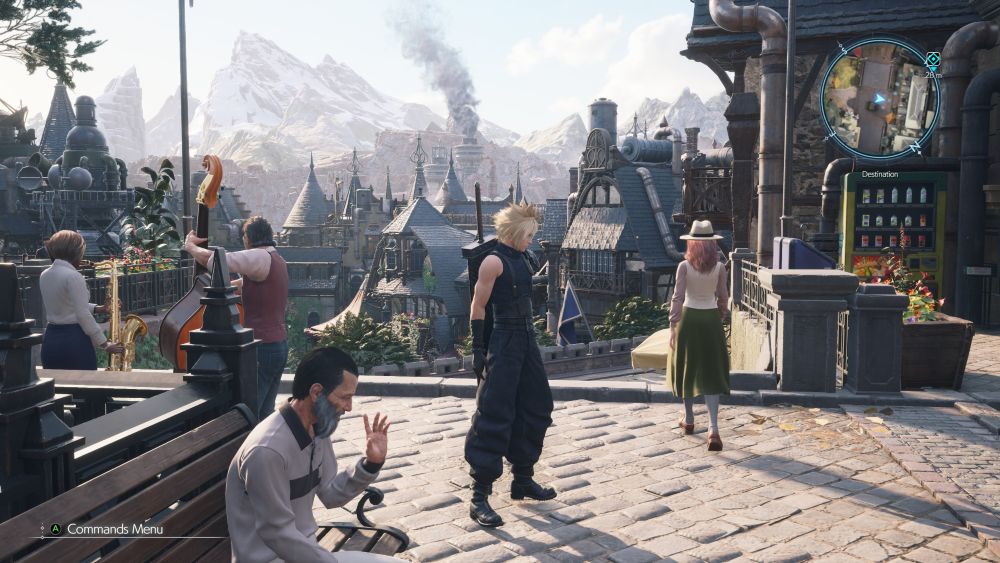
Visually, Rebirth an outstanding feast for the eyes. The level of detail in random corners of the city of Kalm is mind-blowing considering how (presumably) little of the game will be based there. The setting of FF7 has always been one of my favorite parts of the game – the juxtaposition between technology and magic and a world in decline – so seeing Cloud walk past vending machines and people taking pictures while he has a huge Buster Sword strapped to his back somehow hits all the right notes for me.
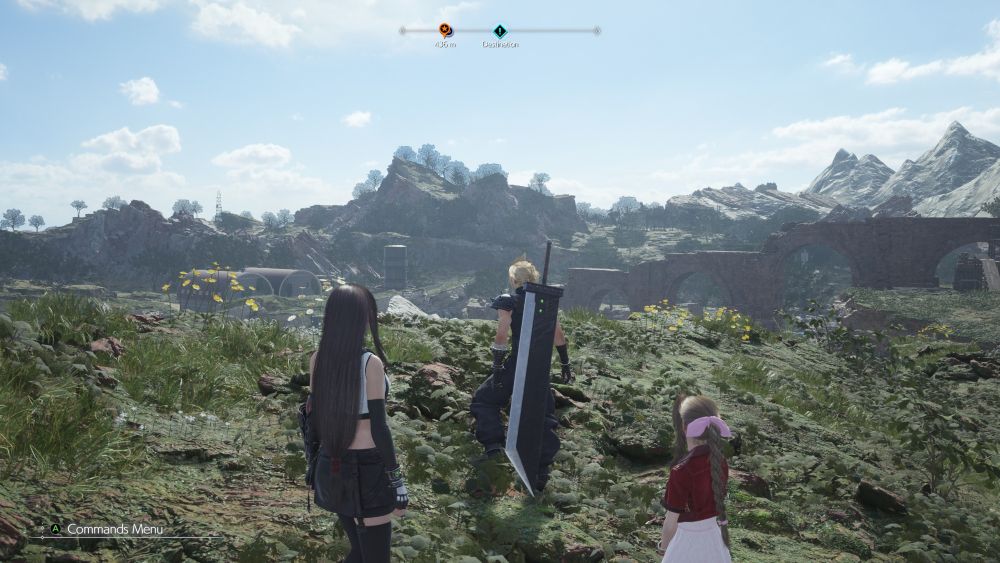
However, there is some significant trepidation on my part. One of the first big post-tutorial reveals is… the Grasslands! You know, the like… generic overworld between points of actual interest in the original game. While I appreciate that the devs were perhaps trying to recapture the 1997 experience when you realized that Midgar was only the opening sequence in the game, my own reaction was a heavy sigh once a big gray map popped up. I further massaged my temples when I later saw 37 different icons appear all over the map. You cannot have nostalgia for doing the same open-world checklists that exist for every modern open-world game. While it is presumably possible to ignore everything else and just hit the next Main Scenario icon, that leads me to the next source of concern: the battle system.
It’s still extremely early on, but as far as I can tell the battle system has only gotten more complex and even less fun as a result. The ATB system is still there, which means actual combat revolves around you spamming light attacks until you fill a meter and can use exciting features like Item or Spell or Ability. Low on health? You better… attack the enemy some more and hope you live long enough to undo a small amount of the damage you took trying to fill up the meter to allow you to heal. But, be careful: just like last game your precious ATB action can be interrupted, or miss entirely if it’s an attack. Which I could understand if this were a Souls-like or whatever, but it is not.
The new combat system additions are Synergy Skills and Synergy Abilities. Once unlocked in the “Folio,” Skills can be used while pressing the Block button and allow two party members to do a special action without needing the ATB gauge. Which is good, giving you at least some extra buttons to push aside from X spam. Synergy Abilities are super-Abilities between two party members that are only active once each character has used enough ATB actions. Some of these are cool, as they result in unique buffs that last quite a while, like giving characters infinite MP. Which, now that I think about it, isn’t as cool considering you still have to have a free ATB bar built up to utilize.
It’s like, what even is this combat system? Spam tiny attacks to fill a meter and then slow down time to select Abilities/Magic, then switch between multiple characters to do the same, then you eventually get to cast Summons (ATB-based), or Limit Breaks, or now Synergy Abilities.
I’m only 7 hours in, so maybe combat gets better this time? Please tell me it gets better. Sigh.
In other words, it’s a rough start to FF7 Rebirth. I’m going to stick with it because Junon, Golden Saucer, and Costa del Sol – along with the overall direction – but Square Enix ain’t making it easy to get there.
Avowed – Veneer Off
I have added another 16 hours into Avowed (total: 32), clearing the entire second zone. And while some of what I reported earlier is still accurate – traversal is fun! – the game’s veneer is definitely rubbing off.
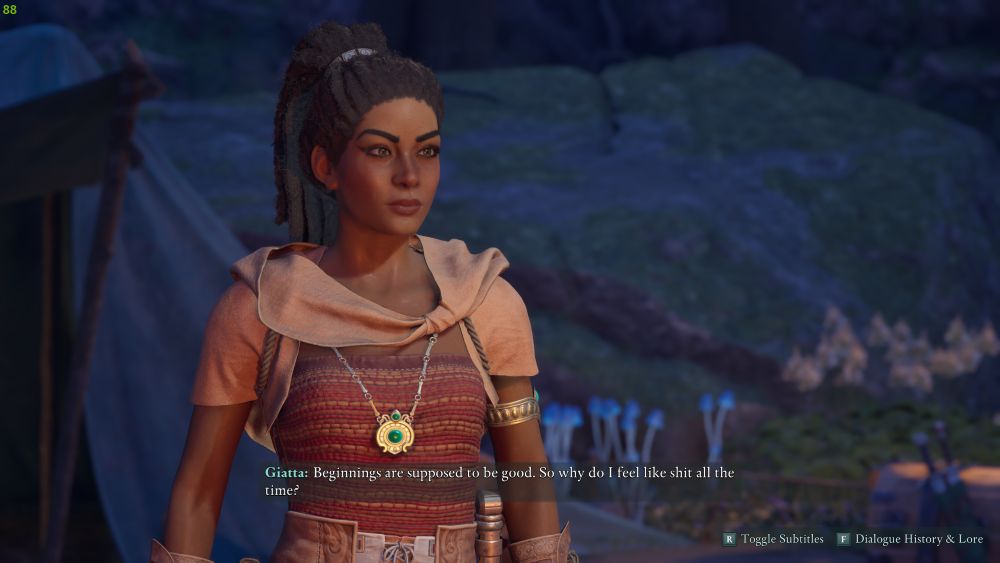
Combat, which hitherto has been fun, is now very rote. For the first half of the second zone, I respecced into a Ranger gun build and almost ended up abandoning the game entirely. There was… just no buttons to press. Sure, Ranger has a sort of vines CC ability, but aside from that, it was power attacks from pistols and nothing else to actively press. Technically I could have grabbed some more active buttons from Wizard as well, but Ranger is the only real splash-class, and trying to elevate your Intellect stat to the point where spells are relevant is a fool’s errand without just being a Wizard.
During the last half of the zone, I went into Fighter, first with a 2H weapon focus and then 1H with shield. Fighter had some more buttons to press – including a very satisfying Charge – and was a more dynamic experience overall with the Parry mechanic and blocking. The issue is that the DPS was just not really there. Avowed loves to throw groups of 5+ enemies at you, which is understandable considering Rangers/Wizards will nearly one-shot most of them from range in the opening salvo. As a Fighter, it’s not satisfying at all spending all your Stamina trying to block/dodge so many enemies. Although you do have two squad mates to help spread aggro around, the reality is that so do Rangers/Wizards, and those classes can actually eliminate enemies quickly. Which technically goes against the “gameplay” of Fighter, as if things die before you get into Parry chains or full attack combos, a lot of the Fighter-based weapons are useless. Which they are anyway, since they don’t kill quickly.
The other major issue that I glossed over previously was the world in general and interactivity in particular. Avowed is not Skyrim. Which is fine, most games aren’t. But as a first-person fantasy game that came out 14 years after Skyrim, Avowed is incredibly static. NPCs barely move (if ever), there is no world reactivity, there is no “stealing,” and every object out in the world is bolted onto the floor, aside from some breakable crates. To be fair, this is more an intellectual criticism, as I hardly noticed anything amiss in-game. But now that I have, I see signs of a Hollywood set everywhere. Which might have been fine, if this were not a fantasy RPG released in 2025 for $70 MSRP.
The final thing that is really dragging me down is the upgrade system and Unique weapons. I have been playing the game “as intended” when it comes to looting and experimenting, but have come to find out that the devs punish that playstyle. For one thing, all the respeccing I have done required me to upgrade several weapons that, oops, I am no longer using. Then I found out that all unique weapons in the world scale to the highest upgraded weapon you own at the time of pickup. What this means is that if the best weapon you have is Fine (blue quality), all the uniques you discover will be Fine. However, if you funnel all your upgrades into one particular weapon and get it to Exceptional (purple), those same uniques would have been Exceptional. And this works all the way into Superb (red) and Legendary.
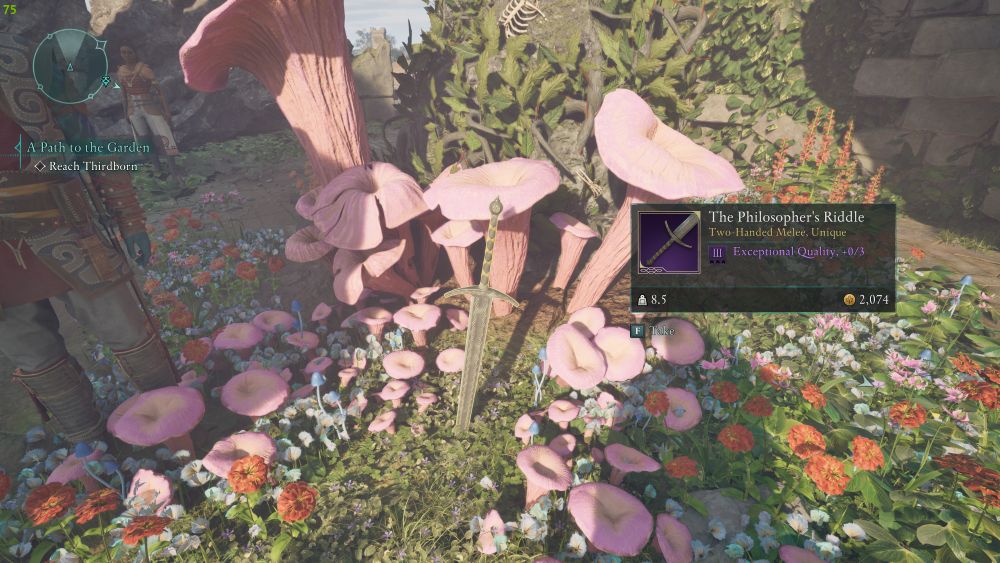
Do you like exploring the map and picking up things organically, doing a few upgrades here and there? Punished! Because now if you decide to go with another weapon or playstyle, you will need to double (or more) the upgrade materials required to level them up. Which, let me remind you, is very necessary because weapons and armor get a debuff if they are more than a few “tiers” below the enemies you are facing. Also, remember that enemies and money is finite in this game, so it is very possible to just screw yourself and be locked into something that is no longer fun.
Which might just be the entire game itself for me, at the moment.
I don’t know, guys. Not everything I play needs to be Game of the Year material; lord knows I play plenty of trashy survival games for hundreds of hours. But, truly, Avowed feels like a game that would have been really great… in 2015. Or maybe 2010. Obsidian is not Bethesda, yes. But this also ain’t New Vegas. And between this and Outer Worlds, I’m thinking that Obsidian needs to stick to what they do best: iterating on the shoulders of better games, rather than trying to make their own.
Grounded was great though, so… ¯\_(ツ)_/¯
Avowed – Early Impressions
I have played about 16 hours of Avowed via Game Pass. Early impressions: mostly great!
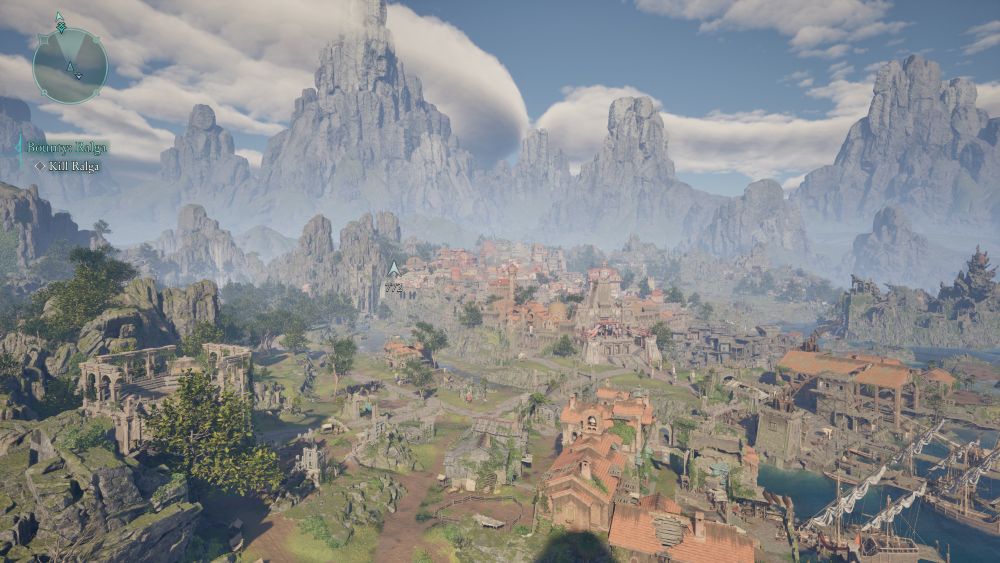
Although I have not yet stepped outside the first area, Avowed is a very gorgeous game. More than that, it is a joy to walk around in. It cannot be understated how much I like a first-person perspective in exploration games, which is elevated further when the character actually feels competent within it. There are marked ledges with the stereotypical yellow ropes, but there is almost no areas in which I felt I could not reasonably scramble up. This isn’t climbing sheer cliffs BotW/Genshin Impact-style, but it’s enough to feel like the world is explorable. It honestly feels one step below Dishonored in how good it feels walking around – if more games could have shadowstep-like abilities, that would be great.
Combat also feels really, really good. I am currently focusing on a Wizard character which gives me, honestly, too many options. The great thing though, is that there is a lot of variety in builds (on default difficulty) and how you engage with enemies. For example, I was rocking the standard wand + spellbook loadout, but I didn’t like how short range the wand ended up being. So, I have a pistol + spellbook. Plus, I have chosen a spellbook that allows me to conjure up a magic staff to beat people with if things get too hairy in close-quarters. Honestly, I kill most things with alpha strikes from a bow and follow-up pistol shots, so I’m leaning towards respeccing more into the Ranger class altogether. Which is easy to do, as it only costs a small amount of currency to respec, which is another plus.
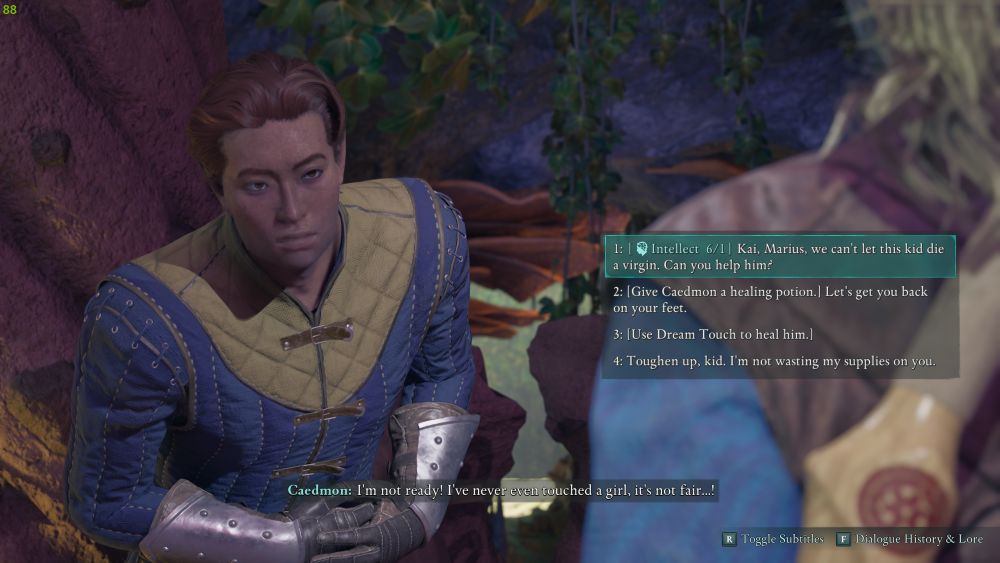
I’m not going to comment much about the story, especially given how early in the game I am. What I can say though, is that I like how the game takes itself seriously without also being too far up its own ass. Being able to view a glossary of all the Proper Nouns during a conversation is helpful, but it’s not always necessary either. Which is great! I did play the original Pillars of Eternity enough to get some of the references, and there were plenty of references to the second game I did not get, but still understood from context clues. I never fully expected Avowed to follow The Outer Worlds irreverence, but nevertheless I am glad the slapstick is relegated to only minor side quests.
Having said all that… yeah, I do have some criticisms.
First, enemies are finite – once you clear an area, it stays cleared. I’ve seen some people praise this as being “immersive,” but it honestly leads to un-immersive player behavior. For example, I was walking in an area and saw some of the lizard creatures battling with spiders. That is great dynamic happenstance (assuming it wasn’t scripted)! But instead of letting them duke it out and attacking the weakened victor, I immediately jumped into the fray because I realized that any incidental monster deaths was a permanent reduction in my possible XP. Now, I am assuming that there is a level cap that can be reached way before the end of the game proper. But this is also a game that gives you more abilities than you have points for, and thus I want to get any many as I can, as soon as I can.
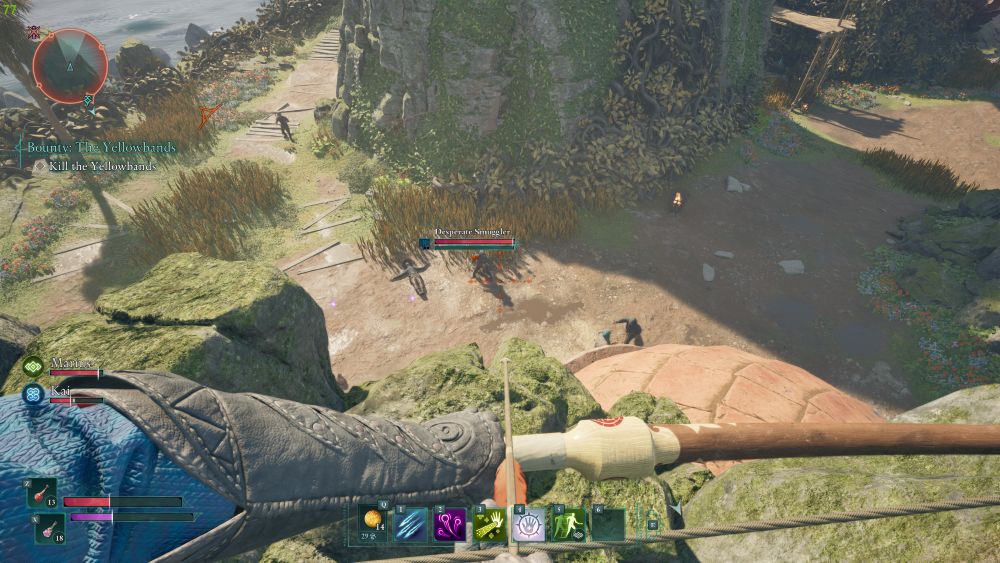
It did occur to me that the original Pillars of Eternity – and most CRPGs – also have the “feature” of finite battles. So perhaps that is not entirely out of place. But even aside from the metagaming aspect, combat itself is fun enough to want more of. I’m seeking out more of these random battles because it’s fun to push the buttons. Which is great! But I hate the idea of knowing they are a dwindling resource.
Another metagame aspect I do not enjoy is the carryover of The Outer Worlds’ “unique item” system. Essentially, the progression mechanic in Avowed is to choose amongst the the items you pick up and then upgrade a few of them over and over. Indeed, almost all of the loot you get from battles and hidden treasures are simply upgrade materials. The problem is that Avowed is also peppered with unique items that have bonus effects that regular items do not. What this means is that if you really like using Bows as a weapon, you are wasting upgrade materials on any regular bow, and should use something else until you get a unique Bow. The problem with that strategy is that weapons are debuffed against enemies of “higher quality” than the weapon used, because… reasons.
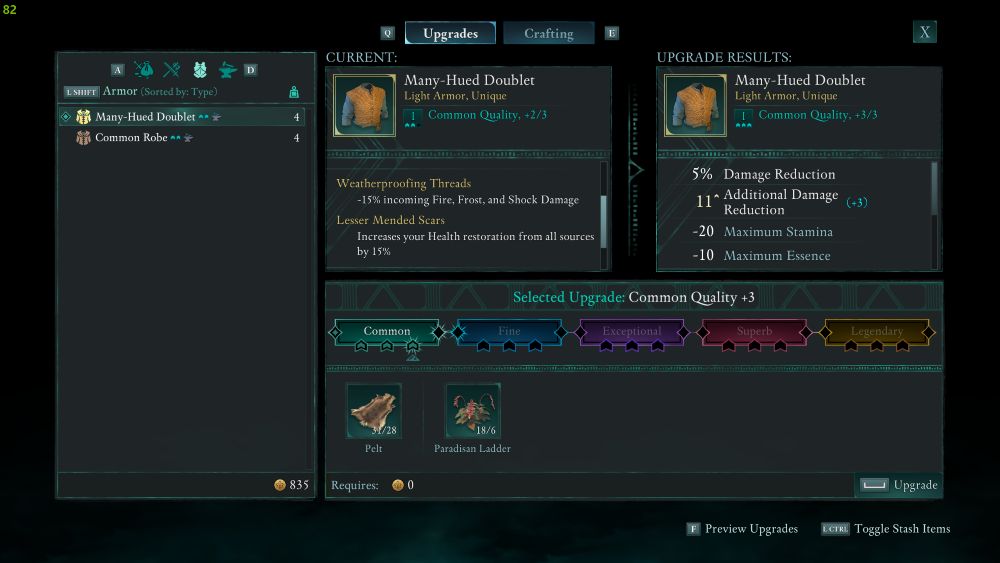
So, remember how I said I was using guns instead of wands for my wizard character? Aside from my range concern, what pushed me towards guns was the fact that I found two unique pistols and no unique wands. Without looking it up, I don’t even know if I’ll find a unique wand in the second area either. Which means I either waste upgrade materials on a regular wand so I can keep up with mobs, or I do something else. Similarly, upgrading spellbooks feels bad because you are locked into getting bonuses to just four spells. You can spend your precious few skill points to memorize spells without needing a spellbook, but you don’t get those bonuses that come from an upgraded spellbook.
Pressing buttons feels good, but each level up (and item upgrade) leaves me feeling unsatisfied.
Overall though, I do anticipate playing Avowed to completion. Perhaps the Wizard life is not for me, and the Ranger will be straight-forward enough to feel satisfying to level. It also helps that I have those unique weapons for the ranger already. Will I grow bored of using just those though? Well, it hasn’t happened yet. And perhaps I’ll accumulate enough Wizard uniques by the time it does.
…and hopefully I’ll still have enough upgrade materials to get them up to speed.
Let’s see how it goes.
Time and Place
Wildstar is one of those failed MMOs I have a bit of (perhaps misguided) nostalgia for. Granted, it’s a lot easier to remember only the good parts of something when the thing no longer exists to remind you of the bad. Wildstar’s terrible combat system, banal questing, radically tone-deaf developers pushing a hardcore experience for no one all seems to fade away with time. Meanwhile, the evocative art design, hoverboards, and astounding home building/decoration options springs right to mind.
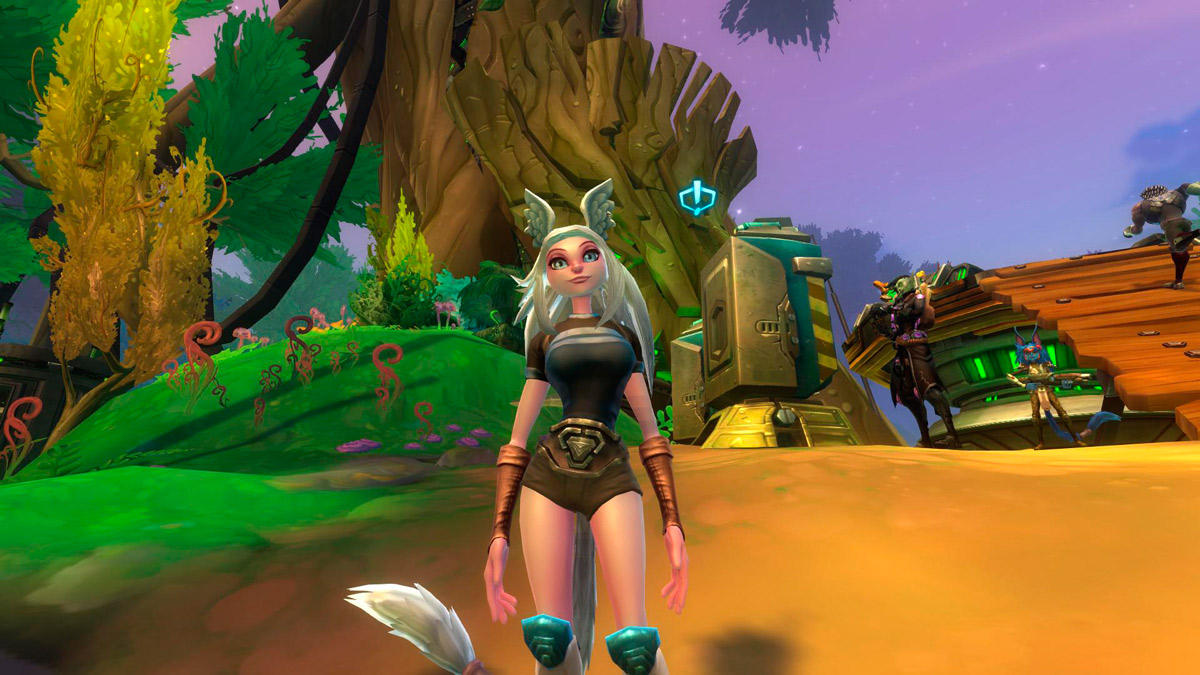
I bring this all up because of an interesting article I read the other day about Tim Cain spending 6 years working on Wildstar. And that wasn’t even all of it, as the game took another three years to release from there. Then the author drops this bomb:
To put it into perspective, when work began on WildStar, World of Warcraft was still in its vanilla era. When WildStar finally launched, we’d seen The Burning Crusade, Wrath of the Lich King, Cataclysm and Mists of Pandaria, and Warlords of Draenor was just around the corner.
No fucking wonder, dude. I had really never understood why the Wildstar devs believed the hardcore angle was a winning strategy in an MMO. Yeah, the original MMOs had that hardcore element to them and were successful. Were they successful because of the hardcore-ness? I would argue “clearly not.” But if the Wildstar devs were laying the groundwork for the game back in the age of vanilla WoW, their stubbornness nine years later makes perfect sense. That level of difficulty was what they were familiar with and wanted to “compete” against. Or perhaps even bring back.
Alas, the zeitgeist had since moved on.
Running Out of (Fae) Road
I am done with Nightingale, (presumably) for now.
I stand by all of my prior reporting, including the original Impressions post. There is a lot of potential with the game and its central realm-walking conceit, the ability for it to introduce fantastical creatures, an absurdly complex crafting system, and how great it feels to move around and exist in these magic(k)al worlds. Overall there is a lot to like here, and Steam tells me I spent 39 hours playing Nightingale. That’s pretty good for any game, let alone an Early Access title.
That said… there is still a long way for Nightingale to go.
The first problem is the consistently uneven difficulty spikes. Right after completing the tutorial island, you are shuttled off to Sylvan’s Cradle, a realm suffering from corruption. This corruption impacts you as well, with a realm-wide massive debuff to passive healing. You are then confronted almost immediately with a new type of Bound enemy that is insanely aggressive and hard-hitting, along with all mobs in general being at “level” 20. Your own gear progression is dependent on collecting higher-tier Essence and spending it to unlock new recipes and crafting tables. And therein lies the rub: you must suffer through being wildly underpowered until you grind enough T2 Essence to spend to craft gear to get back you on par.
And, spoilers, you will smash into the same wall again two realms later with T3 Essence.
By itself, uneven difficulty isn’t that big an issue, although the devs have gotten themselves in a bit of a pickle with the hard T1/T2/T3 Essence delineations. To me, the more relevant problem is a lack of consistent vision when it comes to crafting more generally. There are stats like Injury Resistance that sound important (damage reduction?!), but end up being worthless (prevent sprained ankle). Under Alchemy, they have things like a potion that fills your hunger meter. Literally, why? Food is everywhere and the importance of food buffs means you must be eating all the time. There are other potions to reduce being hot, which is also easily solved by equipping an umbrella, nevermind the fact that heatstroke or whatever simply limits your Stamina regeneration.
One aspect that is also utterly bizarre is the very thing Nightingale cannot afford to fuck up: realm-walking. Specifically, the absolutely nonsense direction they are heading with the Minor Realm cards. Shortly after completing Sylvan’s Cradle, you get the recipe to start building your own portals. Opening a portal means crafting and consuming a Major Realm card to one of the three available biomes (Forest, Swamp, Desert). Minor Realm cards can be used at a Realmic Transmuter within that realm to tweak “the rules” and usually the weather in the process. At first glance, there appears to be a lot of Minor Realm cards, but the more you look at them, the more questions you end up having.
The first group of Minor Realm cards are environmentally cosmetic, which is fine. Cleansing makes the realm turn back to default settings, Foresworn Skies makes it look like a black hole is overhead, Tempest makes it rain all the time, and so on. Then you have some pure upside cards like Feast/Tavern that boost food buffs, Angler makes fishing easier, Treasury lets you farm Essence. Then come the tradeoff ones like Dragon’s Hoard, that boost treasure chest contents but increases damage taken. Fine.
But then you see Blunderbuss that literally says:
Play this card to increase the damage you deal with shotguns, the yield when crafting shotgun ammunition as well as the damage you deal with magickal ammunition, while reducing the damage from other guns.
What? The devs included realm cards for pistols and rifles, by the way, so don’t feel left out. Additionally, there are realm cards that improve the yield of refined building materials, of wood, of ore, of crops, of meat/hide. All separate, of course, and occur only after the realm visibly shatters into a new form from the use of said card.
I’m honestly struggling to identify the design goal here. Is it intended for players to radically remake the realm in order to craft extra shotgun shells, and then revert it to another form to increase the yield on Wheat? Or should this encourage players to turn their primary residence into the City of Doors with portals to themed realms and otherwise endure the loading screens for marginal gains? Why are there output-related cards at all? Tempest makes it rain all the time, which means your crops will always be growing without needing to be manually watered. That sort of thing is what I consider good design – it’s subtle, intuitive (after a fashion), and atmospheric (literally). But then you have Greenhouse/Farm card which just straight-up increases plant growing speed and yield “for reasons.” Are these placeholders? Please tell me these are placeholders. Although placeholders for what I have no idea.
By the way, realms can only have one Minor Realm card at a time. Again, WTF mate? When I first heard about this portal system, I imagined being able to mix and match cards to craft bizarre realms like a very mountainous swamp or whatever. No Man’s Sky this ain’t. Instead, it’s just three procedurally-generated biomes with different skyboxes and min-max bonuses. Granted, there is a Trickster card that lowers gravity and shuffles up resources sources – chopping down trees give meat, skinning creatures gives ore, etc – but most everything else is rote. Safe. Sanitized. Much like with Starfield, you also end up seeing the same POIs and ruins over and over again.
Technically, there’s still time to right the ship before Nightingale runs out of road, to mix metaphors. Well, maybe. I doubt the realm generation code is flexible enough to accept blended biomes. Or maybe the original three will stay as-is and we’ll see others like Snow, Volcanic, and maybe some kind of Chaotic realm. Actually, I just found a quote:
“I think once we get a new biome out there, that will cement the last piece of the puzzle in terms of how we will create content going forward,” Flynn muses when asked about 0.6 and beyond. “There’s a volcano biome, there’s an Arctic and a jungle biome, all currently in discussion right now as to which one we’ll do first.”
Well, there you go. I do think that if they keep the bizarre Blunderbuss-esque Minor Realm cards around, they need to have it as an augmentation to an environmental-style Minor Realm card. That may lead to clearly-optimized combinations like Tempest + Farm, but they should either lean all the way into the nonsense or throw away half the cards immediately. When I think “Victorian gaslamp-fantasy adventure,” what does not come to mind is rewriting the rules of fae realms to make just my pistols better. Now, opening a realm to where all the Bound are wielding pistols and/or there are giant enchanted pistol enemies? That sort of thing is interesting.
Getting devs to gamble on “interesting” is not easy. Especially not when they’re already on their heels.
Complex Crafting
I dedicated a paragraph to Nightingale’s crafting system in my initial Impressions post, but after spending some more time with it and going up the Tiers, it deserves its own article. In short, I haven’t seen a more (optionally!) complex, min-maxing crafting system anywhere else.
At the base level, all the resources that you collect – wood, ore, meat – have attributes. If you craft something using a resource, that item inherits the attributes. That’s… actually it. That’s the system. The key is that as you unlock higher Tier recipes, they call for more complex ingredients, which have intermediate crafting components. In most games, these intermediate items are just a resource sink. The trick Nightingale pulls off is that every crafting steps allows for more opportunity to stuff the end product with extra attributes.
Let’s use a real example. I recently unlocked the first part of Tier 3 items, and I want to upgrade my old gloves to Calcularian Gloves. The recipe is:
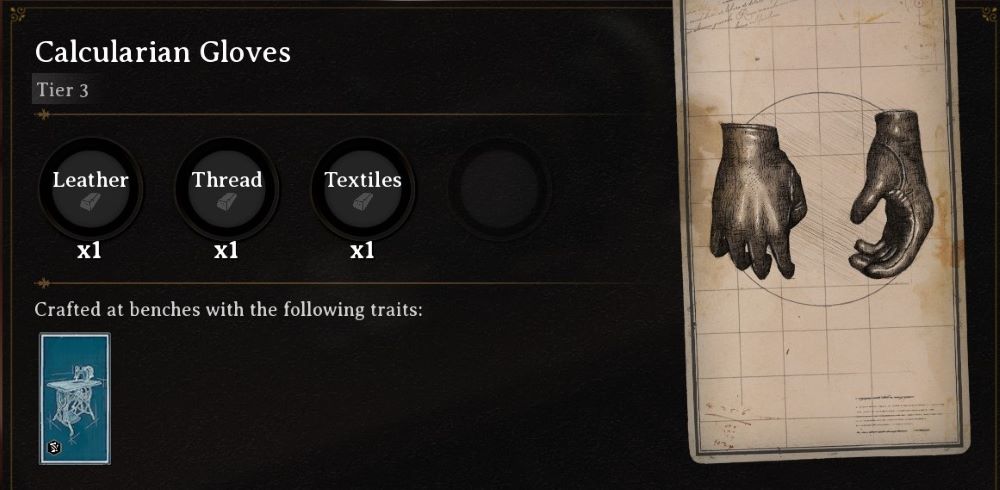
Fairly straight-forward, no? Let’s look at Leather. To make Leather, you need Hide, which comes from skinning creatures out in the world. Hide (Prey) grants +Stamina and Hide (Predator) grants +HP, which is fine, but there is also Fabled Hide that drops from bosses and special mobs that have an assortment of bonus stats. Pick one, craft the Leather, and move to the next ingredient.
…or maybe add a little more juice? As it turns out, Nightingale crafting has an additional unspoken feature in that higher-tier components can be substituted for their standard varieties. In this example, the recipe calls for Leather, but you can use Reinforced Leather for that slot. What’s that? It’s Leather x2 and a Fastener, the latter of which is crafted from Ingots. Now we can bring in some (m)ore stats. I’m a fan of Brass Ingots, as it has Melee Damage +4%, Ranged Damage +6%, and Durability +20. Craft the Fastener (Brass), combine with Leather, and we now have the first (!) ingredient ready for those gloves.
Next is Thread. What, you thought I was just going to “yada, yada, yada” this away? Thread requires Fiber x2. How complicated could that be? I’m glad you asked. There are a lot of sources of Fiber, starting with the grass you can punch in minute 1 of the game, to high-tier plant nodes, to drops from the Bound enemies. Something else that counts as Fiber is Animal Fibre (as spelled in-game). Animal Fibre comes from meat. Meat comes from skinning, but also from those Fabled beasts you slew for their Hide. So rather than cooking the meat for temporary buffs, you can instead craft it into Animal Fibre, and then into Thread for more permanent buffs. Neat.
Lastly, we have Textiles. Which is basically… most everything. I could use Reinforced Leather again for this component, but I wanted to look at other things. What I found on Tier 3 was Durable Cloth. This is made from Cloth + Lining. Cloth is Thread x2 and Lining is… Cloth + Thread x2. Talk about Threadception. Or maybe Fiberception is more accurate. To break this down, Durable Cloth is created using Cloth + Cloth + Thread, which are three opportunities to stuff in more stats. “Opportunity” is the key term here, because Lining by itself satisfies the Textile requirement, as does Cloth. The only reason to complicate it is precisely because it allows us to utilize more resources and multiply their attributes.
The best part is that, again, all of this is optional. If I wanted to fully min-max, I’d make sure that every Thread was crafted from Animal Fibre that came from Fabled Meat (e.g. bosses) that I farmed. Or I could walk outside my shack on tutorial island, skin the first deer I shot, punch some grass, and craft the Tier 3 gloves like that. The stat delta between the two would be incredibly vast, of course, but most reasonable players will probably just craft what they can using the best ingredients they happened to have squirrelled away at that moment. Or maybe they will be driven to go farming for more mats. Either way, that a win-win in the design department… provided you didn’t scare anyone away.
Anyway. Congratulations, you have just made a pair of gloves!
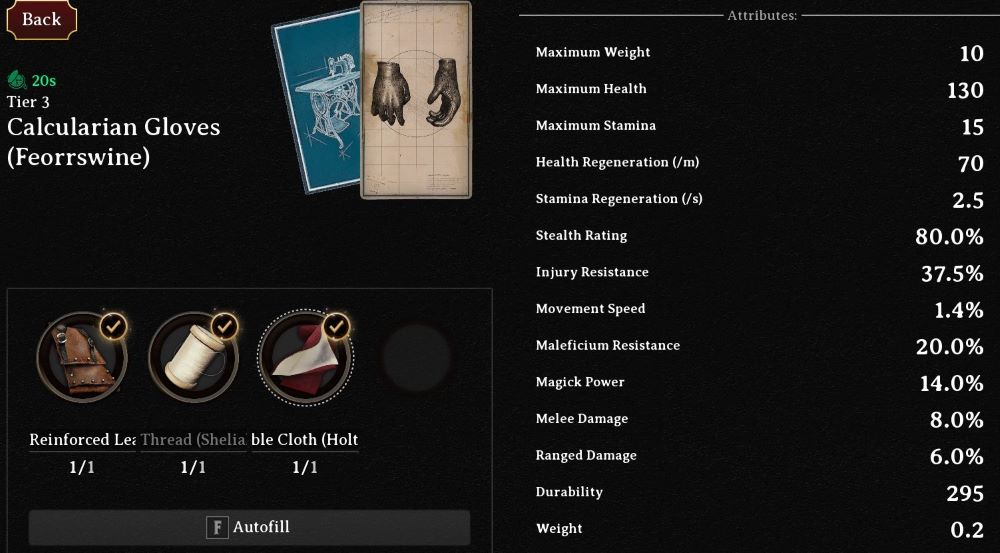
By the way… I hope you arranged the augmentation decorations to maximize your bonus attributes before crafting though. Oh, and be sure craft and apply an Infusion and appropriate Charm. Glad this was just an item of clothing and not a melee weapon, as you’d have all of that plus Enchantments.
What’s In A Game?
Dragon Age: the Veilguard is coming out on October 31st. How I feel about it is… complicated. Veilguard’s first trailer received a lot of flak, but there have been a few subsequent ones that show a more a traditional Dragon Age vibe, as opposed to what felt sort of Fortnite/Borderlands-ish irreverence. Besides, what’s not to love about it being more Dragon Age, featuring a romanceable Scout Harding, and the fact that it’s a BioWare game.
…or is it?
I mean, yes, it’s a BioWare game. It’s also an EA game, proven by the fact that it has a deluxe edition, pre-order bonuses, and a $150 Collector’s Edition with a physical LED dagger and other items that hilariously doesn’t come with a copy of the game. You seriously can’t make this shit up.
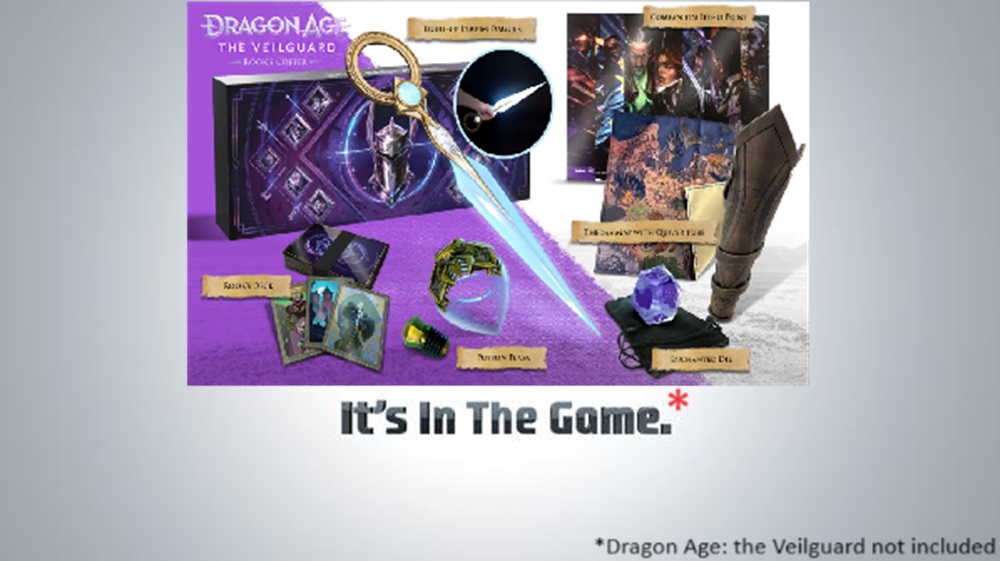
But what is a “BioWare game,” or any game for that matter? Not in an existential sense, but what is meant when we say these things? When I say BioWare game, emotionally I’m referring to a nebulous sort of companion-focused, squad-based RPGs with branching endings based on player dialog choices. Basically, the Mass Effect and Dragon Age series. Which I have historically enjoyed, including even (eventually) Mass Effect: Andromeda. It’s a type of game with a particular vibe to it.
Having said that, being a “BioWare Game” is really just branding and marketing. BioWare also released Anthem, which was a commercial failure; Andromeda wasn’t that hot either, considering how all DLC and follow-up expansions were canceled. Rationally, there should be no expectation that just because BioWare is releasing Veilguard, that it will be of the same quality of [insert favorite Dragon Age game here], especially after the franchise’s 10-year hiatus. But that touch of skepticism should still be the case even if Anthem and Andromeda were smash hits.
I have long cautioned against the sort of hero worship that game developers sometimes generate, especially when it comes to “rockstar” designers. There are people who fall to their knees at the altar of Fallout: New Vegas and Chris Avellone. To which I say: why? Even if New Vegas is your favorite game, there were a lot of cooks in that kitchen. In fact, you probably should be worshiping at the feet of John Gonzalez instead. Or, preferably, worshiping no one, including the companies themselves.
Game design is a collaborative endeavor – solo indie titles aside – and it’s a nigh-impossible task to nail down exactly who did what to make the game as compelling an experience as it was. Especially including the very staff who did it. Back in the day, there was an argument that Blizzard was sending in their B-Team for the Wrath of the Lich King expansion, and that is why subscriptions started to decline for the first time (notwithstanding the 12 million sub peak). As it turns out, that wasn’t the case – most everyone from vanilla and TBC ended up working on Wrath and subsequent expansions. Hell, the most controversial addition to the game (Looking for Dungeon tool) was something the original “rockstars” devs wanted to release in vanilla. It wasn’t the bean counters or the C-Suites or whatever design boogeyman you want to define; the calls were coming from inside the house.
There are times where it appears one very visible person seems to make a difference. Hideo Kojima immediately comes to mind. It is also difficult to argue against the apparent influence of, say, Yoshi-P when it comes to FF14. Or Hidetaka Miyazaki of FromSoftware fame. They could not build their games alone, of course, but leadership can and does set expectations and gives direction in these endeavors. There is a level of consistency – or consistent craziness in Kojima’s case – that is pretty rare in gaming.
By and large, though? Every game is a gumbo and no knows what went into it or why it tastes the way it does. That’s… a pretty strong nihilistic take, I admit, but riddle me this: if someone figured it all out, why is it so hard to bottle the lightning again? Boredom? Fear? Ever-changing audience mores? There are so many moving parts, between the game designers coming and going from the company, to the gaming zeitgeist of the time, to competing game releases, all of which can influence a title’s success. You can’t just say “Obsidian should just make New Vegas 2 and it will be a smash hit” because A) most everyone from the original team has left, B) none of the people who left appear to have taken the secret sauce with them, and C) New Vegas was massively outsold by Fallout 4 in any case.
So, am I still looking forward to Veilguard? Well, two words: Scout Harding.
Seriously though, I don’t want the takeaway to be that you shouldn’t look forward to anything. I have no idea what the plans are for Mass Effect 5, but I still want to find out. Just not on Day 1 (probably), and not with any sort of expectations that because Company A or Game Dev B made it that the end result will be C. If you’re going to base your hype on anything, base it on what the game is promising, not the people who made it. After all, the best games end up taking on a life of their own.
 In An Age
E33: How It’s Done
Feb 16
Posted by Azuriel
I am not particularly far in Claire Obscur: Expedition 33 (E33) – about 12 hours or so in – but I did want to briefly highlight one fantastic customization system that it has in comparison to, say, Avowed, The Outer Worlds 2, or frankly any game that professes to have player agency/customization at all. That system is of Pictos.
In many ways, Pictos feel like OG Final Fantasy 7 Materia: they are an item you equip that grants both stat bonuses plus a passive ability. Once you complete four combats with a given Pico equipped, the passive ability is permanently learned by everybody. Each character then has a pool of “Luma” they can use in a point-buy way to equip the passives. Some effects are cheap, like being able to gain +1 AP on a Perfect Dodge for 1 Luma; more powerful passives can cost 10, 15, or more. Oh, and of course you can freely move Pictos and Luma around at no penalty (there are respec items for base stats though)!
What gets the juices really flowing are the synergies and tradeoffs. Each character can equip three Pictos apiece, and while so equipped, the passive is granted without spending Luma. Thing is, there is usually an inverse relationship between how much Luma it would otherwise take to get the passive, and the raw bonus stats on the Picto itself. A given Picto might have +50 Speed and +15% Crit Chance, for example, but contains a passive that only saves you 3 Luma. Meanwhile, that 20 Luma passive is attached to like a +300 HP brick.
…which can be still be helpful if one of your characters is wielding a weapon that doubles as damage taken in exchange for another bonus. The downside of which you are mitigating with a passive that reduces damage taken by 50% but you cannot be healed by spells. No worries, just stack a bunch of +HP Picos and practice your sweet, sweet dance (dodge) moves.
Now, think about The Outer Worlds 2 in comparison. There is none!
Yeah, these are not the same type of games, so of course they are not set up in the same way. But there will be people who argue that you choosing Engineering and Medical on the character select screen in TOW2 is some deep gesture of customization when it is, in fact, an a priori straightjacket that railroads your entire playthrough. “I’m roleplaying though!” Roleplaying… what? Arbitrary Man?
Anyway. All I’m saying is that I am wherever I am in the game, and already have more than 40 Pictos to choose from. And unlike in TOW2, I am actually choosing builds and testing them out, because I am not expressly penalized for doing so. That’s some good, engaging game design.
Maybe Obsidian should take notes.
Posted in Commentary
1 Comment
Tags: Armchair Game Development, Clair Obscur: Expedition 33, Customization, Game Design, The Outer Worlds 2