Blog Archives
Why Aren’t You Playing Minecraft?
A lot of people are:
As noted in the Reddit thread where I first heard of this, the nigh-million concurrent players is only counting “PC (win/osx/linux) only, versions 1.3 and higher, modded or vanilla it doesn’t matter.” So not only is that number not even close to peak time, it does not count anyone playing on consoles or mobile devices. Or, you know, anyone playing offline.
For the record, as of June 2014 the sales broke down like this:
- PC/Mac: 15 Million
- 360: 12 Million
- PS3: 3 Million
- iOS/Android (Pocket Edition): 16.5 Million
It’s probably not a stretch to say Minecraft achieves concurrency numbers of 3 million or more any given day.
So the question I have to ask everyone – especially those constantly pining for “virtual worlds” – is why aren’t you playing Minecraft? Is this not everything you want in game? Crafting? Check. Small communities where name recognition matters? Check. No LFR/LFD? Check. Customization options? Check. Freedom to progress at your own pace? Check. A virtual world where things that matter happen around you? Check and check. And hey, it’s also a Buy-2-Play box model without a cash shop or other F2P shenanigans (as far as I know). If this isn’t a Jesus game, it’s at least a Moses.
I’m only being somewhat facetious here.
Minecraft isn’t for everyone (although it is for a lot of people), of course, but I always find it somewhat interesting in the reasons people give for why it isn’t good enough. Maybe there aren’t enough people per server? Maybe it’s the graphics? Or perhaps you are a little more attached to the traditional WoW content structure than you would have everyone else believe. After all, with the notable exception of Star Wars Galaxies and perhaps City of Heroes, many of the Jesus games are still around. Here is Dark Age of Camelot. Here is Ultima Online. Or if you prefer, Ultima Online Forever. EVE continues to be a thing. Hell, even EverQuest is still churning away. Is… there a reason you are not playing them instead of complaining about the “sorry state” of current MMOs?
I mean, I get it. A remade FF7 would be the ultimate exercise in nostalgerbation for me. There is no particular shame in saying you want an MMO to look like Wildstar but play like something that came out a decade (or more) ago. But I think it safe to say that it is a bit unrealistic. The original EverQuest and Dark Age of Camelot had budgets around $3 million back in 1999 and 2001. By the time the original Guild Wars came out in 2005, that went up to $20-30 million. RIFT was $60-70 million. SWTOR was around $200 million. I don’t think you often get green-lit for budgets of that size for game-types that clearly weren’t profitable enough to save the original title (in the case of SWG/CoH).
Still, there may yet be hope for… well, if not for you, perhaps your kids. Minecraft is the third-best selling videogame of all time, behind Wii Sports and Tetris. Microsoft bought it for $2 billion. This type of game will very clearly continue to be serious business. Then again, I’m not entirely sure that (F2P?) copies of EQN: Landmark are flying off the digital shelf, nor that ArchAge is doing particularly well, nor that virtual world supporters are supporting (supposed) virtual worlds like The Repopulation.
Camelot Unchained got funded, although the release date appears to be mid-summer 2016. Star Citizen will also (maybe) come out in 2016, with it’s $68 million in crowdfunding. So there’s a horizon out there at least, even if the actual long-term profitability of virtual worlds remains to be seen.
In the meantime… you could always play Minecraft.
Crushing Success
The final tally for Microsoft’s purchase of Minecraft is $2.5 billion. Markus Persson’s (aka Notch) personal take is reported to be $1.8 billion.
What is almost more interesting though is his thought process behind selling at all:
[…] I’ve become a symbol. I don’t want to be a symbol, responsible for something huge that I don’t understand, that I don’t want to work on, that keeps coming back to me. I’m not an entrepreneur. I’m not a CEO. I’m a nerdy computer programmer who likes to have opinions on Twitter.
As soon as this deal is finalized, I will leave Mojang and go back to doing Ludum Dares and small web experiments. If I ever accidentally make something that seems to gain traction, I’ll probably abandon it immediately.
It is almost funny, in a way. Can you separate the making of games from the business of making games? One can imagine some hobbyist painter who inadvertently crafts a masterpiece… that simply stays in the attic for decades. Or a writer who simply creates a book for themselves. The process is what they desired, not the outcome.
But games? Like information, games yearn to be free. A game without players is incomplete. So while I can understand the sentiment behind Notch’s desire, it seems somewhat futile. Being a game designer does not make one a good entrepreneur, true, but once released a game takes on a life of its own.
I will admit that my first reaction was to be a little petulant over Notch’s payout, because $1.8 billion. But looking at Minecraft itself and how it got there… who can really complain? This isn’t a game that preys on the weaknesses of the human psyche with microtransactions and cash shops (in the base game). This isn’t a game built around its business model. This is Old School purity in which a game relied on its own merits to sell more units. Sure, there is merch and movie deals these days but the core of the game remains the same.
So… good on you, Notch. This sale puts you around #1013 on Forbes’ billionaire list. Or to put it another way, Minecraft single-handedly made you equivalent to 2-3 JK Rowlings. Or about a Gabe Newell and a half.
Crazy world.
Microsoft Likely Buying Minecraft for $2 Billion
That is $2,000,000,000.00 USD, for the record.
“The two companies quickly agreed on a framework and approximate price and have been working out the details since”, the Bloomberg report states. “Persson will help out with the transition, though he is unlikely to remain beyond that”.
The Kotaku article comments spend a lot of time questioning the wisdom of the move on Microsoft’s behalf, and I am inclined to agree. Hasn’t Minecraft reached the saturation point yet? Well, at $100 million in profit last year, maybe not. Still, it was originally hard for me to see the endgame here for Microsoft. In-game DLC? Pixelated horse armor? Banner ads on the title screen?
It is apparently much simpler than that: Microsoft is buying customers.
But Mr. Nadella has said that Microsoft views videogames as a way to expand the company’s footholds in PCs and mobile phones. In a letter to employees in July, Mr. Nadella called gaming the “single biggest digital life category, measured in both time and money spent, in a mobile-first world.”
[…] “Minecraft” could also help Microsoft appeal to a new generation of customers, especially on smartphones where Microsoft has struggled with both its homegrown Windows Phone devices and with apps on rival phone systems.
While there are other articles out there stating that Notch would never sell, the information we seem to have now is that, despite Notch having turned down similar offers in the past, it appears he is willing to sell this time around. Good for him. If you are wondering at what price point I would sell out to The Man, $2 billion is plenty. Hell, I’d settle for $2 million.
Especially if it meant I could just go do something else immediately. Or stop before I turned into another M. Night Shamamalamalan.
Beta Impressions: Scrolls
I tried out Scrolls the other day, mainly due to this video. My initial impression is… mixed. Which is not good for a game that requires $20 to buy-in into a beta state.
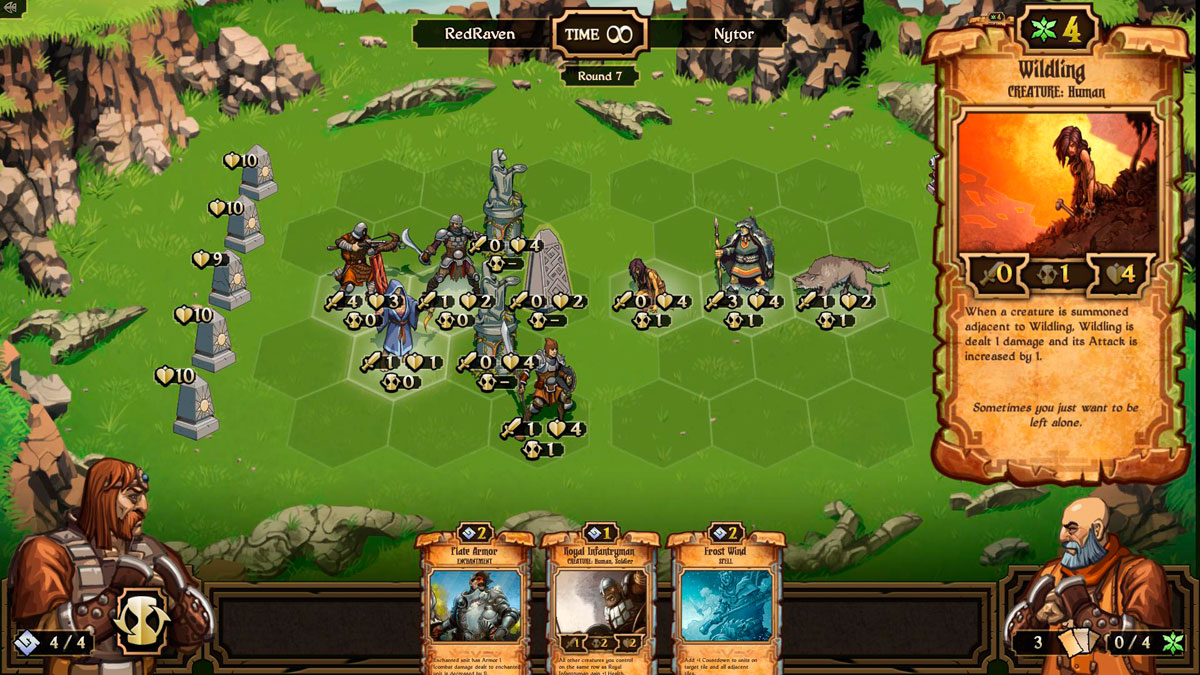
The flesh is willing, but the mind is weak.
For those who may have forgotten, Scrolls is the TCG follow-up project to Mojang’s genre-defining Minecraft. It is essentially Magic-lite with a few extra tactical considerations. Each player has five 10-HP totems at the end of five lanes, and take turns placing creatures or structures or casting spells/enchantments in an effort to reduce three of those five totems down to zero health. Creatures will attack down their lanes when their timer reaches zero, damage is persistent, and creatures can also be moved usually one “hex” each turn.
What I enjoy about Scrolls so far is its rather ingenious, nested card mechanics. At the start of the match, you draw five cards and thereafter draw one card per turn. Each turn, you have the opportunity to discard a card to increase your resources by 1 permanently (e.g. turning it into a MtG “land” essentially) or discarding a card to draw two new cards. As you can only have three copies of a given card in your deck, this immediately makes the early game exceedingly complex on a strategic level. Should you turn that high-cost card into resources now, or save it for later? Now that you’re at 5 resources, should you discard in order to draw two new cards or continue pumping up resources to allow you more options each turn? I doubt that Scrolls is the first card game to feature a system like this, but I am finding it extremely… delicious.
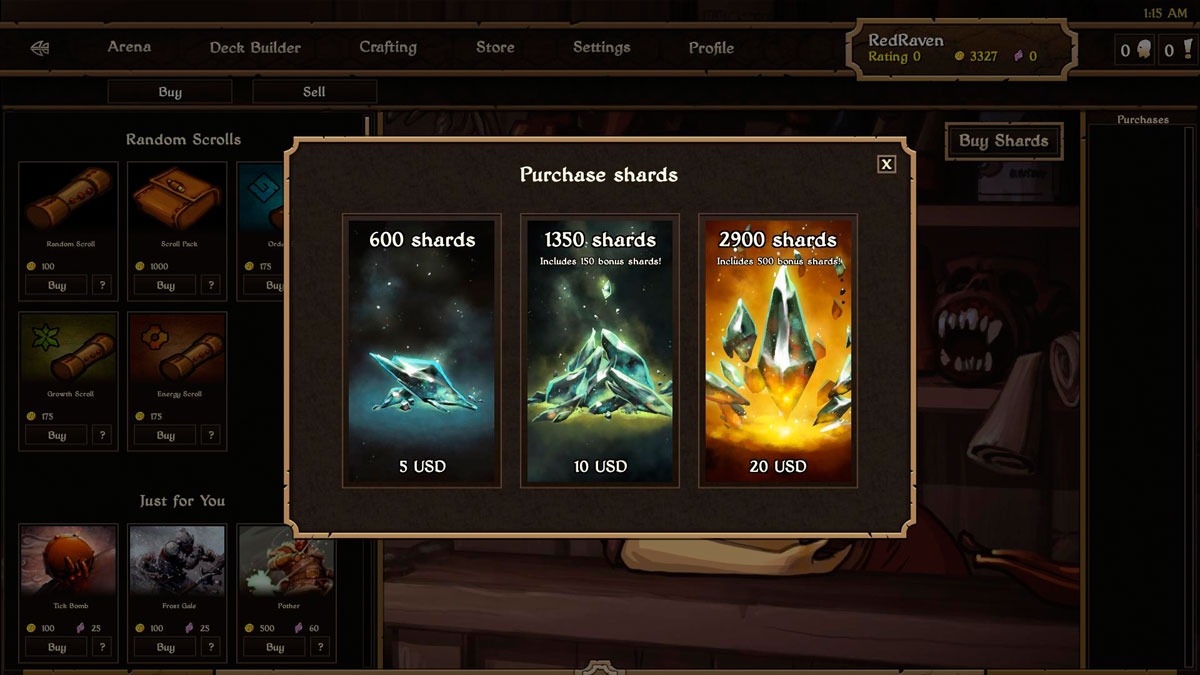
Really? That big pile of Minecraft money not good enough for you?
Now that I think about it, my mixed reaction basically comes down to the Store aspect. After you purchase the game, you unlock one of the three Starter decks to play with. Thereafter, you are stuck purchasing new cards in awkward increments using in-game gold earned from winning matches (either against AI or people). I made the unfortunate mistake of purchasing the Order deck and realizing that I don’t actually like its gameplay – a high emphasis on maneuverability and defense and so on. I am getting around ~300g for winning Trial matches (e.g. scenarios), but the other Starter decks are 6500g total. I started with 2000g, but foolishly purchased the 10-card booster packs at 1000g apiece.
So, essentially, I am stuck with a deck I don’t particularly enjoy playing while having to grind out dozens of games with no hope of actually seeing any new cards for that entire duration. Technically, I can also purchase things in the store for Shards, which is the RMT currency. However, the thought of spending more money on top of the $20 I already paid to play the game in the first place is repulsive. Scrolls is not a F2P game. Finding myself confronted with a payslope after the initial paywall is incredibly frustrating, especially with there being no way to undo the designer trap (having to choose a Starter deck with zero information) I fell into to begin with. This is a TCG, sure, but if your Starter deck isn’t fun to play, most rational people won’t be playing for long.
I am going to continue playing in the hopes that things improve, but at the moment I couldn’t really recommend Scrolls to anyone just yet.
Speaking of TCGs…
…hey, Scrolls is apparently still a thing. You know, the card game from Mojang, aka the company that made Minecraft, that was sued by Bethesda due to “Scrolls” being too close to that part of the name no one uses when talking about Bethesda games. Although I suppose with The Elder Scrolls Online coming out, that could conceivably change.
The open beta for Scrolls starts June 3rd. Poking around on the site reveals that the game proper will cost $20, and while there is a RMT currency (“Shards”), according to Mojang (emphasis added):
Shards are now enabled
- Shards are completely optional. We’re never going to force you to spend in order to progress
- Every item can also be bought for in-game Gold
- A limited selection of items can be purchased using Shards
- You can now buy Shards – our secondary currency – with real-life cash
- Shards and Gold only have an in-game value
- You can’t cash out
In other words, it does not appear as though cash shop currency is required to purchase the equivalent of booster packs. In fact, aside from the cards themselves, I’m starting to wonder how like a TCG this game is even supposed to be. Scrolls isn’t being marketed as a F2P game for starters, so it’s possible that its constructed in a fashion that allows reasonable card progression just from play, e.g. it’s a normal damn game that doesn’t require goddamn graphing calculators to plot entertainment per dollar ratios. We’ll see how that all shakes out.
It is kind of amusing, how often things release is apparently independent cycles. Deep Impact came out just months before Armageddon. Dante’s Peak came out two months before Volcano. And now we have Hex, Scrolls, and Hearthstone all either releasing or hitting Open Beta in 2013. I would count Cardhunter among them, but the stingy bastards have yet to give me a Beta invite.
The nerve.
Review: Terraria
Game: Terraria
Recommended price: $10 (full)
Metacritic Score: 83
Completion Time: 50+ hours
Buy If You Like: 2D Minecraft, procedurally-generated Metrovania platformers
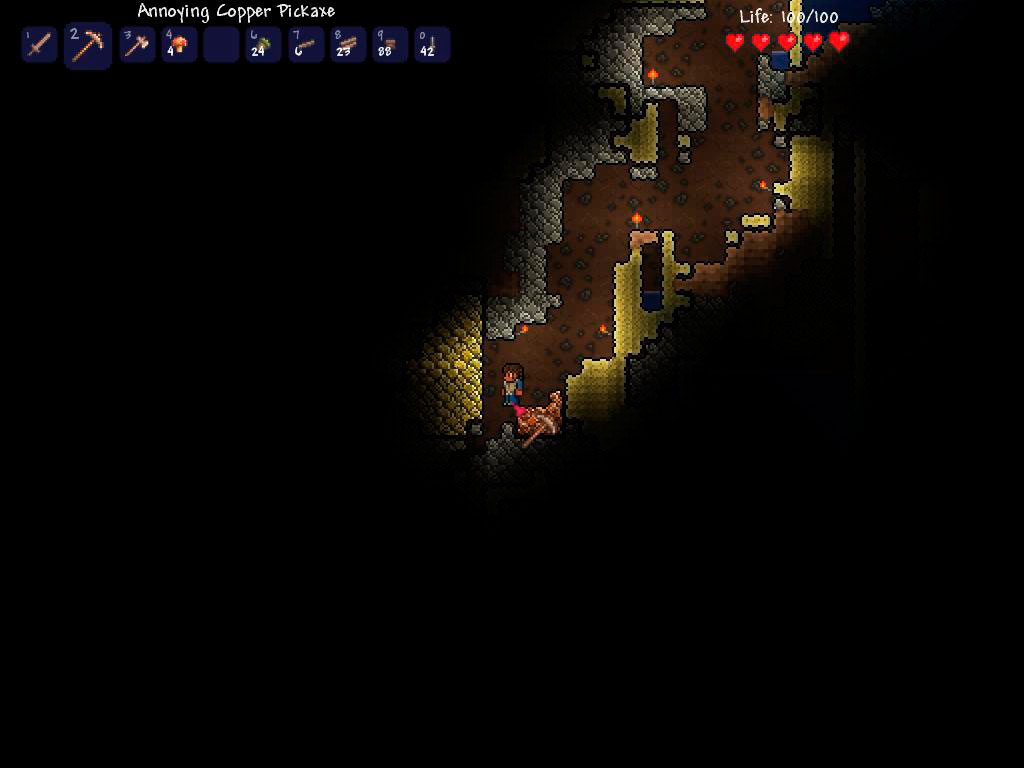
WHY IS THIS SO FUN?! *sobs*
Up until I started playing a few weeks ago, the entire mental space Terraria occupied for me can be summed up as “that 2D Minecraft knock-off.” I am not even sure which game came first, and it did not seem to matter: Terraria was just another game about digging for ore and crafting better pickaxes to mine for more ore. In only two dimensions.
After seeing an entire weekend evaporate in a flurry of clicking pixel blocks however, I am here to say that Terraria is not just a 2D Minecraft clone. It is an unholy union between all the addictive parts of Minecraft combined with legitimately entertaining Metrovania gameplay with a liberal dose of SNES graphical/musical nostalgia thrown into the mix.
Terraria starts out innocently enough, with your character equipped with a copper sword, axe, and mining pick. The beginning hours will be spent chopping trees, building your first crafting station, killing some slimes to turn their quivering innards into fuel for your torches, and so on. Much like Minecraft, zombies and other uglies come out at night which drives you to create shelter and then start digging underground for wont of something else to do.
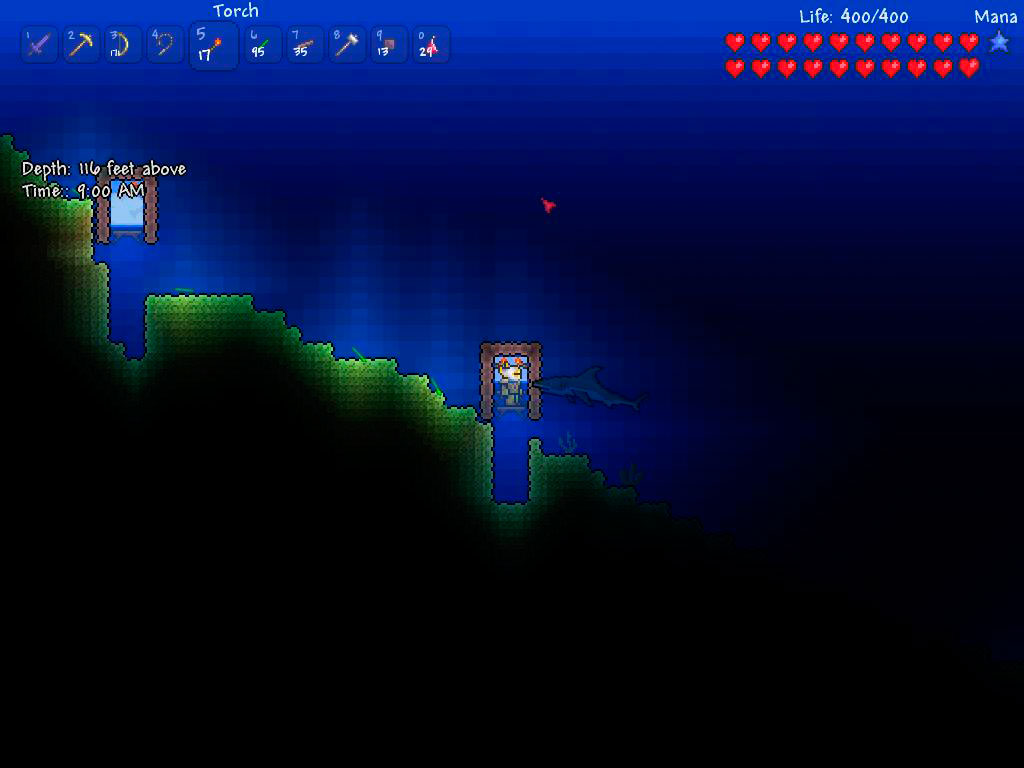
C’mon, this is easily more explainable than average Minecraft shenanigans.
While it might not initially seem so at first, there is a surprising amount of depth (har har) to Terraria’s gameplay. While you are hunting around for Copper and Iron ore, you will of course encounter enemies in the deep places of the earth. You will also frequently encounter priceless clay pots of a forgotten age which can be broken and looted for coins. You will eventually start coming across chests filled with goodies/equipment, and even crystalline Hearts, which can be broken and then consumed to increase your HP.
As you hit certain milestones, the world around you changes. Once you have accumulated 50 silver pieces, a Merchant will hang around your house, provided you build a room for him to sleep in. Finding and hoarding bombs will cause the Demolitionist to start peddling his explosive warez. And once you surpass 200 HP, there is an increasing chance the Eye of Cthulhu (the first boss) will settle its gaze upon your growing hamlet.
Not only does all this progression feel natural, it is also addicting. Your hunt for better ores to craft better armor and weapons to make your life easier leads to encountering stronger foes and ever more secrets. While crafting is a lot less complex than with Minecraft – you can talk to the Guide to see every craftable item that a given ingredient can produce – it simultaneously feels a bit deeper. Hitting Diamond could be accomplished relatively quickly in Minecraft, at which point you were essentially in the endgame. Contrast that with Terraria, where the natural hardiness of your foes directs your exploration of the whole of the game map before culminating in a Final Boss… whose defeat unlocks the Hardmode version of your world, with new enemies and even harder bosses.
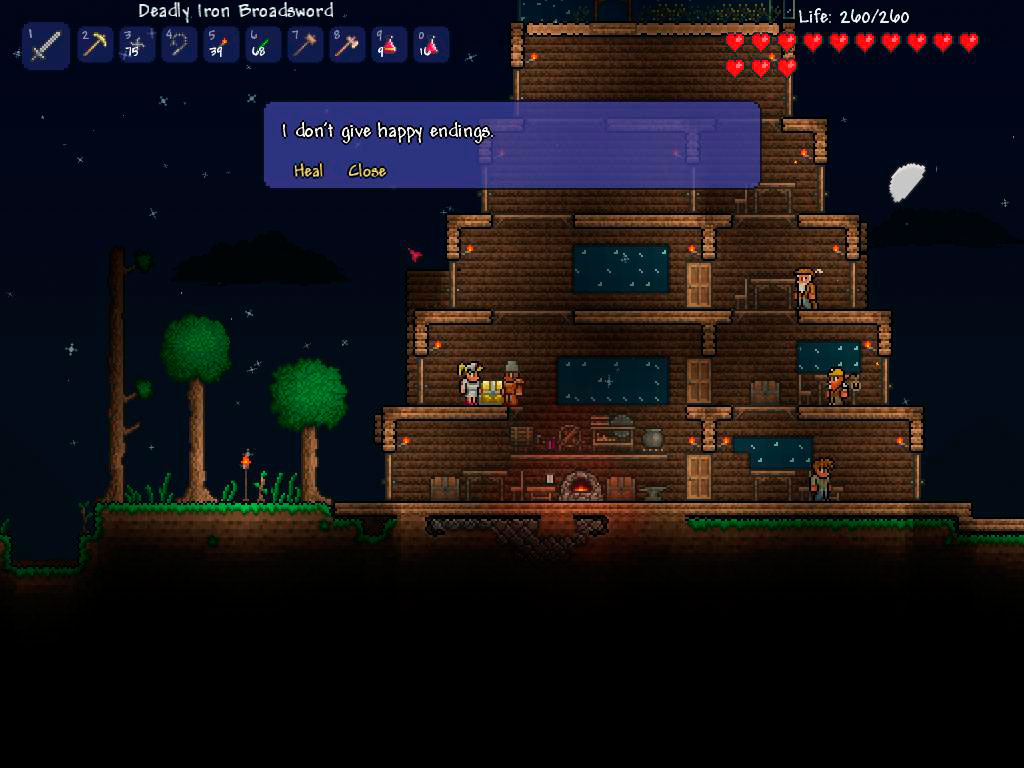
I… I’ll see myself out.
Of course, all of this implicit progression leads to a necessarily more finite resolution. While there are quite a few different set pieces to play around with, you are probably not going to spend the same amount of time building castles and mountain fortresses here as you would in Minecraft. That said, my game clock read 53 hours by the time I finished off the last of the Hardmode bosses and crafted the final piece of my ultimate armor. I could farm these bosses a few more times for their exclusive material drops – who wouldn’t want to run around with a flamethrower? – but it almost seems superfluous at this point. What would be next? Would I reroll a new character in a new procedurally-generated world? I could. But I feel I have already mastered these mechanics, and would simply arrive at the same destination a bit faster this time around. Hell, I could even equip my new character with the flamethrower and best pickaxe in the game to further speed along the process. Or I could go play something else.
Overall, the only real regret I have with Terraria was having spent all the time up to this point thinking of it as just a 2D Minecraft. Both games share many similar qualities, but why would another instance of “cause one to lose all track of time” or “become obsessed with mining better ore” be considered a deficiency? Both games are fun, in slightly different ways. Indeed, I am not even sure which one I would recommend first to someone who has played neither. Show Minecraft first, and like me, you might be a tad disappointed in the more limited forms of customization and Terraria not quite comparing to the sheer scale of an infinite 3D world. With Terraria going first though, you run the risk of having the person balk at Minecraft’s lack of direction and flat sense of progression.

Yes, that’s a lava moat below a lever-operated trapdoor.
In any case, having indie game companies force these tough choices on us when the AAA industry is falling over themselves pumping out derivative, 6-hour long sequels is ultimately a good problem to have.
Unfair Impressions: Darkfall, Final (?)
I was not sure there was going to be a Day 3 to this series. Hell, Day 2 came as a complete surprise for that matter. My default expression in life is “Impress me,” to which Darkfall just laughs. “Okay, show me what you have to offer.” “Show yourself.” There is an inherent nobility to that uncompromising sentiment, a sense that all the other games out there selling themselves are, indeed, engaging in prostitution. Darkfall instead has the purity of your back yard, with the creek your mother told you to stay away from. No one gave you a quest to turn over rocks to see what lied beneath them; you just did it because you were there, and hey look at that weird bug, I wonder what happens when I… eww.
Sorry, sometimes I get carried away with my own bullshit.

#MMOLogic
In truth, I continued playing Darkfall because I was interested in how onerous it would be to make arrows for my Skirmisher. The spiders never dropped any coin, the vendors were asking for 30+ crafting mats for 1g, and my initial try at crafting wooden planks left me with not enough gold to purchase a pick axe to mine the requisite stone for arrowheads. Considering my character was ostensibly an archer, would the game allow me to run out of arrows?
Of course it would.
I abandoned the spider spawns, and tried the other starter monster spawn location. It too was farmed out; in fact, I don’t even know what mobs spawn there as none lived long enough for me to point at them. From the map, I noticed some ruins off to the west. If there’s ruins, there’s monsters. Sure enough, it was zombie spawn city.
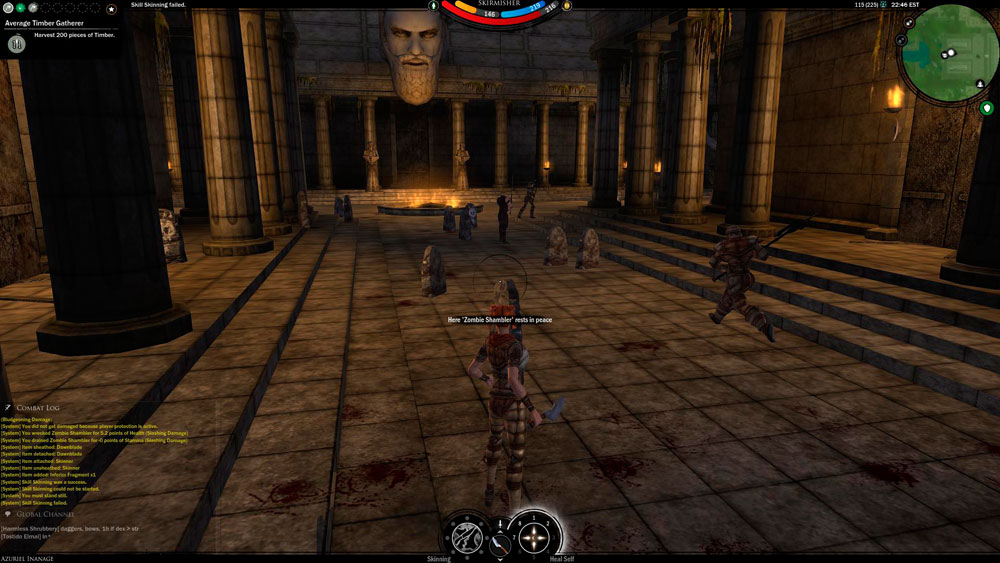
My potential future. Kill me now.
While I sat on the fringes watching characters in clearly superior gear farming through the zombies like butter, it occurred to me that there is a distinction between sandboxes that few ever make. There is the sandbox in which you perform repetitive actions in order to have fun later, and there are the ones in which you have fun doing fun things that leads to more fun later. Darkfall, to me, is the former; Minecraft would be the latter. And the funny thing is that the former doesn’t sound all that different from what I was required to do in WoW.
The zombies that trickled past the farmers did end up dropping hard currency – around 1-3g every 5-10 mobs. Examining the pleasure I felt when I walked away with 22g at the end of the farming excursion was a sobering experience. There were likely better spots for gold farming, even in the protected newbie zones, but it was a glimpse back into the churning abyss of a grind without end. Work hard today so you can have fun later, as opposed to having fun… having fun.
In any case, I remain pleased that I gave Darkfall the ole college try. Every time I read Syncaine’s latest post about ganking a dude and stealing all his stuff (and his boat), or about how he AFK farmed while writing the post, I can visualize what exactly all those shenanigans looked like. And then realize that game he and others are playing exists primarily in their own minds.
Which isn’t a bad thing, of course. It’s just not my thing.
Minecraft Beats CoD
As reported by Kotaku:
[…] Since Major Nelson has publicized the numbers, the most popular game on Xbox Live—this is according to unique users playing the game while logging into the service, not just those playing multiplayer—has always been a first person shooter. Gears of War. Halo. And, for more than two years running, something from the Call of Duty series.
That came to an end this past week, when Minecraft‘s Xbox 360 edition emerged as the most played game on the Xbox 360. Back in May, the title—a console adaptation of the PC game, sold over Xbox Live Marketplace, now—finally broke Call of Duty‘s stranglehold on the top two of Xbox Live’s most active chart, something not even FIFA, the world’s most popular sports video game, could do.
In the week of Oct 15, Minecraft took No. 1.
And, of course, one of the very first comments is “One overrated game tops another.”
I have not booted up Minecraft since the beta ended – not out of hipster snobbery, but due to having gotten my 100+ hour fill already – so I cannot really speak to the game as it exists currently. But let me just say: good goddamn job. Although there have undoubtedly been indie game successes before this one, I think the gaming historians of the future will look back and catalog indie games as being BM (Before Minecraft) and AM (After Minecraft).
Going from 1-2 programmers to knocking Call of fucking Duty out of the number one slot on Xbox Live is a success story for the ages.
Kinda makes me wonder whether this topical (MMO) sandbox debate has some traction. Is Minecraft just an Angry Birds, e.g. hugely popular in a self-contained way with few derivatives? Or is it more of an iPad phenomenon, e.g indicative of consumers being introduced to something they did not realize they wanted (like tablet computers)?
Start your betting here.
And The Rest
Let’s go ahead and wrap up the rest of my Guild Wars 2 impressions.
Point 10: Making Bank
Guild Wars 2 has, by far, the best inventory management system I have seen in a videogame. And it was a feature I only discovered accidentally in my final few hours of playtime.
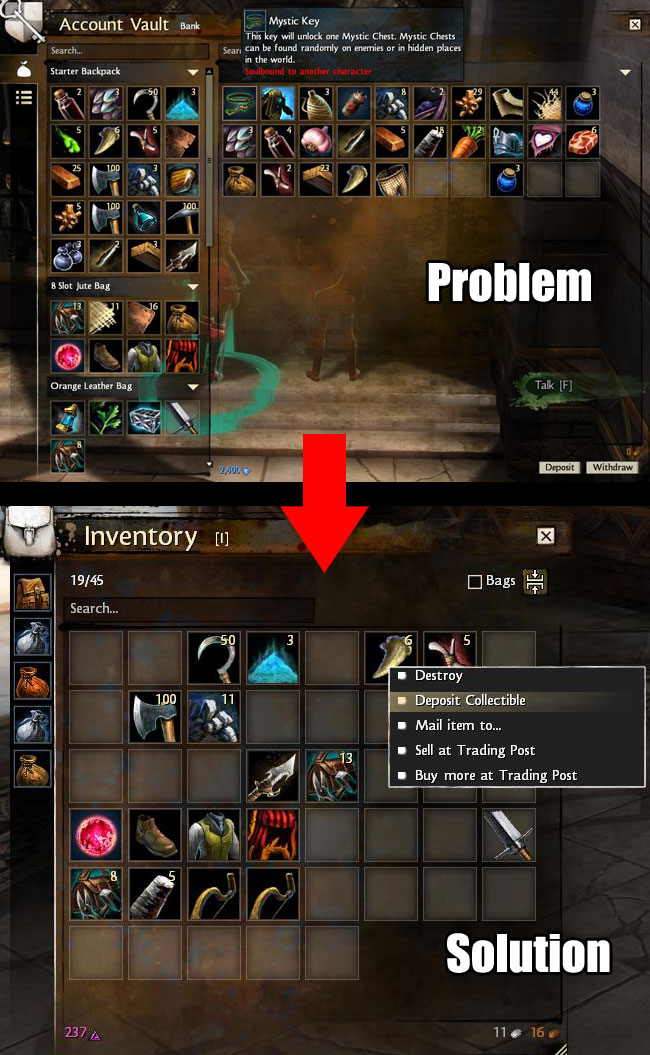
This needs to be in all games, ASAP.
It is called the Collectible Tab and it is to my eternal shame that I did not take a screenshot.
Essentially, the Collectible Tab is hundreds of organized, square silhouettes that represents all of the trade and crafting goods in Guild Wars 2 (and maybe more besides). Instead of you needing to waste precious bank space with your stacks of Jute scraps (e.g. Linen Cloth), you merely drag it to the Collectible tab and it automatically gets sorted and contained in its own little square. Or, you know, you can simply right-click the item and select the “Deposit Collectible” option. From anywhere. And by “anywhere” I mean, literally, anywhere you can open the Inventory screen. Farming bandits and find your bags are overflowing with the pilfered trophies from corpses of men you murdered in cold blood? Two clicks and you are done.
I did not think to check whether there is an upper-limit to the stack size of items stored in the Collectible Tab. All I know is that I no longer will need to do my OCD WoW bank routine wherein I manually alphabetize herbs by expansion, rarity, and the aesthetic qualities of the icon. Simply put, the banking system in Guild Wars 2 is built out of win.
Point 11: The AH on the other hand…
There is a very specific thing that happened to the AH, for a very specific reason, and it has soured my experience with it somewhat. What happened was this:
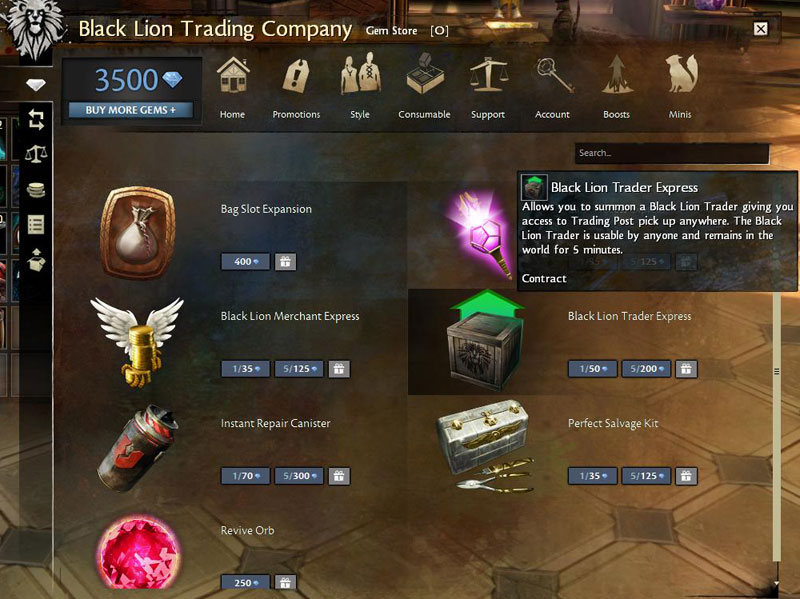
Oh, RMT. Is there ever a bridge too far?
Basically, ArenaNet took the ability of players to retrieve their successful auctions from anywhere, limited it to the Trading Post NPCs, and then are selling consumables in the cash shop to allow you to pick up your items anywhere… for 5 minutes. Considering you can teleport to within 30 yards of the Trading Post NPCs at any time from any where, this might come across as a tad… nitpicky. Entitled, even.
But let us be clear what is going on here. You can sell, buy, and browse the AH from anywhere in the game world at any time. And during the first beta weekend, you could also pick up your successful auctions (money and items both) from anywhere as well. Now you cannot, and there is consumable cash shop item that temporarily restores the functionality. Granted, the Trading Post NPCs did not have much of a purpose before, but that is a design problem with an easy solution, e.g. remove them. Or leave them as reminders to those who forgot you can access the AH from anywhere by pressing “O.”
I can recognize the cognitive dissonance between my accepting as intuitive the fact that you cannot withdraw from your bank from anywhere, and the obviously analogous Trading Post situation. Maybe this is only an issue with my seeing the monetizing team in action – had this been in the first beta weekend, it might be that I wouldn’t have thought any different. Nevertheless, I seen what they did last summer, and I had/have a problem with this change.
Everything else about the AH is fantastic, although I must admit that Buy/Sell orders somewhat diminishes the thoroughly soothing gameplay I find in searching for AH bargains.
Point 12: Guilded
I did not actually join a guild, but I thought this was a good idea:
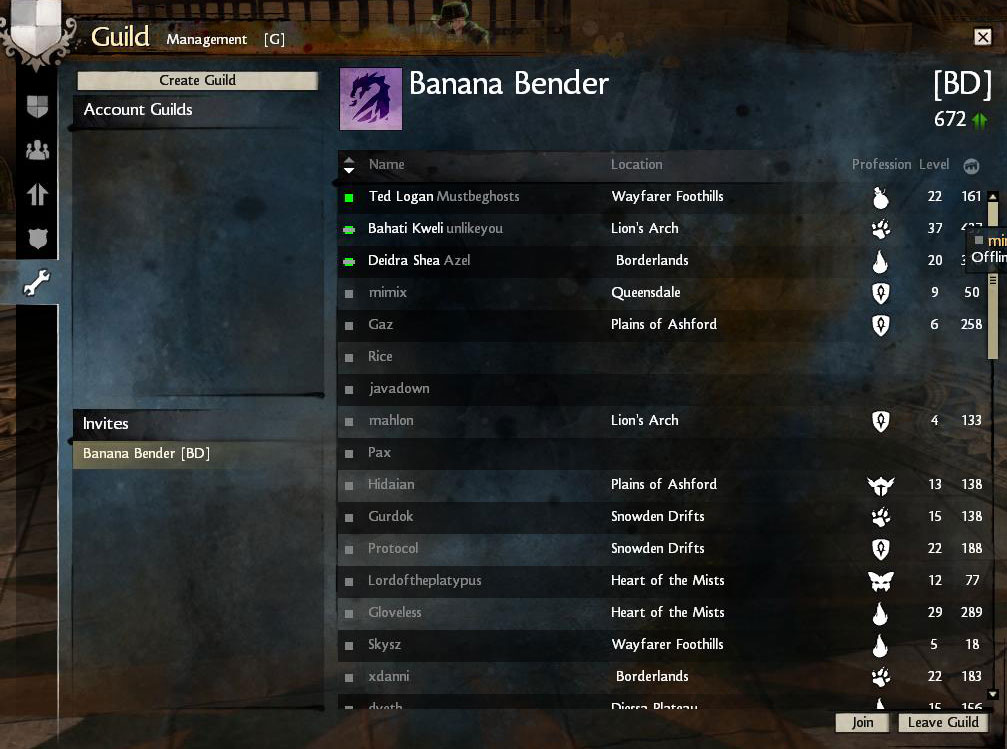
Kinda like a Background Check.
When you click on a Guild invitation, it takes you to a screen that allows you to actually look at said Guild’s roster before joining. This is another of those common sense features that you wonder why are not in more games. The only thing missing is a Cover Letter and perhaps a list of three things the Guild is bad at.
Point 13: Minecrafting
This is 100% a personal preference thing, but I’m not a huge fan of the crafting system in Guild Wars 2. There are a number of surprisingly complicated base recipes – when was the last time you saw a game that requires you to construct a wristguard strap and wristguard padding before combining the both with a 3rd ingredient to make a pair of gloves? – but the vast majority of recipes comes from the “Discovery” system, aka the Trial & Error system.
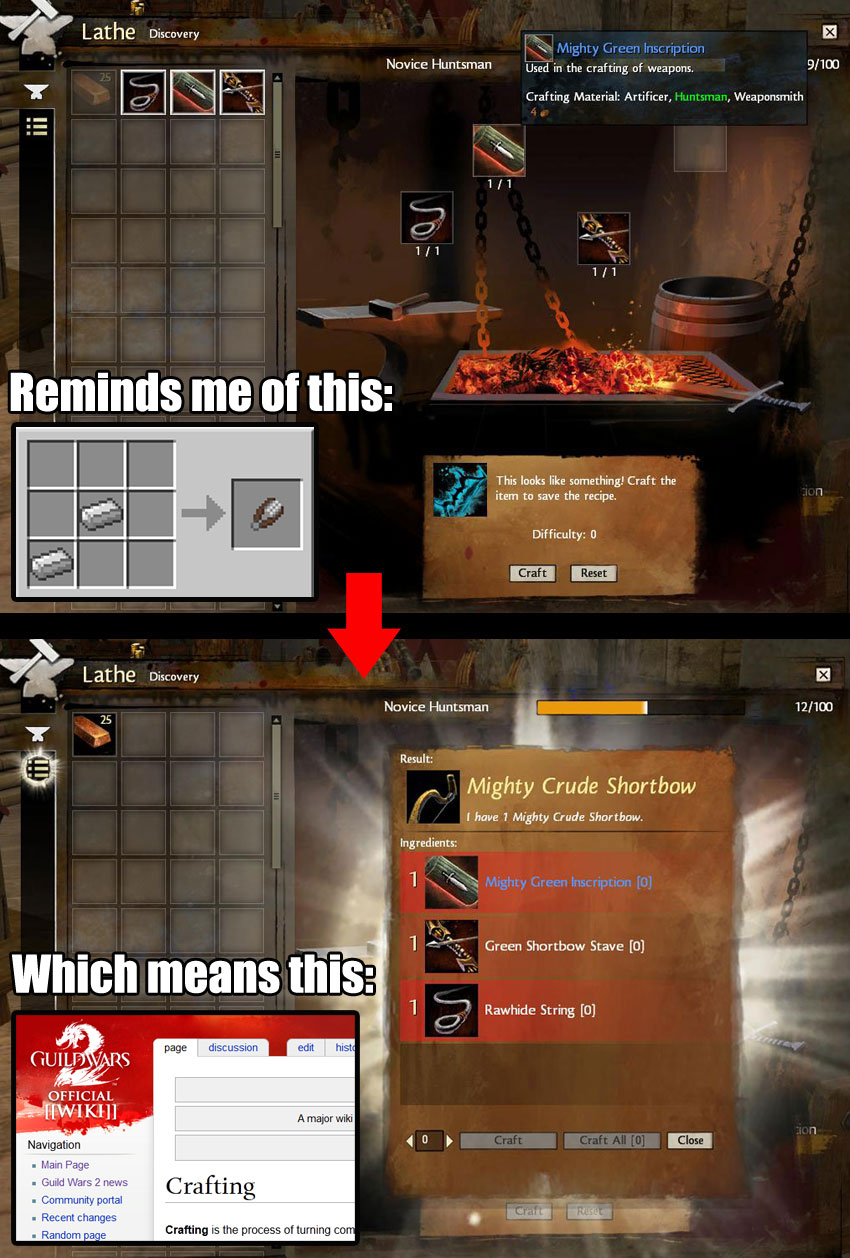
Oh, good.
Or, perhaps most likely, the “Just look at the damn Wiki” system.
The bow in the above picture is a lame example, of course, but I otherwise find zero entertainment in such “just try it!” crafting systems. My brain simply doesn’t work that way; I am too damn methodical. Do you know the first thing I did when I built a crafting table in Minecraft? I put a piece of wood in the first empty square. Then I put another piece of wood in another square beside the first. And then I moved the second piece of wood over one square. And then moved it again, in sequence, around the remaining empty squares. Then I added a third piece of wood, and repeated the process. If you asked me to crack the combination code to a briefcase, I would start with 0-0-1 and end with 9-9-9, X number of hours later… if I did not simply throw the briefcase out the window beforehand.
Don’t get me started on Word Finds, or that Doodle God app.
I saw the following quote during the first beta, but I forgot to specifically notate it:
Originally posted by Linsey Murdock
Cooking is considered our advanced craft. It will cost you more money, karma, and time traveling the world than any other crafting discipline.
Pro Tip: Every cooking recipe in Guild Wars 2 is a real recipe for real food in real life (or a basic approximation). If you think you are close to figuring out one of the combinations, google a recipe for the food you suspect it might be, and odds are, you can find a bunch of recipes for things like that to try out.
If you like this sort of thing, you will like Guild Wars 2 crafting quite a bit. If you don’t, you will probably be Alt-Tabbing to the Wiki like myself.
Incidentally, this is also true of the crafting system:
Originally posted by Linsey Murdock
The way leveling XP gain works in crafting is this: For leveling a discipline from 0-400, you will gain 10 levels along the way. By maxing out all 8 disciplines, you will gain 80 levels. That means you could dedicate a character to crafting, feed it all the mats you get on other characters and level it all the way to 80 without ever needing to kill a thing. As hardcore crafters, we think that is pretty cool.
__________
Conclusion
That about sums up my impressions of this second beta weekend. If/when the third beta weekend comes along, my tentative goals will be the following:
- Test the Norn/Charr areas more thoroughly to see if I run into the same pacing issues I experienced in Queensdale.
- Verify whether it was user-error in Queensdale after all.
- Level a character high enough to see how the “trinity-less” dungeons work.
- Sell my gems on the AH so I’ll have more than 10 silver to rub together.
- Continue being angry at puppies, rainbows, and the laughter of small children.
So look forward to that. I know I am.
 In An Age
Tautology of Value
Jan 16
Posted by Azuriel
Keen has a post up on the nature of F2P that, at first blush, reads as a truism. Namely, that one should be suspicious of any F2P title – after all, if the developers thought it were a valuable product, they would be pricing it accordingly.
This prescriptive sentiment has always bugged me. In one of the comments someone else asserts:
These all read as tautologies to me. How do you know if a game is great? It sells itself. And games that sell themselves are great, by definition.
…except we all have examples of underrated masterpieces, and garbage that sells millions of copies every year. Unless we are ready to admit that Star Wars Galaxies was terrible and Candy Crush Saga is one of the best videogames of all time, we need to decouple a game’s quality from its sales performance. There is correlation on a good day, but just as often there is not.
Similarly, the trend towards F2P is not necessarily one of naked greed and cynicism. I will be the first to admit that I prefer the antiquated “buy the box” or subscription models, as I believe it properly aligns developer incentives (i.e. make better content vs more cash shop items). But in 2015, there is one reality every developer must face:
1) F2P competition exists.
If you are all set to release a subscription-based MOBA in an environment where League of Legends still exists, you are going to have a bad time. The same is true for subscription-based MMOs these days. It is easy to claim that Wildstar (etc) failed not because of the subscription model, but because it wasn’t good enough to justify a subscription model. But that still sounds tautological to me. “If the game was good, it would not have failed.” Or to shorten it: “If it were good, it would not be bad.”
In the present MMO environment, it isn’t enough to simply be good – one has to be as good or better than all the alternatives, many of which are F2P. This is especially salient in MMOs considering the social dynamics are pretty much the only reason why you would continue playing the game. We can imagine a scenario in which the perfect (to you) MMO is released… but it ends up as a ghost town, and subsequently loses most (or all) of its value.
Which makes this part of Keen’s post a little ridiculous:
Of course charging a subscription or box price will dissuade people from playing, else lowering prices would not generate any increased sales. Obviously there are people out there willing to purchase $60 titles on Day 1; what is less obvious is whether there are enough. Unless you are willing to settle for Minecraft, most MMOs are released with $60+ million price-tags which need to be recouped by volume. Populations in the 100,000 range simply can’t cut it anymore, nevermind the negative social effects of low server concurrency. It is quite a pickle that you place MMO developers in when they either need to craft a more valuable product than WoW (etc) or go with an extremely low-budget project… which will still be called a failure anyway due to low sales volume. “A good product sells,” remember?
Overall, I do think the warning vis-a-vis F2P games is sound – there is no payment model better suited to erode consumer surplus than F2P. And there are certainly a million and one examples of very bad, very cynical F2P cash-grabs. But I do not agree that good games necessarily sell (or sell themselves), I do not agree that sales is necessarily an indicator of quality at all, and I would suggest that developers have many perfectly valid reasons to “give their product away” even if they could have charged for it. In fact, they very well may have to these days, just to get enough warm bodies in the door to achieve the social critical mass that MMOs require.
Posted in Commentary, Philosophy
5 Comments
Tags: F2P, Keen, Minecraft, MMO, Tautology