Blog Archives
Review: Dawncaster
Dawncaster is mobile deckbuilding roguelite that is in the esteemed company of Slay the Spire and Balatro for how many hours I have played, and how willing I was to pay real dollars for the privilege. While it does have some design choices that limit its depth, I can consistently find myself playing runs lasting for hours while also experimenting with different strategies.
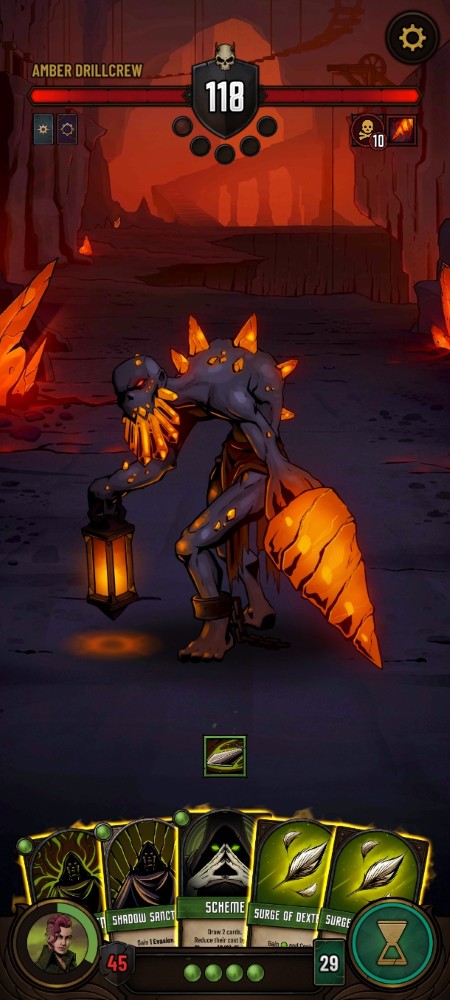
As mentioned, Dawncaster is a deckbuilding roguelite. At the beginning of each run, you can choose between one of six classes, which is then customized with a selection of Basic Attacks, a Weapon Ability, and then a special Starting Card. Alternative options can be unlocked using in-game currency earned from daily quests and completing runs (win or lose). Once you begin a run, you enter “Canto 1” (of 9) and are presented with three encounter options from a “deck,” which can include treasures, shrines, NPCs, or monsters. With the exception of treasures, the two non-selected encounter cards are then reshuffled into the deck. Your goal is to work your way to the boss of the Canto and defeat them.
Monster combat is fairly typical for the genre. Each turn, you gain energy of a specific type (Blue, Green, Red, etc) for your class and draw 5 cards; leftover energy is carried over into future turns, but cards are discarded. From this base, a wide variety of scenarios and strategies develop. There are debuffs like Bleeding, Poison, Doom, and buffs like Armor, Barrier, Focus. There are cards that draw cards, cards that discard cards, cards that stay in your hand from turn to turn, curses that go into your deck or the enemy’s deck, enchantments, temporary cards, and so on and so forth. Also, cards can be upgraded and even have keywords added to them.
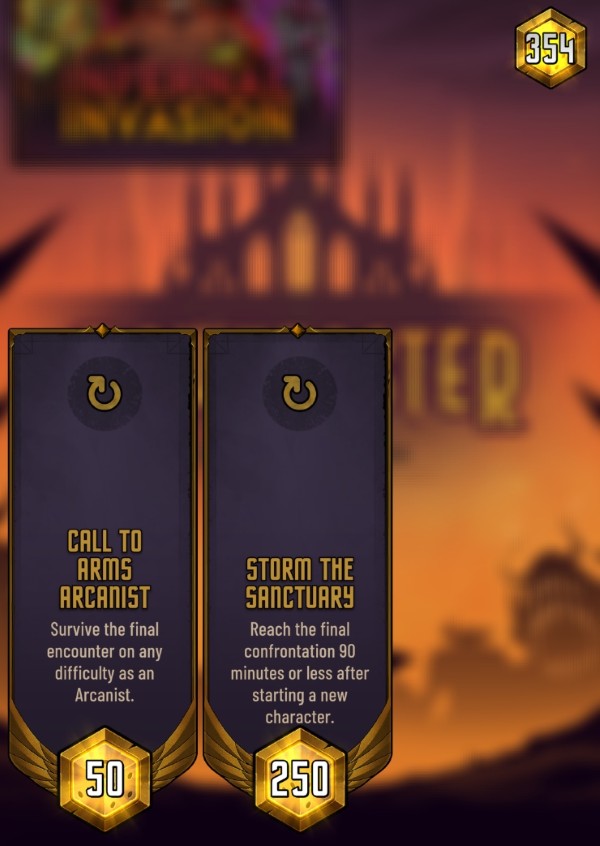
If anything, the sheer breadth of options is one of the shortcomings of Dawncaster. And, paradoxically, that same breadth leads to many runs feeling the same.
As mentioned previously, there are six classes… but there are no specific class cards, only color cards. Certain classes start locked to a specific color, such as the Arcanist and Blue energy. After each successful combat encounter, you get to select one of three card rewards that are tied to what energy you have access to. Generally speaking, the mechanics within each color are synergistic, but even when they aren’t, at least you can try to focus on the one you want. The problem is when you gain access to other colors, which can happen at class selection or even during a given run depending on your choices. At that point, you still only get three card rewards after each encounter, but now the card pool expands to include both colors. Sometimes this can be a good thing – some colors are better at card draw or specific debuffs, etc – but often this means you will be offered useless rewards for most of a run, leading to failed decks. Alternatively, even when things go perfectly, it usually does so because a specific combo is so much better than the other available options.
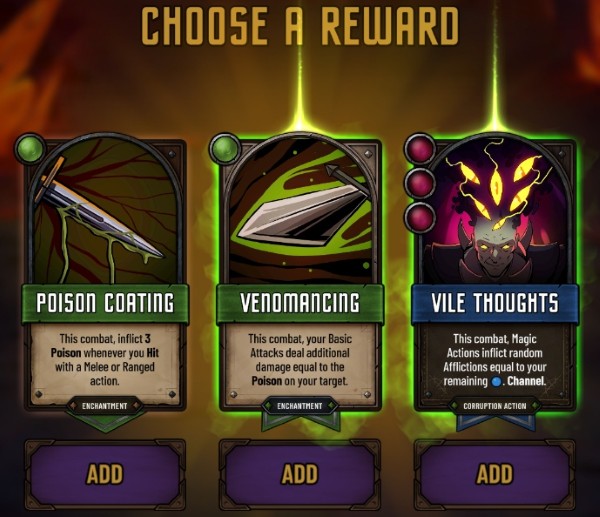
Dawncaster has multiple DLCs available for purchase, which adds more cards, enemies, encounters, and bosses. Tragically, the additional cards do not feel all that good because of the specific issue above: if they are not directly related to your strategy, they just pollute your limited card choices. There is a shopkeeper NPC that gives you a bunch of card choices, but again, there are so many cards out there that you can hit them up a half dozen times and still never find the necessary cards to make your strategy work. Of course, targeting a specific strategy is probably not the best idea; I would never start a Slay the Spire run and say “I’m doing a Poison build this time” before seeing some good Poison cards. But at least with Slay the Spire, I would only see The Silent cards as rewards, rather than every class.
Anyway, this is the quibble I have with Dawncaster after literally a hundred hours or more of gameplay. I still feel like Slay the Spire is the better deck-building roguelike, but Dawncaster is in the top 5 for the genre, if not directly second place (especially on mobile). If you are looking for something to play on your phone that isn’t F2P and/or gacha, I can definitely recommend this game.
Balatro
If you haven’t heard about the latest indie darling, Balatro, let me tell you: it’s legit. Balatro is available on both Steam and now on mobile, the latter of which is what I recommend picking up, as there aren’t many non-exploitative mobile games out there.
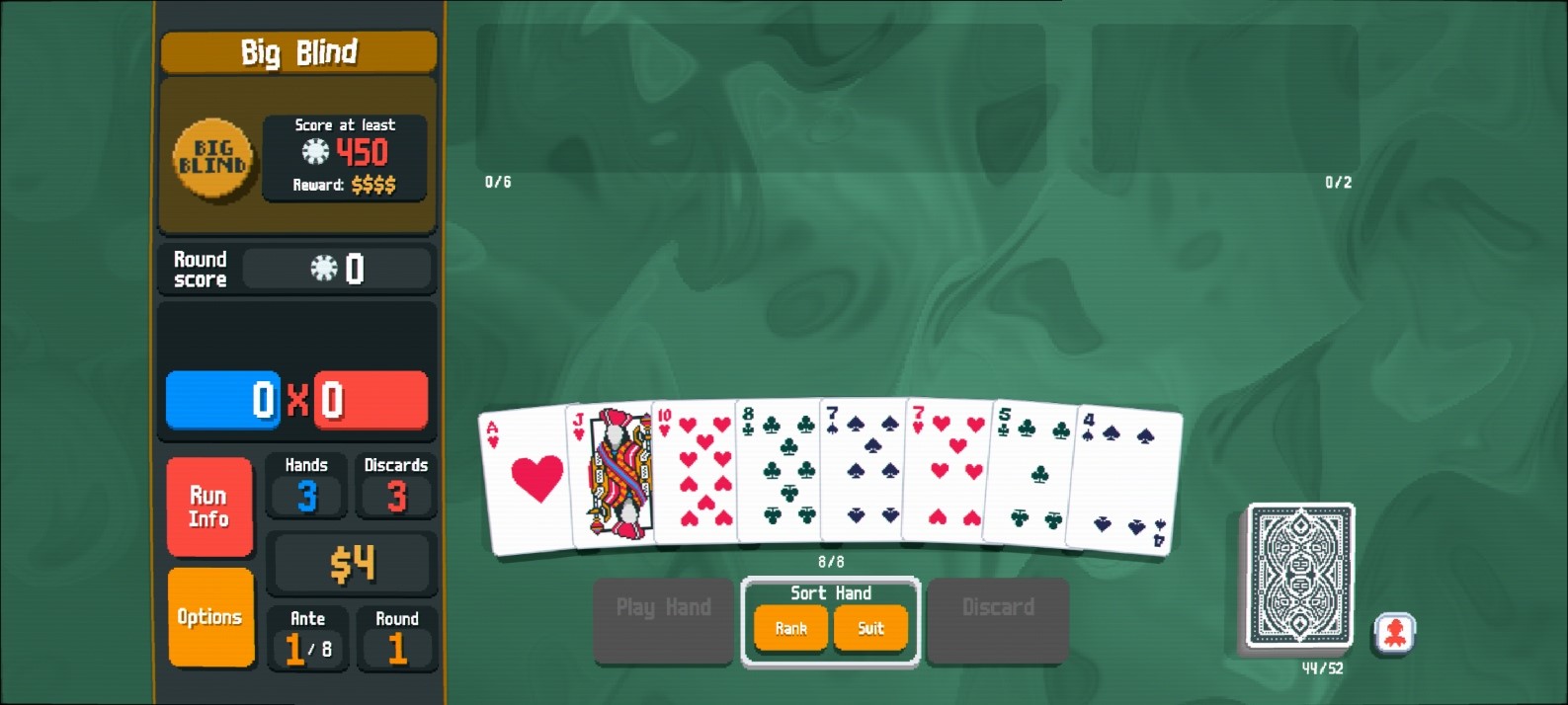
Fundamentally, Balatro is a deckbuilding roguelike based around making poker hands using a standard deck of cards. Your overall goal is to clear eight “levels” (Antes) that consist of three “battles” (Blinds) apiece, one of which is a boss that has negative modifiers. Battles are won by exceeding a score (Chips), which is generated based on the poker hands you play… plus any modifiers. For example, let’s say you have two pairs: a pair of Queens and a pair of 5s. A two pair hand is worth 20 Chips x 2 multiplier by itself. You then add the face value of the cards used to the Chip value, so it ends up being 50 x 2, or 100 Chips. The very first Blind requires 300 Chips or more to beat, so you would be well on your way to success there. Under normal settings, you get to play a total of 4 hands to beat the Blind, and get a total of 4 discards (up to 5 cards each time) in order to make said hands.
Winning battles gives you a base level of money ($3-$5) with bonuses based on unused hands remaining and “interest” on unused cash from prior rounds. You use this money in-between rounds in a shop phase that lets you purchase various things.
The twist with the game comes from the modifiers available.
The Jokers are the most famous elements of the game, and they truly run the gamut. The most basic Joker grants you +4 to your multiplier; if we had that with our earlier two pair hand, the Chips score would have been 300 by itself (50 x 6). Some Jokers give you a scaling buff, some revolve around increasing your economy, some focus on enhancing specific suits or poker hands, some give bonuses to other Jokers, and so on. You get to equip up to five Jokers under default settings. Then there are Planet cards. These are consumables that permanently (for this run) upgrade the scoring of poker hands. Then there are Tarot cards, which are consumables that do a bunch of different things, including giving you more Tarot cards, more Planet cards, changing the suits of specific cards, etc. Oh, and the deck of cards itself can be enhanced or augmented to a variety of ways – cards can be deleted, added, changed to give +4 multiplier when scored, give more points when not played, etc. etc.

As you can probably tell, the dopamine hits come from the combination of regular poker RNG along with Joker RNG, boss RNG, shop RNG, and generally shenanigan RNG. You could be just scraping by, hit an amazing shop, and walk into the next round flush with cash and scaling Jokers. You could be breezing through the game and then hit a boss modifier like “Diamonds are debuffed” and do a ShockedPikachu.jpg when your “turned all the cards into Diamonds” deck is shafted. And, yeah, while I mentioned the word RNG a bunch previously, at the end of the day it is still about poker – there are strategies and probabilities that you can leverage to improve your expected outcomes.
Perhaps the best part of Balatro is the simple fact that it is a complete experience. There are no micro-transactions, no DLC, no real-world money intervention. I purchased it from Google Play for $10 and that’s that. Overall, I would still claim Slay the Spire to be the best deckbuilding roguelike, but Balatro certainly jumped out of nowhere to land in the top-5, if not second place. Not bad for a 1-man team.
Mobile Review: Slice & Dice
Slice & Dice is a F2Try dice-based roguelike. You can play the first 12 “levels” for free, but it costs $7 to unlock the rest of the game.
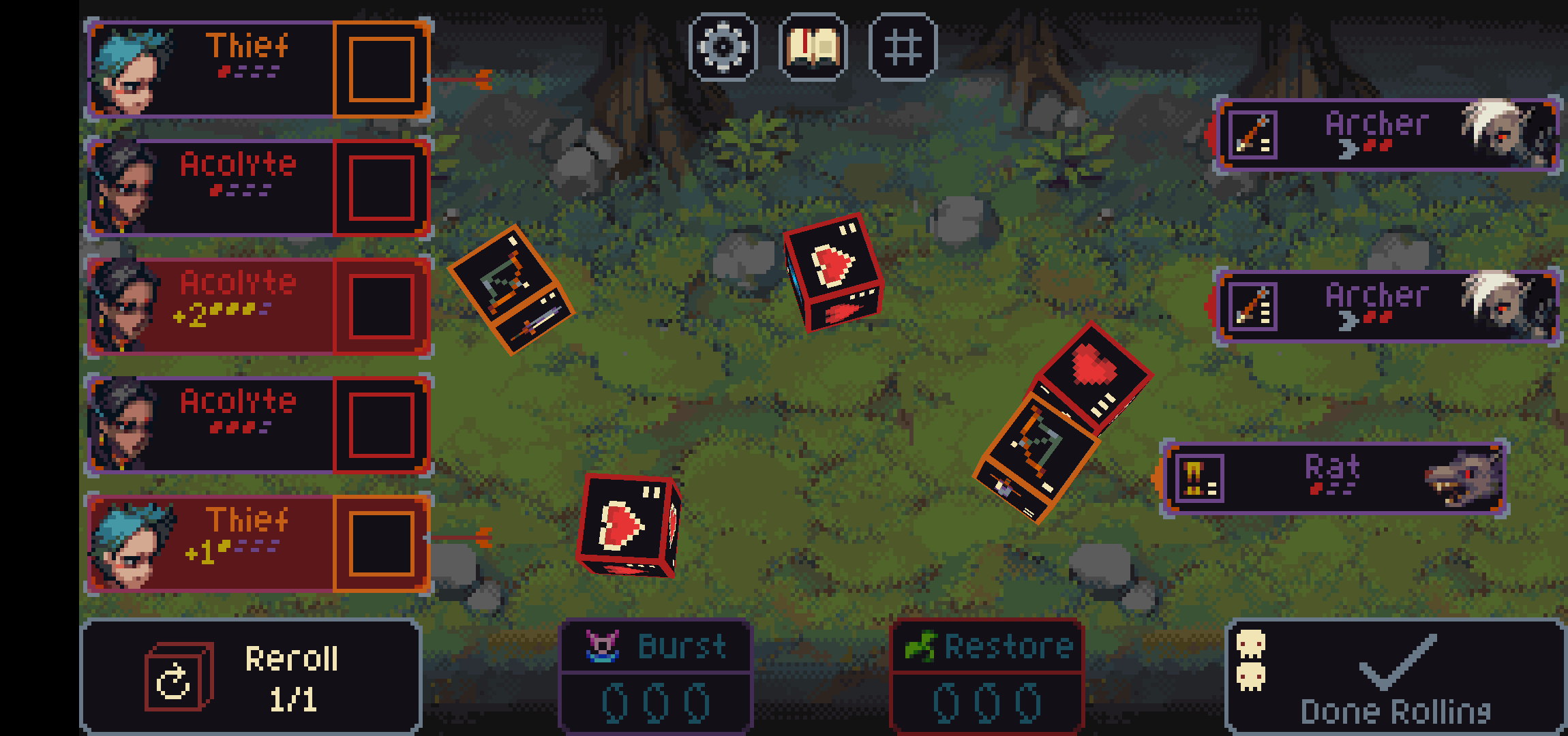
On the face of it (har har), the game appears relatively simple. By default, you control a party of five traditional archetypes – Rogue, Warrior, Defender, Healer, Mage – who face an assortment of enemies. Each round, enemies will roll their dice and indicate who they will be attacking, assuming they survive.
Then your team will roll one die per class. Each six-sided die has different abilities on it as determined by that die’s class and any modifications due to items. If you like a specific die roll, you can “save” it by tapping and then reroll any remaining dice up to two times. After all dice are locked in, you then can use the dice to attack enemies, shield your team, generate mana for Spells, or a number of other unique effects. Any surviving enemies will then attack back. Then everyone gets to do it again.
After each successful battle, surviving heroes are healed to full, any defeated heroes return to life at half-health, and there are alternating rewards of class promotion or random item selection. For class promotion, two heroes are randomly selected to get promoted to one randomly selected option, and you decide which one does. For example, you might be able to choose between your Rogue and Cleric getting promoted to a Tier 2 version of those classes, but not choose for the Warrior to be upgraded instead, or choose between the 5-6 Rogue options. Similarly, with item selection you can choose between two options or go for a mystery roll if neither one works well for your setup.

If that sounds like a lot of randomness, well… it is a dice-based game.
After I understood the general shtick of the game and saw what sort of boss battles were available, I started losing interest. The game seems a bit simple, right? Plus, winning didn’t really seem to offer much progression. But that was when I discovered the Achievements and other unlocks. Basically, the game has 40+ achievements that all unlock something when, uh, achieved. Most of the time these unlocks are additional items that get added to the pool for future runs, but other times there are additional difficulties and new game modes. For example, with Custom Party you can choose to bring 5 Mages or some other mix of heroes, and Shortcut lets you skip the first 8 levels (although you get random items and promotions). The unlocks themselves are not always worth it per se, but they provide something to work towards and potentially discover some fun along the way.
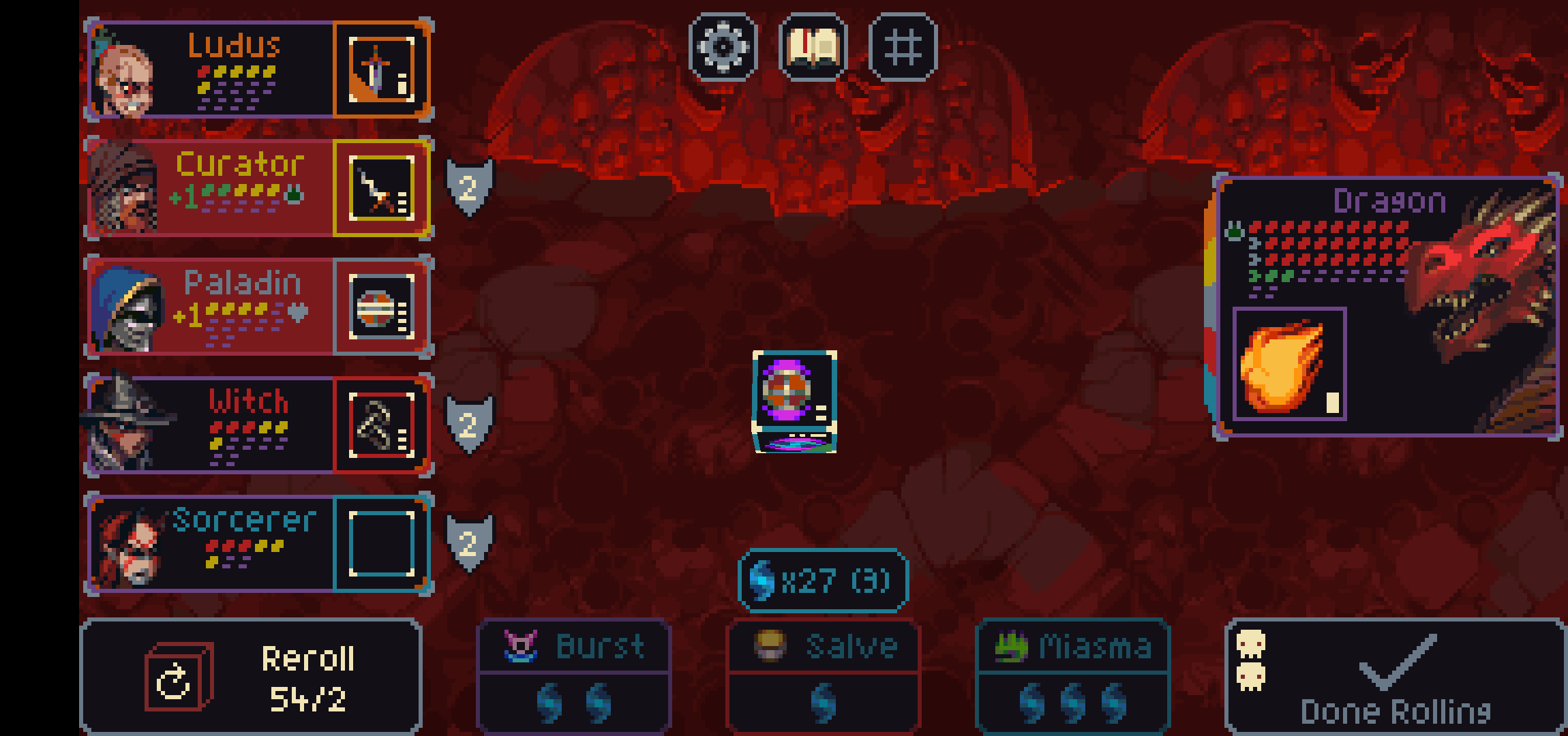
Notwithstanding the progression element, the game feels very satisfying to play in the moment. I often feel the pull of “just one more turn” given how many micro and macro decisions you end up needing to make. Is 2 damage good enough, or do you gamble on a 16.67% chance of getting a blank in order to hit something better? Should you focus-fire the big monster, or take out the small fry first? Do you blow all your mana on trying to save one hero this turn, or let them die to push more damage?
Overall, I am extremely pleased with my $7 purchase and probably have logged 30-40 hours thus far. One of the achievements to unlock Speed Run leaderboards is to win Standard mode in under 45 minutes, to give an idea of average successful run length. I also highly appreciate the fact that the game is short interval-friendly, e.g. there is no real-time component and you can minimize the app without messing anything up. It is no Slay the Spire, but it’s a game that has come closest to scratching the itch.
Made for PC
Word on the streets is that PS4-exclusive Horizon: Zero Dawn is coming to PC this year.
Will it release for $9.99 or less, as it was priced this recent holiday season? Probably not. Will it be just a slap-dash port locked at 30 fps or some nonsense? Possibly. But the big deal here is that Sony is taking its first steps towards releasing first-party games on another system. As someone who was prepared to buy a PS4 just to play 3-4 games, this is good news to me.
It does make you think about the future though. Nintendo is pretty much the last reasonable hold-out when it comes to the console wars, always coming up with some proprietary zaniness for their hardware and making everyone pay full MSRP because they can. The Apple of the console world, if you will.
Indeed, everyone originally thought that this console-to-PC shift was a natural result of consoles basically more and more becoming little PCs with custom cases. But in the final analysis, it is probably more due to the mobile market drinking everyone’s milkshake than anything else. Mobile gaming was 45% of the entire gaming market in 2019. While that doesn’t necessarily mean that less money was spent in the console world, it does mean that the opportunity cost for keeping your bestselling titles silo’d away is higher. I mean, it was always there, with the hope being that it pushed some hardware sales along the way.
Honestly though? These days I am thinking mighty long and hard on whether a $300+ console is going to be a better purchase than a $300 phone. The latter is something I use for hours every single day, even when I don’t find the time to boot up the PC, much less a third gaming device.
It Also Gets Harder
You know, I used to look down on “mobile gamers.” Or rather, they just never figured into my headcanon for what a real gamer was. Your mom playing Candy Crush is not the same as you playing a MMO for a decade on a $1200 PC. Nevermind how both developers are technically under the same corporate umbrella these days.
This past week, I went three days in a row without playing games.
Some of that was due to literally not having the time. My window these days is precisely between 8:30pm and 10:30pm, which is after the baby goes to sleep the first time, and when he wakes up for another bottle right before I should be going to sleep. Two hours seems like a decent chunk of time, but that is also the time I have to burn to get chores done around the house. By the time my ass hits the computer chair, it’s 9:50pm and… what then? What am I meaningfully playing for 40 minutes?
Of course, I am not counting the time spent playing Clash Royale. Or sometimes Hearthstone (Adventures). Those ~12 minute increments add up throughout the day in ways they could not via any other games. But these are not real, substantial narrative experiences.
After a while though, I have to start asking myself if that is what I even want. Maybe not in 40-minute increments, but surely I could make time elsewhere, if it were that important to me? I certainly seem to default back to Reddit browsing and low-effort time-killing readily enough. Almost as though I’m enjoying myself.
Luckily enough, I got through the ennui by the end of that week. But it did get me to thinking about what kind of gaming experience I was looking for.
Vote with Your (Whale) Wallet
There was an interesting, albeit depressing, exchange on Reddit concerning the release of Dr. Mario World, Nintendo’s latest foray into mobile nihilism. Basically, it’s Dr. Mario meets Candy Crush (e.g. stamina meters) with a dash of gacha game lootboxes. Which is a little weird, considering Nintendo seems to make a point about not being too greedy with their monetization strategies. What changed?
$$$$$$
Whales vote with their wallets. There is nothing the other 90% of us can do about it. They are an insurmountable minority.
That’s the issue with “vote with your wallets”… the people with more money have more votes.
Five years ago, I made the point that “voting with your wallet” was a losing strategy, in comparison to complaining about things and thereby possibly voting with other peoples’ wallets. That sentiment seems almost quaint these days. The current reality we inhabit is one in which the mere existence of people willing to drop $100 (or $1000) in a sitting dictates how mobile games are developed.
I would like to believe there is some kind of silver lining in all this. And maybe there is. If you are just looking for something to do on your phone, there are tens of thousands of options available for free. Not all of them are even horrible. Hell, go play Dr. Mario World if you want!
As someone who loves the purity of elegant game design though… I’m fucked. I could vow to never play these games again, convince thousands more to join the boycott, and it wouldn’t matter. When 90% of the playerbase is already not paying for anything, and the average lifetime value of paying customers is single digits, one $99 purchase justifies a lot of nonsense. Not just in one game, but every game. There will be exceptions, but they exist as deliberate acts, fighting the ocean current.
When money is speech, the richest speak the loudest.
…er, when did we decide that was a good idea, again?
Mobile Attributes
As I have begun my homebound tour of baby duty, I have a new appreciation for mobile gaming. Because it is the only gaming I can conceivably complete. While there are only three games in particular that I’m playing at the moment, I’m becoming well acquainted with the specific attributes of each one.
Time-to-Play
How long it takes from the moment you press the icon until you can start making selections. This probably shouldn’t matter as much because if you’re counting seconds you likely weren’t going to be having a lot of fun to begin with. That said, it became important to me once I realized that it takes Hearthstone 38 seconds to boot up.
Thirty. Eight. Seconds.
That’s just to get to the quest screen, by the way, not actually playing. In contrast, Clash Royale takes 17 seconds and Gems of War takes… huh, 32 seconds. For some reason, Hearthstone seemed more egregious.
Minimization
How the game reacts to being minimized or otherwise losing focus. This attribute is a bit tough to precisely quantify because apparently it matters for how long the interruption lasts. Sometimes you can minimize to shoot off a text and be fine, and other times the app requires you to log back in.
Hearthstone used to be the worst at this, not only requiring a re-login, but also counting a Dungeon Run as a loss if you minimized in the middle of a boss instead of on the reward screen. As of some patch ago, you can safely minimize without losing progress.
Clash Royale is finicky, but even when there’s the equivalent of a re-log, it’s very brief. Things are significantly different if you are in the middle of a battle though. In some cases you can get back in, but you are generally penalized as “leaving the match.”
Gems of War, in my experience, doesn’t care and will be right back up instantly.
One-Handed Play
Can the game be played with one hand… if you know what I mean. Because you have a baby in the other hand.
Both Hearthstone and Gems of War are perfectly playable with one hand. Both games are basically turn-based, and even if you’re playing a human opponent in Hearthstone, you have a minute and a half to complete your turn.
Clash Royale on the other (one) hand is technically playable, but sometimes entire matches can be decided on pixel-perfect placement of troops at precisely the right moment. So in this respect, I’d say this isn’t a one-handed game.
Fun
Pretty standard.
Depth
Same.
Microtransactions
They all have them.
…
Overall, I will say that Hearthstone’s Dungeon Run modes have been the MVP for me this far. When I said I had no desire to play Dalaran Heist anymore, that was before I got stuck watching a baby for 12+ hours a day. I’m already halfway through beating Chapter 1 heroic mode with every class, and being grateful I have something to do.
Disposable Progression
As I am playing a lot of mobile games lately, my nose is being rubbed in perhaps the most annoying design “feature” I have encountered in years: disposable progression.
The game in question is Gems of War, but it’s not specific to this title. Basically, you create a four-member team of monsters and use their abilities to fight your foes. There are hundreds of different monsters available, across a number of rarities, with all sorts of possibly interesting combinations. Each monster can be upgraded with a certain currency, special traits unlocked with a separate currency, and a third currency (extra copies) can upgrade the rarity of the card itself.
The problem is that you aren’t likely to use the first four monsters you pick up. So any currency you use to level them up and otherwise bridge the gap between completing missions and unboxing better monsters is effectively wasted. Maybe it can be considered “the cost of doing business,” but it nevertheless creates perverse incentives when I play. “Do I really need to level this guy up?” The answer is generally no, or at least never feels like a solid yes, so I don’t. And thus not only do I make the game more boring and harder for myself, I also rob myself of whatever pleasure can be derived from improving one’s characters.
I mean, it’s possible things were designed this way with the goal of actually getting players to waste currency in a bid to pad out game time. After all, if you sufficiently hoard currency, it’s technically possible to max out a new monster the minute you unbox it. That is not a particularly good outcome for anyone. And perhaps there isn’t really a way around things anyway – this may be a systemic issue the moment you design a game to have dozens and dozens of party members.
Regardless, it still feels bad. I have used the same monster team for the past two weeks, so I possibly should just bite the bullet and spend all my currency leveling them up. But the moment some cool legendary monster or whatever pops out of a box, I’m going to be quite miffed. And miffed to me is not opening the wallet to spend real currency buying fake currency, but uninstalling the game.
Time-Broke
Know what’s downright quaint? This Time-Poor post from back in March.

Two or three weeks sans gaming isn’t too bad in the scheme of things. Or wouldn’t be, if there was some kind of known endpoint. I’m a planner, a schemer, an optimizer. Meanwhile, my baby is an agent of chaos. Sometimes he’ll go three hours between feedings, and other times I’m feeding him every 30 minutes for an hour and a half. And since you can’t really do much else, the TV is on in the background, and when he finally calms down, you might be interested in the rest of the show.
This whole experience thus far has given me some first-person views of the gaming edifice though.
On Sunday, I actually had a solid 1-2 hour chunk of time to do non-baby, non-household chore things at like 11pm. The whole world felt like my oyster! Unfortunately, I hate oysters, and I found myself browsing Reddit – which I do on my phone anyway – and then playing a few games of Slay the Spire. The thought of diving back into Divinity: Original Sin 2 was, well, unthinkable. What would I do? Walk around, get in one combat, then turn the game off?
It got me thinking about uninterrupted time, and how often some games require it. The traditional expectation of it being required is when a game functions on Waypoint Saving. But if you have a narrative experience that you care about at all, then uninterrupted time is required. But even if a game doesn’t have a narrative, you might still need uninterrupted time in order to progress in the “what was I doing?” fashion. Or perhaps even the mundane “what buttons do what again?” sense.
Games with grinding are also right out. It used to be “ain’t nobody got time for that” was because life is full of so many other, better games you could be playing instead. Nowadays, for me, it’s literal.
Having said all that, I find time for mobile games. Clash Royale is still an hourly diversion. I bought You Must Build A Boat and also downloaded Gems of War, both of which can be played in small chunks. I was looking at Terraria, but was scared away by a review stating the last update was in August 2016. Instead, I (re)bought Stardew Valley. While I haven’t tried it out yet, I’m hopeful that it can also scratch the progression itch in a more nutritive way that gacha games cannot.
We’ll see how it goes.
 In An Age
Steam Link
Jun 3
Posted by Azuriel
What a rollercoaster ride of emotion.
Way back in the day, I purchased a physical Steam Link. This was a little black rectangle that allowed you to stream Steam from your PC to your TV. The purchase was made after I attended a few game nights with friends, and the hilarity that ensued from the Jackbox games. The setup over there was a laptop plugged into the TV; having no laptop myself, this seemed like a good workaround. I promptly never actually used it and Valve stopped making them.
Cue last week when I discovered that there’s a Steam Link App on the Google Play store. It pretty much does exactly what it sounds like: stream any Steam game from your PC to your phone. You may be wondering who in the world that sort of thing is for. Me. It’s for me. Or anyone stuck watching their progeny running around in quarantine while pretending to be working from home. Can’t use the physical Steam Link because that means the little guy can see a screen, and apparently kids are ruined forever if they witness more than 30 minutes of pixels a day.
If you have been following this blog for any length of time though, you know that I never do things the easy way.
The app is fine but you need a controller. Your options for native support are a Steam controller (discontinued), PS4/Xbone controllers (don’t have either console), or some nVidia garbage that is literally $200. When I looked at PS4/Xbone controllers, they started at $65 and went up from there. That’s… normal? Jesus. Actual prices during this pandemic are much higher, especially on Amazon.
So I decided to purchase just a generic bluetooth Android controller. The $35 kind that expands outward and turns your phone into a Switch-like device. While the controller “worked,” it was not recognized by Steam Link. So you have to download their China app – it’s always fun scrolling through items on Amazon and see “competitors” all say you need use the same app – which basically throws an overlay over your screen to make touch controls work with the controller. That got the job done… aside from the fact that you have to look at your touch controls all the time. Yuck.
So here I am now, returning the junk, and looking to see if spending $65 + $10 (for phone mount) is worth being able to play Fell Seal in the living room on my phone. Do I have other options?
I did look into Moonlight, which is another app that interfaces with your nVidia graphics card for streaming purposes. After spending an hour of the precious, “I could actually be playing videogames on my computer” time, I abandoned the effort when it didn’t work even after a driver update.
Currently, I am in a holding pattern. I do already have a PS3 controller (for the PS3 I never play) and an Xbox 360 controller I bought specifically for PC games that necessitate it. I have heard some people have success with simply pairing the Xbox controller to their PC (instead of the phone), and then basically bringing the controller and phone to the living room, assuming a decent bluetooth signal. Or maybe I will try getting one of those 8bitendo controllers that might be recognized by Steam Link. Or maybe I’ll just break down and spend an extra $30+ for a legit controller that will have no other use than however long this situation persists.
Or maybe I will just get by like I have up to this point, subsisting mainly on Reddit and playing with my child.
It’s a rough life, I know.
Posted in Commentary
Comments Off on Steam Link
Tags: Controller, Mobile, Steam Link, Wait of Shame