Author Archives: Azuriel
Review: Don’t Starve
Game: Don’t Starve
Recommended price: $10
Metacritic Score: 79
Completion Time: 20-60 hours (variable)
Buy If You Like: Roguelikes that don’t kid around, amazing indie games
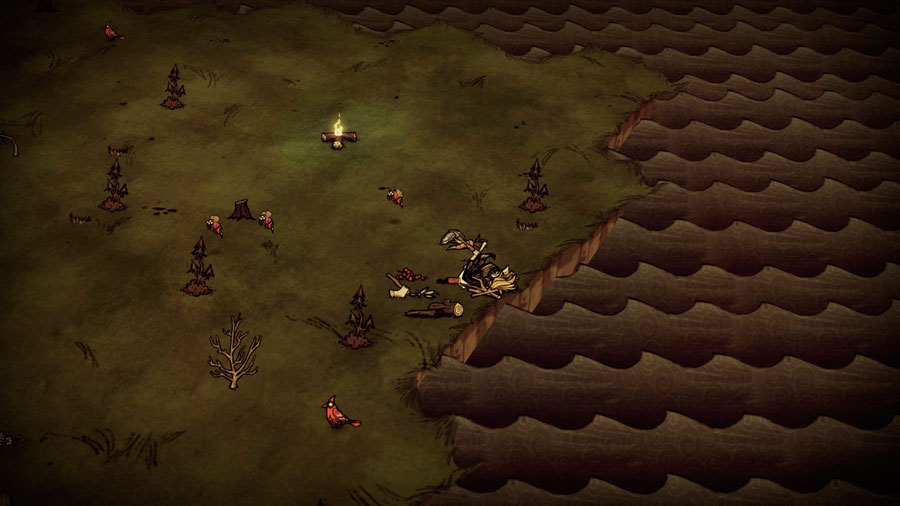
Pro tip: bees will STAB you TO DEATH
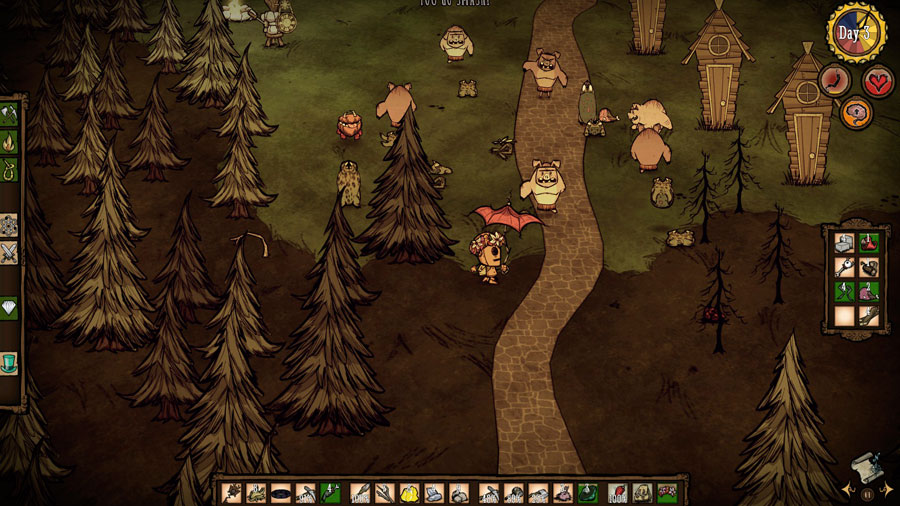
Don’t Starve is a harsh, survival indie roguelike with dark humor, a fairly unique visual style, and a pointed lack of hand-holding. You control a man named Wilson who suddenly wakes up in the wilderness, is told that finding some food before dark would be a good idea, and then… you are on your own. From there, the basic idea is to scrounge for some carrots/berries while using available materials to craft torches, tools, traps, and other basic gear as you do your best to survive in a world that wants you dead.
Moving around and interacting with the world is surprisingly easy and intuitive. You can move around via left-clicking the ground/objects or by using WASD. Interacting with objects is done either with left-click or right-click. Pressing the Spacebar will cause your character to perform some context-sensitive activity, like start chopping a tree if equiped with an axe, pick up something if it is nearby, or attack an enemy. Combat is not particularly deep, but the “shallowness” combined with the roguelike nature of the game lends a tremendous amount of gravitas to battles. It reminds me of survival horror games that have clunky combat on purpose, to ratchet up the implicit difficulty.
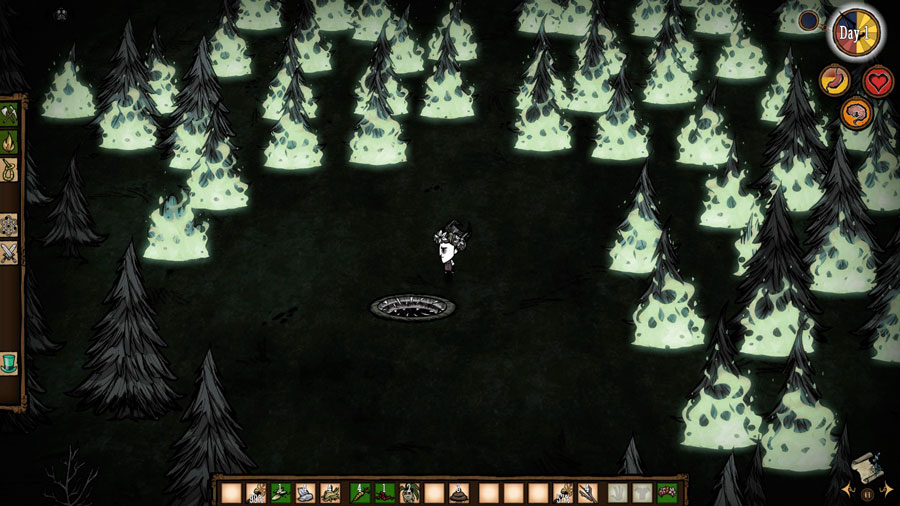
Don’t worry, I got this under control.
The default game starts you in Survival Mode, which is really more of a Sandbox mode. While there is not really an “endgame” in this mode, the game’s structure naturally (and ingeniously) lends itself to a sense of progression and escalating danger. Establishing a base camp is pretty typical and allows you to stockpile materials and research structures, making the maintenance of your Hunger, Health, and Sanity easier. On the other hand, resources generally do not regenerate very quickly, which forces you to forage farther and farther from your base camp with each passing day. And ultimately, the arrival of Winter will stretch your capacity to survive to the very limit, given how traditionally easy sources of food dry up (plants don’t grow, ponds freeze over). This is on top of an escalation of random hostile encounters by the Hounds, or other boss-level mobs.
Those in search of a more structured endgame can seek out Maxwell’s Door, a set piece randomly located somewhere on the map. Once entered, you are in Adventure Mode, tasked with surviving five randomly-determined theme worlds while collecting four Things in order to open the gate to the next world. Even if Don’t Starve consisted entirely of Adventure Mode, it would be enough to cover at least 20+ hours of gameplay. Especially given how the brutality of Survival Mode holds nothing to Adventure Mode worlds in which you are trapped in an endless Winter, or constant rain, or even a world with zero sunlight.
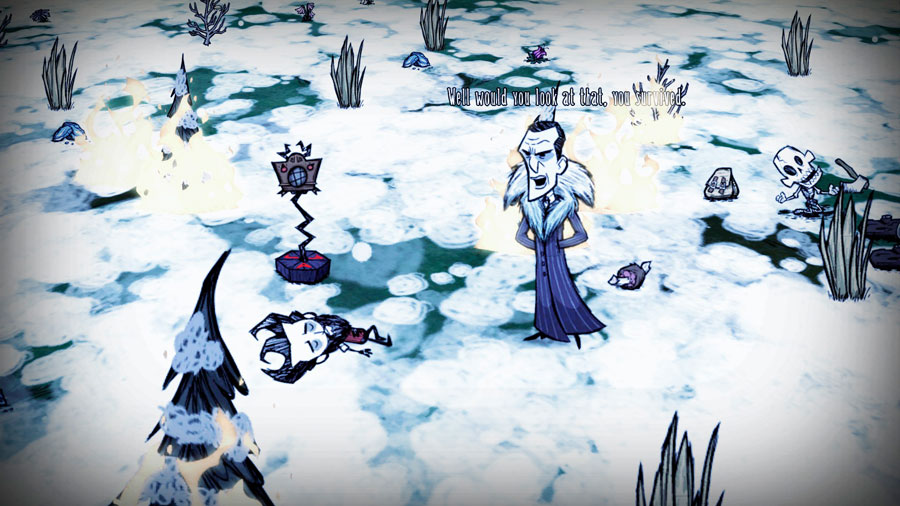
I’m pretty surprised myself, actually.
While I have been infatuated with Don’t Starve for quite some time, the game isn’t for everyone. Don’t Starve is extremely unforgiving, even in roguelike terms, where death is both easy to stumble into and results in a deletion of your save file. That said, while death is easy, it is almost always going to be due to mistakes you have made, rather than randomized deathtraps. Even if you get one-shot by a particular mob, that is only because you chose not to wear armor at the time, or because you were being reckless in not running away. Compare that to a game like The Binding of Isaac, where a white pill might randomly give a buff in one game and permanently reduce health in another.
If you are someone willing to play and lose dozens of hours of progress in a roguelike though (or cheese the system via console commands or making backup save copies), I cannot recommend Don’t Starve enough. It has style, it has substance, and it is receiving developer updates every 3 weeks (at the moment). It is simple to get into, impressively complex when you start planning ahead, and always engaging while you struggle to survive.
Bioshock Infinite DLC Cometh
I am not entirely sure how I feel about the news that Bioshock Infinite will be getting three DLC packs in the near future. Actually, I do: a distinct lack of fucks given.
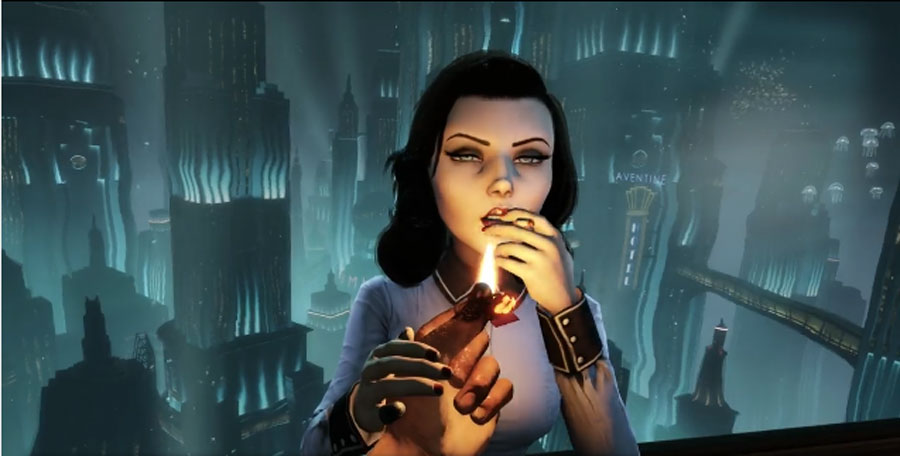
Can this be considered fan service?
The first DLC is a story-less horde mode that will subject you to more of the banal combat system. The second and third are portions of a presumably expanded narrative, although who can really tell what is going on in a time-traveling alternate-dimension throw-everything-at-the-wall plot? But, hey! We’re going to see a pre-destruction Rapture! You know, a throwback to the games that were actually good.
To be fair, Bioshock Infinite did do some things right. The visuals were gorgeous, Elizabeth made the game feel more human, Columbia had brilliant imagery, the music was fantastic, and so on. It is just that Kotaku’s recent interview with Ken Levine boiled my residual bile concerning the plot back up into white-hot incandescent rage. I was fine all the way up until the final paragraph:
“I walked away from BioShock Infinite actually very, very satisfied mostly because of the debate that people were having, not just about what happens in the game, but about what the meaning of it was. That we gave something for people to argue about. We trusted the gamers enough to say, ‘You know what? There’s some room here for you.’ If people walk away frustrated that we didn’t explain everything to them, it probably wasn’t a game for them.”
That noise you just heard is the sound of an aneurysm.

No, Levine, you do not get to fucking say that. As I pointed out months ago, the plot of Infinite is complete garbage. The “room” left for gamers is for them to refuse to apply critical reasoning to their experience, thereby passively constructing a better ending which doesn’t exist inside the actual game.
I can get behind a narrative that explores the descent of a man’s soul to the point that he believes unmaking his existence would be better for everyone involved. We can all probably emphasize with that, regretting having done things or failing to do so. That was not Bioshock Infinite’s plot. The real plot was this:
Finally, let me kind of wrap all these various ingredients up into one complete shit sandwich. What exactly is the message being conveyed here in Bioshock Infinite? What is the theme, the moral of the story?
At the beginning, I almost felt like Booker was trying to make up for his sins, to seek forgiveness and redemption, to put things right. But what is Booker’s actual crime that he is repenting? To stop a person he never turned out to be from entrapping the person he is into a crime a third version must now stop? Booker choosing to be drowned seems a noble sacrifice until you realize what exactly he is undoing: choices he never made. Or, even worse, stopping a man (Comstock) he had no choice into becoming. There is never any “good Comstock” because apparently being bad is a constant. Fate. Predestination.
What is the message here about personal responsibility, free will, and choice? You have none because Constants and Variables. And suddenly, infinite universes means you are implicitly responsible to consequences [of actions] that you never chose and never happened in your own universe. Do you remember when you donated to charity instead of setting a baby on fire? Well, you should feel real bad anyway because the not-you baby-arsonist is running amok and it’s up to you to stop yourself like you already did by not setting the baby on fire in the first place. GUYZ, DEEPEST PLOT EVAR.
There is no route from Infinite’s plot to a good story. None. The “grand redemption” is paying for mistakes you explicitly did not commit in this universe. Even in my most charitable reading of the game – that Booker acknowledges the potential darkness in his soul – leads to the same asinine moral conclusions. Because Booker can choose evil, and did so in an alternate universe, it’s better to kill all possible versions of himself before he can make that potential choice. O… kay? All of us have darkness inside; quite literally who we are is determined by how we manage that darkness. Simply choosing to have it never happen in the first place is an easy, childish fantasy.
And don’t get me started on how moral responsibility can possibly exist in a deterministic universe.
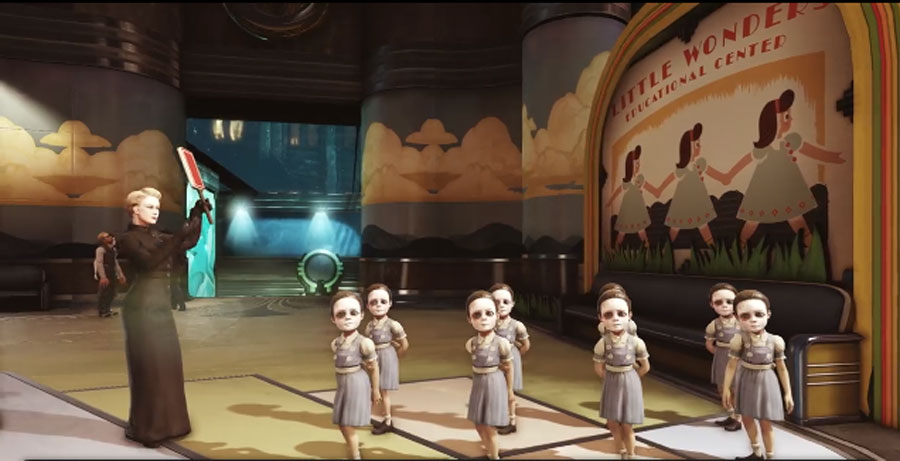
Remember to feel guilty for killing them in an alternate universe you weren’t a part of.
But you know what? This is not even about Infinite anymore. This is about the hubris of an artist to paint his/her deficiencies as strengths, thereby negating any difference between good or bad works. It is me telling you that if you do not find this argument convincing, it is your fault. “If you don’t like this thing I made, it must not have been for you, and thus you’re an idiot for having bought it.” That’s not how this shit works! And besides, Levine, you already told us everything relevant in the game proper: namely, that you’re the next M. Night Shamalanananon. A couple of great works, followed by a more crappy one, and all of a sudden (spoiler alert) the trees are killing everyone.
The tragedy in all this is that we already know who ultimately wins the historical narrative. It has been four months since the debacle started, and all the comment sections in the DLC posts are filled with those gushing over the “deep” ending. And why not? Those who were disgusted as I am have long since stopped caring, or are embarrassed to silence that they still do, leaving the uncouth Philistines to drown in their Confirmation Bias echo chambers. And that is how this whole thing will play out: a great game with a good plot that sold millions of copies. Just like 50 Shades of Grey, Diablo 3, and EA’s Sim City.
Constant and variables, amirite? Christ, how depressing.
Server Merges Are Coming
Blizzard is calling them “Connected Realms,” but it occurs to me that in the future, any MMO dev can simply call their server merges “connected realms” to bypass the negative stigma surrounding the term. “We’re not merging, we’re connecting! Which is like merging, except with a hashtag!”
On a different note, this quote from the Connected Realms FAQ is a nice follow-up to yesterday’s post (emphasis mine):
Connected Realms also allow us to link populations in a way that’s not disruptive to players, and that doesn’t negatively impact players’ sense of identity and character. Other alternatives such as merging realms would require us to force character name changes if there were conflicts, and could lead to confusion for returning players who’d log in to find their realm missing from the realm list. Some players also feel strong ties to their realm’s name or history, and we don’t want to erase that.
Let me ask you something, and get ready to have your mind blown. What is a realm’s name or history if not the collection of people in it? What is the difference between Auchindoun-US, the shit-hole I played on for 4+ years, and something like Stormrage-US, one of the highest-populated servers in WoW?
The people. That’s it. Auchindoun’s Lower City looks exactly the same as Stormrage’s Lower City. Arthas looks the same, the mobs look the same, the resource spawns are the same, the quests are the same, every single thing is the same.
While the speed of opening the AQ Gates or whether there was a server first heroic Lich King kill before the expansion comes out differs depending on the server, that is simply due to – again – the people. The AQ gates are open everywhere. Deathwing is dead everywhere. Garrosh will be a raid boss everywhere soon. Remove the people, and every single MMO server is the same.
This is why I cock an eyebrow at “dynamic” and “emergent” anything. EQN is going to have StoryBrick AI in there somewhere. Cool… but is that going to mean Server A has a completely different ecology than Server B? If not, we must have radically different definitions of what those words mean. Player ecologies differ between servers of course, sometimes radically, and make the server distinctions worthwhile. But servers differing on the development side? As far as I know, that hasn’t happened yet.
Anyway: server merges in WoW. Given how my friends bailed out of Auchindoun and to a PvE server during the half-price sale a while back, there is literally nothing to go back to. Should I ever desire to. For Press™ reasons. That $25 a pop price though… jesus. The suits over there sure like making the decision easy.
The Siren Call of Dynamism
Looks like we have the next Jesus game:
EverQuest Next Could Fix Everything Wrong With MMORPGs
I’ve played every major massively multiplayer role-playing game released since 1998, yet it feels like I’ve spent the past 15 years playing the same game over and over again. That’s a problem. EverQuest Next is the solution.
I probably should have stopped reading that Kotaku article right there, but I’m a masochist at heart.
Don’t get me wrong, some of the things I’m reading about EverQuest Next sound interesting. Voxel-based things, somehow without looking like Cube World. And… err… yeah. Classless/multi-class systems like The Secret World/FF11. Stylized graphics like WoW, Firefall, Wildstar. Red zones on the ground that you shouldn’t stand in, like most every game these days. Jumping and “parkour” (which means what, exactly, in this context?) like in Guild Wars 2. Reducing abilities down to eight, like Guild Wars 2 again. Dynamic events and “calls to arms” like Guild Wars 2 and Firefall and Warhammer. Hell, considering they brought over Jeremy Soule to do their soundtrack, they probably should have just called the game EverGuildQuestWars2Next.
Then there are the hype red flags. A StoryBricks-based AI that wanders around and sets up camp organically? Neat. But then I started reading this interview:
So, to better understand the Rallying Calls, I wasn’t clear on some things with David Georgeson’s example: say you’ve built a big city, and built these stone walls around it, and now an army has come for a siege. Is that something that happens over a couple hours, or a week?
McPherson: That army siege lasts until the players on the server have completed that stage.
[…]
With the “emergent AI,” though, how can you maintain something indefinitely? If the army comes to attack, and is defeated outright in an hour or the players just ignore it, what then? Do you keep spawning enemies?
Butler: Until the things that spawn them are destroyed.
[…]
So, if orcs are released into the world and wander around looking for areas they like, they’re not coming from some point and spreading outward, they’re spawning from camps they set up?
McPherson: Right, perfect example. So in phase four of this Rallying Call, four large orc warband camps spawn in the hills. Those camps are literally swarming with orcs.
Butler: And they’re unassailable.
McPherson: Until you meet the requirements to move on to that next area and eliminate those. Then you and your army push past them and assault them in their homeland.
Butler: You try to fireball the palisade walls in the orc camps, but the fireball doesn’t take down the walls because you need catapults, because that’s what unlocks the next phase and gives you the ability to assault the camps directly.
[…]
What happens if players don’t do any of this?
Butler: It’s simple, it doesn’t advance. So just like a chapter of a book, right? You’ve got your personal storyline, you’re playing through the game. Your personal contribution and the story that goes with it goes on at whatever pace you choose to pursue. The server has a storyline as well, expressed with these Rallying Calls. If players choose not to pursue them, the clock just doesn’t advance.
Oh. So… these things are completely indistinguishable from anything we’ve seen a thousand times before, all the way back to simple phased quests in WoW? Will there be a little “Catapults put into position: 0/2” blurb in the middle-right side of the screen too? How dynamic and revolutionary.
Getting back to the Kotaku article, the author presents his final conclusion like this:
Addressing the Real Problem
Boredom is the enemy of the MMORPG, plain and simple. Now matter how gorgeous the world, or how animated the player base or how compelling the game itself, eventually all of that content the developers spent years creating is going to grow stale.
That’s the real problem here. MMORPGs have traditionally been developed much like single-player games. There’s a beginning, a middle and an end. They can be padded with downloadable content, but they’re still single-player games with other people crammed in there to keep us from realizing that we’re playing the same thing over and over again.
Maintaining a strong community helps, but its not enough. To really solve the core problem, you’ve got to create what so many games before have promised — a living, breathing, ever-changing world.
EverQuest Next sounds like the solution to me.
Now, he says he has been playing MMOs for the last 15 years, but I get the distinct impression that he hasn’t. All long-term compelling MMO content is player-based. An ever-changing world is irrelevant in comparison to a completely static world populated with other people you like hanging around with. People are still playing the original EverQuest for god’s sake! This is besides the fact that there isn’t a “living, breathing, ever-changing world” in EQN or anywhere.
Even if EQN or some future game actually managed to pull it off, would you even want to play it? As I pointed out back in 2011, player impact on the game world is considerably less interesting than many people make it out to be. Imagine if xxArthasDKlolxx killed an NPC and now you can never interact with said NPC again. Is that what you want? Feature sets that include “destructible environments” always have to be followed up by explanations about how it isn’t permanent, lest new players be introduced to a cratered wasteland made by bored griefers.
EVE has been in the news lately with its dynamic player impact, but all of that has been confined to player social structures, and not the game-world itself; star systems have changed ownership, but it’s not as though there are less NPCs or ice rocks in the universe.
That’s how you do dynamic content: with people. Whether orcs spawn in the valley or on the hill is extremely trivial, considering you still have to remove them in pretty much the same manner as you did 15 resets ago. GW2 has committed itself to two-week content obsoletion cycles, which I guess is one way to avoid the tedium of redoing the same thing over and over. Then again, even if the set pieces change, you are still interacting with the world the same way, more or less, as you did at level 1. “Kill this, click that, jump here, fill up your meter, claim rewards.”
I’m not saying that dynamic/changing content can’t be fun, I’m saying that dynamic content is not some silver bullet for boredom. Things might change randomly or dynamically, but your understanding of their mechanics only increases over time. Nils has talked about this years ago, as I have, but I think Klepsacovic summed it up more poetically here:
That last part is the key: anything I could think of. Early on I did not imagine what else I could want to do in this world. I’d done only a tiny fraction of what I could. This had two effects. One was that I had not run into a limit yet. The other was that I could not imagine a limit. I did not imagine that the sky ended, that the quests ended, that the raids could all be done. These were all true, but since I did not know them and did not even imagine them, they were irrelevant. I was running the infinite distance of a circular path.
Since then I’ve learned and my behavior has changed. I do not run in circular paths. I run out, find the edge, map it out, and then fill it in. This means that very early on my mind has already filled the size of the world, so that all that can happen after are details, with nothing big to be revealed. In my mind it looks like two strategies for filling in a circle. Both start at the center. One draws a line out to the edge and now the radius is known. It then spirals inward, knowing exactly where it is headed. The other starts the spiral at the center. It will cover the same area, but it will do so not knowing where the edge is, what the limits are, until it reaches them.
Cynicism is easy, but it’s also an appropriate response to any claim that non-player dynamism is going to solve anything. You can still get bored playing a procedurally-generated game; if that fact is not the simplest indictment of the intellectual bankruptcy of Mike Fahey’s Kotaku argument, I don’t know what is. People are the only thing that will continue making a game interesting once you have mapped out the circle. The player-built structures and other such things might bridge the gap, but it won’t be enough if you aren’t making friends and setting down roots. Given how EQN is F2P though… well, I’m not holding out hope for a particularly stable, long-term community.
All that said, EQN is now on my radar. If it’s fun, I’ll play it. Hell, I’m kinda interested in the incredibly devious EQN Landmark “game” where you’ll likely pay SOE for the privilege of building content for them (Landmark is F2P, but that just means the costs are hidden). Imagine building your own house – as in, your IRL house – and placing that in game… or selling it to other people. I have never used Portal 2’s puzzle-making feature, but I am always a fan of developers giving players tools to build in-game stuff. Crowd-sourcing is great, but even better is the ability to sorta build your own game design portfolio.
Would I get bored with EQN eventually? No doubt. But I don’t see that inevitability as a negative – it is simply the natural consequence of learning and experiencing things. An MMO doesn’t have to last forever to be worth playing. People and relationships don’t last forever either, but I don’t see anyone saying those are a waste of time.
In Defense of Nostalgia
“That’s just the nostalgia talking.”
After reading Liore’s post about starting to play Final Fantasy 7 for the first time (from the latest Steam sale), I started thinking about nostalgia. After all, I still consider FF7 in my top three favorite videogames of all time. I have undoubtedly played other games for longer – and it’s likely that I’ve played “better” games since then – but a component of what I describe as “favorite” includes impact on my life.
Nostalgia is always used as a pejorative in videogame discussions, a way of dismissing the assertion that X is better than Y, or that X is still good at all. Hell, I have probably used the term in the same manner. But it seems clear to me now that the “charge” of nostalgia is a bit too sweeping. Sure, sometimes you think something is (still) good simply because you liked it when you were younger. But sometimes you do just so happen to experience a revolution or cultural event as a child. Was the moon landing “just nostalgia talking”? Was MLK’s speeches “just nostalgia talking?”
The cultural impact of FF7 in gaming specifically cannot be overstated. It has sold 10 million copies as of 2010, which might not sound impressive for a game that came out in 1998, but keep in mind that that still makes it the best-selling Final Fantasy title of all time. It pretty much popularized the (J)RPG genre in the United States, and arguably sold the original PlayStation by itself. The graphics, which admittedly don’t hold up well at all today, were revolutionary at the time. And the music? The end of Disc 1? One-Winged Angel? There is a reason why so many people cosplay as FF7 characters and not, say, characters from FF6 or FF4 or FF9.
But let’s assume that is just nostalgia talking. Well… when does nostalgia not talk? Is everything from the past suspect? Do things only get better over time? Are all the good things in gaming just conveniently occurring right now? (Hint: Many MMO bloggers are saying no.) I am not entirely sure that a hyper-focus on the present is any less ridiculous than a longing for the past.
I will be the first to admit I have criticized someone for having “rose-colored glasses” in regards to wistfully looking back to, say, TBC WoW game design. And I do actually still stand by those criticisms: there is nothing about TBC that I don’t honestly and truly believe Wrath improved (with the exception of Kara, maybe). But… I dunno. I’m not sure anymore that I can legitimately claim “that’s just nostalgia talking” in one instance and not levy the same damnation on a game like FF7. Vanilla WoW or even TBC WoW were just as groundbreaking at the time, in their contexts, as FF7 or anything else. Cataclysm? Much less so.
Nostalgia remains a tricky subject though. Can something be both legitimately revolutionary and not hold up to today’s scrutiny? Probably. Like… Pong, maybe. And surely there are others too, although the first thing that came to mind, Super Mario Bros, actually holds up IMO. Secret of Mana? The music alone buoys the game. And, again, I’m not entirely sure why a game “not holding up” is necessarily a deficiency of the game anyway. A timeless classic in other mediums remains amazing by definition, but it is not as though we continuously invent new ways of reading books or watching movies. Meanwhile, there are millions of different iterations on combat systems or simple object interaction. Holding games to the same standards of books and other mediums seems like an unfair comparison in that regard.
And really, who cares if it is “just nostalgia”? Regardless of whether FF7 holds up, it had a significant impact on my (gaming) life if nothing else. I created save files in front of every CG cutscene and showed my friends when they came for sleep-overs. Remember the Mako Junon Cannon firing? I was showing them that one and my friend David quipped “Is that the gun?” when the camera was panning to the side turrets. I paused a beat and then said “No, that’s the gun” as the Cannon came on-screen. That IRL moment couldn’t get more cinematic if we tried.
As I mentioned at the top, I have undoubtedly played other games for longer amounts of time, and probably have played objectively better games too. Nevertheless, I’m not entirely sure whether my favorite games of all time list have really changed. To be honest, I haven’t thought about it all that much. Bastion was good enough to dislodge some SNES game, surely, but which one? Hell, can I even get myself to play my supposedly favorite games again? And if I can’t, should that even mean anything?
I dunno. I also purchased FF7 during the latest Steam sale, and am looking forward to playing it again with no mods (besides the music one that makes it sound like the PS1 original). Will it hold up? Will my opinion on it change? We’ll see. Maybe not soon, but eventually. And then perhaps I should give Xenogears and Final Fantasy Tactics another try too, seeing as they hold spots #1 and #3 respectfully.
There Can Be Only One
With an odd sense of inevitability, I beat Don’t Starve’s Adventure Mode Sunday night.
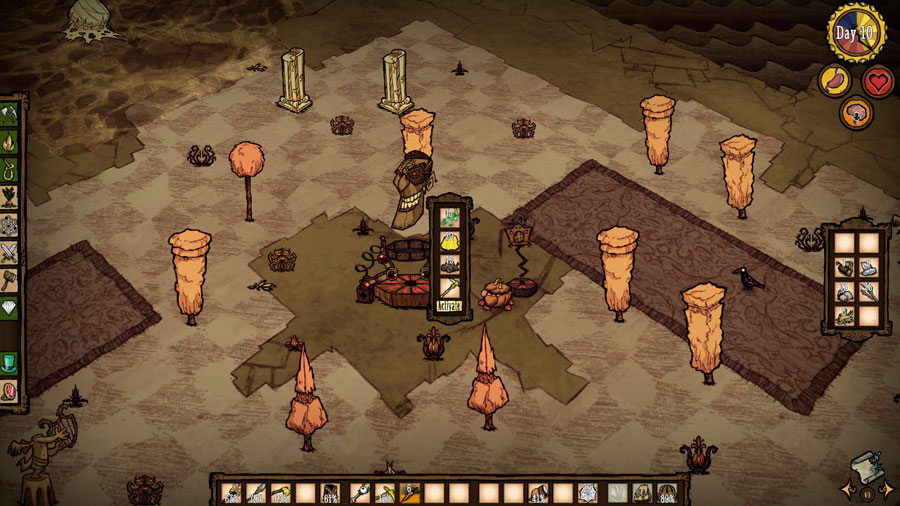
This is what they call “overkill.”
In one sense, my victory was all but assured the moment I zoned into the first world as WX-78. As I may have mentioned, each of the various alternate characters have different pros and cons. The default Wilson has no negative qualities, and has the benefit of growing a beard; if left unshaven, the beard acts as insulation against the cold, while shaved beard hair can be used to craft a Meat Effigy (placeable respawn structure). Wickerbottom has higher penalties for eating spoiled food and can’t sleep, in exchange for the highest Sanity pool, the ability to craft spell books, and can use a lower-level research structure to build higher-tier items. Meanwhile, WX-78 has the lowest starting stats and takes damage in the rain, but can eat spoiled food with no penalty and can eat gears to regain health/hunger/sanity while also increasing said stats by 20 each (to a certain maximum).
With the exception A Cold Reception – where it rains constantly – victory was more or less assured with WX-78 due to the gear bonus alone. While the locations of the Things you are hunting are random, the set pieces in which they are located are all the same. Thus, you know there will always be at least four mechanical enemies at the “exit” to a given world and they will drop two gears each. Gears stack up to 40 in a single inventory slot, do no spoil, and as mentioned earlier they provide a huge boost to all three meters.
In fact, it turns out that I wasted a significant amount of time cooking food throughout most of the worlds given that one gear snack would have been enough to sustain me for an entire day – I waltzed into the final world with 40 gears and left 4 days later. Compare that to my best Wilson run, where I was constantly in dire need of sustenance in a world where plants don’t grow and rabbits need to be dug out of the ground. Indeed, my death in that last level was due to stopping to dig up mushrooms to boost my health/sanity, which was completely unnecessary with WX-78’s gears.
Do I feel satisfied? Well… more or less. I definitely feel like a switch has been flipped off in my mind, allowing me to move on (for real this time). The difference in implicit difficulty sort of made it feel like I had godmode on, although I suppose I should not discount the fact that I had 50+ hours of experience and knew what to expect going in. Another part of it though? I think that I expected to have beaten it that last time with Wilson. The roguelike aspect of having to redo the whole thing generated more hours /played, but not necessarily more enjoyment.
Just shy of 60 hours.
In any case, there is actually more to do. The most recent update fleshed out the Cave system even more, which acts as its own mini-Adventure mode insofar as dying in a cave simply respawns you outside the entrance. I could also seek to, you know, actually survive in Survival Mode – the farthest I got was about day 40. Or… I could move on.
I’m going to try the latter and see if it sticks this time.
WoW Down Another 600k to 7.7m
If the same thing happens every three months, does it still count as news? WoW is down to 7.7m from 8.3m, a loss of 600k subscribers, meaning we are back into pre-2007 territory.
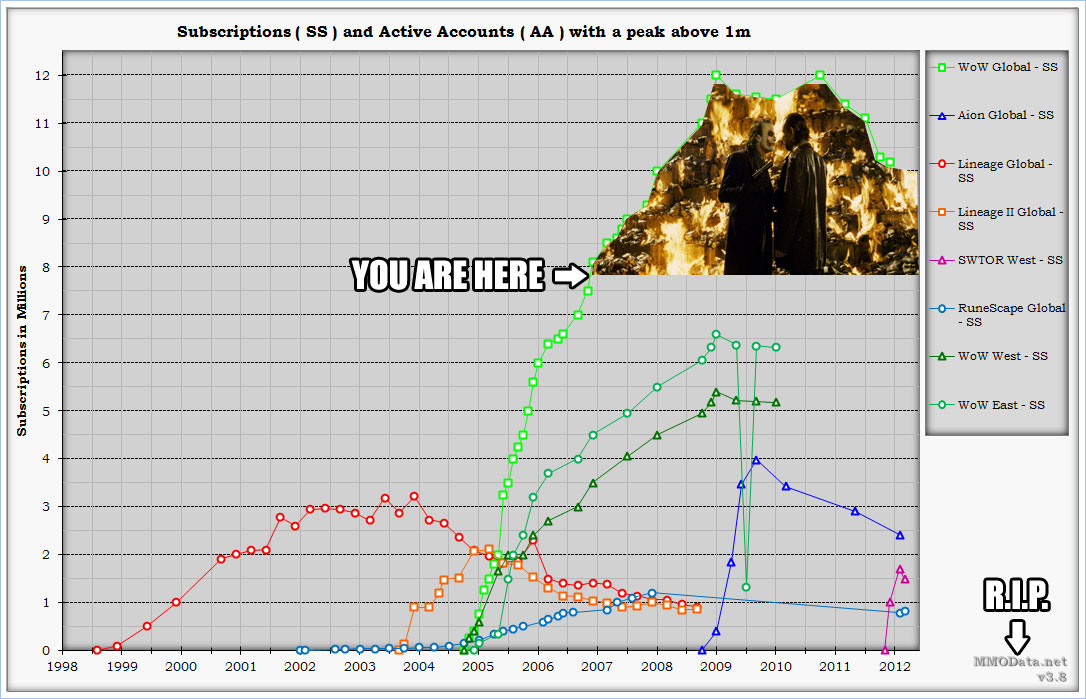
“It’s about sending a message.”
One of the more interesting facts, personally, was the resolution to the possible Vivendi fiasco. You know, the whole situation in which Vivendi was in the process of raiding Activision Blizzard’s big piles of cash, potentially bringing a company with several billion-dollar franchises to its knees for no game-related reason? Oh, didn’t hear about that before MMO-Champ casually talked about the stock buy-back with no context? I might suggest expanding your blogroll with the illustrious Nosy Gamer (or NoizyGamer, apparently), who has been following this particular series of power-plays since at least July 10th. Things could have turned out incredibly bad for Blizzard, and I imagine that the vast majority of even blog-aware people would have not known about it until the fan hit the shit.
Incidentally, NoizyGamer has been keeping up The Digital Dozen feature – tracking the top 12 MMOs based on XFire numbers – every week since the start of 2012. XFire is XFire, but it’s pretty much all we have left at this point, inbetween quarterly reports. There is also a bunch of EVE posts and talk about EVE bots, but nobody is perfect ¹.
Anyway, there it is. Kinda interesting (and scary) to read about all the Machiavellian schemes going on inside the gaming industry, and realizing that good game companies fail all the damn time despite producing legitimately good titles. Say what you want about WoW’s current direction, but I don’t think anyone wants Blizzard to fold because some stock-holder in Europe has a bad credit rating; we want it to fail for real reasons, like raiding is too hard/easy, LFD exists, or because Ghostcrawler was mean to somebody on Twitter.
¹ Just kidding, the stuff about bots is pretty cool.
Steam Haul: Summer 2013
Someone asked me the other day what I picked up during the Summer Steam sale. So here’s the list:
- Antichamber
- Don’t Starve (of course)
- Far Cry 3 + Blood Dragon DLC
- Surgeon Simulator 2013
- Fez
- On the Rain-Slick Precipice of Darkness 4
- The Swapper
- Gunpoint
- Monaco
- Civ 5 (upgrade to Gold edition)
- Strike Suit Zero
- Dungeon of Dredmor (DLC)
- Rogue Legacy
- Closure
- Just Cause (hey, it was $0.27)
- Sanctum 2
Altogether, that came to around $133.24. Is that a lot? Probably. Then again, that’s about the same price as Far Cry 3 and Civ 5 bought on Day 1. At least, that’s what I keep telling myself.
That, and Press™. In fact, couldn’t these just be considered business expenses? Hmm…
Console Counselor Councilor
Okay, I am contractually obligated to divulge that I sit on a THRONE OF LIES.
I may or may not have orchestrated this slaughter.
To be fair (to myself), I already mentioned how I was was getting bored with Don’t Starve’s Adventure Mode, in part, due to not being able to change characters. When I created a new Save with a new character in an attempt to start Adventure Mode with them, I was stymied by the requirement of trudging across the map trying to locate Maxwell’s Door. So what changed?
As befits my new (?) seating arrangement: cheating. Specifically, I enabled console commands. And with my new god-like powers, I… just teleported to Maxwell’s Door. Problem solved.
Now, it should be noted that I still feel a bit wary. Cheating is, well, cheating. I don’t actually care what other people think about the act per se, but I wonder if this will diminish the accomplishment of actually beating Adventure Mode. Technically, I haven’t actually cheated in Adventure Mode – just getting there. And considering I was at the end of my enjoyment with the game proper, any entertainment gleaned at this point is entertainment that would not have existed otherwise.
On the plus side, the character I chose, WX-78, is a robot that starts with lower stats in exchange for the ability to eat Gears to both replenish Health/Hunger/Sanity and increase their maximum stats. And he also takes damage when it rains. So, of course, my very first world is A Cold Reception, aka Waterworld, aka the world where it rains (frogs) for approximately 14 hours every day.
Nice try, Maxwell, but I’m still coming for you like a hungry ghost.
 In An Age
The Limits of Procedure
Aug 12
Posted by Azuriel
In a recent post, Tobold says:
Two paragraphs later though, he sort of undermines his own argument a bit (emphasis mine):
Er… if players cannot possibly make the mobs extinct, what’s the point in having an “ecosystem” in the first place?
But, never mind that. What I really wanted to talk about is the Minecraft bit. Because sometimes I get the feeling that “procedurally-generated” as a concept is being elevated as some paragon virtue of game design – a silver-bullet to boredom – when it is really nothing of the sort.
A procedurally-generated game solves exactly one problem: metagaming. That is not quite the correct word I want to use though, as you can still technically metagame a procedurally-generated world in several ways. Namely, by knowing its procedures. For example, no matter what Minecraft world is created (mods aside), diamond only spawns in layer 19 and below. Indeed, there is a whole bunch of Minecraft constants to consider (accurate circa 2010 anyway). All the Minecraft map being procedurally-generated does is prevent you from following a guide telling you to move North a hundred steps and then walk East to find a nice batch of Iron Ore near the surface. Avoiding those scenarios is certainly useful, and it’s always fun running into the truly bizarre and whimsical creations of the RNG gods.
The problem arises in treating the procedurally-generated whatever as “endless content,” when it is really not anything of the sort. As I talked about before, your knowledge of a game’s systems really only ever increases as you play; novelty has diminishing returns within the same game. Each Minecraft world generated may be completely different, but you are going to be doing the same sort of things each time: punch wood, make tools, make structure, dig for ore, etc. Different starting locations and details can spice up the gameplay for a time, but your “build order” is unlikely to change much no matter where you are.
Procedurally-generated content definitely has a place in gaming, usually in the context of roguelikes, but it will not solve any of EQN or any other MMO’s problems. Not that its application in MMOs made much sense in the first place – one of the defining characteristics of an MMO is a persistent world, which is incongruent with procedural generation. Even if it was just one world of infinite size (expanding at the edges), the amount of space surrounding objects of player interest would remain finite. And that’s assuming players would be willing to trudge out very far from their starting location in the first place.
No, just adding more space isn’t going to solve the issue. If anyone claims that an MMO’s world cannot be too big, simply point them at any given low-pop server of any game anywhere.
Posted in Commentary
10 Comments
Tags: Build Order, Diminishing Returns, EQN, Novelty, procedurally-generated, Tobold