Author Archives: Azuriel
Space Saving
When I bought my new computer a while back, I splurged on a 2TB SSD to ensure I had enough space to install a large(r) number of games. I get in certain gaming “moods” and thus need to ensure that I have certain flavors available, lest I do something dumb like watch YouTube Shorts for hours instead. Unfortunately, not even 2TB can save me forever.
After installing Folder Size Explorer, I found the top offenders:
- Red Dead Redemption 2 – 120GB
- Diablo 4 – 45GB
- Starfield – 127GB
- Star Wars Jedi: Fallen Order – 51GB
- Star Wars Jedi: Survivor – 130GB
- Control – 50GB
- Death Stranding – 63GB
- Alan Wake Remastered – 38GB
- Baldur’s Gate 3 – 142GB
- Day’s Gone – 60GB
- Elden Ring – 48GB
- Assassin’s Creed: Odyssey – 78GB
- Assassin’s Creed: Origins – 49GB
That’s definitely a Who’s Who of backlog shame.
Now, of course, none of this is a problem-problem. I don’t actually need to have SW Jedi Survivor installed when I haven’t completed the first one. Starfield can probably go too, since I already played it for 65 hours and am unlikely to go back prior to the expansion coming out (or at all). And not sure why I have any of the Assassin’s Creed games installed. But… You Never Know™.
Of the list, I am making the most current progress on Control and Diablo 4. Which is tragic, in a way, given the installed alternatives. But what I really want to be playing right now is some dumb survival crafting game. I am not playing one due to the fact that I have basically played them all aside from the ones not currently on sale. Mercifully, the Steam Summer sale starts on 6/27, so I can get back to vigorously scratching the eczema that is a predilection towards punching trees and hoarding resources.
…although, I’m just now realizing that I will actually need, you know, space to install these games.
Oh my. Better get back to it.
Forever Winter
Going to be adding Forever Winter onto my list of games that look cool that I’m probably never going to actually play:
I say that because it’s being described as a “co-op tactical squad-based survival horror shooter.” I have zero interest in playing with randoms anymore, let alone in a scenario that allows for an entirely novel way of griefing, e.g. making too much noise and getting caught by AI horrors.
Conceptually though? Game is Badass with a capital B.
While the above trailer looks amazing, it was actually this video that hit hardest:
In short, it seems like most of the people that are working on the game are concept artists that finally get to implement their concept art. A battle tank draped in bound, naked corpses? Flamethrower troops in spacesuits with American flags draped over their face? Yes, please. Granted, I did not quite see any of those in the gameplay reveal trailer, so who knows if they actually follow-through.
It will be interesting to see how the game ultimately shakes out. I’m a big fan of grimdark, post-apocalypse looting. Having to be weary of getting into fights that are impossible to win is also compelling. But there will need to be a real trick on how that translates into long-term fun. Will there be a story mode or overall plot? The trailers seem to indicate you may end up fighting “bosses” eventually, which provides something of a “why” to grind out whatever resources. But if the whole of the game lends itself to not attacking things, and possibly punishes you for doing so, it will be tricky to land the transition without feeling like the game itself turned into something else. Sort of like when you have a stealth game that suddenly has a stealth-less boss fight (Deus Ex: Human Revolution), or a traditional FPS with an annoying stealth level (too many to mention).
Regardless, I will be following Forever Winter with interest.
So, You Want An Above-Ground Pool
[Note: I wrote this last year, but never got around to actually posting it at the time. Since I recently set up my pool again, it became a bit more topical. Enjoy.]
One of the reasons I haven’t been playing many videogames this past month is because I was setting up an above-ground pool. In the spirit of my other apropos nothing post about shipping PS1/PS2 games, let me chronical the struggles I had with getting mine set up. Maybe you can learn from my mistakes, maybe you just enjoy the schadenfreude.
Step 0: Do you really need one?
No, seriously, do you really need one? I got mine on the cheap, but a yearly pass to a sorta nearby pubic pool would only have run me $200, at worst, per year. By the time everything is done, you are likely going to be spending $1000+ and who knows if anything you bought is going to survive the five years (or more) it takes to break-even. Now, you are probably going to use a pool in your backyard on a whim more often than getting into a car and driving somewhere, but just acknowledge the math involved.
Also, do not bother with any of this late in the season. Like in August. That’d just be dumb.
Step 1: Survey your domain
It’s very important that you look at what you’re dealing with terrain-wise before you even consider pool options. Do you have a good space for one? Is it near trees? How tough is the soil? Are you going to try do everything by-the-book and actually get a permit for your pool, to include all the things the permit requires? Some of those things include having a fully-enclosed, self-locking fence, being X distance away from the home, and so on.
For me, my house already had a “dog run” area that was fully fenced up:

The grass looks sketchy, but that was because I had just mowed on the lowest setting. What is not obvious from the picture – or even looking at it in person – is how the ground isn’t level. Like, not even a little bit. But I’ll get into that in a minute.
Step 2: Secure a Pool
The retail price of an above-ground pool varies, but the 9’x18’x48″ pool we settled on is $800 normally. I bought mine for $100. How? Warehouse resellers. Sort of like eBay for items that people returned to Amazon, who then sold to warehouses for pennies on the dollar. I’m not going to give out the name of the one I used, but basically I saw some pictures of a very beat-up box online but the pool liner still looked wrapped in plastic, so I rolled the dice. Spoiler alert: it worked out.
Step 3: Prep the field
Do not install a pool in August. I repeat, do NOT install a pool in August.
So anyway, there I was, installing a pool in August like a moron. I borrowed a 25-year old mini-tiller from a neighbor and started to work on the 9×18 area where the pool would be located. Phase 1 was just clearing the grass out. If you have a sod remover or other fancy equipment, use that. Otherwise, make sure to till and rake that top layer of dirt/grass away and compost it elsewhere or whatever.

Step 4: Level the playing field
Mentally accept that 80% of the work in setting up an above-ground pool is leveling the ground. Don’t cut corners, don’t say “fuck it, that’s good enough,” don’t do this in August when your pasty ass is sweating buckets within the first 15 minutes of being outside.
The dirt needs to be level. I used a 3ft level taped onto a wooden 2×4, but that was sketchy. You can (and should) buy a contractor level, with longer being better – they are expensive on Amazon, but my local hardware store had a 6ft level for like $15. In any case, I took my level and… realized that the cleared area had a significant slope. Like 3 inches or more.
I recommend digging down rather than filling up. The idea is to use a tiller to get the dirt nice and frothy, and then shovel it over onto the lower end. Two birds, one shovel. The problem with just buying a bunch of topsoil and raising the low end is two-fold. First, it’s difficult to know how the topsoil is going to behave once compressed. Like, even if you tamp it down, I noticed it springing back up in a way four feet of water per square inch was not going to allow it to. Secondly, keeping the dirt and topsoil where it is supposed to be becomes tricky. If it’s just in a big pile, erosion might see the sides start to lower and things becoming increasingly uneven.
Step 5: Measure twice, dig once
Once everything seems level, measure everything again. Read the instructions, look at pictures.
My pool is 9×18 so I leveled a 9×18 area. Had I looked at the goddamn box one more time, I would have realized that while the bottom of the pool is indeed 9×18, the side support beams actually extend out another 1.5 feet on both sides. While we ended up just rolling with it, this means the side walls are bowed in and who knows if there is any permanent damage to the steel pipes or what sort of extra wear that will have done to the liner. All of which could have been avoided by looking at the box.

Step 6: Get some help setting it up
The instructions say 2-3 people can set up the pool in 30 minutes. Get at least that many people and budget 2+ hours. I’ve seen videos of people doing it themselves, but not when it’s August.
It is also important at this point – and probably before this point – to understand where things are going to be located. For example, where are the holes for the pump? Where is the drainage port? It’s a huge pain in the ass to move anything once those supports go in, so avoid having to make corrections.
Step 7: Fill and (hopefully) enjoy
At a certain point, you won’t know if everything worked out until you actually start putting in water. You are going to want to try and smooth out any wrinkles in the liner when there is less than an inch of water inside. It’s also very important to walk all along the bottom to feel for any errant rocks or pokey things that might cause issues.
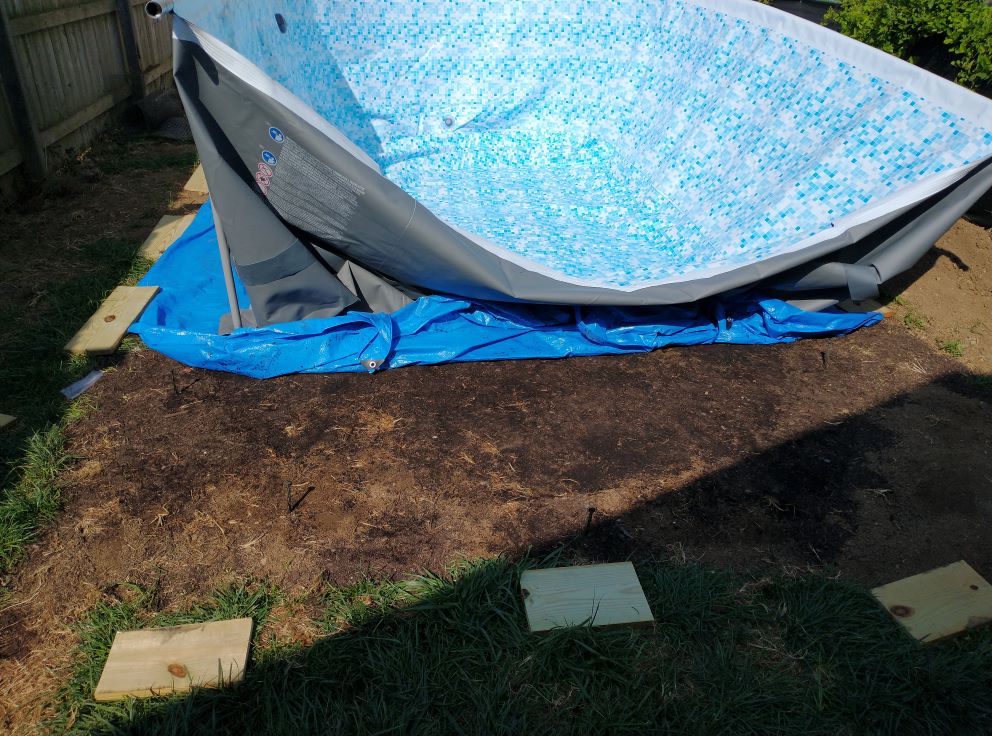
For me, we ended up fully filling the pool and then had to completely empty it because the water level was a difference of 4 inches. The pool instructions say “no more than 1 inch difference” but most of what I read online suggested 2-3 inches would be fine. The issue was more than just the water level though, as we also had the side wall concern I mentioned earlier. So, after it was emptied, I put in a bunch of topsoil under the low side, dug 1-2 inches down on the side supports and filled it back up. It’s not perfect still, but we’ve successfully used it for two weeks now and it just needs to make it a few more before the likely end of the season. Next year, I will relevel things properly.
Not in August, of course. Because that would be dumb.
Addendum
To help protect the bottom of the pool, we used a giant tarp underneath. A tarp will not prevent rocks from poking your feet from inside the pool and otherwise being a hazard. No, I don’t camp a lot, how can you tell? Also, I do recommend rolling up the ends of the tarp so the support poles don’t push on them. This is primarily so you don’t have a little mosquito puddle just sitting there.
Buy and cut some treated wood for your supports to stand on and dig them into the ground a bit. I briefly thought about using paver patio stones, but was worried about what would happen if the stones snapped. A few of the wood boards are already in rough shape, so I’m glad I stuck with wood.
If you end up with wrinkles in the bottom of the pool after there is too much water in there, one lifehack solution is to buy a new old-school plunger. You know, the ones that are flat on the bottom and are terrible for plunging toilets. According to some clever Youtube videos though, they work just fine in lifting up the pool liner to help smooth out wrinkles.
Those chlorine tabs you put in bobbers are for maintaining a given chlorine level. Pool “shock” is super-concentrated chlorine to raise levels high enough to be safe. You can really optimize different chemicals (pH, alkalinity, etc) if you want to, but it’s all in service of keeping proper amounts of chlorine.
I recommend two different types of water testing kits. The first one I bought was all fancy with eye-droppers and little bottles of chemicals. Kept saying I didn’t have any chlorine though. Bought the test strip kind just to confirm and, hey, actually I had 5ppm chlorine in there. It’s possible that there was user error involved with the fancy test, but that issue is still resolved by having two different testing kits.
Solar covers do indeed work. The one I bought looks basically like a 22-foot diameter heavy-duty piece of blue bubble wrap. Threw it on, cut it into a rough oval shape with scissors, and will hopefully get another few weeks of reasonable pool use this Fall.
Guarded About Veilguard
There was an Xbox Game Showcase 2024 recently that revealed a lot of trailers for upcoming games. One of those trailers was for Dragon Age: Veilguard, formally known as Dragon Age: Dreadwolf. You can go ahead and watch it yourself first:
Now, the trailer is getting mercilessly shit on by Reddit. There are a lot of Dragon Age: Origin uberfans still kicking apparently (of which I am one, technically) that are appalled at “what the series has become.” Which is funny, considering Origins came out in 2009 and the series has spent more time being something else than it ever has as Origins. All the complaints about EA destroying Bioware is similarly asinine considering A) by all accounts Bioware does this to itself, routinely, and B) who is still even at Bioware 15 years later? That is a topic for another day, though.
Most of the criticisms seem to be leveled at the trailer’s Marvel and/or Fortnite crossover energy. It reminded me more of the D&D: Honor Among Thieves trailer, honestly, but I get it. Dragon Age started out as a sort of gritty, grimdark fantasy RPG and that has… mellowed over time. But it did get me curious about trailers for the prior games.
- Dragon Age: Origins – “Warden’s Calling” and “Sacred Ashes.”
- Dragon Age 2 – “Destiny Extended“
- Dragon Age: Inquisition – “The Breach“
I don’t actually expect you to watch all those, but the summary is: most are pretty damn similar, minus the Borderlands-style name introduction. Yes, there is less blood and more… rizz. The thing about trailers though is that they don’t really matter. It sucks when they suck, for sure, and can definitely dampen the enthusiasm and hype. And, yeah, they can also be indicative of a truly terrible game. But it also goes the other way, right? There are plenty of trailers better than the game they represent, or misleading at best. Just think about the best parts of any of the Dragon Age games to you, and then point me towards where that is represented in its trailer.
I’ll start:
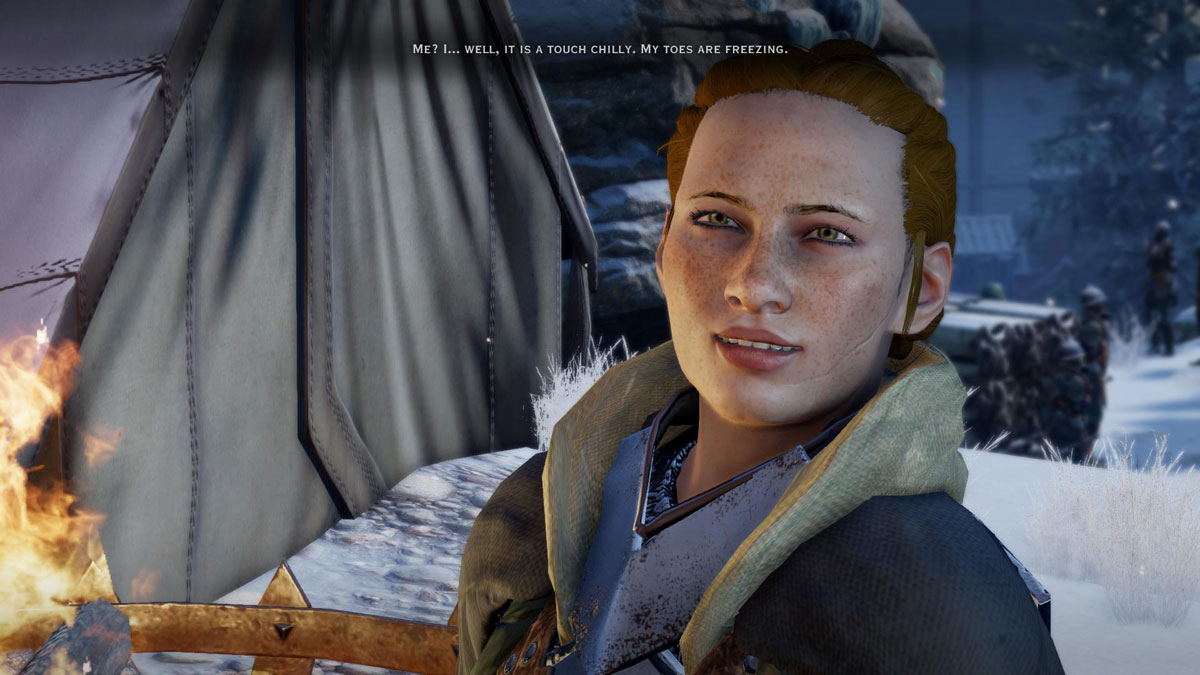
That’s right, Scout Harding. The worst part about Dragon Age: Inquisition was that you couldn’t romance Harding, and now? A decade later you (presumably) can. Game on.
Impressions: Diablo 4
They brought back the grimdark.
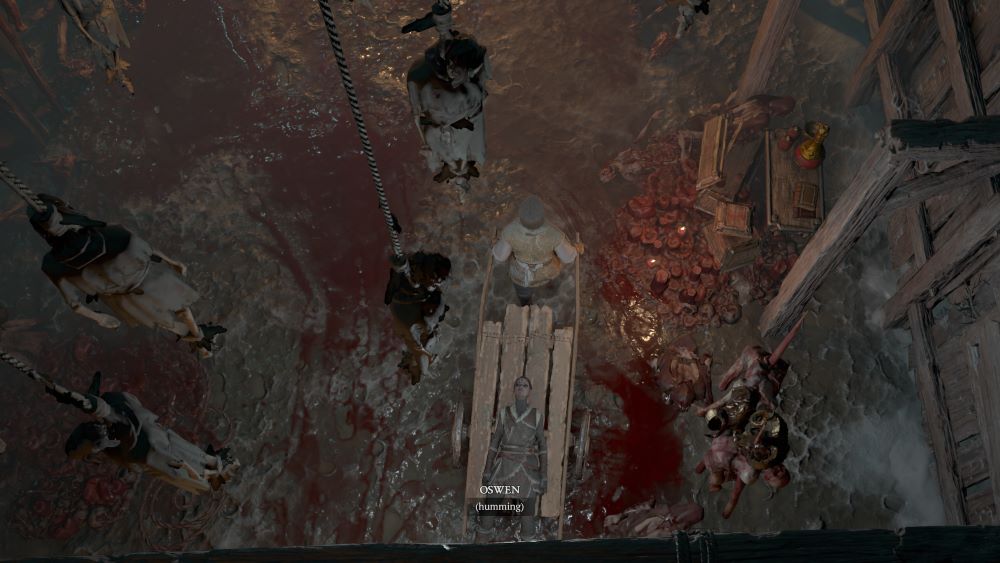
I have been generally enjoying my time with Diablo 4, all the way up to level 30 40 as a Necromancer. I tend to gravitate towards Necromancers in any game that offers it (including MMOs), and I definitely remember rolling one the first time I started playing Diablo 2 right as I moved to college. It’s kind of a difficult design to get right though. If your minions are too strong, you end up not pushing buttons and simply walking around the map melting bad guys. Conversely, if minions are too weak, they may as well not exist. Plus, you can generally get punished for having a minion-build during boss fights, as the boss will kill them quickly and there may not be any corpses around to bring them back.
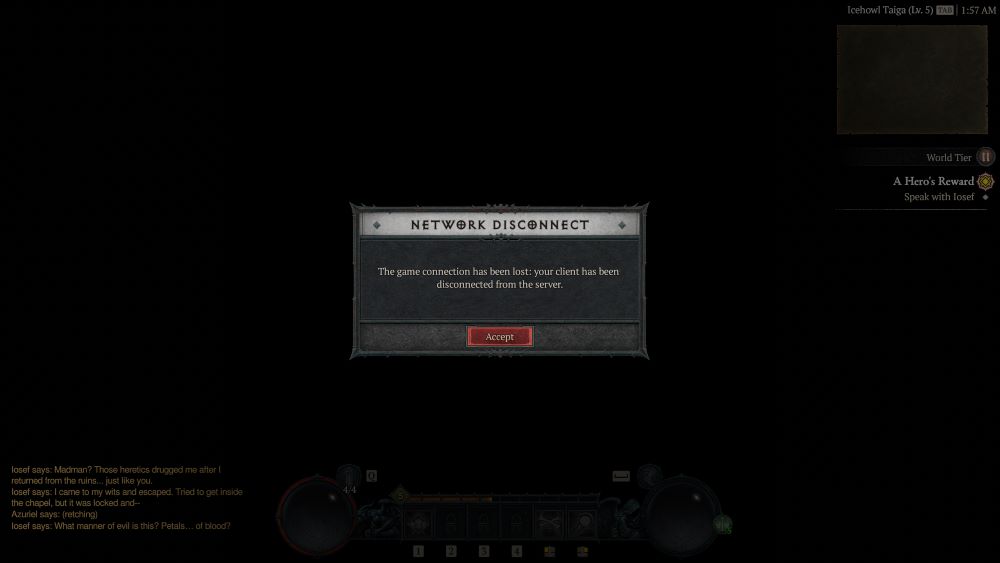
I’m happy to report that Diablo 4 solves the issue is an interesting way: a draining basic attack that creates corpses every few seconds. Things can definitely go downhill quickly if you aren’t paying attention to your skeleton crew, but I appreciate the novel solution. It also enables the frequent use of Corpse Explosion, which has a very satisfying aural element to it. Killing the first enemy and then chain-popping dozens more feels good every time.
What kind of shocked me though is how you are limited to six buttons.
I legit had to look back to Diablo 3 and Diablo 2 screenshots to see that, yeah, it’s been that way for decades. Which is fine, I guess, but became real annoying once I realized that the Golem takes up one of those buttons. Was that always that way too? I suppose it’s as good a balancing mechanism as any, but it also reinforces the whole “walk around the map doing nothing” angle even more. It also makes me question why these other Skills exist with longer cooldowns. I’ll probably come across some meta build that farms the endgame in 20-30 second increments, but it’s baffling thus far.
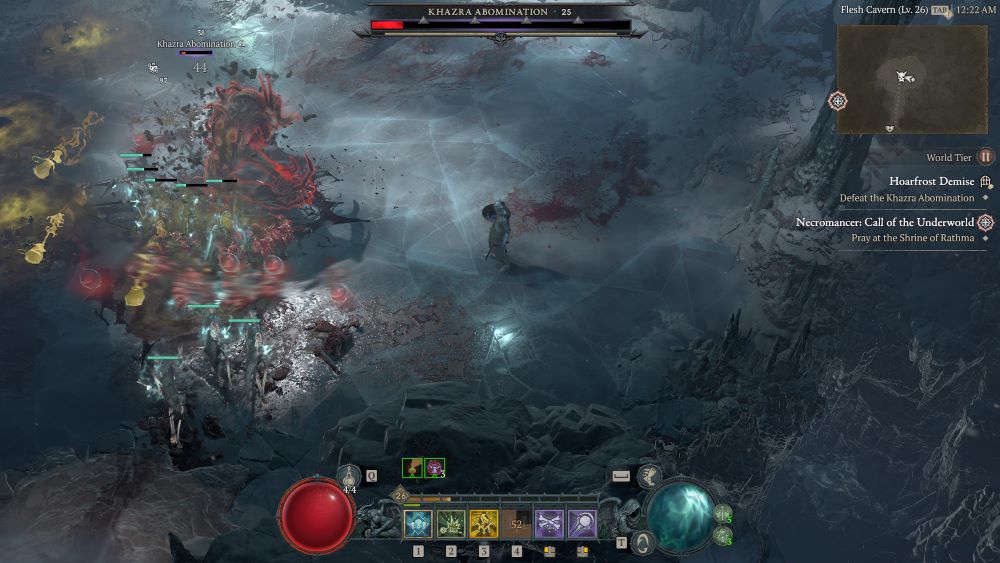
Of course, everyone knows the “real game” doesn’t happen until you start getting decked out in Legendary gear. I can already see how some Affixes can radically change basic abilities; perhaps that is the secret sauce for making 6 buttons still feel like enough agency. Diablo 4 does allow you to scrap Legendary items and then add their special ability to future item you want, which is fantastic. If Borderlands 4 doesn’t have something similar, it’s going to feel miles behind.
I will say though, playing Diablo 4 has given me a greater appreciation for V Rising. I said multiple times that V Rising’s ARPG angle fell short, and you should “just play Diablo 4” instead. While that is true from a loot perspective, I do have to say that V Rising feels way better from a gameplay perspective. Didn’t quite realize how much I missed WASD movement than when I was left-clicking around in Diablo 4 and either halted to shoot when I wanted to move, or moved when I wanted to shoot. Yeah, you can hold Shift to stay still, but that gets awkward when the game wants you to keep your fingers on 1234.
Anyway, so far so good. My focus is on the story, doing some random dungeons/side quests along the way, and raising the World Tier difficulty as it become available. There is likely a zero percent chance I’m spending hours farming endgame-endgame gear for the giggles, but it’s fun enough for now.
V Rising: All Done
I’m done with V Rising after about 56 hours.

I technically did not “beat” the game, but I am done. All bosses have been defeated aside from the last two: Adam and Dracula. I have maxed my gear and spells, acquired a Legendary weapon, and was otherwise facing down 5-6 additional hours of “gitting gud” before seeing… I don’t think there’s even credits screen here. There have been tough bosses leading up to this point, but these last two have multiple phases and Adam even requires the crafting of a special consumable to even access him for an hour. I think I could eventually take down Adam by investing in crafting a different endgame weapon, or swapping out spells during a fight transition, but honestly fuck that.
Overall, I stand by my earlier assessment of the game, e.g. it’s OK. I did develop a deeper appreciation of the visuals though and the overall art direction. Running around the map during daytime became an interesting game unto itself, as you tried collecting resources or fighting mobs only to have the shading tree collapse from an errand attack. The sound that accompanied increasing exposure to sunlight was also very satisfying (if not deadly). The moment-to-moment gameplay was satisfying.
What is less satisfying is the grind on the macro level. As stated before, there is no XP here, and mobs themselves rarely drop anything of value, so there’s really no point to combat. The whole vampire fantasy takes a bit of a hit when you rush from house to house rummaging through dressers for bits of cloth and paper. A lot of that has to do with some of the absurd recipes.

Here is an example of what I’m taking about. I need Power Cores to craft an item. Crafting them requires 18 Radium Bars + 9 Charged Batteries for 2 Power Cores. I’m just going to ignore the Charged Batteries, because you basically just farm Depleted Batteries from certain enemies and then have to juice them up out in the world. The Radium Bars on the other hand… oh boy.
- Power Core x2 = 18 Radium Bars + 9 Charged Batteries
- Radium Bars x4 = 135 Tech Scrap + 9 Sulfur + 3 Sludge-Filled Container
- Tech Scrap = mob drop and/or mining resource
- Sulfur x1 = Sulfur Ore x45
- Sludge-Filled Container x1 = 9 Glass + 9 Mutant Grease + 3 Iron Ingot
- Glass x1 = 45 Quartz
- Mutant Grease = mob drop*
- Iron Ingot x1 = 45 Iron Ore
- Radium Bars x4 = 135 Tech Scrap + 9 Sulfur + 3 Sludge-Filled Container
Again, all of that for two (2) Power Cores. You need 9 Power Cores to craft the highest tier of necklace. So that’s 90 Radium Bars. Which might not have been as bad as it felt if there was a reliable way of farming for Radium Bars directly. Instead, at best you are running around 1-2 areas breaking all the boxes in a desperate hope that you can get 5-10 Radium Bars from drops. That shit immediately reminded me of Warframe, and it feels outrageously dumb for the same reasons. I can sorta maybe get behind mining for ore as a fledgling vampire, but endgame Dracula-esque vampire overlord reduced to breaking open boxes for loot is too much. Farming enemies? Good. Breaking background clutter? Bad.
One thing that made it better/worse were servants. These are people you capture and then turn into vampires, who then can be sent on resource-gathering missions. While it takes a bit to set them up – they have to basically be equipped with the same gear you have, which means grinding some more – they can return fantastic amounts of resources on a real-time basis. To a point. There are several time increments you can dispatch servants on, such as 4h, 8h, 16h, and 24h, but the difference between 8h and 16h is not 2x the loot. Which means you are better off logging on, dispatching servants for 4h or 8h, then logging off. Sometimes they get injured, so they cannot be immediately be sent back out.

So, anyway, there I was, logging onto V Rising three times a day to dispatch servants because I no longer wanted to spend time manually farm resources. And remember, I’m already on +100% global loot. Once I realized that I could only play more of the parts of the game I enjoyed by playing it less… I did so. And then discovered that the other games I was playing instead were actually kind of fun and rewarded me for playing them more. Imagine that!
Arguably, none of this is how V Rising is “meant” to be played in the first place. You’re supposed to be out in the world with your chums, farming some mobs, attacking (or being attacked by) other vampires and stealing their loot, defending your castle from destruction, and so on. Theoretically, it would feel like less of a grind if there was more grind, insofar as you wouldn’t be hitting the endgame wall as early. Or something. But by the time I got there, I kept asking myself: why this over Diablo 4 or whatever? At least there I had something to potentially look forward to from killing all these random mobs.
That’s V Rising. I give it props for melding the survival crafting and ARPG genres in an innovative way, and overall being a very slick game. I can see how other people might play it for hundreds of hours with friends and/or internet strangers. But it doesn’t really deliver a better experience in any individual one of the categories compared to other offerings. And while it does offer most of the trappings of a good vampire fantasy, it shrivels up in the sweaty heat of an unnecessarily grindy endgame.
Unsustainability
Senua Saga: Hellblade 2 recently came out to glowing reviews and… well, not so glowing concurrent player counts on Steam. Specifically, it peaked at about 4000 players, compared to 5600 for the original game back in 2017, and compared to ~6000 for Hi-Fi Rush and Redfall. The Reddit post where I found this information has the typical excuses, e.g. it’s all Game Pass’s fault (it was a Day 1 release):
They really don’t get that gamepass is unsustainable. It works for Netflix because movies and tv shows can be made in a year or less so they can keep pumping out content each year. Games take years to make and they can’t keep the same stream of new content releasing the same way streaming services do.
Gamepass subs are already stagnating, they would make more money if they held off putting new exclusives on gamepass like movies do with putting them in theatres first before putting them on streaming. (source)
Now, it’s worth pointing out that concurrent player counts is not precisely the best way to measure the relative success of a single-player game. Unless, I suppose, you are Baldur’s Gate 3. Also, Hellblade 2 is a story-based sequel to an artistic game that, as established, only hit a peak of 5600 concurrent players. According to Wikipedia, the original game sold about 1,000,000 copies by June 2018. Thus, one would likely presume that the sequel would sell roughly the same amount or less.
The thing that piqued my interest though, was the reply that came next:
Yeah, even “small” games like Hellblade and Hi-Fi Rush, which are both under 10h to complete, took 5/6 years to develop. It’s impossible to justify developing games like these with gigantic budgets if you’re going to have them on your subscription service.
I mean… sure. But there’s an unspoken assumption here that these small games with gigantic, 5-6 year budgets would be justified even without being on a subscription service. See hot take:
Hellblade 2 really is the ultimate example of the flaw of Xbox’s “hands off” approach to game dev.
How has a studio been able to take 5 years making a tiny game that is basically identical to the first?
How did Rare get away with farting out trailers for Everwild despite the game literlaly not existing?
Reddit may constantly slag off strict management and studio control, but sometimes it’s needed to reign studios in and actually create games…
Gaming’s “sustainability problem” has long been forecast, but it does feel like things have more recently come to a head. It is easy to villainize Microsoft for closing down, say, the Hi-Fi Rush devs a year after soaking up their accolades… but good reviews don’t always equate to profit. Did the game even make back its production costs? Would it be fiduciarily responsible to make the bet in 2024, that Hi-Fi Rush 2 would outperform the original in 2030?
To be clear, I’m not in favor of Microsoft shutting down the studio. Nor do I want fewer of these kind of games. Games are commercial products, but that is not all they can be. Things like Journey can be transformative experiences, and we would all be worse off for them not existing.
Last post, I mentioned that Square Enix is shifting priorities of their entire company based on poor numbers for their mainline Final Fantasy PS5 timed-exclusive releases. But the fundamental problem is a bit deeper. At Square Enix, we’ve heard for years about how one of their games will sell millions of copies but still be considered “underperforming.” For example, the original Tomb Raider reboot sold 3.4 million copies in the first month, but the execs thought that made it a failure. Well, there was a recent Reddit thread about an ex-Square Enix executive explaining the thought process. In short:
There’s a misunderstanding that has been repeated for nearly a decade and a half that Square Enix sets arbitrarily high sales requirements then gets upset when its arbitrarily high sales requirements fail to be met. […]
If a game costs $100m to make, and takes 5 years, then you have to beat, as an example, what the business could have returned investing $100m into the stock market over that period.
For the 5 years prior to Feb 2024, the stock market averaged a rate of return of 14.5%. Investing that $100m in the stock market would net you a return of $201m, so this is our ROI baseline. Can the game net a return higher than this after marketing, platform fees, and discounts are factored in?
That… makes sense. One might even say it’s basic economics.
However, that heuristic also seems outrageously unsustainable in of itself. Almost by definition, very few companies beat “the market.” Especially when the market is, by weight, Microsoft (7.16%), Apple (6.12%), Nvidia (5.79%), Amazon (3.74%), and Meta (2.31%). And 495 other companies, of course. As an investor, sure, why pick a videogame stock over SPY if the latter has the better return? But how exactly does one run a company this way?
Out of curiosity, I found a site to compare some game stocks vs SPY over the last 10 years:

I’ll be goddamned. They do usually beat the market. In case something happens to the picture:
- Square Enix – 75.89%
- EA – 276.53%
- Ubisoft – 30.56%
- Take Two – 595.14%
- S&P 500 – 170.51%
And it’s worth pointing out that Square Enix was beating the market in August 2023 before a big decline, followed by the even worse decline that we talked about recently. Indeed, every game company in this comparison was beating SPY, before Ubisoft started declining in 2022. Probably why they finally got around to “breaking the glass” when it comes to Assassin’s Creed: Japan.
Huh. This was not the direction I thought this post was going as I was writing it.
Fundamentally, I suppose the question remains as to how sustainable the videogame market is. The ex-Square Enix executive Reddit post I linked earlier has a lot more things to say on the topic, actually, and I absolutely recommend reading through it. One of the biggest takeaways is that major studios are struggling to adjust to the new reality that F2P juggernauts like Fortnite and Genshin Impact (etc) exist. Before, they could throw some more production value and/or marketing into their games and be relatively certain to achieve a certain amount of sales as long as a competitor wasn’t also releasing a major game the same month. Now, they have to worry about that and the fact that Fortnite and Genshin are still siphoning up both money and gamer time.
Which… feels kind of obvious when you write it out loud. There was never a time when I played fewer other games than when I was the in the throes of WoW (or MMOs in general). And while MMOs are niche, things like Fortnite no longer are. So not only do they have to beat out similar titles, they have to beat out a F2P title that gets huge updates every 6 weeks and has been refined to a razor edge over almost a decade. Sorta like how Rift or Warhammer or other MMOs had to debut into WoW’s shadow.
So, is gaming – or even AAA specifically – really unsustainable? Possibly.
What I think is unsustainable are production times. I have thought about this for a while, but it’s wild hearing about some of the sausage-making reporting on game development. My go-to example is always Mass Effect: Andromeda. The game spent five years in development, but it was pretty much stitched together in 18 months, and not just because of crunch. Perhaps it is unreasonable to assume the “spaghetti against the wall” phase of development can be shortened or removed, or I am not appreciating the iteration necessary to get gameplay just right. But the Production Time lever is the only one these companies can realistically pull – raising prices just makes the F2P juggernaut comparisons worse, gamer ire notwithstanding. And are any of these games even worth $80, $90, $100 in the first place?
Perversely, even if Square Enix and others were able to achieve shorter production times, that means they will be pumping out more games (assuming they don’t fire thousands of devs). Which means more competition, more overlap, and still facing down the Fortnite gun. Pivoting to live service games to more directly counter Fortnite doesn’t seem to be working either; none of us seem to want that.
I suppose we will have to see how this plays out over time. The game industry at large is clearly profitable and growing besides. We will also probably have the AAA spectacles of Call of Duty and the like that can easily justify the production values. Similarly, the indie scene will likely always be popping, as small team/solo devs shoot their shot in a crowded market, while keeping their day jobs to get by.
But the artistic AA games? Those may be in trouble. The only path for viability I see there is, ironically, something like Game Pass. Microsoft is closing (now internal) studios, yes, but it’s clearly supporting a lot of smaller titles from independent teams and giving them visibility they may not otherwise have achieved. And Game Pass needs these sort of games to pad out the catalog in-between major releases. There are conflicting stories about whether the Faustian Game Pass Bargain is worth it, but I imagine most of that is based on a post-hoc analysis of popularity. Curation and signal-boosting is only going to become increasingly required to succeed for medium-sized studios.
Gaming News Roundup
Square Enix stocks tumble on news that FF16 and especially FF7 Rebirth have not met sales targets. Which would normally be concerning… if not for the fact that these games are still Sony exclusives. Which, as a strategy, appears to be changing going forward.
In response to the tumbling profits, Square Enix announced what it calls “Square Enix Reboots, and Awakens”, a three-year plan for rebooting for long-term growth. This involves a rethink across all parts of the business, but the highlight is a “shift to a multiplatform strategy.” Square Enix said it will “aggressively pursue a multiplatform strategy that includes Nintendo platforms, PlayStation, Xbox, and PCs.” […]
As part of this multiplatform push, Square Enix said it will “build an environment where more customers can enjoy our titles in regards to major franchises and AAA titles including catalog titles.” The suggestion in all this is mainline Final Fantasy games will ditch PlayStation exclusivity going forward, although Square Enix has yet to announce specifics beyond Final Fantasy 16’s upcoming launch on PC.
It really boggles the mind sometimes, how stuck in the past these game executives can be. Helldivers 2 has been a breakout smash hit, with a large portion (possibly majority?) of the playerbase being on PC; it was significant enough for the Steam review-bomb campaign to work in any case. PC receiving ports in general has improved over the years for sure, but the fact that it takes ages is moronic. It’s been over fours years and PC still doesn’t have The Last of Us 2. Horizon: Forbidden West just came out on PC like two months ago. FF7 Remake took almost two years. Ghost of Tsushima took four years. God of War: Ragnarok probably won’t be out till 2025.
Speaking of ports, Ghost of Tsushima has beaten out God of War for the top spot on the Steam concurrent user spot for Playstation single-player games, at 77k and some change. Helldivers 2 sits at 457k, by the way. I’ve heard some chatter on Reddit about how this demonstrates that Sony’s “strategy” works, e.g. only releasing games on PC after a long-ass time. I mean… I guess? Unless there is some presumption that people bought PS5s just for this game, or that PS5 owners will buy it again on PC, I think this simply demonstrates Sony delayed a solid boost of revenue for 4 years for no reason.
Fallout: London is a fan-made Fallout 4 mod that is essentially an entirely new Fallout game. You may have heard some stories about how its original April release was delayed due to the “surprise” next-gen updates to Fallout 4 that Bethesda released a few weeks back. Well, it appears that the mod is back on track to be released… sometime. Soon™! The real news though, is how the modders somehow convinced GOG to host the 30-40GB files. This was needed, as Nexus Mods has an upper size limit. These fan projects usually get killed by the suits right before release, so the fact that not only will this thing (presumably) come out, but the fact that GOG is hosting the files is extraordinary.
Valve is working on what appears to be 6v6 MOBA-like Overwatch game called Deadlock. Now, I understand that Valve has a unique sort of “structure” over there, wherein developers basically just stew in a petri dish until games extrude through the biofilm… but, really? This is whatever actual game developers still left over there have chosen to spend their time on? Christ. I guess it’s at least something, as opposed to whatever George R.R. Martin and Patrick Rothfuss are doing. Finish your fucking stories!
 In An Age
Bad Romance
Jun 26
Posted by Azuriel
Avowed is an upcoming Obsidian game that is, perhaps unfortunately, being more defined for what it’s not. As in, not Skyrim, not Baldur’s Gate 3, and so on. Instead, it’s… basically The Outer Worlds set in the Pillars of Eternity universe. Which is a thing they can do, I guess.
But one of the things the developers intentionally left out is causing some discussion: romance options.
For the record, this is generally how Obsidian rolls anyway. Fallout: New Vegas didn’t have romanceable companions, the original Pillars of Eternity didn’t have any, and The Outer Worlds teased a bit but didn’t have any either. At some point though, you have to wonder if it’s more a philosophical viewpoint, personal preference, or… a lack of experience.
On Reddit however, the thread turned into a deeper commentary on romance options in games more generally. The topic did give me some pause, as the two “camps” were not necessarily in direct opposition. On the one hand, you had people who said:
And then you have people who respond elsewhere:
I would say both things can be true at the same time. Crafting a believable game romance is difficult, and yet a paper-thin attempt is often better than nothing. Now, obviously, no one really wants it to be paper-thin, and a lot of this is predicated on the devs being able to craft companions that you care about to begin with. We’re also kind of hand-waving away what counts as a “believable romance.”
Anyway, there are some baseline improvements all devs can make who do include romance in their games. For one: how about not having the relationship start at the last Save Point before the final boss? It’s a fairly common trope in basically all media, and I understand the function, e.g. it allows players to head-cannon their own happily ever after. And, sure, sometimes whether two characters get together is the entire plot; basic relationship maintenance is much less exciting. But I would really like to see more attempts like Cyberpunk 2077 wherein you have more interaction with your bae over time. With some RPGs that might end up too complex – imagine having to script hundreds of branching combat dialog depending on when and with whom you are smooching – but even the little gestures would make things feel more grounded in-game. Again, like with Cyberpunk’s little chat messages and such.
The one argument against romance options I do not respect though is the whole “it’s usually just a checklist of dialogue choices, a quest then fucking,” therefore why even bother including it. There might be a broader conversation to be had about how media depictions of romance may lead some to incorrectly believe real-life relationships are a matter of putting in enough gift tokens until sex pops out or whatever. But also… no. As someone else more elegantly countered:
Games are gamified with game mechanics, news at 11. Love bombing an NPC with gifts until they marry you is indeed not realistic (although…). But it’s not as though the player often has any choice in the language of action available in the game. You cannot wink, joke with, twirl your hair, casually touch the shoulder of, or any of the myriad of ways we clumsily indicate and/or reciprocate romantic interest IRL. If the only way you can interact with the game world is pressing E and picking a dialog, then yeah, those are the parameters on how romance happens.
Can devs do romance better within the confines of the medium? Absolutely. I really appreciated in My Time at Sandrock how there was a clear dialog option which indicated your romantic interest with an NPC, which opened up more flirty dialog later; that would prevent the sort of (now infamous) misunderstandings with Gale in Baldur’s Gate 3. Going further, my idealized “solution” would be for the player to be able to select in a menu somewhere that you are romantically interested in character X, and then subtly enhance all your interactions (body language, etc) towards that character. That may alleviate some of gift-spamming and perfect dialog choice concerns and help the relationship progress feel more natural. Or as natural as you can do via a controller and game menus.
And, yeah, writing deeper characters with more interesting personalities works too. Obviously.
Obsidian is, of course, free to sit things out if their writers aren’t feeling it. I haven’t played Pillars of Eternity 2, but I’ve heard the romances there were especially bad, and thus the devs may be feeling it’s not worth trying again. It’s also true that not every narrative needs or is appropriate for having romance options. But I do think it’s okay to be asked about romance in any game focused on developing “meaningful bonds” between characters with dialog choices because that is a thing that happens. And many players, myself included, enjoy it even if it’s at or below trashy romance novel levels. Sometimes especially if it’s at that level.
As to whether Avowed works without it, we shall see.
Posted in Commentary
2 Comments
Tags: Game Design, Language of Action, Obsidian, Romance, Romance All the Things