Author Archives: Azuriel
Review: Fallout: New Vegas
Game: Fallout: New Vegas
Recommended price: Full Price ($20)
Metacritic Score: 84
Completion Time: 70+ hours
Buy If You Like: Fallout 3, Oblivion
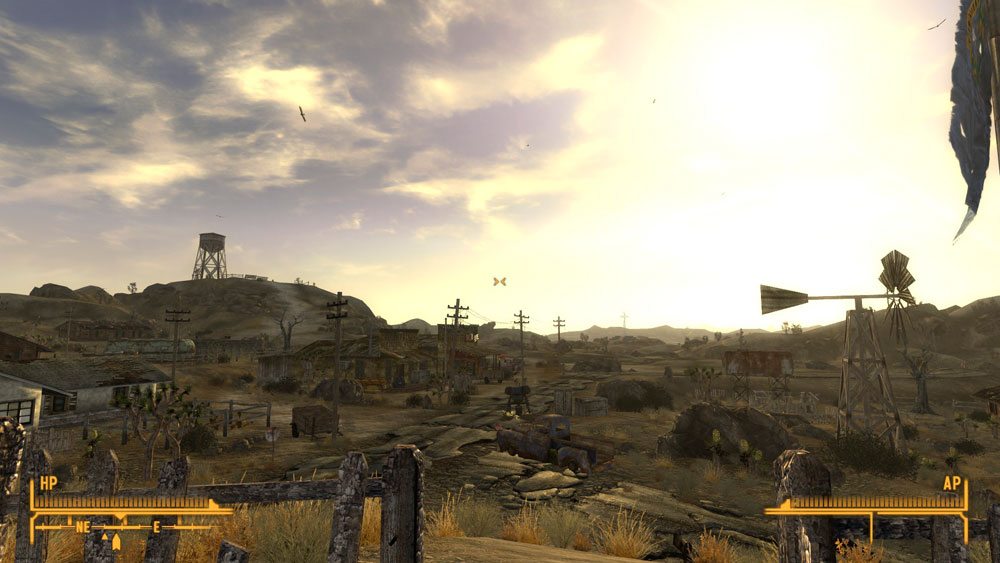
The ever-important first vista shot.
When I played Fallout 3, it completely revolutionized the series to me. A storied veteran of the original Fallout, Fallout 2, and Fallout Tactics, the idea of a first-person non-grid-based combat game filled me with dread. Would it feel like Fallout? Why turn this series into a FPS?
By the end of the first hour, my fears (and free time) melted away in the vast furnace of Fallout 3’s immersive, brilliant post-apocalyptic world. I had already played games like Oblivion, but it was not until Fallout 3 that I truly appreciated the depths in Bethesda games; the ability to just strike out and roam. While it lacked the brilliant storytelling of the prior games, I felt it made up for it in all the unspoken narratives of the world around you. Suffice it to say, Fallout 3 remains in my top 5 games of all time.
This is not, of course, a Fallout 3 review.
Fallout: New Vegas is a noble attempt at having it both ways: the exploration and the narrative. You start not as a fresh-faced Vault Dweller, but as a middling Courier, shot in the head in media res ala Uma Thurman in Kill Bill. And in typical narrative-driven fashion, your quest for revenge starts at Point A and leads inexorably to Point B.
This is roaming on rails, at least for the first few dozen hours, with the slightest deviation leading to certain death. Strike North from the starting city and you will face level 20 Giant Radscorpions. Stray too far West outside the plot-directed Southerly route and Super Ghouls will eat your face off. Cut through the mountains to the East and you will inexplicably face the Blind Deathclaw guarding the path, conveniently immune to the effects of even your Stealth Boy invisibility cloak.
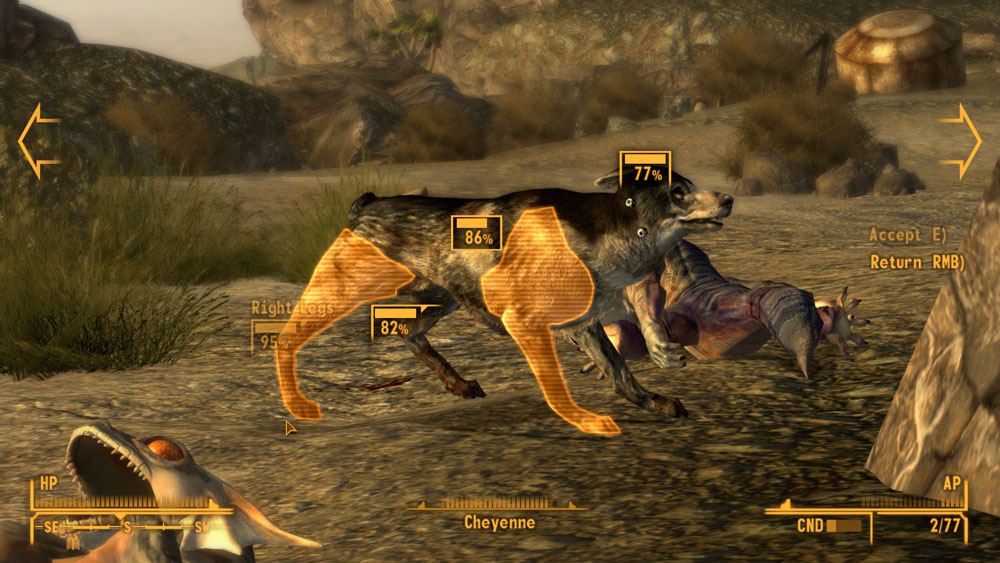
Decisions, decisions.
Between the visible fences of high-level monsters and being able to see New Vegas’s Lucky 38 tower from any vantage point in the game, F:NV starts off by feeling microscopic in comparison to Fallout 3. But a curious thing happens as you finally reach the Southern reaches of I-15 and turn East. “Tutorial Mode” over, the game suddenly opens up, blooming with hidden depth and density like some desert flower. There is still the highlighted yellow-brick plot road to follow, but you can actually strike out on your own at this point with less risk of instant death. I decided to plow my way to New Vegas proper at this point, stopping only at the various locations within sight along the way.
It ended up taking me over 40 hours just to reach the gates.
Combat in F:NV is more or less identical to Fallout 3: you can still treat the entire game as a normal FPS or you can pause the action in VATS mode to specifically target enemy extremities. Weapons skew a lot more towards traditional Spaghetti Western fare as befits the motif, but classic laser/plasma guns are not too far behind.
F:NV does feature some interesting innovations compared with its predecessor, including the use of Factions with mostly independent reputations. Don’t like the New California Republic? Join Caesar’s Legion. Or vice versa. Or screw them both and embrace Mr. House’s vision of the future. Or screw him too and embrace your own brand of justice. While the burgeoning complexities of the midgame collapses into an endgame constant, fundamentally the ending is one you can choose. Classic Fallout.
Well… mostly. While all of the set pieces are in place, including many of the same (recycled) posters last seen around the D.C. area, I could not help but feel that F:NV was… missing something. Something ephemeral, something intangible. F:NV is set in the same Fallout universe with the same people and the same post-apocalyptic problems. And perhaps that is what felt off. If this were the 1990s, F:NV would have been an expansion pack to Fallout 3, not a spiritual sequel.
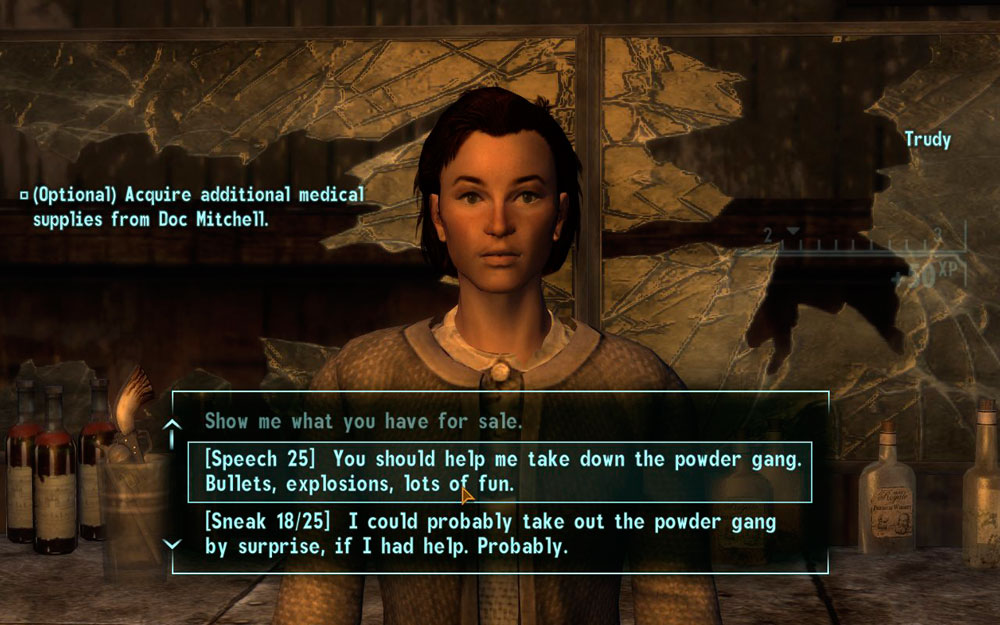
I do kinda miss the Fallout 1 & 2-style depth to responses.
Don’t get me wrong, there is more than enough to do in F:NV to justify its own existence. But it felt more like Fallout 3.5 than its own game. And yet, at the same time, F:NV feels like it didn’t have to be a Fallout game at all. Sure, there are Vaults and Nuka-Cola and Super Mutants aplenty. But the overarching narrative of revenge never felt personally compelling, and the coming clash between NCR and Caesar’s Legion seemed a digression. This game was Fallout when I was just wandering around, eager to scavenge what I can out of crumbling ruins I see just on the horizon. When I was the Courier just trying to make a final delivery for no particular reason? Not so much. The Platinum Chip is not too different from the Water Chip when it comes to plot McGuffins, but it felt different just the same. I wasn’t protecting my home, my family, nor was I my own person. I was… the Courier, a stranger in familiar skin, following a past everyone knows about but me.
Ultimately, Fallout: New Vegas is not Fallout 3. For some people, that will be a relief; for others, a deficiency. But it is important to keep in mind the scale of this particular comparison. I am pulling out the microscope and judging the relative merits of Mt. Everest versus the Grand Canyon. I am quantifying and comparing the love felt for a firstborn son with that for a granddaughter. Fallout: New Vegas cannot be fairly judged by a jury of its peers because it has no peers other than Fallout 3… and possibly Skyrim/Oblivion. So while I still feel that Fallout 3 is better than Fallout: New Vegas, the latter is better than damn near every other videogame I have played. I am being so critical not because Fallout: New Vegas is a bad game, but precisely because it is so good.
DLC
There are four main pieces of DLC for Fallout: New Vegas, although at this point they will all likely be bundled with any Game of the Year copy you will buy. Briefly though, I will describe them for posterity.
Honest Hearts: Technically speaking, this was my least favorite of the DLCs. Heading into the outskirts of New Caanan, the Courier gets to interact with Burning Man, the hitherto presumed-dead former leader of Caesar’s armies. While there is a main plot concerning the story of revenge/redemption, it simply does not flow too well, in my opinion. I never really cared about the plights of the tribes or the lands they occupied.
Conversely, the sort of understated plot line of “The Father in the Cave” revealed via in-game computer archives was one of the more poignant mini-narratives I have seen in Fallout, if not in games period. If you’ve chosen to never play F:NV (and are still reading this review for some reason), go read the transcript here; it is presented in the Wiki exactly as you see it in-game, aside from actually exploring some of the locations (and seeing the traps) mentioned in the text.
Outside of that, the Hearts DLC does feature a lot more plant materials for use in homemade stimpacks, and an abundance of clean drinking water for those doing a Hardcore run.
Old World Blues: Modeled on 1950s-era space dramas, I found this DLC to be exceptionally fun and funny both. The premises push the boundaries of believability even in the Fallout universe (your brain is scooped out right at the start), but after a while it ceases to be particularly relevant as you blast giant mechanical radscorpions and other ridiculous enemies. As a sort of bonus, by the end of the DLC you essentially receive a remote mountain base with all sorts of crafting stations and other amenities that you can teleport to at any time.
Dead Money: While this DLC opens up with my least favorite gaming trope – the sort of Metroid-esque “remove all your gear” mechanic – it does sort of ratchet up the tension and make the rest of the storyline work. Collared with explosives, you are forced to try and open up a vault underneath one of the few surviving casinos outside of the New Vegas area. The limited weapon selection and deadly dust clouds skews the DLC more towards survival-horror than Fallout sidequest, but I was pleased with the plot, imagery, and ultimate payoff.
Lonesome Road: Out of the four, this DLC most fits the narrative of the game proper. I felt it a smidge too linear for my liking (although not as linear as Dead Money) and a bit too ridiculous in other places (trigger nuclear bombs to move wooden debris out of your way, what?), but out of the four this most fit the tone of Fallout games.
Unfair Impressions: Darkfall, Final (?)
I was not sure there was going to be a Day 3 to this series. Hell, Day 2 came as a complete surprise for that matter. My default expression in life is “Impress me,” to which Darkfall just laughs. “Okay, show me what you have to offer.” “Show yourself.” There is an inherent nobility to that uncompromising sentiment, a sense that all the other games out there selling themselves are, indeed, engaging in prostitution. Darkfall instead has the purity of your back yard, with the creek your mother told you to stay away from. No one gave you a quest to turn over rocks to see what lied beneath them; you just did it because you were there, and hey look at that weird bug, I wonder what happens when I… eww.
Sorry, sometimes I get carried away with my own bullshit.

#MMOLogic
In truth, I continued playing Darkfall because I was interested in how onerous it would be to make arrows for my Skirmisher. The spiders never dropped any coin, the vendors were asking for 30+ crafting mats for 1g, and my initial try at crafting wooden planks left me with not enough gold to purchase a pick axe to mine the requisite stone for arrowheads. Considering my character was ostensibly an archer, would the game allow me to run out of arrows?
Of course it would.
I abandoned the spider spawns, and tried the other starter monster spawn location. It too was farmed out; in fact, I don’t even know what mobs spawn there as none lived long enough for me to point at them. From the map, I noticed some ruins off to the west. If there’s ruins, there’s monsters. Sure enough, it was zombie spawn city.
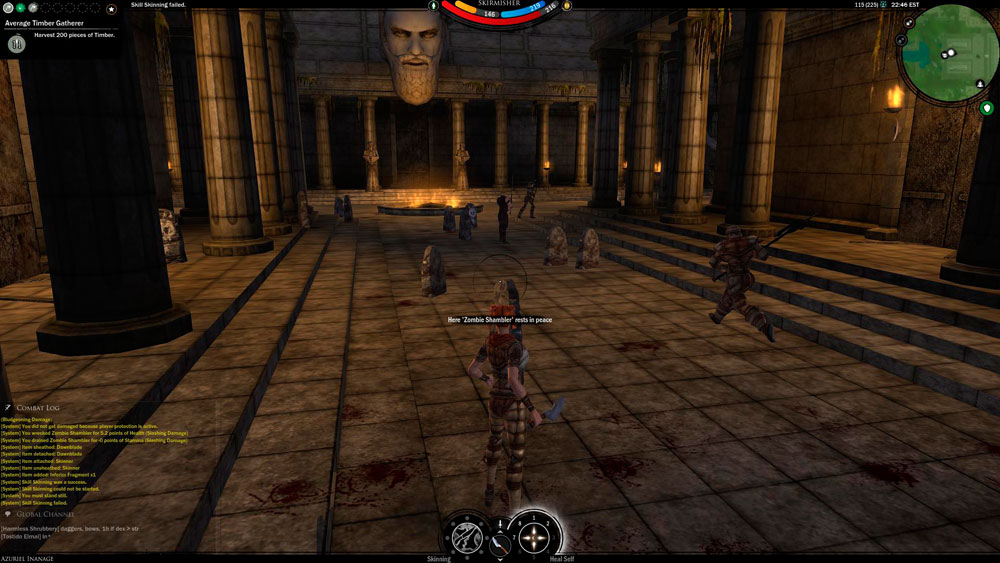
My potential future. Kill me now.
While I sat on the fringes watching characters in clearly superior gear farming through the zombies like butter, it occurred to me that there is a distinction between sandboxes that few ever make. There is the sandbox in which you perform repetitive actions in order to have fun later, and there are the ones in which you have fun doing fun things that leads to more fun later. Darkfall, to me, is the former; Minecraft would be the latter. And the funny thing is that the former doesn’t sound all that different from what I was required to do in WoW.
The zombies that trickled past the farmers did end up dropping hard currency – around 1-3g every 5-10 mobs. Examining the pleasure I felt when I walked away with 22g at the end of the farming excursion was a sobering experience. There were likely better spots for gold farming, even in the protected newbie zones, but it was a glimpse back into the churning abyss of a grind without end. Work hard today so you can have fun later, as opposed to having fun… having fun.
In any case, I remain pleased that I gave Darkfall the ole college try. Every time I read Syncaine’s latest post about ganking a dude and stealing all his stuff (and his boat), or about how he AFK farmed while writing the post, I can visualize what exactly all those shenanigans looked like. And then realize that game he and others are playing exists primarily in their own minds.
Which isn’t a bad thing, of course. It’s just not my thing.
Review: Spec Ops: The Line
Game: Spec Ops: The Line
Recommended price: $10
Metacritic Score: 76
Completion Time: 6 hours
Buy If You Like: Kane & Lynch-esque cover-based military shooters
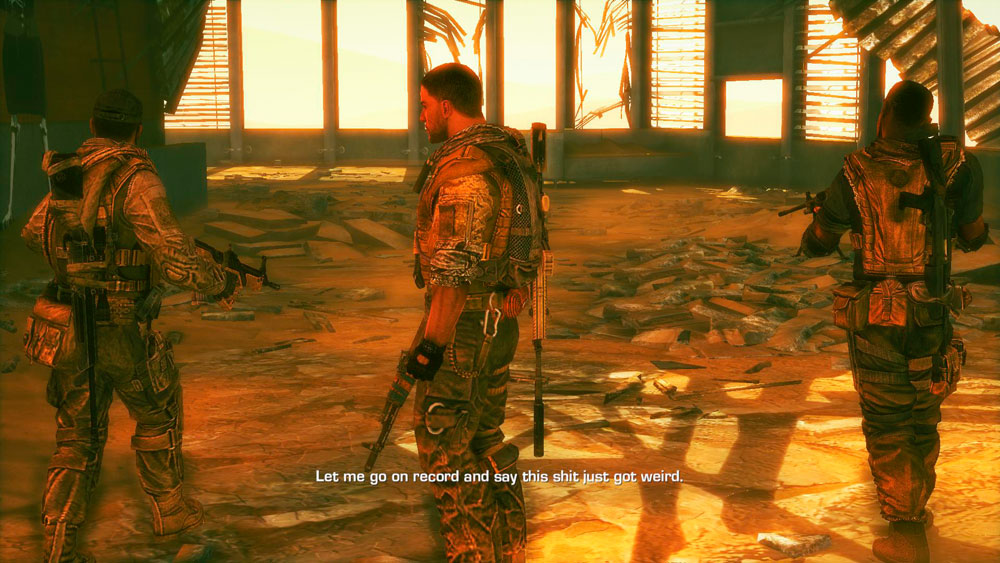
You said it, Lugo.
Spec Ops: The Line is an over-the-shoulder cover-based military shooter that seeks to subvert the tropes of its genre. You control Captain Adams, tasked with commanding your two Delta Force squad mates in search for what happened to Colonel Konrad and the rest of the 33rd Battalion. The search leads them into the ruined city of Dubai, which appears to have devolved into anarchy after a series of epic sandstorms cut it off from the rest of the world.
After killing some insurgents whom had taken members of the 33rd hostage, the mission starts to go pear-shaped when the very soldiers you are trying to save confuse your team for CIA operatives who have been riling up the insurgents. From there, things just keep getting darker and darker as you continue taking completely rational steps towards a line you did not realize you already crossed hours ago.
I was interested to play Spec Ops precisely because I heard about its subversive themes. What I discovered though, is that I have seen this all before in Far Cry 2 and Kane & Lynch 2: Dog Days. In fact, Kane & Lynch is the perfect analog here despite approaching from the opposite side of the legal spectrum: both games are over-the-shoulder cover-based shooters whose scenarios start off as reasonable before relentlessly veering into the absurd. What seems like a natural progression or escalation of violence suddenly sickens you once you realize what exactly you are doing. How did I go from killing insurgents to killing Americans? Why am I looking forward to the next cover-strewn environment so I can use my grenade launcher to kill even more soldiers?
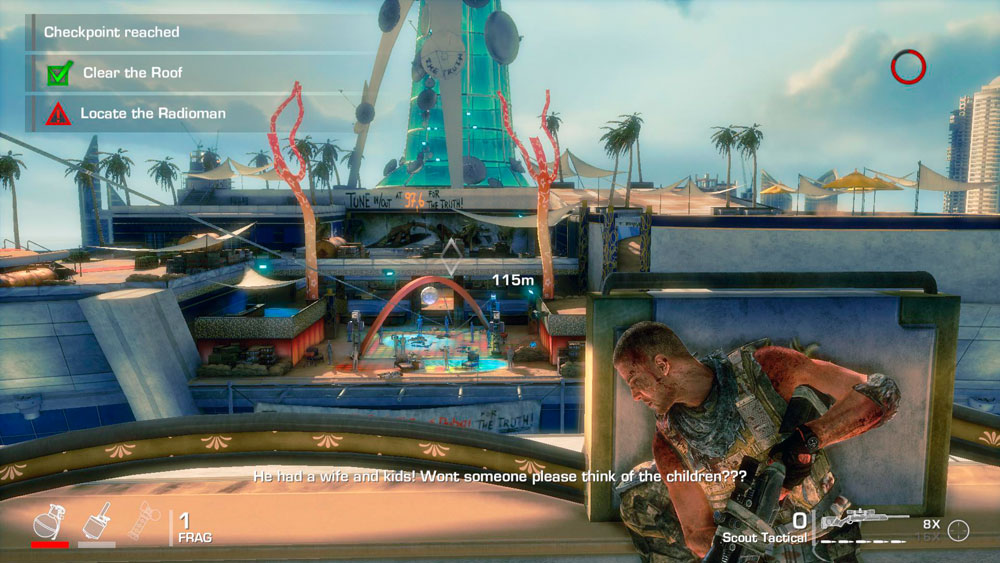
This joke never gets old.
The eponymous “Line” referred in the game title probably refers to one specific incident (that I won’t spoil), given how long it was dwelt upon, but I personally found it curiously ineffectual. At first, I didn’t even realize that my actions caused the incident in question, and even after I wasn’t particularly convinced player agency was involved. In spite of that, the game does a great job in fostering a sense of nihilistic fatalism. The situation becomes so FUBAR that it almost doesn’t matter what else you do at that point. And then you, the human player behind the screen, start to realize what that means for soldiers in real situations out in the world.
I am sympathetic to the argument that perhaps some reviewers give Spec Ops: the Line too much credit. While the gameplay doesn’t noticeably change, I absolutely felt fatigued by the end of the six hour story campaign. Construing that fatigue and feeling of pointlessness as being intentional artistic designs, might be a little too clever an excuse to take seriously; it sort of hand-waves away any possibility of bad game design, and feels a bit too convenient besides. If you are willing to give the designers the benefit of the doubt though, it is certainly an effective plot mechanism… just as it was in Far Cry 2 and Kane & Lynch.
Ultimately, I feel Spec Ops: the Line as an experience is worth a bit more than my usual limit for these shorter games. The visuals are amazing, the interaction with your squad is superb, and the setting is both unique and artistic. You might feel drained and depressed by the end, but at least you felt something – a feeling that might actually persist beyond turning the system off. Which is more than I can say for a lot of the games I have played.
Unfair Impressions: Darkfall, Day 2
I felt like the screenshots were not enough to fully immerse you in the world of Darkfall. So here is a video of me attacking some spiders. Don’t forget to switch to 1080p quality!
In terms of the tutorial, I finally realized why I was stuck on the “skinning” portion. While you can loot leather from the glowing gravestones, if you have a skinning knife you can also skin… the gravestones. Because that makes sense. The failure rate seems ridiculously high, but eventually I loot one.
The next step is to hearth to your bindstone, which I did exactly two minutes later. Literally, guys, it’s a 120-second cast. I started it up and left to make my lunch for the next day.
This actually reminds me of another curious thing: AFK-farming seems encouraged in Darkfall. Much like in Guild Wars 2, you must buy a logging axe or herbing sickle in order to gather materials, and these items have charges (durability in this case) that deplete on use. The difference here is that you can start up the animation in Darkfall and walk away from the keyboard – your character will merrily continue chopping timber until (presumably) the axe is worn down to the nub or the tree runs out of wood. It reminds me of what I have heard about mining space rocks in EVE, insofar as gathering only requires button presses once every half-hour. Is that supposed to discourage people from farming, or a concession that farming is so boring the game will do it for you while you Tab out and play something more engaging?
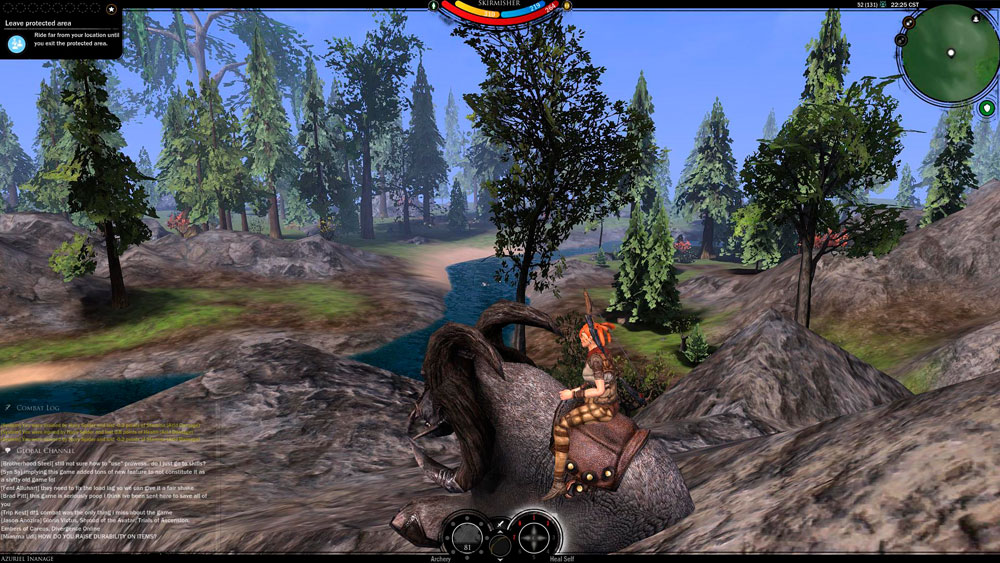
At the Southern FFA border.
In any event, the next stage of the tutorial was taking a 100kg (!) mount idol from the bank and summoning a mount. From there, you are tasked to running to the border of the protected area, sticking your toe over, and then coming back inside. Ah… so I was paranoid for no reason this entire time. Well, sorta. Apparently if you aren’t careful, people can actually steal your mount and ride away. After which I assume you are shit outta luck. Considering that unsummoning the mount takes a minimum of 2 seconds after dismounting, you’ll never want to actually be in town riding the thing.
After much squinting at the abysmal UI, I finally found and dabbled with the Prowess system. Essentially, you earn Prowess doing things, doing a certain number of things (Feats), and presumably other ways too. Prowess essentially act as skill points you use to upgrade skills, increase your ability scores (Strength, Dexterity, etc), and so on. Most skills start a 1 and can be increased up to 100 with an increasingly harsh cost ratio (1:1 up to ~25, then 2:1, etc); each upgrade level typically improves cast speed plus some miscellaneous qualities by some percentage. As an example, putting points into Archery lets me fire faster and deal more damage per arrow, whereas Mining let’s me increase my AFK-yield.
That all makes sense, but I was taken aback a bit from the “Boosts”. At first, I was thinking they were F2P-esque boosts, but that does not appear to be the case.
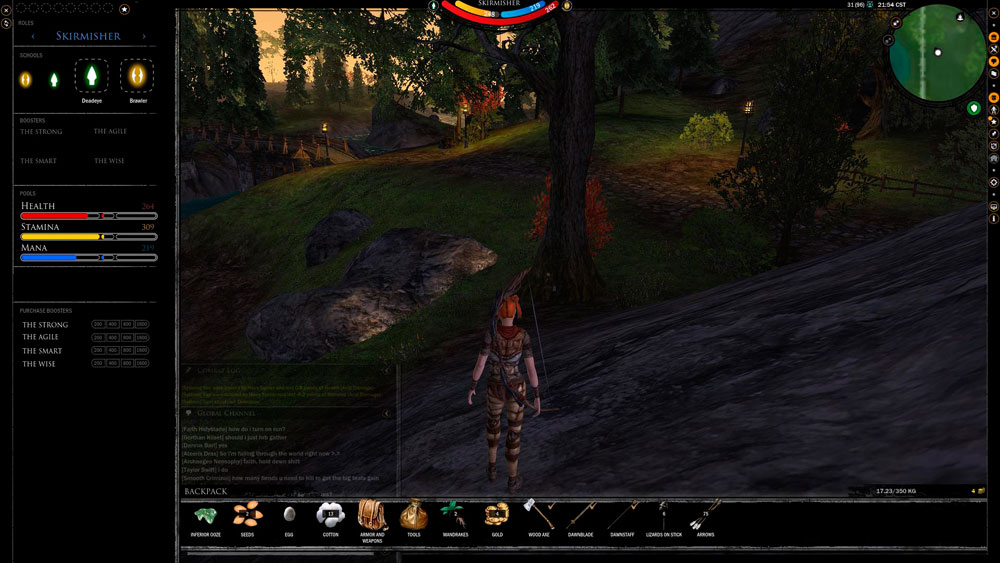
Ha ha, we got you good.
Instead, they are… err. Well, you can buy the first rank of “the Agile” boost for 200 Prowess, and it increases Dexterity by +10 and the Stamina by +37. Considering that manually boosting Dexterity by +1 costs 30 Prowess, I don’t actually know the point of boosts in this context other than a designer “Gotcha!” moment. I mean, I suppose that it is a way to quickly achieve your class’s optimum stats while still offering a Prowess sink for long-term players (e.g. Warrior dumping extra Prowess into Intelligence once everything warrior-y is bought).
If there is a third day of playing Darkfall in my future, my goal is to figure out the crafting side of things. I understand the basics, but I’m a little uncertain about how one actually goes about getting hard currency; considering that crafting consumes gold as well as mats, you have to have a baseline of income from somewhere. None of the mobs I have killed dropped gold thus far. Does it all come from vendoring goods? There are no “quests” of course, and there doesn’t appear to be an AH either.
So… yeah. Darkfall.
Unfair Impressions: Darkfall: Unholy Alliance
That’s right, ladies and gentlemen. You know you are batting in the Big Leagues when you can bamboozle people into believing you are a member of the Press™ despite running a blog that is barely eking out Google pagerank from an Amazon book review and a bioterrorism article written in 2004 that happened to use the phrase “in an age” in the title. I suppose that this is sort of the gaming blogger dream though, wherein people send you free things and you write about them; instead of, you know, the standard procedure of having to purchase things to write about, like some kind of animal.
Whatever the case, Aventurine has inexplicably included me on their Press mailing list for Darkfall: Unholy Wars, and I am now entitled to the game itself along with 30 days of Press™ subscription for free. Rather than allow this inevitably comical misadventure go to waste, I downloaded and patched the game last Wednesday night.
It is worth noting why this post is labeled “Unfair Impressions”: basically, I have zero interest in Darkfall: UW. In fact, I would say less than zero interest. The sum total of what I know about Darkfall is that it is a full-loot FFA PvP game that some say is the most skillful MMO out there. They also say it’s terrible playing by yourself. Fantastic. Let me wander around, lost and confused, as I endeavor to stay as far away from other people as humanly possible.
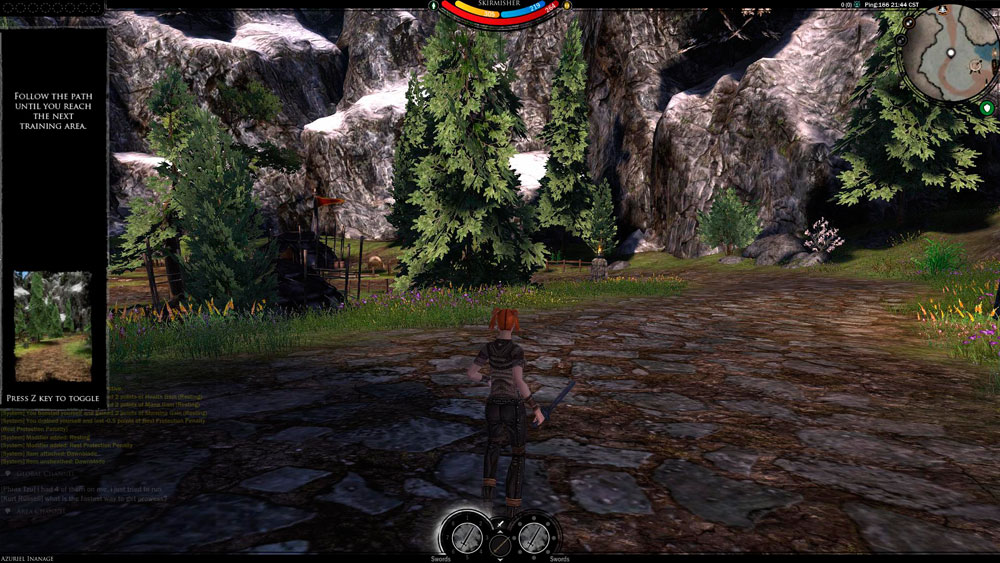
Well… they got the 2004 look down, at least.
Okay, I’m not going to mention how godawful ugly this game is. Not even once. The screenshots really speak or themselves. And as far as I’m aware, my settings are dialed to the max.
I am in the first town. I’m pretty sure this area is still a sanctuary, but I’m nervous about accidentally left-clicking someone. Okay, let’s follow the tutorial. “Buy an axe.” Alright, let’s see…

Way to maximize useless screen-space.
…good god, is this the vendor interface?
Alright, nevermind, let’s go out to a monster spawn.
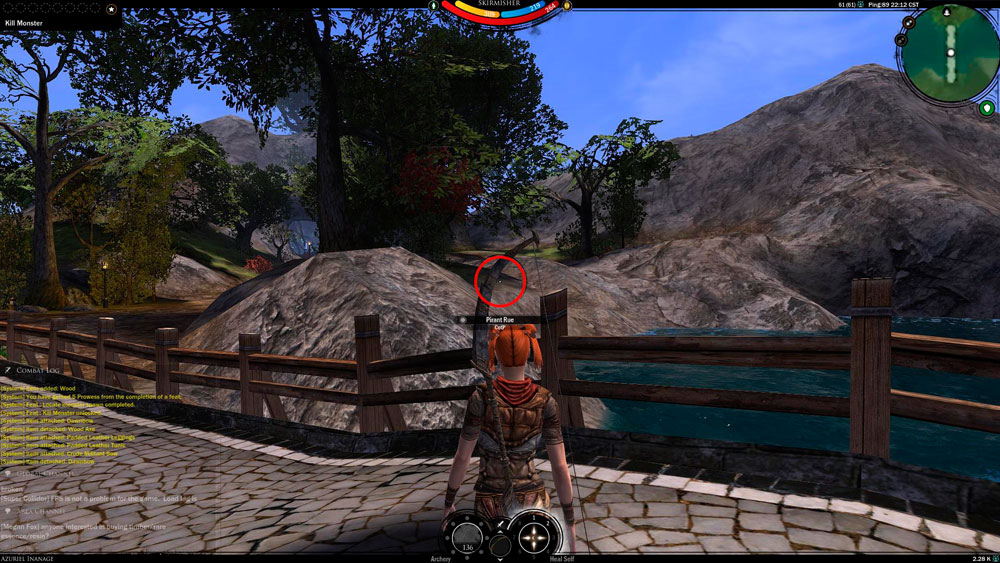
Trust no one.
Halfway across the bridge, I notice a dude standing around. Is he a ganker, waiting for me to cross into no man’s land? Is he AFK? Can I gank him? It seems like a trap, so I shuffle away and swim into the river. My default strategy when I feel threatened is to make killing me as annoying as possible. Not that it ever stops anyone, but I derive the same satisfaction I imagine a puffer fish feels when swallowed by… whatever it is that chokes on a puffer fish before dying to its poisonous organs.

Don’t mind me. Please.
Monster spawn time. Cave spiders. I… think they shoot poison at me, but it is hard to tell. There are 4-5 people in the cave killing spiders already. Do they know each other? Is this zone still protected? I give everyone a wide berth and hang out in the cobwebs. I kill a spider and loot its tombstone. Leather. Spider… leather? But wait, my little achievement tutorial thing says I must skin the tombstone. But I already have… or have I? Okay, let’s kill another spider. Except another doesn’t spawn in my area, and now there are more people in the cave and it’s late and I want to play something else.
Alright… how do I log off? I binded myself to a stone in town, so maybe I can hearth back? After searching the painfully bad UI, I see the option. I click on the button and… wait. Still waiting. I get that it would be too easy to escape a ganking if it were quicker, but a full 120-second hearth timer?
Good lord, maybe this was a bad idea.
No Good Deed Goes Unpunished
In a game with morality choices, would you choose the Good options if the results were often worse?
Most of the games I can think of that had moral choices ended up rewarding you the most if you chose the Good options. In Bioshock, for example, you could either “harvest” the Little Sisters for extra upgrade currency, or you could Cleanse them for a smaller reward. As it turns out though, if you end up Cleansing the Little Sisters they would start dropping off care packages containing ammo and extra upgrade currency, such that you might even come out ahead by going the Good route. The choice also ends up reflecting the tone of the ending, but it luckily skews towards Evil Ending rather than Bad Ending per se.
In thinking back to Bioshock, I started wondering if I would have been more inclined to harvest the Little Sisters if they did not “sweeten the deal” with the gift baskets later. I would like to say “No,” but I also feel like the “Pick the Good option and get bigger reward later” is such a ingrained gaming trope that I am beginning to question which inclination came first. Would the promise of a “better” ending be incentive enough to make Good choices, even if the game proper was made more difficult thereby?
Or to go all the way: what if the only reward of a Good choice in a game was the personal satisfaction of having done the right thing? In other words, what if the player was punished in some way for choosing the moral thing to do? An example could be sparing a bad guy, only to have them return and kill an NPC teammate later. Would the average gamer behavior change? Would the moral players feel better about their choices, or worse?
Sometimes I feel like I want to be a game designer just to screw with people.
Got Ghostcrawler on Speed-dial
Right after yesterday’s complaints, the following notes go up:
- Experience needed to increase from level 85 to level 90 has been reduced by 33%.
- Reduced the number of Lesser Charms of Good Fortune needed for the Mogu Runes of Fate weekly quest to 50, down from 90.
- Players no longer need to have defeated Grand Empress Shek’zeer to enter the Terrace of Endless Spring in Normal difficulty.
- Shado-Pan and The August Celestials daily quests no longer have a faction prerequisite to be Revered with the Golden Lotus.
Technically, the last one has been in there a while, if you haven’t noticed before.
Anyway, nice try, Ghostcrawler, but it’s too little, too late for me. Maybe when the next expansion is 50% off, I’ll dip my toe in again like I did this last time. Then again, maybe not.
 In An Age
Ouch. WoW down another 1.3 million
May 9
Posted by Azuriel
As reported by MMO-Champion, the subscriber total was 8.3 million at the end of the quarter, a loss of 1.3 million subs since Q4 (which had its own 400k loss). For those keeping track at home, Blizzard had 9.1 million subs back on August 3rd, 2012, during an eight-month lull of zero content at the end of Cataclysm, i.e. pre-Mists of Pandaria. That is a net loss of 800k this expansion – with a 1.5 million sub rollercoaster in the middle – and the lowest subscriber count WoW has had since 2007.
By the way, RIP to MMOData.net, which has not made an update in nearly nine months now. How can we pontificate without graphs? Sigh.
I went and signed up to listen to the investor report as there was not a transcript available, wondering where MMO-Champ got the rest of those bullet points. Plus, you know, Press™:
Nothing could go wrong with this.
To save yourself 38 minutes, just trust me when I confirm MMO-Champ got all the relevant information.
What did interest me though was hearing how ultra-conservative Activision Blizzard is. I mean, that sort of thing isn’t a particular trade secret, but when Bobby Kotick explained that the company wasn’t interested in the mobile sphere because the Top 10 titles change every year, I cocked an eyebrow. Call of Duty and WoW still have a lot of viable milking years ahead of them, but this is the same company that gushed about their $1 billion Skylanders franchise that didn’t even exist two years ago. If CoD: Ghost ends up pulling a Warfighter along with the further expected losses (their words) in WoW subs, you can almost imagine a scenario in which they conserve themselves right off a cliff by the end of this year.
But, alas, the money machines continue unabated.
Finally, I sort of chuckled at this part of the WoW presentation:
Well… yeah. What did they imagine would happen when you release
one ofthe most alt-unfriendly expansion in the history of the game? And then proceed to put everything behind a triple-gate of dailies and rep, all but remove leveling dungeons (only to put them back), and then essentially stop all production of 5m dungeons for the rest of the expansion? Oh, and don’t get me started on the continued embarrassment of no-pop servers languishing.At this point, all I’m really interested in is Hearthstone (as hopefully a cheaper Magic: Online) and maybe Bungie’s new game; Titan has been too much of a cocktease for too long to even get a rise out of me anymore. Otherwise Activision-Blizzard might join the ranks of EA as a big-budget publisher who only produces one title that I am remotely interested in, with all the “risky” indie ventures soaking up the money I leave on the table.
And as Doone points out, that’s probably the best thing for everyone involved.
Posted in Commentary
10 Comments
Tags: Activision, Blizzard, Hearthstone, Investor Report, Loss, Mists of Pandaria, MMO-Champion, MMOData.net, Press, Skylanders, Subscription, ultra-conservative