Author Archives: Azuriel
Dragon Age Online
After around 20 hours of Dragon Age Inquisition, I am more convinced than ever that this is all an elaborate beta testing of the inevitable MMO sequel. Seeing other Heralds running around and closing rifts would not at all have seemed out of place. Hell, there are already dungeons, bosses, grouping, abilities with cooldowns, action combat, mining and herb gathering every 5 feet, crafting, gear upgrades, something approximating reputation meters, companions, mounts, talent trees, and repeatable/grindy quests.
After 20 hours, I am also convinced I am playing this game all wrong. Witness:

Do all the things.
Basically, I have 4 Inquisition perks, 67 “Power,” and hit level 10… all before recruiting another party member beyond the default ones. No, I did not stay entirely within the Hinterlands; I simply did most of everything aside from the Main Plot that naturally unlocked as I leveled up. If they didn’t want me completing the swamp zone until after the first major encounter with the Chantry, perhaps they should have made the enemies stronger.
Or… maybe they did, and I didn’t notice because I’m goddamn level 10. Oops.
Although I have clearly screwed the game up for myself this way, I am not entirely convinced it is my fault. The genre in general – and Dragon Age in particular – is fond of having plot progression tied to permanently closing areas and eliminating quests. Which isn’t necessarily a bad thing in of itself, but if I am always paranoid that this particular foray into Zone X might be the last chance I have to acquire Something Something Y, you can bet I am going to do all the things.
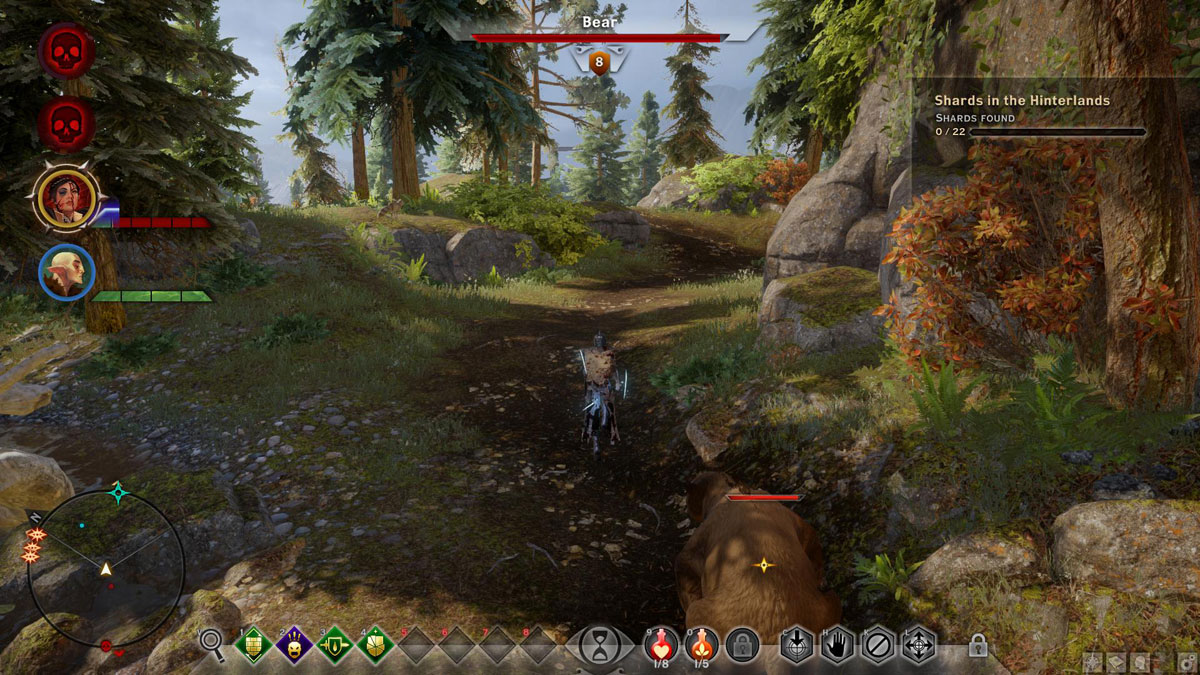
At least I’ll never have to run away from bears again.
It is one of those unfortunate Design Catch-22s wherein you give the player a variety of activities to complete (in case they don’t like a particular kind) and then the player ends up doing everything. What’s the real alternative though? Only having a very limited selection of quests? Relying on a player’s self-control to move on from an area simply because one has become a god amongst men?
Hah! We’re MMO players: we pay by the month for the privilege of performing pointless activities.
In any case, an hour or two after I took that screenshot I advanced the plot by one degree and suddenly recruited four new party members. I am guessing that there is still one more out there somewhere, if only because my total party is otherwise mirror images of each other: male/female shield warrior, male/female mage, male/female ranged rogue, and then just male 2H warrior. Perhaps it will be a melee rogue, just to shake up the symmetry.
I’ll find out eventually, I suspect. Just as soon as I feel like advancing the plot one more degree. In the meantime, I got some more shards to find.
Pay2Winside 2
According to Steam, I have not played Planetside 2 in over a month. There are a number of reasons for this, but the bottom line is that it has gotten increasingly bad for “drop in, shoot faces” kind of gameplay, which is what I have spent the prior 433 hours doing. Maybe it would be more entertaining in a Platoon (i.e. guild), but if I wanted social obligation, I would be playing WoW. Besides, I’m not entirely convinced that Platoon-play is all that fun given that the “metagame” in PS2 mainly revolves around either zerging occupied bases or babysitting empty ones. If you want to shoot faces, you are literally better off finding the WoW equivalent of “Blacksmith Bridge” in Arathi Basin by yourself.
What completely astounds me however is how tone-deaf the developers are.
Implants were introduced into PS2 a while ago, and they represent an extra loadout choice slash gear progression avenue. You get them randomly whenever you earn XP, they require energy to power (something like 0.5/second for the low-level ones), you earn Energy Chargers the same way, and finally you can combine 5 of the same Tier N Implant to get a random Tier N+1 Implant. Or you could buy random Implants or Chargers with in-game Certs or Station Cash. Cue ominous foreshadowing.
Up until a little while ago, Tier 3 Implants were as high as things went. Then Tier 4 Implants were introduced. Then everything below Tier 4 was nerfed to make Tier 4 viable. Then the drop-rate for those random Implants (and Chargers) you get free via XP were slashed. Given how the Implants actually give you some legitimately quantifiable gameplay advantages, players started questioning SOE about P2W concerns. The response?
But perhaps you want to give Smedley the benefit of the doubt. Then mosey on over to this Reddit thread:
No I don’t believe I said that [Implants are big money makers]. They do make money but we’re continuing to make adjustments to improve that. (Radar_X)
So we should expect a bigger P2W experience?
Should probably just uninstall PS2 now. (Twinki)
Depends on how you define P2W. If implants are P2W, then yes you may not like everything in the future. (Radar_X)
Oh good.
On the one hand, I understand that they have to keep the lights on and all that. On the other hand… yeah, no thanks. I very nearly bought another $15 Station Cash card at Walmart because it seemed as though SOE was actually going to have a Triple Station Cash sale this past Christmas. Since the Walmart card has an extra 500 SC on it, it ends up being $60 worth of currency for $15. Then I realized that the only SOE title I actually care about beyond PS2 was H1Z1, which… well, yeah. Given how far PS2 is going to “keep the lights on,” I am beginning to doubt the promises that H1Z1 won’t be selling guns and/or survival tools in the store.
I suppose we’ll have to wait and see sometime after SOE stops selling Early Access for $20.
End of Year
Looking back in the archives, it does not appear that I have any sort of New Years tradition, be it predictions or year-end reviews. I don’t see any particular reason to start now. Happy New Year!
…
…okay, I’ll write a little more.
Currently playing Dragon Age: Inquisition, at around 40 FPS on a good day. The overclocking worked for 5-8 FPS, which sounds small, but makes a big difference going from 35 to 40. There were a few moments of glorious 60 FPS when I wasn’t overlooking vistas and such, so I may chase that dragon at the expense of plastic hair or whatever people complained about at certain graphic settings.
One thing this year has heralded the end of, at least in my mind, is the tyranny of Steam sales. Between Humble Bundles, Amazon price-matching, insane GreenManGaming discounts, and general aggregators like IsThereAnyDeal.com, the best deals are generally not on Steam. This point was hammered home a few weeks ago when I realized taking advantage of cheap Steam dollars actually limited my options – almost to the point that I might end up paying more.
In the 11th hour though, Steam finally delivered some historic lows prices for the following:
- Transistor
- The Long Dark
- The Forest
- Child of Light
- Wasteland 2
- The Banner Saga
Two of those are Early Access games and both are sandbox roguelikes at that, but I enjoyed Don’t Starve so… yeah. Perhaps by the time I get around to playing The Long Dark and The Forest, the full games will be out. There were two games I eyed but did not pull the trigger on: Divinity: Original Sin and Wolfenstein. The Steam discounts of both were above historic lows, so I figure I can keep waiting a bit longer for them to fall deeper into discounts. It isn’t as though I’m hurting for games, right?
And that’s about it. In 2015 I anticipate coming back into WoW for at least a brief period of time; longer depending on if Blizzard goes forward with WoW PLEX, and what price gold price it ends up settling on. If the going rate for time-codes is 20,000g, it would be difficult to argue against buying the expansion and immediately buying 20 months of playtime. Even if I do not end playing that long, it would be a good hedge against inflation to keep gold locked up in time-codes (assuming the codes do not decay). You can take the goblin out of the AH, but you can’t… something something.
Beyond that, we will have to see what catches my eye.
Falling Behind the Curve
As you may have noticed in the sidebar and/or prior post, I have picked up Dragon Age: Inquisition. I have not played it as much as I should have been however, because it is the first PC game in which I’ve ran into a hardware wall.
I am still strategically turning settings down, but I’m talking about Medium settings and getting maybe 40 FPS on a good day. Yesterday, my gaming session was cut short by the game randomly diving down to a literal 4 FPS level every 30 seconds. I “solved” that issue by spending a long time on Youtube weeding through arcane practices, many of which sounded suspiciously similar to “blow on the dice to make them roll high” from D&D players. One of the suggestions was to turn off FRAPS and other FPS counters; I was, of course, unable to ascertain whether it actually worked or if things ran better because I was unable to actually tell how bad it was running.
In any of these sort of situations, I come back to my experience with Skyrim. Basically, if your game doesn’t look as good as Skyrim on my machine, that’s your fault. Perhaps it’s not entirely fair to have that as a benchmark – I do notice a lot more NPCs milling about in Inquisition – but I still end up questioning whether my rig is truly outdated or if the designers got lazy with the PC optimization.
Regardless, my Inquisition FPS woes motivated me to start looking at weak points in my gaming rig:
- i5-2500K Processor (4x 3.30GHz/6MB L3 Cache)
- 8 GB [4 GB X2] DDR3-1600
- NVIDIA GeForce GTX 560 Ti – 1GB – EVGA Superclocked – Core: 900MHz
Now, I’ve heard a lot of people talk about getting GTX 970 cards recently, so I figured that my ole 560ti might finally have been gotten to its obsolescence phase. On the other hand, I am not about to spend $300+ on a new graphics card either. What I want slash need is a way of determining the price points of various GTX cards in terms that I can understand.
For example, while I like this chart, it doesn’t really tell me much:

Again with the numbers.
Actually, the chart did tell me quite a bit, as I was very seriously considering the GTX 750ti because bigger numbers equals better, right? I would have been quite pissed at that $100+ purchase for the tiniest of gains, let me tell you. But off-hand, I have no idea what 20,000 more… units translates into FPS terms. Eyeballing PCPartPicker.com shows that a 760 costs $170, the 770 is $260, and the 780 sits at $283. Which is a little weird considering the performance increase on the chart, and the fact that the rest of the 780s on the list are north of $400, above even the the 970s.
What ended up further confusing me is the fact that YouTube videos like this one exist. For the click averse, the title is “Battlefield Hardline ULTRA SETTINGS – NVIDIA GeForce GTX 560TI 1GB DDR5 @ AMD A-10 6800k 4.30Ghz.” And it looks like it runs okay, although there is no framerate counter in the corner. So… what gives? I’m pretty sure I wasn’t playing BF4 on Ultra on my rig. I think the person might have been playing at a lower resolution than 1920×1080, but would that make that big of a difference? I’m pretty used to 1080p at this point though, and am not sure I want to give it up even if it magically fixed all my problems.
From my research on the processor side of things, I have heard that the i5-2500K is still pretty pimp as far as things go. I did verify the speed at 3.3ghz, which means it has not been overclocked. I basically know nothing about overclocking other than what I have read on the internet, so I’m not sure whether that is an avenue worth exploring versus the risk of my machine bursting into flame. Then again, it is liquid cooled, so… yeah.
What this post boils down to is this: I’m open to any suggestions. It could be Inquisition settings, GTX card comparisons (I’m sticking with Nvidia), overclocking guides if that would actually help, and so on. As it stands, it’s still early enough in Inquisition that I likely won’t miss much by turning down settings before I get too invested in my characters actually looking good, but I’d prefer that they do. I mean, come on, Far Cry 3 and Tomb Raider and Titanfall looked fucking fantastic. Why can’t Inquisition? Bah.
[Fake Edit]: I did end up finding this site that compared Inquisition FPS on Ultra settings across multiple cards. The short version is that the 760 gets 30, 770 has 39, and the 780 hits 45. The 750ti is the closest equivalent to my own card, and it eked out 22 FPS. Which, let me tell you, is not indicative of in-game FPS at all at Ultra settings. Still, at least I have some sense of scale now. Will I spend hundreds of dollars on a new card to get 8 more frames per second? Well, I don’t actually need Ultra settings, so hopefully that 8 multiplies out a bit on, you know, High settings or whatever.
WoW PLEX, pt 2
In the comments on the last post, Kring took me to task a bit for not delving deeper into the sort of game design considerations regarding WoW’s impending (?) PLEX introduction. Part of the reason I didn’t was because how it impacts me in pretty fundamental: it introduces dollar signs into my gameplay. Whether the concept or implementation of PLEX itself fits WoW is immaterial to me – it could be the best thing ever done in the history of the game… and I’m still going to be calculating my repair costs and AH cuts in USD.
That’s my own neurosis though, so perhaps it’d be interesting to look at the broader picture.
Who is WoW PLEX for?
Kring suggests the following:
Blizzard has problems to gain new players. I’m sure that if you can tell LoL players that “good player can play WoW for free” that has some appeal. And I think that’s their primary goal. To spread the news that “WoW is F2P for good player”. Which means PLEX must stay in a reasonable range, they don’t want “good player” to complain that it is “too expensive”.
Here we have the first question. Who is the player base which Blizzard thinks will constantly buy PLEX for Euro to sell it for gold?
The real answer to this question is pretty simple: WoW PLEX is for the tens of thousands of players currently purchasing from illicit gold sellers every month. And that is probably the extent to which Blizzard has thought about PLEX being utilized. We saw this exact same line of reasoning single-handedly birth the abomination that is was the Diablo 3 AH, and I have little reason to believe there is some deeper design significance going on. WoW PLEX is solely to combat illicit RMT.
While there may be X number of AH barons who will be able to PLEX their accounts year-round, I do not suspect it will be the norm for them, let alone the average person.
Are there enough gold sinks in WoW?
Second, I have my doubts that WoW at the moment has big enough gold sinks to keep enough player interested to buy PLEX with Euro and sell it for gold. PLEX will be consumed on a monthly basis, which means they must also be supplied on a monthly basis.
I think WoW must be changed to add gold sinks. New huge gold sinks. And they must hurt the players which Blizzard intends to sell PLEX for Euro in the future.
Four words: Black Market Auction House:
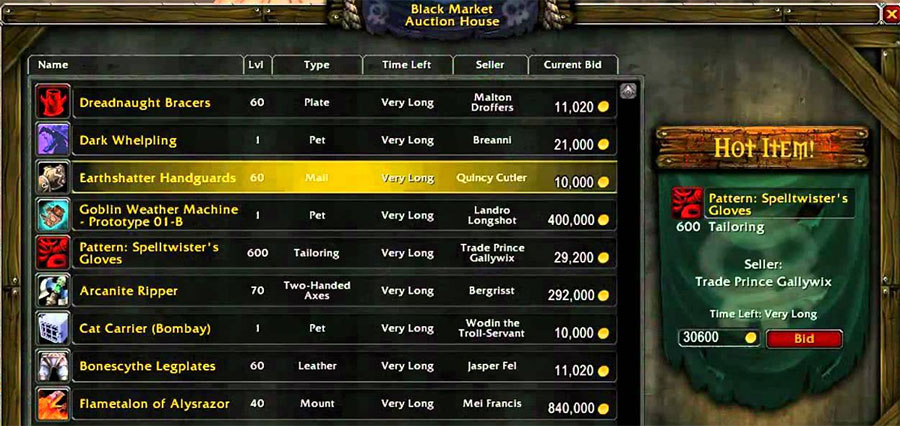
The Mariana Trench of Gold Sinks.
I could also include the more traditional “100k gold vendor mount” but that seems like small potatoes compared to the above screenshot of 840k (and counting) for the Flametalon mount. The genius of the BMAH – besides being able to have auctions get into the million-gold range – is that it targets everyone: the people chasing rare pets/mounts, the collector looking for one-of-a-kind or extremely limited items like the Arcanite Ripper, and then even the hardcore raiders with Mythic loot drops. Indeed, I don’t see much stopping even ultra-casual players from grabbing uber-high gear to help out in dungeons or to make rep grind dailies easier. Well, nothing stopping them other than needing tens of thousands of gold… which, hey, what a coincidence!
Now that I think about it, the true genius of the BMAH may well be that it was introduced first. Can you imagine the backlash if Blizzard dropped in WoW PLEX and then opened up the BMAH a week later? I don’t really believe Blizzard is that nefarious, primarily because that would require the ability to actually think ahead and plan accordingly. Which is demonstrably missing, as evidenced by their inability to release expansions on time.
Will WoW’s game design change because of PLEX?
Yes, but perhaps not for the reasons you might think.
Blizzard will shift resources to mainly create content for the player base that buys PLEX with Euro. This will be their primary target and this will be the group that will get the most updates. Take a look at GW2. They setteled on a biweekly rythm of adding new items to the cash shop and delivering small parts of their living story. Blizzard will have to add a new gold sink on at least a monthly basis and deliver something for the PLEX with Euro buying player.
What does that mean for the other player? Will we get even less “free” content? (free = not shielded with an insane gold wall).
I do not believe that Blizzard will move towards anything resembling biweekly game additions, basically because I don’t believe Blizzard is capable of creating content with such speed. That’s certainly a snarky response, but it is somewhat rooted in the dev team’s rather consistent push-back against obviously-goofy things in the game. For example, the rather strict Transmog rules which prevent you from wielding giant fish. There have certainly been plenty of silly toys and such over the years, but I don’t think we’ll ever see the sort of GW2-esque Quaggan backpacks. When you cut out those category of items, you are left with a much harder problem in spending artist time designing in-universe gear.
The real impact might well be to go the other direction: being more cautious around implementing gold sinks. I’m not quite sure what the total gold cost of the Garrison ended up being, but imagine something like Epic Flying at 5000g when PLEX is sitting at 15,000g apiece. Honestly, PLEX will probably be closer to 150,000g than anything, but Blizzard will nevertheless need to be careful to not appear to be jacking prices up for PLEX sales. Some percentage of players might sell PLEX to keep up, but there is another (likely larger) percentage that would balk at paying a double-subscription fee and just get squeezed out of the game entirely.
Is this baby steps towards F2P?
Technically it could be, but I feel like people lose the proper sense of scale when it comes to WoW.
F2P really only makes sense for a game if F2P revenue > Subscription revenue, right? One of the fundamental ways of measuring F2P revenue is ARPU, which is Average Revenue Per User. As of April, SuperDataResearch lists World of Tanks as the highest ARPU amongst several high-profile F2P titles, such as League of Legends and TF2. That amount? $4.51 ARPU. Now, LoL is sitting at $1.32 ARPU in comparison, but it of course has tens of millions of more players and thus generates much higher overall revenue than World of Tanks.
The ARPU for (Western) WoW players is at least $14.99, if you have forgotten.
Would WoW attract and ensnare at least 30+ million F2P players such that F2P would make economic sense? Could WoW attract that many? It’s very doubtful in my mind, and a rather absurd risk when you are already taking in a billion dollars a year doing exactly what you are currently doing. Blizzard won’t even enable flying in Silvermoon and you think they’ll restructure the entire payment scheme for the game? I can perhaps see them doing so sometime in the distant future, but that is the same future in which WoW drops below 5 million subscriptions. Which is still twice as many as anyone else has ever had.
Final Thoughts
Ultimately, I think WoW PLEX is a bold move on Blizzard’s part entirely meant to combat gold selling. I do not believe they are making an overt move towards F2P, I do not believe this change heralds the introduction of more gold sinks, and I do not believe many people are asking the right questions. Namely: how are you going to feel about dailies (etc) once this gets introduced? I already know it’s going to suck for me, because it sucked in Diablo 3 and Wildstar vis-a-vis hoarding currency for no particularly rational reason.
The idea is sound, and will likely work out for a lot of people. Just not me.
WoW PLEX
One of the more interesting blue posts to come out of a WoW lately has been Blizzard’s flirting with a PLEX-like subscription option:
New Ways to Play
We’re exploring the possibility of giving players a way to buy tradable game-time tokens for the purpose of exchanging them in-game with other players for gold. Our current thought on this is that it would give players a way to use their surplus gold to cover some of their subscription cost, while giving players who might have less play time an option for acquiring gold from other players through a legit and secure system. A few other online games offer a similar option, and players have suggested that they’d be interested in seeing something along those lines in WoW. We agree it could be a good fit for the game, and we look forward to any feedback you have as we continue to look into this feature.
Reaction seems to run the gambit from “OMG P2W!!1” to “that’s not going to work.” Wilhelm has an exceptional review on the overall topic on TAGN. As someone who rather enjoys the economic side of MMOs, you might assume that I would be excited about this news myself. And you would be correct, in a sense. You would also be correct in saying that this both increases the chances I play WoW again and the chances that I do not.
To be clear, I think the argument that adding PLEX to WoW is somehow turning it into Pay-2-Win is ridiculous. People have been able to sell the TCG loot cards for ages, and I would argue that the ability to have multiple accounts (let alone the more recent instant-90 purchases) would qualify as P2W under similar definitions. This thesis is also being forwarded by Gevlon, whom believes EVE isn’t P2W, despite the advantages being demonstratively better in that game.
Because even if you bought full, top-tier raiding suit of gear in WoW, what then? What have you won? The personal advantage is immaterial unless you are also grouped with the best players anyway. And even then, the advantage is one that is easily met by anyone who has played WoW in the last ten years (i.e. anyone with alts). Or anyone who has taken advantage of Recruit-A-Friend. Or anyone who has a friend chain-run dungeons with them. Or, let’s be serious, anyone who has a friend, period.
Bhagpuss and Others may bandy about the whole “you’re getting paid less than minimum wage if you farm for gold” canard, but that’s completely irrelevant IMO. One derives a “virtual wage” from any form of entertainment, which is the reason you’re playing videogames and not working 18 hours every day. Indeed, every single day that you forgo the possibility of overtime work is a day in which that one or more hour of free-time gained is worth 1.5x your rate of pay. And if you think $0.18/hour or whatever is bad, think about the $0.00 you get from a single-player game!
No, the way that PLEX-like systems kill my enjoyment of a given game is by the transitive property of in-game currency. You are no longer spending 100,000g on that fun mammoth mount with the repair vendor, you are spending $45 or however many PLEXes you could have purchased with that 100k. I had this same issue in Wildstar, as you might recall:
Or, hey, maybe you just want to dye your clothes. Hopefully you enjoy pastel colors, because otherwise you are looking at 9.26 platinum (926g) to dye your clothes red, and a similar amount with the ever-suspiciously-rare black dye. That is quite literally $80. For one channel, out of three.
Or maybe you just want to unlock the AMP that is responsible for 20% of your class’s theoretical DPS. Sorry, it’s an ultra-rare world drop. Current price? 12p on the AH. Or $100.
Isn’t it wonderful what RMT does to one’s perspective?
And further back in Diablo 3:
…but today all of this has changed for me [when gold was directly purchasable on D3 AH].
That 722,500g is no longer a means of purchasing a better weapon with more Life on Hit for progression… it’s $2.24. Nor is the 900+ DPS 1H weapon I snagged for a 1.5 million gold bid (a true steal) actually 1.5 million gold – it’s a somewhat ludicrous $4.65 cash shop transaction. That I did not whip out my credit card is irrelevant; like most AH goblins, I have preached the opportunity cost hymn too much to ever look at such things differently. Given that I could use the weapon to help clear Act 3 and then resell it for 3 million, perhaps it is more like a loan. Or a Vegas gamble at the nickle slots.
Once I see the dollar sign in my gameplay, I cannot unsee it. The AH is no longer the fun little diversion that keeps me engaged for months, and instead becomes a subscription energy meter. Repair costs go from a figurative to a literal nickel-and-diming penalty. I start second-guessing my in-game purchases just as I second-guess my everyday IRL purchases. “Do I really need that BiS trinket, considering it costs $9.37?” The answer is always No.
So while it’s nice to see that my gold-hoarding tendencies might have a more useful function in the future, it comes at a… er, heavy cost.
You Win, Amazon Add-On Program
Back in the day, one of the big draws of Amazon for me was the free shipping on any orders over $35. If you waited long enough to accumulate a decent enough shopping cart, it worked out rather well as you were spending more than $35 anyway. Other times, I would really want that $25 item right now, but was faced with the prospect of eating shipping costs and “getting nothing” versus just finding ten more bucks worth of whatever. Of course, that is kinda Amazon’s entire plan, right? Once Prime came out, my worries disappeared and these days I routinely pick up $15 items whenever I feel like it rather than saving for one big purchase.
Enter Amazon’s Add-On items. If you want a thing of $1.59 Scotch Tape, Amazon won’t ship it to you at all unless you pair it with $25 worth of other items.
So last week, I found some random item I wanted to get for someone. “$2 add-on, huh? Okay.” I started looking around Amazon for other things that perhaps I had been putting off purchasing. So I picked up a 3-meter HDMI cable for $7.50. And… err… let me look around some more. Oh, here’s an anti-static wrist strap for $6. You know, for that distant future in which I install another SSD or upgrade my video card or whatever. Then it was one of those shake bottles with the metal ball inside, for protein shakes, for $8. I was close now! And you know, I always wanted another end-table and here’s this one for $19. Done!
Oh. The end-table isn’t shipped from Amazon, so it doesn’t actually count towards the limit.
At this point, I’ve been on Amazon for almost an hour and decided to basically say “Fuck it” and bought what I want. Which was this:
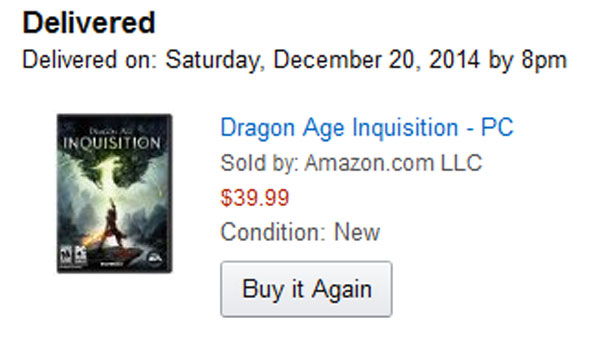
Fine~
So, you win this round, Amazon. And, I suppose, I win a little too.
Learning to Let Go
For the longest time, I was a believer in playing games to completion no matter what. A large part of this sentiment was codified back in my semi-official reviewing days in which we were required to beat a given game before we could review it. That always seemed like a reasonable request, and it meshed rather nicely with my general sense of optimism (…stop laughing) regarding the possibility of a game making up for its earlier shortcomings in the 11th hour. Kind of like… err… huh. I can’t think of any examples at the moment, but I’m sure there are some. And maybe this next game will be the one!
In the past few weeks, I have made a concerted effort to abandon such sentiments.
You might have noticed that I am reviewing less games these days. While I still enjoy writing reviews, I’m less convinced that many of the games I play either need or deserve them. I finished Batman: Arkham Asylum a few days ago, for example, but who out there would really benefit from my take on a game which has two sequels and a derivative (Middle Earth: Shadows of Mordor) already? It’s an open question if anyone benefits from any review I do, but at least more topical games are easier to justify to myself. Once the “review potential” of a game is reduced to zero, I no longer feel any need to finish it.
Or, in some cases, even start them. My original plan was to start playing the old Tomb Raiders before starting the Square Enix reboot, but I just “Nope’d” out of there after seeing some screenshots. Company of Heroes was played just long enough to start realizing that I liked Dawn of War better. I started playing Thief Gold two days ago and stopped this afternoon. Minutes before writing this post, I was going through the tutorial of Fable: the Lost Chapters; camera was a little too wonky for my tastes though, and now here we are.
I still do feel a little bad when I banish a Steam game into my Finished category, as obviously I spent some amount of money acquiring it at some indeterminate point in ages past. But on the other hand? I can acknowledge that I have likely past the threshold beyond which there are more legitimately fun games that I am actually excited to play than I have time on this mortal coil to do so. Perhaps it is crass to say, but… if I had cancer, would I spent my remaining time playing the original Hitman? Or, really, any of the Hitman games (I’ve heard Blood Money is the best though)? Probably not.
It pains me to know other people will not likely experience the joy that was Xenogears or Tenchu or whatever, but I understand the dilemma now more than ever. No matter how good Game X was for Y reason, sometimes the Z era was what made it so. Can I really appreciate the original Thief in the proper context of its time? Well, I did make it to the third level before shutting it down. I have heard conflicting reports as to whether the Thief reboot lived up to its lineage, but I am now more inclined to spend the $6 (deal is over, alas) to purchase the new one than I am to play through the original(s).
In any case, that is where I am at the moment. I’m not opposed to older games, but they will have to work extraordinarily hard (and quickly) to keep my attention, starting now. Ain’t nobody got time to play games out of some misguided sense of obligation.
Devalued Steam Bucks
So this past Black Friday, I took advantage of two deals which, at the time, seemed to be no-brainers. First was a $50 Steam gift card being sold by Best Buy for $40. The second was the Logitech G502 gaming mouse being sold for $80… with a $50 Steam gift card thrown in. Pretty sweet, right?
Well… I’m now having a hard time imagining what I’d buy with this.
It’s not that there are no games I want to purchase on Steam, it’s that there aren’t many games I want to purchase from Steam. My Steam Wallet money isn’t going to pay for purchases on GetGamesGo, or GMG, or Amazon, or Square Enix’s own website, or Humble Bundle, or wherever else. When you limit yourself to just the Steam store, I’m finding that the value just isn’t there in many cases. Or at least not to the same degree. And it feels real damn silly to knowingly pay $2 more or whatever for a digital product you could purchase cheaper somewhere else with a similar number of mouse-clicks.
Basically, I am really hoping that this year’s Christmas Steam sales are extraordinarily good, lest I feel dumb for locking up my dollars in Steam’s storefront specifically. Which is a scenario that would have been outrageous even a few years ago.


What is Dragon Age Even About?
Jan 8
Posted by Azuriel
I was trying to describe the Dragon Age series to a friend the other day, and failing miserably. You see, this friend is a huge fan of the Mass Effect series. Should be easy, right? “It’s like a fantasy Mass Effect. It’s even made by the same studio!”
Except that is not really true.
I mean, yeah, it’s made by Bioware. But the longer I look at the Dragon Age series as a whole, the less it looks like a coherent narrative and more a mishmash of one-dimensional fantasy tropes. Dragon Age: Origins was a breath of fresh air with the Mage/Templar relationship, turning Elves into wandering Gypsies, and otherwise subverting a lot of traditional fantasy. Perhaps the genre has evolved in parallel or the novelty has worn off, as these days I’m finding the Dragon Age setting floundering for an identity.
I liked the Grey Warden schtick in the first game, even if it ultimately meant you were fighting dragons and orcs. In Dragon Age 2, you really weren’t doing anything of note; things just happened around you. While there is still time for Inquisition to kick into gear plot-wise (no spoilers, please), I’m at a bit of a loss in mustering up the motivation to care about anyone around me. Don’t get me wrong, party banter is pretty much the reason someone plays Bioware games; I just find it hard to like someone when there’s no real context for their decisions or personality.
For example, I have lost all investment in the Mage vs Templar narrative arc. The concept of anti-mage knights overseeing mage initiation rituals was pretty cool in the first game. It evoked a sort of Wheel of Time “mad dog on a leash” image; I started thinking that perhaps a similar thing should exist in the Star Wars universe vis-a-vis Jedi. It gets the mental gears moving, you know?
But now we are left with insane Mage vs insane Templar generic fantasy 101. My next Inquisition plot point indicates I will need to choose between seeking Mage support or Templar support, with the decision being mutually exclusive. I’m honestly about two seconds away from looking it up on the Wiki and making a decision based on which side gives the better loot. Quite simply, the game hasn’t given me any reason to care about the outcome. Compare that to my utter agony over the Genophage decision in Mass Effect 2. Same sort of binary, morally grey decision, but Mass Effect managed to get me to care. Dragon Age doesn’t even try anymore.
If someone asked you to sum up the Mass Effect series, you could say “scrappy Commander gets ship, builds galactic coalition to defeat Reapers.” As for summing up Dragon Age… uh… hmm. “Series of unrelated scrappy heroes collects NPCs and fights mobs.” Obviously it’s a lot harder to come up with a coherent narrative when you change heroes every game, but I’m not sure how much slack Dragon Age deserves. The Far Cry games have nothing to do with one another, and yet I can feel the thread that binds them. Where is the Dragon Age thread? What is Dragon Age even about?
I think Bioware would have been a lot better off sticking to the Grey Warden angle. Having a new Blight every game would be pretty formulaic (and unsustainable), of course, but I would of loved to have seen a more nuanced exploration of what life is like for the condemned Wardens in the post-Blight period. Sort of like a subverted fantasy plot, wherein your coalition and party members start strong and then fade out, slowly ground to dust via political machinations that find the Warden treaties inconvenient once the world is no longer ending. Perhaps there is a schism that develops amongst Wardens that desire children and security for their families. Maybe the Mage vs Templar rebellion could have started by the Mages deciding to free themselves en masse by joining the Warden cause.
Shit, can you imagine? Do you allow the Mages to essentially subvert the Warden code to emancipate themselves? They get their freedom, but there won’t be enough safeguards amongst the Wardens to keep a check on their power. Plus, what of the nobles who suddenly see the Wardens become a stateless army whose treaties supersede their sovereignty? Do the Wardens become complicit in the subjugation of Mages by rejecting them, especially when the Templars crack down extra hard after the attempted mutiny? Meanwhile, an Archdemon stirs from the all the conflict and bloodshed…
That would be an interesting decision. Not choosing between two NPC leaders that I was introduced to 10 seconds ago.
Who knows, maybe Inquisition will turn out to be super interesting in the final analysis. It isn’t terribly interesting now though, and it will have a hell of a time matching the plot I just invented a minute ago. The game is still fun, but I’d rather be playing Skyrim 2. Since I can’t, Inquisition will have to do.
Posted in Commentary, Impressions
15 Comments
Tags: Decisions, Dragon Age: Inquisition, Grey Warden, Mass Effect, Plot