Category Archives: Commentary
ChatGPT
Came across a Reddit post entitled “Professor catches student cheating with ChatGPT: ‘I feel abject terror’”. Among the comments was one saying “There is a person who needs to recalibrate their sense of terror.” The response to that was this:
Although I am bearish on the future of the internet in general with AI, the concerns above just sort of made me laugh.
When it comes to doctors and lawyers, what matters are results. Even if we assume ChatGPT somehow made someone pass the bar or get a medical license – and they further had no practical exam components/residency for some reason – the ultimate proof is the real world application. Does the lawyer win their cases? Do the patients have good health outcomes? It would certainly suck to be the first few clients that prove the professionals had no skills, but that can usually be avoided by sticking to those with a positive record to begin with.
And let’s not pretend that fresh graduates who did everything legit are always going to be good at their jobs. It’s like the old joke: what do you call the person who passed medical school with a C-? “Doctor.”
The other funny thing here is the implicit assumption that a given surgeon knowing which drug to administer is better than an AI chatbot. Sure, it’s a natural assumption to make. But surgeons, doctors, and everyone in-between are constantly lobbied (read: bribed) by drug companies to use their new products instead. How many thousands of professionals started over-prescribing OxyContin after attending “all expenses paid” Purdue-funded conferences? Do you know which conferences your doctor has attended recently? Do they even attend conferences? Maybe they already use AI, eh?
Having said that, I’m not super-optimistic about ChatGPT in general. A lot of these machine-learning algorithms get their base data from publicly-available sources. Once a few of the nonsense AI get loosed in a Dead Internet scenario, there is going to be a rather sudden Ouroboros situation where ChatGPT consumes anti-ChatGPT nonsense in an infinite loop. Maybe the programmers can whitelist a few select, trustworthy sources, but that limits the scope of what ChatGPT would be able to communicate. And even in the best case scenario, doesn’t that mean tight, private control over the only unsullied datasets?
Which, if you are catering to just a few, federated groups of people anyway, maybe that is all you need.
End of Year: 2022 Edition
Just like 2021, except we all just gave up.
Workwise, I ended the year still at the same company but promoted to a more senior role. There have been a number of bonuses and raises offered company-wide, as management starts understanding that, yeah, this new labor market is here to stay. There are apparently some more raises in store for my specific department, but we’ll have to see how that pans out. Despite spending literally $15,000 in daycare this year, my family is doing perfectly OK. Which means I made it, I guess. My options trading and crypto are most definitely not making it, but I’m in a position where I can realize some losses and at least not pay taxes on the gains this year, while still having some upside exposure. It has to rally again someday, right guys? Guys?
Family is doing great. My kiddo is potty training like a champ.
Enough real life. Let’s talk games. First is the Steam lineup:
- Meteorfall: Kromit’s Tale
- Black Book
- FAR: Lone Sails
- My Friend Pedro
- Per Aspera
- Borderlands 3
- Before We Leave
- Raft
- Necromunda: Hired Gun
- Legend of Keepers
- Despotism 3K
- SOMA
- Core Keeper
- Satisfactory
- Sigil of the Magi
- Gordian Quest
- Rimworld
- DOOM (2017)
- Cardpcalypse
- Slay the Spire
- Noita
Although many of the games don’t necessarily have a defined “win state” (and many are Early Access besides), realistically I only finished Meteorfall, FAR, Per Aspera, and Borderlands 3. It was especially egregious with games like SOMA, wherein I played to the first area where the first monster appears, Alt-Tabbed to see what happens if they get you, realized that there is an EZ-mode with no real consequences, and then never actually booted the game back up again. At the same time, I have been trying to embrace the whole “Spark Joy” Kondo-ism a bit more than in years past. Play games when they are fun, stop when they aren’t. Just a shame that games stop being fun before they’re over.
For the Epic Game Store:
- Horizon: Zero Dawn
- Cyberpunk 2077
- Everything
- Final Fantasy 7 Remake
I… think that’s literally it. And again, I only really finished FF7R from that list. Going forward, I think I’m going to have to start making a concerted effort to completely ignore side quests and such for the more open-world games. Or maybe not. Sometimes the sidequests end up being much more interesting than the main quest for a lot of those kind of games.
By the way, the Epic Store interface is still embarrassingly shitty in 2022. When I go to my library and choose “Sort by Recently Played,” I would expect the games to be sorted by, you know, how recently they were played. But they’re not. You can’t even have the games sort themselves by most played. Ugh.
For Game Pass:
- Dreamscaper
- Amazing Cultivation Simulator
- Offworld Trading Company
- Citizen Sleeper
- Deathloop
- Grounded
- Sable
- Metal: Hellsinger
- Superliminal
- Unsighted
- Vampire Survivors
- Turnip Boy Commits Tax Evasion
- Hardspace: Shipbreaker
- Loot River
- Nobody Saves the World
- Tunic
- Sunset Overdrive
- We Happy Few
- Outriders
Once again, Game Pass is the de facto best place to try out games you wouldn’t otherwise play unless they were wedged in a random bundle. Of the list, Grounded was the clear winner here with a whopping 68 hours played… and I haven’t even beaten it yet. We’ll see if I ever pop back in.
For completeness’s sake, I also continued to play Hearthstone and Guild Wars 2 throughout 2022.
Looking at 2023, my goal is to actually sit down and play Red Dead Redemption 2, Disco Elysium, Death Stranding (played 7 hours and fell off), Chained Echos, Wildermyth, and… SOMA. Maybe Assassin’s Creed Odyssey or Origins. And finish off Cyberpunk 2077 and Horizon: Zero Dawn. According to HowLongToBeat, that lineup is 256 hours all by itself (main stories only). Which is like 5 hours a week, so not unreasonable even if I pretend to be a responsible father figure. We’ll see.
I really enjoyed Void’s “Games of the Year” schtick over at A Green Mushroom, where there was a running tally of games played and how they sorted themselves over the year. I’ve always struggled with “justifying” creating a blog post about some of the random shit I try to play (e.g. Nobody Saves the World, Metal: Hellsinger, etc), even though personally I enjoy reading every single article by anyone still posting on my blogroll. So, heads up, there may be some experimentation with that format in 2023. Or maybe I just continue doing my own thing, which apparently continues to work.
Well, “work,” for given definitions of work.
…which I’m defining as being awesome. See you in 2023.
Rimworlder, part 2
Instead of doing minor edits and publishing the last post, I continued playing Rimworld for about 25 hours over a week. Yeah, all other games in progress (aside from GW2 dailies) have been blown away. However, in that time, I have come to a number of conclusions. Or maybe just a primary one from which all others follow.
The Rimworld DLCs make no sense.
Royalty was the first DLC to be released. The big addition was the sort of Fallen Empire faction that you interact with almost immediately in every playthrough. If you ally with the Empire, you can select one or more pawns to start accruing Honor via quests and such, which is used to ascend royal ranks, which in turn unlocks the ability to have Psycasts. Higher ranked pawns will need increasingly spurious luxuries befitting their titles, requiring the creation of a throne room, better quality clothes, and so on.
If you don’t ally with the Empire, you basically don’t get to play with Psycasts. There are a few opportunities to waylay Imperial caravans and steal the items that grant Psycast levels, but they are few and far between from what I have heard. That said, each map also has an Anima Tree somewhere that allows Tribal-based (and only Tribal-based) pawns to meditate/worship at its trunk to eventually unlock all Psycasts and assorted goodies, no Empire needed.
In practice, the entire Royalty DLC feels at odds with its premise. Roleplaying as a royal colony and eventually using the Empire as a win condition (joining the Imperial flotilla) is perfectly fine. Tying Psycasts to royal titles is not. The earliest Psycast that has any particular use (Vertigo Pulse) requires the Knight rank. The next one is Praetor, which unlocks Skip (tactical teleport) and Wallraise (cover on demand). These are very useful abilities, but each individual pawn would need their own separate throne room and gain the appropriate amount of individual Honor to gain them. It also gets a bit goofy having a Count, whom “might have a personal fleet of capital ships,” be slumming around with the rest of the fighters to take out a Mechanoid Cluster.
Tribalists being able to short-circuit the entire Psycast system by spending time at an Anima Tree kinda drives everything home. I haven’t done so myself, but there is plenty of chatter about how you can get your entire Tribal colony to be level 6 Psycasters very easily, which would otherwise require a half-dozen throne rooms and other goofiness the “normal” way. There are probably mods out there to fix things, but why not have rituals or research or whatever to allow non-Tribals access to Anima Tree benefits? Royal ranks would still have a purpose – Permits are enough of a thing IMO to justify the title system – plus perhaps you could make it easier for royals to find/buy/hand out the Psycast-level items.
For the Ideology DLC… there isn’t much to say, actually. It opens up some directed roleplaying and/or absurd min-maxing opportunities. In my current playthrough, it doesn’t really add much to the gameplay aside from some annoyances. For example, at least two of the main factions on the planet are Supremacists, which means they are effectively permanently hostile (on top of the always-hostile pirates, raiders, etc). Beyond that, my colony can… uh… perform one dance party a year. Two of my pawns can give a few speeches, but even if you max out the chance of success, there’s still a minimum chance of failure. There are also a series of quests to find a relic, but near as I can tell, that ultimately gives a mood buff equivalent to eating at a table during the once-per-year dance party.
For the Biotech DLC, we come around again to absurdity.
Using Biotech to create custom starting scenarios is perfectly fine. Cannibal mole men? Beautiful furkin? Straight-up vampires? Go for it. However, there’s a big chunk of the mid-game revolving around Genebanks and such that allow you to acquire genes (purchased or extracted) and augment your pawns. But… why? The system is extremely random and requires a colony with excess resources to the point that you may as well just be installing bionic limbs and such. Moreover, if you are creating a custom xenotype at the outset, things would be much faster just having your existing pawns have children of said xenotype versus some convoluted system of extracting genes from your pawns and mashing them together into a former prisoner you converted. There may be some point to the system once you start looking at the more OP Archite genes, but that requires purchasing Archite capsules, then the Archite genes, and then implanting them. All to do what? Make one pawn superhuman in a way fully bionic organs in Cataphract Armor does not?
On the other hand, children are amazing in Biotech. It allows your colony to grow in an organic way, it ups the stakes during raids, and I appreciate watching them become more useful additions to the family. The stories that get generated in this way are also novel. For example, I took in a small refugee family of a father, mother, and small child. Things were going well… until I got the notification that a Fennec fox was hunting the child, who for some reason was trying to haul boulders from across the map. Unable to reach the fox in time, the child was downed and then eaten. This caused the mother to fly into a murderous rage… in the middle of a classroom where she was teaching my colony’s first child. She beat him to death with a club, which I had not removed from her inventory.
And that’s how I learned to always restrict the zones where children can roam. And disarm refugees.
After I reloaded an earlier save game, of course. Iron man, I am not.
Rimworlder
As feared, I succumbed to Rimworld yet again.
The experience of playing Rimworld 1.4 with all the paid DLC has been interesting. And yet, simultaneously, an outrageous slog. Principally, my problem with Rimworld is the opening act. The “game” doesn’t really start until you have a working refrigerator and a relatively stable colony of 5-6 people. Before that point, you do not have the resources or manpower to engage much with the Research tree, rituals, caravans to other settlements, or any of the fun war crime shenanigans that just sort of happen on the way down the slippery slope.
To back up a bit, let me talk about my first scenario this time around: Rich Explorer. Instead of crash landing with three pawns, you land with just one but with a pile of money and a tech tree unlocked enough to built turrets right away. For some reason, this particular scenario has been speaking to me for months now – possibly because it speaks to the sort of survival games I enjoy. What I discovered was… pain, and not just because I run the Randy storyteller with the 2nd highest difficulty. Basically you have to have Construction 5 skill on your pawn in order to craft turrets, so I was defending solo for the first year. Not that it would matter much, because turrets require power, which was difficult to set up when you are also trying to sow crops to survive the winter. And that’s another deviation from my historical Rimworld attempts, e.g. not selecting a temperate zone that has year-round crops.
I persisted with that playthrough all the way to the next summer, until the moment that the four pawn colony I had scraped together all managed to get food poisoning at the same time. I wasn’t under attack or anything, I was just frustrated beyond reason that all four of my pawns were vomiting constantly, weak with fatigue, and I was zoomed in, watching pixels to see if they managed to actually finish eating the meal or would get interrupted and then collapse on the floor from starvation or not. It’s very possible that the colony would be fine, but I didn’t want to waste my time even on the highest game speed to see if they would.
Honestly, I don’t remember much about the 2nd attempt. I just abandoned it for similar reasons.
The third and current attempt is somewhat of a “cheese” run. Using the Biotech DLC, I decided to create my own xenotype that includes the Iron Stomach trait that makes them immune to Food Poisoning. I also used the Ideology DLC to create a belief that organ harvesting is OK, seeing corpses don’t provide a negative debuff, and research speed is increased. My pawns are genetically addicted to Psychite though and the area I settled in only has two growing seasons. Plus, any recruits beyond those initial three won’t have the xenotypes or Ideology bonuses without extra work.
That said… it’s still a slog. I’m currently surviving (thus far) the winter and barely have had time to research any new techs, let alone anything that utilizes the rest of the DLC material. Which is not necessarily the “point” of the game, but come on. All the fun stuff (to me) occurs when you have a somewhat stable base and can start meaningfully interacting with the rest of the game world. I’m still very far from being able to do anything with gene editing, Psycasts, or anything other than try and survive the winter without multiple psychological breaks.
Welcome to the rim, I guess.
Patch Waiting Game
Waiting for game patches is a dangerous… game.
For a minute there, I was hot and heavy for Grounded. Then the 1.0.2 patch hit, featuring some nice Quality of Life updates, but also a substantial nerf to an item I was actively using (Toxicology Badge). Barely more than a week later, they rolled out 1.0.4 which rebalanced a lot of the weapons in the game more generally, retooling some of the Mutations. Around this time, I started seeing reports that there was still a bug with the final battle, and not the Arthropod kind. So, even if I wanted to plow forward with the game with my inventory wildly fluctuating, I wouldn’t be able to see the end screen.
So… I waited. Then started playing something else. And here I am, nearly a month later, not having touched the game at all. At a certain point, I start having to get a gut check for how likely it is that I would ever actually come back and finish things.
Obsidian is now teasing Patch 1.1, set to hit the testing servers on November 28th. Certainly no sense in getting back into the game just to miss out on being able to travel up ziplines, right? Right.
I am waiting around for RimWorld too. A few months ago now I actually bought both the Royalty and Ideology expansions on sale. Haven’t played a game with them yet though, as I had other games I wanted to get to first, lest RimWorld consume all the oxygen in the room. Then the Biotech DLC was released, which sounded right up my alley. But of course you have to wait for all your mods to be updated to support Biotech first, though. Then Tynan mentioned that they are working on a patch that will feature cross-DLC integration for the first time. Can’t start a new game without that, right? Right.
Patches, man.
It feels good knowing developers are (usually) improving the game. On the other hand, that means you have to choose between continuing to play a good-enough version, or waiting for the better one.
Dead Internet
There are two ways to destroy something: make it unusable, or reduce its utility to zero. The latter may be happening with the internet.
Let’s back up. I was browsing a Reddit Ask Me Anything (AMA) thread by a researcher who worked on creating “AI invisibility cloak” sweaters. The goal was to design “adversarial patterns” that essentially tricked AI-based cameras from no longer recognizing that a person was, in fact, a person. During the AMA though, they were asked what they thought about language-model AI like GPT-3. The reply was:
I have a few major concerns about large language models.
– Language models could be used to flood the web with social media content to promote fake news. For example, they could be used to generate millions of unique twitter or reddit responses from sockpuppet accounts to promote a conspiracy theory or manipulate an election. In this respect, I think language models are far more dangerous than image-based deep fakes.
This struck me as interesting, as I would have assumed deep-faked celebrity endorsements – or even straight-up criminal framing – would have been a bigger issue for society. But… I think they are right.
There is a conspiracy theory floating around for a number of years called “The Dead Internet Theory.” This Atlantic article explains in more detail, but the premise is that the internet “died” in 2016-2017 and almost all content since then has been generated by AI and propagated by bots. That is clearly absurd… mostly. First, I feel like articles written by AI today are pretty recognizable as being “off,” let alone what the quality would have been five years ago.
Second, in a moment of supreme irony, we’re already pretty inundated with vacuous articles written by human beings trying to trick algorithms, to the detriment of human readers. It’s called “Search Engine Optimization” and it’s everywhere. Ever wonder why cooking recipes on the internet have paragraphs of banal family history before giving you the steps? SEO. Are you annoyed when a piece of video game news that could have been summed up with two sentences takes three paragraphs to get to the point? SEO. Things have gotten so bad though that you pretty much have to engage in SEO defensively these days, lest you get buried on Page 27 of the search results.
And all of this is (presumably) before AI has gotten involved belting out 10,000 articles a second.
A lot has already been said about polarization in US politics and misinformation in general, but I do feel like the dilution of utility of the internet has played a part in that. People have their own confirmation biases, yes, but it also true that when there is so much nonsense everywhere, that you retreat to the familiar. Can you trust this news outlet? Can you trust this expert citing that study? After a while, it simply becomes too much to research and you end up choosing 1-2 sources that you thereafter defer to. Bam. Polarization. Well, that and certain topics – such as whether you should force a 10-year old girl to give birth – afford no ready compromises.
In any case, I do see there being a potential nightmare scenario of a Cyberpunk-esque warring AI duel between ones engaging in auto-SEO and others desperately trying to filter out the millions of posts/articles/tweets crafted to capture the attention of whatever human observers are left braving the madness between the pockets of “trusted” information. I would like to imagine saner heads would prevail before unleashing such AI, but… well… *gestures at everything in general.*
Commercialization of Evil
I have to admit, when I first read the article title “Dreamlight Valley is a waking nightmare and Disney must be stopped,” I thought both that clickbait is getting out of control and… yeah, that’s some quality clickbait that deserves a click. What I discovered is a pretty legit, punchy article that brings up an increasingly odious problem when it comes to Disney and their commercialization of evil.
The TL;DR is that Disney is populating Dreamlight Valley – aka Stardew Valley meets Animal Crossing – with whitewashed villains. For reasons. Probably commercial ones. As the article states:
You can’t sell a backpack with a genuine monster on it, so the various appalling crimes and deeds of the Disney Villains have been meticulously sanded away – these figures reduced to queer-coded girlbosses so gentrified hipsters who love Hamilton can get tattoos of them guilt-free. Earlier this year, Disney released an advert for their doomed Star Wars hotel depicting a mother and her daughter enjoying their expensive vacation by dressing up as space nazis and narcing on beloved revolutionary icon Chewbacca. The pair of them smirk as stormtroopers lead Han Solo’s fluffy best friend away in handcuffs, presumably to either an execution or to be shipped off to a kyber mine as slave labour.
Is this really a problem endemic of the moral failings of society? Probably not. But I was a bit surprised to learn that Disney also has a mobile gacha game called Disney Twisted Wonderland that turns all their villains into anime-inspired versions of themselves. The latest addition is one based on Claude Frollo, whose cartoon bigotry in The Hunchback of Notre Dame has only become more relevant over time, and would probably precipitate a “woke backlash” if it had not already been released 25 years ago.
In principle, I do not have anything against people dressing up as Stormtroopers or whatever. People do that not because they were space Nazis, but because the designs are iconic and, yes, cool-looking. That’s just a win for the Art department. And so I can see the draw for Disney to tap into these hitherto untapped wells of marketing material in the form of villains – demeanor/war crimes aside, they are just as iconic if not more so than the heroes of the films they serve to foil.
So… what’s the big deal? I dunno. Maybe nothing.
Nevertheless, I do feel like something gets lost over time. We probably should not be relying on Disney movies to teach morality to children in the first place, but whatever cautionary tale might have existed in these characters’ stories becomes muddled and unrecognizable through the commercialization process. And what was gained? This is not a Wicked-style introspective on possibly misunderstood villains. It’s just… business cashing in on cachet. Which is what they do, I guess.
Hitting a Nerve
Tobold wants me off his lawn. He has a history of political posts that claim “centrism” despite being wrapped in the language of right-wing culture wars, and the recent Races are racist post is no exception. In it, he laments:
It is a sign of the times in which artists live in constant fear of being attacked for slights they never intended that Wizards of the Coast in the first playtest material for One D&D removes stat modifiers from races. In the new version of Dungeons & Dragons, choosing your race is mostly cosmetic. Orcs aren’t strong anymore, instead they “count as one Size larger when determining your carrying capacity and the weight you can push, drag, or lift.”. And to avoid comparative negative stat discrimination, positive stat bonuses are gone as well. The “2-3 feet tall” halflings are now just as strong as the “6-7 feet tall” orcs, in order to avoid racial discrimination. We will have gnomish barbarians and orc wizards.
Gnome barbarians and orc wizards, oh no!
Let’s take a moment to talk about the game design topic though.
This change just reflects what modern multiplayer game design figured out a decade ago: prescriptive racial modifiers only encourage min-maxing and otherwise limit design space. Look at the state of endgame World of Warcraft. Does anyone still think it is a good idea that the race you chose on the character select screen should have such an impact on raiding or M+ or PvP 15 years later? Maybe you say “yes.” Well, the end result of that is a faction imbalance so massive Blizzard finally buckled, and is making most activities of the game cross-faction in the upcoming Dragonflight expansion to prevent the entire edifice from collapsing.
Which is good idea, by the way, because factions are dumb too. “Let’s divide our playerbase and foster different and hostile identities.” Oh, now people are quitting in droves because they are stranded on dead servers/factions and none of our world PvP systems are viable. *Surprised Pikachu face*
Compare all that with, say, Guild Wars 2. I think technically each race has a special ability, but they are irrelevant at all stages of play, which allows players to pick a race based on aesthetics or fantasy. Want to be an Asuran Warrior instead of Charr or Norn? Go for it. One of my first characters 10 years ago was a Sylvari Engineer, because the thought of a plant-person running around with a flamethrower was hilarious to me. Still is, actually. If GW2 was more “traditional” fantasy surely I would have negative modifiers for being around flames, if I were allowed to be an Engineer at all.
Was any of that what Tobold really wanted to talk about? Nope:
I am not sure what purpose races serve in a fantasy role-playing game if there isn’t actually any difference between them. If they are all the same and lack profile, races have been effectively removed in order to appease the thought police. But races remain nominally in the game, because a much bigger part of the D&D customer base would be deeply offended if you’d just remove all fantasy races. It is a bad compromise that will make nobody happy. The thought police will still be triggered by the mere existence of the word “race” in the rulebook. And the players will have lost interesting options in character creation. Can’t we just admit that the real world is complicated, and be allowed some refuge in much simpler fantasy worlds?
You would think that a centrist is all for “bad compromises that make nobody happy,” but the follow-up comments demonstrate that is not the case. When I pointed out that, historically, CRPGs gave female characters Strength penalties for similarly dubious reasons, he replied with:
So you are saying that god is sexist, because (s)he made women less strong than men? I don’t understand your objection to a game rule that reflects reality.
Well, there it is. A Rogue can make a successful Reflex Save in a broom closet hit by a Fireball (which also sets nothing on fire) to avoid all damage, but it’s important for reasons that fantasy game rules reflect “reality.” But only certain “realities.” And those certain reflections of reality are more important to a game’s design than, I dunno, any consideration of what the design leads to, e.g. prescriptive race/class combos that force players to choose between their own fantasy and numerical success. Nevermind the extra social pressure to be helpful that inherently comes from being a part of a group.
While I had been trying to avoid the bait, the third time was not the charm. In an unnecessary paragraph, I threw in this at the end:
“Of course, that’s not the real issue here, is it? I guess you’ve traded your armchair game designer hat for an imitation MAGA one so you can fill your retirement with Boomer culture wars. Which… OK, I guess. Perhaps you can make a little safe space around the D&D table where you can’t get triggered when the “thought police” removes your +2 modifier.
In retrospect, not my proudest moment. However, it certainly hit a nerve, with Tobold going off quoting “They came for the socialists…” and how evil triumphs when good men do nothing.
Here’s the thing though: if you use the word “woke” as a pejorative and talk about the “thought police” being “triggered” while also apparently defending gender-based modifiers as being a justified reflection of (fantasy!) reality… you may want to take a moment and ponder on what “left of center” even is. This is not neutral language. Unless it was being used ironically in a way I did not detect, it hits about the same as Ron DeSantis’ victory speech wherein he used the word “woke” 5 times in 19 seconds:
“At the end of the day, we were not going to let this state be overrun by woke ideology,” DeSantis said. “We will fight the woke in the businesses, in government agencies, fight the woke in our schools, and never surrender to the woke agenda. Florida is the state where woke goes to die.”
Perhaps even pointing that out is ipso facto thought policing, in which case… weewoo weewoo, I guess.
I understand the desire to keep politics separate from one’s hobby. Although, that sort of presupposes politics weren’t already deeply ingrained from inception – art is usually a product of its time. What I do not understand is how or why this particular hill is the one to die on. Not only does it make no practical difference to the experience of D&D – you literally can make up whatever rules you wish or use any edition to run your game – it is not particularly interesting game design in the first place.
Indeed, here is a quote from the Principle Rules Designer for D&D, Jeremy Crawford:
“For quite some time, we have not liked how the choice of race in the game had often too much weight on the player’s choice of class,” Crawford admitted. “Fans often talk about this—that connection between race and class is not something we as designers actually desire. We want players to pick those two critical components of their character and choose the two that really sing to them so they don’t feel like they’re pigeonholed. [In Monsters of the Multiverse] people will get the floating bonuses we introduced in Tasha’s Cauldron. If somebody is making a character, and wants to recreate the bonuses that existed previously, the advantage of the floating bonus system is they can do exactly that.”
Here is another one:
“Contrary to what many people might think,” said Crawford, “those ability score increases that are in those different options, they’re not there for game balance purposes. They are there strictly to reinforce the different archetypes that have been in D&D going all the way back to the ’70s. […] It really has been just about archetype reinforcement, and because it’s not there for game balance reasons we give people the option in Tasha’s Cauldron to take whatever those bonuses are […] put them in any ability score you want.”
If you want a traditional, archetype-driven high-fantasy campaign wherein Orc babies light up when the Paladin casts Detect Evil, go right ahead. I personally ran D&D campaigns for six years that featured nary a dungeon nor a dragon. Do what you want!
But if you are insistent on being outraged by this change, irrespective of your ability to articulate a game design counter-argument, cloaked in the language of far-right cultural wars, maybe some introspection is in order. And if the notion of introspection itself feels like self-censorship to be fought with the strength of Niemöller… well, you kind of got your answer right there, eh?
Out of this RimWorld
After hitting a lull in Final Fantasy 7 Remake motivation, I did the most logical thing possible with a $1800 prebuilt PC: reinstalled RimWorld. Admittedly, it had been a while.
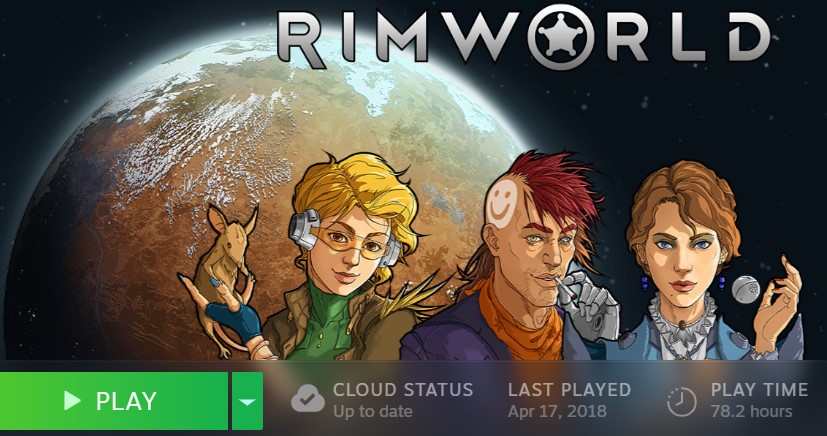
While there has been two expansions released, the core experience has largely remained intact. I think the biggest thing that threw me for a loop was needing to build a wooden pen for animals. Previously, you could just “paint” an Allow zone for animals in an area, and herd them elsewhere by moving the zone. Probably a bit too abstract, sure, but it’s not as though the rest of the game is super intuitive.
The other aspect of the game that returned quickly was the demotivating sense of inevitability. And I don’t just mean those unfortunate events where the dice don’t land your way and your best sniper gets shot in the eye by a tribal with an arrow from 50m away. I mean when you hit Spacer tech and you’re starting down the charged barrel of endgame Civilization Conquest next-turning for the next dozen hours. Don’t get me wrong, there is nothing certain about Randy RNG beyond your tears… but, also, kinda yeah there is. There is a point where all you’re doing is pulling the handle, and seeing if you’ve successfully installed a bionic spine into colonist #6, or if everyone gets muscle parasites an hour before a mechanoid cluster lands inside your base.
I’m currently on the fence regarding whether I believe the expansions would help. The prevailing wisdom is that the Royalty DLC adds a lot of new content, while Ideology adds more roleplay elements. Either or both could possibly help with that inevitable feeling. I certainly have no desire to caravan across the planet and/or DIY a spaceship – I did both years ago and that was enough.
But… we’ll see. It was a craving for a survival experience that led me to reinstalling in the first place, and RimWorld isn’t that. It’s adjacent, in a way. But once you’ve had your fill, that’s that.


Like Souls
Feb 13
Posted by Azuriel
In the past two weeks, I played a few hours of Blasphemous and Salt & Sanctuary. Both of these games are in the increasingly crowded 2D Soulslike genre, made famous by Dark Souls (or Demon Souls if wish). As I was farming some currency to level up a bunch of times in Salt & Sanctuary – and before remembering I had previously played the game for 10 hours a few years ago – I had a thought. I have played a lot of Soulslike games over the years… and not actually Dark Souls. That’s weird, right?
So, it’s happening.
Not certain whether I’m going to chronical this shit, or just give the occasional summaries. Not much oxygen left in the room between Elden Ring and decades of Youtube videos of people beating the entire Dark Souls trilogy without taking a single point of damage while using a DDR dance pad as their controller. That might be two separate videos. Whatever.
If you want to see me “Git Gud” or otherwise maintain my adequate levels of Gud, buckle up.
Posted in Commentary
Comments Off on Like Souls
Tags: Dark Souls, Git Gud, Soulslike, What Could Possibly Go Wrong?