Category Archives: Commentary
Battlefield V is Awful
Holy shit is Battlefield V some hot garbage.
The open beta just came out, so you can go play it for yourself. It’s roughly a 12GB download, and I regretted it almost immediately.
You will note that I am not saying that the one specific map is hot garbage, even though it is. No, I am talking about the entire Battlefield experience. We have known from previews and the like that DICE was radically changing the mechanics, but it wasn’t until I actually sat down and played it that I realized how terrible they all were.
Ammo is severely limited. You have two, maybe three clips of ammo. See some figures running around in the distance? Shoot at them for a few seconds, reload, and… oh, hey, you have 30 bullets left. This change was supposed to make the Support class more useful, I think, but the reality is that no one is Support because you die instantly and can’t shoot anyone as Support.
Oh, and by the way, as Support you have infinite respawning ammo pouches to give other people, but you cannot resupply yourself. I ran around for five solid minutes with 15 bullets left in my mag, throwing ammo pouches left and right. I could only toss them when aiming directly at teammates – no throwing them at your feet and getting ammo yourself. I suppose they assume there will be two Support classes resupplying each other? This may or may not be alleviated once you unlock the actual Ammo Crate, but I have no idea.
Health is severely limited. While you start with 100 HP, there are breakpoints at which you cannot auto-heal past. In other words, if you get shot down to 10 HP, you will automatically regain HP up to like 65 HP or whatever. To heal yourself further than that, you need a Medic. In isolation, this is a change I’m kinda in favor of. It’s frustrating getting a few good shots into a target, only to have them hide and come back out at full health. But it’s a problem when…
Time-to-Kill is 0.00000001. Okay, that’s a bit exaggerated, but for the most part you will be dead before you realize that you are getting shot. In the case that you aren’t immediately killed from random gunfire, hiding will cause you to only heal up to 1/3 or half health, beyond which you will be instantly killed by any sniper tagging you in the foot.
All of the above combines into a bitter, shit stew of disappointment.
Spawn in somewhere. Run around, get shot a few times, now you’re at 10 HP. You heal up as best you can, but now you’ll be one-shot by any sniper in the area. Or maybe you kill a dude before getting shot yourself. You’re in a good position on the field, but… you only have 20 bullets left. Well, you may as well charge into the building and hope for the best, right? Kill a dude, go down yourself, then miraculously get revived by a medic. Except now you just have your pistol, and you get killed by the enemy as they retake the site.
I’m not entirely sure what I expected. Probably not a worse Battlefield 1, that’s for sure. But it’s hard to fully grasp how terrible this series has become, and for what possible reason. In Battlefield 2, Battlefield 3, and Battlefield 4, the game was about 64-player matches in which you did crazy-cool things with tanks and planes flying everywhere, dropping out of helicopters, and so on and so forth. Then DICE put out Hardline and it flopped. Then came Battlefield 1, which didn’t flop, but was oppressive as shit, and not at all fun to play. Now we have an even-worse set of gameplay systems, and less vehicles to boot.
It’s not hard, people. Just let us have fun shooting things. If I wanted an oppressive battlefield environment in which I had no individual agency, had to rely on teammates that failed to deliver, and was barred from doing any cool things, then… I would just go back to work. Like I do every day.
Luckily, DICE can fix these things. There’s still time to just give everyone two additional magazines, let Supports and Medics supply themselves, and bring up the TTK numbers. Now, whether DICE actually does so before launch or only after BFV sales flop, that’s up to them.
Until said changes are made though, I’m sitting this Battlefield out.
Leveling Punishment
C.T. Murphy recently wrote:
Leveling, as in playing the game, is still a lot of fun in World of Warcraft. Leveling, as in playing a roleplaying game where you expect your character to advance and evolve, has never been worse.
When you level up in Battle for Azeroth, you get nothing. No talents, abilities, or anything of any kind of merit whatsoever. Everything scales now too so there isn’t even a sense of “being able to go places I previously couldn’t”. Outside of padding, I don’t understand why they added more levels in the first place.
This is 100% accurate with my own WoW experience currently.
We are approaching three weeks since the expansion launched. I was on vacation for a week in the middle there, but the fact remains that my first toon hit level 113 on Thursday. It’s not that the leveling is slower, it’s that there isn’t any point to it. WoW fully embraced the TES: Oblivion conceit of punishing players for leveling up. At least, that’s how I feel about it right now.
Seriously though, think about it. Everyone talks about how the stories and quest-lines in BfA are excellent. Okay… are any of them gated by level? I don’t think so. Maybe the War Campaign? In which case it might actually be better to turn off XP at level 111 and just complete all your questing with your uber Legion gear (including Legendaries) and breeze through the mobs. You get nothing but weaker during the leveling process. That’s literally insane game design.
Of course, once you finish all the story bits, the actual endgame is still gated at level 120. And it would certainly suck if you ever changed your mind and had to gain 9 levels with zero questing opportunities. But the mere fact that this almost sounds plausible is blowing my mind.
As it stands, my primary purpose in logging in is checking the AH, and doing some light farming based on the prices of the day. The questing is fine, but it’s literally worse than doing quests at max level, considering how your character gets weaker each time they level up. So, I would rather run around hitting resource nodes and fill up my gold bar than my XP bar.
At least the former will make my gaming experience feel better.
Disposable Professions
As of Battle for Azeroth, WoW professions have become almost entirely disposable.
I noticed this last night as I was puttering around on some of my alts. Three of them wear leather armor, so I was hopping onto each one trying to remember which had Leatherworking. As it turns out, none of them did. So, without much thought, I dropped Skinning on the rogue and then… paused. “Leather is cheap, but those Blood-Stained Bones are relatively expensive.” Then I decided that my druid would likely be more efficient at AoE farming for leather anyway, so I logged onto her and then dropped Enchanting without a pause and gave her Skinning.
If you have not been keeping track at home, Blizzard had been moving towards the Single Expansion Relevance model for a while now. Professions used to start at 1, and you would need to dedicate tens of thousands of gold/hours farming to level them up to 300+ just to get near where current-content gear was. If you kept up, you were sitting pretty, because everyone else just coming back from a break or brand new players had a huge grind ahead of them.
It was not a particularly elegant model, but it still felt… reasonable. Plus, the constant need for old-world mats for newly profession-ed characters meant that lowbies had a good shot at become rich by just gathering herbs/ore as they leveled. There was a whole micro-economy that existed there, including the savvy Auctioneers who were able to throw together a “profession kit” that would allow someone to max out to current content within 30 minutes. The dedication needed to remain in your own professions would inspire people to level alts just to have additional options, who then needed to be leveled and geared and fed a diet of AH materials, and so on, and so forth.
Then things started to change.
The first steps were allowing players to harvest current-expansion nodes even as a starter herbalist/miner. Blizzard made sure that the product extracted was basically junk, or 1/10th of the normal result, but you could at least tap the node. And that was reasonable, especially for the gathering professions, as it didn’t make a whole lot of sense to force high-level characters to be scouring old Azeroth for Tin nodes.
Then came the gimmie recipes for crafters, which allowed them to use current-expansion resources to rank up 400+ levels. One would think that such a feature killed off the old-school profession kits, but all it really did was set a price ceiling at which it was cheaper to just buy new herbs/ore. This was especially true at the beginning of an expansion, when the latest herbs/ore were selling for hundreds of gold apiece.
Somewhere in there, Blizzard also introduced profession books, which would allow you to “relearn” all the recipes you had lost when abandoning a profession.
With BfA, the circle is now complete. Professions are entirely stratified into expansion-specific tiers. Profession bonuses, which were the bane of hardcore raiders, were watered-down and diluted into irrelevance. Once a part of your character’s identity and story, professions are, at most, a (temporary) economic decision. Hell, in the heady days of a new expansion release, it can sometimes be worth the 1000g fee to relearn a profession if you can make ten times that amount in a night of being a temporary whatever. Blizzard helpfully removed most of the dungeon requirements for 3-star ranks, so the barriers has never been lower.
And all of that is probably for the best.
I sat here a while, exploring my feelings on the matter, before coming to that conclusion. I am a huge critic of any game design in which someone can lose on the character select screen, and WoW’s profession bonuses combined with the grind back up to max rank was just another form of that. That is on top of the ~5%/month churn rate which could see your entire MMO population turn over every 20 months. A new expansion is usually released how often, again? It’s just not a good design IMO to require people to pump out thousands of useless pieces of junk to increase a number to a sufficient degree to get to starting line.
Nevertheless, yeah, there is a part of me that had fond memories of the old system. My namesake paladin has been a Jewelcrafting/Alchemist since 2008 and none of that matters. I spent hundreds of hours leveling up a fleet of alts to cover every profitable base each expansion, and now the same thing could be done by one toon and a willingness to drop 1000g.
I am sort of waiting for the day when Blizzard just goes full GW2 and lets you buy extra profession slots for real money and otherwise just be done with the restrictions altogether.
P2Emote
Clash Royale has veered into an interesting monetization direction.
The game has always had built-in P2W-lite elements, and still does. Specifically, you can buy gold and special treasure chests, both of which can accelerate your progression well above the curve. Will it be a permanent advantage? No. Eventually your overleveled troops will carry you to enough victories to place you where your power-level and skill levels indicate. That the system is (eventually) self-correcting does not diminish the fact that you bought wins, but nevermind.
These days, Supercell has fully committed to… emotes. Lots and lots of emotes.
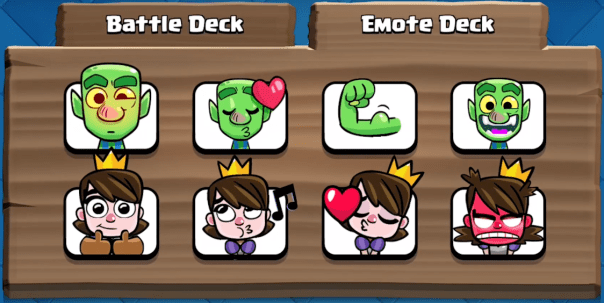
It’s been about two years since Supercell initially double-down on the emote trolling, only to back down three months later. The “backing down” required you to specifically mute your opponents every single game, but at some point they allowed the setting to stay on. However, one of the downsides was that muting emotes then muted them from your own teammate. There really wasn’t much communication possible via emotes, but it was sometimes useful to be able to “complain” about your partner’s inanity.
Towards the end of June of this year, Supercell released the new Goblin emotes. At first, I thought this seemed a bit silly. I mean, they were sold in $25 bundles that included a bunch of gold and cards which effectively made the emotes “free,” but it’s hard to imagine a company selling a sort of cosmetic item that anyone can just disable entirely. Later on, Supercell went on to just sell packages of emotes for $5, and mix and matching the types of bundles.
The funny thing is… I turned emotes back on. And I am somewhat serious about wanting to buy a certain combination of emotes.
The specific scenario I want to be able to communicate via emote is when my own 2v2 partner does something unbelievably fucking stupid. Like, every person I get matched with is supposed to be around my own skill level, right? So how can they be so dumb? It’s one thing to be interrupted while playing the game. It’s something else entirely to place troops poorly, or not at all, or basically get flustered and do random shit.
Goblins have a “roll eyes” and “this is fine (burning building)” emote and I want, nay, need to be able to communicate this to my opponents. Not my own teammate, because they either already know they fucked up, or are too stupid to comprehend it anyway. Just something a bit more… precise than simply the default “angry” emote plus sending a Fireball to the King Tower – the nigh-universal “I give up” action.
I didn’t think emotes could possibly work as a monetization strategy, especially when you can turn them off at will, but here we are. Supercell surprises me again.
The Price is Wrong
It’s been a few days since the drama, but I wanted to reserve a piece of internet real estate to talk about the Jessica Price fiasco. It’s fine if you don’t know who that is, or what the drama is about. All you really need to know is the following sequence of events:
- Jessica Price talks about the challenges with narrative storytelling in MMOs.
- Popular streamer and GW2 content creator, Deroir, suggests that solutions can be found doing things a different way.
- Jessica Price responds with the following:
Today in being a female game dev:
“Allow me–a person who does not work with you–explain to you how you do your job.”
like, the next rando asshat who attempts to explain the concept of branching dialogue to me–as if, you know, having worked in game narrative for a fucking DECADE, I have never heard of it–is getting instablocked. PSA.
Since we’ve got a lot of hurt manfeels today, lemme make something clear: this is my feed. I’m not on the clock here. I’m not your emotional courtesan just because I’m a dev. Don’t expect me to pretend to like you here.
The attempts of fans to exert ownership over our personal lives and times are something I am hardcore about stopping. You don’t own me, and I don’t owe you.
Within the day, she was fired.
The reason I wanted to lay this all out is because the reality-distortion fields are being engaged and the entire debacle is being framed as a new Feminism vs GamerGate front. And that’s incredibly dumb, and sad, and arguably dangerous. Jessica Price was fired because she was behaving as a noxious asshole in an official capacity. Full stop. We don’t even have to examine whether it was “mansplaining” to interact with Jessica’s social media post, because there isn’t a scenario in which her response is ever appropriate.
And instead of talking about that, we’re talking about this:
Price is worried about the precedent the firings set. “The message is very clear, especially to women at the company: if Reddit wants you fired, we’ll fire you,” she said. “Get out there and make sure the players have a good time. And make sure you smile while they hit you.”
That’s a Kotaku link, but the framing of the debate is also being set by Polygon (emphasis mine):
Jessica Price, who was fired by ArenaNet last week for arguing with fans of the company’s Guild Wars 2 MMO, said she feels betrayed by how the company “folded like a cheap card table” when confronted by toxic fandom. In an interview with Polygon, she talked about the meeting in which she was fired, and castigated ArenaNet managers for their “highly unprofessional” reaction to a social media controversy.
That kinda makes it sound like Price was heroically standing up to the school bully, and unfortunately got caught in the Zero Tolerance policy for fighting back.
Instead of, you know, reading literally this:
Really interesting thread to read! 👌 However, allow me to disagree *slightly*. I dont believe the issue lies in the MMORPG genre itself (as your wording seemingly suggest). I believe the issue lies in the contraints of the Living Story’s narrative design; (1 of 3)
When you want the outcome to be the same across the board for all players’ experiences, then yes, by design you are extremely limited in how you can contruct the personality of the PC. (2 of 3)
But, if instead players were given the option to meaningfully express *their* character through branching dialogue options (which also aren’t just on the checklist for an achievement that forces you through all dialogue options), (3 of 4 cause I count seemingly…)
then perhaps players would be more invested in the roleplaying aspect of that particular MMORPG. Nonetheless, I appreciate the insightful thread! (End)
And responding with:
Jessica Price:
thanks for trying to tell me what we do internally, my dude 9_9
Deroir:
You getting mad at my obvious attempt at creating dialogue and discussion with you, instead of just replying that I am wrong or otherwise correct me in my false assumptions, is really just disheartening for me. You do you though. I’m sorry if it offended. I’ll leave you to it.
Jessica Price:
Today in being a female game dev:
“Allow me–a person who does not work with you–explain to you how you do your job.”
And yet this is somehow Reddit’s fault, as if the notoriety of the thread detailing Price’s behavior was spontaneously generated (or artificially manufactured), and not the natural result of her shockingly aggressive behavior. Suppose there were bots involved, perhaps unleashed by GamerGaters who are somehow huge GW2 fans and capable of mobilizing within hours. The most they could do is increase the thread’s visibility, after which it seems easy to imagine becoming self-perpetuating.
I don’t like anything about this entire scenario – it feels like a permanent loss to chaos and entropy. This unforced error gives those in GamerGate a free win, when their general philosophy is abhorrent nonsense. And here I am, also defending corporations and their ownership over the social media profiles of their employees, even when “off the clock.” Like when Price writes “make sure you smile while they hit you,” I want to ask if she has ever worked a goddamn day in customer service or retail in her entire life. Yeah, that’s the job. I’ve worked at places for years in which hanging up on a customer was a fireable offense the first time you did so.
I don’t know what the takeaway on all this is. I am not a culture warrior, but I do believe in social justice. I’m a bleeding-heart liberal, but I can’t muster any sympathy for Price. Maybe I’m not as good as I imagine myself to be. But if that person has to read what was actually said and come to the “Reddit got me fired” conclusion? Then I don’t want to be that guy. Price deserved the boot.
Survival Tropes
Tropes are a thing. A lot of people feel like tropes are the worst thing imaginable, and every new title should be breaking new ground every time, or what is the point? That’s a bit unrealistic, I think. To me, tropes can be comforting. Experience in one game does not often transfer to another, so when it does, it can help in understanding the mechanics that interact in new ways. Plus, sometimes the tropes make the genre what it is.
That said, I have been playing a lot of survival games lately, and some of these tropes have got to go.
Starting out naked with no items? That’s good, important even.
Crafting recipes that require a resource that should be abundant, but turns out to be super rare? That shit has got to go. I’m in Conan: Exiles and there are two early-game arrow recipes: one requires bones and the other requires feathers. Just guess how many bones exist in the average human or animal. If you guessed “a similar number to the amount of feathers that are contained in a clearly-feathered ostrich-like creature,” you would be correct. Zero, specifically, on average.
Although, arguably worse is how little bark you can harvest from trees.
Shit like that didn’t phase me much in the past, but I think I was spoiled by The Forest. In that survival game, you can just chuck dead bodies on your campfire, and 6-7 bones would pop out a few minutes later. Oh, and it has the best building mechanic in any survival game I have played: you set down a blueprint and then have to carry the materials to that location. That makes way better sense than putting 540 stones in your (loincloth) inventory, crafting a Furnace that mysteriously weighs 50% less, and then plopping it down wherever.
At the same time, having experienced the ability to climb anywhere in Conan, it will be tough to go back to other survival games in which a waist-high cliff is an insurmountable obstacle.
One step forward, two, three, sometimes forty steps back.
Steamy Summer
Just to contradict Bhagpuss, let’s talk about the Steam Summer sale.
Actually, Steam sales are kind of irrelevant these days, as most digital retailers either match or beat even the best discounts most of the time. For example, Steam currently has a bundle up for Prey + Dishonored 2 for $28.33. If you pick up Prey for $15 on Steam individually, then you can buy Dishonored 2 for $13 on DLGamer and save yourself… thirty-three cents.
An actual example would be something like Conan: Exiles. It’s $24 on Steam and several other retailers, like Amazon. Well, I have one of those Amazon credit cards which gives you 5% cash back on purchases. So, we’re back to the big bucks in saving… $1.20.
Hmm. Perhaps we are indeed way past the commodification stage of gaming.
On a somewhat related topic, you might have seen people talking about the new Steam tool which allows you to check your total money spent on the platform from the beginning. Some people have posted their numbers rather guiltily, or celebrating their “low” scores. My own personal spending was around $2100, but I was curious as to how long a time-span that covered.
So, I scrolled and scrolled till I reached bedrock:

That takes me back.
Across eleven years, that comes out to about $16/month in entertainment. Humble Bundles and the like are not counted, of course, but I still feel more thrifty than guilty. During my Magic: Online days, I would routinely drop $10 to enter a Draft tournament that could be over within 30 minutes, to say nothing about what I spent on paper cards over the years. And, of course, most of us have years-long histories of MMO subscriptions behind us instead of, or in addition to, these numbers.
Still, I get the guilt. I have a wishlist of games I’m tracking across various storefronts, despite the fact that my library is filled with unplayed titles. Part of it is “collect them all,” but a larger part is avoiding “I feel like playing X right now, but the game isn’t on sale anymore.” For example, I’m currently on a survival kick and have an insane urge to play State of Decay 2. It’s not on sale though, so I’m looking at all the other games I have and playing those in the (vain) hope that it will scratch the itch. But it doesn’t. Close, but not quite. But I feel rather lucky I already have The Forest, and Subnautica, and a handful of other titles to tide me over until either the target game goes on sale, or the craving subsides.
Anyway, this is the current list of games on my radar:
- Conan: Exiles ($24)
- Final Fantasy 15 ($25)
- State of Decay 2 (no sale, $30)
- Divinity: Original Sin 2 ($36)
- Far Cry 5 ($45)
- ARK DLC ($12)
- Kingdom Come: Deliverance ($42)
- Prey ($15)
- Dishonored 2 ($13)
- Metal Gear Survive ($25)
Of those, I’m heavily leaning towards picking up Prey & Dishonored 2. And Final Fantasy 15. And Conan: Exiles. Because reasons. Well, mainly because Subnautica and The Forest aren’t cutting it anymore and I don’t have the hard drive space for ARK and I need to purchase all the things all the time and hoard digital games like pieces of wood to craft a shack in a post-apocalyptic world.
/breathes in a paper bag
Or maybe I do nothing. Play the games I have, let the seasonal sales pass, and reevaluate my options during the next major holiday. Considering Alpha 17 for 7DTD will be coming out in a month or so, and the Fallout 76 Beta will (presumably) happen before November, I could wait it all out.
Or maybe I just buy the fucking game I want and play; get it out of my system and on with my life.
Another Bad Good Idea
It sometimes astonishes me how certain game design decisions make it off an office whiteboard and into real, live games played by people. Like, do the designers realize how bad the idea is at the time, but think it’s the least bad idea of their available options? Or do they simply not think it through?
In a video posted to the official Fallout Twitter account, Jeff Gardiner, project lead for Fallout 76, was asked: “How do sneak perks and detection work in Fallout 76?”
Gardiner responded:
“As soon as you crouch, which engages our stealth mode, the dot [AKA your character marker] will very quickly fade away, so other players won’t be able to find you.”
There is still some confusion about this mechanism on Reddit, considering that there are two “dots” to which this can refer: the pip on the compass ribbon, or your character’s dot on the map (which is currently set to display everyone’s position all the time). Regardless, I have seen some celebration going on from people who believe the above is “the answer” to what they were worried about occurring in Fallout 76, e.g. being hunted down by griefers.
Let me explain what will happen in practice: you will be hunted down by griefers while hindering your own gameplay the entire time.
If Fallout 76 launches with the ability to see everyone on the paper map (as it is currently), the people doing the player-hunting will have perfect information regarding your location and direction of travel. “But you’ll be able to see them too, and then know to hide.” Nope. The only time you’ll know they’re coming is if you are running around with the map out, obscuring your view of the game world and otherwise not engaging with it. Not to mention that knowing your target is in a certain area is more than enough to go on for hunting purposes, so the griefer can check that you’re exploring some ruins, and then sneak that direction to intercept.
Suppose you do happen to notice their dot moving towards you… what then? You crouch, they crouch, and the both of you perform a crabwalking game of cat and mouse. Sounds fun. Maybe you just hide in a bathroom, map out, and wait to either surprise them or hope that they go away. Meanwhile, mobs are going to be respawning and attacking you because, you know, you were in the middle of PvE before xXxDethClawz69xXx came to pay you a visit.
Suppose Bethesda removes the map markers for players upon release, and thus this dot is really the compass ribbon. For one thing, that’s a lot better, as it would prevent people from starting to hunt you from across the map. However, we are once again in a situation where you are encouraged – under the threat of player killing – to be Sneaking around 24/7. Except it won’t work as much for you because, again, you are trying to engage in normal PvE and your hypothetical opponent is not. Remember, VATS is real-time, so taking out a sprinting Feral Ghoul while crouched is not going to be easy without an alpha-strike; there are going to be moments when you are map visible.
That there are mechanisms in place to prevent one particular player from killing you over and over is nice, but irrelevant. I prefer to not be killed, even if it “only” costs me a bit of time. Thus, the optimal method of gameplay will be to Sneak all the time, crawling around the floor at 50% speed. That is kinda how I play most Fallout games anyway, but only when I’m actively trying to get Sneak Attack Criticals. I’m not looking forward to doing that as a matter of course, every minute of every play session, while checking the map every 5 seconds.
Like I mentioned before, I get it. There are some emergent stories lost when you become immune to the pointless aggression of other people. There will be the thrill of scavenging in a warehouse while crouched, and see an oblivious stranger appear down the hallway. Or perhaps the triumph of a griefer getting killed, as was shown in the Fallout 76 video. Hell, if there are Bottlecap Mines and other traps, maybe you look forward to seeing people try and fail to take you out.
But there are definitely gameplay costs involved, and I’m not sure how much consideration was given beyond “wouldn’t it be cool if Sneak worked on players?” Presumably people appear on the map because otherwise it would be difficult to find others in such a large game space, right? Well, the game space might be large, but the density likely isn’t, so key resources are likely to draw players to specific locations out of convenience. Then you have the fact that a dangerous (PvE) world is going to involve the firing of a lot of bullets, which other players could hear.
Ultimately, we’ll see how it shakes out in the Beta. And perhaps that is what Bethesda is looking forward to as well. But I remain surprised how often incredibly flawed ideas persist almost all the way until release. Then again, working at my IRL job, I can sometimes see how it happens too.
 In An Age
Beta for Azeroth
Sep 17
Posted by Azuriel
The expansion honeymoon phase is over for the WoW playerbase, and the rabble is’a rousing. To which I say, “about goddamn time.” The latest fuel on the fire? Ion Hazzikostas himself went into a Reddit AMA and basically said shit is broken on purpose. Which then led to this amusing exchange:
While it might not have quite the meme potential of EA’s “sense of pride and accomplishment” disaster, it remains one of those insidious bits of accidental truth that rusts out the suspension of disbelief. And lest you extend any sort of doubting benefits to Ion, just read his response to a question about the sad state of Resto Shaman thus far:
In other words, the design team knew that the spec was weak at launch, but felt like gear would fix the problem later, so they decided to do nothing. Did they end up buffing Shaman? Yes… “measurely,” with trepidation. But why wait for a hotfix if you already knew the interim was going to be bad? And more importantly: why make your players wait for the game to fix itself?
Look, I understand the delicate balance the devs are trying to make here. If Blizzard made Resto Shaman competitive in PvE from the beginning, they would have to nerf them in the future to ensure that the Mastery scaling (or whatever) didn’t make them clearly better than any of the other healers. Nerfing always feels bad. But do you know what else feels bad? Being gimped on purpose because there’s some master plan in which you become adequate later.
This perverse philosophy really explains everything that we have been seeing in Battle for Azeroth thus far. The wonky Warfront timing, for example, will “fix itself” later on when there are 3-4 of them running consecutively. Some Professions not having any use for some dungeon/raid crafting materials, is another exa…
Just kidding, none of the devs put any thought into Professions at all.
Or maybe they did, and they are just waiting to introduce the Expulsom Trader, ala the Blood of Sargeras Trader, into patch 8.1. That would certainly maintain the consistency of “reuse every aspect of the game’s design” method, which more and more seems like it’s done out fear of fucking up the formula than intentional design. But again, why wait? You know the solution, so just do it. Or be bold and make Expulsom/Sanguicell Bound-on-Account.
This entire fiasco reminds me of the advice I gave new bloggers six years ago: don’t “save” your best stuff. In the most charitable, optimistic scenario Blizzard is planning for the final months of the expansion to be fantastic. By then, everyone will have the appropriate Azerite Levels to use the outer rings of any gear drops right away, and there will be hundreds of new Azerite traits, and so on. It even jives with the way Blizzard has handled PvP gear looks for a long time – the first tier looks pretty generic, but by the end you are a proper badass.
The problem is… why should someone play during the broken part? I already used a WoW Token a few days ago, so I feel kinda stuck already, but if I had read this AMA before renewing, then I wouldn’t have. Everything that people praise about the expansion – the music, the questing, the general environment – is still going to be there after 8.1, or six months later, or whenever. I’m not suggesting that you go full Gevlon and essentially wait for the next expansion – which at this point, may end up having the same exact issues again – but waiting for 8.1 or 8.2 seems pretty ideal.
If you ever wondered what the deal was with people complaining about Destiny versus Destiny 2, this was precisely it. Or the Complete Edition of Civilization 5 versus Civilization 6 without expansions. Designers make mistakes, and that is okay. It means they are trying something new. What is not okay are designers who make mistakes, fix those mistakes, and then come out with a new product with the old mistakes baked in so they can sell you the solution all over again.
Posted in Commentary, WoW
11 Comments
Tags: AMA, Battle for Azeroth, Broken, Game Design, Ion Hazzikostas, WoW