Category Archives: Commentary
Egregious
Hearthstone recently announced a new feature coming soon: pets! As in, little animated avatars that sit in the lower-left corner of the game board and do cute things and react to emotes, dealing damage, and so on. Pets are purely cosmetic with no gameplay elements whatsoever. Blizzard has introduced a lot of cosmetic enhancements to the game over the years, so this would not be especially noteworthy.
What is noteworthy this time around is the fact that this pet will cost most people $160.
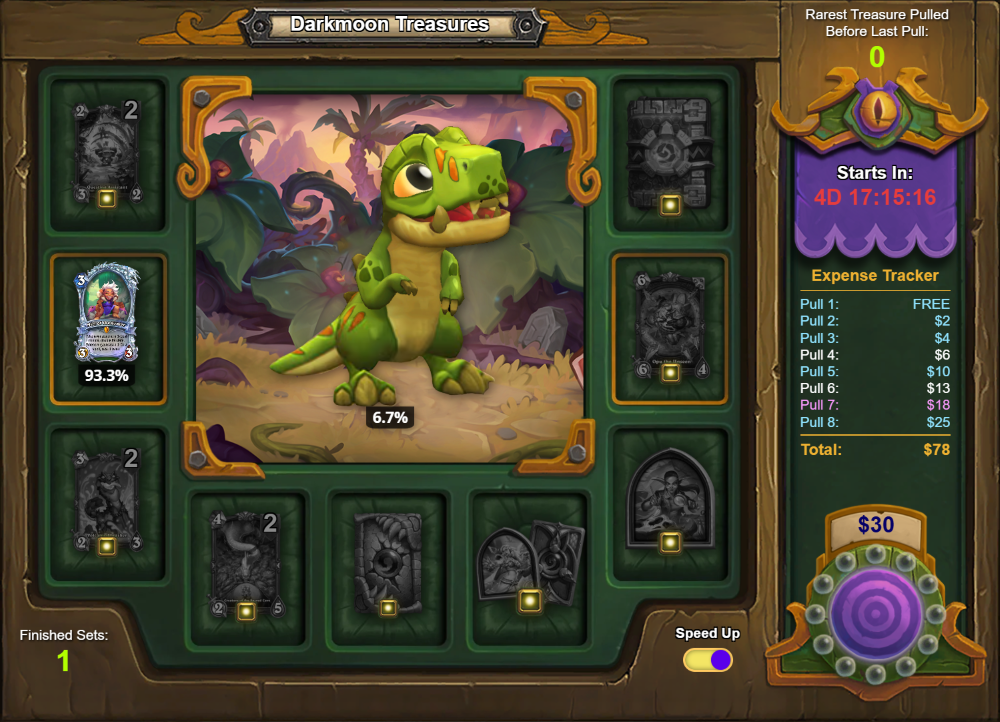
(Most coverage says $158 because it takes 15,800 Runestones, but you can’t buy that specific amount.)
The only way to unlock this first pet is to participate in the new Darkmoon Faire gacha machine – only available for a limited time! – which features 10 prizes. The first pull is free, because of course it is. Thereafter, there is an escalating cost for some reason, and a weighted score that puts the odds of getting the pet at between 0.1% and 7%, even after eight prior pulls… for nefarious reasons. This is certainly some of the most ridiculous gacha bullshit I have seen ever recently.
…at least, until I remembered some of the other “sales” Blizzard has had.
For reference, here is what my shop looks like currently:
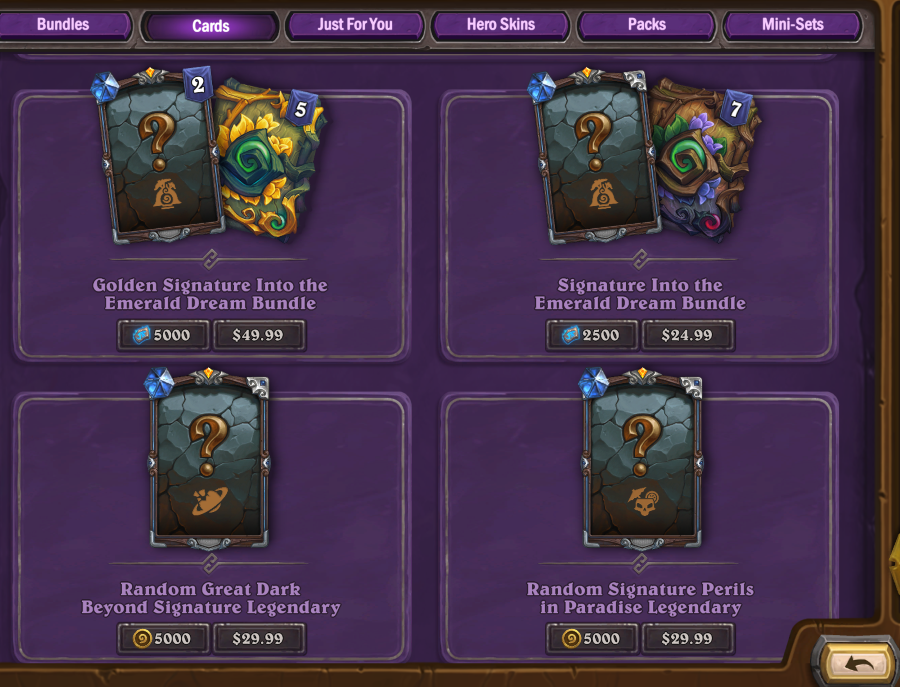
You don’t really need to know what Golden packs are or the value of Signature Legendary cards – just look at the dollar totals. Not pictured are some of the “Mythic” alternative hero portraits, which turn the typical JPGs into 3D models with special animations and such for the low, low price of $60. Several months ago, there was a “bundle” of two different colors of the Kerrigan model for $80. So, while doubling the upper floor to $160 certainly feels egregious, I cannot say it came out of nowhere.
Plus, if I were feeling onery, I would point out that technically the pet only costs $158 if you value the remaining items at zero. Signature Legendary cards in the shop are sold for $30 as seen above. Hero portraits are usually $10 apiece and there are two. It’s hard to value a Diamond Legendary since you only get those in special ways, but I think I’ve seen them go for $40-$50. A single Golden pack costs $4. I’m not going to speculate on the other Signature cards or the card back, but already we’re back down to $54 taking the other stuff into account.
Is this rollout still a PR disaster? Yes. Is it indicative of cynical, pernicious monetization? Yes. Does it bring up legitimate fears about the future direction and longevity of the game as a whole? Yes.
Is it completely unexpected for Hearthstone? …ehh, kinda sorta maybe yes. But also no.
I Get No Respec
The Outer Worlds 2’s game director believes implementing 90+ perks with no respec option will lead to role-playing consequences.
“There’s a lot of times where you’ll see games where they allow infinite respec, and at that point I’m not really role-playing a character, because I’m jumping between — well my guy is a really great assassin that snipes from long range, and then oh, y’know, now I’m going to be a speech person, then respec again, and it’s like–” […]
“We want to respect people’s time and for me in a role-playing game this is respecting somebody’s time,” Adler argues. “Saying your choices matter, so take that seriously – and we’re going to respect that by making sure that we give you cool reactivity for those choices that you’re making. That’s respecting your time.
Nah, dawg, having an exit strategy for designer hubris and incompetence is respecting my time.
Imagine starting up Cyberpunk 2077 on launch day and wanting to role-play a knife-throwing guy… and then being stuck for 14 months (until patch 1.5) before the designers get around to fixing the problem of having included knife-throwing abilities with no way to retrieve the knives. As in, whatever you threw – which could have been a Legendary knife! – just evaporated into the ether. Or if you dedicated yourself to be a Tech-based weapon user only to find out the capstone ability that allows tech-based weapons to ignore enemy armor does nothing because enemies didn’t actually have an armor attribute. Or that crafting anything in general is an insane waste of time, assuming you didn’t want to just print infinite amounts of currency to purchase better-than-you-can-craft items.
Or how about in the original release Deus Ex: Human Revolution when you go down the hacking/sneaking route. Only… surprise! There are boss fights in which hacking/sneaking is useless. Very nice role-playing consequences there. Devs eventually fixed this two years later.
The Outer Worlds 2 will not be released in a balanced state; practically no game is, much less ones directed by apparent morons. Undoubtedly we will get the option for inane perks like +50% Explosive Damage without any information about how 99% of the endgame foes will have resistances to Explosive Damage or whatever. In the strictest (and dumbest) interpretation I suppose you could argue that “role-playing” an inept demolition man is still a meaningful choice. But is it really a meaningful choice when you have to trap players into making it? If players wanted a harder time, they could always increase the game difficulty or intentionally play poorly.
Which honestly gets to the heart of the matter: who are you doing this for? Not actual role-players, because guess what… they can (and should) just ignore the ability to respec even if it is available. Commitment is kind of their whole schtick, is it not? No, this reeks of old-school elitist game dev bullshit that was pulled from the garbage bin of history and proudly mounted over the fireplace.
But I’ll tell you, not every game is for every single person. Sometimes you have to pick a lane.”
And yet out of all the available options, you picked the dumbass lane.
It’s funny, because normally I am one to admire a game developer sticking to their strong vision for a particular game. You would never get a Dark Souls or Death Stranding designed by a committee. But by specifically presenting the arguments he did, it is clear to me that “no respecs” is not actually a vision, it’s an absurdist pet peeve. Obsidian is going to give us “cool reactivity” for the choices we make? You mean like… what? If I choose the Bullets Cause Bleed perk my character will say “I’ll make them bleed”? Or my party members will openly worry that I will blow everyone up when I pick the Explosion Damage+ perk? You can’t see it, but I’m pressing X to Doubt.
[Fake Edit]
I just came across developer interviews on Flaws and Character Building. Flaws are bonus/penalty choices you get presented with after a specific criteria is met during gameplay. One example was Sungazer, where you after looking at the sun too many times, you can choose permanent vision damage (bloom and/or lens flair all the time), +100% ranged damage spread, but you can passively heal to 50% HP when outside in the daytime. The other is Foot-In-Mouth where if the game notices you quickly breezing through dialog options, you can opt to get a permanent +15% XP gain in exchange for only having a 15-second timer to make dialog options, after which everything is picked randomly.
While those are probably supposed to be “fun” and goofy examples, this is exactly the sort of shit I was talking about. Sungazer is obviously not something a ranged character would ever select, but suppose I was already committing to a melee build. OK… how often will I be outside? Does the healing work even in combat? How expensive/rare are healing items going to be? Will the final dungeon be, well, a dungeon? I doubt potentially ruining the visuals for the entire rest of the game will ever be worth it – and we can’t know how bad that’s going to be until we experience it! – but even if that portion was removed, I would still need more information before I could call that a meaningful choice.
“Life is full of meaningful choices with imperfect information.” Yeah, no, there’s a difference between imperfect information because the information is unknowable and when the devs know exactly how they planned the rest of the game to go. Letting players specialize in poison damage and then making all bosses immune to poison is called a Noob Trap.
The second video touches more directly on respecs and choices, and… it’s pretty bad. They do their best and everything sounds fine up until the last thirty seconds or so.
Yes, you can experiment and play with it a bit. And you may find something… ‘I try this out and I don’t really like it too much’ you know… you might load a save. You might want to do something different, you might try a different playthrough.
This was right after the other guy was suggesting that if you discover you like using Gadgets (instead of whatever you were doing previously), your now-wasted skill points are “part of your story, part of your experience that no one else had.” Oh, you mean like part of my bad experience that can be avoided by seeing other players warning me that X Skill is useless in the endgame or that Y Skill doesn’t work like it says it does in-game?
Ultimately, none of this is going to matter much, of course. There will be a respec mod out there on Day 1 and the mEaNiNgFuL cHoIcEs crowd will get what they want, those who can mod will get what we want, and everyone else just kind of gets fucked by asinine developers who feel like they know better than the ones who made Baldur’s Gate 3, Cyberpunk 2077, Elden Ring, and Witcher 3.
N(AI)hilism
Wilhelm has a post up about how society has essentially given up the future to AI at this point. One of the anecdotes in there is about how the Chicago Sun-Times had a top-15 book lists that only included 5 real books. The other is about how some students at Columbia University admitted they complete all of their course-work via AI, to make more time for the true reason they enrolled in an Ivy League school: marriage and networking. Which, to be honest, is probably the only real reason to be going to college for most people. But at least “back in the day” one may have accidentally learned something.
From a concern perspective, all of this is almost old news. Back in December I had a post up about how the Project Zomboid folks went out of their way to hire a human artist who turned around and (likely) used AI to produce some or all of the work. Which you would think speaks to a profound lack of self-preservation, but apparently not. Maybe they were just ahead of the curve.
Which leads me to the one silver-lining when it comes to the way AI has washed over and eroded the foundations of our society: at least it did so in a manner that destroys its own competitive advantage.
For example, have you see the latest coming from Google’s Veo 3 video AI generation? Among the examples of people goofing around was this pharmaceutical ad for “Puppramin,” a drug to treat depression by encouraging puppies to arrive at your doorstep.
Is it perfect? Of course not. But as the… uh, prompt engineer pointed out on Twitter, these sort of ads used to cost $500,000 and take a team of people to produce over months, but this one took a day and $500 in AI credits. Thing is, you have to ask what is eventual outcome? If one company can reduce their ad creation costs by leveraging AI, so can all the others. You can’t even say that the $499,500 saved could be used to purchase more ad space, because everyone in the industry is going to have that extra cash, so bids on timeslots or whatever will increase accordingly.
It all reminds me about the opening salvo in the AI wars: HR departments. When companies receive 180 applications for every job posting, HR started utilizing algorithms to filter candidates. All of a sudden, if you knew the “tricks” and keywords to get your resume past said filter, you had a significant advantage. Now? Every applicant can use AI to construct a filter-perfect resume, tailored cover letter, and apply to 500 companies over their lunch break. No more advantage.
At my own workplace, we have been mandated to take a virtual course on AI use ahead of a deployment of Microsoft Claude. The entire time I was watching the videos, I kept thinking “what’s the use case for this?” Some of the examples in the videos were summarization of long documents, creating reports, generating emails, and the normal sort of office stuff. But, again, it all calls into question what problem is being solved. If I use Claude to generate an email and you use Claude to summarize it, what even happened? Other than a colossal waste of resources, of course.
Near as I can tell, there are only two endgoals available for this level of AI. The first we can see with Musk’s Grok, where the AI-owners can put their thumbs (more obviously) on the scale to direct people towards skinhead conspiracy theories. I can imagine someone with less ketamine-induced brain damage would be more subtle, nudging people towards products/politicians/etc that have bent the knee and/or paid the fee. The second endgoal is presumably to actually make money someday… somehow. Currently, zero of the AI companies out there make any profit. Most of them are free to use right now though, and that could possibly change in the future. If the next generation of students and workers are essentially dependent on AI to function, suddenly making ChatGPT cost $1000 to use would reintroduce the competitive advantage.
…unless the AI cat is already out of the bag, which it appears to be.
In any case, I am largely over it. Not because I foresee no negative consequences from AI, but because there is really nothing to be done at this point. If you are one of the stubborn holdouts, as I have been, then you will be ran over by those who aren’t. Nobody cares about the environmental impacts, the educational impacts, the societal impacts. But what else is new?
We’re all just here treading water until it reaches boiling temperature.
Dumb Problems to Have
Scenario: Fanatical is having another one of their bundle sales. In this specific situation, you want to pick up Backpack Heroes and at least one other game, in order to activate the discount. But which other game? Looking through things, you remember hearing that Laika: Aged Through Blood was an interesting “motorvania”. But wait a minute… do you already have that? Let’s check:
- Steam
- Epic
- GOG
- EA
- Amazon
- Ubisoft Connect
- Xbox Game Pass
Luckily, there are a few aggregators. GOG Galaxy is one, for example. However, for some reason it has got stuck trying to import your Epic games, and thus you can never really trust it. Google searches show you Heroic Games Launcher and Lutris, but after browsing it appears those are Linux-based options intended for the Steam Deck and/or Linux handhelds. Finally, you see Playnite. Will that work?
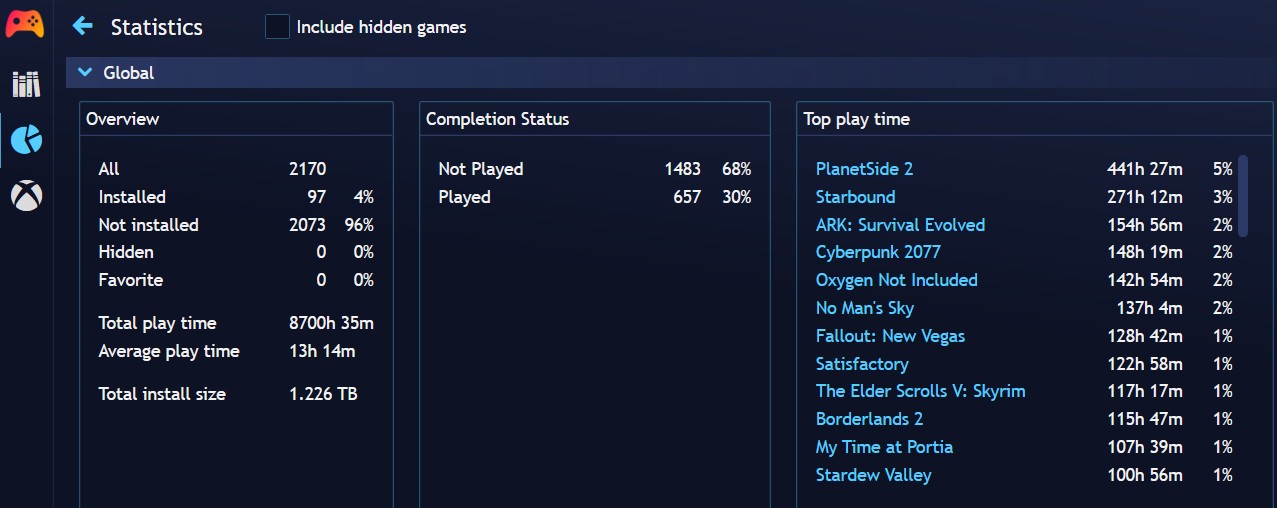
Yes… and no. Out of the box, Playnite will display every Xbox Game Pass game you have ever played before, even if it is no longer on the service. Very annoying. There is an add-on you can install though, to create a separate button to browse the currently available Game Pass games (under Generic: “Game Pass Catalog Browser”). Additionally, there is still some oddness with Steam, insofar as the 449 hours /played of 7 Days to Die is not registering, which kind of calls into question the validity of any of the other stats. But, at least it’s something.
Of course, all of this is an exceedingly dumb/first-world problem to have. A true “I can’t hold all these games” moment. A double-embarrassment of riches, if you will.
I just wish this modern problem would have a modern solution.
Dollar Per Hour of Entertainment
Today I want to talk about the classical “$1 Per Hour of Entertainment” measurement of value. This has been a staple of videogame value discussions for decades. There are multiple problems with the formula though, and I think we should collectively abandon its use even as general rule of thumb.
The first problem is foundational: what qualifies as “entertainment”? When people evoke the formula, they typically do so with the assumption that hours spent playing a game are hours spent entertained. But is that actually the case? There are dozens and dozens of examples of “grind” in games, where you must perform a repetitive, unfun task to achieve a desired result. If you actively hate the grinding part but still do it anyway because reward is worth it, does the entire process count as entertainment? Simply because you chose to engage with the game at all? That sounds like tautology to me. May as well add the time spent working a job to get the money used to buy the game in that case.
Which brings me to the second problem: the entertainment gradient. Regardless of where you landed with the previous paragraph, I believe we can all agree that some fun experiences are more fun than others. In which case, shouldn’t that higher tier of entertainment be more valuable than the other? If so, how does that translate into the formula? It doesn’t, basically. All of us have those examples of deeply personal, transformative gaming experiences that we still think about years (decades!) later. Are those experiences not more valuable than the routine sort of busywork we engage with, sometimes within the same game that held such highs? It is absolutely possible that a shorter, more intensely fun experience is “worth” more than a mundane, time-killing one that we do more out of habit.
Actually, this also brings up a third problem: the timekeeping. I would argue that a game’s entertainment value does not end when you stop playing. If you are still thinking about a game days/months/years after you stopped playing, why should that not also count towards its overall value? Xenogears is one of my favorite games of all time, and yet I played through it once for maybe 80 hours back in 1998. However, I’ve thought about the game many, many times over the intervening decades, constantly comparing sci-fi and/or anime RPGs to it, and otherwise keeping the flame of its transformative (to me) memory alive. Journey is another example wherein I played and completed it in a single ~3 hour session, and I still think about it on occasion all these years later. Indeed, can you even say that your favorite games are the same ones with the highest dollar per hour spent playing?
The fourth problem with the formula is that it breaks down entirely when it comes to free-to-play games. Although there are some interesting calculations you can do with cash shop purchases, the fact remains that there are dozens of high-quality games you can legitimately play for hundreds of hours at a cost of $0. By definition, these should be considered the pinnacle of entertainment value per dollar spent, and yet I doubt anyone would say Candy Crush is their favorite gaming experience of all time.
The final problem is a bit goofy, but… what about inflation? The metric has been $1 per hour of entertainment for at least 20 years, if not longer. If we look at 1997, $1 back then is as valuable as $2.01 today. Which… ouch. But suggesting that the metric should now be $2 per hour of entertainment just feels bad. And yet, $1 per two hours of entertainment also seems unreasonable. What games could hit that? This isn’t even bringing up the other aspect of the intervening decades: loss of free time. Regardless of which way inflation is taken into account, fundamentally I have less time for leisure activities than I did back in high school/college. Therefore the time I do have is more valuable to me.
At least, you’d think so. Lately I’ve been playing Hearthstone Battlegrounds (for free!) instead of any of the hundreds of quality, potentially transformative game experiences I have on tap. Oh well.
Now, I get it, nobody really uses the $1 per hour of entertainment metric to guide their gaming purchases – they would otherwise be too busy playing Fortnite. But, fundamentally, calculating the per hour rate is about the worst possible justification for a discretionary purchase, the very last salve to ease the burn of cognitive dissonance. “At least I played this otherwise unremarkable game for 60+ hours.” Naw, dawg, just put it down. Not every game is going to be a winner for us individually, and that’s OK. Just take the L and move on. Everything is about to start costing $80, and you sure as shit don’t have 20 more hours per game to pretend you didn’t get bamboozled at checkout.
But you know what? You do what you want. Which is hopefully doing what you want.
Switch 2 Paying Too Much
In the weeks leading up to today, I was actually looking forward to hearing the details about Nintendo’s next console, Switch 2. Which might seem odd, considering I let the entirety of the original Switch lifecycle pass me by. And, actually, the last console of any kind that I purchased was a PS3 and I barely played any of the games I bought on that. I did upgrade my PC in 2022, and that is where I do most of my gaming. But… well, I have recently started being interested in portable gaming and figured that if I were to jump into the waters, maybe the Switch 2 would be as good a place as any.
Except, perhaps, when it costs this fucking much:

- Switch 2 console – $449.99
- Mario Kart World – $79.99 (!!!)
Leaks were suggesting $399, and it’s “just $50 more” as some say… but look at the game prices now. We were just talking about analysts suggesting (and begging) for Grand Theft Auto 6 to launch at $100, and it seemed like an absurdity. But here’s Nintendo leap-frogging the new $70 “standard” and going right for $80. And since it is Nintendo, these game prices are going to basically be set in stone for the decade – no Summer Sales or discounts for us.
Well, aside from the $500 console bundle with Mario Kart, saving you $30 one time.
The grand irony is that I had started getting interested in the Switch 2 because I developed a renewed interest in handheld emulators. I fell into a deep YouTube rabbit-hole around the explosion of these handhelds, and even picked one up myself on the cheap (Miyoo Mini+). This was technically (even more) unnecessary considering I still have a PSP and even an OG DS which are both set up to be emulators. In my mind though, I wanted something dedicated to emulation specifically, with a smaller formfactor, with the assumption that I may give it to my son once he gets into gaming. With me playing it in the meantime, of course.
After playing around with the Miyoo Mini+ though, I discovered strange sort of nostalgia holes. It will play up to PS1 games no problem, but I started thinking about the N64 games I might want to play again. Or GameCube. But not PS2, for some reason. Anyway, once you start looking into that direction, your options shrink until you start hitting the “Steam Deck” tier which is $400 (or more). At which point, well, here we are again. Although potentially tackling my Steam backlog…
…I wonder how long it will take for the Switch 2 to be cracked? Best of all worlds, potentially.
In any case, god damn, Nintendo. There are plenty of talking heads saying that $70/$80 games are “necessary” to “save” the industry. What’s not often mentioned is how many chairs will be remaining once the music stops. Gamers were already spending 60% of their time playing 6+ year old games back in 2023, so how many new $80 titles do you think they’ll be buying in 2025 in this economy? Nintendo will probably be fine. Other studios? Probably not so much.
Avowed – The End
Got the end of Avowed after 66 hours.
Despite souring on the combat, I did not rush through the end. Aside from a few hidden treasures in the last zone, I otherwise completed all of the side-quests available. Due to the strange open-endedness of Avowed, sometimes it was not clear whether these were legit side-quests or just required story beats done out of order. Either way, I wrung out every ounce of whatever value Avowed had.
And in the final analysis? Avowed was not redeemed in my eyes… but it got closer than I expected.
To me, there was a disconnect between the story and the plot. Maybe those are the wrong terms, but follow me for a moment. I consider the plot to be the main quests and decisions you make in each of the four zones. None of those bits were especially interesting, and not just because I didn’t know what my motivation was supposed to be – the “choices” were just too comically extreme. For example, the game tells you Animancy is banned in your empire, that it’s dangerous, etc. What the game doesn’t do is show you it’s dangerous, or why it’s banned, just that it is. You then get asked if you want (or accidentally allow) every Animancer in the area to die. Huh? The fourth area was even worse.
The broader story on the other hand, I did find more interesting. Each zone has a god totem you can put together from pieces hidden about, and the first time I completed one and then heard their conversation… I was quite intrigued. I did not finish the first Pillars of Eternity game, but I am vaguely aware that the gods get involved a bit more personally in the setting (although what RPG endgame doesn’t, amirite?), and I’m all for it. That bit was very interesting to me, and may be a seed that grows into a desire to play PoE 1 & 2 later. Then again, I technically already know what happened.
In any case, I have zero interest in any future Avowed DLC and have already uninstalled the game.
Avowed – What’s My Motivation?
I haven’t written much because I’m trying to work my way through Avowed. And it really is work at this point, because Avowed is not a good game. But I feel it is not good in a similar way that Bioshock Infinite was not good: the most frustratingly nuanced ways imaginable.
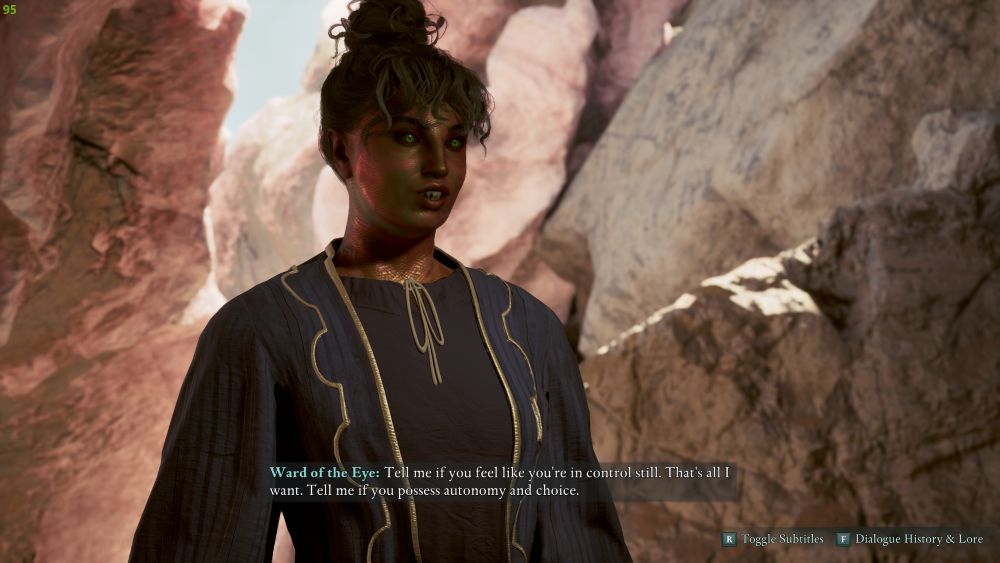
One example is with the combat system. I’ve talked about it all before, in that Ranger was strong but boring, Warrior was active but weak, and Wizard was both active and strong. About halfway through the 3rd zone though, none of it really mattered – even the Wizard became a chore. There are a lot of little reasons that quickly add up in the background until it hits you all at once.
- Very few enemy species (mostly beetles, spiders, bears, lizardmen)
- Very few enemy types (shield guy, magic guy, healer guy, ranged guy, summon guy)
- Zero percent chance any dropped loot is useful in any way
- 99% chance all the encounters feature 6+ enemies
- 100% chance all the encounters play out the same exact way, regardless
- Leveling and upgrading largely become perfunctory starting in 3rd zone
Regarding the last point, Avowed has a really shitty talent/skill tree. It’s not something I’ve seen many other people talk about, but it’s one of the most uniquely uninspired one I’ve ever seen in a game. Seriously, look at this shit. Warrior has 6 buttons to press, Ranger gets 5, and Wizard… 21, technically. But look at the level 15 and level 20 bands, which is where one might assume you’re getting the biggest power boosts. Outside the active button, Fighter gets shit like… perfect (!!) blocks rebound arrows, and you deal 70% of the damage you received. Ranger gets increased crit chance (already 100% when you hit weak spots), and bonus damage on unaware enemies. Wizards get… increased elemental accumulation, but you have to spec into each element individually.
Oh, and on the ultimate level 20+ band? Fighters can… heal companions by 10% when you kill enemies! Rangers can… deal more stun accumulation with power attacks with ranged weapons! Wizards can… get fucking nothing, unless you want to learn Meteor Shower without a spellbook, which you never would because spellbooks give you like an 80% Essence discount on that otherwise meter-eating spell. Yes, Arcane Seal is something a Wizard can take at 20+ and effectively have infinite Essence regen. But at that point in the game, you effectively have infinite regen already from the hundreds of random vegetables you’ve collected throughout the game.
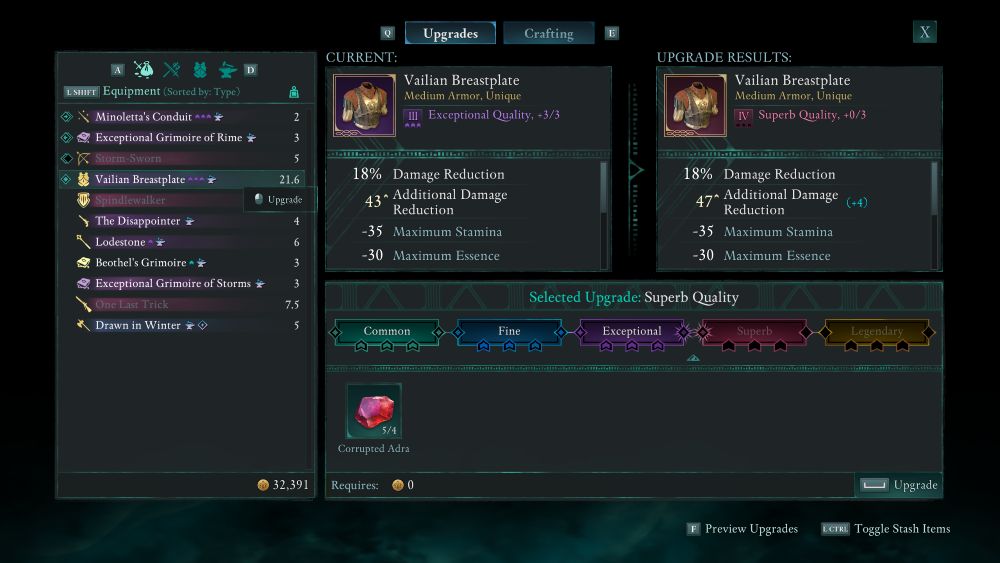
The other half of character progression is also shit. Getting Uniques out in the world has long ceased to be exciting. First time you replace a generic weapon with Unique? Fantastic. The second time? Frustrating, because you likely sunk a bunch of upgrade mats into the first one. Then you start to realize that none of the special abilities of Uniques matter all that much compared to the overall “tier” due to the asinine enemy “level” balance. If your stuff is blue and they are purple, you deal 35% less damage and take 35% more damage. Meanwhile, each time you upgrade a weapon or armor, you get silly shit like +9 damage or -4 damage received. Upgrading a Unique never boosts the special effects… why?
Finally, I want to talk about the story in general terms. I’ll throw a Yellow spoiler warning just in case, but the short version is: the game never answers the question of “what’s my motivation?”

The general premise of the game is that you are a godlike of an unknown god, working in the court of an Aedyran emperor. You are then tasked with solving the Dreamscourge plague problem in the Living Lands, an isle that the emperor is interested in taking over. You are sent over as an Envoy of the emperor himself, granting you leeway in resolving the Dreamscourge crisis in any manner you deem fit.
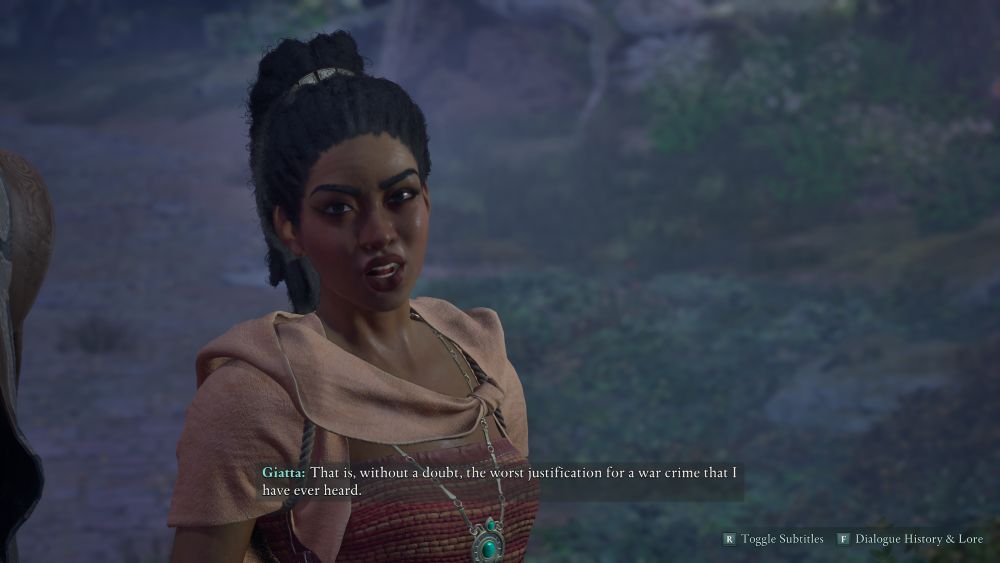
The problem is that all the Aedyran empire stuff just up and evaporates as soon as you step on the docks, unless you commit to being cartoonishly evil for the rest of the game. And if you do, all of your companions are from the Livings Lands, so they’ll be mad at you for everything you do. Having evil options in RPGs is a good thing even if players do not typically engage with it, but the problem is setting up your game to support it. None of your Avowed companions will leave you no matter what choices you make. There are no Aedyran or Steel Garrote companions, which would make such an evil playthrough more reasonable. And while I have not yet finished the game at the time of this writing, I haven’t really seen any good motivation to even care about the Aedyran side of things. Nobody is reminding you of your duty to the emperor, or even really questioning your loyalty.
This is not the first place Avowed leaned so far into “roleplay” that it fell directly into RPG mad libs. There are frequent dream sequences throughout the game where you are asked to choose how events in the past played out. Some of these choices lead to you getting one godlike ability versus another, but the majority of it is just… there. I understand that there are (presumably) people who like this sort of thing, but Avowed just sort of drops it on your porch and leaves. There’s no context, no sense of purpose. Again, what’s my motivation? Am I training somebody to be more forgiving or spiteful, depending on my dream answers? Or am I literally playing one-person mad libs?
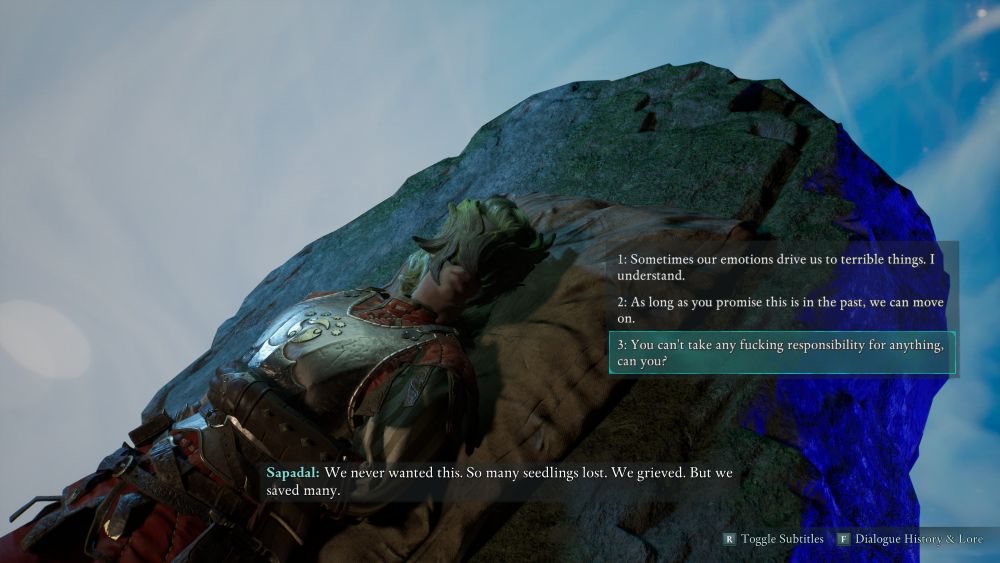
I get that this may not sound all that different from all the normal RPG choices you encounter in the genre. In Baldur’s Gate 3, you can choose to free a gnome strapped to a windmill or send him flying by cranking up the speed. That choice doesn’t matter too much in the scheme of things, either way. Except, of course, to the gnome, and possibly some party members. But that at least has some immediate context and consequences and feels like a real choice. There are some quests vaguely similar to that in Avowed, but they all ring hollow. Perhaps in the abstract the quests are identical, and I’m just not invested in the world of Avowed in the same way as BG3 or Mass Effect or anything else. Or perhaps the devs simply were painting-by-numbers and forgot to include a soul in their creation.
And that brings me back to the Bioshock Infinite comparison from the top. There are some games in which I can understand people enjoying, even when I do not. League of Legends? That’s definitely of no interest to me, but I get it. Overwatch 2? Sure, I enjoyed the original for a time as well. Call of Duty? I prefer the Battlefield series, but a more arcade feel can be fun.
If someone says Bioshock Infinite is one of their favorite games though, my eyebrows go all the way up. Maybe the DLCs fixed the plot later, but Bioshock Infinite’s story was otherwise objectively terrible, like Mass Effect 3 original ending terrible. I feel the same way when I see people online say Avowed is a 9.5/10 or they are eager for another playthrough. I don’t even want to finish this first playthrough, let alone running around opening chest after chest of the same random crafting materials again. Some aspects of Avowed are fantastic genre improvements, like the feel of melee and the feel of exploration via jumping/traversal. Unfortunately, tragically, there is just no follow-through, no stuck landing.
The only way I can see Avowed being someone’s favorite RPG or deserving of a high score is if they simply haven’t played better games before. Which, given that many of my own favorite games came out 10-20 years ago, might be increasingly understandable. What a bummer.
I suppose there is still time in the 4th Act and resultant endings for Avowed to pull a miraculous redemption. Well, aside from the combat and itemization and character progression and world interactivity – those ships have already sailed. We’ll see if the plot payoff was worth the pain.
Avowed – Veneer Off
I have added another 16 hours into Avowed (total: 32), clearing the entire second zone. And while some of what I reported earlier is still accurate – traversal is fun! – the game’s veneer is definitely rubbing off.
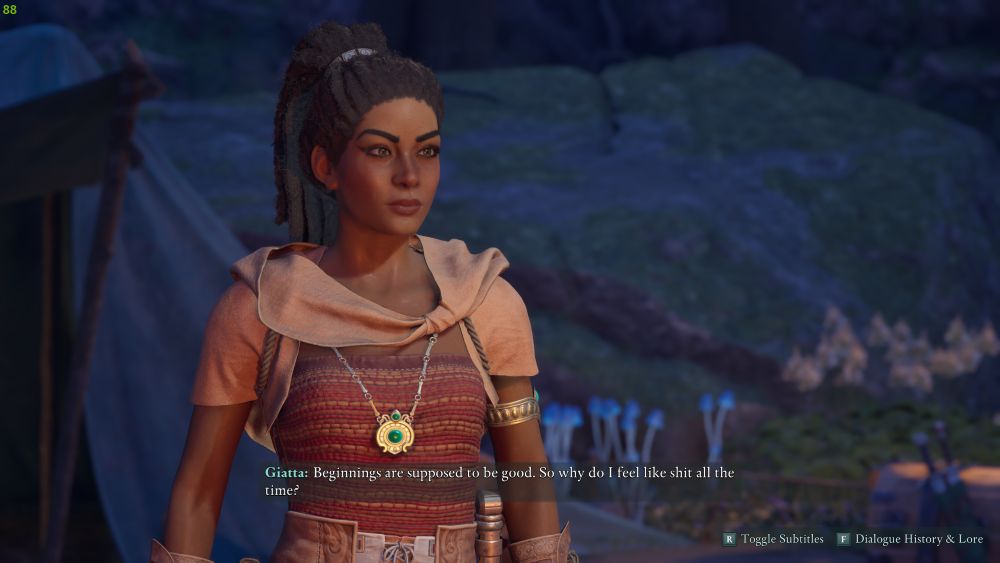
Combat, which hitherto has been fun, is now very rote. For the first half of the second zone, I respecced into a Ranger gun build and almost ended up abandoning the game entirely. There was… just no buttons to press. Sure, Ranger has a sort of vines CC ability, but aside from that, it was power attacks from pistols and nothing else to actively press. Technically I could have grabbed some more active buttons from Wizard as well, but Ranger is the only real splash-class, and trying to elevate your Intellect stat to the point where spells are relevant is a fool’s errand without just being a Wizard.
During the last half of the zone, I went into Fighter, first with a 2H weapon focus and then 1H with shield. Fighter had some more buttons to press – including a very satisfying Charge – and was a more dynamic experience overall with the Parry mechanic and blocking. The issue is that the DPS was just not really there. Avowed loves to throw groups of 5+ enemies at you, which is understandable considering Rangers/Wizards will nearly one-shot most of them from range in the opening salvo. As a Fighter, it’s not satisfying at all spending all your Stamina trying to block/dodge so many enemies. Although you do have two squad mates to help spread aggro around, the reality is that so do Rangers/Wizards, and those classes can actually eliminate enemies quickly. Which technically goes against the “gameplay” of Fighter, as if things die before you get into Parry chains or full attack combos, a lot of the Fighter-based weapons are useless. Which they are anyway, since they don’t kill quickly.
The other major issue that I glossed over previously was the world in general and interactivity in particular. Avowed is not Skyrim. Which is fine, most games aren’t. But as a first-person fantasy game that came out 14 years after Skyrim, Avowed is incredibly static. NPCs barely move (if ever), there is no world reactivity, there is no “stealing,” and every object out in the world is bolted onto the floor, aside from some breakable crates. To be fair, this is more an intellectual criticism, as I hardly noticed anything amiss in-game. But now that I have, I see signs of a Hollywood set everywhere. Which might have been fine, if this were not a fantasy RPG released in 2025 for $70 MSRP.
The final thing that is really dragging me down is the upgrade system and Unique weapons. I have been playing the game “as intended” when it comes to looting and experimenting, but have come to find out that the devs punish that playstyle. For one thing, all the respeccing I have done required me to upgrade several weapons that, oops, I am no longer using. Then I found out that all unique weapons in the world scale to the highest upgraded weapon you own at the time of pickup. What this means is that if the best weapon you have is Fine (blue quality), all the uniques you discover will be Fine. However, if you funnel all your upgrades into one particular weapon and get it to Exceptional (purple), those same uniques would have been Exceptional. And this works all the way into Superb (red) and Legendary.
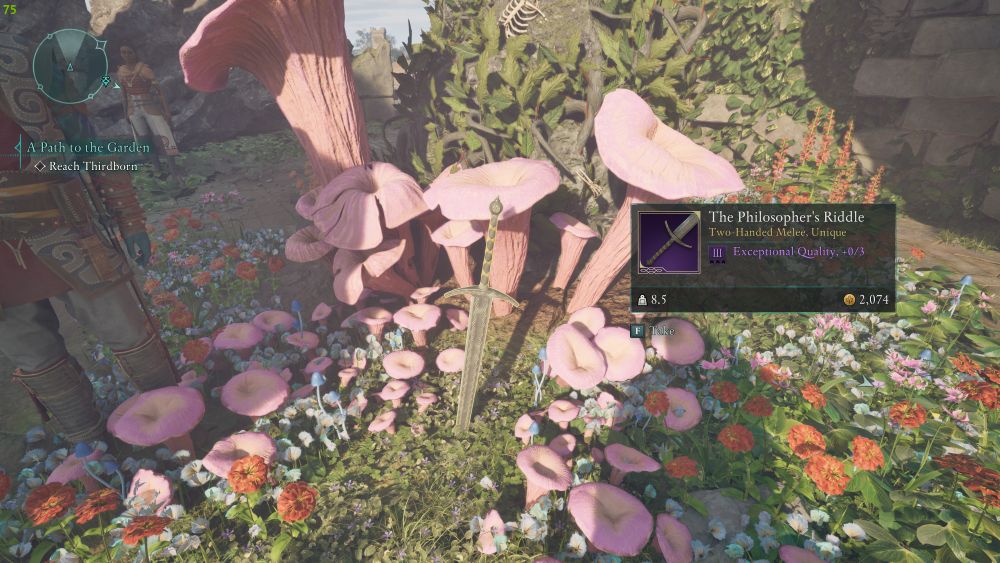
Do you like exploring the map and picking up things organically, doing a few upgrades here and there? Punished! Because now if you decide to go with another weapon or playstyle, you will need to double (or more) the upgrade materials required to level them up. Which, let me remind you, is very necessary because weapons and armor get a debuff if they are more than a few “tiers” below the enemies you are facing. Also, remember that enemies and money is finite in this game, so it is very possible to just screw yourself and be locked into something that is no longer fun.
Which might just be the entire game itself for me, at the moment.
I don’t know, guys. Not everything I play needs to be Game of the Year material; lord knows I play plenty of trashy survival games for hundreds of hours. But, truly, Avowed feels like a game that would have been really great… in 2015. Or maybe 2010. Obsidian is not Bethesda, yes. But this also ain’t New Vegas. And between this and Outer Worlds, I’m thinking that Obsidian needs to stick to what they do best: iterating on the shoulders of better games, rather than trying to make their own.
Grounded was great though, so… ¯\_(ツ)_/¯
 In An Age
Teanautica
Jul 14
Posted by Azuriel
Do you enjoy some gaming drama? What am I asking, who doesn’t? Pull up a chair and let’s spill it.
First, set the stage. Subnautica was a much-beloved underwater indie breakout hit created by Unknown Worlds. The follow-up semi-sequel, Below Zero… not so much. Nevertheless, the actual sequel Subnautica 2 is the second-most wishlisted game on Steam, trailing Hollow Knight: Silksong. Krafton buys Unknown Worlds in 2021. Subnautica 2 was revealed to be in development since April 2022, had a cinematic video released October 2024, and reports it would have an Early Access release sometime in 2025. In April of this year, there was even a few gameplay trailers.
And then a shoe dropped: Krafton, the company that purchased Unknown Worlds for $500m had fired the entire executive leadership, and delayed the game until 2026. Why? “It wasn’t ready.”
Charlie Cleveland, now-former head of Unknown Worlds, said it was ready for Early Access. Which, okay, just a leadership spat, right? But then came the juice: a Bloomberg report that highlighted special “earn-in” terms of the Unknown Worlds buyout. Specifically, if Unknown Worlds was able to meet certain sales targets by the end of 2025, they would get a $250m bonus. All of a sudden, it became obvious that Krafton sacked the leadership team and delayed Subnautica 2 just to avoid the payout.
…or was it?
Krafton resurfaced to hang all the dirty laundry out to dry:
Incidentally, there’s an additional paragraph down towards the end that says Krafton “reaffirm our commitment to provide the rewards [the remaining devs] were promised.” It remains to be seen whether that is indeed $25m, whether it is still dependent on the same targets, and so on. Now that everything is in the open, I think it will be harder for the working devs to be screwed, but we’ll see.
As you can imagine, Reddit and a lot of the internet is awash in hot takes. Most of which are bad.
“Krafton is clearly lying!” “Obvious corporate fuckery.” “They are just trying to get out from paying $250m.” “Krafton is using weasel words and won’t be paying the other devs money either.”
I sympathize with these notions. At least, I did until I found out that Charlie Cleveland really was taking the piss. Krafton’s statement of “chose to focus on a personal film project” comically undersells it:
That’s from Charlie’s website. Also from his website, in the About section:
What else should have been taking place at the end of 2023? Maybe… working on your fucking game?
Don’t want to trust Krafton’s motives? Fine, don’t. But let’s not pretend ole Cleveland Steamer over here was doing anything other than quiet quitting and waiting for his cut of $225m off the backs of devs who were otherwise floundering.
The three fired founders are suing, of course, so perhaps we’ll get more salacious details in discovery. Or maybe it will just be settled out of court. Whatever the case, what I do think is abundantly clear and not nearly communicated enough is this: the founders of Unknown Worlds very clearly fucked off and were waiting for a second paycheck they did not earn. Did Krafton suddenly fire them to prevent Subnautica 2 from entering (a premature) Early Access and thus likely getting enough revenue to trigger a $250m payout? Yeah. Clearly, yes. But was that wrong? No, clearly no.
Charlie elsewhere claims they always shared the profits and would have shared the $225m payout with the actual employees building Subnautica 2 and rah rah rah. That’s a cute sentiment, and I’d almost believe it if he hadn’t abandoned the team. “Subnautica has been my life’s work and I would never willingly abandon it or the amazing team that has poured their hearts into it.” So… were ya working on Subnautica 2 or were ya not, homeslice? Attended the meetings? Signed off on the ever-reducing Early Access scope? Got any receipts, my friend? Or just mad you’re in the Find Out phase?
I’m about as anti-corporate as it comes – feel free to read any of the 1500+ posts from over a decade to confirm. But what I have realized time and time again, is two things:
Don’t take Charlie’s side just because you really liked Subnautica. It’s a beautiful flower in a sea of shit and should be celebrated. The same dev team went on to make Below Zero, and Charlie fucked off to make Moonbreaker. They are not gods, they are not heroes, and chances are none of them have any idea how or why the games they made were any good in the first place. Some games are simply products of their time and would have not have been as successful had they come earlier or later. If they really had the secret sauce, every game would be better than the last. And that is rare.
Also, after you get bought out for $500m with another $250m queued up in a couple of years, if you cared maybe you can sit your ass behind a desk for a minute to ensure your team gets the cut. Or, you know… don’t, and then quit out of principle and go make your AI-seeded Christmas movie. Pick a lane.
Anyway, little ranty at the end there, but it’s Drama with the capital D. You’re welcome.
Posted in Commentary
Comments Off on Teanautica
Tags: Controversy, Drama, Krafton, Lawsuit, M. Night Shamamamalan, Subnautica, Unknown Worlds